PART 3 — THE VEIL I WAS FINALLY READY TO REMOVE
The message from Valecrest security stayed on my screen.
Adrian just tried accessing the company accounts remotely. Access denied.
Then the second line.
Vanessa attempted the same account three minutes later.
For a moment, the cathedral disappeared.
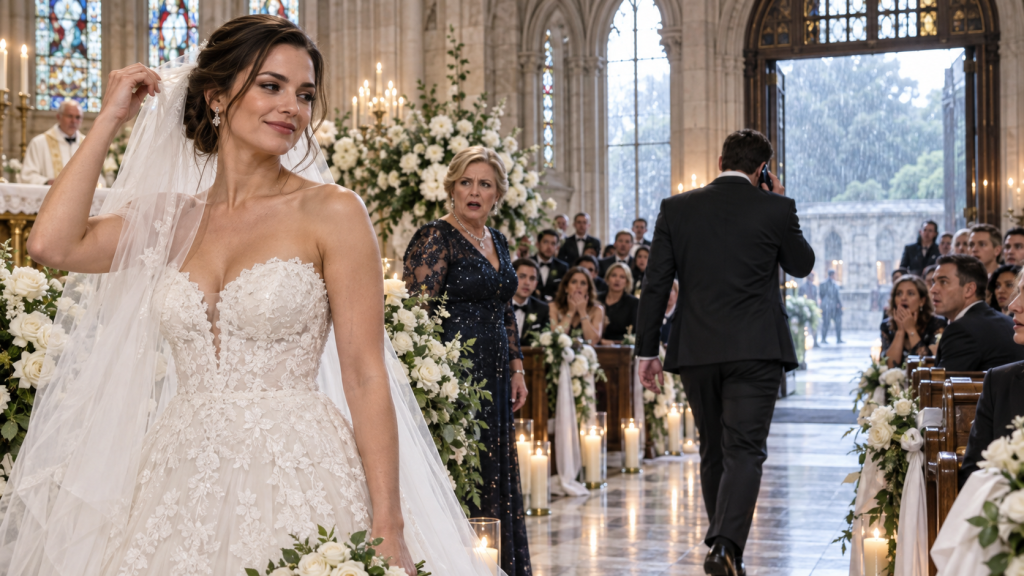
The white roses.
The candles.
The wet afternoon light pressing against the stained-glass windows.
Two hundred guests pretending not to stare at the bride whose groom had just driven away.
None of it mattered.
I read the message again.
Vanessa had tried to access the account.
Not Adrian’s personal checking account.
Valecrest.
The company.
The same company that had already sent more than $1.4 million toward entities connected to her.
My sister Mara moved beside me.
“What does that mean?”
I looked toward the cathedral doors.
Rain shone silver beyond them.
“It means Adrian didn’t leave because he suddenly discovered true love.”
Mara’s face tightened.
“What did he leave for?”
I locked my phone.
“I’m going to find out.”
Celeste was still standing ten feet away.
Adrian’s mother had built an entire personality around being composed in expensive clothing.
That afternoon, for the first time since I met her, she looked disorganized.
Her lipstick was perfect.
Her face was not.
“What are you talking about?”
she demanded.
I had forgotten she was close enough to hear.
“Nothing you need to handle.”
Her chin lifted.
“I am Adrian’s mother.”
“Yes.”
“And Valecrest belonged to his father.”
“No.”
The word stopped her.
I had wanted to say it for years.
“It was founded by his father.”
I continued.
“That is not the same thing as belonging permanently to the Vale family.”
Her eyes flashed.
“You know exactly what I mean.”
“I do.”
“That’s the problem.”
Valecrest had nearly collapsed two years after Adrian’s father died.
Too much leverage.
Three developments moving simultaneously.
Construction costs rising faster than projections.
A major commercial tenant withdrawing after permits had already been secured.
Adrian had inherited confidence before he inherited judgment.
When things became dangerous, he called me.
At the time, I was a corporate finance attorney specializing in restructuring and complex real-estate transactions.
He called our first meeting a favor.
The favor lasted three years.
I renegotiated debt.
Reworked investor rights.
Separated project-level risk.
Convinced two lenders not to declare default.
Brought in outside equity when Adrian still believed the solution to every cash shortage was another loan.
By the time Valecrest stabilized, I knew the company better than most people with offices bearing its name.
Adrian called me his fiancée when introducing me socially.
When introducing me professionally, he preferred:
“Claire helps us with contracts.”
It had bothered me.
Then amused me.
Eventually, it warned me.
Celeste stepped closer.
“What did you do?”
There was fear beneath the accusation.
Interesting.
“I documented what already existed.”
“What does that mean?”
“It means if you own Valecrest securities, you’ll receive formal notice through counsel.”
Her eyes narrowed.
“I am not a shareholder.”
“I know.”
That surprised her.
People often assume old family money equals current legal ownership.
It doesn’t.
Her late husband’s estate restructuring had been complicated.
Celeste had income rights through a trust.
Adrian had meaningful shares.
But independent investors held enough voting power that the board mattered.
That arrangement had once offended Celeste.
That afternoon it might save the company.
The wedding coordinator approached carefully.
“Claire?”
Her expression carried the frightened courtesy of someone unsure whether she was speaking to a client or an active disaster.
“Yes?”
“The guests are waiting.”
I looked across the cathedral.
They were.
Some were friends.
Some Adrian’s business contacts.
A few investors.
Several contractors.
Family.
People who had flown across the country.
People who had bought dresses and hotel rooms and gifts because Adrian and I had promised them a wedding.
They deserved something better than whispers.
I walked back toward the microphone.
Mara caught my wrist.
“You don’t have to perform.”
“I know.”
That was why I could do it.
I stood where I had expected to say vows.
The veil was gone.
The train of my dress gathered at my feet.
The microphone carried my breathing through the cathedral.
I looked at the room.
“My apologies.”
A nervous laugh moved somewhere near the back.
Good.
Human sound.
“As most of you have probably gathered, there will not be a wedding today.”
This time no one laughed.
“I am not going to discuss Adrian’s private choices in public.”
Celeste made a tiny sound.
I ignored it.
“Several people here have business relationships with Valecrest Group. If that includes you, the company’s board and counsel will communicate anything material through appropriate channels.”
I paused.
“Please do not rely on rumors from this room.”
That sentence was partly for them.
Mostly for myself.
“As for the reception…”
I looked toward the doors.
“The food has already been prepared.”
“Some payments are unrecoverable.”
“So we are donating what can reasonably be donated and releasing vendors where possible.”
Mara whispered behind me:
“You paid for an open bar.”
I almost smiled.
Then I looked back at the guests.
“If you have traveled a long way, please take your gift back.”
A few people shifted.
“I mean that sincerely.”
“Today did not become what you were invited to celebrate.”
My throat tightened.
It was the first moment heartbreak entered cleanly.
Not anger.
Not relief.
Loss.
“I’m sorry.”
I stepped away.
That was enough.
A woman near the front began clapping.
I stared.
It was my aunt.
Of course.
Then Mara joined her.
Then someone else.
Soon half the cathedral was applauding.
I hated it.
I understood it.
I wanted to disappear.
Instead, I smiled once and walked down the aisle alone.
There are photographs somewhere of that walk.
I have never looked at them.
Some moments belong better to memory than images.
My attorney was waiting for me at the hotel.
Her name was Nina Park.
Not wedding counsel.
Corporate counsel.
The woman who had spent six months helping me preserve evidence without making accusations we could not yet prove.
She wore jeans.
I wore twelve thousand dollars of silk.
Life enjoys contrast.
The second I entered the suite, Nina looked at the dress.
Then at me.
“Did you sign anything?”
“No.”
“Marriage certificate?”
“No.”
“Officiant never completed the ceremony?”
“No.”
She nodded.
“Good.”
I laughed once.
“You could pretend sympathy.”
“I am sympathetic.”
“Professionally?”
“Extremely.”
Mara shut the door behind us.
“Is she always like this?”
“Yes.”
Nina pointed toward the sofa.
“Sit.”
I lowered myself carefully.
The dress took up half the furniture.
Nina opened a laptop.
“Here’s what happened after the board vote.”
The independent audit committee had met remotely while I was still in the cathedral.
Three independent directors.
Outside counsel.
The board chairman, Samuel Reed.
I had not voted.
That mattered.
My relationship with Adrian made recusal obvious.
I had supplied evidence.
I did not decide the result.
The committee had activated the protective provisions attached to the refinancing that closed at 9:00 that morning.
Adrian’s authority over extraordinary transfers was suspended.
All related-party payments above a defined threshold required independent approval.
The company’s banks had been notified.
So had the new lender.
No accounts were frozen wholesale.
Payroll still worked.
Project payments still worked.
Ordinary operations continued.
Adrian had simply lost the ability to move large amounts wherever he wanted.
Governance.
Boring.
Beautiful.
“What exactly did he try to do from the airport?”
I asked.
Nina enlarged a security log.
“First attempt: access treasury portal.”
“From Adrian’s device?”
“Yes.”
“Second?”
“Same device.”
“Different credentials.”
“Vanessa’s?”
Nina nodded.
“How does she have Valecrest credentials?”
“She shouldn’t.”
“Did she ever?”
“Not legitimately.”
My stomach tightened.
Nina continued.
“Then there was a third attempt.”
“What?”
“To approve a pending wire.”
My hands went cold.
“How much?”
She turned the screen.
$2,800,000.
I stared.
Destination:
VNR Strategic Holdings LLC
Vanessa.
Or close enough.
The wire had been entered into the system Friday morning.
Scheduled to release Monday.
Two million eight hundred thousand dollars.
“What was it labeled?”
“Land acquisition consulting fee.”
I laughed.
Mara stared at me.
“What?”
“There is no land acquisition consultant in America earning $2.8 million for a project Valecrest has not purchased.”
Nina nodded.
“The audit committee agrees.”
“Did he create it?”
“The instruction originated from Adrian’s executive credentials.”
“Was there backup?”
“One invoice.”
“From VNR?”
“Yes.”
“Description?”
Nina read:
“Strategic sourcing and exclusive opportunity access.”
I closed my eyes.
“Meaning nothing.”
“Essentially.”
Mara sat across from me.
“So he was going to marry you and steal almost three million dollars on the same weekend?”
“Allegedly redirect.”
Nina corrected automatically.
Mara stared at her.
“You must be incredible at parties.”
“I’m excellent.”
Despite everything, I laughed.
Then cried.
It happened so quickly I could not stop it.
One second laughter.
The next I was bent forward in my wedding dress with both hands over my face.
Mara came beside me.
Nina closed the laptop.
No one spoke.
Good.
There are moments language only makes crowded.
“I knew about the $1.4 million.”
I finally said.
“I knew he was cheating.”
Mara froze.
“You knew about Vanessa?”
“For six months.”
“Claire.”
“I didn’t know everything.”
“Why were you marrying him?”
There it was.
The question I had avoided even inside my own head.
I stared at the ruined line of mascara on my hand.
“I don’t know.”
Mara looked heartbroken.
That made it worse.
“Yes, you do.”
she said.
Sisters.
Always dangerous.
I stood and walked toward the window.
Rain streaked the glass.
“I kept thinking I needed certainty.”
I said.
“Proof.”
“Enough proof.”
“Enough proof for what?”
“To destroy him?”
“No.”
I shook my head.
“To justify leaving.”
Mara’s face changed.
Nina looked down.
That was the truth.
I had spent my professional life advising people not to sign agreements they did not understand.
Not to accept vague promises.
Not to ignore material risk.
Yet inside my relationship, I had built an impossible standard.
I needed absolute proof before I could walk away.
Secret transfers were not enough.
Late-night messages were not enough.
A hotel receipt was not enough.
Vanessa’s name appearing around the edges of transactions was not enough.
Adrian’s contempt when I asked questions was not enough.
My own unhappiness was definitely not enough.
Why?
Because he had not hit me.
Had not screamed constantly.
Had not abandoned me until that afternoon.
He was charming.
Successful.
Occasionally tender.
We had beautiful vacations.
Shared friends.
A wedding planned.
I had spent three years saving his company.
Leaving him felt like admitting the entire structure had been built around a lie I should have caught earlier.
So I kept investigating.
Professional competence turned into emotional delay.
Nina spoke quietly.
“You did not need evidence admissible in court to cancel a wedding.”
“I know.”
“Do you?”
“I do now.”
Mara wiped her eyes.
“Then why did you smile when he left?”
I thought about Adrian’s black sedan vanishing into rain.
The strange lightness.
“Because he made the decision I had been too afraid to make.”
Mara looked at me.
“That’s terrible.”
“Yes.”
“And lucky.”
“Yes.”
Both.
Most true things were.
At 5:42 p.m., Adrian called.
I watched his name flash across my phone.
Once.
Twice.
Three times.
Then an email.
CALL ME NOW. THIS IS INSANE.
A second:
YOU HAD NO RIGHT TO LOCK ME OUT.
A third:
YOU’VE PUT THE COMPANY AT RISK.
I showed Nina.
She sighed.
“Ignore.”
Then Adrian called her.
She answered.
“Nina Park.”
I could hear his voice from across the room.
Shouting.
Nina’s expression did not change.
“No.”
Pause.
“No.”
Longer pause.
“Adrian, stop speaking for thirty seconds.”
Mara covered her mouth to keep from laughing.
Nina continued.
“You are not locked out of the company.”
“You are suspended from extraordinary financial authority pursuant to agreements you signed.”
Pause.
“No, Claire did not vote.”
Pause.
“Correct.”
Longer pause.
“Yes, I am aware it is your wedding day.”
Nina looked at me.
“Former wedding day.”
I laughed despite myself.
Then her face sharpened.
“What did you just say?”
Silence.
Nina pressed speaker.
Adrian’s voice filled the suite.
“…because Vanessa told me Claire already knew.”
Every part of me went still.
Nina asked:
“Knew what?”
“That I was leaving.”
I looked at the phone.
Adrian continued.
“She said Claire had been planning to pull the company out from under me for months.”
Nina spoke carefully.
“Where are you?”
Silence.
Then:
“Airport.”
“With Vanessa?”
Another silence.
“Yes.”
“Do not attempt further company access.”
“This is my company.”
“No.”
Nina’s voice hardened.
“It is a company in which you hold an interest and formerly exercised executive authority.”
“I am the CEO.”
“At this moment, you are a suspended CEO.”
Adrian swore.
Nina ignored it.
“Your lawyer will receive formal notice.”
Then she hung up.
I stared.
“What did he mean Vanessa told him I knew?”
Nina reopened the laptop.
“That’s what we need to find out.”
The answer came faster than expected.
Not from Adrian.
From Vanessa.
At 7:10 that night, her lawyer called Valecrest’s outside counsel.
By 8:30, Vanessa wanted to cooperate.
Not because conscience had suddenly arrived.
Because the failed $2.8 million transfer had frightened her.
And because Adrian, apparently, had blamed her in the airport lounge the moment he realized the accounts were inaccessible.
Romance had lasted approximately forty-seven minutes under financial stress.
Vanessa’s first statement was messy.
Self-serving.
Still useful.
She admitted the affair.
Sixteen months, not six.
The six-month mark was merely when Adrian began transferring larger sums toward entities she controlled.
He had told her Valecrest owed him deferred compensation.
That the money routed through her companies represented consulting fees and future investment capital.
She knew some invoices were exaggerated.
She denied knowing company funds were being diverted improperly.
The security logs did not help her.
Neither did messages.
Outside counsel eventually obtained them.
One from Adrian:
Close is Friday. After that Claire can’t stop anything.
Vanessa:
What about the board protections?
Adrian:
Boilerplate. She added half that nonsense to make investors feel good.
Vanessa:
And the Monday wire?
Adrian:
It clears after the wedding. We’ll be gone before anyone notices.
I read that message three days later.
Gone.
Honeymoon.
That had been Adrian’s plan.
Marry me Saturday.
Fly to the Maldives Sunday.
Let a $2.8 million wire clear Monday.
To Vanessa’s entity.
While I sat beside him on a beach.
That level of contempt is almost artistic.
Then another message.
Vanessa:
If you marry her, I’m done.
Adrian:
Don’t start.
Vanessa:
I mean it.
Adrian:
I need to get through Saturday. Investors expect stability. Claire walking now creates questions.
I stopped reading.
My hands were shaking.
Not because of the affair.
Because he had needed the wedding to create the appearance of stability.
Me.
My face.
My reputation.
My signature.
The woman who “helped with contracts.”
Apparently useful enough to marry for lender optics.
Vanessa had sent the final message that morning:
If I come back right now, will you still choose me?
Then called.
She had been at the airport because she had booked a flight out after threatening to end the relationship.
Adrian chose her.
Maybe love.
Maybe panic.
Maybe because the refinancing had already funded and he believed my usefulness had expired at 9:00 a.m.
I would never know precisely.
Eventually, I stopped needing to.
Motives matter.
Actions record them imperfectly.
Sometimes action is enough.
The board met Monday morning.
Not in a dramatic glass tower.
Video conference.
Lawyers.
Audit committee.
Adrian with counsel.
I attended only the sections where my information was required.
I recused from deliberations involving him.
Valecrest’s CFO presented liquidity.
Stable.
Payroll covered.
Project accounts properly segregated once the suspicious transfers were isolated.
The $2.8 million wire had never left.
A significant portion of the earlier $1.4 million could be traced.
Some had funded legitimate expenses through improper channels.
Some went to Vanessa’s companies without documented value.
Some returned to accounts Adrian controlled.
A smaller portion remained unclear.
The investigation would take months.
Good.
Truth that arrives too quickly is often fiction.
The board suspended Adrian from all executive duties pending review.
Not because he left me at the altar.
The minutes never mentioned Vanessa as “mistress.”
They referred to undisclosed related-party transactions, potential conflicts, unauthorized access, misleading invoices, and possible misuse of company funds.
Corporate language.
Cold.
Precise.
Protective.
I loved it.
Adrian’s lawyer objected.
Of course.
He argued Adrian remained Valecrest’s largest individual shareholder.
True.
He argued removing him could damage confidence.
Possible.
He argued I had manipulated the refinancing to create a mechanism that could be used against him.
False in the important way.
I had drafted mechanisms that applied to anyone.
Including me.
That was the point.
Good governance is not revenge if it binds everyone.
Samuel Reed, the board chairman, asked Adrian one question.
“Did you read the covenants before signing?”
Adrian’s face changed on screen.
“I relied on counsel.”
Samuel looked toward company counsel.
Counsel said:
“We advised Mr. Vale specifically regarding Section 8.4 and the related-party provisions.”
Silence.
There it was.
Adrian had not been tricked.
He had been bored.
Sometimes boredom is expensive.
After the meeting, Celeste came to my apartment.
Uninvited.
I almost did not open the door.
Then did.
Not because she was Adrian’s mother.
Because she looked like someone who had not slept.
She entered without waiting.
Some habits survive crisis.
“You need to stop this.”
“No.”
“Claire.”
“No.”
She stared at me.
“You planned to marry him while investigating him.”
“Yes.”
“What kind of person does that?”
A fair question.
“One who was afraid of making the wrong decision.”
Her face hardened.
“You humiliated my son.”
I laughed.
“Celeste, your son left his bride at the altar in front of two hundred people.”
“That was emotional.”
“Yes.”
“And moving company money was financial.”
“Also yes.”
“We can hold two ideas at once.”
She sat.
Her composure cracked.
“What happens to Valecrest?”
“There is an audit.”
“Will they remove him?”
“Possibly.”
“Can you stop it?”
“No.”
“Would you?”
“No.”
She looked at me as if I had struck her.
“He loves that company.”
“Then he should have protected it.”
“That company is his father.”
“No.”
I said softly.
“It was his father’s work.”
“It became other people’s work too.”
“Employees.”
“Investors.”
“Contractors.”
“Lenders.”
“Mine.”
She looked away.
That last word mattered.
For years, Celeste had accepted my labor while preserving the mythology that Valecrest belonged to the men who shared her surname.
“You always wanted control.”
she said.
I almost smiled.
“No.”
“I wanted rules.”
“People who resent rules often call that control.”
Her eyes flashed.
“You think you’re better than us.”
“No.”
“Then what do you think?”
I thought for a long time.
“That Adrian believed love meant I would keep translating his recklessness into stability.”
Celeste said nothing.
“And I let him.”
I continued.
“For too long.”
“That part belongs to me.”
She stared.
No villain speech could have unsettled her more than shared responsibility.
“I should have canceled the wedding months ago.”
I said.
“But I did not.”
“Why?”
“Because I loved him.”
Celeste’s face softened.
For one second, we were simply two women who loved the same difficult man differently.
Then she whispered:
“He loved you too.”
“I know.”
She looked surprised.
I did.
That was the tragedy.
Adrian’s betrayal would have been simpler if he had never loved me.
But love is not a vaccine against selfishness.
People can love you and still use you.
The feeling does not excuse the behavior.
“What do I tell him?”
Celeste asked.
“For once?”
I said.
“Nothing.”
She frowned.
“Let him sit with himself.”
She left ten minutes later.
Not angry.
Not reconciled.
Just tired.
I understood.
The wedding dress remained hanging in my spare room for three months.
I could not decide what to do with it.
Sell.
Donate.
Burn.
Mara voted fire.
Nina voted tax-deductible donation.
Of course.
I did nothing.
The dress waited.
Like many things.
Adrian moved into a hotel after the board suspended him.
The house we had shared belonged to both of us through a co-ownership agreement.
Not marital property because there had been no marriage.
Still complicated.
We had to separate furniture.
Equity.
Accounts.
Deposits.
The irony of needing lawyers to divide a life we had failed to legally combine was not lost on me.
The marriage license remained unsigned.
The officiant never completed or returned it.
There was no divorce.
People assumed that made things easier.
Legally, in some ways.
Emotionally, no.
I still lost a marriage.
It simply died before the state had time to recognize it.
Grief does not check filing status.
Adrian wrote me one letter in the first month.
Handwritten.
Not email.
Probably on advice from someone who understood I would delete digital pleading.
I opened it.
His first sentence:
I know you think I used you.
I stopped reading.
Not because the rest did not matter.
Because people often reveal the problem in how they describe your experience.
I did not “think” he used me.
There were messages.
Transfers.
Investor statements.
Facts.
Still, three days later, I finished.
He wrote that Vanessa made him feel wanted rather than managed.
That sentence hurt.
I had managed crises.
Debt.
Investors.
His calendar sometimes.
His father’s estate fallout.
The messes he created and then called stress.
Somewhere along the way, he had begun experiencing competence as criticism.
Vanessa admired him.
Needed him.
Did not tell him what he could not do.
I could understand why that felt intoxicating.
Understanding did not require returning.
He wrote:
With you, I always felt like I was being measured.
I thought about that for days.
Had I measured him?
Yes.
Sometimes.
Had I become controlling?
Sometimes.
Had I corrected him in rooms where perhaps I could have waited?
Yes.
Had frustration turned my voice sharp?
Absolutely.
Fifteen honest failures would not equal his misconduct.
But I could own mine without letting him use them to purchase absolution.
Adults should be capable of holding disproportionate responsibility without flattening everything into “both sides.”
His final line:
I left because I thought you had already stopped choosing me.
That one stayed.
Maybe he believed it.
Maybe he needed to.
Either way, he had still answered Vanessa’s question with yes while I stood in a wedding dress.
Some truths do not require interpretation.
The audit lasted four months.
The final report ran hundreds of pages.
I read all of it.
Of course I did.
The findings were neither as catastrophic as gossip claimed nor as harmless as Adrian’s defenders hoped.
Valecrest had not been secretly emptied.
No $50 million offshore scheme.
No vast criminal empire.
Instead, something more ordinary.
And more believable.
A senior executive had used complexity and authority to redirect company resources toward personal interests, sometimes disguising them as legitimate services.
Roughly $1.46 million in past payments required adjustment or recovery.
Another $2.8 million wire had been prevented.
Several vendor contracts connected to Vanessa lacked credible deliverables.
Some reimbursements were personal.
There were false descriptions.
Incomplete disclosures.
Backdated approvals.
A pattern.
Not a movie.
Enough.
Vanessa returned a substantial amount through a civil settlement.
Her lawyer insisted she had provided some legitimate consulting.
The auditors agreed she had done limited work.
Limited.
Not remotely equivalent to what had been paid.
She surrendered claims to the rest and cooperated with investigators.
She and Adrian began blaming one another almost immediately.
I stayed out of it.
I had spent enough time inside their relationship without consent.
Adrian resigned as CEO before the board could remove him.
People called that dignity.
Maybe.
His resignation letter claimed he was stepping aside to protect Valecrest from distraction.
No mention of me.
Good.
No mention of Vanessa.
Better.
No confession.
Expected.
The board appointed the COO as interim chief executive.
Not me.
That surprised the press more than it surprised me.
I did not want the job.
I was good at restructuring.
Governance.
Negotiation.
I had no desire to spend my mornings discussing construction schedules and leasing velocity.
Competence is not an obligation to occupy the highest chair available.
I remained on the board temporarily.
Then reduced my role.
The company did not need to become the monument to my broken engagement.
I wanted it to survive.
That was enough.
The criminal investigation took another year.
Prosecutors reviewed the false invoices, misrepresentations, and attempted wire.
I did not call weekly.
At first, I wanted to.
Nina stopped me.
“Your life cannot become waiting for the state to validate your anger.”
Annoying.
Correct.
Ultimately Adrian entered a plea to financial offenses related to the undisclosed transactions and false business records.
Some allegations were dropped.
Others resolved through civil restitution.
He received a sentence involving a period of confinement, supervised release, restitution, and restrictions on certain fiduciary responsibilities.
Not twenty years.
Not nothing.
Consequences proportional to what could be proved.
I attended sentencing.
Not to watch him suffer.
Because I wanted to hear whether he would tell the truth when there was nothing left to gain from the lie.
He did.
Mostly.
He stood before the court thinner than I remembered.
No tailored confidence.
No Valecrest title.
Just Adrian.
He said:
“I believed the company existed because I carried my father’s name.”
My throat tightened.
Then:
“I treated other people’s work as support for my ownership instead of part of what created value.”
His lawyer had probably helped.
Still.
Words matter even when edited.
He continued.
“I hid conflicts because I believed I could fix the consequences later.”
Then:
“I hurt people who trusted me.”
He looked toward me.
Not long.
Enough.
“I especially hurt Claire.”
No request for forgiveness.
Good.
Outside court, Celeste approached.
Her hair had gone almost entirely silver.
“Thank you for coming.”
I looked at her.
“I didn’t come for you.”
“I know.”
Progress.
She looked toward the courthouse doors.
“He finally understands.”
“Maybe.”
She winced.
I softened.
“Understanding is something behavior proves over time.”
She nodded.
“You taught me that.”
“No.”
I smiled slightly.
“Life did.”
Vanessa was never prosecuted on the same level.
Her cooperation, lesser authority, and the evidence about what she knew made her case different.
She entered a civil settlement and resolved a smaller related matter.
People online hated that.
I stopped reading comments.
Strangers love symmetry.
Life rarely provides it.
Vanessa had done harm.
Adrian had held the fiduciary authority.
Different responsibility.
Different consequences.
Fairness does not always mean identical punishment.
Three years passed before Adrian wrote again.
By then, I had sold part of my Valecrest interest.
Kept some.
Enough to remain connected without being consumed.
I had gone back to advisory work.
Not the same firm.
My own.
Small.
Selective.
I worked with founders who had outgrown the belief that charisma counted as governance.
There were many.
Adrian’s second letter was shorter.
Claire, I reread the refinancing agreements while I was inside.
I laughed.
Of course.
Finally.
Then:
You did not bury traps in them. You wrote exactly what you told me you were writing. I called it boilerplate because reading it would have required admitting you understood the company better than I did in areas I considered mine.
That was better.
He wrote:
I resented that investors trusted your judgment. Instead of becoming worthy of the same trust, I tried to reduce your role in the story.
My chest tightened.
There.
That was the center.
Not Vanessa.
Not the money.
Not even the wedding.
Erasure.
He had needed me.
Then resented needing me.
So he made my contribution smaller in public while using it privately.
The next line:
I think that is why I kept saying you “helped with contracts.” If I said what you actually did, I had to admit Valecrest survived because I was not enough by myself.
I stopped.
Read it again.
Then cried.
Not because I wanted him back.
Because the truth had finally arrived in language I did not have to correct.
His final paragraph:
I am sorry I turned dependence into contempt. I am sorry I let you stand in a wedding dress while I chose cowardice. I hope someday the memory of me leaving feels less like rejection and more like the door I was too selfish to know I was opening for you.
That one made me angry.
Then less angry.
Eventually, I understood what he meant.
I never replied.
Not because I hated him.
Because not every accurate apology requires correspondence.
The dress finally left my spare room that same year.
Mara came over with wine.
“Fire?”
“No.”
“Coward.”
“I’m donating it.”
“To whom?”
A nonprofit that provided formalwear and wedding attire to women with limited means.
Mara stared.
“You’re giving your cursed wedding dress to another bride?”
“It’s fabric.”
“That dress saw things.”
“It did not cause them.”
She narrowed her eyes.
“Therapy has ruined you.”
“Probably.”
Before I packed it, I removed one thing.
A tiny loop sewn inside the bodice.
My mother’s blue ribbon.
Something borrowed.
Something blue.
She had died years before I met Adrian.
Mara and I had placed the ribbon there together.
I kept that.
The rest went.
Objects should not be sentenced for human conduct.
The veil was different.
I had removed it before Adrian’s car disappeared completely.
Mara had picked it up from the cathedral floor.
For years it stayed folded in tissue paper.
Then one morning I opened the box.
Held it.
White tulle.
Almost weightless.
Funny.
Something so light had once felt like a wall between me and what I already knew.
I cut a small piece from the edge.
Framed it beside a line I wrote myself:
Seeing clearly is not the same as being ready to act. Be kind to the version of you who needed time.
The rest I discarded.
Not ceremonially.
Trash day.
Healing is often disappointingly practical.
Five years after the wedding that never happened, Valecrest completed its largest project.
A mixed-use redevelopment Adrian had once championed.
The new CEO invited me to the opening.
I almost declined.
Then went.
The building was beautiful.
Not because Adrian dreamed it.
Not because I financed parts of it.
Because hundreds of people had worked on it.
Architects.
Engineers.
Laborers.
Bankers.
Attorneys.
City planners.
Leasing teams.
Security staff.
The myth of the lone visionary looked especially ridiculous while standing inside a structure touched by thousands of hands.
Samuel Reed spoke.
Then the CEO.
Then, unexpectedly, they called me.
I had explicitly said no speech.
People had stopped respecting me since retirement from active crisis management.
I walked toward the microphone.
Short.
I promised myself.
“Valecrest has spent years learning something expensive.”
I said.
A few people laughed nervously.
“Companies do not become strong because the right person controls everything.”
“They become strong because no single person can quietly override what everyone else depends on.”
I looked around.
“Good governance is not distrust.”
“It is respect for the fact that human beings—including talented, loved, charismatic ones—can make terrible decisions.”
The room became very quiet.
Then:
“Build systems that survive your heroes.”
I stepped down.
Samuel whispered:
“Short.”
“I keep promises.”
“Some.”
I glared.
He smiled.
That evening, Mara and I had dinner.
She asked:
“Do you ever miss him?”
I knew who.
“Yes.”
She looked surprised.
“Still?”
“Sometimes.”
“What part?”
I thought.
“His laugh.”
“The version of him before everything became management.”
“The way he used to bring me coffee without asking what I wanted because he always knew.”
Mara waited.
Then:
“Do you miss being with him?”
“No.”
Both true.
She nodded.
“I think people assume healing means the good memories become fake.”
“They don’t.”
I said.
“They just stop being instructions.”
That was the sentence I needed.
Memories are not instructions.
A beautiful past does not command a future.
I dated eventually.
Slowly.
Poorly.
One man spent our entire first dinner explaining commercial real estate to me.
I let him go for seven minutes.
Then asked what cap rate he was using.
He never recovered.
Mara still tells that story.
I met Jonah two years later.
Architect.
Divorced.
No children.
Quiet.
The first time he asked what happened to my engagement, I gave him the short version.
“The groom left for his ex.”
Jonah blinked.
“On the wedding day?”
“Yes.”
He stared.
“That sounds like something people invent for podcasts.”
I laughed so hard I liked him immediately.
Months later, I told him about Valecrest.
The money.
The clauses.
The audit.
He listened.
Then asked:
“What part hurt the most?”
Not:
How much money?
Not:
Did she go to jail?
Not:
Did you ruin him?
“What part hurt the most?”
I thought.
“That I needed him to leave before I could admit I wanted out.”
Jonah nodded.
No advice.
No inspirational quote.
Just understood the shape.
We lasted.
I did not marry Jonah quickly.
He never pushed.
Five years in, he proposed.
Small.
Kitchen.
No audience.
I said:
“I need time.”
He smiled.
“Take it.”
That sentence nearly made me say yes immediately.
I didn’t.
Growth.
Three months later, I answered.
“Yes.”
We married at city hall.
Twelve people.
Mara.
Nina.
A few friends.
No investors.
No cathedral.
No white roses.
I wore navy.
Jonah wore gray.
Afterward, we ate dinner in a private room at a little Italian restaurant.
At some point Mara stood.
I groaned.
“No speeches.”
She ignored me.
“Five years ago—”
“Sit down.”
Everyone laughed.
She continued.
“My sister stood in a cathedral while a man made the worst decision of his life.”
I shook my head.
“No.”
Mara stopped.
I smiled.
“He made the worst decision for himself long before that.”
“The wedding day was just when he made it visible.”
Mara raised her glass.
“Fine.”
“To visibility.”
I laughed.
“To visibility.”
We drank.
Jonah and I signed a prenup.
Romantic.
Actually, yes.
We discussed assets.
Debt.
Inheritance.
Business interests.
What happened if one of us stopped working.
Medical decisions.
Everything.
No shame.
No fog.
The signing felt more intimate than some kisses I had shared with Adrian.
Clarity is underrated as romance.
Years later, I received one final message from Adrian.
Not a letter.
Email.
Subject:
No response needed.
Good start.
He had rebuilt a career in development consulting after restrictions expired.
Smaller projects.
No executive control over investor funds.
He wrote:
I heard you remarried. I hope he reads what he signs.
I laughed.
Then:
I mean that sincerely.
I believed him.
The rest was brief.
I’m glad you found someone who did not require you to disappear in order to love him. I’m still learning how not to disappear other people.
That was all.
I replied for the first time in years.
Take care of yourself, Adrian.
Four words.
Enough.
Celeste lived long enough to become strange friends with me.
Not close.
Occasional lunch.
Mostly because Valecrest remained part of both our histories.
She apologized once.
At seventy-nine.
Over soup.
“I treated you like staff with privileges.”
I stared.
That was remarkably precise.
“Yes.”
“You were more useful to the company than Adrian.”
“No.”
She frowned.
“No?”
“I was useful differently.”
Important.
I had no interest in replacing his mythology with mine.
Adrian knew development.
Sales.
Vision.
Relationships.
He had built real things.
His wrongdoing did not make every contribution fake.
“Valecrest needed both of us.”
I said.
“The tragedy was that he thought admitting that made him smaller.”
Celeste looked down.
“So did his father.”
There.
Generational truth.
No excuse.
Context.
She told me Adrian’s father had routinely called her work at home “helping out” even though she managed leases and bookkeeping for the first seven years of the company.
I stared.
“Did Adrian know?”
“He watched.”
The pattern became visible.
Not destiny.
Pattern.
Adrian had learned that men built things and women made the building possible quietly.
Then he repeated it.
Breaking a pattern requires first naming it.
Too late for us.
Not too late for him.
Celeste died two years later.
Adrian sent me notice through Mara.
I attended the funeral.
Jonah came with me.
I saw Adrian across the church.
Older.
Gray beginning at his temples.
He saw me too.
After the service, we met near the doors.
Different church.
Different day.
Still candles.
Life likes echoes.
“I’m sorry.”
I said.
“Thank you.”
He looked at Jonah.
Then back at me.
“This is your husband?”
“Yes.”
Jonah offered his hand.
“Jonah.”
“Adrian.”
They shook.
No masculinity contest.
No ghosts fighting.
Just men.
Then Adrian looked at me.
“You look happy.”
“I am.”
He smiled sadly.
“Good.”
He meant it.
That was enough.
Before leaving, Adrian said:
“Claire.”
I turned.
“I’ve wondered for years.”
“What?”
“Why did you say perfect timing?”
There it was.
The line everyone remembered.
I looked toward the church doors.
Rain again.
Not the same rain.
Still.
“I didn’t know then.”
I said.
He frowned.
“I thought you had planned everything.”
“No.”
“I had prepared for the company.”
“I had not prepared for myself.”
He waited.
“I smiled because you left at the exact moment I no longer had to lie to myself about marrying you.”
His face changed.
Pain.
Acceptance.
Maybe both.
“I had been waiting for evidence strong enough to give myself permission.”
“You gave it to me publicly.”
He nodded slowly.
Then:
“I’m sorry.”
“I know.”
No bitterness.
No tenderness demanding more.
Just the truth between us.
We said goodbye.
On the drive home, Jonah asked:
“You okay?”
“Yes.”
“Actually?”
I smiled.
“Actually.”
He squeezed my hand.
No discussion.
Wonderful.
People who hear the wedding story always think the best part was the clauses.
The board vote.
The $2.8 million wire that never cleared.
Adrian losing account access while racing toward Vanessa.
It is satisfying.
I understand.
Stories like clean reversals.
Powerful man abandons bride.
Bride turns out to control the thing he values.
Applause.
Consequences.
End.
But that is not the ending.
Not even close.
The hardest part happened after the audience left.
When I had to admit that six months before the cathedral, I already knew enough.
Maybe not enough for prosecutors.
Enough for me.
I had confused proof with permission.
I thought leaving required a case.
A closing argument.
Exhibits.
A unanimous verdict.
It did not.
A relationship is not court.
You are allowed to leave because trust feels wrong.
Because respect has thinned.
Because you keep becoming smaller.
Because your body tightens when someone enters a room.
Because the future you are planning feels like a sentence you are writing for someone else.
You do not need fraud.
You do not need another woman.
You do not need a failed wedding.
You are allowed to know your own life before you can prove it.
That was the lesson Adrian accidentally gave me.
The most valuable thing he ever left behind.
I also learned something less elegant.
Being right does not make heartbreak smaller.
The audit proved me right.
Messages proved me right.
The board proved I had prepared wisely.
None of it helped at 2:00 a.m. when I remembered Adrian dancing with me in the kitchen.
Or the first apartment.
Or his father’s funeral when he cried into my shoulder and told me I was the only person holding him together.
Or the morning he proposed before coffee because he had hidden the ring badly and knew I had already found it.
Those moments were real.
Then other real things happened.
Human life refuses to simplify for our convenience.
Adrian loved me.
Adrian used me.
Adrian admired me.
Adrian resented me.
He built Valecrest.
He endangered Valecrest.
He betrayed me.
He later understood parts of himself better.
None cancels another.
I no longer need one final label.
Labels are useful in contracts.
People are messier.
And Vanessa?
For years strangers wanted me to hate her most.
I never did.
I disliked her.
Distrusted her.
Thought what she did was cruel.
But she did not promise me fidelity.
Adrian did.
She did not ask me to save Valecrest.
He did.
She did not stand at an altar with me.
He did.
Her responsibility was real.
His was different.
Keeping those proportions helped me heal without making another woman the central villain in a man’s choices.
Valecrest survives.
That pleases me.
It changed.
Better controls.
Stronger board reporting.
No founder-family exceptions.
Related-party disclosures every quarter.
Employees gained a small equity pool during a later recapitalization.
I supported that.
Not as revenge against Adrian.
Because companies should belong, in some measure, to the people who keep showing up after founders stop being legends.
Samuel retired.
The interim CEO became permanent.
Then eventually someone else replaced him.
Buildings still rose.
Deals still closed.
That was another humbling thing.
Valecrest did not collapse without Adrian.
It did not collapse without me either.
Organizations should survive their important people.
So should families.
So should individuals.
Sometimes I drive past the cathedral.
Not intentionally.
It sits near a route we take to Jonah’s sister’s house.
The first few times, I looked away.
Then one day I didn’t.
White stone.
Tall windows.
Steps where Adrian ran into rain.
Nothing happened.
My heart did not race.
No dramatic memory.
Just architecture.
That is when I knew the place had released me.
Or I had released it.
Same result.
I never framed a photograph from that wedding.
There was no wedding.
But Mara kept one.
She showed me years later.
I am standing near the altar after removing the veil.
Guests blurred behind me.
My face turned slightly toward the windows.
I am smiling.
Not triumphantly.
That surprised me.
The smile looks exhausted.
Almost grateful.
Mara asked:
“Do you want a copy?”
“No.”
“Why?”
“Because I remember her.”
The woman in the photograph.
Thirty-nine.
Silk dress.
Heart breaking.
Company protected.
Life not yet.
I do not need her frozen on a wall.
I carry her differently now.
If I could speak to her, I would not say:
You’re going to win.
That would be cruel.
There was nothing to win.
I would say:
Take off the veil.
Not the fabric one.
The other.
The one made from explanations.
Maybe he’s stressed.
Maybe the transfers are legitimate.
Maybe Vanessa is only a friend.
Maybe after the wedding things will settle.
Maybe if the refinancing closes.
Maybe if I become easier.
Maybe if I stop asking.
Maybe if he feels secure.
Maybe.
Maybe.
Maybe.
A veil can be woven from hope too.
I would tell her:
You already know enough to be kind to yourself.
And if you need one more moment before you act, that does not make you weak.
It makes you human.
Then I would stand beside her.
Not rescue.
Just stand.
The way Mara did.
The way Nina did.
The way people should.
Years later, Jonah once asked whether I regretted the wedding expenses.
I laughed.
“Which ones?”
“All of it.”
“Flowers.”
“Cathedral.”
“Dress.”
“Deposits.”
I thought.
“No.”
“Really?”
“I regret some.”
Then:
“But the most expensive mistake would have been completing the wedding because I wanted to justify what I’d already spent.”
He smiled.
“Sunk-cost fallacy.”
“Exactly.”
“Very romantic.”
“You married a finance lawyer.”
“That was my first mistake.”
I threw a pillow at him.
That may be the final lesson.
You do not continue a bad life because you already paid for the flowers.
You do not marry the wrong person because two hundred guests arrived.
You do not ignore theft because the company carries someone’s family name.
You do not preserve a lie because truth will embarrass people.
You do not remain where you are diminished simply because leaving will prove somebody wrong about you.
Past investment is not future obligation.
In business.
In love.
In almost everything.
On our tenth anniversary, Jonah gave me a gift box.
I became suspicious immediately.
“Should I call Nina?”
“She retired.”
“She still answers.”
He laughed.
Inside was a tiny silver veil charm.
I stared at him.
“Dangerous.”
“Turn it over.”
On the back, engraved so small I needed my glasses:
SEE CLEARLY. CHOOSE FREELY.
I cried.
Then complained the charm was sentimental.
Then wore it.
Hypocrisy is another human tradition.
The original words still come back sometimes.
Vanessa:
If I come back right now, will you still choose me?
Adrian:
Yes.
For years, I thought that exchange was about him choosing her instead of me.
Eventually I understood the more important choice happened seconds later.
I watched his car disappear.
Removed my veil.
Smiled.
And for the first time in months, stopped choosing a future I no longer trusted.
Adrian made his choice.
Then I made mine.
His happened loudly.
Mine happened quietly.
But mine lasted longer.
That is why, when people ask what “perfect timing” meant, I no longer tell them about the refinancing.
Not first.
Yes, the clauses became effective that morning.
Yes, the board protections were irrevocable.
Yes, the suspicious wire was stopped.
Yes, Adrian walked away at precisely the moment he believed himself financially untouchable.
All true.
But paperwork was only half the timing.
The other half was me.
I had finally reached the point where losing him frightened me less than losing myself.
I just had not admitted it yet.
Then the cathedral doors opened.
He left.
And the truth had somewhere to enter.
The company survived.
I survived.
Adrian survived too.
Not unchanged.
None of us did.
Vanessa moved on.
Celeste softened before she died.
Valecrest learned that governance is what remains when charisma fails.
I learned that love is not proved by how much dishonesty you can absorb without leaving.
And years later, when I stood beside Jonah at city hall, there was no veil over my face.
I wanted to see everything.
The room.
The man.
The document.
My own hands.
When the clerk asked whether I chose him freely, I laughed softly.
Jonah squeezed my fingers.
The clerk looked confused.
“Sorry.”
I said.
“Old story.”
Then I looked at Jonah.
This time no investor needed my signature.
No company needed my reputation.
No family needed a performance.
No one was waiting at an airport.
There was nothing to prove.
Nothing to rescue.
Nothing hidden beneath the contract.
So when I answered, the word belonged entirely to me.
“Yes.”
And that was the perfect timing I had been waiting for all along.
THE END STORIES! THANK YOU FOR READING GOOD LUCK !❤️
Related Posts