➡️ PART 3 ENDING PART➡️
The gray-haired attorney let my question hang in the stadium air.
“What papers?”
He looked at the three girls standing beneath their graduation caps.
Then he looked back at me.
And smiled.
“I should probably correct something before Mr. Bennett has a heart attack in front of several thousand witnesses.”
A ripple of nervous laughter moved through the crowd.
I couldn’t laugh.
My knees were still weak.
The attorney lifted the blue folder.
“The house is still yours, Mr. Bennett.”
I blinked.
“But the mortgage isn’t.”
For a second, I didn’t understand the words.
Ava was crying.
Claire had both hands over her mouth.
June—the one who had always been able to stare down doctors, principals, landlords, and once an entire girls’ soccer team—was crying so hard she could barely keep the microphone near her lips.
The attorney continued.
“As of 8:14 this morning, the remaining balance on your mortgage was paid in full.”
My heart stopped.
“No.”
I said it too loudly.
The microphone caught it.
The audience laughed again.
The girls didn’t.
“No.”
I repeated.
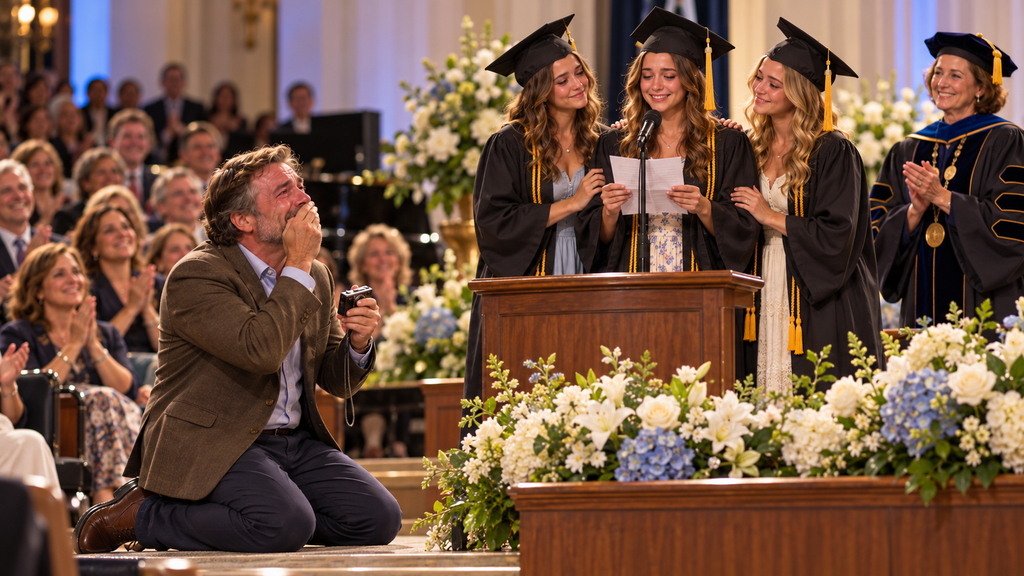
I finally managed to stand.
“You did not do that.”
Ava laughed through her tears.
“We did.”
“With what money?”
Claire whispered:
“Dad.”
“No.”
I shook my head.
“You have student loans.”
“We don’t.”
June said.
I stared at her.
“What?”
She wiped her face with the sleeve of her graduation gown.
“We need to explain.”
“You certainly do.”
The dean discreetly moved another chair toward me.
I sat because my legs had stopped negotiating.
June looked out over the audience.
Then back at me.
“Two months ago, when we found Daniel, we found something else.”
She looked at the attorney.
He opened the folder.
“My name is Samuel Price.”
he said.
“I represented Teresa Morales.”
My chest tightened.
I knew the name.
Not personally.
But I knew it.
Elena’s mother.
The girls’ maternal grandmother.
A woman I had met twice.
Once at my brother’s wedding.
Once at Elena’s funeral.
She had stood across the grave from me wearing a black veil, staring at Daniel with a kind of grief that looked almost like accusation.
Afterward, she disappeared from our lives.
Or so I had always believed.
Samuel continued.
“Mrs. Morales died eighteen months ago.”
I lowered my head.
I hadn’t known.
“She left a trust.”
My eyes lifted.
“For who?”
The girls looked at each other.
Samuel smiled softly.
“For them.”
The stadium disappeared.
Everything became the three young women onstage.
Ava.
Claire.
June.
My babies.
Not babies.
Women.
But grief is not respectful of age.
In my heart, they were suddenly six months old again.
Three carriers on my doorstep.
Three crying mouths.
Three sets of fists waving in the February cold.
A note on a gas receipt.
I’m sorry, Noah. I can’t do this.
I whispered:
“How much?”
June shook her head.
“That isn’t the important part.”
“It’s important if you just paid off my house.”
A few people laughed.
This time I heard it.
Barely.
Samuel said:
“The trust was divided equally among the three of them.”
“And all three independently chose to use a portion of their distributions to satisfy the remaining mortgage balance on your home.”
I looked at the girls.
“How much was left?”
Claire answered quietly.
“Sixty-three thousand, four hundred twelve dollars and seventeen cents.”
Of course Claire knew the cents.
She was the one who used to count Halloween candy into mathematically equal piles.
I almost laughed.
Instead I cried.
“You had no right.”
Ava smiled through tears.
“Technically, we had every right.”
“You know what I mean.”
“Yes.”
June lowered the microphone.
Then said something only I could hear.
“So did you.”
I stared.
She continued.
“You had no right to empty your retirement account when I needed surgery.”
My throat closed.
“We found the statement.”
“Noah.”
Claire said.
Not Dad.
Noah.
The name they used when they wanted me to listen as an adult instead of protect them as a father.
“Sixteen years ago.”
she continued.
“Thirty-eight thousand dollars.”
“Early withdrawal penalty.”
“Taxes.”
“And then you refinanced the house because there still wasn’t enough.”
I looked at Samuel.
“You showed them this?”
He shook his head.
“They showed me.”
My eyes returned to the girls.
Ava whispered:
“We found your metal box.”
My heart stopped.
“What?”
“We needed Mom’s death certificate for the trust.”
Claire explained.
“You told us the old documents were in your closet.”
“You said to look in the green file.”
“We found the metal box behind it.”
I closed my eyes.
The box.
I had not opened it in years.
Inside were documents I never expected the girls to see.
Daniel’s note.
Medical bills.
Custody orders.
Receipts.
The retirement statement.
Three hospital bracelets.
Elena’s obituary.
A faded photograph of Daniel holding the triplets the day they came home from the hospital.
My failure to throw away the past had finally introduced itself to them.
June looked at me.
“You kept everything.”
I tried to make a joke.
“I keep receipts.”
Nobody laughed.
June’s voice broke.
“You kept proof of every time you chose us.”
That sentence went straight through me.
I looked down.
“No.”
I whispered.
“I kept paperwork.”
Ava smiled.
“That’s what you would say.”
Then she turned toward the audience again.
“Our dad hates speeches about sacrifice.”
The crowd went quiet.
“He hates when people say he ‘gave up his life’ for us.”
I looked up.
Because I did.
I hated that phrase.
Ava continued.
“Whenever someone said it, he’d say…”
All three girls answered together:
“I didn’t give up a family. I got one.”
The audience broke.
People stood.
Not a polite standing ovation.
Something louder.
Rawer.
I covered my face.
I hated crying in public.
Apparently my daughters had organized the largest possible venue for it.
When the applause finally softened, Samuel raised the blue folder again.
“There is one additional matter.”
I looked at him.
“No.”
The audience laughed.
I pointed at the girls.
“Whatever it is, no.”
Claire grinned.
“You haven’t heard it.”
“I raised you.”
“I know how this works.”
Ava laughed.
June reached into her gown.
Pulled out three documents.
Not thick.
One each.
She looked at me.
“Dad.”
There was that word.
Simple.
Ordinary.
Twenty-two years old and still capable of undoing me.
“We know legally you’re our uncle.”
I nodded.
At first, I had temporary guardianship.
Then permanent custody.
Daniel never contested it.
He never appeared at hearings.
Never called.
Never sent an address.
When the girls were eight, a judge terminated what remained of his parental authority after years of abandonment.
I had considered adoption then.
But money was tight.
Life was chaos.
And by the time everything settled, the girls were old enough to understand names and fathers and questions I was afraid to answer badly.
So I told myself paper did not matter.
Maybe some part of me was also afraid.
What if Daniel came back?
What if the girls wanted him?
What if adopting them looked like stealing something that was never mine?
So I stayed Uncle Noah on government forms.
Dad everywhere that counted.
June held up the pages.
“These are petitions for adult adoption.”
The world stopped.
“No.”
I whispered.
Ava cried harder.
“We already filled out our parts.”
Claire smiled.
“Samuel checked them.”
June came down from the stage.
Not using the stairs at first.
The dean grabbed her elbow and directed her toward them before she broke an ankle five minutes after graduating.
She walked across the floor.
Straight to me.
Then Ava.
Then Claire.
Three black gowns.
Three caps.
Three women surrounding the man who had once sat awake at 3 a.m. googling:
How long can baby formula sit out?
June knelt.
“Dad.”
I shook my head because I could not speak.
She placed the petition in my hands.
“We don’t want to graduate and start our adult lives with the wrong man listed where our father should be.”
I looked at Daniel’s legal name on the page.
Then mine.
Noah James Bennett.
Proposed adoptive parent.
My vision disappeared.
Ava knelt beside June.
“You spent twenty-two years choosing us.”
Claire lowered herself on the other side.
“We figured we could do some paperwork.”
I laughed.
A terrible, broken sound.
“Paperwork?”
Claire shrugged through tears.
“You raised us.”
“I handle forms.”
Of course.
I pulled all three of them toward me.
Caps fell.
Someone’s tassel hit me in the eye.
The stadium erupted again.
But I stopped hearing it.
All I could hear were three voices.
Dad.
Dad.
Dad.
And somewhere beneath them, impossibly far away, three six-month-old babies crying on a cold landing above a hardware store.
The graduation ended two hours later.
I remember almost none of it.
Photographs happened.
Professors hugged the girls.
People I had never met hugged me.
A woman from the row behind us pressed tissues into my hand and said:
“You did good.”
I told her:
“They did better.”
That was the truth.
Samuel gave me his card.
“Call me Monday.”
I stared at him.
“I haven’t said yes.”
He smiled.
“You haven’t said anything coherent in forty minutes.”
Fair.
Ava hooked her arm through mine.
“He’ll sign.”
“You don’t know that.”
She kissed my cheek.
“Yes, we do.”
Children become extremely arrogant when they correctly understand your heart.
We planned a graduation dinner at a little Italian restaurant near campus.
Nothing fancy.
I had spent months saving for it.
Three graduates.
One bill.
I had already studied the menu online so I would not visibly flinch at the prices.
We were halfway across the parking lot when Claire stopped walking.
I turned.
“What?”
Her face had gone pale.
A man stood beside my truck.
For one second, I did not recognize him.
Age does strange things when memory freezes somebody at thirty-one.
The hair was thinner.
The shoulders softer.
There were deep lines around his mouth.
But the way he leaned against the vehicle—
One ankle crossed over the other.
Hands inside his jacket pockets.
I knew.
My stomach went cold.
Daniel.
My brother.
The girls went silent.
He looked at me.
Twenty-two years collapsed.
The last time I had seen him, his wife had been dead eleven days.
He had not shaved.
His shirt smelled like cigarettes and baby formula.
He put three car seats outside my apartment.
He would not look at me.
I remember grabbing his arm.
“Daniel.”
He pulled away.
“I can’t.”
“You have to.”
“No.”
“They’re your daughters.”
“I know.”
“Then what are you doing?”
He looked at me then.
Eyes red.
Empty.
“If I stay, I’m going to ruin them.”
I thought that was grief talking.
I told him to sleep.
Take a shower.
We would call someone.
He promised he would come back in the morning.
Instead, I found the gas receipt.
And Daniel vanished.
Now he stood beside my truck at his daughters’ college graduation.
June whispered:
“You came.”
Daniel looked at her.
“I said I might.”
My chest tightened.
“You invited him?”
Claire answered.
“No.”
“He knew the date.”
Daniel lifted both hands.
“I’m not here to cause trouble.”
I laughed.
Twenty-two years.
Apparently that was still the family specialty.
“You’re standing beside my truck.”
He flinched at my.
Good.
Ava moved closer to me.
Daniel noticed.
The hurt on his face was almost enough to make me feel guilty.
Almost.
He looked at the girls.
“I watched the ceremony online.”
June crossed her arms.
“How?”
“Campus livestream.”
He swallowed.
“I saw what you did.”
No one spoke.
Then he looked at me.
“House.”
“The adoption papers.”
He laughed weakly.
“Hell of a day.”
I stared at him.
“Why are you here?”
His eyes filled.
“Because I heard them call you Dad.”
Claire snapped:
“We’ve called him Dad since we were three.”
Daniel nodded.
“I know.”
“No.”
Ava said quietly.
“You don’t.”
That was worse.
Daniel looked as though she had struck him.
He took an envelope from his jacket.
I tensed.
“What is that?”
“Nothing bad.”
“Twenty-two years ago you left me one envelope-sized object and three babies.”
“I’m not optimistic.”
June almost laughed.
Then stopped herself.
Daniel looked down.
“Letters.”
My chest tightened.
“To them.”
He held out the envelope.
Claire did not take it.
“How many?”
“Twenty-six.”
Ava frowned.
“What?”
“I wrote.”
Daniel whispered.
“Over the years.”
“Birthdays.”
“Christmas.”
“When you would’ve started kindergarten.”
“Thirteen.”
“Sixteen.”
“High-school graduation.”
June stared.
“You never mailed them.”
“No.”
“Then they’re not letters to us.”
Daniel flinched.
“They are.”
“No.”
June’s voice hardened.
“They’re letters to yourself.”
Silence.
Even I had nothing to add.
Daniel looked down.
“I deserved that.”
“Yes.”
she said.
He nodded.
I watched him.
Part of me wanted to hate him cleanly.
It would have been easier if he arrived arrogant.
Demanding.
If he called the girls ungrateful.
If he challenged the adoption.
But shame is harder to fight than cruelty because sometimes it looks too much like pain.
He said:
“I’m not asking you not to do the adoption.”
I looked at him.
His mouth trembled.
“You should.”
The girls went still.
Daniel nodded toward me.
“He’s your father.”
My chest hurt.
Ava started crying.
Daniel continued.
“I’m the man who made you.”
“I was supposed to become your father after that.”
“I didn’t.”
He looked at me.
“Noah did.”
I had waited twenty-two years to hear something like that.
It did not feel good.
Some sentences arrive too late to be satisfying.
Claire asked:
“Why did you leave?”
Daniel closed his eyes.
“You already asked me that.”
“On the phone.”
“Yes.”
“And you said you were scared.”
“I was.”
“You also said Dad chose to keep us, so we became his problem.”
Daniel looked ashamed.
“I shouldn’t have said that.”
“But you did.”
“Yes.”
“Was it true?”
He looked at me.
Then back at her.
“No.”
June stepped forward.
“Then why did you say it?”
Daniel’s eyes filled.
“Because you asked me why he stayed when I didn’t.”
“And I had no answer that didn’t make me hate myself.”
No one moved.
He continued.
“Your mother died.”
“Elena died.”
His voice broke on her name.
“I came home from the hospital with three babies and every corner of the house still looked like her.”
“Her cup.”
“Her shoes.”
“Her sweater over the chair.”
“Three babies who cried with her face.”
He covered his mouth.
I remembered that house.
I remembered too.
Daniel continued.
“I didn’t sleep.”
“I started drinking.”
“Then pills.”
I looked at him sharply.
I had known about alcohol.
Not pills.
“I would hold one of you and think…”
He stopped.
Claire whispered:
“What?”
Daniel began sobbing.
“That you deserved somebody who wasn’t me.”
June looked away.
He continued.
“I told myself leaving was protecting you.”
“For about a month, I believed that.”
“Then after a month?”
He laughed bitterly.
“I knew what I had done.”
Ava whispered:
“So why not come back?”
There.
The impossible question.
Daniel looked at me.
“Because Noah was doing it.”
I stared.
“He called.”
Daniel said.
“Once.”
My heart stopped.
“What?”
“You called a number I’d left with a friend.”
“I never spoke to you.”
“No.”
“I listened to the voicemail.”
I remembered leaving dozens.
Maybe one reached him.
Daniel wiped his face.
“You said June had an ear infection.”
“You said Ava wouldn’t sleep unless somebody hummed.”
“You said Claire laughed for the first time.”
His voice broke.
“You sounded exhausted.”
“But they sounded alive.”
He looked at me.
“And I thought if I came back, I’d ruin whatever you were building.”
I felt anger rise.
“Convenient.”
“Yes.”
He said immediately.
“It became convenient.”
That honesty stopped me.
“Then shame became an excuse.”
“I told myself I’d come back when I was sober.”
“Then when I had a job.”
“Then when I had an apartment.”
“Then when I was stable.”
“Every milestone made it worse because it proved I had enough of a life to return.”
“But every year I waited meant I had more to explain.”
“So I kept waiting.”
He looked at the girls.
“And eventually I built another life because I was a coward who decided a new story was easier than fixing the one I destroyed.”
Claire whispered:
“Your sons.”
Daniel closed his eyes.
They had found them.
Of course.
Two boys.
Eli and Grant.
Social media.
Family photographs.
Fishing trips.
Birthdays.
A father smiling beside them.
“Yes.”
Ava cried.
“You raised them.”
“Yes.”
June’s voice was almost emotionless.
“You taught Grant to drive.”
Daniel stared at her.
“Yes.”
“You coached Eli’s baseball team.”
“Yes.”
“You went to their graduations.”
“Yes.”
Each answer hurt.
No screaming.
No excuse.
Yes.
Yes.
Yes.
Finally June asked:
“Why were they worth coming home for?”
Daniel’s face collapsed.
“They weren’t more worthy.”
“Then why?”
“Because by then I had learned how to stay.”
June shook her head.
“That’s not fair.”
“No.”
he whispered.
“It isn’t.”
I had never seen my brother look so old.
I surprised myself.
I stepped between them.
Not to protect Daniel.
To protect the girls from getting an answer no human being could make satisfying.
“You don’t have to finish this today.”
I said.
June stared at me.
“He gets to walk away again?”
“No.”
“You get to.”
That stopped her.
“You just graduated.”
“You stood on a stage.”
“You paid off a mortgage you had no business paying.”
She almost smiled.
“You emotionally assassinated me in front of four thousand people.”
Ava laughed through tears.
I continued.
“You do not owe Daniel a twenty-two-year reckoning in a parking lot because he finally showed up.”
Daniel nodded.
“He’s right.”
June glared.
“Don’t agree with him like you get a vote.”
I almost laughed.
Daniel accepted it.
“Fair.”
Claire looked at him.
“Why now?”
Daniel took a breath.
“Because Samuel contacted me.”
I turned.
“What?”
The girls looked at each other.
Ava explained:
“When the trust administrator couldn’t verify some family records, they found Daniel.”
My stomach tightened.
Daniel continued.
“Teresa’s trust named the girls.”
“Samuel needed documentation.”
“He contacted me.”
“And you suddenly remembered you had daughters.”
June said.
Daniel winced.
“Yes.”
“No.”
Claire said.
“What happened after he contacted you?”
Daniel looked ashamed.
“I asked whether I had any claim.”
There it was.
The sentence poisoned whatever sympathy had been growing.
Ava stepped backward.
“You what?”
“I didn’t know what the trust was.”
“You asked for money?”
Daniel shook his head quickly.
“I asked if anything passed through me as their father.”
Claire laughed.
Disgusted.
“You hadn’t been our father for twenty-two years.”
“I know.”
“Did Samuel tell you no?”
“Yes.”
“And then we contacted you.”
“Yes.”
June whispered:
“Were you nice to us because of the trust?”
Daniel stared.
“No.”
“How do we know?”
“You don’t.”
Silence.
At least he did not beg.
He continued.
“I heard money and my first instinct was still survival.”
“That should tell you how little I had changed in some ways.”
“I’m not proud.”
“But by the time you called…”
He looked at them.
“I wanted to hear your voices.”
Ava started crying.
Daniel did too.
None of us knew where to put the grief.
Then he said:
“There’s something else you should know.”
I almost laughed.
Of course there was.
“Daniel.”
I warned.
“Noah needs to know too.”
My stomach tightened.
“What?”
He looked at me.
“Elena had life insurance.”
“I know.”
I said.
He froze.
The girls turned toward me.
“You knew?”
Ava asked.
“I knew there was a policy.”
I looked at Daniel.
“I never knew the amount.”
Daniel whispered:
“One hundred ninety thousand.”
My jaw tightened.
Twenty-two years ago.
That was a fortune to a twenty-seven-year-old hardware clerk with three infants.
A fortune I never saw.
Claire stared at him.
“What happened to it?”
Daniel closed his eyes.
“I received it.”
“All of it?”
“Yes.”
“And?”
“I spent it.”
June laughed once.
“What?”
“I paid hospital bills.”
“Funeral.”
“Some debt.”
“Then I left.”
“How much did you take with you?”
Daniel looked sick.
“About one hundred thirty thousand.”
My heart stopped.
One hundred thirty thousand dollars.
While I diluted the last scoop of formula farther than recommended once because payday was twelve hours away.
While I learned which grocery store marked diapers down on Wednesdays.
While I sold my motorcycle.
While Mrs. Reed downstairs watched the girls for free because I could not afford daycare on Saturdays.
One hundred thirty thousand dollars.
I whispered:
“You knew I had them.”
“Yes.”
“You knew I made eleven dollars and forty cents an hour.”
“Yes.”
“You took one hundred thirty thousand dollars.”
“Yes.”
“And never sent a diaper.”
Daniel sobbed.
“No.”
I hit him.
I had never hit my brother in my adult life.
Not hard.
Open hand across the face.
The sound cracked through the parking lot.
The girls gasped.
I stood there shaking.
Daniel did not touch his cheek.
“I deserved that.”
“No.”
I said.
“You deserved to send the money.”
That hurt more.
His face folded.
I stepped back.
“I’m sorry I hit you.”
He nodded.
“Don’t be.”
“I’m not apologizing for you.”
I said.
“I’m apologizing because I don’t want that to be who I am.”
June took my hand.
I squeezed it.
Daniel reached into his jacket again.
Another paper.
This time I almost laughed.
“You travel with a filing cabinet?”
He managed a weak smile.
“I brought a cashier’s check.”
The girls stiffened.
“For what?”
Claire asked.
“Eighty thousand.”
Silence.
Daniel continued.
“It’s what I can repay.”
“Not all of it.”
“Not close after twenty-two years.”
“But it’s what I have without taking from my wife’s retirement or my sons’ education.”
June stared.
“You have eighty thousand dollars available?”
“I sold land.”
“What land?”
“A parcel Elena and I bought before she died.”
I remembered it.
Three acres outside town.
Nothing on it.
Daniel continued.
“I kept it all these years.”
“I couldn’t explain why.”
“Maybe because part of me knew it was connected to her.”
“It sold last month.”
He held the check.
“I want you three to have it.”
Ava did not take it.
“Why?”
“Because the insurance should have been used for you.”
Claire looked at Samuel, who had quietly approached from behind us.
Apparently even attorneys are drawn to unresolved paperwork.
Samuel asked:
“May I?”
Daniel handed him the check.
Samuel studied it.
Then looked at the girls.
“This should not be accepted or distributed in a parking lot.”
Thank God for lawyers.
June almost laughed.
Samuel continued.
“We can document the transfer appropriately if you choose to accept it.”
“If.”
Daniel nodded.
“I’m not buying anything.”
he said.
“Not forgiveness.”
“Not contact.”
“Not the right to be called Dad.”
He looked at me.
“And not Noah’s place.”
My anger remained.
But something inside it shifted.
Not gone.
Complicated.
Life’s favorite condition.
We went to dinner without Daniel.
He did not ask to come.
Good.
At the restaurant, nobody touched the bread for five full minutes.
Finally Claire said:
“Well.”
Ava laughed.
Then June.
Then me.
We laughed until strangers looked over.
Not because anything was funny.
Because sometimes after too much grief, the body pulls the fire alarm.
Our waiter approached cautiously.
“Are we celebrating?”
All four of us looked at one another.
Ava said:
“Graduation.”
Claire said:
“Mortgage payoff.”
June said:
“Adult adoption.”
I added:
“And generational emotional collapse.”
The waiter nodded.
“I’ll give you a minute.”
We laughed harder.
Eventually, I became serious.
“You’re taking the mortgage money back.”
Three identical expressions appeared.
The triplets did not look identical.
But indignation was apparently genetic.
“No.”
June said.
“Yes.”
Ava shook her head.
“Dad.”
“You have your grandmother’s trust.”
“That belongs to you.”
Claire leaned forward.
“It is ours.”
“Exactly.”
“And we chose what to do with part of it.”
I pointed at her.
“You are twenty-two.”
“Yes.”
“You’re supposed to waste money on things you regret.”
June said:
“We bought concert tickets.”
“Good.”
Ava added:
“Claire bought a twelve-dollar smoothie yesterday.”
I put my hand over my heart.
“Reckless.”
Claire glared.
Then softened.
“Dad.”
I looked at her.
“The trust is significant.”
“How significant?”
They glanced at Samuel, who had joined us at the far end of the table.
He answered.
“Each granddaughter’s share was approximately one hundred and forty-eight thousand dollars after administration.”
I stopped breathing.
Three shares.
More than four hundred thousand total.
Teresa Morales had left them a future.
Claire continued.
“We each used a little over twenty-one thousand to clear the mortgage.”
“That still leaves us with more money than any of us expected to have when we graduated.”
Ava added:
“We have jobs.”
June smiled.
“And you taught us not to buy stupid cars.”
I stared.
“I also taught you not to spend sixty-three thousand dollars without talking to me.”
June smiled.
“You taught us to help family.”
“That rule is suspended when family is me.”
“No.”
All three said together.
I rubbed my face.
“This is why nobody should raise triplets.”
Then I asked the question that hurt.
“Did Teresa know about you?”
Samuel answered.
“She knew you had custody.”
My eyes lifted.
“What?”
He nodded.
“How?”
“Private investigator.”
I sat back.
“Why didn’t she contact us?”
The girls became quiet.
Samuel’s face softened.
“She tried.”
I looked at him.
“What?”
He opened the blue folder again.
Inside were copies of letters.
Some returned.
Some unopened.
Addressed to:
Daniel Bennett.
Then later:
Noah Bennett, guardian of Ava, Claire, and June Bennett.
My old apartment.
The house.
A post-office box I had used.
My heart started pounding.
“I never saw these.”
“I believe you.”
Samuel said.
“Several were returned by Daniel.”
I turned toward the empty chair where my brother was not sitting.
Samuel continued.
“Others appear to have been sent to an incorrect address.”
“Teresa believed for several years that you did not want contact.”
“Why?”
He hesitated.
“Daniel told her that.”
Of course.
My chest tightened.
Samuel continued.
“Later she learned through an investigator that the girls were with you and doing well.”
“She wrote again.”
I picked up one letter.
My name.
Teresa’s handwriting.
Dated seventeen years earlier.
I opened the copy.
Mr. Bennett,
Not Noah.
Formal.
Distant.
I do not know whether you blame me for what happened after Elena’s death. I blame myself enough for both of us. Daniel told me the girls were safe and that your family did not wish contact with Elena’s side. I respected that longer than I should have.
My eyes blurred.
If that was untrue, please forgive my cowardice in accepting it.
I stopped.
Cowardice.
The word seemed to be haunting our family.
I continued.
I have established accounts for the girls. They are not payment for absence. Money cannot do that. I only want them to know Elena came from somewhere too.
I covered my mouth.
Ava took my hand.
Samuel said:
“Teresa never stopped funding the trust.”
I looked at the girls.
“Did you know this?”
“Not until two months ago.”
Claire said.
“She kept photographs too.”
Ava added.
“Of Mom.”
June whispered:
“Baby pictures.”
The girls had so few pictures of Elena.
Daniel had taken most when he vanished.
Another theft I had never been able to repair.
Ava smiled through tears.
“We have boxes.”
I started crying all over again.
“Of your mother?”
They nodded.
For twenty-two years, I had worried I had not given them enough of Elena.
Not enough stories.
Not enough photographs.
Not enough of the woman whose face disappeared from the world eleven days before her husband disappeared too.
And all that time, another grandmother had been keeping pieces.
Waiting.
That night, back at the house, we opened the first box.
Elena at six.
Missing front tooth.
Elena at fourteen.
Awful bangs.
June laughed.
“Mom had terrible hair.”
I pointed.
“Your bangs in seventh grade.”
She stopped laughing.
Ava found a photograph of Elena holding all three babies in the hospital.
She pressed it to her chest.
Claire found a letter Teresa had written after seeing a newspaper clipping about the girls’ high-school academic awards.
Three beautiful girls. Elena would have embarrassed them by bragging to strangers.
Claire sobbed.
I left the room.
Not because I did not want to see.
Because grief sometimes needs a hallway.
Ava followed.
“Dad?”
“I’m okay.”
“No.”
“I’m sixty-one.”
“I’m allowed to lie about being okay.”
She hugged me.
I laughed into her hair.
She smelled like the same vanilla shampoo she had used since fifteen.
“You should have had these.”
I whispered.
“We have them now.”
“It’s not the same.”
“No.”
She said.
“It’s not.”
That answer helped.
No pretending.
Loss remains loss even after something beautiful is recovered.
At midnight, after the girls went to bed in the rooms they had supposedly “moved out of” but somehow still occupied whenever convenient, I sat alone at the kitchen table.
The adoption petitions lay in front of me.
My name.
Their names.
Three signature lines.
I remembered the first custody hearing.
The judge looked over his glasses.
“You understand this is significant responsibility?”
I had three babies with me.
One crying.
One asleep.
One chewing the corner of a folder.
I nearly laughed.
“Yes, sir.”
“Do you have adequate housing?”
“No, sir.”
He stared.
I corrected.
“Not yet.”
“Income?”
I told him.
He looked worried.
So was I.
Then he asked:
“Why are you seeking custody?”
I looked at three babies who had no one else in the courtroom.
“Because they need somebody.”
That had been my entire qualification.
Somebody.
I became somebody one day at a time.
Now twenty-two years later, three women wanted to make the word permanent.
I signed all three petitions at 12:18 a.m.
Then cried over the kitchen sink so nobody would hear.
They heard.
Of course.
Triplets.
Three bedroom doors opened.
June called:
“Did you sign them?”
“No.”
Claire shouted:
“You are a terrible liar.”
Ava came running down the hallway.
They found me.
Saw the signatures.
And screamed loudly enough to wake the neighbor’s dog.
The adoption hearing took place six weeks later.
Adult adoption is not usually dramatic.
Ours became dramatic because apparently the girls considered privacy an enemy.
Dad’s old coworkers came.
Mrs. Reed from my apartment-building days came with a walker.
Their high-school principal.
Samuel.
Two professors.
Half the hardware store.
I stared at the packed courtroom.
“I hate all of you.”
June kissed my cheek.
“We know.”
The judge was a woman around my age.
She read the petitions.
Looked at each girl.
Then me.
“Mr. Bennett, do you understand that adult adoption creates a legal parent-child relationship?”
“Yes, ma’am.”
“And you consent?”
I looked at the girls.
Twenty-two years flashed.
Ava throwing peas from a highchair.
Claire needing nine stitches after attempting to prove bicycles could “sort of fly.”
June under a hospital blanket after surgery.
Three first days of school.
Three first heartbreaks.
Three college acceptance letters.
Three empty bedrooms after move-in weekend.
Three women now crying in front of me.
“Yes.”
My voice broke.
The judge smiled.
“Ms. Ava Bennett?”
“Yes.”
“You wish to be adopted by Noah Bennett?”
Ava laughed through tears.
“I think he’s stuck with us either way.”
The judge smiled.
“Legally.”
“Yes.”
Claire:
“Yes.”
June:
“Yes.”
Then the judge signed.
A sound went through the room.
Not applause yet.
A collective breath.
The judge looked at me.
“Congratulations, Mr. Bennett.”
Then at the girls.
“Congratulations to all four of you.”
June whispered:
“Dad.”
I looked at her.
“What?”
“Now you can’t get rid of us.”
I cried.
The courtroom laughed.
Then applauded.
Daniel did not attend.
He asked.
The girls said no.
He accepted it.
That mattered.
He sent one message.
Today isn’t about me. I hope it’s beautiful.
June did not respond.
Ava did.
It was.
Claire waited three days.
Then sent:
Thank you for not coming.
Daniel replied:
I understand.
Small things.
Sometimes growth is staying away when your presence would make something about you.
The eighty-thousand-dollar repayment sat in escrow for nearly four months.
The girls could not decide whether to accept it.
Ava wanted to.
June did not.
Claire created a spreadsheet.
Of course.
She estimated what one hundred thirty thousand dollars invested conservatively over twenty-two years might have become.
Then immediately regretted it.
“Do not show me.”
I said.
“It made me nauseous.”
“Delete it.”
She did.
We eventually sat at the kitchen table.
Daniel was not there.
Samuel was.
I told them:
“The money is yours to decide.”
June looked at me.
“Some should go to you.”
“No.”
“Dad.”
“No.”
“You paid for everything.”
“I was your parent.”
“Exactly.”
she said.
“You shouldn’t have had to do it with money that was supposed to help raise us sitting somewhere else.”
My chest tightened.
Ava whispered:
“We can’t reimburse childhood.”
“No.”
I said.
“You can’t.”
“So what do we do?”
I thought about it.
Then said:
“Use part of it for something your mother would recognize.”
They stared.
“I barely knew Elena compared with Daniel.”
I continued.
“But she cared about nurses.”
“Hospital workers.”
“She talked about finishing school.”
Ava smiled.
“Scholarship?”
Claire immediately reached for a notebook.
June groaned.
“God, don’t let Claire create a committee.”
Too late.
We used part of Daniel’s repayment to establish a small scholarship in Elena’s name for students who had lost a parent and were studying nursing or respiratory care.
Not huge.
One student each year.
The rest the girls divided.
I refused a cent.
They complained.
I won.
Occasionally age has privileges.
Daniel and the girls built three different relationships.
That was something I had to learn to tolerate.
Ava spoke to him first.
She wanted stories about Elena.
Daniel had more than anyone alive.
He told her about their first date.
Elena ordered the most expensive thing because Daniel bragged that he had just gotten paid.
She hated camping.
Loved thunderstorms.
Could not whistle.
Burned pancakes.
Sang beautifully.
Ava came home from their first lunch and cried in my kitchen.
I nearly said:
Don’t see him again.
Instead I asked:
“Was it good?”
“Yes.”
“Was it bad?”
“Yes.”
Fair.
She continued seeing him occasionally.
Never called him Dad.
Daniel never asked.
Claire took longer.
She wanted documents.
Dates.
Facts.
She asked Daniel for financial records from the insurance payout.
He provided what he had.
That was her way of deciding whether truth existed.
Eventually, she began emailing him.
Mostly about family medical history.
Then books.
Then politics.
Then nothing for weeks.
A relationship with no label.
It worked for them.
June refused contact for two years.
Daniel never pressured her.
On her twenty-fifth birthday, he sent one card through Samuel.
No guilt.
No request.
Happy birthday, June. I’m grateful you exist. No answer needed. Daniel.
She put it in a drawer.
Six months later, she called him.
I only learned because she told me afterward.
“What did you say?”
I asked.
“That I still hate him.”
“What did he say?”
“That he understands.”
“What else?”
“That Mom used to swear when she burned toast.”
I laughed.
“Elena absolutely did.”
June smiled.
“That was it.”
“Are you seeing him again?”
“I don’t know.”
Good.
No rush.
Reconciliation should never be treated like a graduation requirement.
My relationship with Daniel was harder.
He was my brother.
That meant the betrayal had a different shape.
For years, I had imagined him dead.
Not literally at first.
But eventually, yes.
There were nights I searched obituaries.
Social media.
Old friends.
Hospitals once.
I wondered whether I should tell the girls their father might not be alive.
Then I would get angry at myself because being dead felt like an excuse he had not earned.
Now he existed.
And every time I looked at him, I remembered formula.
Hospital bills.
Working from 6 a.m. until closing.
Three girls with stomach flu at the same time.
I remembered being twenty-eight and falling asleep on the kitchen floor because June would only sleep if I sat beside her crib.
And somewhere, Daniel had one hundred thirty thousand dollars and a road leading away.
It took a long time.
Then one afternoon he came to my hardware store.
Yes.
The same store.
I owned part of it by then.
Old Mr. Haynes had sold me a share years earlier.
Daniel stood near the paint counter.
“You busy?”
“Always.”
“Can I help?”
I stared.
“You know anything about hardware?”
“No.”
“Then probably not.”
He smiled weakly.
I hated that he still smiled like my brother.
We got coffee.
He said:
“I don’t want forgiveness.”
“Good.”
“I want to apologize without asking you to make me feel better.”
I waited.
He continued.
“You were twenty-seven.”
I looked down.
“You had no money.”
“No partner.”
“No preparation.”
“And I decided because you were stronger, you could carry what I dropped.”
My throat tightened.
He continued.
“I turned your character into an excuse for my failure.”
That sentence sat between us.
“I told myself Noah can handle it.”
“Every time I thought about coming back.”
“Noah has it.”
“As if your ability made my responsibility disappear.”
I cried.
Quietly.
He did too.
“I’m sorry.”
he said.
“You lost things.”
“Yes.”
“What?”
I looked at him.
“You want a list?”
“No.”
“Good.”
I thought anyway.
A woman named Rachel I almost married.
She loved the girls.
But at thirty-three, she wanted a child of her own.
I could not imagine starting again.
We ended kindly.
Still hurt.
A promotion in Richmond.
Better salary.
I declined because June’s specialists were here.
Friends moved.
Trips happened.
Life narrowed.
Then widened again around the girls.
I looked at Daniel.
“I did lose things.”
“Yes.”
“But don’t turn my life into a tragedy so you can understand the cost.”
He stared.
“What?”
“I was happy too.”
His eyes filled.
“I loved raising them.”
“I laughed.”
“I had friends.”
“I had work.”
“I had three kids who once covered my truck in feminine hygiene pads because they saw a prank online.”
Daniel burst out laughing.
I did too.
“That happened?”
“Two hundred dollars in paint damage.”
He laughed harder.
I smiled.
“I didn’t give up twenty-two years.”
I said.
“I lived them.”
His laughter stopped.
“I need you to understand that.”
He nodded.
“I do.”
“No.”
I looked at him.
“You abandoned your daughters.”
“That is yours.”
“But my life afterward is mine.”
“Do not describe it only by what you made harder.”
He cried.
Then nodded.
“Okay.”
That was the first day I started forgiving my brother.
Not because he deserved a clean slate.
Because I no longer wanted my love for the girls described as the debris of his failure.
The house felt different after the mortgage disappeared.
Not physically.
Same squeaky hallway.
Same cracked tile near the laundry room.
Same porch step I had promised to replace for nine years.
But every month, when the old mortgage payment date arrived, my bank account stayed still.
The first month, I thought something had gone wrong.
I called Claire.
“Did the lender send a release?”
“Yes.”
“Are you sure?”
“Yes.”
“Check.”
“I already checked.”
“Check again.”
She hung up on me.
Children become disrespectful immediately after paying off your mortgage.
I walked through the house that evening.
The girls’ height marks were still inside the pantry door.
Ava in red.
Claire blue.
June green.
At thirteen, June drew a line above Claire’s actual height.
They argued about it for seven years.
I touched those marks.
The house had nearly disappeared once.
June’s surgery.
Insurance denied part of the procedure.
I had twenty-one days to figure it out.
I cashed retirement money.
Refinanced.
Never told them.
They were children.
Children should not lie awake because the roof has a dollar sign.
Now the same children had removed that debt.
Not children.
I knew.
Still.
I sat on the pantry floor and cried.
Again.
Apparently my sixties were going to be damp.
The girls also lied about one thing.
They said the graduation surprise was finished.
It was not.
Three months later, they took me to the hardware store on a Sunday.
Closed.
Mr. Haynes was there.
So were half the employees.
A banner hung over the loading bay.
NOAH’S WORKSHOP
I stopped.
“No.”
June laughed.
“You haven’t even seen it.”
“No.”
Behind the store was a small renovated workshop space.
For me.
I had spent thirty-four years repairing other people’s cabinets, tables, doors, and broken drawers in borrowed corners.
Woodworking had always been the thing I did after everyone went to sleep.
The girls renovated the unused back room.
Workbenches.
Tool storage.
Dust collection.
A little sign:
BENNETT & DAUGHTERS
I stared.
“You’re not daughters in a hardware business.”
Claire shrugged.
“Legally, we’re daughters everywhere now.”
Technicality weaponized against me.
I approved.
Ava whispered:
“You spent twenty-two years making space for us.”
“We wanted you to have some.”
That line nearly finished me.
I started building furniture.
Nothing extraordinary.
Tables.
Benches.
Toy chests.
Then cribs.
The first crib was for Ava.
Three years after graduation, she called me at 6:20 in the morning.
“Dad?”
I heard crying.
My heart stopped.
“What happened?”
“Nothing.”
“Then why are you crying?”
“I’m pregnant.”
I sat down on the edge of the bed.
“What?”
She laughed through tears.
“You’re going to be Grandpa.”
I cried before she finished.
Naturally.
When her daughter was born, Ava named her Elena.
Not because anyone asked.
Not because memory demanded it.
Because she wanted to.
Daniel came to the hospital separately.
He stood outside until Ava invited him in.
I watched him hold Elena.
The granddaughter named after the wife he lost.
His hands shook.
He cried.
Then he handed her back immediately when she fussed.
Old fear.
Still somewhere inside.
I took the baby.
She settled against my chest.
Daniel watched me.
“Of course.”
he whispered.
“What?”
“She knows.”
I looked at the tiny face.
“No.”
I said.
“I’m just warmer.”
He laughed.
We both knew that was not what he meant.
Claire became an attorney.
Nobody who knew her as a child was surprised.
She joined a legal-aid organization focused on housing and benefits.
At her swearing-in ceremony, she gave me a copy of the adult adoption petition.
Framed.
My signature at the bottom.
“Really?”
I asked.
“You kept Daniel’s gas receipt for twenty-two years.”
“Fair.”
On the back she had written:
Some paperwork tells you who left. Some tells you who stayed.
I hung it in the workshop.
June became a physical therapist.
The surgery that nearly cost us the house had been for a spinal condition discovered when she was six.
Years of appointments followed.
She remembered more than I realized.
One day she said:
“You know why I chose PT?”
“To boss strangers around?”
“Yes.”
Then:
“And because I remember you learning every exercise they gave me.”
I smiled.
“I was terrible.”
“You were.”
“But you did them with me.”
She paused.
“I wanted to be the person who teaches families what to do after they go home.”
I had no answer.
Some seeds grow where you never realized you planted them.
At sixty-eight, my knee finally became bad enough for surgery.
The girls reacted as though I had announced a terminal illness.
Ava created a meal calendar.
Claire reviewed every insurance statement.
June practically moved into my house.
I hated it.
Which meant I understood exactly how annoying I had been as a father.
One night, June stood over me with an ice pack.
“Twenty minutes.”
“I know.”
“You took it off after seven.”
“It was cold.”
“That is literally the point.”
I glared.
She smiled.
“This is fun.”
“What?”
“Revenge.”
I threw a pillow at her.
Missed.
Bad knee.
Daniel visited during recovery.
He brought soup.
Terrible soup.
I took one bite.
“What is this?”
“Chicken.”
“What happened to it?”
He laughed.
We sat on the porch.
Quiet.
Then he asked:
“Do they take care of you like this all the time?”
“No.”
“Yes.”
Ava shouted from inside.
I rolled my eyes.
Daniel smiled.
“You did good.”
I looked at him.
“They did.”
“You know what I mean.”
I did.
For years, compliments about the girls made me uncomfortable because some part of me thought accepting credit stole something from Elena.
Or even Daniel.
Eventually, I learned parenthood has room for truth.
Elena gave them life.
Daniel gave them life too.
Then failed them.
I raised them.
They became themselves.
No single sentence needed to erase another.
So I said:
“Thank you.”
Daniel nodded.
That was enough.
Teresa’s scholarship grew too.
The girls contributed annually.
Eventually Daniel did.
Then I did.
We renamed it after both Elena and Teresa Morales.
The first recipient we met was a young man whose father had died while he was in high school.
He worked nights at a grocery store.
Studied respiratory therapy.
When he thanked us, I thought of twenty-seven-year-old Noah above a hardware store with $312.
I shook his hand.
“Sleep sometimes.”
He laughed.
“I’ll try.”
I almost told him trying was not enough.
Then remembered I was not his father.
Growth.
Mrs. Reed died at ninety-three.
The neighbor who had told me:
“You can’t raise three babies alone.”
At her funeral, all three girls came.
Ava whispered:
“She was technically right.”
I looked at her.
“What?”
“You didn’t raise us alone.”
I thought.
Mrs. Reed babysitting.
Mr. Haynes advancing me pay.
A nurse teaching me how to give June medicine.
Teachers.
Friends.
Neighbors.
A church pantry I once used and never told the girls about.
She was right.
The myth of the heroic single parent can become another cruelty.
It erases the hands that quietly held the edges.
I whispered:
“No.”
“I didn’t.”
Ava squeezed my arm.
“But you stayed at the center.”
That was true too.
Daniel’s second wife eventually met the girls.
Her name was Beth.
She had learned about them only ten years into her marriage.
That betrayal belonged to her.
She apologized anyway.
“I should have pushed him harder to contact you.”
June said:
“He was an adult.”
Beth nodded.
“Thank you.”
Good woman.
His sons, Eli and Grant, became strange half-brothers in adulthood.
Awkward at first.
Then less.
Grant and Claire discovered they both hated olives.
Apparently family bonds require very little genetic evidence.
No one pretended they had shared childhood.
They had not.
But family can begin late without rewriting early.
That became another lesson.
Years after graduation, I finally asked Ava how they discovered Daniel.
We were sitting in the workshop.
She smiled.
“Claire.”
Of course.
“What did she do?”
“Background databases.”
“Public records.”
“Old marriage license.”
“Then Facebook.”
I groaned.
“Did you stalk your biological father?”
“Research.”
Claire shouted from the front room.
Apparently she had arrived without me noticing.
Ava laughed.
“We found a picture first.”
“What picture?”
She hesitated.
“Daniel with his sons.”
“Fishing.”
I knew.
My chest tightened.
“What did you feel?”
“Angry.”
“Jealous.”
“Then guilty for being jealous.”
“Why guilty?”
“Because they were kids too.”
She looked at me.
“They didn’t take him from us.”
That was wise.
I nodded.
“No.”
“He left before they existed.”
Ava continued.
“Then we saw their graduation photos.”
“That’s why we contacted him before ours.”
I looked at her.
“You wanted to know if he’d come.”
She nodded.
“Did you invite him?”
“No.”
“We asked whether he knew we were graduating.”
“What did he say?”
“He asked the date.”
I winced.
Ava smiled sadly.
“That answered enough.”
One night, years later, Daniel and I sat by a fire in my backyard.
The girls had gone.
Grandkids asleep inside.
He said:
“I still have the original note.”
I turned.
“What?”
“The gas receipt.”
My heart stopped.
“No.”
“You have a copy.”
I stared.
I had always assumed the note in my box was original.
He shook his head.
“You found the carbon copy.”
“Carbon copy?”
“The gas station receipt pad had two layers.”
I laughed.
“What kind of cheap dramatic nonsense is that?”
He smiled sadly.
“I kept the original.”
“Why?”
His eyes filled.
“Punishment.”
I went quiet.
“I carried it in my wallet for nine years.”
“Then a box.”
“Every time I wanted to convince myself I had reasons, I read what I actually wrote.”
I’m sorry, Noah. I can’t do this.
Five words after sorry.
Twenty-two years after that.
I asked:
“Do you still have it?”
“Yes.”
“Burn it.”
He looked surprised.
“What?”
“Burn it.”
“I thought you’d want it.”
“I have enough relics.”
He stared into the fire.
Then took out his wallet.
I laughed.
“You still carry it?”
“Not always.”
Apparently tonight was one of the always nights.
He unfolded a brittle piece of paper.
I recognized his handwriting.
Daniel held it over the flames.
Then stopped.
“Are you sure?”
“No.”
I said.
“But do it anyway.”
He let go.
The receipt curled.
Blackened.
Disappeared.
Daniel cried.
I did too.
Not because history was erased.
Paper has never had that power.
Because some evidence has finished its job.
My daughters turned forty before I understood the full joke of that graduation day.
They had told everyone:
“We found what he left behind.”
At first, I thought they meant Daniel’s note.
Then the trust.
Then the insurance.
Then the letters.
But years later, June corrected me.
“No.”
“What?”
“We meant you.”
I stared.
She smiled.
“He left us behind.”
“And we found what he left behind.”
She touched my shoulder.
“You.”
My eyes filled.
“That’s disgustingly sentimental.”
“I know.”
“You planned that line?”
“For months.”
“Terrible.”
She kissed my cheek.
“You cried.”
“Manipulation works.”
She laughed.
By then, the house was full again.
Not with triplets.
With grandchildren.
Too many shoes.
Tiny fingerprints.
Plastic cups in the wrong cabinets.
Elena—Ava’s daughter—liked sleeping in the room her mother shared with her sisters.
Claire had twin boys, because apparently God has a sense of humor and wanted to test whether triplet trauma was hereditary.
June had one son and declared one “plenty.”
On Christmas Eve, all of them came.
I stood in the kitchen watching my daughters argue over gravy.
Claire:
“You need more flour.”
June:
“No.”
Ava:
“You’re both wrong.”
Exactly like they were twelve.
I leaned against the counter.
For years, people had said:
“Noah gave up everything.”
I finally understood why the sentence always bothered me.
Look at everything.
The house.
The noise.
The girls.
Their partners.
Children running down my hallway.
A scholarship.
A workshop.
A brother who had returned imperfectly.
Photographs of Elena.
Teresa’s letters.
A paid-off mortgage.
Three adult-adoption orders framed in the hall because the girls insisted.
What exactly had I given up?
One possible life.
Yes.
But everyone does that simply by living one.
Choosing anything closes doors.
That does not make the room you entered empty.
On my seventy-fifth birthday, the girls took me back to their university.
The dean who had hosted their graduation was retired.
The stadium looked smaller.
Everything from memory does.
June pointed.
“That’s where you dropped.”
“I did not drop.”
“You absolutely dropped.”
“My knee buckled.”
Ava laughed.
“Emotionally.”
Claire added:
“Medically.”
I ignored them.
We walked to the stage.
Empty.
I stood where they had stood.
Twenty-two-year-olds in black gowns.
June had read Daniel’s note.
Ava revealed the retirement account.
Claire had smiled like she knew something I did not.
Then Samuel stepped forward with that blue folder.
The house you nearly lost raising them is no longer yours.
I laughed.
“What?”
Ava asked.
“I thought for about four seconds you had sold my house.”
Claire smiled.
“We considered making him phrase it better.”
“You failed.”
“He wanted drama.”
“Lawyers.”
Claire looked offended.
Samuel had died a few years earlier.
Good man.
Sharp suits.
Terrible sense of theatrical timing.
I missed him.
We sat in the empty stands.
Ava handed me an envelope.
I stared.
“No.”
She laughed.
“Relax.”
“I’ve learned envelopes are dangerous.”
Inside was a photograph.
Graduation day.
The moment after I signed nothing.
Before the adoption.
All three girls kneeling around me.
My face completely broken.
Their faces wet with tears.
Behind us, thousands of people standing.
I had never seen that photograph.
On the back, Claire had written:
The day the world finally saw our dad.
I cried.
Of course.
At seventy-five, dignity becomes inefficient.
I asked them one question.
“Did you ever feel like I wasn’t enough?”
All three stared at me.
Ava frowned.
“What?”
“Growing up.”
“No mother.”
“No biological father.”
“Me working all the time.”
“I made mistakes.”
“So many.”
June smiled.
“Your braids were criminal.”
“Not helping.”
Claire became serious.
“We missed Mom.”
I nodded.
“We wondered about Daniel.”
Another nod.
“We were angry.”
“Sometimes at you because you were the only parent available to be angry at.”
I laughed softly.
That made sense.
Claire continued.
“But not enough?”
She shook her head.
“No.”
“You were not supposed to replace everybody who was gone.”
My throat tightened.
Ava whispered:
“You were supposed to stay.”
“And you did.”
There it was.
The whole story reduced to one verb.
Stayed.
Not perfect.
Stayed.
When people ask what makes a parent, I do not have a clever answer.
DNA matters.
History matters.
Law matters.
Names matter.
None of them are nothing.
But I know this:
Fatherhood happened at 2:13 in the morning when Ava had croup and I drove through snow with one baby coughing and two screaming because I could not leave anyone behind.
It happened when Claire failed algebra and hid the report card under the dog food even though we did not own a dog.
It happened when June woke from surgery and whispered:
“Dad?”
before she fully opened her eyes.
It happened at three college move-ins, when I drove home alone and pulled over twice because the truck suddenly sounded too quiet.
It happened every ordinary Tuesday nobody photographs.
That is where families are made.
In repetition.
In showing up again after yesterday exhausted you.
Daniel gave the girls life.
Then grief broke him.
Fear carried him away.
Cowardice kept him gone.
He eventually returned.
That mattered.
It did not rewrite what Noah—what I—had done.
And what I did did not erase Elena.
Or Teresa.
Or even the parts of Daniel that the girls eventually chose to know.
Family did not become healthier when we decided one person had to own every title.
It became healthier when truth stopped being a competition.
I never remarried.
Not because the girls “cost” me love.
I dated.
I loved once seriously after they left college.
Her name was Marianne.
Widowed librarian.
Mean Scrabble player.
She had two grown children.
We traveled.
Fought about air conditioning.
Stayed together eleven years until cancer took her.
The girls adored her.
At her funeral, June whispered:
“See?”
“What?”
“You got another family too.”
I cried.
Again.
Life had refused every narrow definition anybody tried to give it.
The old house is still standing.
The mortgage release is framed in my office because Claire said financial documents are “romantic when properly contextualized.”
I disagree.
But I kept it.
The pantry door with the height marks was removed during a renovation.
I nearly murdered the contractor.
We found it in the dumpster.
I now own a pantry door that is not attached to any pantry.
Ava calls that hoarding.
I call it archival preservation.
And Daniel?
He died before me.
Stroke.
Unexpected.
I sat beside him in the hospital with Beth and his sons.
Ava came.
Claire came.
June arrived last.
She stood near the doorway for a long time.
Daniel opened his eyes once.
Saw her.
He could not speak.
June walked to the bed.
Took his hand.
She said:
“I’m here.”
Not:
I forgive you.
Not:
Dad.
Just:
I’m here.
Daniel cried.
One tear.
Then closed his eyes.
He died that night.
Afterward, June stood in the parking lot.
Same kind of parking lot where we had confronted him after graduation decades earlier.
She looked at me.
“I don’t know what I feel.”
I hugged her.
“You don’t have to.”
She cried.
“I’m sad.”
“Okay.”
“I’m angry.”
“Okay.”
“I loved him a little.”
“Okay.”
“I hate that.”
I smiled sadly.
“Also okay.”
Human hearts are terrible at clean accounting.
At Daniel’s funeral, one of his sons asked me:
“Were you angry with him?”
I laughed.
“For about thirty years.”
He smiled weakly.
“Did you forgive him?”
I thought.
“Enough.”
“What does that mean?”
“It means the past stopped requiring daily attention.”
He nodded.
I liked that answer.
I still do.
After Daniel’s funeral, the girls came back to my house.
They opened the old metal box.
The gas-receipt copy was still there.
June held it.
“Burn this one too?”
I thought.
Then nodded.
We went outside.
Four adults around a little fire.
Claire lit the paper.
It curled.
Disappeared.
Ava said:
“Feels weird.”
“Yes.”
June looked at me.
“Sad?”
“No.”
I watched the last corner turn to ash.
“Finished.”
That was the word.
Not forgotten.
Finished.
Years earlier, Daniel had left three babies on my doorstep because he said he could not do it.
For a long time, I defined myself against that sentence.
I can.
He couldn’t.
I could.
He left.
I stayed.
Age softened that too.
The truth was:
Many days I couldn’t.
I did not know what I was doing.
I was scared.
Broke.
Angry.
Lonely.
I once put formula powder directly into the bottle before adding water and spent ten minutes convinced I had poisoned Ava.
I forgot picture day.
Twice.
I yelled.
Apologized.
Made terrible pancakes.
Worked too much.
Missed things.
There were nights all three girls cried and I sat on the bathroom floor crying too.
The difference was not that I could.
The difference was that I kept coming back the next morning.
Sometimes staying is not confidence.
It is simply refusing to let fear make the final decision.
That is why the graduation broke me.
Not the applause.
Not the mortgage.
Not even the adoption papers.
It was hearing my daughters tell the truth I had never allowed myself to say.
I had stayed.
And they had noticed.
Parents spend years believing the important sacrifices are invisible.
Maybe many are.
But children notice strange things.
The coat you keep wearing because theirs matters more.
The way you pretend you already ate.
The tired face in the audience.
The money you never mention.
The chair beside a hospital bed.
They may not understand it at eight.
Or fifteen.
Sometimes not at twenty-two.
Then one day they become adults.
They look backward.
And suddenly they see the architecture of their childhood.
Who held what up.
Who disappeared.
Who stayed.
The girls used to tell people I saved them.
I always corrected them.
“Absolutely not.”
One afternoon, Elena—my granddaughter—asked:
“Why?”
She was eight.
Ava looked at me from across the kitchen.
I said:
“Because people aren’t puppies.”
Elena frowned.
“That doesn’t answer it.”
Smart kid.
I tried again.
“I didn’t save your mom.”
“I raised her.”
“What’s the difference?”
I thought.
“When you say you saved somebody, it sounds like they owe you for surviving.”
Ava’s eyes filled.
“I never wanted that.”
Elena considered.
“So Mom doesn’t owe you?”
“Not a thing.”
Ava whispered:
“Too late.”
I looked at her.
She smiled.
“I love you anyway.”
That was different.
Love freely returned is not debt.
At eighty, I could no longer work in the workshop every day.
My hands stiffened.
Eyes worse.
Knee complained.
The girls insisted I move into a smaller place.
I refused.
They reminded me the house had stairs.
I reminded them I had raised triplets.
The stalemate lasted six months.
Then I slipped on the second stair.
Nothing broken.
Unfortunately, witnesses.
I moved.
The girls sold the house.
I cried at closing.
More than I expected.
The buyer was a young couple with twin baby girls.
Not triplets.
Amateurs.
Before we left, I took the pantry door.
Obviously.
The buyer looked confused.
Claire said:
“Don’t ask.”
With part of the sale proceeds, I did something the girls hated.
I restored the money they had used to pay off my mortgage.
Not directly.
They would have refused.
I put equivalent amounts into education accounts for the grandchildren.
When Claire found out, she called me.
“You cheated.”
“I am old.”
“That is not legal authority.”
“You’re the lawyer.”
“Sue me.”
She hung up.
Five minutes later she texted:
I love you.
I replied:
Leftovers in fridge.
Some family traditions improve.
My final home was a small cottage near Ava.
One story.
Wide doors.
Workshop shed.
Grandchildren everywhere.
On one wall, three photographs.
The triplets at six months.
Graduation.
Adult adoption day.
People always looked at the first.
Three babies lined beside each other.
Ava asleep.
Claire staring suspiciously at the camera.
June screaming.
Then the graduation photo.
Then the courtroom.
Three chapters.
Not the whole book.
But enough.
On one quiet afternoon, June visited.
I was eighty-two.
She was sixty.
Imagine that.
Your child becomes sixty and some part of you still wants to ask whether she packed a sweater.
She sat beside me.
“Dad?”
“Yes?”
“Do you regret anything?”
“Absolutely.”
She laughed.
“What?”
“Buying you that drum set.”
“I was nine.”
“Exactly.”
“Seriously.”
I thought.
“Rachel.”
She knew.
“The woman you dated?”
“Yes.”
“You regret losing her?”
“Sometimes.”
“Would you change it?”
That was harder.
“If changing it changed you girls?”
“No.”
She smiled.
“Convenient.”
“Life is.”
Then I said:
“I regret thinking I had to do everything alone.”
June nodded.
“I regret being ashamed when I needed help.”
“Anything else?”
“I should have told you more about your mother.”
“You told us what you remembered.”
“I was afraid I’d say something wrong.”
June took my hand.
“Dad.”
“Yes?”
“We never needed you to be Mom.”
My throat tightened.
“I know.”
“Took me a while.”
“Me too.”
Then she asked:
“Do you remember graduation?”
I laughed.
“Vaguely.”
“You almost passed out.”
“Lie.”
“You made a noise like a dying goat.”
“Get out of my house.”
She smiled.
Then became serious.
“We worried you’d be mad.”
“About the mortgage?”
“Yes.”
“I was.”
“We know.”
“Still am.”
“Good.”
She squeezed my hand.
“Best money I ever spent.”
I looked at my daughter.
Gray in her hair now.
Same serious eyes she had on graduation day.
“You know what the best thing you gave me was?”
“What?”
I smiled.
“Those adoption papers.”
Her eyes filled.
“That mattered?”
“More than the mortgage.”
“Really?”
“June.”
“I’d already called you my daughter for two decades.”
“The paper didn’t make it true.”
“But it let you say you knew it was true too.”
She cried.
So did I.
Some conversations take sixty years to finish.
When I eventually died—
No.
I suppose I cannot narrate that part.
So let me stop before someone accuses me of becoming unreliable.
Let me tell you instead what I wrote for the girls.
I wrote three letters.
And unlike Daniel, I mailed mine early.
Ava’s began:
You taught me that tenderness is not the opposite of strength.
Claire’s:
You taught me to read the paperwork, which was irritating because I preferred guessing.
June’s:
You taught me that surviving something does not mean you have to spend your life proving you survived it.
Then one letter for all three.
I put it inside the old metal box.
No abandonment note.
No unpaid bill.
Just this:
Girls,
People will probably tell you I gave up my life for you. Correct them.
I was twenty-seven when you arrived. I was scared, broke, and spectacularly unqualified.
You ruined my sleep, my carpet, my truck, several relationships, and one perfectly good recliner.
You also gave me the funniest, hardest, fullest life I could have imagined.
Do not turn love into debt after I’m gone.
You owe me nothing.
Not grief.
Not guilt.
Not a monument.
Live.
Spend money on stupid vacations occasionally.
Call each other.
Forgive slowly when slow is honest.
And if anyone ever tells you your real father abandoned you, correct them.
One father abandoned you.
Your real father stayed.
Love,
Dad
I used to think fatherhood began when the smallest baby wrapped her hand around my finger.
It didn’t.
That was only the invitation.
Fatherhood was every choice afterward.
So was daughterhood.
So was family.
We chose each other for twenty-two years before a judge ever signed anything.
The law eventually caught up.
The heart had finished the paperwork long before.
And the thing the girls did at graduation that made my knees give out?
People always assume it was paying off the house.
It wasn’t.
Money can make a grown man cry.
But money was never the center.
It was not discovering Teresa’s trust.
Not Daniel’s letters.
Not even the eighty thousand dollars he tried to return.
It was three young women standing on a stage in black graduation gowns.
Three babies I had once been terrified I could not keep alive until morning.
Three daughters looking at thousands of strangers and saying, without shame or hesitation:
That man is our father.
For twenty-two years, I had believed I was the lucky one because they stayed with me.
On graduation day, I finally understood something.
They believed they were lucky because I stayed with them.
Maybe that is what family is at its best.
Not one person rescuing another.
Not blood demanding loyalty.
Not sacrifice recorded like debt.
Just people, over and over, choosing to remain when love becomes inconvenient.
Daniel left three car seats on my doorstep.
He thought he was leaving me a burden.
He was wrong.
He left me Ava.
Claire.
June.
He left me science fairs and scraped knees.
Braids I never learned to do properly.
Three graduations.
Grandchildren.
A workshop.
A full house.
A lifetime.
And twenty-two years later, in front of an entire stadium, the three things he once left behind stood on a stage and gave me the only title I had ever truly wanted.
Dad.
I did not give up my life raising them.
They became my life.
And I would choose them again.
Three car seats.
One diaper bag.
Empty bank account.
Terrified heart.
All of it.
Every single time.
THE END STORIES! THANK YOU FOR READING GOOD LUCK !❤️
Related Posts