The envelope trembled in the captain’s hand. Grandma stared at it as though he had just placed a ghost between them. Around us, the cabin had grown strangely quiet. People were pretending not to listen.
Nobody was fooling anyone. The captain looked toward the first officer. “Lena, I need five minutes.” She nodded. “I’ll let the cockpit know.” Then he crouched beside Grandma again. “My name is Adrian Mercer.”
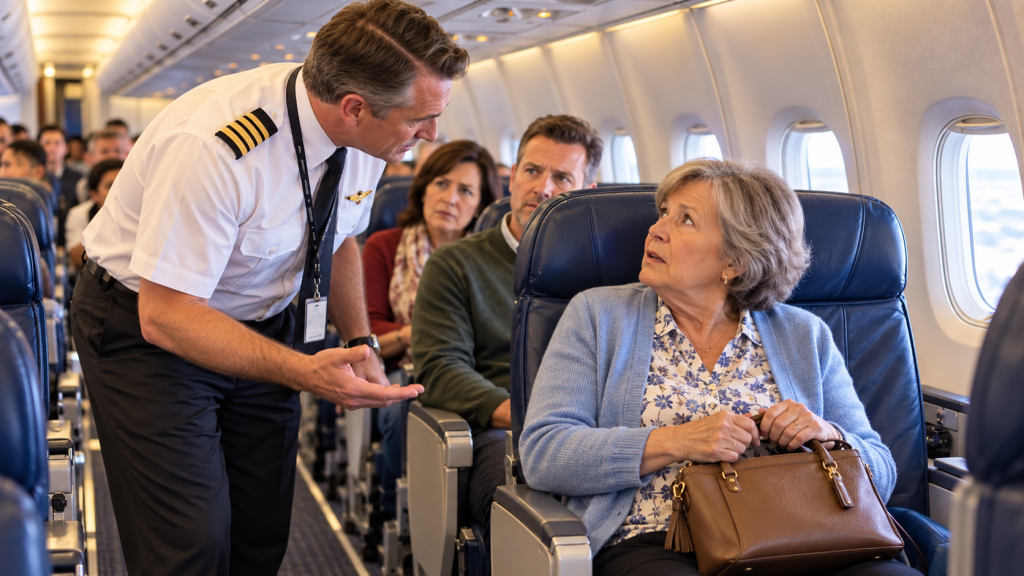
Grandma’s face changed. “Adrian?” He smiled faintly. “My father named me after his grandfather, but yes.” Her hand flew to her mouth. “You’re Daniel’s boy.” Captain Mercer’s eyes filled. “I’m the baby he almost missed being born.” Grandma started crying before I understood.
I crouched in the aisle beside her.
“What does that mean?”
Captain Mercer looked at Grandma first, silently asking permission.
She gave the smallest nod.
He turned to me.
“My father was supposed to fly with your grandfather on June seventeenth, 1996.”
Three days after the date printed on the faded boarding pass.
“But my mother went into labor early that morning.”
Grandma whispered:
“Thomas told him to go.”
Adrian nodded.
“My father refused at first.”
“He said the aircraft needed two experienced test pilots.”
“But Captain Walsh told him, ‘Airplanes will still be here tomorrow. Your first child won’t be born twice.’”
Adrian smiled through tears.
“My father went to the hospital.”
“I was born at 2:41 that afternoon.”
My stomach tightened.
“What happened to Grandpa?”
Adrian looked at Grandma.
She shut her eyes.
Then answered herself.
“The airplane went down at 4:18.”
I stared at her.
All my life, Grandpa Thomas had existed only in photographs.
A tall man with a broad smile.
A pilot’s cap.
One picture of him holding my mother as a little girl.
Another beside Grandma at Christmas.
The official family story had always been simple.
Grandpa died in a car accident before I was old enough to remember him.
Except now Grandma was sitting in seat 34A holding a twenty-seven-year-old boarding pass while an airline captain told me my grandfather had died in an airplane.
“Why did you tell us it was a car accident?”
I whispered.
Grandma looked at me.
Shame moved across her face.
“Because I couldn’t bear telling the story.”
“That isn’t the same thing.”
“I know.”
“For twenty-seven years?”
“I know.”
I wanted to be angry.
Part of me was.
But then I looked at her hands.
At eighty years old, they were shaking like the hands of someone much younger who had just received terrible news.
Maybe some grief never ages with the body.
Captain Mercer glanced toward the cockpit.
“I can’t stay long.”
He held out the envelope.
“But my father made me promise.”
Grandma stared at it.
“You carried that with you?”
“Every flight.”
My eyes widened.
Adrian smiled sadly.
“Not literally the same envelope in my pocket every day.”
“He kept it in a fireproof case.”
“When he got sick, he gave it to me.”
“That was eleven years ago.”
“Since then, I’ve kept it in my flight bag.”
“Why?”
I asked.
“Because my father thought Evelyn Walsh might eventually come west again.”
Grandma began crying harder.
“You’ve been waiting eleven years?”
“My father waited sixteen before me.”
That silenced me.
Twenty-seven years.
Two generations waiting for one woman to sit in one particular seat.
Grandma reached for the envelope.
Then stopped.
Her hand hovered above it.
“I don’t know if I can.”
Adrian’s expression softened.
“You don’t have to open it here.”
Grandma looked toward the window.
Clouds stretched beneath us like snow-covered fields.
“Thomas told me I would know when.”
“What did he tell you?”
I asked.
She touched the old boarding pass.
“On our last trip together, he wrote something on the back.”
She turned it over.
I had only seen the printed front.
On the reverse, written in faded blue ink, were two lines.
If the truth ever becomes heavier than the grief, fly west.
Sit in 34A. Daniel will know.
A chill ran over my skin.
“He knew something was going to happen?”
I asked.
Captain Mercer answered carefully.
“He knew something might.”
Grandma looked at him.
“So Daniel found it.”
“Yes.”
“The report?”
Adrian’s jaw tightened.
“Some of it.”
Grandma closed her eyes.
“I knew it.”
I stared between them.
“Knew what?”
Captain Mercer stood.
“I really do have to get back.”
“But after we land, please don’t leave the gate.”
He looked at Grandma.
“There are things my father kept.”
“Copies.”
“Photographs.”
“Maintenance notes.”
Grandma’s face drained.
“You brought them?”
“Not on the aircraft.”
“My sister has the originals.”
“She’s meeting us in California.”
I stood.
“Why?”
Adrian looked at me.
“Because when my father died, he left instructions for both of us.”
“What instructions?”
“To finish what Captain Walsh started.”
Then he walked back toward the cockpit.
I remained in the aisle.
Completely frozen.
Grandma stared at the sealed letter resting in her lap.
Passengers slowly returned to their books, phones, and headphones.
But the cabin did not feel normal again.
Neither did my grandmother.
Neither did I.
I sat in the empty aisle seat beside her after the passenger who had been sitting there quietly offered to swap with me.
“Stay with her.”
the woman whispered.
I thanked her.
Then turned toward Grandma.
“Open it.”
Grandma shook her head.
“Not yet.”
“You waited twenty-seven years.”
“Exactly.”
She pressed the envelope against her chest.
“Another hour won’t kill me.”
I wanted to ask a thousand questions.
Why had Grandpa thought something might happen?
What report?
Why did Grandma know enough to be frightened but not enough to know the truth?
Why had Daniel Mercer’s children inherited evidence?
Why did seat 34A matter beyond one old memory?
Instead, I asked the simplest question.
“Why California?”
Grandma looked out the window.
“Because that’s where your grandfather was going when we sat here the last time.”
“You were on the same flight?”
“Yes.”
“Together?”
“Not exactly.”
She smiled sadly.
“Your grandfather was working.”
I waited.
Grandma ran one thumb along the boarding pass.
“Thomas had been a commercial pilot for twenty-two years.”
“By 1996, he was one of the company’s senior training captains.”
“He taught younger pilots how to handle difficult aircraft.”
“He loved it.”
“He said flying a plane was easy when everything worked.”
“The real job started when something didn’t.”
That sounded like the man in the photographs.
Steady.
Confident.
Grandma continued.
“Three weeks before his death, one particular aircraft began having problems.”
“What kind?”
“The nose would pitch unexpectedly.”
My stomach tightened.
“While flying?”
“Yes.”
“He said it happened twice.”
“Both times, crews recovered.”
“Maintenance inspected everything.”
“Nothing obvious.”
“So they kept flying it?”
She nodded.
“Thomas hated that.”
“He believed something was wrong in the stabilizer system.”
“What’s that?”
“The part that helps control the plane’s pitch.”
I knew enough to understand the implications.
“If it failed…”
“You could lose control.”
Grandma’s fingers tightened.
“Thomas filed reports.”
“So did another pilot.”
“Maintenance replaced a component.”
“The problem disappeared.”
“For a little while.”
She swallowed.
“Then it happened again.”
I stared.
“What happened on June fourteenth?”
“Our last flight together.”
Her voice softened.
“I was flying to California to visit my sister.”
“Thomas was operating the flight.”
“The airline still allowed family standby travel back then, but the plane was packed.”
“The only seat left was 34A.”
She almost smiled.
“I complained.”
“You?”
She gave me an offended look.
“I was sixty-three, not a saint.”
Despite everything, I laughed.
“So Grandpa told you to take it?”
“He came back before departure.”
“Leaned over.”
“Kissed my forehead.”
“And said, ‘Thirty-four A is better than no California.’”
Her smile disappeared.
“During that flight, there was another control problem.”
My laughter died.
“With you onboard?”
“Yes.”
“What happened?”
“Most passengers never realized.”
“Thomas and Daniel did.”
“After landing, Thomas found me at the gate.”
“He was pale.”
“I had almost never seen him afraid.”
Grandma looked down.
“He told me the aircraft had pitched nose-down unexpectedly during descent.”
My chest tightened.
“Did anyone get hurt?”
“No.”
“He and Daniel recovered.”
“They landed normally.”
“But Thomas said he was done.”
“Done flying?”
“Done pretending the problem had been fixed.”
Grandma touched the handwritten message on the back of the boarding pass.
“He grounded the aircraft himself.”
“Can a captain do that?”
“He wrote it up so strongly that maintenance couldn’t simply turn it around.”
“He demanded a full inspection.”
“And?”
“Management was furious.”
“Why?”
“Money.”
One word.
Old problem.
Grandma continued.
“Summer schedule.”
“Full flights.”
“A plane sitting on the ground costs money.”
“Thomas said they pressured maintenance to clear it.”
“Daniel agreed with Thomas that more testing was needed.”
“What did Grandpa do?”
“He volunteered to fly a non-passenger test.”
My blood went cold.
“The plane that crashed?”
She nodded.
“Why would he do that?”
Her eyes flashed.
“Because the alternative was letting it carry passengers.”
That silenced me.
Grandma looked toward the cockpit.
“Thomas told me there was a morning flight scheduled after the test.”
“One hundred and forty people.”
“He said if that aircraft was going back into passenger service, he wanted to know what it would do first.”
My throat tightened.
“Did he know it might crash?”
“No.”
She shook her head firmly.
“He knew testing carried risk.”
“That is different.”
“Don’t turn bravery into a death wish.”
The correction was sharp.
I nodded.
She softened.
“Sorry.”
“No.”
“You’re right.”
She continued.
“The plan was simple.”
“Take the aircraft up with a small crew.”
“Reproduce the conditions.”
“Return.”
“Maintenance would collect data.”
“Except Daniel’s wife went into labor.”
“Thomas told him to leave.”
“And then?”
“Another pilot went.”
Grandma closed her eyes.
“Samuel Price.”
“Thirty-nine.”
“Two children.”
“Flight engineer Martin Cole.”
“Forty-five.”
“Thomas.”
“All three died.”
I stared at her.
“You remember all their names.”
“I have never forgotten them.”
The plane hit mountainous terrain east of Sacramento after a sudden loss of pitch control.
The official investigation took fourteen months.
Grandma remembered every day.
“Did they determine what happened?”
I asked.
Her jaw tightened.
“The report said probable pilot error compounded by improper trim management.”
I stared.
“Pilot error?”
“Yes.”
“Grandpa was blamed?”
“Not entirely.”
“But enough.”
I felt anger rise.
“But he had reported the problem.”
“Those reports were in the record.”
“Some.”
That word again.
Some.
“What was missing?”
Grandma looked at the envelope.
“That is what I came to find out.”
For the next thirty minutes, neither of us spoke.
Then the seat-belt sign came on.
We were beginning descent.
Grandma still had not opened Thomas’s letter.
I thought she might wait until we landed.
Then turbulence shook the cabin.
Nothing serious.
Just enough to make glasses rattle.
Grandma’s fingers clamped around the armrest.
I put my hand over hers.
“You okay?”
She stared ahead.
“I haven’t flown since his funeral.”
Of course.
Thirty years, she had said.
Almost exactly.
“Why now?”
She looked at me.
“Because I turned eighty.”
I waited.
She gave a tiny smile.
“Eighty is a ridiculous age to keep being afraid of a dead man’s instructions.”
Despite myself, I laughed.
Then she looked down at the envelope.
“And because Daniel died.”
“How did you know?”
“His obituary.”
“You kept track of him?”
“From a distance.”
“Why didn’t you contact him?”
“Because I was angry.”
“At Daniel?”
“At everyone.”
She closed her eyes.
“The airline.”
“The investigators.”
“Thomas.”
I stared.
“Grandpa?”
“Yes.”
“For dying.”
Her voice broke.
“Grief is not fair.”
“You get angry at the person who left even when you know they didn’t choose it.”
I squeezed her hand.
Grandma whispered:
“Daniel wrote me twice.”
“What did he say?”
“That he had things Thomas wanted me to know.”
“That he believed the investigation was wrong.”
“Why didn’t you answer?”
“I couldn’t.”
“Then why seat 34A now?”
“Because Daniel’s second letter said one sentence.”
“What?”
She looked toward me.
“Whenever you are ready, Thomas left the path back to him on the boarding pass.”
My eyes filled.
“You still had it.”
“Always.”
She touched the purse.
“That’s why I kept these wings too.”
“The silver ones?”
“They were Thomas’s first airline wings.”
Captain Mercer had recognized them because Daniel apparently had a photograph.
Grandma had carried them for twenty-seven years without explanation.
I had seen them at birthday parties.
Funerals.
Thanksgivings.
Grocery stores.
An entire history clipped beside a zipper.
The plane touched down in California just after four in the afternoon.
When the wheels struck the runway, Grandma gasped.
Then started crying.
I thought she was frightened.
She shook her head.
“Last time I landed here, Thomas was alive.”
I had no answer.
As we taxied toward the gate, Captain Mercer’s voice came over the speaker.
“Ladies and gentlemen, welcome to California.”
Normal announcement.
Weather.
Local time.
Seat belts.
Then he paused.
“There is also one passenger onboard today whom I would like to welcome back after a very long absence.”
Grandma froze.
He did not name her.
Good.
“This flight means something special to our crew.”
“Sometimes aviation is measured in miles, altitude, and time.”
“But sometimes it is measured in the people who trust us to bring them home.”
His voice cracked almost imperceptibly.
“Today, we are honored to have one of those people flying with us again.”
A few passengers looked toward Grandma.
Someone began clapping.
Then another.
Grandma shook her head.
“No.”
She hated attention.
Naturally.
But the applause spread.
Quiet.
Respectful.
Grandma covered her face.
When we reached the gate, passengers began disembarking.
Several stopped.
One older man touched Grandma’s shoulder.
“Welcome back.”
A woman said:
“Your husband sounds like he was brave.”
Grandma thanked them.
Then we waited.
Last off.
Captain Mercer met us at the aircraft door.
Without his cap, he looked less like an authority figure and more like somebody’s son.
“Ready?”
he asked.
Grandma held the unopened envelope.
“No.”
Adrian smiled.
“Good.”
“What?”
“My father used to say anyone who claims they’re ready for the important things is probably lying.”
Grandma laughed.
“That sounds like Daniel.”
We walked up the jet bridge.
At the gate stood a woman in her late fifties.
Silver-streaked hair.
Brown coat.
She held an old cardboard archive box.
When she saw Grandma, she started crying.
“Mrs. Walsh?”
Grandma stopped.
The woman placed the box on a chair.
“My name is Rebecca Mercer.”
“Daniel’s daughter.”
Grandma’s lips trembled.
“You have his eyes.”
Rebecca laughed through tears.
“Everybody says I have Mom’s.”
“Your mother didn’t spend enough time arguing with your father.”
Rebecca stepped forward.
“Can I hug you?”
Grandma nodded.
They embraced.
I watched Captain Mercer turn away to wipe his eyes.
Rebecca whispered:
“My father waited a very long time for this.”
Grandma pulled back.
“So did I.”
We moved into a quiet airline conference room.
No press.
No airport executives.
Just us.
Adrian.
Rebecca.
Grandma.
Me.
And the box.
Rebecca placed it on the table.
“My father collected everything he could after the crash.”
“Copies of Thomas’s reports.”
“Letters.”
“Maintenance notes.”
“Photographs.”
“Correspondence with investigators.”
“Some of it eventually became public.”
“Some didn’t.”
Grandma stared.
“Why didn’t he send it?”
“He tried.”
Rebecca looked uncomfortable.
“Twice.”
“I know.”
“He respected your silence after that.”
“Then Dad found Thomas’s letter.”
Grandma looked at the envelope.
“When?”
“Not immediately.”
Rebecca opened the archive box.
Inside was a small leather flight case.
“Thomas left this in my father’s locker the morning of the test flight.”
Grandma whispered:
“Why?”
“Because Dad was supposed to fly with him.”
Rebecca touched the case.
“When Dad came back to work after I was born, Thomas was already dead.”
“His locker had been cleared.”
“But this case had been placed inside Dad’s.”
“There was a note.”
She handed Grandma a photocopy.
Thomas’s handwriting.
Daniel,
If this test goes badly, don’t let them turn us into fools.
The reports are copied. Keep one set.
Evelyn has the boarding pass. If she ever uses it, give her the letter. Not before.
She deserves the choice to reopen this.
And if your kid arrives before you’re back, tell him I expect a decent middle name.
Adrian laughed softly.
“My middle name is Thomas.”
Grandma broke.
She pressed both hands over her mouth.
Captain Adrian Thomas Mercer looked down.
“My father said that was non-negotiable.”
Grandma reached for him.
He came around the table.
She hugged him.
Not ceremonially.
Like family.
“I’m sorry.”
she whispered.
“For what?”
“I didn’t answer your father.”
Adrian held her carefully.
“He never blamed you.”
Rebecca nodded.
“He said grief makes people protect whatever is left.”
Grandma cried harder.
When she sat again, she finally touched the envelope.
I watched her break the seal.
The paper inside was thin.
Three pages.
Thomas’s handwriting.
Still dark.
Grandma unfolded them.
She tried to read.
Couldn’t.
She handed them to me.
“You.”
I stared.
“Grandma—”
“Please.”
My hands trembled.
I began.
“Evie.”
Grandma closed her eyes.
Nobody called her Evie anymore.
I continued.
“If you are reading this, then something happened on the test flight and you eventually became brave enough—or angry enough—to sit in 34A again.”
Grandma laughed through tears.
“That man.”
I read on.
“I am writing this because there is a difference between going to work and choosing danger, and I do not want you spending the rest of your life believing I wanted to be heroic.”
“I do not.”
“I want to come home.”
Grandma folded forward.
Rebecca reached for her hand.
I kept reading.
“The aircraft has an intermittent pitch problem.”
“We have reproduced enough of it to know maintenance has not found the real cause.”
“I have grounded it twice.”
“There is pressure to return it to service.”
“I will not put passengers on it until I understand what it is doing.”
“Tomorrow, Daniel and I are scheduled to take it up empty except for the test crew.”
“If his baby comes, I am sending him home.”
Adrian smiled through tears.
“He knew.”
I continued.
“If something happens, people may call it pilot error because pilots are the easiest part of an accident to bury.”
“Do not believe any report simply because it uses official language.”
My throat tightened.
“I made mistakes in thirty-one years of flying.”
“I am sure I will make more.”
“But I know what this airplane has been doing.”
“And Daniel knows.”
“Copies are in his hands.”
Grandma whispered:
“They blamed him anyway.”
I continued.
“Evie, I need you to understand one more thing.”
“I did not take this flight because I loved airplanes more than I loved you.”
“I took it because tomorrow morning that aircraft is scheduled to carry one hundred and forty-two people to Denver.”
“If it is safe, we will prove it.”
“If it is not, better three trained crew members learn that than one hundred and forty-two families.”
Grandma made a sound somewhere between a sob and a protest.
“No.”
I stopped.
She shook her head.
“He shouldn’t have written that.”
Rebecca whispered:
“Why?”
“Because that is exactly the kind of sentence that lets dead men sound noble while their wives have to live afterward.”
The room went still.
Grandma wiped her eyes angrily.
“I hate him for that sentence.”
Nobody corrected her.
Good.
Grief deserves room for anger.
I waited.
Grandma nodded.
“Keep going.”
I read.
“You will be angry.”
“You should be.”
“If I come home, burn this and tell me I’m an arrogant idiot.”
A laugh broke through Grandma’s tears.
I continued.
“If I don’t, do not make a shrine of me.”
“Travel.”
“Remarry if you want.”
“Complain about my shirts.”
“Tell our daughter I snored.”
“I do not want death to turn me into a better man than I was.”
Grandma laughed loudly.
“Oh, Thomas.”
I was crying too.
“Seat 34A is not sacred.”
“It is only where you sat the last time I looked back through a cabin and found you.”
“I need you to remember that.”
“I always looked back.”
Grandma pressed a fist to her lips.
“And if someday you return there, it should not be because you are waiting for me.”
“It should mean you finally stopped.”
Silence.
I could barely see the page.
The letter ended:
“Daniel will know what to do with the reports.”
“Trust him when you can.”
“Forgive me when you want.”
“Not before.”
“I love you.”
“Thomas.”
Nobody spoke.
The airport outside continued functioning.
Announcements.
Rolling bags.
Boarding calls.
Somewhere, thousands of people were leaving and arriving.
Inside the conference room, twenty-seven years collapsed.
Grandma took the letter.
She read the final lines herself.
Then she folded it.
Not carefully.
Just enough.
“I wasted twenty-seven years.”
she whispered.
I grabbed her hand.
“No.”
“Yes.”
“I stayed angry.”
“You lived.”
“I stopped flying.”
“So?”
“I stopped going places Thomas and I planned.”
“Grandma.”
She looked at me.
“I told myself I didn’t care.”
“But I did.”
“I never went back to California.”
“I never saw Daniel again.”
“I let the report be the last word because fighting it meant reliving everything.”
Rebecca opened the archive box.
“Then maybe it’s time you see what Dad did with those years.”
She took out a thick binder.
On the front:
WALSH / PRICE / COLE – FLIGHT 714 TEST ACCIDENT
Grandma stared.
“Dad spent sixteen years trying to reopen the technical findings.”
Rebecca said.
“Did he?”
I asked.
“Eventually.”
Adrian sat.
“Eight years after the crash, a retired maintenance supervisor contacted him.”
Grandma’s face changed.
“Who?”
“Raymond Ellis.”
She knew the name.
I could tell.
“He signed the release.”
Grandma whispered.
Adrian nodded.
“He had supervised the maintenance inspection before the test flight.”
“What did he say?”
Rebecca opened the binder.
“He admitted technicians had found metal contamination inside part of the horizontal stabilizer trim actuator.”
I did not understand every word.
Grandma did.
Her face drained.
“They found it.”
“Yes.”
“Before the test?”
“Yes.”
Grandma stood so quickly her chair rolled backward.
“They found it before Thomas took that airplane up?”
Rebecca’s eyes filled.
“Yes.”
Grandma pressed both hands to the table.
“Then why…”
Adrian answered.
“The maintenance team initially believed the contamination came from normal wear.”
“Management wanted the aircraft available.”
“They cleaned the assembly.”
“Ran ground tests.”
“It passed.”
“Captain Walsh refused to accept that as sufficient.”
“So the test flight still happened.”
“Yes.”
“But the original maintenance worksheet noting the metal contamination was not included in the first investigation package.”
Silence.
My stomach turned.
“Was it hidden?”
I asked.
Rebecca spoke carefully.
“That became the question.”
The suspense suddenly shifted from family grief to something darker.
“Dad believed it was intentionally omitted.”
“He could never prove who made that decision.”
“Raymond Ellis said he was instructed to replace the worksheet with a clean summary.”
“By who?”
Grandma asked.
“A regional maintenance director named Charles Varden.”
Grandma looked like she had been punched.
“You know him?”
I asked.
“He sat in my kitchen.”
My skin went cold.
“What?”
“Two weeks after the funeral.”
Grandma’s voice became distant.
“He brought flowers.”
“He told me Thomas had been one of the best.”
“He said accidents sometimes happen when even good pilots misread unusual situations.”
Her hands shook.
“He sat in my kitchen and let me believe Thomas caused it.”
Rebecca nodded sadly.
“My father confronted Varden.”
“What happened?”
“He denied everything.”
“Raymond would not sign an affidavit then.”
“He was afraid of losing his pension.”
“So nothing changed?”
“Not then.”
“Years later, Raymond became ill.”
“He contacted Dad.”
“This time, he signed.”
Adrian opened another folder.
“There had also been two prior write-ups involving uncommanded trim movement that were coded under separate maintenance categories.”
“When investigators reexamined everything together, the pattern became clearer.”
“Did they reopen the crash?”
“Not a full public reinvestigation.”
Rebecca answered.
“But the airline’s insurer and federal safety office reviewed supplemental evidence.”
“An amended technical memorandum was issued.”
“What did it say?”
Adrian looked at Grandma.
“That mechanical failure was the most probable initiating event.”
Grandma sat.
Hard.
“They cleared Thomas?”
“Not in headlines.”
Rebecca said.
“Not the way Dad wanted.”
“But yes.”
“The later review concluded the crew’s response was consistent with a sudden stabilizer trim malfunction.”
“Captain Walsh was not found to have caused the initial upset.”
Grandma cried silently.
Twenty-seven years.
A man blamed enough to stain his death.
Then quietly corrected in paperwork most people never read.
“That’s not enough.”
I said.
Everyone looked at me.
I surprised myself.
“It’s not enough.”
“They blamed him publicly?”
Rebecca nodded.
“Then they corrected it quietly?”
“Yes.”
“That’s cowardly.”
Grandma touched my wrist.
“Sweetheart.”
“No.”
I looked at her.
“You spent decades thinking he crashed that plane.”
“I thought…”
She stopped.
Then whispered:
“I thought maybe he had been too proud.”
“What?”
“The official report said he overcorrected.”
“That he insisted on a test profile that was too aggressive.”
“I spent years wondering whether Thomas’s stubbornness killed three men.”
My heart broke.
“That is what they left you with.”
“Yes.”
Adrian’s jaw tightened.
“My father felt the same.”
“About himself?”
“He wasn’t on the flight.”
“But he helped plan the test.”
“He spent years thinking if he had stayed instead of going to the hospital, maybe the outcome would have been different.”
Rebecca whispered:
“Dad loved us.”
“But every birthday Adrian had was tied to the day Thomas died.”
Adrian looked down.
“That is a strange thing to grow up with.”
“I was celebrated and mourned on the same date.”
Grandma reached across the table.
“You were a baby.”
“I know.”
“My father eventually knew too.”
“Thomas told him to leave.”
“He spent years trying to honor that.”
I looked around the table.
An old widow.
A captain born on the day another captain died.
A daughter who inherited boxes of evidence.
And me.
The granddaughter who thought she bought an eighty-year-old woman a comfortable vacation.
I had no idea what I had actually bought.
A route back.
Rebecca pulled out a photograph.
Black and white.
Three men beside an aircraft.
Thomas.
Daniel.
Samuel Price.
Grandma touched Grandpa’s face.
“He hated that tie.”
Adrian laughed.
“My father said he wore it because you bought it.”
“I did.”
“He lied and said he liked it.”
“Marriage.”
she said.
We laughed.
Small.
Necessary.
Then Rebecca removed another envelope.
“This is for you too.”
Grandma stared.
“From Thomas?”
“No.”
“From my father.”
The handwriting was different.
Daniel Mercer.
Grandma hesitated.
Then opened it herself.
She read silently at first.
Then aloud.
“Evelyn.”
“I failed Thomas in one way.”
“I let respect for your grief become an excuse to stop trying.”
Grandma’s eyes filled.
“I told myself you had chosen silence.”
“Maybe you had.”
“But Thomas gave me evidence because he wanted the truth protected, not buried politely.”
She stopped.
Rebecca whispered:
“Keep going.”
Grandma did.
“When Raymond finally came forward, I wanted to call you immediately.”
“I didn’t.”
“I was afraid you would hang up.”
“That was cowardice.”
“I cannot ask Thomas whether he forgives me.”
“So I am asking you.”
Grandma closed her eyes.
“He always blamed himself too much.”
Adrian smiled.
“Yes.”
Grandma continued.
“The revised findings are enclosed.”
“Thomas did not lose control because he was reckless.”
“The aircraft failed in the way he had warned it might.”
“He and the crew kept it away from a populated valley long enough to prevent casualties on the ground.”
“They did not save themselves.”
“They did save others.”
My throat tightened.
Grandma whispered:
“Others?”
Adrian nodded.
“The flight path.”
“The aircraft initially began descending toward a suburban area.”
“Investigators later reconstructed control inputs.”
“Thomas and Samuel managed a partial turn toward open terrain.”
Grandma covered her mouth.
“I didn’t know.”
“No.”
Rebecca said.
“Dad wanted you to.”
Grandma read the final paragraph.
“I named my son Adrian Thomas because your husband sent me home to meet him.”
“My daughter Rebecca became an engineer because she wanted to understand the machines that took him.”
“We built our family in the shadow of a debt Thomas never asked us to repay.”
“I hope you come back someday so I can tell you this myself.”
“If I am gone, my children will.”
“They know the story.”
“Seat 34A.”
“The silver wings.”
“Everything.”
“Daniel.”
Grandma folded the letter.
For a long time, she said nothing.
Then:
“I was so angry at him.”
“At Daniel?”
“Yes.”
“Because he survived.”
The honesty shocked me.
Grandma nodded.
“I know how ugly that sounds.”
“No.”
Adrian said quietly.
“My father knew.”
Grandma looked at him.
“He did?”
“Yes.”
“He told me once that survivor’s guilt is hard, but survivor’s blame is worse because nobody admits it exists.”
Grandma cried.
“I hated seeing him with his children.”
“Thomas didn’t get to grow old.”
“Daniel did.”
“I thought that was unfair.”
“It was.”
Rebecca said.
Grandma looked at her.
“You’re allowed to say that?”
“Yes.”
“My father said it too.”
Silence.
Then Grandma began laughing through tears.
“Thomas would hate all of us sitting around making him noble.”
Adrian smiled.
“He explicitly requested otherwise.”
“That letter was very clear.”
Grandma wiped her face.
“Good.”
She stood.
“Then I would like a drink.”
Rebecca blinked.
“Now?”
“I waited twenty-seven years.”
“I’m not processing this sober.”
Even Adrian laughed.
We spent the evening in a quiet hotel restaurant near the airport.
Grandma drank one glass of red wine.
Then half of another.
She talked more than I had heard her talk about Grandpa in my entire life.
Not about the crash.
About him.
Real him.
Thomas Walsh hated olives.
He sang badly.
He once forgot their anniversary but remembered the registration number of every aircraft he had flown that month.
He cried when my mother was born.
He refused to ask for directions.
He made pancakes shaped like airplanes.
He bought Grandma the same perfume for twelve straight years because he thought having one successful gift idea meant he had solved birthdays permanently.
“He sounds annoying.”
I said.
Grandma pointed her wineglass.
“Extremely.”
She was smiling.
That was the first time Grandpa became human for me.
Not dead pilot.
Not photograph.
Not secret.
A husband who lied about liking ties.
That night in the hotel, Grandma finally told me the rest of her own secret.
We sat on neighboring beds.
The old purse between us.
“I received a settlement after the crash.”
she said.
I looked at her.
“From the airline?”
“Yes.”
“Was that why you couldn’t talk?”
“Partly.”
“There was a confidentiality clause.”
“That sounds suspicious.”
“It was common in settlements.”
“Did they buy your silence?”
Grandma thought.
“I used to say yes.”
“Now?”
She looked at me.
“I think I sold it because silence was easier.”
That was harder.
“I was exhausted.”
“Your mother was twenty-two.”
“She had just married your father.”
“I had a mortgage.”
“No Thomas.”
“Lawyers told me fighting could take years.”
“The airline offered enough that I would never worry about losing the house.”
“So I signed.”
“Did you know about the missing maintenance report?”
“No.”
“If I had, I would not have signed.”
She stared at her hands.
“When Daniel wrote years later saying he believed evidence had been excluded, I thought he was trying to drag me back into a fight I had barely survived.”
“So I ignored him.”
“You were protecting yourself.”
“Yes.”
“Maybe.”
She looked at me.
“But self-protection can become a habit long after the danger ends.”
That line stayed with me.
The next morning, we met Adrian and Rebecca again.
Rebecca had arranged something.
She would not tell us what.
We drove east.
About an hour.
Then another.
Grandma became quieter as mountains appeared.
Finally, the car turned onto a small road leading to a memorial overlook.
A plaque stood beside a trail.
Grandma stopped walking.
“What is this?”
Adrian answered.
“The accident site is several miles beyond public access.”
“But this memorial was installed fifteen years ago.”
“For all three crew members.”
Grandma stared.
“You knew?”
“No.”
Of course she didn’t.
The plaque listed:
CAPTAIN THOMAS J. WALSH
CAPTAIN SAMUEL PRICE
FLIGHT ENGINEER MARTIN COLE
Below:
Their actions during the final minutes of Flight 714 prevented loss of life on the ground and contributed to safety improvements in aircraft trim-system inspection.
Grandma touched Thomas’s name.
“They fixed it.”
Rebecca nodded.
“After the supplemental review.”
“They changed inspection procedures.”
“Modified components.”
“Added reporting requirements.”
“So Thomas’s reports mattered.”
“Yes.”
Grandma closed her eyes.
For decades, she thought his death ended in blame.
Now she stood before proof that his warnings changed something.
Not enough to bring him home.
Enough to keep the loss from being useless.
She sat on the bench.
I gave her space.
Adrian stood several feet away.
Then Grandma called him.
“Come here.”
He did.
She took the silver pilot wings from her purse.
The wings that had hung there my entire life.
She placed them in his palm.
Adrian immediately shook his head.
“No.”
“Yes.”
“Mrs. Walsh—”
“Evelyn.”
“Evelyn, these are Thomas’s.”
“I know.”
“They belong to you.”
“They belonged to him.”
“Then me.”
“Now you.”
Adrian’s eyes filled.
“I can’t take these.”
“You carried his letter eleven years.”
“Your father carried his truth sixteen.”
She closed Adrian’s fingers around the wings.
“You can carry something smaller now.”
He cried.
So did Rebecca.
So did I.
Apparently our family had become a public water feature.
Adrian looked down at the wings.
“I’ll keep them safe.”
Grandma shook her head.
“No.”
He looked up.
“Use them.”
“What?”
“Don’t put them in a box.”
“Don’t turn Thomas into a museum.”
“He specifically told me not to.”
Adrian laughed through tears.
“What would you like me to do?”
“Clip them somewhere you can see them.”
“And when a young pilot gets too confident, tell them about the old man who grounded an aircraft because something felt wrong.”
Adrian smiled.
“I can do that.”
Grandma looked toward the memorial.
“Good.”
Then she whispered:
“Thomas, you dramatic bastard.”
Rebecca laughed so hard she had to turn away.
On the flight home three days later, I tried to upgrade Grandma again.
She refused.
Of course.
“What seat do you want?”
I asked.
She looked at her boarding pass.
“Anything but 34A.”
That surprised me.
“Why?”
“Because Thomas told me not to wait for him there.”
My throat tightened.
The gate agent gave us two seats together in row twenty-one.
Middle and aisle.
Grandma took the middle without complaint.
A miracle.
Before boarding, she purchased a ridiculous airport neck pillow.
Bright blue.
Thomas would probably have mocked it.
We boarded.
As we passed first class, Grandma looked at me.
“You spent too much money on that seat.”
“I know.”
“Did you get a refund?”
“Travel credit.”
“Good.”
“Why?”
“We’re going somewhere next year.”
I stared.
“Where?”
“Italy.”
“What?”
“Thomas and I planned it for our twenty-fifth anniversary.”
“We never went.”
My eyes filled.
Grandma frowned.
“Don’t start crying.”
“I’m not.”
“You absolutely are.”
I laughed.
“Fine.”
She squeezed my hand.
“Book economy.”
“Absolutely not.”
“Then premium economy.”
“Negotiable.”
“Good.”
She smiled.
That was how I knew something had changed.
Not because she had solved grief.
Because she had made a future plan.
The story did not end there.
Old secrets rarely close neatly once opened.
A month later, Adrian called.
Grandma answered on speaker because apparently I had become involved forever.
“Evelyn.”
“Yes?”
“I received a call from the airline’s historical department.”
Grandma rolled her eyes.
“That sounds boring.”
“It might not be.”
“What?”
“They want permission to include Thomas’s letter and Daniel’s documents in the company safety archive.”
Grandma became quiet.
“Public?”
“Partly.”
“They want to create an internal training case about speaking up on maintenance concerns.”
Grandma looked at me.
“What do you think?”
I almost answered.
Then stopped.
She noticed.
“Good.”
“What?”
“You didn’t tell me.”
I smiled.
“Your decision.”
Her expression softened.
“Yes.”
She told Adrian:
“Use the technical material.”
“What about Thomas’s private letter?”
“No.”
“Understood.”
Then she reconsidered.
“One line.”
“Which?”
Grandma looked toward the window.
“Do not believe any report simply because it uses official language.”
Adrian was quiet.
Then:
“That’s a good line.”
“I know.”
“He was irritatingly good when he wanted to be.”
The airline archive accepted the condition.
No private love letter.
No turning grief into corporate inspiration.
Just technical history.
Warnings ignored.
Evidence omitted.
Corrections made.
Lessons carried forward.
Grandma insisted Samuel Price and Martin Cole receive equal attention.
“Thomas was not alone in that cockpit.”
she said.
That mattered.
Several months later, relatives began hearing the true story.
My mother first.
She cried for two hours.
Then got angry.
“Mom, why didn’t you tell me?”
Grandma answered exactly as she had with me.
“Because I couldn’t bear telling the story.”
My mother replied:
“It was my father too.”
That hurt Grandma.
I watched.
Old secrecy produces new injuries even when it began as self-protection.
Grandma did not defend herself.
“You’re right.”
she said.
My mother started crying harder.
“I thought he died on the highway.”
“I know.”
“You let me believe that.”
“Yes.”
“Why?”
Grandma looked at her daughter.
“Because every time you asked how your father died, I saw the aircraft hitting that mountain.”
“I wanted him to die once.”
“Not every time I told you.”
My mother went quiet.
That explanation did not erase the hurt.
But it gave it shape.
They talked for hours.
Not fixed.
Started.
That became the pattern of that year.
Truth did not magically heal everyone.
It gave everyone the right wound.
My mother had spent decades grieving the wrong death.
Grandma had spent decades carrying blame she did not need.
Daniel Mercer had died wishing he had tried harder.
Adrian grew up believing his birthday existed beside a debt.
Rebecca inherited an archive instead of a normal family story.
Now each person could finally place responsibility where it belonged.
The airline had made errors.
Maintenance leadership had made worse ones.
Thomas had chosen risk but not death.
Daniel had chosen his newborn because Thomas told him to.
Evelyn had chosen silence because grief overwhelmed her.
Nobody needed to invent cleaner versions.
A year later, Grandma and I went to Italy.
Premium economy.
She complained about the food.
She flirted shamelessly with an eighty-three-year-old widower from Boston.
She walked through Florence slower than everyone else but refused a wheelchair.
At a small café, she lifted a glass of wine.
“To Thomas.”
I smiled.
“To Grandpa.”
Then she added:
“And to not waiting.”
We drank.
Grandma lived six more years.
Long enough to return to California twice.
Long enough to attend Adrian Mercer’s retirement ceremony.
Long enough to stand beside Rebecca when the airline opened a permanent safety archive carrying the names Walsh, Price, and Cole.
Not a heroic shrine.
A case study.
Human beings.
Warnings.
Mistakes.
Systems.
Consequences.
At Adrian’s retirement dinner, he wore Thomas’s silver wings pinned inside his jacket.
Not on the outside.
Inside.
Grandma noticed.
“I told you not to hide them.”
Adrian laughed.
“They’re touching my heart.”
Grandma stared.
“That is disgustingly sentimental.”
“You started this.”
“I absolutely did not.”
He hugged her.
When Grandma died at eighty-six, we found the old leather purse in her closet.
No silver wings anymore.
The zipper was broken.
The leather soft.
Inside were receipts.
Peppermints.
A tiny bottle of hand lotion.
And the old boarding pass.
34A.
On the back:
If the truth ever becomes heavier than the grief, fly west.
Sit in 34A. Daniel will know.
Grandma had added one line beneath Thomas’s handwriting.
Different ink.
Older hand.
I finally did. You were right. I hate that.
I laughed through tears.
There was also an envelope addressed to me.
I sat on her bedroom floor and opened it.
Sweetheart,
If you are reading this, I have finally managed to become unavailable for travel.
Do not spend too much on my funeral.
I mean it.
You spent enough on the first-class ticket I refused.
I laughed.
Then kept reading.
You were angry when I gave up that seat.
I saw it.
You tried so hard to make my eightieth birthday comfortable.
You thought comfort was the gift.
It wasn’t.
The ticket was.
You gave me a way back to the place I had been avoiding for twenty-seven years.
I did not know Adrian Mercer would be flying.
I did not know Daniel’s children still had the letter.
I knew only what Thomas wrote on that boarding pass.
Sit in 34A.
So I did.
I almost didn’t.
At the gate, I stood there for ten minutes pretending to look at departure screens because I was afraid to ask for the seat.
Then I remembered something.
Fear gets very repetitive when you keep obeying it.
That made me laugh because it sounded exactly like her.
I read on.
There is something I want you to understand.
Do not turn seat 34A into magic.
It was not fate.
It was not your grandfather guiding airplanes from heaven.
It was a seat.
A number.
A promise.
The important part was not sitting there.
The important part was choosing to go somewhere I had avoided.
People love symbols because symbols are easier than decisions.
Do not make that mistake.
If your life ever becomes smaller because you are afraid of one room, one road, one conversation, one memory, or one truth, do not wait twenty-seven years like I did.
Go back when you can.
Not because the past is waiting to change.
It won’t.
Go back because you might.
I stopped reading.
Cried.
Then continued.
Thomas was not waiting in 34A.
Daniel was gone.
The crash still happened.
Nothing was undone.
But I learned the truth, and the truth did something grief could not.
It gave me back the years after.
That is what I want for you.
Not a life without pain.
A life that keeps having an after.
Love,
Grandma.
I folded the letter.
For a long time, I sat beside her old purse.
Then I clipped the boarding pass inside.
Years later, Captain Adrian Mercer invited me to visit the airline archive.
Grandma had been gone three years.
Adrian was fully retired.
Rebecca met us there.
The exhibit was simple.
No dramatic video.
No heroic music.
A photograph of the three crewmen.
Technical diagrams.
Copies of maintenance reports.
A timeline showing repeated trim anomalies.
The omitted worksheet.
The later supplemental finding.
A quotation from Thomas:
I know what this airplane has been doing.
Another from Daniel:
Safety begins when somebody is willing to be inconvenient.
I smiled at that.
Grandma would have liked it.
Then I saw a small display case.
Inside were silver pilot wings.
Thomas’s.
I looked at Adrian.
“I thought Grandma told you not to put them in a box.”
He smiled.
“She did.”
“So?”
“I wore them until I retired.”
“Then I gave them here on one condition.”
“What?”
“That they be removable.”
He opened the case with a key.
Took out the wings.
Pinned them inside his jacket.
“Still carrying them.”
I laughed.
“Good.”
We stood in front of the photograph.
Thomas Walsh.
Samuel Price.
Martin Cole.
All three young forever.
Adrian whispered:
“My dad spent most of his life believing he owed Thomas something.”
“Grandma too.”
“What do you think they owed him?”
I thought.
“Nothing.”
Adrian looked at me.
I continued.
“Maybe remembering accurately.”
“That’s different from debt.”
He smiled.
“I like that.”
“Grandma taught me.”
We walked toward the exit.
Then I noticed a row number painted discreetly on the archive wall.
34A.
I stopped.
Adrian followed my eyes.
“That wasn’t me.”
“Rebecca?”
“No.”
Rebecca grinned.
“Maybe.”
I laughed.
“Grandma would hate that.”
“I know.”
We stood there smiling.
Then I thought about the first-class ticket.
The one I bought because I wanted Grandma’s birthday to feel special.
I thought first class meant more comfort.
A wider seat.
Better food.
A quiet cabin.
I thought generosity meant giving someone the best available place.
Grandma taught me something else.
Sometimes the best seat is not the most expensive one.
Sometimes it is the one attached to the truth you have been avoiding.
She gave up first class because comfort was not what she needed.
She needed 34A.
A cramped economy window.
A faded boarding pass.
A set of silver wings.
And the courage to return to a place she had avoided for nearly three decades.
I had been irritated with her.
Then confused.
Then frightened when a pilot came walking down the aisle searching for her.
By the time we landed, I understood almost nothing.
By the time we returned home, I understood more about my grandmother than I had learned in my entire life.
She had not been fragile.
She had been carrying something heavy.
There is a difference.
For twenty-seven years, she carried grief, anger, doubt, and an unfinished promise inside a brown leather purse.
Then one day, at eighty years old, she decided the truth had finally become heavier.
So she changed her seat.
And everything after that changed with it.
THE END STORIES! THANK YOU FOR READING GOOD LUCK! ❤️
Related Posts