Evelyn’s voice filled the hallway. “The property Chloe tried to reserve is the same house you just bought in cash.” Nobody moved. Marcus still held the fallen page. Chloe stood barefoot beside my bedroom door, her face so pale that even her lipstick seemed too bright.
I rested one hand on the brass key beneath my Bible. For two full years, I had been treated like a woman occupying borrowed space. Now I owned the house they had spent eighteen months describing as the symbol of everything they deserved. And they did not yet know that house represented less than one percent of what had changed in my life.
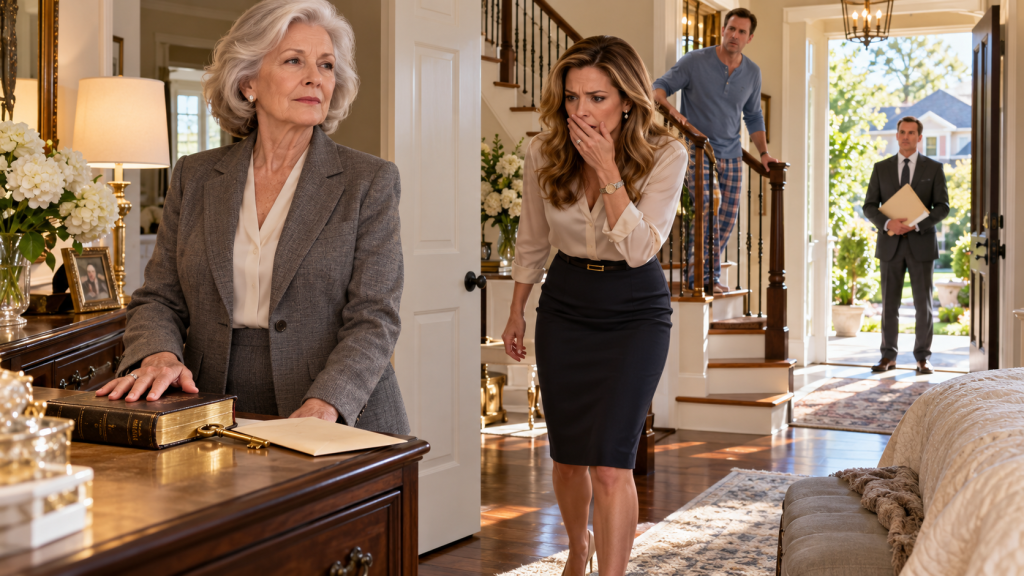
Marcus looked from Chloe to me. “What does she mean, bought?” I answered simply. “I bought a house.” “With what?” I smiled faintly. “My money.” His expression sharpened. “What money?” There it was. Not: Are you happy?
Not:
Why didn’t you tell us?
Not:
Where is it?
The first question was ownership.
I said nothing.
Marcus looked toward my attorney’s voice coming from the phone.
“Who is this?”
Evelyn answered before I could.
“Evelyn Sterling. I represent your mother.”
His jaw tightened.
“Represent her in what?”
“My affairs,” I said.
“What affairs?”
“All of them.”
Chloe finally found her voice.
“This is insane.”
I looked at her.
“Which part?”
“You secretly buying our house.”
I almost laughed.
“Your house?”
“The house we wanted.”
“That is not ownership.”
“You knew.”
“Yes.”
“You knew we loved it.”
“Yes.”
“And you still bought it?”
“Yes.”
Her eyes filled.
Marcus stared at me.
“Why?”
For a moment, I considered giving him the easy answer.
Because you asked me to leave.
Because Chloe called me a financial burden.
Because no one followed me onto the patio.
Because I wanted you to feel small.
That would have made the story simpler.
It would also have been dishonest.
“I bought it because I liked it.”
Marcus blinked.
“That’s it?”
“That is enough.”
Chloe laughed bitterly.
“You’re punishing us.”
“No.”
I picked up the brass key.
“I stopped asking whether my decisions would inconvenience you.”
There is a difference.
A very large one.
The process server cleared his throat.
“I’ll be going.”
Nobody thanked him.
After he left, Marcus shut the front door.
Then turned toward Chloe.
“What did you file?”
“Nothing.”
“You were just served.”
“It’s a civil complaint. It doesn’t mean anything.”
“Why is Mom’s name in it?”
Chloe looked at me.
I could almost see her searching for the correct amount of truth.
Not all of it.
Just enough to survive the next ten minutes.
“I thought Eleanor would help.”
“You thought?”
Marcus held up the page.
“You listed her as a guarantor.”
“I only put her name down during prequalification.”
“With permission?”
Silence.
Marcus looked at me.
I said,
“No.”
Chloe snapped,
“I was going to tell you.”
I laughed softly.
The sentence belonged in a museum.
Every person caught after acting without consent suddenly becomes someone who was just about to ask.
“When?”
Chloe crossed her arms.
“After we had a real chance at the house.”
“You had a real chance without using my name.”
“No, we didn’t.”
Marcus stared at her.
“What does that mean?”
She shut her eyes.
And that was when I knew this was going to become larger than a fake proof-of-funds letter.
I knew that expression.
It was the expression of someone carrying a second lie underneath the first.
Marcus said again,
“What does that mean?”
Chloe whispered,
“We didn’t qualify.”
“For what?”
“The bridge loan.”
He went still.
“What bridge loan?”
Chloe looked toward me.
Then back at him.
“For the down payment.”
Marcus stepped backward.
“You told me your father was helping.”
“He said he would.”
“Did he?”
“No.”
The room changed again.
Marcus ran one hand over his face.
“How much were we short?”
Chloe whispered,
“About two hundred and eighty thousand.”
His mouth opened.
“Two hundred and eighty?”
She began crying.
“The sellers wanted proof of funds immediately.”
“You told me we had it.”
“I thought I could arrange it.”
“How?”
She looked at me.
I already knew the answer.
Marcus did too.
“No.”
Chloe said nothing.
He stared.
“No.”
Then louder:
“You were going to use my mother?”
“I thought she still had money from selling her Savannah house.”
I felt something inside me grow very quiet.
My Savannah house.
The yellow kitchen.
The porch.
The rosebushes.
The place I sold because Marcus told me I would never have to worry about being alone.
The proceeds had been mine.
Most of them remained mine.
I had never discussed the amount.
Apparently Chloe had.
She continued quickly.
“She wasn’t using it.”
I looked at her.
I did not raise my voice.
“Say that again.”
She froze.
“You said I wasn’t using it.”
“I didn’t mean—”
“You did.”
I nodded.
“That is the problem.”
Marcus looked at Chloe as though he had never seen her clearly before.
But I knew better than to let him stand too comfortably on the moral high ground.
He had spent two years watching me become the household’s silent labor.
He had listened while his wife discussed my groceries like a quarterly loss.
He had asked me when I was finally moving out.
He did not get to become innocent because her forgery shocked him.
I turned toward him.
“And what did you know?”
His face changed.
“About what?”
“The house.”
“I knew we couldn’t comfortably afford it yet.”
“That was not my question.”
He looked at Chloe.
Then at me.
“I knew she was trying to find additional financing.”
“Did you know she wanted to use my name?”
“No.”
I believed that part.
But not enough.
“Did you ever ask where the money was coming from?”
He hesitated.
There.
“No.”
“Why?”
He looked down.
“Because I wanted the house.”
Exactly.
Convenient ignorance is not the same as innocence.
Evelyn’s voice came from my phone.
“Eleanor.”
“Yes?”
“We should discuss the rest privately.”
Marcus looked at me sharply.
“The rest?”
I picked up the phone.
“I’ll call you back.”
Then I ended the call.
Marcus stared.
“What rest?”
I slipped the brass key into my blazer pocket.
“You will learn the parts that concern you.”
His face tightened.
“I’m your son.”
“That is a relationship.”
I looked directly at him.
“It is not a financial authorization.”
That sentence hurt him.
I saw it.
Good.
Not because I wanted revenge.
Because some lessons need to reach bone.
I packed that morning.
Not everything.
Just enough.
Two suitcases.
My Bible.
Arthur’s old watch.
Three framed photographs.
My medication.
The small ceramic bird my granddaughter made in third grade.
Marcus followed me upstairs.
“Where are you going?”
“My house.”
“It isn’t closed yet.”
“The seller gave my trust temporary occupancy permission after funds cleared.”
He stared.
“You paid already?”
“Yes.”
“How much?”
I smiled.
“The amount on the contract.”
“Mom.”
“No.”
He blinked.
“What?”
“You are still asking the wrong questions.”
His eyes reddened.
“What am I supposed to ask?”
I zipped the suitcase.
“You could start with whether I’m safe.”
That stopped him.
I carried one bag downstairs.
He took the other.
I did not tell him to.
I did not thank him either.
At the front door, my granddaughter Lily appeared.
She was fourteen.
Quiet.
Observant.
Old enough to understand tension and young enough to still believe adults should make sense.
“Grandma?”
I turned.
“Yes?”
“Are you leaving because of Dad?”
The question broke something.
I looked at Marcus.
He closed his eyes.
I crouched as much as my knees allowed.
“I’m leaving because I bought a home.”
“Are you mad at us?”
“No.”
“At Mom and Dad?”
I looked toward Chloe.
Then back to Lily.
“I’m hurt.”
Lily’s eyes filled.
“Are you coming back?”
“To visit?”
“Yes.”
“If I’m invited.”
She frowned.
“You live here.”
“Not anymore.”
My grandson Noah appeared behind her.
Seventeen.
Tall.
Always pretending not to care.
He looked at my suitcases.
“Did Dad kick you out?”
Marcus said,
“No.”
I answered,
“He asked when I was moving.”
Noah looked at his father.
“That’s basically kicking someone out.”
Marcus flinched.
“Stay out of this.”
“No.”
Noah’s voice cracked.
“You told us Grandma wanted her own place.”
I looked at Marcus.
He had rewritten the dinner already.
I turned back to Noah.
“I did not have plans to move until last night.”
The boy stared at his father.
Marcus whispered,
“I thought it would be better for everyone.”
Noah laughed bitterly.
“Meaning Mom.”
Chloe snapped,
“That is enough.”
But it was not.
Children notice far more than adults think.
They simply do not always have names for what they see.
Lily started crying.
“You said Grandma was expensive.”
Chloe’s face went white.
I stared at her.
Lily covered her mouth.
She had not meant to say it.
I stood slowly.
“Lily.”
She looked terrified.
“It’s okay.”
“No, it isn’t.”
Her voice shook.
“I heard Mom say you cost more than daycare would.”
The room became absolutely still.
That one landed differently.
Because it turned my labor into arithmetic.
Marcus whispered,
“Chloe.”
She shook her head.
“I was frustrated.”
Noah laughed.
“You always say that after you say horrible things.”
“Go upstairs.”
“No.”
“Now.”
He looked at me.
“Grandma, don’t go.”
That nearly stopped me.
Nearly.
I took his hand.
“I have to.”
“Why?”
“Because if I stay after being told I am a burden, I teach everybody in this house that love means accepting whatever people say once they think you have nowhere else to go.”
Noah’s eyes filled.
I continued.
“I do have somewhere else to go.”
He hugged me.
Hard.
Lily joined him.
For the first time in two years, someone tried to stop me from leaving.
It was not my son.
That fact stayed with me.
My new house felt enormous the first night.
Too much space.
Too much quiet.
Four bedrooms.
A sunroom.
A kitchen island larger than the table Arthur and I had eaten at for thirty-eight years.
I walked from room to room wearing socks because I had not yet bought slippers.
At dusk, I sat on the wrap-around porch with tea.
The same kind of porch Marcus and Chloe loved in listing photos.
The same kind of porch I had once owned in Savannah.
Only this one was mine because I chose it.
Not because a husband bought it.
Not because a son gave me a room.
Mine.
The $89 million sat mostly untouched.
That amount had sounded absurd from the beginning.
Even after taxes and structured planning, it was more money than I could emotionally understand.
Evelyn had warned me.
“Do not confuse having access to money with needing to make decisions immediately.”
So I didn’t.
The house was my first large purchase.
Not a jet.
Not jewelry.
Not some grotesque sports car.
A porch.
A room nobody could call a guest room.
A front door nobody could suggest I leave.
I slept badly.
Not because I regretted leaving.
Because independence after dependence can feel like loneliness before it feels like freedom.
At 6:12 the next morning, I heard Arthur’s voice in my head.
Not literally.
Memory.
He used to say:
“A house is quiet until you make a life inside it.”
So I made coffee.
Opened the curtains.
Then called a moving company.
By noon, my belongings were being delivered.
By three, a locksmith changed the temporary locks.
Not because I thought Marcus would come.
Because I wanted the keys to be mine from the beginning.
At 4:40, Evelyn arrived.
She carried two folders and a bottle of champagne.
“I brought documents and something irresponsible.”
I looked at the champagne.
“You are my kind of attorney.”
We sat in the sunroom.
She opened the first folder.
“The civil complaint against Chloe is from the brokerage and listing agent.”
“Will she be arrested?”
“Not based on this complaint alone.”
“Good.”
Evelyn looked surprised.
“You don’t want criminal charges?”
“I want accuracy.”
She nodded.
“Good answer.”
The forged proof-of-funds letter was serious.
So was the false guarantor representation.
But the most damaging document was not the letter.
It was an electronic financing application submitted three days before Marcus asked me to move out.
The application listed my estimated assets.
Not exact.
Estimated.
Savannah home proceeds.
Social Security.
Arthur’s life insurance.
My pension.
A brokerage account Chloe apparently believed existed.
And under anticipated additional support:
Family inheritance expected within 12–24 months.
I stared.
“My inheritance?”
Evelyn nodded.
“They were describing money Marcus expected from you.”
“I’m alive.”
“Yes.”
“They used my future death as an asset.”
Evelyn said nothing.
There are moments when silence is more respectful than comfort.
I kept reading.
The document contained Marcus’s name.
Not as an applicant.
As spouse.
With electronic acknowledgment that he knew Chloe was seeking financing.
My hands went cold.
“He said he didn’t know.”
“He may not have known about the forged guarantor letter.”
“But he knew about the application.”
“Yes.”
I closed my eyes.
Evelyn continued carefully.
“There’s another piece.”
“Of course there is.”
“An email.”
She slid it toward me.
From Marcus.
To Chloe.
Subject:
Mom
The date was ten days before the dinner.
My son wrote:
If she sells her investments or moves into senior living, she won’t need most of the Savannah money anyway. We should talk to her before she starts giving things away.
I read it twice.
Then:
And if she moves out soon, we can convert the room and probably refinance next year.
My room.
A future office.
A gym.
A photography room.
Anything except evidence that I had lived there.
Chloe replied:
She won’t volunteer money unless she feels like we really need it.
Marcus:
Then make her understand we do.
My hands began shaking.
Evelyn put one hand over the paper.
“That is enough for today.”
“No.”
“Eleanor.”
“I want the rest.”
She watched me.
Then moved her hand.
Chloe wrote:
If she thinks we’re planning to move up, maybe she’ll help with the new place.
Marcus:
She always says she wants the kids to have stability. Use that.
Use that.
My love for my grandchildren.
Use it.
Not ask.
Not explain.
Not invite me to decide.
Use it.
That night, I did not cry.
I expected to.
Instead, I walked onto the porch and watched headlights move through the neighborhood.
Something in me had shifted beyond tears.
For months after Arthur died, I cried because there was too much love with nowhere to go.
Now I felt the opposite.
There was a place for my love.
There simply needed to be less access attached to it.
The next morning, Marcus arrived.
He did not know the address from me.
He knew it because property records, even trust structures, are not magic invisibility cloaks forever.
He rang the bell.
I watched him through the camera.
For several seconds, I considered not opening the door.
Then I did.
He stared past me into the foyer.
“You really bought it.”
“Yes.”
He almost laughed.
“This was our house.”
“No.”
“It was our dream house.”
“That is different.”
He looked exhausted.
“Can I come in?”
I thought.
Then stepped outside and closed the door behind me.
“No.”
That hurt him.
Good.
Again, not revenge.
Reality.
He sat on the porch chair.
I remained standing.
Finally he said,
“I lied.”
“Yes.”
“I knew about the financing application.”
“Yes.”
He looked up sharply.
“How?”
“Your email was produced.”
His face fell.
“Okay.”
“You told Chloe to use my grandchildren to pressure me.”
He closed his eyes.
“I said something stupid.”
“No.”
I shook my head.
“You said something strategic.”
“That is worse.”
He began crying.
“Mom, I didn’t know she forged anything.”
“I believe you.”
Relief flashed across his face.
Too soon.
“I also believe you wanted my money without having the courage to ask honestly.”
The relief disappeared.
He stared at the porch boards.
“We wanted this house.”
“I know.”
“Chloe thought if we could get under contract, we could figure out the rest.”
“With my money.”
“Yes.”
There it was.
Finally.
No decoration.
I sat across from him.
“How much did you think I had?”
“I don’t know.”
“That is a lie.”
He rubbed his face.
“Maybe four hundred.”
“Four hundred thousand?”
“Yes.”
“Why?”
“The Savannah house.”
“Arthur’s life insurance.”
“My pension.”
He looked ashamed.
“You inventoried me.”
“No.”
“Yes.”
“You counted what you thought I had before deciding whether I was too expensive to keep.”
Tears ran down his face.
“That isn’t fair.”
I leaned back.
“Then explain the fairness to me.”
He could not.
I continued.
“You asked me to live with you.”
“Yes.”
“You told me not to worry about rent.”
“Yes.”
“I paid groceries anyway.”
“I know.”
“I cooked.”
“Yes.”
“Drove your children.”
“Yes.”
“Did laundry.”
“Yes.”
“Signed permission slips.”
“Yes.”
“Stayed home when Lily was sick.”
“Yes.”
“Waited for repairmen.”
“Yes.”
“Picked up prescriptions.”
“Yes.”
“Then Chloe said I cost more than daycare.”
Marcus started crying harder.
“That was awful.”
“You agreed with it enough to ask me to leave.”
“I was angry.”
“About what?”
He looked toward the street.
“Our life.”
“Be specific.”
“We were behind.”
That surprised me.
“Behind on what?”
He laughed once.
“Everything.”
Then he told me.
Credit cards.
A second mortgage.
Private school tuition.
A boat loan I did not know they had.
Chloe’s online boutique had lost almost sixty thousand dollars.
Marcus’s bonus had been smaller than expected for two years.
They had borrowed against retirement accounts.
The house they lived in—the pristine, expensive Austin showpiece—had far less equity than I assumed.
The dream house was supposed to reset their image.
Sell current property.
Roll debt.
Use my money for down payment.
Move up.
Tell everyone it was success.
I stared at him.
“So you were drowning.”
“Yes.”
“And instead of telling me, you called me a burden.”
He covered his face.
“I hated myself.”
“No.”
I shook my head.
“You hated feeling like a failure.”
“That is not the same thing.”
He looked at me.
I continued.
“And because you hated that feeling, you needed someone below you.”
His face crumpled.
“Mom.”
“You chose the safest person.”
“The widow in your guest room.”
“The woman who would fold laundry after being insulted.”
“The mother who would keep secrets because she did not want to embarrass her son.”
He sobbed.
I let him.
Sometimes love means not rescuing somebody from a feeling they earned.
After a while, he whispered,
“How much do you have?”
I almost laughed.
Even then.
Even crying.
The number still pulled at him.
I stood.
“That is not your business.”
His face hardened slightly.
“Mom, come on.”
“No.”
“I’m not asking for anything.”
“You are asking for information that changes how you calculate me.”
“That’s not fair.”
“It is exactly fair.”
He stood too.
“Do you think I only care because of money?”
“I think you asked me to leave before you knew I had any.”
That ended the conversation.
He went home.
Three days later, Chloe called.
I did not answer.
Then she texted:
I want to apologize in person.
I replied:
Not yet.
She wrote:
Please.
I replied:
No.
That single word felt extraordinary.
No explanation.
No justification.
No fear.
Just no.
Evelyn helped resolve the civil matter.
The brokerage did not pursue the most aggressive possible claim once the false financing package was withdrawn and costs were repaid.
Chloe retained her own attorney.
She eventually admitted she had altered proof-of-funds documentation and listed me as a proposed guarantor without permission.
She paid damages and fees.
Her professional reputation in the local real-estate social circle collapsed more completely than the legal case did.
People who had admired her curated life suddenly became very interested in what was behind the photographs.
I took no pleasure in that.
Public humiliation is not justice.
It is simply public.
More troubling was what happened inside their marriage.
Marcus blamed Chloe.
Chloe blamed Marcus.
He said she forged.
She said he pressured.
He said she lied about financing.
She produced his emails encouraging her to “make Mom understand.”
Their marriage became a courtroom where every old resentment applied for admission.
The children suffered.
That mattered to me more than anything else.
Noah called first.
“Grandma?”
“Yes?”
“Can I stay with you this weekend?”
I paused.
Not because I did not want him.
Because boundaries get complicated when grandchildren are involved.
“Did your parents say yes?”
“Dad did.”
“Your mother?”
“She said whatever.”
That answer told me enough.
He arrived Friday with a backpack and the expression of someone pretending he was not escaping.
He walked through my house slowly.
“This is huge.”
“Yes.”
“Dad is really mad.”
“I know.”
“He says you bought it to humiliate him.”
“I didn’t.”
Noah looked at me.
“Why this house, then?”
I smiled.
“Because the sunroom faces east.”
He stared.
“That’s it?”
“And the porch.”
He laughed.
“You spent like three million dollars because of a porch?”
“Two-point-four.”
His eyes widened.
I laughed.
“You asked.”
He followed me into the kitchen.
Then he said quietly,
“Mom says you have more money than everybody thinks.”
I set down the kettle.
“Does she?”
“She says maybe you inherited something.”
I looked at him.
“Do you want to know?”
He thought.
Then surprised me.
“No.”
I smiled.
“Why not?”
“Because Dad’s acting weird about it.”
Smart boy.
I hugged him.
That weekend, we did ordinary things.
Pizza.
A movie.
He helped me choose patio furniture.
He complained about the mattress in the guest bedroom.
I told him he was free to stay at a hotel.
He laughed.
The house started feeling alive.
Lily came the next weekend.
Then both.
I never paid them to visit.
Never gave extravagant gifts.
That was deliberate.
Evelyn warned me early:
“Do not turn money into proof of love.”
I listened.
Birthdays remained reasonable.
College help would be structured.
No luxury cars at sixteen.
No surprise million-dollar checks.
I had watched what imagined inheritance did to Marcus.
I was not going to train his children to do the same arithmetic.
Six months after the lottery claim, I created an estate plan.
Not because I expected to die.
Because wealth without structure invites fantasies.
Evelyn asked,
“What do you want the money to do?”
That question changed everything.
Not:
Who gets it?
What should it do?
I thought about Arthur.
He had been a public-school principal for thirty-four years.
He believed children should be able to read before anyone asked what they might earn someday.
I thought about my church.
The hospice nurses who helped Arthur die without fear.
The community college where I took night classes when Marcus was small.
The women at my grief group who had no retirement savings and stayed in bad living situations because rent was impossible.
My answer came slowly.
“I want the money to create options.”
Evelyn smiled.
“Now we can build something.”
We created a foundation.
Not with my name in enormous letters.
Arthur’s.
The Arthur Vance Opportunity Fund.
Scholarships.
Emergency housing assistance for widows and widowers over sixty.
Grants for school libraries.
Caregiver respite.
Legal-aid funding for older adults facing financial exploitation.
The irony was not lost on me.
I also set aside trusts for Noah and Lily.
Education.
First homes within reasonable limits.
Health needs.
Business funding only after independent review.
No direct control until they were older.
No giant payout at twenty-one.
As for Marcus?
He remained a beneficiary.
That surprises people.
They expect revenge.
They want the story where I cut him off entirely and leave millions to a cat.
I do not own a cat.
And anger should not write a will.
Marcus’s share was structured.
No lump sum.
No access to the foundation.
No role as trustee.
No power over me while I lived.
He would receive enough after my death to know I had loved him.
Not enough to make my death a financial event he needed.
When Evelyn asked whether I was certain, I said:
“I want my son to grieve me.”
“Not calculate me.”
She nodded.
That was the plan.
I still had not told Marcus the amount.
He found out nine months later.
Not from me.
Lottery privacy protects your name from public celebration.
It does not erase every trail forever.
A financial reporter researching state lottery trusts connected several transactions.
A local article speculated that a newly created trust tied to an anonymous $89 million jackpot had purchased property in Austin and funded a charitable foundation.
The article did not name me.
Marcus called within an hour.
“Mom.”
“Yes?”
“Is it you?”
I said nothing.
“Mom.”
His breathing changed.
“It is.”
I closed my eyes.
Arthur, I thought.
Here we go.
Marcus whispered,
“Eighty-nine million dollars?”
I sat in the sunroom.
“Yes.”
Silence.
Then laughter.
Not joyful.
Disbelieving.
“You had eighty-nine million dollars when I asked you to leave?”
“Yes.”
“And you said nothing?”
“Yes.”
“Why?”
“Because the question was whether you wanted me there.”
“Not whether I could pay to be wanted.”
He started crying.
“That’s not fair.”
“What part?”
“If I had known—”
He stopped.
There it was.
The sentence that answered everything.
“If you had known, what?”
Silence.
I waited.
Finally he whispered,
“I wouldn’t have asked you to leave.”
I closed my eyes.
“Exactly.”
He started crying harder.
“No, Mom, that came out wrong.”
“No.”
“It came out honest.”
“I meant—”
“You would have treated me better if you knew I was rich.”
“No.”
“Yes.”
“That is the entire reason I stayed quiet.”
He shouted,
“You were testing me?”
I went cold.
“No.”
I stood.
“My grief was not a test.”
“My unpaid labor was not a test.”
“Living in your guest room was not a test.”
“Your behavior was your behavior.”
“I did not create it.”
The line went quiet.
Then Marcus said,
“Do Noah and Lily know?”
“No.”
“Does Chloe?”
“She will now.”
He exhaled.
“Mom, we need to talk.”
“No.”
“Eighty-nine million dollars changes things.”
“For you.”
That ended the call.
Within twenty-four hours, everything changed.
Not my life.
Theirs.
Chloe sent flowers.
Marcus sent a handwritten letter.
My cousin called after not speaking to me in four years.
A nephew asked whether I remembered his daughter was applying to college.
A woman from church suddenly wanted to “reconnect.”
Wealth does not create greed.
It reveals which doors greed had been waiting behind.
I changed my number.
Not dramatically.
Quietly.
Evelyn’s office filtered requests.
The foundation had formal application procedures.
Nobody got money because they knew me.
That included family.
Especially family.
Marcus arrived at the gate two days later.
Yes.
I had installed a gate.
Not because wealthy people need gates.
Because relatives who believe surprise visits are emotional arguments do.
He called from outside.
“Please let me in.”
I did.
Not into the house.
Onto the porch.
He looked terrible.
“You should have told me.”
“No.”
“I’m your son.”
“Yes.”
“You lived under my roof.”
“Because you asked me to.”
“And you let me think you were broke.”
“I never said I was broke.”
“You acted like it.”
“What does a wealthy widow act like?”
He stared.
I continued.
“Should I have worn diamonds to breakfast?”
“Bought a Bentley?”
“Thrown cash beside the laundry so you would respect me?”
He looked down.
“No.”
I sat.
“Marcus, you are not angry because I lied.”
“I didn’t.”
“You are angry because the information you used to decide my value was incomplete.”
He started crying.
“I hate hearing you say that.”
“I hated living it.”
He sat opposite me.
For several minutes, we said nothing.
Then:
“Are you giving it all away?”
I almost smiled.
“No.”
“Are the kids taken care of?”
I looked at him.
“There it is again.”
He shut his eyes.
“I’m trying.”
“I know.”
He corrected himself.
“Are the kids okay?”
“Yes.”
“That’s all I needed.”
“No.”
I smiled faintly.
“That’s not all you wanted.”
He laughed through tears.
“No.”
“Better.”
He leaned forward.
“What do I do?”
“About what?”
“Us.”
That was finally the right question.
I thought.
“You stop asking what money changes.”
“You start asking what you did before you knew.”
He nodded.
“And Chloe?”
“That is between Chloe and me.”
“She’s falling apart.”
“I’m sorry.”
“You could help.”
“I could.”
I waited.
“That does not mean I should.”
He looked angry.
Then ashamed of being angry.
Growth begins in that space sometimes.
He stood.
“I love you.”
“I love you too.”
He looked surprised.
“Then why does this feel like punishment?”
“Because you confused access with love.”
He left quietly.
Chloe took longer.
Almost a year.
Her first apologies were terrible.
“I’m sorry you felt unwelcome.”
No.
“I’m sorry things got out of hand.”
No.
“I’m sorry the financing paperwork was misunderstood.”
Absolutely not.
I returned every letter through Evelyn with no response.
Then one arrived eighteen months after I moved out.
No flowers.
No explanation.
Just five paragraphs.
Eleanor,
I used your name because I believed you were too dependent on us to make a problem about it.
I stopped.
Then continued.
I thought because you lived in our house, ate meals with us, and relied on Marcus for housing, you would eventually sign whatever made the situation easier.
Specific.
Good.
I also resented you because the children trusted you with things they did not tell me.
That surprised me.
You were available when I was busy. Instead of being grateful, I treated your availability as evidence that your time was worth less.
My eyes filled.
There it was.
The heart of it.
When Marcus asked you to move, I was relieved.
When I discovered you had bought the house we wanted, I felt robbed.
That was irrational. The house was never ours.
I smiled sadly.
When I discovered the lottery amount, I realized something ugly: I immediately started calculating what your money could fix for us.
No decoration.
I am sorry.
Then:
I do not expect access to your money.
I am asking whether one day I might earn access to you.
I read that sentence three times.
Then called her.
We met in a café.
Public.
Neutral.
Chloe looked older.
Less polished.
She had closed the boutique.
Returned to work in healthcare administration, the job she had before trying to become an entrepreneur.
She sat across from me.
“Thank you for coming.”
“I appreciated the letter.”
She nodded.
“I meant it.”
“I know.”
She started crying.
“I was awful to you.”
“Yes.”
She almost laughed.
“You don’t soften anything.”
“I am seventy-three now.”
“I’m conserving time.”
That made her laugh.
Then she said:
“I thought if you contributed money, I would respect you more.”
I waited.
She wiped her eyes.
“That sentence sounds disgusting out loud.”
“It sounded disgusting silently too.”
She nodded.
“I know.”
“Why did my presence bother you?”
She took a long breath.
“Because you were good at things I was failing at.”
I said nothing.
“The kids were easier with you.”
“Dinner happened when you handled it.”
“The house was calmer.”
“Marcus complained less.”
“I was working constantly, trying to make the boutique look successful.”
“And you were just… useful.”
I winced.
She corrected herself.
“No.”
“You were loving.”
“And I turned it into labor because if I called it love, I had to admit I needed you.”
That was honest.
Painfully so.
She continued.
“When Marcus asked you to leave, I thought I’d feel relieved.”
“Did you?”
“For three days.”
Then she laughed through tears.
“Then the laundry piled up.”
We both laughed.
Not because the past was funny.
Because absurdity sometimes cracks a window in grief.
I did not forgive her that afternoon.
I did not need to.
We began with coffee.
Then lunch months later.
Then a birthday dinner.
No money discussions.
If she mentioned finances, I ended the conversation.
She learned.
Marcus learned too.
Slowly.
He and Chloe stayed married.
Barely.
They spent two years in counseling.
Sold the Austin house.
Moved into something smaller.
Public school for Lily.
No boat.
No private club.
No lifestyle photography pretending everything was effortless.
Marcus changed jobs.
Chloe rebuilt her career.
They paid down debt.
Not with my money.
The first year was ugly.
The second was humbling.
By the third, they looked lighter.
Failure is expensive.
So is pretending.
Noah went to college in Colorado.
The trust paid tuition directly.
He knew there was a family education fund.
Not the amount.
When he graduated, he hugged me and said:
“Thanks for school.”
I replied:
“Thank your grandfather.”
The fund carried Arthur’s name.
Lily became a nurse.
She chose nursing partly because, she said, she liked being useful.
I told her:
“Useful is good.”
“Just do not confuse it with lovable.”
She looked at me.
“That sounds personal.”
“It is.”
On my seventy-fifth birthday, Marcus gave me a small wrapped box.
Inside was a key.
I stared at it.
He smiled nervously.
“It’s to our house.”
They had recently bought a modest three-bedroom home.
Nothing like the dream house.
Warm.
Lived-in.
Paid for within reason.
I held the key.
“What is this for?”
He swallowed.
“So you know you’re welcome.”
I looked at him.
“Do I have to fold laundry?”
He laughed.
Then cried.
“No.”
“Cook?”
“No.”
“Drive anyone?”
“No.”
“Pay utilities?”
“No.”
I smiled.
“Then maybe I’ll visit.”
He hugged me.
Not because I had money.
At least, not only because I had money.
Trust is not rebuilt by one symbolic gesture.
But symbols can mark distance traveled.
I kept that key.
I never used it without knocking.
That mattered to me too.
Respect should travel both directions.
The $89 million became less dramatic over time.
Markets rose.
Markets fell.
The foundation gave away millions.
I bought a reliable car.
Then another after seven years.
I traveled.
Ireland with Evelyn after she retired.
Savannah twice.
I returned to the street where Arthur and I had lived.
The new owners painted the yellow kitchen blue.
I was offended.
Then remembered it was their house.
Growth.
I visited Arthur’s grave.
Sat beside it.
Told him everything.
The lottery.
Marcus.
The dream house.
The trust.
The foundation.
I laughed imagining his response.
“You won eighty-nine million and bought one house?”
That sounded like him.
I whispered,
“I bought freedom first.”
The wind moved through the trees.
No miracle.
No sign.
Just leaves.
That was enough.
When I turned eighty, I made one decision everyone expected much earlier.
I told the family the estate plan.
Not dollar amounts.
Structure.
The children’s trusts.
Marcus’s limits.
The foundation’s share.
My healthcare directives.
Who held financial power if I became incapacitated.
Not Marcus.
A professional fiduciary with Evelyn’s successor firm.
Marcus looked hurt.
I let him.
Then he said,
“I understand.”
That mattered more than if he had pretended not to care.
Chloe asked:
“Are you sure you don’t want family handling it?”
I smiled.
“Family handles love.”
“Professionals handle authorization.”
She nodded.
No argument.
Years earlier, she would have heard rejection.
Now she heard architecture.
A life needs architecture.
Especially when money is involved.
At eighty-two, I sold the dream house.
That shocks people too.
They imagine I stayed forever because buying it had been the grand victory.
But keeping something forever just because someone else wanted it is another way of letting them control you.
My knees disliked the stairs.
The yard was too much.
The pool was wasted.
I bought a smaller ranch-style home near a park.
No gate.
Smaller porch.
Still enough room for tea.
Marcus helped me move.
He carried boxes without comment.
Then found the original brass key from the dream house in a drawer.
He held it up.
“Want to keep this?”
I looked at it.
For years, that key had symbolized the morning after I stopped accepting someone else’s definition of my place.
Now it was simply a key to a house I no longer owned.
“No.”
He smiled.
“Trash?”
“Trash.”
He dropped it into the bin.
That felt better than saving it.
By then, nobody called any bedroom “the guest room” while I was standing in it.
Nobody discussed what I contributed.
Nobody compared my groceries to daycare.
Not because my family had become perfect.
Because truth had consequences.
And consequences, when accepted, can become education.
Marcus once asked me whether I would have helped him financially if he had simply told me the truth before asking me to leave.
I thought for a long time.
“Probably.”
His face fell.
“How much?”
I laughed.
“You haven’t learned everything.”
He smiled sheepishly.
“Right.”
Then I answered differently.
“I would have helped enough that you had options.”
“Not enough that you learned nothing.”
He nodded.
“That’s fair.”
There is no version of the story where wealth solved our family.
Money solved logistics.
Housing.
Legal protection.
Healthcare.
Education.
Those things matter.
A great deal.
But money did not make Marcus apologize.
Money did not teach Chloe why she resented me.
Money did not restore trust.
Money did not make Noah call.
Money did not make Lily hug me when I left.
In fact, money complicated everything the moment they knew.
What saved us—where saving was possible—was specificity.
Marcus eventually saying:
“I asked you to leave because I was ashamed of my finances and wanted your room back.”
Chloe saying:
“I used your dependence because I thought you wouldn’t fight.”
Me saying:
“I loved you, but I will not buy my place in this family.”
Those sentences did more than millions.
At eighty-six, I sat at Marcus and Chloe’s table on Thanksgiving.
A modest table.
Scratched.
Crowded.
Real.
No designer centerpiece.
No hidden financing package.
No one calculating who ate what.
Noah brought his fiancée.
Lily burned the rolls.
Marcus carved the turkey badly.
Chloe laughed.
At one point, she passed me the bread basket.
I froze for half a second.
The old dining room returned.
6:18 p.m.
The rolls in my hands.
Marcus asking when I would finally move out.
Chloe staring at her potatoes.
Silence.
Then Marcus noticed my face.
“You okay, Mom?”
I looked around.
“Yes.”
He waited.
Actually waited.
“Really?”
I smiled.
“Really.”
Then I took a roll.
That was the ending I wanted.
Not a mansion.
Not $89 million.
Not a son begging at a gate.
A table where someone noticed my silence and asked whether I was all right without calculating what my answer might cost.
Years after I bought their dream house, people still loved that part most.
They called it revenge.
I never did.
Revenge would have been buying the house to hurt them.
I bought it because I finally understood something Arthur had spent forty-seven years trying to teach me.
A home is not where someone allows you to remain.
A home is where you are not required to justify your existence.
The lottery gave me the financial power to act on that truth quickly.
But the truth itself cost nothing.
Marcus could have given it to me at dinner.
Chloe could have given it to me every morning.
I could have given it to myself years earlier.
You belong where love does not arrive with an invoice.
You belong where your usefulness is not the rent.
You belong where your age does not make your time cheaper.
And if someone only discovers your value after they discover your bank balance, do not confuse their new attention with love.
Watch what happens after the number stops being exciting.
That is where the truth lives.
I won $89 million at seventy-one.
The money changed my address.
It changed my estate plan.
It changed the scale of what I could give away.
But the most important purchase I ever made happened before I signed for any house.
I bought back the right to leave a table where I was no longer being treated like family.
Everything else came after.
THE END STORIES! THANK YOU FOR READING GOOD LUCK! ❤️
Related Posts