The handle twisted again. Hard. Chloe screamed and buried her face against my side. I pulled her backward from the door. “Stay behind me.” Outside, David’s voice changed. The soft, polished tone disappeared. “Marcus, open this door.”
I said nothing. “I know you can hear me.” Sirens grew louder. Chloe’s fingers dug into my shirt. “He’s going to be mad.” I crouched. “Listen to me.” Her eyes were enormous. “You are not in trouble.” “He found Bunny.”
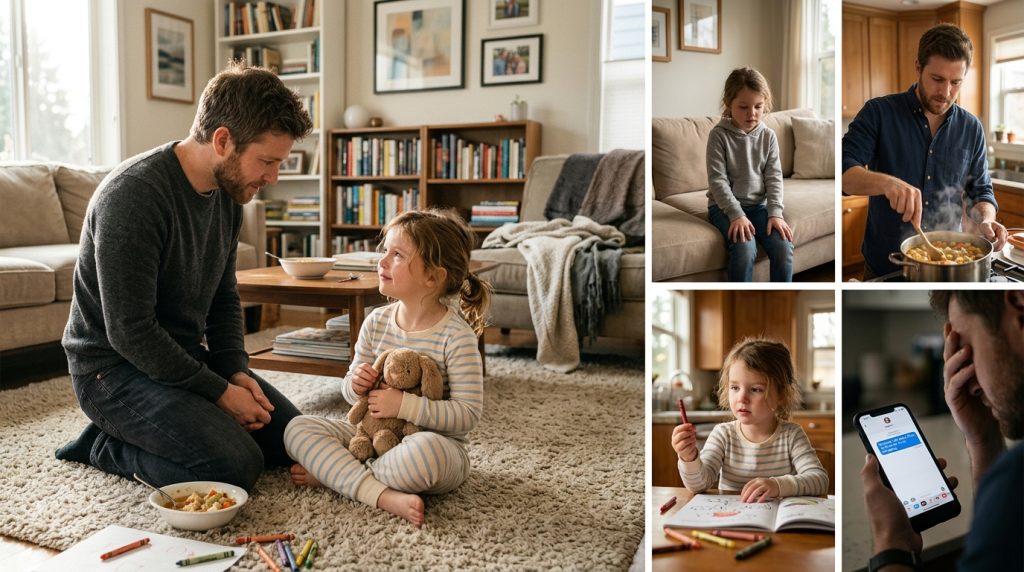
“Yes.” “Am I bad?” “No.” “Did Bunny tell?” I looked at the small tracker lying on my kitchen counter. “No.” I forced my voice to stay calm. “Bunny didn’t do anything wrong either.” Three police cruisers stopped outside. Blue lights filled the windows.
David stepped away from the porch.
For one second, I thought he would run.
He didn’t.
That would have made him look guilty.
David cared too much about appearances to run.
By the time officers reached the front steps, he had transformed again.
Shoulders relaxed.
Hands visible.
Concerned boyfriend.
Responsible adult.
I watched through the window as he pointed toward my house.
Probably telling them I had taken Chloe without permission.
One officer knocked.
“Seattle Police.”
I opened the door only after seeing uniforms.
David immediately stepped forward.
“There she is.”
His voice cracked with manufactured relief.
“Chloe, sweetheart.”
Chloe made a sound I had never heard from a child.
Not crying.
Something smaller.
Her whole body folded behind mine.
The officer noticed.
So did the woman beside him.
Officer Ramirez looked down at Chloe.
Then at David.
“Sir, stay where you are.”
David lifted his hands.
“I’m her stepfather.”
“You’re not married to her mother,” I said.
He glared at me.
Officer Ramirez raised one hand.
“Everybody stops talking.”
Good.
Finally.
He separated us.
I explained what Chloe had said.
The food restrictions.
The chair against the door.
The schedule.
The tracker.
Sarah’s call.
I showed him the paper.
Monday: No dinner.
Tuesday: Water only.
Wednesday: Bread if she obeys.
Thursday: No speaking.
Friday: Lockdown.
Officer Ramirez’s expression barely changed.
But the female officer, Chen, looked at Chloe.
“Is this your handwriting?”
Chloe shook her head.
“No.”
“The purple part?”
Chloe looked down.
“I wrote that.”
Officer Chen read:
I really do want to be good.
Something moved across her face.
Then disappeared.
Police officers learn to hide feelings too.
Officer Ramirez asked David,
“Did you write this?”
David laughed.
“Of course not.”
He looked at me.
“Marcus has always hated me.”
I almost answered.
Ramirez stopped me.
“Mr. Cole, I am talking to him.”
David nodded.
“Sorry.”
Then he smiled.
That smile.
The one I had seen at Thanksgiving dinners.
The one he used when discussing wine.
The smile that said reasonable people would naturally stand on his side.
He gestured toward the schedule.
“Chloe has behavioral problems.”
My fists tightened.
Officer Chen noticed.
She shifted slightly between us.
David continued.
“Her therapist recommended structured consequences.”
I looked at him.
“Which therapist?”
He turned.
“See?”
He pointed toward me.
“This is exactly the problem.”
“Sarah’s family interferes.”
I laughed.
“You’re starving a five-year-old.”
“She is not being starved.”
Chloe flinched.
David saw it.
Then did something that told me everything.
He looked at her and said quietly,
“Chloe.”
Just her name.
Nothing else.
Her breathing stopped.
That one word frightened her more than all his shouting at the door.
Officer Chen noticed too.
She crouched to Chloe’s height.
“Sweetheart, you can stay with your uncle.”
Chloe grabbed me tighter.
David said,
“She needs to come home.”
“No,” Sarah shouted through my phone.
I had forgotten she was still connected.
Everyone looked at it.
Officer Ramirez asked,
“Who is that?”
“Her mother.”
“Put her on speaker.”
I did.
“Ma’am, state your name.”
“Sarah Bennett.”
“Where are you?”
There was road noise behind her.
“Driving north from Portland.”
“Pull over before we continue.”
“I can’t—”
“Ma’am.”
A beat.
“Okay.”
We waited until the background noise stopped.
Ramirez asked,
“Do you consent to your daughter remaining with Marcus Cole tonight?”
“Yes.”
Immediately.
“Yes. Absolutely.”
“Do you want David Cole to pick her up?”
“No.”
David’s face changed.
“Sarah.”
She started crying.
“No.”
His eyes hardened.
“Sarah, don’t do this.”
Officer Ramirez stepped closer to him.
“You do not speak to her.”
David stared at the phone.
Sarah continued.
“I found a camera in Chloe’s bedroom.”
Officer Chen looked at Chloe.
Then at David.
Sarah’s breathing shook.
“And I found the phone controlling it.”
David went white.
For the first time that night, he truly lost control of his face.
It was small.
Half a second.
Enough.
He said,
“She went through my property.”
Sarah laughed through tears.
That was when I knew the phone mattered.
Officer Ramirez asked,
“Do you still have it?”
“Yes.”
“Where?”
“With me.”
“Do not alter it.”
“I haven’t.”
“Do not access anything else on it.”
“I already photographed some screens.”
“That’s fine. Preserve everything.”
David stepped forward.
“That phone is mine.”
Officer Ramirez turned.
“Stay back.”
David stopped.
The officer’s voice hardened.
“Right now, the only thing I need you to do is remain where you are.”
Sarah whispered,
“Marcus.”
“Yes?”
“The camera wasn’t the worst thing.”
Chloe’s fingers tightened around mine.
I looked at her.
“What did you find?”
There was a pause.
Then Sarah said something I still remember word for word.
“He was making her afraid on purpose.”
Nobody spoke.
Sarah began crying.
“The phone has videos.”
David snapped,
“Shut up.”
Officer Ramirez moved immediately.
“Hands behind your back.”
David stared.
“What?”
“You’re being detained while we sort this out.”
“This is insane.”
“Hands.”
“I haven’t done anything.”
“Hands behind your back.”
The cuffs clicked.
Chloe jumped at the sound.
David twisted his head toward her.
“Chloe, tell them.”
Officer Chen stepped between them.
David raised his voice.
“Tell them I take care of you.”
Chloe began sobbing.
I scooped her up.
She was five.
Five.
And a grown man in handcuffs was trying to make her defend him.
Officer Ramirez guided David toward the cruiser.
David shouted,
“Sarah is unstable!”
Then:
“She leaves that kid everywhere!”
Then:
“Marcus drinks!”
I almost laughed.
I barely drank at all.
But it did not matter.
He was throwing anything.
Everything.
Trying to rebuild control from pieces.
Before he entered the cruiser, he turned toward my house.
His voice became calm again.
“You’re all making a very serious mistake.”
That sentence frightened me more than the yelling.
Not because I believed him.
Because I realized how many times Chloe probably had.
Police did not immediately arrest David for every terrible thing we suspected.
That is not how it works.
They detained him.
Interviewed him.
Photographed the tracker.
Collected the paper.
Took statements.
Contacted child-protection authorities.
A detective came to my house before dawn.
So did a child-welfare worker named Elena Park.
At 3:46 in the morning, my kitchen looked like a command center.
Coffee cups.
Notebooks.
Evidence bags.
My untouched pot of stew.
And one exhausted little girl asleep on the couch with her stuffed bunny tucked under her chin.
The tracker had been removed.
Bunny had been opened along the seam.
The stuffing was exposed.
I asked Elena,
“Should I throw it away?”
“No.”
“Why?”
“If Chloe wants to keep it, let her keep it.”
“But he used it to track her.”
“Then take out what doesn’t belong.”
She looked toward the couch.
“Don’t take the comfort object too.”
I nodded.
That sentence stayed with me.
Take out what doesn’t belong.
Keep what was hers.
It would become a larger lesson later.
Sarah arrived at 5:18 a.m.
She came through the door looking like she had aged ten years in one night.
Her hair was unbrushed.
Mascara streaked beneath her eyes.
She carried a backpack in one hand and a plastic evidence bag in the other.
Elena stopped her.
“Is that the phone?”
“Yes.”
“Set it down.”
Sarah obeyed.
Then she saw Chloe.
Her knees nearly gave out.
“Oh God.”
She took one step toward the couch.
Chloe woke.
Her eyes opened.
For one terrible second, she looked scared of her own mother.
Sarah saw it.
She stopped moving.
That broke her more completely than anything else.
“Hi, baby.”
Chloe stared.
Sarah lowered herself to the floor several feet away.
“I’m not going to touch you unless you want me to.”
Chloe’s eyes filled.
“Is David here?”
“No.”
“You promise?”
“I promise.”
Chloe looked at me.
I nodded.
“He’s not here.”
Only then did she get off the couch.
She crossed the room slowly.
Sarah held out her arms.
Chloe hesitated.
Then ran into them.
Sarah made a sound like something inside her had torn.
“I’m sorry.”
She held Chloe carefully.
“I’m so sorry.”
Chloe whispered,
“Am I in trouble?”
“No.”
“Because I told Uncle Marcus?”
“No.”
“Because I ate?”
Sarah closed her eyes.
“No.”
“Because I took Bunny?”
“No.”
Then Chloe asked,
“Is today a food day?”
Sarah buried her face in her daughter’s hair.
I turned away.
I had been angry at Sarah all night.
Furious.
How do you live in the same home and not know?
How do you miss hunger?
Locked doors?
Fear?
How do you let a boyfriend turn your child into this?
But watching my sister hold Chloe, I understood anger was going to have to wait.
A five-year-old was in the room.
Adult guilt could not become another burden she had to manage.
Elena said gently,
“Sarah, I need to speak with you privately.”
Sarah nodded.
“I’m not leaving her.”
“You don’t need to go far.”
We moved to the dining room.
Chloe stayed on the couch where she could see us.
I sat beside her.
Elena asked Sarah to explain everything.
Sarah stared at the phone inside the evidence bag.
“I found the camera yesterday morning.”
“Where?”
“Inside the smoke detector.”
“Are you certain it was a camera?”
“Yes.”
“I took it down.”
“Why?”
“I thought maybe David installed it because Chloe had been sleepwalking.”
Elena waited.
Sarah started crying.
“I know how stupid that sounds.”
Elena did not comfort her.
She did not shame her either.
“Continue.”
Sarah nodded.
“David was at the gym.”
“I called him.”
“He got angry that I touched it.”
“That’s when I knew.”
“What did he say?”
“That it was for safety.”
“That Chloe lies.”
“That I’m too soft.”
“That we need to know what she does at night.”
I looked at my niece.
She was coloring now.
Purple crayon.
Small, careful strokes.
Sarah continued.
“He told me to put it back.”
“I said no.”
“He said we’d discuss it after I got home from Portland.”
“Was the work conference real?”
“Yes.”
“I was scheduled to leave that afternoon.”
“And Chloe?”
“I had already asked Marcus to watch her.”
“Did David know?”
“He knew someone was watching her.”
“But not Marcus.”
“Correct.”
“Why?”
Sarah wiped her eyes.
“Because after the camera, I got scared.”
Finally.
That word.
Scared.
“I told David our neighbor Mrs. Klein was taking Chloe.”
“Why lie?”
“I didn’t want him knowing where she was until I understood what I’d found.”
Elena nodded.
“Then?”
“After David left again, I searched Chloe’s room.”
My stomach tightened.
“I know I shouldn’t have been snooping.”
Elena interrupted.
“We are not evaluating your etiquette.”
Sarah almost laughed.
Then continued.
“There was a locked drawer in David’s desk.”
“I knew the code because he uses our anniversary.”
“Inside was another phone.”
“Not his regular phone.”
“A cheap Android.”
“What was on it?”
Sarah looked at Chloe.
Elena followed her eyes.
“We can pause.”
“No.”
Sarah shook her head.
“I need to say it.”
But Elena stopped her.
“Not in front of Chloe.”
That was the first of many times professionals would teach us something essential.
Children do not need to repeatedly hear the worst things that happened to them in order for adults to take them seriously.
We moved farther away.
I stayed close enough that Chloe could still see me.
Sarah lowered her voice.
“The phone controlled the camera.”
“Also sensors.”
“What kind?”
“Door sensor.”
“Motion alerts.”
“The tracker.”
She pointed toward Bunny.
“There was an app showing Chloe’s location.”
I felt sick.
“That’s how he found her.”
“Yes.”
Sarah covered her face.
“He knew I lied about Mrs. Klein because Bunny showed up here.”
Elena wrote something.
“What else?”
Sarah began shaking.
“Videos.”
I clenched my jaw.
Not that kind.
I told myself.
Please.
Not that kind.
Sarah must have seen my face.
“No.”
She understood.
“Nothing sexual.”
The relief nearly made me collapse.
Then she said,
“But they were horrible.”
I looked at her.
“What?”
“He would take food away.”
“Then record what happened later.”
I frowned.
“What do you mean?”
“She’d cry.”
“Ask for food.”
“Get angry.”
“Bang on the door.”
“He recorded it.”
I felt cold.
Sarah whispered,
“Then he showed me clips.”
My stomach turned.
“What clips?”
“Just the parts where she screamed.”
“Where she threw things.”
“Where she called him mean.”
“He told me she was becoming violent.”
“He said she needed stricter consequences.”
I stared at Sarah.
She began sobbing.
“He created the behavior.”
Then showed you the reaction.
“Yes.”
The room went quiet.
That was the worst thing.
Not simply surveillance.
Engineering fear.
Withholding food.
Creating desperation.
Recording the desperation.
Then using the recording to convince Sarah that Chloe was the problem.
David had not only controlled a child.
He had manufactured evidence against her.
Sarah whispered,
“There were folders.”
“What folders?”
“Dates.”
“Rules.”
“Punishments.”
“Things like ‘noncompliance.’”
“‘Attention seeking.’”
“‘Food fixation.’”
I almost exploded.
Food fixation.
A starving child asking for dinner.
“He wrote notes after every punishment.”
“Why?”
“I don’t know.”
Elena asked,
“Anything suggesting he shared them?”
“No.”
“Anything suggesting another person was involved?”
Sarah hesitated.
“Yes.”
Everyone froze.
“Who?”
“I don’t know.”
“There were old folders.”
“Not Chloe.”
“What names?”
“Eli.”
“And Mason.”
The hairs rose along my arms.
Elena’s expression changed.
“How old were the files?”
“Some six years.”
“Some four.”
“And the content?”
“Similar language.”
I whispered,
“He’s done this before.”
Elena held up a hand.
“We don’t know that yet.”
Right.
Evidence.
Not assumptions.
But the possibility hung in the room.
Police searched Sarah’s house that morning after obtaining appropriate legal authority.
They found the camera.
Door sensors.
A small motion device near Chloe’s bedroom.
A lock high on the pantry.
The chair Chloe had mentioned.
A black electronic ankle band used as a proximity alarm.
Not a shock device.
That mattered.
David had told Chloe it would “know” if she left her room.
The marks on her ankle came from it being fastened too tightly.
He had turned a cheap monitoring device into something monstrous simply by convincing a child it controlled her.
They found printed schedules.
Food logs.
Behavior notes.
A second phone.
Two external hard drives.
And old files.
Eli.
Mason.
Those names eventually became people.
David had previously dated a woman named Rebecca.
She had two sons.
Eli and Mason.
At the time, they were seven and nine.
Rebecca had never filed criminal charges.
She had left David abruptly after eleven months.
When detectives contacted her, she cried.
Then she said:
“I wondered if I was crazy.”
That sentence echoed Sarah.
Rebecca described rules.
Silence punishments.
Bedroom confinement.
Food restrictions she thought were “structured consequences.”
David telling her the boys manipulated her.
David recording tantrums.
David insisting she was too weak to parent.
The relationship ended when Mason told a school counselor David had locked the pantry.
Rebecca confronted him.
He called her unstable.
She took the boys and left.
No criminal case followed.
No one connected the dots.
Until Chloe.
Rebecca’s old emails and photographs did not prove everything.
But they supported a pattern.
Her sons, now teenagers, were not forced into our case casually.
They had their own rights.
Their own trauma.
Investigators handled that separately.
I never met them.
I was glad.
Not every person harmed by the same man needs to become part of the same family story.
Chloe went to the hospital that morning.
Not because she was visibly collapsing.
Because children who have had food withheld need medical evaluation.
Her pediatric records told part of the story.
Over the previous year, her weight had dropped across growth percentiles.
Not catastrophically.
Enough.
Sarah had been told Chloe was “picky.”
David told her he was working on it.
Chloe had mild dehydration.
Low iron.
Nutritional deficiencies that were treatable.
No dramatic organ failure.
No impossible medical miracle.
Just the ordinary physical evidence of a child whose body had repeatedly been told it could not rely on food.
The doctor asked Sarah,
“How long has this been happening?”
Sarah whispered,
“I don’t know.”
That answer destroyed her.
She went into the hallway and vomited.
I followed.
She leaned against the wall.
“How didn’t I know?”
I was still angry enough to answer badly.
“You should have.”
She looked at me.
I regretted it immediately.
But I did not take it back.
Because part of it was true.
Sarah closed her eyes.
“I know.”
I expected defensiveness.
Instead she whispered,
“I know.”
Then:
“He kept telling me she was difficult.”
“I wanted to believe him because I was tired.”
She slid down into a chair.
“I was working.”
“I was behind on bills.”
“He paid more.”
“He cooked.”
“He handled bedtime.”
“He said he was taking pressure off me.”
Her face crumpled.
“I thanked him.”
That is how control often enters a household.
Not wearing a mask.
Carrying groceries.
Solving problems.
Offering relief.
Then slowly making relief expensive.
I sat beside her.
“I’m angry at you.”
She nodded.
“You should be.”
“I don’t know how much.”
“I don’t either.”
We sat in silence.
Then she whispered,
“But right now I need to fix what I can.”
That was the right answer.
Child protection opened an investigation into Sarah too.
She was furious for about ten seconds.
Then stopped herself.
“Of course you have to.”
Elena nodded.
“We need to understand what you knew.”
“I understand.”
“Chloe may need a temporary safety plan.”
Sarah went pale.
“You mean she can’t come home with me?”
“Possibly.”
Sarah started crying.
I expected her to fight.
She didn’t.
She looked at Chloe through the hospital-room window.
Then said,
“If Marcus is approved and she feels safe there, she can stay with him.”
That decision changed how I saw my sister.
Not because it erased what she missed.
It didn’t.
Because when forced to choose between her own pain and Chloe’s sense of safety, she finally chose Chloe without hesitation.
I became a temporary kinship caregiver.
Three days turned into eleven weeks.
Nobody had planned that.
My apartment was designed for one adult and occasional football games.
Suddenly I owned childproof cups.
Three kinds of cereal.
Nightlights.
A step stool.
Hair detangler.
Bandages with cartoon animals.
And more stuffed creatures than any single household requires.
The first week, Chloe asked permission for everything.
“Can I open the fridge?”
“Yes.”
“Can I have yogurt?”
“Yes.”
“Can I have two?”
“Yes.”
“Can I save one?”
“Yes.”
“Can I drink milk?”
“Yes.”
“Can I use the blue cup?”
“Yes.”
“Can I put it back if I change my mind?”
“Yes.”
One afternoon, she stood in front of my refrigerator for three full minutes.
Door open.
Cold air pouring out.
I almost said,
“Pick something.”
Then stopped.
Choice was new.
She was not wasting electricity.
She was practicing freedom.
So I waited.
Finally she chose an apple.
Then looked at me.
“You sure?”
“Yes.”
She bit into it.
Walked away.
Left the refrigerator door open.
I smiled.
Then closed it myself.
Progress.
We created a snack basket on the bottom pantry shelf.
At first I wanted to fill it with every food imaginable.
Cookies.
Crackers.
Fruit snacks.
Granola bars.
Chocolate.
Anything to prove abundance.
Her therapist, Dr. Maya Patel, stopped me.
“Do not turn food into a performance either.”
I frowned.
“What do you mean?”
“She needs reliability.”
“Not spectacle.”
“Regular meals.”
“Available snacks.”
“No bargaining.”
“No moral language around food.”
“No ‘good girl’ dessert.”
“No cleaning your plate.”
“No making her eat when she is full.”
I nodded.
“Got it.”
“And stop asking if she’s hungry every twenty minutes.”
I felt attacked.
“I’m trying to help.”
“I know.”
She smiled.
“Helping can become pressure when you are frightened.”
I shut up.
That was another lesson.
Fearful adults love to overcorrect.
Chloe did not need me to become a cheerful food policeman.
She needed the kitchen to become boring.
Predictable.
Safe.
So breakfast happened.
Lunch happened.
Dinner happened.
Snacks existed.
Nobody announced that she deserved them.
She simply did.
The first time she left half a sandwich on her plate, I nearly cried.
Because weeks earlier she had eaten stew as though somebody might take the spoon away.
Now she could stop.
Trusting another meal would come.
Sarah visited under the safety plan.
At first, supervised.
That humiliated her.
She accepted it.
She sat on my living-room floor playing blocks while Elena watched.
Chloe barely spoke.
Sarah did not push.
That mattered.
On the third visit, Chloe asked,
“Are you still with David?”
Sarah said,
“No.”
“Does he know where your new house is?”
“No.”
“Can he come?”
“No.”
“Promise?”
“Yes.”
Chloe looked at Elena.
“Is she telling the truth?”
My heart broke.
Elena answered,
“Yes.”
Sarah cried silently.
But she did not make Chloe comfort her.
That mattered too.
Sarah moved out of the house she shared with David.
She did not wait for the criminal case.
She terminated the lease.
Changed banks.
Changed passwords.
Replaced her phone.
Worked with a domestic-violence advocate.
Only then did I learn David had controlled more than Chloe.
Sarah had not thought of herself as abused.
Because he had not hit her.
But he monitored spending.
Read her messages.
Controlled the security system.
Insisted on knowing where she was.
Criticized friends.
Gradually made family visits unpleasant.
Told her I was irresponsible.
Told her our mother was intrusive.
Told her Chloe behaved worse after seeing relatives.
Every relationship outside the house became associated with conflict.
Sarah had not been imprisoned.
She had been narrowed.
There is a difference.
It is still dangerous.
One afternoon, she showed me screenshots.
David:
Why did you need to talk to Marcus for forty minutes?
Another:
If you respected me, you wouldn’t undermine the rules with Chloe.
Another:
Your family keeps you weak.
Another:
You say you want help, then complain when I take charge.
I looked at her.
“You didn’t show me any of this.”
She laughed without humor.
“You already hated him.”
“I did not.”
“You didn’t like him.”
“Correct.”
“So I thought if I showed you, you’d say ‘I told you so.’”
I stared.
“Would I have?”
She looked at me.
“Probably.”
Fair.
That hurt.
Our family had its own patterns.
Not like David’s.
But enough.
I was the blunt brother.
Sarah was the sister who needed to prove she could manage her own life.
When I disliked a boyfriend, she defended him harder.
David learned that.
Used it.
That did not remove Sarah’s responsibility.
It helped explain why she became isolated.
The criminal case developed slowly.
David was initially released under strict no-contact conditions while prosecutors reviewed evidence.
That terrified all of us.
But a release is not acquittal.
Nor is detention automatic simply because accusations are serious.
We installed cameras.
Not hidden ones.
Visible.
Explained to Chloe.
“This camera watches the front door.”
“Why?”
“So we know who comes.”
“Can it watch me sleep?”
“No.”
“Can David see it?”
“No.”
“Can I turn it off?”
“Not the front-door one.”
She frowned.
“Why?”
“Because that one is for everybody’s safety.”
She thought.
“Okay.”
Consent does not mean children control every safety decision.
But explanations matter.
David violated no-contact once.
Not by coming to the house.
By sending a message through a mutual friend.
Tell Sarah this can all go away if she stops exaggerating.
The friend turned it over to police.
That became another piece.
He still thought the problem was the story.
Not the conduct.
His attorney eventually advised him to stop talking.
Good advice.
The forensic interview with Chloe was conducted by a specialist.
Not me.
Not Sarah.
Not six relatives asking questions.
Dr. Patel explained why.
“Memory is vulnerable to repetition.”
“Do not rehearse her testimony at home.”
I hated the word testimony.
“She’s five.”
“I know.”
“Then why should she have to—”
“She shouldn’t have to carry the case.”
Dr. Patel interrupted gently.
“That is my point.”
I stopped.
“She can tell what she remembers in the proper setting.”
“Then at home, let her be Chloe.”
So we did.
Mostly.
Sometimes I failed.
One night she asked for water.
I handed it to her.
Then, without thinking, I asked:
“Did David ever make you sleep without—”
I stopped myself.
She stared.
I said,
“Never mind.”
She looked confused.
I changed the subject.
“What should we name the spider in the bathroom?”
“Gross.”
“Excellent name.”
She laughed.
That was better.
Police recovered months of recordings.
We did not watch them.
I refused.
Sarah watched only what her attorney and therapist recommended.
There is a fantasy that victims need to see everything to understand.
They don’t.
Sometimes knowing enough is enough.
Investigators described what mattered.
Food restriction.
Confinement.
Intimidation.
Monitoring.
Deliberate provocation followed by selective recording.
Files from the previous family.
There was no evidence David sold videos.
No evidence of sexual material.
No hidden trafficking conspiracy.
The truth was smaller.
And somehow more disturbing.
He built systems of control inside ordinary homes because control made him feel powerful.
He selected partners who were overwhelmed.
Presented himself as helpful.
Became indispensable.
Then positioned children as the source of household chaos.
He “fixed” the chaos by escalating rules.
When the rules produced fear, hunger, anger, or resistance, he pointed to those reactions as proof the child needed him.
A closed loop.
He did it with Rebecca.
Then Sarah.
There might have been others.
Investigators found no evidence strong enough to support more claims.
So we stopped there.
Truth does not become stronger by stretching it.
David eventually entered a plea.
The exact charges were less dramatic than the story felt.
Child abuse-related offenses.
Unlawful restraint.
Harassment and surveillance-related conduct.
Violations connected to his monitoring system.
Evidence from the prior family was handled carefully and not magically used to convict him of every bad thing he had ever done.
He served years in prison.
Not forever.
Years.
A no-contact order protected Chloe and Sarah.
He lost his job.
His “perfect gentleman” reputation disappeared.
But reputation was not punishment I cared about.
I cared that Chloe could open a refrigerator.
I cared that Sarah could close a bedroom door without wondering who was watching.
I cared that Bunny had no blinking light inside.
That was enough.
The day after David accepted the plea, Sarah came to my apartment.
Chloe was at kindergarten.
Sarah sat at my kitchen table.
The same table where Chloe had asked if she was allowed to eat.
She placed something on the wood.
The punishment schedule.
I stared.
“Why do you have that?”
“The police released a copy.”
“Why did you bring it here?”
Sarah looked at the purple crayon.
I really do want to be good.
Then she started crying.
“I keep thinking about this sentence.”
I sat down.
“She thought food depended on goodness.”
“I know.”
“She thought speaking depended on goodness.”
“I know.”
“She thought leaving her bedroom depended on goodness.”
“I know.”
Sarah covered her face.
“I taught her to trust him.”
That was the hardest sentence she ever said.
I did not lie to make her feel better.
“Yes.”
She sobbed.
I continued.
“And then when you found out, you stopped.”
She looked up.
“That’s not enough.”
“No.”
“It isn’t.”
She almost looked angry.
I leaned forward.
“You do not get to turn accountability into self-destruction.”
She stared.
“That would still make Chloe responsible for managing what David did.”
“What do you mean?”
“If you spend the rest of your life collapsing in guilt, who has to worry about you?”
She looked away.
“Her.”
“Yes.”
“She needs a mother.”
“Not a defendant.”
Sarah wiped her eyes.
“What if she hates me?”
“Then you let her.”
Her face crumpled.
“What?”
“If she gets angry, you don’t explain it away.”
“If she asks where you were, you answer.”
“If she says you should have known, you don’t make her comfort you.”
“If she forgives you, fine.”
“If she doesn’t for a long time, fine.”
Sarah looked at the paper.
“I’m scared.”
“I know.”
“Good.”
She almost laughed.
“You’ve always been terrible at comfort.”
“I’m improving.”
“Marginally.”
That was the first real laugh we shared in months.
Chloe returned to Sarah full-time after eleven weeks.
Not because the investigation vanished.
Because Sarah completed the safety requirements.
New home.
No contact with David.
Therapy.
Parenting work.
Financial independence plan.
Cooperation with investigators.
Chloe wanted to go home with her.
That mattered.
The first night back, she called me at 8:17.
“Uncle Marcus?”
“Hey, kiddo.”
“Mom said I can have cereal tomorrow.”
“Sounds suspicious.”
“She said cereal is breakfast.”
“I’ve heard rumors.”
“And I don’t have to ask?”
I swallowed.
“No.”
“She said I can ask if I want something different.”
“That sounds right.”
Pause.
“Can I come over Saturday?”
“Yes.”
“You didn’t ask Mom.”
“I assume you already did.”
She giggled.
“I didn’t.”
“Then ask your mother.”
“Okay.”
Progress includes ordinary rules.
Freedom is not the absence of adults saying no.
It is knowing no is not arbitrary cruelty.
Years passed.
Healing did not move in a straight line.
At six, Chloe hid crackers under her pillow.
Sarah found them.
Did not punish her.
Did not dramatically tell her she never had to do that again.
She simply added a sealed snack container beside the bed.
Dr. Patel suggested it.
Predictability first.
At seven, Chloe stopped hiding food.
At eight, she started leaving food unfinished.
At nine, she slept with the bedroom door half closed.
That was huge.
At ten, fully closed.
No chair.
No sensor.
No fear.
At eleven, she went to sleepovers.
The first one lasted forty-three minutes.
Sarah picked her up at 9:13 p.m.
No shame.
The second lasted until midnight.
The third, all night.
At twelve, Chloe asked Sarah:
“Why did you believe him?”
Sarah did not dodge.
“Because I wanted help.”
“That’s dumb.”
“Yes.”
Chloe stared.
Sarah continued.
“And because he lied well.”
“And because I ignored things that made me uncomfortable.”
“And because I was afraid that admitting I was wrong would mean I had failed you.”
Chloe’s eyes filled.
“You did fail me.”
Sarah cried.
“Yes.”
No excuses.
Then Chloe asked:
“Are you going to do it again?”
“No.”
“How do you know?”
Sarah thought.
“Because now I know love doesn’t require me to hand someone else my judgment.”
That answer came from years of work.
Chloe nodded.
Then went upstairs.
No dramatic hug.
No instant forgiveness.
But that night she came back down and asked Sarah to braid her hair.
Sometimes repair arrives sideways.
Rebecca contacted Sarah once after the case.
The previous girlfriend.
She wrote:
I am sorry our case never became enough to stop him before he met you.
Sarah responded:
You were responsible for getting your sons out. You did that. David was responsible for what he did next.
Rebecca replied:
Thank you.
That was all.
Two women refusing to inherit a man’s responsibility.
I appreciated that.
As for me, I stayed the uncle.
Not replacement father.
Not savior.
Uncle.
I made pancakes badly.
Helped with homework.
Taught Chloe to ride a bike.
Overreacted when she scraped her knee.
Got corrected by Sarah.
At fourteen, Chloe told me I hovered.
“I do not.”
“You text me every fifteen minutes when I’m at the mall.”
“Every thirty.”
“That’s still weird.”
“You were kidnapped by a tracker.”
She stared.
“Uncle Marcus.”
I closed my eyes.
“Bad phrasing.”
“Very.”
“I’m sorry.”
She smiled.
“You’re working on it.”
Apparently all of us were.
When Chloe turned sixteen, she asked to see Bunny.
Sarah had stored him carefully after Chloe stopped sleeping with him.
We sat at my kitchen table.
Sarah brought the rabbit in a box.
The seam along its belly was still visible.
Chloe held him.
Turned him over.
Touched the repaired fabric.
“Is this where it was?”
“Yes,” I said.
“The tracker?”
“Yes.”
She was quiet.
Then:
“Did you keep it?”
“The tracker?”
“Yes.”
“No.”
Police returned it eventually.
I had destroyed it.
I told her.
She nodded.
“Good.”
She held Bunny closer.
Then smiled.
“He didn’t ruin Bunny.”
“No.”
That sentence made me think of Elena.
Take out what doesn’t belong.
Keep what was hers.
Chloe looked at Sarah.
“Can I have him again?”
“Of course.”
She took Bunny home.
Not as a trauma artifact.
A stuffed rabbit.
That was victory.
At seventeen, she began working at a neighborhood café.
The first time I visited, she came to my table wearing an apron.
“What can I get you?”
“Stew.”
She stared.
“We’re a coffee shop.”
“Terrible service.”
She rolled her eyes.
I ordered a sandwich.
She brought it with extra pickles because she knows I hate them.
Revenge.
Healthy teenage revenge.
I tipped obscenely.
She returned the receipt.
“No.”
“What?”
“This is too much.”
“I’m generous.”
“You’re embarrassing.”
“Family tradition.”
She laughed.
No one in that café knew that once, at five, she asked whether she was allowed to eat.
Good.
Trauma is greedy enough without becoming your introduction forever.
When Chloe turned eighteen, Sarah gave her a box.
Inside were selected records.
Not every police report.
Not every video description.
A copy of the schedule.
The purple-crayon note.
A letter Sarah had written years earlier but never sent.
Chloe read the schedule.
Then stared at her own handwriting.
I really do want to be good.
She sat quietly.
Sarah said,
“You don’t have to keep that.”
Chloe looked at me.
“Did I really write this?”
“Yes.”
She swallowed.
“I don’t remember.”
“That’s okay.”
She tore the page once.
Then again.
Sarah said nothing.
She kept tearing until the pieces were small.
Then Chloe walked to the trash.
Dropped them in.
And said:
“I was five.”
We waited.
She continued.
“I didn’t need to be good to deserve dinner.”
Sarah started crying.
So did I.
Chloe pointed at us.
“Oh my God.”
“What?”
“You two always cry.”
I laughed.
“Occupational hazard.”
She rolled her eyes.
Then asked:
“Are we eating?”
Sarah smiled.
“Yes.”
“What?”
“Chicken stew.”
Chloe stared at her.
“Seriously?”
Sarah laughed.
“You chose the menu.”
“Oh.”
We sat at the table.
Same recipe I had made years earlier.
Chicken.
Carrots.
Potatoes.
Celery.
Nothing magical.
Just dinner.
Chloe served herself.
No shaking hands.
No permission.
She took a second helping.
Then pushed the bowl away before finishing.
“I’m full.”
Sarah said,
“Okay.”
One word.
No guilt.
No rules.
No good-girl language.
Okay.
That was the ending I cared about.
Not David’s conviction.
Not the tracker.
Not the cameras.
Not the headlines his case briefly produced.
A bowl left unfinished because a young woman trusted food would exist tomorrow.
People sometimes ask me what the worst thing David did was.
They expect me to say the hunger.
The locked door.
The tracker.
The camera.
Those were terrible.
But the thing that still frightens me most is how he made Chloe believe ordinary human needs were moral failures.
Hungry?
Bad.
Thirsty?
Demanding.
Lonely?
Attention seeking.
Afraid?
Manipulative.
Want comfort?
Disobedient.
He took the most basic signals a child’s body could send and translated them into evidence against her.
That was the real prison.
The rest had doors.
Years of love opened them.
Slowly.
Sarah never forgave herself completely.
I don’t think parents do.
But guilt stopped running her life.
She never remarried while Chloe was young.
Not because she swore off love.
Because she wanted to rebuild her own judgment before blending another adult into their home.
Later, when Chloe was in college, Sarah dated a man named Luis.
The first time Chloe met him, he asked before sitting beside her on the couch because her backpack was there.
She laughed afterward.
“He’s scared of me.”
Sarah said,
“He’s respectful.”
“Same thing.”
They eventually married.
Slowly.
No dramatic rescue.
No replacement father.
Luis knew the history.
He did not compete with it.
He also never used the phrase “good girl.”
Smart man.
I remained in Seattle.
Eventually moved out of the apartment where it happened.
Not because I hated the place.
Because the landlord raised the rent to an insulting amount.
Life keeps being ordinary even after terrible things.
When I packed the kitchen, I found the old stew pot.
I almost threw it away.
Then didn’t.
It had done nothing wrong.
Years later, Chloe took it when she moved into her first apartment.
“You want this ugly thing?”
“Yes.”
“Why?”
“It makes good stew.”
I smiled.
“Correct answer.”
On her first Sunday there, she invited Sarah and me over.
Tiny kitchen.
Secondhand table.
One chair slightly broken.
She served chicken stew.
I took a bite.
“Too much salt.”
“Leave.”
“Your mother raised you badly.”
Sarah laughed.
Chloe pointed her spoon at both of us.
“My house.”
“My rules.”
For half a second, the phrase landed strangely.
Then she smiled.
“Rule one: everybody eats.”
Sarah covered her mouth.
I looked down at my bowl.
Chloe groaned.
“Please don’t cry.”
“No guarantees.”
She laughed.
And we ate.
That is how I remember her now.
Not trembling beside my kitchen table.
Not hiding behind my legs while David stood outside.
Not asking whether tomorrow would be a food day.
I remember a young woman in her own apartment, arguing about salt, feeding the people she loved, and stopping when she was full.
The night she came to me, I thought my job was going to be cartoons and chicken nuggets.
Instead, she taught every adult around her something far harder.
A child should never have to earn food.
Never earn safety.
Never earn the right to speak.
And love that demands fear before obedience is not protection.
The tracker inside Bunny told David where Chloe was.
It did not tell him the most important thing.
She had finally reached a house where someone would believe her.
That was the one location he could no longer control.
THE END STORIES! THANK YOU FOR READING GOOD LUCK! ❤️
Related Posts