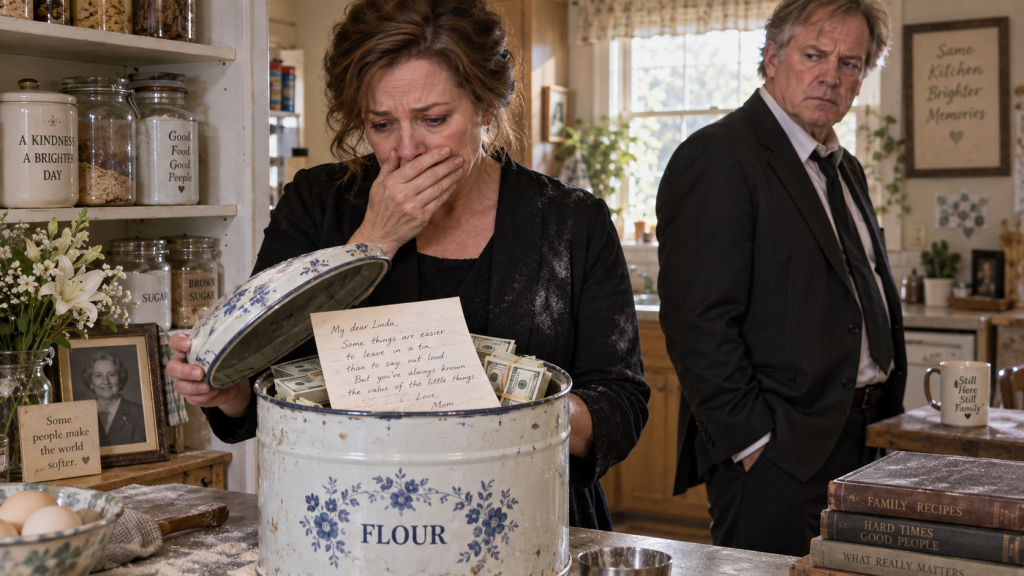
While sorting through Mama’s pantry after her funeral, I found $18,940 in the old flour tin she had never let us touch. Underneath lay an envelope addressed to me. “Forgive me, Linda,” the letter began. My brother dismissed the cash as grocery savings, but the next line named my stepfather, Wayne—and changed everything. By 5:05 that evening, I was heading to the bank, the tin beside me and flour still dusting my clothes.
Part 1: The Tin We Were Never Allowed to Open
Everything in Mama’s pantry had its place, but the white enamel flour tin with faded blue flowers was strictly off-limits. When I reached for it at twelve, she slapped my hand, then later apologized over cocoa.
“Leave that tin alone, Linda.” She never explained, and I learned not to question the things she refused to discuss.
Mama died at seventy-eight after a stroke in her sleep. The hospice nurse said it had been quick, and I held on to that reassurance.
We buried her on Thursday. By Friday, my older brother Russell wanted the house emptied within two days, so he tackled the living room while I sorted the kitchen.
Eventually, I reached for the forbidden tin. Its unexpected weight made me carry it to the counter before lifting the lid.
Inside were bundles of twenties, fifties, and hundreds. Beneath them lay an envelope bearing only my name in Mama’s handwriting.
Russell appeared and asked what I had found. When I told him, he dismissed it as forgotten grocery money.
We counted $18,940. That was hardly spare change misplaced after shopping.
I unfolded three handwritten pages. “Forgive me, Linda,” Mama began, followed by a sentence that stopped me cold: “You deserved to know what Wayne did with your settlement.”
More than thirty years earlier, a delivery truck had hit me outside a grocery store when I was seventeen. My stepfather handled the insurance claim and said the payout was $42,000, nearly all consumed by medical bills.
He promised me the balance at eighteen. When that birthday came, he claimed there was nothing left.
Mama’s letter revealed that the payment had actually been $63,000. Wayne had kept every dollar.
She discovered it five years afterward and confronted him until he admitted it. But fearing the loss of her secure home, she never reported him or told me.
She offered no defense. She admitted choosing her own comfort over what was rightfully mine.
Behind me, Russell spoke. “There’s no point dragging up the past.”
I turned, holding the letter. “You already knew.”
He looked away. Suddenly, I wondered how much of my life they had discussed without ever telling me.
PART 2 — WHAT MAMA TRIED TO GIVE BACK
“You already knew.”
The words sounded quieter than I expected.
That frightened me more than shouting would have.
Russell stood in Mama’s kitchen with one hand resting on the back of a chair, his eyes fixed somewhere over my shoulder.
For almost a minute, he said nothing.
Outside, wind moved through the oak tree beside the driveway.
Inside, the refrigerator hummed.
The old house continued making its ordinary sounds as though nothing inside it had changed.
But everything had.
I held Mama’s letter in both hands.
The flour tin sat open on the counter.
Money lay in uneven stacks beside it.
Eighteen thousand nine hundred forty dollars.
Enough to matter.
Not enough to explain thirty years.
I looked at my brother.
“How long?”
Russell swallowed.
“Linda.”
“How long have you known?”
He rubbed one hand over his face.
“I didn’t know everything.”
“That isn’t what I asked.”
He finally looked at me.
“About twenty years.”
The room tilted.
Twenty years.
I was fifty-two.
That meant Russell had known since I was around thirty-two.
Long enough to watch me raise children.
Long enough to watch me refinance a house.
Long enough to watch me work weekends.
Long enough to hear me joke, more than once, that if Wayne had not “spent everything on the hospital,” maybe I would have started adulthood differently.
Russell had heard those words.
And remained silent.
I set the letter down because my hands had begun shaking.
“You knew he stole from me for twenty years.”
“I knew there had been money.”
“Stop.”
My voice sharpened.
“Do not reduce it to ‘there had been money.’”
Russell closed his mouth.
“Sixty-three thousand dollars.”
I pointed toward the letter.
“Money awarded because I got hit by a truck.”
“Money that was supposed to be mine.”
“He stole it.”
“And Mama knew.”
“And you knew.”
Russell’s jaw tightened.
“I found out later.”
“Twenty years ago is later?”
He flinched.
Good.
I wanted the truth to hurt someone besides me.
“I was trying to protect Mama.”
The sentence came out carefully.
Prepared.
I laughed once.
Not because anything was funny.
“Of course you were.”
“Linda.”
“No, really.”
I looked around the kitchen.
At Mama’s yellow curtains.
Her crocheted potholders.
The little ceramic rooster she had kept beside the stove since 1989.
“So everyone spent thirty years protecting Mama.”
Russell shook his head.
“It wasn’t that simple.”
“It usually isn’t.”
I picked up the letter.
“But somehow the complicated part always meant I was the one who didn’t get told.”
He stared at me.
I continued.
“Wayne protected himself.”
“Mama protected the house.”
“You protected Mama.”
“And who exactly protected me?”
Silence.
That was the first honest answer in the room.
No one.
Russell sat at the kitchen table.
He looked older than he had at the funeral.
Not sadder.
Older.
There is a difference.
Grief can strip away some of the disguises people wear.
I remained standing.
“I want everything.”
“What?”
“Everything you know.”
“Linda—”
“If you lie to me now, I walk out of this house and whatever is left between us goes with me.”
He looked down.
That was not a threat.
I meant it.
For years, Russell and I had not been especially close, but we had maintained the reliable sibling relationship built out of birthdays, Thanksgiving, shared jokes, and the occasional emergency call.
I suddenly did not know whether any of that had been real.
Or whether it had simply existed on top of something rotten.
Russell reached for the chair opposite him.
“Sit.”
“No.”
He nodded once.
Then began.
“I found out when Wayne was sick.”
“What kind of sick?”
“His first heart problem.”
I remembered.
Wayne had been sixty-one.
Chest pain.
Three nights in the hospital.
Mama terrified.
I had brought casseroles.
Of course I had.
Russell continued.
“He thought he might need surgery.”
“And?”
“Mama was scared.”
“That sounds familiar.”
He looked at me.
“I went over one night.”
“She was crying.”
“She said there were things she had done wrong.”
I crossed my arms.
“What things?”
“At first, she wouldn’t say.”
“Then Wayne started yelling from the bedroom that she was being dramatic.”
My stomach tightened.
Even dead, I could hear his voice.
Wayne had been good at turning fear into inconvenience.
“He told her to shut up?”
“Basically.”
“And she?”
“She waited until he fell asleep.”
Russell paused.
“Then she told me about your settlement.”
I felt cold.
“How much did she tell you?”
“That the payout was larger than Wayne told you.”
“How much larger?”
“She said twenty-one thousand.”
“That was the difference.”
“Yes.”
“And the rest?”
“She said he took all of it.”
There it was.
No confusion.
No partial truth.
Russell had known.
“What did you do?”
He looked away.
“I told her to tell you.”
My anger hesitated.
Only slightly.
“And?”
“She refused.”
“Why?”
“You know why.”
“I want to hear you say it.”
Russell’s face tightened.
“She was afraid.”
“Of what?”
“Losing the house.”
“Wayne.”
“Everything.”
I laughed bitterly.
“She was still afraid of losing the house fifteen years after finding out what he did?”
“He owned most of it then.”
“And later?”
Russell said nothing.
Mama had eventually inherited money from Aunt Doreen.
Enough to pay off the mortgage.
Enough to have options.
I knew because I helped her choose a bank.
“Later she had choices.”
I said.
“Yes.”
“And still said nothing.”
“Yes.”
The word was almost a whisper.
That hurt more than any excuse.
I walked toward the sink.
Mama had always kept the window over it spotless.
She said a clean window made a small kitchen feel larger.
I stared into the backyard.
Her tomato cages were still there.
Empty now.
One tipped sideways.
I remembered summers when she tied vines to them with strips of old pantyhose.
I remembered the smell of sun-warmed tomatoes.
I remembered her hands.
Those same hands had written:
Forgive me, Linda.
I had loved those hands.
That was the terrible part.
Betrayal does not become easier when it comes from someone you never loved.
It becomes simpler.
This was not simple.
Russell spoke behind me.
“She hated herself for it.”
I turned.
“That helps you?”
“No.”
“Then don’t give it to me like medicine.”
He looked down.
“You asked what I knew.”
“I asked what you knew.”
“Not how badly she felt.”
Russell nodded.
“You’re right.”
I almost hated him for saying that too.
Because agreement did not return time.
Nothing could.
I thought about seventeen-year-old me.
Leg broken.
Pelvis fractured.
Months of therapy.
Scars on my left thigh.
Wayne sitting beside my hospital bed telling me not to worry about money.
“You’re family,” he had said.
“We’ll handle everything.”
We.
What a useful word for theft.
“When did he spend it?”
I asked.
Russell’s brow furrowed.
“What?”
“The money.”
“Do you know where it went?”
He hesitated.
“Some.”
I turned fully.
“Tell me.”
“Mama said Wayne used part of it for the down payment on the hardware store.”
My stomach dropped.
“What?”
“You remember when he bought into Bellman Hardware?”
Of course I remembered.
I had been eighteen.
Wayne had called it the opportunity of a lifetime.
For years, Mama told everyone how brave he had been to “bet on himself.”
The hardware store eventually became profitable.
Very profitable for a while.
He sold his share when he was fifty-six.
Used the money to pay down the house.
My house?
No.
Their house.
With my settlement.
I gripped the edge of the counter.
“How much?”
“I don’t know exactly.”
“Guess.”
“Twenty-five or thirty thousand.”
I closed my eyes.
Nearly half.
“What about the rest?”
“He paid some debts.”
“What debts?”
“Credit cards.”
“A truck.”
“Maybe taxes.”
Russell rubbed his forehead.
“Mama didn’t know every detail.”
“So my pain financed his fresh start.”
Russell said nothing.
I laughed again.
That was becoming a habit.
Not a healthy one.
All my life, Wayne had told the story of his business success as proof of discipline.
Hard work.
Good instincts.
He never mentioned the teenager whose broken body provided his capital.
I felt sick.
“I need air.”
Russell started to rise.
“I’m coming.”
“No.”
“Linda.”
“I said no.”
I walked outside.
The back porch steps creaked beneath my weight.
Mama had complained about replacing them for years.
Then decided they were “still perfectly good.”
I sat.
Flour dust still covered the front of my black blouse.
I had worn it to sort a pantry.
Now it felt like evidence.
My phone showed 3:41 p.m.
Less than two hours since I found the tin.
Some afternoons divide a life cleanly into before and after.
This was one.
I called my husband, Daniel.
He answered immediately.
“How’s the house?”
I could not speak.
His tone changed.
“Linda?”
I pressed my fingers against my eyes.
“I found something.”
“What happened?”
“Mama left me a letter.”
Silence.
Daniel knew enough not to interrupt.
“She knew Wayne stole my settlement.”
Another silence.
Longer.
“What?”
“All of it.”
I explained.
Not beautifully.
In pieces.
$63,000.
The hardware store.
Mama discovering it years later.
Russell knowing for two decades.
The flour tin.
The cash.
When I finished, Daniel said nothing for several seconds.
Then:
“Do you want me there?”
I almost cried.
Not:
What are you going to do?
Not:
Can we get the money back?
Not:
How much is it worth now?
Just:
Do you want me there?
“Yes.”
“I’m leaving now.”
“Daniel.”
“Yes?”
“Don’t call anyone.”
“I won’t.”
“Especially the kids.”
“I won’t.”
I exhaled.
“Thank you.”
“I love you.”
That nearly broke me.
“Love you too.”
I hung up.
Then sat on Mama’s porch and tried to understand how love and anger could occupy the same body without tearing it apart.
Russell came outside ten minutes later.
He stayed standing.
Smart.
“I remembered something.”
I looked at him.
“What?”
“Mama said the flour tin wasn’t the only thing.”
My spine stiffened.
“What does that mean?”
“I don’t know.”
“She said if you ever found the letter, you should call someone named Martin Vale.”
The name meant nothing.
“Who is that?”
“An accountant, I think.”
“Wayne’s?”
“No.”
“Mama’s.”
That surprised me.
Mama hated accountants.
At least, I thought she did.
Russell continued.
“She met him after Wayne died.”
Wayne had died eight years earlier.
Stroke.
Fast.
Mama had outlived him almost a decade.
“And you’re telling me this now?”
“I forgot.”
I stared.
“You forgot?”
“It was years ago.”
“My name was attached to it.”
“I know.”
“Apparently that doesn’t improve your memory.”
He accepted that.
Good.
“Did she give you a number?”
“No.”
“Address?”
“No.”
“But I saw his business card once.”
“Where?”
“In her desk.”
I stood immediately.
“Show me.”
Mama’s desk was in the spare bedroom.
A dark oak piece she bought at an estate sale when I was in college.
She kept everything.
Utility receipts from 1996.
Old Christmas stamps.
Warranty cards for appliances that had been replaced twice.
We went through the drawers.
Nothing.
Then I remembered the little locked compartment.
Mama had always kept a tiny brass key on her house ring.
I found it in the dish beside the front door.
The compartment opened with a dry click.
Inside were three things.
A business card.
A bank book.
And a photograph.
I picked up the photograph first.
It showed Mama sitting at a restaurant booth with a man I did not recognize.
She looked about seventy-two.
He was older.
Silver hair.
Glasses.
On the back, in Mama’s handwriting:
Martin — thank you for helping me do one decent thing.
My throat tightened.
Russell looked over my shoulder.
“That’s him.”
The business card read:
MARTIN VALE, CPA
Estate & Fiduciary Services
Sugar Land, Texas
There was a phone number.
I called.
A receptionist answered.
I gave my name.
There was a pause.
Then:
“Ms. Mercer?”
“Yes.”
“Mr. Vale has been expecting your call.”
That sentence chilled me.
“How?”
“Your mother left instructions.”
My heart began pounding.
“When?”
“Several years ago.”
“Can I speak to him?”
“Of course.”
Music played for twenty seconds.
Then an elderly man answered.
“Linda?”
“Yes.”
His voice softened.
“I’m very sorry about your mother.”
“Thank you.”
“I imagine you found the tin.”
I closed my eyes.
“Yes.”
Russell stared.
Martin continued.
“Did you find the letter?”
“Yes.”
“Then you know part of the story.”
“Part?”
A pause.
“Yes.”
I looked at Russell.
“What part don’t I know?”
Martin sighed.
“Your mother asked me not to discuss anything until after her death and only if you contacted me yourself.”
“Why?”
“Because she was ashamed.”
I almost snapped at him.
Then stopped.
He did not create this.
“What did she do?”
“She spent the last six years trying to repay you.”
I said nothing.
Martin continued.
“She knew she could never recreate the original sum exactly.”
“Not after so much time.”
“But she began setting aside money.”
“The cash in the tin was part of that.”
My eyes moved toward the kitchen.
“Part?”
“Yes.”
“How much more?”
Another pause.
“Linda, I think this is better discussed in person.”
“No.”
My voice sharpened.
“I have had enough people deciding what information is better delivered later.”
Silence.
Then Martin said:
“That’s fair.”
He cleared his throat.
“Your mother established an account in your name as payable-on-death beneficiary.”
My knees weakened.
“How much?”
“As of last month, approximately seventy-four thousand dollars.”
I sat on the edge of the desk chair.
Russell whispered:
“What?”
I held up a hand.
Martin continued.
“She also maintained a separate ledger.”
“A ledger of what?”
“What she believed she owed you.”
I closed my eyes.
“Based on the sixty-three thousand?”
“Yes.”
“With interest?”
“In her own way.”
I laughed softly.
Of course Mama had invented her own mathematics.
“She tracked what she thought the money might have grown to if it had been preserved.”
“How much did she think that was?”
“She never settled on one number.”
“But her last estimate was just over one hundred sixty thousand.”
My breath caught.
“And she had seventy-four?”
“Plus the cash.”
“That’s ninety-three.”
“Yes.”
I whispered:
“She died thinking she still owed me sixty-seven thousand dollars.”
Martin’s voice grew quiet.
“She died believing the money was only the visible part.”
That stopped me.
“What does that mean?”
“She believed she owed you something she could not calculate.”
“Trust?”
“Yes.”
My eyes filled.
For a moment, I hated that sentence.
Because it sounded beautiful.
And beauty felt dangerous right then.
“Mama doesn’t get to repair this with a poetic accountant.”
Martin gave a sad laugh.
“No.”
“She knew that.”
“Did she?”
“Yes.”
“How?”
“Because every year she asked me the same question.”
“What?”
“If money could make what she did less wrong.”
My throat tightened.
“What did you tell her?”
“No.”
I stared at the photograph in my hand.
Mama smiling beside him.
Thank you for helping me do one decent thing.
Martin said:
“I told her repayment could be decent without being absolution.”
That sentence stayed in the room.
Repayment could be decent without being absolution.
I understood immediately.
Good acts done late still matter.
They just do not erase the years before them.
“When can I meet you?”
I asked.
“Today, if you want.”
I glanced at the clock.
4:09.
“Your office closes at five?”
“Normally.”
“Can you wait?”
“Yes.”
“I’m coming.”
“Bring identification.”
“And Linda?”
“Yes?”
“Bring the letter.”
I looked toward Russell.
“Anything else?”
“No.”
A pause.
“Although I suspect your brother may want to come.”
Russell stiffened.
I did too.
“Why?”
Martin said quietly:
“Because there is something your mother left for him as well.”
We drove separately.
I insisted.
The flour tin sat on the passenger seat beside me.
I do not know why I brought it.
Maybe because it felt wrong to leave the money alone in Mama’s kitchen.
Maybe because I needed the object itself.
The blue flowers.
The chipped lid.
The ridiculous container that had guarded more truth than most people in my family.
At 5:05 p.m., I pulled into the bank parking lot where Martin’s office shared a building with a private trust department.
My blouse was still dusted with flour.
I noticed in the rearview mirror.
For a second, I almost brushed it off.
Then I left it.
I looked exactly like what I was.
A daughter who had gone into a pantry expecting old baking supplies and emerged carrying thirty years of buried history.
Russell parked beside me.
Daniel arrived two minutes later.
The moment I saw him, I started crying.
Not gracefully.
He came around the car and held me.
I pressed my face into his shoulder.
For several minutes, I said nothing.
Neither did he.
Russell stood several yards away.
He looked like he wanted to disappear.
When I finally stepped back, Daniel wiped flour from my cheek.
“You look like you fought a bakery.”
I laughed through tears.
“Bakery won.”
His eyes softened.
Then he looked at Russell.
Not warmly.
But he nodded.
Russell nodded back.
Adults sometimes communicate entire wars that way.
Martin Vale was seventy-nine.
Thin.
Silver-haired.
Dressed in a dark suit with a blue tie.
He stood when we entered.
“Linda.”
I shook his hand.
“This is my husband, Daniel.”
“And Russell.”
Martin looked at my brother.
“I remember you.”
Russell frowned.
“We’ve met?”
“Once.”
“When?”
“At your mother’s house.”
Russell looked unsettled.
Martin did not elaborate.
He led us into a conference room.
On the table sat a gray file box.
Not a folder.
A box.
I stared at it.
“What is that?”
“Your mother’s records.”
“All of them?”
“The relevant ones.”
I sat.
Daniel beside me.
Russell across.
Martin remained standing for a moment.
“I want to say something before we begin.”
I looked at him.
“Your mother did not ask me to defend her.”
“That’s good.”
“She was very explicit about that.”
Martin sat.
“She told me if I ever spoke to you, I was to give you the records.”
“Not an interpretation.”
“The records.”
He opened the box.
Inside were envelopes.
Bank statements.
Receipts.
Photocopies.
Handwritten notebooks.
At the top lay another letter addressed to me.
My stomach clenched.
“Another?”
“Yes.”
“Why wasn’t it in the tin?”
“Because she was afraid your first reaction would be to destroy everything.”
I almost smiled bitterly.
“She knew me.”
“She hoped she did.”
I opened it.
Linda,
If you are reading this, then you found the first letter.
You are angry.
You should be.
Do not let anyone tell you grief requires kindness toward the dead.
Death does not make me innocent.
I stopped.
My eyes blurred immediately.
Daniel touched my wrist.
I continued.
I kept the truth because I was afraid of Wayne.
Then, after I was no longer afraid of him, I kept it because I was afraid of you.
That is uglier, but it is true.
I feared losing your love more than I respected your right to know what had been taken from you.
My breath broke.
There it was.
Not security.
Not house.
Not Wayne.
Later.
Me.
She had been afraid I would stop loving her.
And so she chose a version of my love that required ignorance.
That hurt differently.
I read on.
For years I told myself telling you would only reopen an old wound.
That was cowardice dressed as concern.
The wound was already open.
You simply did not know whose hand had caused it.
I covered my mouth.
Daniel looked away.
Even Russell’s eyes filled.
Mama continued:
The money in the tin is not hidden savings.
It is the first money I set aside after Wayne died.
I intended to tell you then.
I failed again.
Every year after that, I said I would tell you on your birthday.
Then Christmas.
Then after Easter.
Then next year.
Cowards are always rich in tomorrows.
I had to stop reading.
“Cowards are always rich in tomorrows.”
The line felt like Mama sitting across from me.
Not asking forgiveness.
Finally telling the truth in the only place she had been brave enough to do it.
Paper.
Martin waited.
I continued.
There is an account Mr. Vale will explain.
There are also records of the original settlement.
I found them in Wayne’s old business files after he died.
That sentence made me sit straighter.
Original records.
Not memory.
Not confession.
Proof.
I looked at Martin.
He nodded toward the box.
I kept reading.
You will see exactly what he received.
You will see transfers made afterward.
You will see the money that went into Bellman Hardware.
I am ashamed to say some of the profit from that business later helped pay for this house.
That means I lived for years inside something partly purchased with what was stolen from you.
I knew that.
And I stayed.
My vision blurred.
The house.
Mama’s kitchen.
The roof I helped repaint.
The porch.
The bedroom where I slept on holidays.
All of it suddenly felt connected to me in a way I had never wanted.
Not mine.
Built partly from mine.
Mama continued.
I cannot give you back your youth.
I cannot give you the choices that sixty-three thousand dollars might have given an eighteen-year-old girl.
Maybe you would have gone to a different college.
Maybe you would have bought a home sooner.
Maybe you would have wasted every cent.
That should have been your mistake to make.
I cried then.
Because that was exactly it.
People assume theft is measured by the amount taken.
Sometimes it is measured by choices removed.
I had worked through community college.
Dropped out for a year when money became tight.
Moved back home.
Married later than I expected.
None of those things had ruined my life.
I loved Daniel.
I loved our children.
But I would never know whether those paths had been entirely mine.
Wayne had stolen not only money.
He had reached forward into decisions he had no right to touch.
Mama had understood.
Too late.
But she had understood.
Then I reached the paragraph about Russell.
I stopped.
He noticed.
“What?”
I looked at him.
Mama wrote:
Russell knew part of this.
He learned when Wayne was ill.
He begged me to tell you.
When I refused, he should have told you anyway.
He knows that now.
But I also asked him to keep my confidence, and he chose me.
That was wrong.
Do not let him claim I forced him.
I did not.
Russell looked down.
His face crumpled.
Mama’s letter continued.
He was trying to protect me.
But protection becomes corruption when it requires someone else to remain deceived.
I hope he understands that before you read this.
Russell covered his face.
I stared at him.
For the first time that day, my anger toward him changed shape.
Not disappeared.
Changed.
He had been named.
Not excused.
Mama had not taken responsibility for his silence.
She had returned it to him.
That mattered.
Then the letter changed.
There is something else you must know.
I held my breath.
Wayne did not take the settlement alone.
I looked up.
Martin’s expression tightened.
Daniel leaned closer.
Russell lifted his head.
I read:
When the check arrived, it was deposited into a joint account controlled by Wayne and me.
My heart stopped.
No.
I read it again.
Joint account.
Wayne and me.
Mama.
I could not breathe.
Russell whispered:
“What?”
I handed him the page because I suddenly could not hold it.
He read.
His face went white.
“I didn’t know.”
I looked at Martin.
“Did you?”
“Yes.”
The word fell softly.
I stood so fast the chair scraped backward.
“Then she lied in the first letter.”
“No.”
Martin remained seated.
“She omitted.”
“That is lying.”
“Yes.”
He did not argue.
Good.
“She said Wayne kept it.”
“He did.”
“But it went into her account.”
“Yes.”
“She had access.”
“Yes.”
My chest tightened painfully.
Daniel stood beside me.
I pushed one hand against the table.
“How much did she know at the time?”
Martin reached into the box.
“Read the bank records.”
“I want you to tell me.”
He hesitated.
“All right.”
He folded his hands.
“Your mother signed the deposit slip.”
The room went silent.
I stared at him.
No grief.
No complexity.
No poetic letter could soften that.
Mama had signed.
Seventeen-year-old me lay in a hospital bed.
And Mama signed the deposit.
“What did she think it was?”
“She claimed Wayne told her the money needed to pass through their account to pay your medical expenses.”
“Did she believe him?”
“At first.”
“At first?”
Martin looked down.
“The records show a $28,000 transfer into the hardware business within six weeks.”
“She would have seen that.”
“Yes.”
“And?”
“She later admitted she knew by then something was wrong.”
“How wrong?”
“She knew the medical bills were not consuming the whole settlement.”
My voice went flat.
“So she knew.”
“Yes.”
“Thirty years ago.”
“Yes.”
Not five years later.
Not the story from the first letter.
She had known something was wrong almost immediately.
Maybe not everything.
Enough.
I turned away.
This was worse than Wayne.
Not morally.
Differently.
Wayne had always been capable of cruelty.
Mama had been home.
Mama had been cocoa after school.
Mama had been the person who brushed tangles from my hair.
Children build morality around the adults who comfort them.
When those adults betray them, the past itself becomes unstable.
I walked to the window.
The parking lot outside was nearly empty.
5:52 p.m.
People were going home.
The world remained offensively normal.
“Why did she write the first letter that way?”
I asked.
Martin answered softly.
“Because shame edits.”
I turned.
“What?”
“She spent years telling herself the version in which Wayne acted and she discovered it later.”
“Eventually, she understood she had repeated that story so often it became memory.”
My skin crawled.
“She rewrote her own part.”
“Yes.”
“And the second letter?”
“She wrote it two years later.”
“After?”
“After we reviewed the original records together.”
I looked at the box.
“This was therapy for her.”
“In part.”
“Did she have a therapist?”
“Yes.”
That surprised me.
Mama had mocked therapy when I was younger.
Maybe age humbled her.
Maybe guilt did.
Martin continued.
“She spent her last years trying to separate what she wished had happened from what did.”
I stared at the second letter.
That was why there were two.
The first was the story Mama had lived with.
The second was the story the documents forced her to face.
I hated that.
I respected it.
Both were true.
Human beings are exhausting.
I sat again.
“What else is in the box?”
Martin opened the first folder.
Settlement statement.
$63,000.
Dated thirty-four years earlier.
My name.
My injury claim.
My guardian authorization.
Wayne’s signature.
Mama’s signature.
I touched the page.
My fingers went numb.
There it was.
A number that had existed while I was still learning to walk without pain.
Then the deposit slip.
Then bank statements.
$28,000 to Bellman Hardware.
$11,400 to credit cards.
$7,800 to a truck loan.
$5,000 transferred elsewhere.
The rest disappeared into ordinary spending.
Groceries.
Mortgage.
Utilities.
Life.
That part hurt almost more.
Not all of it had purchased some dramatic secret.
Some of my settlement had probably bought milk.
Gas.
Christmas presents.
Maybe my own birthday cake.
The theft had dissolved into family life until it became impossible to point at one object and say:
There.
That belongs to me.
Money is dangerous that way.
Once stolen money enters a household, morality becomes diffuse.
Everyone eats dinner.
One person pays the price.
Then Martin opened another envelope.
“Your mother kept a reconstruction.”
Inside were handwritten pages.
Mama’s handwriting.
Dates.
Amounts.
Calculations.
At the top:
WHAT LINDA SHOULD HAVE HAD.
I could not look away.
She had included:
Original settlement: $63,000.
Less documented medical expenses actually paid from the fund: $8,214.
Wrongfully used: $54,786.
I froze.
“Wait.”
I looked at Martin.
“So not all sixty-three was stolen?”
“No.”
“Some medical bills were actually paid?”
“Yes.”
“Why did everyone keep saying all of it?”
“Because emotionally, your mother regarded the whole settlement as yours.”
“That is not the same as legally.”
“No.”
I appreciated the distinction.
Even then.
Maybe because I needed one clean fact in a room full of memory.
The amount actually diverted had been about fifty-five thousand.
Still enormous.
Especially then.
Mama had calculated hypothetical growth.
Conservative savings.
Moderate investment.
Inflation adjustment.
She had written different totals.
$112,000.
$146,000.
$163,000.
Beside one number, she wrote:
There is no honest interest rate for betrayal.
I closed my eyes.
Mama could have been maddeningly eloquent after she died.
Then Martin turned toward Russell.
“This envelope is yours.”
Russell stared.
“I don’t want it.”
“Your mother did.”
“That doesn’t mean I do.”
“You should read it eventually.”
“What is it?”
“A letter.”
“Money?”
“No.”
Russell almost laughed bitterly.
“Of course not.”
I looked at him.
Something in his expression surprised me.
Not envy.
Relief.
He did not want the money attached to this.
Maybe he understood enough to know it would poison whatever remained between us.
Martin continued.
“She also left instructions about the house.”
I stiffened.
“What instructions?”
“The house passes equally to both of you under the will.”
Russell looked surprised.
I did too.
“Even knowing part of it came from my settlement?”
I asked.
“Yes.”
Anger rose again.
“That makes no sense.”
Martin raised one hand.
“There is an additional instruction.”
“What?”
“If you wish to claim a larger share based on the diverted funds, Russell has already been given the option to consent without litigation.”
I turned toward him.
“You knew this?”
Russell shook his head quickly.
“No.”
Martin looked confused.
“Your mother told me she discussed it with you.”
“She told me she wanted me to ‘do right by Linda’ with the house.”
“That was it.”
Martin nodded slowly.
“Then she did not fully explain.”
Typical.
Even in planning, Mama could not stop hiding behind implication.
“What does ‘larger share’ mean?”
I asked.
Martin answered:
“She proposed that you receive seventy-five percent of the net sale proceeds.”
Russell stared.
“Seventy-five?”
“Yes.”
“And me twenty-five?”
“Yes.”
I watched him.
This was the first moment money stood directly between us.
Not old money.
Current money.
Mama’s house was worth maybe $310,000.
After costs, the difference between half and twenty-five percent would matter.
Not life-changing.
Meaningful.
Russell looked at me.
Then said:
“Take it.”
I blinked.
“What?”
“The seventy-five.”
“You haven’t even thought.”
“I have.”
“For ten seconds.”
“I’ve thought for twenty years.”
His eyes filled.
“Take it.”
I studied him.
“Why?”
“Because she was right.”
“About what?”
“I chose her.”
He swallowed.
“Every year I didn’t tell you, I chose her comfort over your truth.”
His voice cracked.
“I told myself it wasn’t my secret.”
“That I had no right.”
“That telling you would destroy your relationship with Mama.”
He laughed bitterly.
“But really, I was scared you would hate me too.”
That was the family disease.
Fear of losing love.
Mama lied because she feared losing mine.
Russell stayed silent because he feared the same.
Wayne stole because he believed love and authority gave him permission.
Everyone controlled truth to control belonging.
I stared at my brother.
“Do you think giving me twenty-five percent extra fixes it?”
“No.”
“Then don’t offer it like penance.”
“I’m not.”
“What is it?”
He thought.
“Something that should have happened anyway.”
That answer mattered.
Daniel had barely spoken.
On the drive home later, I asked why.
He kept his eyes on the road.
“Because every time I wanted to say something, I realized it was your family.”
“You are my family.”
“I know.”
He reached for my hand.
“But that history belongs to you first.”
I looked out the window.
The flour tin sat in the back seat.
Martin had helped me deposit the $18,940 into a temporary account in my name.
The larger account would transfer after paperwork.
I should have felt rich.
Instead, I felt robbed in a new way.
Not financially.
Emotionally.
Every recovered dollar arrived attached to proof.
I squeezed Daniel’s hand.
“Do you think I should forgive Mama?”
He glanced at me.
“She’s dead.”
“That doesn’t answer me.”
“I know.”
He was quiet.
Then:
“I think you should stop asking what she deserves.”
I looked at him.
“What should I ask?”
“What you need.”
I sat with that.
“Those aren’t the same?”
“No.”
He turned onto the highway.
“Forgiveness isn’t an award.”
“You don’t give it because someone completed enough apology paperwork.”
Despite myself, I smiled.
“Very romantic.”
“I’m trying.”
He continued.
“If forgiving her helps you stop carrying her choices, then maybe.”
“If anger is still telling you something you need to hear, then maybe not yet.”
I looked at him.
“You sound like a therapist.”
“I’m married to you.”
“Same training.”
I laughed.
Then cried.
It was that kind of day.
That night, I did not go through Mama’s things.
I sat at my own kitchen table.
Daniel made tea.
I opened both letters.
Read them side by side.
The first Mama had written when she still needed Wayne to carry most of the blame.
The second after records forced her to see herself more clearly.
That difference became the part I could not stop thinking about.
People imagine confession as one clean act.
It is not.
Sometimes truth comes in layers because shame has to be peeled away slowly.
The first truth:
Wayne stole your money.
The second:
I knew later and stayed silent.
The deeper truth:
I knew something was wrong much earlier.
The final truth:
I chose comfort, then fear, then cowardice.
Each version hurt more.
Each was also more honest.
That mattered.
I did not know yet whether it was enough.
Maybe enough was the wrong question.
The following morning, Russell called.
I almost did not answer.
Then I did.
“Hi.”
“Did you read my letter?”
“No.”
“Martin gave it to you.”
“He gave it to me.”
“You haven’t opened it?”
“No.”
“Why?”
“Because I spent yesterday reading dead people’s explanations.”
That silenced him.
Then he said:
“Fair.”
I expected him to ask whether I hated him.
He didn’t.
Instead:
“There’s something else I need to tell you.”
I closed my eyes.
“Of course there is.”
“This one is about Wayne.”
“What now?”
“When he sold his share of Bellman Hardware…”
I waited.
“He gave me money.”
Cold spread through me.
“How much?”
“Twenty thousand.”
“When?”
“I was twenty-four.”
My heart pounded.
“What for?”
“My first house.”
There it was.
Another branch.
My stolen settlement.
Hardware business.
Profit.
Russell’s down payment.
He continued quickly.
“I didn’t know where it came from then.”
“But later you did.”
“Yes.”
“How long after?”
“When Mama told me.”
Twenty years ago.
I stood.
“Russell.”
“I know.”
“You found out part of your house had been paid for with money stolen from me.”
“Yes.”
“And you said nothing.”
“Yes.”
“Did you ever think about paying me back?”
He cried then.
I heard it.
“Every year.”
The answer made me furious.
“Thinking is free.”
“I know.”
“Twenty years, Russell.”
“I know.”
“You could have sent fifty dollars a month.”
“I know.”
“A birthday card.”
“Anything.”
“I know.”
“Stop saying you know!”
He went silent.
I breathed hard.
Then he said:
“I was ashamed.”
“Good.”
“I kept waiting until I could make it meaningful.”
“What does that mean?”
“I thought if I told you, I should have enough money to repay the full twenty.”
“And?”
“I never did.”
“So because you couldn’t repair everything, you repaired nothing.”
Silence.
That was it.
Another family habit.
Waiting for a perfect correction instead of making an imperfect one today.
Cowards are always rich in tomorrows.
Mama’s sentence returned.
Maybe it applied to all of us.
“What are you going to do now?”
I asked.
Russell took a breath.
“I’m selling my fishing boat.”
I blinked.
“What?”
“It’s worth around fourteen.”
“Russell.”
“And I have six in savings I can use.”
“No.”
“Linda.”
“No.”
“You just said thinking was free.”
“That doesn’t mean I want your boat.”
“It isn’t about the boat.”
“It is to me.”
I sat.
“Listen.”
He did.
“I do not want everyone turning this into a repayment contest.”
“But I benefited.”
“Yes.”
“That matters.”
“Yes.”
“Then let me do something.”
I thought about it.
“Fine.”
He waited.
“Do something that costs you honesty before it costs you money.”
Silence.
“What does that mean?”
“Tell your wife.”
He stopped breathing.
I knew then she did not know.
“Tell your kids.”
“Linda—”
“You have spent twenty years carrying a secret because you were ashamed.”
“If you want to do something difficult, stop hiding.”
He was silent for so long I checked the call.
Then:
“Okay.”
I had not expected agreement.
“Really?”
“Yes.”
His voice shook.
“I’ll tell them.”
“Then after that, we can talk about money.”
He whispered:
“Okay.”
That mattered more than the boat.
Money can sometimes become a cleaner punishment than truth.
I did not want clean.
I wanted real.
Three days later, Russell came to my house.
His wife, Carla, came with him.
So did their adult daughter, Emily.
Their son joined by video.
I had not asked for an audience.
Apparently Russell had decided if he was telling the truth, he was doing it fully.
He told them everything.
Wayne.
The settlement.
Mama.
The hardware store.
The house down payment.
His silence.
He did not minimize.
I watched Carla’s face change.
Shock.
Anger.
Sadness.
When he finished, she asked:
“Why didn’t you tell me?”
Russell stared at the floor.
“Because I knew what you would think of me.”
Carla’s voice broke.
“So you let me think something else.”
He looked at her.
“Yes.”
That was the lesson in one sentence.
People hide truth to protect how others see them.
But what they are really protecting is an image.
Not a relationship.
A relationship requires reality.
Emily cried.
Not because of the money.
Because she had spent her whole life believing Grandpa Wayne had helped her parents buy their first home out of generosity.
Family mythology dies strangely.
Not with explosions.
With corrected sentences.
Afterward, Carla pulled me aside.
“I’m sorry.”
“You didn’t know.”
“I lived in that house.”
“You didn’t know.”
“I still benefited.”
“That doesn’t make you guilty.”
She looked relieved.
I understood why.
We confuse benefit with blame too easily.
I was learning to separate them.
Russell had known.
Carla had not.
Those differences mattered.
Accountability without precision becomes revenge.
I did not want revenge.
I wanted the truth arranged correctly.
For once.
A week after Mama’s funeral, I returned to her house alone.
No Russell.
No Daniel.
Just me.
I stood in the pantry.
The shelf where the flour tin had sat was empty.
A pale ring remained in the dust.
I ran one finger across it.
For more than forty years, that tin had been part of the scenery of my life.
As a child, I thought it contained flour.
Then I thought it contained a secret.
Now I understood it had contained guilt.
Mama had turned guilt into cash because cash was easier to count.
Eighteen thousand nine hundred forty dollars.
Neat.
Finite.
But guilt is not finite.
Neither is forgiveness.
I began packing canned goods.
Beans.
Tomatoes.
Old spices.
Three boxes for donation.
One for trash.
Then I found a jar of cocoa.
Mama’s brand.
I froze.
Twelve years old.
Her hand slapping mine away from the tin.
Later, cocoa at the kitchen table.
“I’m sorry I yelled.”
I had forgiven her then in thirty seconds.
Children do that.
Adults sometimes spend their whole lives depending on it.
I sat on the pantry floor and cried.
Not for the money.
Not even entirely for the betrayal.
For Mama.
For the woman who had loved me imperfectly.
Cowardly sometimes.
Deeply, I still believed.
I cried because death had left me with no possibility of hearing her say the truth out loud.
Letters are powerful.
They are also unfair.
Paper never has to watch your face.
I read the final page of her second letter there on the pantry floor.
I had not been able to finish it at Martin’s office.
Linda,
I do not know if you will forgive me.
I am trying very hard not to make this letter ask you to.
I spent too many years making my fear your burden.
I do not want my death to become another way of doing that.
If you are angry, be angry.
If you keep the money, keep it.
If you give it away, that is your choice.
If you never visit my grave, I understand.
But there is one thing I hope you believe.
I did love you.
Not well enough.
Not bravely enough.
But truly.
I used to think true love excused cowardice.
Now I think true love makes cowardice more tragic.
You deserved a braver mother.
I was not one when it mattered most.
I am sorry.
Mama
I lowered the paper.
And for the first time since opening the tin, I did not feel only anger.
I felt grief.
Pure grief.
The kind I had expected at the funeral but could not reach because shock had taken its place.
Mama was gone.
Not the villain in the letter.
Not the frightened wife.
Not the woman who signed the deposit slip.
Mama.
The person who sang too loudly in church.
Who burned biscuits because she always got distracted talking.
Who called thunderstorms “God moving furniture.”
Who sat beside my bed when my first child was born.
Who betrayed me.
Who loved me.
Both.
That was the hardest truth.
Not deciding whether she had been good or bad.
Accepting that she had been a whole person capable of both love and cowardice.
And I had been shaped by both.
At 4:30 that afternoon, Martin called.
“There’s one last matter.”
I almost laughed.
“You people use that phrase irresponsibly.”
He chuckled.
“I deserve that.”
“What now?”
“Your mother left a sealed instruction regarding Wayne’s grave.”
I blinked.
“That is not a sentence I expected.”
“She paid for both cemetery plots.”
“I know.”
“She left a request concerning the headstone.”
My stomach tightened.
“What request?”
“She wanted her name placed separately.”
I went still.
Their cemetery marker had been purchased when Wayne died.
Large granite stone.
WAYNE AND MARGARET MERCER.
His birth and death dates.
Her birth year with blank space beside it.
“She didn’t want to be buried with him?”
“She did want the plot.”
“She did not want her name on the same stone.”
“Why?”
Martin’s voice softened.
“She wrote that she had spent too much of her life letting his choices become part of her name.”
I closed my eyes.
Of course Mama found courage after it could no longer inconvenience her.
The thought was cruel.
Also true.
“What does she want?”
“A separate marker.”
“Simple.”
“Just Margaret Elaine Mercer.”
“No mention of wife?”
“No.”
“Mother?”
“No.”
“Nothing?”
“Only her name and the words…”
He paused.
“What words?”
“She chose: ‘I finally told the truth.’”
My breath caught.
I almost laughed.
Almost cried.
“Did she really?”
“Yes.”
I looked around the pantry.
Empty shelves.
Dust.
Sunlight.
A life being dismantled box by box.
“No.”
I said.
Martin went quiet.
“No?”
“Don’t put that on her grave.”
“All right.”
He sounded unsurprised.
“What would you prefer?”
I thought about it.
Then:
“Just her name.”
Nothing else.
No final moral.
No attempt to control how strangers understood her.
Margaret Elaine Mercer.
A life.
Complicated enough without an epitaph explaining it.
Martin said:
“I think she would have accepted that.”
I looked at the letter in my hand.
“I hope so.”
Then I corrected myself.
“No.”
“What?”
“It doesn’t matter.”
There was a pause.
Then Martin said softly:
“No.”
“It doesn’t.”
That felt like freedom.
Small.
But real.
That evening, Russell arrived.
He stood in the pantry doorway.
“Need help?”
“Yes.”
He grabbed a box.
We worked quietly.
After fifteen minutes, he said:
“I told Carla everything.”
“I know.”
“She’s furious.”
“She has the right.”
“I know.”
I looked at him.
“Stop saying that.”
He smiled weakly.
“Sorry.”
We continued.
Then he said:
“I’m still selling the boat.”
I sighed.
“Russell.”
“Not for you.”
I stopped.
“What?”
“I’ve been thinking.”
“That is dangerous.”
He almost smiled.
“I want to put the money somewhere else.”
“Where?”
“There’s a scholarship fund at the community college.”
My chest tightened.
The same community college I attended after the accident.
“I thought…”
He swallowed.
“Maybe for students who have to stop school because of family money problems.”
I stared at him.
“That is very specific.”
“Yes.”
“Is this guilt?”
“Partly.”
“Will it make you feel better?”
“I hope not too quickly.”
That answer surprised me.
He continued.
“I don’t want to buy forgiveness.”
“I know I can’t.”
“I just keep thinking about what you said.”
“What?”
“That I could have done something small instead of waiting to make it perfect.”
He looked down.
“This is something.”
It was.
Not repayment.
Not justice.
Something.
“Okay.”
I said.
Russell looked up.
“Okay?”
“Yes.”
“Do it.”
His eyes filled.
He nodded.
Then picked up another box.
That was how my brother and I began again.
Not with a hug.
Not with instant forgiveness.
With canned peaches and a decision to stop waiting for perfect repairs.
Later that night, we found one last envelope behind the flour shelf.
No name.
Inside was a single page.
Mama’s handwriting.
No confession.
No explanation.
Just a list.
Linda’s college tuition I did not pay.
$4,200
Linda’s first apartment deposit I could have helped with.
$600
Linda’s dental bill at twenty-three.
$780
Linda’s mortgage trouble when Daniel was laid off.
$1,100
Linda never asked.
I knew.
At the bottom:
These are not debts because she never requested them.
I write them because I saw more than I admitted.
I sat down.
Russell read over my shoulder.
Neither spoke.
That page hurt worse than the bank records.
Because it proved Mama had watched.
She knew when I struggled.
She knew money had been taken from me.
And sometimes she could have helped.
She did not.
Why?
Fear?
Shame?
Because helping might have invited questions?
I would never know.
Some questions die with people.
That is part of death nobody warns you about.
You are not only grieving a person.
You are grieving every answer they can no longer provide.
By the time we left Mama’s house, it was almost ten.
Russell locked the door.
We stood on the porch.
“You hate me?”
he asked.
I looked at him.
“No.”
“Are you sure?”
“No.”
That made him laugh.
Then I said:
“I’m furious with you.”
His smile disappeared.
“I know.”
“But I don’t hate you.”
He nodded.
“Can we be okay?”
I thought about it.
“Not yet.”
He swallowed.
Then nodded again.
“Fair.”
I touched his arm.
“But maybe eventually.”
His eyes filled.
That was all I could give.
For once, I did not overpromise comfort.
He accepted what was real.
That was progress for both of us.
In the weeks that followed, Mama’s account transferred to me.
Seventy-four thousand three hundred and twelve dollars.
The flour-tin cash made the total just over ninety-three thousand.
The house sold later.
I accepted the seventy-five percent share.
Not easily.
Not greedily.
But deliberately.
Russell did not object.
After taxes and costs, the additional amount felt substantial.
For the first time in my life, I had money connected directly to the loss I had never known how to name.
Daniel asked what I wanted to do with it.
I did not know.
At first I thought I should be responsible.
Invest everything.
Then I thought I should be symbolic.
Donate everything.
Then I realized both choices were about proving something.
I had spent enough years inside other people’s morality.
So I made three decisions.
I paid off the remaining balance on our mortgage.
I opened education accounts for my grandchildren.
And I took ten thousand dollars for myself.
Not retirement.
Not bills.
Not anyone else.
Me.
I booked the trip to Italy I had talked about since I was twenty-four.
Daniel stared when I showed him the tickets.
“Are you serious?”
“Yes.”
“You hate flying.”
“I hate regret more.”
He smiled.
“When?”
“September.”
“Two weeks?”
“Three.”
His eyebrows rose.
“Who are you?”
I laughed.
Maybe that was the point.
I would never know who eighteen-year-old Linda might have become with her own money.
But fifty-two-year-old Linda still had choices.
Not the same ones.
Real ones.
I intended to use them.
Before the trip, I went to Mama’s grave.
The new marker had been installed.
Margaret Elaine Mercer.
1939–2018.
Nothing else.
Wayne’s larger stone sat beside it.
His epitaph read:
DEVOTED HUSBAND, FATHER, PROVIDER.
Provider.
I stared at that word for a long time.
Then laughed quietly.
Cemeteries contain some of the most confident lies ever carved in stone.
I placed flowers at Mama’s grave.
Not Wayne’s.
I sat in the grass.
“I’m still mad at you.”
Wind moved through the trees.
Of course there was no answer.
“I think I always will be a little.”
Nothing.
“I also miss you.”
That was harder.
“I hate that both are true.”
I cried.
Then I took the second letter from my purse.
I had brought it thinking I might leave it there.
I didn’t.
It belonged to me.
Not the grave.
“Mama.”
My voice broke.
“I don’t know if I forgive you yet.”
I looked at her name.
“But I believe you were sorry.”
That distinction mattered.
Forgiveness belonged to me.
Remorse belonged to her.
I did not need to confuse them.
I stood.
Brushed grass from my knees.
Then added:
“And I’m going to Italy.”
For some reason, that made me smile.
Mama had always wanted to go.
Never did.
Another tomorrow.
I would not inherit that habit.
That evening, Martin called one final time.
“I promise this really is the last thing.”
I laughed.
“Dangerous opening.”
“The old Bellman Hardware records finished review.”
My smile faded.
“What about them?”
“There was a later payment made when Wayne sold his interest.”
I sat.
“To whom?”
A pause.
Then Martin said:
“Your mother.”
My chest tightened.
“How much?”
“Forty-eight thousand dollars.”
I stopped breathing.
“When?”
“Twenty-two years ago.”
Long before Wayne died.
Long before Mama claimed she had no way to repay me.
“What did she do with it?”
“That’s what I wanted to discuss.”
I closed my eyes.
Of course.
One more layer.
“Tell me.”
“She deposited it into a separate savings account.”
“For me?”
“No.”
My stomach dropped.
“Then for who?”
Martin hesitated.
“For Russell.”
Silence.
I could not move.
“What?”
“The account appears to have been created for him.”
“How much remains?”
“Nothing.”
My hand tightened around the phone.
“What happened to it?”
“It was withdrawn over several years.”
“By Mama?”
“Yes.”
“For Russell?”
“That part is unclear.”
I stood.
My heart pounding.
I thought of Russell.
The house down payment.
The silence.
The boat.
The scholarship.
All the new fragile truth between us.
“Does Russell know?”
“I don’t know.”
I looked toward Daniel, who had just entered the kitchen.
He saw my face.
Stopped.
“What happened?”
I did not answer him.
I spoke into the phone.
“Martin.”
“Yes?”
“Send me everything.”
“I will.”
I hung up.
Daniel approached.
“What is it?”
I stared at him.
Then at the old flour tin, which I had kept on top of our refrigerator.
Empty now.
Washed clean.
Still chipped.
I thought we had reached the bottom.
We had not.
Mama had left another trail.
Forty-eight thousand dollars.
Money that came from the business built partly with my stolen settlement.
Money placed in an account for Russell.
Money now gone.
Daniel whispered:
“Linda?”
I looked at him.
“I need to call my brother.”
And for the first time since Mama’s funeral, I realized the flour tin had not contained the family secret.
It had only contained the first key.
PART 3 — THE LAST SECRET IN MAMA’S LEDGER
I called Russell three times before he answered.
By then, I had already walked from the kitchen to the living room and back so many times that Daniel finally took the phone out of my hand.
“Sit down.”
“I’m fine.”
“You’re circling the coffee table.”
“I’m thinking.”
“You’re wearing a path in the carpet.”
I glared at him.
He handed the phone back.
“Think sitting down.”
So I sat.
On the fourth call, Russell answered.
“Hey.”
His voice was cautious.
He already knew something was wrong.
Maybe siblings never entirely lose that instinct.
“Did Mama ever open a savings account for you?”
Silence.
Not long.
Long enough.
“Russell.”
“I don’t know what you mean.”
“Forty-eight thousand dollars.”
The silence changed.
That was enough.
“You know exactly what I mean.”
He inhaled.
“Linda—”
“No.”
My voice came out sharper than I intended.
“Do not start with my name like you’re preparing me for another explanation.”
Daniel sat across from me.
Quiet.
Present.
I held the phone tighter.
“Did Mama open an account for you with money Wayne received from selling Bellman Hardware?”
Russell said nothing.
Then:
“Yes.”
The room seemed to shrink.
“How much did you know?”
“At first?”
“Do not divide this into convenient stages.”
“I’m not.”
“Then answer me.”
He exhaled.
“I knew there was an account.”
“When?”
“When I was twenty-eight.”
I closed my eyes.
Twenty-eight.
I had been twenty-five.
Working two jobs for a while because Daniel had been laid off from the plant.
The year our refrigerator died.
The year I borrowed six hundred dollars from a credit card to pay for dental work.
Mama’s list had remembered that.
Apparently so had her bank account.
“How much did you think was in it?”
“She said around fifty thousand.”
My eyes opened.
“So you knew the amount.”
“Yes.”
“And where did you think it came from?”
“She said Wayne had set money aside after the hardware sale.”
“For you.”
“Yes.”
“Why?”
“She said he wanted to help me buy a house and start a business.”
I laughed once.
It sounded ugly.
“Of course.”
“Linda.”
“What?”
“I didn’t know it was connected to your settlement.”
“Not then.”
“No.”
I believed that part.
Maybe because I needed one thing not to be worse than it already was.
I stood again.
Daniel gave me a look.
I ignored him.
“When did you find out?”
Russell’s voice softened.
“When Mama told me about your settlement.”
“Twenty years ago.”
“Yes.”
“So by then you knew the hardware business was partly funded with my money.”
“Yes.”
“And you knew Mama had put forty-eight thousand from the sale into an account for you.”
“Yes.”
My hand went cold around the phone.
“Then you knew.”
A pause.
“Yes.”
“You knew that money was connected to what was stolen from me.”
“I knew some of it probably was.”
“Probably?”
“I didn’t have the records.”
“Neither did I.”
Silence.
That was the point.
Everyone else had received enough information to make choices.
I had received none.
“How much did you take?”
I asked.
Russell’s breathing changed.
“All of it eventually.”
My chest tightened.
“On what?”
“The house.”
“Which house?”
“The second one.”
That surprised me.
Not the first house Wayne helped with.
The second.
Russell continued.
“When Carla got pregnant with Emily, we wanted more space.”
“I remember.”
“We bought the place on Briar Glen.”
The red-brick house.
Four bedrooms.
A pool.
The place where we had spent Christmas for nearly a decade.
My children had learned to swim there.
I had brought casseroles there.
Birthday gifts.
Wedding-anniversary flowers.
I closed my eyes.
“How much of the down payment came from that account?”
“About thirty-five.”
“And the rest?”
“Repairs.”
“Furniture.”
“A little for Emily’s hospital bill.”
My stomach turned.
Ordinary life again.
Stolen money has no decency.
It does not remain in one envelope waiting to be identified.
It becomes carpet.
Cribs.
Swimming pools.
Hospital bills.
Dining tables.
Memory.
That makes moral accounting impossible.
Not legally.
Humanly.
“I stayed at that house.”
I whispered.
Russell said nothing.
“My children slept there.”
“I know.”
“I brought your daughter birthday presents while part of the house had been paid for with money taken from me.”
“I know.”
“Stop saying that.”
“I don’t know what else to say.”
“Try the truth.”
“I am telling you the truth.”
“No.”
I shook my head.
“You’re telling me facts now.”
“That is not the same thing.”
Russell went silent.
Daniel looked at me.
I turned away.
“What did you tell yourself?”
I asked.
“What?”
“When you learned where it came from.”
“What did you tell yourself so you could keep living in that house and never tell me?”
That was the question.
Not how much.
Not dates.
What story did he use?
People rarely survive their own guilt without one.
Russell breathed slowly.
Then:
“I told myself Wayne had already given me the money before I knew.”
I closed my eyes.
“I told myself it wasn’t my fault.”
“Wasn’t it?”
“Not at first.”
“No.”
He continued.
“Then I told myself the money had changed form so many times nobody could say which dollar was yours.”
I almost smiled bitterly.
There it was.
A technicality.
A moral shelter.
“And then?”
“I told myself if I told you, you’d never speak to Mama again.”
My throat tightened.
“And after Wayne died?”
“I told myself telling you would only make you miserable.”
I laughed.
“Mama used that one too.”
“I know.”
“And later?”
Russell began crying.
“I stopped telling myself anything.”
His voice cracked.
“I just tried not to think about it.”
That was perhaps the most honest thing he had ever said.
Sometimes cowardice does not require a philosophy.
Only distraction.
I ended the call without deciding anything.
Russell did not ask whether I forgave him.
Maybe he had learned.
Daniel waited.
“Well?”
I stared at the dark phone.
“He knew.”
“How much?”
“Enough.”
Daniel nodded once.
He did not say I told you so.
He had never told me so.
That was one reason I trusted him.
“He used the money?”
“Yes.”
“Knowing?”
“Later.”
Daniel rubbed his jaw.
“What do you want to do?”
I laughed quietly.
“I am getting very tired of people asking me that.”
“What would you rather they ask?”
I thought.
“How do I feel?”
He leaned forward.
“How do you feel?”
That stopped me.
I looked down.
“Stupid.”
Daniel’s expression tightened.
“No.”
“Yes.”
“No.”
“I sat in that house.”
“So?”
“I helped Carla pick curtains.”
“That doesn’t make you stupid.”
“I trusted everyone.”
“That doesn’t make you stupid either.”
“It feels stupid.”
He came closer.
“Linda.”
I looked at him.
“Trusting people who lie to you is not the same as helping them lie.”
The sentence landed gently.
Maybe because he knew I had started turning everyone else’s choices into evidence against myself.
I hated that habit.
It was easier to be angry at me than to admit I had been loved by people who had repeatedly failed me.
“Do you think Russell is a bad person?”
I asked.
Daniel sat back.
“No.”
“Why?”
“Because people are more than one moral category.”
“That sounds convenient.”
“It is inconvenient.”
He smiled sadly.
“A bad person is easier.”
He was right.
If Russell were simply bad, I could leave.
If Mama had never loved me, I could dismiss every good memory.
If Wayne had been cruel every day, maybe I would not have spent years thinking of him as difficult but dependable.
Reality was messier.
That was the curse of it.
People can do unforgivable things and still make you laugh.
They can betray you and still remember your birthday.
They can love you and still choose themselves when courage is required.
Martin sent the records the next morning.
I spent four hours at the dining-room table.
Daniel brought coffee.
Then lunch.
Then coffee again.
The bank statements told a cleaner story than people had.
Forty-eight thousand dollars from the Bellman Hardware sale went into an account Mama controlled.
At first, Russell was named beneficiary.
Later, Mama added him as joint owner.
Over six years, most of it left.
A large cashier’s check for thirty-four thousand eight hundred dollars.
Another for seven thousand.
Several smaller withdrawals.
I matched dates against old family calendars.
House purchase.
Renovation.
Emily’s birth.
Ordinary life.
Then I found something else.
A deposit.
Ten thousand dollars.
From Russell.
Sixteen years ago.
I stared at it.
Then another.
Five thousand.
Four years after that.
Then smaller deposits.
Two thousand.
One thousand.
Eight hundred.
Not regular.
Not enough to restore the account.
But enough to mean something.
I called Martin.
“What am I looking at?”
“You found the repayments.”
“He repaid Mama?”
“Partially.”
“Why?”
“He apparently began after learning more about the origin of the money.”
My anger paused.
“He tried to put it back?”
“Yes.”
“How much total?”
“Just over twenty-one thousand.”
I frowned.
“Then where is that money now?”
Martin hesitated.
“In part, it appears to have funded your mother’s account for you.”
The room went still.
“What?”
“The seventy-four thousand.”
“No.”
“Not all of it.”
He continued carefully.
“But the records suggest some of Russell’s repayments were redirected into the account she established for you.”
I stared at the papers.
The money had made a circle.
Mine.
Wayne.
Business.
Mama.
Russell.
House.
Russell back to Mama.
Mama back toward me.
No clean line.
No simple thief.
No simple repayment.
Just decades of people trying, too late and imperfectly, to move value back toward where it should have been.
I hated how human it was.
“Did Russell know she was putting it into my account?”
“I don’t know.”
“Can you tell?”
“No.”
I closed my eyes.
“Of course.”
Martin sighed.
“You’re looking for a clean ending.”
“No.”
I said.
Then realized I was lying.
Maybe I had been.
A number.
A confession.
A final guilty person.
Something I could point to and say:
That was the whole thing.
But families rarely offer whole things.
Only layers.
That afternoon, Russell came to my house.
Unannounced.
I nearly did not let him in.
Then I saw the box he was carrying.
Not the old flour tin.
A cardboard banker’s box.
“What is that?”
“My records.”
My stomach tightened.
“Your what?”
He came inside.
Daniel stayed in the kitchen but did not leave.
Russell set the box on the table.
“I kept things too.”
“Apparently everyone in this family was building an archive except me.”
He accepted that.
Inside were copies of deposits.
Bank slips.
Letters.
One page in Mama’s handwriting.
Russell unfolded it.
“I found this last night.”
He handed it to me.
Russell,
You asked again whether I told Linda.
No.
I have not.
I know what you think of me.
You are right.
Do not punish yourself for money you accepted before you knew.
But now that you know, decide what kind of man you want to be with the part that remains in your life.
I cannot make that decision for you.
Mama
I looked up.
“When was this?”
“Twenty years ago.”
“What did you do?”
He swallowed.
“I started paying her back.”
“I saw.”
He looked surprised.
“Martin sent me everything.”
“Good.”
“Why didn’t you pay me?”
His face tightened.
“Because Mama begged me not to.”
There it was again.
I almost laughed.
Not because it was funny.
Because Mama had managed to direct even the repentance.
“She said if money suddenly came from me, you’d ask questions.”
“She wanted to put it back herself.”
“And you let her.”
“Yes.”
My jaw tightened.
“Why?”
“I was scared.”
“At least everyone is consistent.”
He almost smiled.
Then didn’t.
“I told myself if the money was restored, maybe the truth mattered less.”
“That is a terrible theory.”
“Yes.”
“When did you figure that out?”
“About five years later.”
“And then?”
“I confronted her.”
“About telling me?”
“Yes.”
“What did she say?”
Russell sat.
“She said she was going to.”
I laughed.
“Tomorrow.”
“Yes.”
“Christmas.”
“Yes.”
“My birthday.”
“Yes.”
He looked broken.
“She always had a date.”
Cowards are always rich in tomorrows.
Mama’s sentence again.
It had become the family motto nobody wanted.
“What did you do then?”
“I threatened to tell you.”
I stared.
“What stopped you?”
“She had a panic attack.”
My anger rose immediately.
“So?”
“I know.”
“No, really.”
I stood.
“She panicked, so I stayed quiet?”
“She couldn’t breathe.”
“She thought she was having a heart attack.”
“I called an ambulance.”
“And after?”
Russell covered his face.
“She made me promise not to do it while she was recovering.”
I stared at him.
“And that promise lasted fifteen more years?”
He nodded.
I looked away.
Sometimes a single weak moment becomes a structure.
Then people live inside it because dismantling it feels harder each year.
Russell whispered:
“I should have broken the promise.”
“Yes.”
“I know.”
I looked at him.
This time, I let him say it.
“What do you want from me?”
I asked.
He looked startled.
“Nothing.”
“No forgiveness?”
“No.”
“No agreement that the repayments count?”
“No.”
“No share adjustment on the house?”
“No.”
“Then why are you here?”
Russell opened the box again.
He removed a cashier’s check.
Twenty thousand dollars.
He slid it toward me.
I stared.
“I sold the boat.”
Of course he had.
“I told you not to turn this into a repayment contest.”
“I know.”
“Then what is this?”
“The amount Wayne gave me for my first house.”
“I thought the first house money was different.”
“It is.”
“That came directly from him before the account Mama set up.”
“Yes.”
“So now you are repaying that too.”
“Yes.”
I rubbed my forehead.
“This is madness.”
“Maybe.”
“Do you think if enough money crosses this table, the past becomes morally balanced?”
“No.”
“Then stop.”
Russell’s eyes filled.
“I don’t know how else to do something.”
That sentence softened me.
Not enough.
Some.
“Then do something else.”
“I already told everyone.”
“I know.”
“I started the scholarship.”
“I know.”
“I sold the boat.”
“I know.”
“What else?”
His voice cracked.
“Tell me what to do.”
And there it was.
The oldest temptation in a wounded family.
Make the injured person write the redemption plan.
I shook my head.
“No.”
His face fell.
“I can’t tell you how to become someone you can live with.”
Silence.
“That is your work.”
He looked down.
I pushed the check back.
“Keep it.”
“Linda.”
“Keep it.”
“I don’t want it.”
“Then donate it.”
“To what?”
“Your choice.”
“That feels like avoiding you.”
“Not everything has to route through me.”
He stared.
I continued.
“The money was mine once.”
“Then it stopped being only money.”
“It became houses.”
“Children.”
“Years.”
“Shame.”
“You cannot reverse all that with a check.”
“So what can I do?”
I thought.
“Be different before the next secret asks something of you.”
He looked at me.
“That’s it?”
“That’s enormous.”
For three weeks, I did not speak to Russell.
Not as punishment.
I needed distance.
That surprised him.
It surprised me too.
Our family had always responded to discomfort by closing ranks quickly.
Someone cried.
Someone apologized.
Food appeared.
The subject disappeared.
We called that peace.
It was not peace.
It was speed.
Real repair is slower.
Slower than grief.
Slower than shame.
Slower than a family’s desire to get back to normal.
I no longer wanted normal.
Normal had protected the secret.
During those weeks, I went to Italy with Daniel.
I almost canceled.
The timing felt obscene.
How could I drink wine in Tuscany while family history still smoldered?
Daniel refused.
“You are going.”
“Bossy.”
“Yes.”
“What if something happens?”
“It will wait.”
“What if Russell calls?”
“You have voicemail.”
“What if Martin finds another account?”
Daniel stared at me.
“Then I am personally suing your dead mother.”
I laughed.
That was enough.
So we went.
Rome first.
Then Florence.
Then a small town outside Siena where Daniel got lost three separate times and blamed medieval street planning.
I laughed more in those three weeks than I had in months.
The first few days, guilt followed me.
Then something loosened.
I stood in front of paintings older than my entire family history.
Walked stone streets that had survived wars.
Ate pasta under yellow lights.
Watched strangers live lives that had nothing to do with Mama.
Perspective is not a cure.
But it is air.
One afternoon, Daniel and I sat outside a café.
He asked:
“What are you thinking?”
“About seventeen-year-old me.”
“What about her?”
“I wonder if she would have come here.”
“Maybe.”
“Maybe not.”
“She might have spent the money on a bad car.”
“Very possible.”
“Or college.”
“Maybe.”
“Or nothing responsible.”
“Probably.”
I smiled.
“That’s what Mama wrote.”
“What?”
“That maybe I would have wasted it.”
“And that should have been your mistake to make.”
I looked at him.
“Yes.”
The sentence no longer hurt quite as sharply.
Because I understood something else.
I could not reclaim that choice.
But I could stop allowing the stolen choice to steal current ones.
I ordered dessert.
Daniel looked shocked.
“You never order dessert.”
“I am healing.”
“That is tiramisu.”
“Same thing.”
We laughed.
And I ate the whole thing.
When we came home, there was a letter from Russell.
Not a text.
Not a voicemail.
Paper.
I opened it at the kitchen table.
Linda,
I kept thinking about what you said.
Be different before the next secret asks something of you.
I realized I have spent most of my life believing loyalty means protecting people from consequences.
That is what I did for Mama.
That is what I did for myself.
I called it loyalty because cowardice sounded worse.
I am not writing this to ask you to answer.
I donated the boat money to the scholarship fund and added another ten thousand from savings.
I told Carla I am going to therapy.
She said, “Finally.”
That hurt my feelings.
I deserved it.
I am trying to learn how to tell the truth before I am cornered by documents.
That line made me laugh.
Then I cried.
He continued.
I do not expect us to go back to normal.
I think normal was the problem.
If there is a different relationship available someday, I would like it.
If not, I will still be sorry.
Russell
I read it twice.
Then folded it.
Daniel asked:
“Good?”
I thought.
“Real.”
That was better.
The house sale closed two months later.
Mama’s house.
The place with the pantry.
The tomato cages.
The desk.
The porch.
I stood in the empty kitchen on the final morning.
Russell came too.
We had not seen each other since before Italy.
At first, neither knew what to say.
Then he pointed at the pantry.
“Want to check for another forty thousand?”
I stared.
He looked terrified.
Then I laughed.
Hard.
He joined.
The laughter felt dangerous.
Then freeing.
We stood there laughing in the empty kitchen where so much had been hidden.
When we stopped, Russell wiped his eyes.
“Too soon?”
“Probably.”
“Sorry.”
“No.”
I smiled.
“Keep that one.”
We walked through the rooms.
Empty houses reveal the shape of memory.
Without furniture, everything looks smaller.
Mama’s bedroom.
The spare room.
The living room where Wayne fell asleep in his chair.
The hallway where we measured our children against the doorframe.
Russell stopped beside the pantry.
“I’m going to miss this place.”
“So am I.”
That surprised both of us.
“How can we miss it?”
he asked.
“Because betrayal doesn’t erase Christmas.”
He looked at me.
“Or birthdays.”
“Or Mama’s soup.”
“Or Wayne teaching us gin rummy.”
I nodded.
“Both.”
Russell whispered.
“Again.”
“Yes.”
I was tired of both.
It was still true.
At closing, I signed the seventy-five percent split.
Russell signed without hesitation.
Afterward, he asked:
“Still okay with this?”
“No.”
He looked alarmed.
I smiled faintly.
“I don’t think anything about this feels okay.”
“But I think it’s fair enough.”
He nodded.
Fair enough.
Not perfect.
Not morally precise.
Enough.
Sometimes that is the most adulthood gives you.
I used some of the house proceeds to do something unexpected.
I hired a forensic accountant.
Not because I believed there was more money.
Because I wanted the trail finished.
No guesses.
No family mythology.
No one saying “I think.”
She spent four months reviewing everything Martin had kept.
Settlement records.
Business records.
Mama’s ledgers.
Wayne’s sale documents.
Russell’s account.
The result was almost disappointingly ordinary.
No secret mansion.
No hidden trust.
No second family.
No massive remaining fortune.
The diverted settlement had been spent, invested, transformed, partially repaid, lost, recovered, redirected.
Messy.
Human.
Finite.
When the accountant gave me the final report, I felt an emotion I had not expected.
Relief.
Not because the numbers balanced.
They didn’t.
Because there were no more doors.
No more envelopes waiting behind shelves.
No more calls beginning:
There is one more thing.
The truth was finally complete enough.
That mattered.
I called Russell that evening.
“The accountant finished.”
He was silent.
“And?”
“That’s all.”
“What do you mean?”
“No more money.”
“No more accounts.”
“No more surprise checks.”
“No more secret property.”
Russell exhaled.
“Thank God.”
I laughed.
“You sound disappointed.”
“Absolutely not.”
We both went quiet.
Then he asked:
“So what happens now?”
I looked out the window.
Autumn had begun.
Leaves gathering along the fence.
“What do you mean?”
“With us.”
There it was.
Not money.
Us.
I took my time.
“I don’t know.”
“Okay.”
“That’s not a no.”
“I know.”
“Would you like dinner Sunday?”
He was quiet.
Then:
“Yes.”
“Just you and Carla.”
“No whole family?”
“Not yet.”
“Okay.”
“Daniel is making pot roast.”
“He overcooks it.”
“I know.”
“I’ll come anyway.”
That was how we started.
Not forgiveness.
Dinner.
The first Sunday was awkward.
Russell brought wine.
Daniel opened it.
Carla hugged me carefully.
No one mentioned Mama for the first twenty minutes.
Then Russell dropped his fork.
It clattered.
We all jumped.
He stared at us.
“This is ridiculous.”
I almost smiled.
“What?”
“We’re eating like diplomats.”
Daniel laughed.
“Accurate.”
Russell took a breath.
“I miss you.”
The room went quiet.
There it was.
No preamble.
I looked at my brother.
“I miss you too.”
His eyes filled.
“That doesn’t mean—”
“I know.”
He stopped.
Good.
He had learned.
It did not mean everything was repaired.
It did not mean the silence was forgiven.
It did not mean trust had returned.
It meant I missed him.
One truth at a time.
That became our method.
Over the next year, we rebuilt something different.
Not the old relationship.
The old one had depended on avoidance.
This one had questions.
If Russell said, “It’s nothing,” I asked again.
If I was angry, I said so before three holidays passed.
Carla stopped smoothing conversations over.
Daniel developed an annoying habit of asking, “Is that true, or is that family true?”
We hated him for it.
He was useful.
At Thanksgiving, Russell stood before dinner and said:
“I need to tell everyone something before I lose courage.”
The room froze.
I nearly threw a roll at him.
“What now?”
He laughed nervously.
“Nothing illegal.”
Good start.
He told the extended family about the settlement.
Not every detail.
Enough.
Some relatives were shocked.
Aunt Marie cried.
Cousin Paul said:
“But Wayne was such a good provider.”
Russell and I looked at each other.
Then both laughed.
We could not help it.
Provider.
That tombstone word.
Maybe healing is when the lie finally sounds absurd instead of powerful.
The scholarship Russell created became real the following fall.
He named it nothing connected to Mama.
Nothing connected to me.
Just the Second Chance Student Fund.
I liked that.
It helped one student the first year.
A woman in her thirties who had to pause classes after a rent increase.
Then three students.
Then six.
Russell never asked me to attend anything.
That mattered.
He was not performing repentance.
He was building a habit.
One day, Emily told me:
“Dad keeps every thank-you note.”
I smiled.
“Good.”
“He cries.”
“Genetic weakness.”
She laughed.
Then she became serious.
“He changed after Grandma died.”
“So did we all.”
“No.”
She shook her head.
“I mean he listens differently.”
That was perhaps the best report I could have received.
Mama’s money sat in my account for almost a year before I touched most of it.
I had used some for the mortgage.
The trip.
Grandchildren’s accounts.
But a large portion remained.
Every statement bothered me.
Not because I did not want it.
Because I did not know what it was.
Inheritance?
Restitution?
Guilt converted to currency?
Eventually, I stopped needing the word.
I divided part of it.
Some stayed invested.
Some went into a scholarship at the community college.
Not Russell’s.
A separate one for students returning after medical interruption.
I had been seventeen when the accident rearranged my education.
It seemed right.
I did not name it after Mama.
Or Wayne.
Or me.
Just:
The Open Door Grant.
Because that was what the money should have been.
A door.
Not a monument.
Two years after Mama died, I went back to the cemetery.
Alone.
I brought no flowers.
Just myself.
Wayne’s stone still read:
DEVOTED HUSBAND, FATHER, PROVIDER.
Mama’s remained simple.
Margaret Elaine Mercer.
I sat between them.
For a long time, I said nothing.
Then I spoke to Wayne first.
“I don’t forgive you.”
The wind moved through dry grass.
“I don’t know if I ever will.”
His stone offered no argument.
That was one advantage of cemeteries.
“You stole something from me.”
“Not just money.”
“Choice.”
“You taught everyone else to survive your decisions.”
I swallowed.
“And then you died before any of us learned how to stop.”
I looked at Mama’s stone.
“That part is not all yours.”
Important.
Precision.
I had promised myself.
I turned toward her.
“Mama.”
My voice broke.
“I think I forgive you.”
The sentence surprised me.
I had not planned it.
I waited.
No lightning.
No relief from heaven.
Just wind.
I continued.
“Not because you repaid me.”
“Not because you wrote beautiful letters.”
“Not because you were sorry.”
I stared at her name.
“I forgive you because I am tired of needing you to become different before I am allowed to move on.”
Tears came.
“That doesn’t make what you did smaller.”
“It makes it finished enough for me.”
Finished enough.
Not erased.
Not excused.
Enough.
I cried for a while.
Then laughed because Mama would have hated me sitting on damp grass in good pants.
That memory felt warm.
For the first time, warmth did not feel like betrayal of myself.
I could love her memory without lying about her.
That was forgiveness.
Not innocence restored.
Complexity accepted.
Russell asked me about the visit later.
“Did you forgive her?”
“Yes.”
His face changed.
“Really?”
“Yes.”
“What about me?”
I stared at him.
He immediately raised both hands.
“Bad question.”
I laughed.
“At least you caught it.”
“I’m learning.”
I thought.
“Maybe partly.”
He nodded.
“I’ll take partly.”
“Don’t.”
He frowned.
“Why?”
“Because forgiveness is not a grade.”
“It’s not something you collect from me to feel complete.”
He looked down.
“Right.”
“You need to be okay even if I never give you the word.”
He swallowed.
“I’m trying.”
“Good.”
Then I added:
“But yes.”
He looked up.
“I forgive you.”
Russell started crying.
I pointed.
“Do not make this dramatic.”
He laughed through tears.
“Too late.”
I continued.
“I forgive you.”
“I do not trust you the way I once did.”
He nodded.
“I know.”
“But I trust you more than I did two years ago.”
That mattered more.
Trust is not a door.
It is a staircase.
You can climb slowly.
One kept truth at a time.
The strangest thing happened after forgiveness.
Nothing.
No music.
No sudden return to childhood closeness.
Russell still annoyed me.
I still remembered.
Some days, anger returned.
Then left.
That was okay.
Forgiveness did not turn memory into blank paper.
It changed what memory demanded from me.
Before, the past wanted judgment every time I touched it.
After, it became history.
Sad.
Important.
No longer in charge.
Years passed.
Daniel retired.
Badly.
He reorganized the garage three times in two months.
I threatened to find him employment.
We traveled more.
Not extravagantly.
Deliberately.
New Mexico.
Vermont.
Another trip to Italy, because apparently one act of rebellion can become habit.
Russell and Carla joined us once.
That would have been impossible five years earlier.
We argued about train schedules.
Russell lost his passport in a hotel safe.
I told him Mama would have hidden it in a flour tin.
He stared.
Then laughed so hard he had to sit down.
That was the moment I knew we had crossed into something new.
The symbol of the betrayal could become a joke without becoming trivial.
Pain had lost its monopoly on the object.
When I turned sixty, Emily gave me a gift.
A restored flour tin.
Not Mama’s.
A matching one she found online.
White enamel.
Blue flowers.
I stared at it.
She looked nervous.
“Too weird?”
“Yes.”
“Oh.”
I smiled.
“And perfect.”
Inside were recipe cards.
Not money.
Not letters.
Family recipes.
Mama’s biscuits.
Carla’s pecan pie.
Daniel’s pot roast, with a note from Russell:
Reduce cooking time. Please.
I laughed.
At the bottom was a blank card.
Emily had written:
For things we choose to pass down.
That undid me.
Because that was the real question all along.
Inheritance is not only money.
It is habits.
Silence.
Fear.
Recipes.
Humor.
Ways of apologizing.
Ways of not apologizing.
We had inherited secrecy.
We did not have to pass it down.
I put the tin in my pantry.
On an open shelf.
No rule against touching it.
When my granddaughter asked what was inside, I said:
“Look.”
She opened it.
That mattered more than I can explain.
The original flour tin remained with me too.
I never restored it.
The chipped lid.
Faded flowers.
Small rust mark near the base.
For years, I kept it above the refrigerator.
Then one day, I moved it down.
Not hidden.
Not sacred.
I filled it with flour.
Actual flour.
Daniel found me doing it.
He stared.
“You’re using it?”
“Yes.”
“For flour?”
“That is apparently what flour tins are for.”
He smiled.
Then his eyes filled.
“You okay?”
“Yes.”
And I was.
The first time I opened it afterward, flour dust rose.
I laughed.
No money.
No letter.
No secret.
Just flour.
Ordinary can be holy after enough secrecy.
The Open Door Grant grew.
Not because I became wealthy.
Because other people gave.
Former recipients donated later.
Teachers.
Nurses.
A mechanic.
One woman sent twenty dollars with a note:
Someone helped me once.
Use this for the next person.
I kept that note.
Maybe because it represented a cleaner version of money moving through lives.
Not stolen.
Not hidden.
Given.
Received.
Passed on.
No shame.
No secret ledger.
Just help.
The first student who received the grant was nineteen.
Car accident.
Missed a semester.
Could not cover the return deposit for school.
When I read the application, I had to stop.
Seventeen-year-old me sat beside me for a moment.
Then left.
I approved the grant.
Not because I was fixing my past.
You cannot.
Because the present had asked something simple.
Help if you can.
This time, I could.
One Christmas, Russell handed me a small envelope.
I stared.
“No.”
He laughed.
“It’s not money.”
“Good.”
Inside was a photocopy of a scholarship thank-you letter.
A student wrote:
I almost quit because one emergency became three months of falling behind. The grant didn’t solve my life. It gave me enough time to solve it myself.
I read that twice.
Russell said:
“I thought you’d like that.”
“I do.”
We sat quietly.
Then he added:
“I think that’s what Mama was trying to do at the end.”
“What?”
“Give you enough back to solve something she couldn’t.”
I considered it.
“Maybe.”
Not absolution.
Not restoration.
Time.
Room.
A door.
Maybe that was enough.
Ten years after Mama’s funeral, Martin Vale died.
His daughter sent me a package.
Inside was a copy of the photograph I had seen in Mama’s desk.
Mama and Martin in the restaurant booth.
On the back, beneath Mama’s note, Martin had later written:
She never believed she deserved forgiveness. I hope Linda understands forgiveness was never the same as permission.
I sat with that sentence for a long time.
Then placed the photograph in an album.
Not hidden.
Not framed.
Stored with context.
That was where the past belonged.
Accessible.
Named.
Not worshiped.
Not buried.
By then, Russell and I had become genuinely close.
Different from childhood.
Better in some ways.
More honest.
He called before making decisions involving shared family matters.
I told him when he irritated me.
He told me when I was controlling.
That was rude.
Sometimes correct.
One summer, we went through boxes of old family photographs.
Wayne appeared often.
Birthday cakes.
Fishing trips.
Christmas morning.
Russell held one up.
Wayne had one arm around me.
I was sixteen.
Smiling.
Russell asked:
“Do you hate seeing these?”
I looked at the girl.
“No.”
“Why?”
“Because she didn’t know yet.”
He stared.
“And?”
“She was happy that day.”
That mattered.
I would not let later truth steal earlier joy.
Wayne’s betrayal did not retroactively make every childhood laugh false.
Mama’s cowardice did not turn every bedtime story into manipulation.
Healing meant protecting truth from both directions.
Do not soften harm.
Do not exaggerate it until nothing good is allowed to remain.
Both are distortions.
I was done living inside distortion.
Daniel died when I was sixty-eight.
Heart attack.
Sudden.
No warning.
No final conversation.
No dramatic bedside scene.
One moment, he was complaining about a loose cabinet hinge.
The next, he was gone.
Grief returned differently then.
Cleaner.
Not easier.
Cleaner.
There were no secrets.
No unpaid moral debts.
No hidden accounts.
I knew he loved me.
He knew I loved him.
That did not make losing him gentle.
It made grief honest.
I understood then what Mama had stolen from herself by waiting.
She had denied herself the possibility of clean grief.
Every death leaves things unsaid.
But there is a difference between ordinary incompleteness and deliberate silence.
After Daniel’s funeral, Russell stayed at my house for a week.
He cooked terribly.
Burned toast.
Overwatered my plants.
Slept on the couch because he said the guest bed hurt his back.
One night, I found him in the kitchen at 2:00 a.m.
He had opened the flour tin.
The original one.
He looked guilty.
“I wanted crackers.”
“Those are not flour.”
“I discovered that.”
I laughed.
Then cried.
He held me.
Not because the past was gone.
Because the present was here.
That was family now.
Not people who never hurt each other.
People who stopped hiding when hurt happened.
After Daniel died, I changed my will.
Not dramatically.
No secret clauses.
No moral tests.
I called Russell.
My children.
Everyone involved.
We sat at the table.
I explained everything.
Assets.
Accounts.
Charitable gifts.
Personal items.
The original flour tin would go to Emily.
She had asked.
The restored recipe tin would go to my granddaughter.
Russell looked suspicious.
“No hidden cash?”
“No.”
“No posthumous confession?”
“Not planning one.”
“Good.”
I smiled.
“If I have something to tell you, I’ll do it while I’m alive.”
The room went quiet.
Then Russell said:
“That may be the best thing this family ever learned.”
Yes.
It was.
I am seventy-three now.
Older than Mama was when she started working with Martin.
Sometimes I think about that.
She had years.
Not enough courage.
Then later, courage without enough time.
I understand her more now.
Age does not make wrongdoing disappear.
But it can make fear more recognizable.
I know what it is to worry that one truth could cost you a relationship.
I know what it is to rehearse a difficult conversation and decide tomorrow might be better.
That is precisely why I speak sooner now.
Not perfectly.
Sooner.
When Russell annoys me, I tell him before Christmas.
When my daughter hurts my feelings, I say it.
When I need help, I ask.
When I make a mistake, I try not to build a defense before the apology.
Small things.
That is how family patterns end.
Not usually with one grand declaration.
With dozens of ordinary choices made differently.
Last spring, my granddaughter Sophie came over to bake biscuits.
She was eleven.
The same age I was the first time Mama slapped my hand away from the old tin.
Sophie opened my pantry.
“What’s in this?”
She reached toward the original flour tin.
For one second, my body remembered.
Mama’s hand.
Leave that tin alone, Linda.
The secret.
The fear.
The rule.
Then I smiled.
“Flour.”
Sophie looked disappointed.
“Just flour?”
“Yep.”
She lifted the lid.
White dust puffed upward.
She sneezed.
I laughed.
She dipped a measuring cup inside.
No envelope.
No bundles of money.
No buried life.
Just what the label promised.
She carried the flour to the counter.
“Grandma?”
“Yes?”
“Why are you smiling?”
I looked at her.
“Because I like that you asked.”
She shrugged.
“Okay.”
Then:
“Can I have chocolate chips in the biscuits?”
“That is an offense against your ancestors.”
“Please?”
I laughed.
“Fine.”
We added them.
Mama would have hated it.
That made me laugh harder.
Sophie stared.
“What?”
“Nothing.”
Not nothing.
Everything.
A child touched the tin.
Opened it.
Asked a question.
Received an answer.
Then changed the recipe.
That was the whole ending.
Later, after Sophie went home, I sat alone at the kitchen table.
The old flour tin remained open.
A little flour had spilled onto the counter.
I ran my finger through it.
For years, I thought the money was the center of the story.
$18,940 in cash.
$63,000 settlement.
$48,000 account.
$74,000 restitution fund.
House proceeds.
Repayments.
Scholarships.
Numbers everywhere.
But money had only been the language the secrets used.
The real inheritance was silence.
Mama inherited fear from somewhere I would never fully know.
She passed it to Russell.
To me.
We converted it into avoidance.
Protection.
Politeness.
Then called those things love.
That was the damage.
And the repair was simpler than every bank record.
Tell the truth sooner.
Let people be angry.
Do not confuse fear with kindness.
Do not make someone else’s ignorance the price of keeping your relationship.
Do not wait until a funeral to become brave.
I learned all of that because of one flour tin.
Mama had hidden money in it because money was easier to face than confession.
In the end, the money traveled.
Accounts closed.
Houses sold.
People died.
Scholarships were created.
Nothing remained in the tin except flour.
And that was right.
Objects should eventually be allowed to become ordinary again.
So should people.
I still visit Mama’s grave.
Not often.
Once or twice a year.
I bring flowers.
Sometimes I talk.
Sometimes I don’t.
I no longer begin with:
I’m still angry.
I no longer need to.
One autumn afternoon, I sat beside her stone while leaves moved across the grass.
I said:
“Sophie opened the tin.”
I smiled.
“You would have panicked.”
Wind moved through the cemetery.
“I didn’t.”
My throat tightened.
“That has to count for something.”
Of course there was no answer.
I did not need one.
For most of my life, I had been waiting for dead people, frightened people, guilty people, and ashamed people to give me permission to feel whole.
No more.
I stood.
Touched Mama’s name.
Then said:
“I forgive you.”
Not for the first time.
Maybe forgiveness has to be repeated.
Not because it expires.
Because memory returns in different forms.
I added:
“And I wish you had been braver.”
Both could remain true.
That was the freedom.
On the drive home, Russell called.
“Dinner Sunday?”
“Your house?”
“Yes.”
“Are you cooking?”
“No.”
“Then maybe.”
He laughed.
“Carla is cooking.”
“I’ll come.”
A pause.
Then:
“Love you.”
Years earlier, that phrase would have felt like a demand.
Say it back.
Prove we are okay.
Now it was simply information.
“Love you too.”
I hung up.
At a red light, I looked at my hands.
Older now.
Mama’s hands, almost.
That used to frighten me.
Now it didn’t.
We inherit faces too.
Hands.
Voices.
Laughs.
But resemblance is not destiny.
I could have her hands without repeating her silence.
I could carry love forward without carrying fear with it.
That mattered more than any money she left.
When I got home, the flour tin sat where I had left it.
Open.
Ordinary.
I wiped the flour from the counter.
Closed the lid.
Then changed my mind.
I opened it again.
Left it that way.
No rules.
No mystery.
No fear.
Just an old tin with faded blue flowers in a kitchen full of light.
For thirty-four years, my family had treated truth like something dangerous enough to lock away.
Mama thought silence protected love.
Russell thought silence protected Mama.
I thought keeping peace protected family.
We were all wrong.
Love that cannot survive truth is not protected by silence.
It is only postponed.
The truth eventually arrives anyway.
In a flour tin.
A bank statement.
A letter.
A frightened confession.
A funeral.
So now, when my grandchildren ask about Mama, I tell them the whole story in pieces they are old enough to understand.
I tell them she loved fiercely.
I tell them she was funny.
I tell them she made mistakes.
I tell them some were serious.
I tell them she tried to make amends.
I tell them trying mattered.
I tell them it did not erase what happened.
I tell them both.
Always both.
Because that is the inheritance I want to leave.
Not a cleaned-up family legend.
Not a villain story.
Truth with room for love.
Love with room for truth.
And if there is one sentence I hope survives me, it is not about money.
Not about forgiveness.
Not even about Mama.
It is this:
Tell the truth while everyone is still alive enough to answer it.
That is what Mama waited too long to learn.
What Russell nearly waited too long to learn.
What I refuse to leave for anyone to discover after I am gone.
The old flour tin once held $18,940, three decades of guilt, and the first key to a family secret.
Today, it holds flour.
Nothing more.
And after everything we survived, I cannot imagine anything more beautiful than that.
THE END STORIES! THANK YOU FOR READING GOOD LUCK !❤️
Related Posts