Dylan stared at the forged signature as though looking at it long enough might somehow turn it into mine. The detective did not raise her voice. She didn’t need to. “Mr. Miller,” she repeated, “sit down.” For once, Dylan obeyed. The chair scraped across the floor. He lowered himself into it slowly, all that broad-shouldered confidence collapsing into something smaller.
Something frightened. I stood on the other side of the breakfast table with one hand against the bruise on my cheek. The pancakes were getting cold. Coffee steamed between us. The embroidered tablecloth my mother had left me lay beneath a police report, a forged loan document, and the remains of a family I had spent years pretending was still intact.
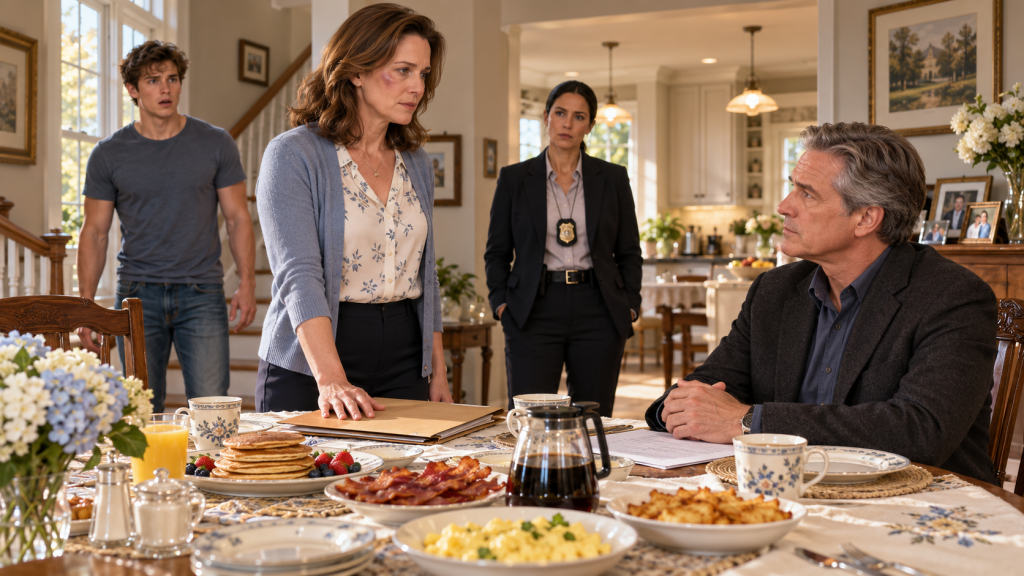
Dylan looked at Richard. “Where did you get that?” Richard’s eyes hardened. “From the trust attorney.” “What trust attorney?” “The one who called me yesterday because he couldn’t reach your mother.” I looked sharply at Richard. “You knew yesterday?” He nodded. “Late afternoon.”
“Before Dylan hit me?”
“Yes.”
I felt dizzy.
“Why didn’t you call?”
“I did.”
My phone had been buried in my purse during my shift at the library.
I remembered seeing two missed calls from him and ignoring them because I assumed he wanted to discuss Christmas plans.
Richard looked ashamed.
“I was going to try again this morning.”
Dylan slammed his palm on the table.
“This is ridiculous.”
The detective looked at him.
“Keep your hands visible.”
His face flushed.
“I didn’t steal anything.”
I finally spoke.
“Then explain my signature.”
He looked at me.
The arrogance tried to return.
“You probably signed something and forgot.”
I almost laughed.
That was the old Dylan.
Always one lie away from making me doubt my own memory.
“I didn’t.”
“You sign stuff all the time.”
“Not a seventy-five-thousand-dollar line of credit.”
The detective’s eyes moved toward Richard.
“How much?”
“Seventy-five thousand approved. Forty-eight thousand drawn.”
My stomach dropped.
I hadn’t heard that number.
I looked at Richard.
“Forty-eight thousand?”
He nodded grimly.
Dylan stood halfway.
“What the hell, Dad?”
“Sit.”
The detective stepped forward.
He sat again.
I gripped the edge of the table.
“Where is the money?”
Dylan said nothing.
“Dylan.”
His jaw tightened.
“Where is forty-eight thousand dollars?”
He looked toward the window.
“Gone.”
The single word barely reached me.
“Gone where?”
“Things.”
“What things?”
“Debts.”
Richard’s voice became low.
“What debts?”
Dylan snapped,
“None of your business.”
Richard stood.
The detective moved between them immediately.
“Mr. Miller, sit back.”
Richard obeyed.
His hands were shaking.
My ex-husband had always been a large man.
Broad.
Quiet.
A mechanic’s hands.
The kind of father who could fix a bicycle with three tools and still somehow miss everything happening inside his own son.
He stared at Dylan.
“You forged your mother’s name.”
Dylan scoffed.
“I was going to pay it back.”
I closed my eyes.
There it was.
The sentence people use when they have already decided another person’s consent is optional.
I was going to pay it back.
As if repayment could erase theft.
As if intention were permission.
The detective asked,
“How did you access the trust documents?”
Dylan looked at me.
I suddenly understood.
My stomach turned.
“You went into my desk.”
His silence answered.
The desk in my bedroom.
The one I kept locked.
Or believed I kept locked.
I whispered,
“When?”
He shrugged.
“Months ago.”
My skin crawled.
He had entered my room.
Gone through my files.
Found my mother’s trust paperwork.
Copied whatever he needed.
While I was making dinner.
Doing his laundry.
Giving him gas money.
Defending him to Richard.
Something inside me cracked open.
Not grief.
Disgust.
“Why?”
He laughed bitterly.
“You wouldn’t help me.”
I stared.
“I gave you money every week.”
“Not enough.”
Richard shut his eyes.
I felt my breath become shallow.
“What did you owe?”
Dylan looked down.
The detective asked again.
“What did you owe?”
Finally, he muttered,
“People.”
“What people?”
No answer.
Richard leaned forward.
“Gambling?”
Dylan looked at him.
That was enough.
My chest tightened.
“How long?”
He rubbed his face.
“A while.”
“How long?”
“Two years.”
Two years.
I thought about every request.
Rent he said he owed.
Car repairs that never seemed to fix anything.
A phone he said had been stolen.
A friend he said was in trouble.
Two years.
Richard whispered,
“You’ve been gambling?”
Dylan exploded.
“Would everybody stop saying it like I’m some kind of criminal?”
The detective’s expression barely changed.
“We’re discussing an assault and alleged identity fraud. Your gambling is secondary.”
Silence.
Dylan’s face went white.
The words landed.
Alleged identity fraud.
Assault.
Not family drama.
Not a misunderstanding.
Not a bad phase.
Names matter.
For years, I had softened everything.
Lazy became lost.
Drunk became stressed.
Cruel became hurting.
Threatening became emotional.
I had spent half my motherhood translating dangerous behavior into kinder language.
The detective had no such habit.
She simply called things what they were.
I looked at the police report.
The blank signature line.
My fingers trembled.
Dylan saw.
His voice softened instantly.
“Mom.”
That one word almost broke me.
Not because it was loving.
Because it was familiar.
The little boy voice.
The one he used when he wanted rescue.
“Mom, don’t do this.”
I looked at him.
His eyes filled.
“I’m your son.”
There it was.
The oldest key he owned.
I’m your son.
The sentence that had opened every door.
Every wallet.
Every second chance.
Every excuse.
I swallowed.
“Yes.”
His face softened.
I continued.
“And I am your mother.”
He nodded quickly.
“Exactly.”
“But I am also a person.”
The softness vanished.
“What?”
I looked at the bruise reflected faintly in the dark kitchen window.
“I am a person you hit.”
He stared.
“I didn’t mean—”
“You hit me.”
“I was angry.”
“You hit me.”
“You provoked me.”
Richard stood again.
This time I held up my hand.
“No.”
He stopped.
I kept looking at Dylan.
“You hit me.”
He looked away.
“And after you did it, you didn’t apologize.”
Silence.
“You told me it was so I would understand.”
His jaw tightened.
The detective watched him carefully.
I whispered,
“I understand now.”
Dylan’s eyes returned to mine.
“What?”
“That loving you does not require me to stand still while you destroy me.”
I picked up the pen.
My hand shook so badly the tip clicked against the table.
Dylan stood.
“Mom.”
I signed.
Eleanor Miller.
Mother.
Victim.
Woman.
The three words finally fit.
The next twenty minutes felt unreal.
The detective asked Dylan to stand.
He began shouting.
Not at her.
At me.
Of course.
“You’re seriously doing this?”
I said nothing.
“You’re sending your own kid to jail?”
Richard stepped closer to me.
The detective told Dylan to turn around.
He refused once.
Then complied.
When the cuffs closed, my knees weakened.
I hated the sound.
Metal.
Final.
Dylan twisted his head toward me.
“You’ll regret this.”
I almost did.
Right there.
Instantly.
My body remembered twenty-three years of responding to his distress.
My instinct screamed:
Stop this.
Fix it.
Tell the detective you changed your mind.
But then I looked at my bruise.
And the forged signature.
And the forty-eight thousand dollars.
The detective guided him toward the door.
Dylan’s voice broke.
“Mom!”
I gripped Richard’s arm.
“Mom, please.”
The little-boy voice again.
Then:
“I’m sorry.”
The words I had waited for all night.
And they arrived only when consequences did.
That hurt almost more than the slap.
He looked at me desperately.
“I’m sorry!”
Tears burned my eyes.
I whispered,
“I hope someday you are.”
The door closed behind him.
Silence filled the house.
The detective’s partner remained for another few minutes.
Questions.
Paperwork.
Instructions about the protective-order process.
Photographs of my cheek.
A number to call.
Everything orderly.
Everything clinical.
When they finally left, Richard and I stood in the kitchen.
The bacon had gone cold.
One pancake had hardened at the edges.
Coffee sat untouched.
Richard stared at the empty chair.
Then he began crying.
Not quietly.
I had seen him cry only twice.
At his mother’s funeral.
And the day our divorce was finalized.
Now he covered his face with both hands.
“I failed him.”
I sat down.
“So did I.”
Richard lowered his hands.
“No.”
“Yes.”
“Eleanor—”
“I did.”
My voice shook.
“I taught him consequences disappeared if he suffered loudly enough.”
Richard stared.
“And I taught him somebody else would always clean up.”
He sat across from me.
“We both did.”
That was more honest.
I looked toward the stairs.
His bedroom door was still open.
Dirty clothes on the floor.
Gaming headset on the desk.
A cracked lamp I had asked him to replace for six months.
Every object suddenly looked different.
Evidence of an adult man I had treated like a troubled child because adulthood meant I would have to demand adult accountability.
Richard whispered,
“What do you want to do?”
I looked at the staircase.
“Pack his things.”
We did not throw them onto the lawn.
I wanted to.
For about five minutes.
Instead, Richard called the lawyer whose number was in the folder.
We learned the correct legal steps for ending Dylan’s residence in the house.
Because even when someone has frightened you, doing things lawfully matters.
Especially then.
The attorney was blunt.
“Do not change locks until you understand occupancy requirements and the protective order.”
“Do not destroy his property.”
“Do not communicate directly if the order restricts contact.”
“Document everything.”
There was something freeing about rules.
For years, our family had operated on moods.
Dylan’s anger.
My guilt.
Richard’s avoidance.
Now there were procedures.
Boundaries that did not disappear because somebody raised his voice.
We packed only items needed for safekeeping and left the rest untouched until advised.
Then Richard went home.
Before leaving, he stood by the door.
“You shouldn’t be alone.”
“I want to be.”
He hesitated.
“Are you sure?”
“Yes.”
He nodded.
Then looked at me.
“I’m sorry.”
“For what?”
“For leaving you to handle him.”
I almost corrected him.
The divorce had not happened because of Dylan.
But Dylan had become the battlefield after it.
Richard moved to Milwaukee for work.
I stayed in Evanston because I wanted stability.
And somehow, stability turned into me becoming the only parent absorbing Dylan’s anger.
Richard paid support.
Called.
Visited.
But distance made it easier for him to believe whatever version I gave him.
And I always gave the softened version.
“He’s having a hard time.”
“He’ll be okay.”
“We’re working through it.”
Richard whispered,
“You made it sound manageable.”
“I know.”
“Why?”
I thought about it.
“Because I didn’t want you to think I couldn’t handle him.”
He looked wounded.
“I would never—”
“Yes, you would.”
He flinched.
I smiled sadly.
“You blamed me after the college dropout.”
His face fell.
“I did.”
“You said I babied him.”
“I was angry.”
“You were also right.”
We stood there with no winner.
Just two parents discovering how much damage can grow between defensiveness and guilt.
Richard reached for the doorknob.
“I’m still coming tomorrow.”
“You don’t have to.”
“Yes.”
He looked at me.
“I do.”
Then he left.
That night, I slept in the guest room.
Not because I was afraid Dylan would return.
The protective order had been granted temporarily.
The police had the information.
But my own bedroom felt contaminated by the idea that he had searched through my desk.
Privacy is strange.
You do not understand how physical it feels until someone violates it.
I lay awake until 3:00 a.m.
Then I cried.
Finally.
Not for the slap.
Not exactly.
I cried for the boy with the red toy car.
The boy who brought me rocks.
The teenager who screamed after Richard moved out:
“Everybody leaves.”
I had spent ten years trying to prove I wouldn’t.
Maybe that had been my mistake.
I confused staying with loving.
They are not always the same thing.
Sometimes love leaves the room.
Calls the police.
Closes the bank account.
Stops rescuing.
Sometimes love says:
You cannot live here like this.
Not because I stopped loving you.
Because I finally stopped calling your destruction helplessness.
The next morning, Richard arrived with boxes from a bakery.
“Why?”
I stared.
He shrugged.
“I can’t make pancakes.”
“You can repair transmissions.”
“Different skill set.”
I laughed.
The first laugh since the slap.
It felt disloyal.
Then I realized joy is not betrayal.
Even in crisis.
Especially then.
We ate pastries at the kitchen table.
No good tablecloth.
No ceremony.
Just crumbs.
Richard asked,
“Do you want to know what the attorney found?”
My stomach tightened.
“What?”
“The line of credit wasn’t the first attempt.”
I stopped chewing.
“What do you mean?”
“There were two rejected applications before it.”
I stared.
“One in March.”
“One in May.”
The successful one had been in August.
Persistence.
That frightened me more than one impulsive act.
“He kept trying.”
Richard nodded.
“How?”
“First using your personal information.”
“Then the trust documents.”
I put down my coffee.
“What else?”
“There’s a credit card.”
My chest tightened.
“In my name?”
“Jointly listed with you as primary.”
I closed my eyes.
Balance: $12,600.
I laughed bitterly.
Richard looked down.
“I’m sorry.”
“Stop saying that.”
He looked up.
“I need facts.”
He nodded.
“The lawyer recommended freezing your credit.”
“I already did.”
That surprised him.
“At two in the morning.”
He almost smiled.
“Good.”
“I’m learning.”
The criminal case moved slower than emotion wanted.
Charges did not become a dramatic verdict overnight.
There were hearings.
Continuances.
Evidence reviews.
Attorneys.
The assault itself was straightforward.
My injury had been photographed.
The detective witnessed his threat the following morning.
The financial allegations required records.
Signatures.
Bank information.
IP logs.
Document access.
I learned something ugly during that process.
Dylan had not acted alone.
Not exactly.
A friend named Trevor had shown him how to open the line of credit.
Trevor had been involved in online sports betting and cryptocurrency schemes.
“Schemes” was the lawyer’s word.
Dylan called them investments.
The forty-eight thousand dollars had moved in pieces.
Some to betting platforms.
Some into digital assets.
Some cash withdrawals.
Some repayments to people I did not know.
By the time accounts were frozen, less than nine thousand remained traceable.
I sat in the attorney’s office staring at the spreadsheet.
“Forty thousand dollars.”
“Approximately.”
I laughed softly.
“That was my mother’s house.”
The lawyer looked confused.
“The line of credit was against your house.”
“No.”
I shook my head.
“I mean the equity came partly from my mother.”
She had left me money.
I used it toward the mortgage.
I had always thought of that equity as the last thing she gave me.
Dylan had turned part of it into bets.
The attorney leaned forward.
“Eleanor, I need you to understand something.”
“What?”
“He could not legally give away your ownership by forging these documents.”
“We have remedies.”
“This is serious.”
“But your house is not automatically gone.”
I breathed.
Slowly.
The word automatically mattered.
Fear had a way of converting possibility into certainty.
We began unwinding what we could.
The lender had fraud procedures.
The forged authorization was challenged.
The process was exhausting.
But the first time I walked into the bank with a folder instead of shame, something changed.
I was no longer hiding what my son had done to protect his reputation.
I was protecting myself.
Dylan called once from detention before the no-contact restrictions were fully explained.
I answered because I did not recognize the number.
“Mom.”
My entire body froze.
“Dylan.”
He was crying.
“I’m sorry.”
I closed my eyes.
“I’m so sorry.”
I said nothing.
“They’re treating me like I’m dangerous.”
That sentence told me everything.
Not:
I scared you.
Not:
I stole from you.
Not:
I hit you.
They’re treating me like I’m dangerous.
Still centered on him.
I whispered,
“You were dangerous.”
Silence.
“Mom.”
“You hit me.”
“I lost control.”
“You threatened me in front of a detective.”
“I was angry.”
“You forged my name.”
“I was desperate.”
Every fact had a costume.
Loss of control.
Anger.
Desperation.
I was tired of costumes.
“You did those things.”
He began crying harder.
“Please don’t do this.”
“What are you asking?”
“Drop it.”
I stared at the wall.
There it was.
He did not want forgiveness.
He wanted escape.
“No.”
His breathing changed.
“Mom.”
“No.”
“You’re ruining my life.”
Something inside me became completely still.
“No, Dylan.”
I swallowed.
“I’m refusing to keep ruining mine to protect you from yours.”
He went silent.
Then his voice hardened.
“So that’s it?”
“For now, yes.”
“You’re choosing Dad over me.”
“No.”
“I’m choosing safety.”
“You always wanted him back.”
I almost laughed.
Even now.
Even here.
The story had to be about abandonment.
Jealousy.
Someone else.
Anything except his behavior.
“Goodbye, Dylan.”
He shouted my name as I hung up.
My hands shook for ten minutes.
Then I made tea.
Small things matter.
Tea.
A locked door.
A quiet house.
A phone that does not control the room.
The protective order became longer-term.
Dylan could not return to the house.
His belongings were collected under arranged supervision.
I was not present.
Richard was.
Later, he told me Dylan cried when he saw the red toy car.
I had kept it all those years.
It was in a shoebox in the closet.
Dylan held it and said,
“Mom kept this?”
Richard told him,
“Your mother kept everything.”
Then Dylan sat on the bed and cried.
When Richard told me, my heart broke.
Not because I wanted him home.
Because love does not switch off when someone becomes unsafe.
That was the hardest lesson.
I could miss my son and still refuse him access to me.
I could remember who he had been without pretending who he had become was acceptable.
Both could be true.
Three months later, Dylan entered a plea arrangement on some charges while financial matters continued to be resolved.
I will not pretend the legal details were neat.
They weren’t.
The outcome involved probation conditions after custody time already served, restitution obligations, mandated treatment, and restrictions on contact.
The court also required him to participate in anger-management programming.
His attorney pushed for gambling treatment.
That part mattered to me.
Not because gambling caused the slap.
It didn’t.
Gambling did not make him entitled.
It did not make him blame me.
But addiction had become another accelerant poured onto a fire already burning.
The judge spoke directly to him.
“You have repeatedly characterized these actions as responses to stress.”
Dylan stared forward.
The judge continued.
“Stress does not authorize violence.”
I felt tears rise.
Some sentences sound simple only because families spend years avoiding them.
Stress does not authorize violence.
The judge looked toward me once.
Then back at Dylan.
“Your mother’s relationship to you did not reduce your obligation to respect her.”
My fingers tightened around the bench.
Richard sat beside me.
Neither of us moved.
Dylan did not look back.
Afterward, outside the courthouse, Richard asked,
“Are you okay?”
“No.”
He nodded.
“Me neither.”
We sat on a bench.
It was cold.
Chicago wind cut between buildings.
People hurried past with folders and coffee.
The world kept moving.
Richard whispered,
“I keep thinking about him at eight.”
I smiled sadly.
“The dinosaur phase.”
“He wore that green hoodie every day.”
“He refused to wash it.”
“You refused to make him.”
I looked at Richard.
“You were the fun parent.”
“You were the scary one.”
He almost laughed.
Then his face fell.
“Do you think we made him like this?”
The question I had been afraid to ask.
I considered it carefully.
“We made mistakes.”
“Yes.”
“We excused too much.”
“Yes.”
“You left more of the emotional parenting to me after the divorce.”
He winced.
“Yes.”
“I protected him from consequences.”
“Yes.”
I looked at him.
“But he is twenty-three.”
Richard nodded slowly.
“There comes a point when our mistakes become context, not permission.”
His eyes filled.
“I needed to hear that.”
“So did I.”
We sat quietly.
Then Richard said,
“I’m going to therapy.”
I stared.
“You?”
“Yes.”
“What happened?”
“Apparently getting older makes me reckless.”
I laughed.
He smiled.
Then added,
“I think I spent years criticizing how you handled Dylan because it kept me from asking what I wasn’t doing.”
That was more apology than I expected.
I looked away.
“Thank you.”
“I’m sorry.”
This time, I let him say it.
For six months, I had no contact with Dylan.
None.
It was the longest I had gone without hearing his voice since the day he was born.
At first, every phone vibration made my stomach drop.
Then slowly, it stopped.
I changed the locks when legally permitted.
Installed cameras.
Changed passwords.
Froze credit.
Moved trust documents to a safe-deposit box.
The practical acts felt almost absurdly empowering.
I had spent decades believing motherhood meant an open door.
Now I understood even love needs locks.
I started sleeping through the night.
Not every night.
But some.
My coworkers noticed.
One of the librarians, Janice, touched my arm.
“You look different.”
I stiffened.
“Bad?”
“No.”
She smiled.
“Rested.”
I almost cried.
Rest had become visible.
Then a letter came.
Not from Dylan.
From his therapist.
Or rather, forwarded with Dylan’s permission through his attorney.
The therapist did not share confidential details.
Only said Dylan had written something he wanted me to receive if I consented.
I stared at the envelope for two days.
Then opened it.
The letter began:
Mom, I have written this six times. The first five versions were about why I did what I did. My therapist told me those were explanations disguised as apologies.
I stopped.
That sounded new.
I continued.
So this version is about what I did.
My eyes filled.
I hit you.
No “because.”
I threatened you.
No “because.”
I stole your identity.
No “because.”
I used money I had no right to touch.
I covered my mouth.
I scared you in your own house and then acted like your fear was disrespect.
Tears fell onto the page.
That sentence went straight through me.
Because he finally understood the inversion.
My fear had become an insult to him.
His aggression had become my responsibility.
The letter continued.
I kept telling myself Dad abandoned me and you owed me more because you stayed. I made your staying into a debt you could never finish paying.
I closed my eyes.
Dylan.
My boy.
Finally saying something true.
Gambling did not make me hit you. Alcohol did not make me hit you. The divorce did not make me hit you. I did that.
I cried.
Quietly.
I am not asking to come home.
That line mattered.
I am not asking you to drop anything.
That mattered more.
I am paying what I can toward restitution. I know that will take years.
Then:
I found the red car.
My vision blurred.
Dad gave it to me with my clothes. I remembered sleeping with it because I thought if I kept something metal under my pillow, nothing bad could happen.
I laughed through tears.
He had never told me that.
You kept it for me longer than I deserved.
I whispered,
“No.”
Not longer than he deserved.
Children do not earn being remembered.
I love you. I know that sentence does not fix anything. I hope someday I can become someone you are not afraid of.
I folded the letter.
Then opened it again.
Read it twice more.
I did not call.
I did not rush toward reconciliation.
The old Eleanor would have.
One good letter.
One tear.
One apology.
Door open.
Bed made.
Dinner waiting.
But accountability deserves time.
So I sent one message through the attorney.
I received your letter. I believe you are beginning to understand. Keep doing the work.
That was all.
And for the first time, all was enough.
A year passed.
Then another.
Dylan lived in supervised transitional housing for a while, then rented a room with two men from his recovery program.
He worked.
Not glamorous work.
Warehouse.
Early shifts.
Steady.
Richard met him monthly.
I knew because Richard told me only after asking whether I wanted updates.
That was another boundary we learned.
Information should be invited.
Not dumped.
“How is he?” I asked one day.
Richard thought carefully.
“Better.”
“Meaning?”
“He gets angry.”
My stomach tightened.
Richard added,
“And then he leaves the room.”
I breathed again.
“He calls his sponsor.”
“Good.”
“He still blames himself hard.”
“That may be necessary for a while.”
Richard looked at me.
“He misses you.”
I looked out the window.
“I miss him too.”
That was the first time I admitted it aloud.
Richard nodded.
Neither of us treated that like a reason to hurry.
The first time I saw Dylan again was twenty-two months after the breakfast.
Neutral place.
A therapist’s office.
No home.
No kitchen.
No memories waiting in cabinets.
I arrived early.
Of course I did.
My hands shook in the waiting room.
When Dylan entered, I almost did not recognize him.
Thinner.
Hair shorter.
Shoulders less inflated somehow.
He saw me.
Stopped.
His eyes filled immediately.
“Hi, Mom.”
My throat tightened.
“Hi.”
He did not approach.
That mattered.
The therapist invited us inside.
We sat across from each other.
Dylan kept his hands folded.
For several minutes, nobody spoke.
Then he said,
“I’m sorry.”
I nodded.
He continued.
“I’m not saying that so you’ll forgive me.”
My eyes filled.
“I know.”
“I practiced not asking.”
A tiny, sad smile.
I almost smiled back.
He looked down.
“I used to think if I apologized, you were supposed to make me feel better.”
I breathed.
“Yes.”
“You did.”
“Yes.”
“I took advantage of that.”
“Yes.”
Each answer hurt.
Each answer freed me.
He looked up.
“I don’t remember deciding to become someone who scared you.”
Tears rolled down his face.
“I think it happened one excuse at a time.”
That sentence broke my heart.
Because that was true for both of us.
His violence did not begin with the slap.
My enabling did not begin with the forged loan.
We both arrived there through repetition.
He continued.
“I want to tell you something.”
“Okay.”
“Trevor wasn’t the first person who told me how to get money from the house.”
I stiffened.
“What?”
He swallowed.
“Grandpa.”
My heart stopped.
“My father?”
Dylan nodded.
My father had died twelve years earlier.
A stern man.
Proud.
Old-school.
The trust had originated partly from him and my mother.
“What do you mean?”
“When I was sixteen, Grandpa told me the house would be mine someday.”
I stared.
“He said you were too soft with money.”
I almost laughed from disbelief.
“My father barely let me borrow ten dollars.”
Dylan nodded.
“He said the house was family property.”
My skin chilled.
“He told me if I ever needed help, I should remember I had a stake in it.”
I sat back.
There it was.
Another thread.
Not an excuse.
But a story Dylan had carried.
Entitlement disguised as inheritance.
My father had loved me.
But he was from a generation where men sometimes spoke over women about property as though daughters were temporary custodians.
Dylan whispered,
“When I started losing money, I remembered that.”
I stared at him.
“And you decided the house was partly yours.”
“Yes.”
“Even though I paid the mortgage.”
“Yes.”
“Even though it was legally mine.”
“Yes.”
“Even though I was alive.”
His face collapsed.
“Yes.”
That answer hurt more than a lie would have.
The therapist spoke softly.
“What do you understand now?”
Dylan wiped his face.
“That somebody telling me I deserved something didn’t make it mine.”
I nodded.
“And?”
He looked at me.
“That being family never gave me ownership over you.”
My breath caught.
There.
The sentence.
The thing I had spent my entire motherhood failing to say.
You are mine to love.
I am not yours to own.
Tears filled my eyes.
“I forgive you for some things.”
Dylan began crying harder.
I continued before either of us misunderstood.
“I am still angry about others.”
He nodded.
“I understand.”
“I don’t trust you yet.”
“I understand.”
“You cannot live with me again.”
His face tightened.
Then he nodded.
“I know.”
“I love you.”
He covered his mouth.
“And I need you to understand that none of those sentences cancel each other.”
He cried openly.
“So do I.”
For the first time, we spoke as two adults.
Not mother and boy.
Not rescuer and rescued.
Two adults.
One had caused harm.
One had endured too much.
Both had work left.
Reconciliation came in inches.
Coffee once every two months.
Then lunch.
Then a phone call on my birthday.
Then Christmas in a restaurant instead of my house.
Why a restaurant?
Because neutral ground still made me feel safer.
Dylan never complained.
That mattered.
When he was three years sober from alcohol and gambling, he gave me a small box.
Inside was a check.
Not large.
Eight hundred dollars.
I frowned.
“What is this?”
“Restitution.”
“There’s already a payment plan.”
“I know.”
“This is extra.”
“Why?”
He smiled sadly.
“I got overtime.”
My old instinct rose instantly.
Keep it.
You need it more.
Motherhood almost spoke before wisdom.
Then I stopped.
I took the check.
“Thank you.”
His eyes filled.
Maybe accepting repayment was also part of his recovery.
Accountability should not always be rescued from discomfort.
The house survived.
The fraudulent line of credit was eventually unwound through the legal and banking process, though not without months of paperwork, stress, and costs.
Some money was lost.
Some recovered.
Dylan’s restitution stretched across years.
I stopped measuring healing in dollars.
Money mattered.
But safety mattered more.
The strangest outcome was that I eventually sold the house.
Not because I had to.
Because I wanted to.
For decades, I had treated that house like proof.
Proof I survived divorce.
Proof I could raise Dylan.
Proof my parents’ sacrifices meant something.
Proof I was stable.
Then one afternoon I realized the building had become a museum to things I no longer needed to prove.
So I sold it.
I bought a smaller townhouse near the library.
Two bedrooms.
Sunlight in the kitchen.
A tiny garden.
The first night there, Richard helped me assemble a bookcase.
Badly.
“You put the shelf backwards.”
“It has two sides.”
“One is unfinished.”
“Character.”
I laughed.
For a few seconds, we felt like the young couple we had once been.
Then the feeling passed.
Gently.
Not every repaired relationship needs to become what it used to be.
Richard and I became friends.
Real ones.
Better perhaps than we had been spouses.
He eventually retired closer to Chicago.
Not for me.
For himself.
For Dylan.
For the grandchildren he hoped might exist someday.
Five years after the slap, Dylan called me at 6:30 one morning.
My heart no longer jumped when his name appeared.
That itself was progress.
“Mom?”
“Yes?”
“I need help.”
I sat up.
The old fear returned instantly.
Money?
Trouble?
Police?
Then he said,
“I’m outside a hospital.”
My stomach tightened.
“What happened?”
“My friend Aaron relapsed.”
I waited.
“He called me.”
“Okay.”
“I got him here.”
“Good.”
Dylan’s voice shook.
“He asked me for money before we came.”
I closed my eyes.
“And?”
“I said no.”
A tear slid down my face.
“He got angry.”
“I stayed calm.”
“He called me a terrible friend.”
“I still said no.”
I smiled.
“Then I drove him to the ER.”
I whispered,
“I’m proud of you.”
Silence.
Then Dylan cried.
So did I.
He had finally learned the difference between helping and rescuing.
The lesson that had nearly destroyed us.
Years later, he told me he understood that breakfast differently.
At first, he thought Richard and the detective had come to humiliate him.
Then he thought I wanted revenge.
Then he thought I had chosen myself over him.
Finally, he understood.
“I think that was the first morning you loved me like an adult.”
I stared at him.
We were sitting in my townhouse kitchen.
He had been allowed there for years by then.
Trust had returned slowly enough to deserve its name.
“What do you mean?”
“You stopped protecting me from reality.”
I felt tears rise.
He looked at the table.
No embroidered cloth.
No police folder.
Just two mugs.
He smiled sadly.
“You made pancakes.”
I laughed.
“You remember that?”
“I remember everything.”
“So do I.”
“I thought the breakfast meant you had forgiven me.”
My chest tightened.
“I know.”
He shook his head.
“I saw food and thought everything had reset.”
I looked at him.
“That was the pattern.”
“Yes.”
He swallowed.
“You always fed me after I hurt you.”
That sentence hit hard.
After slammed doors.
After screaming.
After lies.
I would wake the next morning and make eggs.
As if routine could erase injury.
Dylan whispered,
“I think the detective was the first consequence I couldn’t eat my way past.”
Despite everything, I laughed.
He did too.
Then we cried.
Families sometimes heal in strange places.
When Dylan turned thirty, he invited Richard and me to dinner.
He cooked.
Badly.
The chicken was dry.
The vegetables were nearly raw.
I ate everything.
Not because I had to.
Because he had made it.
After dinner, he brought out the little red toy car.
Still scratched.
Still missing one wheel cap.
He placed it on the table.
“I’m having a kid.”
My fork slipped from my hand.
Richard froze.
“What?”
Dylan laughed nervously.
“Rachel’s pregnant.”
His partner, Rachel, came from the kitchen with tears in her eyes.
I stood.
Then stopped.
For years, my instinct had been to run toward Dylan.
Now I asked,
“Can I hug you?”
His face broke.
“Yes.”
I hugged my son.
Not the boy I remembered.
Not the man who hit me.
The man standing in front of me now.
Both histories existed.
But neither had to cancel the other.
He whispered,
“I’m scared.”
“Good.”
He laughed through tears.
“What?”
“Fear means you understand it matters.”
He pulled back.
“What if I become like Grandpa?”
“Richard?”
“No.”
He smiled faintly.
“Me.”
My heart tightened.
“You won’t avoid that by promising.”
He listened.
“You avoid it by noticing.”
“By apologizing.”
“By getting help before anger becomes identity.”
“By never treating love like ownership.”
He nodded.
“And?”
I smiled.
“By remembering that your child does not owe you for being born.”
His eyes filled.
“I know.”
I squeezed his hand.
“Then start there.”
My grandson was born the following spring.
Dylan named him James Richard Miller.
Richard cried for an hour.
I cried longer.
When I held James for the first time, Dylan stood beside me.
His hands hovered nervously.
“Support his head.”
“I know.”
“You’re holding him too high.”
I looked at him.
“I raised you.”
“Yeah, well…”
He stopped.
We both knew where that joke could have gone.
Then Dylan smiled.
“Fair.”
Baby James opened his eyes.
Tiny.
Helpless.
A whole future.
I looked at Dylan.
“Do you remember what you used to say when you were little?”
“No.”
“When you grow up, you’re never going to let anyone make me cry.”
Dylan’s face changed.
He looked down.
“I failed that.”
“Yes.”
No softening.
Then I added,
“But that wasn’t a promise a child should have had to make.”
He looked at me.
“You were supposed to be a child.”
Tears filled his eyes.
“And I was supposed to be responsible for my own safety long before you became responsible for yours.”
He began crying.
I shifted James gently.
“Do you know what promise matters now?”
Dylan shook his head.
“The one you make to him.”
He looked at his son.
Then whispered,
“I’ll never make you responsible for my anger.”
That was a better promise.
I still have the embroidered tablecloth.
For years, I could not use it.
Every time I saw the pattern, I remembered Dylan walking downstairs with that smile.
The detective at the window.
The folder.
The cuffs.
Then, on James’s first birthday, I took it out.
I washed it.
Ironed it.
Laid it across my dining table.
Richard noticed.
His expression changed.
“You sure?”
“Yes.”
Dylan arrived later carrying James.
He saw the cloth.
Stopped.
I watched his face.
The memory passed between us.
He whispered,
“Mom.”
I smiled.
“It’s a tablecloth.”
His eyes filled.
“I know.”
“No.”
I touched the embroidered edge.
“For years, it was that morning.”
“I’m done giving one terrible day ownership over my mother’s tablecloth.”
Dylan laughed through tears.
“That sounds like therapy.”
“It was expensive. I’m using it.”
Everyone laughed.
And just like that, an object came home.
Not erased.
Reclaimed.
People sometimes ask me why I called Richard instead of the police immediately.
The answer is shame.
Not wisdom.
Not strategy.
Shame.
I was forty-nine years old and afraid people would think I had failed as a mother.
That fear almost kept me unsafe.
So if there is anything I would say to the woman I was at 1:20 that morning, it would be this:
You do not become a bad mother because your adult child makes dangerous choices.
You do not owe silence to protect your child’s reputation.
You do not owe access to someone because you gave birth to them.
And calling something abuse does not mean you stopped loving the person who caused it.
Sometimes naming it is the first loving thing anyone has done.
Not only for yourself.
For them too.
Because Dylan did not begin changing when I explained him.
He began changing when explanation stopped protecting him.
That distinction saved both of us.
I am sixty now.
Still working part-time at the library because retirement turns out to be boring when you actually like books.
Richard lives fifteen minutes away.
We have Sunday coffee sometimes.
Dylan visits with Rachel and James.
There are boundaries.
Still.
Healthy families have them.
We do not shout.
If a conversation becomes heated, it stops.
Nobody borrows money without written terms.
Nobody enters my bedroom or office without permission.
Dylan does not drink.
He attends recovery meetings.
He still sees a therapist when he needs one.
Sometimes he gets angry.
So do I.
The difference is that anger no longer gets promoted to authority.
It is just a feeling.
Not a weapon.
On my sixtieth birthday, Dylan gave me a small frame.
Inside was a photograph.
Me at twenty-six.
Holding him as a toddler.
His little red car clutched in one fist.
Underneath, he had written:
You loved me enough to hold me. Then you loved me enough to let consequences hold me.
I cried.
Of course I did.
Dylan hugged me.
“Good crying?”
I laughed.
“I hate that phrase.”
“Dad says that too.”
“Your father is annoying.”
Richard shouted from the kitchen,
“I heard that.”
We laughed.
James ran around the living room with a toy truck.
Rachel carried cake.
Nothing about the room looked dramatic.
That was the miracle.
Ordinary life.
Safe life.
A family that did not have to pretend pain never happened in order to love one another afterward.
I looked at Dylan.
He looked back.
For a moment, I saw the little boy.
Then the frightened young man.
Then the adult he had chosen, slowly and painfully, to become.
I did not erase any of them.
Neither did he.
That is what real healing eventually became.
Not forgetting.
Not excusing.
Not pretending.
Integration.
Truth without surrender.
Love without self-erasure.
Forgiveness without amnesia.
And boundaries strong enough that nobody in the room had to be afraid.
All those years ago, I thought the breakfast I made after Dylan hit me was a funeral.
In some ways, it was.
The mother who forgave everything died that morning.
Good.
She had loved deeply.
But she had misunderstood love.
She thought motherhood meant standing in the doorway while someone kept walking through her.
The woman who replaced her learned something better.
A mother can say no.
A mother can call the police.
A mother can lock the door.
A mother can testify.
A mother can refuse money.
A mother can love her son from a distance.
And if he changes—not for a week, not because he is afraid, but slowly, consistently, through accountability—
a mother can decide whether to open a new door.
Not the old one.
Never the old one.
A new one.
With rules.
With respect.
With truth standing between them like something solid.
That morning, Dylan thought the man at my table was the surprise.
He thought Richard had come back to punish him.
He thought the detective was the enemy.
He thought the folder was betrayal.
Years later, he finally understood.
The surprise was that his mother had stopped being afraid of losing him.
Because once I stopped fearing that boundary would destroy our relationship, I gave us the first real chance we had ever had to rebuild it.
Not as a frightened mother and an entitled son.
As two adults.
And every time I look at the old red toy car sitting now on the shelf above my desk, I remember the boy Dylan once was.
I love that boy.
I always will.
But I no longer use his memory to excuse the man.
That may be the most important thing I ever learned.
You can love who someone was.
You can hope for who they may become.
But you must still protect yourself from who they are today.
And sometimes, the strongest sentence a mother will ever say is not:
“I forgive you.”
It is:
“No more.”
Because sometimes “no more” is not the end of love.
Sometimes it is where real love finally begins.
THE END STORIES! THANK YOU FOR READING GOOD LUCK !❤️
Related Posts