Tomorrow. That single word seemed to hang in the air longer than Vanessa’s scream. I stood in the doorway of our kitchen, holding my youngest daughter’s hand, while the woman who had abandoned our seven children ten years earlier stared at a glossy brochure announcing that she had raised them.
Behind her, Rob was suddenly very interested in the floor. The birthday decorations were still hanging above our heads. Pink balloons floated near the ceiling. Sophie’s chocolate cake sat on the counter with twelve little candles pushed into the frosting. Ten minutes earlier, our backyard had been filled with laughter.
Now every conversation had stopped. “Tomorrow?” I repeated. Grace nodded. “At the Grand Ashford Hotel. Seven o’clock. They’re calling it the Family Promise Gala.” Vanessa took a step forward. “Grace, give me that.” My eldest daughter didn’t move. At twenty-six, Grace had the same steady eyes as her grandmother. She had been sixteen when Vanessa left, old enough to understand exactly what had happened and young enough to spend years wondering whether she could have prevented it.
Now she held the brochure against her chest.
“No, Mom.”
Vanessa flinched at the word.
It was the first time Grace had called her that in years.
“You don’t understand what we’re trying to do,” Vanessa said.
Grace looked at her.
“Then explain why you told people you raised us.”
Rob cleared his throat.
“This is a misunderstanding about marketing language.”
I turned toward him.
“Marketing language?”
He straightened his jacket.
Rob had always been good at looking important. Even ten years earlier, when he lived next door, he wore expensive watches and talked about investments as though ordinary people were beneath him.
I had trusted him.
He’d eaten dinner at our table.
Helped me assemble the children’s swing set.
Held Sophie when she was a baby.
Then he’d disappeared with my wife.
Now he was standing in my hallway explaining that a lie about my children’s childhood was merely a marketing decision.
“Which part is marketing, Rob?” I asked. “The claim that I abandoned my children? Or the claim that Vanessa raised them?”
His face reddened.
“We’re raising money for disadvantaged families.”
“With photographs of my children?”
Vanessa waved her hand impatiently.
“They’re my children too.”
“Yes,” I answered. “And they are people, not decorations for a fundraising brochure.”
Sophie squeezed my fingers.
I looked down.
Her smile had disappeared completely.
For weeks, she’d been excited about her birthday. She had helped me choose the barbecue menu, hung decorations with her brothers, and invited her closest friends from school.
Now she was standing in her own kitchen looking as though she’d caused a terrible disaster.
That was when I realized what mattered most.
Not Vanessa.
Not Rob.
Not even the humiliating lie in the brochure.
My little girl.
I knelt in front of her.
“Sophie, look at me.”
Her eyes were wet.
“Did I do something wrong?”
My heart broke.
“No, sweetheart.”
“But Mom got mad.”
I swallowed.
“You showed us something we needed to know. That doesn’t mean you’re responsible for how the adults react.”
She glanced toward Vanessa.
“But she called me a brat.”
I felt my jaw tighten.
Behind me, Grace moved closer.
I took Sophie’s hands.
“Nobody gets to call you names because you told the truth.”
Then I stood.
“Vanessa, Rob, I think you should leave.”
Vanessa stared at me.
“Are you serious?”
“Yes.”
“It’s my daughter’s birthday.”
I nodded.
“And you’ve already upset her enough.”
She looked toward Sophie.
“Sweetheart, I’m sorry if you misunderstood—”
“Stop,” I said.
Vanessa turned toward me.
“Don’t tell me how to speak to my own daughter.”
I kept my voice level.
“Then speak to her with kindness.”
For a moment, nobody moved.
Finally, Rob picked up his car keys.
“Come on, Vanessa.”
She looked around the room, searching the faces of our children.
Grace stood beside me.
Owen, our twenty-four-year-old son, had appeared in the hallway with his arms folded.
Emma, twenty-two, stood near the kitchen island.
Caleb, twenty, was beside the refrigerator.
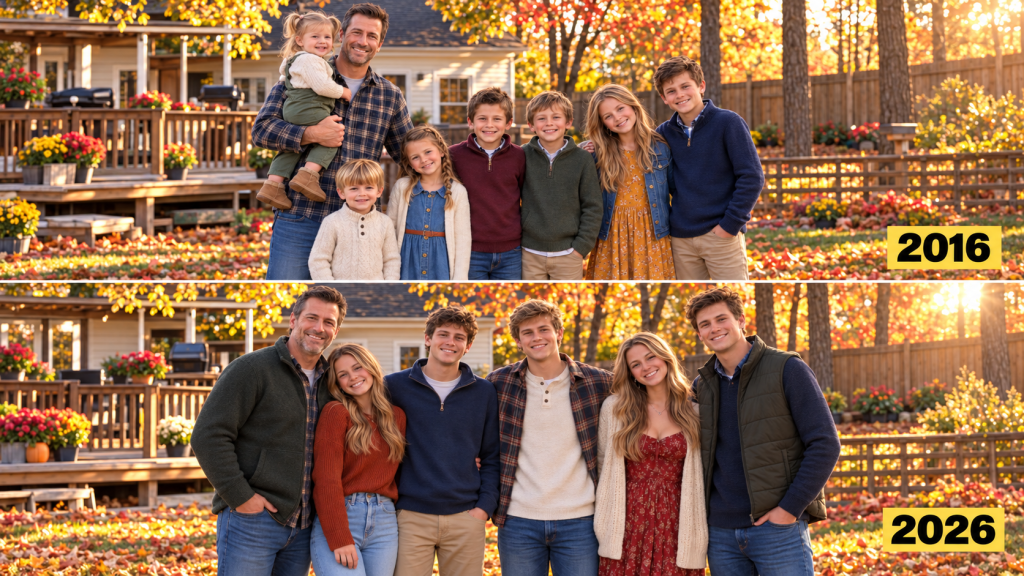
And our seventeen-year-old twins, Noah and Lily, stood shoulder to shoulder near the back door.
Seven children.
Seven faces.
Ten years of birthdays, school mornings, illnesses, disappointments, and little victories Vanessa hadn’t been there to witness.
Her expression changed.
For a moment, she seemed to realize that these weren’t the small children she’d left behind.
They had grown.
They had memories.
And they had voices.
“We’ll talk about this tomorrow,” she said.
Grace shook her head.
“No, we won’t.”
Vanessa stared.
Grace continued.
“Because none of us are going to your gala.”
Rob’s face tightened.
“That’s not a decision you can make for everyone.”
Owen stepped forward.
“She’s speaking for herself. I’m not going either.”
“Neither am I,” Emma said.
Caleb shook his head.
“No chance.”
The twins exchanged a glance.
Then Noah said, “You didn’t even ask us.”
Lily looked directly at Vanessa.
“You don’t get to show up after ten years and book us for an event.”
Vanessa turned toward Sophie.
“Sweetheart?”
My youngest daughter looked at the new tablet lying on the counter.
Then at the bicycle Rob had brought.
Finally, she stepped closer to me.
“I wanted you to come to my birthday,” she whispered.
Vanessa’s eyes filled.
Sophie continued.
“I didn’t want to be in a show.”
For the first time, Vanessa had no answer.
Rob took her arm.
They left without another word.
And when the front door closed behind them, the silence in our house felt enormous.
I expected Sophie to cry.
Instead, she walked into the kitchen, picked up the knife beside her cake, and said, “Can we still have dessert?”
Every one of her siblings looked at her.
Then Caleb laughed.
Not because anything was funny.
Because he’d been holding his breath for ten minutes.
“Absolutely,” he said. “I’ve been waiting all afternoon for that cake.”
Owen reached for the plates.
Emma turned the music back on, softly this time.
Noah went outside to tell the remaining guests that everything was all right.
Lily wrapped an arm around Sophie’s shoulders.
And Grace stood beside the counter with tears rolling silently down her cheeks.
I looked at my children.
They weren’t perfect.
We had arguments.
Forgotten chores.
Bad grades.
Broken appliances.
More laundry than any reasonable household should produce.
But when one of them was hurting, the others instinctively moved closer.
That was something I’d never been able to buy for them.
Something no expensive holiday or diamond necklace could replace.
We finished the birthday party.
Sophie opened her presents from her friends.
Her brothers gave her a ridiculous stuffed giraffe almost as tall as she was.
Emma had made a scrapbook of photographs from the past year.
Grace gave her tickets to a concert by her favorite singer.
And I watched my daughter laughing again beneath the pink balloons.
Later, after everyone had gone home, I found her sitting on the back steps.
The new bicycle was still in the hallway.
The tablet remained unopened.
I sat beside her.
“Long day?”
She nodded.
For a while, we listened to the crickets.
Then she asked, “Dad, did Mom really not want us?”
I felt the familiar ache.
I’d answered variations of that question for ten years.
When Sophie was three, she asked why Mommy didn’t come home.
At five, she wondered whether Mommy lived too far away to visit.
At eight, she asked whether she’d done something wrong.
Now she was twelve.
And for the first time, she’d heard her mother claim that leaving had been an act of generosity.
I took a breath.
“Sweetheart, I can’t tell you exactly what your mother felt.”
Sophie looked down.
“But I can tell you this. She made a choice to leave. That choice was not your fault.”
She nodded slowly.
“Did you ever want to leave?”
The question nearly undid me.
I looked toward our house.
The porch light was flickering again.
The deck needed staining.
I still had a pile of bills on my desk and a washing machine that made a terrible noise during the spin cycle.
There had been nights when I was so exhausted that I cried in the laundry room because I didn’t want the children to see.
But leave them?
Never.
“I wanted help sometimes,” I answered.
Her eyes filled.
“I wanted sleep. I wanted one afternoon without somebody needing something. I even wanted a vacation where nobody asked me to find their shoes.”
She smiled faintly.
“But I never wanted a life without you.”
Sophie leaned against me.
I put my arm around her.
Then she whispered, “Dad, can I tell you a secret?”
“Of course.”
“I knew about the video before today.”
I turned toward her.
“What?”
She swallowed.
“Grace showed it to me last night.”
I stared.
“Why?”
“Because I asked her whether Mom was really coming. She said there was something I should know.”
Sophie’s fingers tightened around mine.
“I watched the video three times.”
I felt my stomach sink.
She looked toward the stars.
“Then I decided I wanted Mom to see it herself.”
I studied my daughter.
Twelve years old.
She’d spent ten years imagining what her mother might say if she came back.
And when the moment finally arrived, Sophie hadn’t asked for revenge.
She’d asked her mother to look at the truth.
“Why didn’t you tell me?” I whispered.
She looked ashamed.
“I didn’t want to ruin your day.”
I closed my eyes.
Then pulled her close.
“Oh, Sophie.”
I thought about all the years I’d spent trying to protect my children from pain.
And suddenly, I understood that they had been trying to protect me too.
The following morning, Grace came to my house before eight.
She was carrying a laptop and a paper bag from the bakery.
“Breakfast,” she announced.
I looked at her.
“Since when do you get up this early on a Sunday?”
“Since my mother started using my childhood as a fundraising campaign.”
I stepped aside.
She entered, placed the bag on the kitchen counter, and opened her computer.
“Dad, we need to talk.”
Something in her expression made me sit down.
She turned the screen toward me.
An email was open.
It had been sent three days earlier by a woman named Evelyn Price, who identified herself as the director of donor relations for the Family Promise Foundation.
Grace had written to the foundation after discovering the promotional video.
At first, she had expected a form response.
Instead, Evelyn had replied personally.
Dear Grace,
Thank you for contacting us. Your concerns are serious. The materials provided to our organization represented that all seven adult and minor children had agreed to participate in tomorrow’s presentation. We were not aware that the family history described to us was disputed.
Please know that we are reviewing the use of your images and the claims made in connection with the event.
I read the message twice.
“All seven agreed?”
Grace nodded.
“That’s what they told the board.”
I stared.
“Sophie is twelve.”
“I know.”
“How could they possibly think she’d agreed to a fundraising event?”
Grace clicked another attachment.
My stomach tightened.
It was a participation form.
Seven names appeared in a column.
Grace.
Owen.
Emma.
Caleb.
Noah.
Lily.
Sophie.
Beside each name was a checkmark.
Across the top were the words:
Family participation confirmed by event sponsors.
At the bottom, Vanessa and Rob were listed as the individuals responsible for coordinating the family appearance.
I looked at Grace.
“Did anyone sign anything?”
“No. It’s a confirmation sheet, not a consent form. But they used it to reassure the board that we were coming.”
I rubbed my forehead.
Grace clicked another page.
Then she said, “Dad, there’s something bigger.”
I looked up.
“The gala isn’t just a dinner. It’s the final event in a fundraising campaign for the foundation’s new family assistance center.”
“How much money?”
She hesitated.
“Apparently, a donor has offered a matching contribution of up to two hundred fifty thousand dollars.”
I stared.
“A quarter of a million?”
Grace nodded.
“And Vanessa’s story is the centerpiece of the appeal.”
I leaned back.
Now I understood why Rob had looked so frightened when Sophie showed them the video.
It wasn’t simply the embarrassment of being exposed at a birthday party.
Their entire fundraising presentation depended on a family that did not exist.
A devoted mother raising seven children alone.
Seven grateful sons and daughters willing to stand beside her.
An inspiring story of sacrifice that would persuade wealthy donors to open their wallets.
Except the sacrifice had been mine.
The childhood memories belonged to my children.
And the woman being celebrated had been absent for ten years.
Grace lowered her voice.
“Dad, Evelyn wants to speak with us.”
I looked at the screen.
“All of us?”
“Whoever is comfortable. She said the foundation doesn’t want to pressure anyone.”
I considered.
“What do you want?”
Grace’s expression softened.
“I want them to stop using our names.”
I nodded.
“And I want them to know you raised us.”
I felt my throat tighten.
“Grace, you don’t have to prove anything about me.”
Her eyes filled.
“Maybe not.”
She reached for my hand.
“But I’ve spent ten years watching people praise you for being strong without knowing how hard you had to work just to keep us together.”
I looked down.
She continued.
“I don’t want another room full of people applauding Mom for things you did.”
I squeezed her hand.
Then asked something that surprised her.
“Would you be willing to let me speak first?”
Grace nodded.
“Of course.”
I looked toward the family photographs hanging above our kitchen table.
Seven children.
A hundred birthdays.
A thousand little moments that would never fit inside a fundraising brochure.
“I don’t want your mother humiliated publicly,” I said.
Grace stared at me.
“After what she did?”
I nodded.
“Yes.”
“Dad—”
“Listen. I want the lies corrected. I want your photographs removed. I want the donors given accurate information.”
I paused.
“But I don’t want to turn your childhood into a public argument.”
Grace’s expression softened.
For a moment, she looked like the sixteen-year-old girl who’d once helped me make lunches at six in the morning.
Then she whispered, “Okay.”
We sat together for a while.
Finally, she reached into the bakery bag.
“I brought cinnamon rolls.”
I smiled.
“Trying to bribe me?”
“Absolutely.”
I laughed.
And we ate breakfast while discussing how to tell the truth without handing our pain to an audience.
Evelyn Price called that afternoon.
She sounded like a woman who had spent the previous twenty-four hours discovering that an important project was built on unreliable information.
“Mr. Bennett?”
“Yes.”
“My name is Evelyn Price. Thank you for agreeing to speak with me.”
I had never met her.
But I appreciated that she began by asking what I wanted to share rather than immediately demanding evidence.
I told her about Vanessa leaving.
About Rob.
About the ten years that followed.
I explained that our divorce and custody arrangements had been settled years earlier and that I had remained the children’s primary caregiver.
I told her Vanessa had not raised the children during that period.
And I explained that none of us had agreed to appear at the gala.
There was a long silence.
Then Evelyn said, “I’m very sorry.”
I took a breath.
“I don’t need sympathy, Mrs. Price.”
“Evelyn, please.”
“All right, Evelyn. I need to know whether you’re still going to use those photographs.”
“No.”
Her answer was immediate.
“We’ve halted the presentation materials and informed the event committee. We’re consulting our board and counsel about corrections and any further action required.”
I nodded.
“Good.”
She hesitated.
“Mr. Bennett, I need to ask whether you’d be willing to provide documentation concerning the family history.”
I considered.
“I’ll have a lawyer review what would be appropriate to share.”
“Of course.”
Then she said something that made me pause.
“I also want you to know that several families are depending on the foundation’s programs.”
I closed my eyes.
For a moment, I pictured the people who might lose help because Rob and Vanessa had built the appeal around a false story.
“Are those programs real?” I asked.
“Yes. Some services are already operating. The proposed center would expand them.”
I thought about that.
“Then I hope you can continue helping those families without using mine.”
Evelyn was silent for a moment.
Then she answered quietly.
“So do I.”
That evening, Vanessa called.
I almost didn’t answer.
The children were scattered around the house, and I had just finished helping Sophie with a science project.
But I wanted to hear what Vanessa had to say.
So I stepped onto the back porch and accepted the call.
“Hello, Vanessa.”
She didn’t bother with a greeting.
“You contacted the foundation.”
I looked toward the yard.
“Grace contacted them. I spoke with Evelyn today.”
Vanessa exhaled sharply.
“Do you have any idea what you’ve done?”
I thought about our seven children standing in the hallway the day before.
“Yes.”
“You’ve jeopardized months of work.”
I remained quiet.
She continued.
“Rob says the board may cancel tomorrow’s presentation.”
“That sounds sensible.”
“Dylan, please.”
She hadn’t used my first name in years.
I closed my eyes.
“Vanessa, you claimed you raised our children alone.”
“I was trying to inspire people.”
“With a story that wasn’t true.”
She sighed.
“You don’t understand how these events work.”
I looked toward the back door.
Inside, Sophie was laughing at something Caleb had said.
“I understand that my children weren’t asked.”
Vanessa grew quiet.
Then she whispered, “I wanted them to be proud of me.”
I stared across the lawn.
For the first time, her voice sounded less angry than frightened.
“You wanted them to be proud?”
“Yes.”
“Then why didn’t you come to their birthdays?”
She didn’t answer.
“Why didn’t you show up when Owen broke his arm?”
Silence.
“When Emma graduated?”
Her breathing grew uneven.
“When Lily had surgery on her ear? When Noah needed someone at his first football game? When Grace was trying to decide whether she could afford college?”
“Stop.”
My voice trembled.
“No, Vanessa.”
I swallowed.
“You don’t get to replace ten years with a twenty-minute presentation.”
She began crying.
I waited.
Finally, she whispered, “I didn’t know how to come back.”
I looked down.
“That may be true.”
I paused.
“But not knowing how to come back didn’t give you the right to pretend you never left.”
For a long time, neither of us spoke.
Then she asked, “Will you tell the children I’m sorry?”
I closed my eyes.
“No.”
She made a small sound.
“If you’re sorry, you can write to them yourself. They can decide whether they want to read it.”
I paused.
“And Vanessa?”
“Yes?”
“Don’t ask Sophie to carry your shame.”
Then I ended the call.
On Monday morning, the foundation made its decision.
The gala would go ahead, but the presentation about Vanessa and her seven children was canceled.
The photographs came down from the website.
The promotional video was withdrawn.
The event organizers informed ticket holders that one of the featured family stories could not be substantiated and would not be used.
The foundation also began an internal review of how the materials had been approved.
I expected to feel relieved.
Instead, I felt tired.
For ten years, I’d been trying to build a life that didn’t revolve around the moment Vanessa left.
Now, in the space of one weekend, that moment had returned to the center of everything.
My phone kept ringing.
Relatives I hadn’t heard from in years suddenly wanted to know what happened.
An old friend asked whether I’d seen the foundation’s announcement.
A cousin wanted to know whether Vanessa had really been supporting the children all along.
Some people were kind.
Others were simply curious.
By lunchtime, I’d had enough.
I sent one message to the family group.
We’re not discussing the children with strangers. Please respect their privacy.
Then I turned off my phone and took Sophie for ice cream.
She chose mint chocolate chip.
I chose vanilla.
We sat at a little table near the window, watching cars pass.
For a while, she didn’t speak.
Then she asked, “Dad, are you mad that Mom came back?”
I considered.
“I’m upset about what she did.”
Sophie nodded.
“But are you mad she came to my birthday?”
I looked at my daughter.
Her question was more complicated than it sounded.
She had spent ten years waiting for her mother.
Then Vanessa finally appeared carrying the exact gifts Sophie had dreamed of owning.
Sophie had been happy to see her.
And almost immediately, that happiness had been replaced by anger and confusion.
I reached across the table.
“No, sweetheart. I’m not angry that you wanted her there.”
Her eyes filled.
“Really?”
“Really.”
She looked down at her ice cream.
“I thought maybe you’d be hurt if I liked the presents.”
I felt my throat tighten.
“Oh, Sophie.”
I squeezed her hand.
“You’re allowed to like a bicycle.”
She gave a small smile.
“And a tablet?”
“Yes, even a tablet.”
She laughed softly.
Then I continued.
“But you don’t owe anybody your affection because they buy you something expensive.”
She nodded.
“Can I keep them?”
I thought about it.
I didn’t want the gifts to become another way Vanessa controlled my daughter’s feelings.
But I also didn’t want Sophie to believe she had to reject everything associated with her mother to prove her loyalty to me.
“We can talk about keeping them,” I said. “And we’ll make sure there aren’t any conditions attached.”
She smiled.
Then her expression became serious.
“Dad?”
“Yes?”
“Do you think Mom really wanted to be with us?”
I looked out the window.
“I think she may have wanted to see you.”
Sophie watched me.
“But wanting something and doing what it takes to care for another person aren’t always the same thing.”
My daughter considered that.
Then she asked, “Do I have to forgive her?”
“No.”
“Ever?”
I took a slow breath.
“That’s something you can decide for yourself, when you’re older and have had time to understand your feelings.”
She nodded.
Then she said something I will remember for the rest of my life.
“I think I can miss her and still be mad.”
I smiled sadly.
“Yes, sweetheart.”
I squeezed her hand.
“You absolutely can.”
The following day, Evelyn Price called again.
This time, her voice was noticeably more relaxed.
“The gala raised money for the family assistance center,” she told me.
I felt relieved.
“I’m glad.”
She paused.
“Mr. Bennett, there’s something else you should know.”
My stomach tightened.
“What?”
“The matching donor’s commitment was never conditional on Vanessa’s children appearing.”
I stared at the kitchen wall.
“What?”
Evelyn explained that the donor had offered support based on the foundation’s proposed services and its financial reporting requirements.
The family presentation was intended to add an emotional element to the evening, but it wasn’t a condition of the matching gift.
“Rob told us the children’s participation was confirmed,” she said. “He also represented the personal story as central to the campaign.”
I rubbed my forehead.
“So he told us the whole program might fail if the children didn’t appear.”
Evelyn sighed.
“I can’t speak to precisely what he told you. But the funding decision was not structured that way.”
I sat down slowly.
For forty-eight hours, I’d been worrying about families losing assistance because we refused to participate in a lie.
Now I learned that the pressure had been unnecessary.
Rob had made the children’s appearance seem indispensable because he wanted the recognition that came with it.
I closed my eyes.
“And Vanessa knew?”
“We’re still reviewing who knew what. We don’t want to draw conclusions before completing that process.”
I appreciated her care.
Then Evelyn added that the board was separately reviewing expenses associated with Rob’s work on the campaign.
No conclusions had been reached about misuse of funds.
But his role in future presentations had been suspended while the review continued.
I thanked her.
After the call, I sat at the kitchen table for a long time.
I thought about all the times Rob had described money as proof of success.
The expensive cars.
The watches.
The holidays.
The way he spoke about generosity as though it were something wealthy people could purchase in large enough quantities to become admirable.
Then I thought about the people who had actually helped us during the years after Vanessa left.
Our neighbor Mrs. Bell, who used to leave casseroles on the porch when she knew I was working late.
My sister Caroline, who watched Sophie while I took night shifts.
Luis, my friend from the repair shop, who once spent an entire Saturday fixing our broken furnace without accepting payment.
The school secretary who quietly arranged for the children to receive donated winter coats when money was tight.
None of them had ever asked for a photograph.
None had expected a standing ovation.
They had simply noticed that somebody needed help and done what they could.
I looked toward the framed family picture above the table.
Then I whispered something I hadn’t said aloud in years.
“We made it.”
And for once, I allowed myself to feel proud.
That weekend, all seven children came over for dinner.
It wasn’t a birthday.
There were no guests.
No decorations.
Just spaghetti, garlic bread, and the sort of crowded family conversation that made me feel both exhausted and grateful.
Grace brought salad.
Owen brought his girlfriend, Rachel.
Emma arrived directly from work and apologized because she hadn’t had time to change.
Caleb fixed the loose handle on the kitchen drawer while waiting for dinner.
The twins argued about whose turn it was to choose the music.
And Sophie sat at the table explaining a science project involving bean plants.
For a while, everything felt normal.
Then Grace set down her fork.
“Dad, I think we should talk about Mom.”
The room grew quiet.
I looked around the table.
“All right.”
Owen leaned back.
“What’s there to talk about?”
Emma gave him a look.
“Plenty.”
He shrugged.
“She left. Now she wants a relationship because she got caught lying.”
Lily shook her head.
“That’s not necessarily the only reason.”
Owen stared at her.
“Are you defending her?”
“No.”
Lily’s voice sharpened.
“I’m saying I don’t know what she’s thinking.”
I raised my hand.
“Nobody needs to win this argument.”
They looked toward me.
I continued.
“You’re seven different people. You remember different parts of what happened. And you’re allowed to have different feelings about your mother.”
Grace nodded.
Noah looked down at his plate.
Then he said quietly, “I barely remember her.”
The words silenced the room.
He was seven when Vanessa left.
Now he was seventeen.
He’d spent more of his life without her than with her.
“Sometimes I look at pictures,” he continued, “and I know she’s my mother, but I don’t remember what it felt like when she lived here.”
Lily’s eyes filled.
“I remember her perfume.”
Everyone turned toward her.
She gave a small, embarrassed laugh.
“Is that weird?”
“No,” I said gently.
She looked down.
“I remember she wore this sweet perfume. When somebody passes me at the mall wearing something similar, I still turn around.”
My throat tightened.
Emma reached for her sister’s hand.
Caleb stared at the table.
Then he whispered, “I remember waiting by the window.”
I looked at him.
He had been ten when Vanessa left.
Old enough to understand she was gone.
Young enough to believe every passing car might bring her home.
“For about six months,” he said, “I thought she might come back if we kept the house clean.”
My heart broke.
“What?”
He shrugged.
“She used to get angry when the living room was messy. So I thought maybe if everything looked nice, she’d want to stay.”
I covered my mouth.
I’d never known.
For ten years, Caleb had carried that little belief without telling me.
I moved around the table and put my hand on his shoulder.
“Son, the house could have been spotless.”
My voice broke.
“Nothing you did or didn’t do caused her to leave.”
He nodded.
Then his eyes filled.
And suddenly, I realized the seven children I’d raised hadn’t simply shared one tragedy.
Each had carried a different piece of it.
Grace had become responsible too young.
Owen had learned to mistrust promises.
Emma had worried about money.
Caleb had tried to keep everything perfect.
The twins had grown up around an absence they couldn’t quite remember.
And Sophie had spent nearly her entire life waiting for a mother who existed more vividly in photographs than in memory.
I sat down again.
For a long moment, nobody spoke.
Then Grace cleared her throat.
“I think that’s why we should decide what we want individually.”
I looked at her.
She continued.
“I don’t want a relationship with Vanessa right now. Maybe that changes someday. Maybe it doesn’t.”
Owen nodded.
“Same.”
Emma looked thoughtful.
“I might want to ask her some questions.”
Caleb shook his head.
“I’m not ready.”
Noah and Lily exchanged a glance.
“We don’t know yet,” Noah said.
I nodded.
Then turned toward Sophie.
She was staring at her plate.
“Sweetheart?”
She looked up.
“Can I just have time?”
I smiled sadly.
“Of course.”
And that was the first family decision we’d made about Vanessa in ten years that didn’t belong to me.
It belonged to the children she’d left behind.
Three weeks later, Vanessa sent seven letters.
Not one letter addressed to the family.
Seven separate envelopes.
Each had a child’s name written across the front.
She delivered them through a family attorney after I asked that any further communication concerning Sophie and the twins be handled carefully.
There were no demands.
No invitations.
No expensive promises.
Just letters.
I placed them on the kitchen table when the children came over that Sunday.
“These are from your mother,” I said.
Nobody reached for them immediately.
Then Emma picked hers up.
“Do we have to read them?”
“No.”
Grace looked at me.
“Have you?”
I shook my head.
“They’re yours.”
She studied me for a moment.
Then gave a small nod.
Owen left his envelope unopened.
Grace took hers home.
Caleb put his inside his coat pocket without looking at it.
The twins exchanged uncertain glances.
Emma opened hers in the living room.
And Sophie carried her letter upstairs.
I didn’t follow.
An hour later, she came downstairs holding the paper.
Her face was wet.
“Dad?”
I looked up.
“Yes, sweetheart?”
“Can I show you?”
I nodded.
She climbed onto the sofa beside me.
Then handed me the letter.
Vanessa had written it by hand.
Dear Sophie,
You were two years old when I left.
For ten years, I’ve told myself different stories about why I did it. Sometimes I said I needed happiness. Sometimes I told myself you would be better off without a mother who felt trapped.
But none of those stories changes what happened.
I left you.
Your father stayed.
I stopped reading.
Sophie was watching my face.
I swallowed and continued.
When I came to your birthday, I hoped the presents would make you happy enough that you wouldn’t ask difficult questions.
Then you showed me the video.
I was angry because I felt exposed. I should have been ashamed of shouting at you, and I am.
You told the truth when I wasn’t brave enough to tell it myself.
You do not owe me forgiveness, Sophie. You don’t owe me a hug, a visit, or a relationship.
If you ever decide you want to know me, I would be grateful for the opportunity to show you that I can listen.
But whether you do or not, I want you to know that leaving was my failure.
It was never yours.
Love, Vanessa.
I folded the paper carefully.
My throat ached.
Sophie looked at me.
“Do you think she means it?”
I considered the question.
“I hope she does.”
She nodded.
Then whispered, “I don’t know if I want to call her Mom yet.”
I pulled her close.
“You don’t have to.”
She rested her head against my shoulder.
For a long time, neither of us spoke.
Then she asked, “Can we put this in my memory box?”
I smiled.
“Of course.”
We went upstairs together.
She opened the wooden box beneath her bed, the one where she kept birthday cards, little souvenirs, and photographs from family trips.
She placed Vanessa’s letter inside.
Then closed the lid.
Not throwing it away.
Not making a promise.
Just giving herself permission to decide later.
I thought that was remarkably wise for a twelve-year-old.
Over the following months, life settled into a new rhythm.
The foundation completed its review of the misleading family presentation, issued corrections, and strengthened its approval procedures for personal stories and photographs.
Rob no longer represented the organization.
Questions about expenses were addressed separately through its formal review processes.
Vanessa and Rob’s relationship, according to the little I heard, became strained.
Eventually, they separated.
But I didn’t celebrate.
Their relationship had never been the foundation of my happiness, and its ending couldn’t give us back the years we’d lost.
Vanessa began counseling.
She also made inquiries through appropriate legal channels about her responsibilities toward the children, including unresolved financial obligations.
I didn’t promise the children that she had changed.
I told them what I knew.
Then let her actions speak for themselves.
Emma eventually agreed to exchange a few letters with her.
Grace continued keeping her distance.
Owen remained uninterested.
Caleb wasn’t ready to discuss it.
The twins were still deciding.
And Sophie kept her letter in the wooden box.
Sometimes she read it.
Sometimes she didn’t.
I respected both choices.
As for me, I began doing something I should have done years earlier.
I started taking care of myself.
For ten years, I’d worked as though exhaustion were simply another household expense.
I’d skipped doctor appointments.
Turned down invitations.
Ignored hobbies.
And convinced myself that every minute I spent doing something enjoyable was a minute stolen from my children.
But the children were growing.
Grace had her own career.
Owen was building a life with Rachel.
Emma had begun talking about moving into her first apartment.
Caleb was studying and working.
The twins were preparing for their final year of high school.
And Sophie was becoming a thoughtful, funny, fiercely independent young girl.
They still needed me.
But they didn’t need me to disappear into fatherhood.
So I started woodworking again.
Before Vanessa left, I’d loved building small pieces of furniture.
Afterward, there was never time.
One Saturday, I cleaned out the garage.
Found my old tools.
And began building a wooden bench for the backyard.
Sophie helped sand the legs.
Noah painted the frame.
Lily chose the cushions.
When we finished, all three of them insisted on sitting on it at once.
The bench creaked.
I laughed so hard I nearly cried.
And for the first time in years, I remembered that life could be more than surviving until the next bill was paid.
The following summer, Sophie turned thirteen.
This time, she wanted a smaller birthday.
No elaborate barbecue.
No giant decorations.
Just her siblings, a few school friends, and a homemade chocolate cake.
I offered to take her to a restaurant.
She shook her head.
“No, Dad. I like being home.”
So we celebrated in the backyard.
Grace brought flowers.
Owen arrived carrying a ridiculous inflatable flamingo.
Emma made the cake.
Caleb grilled the burgers.
The twins decorated the fence with strings of lights.
And Sophie spent most of the afternoon laughing.
When it was time to open presents, she handed me a small envelope.
I looked at her.
“What’s this?”
“A present.”
I laughed.
“It’s your birthday.”
“I know.”
She grinned.
“Open it.”
Inside was a photograph.
All seven children stood together in the backyard.
Grace had her arms around Emma and Lily.
Owen and Caleb were pretending to wrestle.
Noah was making a ridiculous face.
And Sophie stood in front, smiling.
Beneath the photograph, she’d written:
THE SEVEN REASONS DAD NEVER GAVE UP.
My eyes filled.
“Sophie.”
She stepped closer.
“There’s something on the back.”
I turned it over.
In careful handwriting, she’d written:
Dear Dad,
When Mom came back, I thought maybe all the expensive things she brought meant she’d found a better life.
But then I looked at our pictures.
You were at every birthday.
Every school play.
Every Christmas.
You were there when I was sick, when I was scared, and when I didn’t know what to do.
I know we didn’t have everything.
But we always had you.
And I think that’s what made our life good.
Love, Sophie.
I couldn’t speak.
The words blurred.
Then my daughter wrapped her arms around me.
“Please don’t cry, Dad.”
I laughed through tears.
“Too late.”
She hugged me tighter.
Behind her, the others moved closer.
One by one, my children gathered around us.
Seven children.
The people I’d spent ten years worrying about.
The people I’d worked three jobs to support.
The people who’d seen me exhausted, frightened, frustrated, and sometimes completely overwhelmed.
They knew I wasn’t perfect.
I had made mistakes.
I’d missed school events because I was working.
I’d occasionally forgotten appointments.
There were years when the only vacation we could afford was a weekend camping beside a lake.
And sometimes, after everyone fell asleep, I’d sat alone at the kitchen table wondering whether I was giving them enough.
But standing in that backyard, surrounded by my children, I finally understood something.
They had never needed me to be a perfect father.
They needed me to be a father who stayed.
I looked around at their faces.
Then toward the house.
Our house wasn’t grand.
The fence still needed repairs.
The kitchen cabinets were old.
And there were always shoes scattered near the front door.
But it was filled with memories that no amount of money could purchase.
I thought about Vanessa standing on our porch a year earlier, holding expensive gifts and explaining that she’d left to build a better life.
Perhaps she truly believed money could repair what absence had broken.
Perhaps she believed beautiful things would make the children forget the years she’d missed.
But our children had learned something much simpler.
A better life wasn’t always the one with the biggest house, the newest car, or the most impressive vacations.
Sometimes it was the life where someone remembered your favorite breakfast.
Where somebody waited up when you were late.
Where a tired father sat beside your bed until the fever broke.
Where seven children could grow up knowing that, whatever happened, there would always be somebody waiting at home.
That evening, after the guests left, Sophie sat beside me on the wooden bench.
The fairy lights glowed above us.
She rested her head against my shoulder.
“Dad?”
“Yes, sweetheart?”
“Do you think I’ll ever be able to forgive Mom?”
I looked toward the stars.
“Maybe.”
She nodded.
“Would that hurt your feelings?”
I turned toward her.
“No.”
Her eyes filled.
“Really?”
I smiled.
“Really.”
I took her hand.
“Your relationship with your mother belongs to you. I won’t make you hate her to prove you love me.”
She leaned against me.
“And I won’t make you forgive her before you’re ready.”
For a long time, we sat quietly.
Then she whispered, “I love you, Dad.”
I kissed the top of her head.
“I love you too.”
And I meant it with every tired, grateful, imperfect part of my heart.
Ten years earlier, Vanessa had walked out of our house and told me I’d manage on my own.
She was wrong about one thing.
I hadn’t managed entirely on my own.
My children and I had grown up together.
We’d learned to depend on each other.
We’d accepted help from people who genuinely cared.
And we’d built a family that survived not because nobody ever hurt us, but because we refused to let that hurt become the only story we told.
Vanessa left because she believed she deserved a better life.
I stayed because my children deserved a father who wouldn’t abandon them.
And after all those years, the greatest reward wasn’t watching her regret her decision.
It was watching our seven children become people who understood that love wasn’t measured by what someone promised.
Love was measured by who showed up.
Who listened.
Who kept their word.
Who held on through the difficult years.
And who remained when walking away would have been easier.
That night, I looked toward our little house, glowing beneath the backyard lights.
For ten years, I’d wondered whether the sacrifices had been enough.
Now, with my youngest daughter beside me and her six siblings laughing inside, I finally had my answer.
We weren’t a family that had been left behind.
We were a family that had stayed together.
THE END STORIES! THANK YOU FOR READING GOOD LUCK !❤️
Related Posts