Daniel stared at the clinic appointment page as if the ink itself had betrayed him. For years, he had controlled every room by speaking first. By naming what happened before anyone else had time to understand it.
A bruise became clumsiness. A cracked rib became a fall. Fear became moodiness. Silence became agreement. And violence became something I had supposedly “pushed him into.” But that morning, he was no longer the first person telling the story. The doctor had spoken.
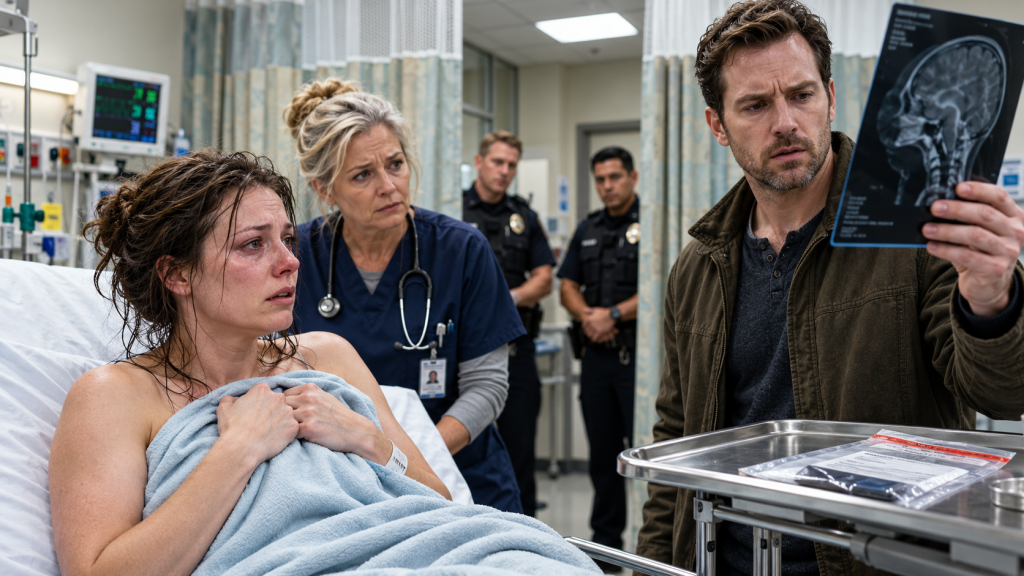
The neighbor’s camera had spoken. The X-rays had spoken. My body had spoken. And now his own handwriting was speaking too. If it’s another girl, terminate before Rebecca knows anything.
I stared at the sentence until the letters blurred.
Then I looked at Daniel.
“You were going to do what?”
He opened his mouth.
Nothing came out.
The taller officer took the paper from his hand.
“Sir, step back.”
Daniel’s face changed.
“Rebecca, listen to me.”
I laughed.
It hurt my ribs.
But I laughed anyway.
“You were going to make me terminate my own pregnancy without telling me?”
“No.”
The officer glanced at the page.
“Then explain the note.”
Daniel’s jaw tightened.
“It’s being taken out of context.”
Dr. Morris actually looked angry.
Not dramatic.
Not loud.
The kind of anger professionals learn to carry without losing precision.
“What context makes that sentence acceptable?”
Daniel turned toward her.
“You don’t understand my family.”
Dr. Morris replied,
“I understand your wife has multiple healed fractures, fresh injuries, a pregnancy she apparently did not know about, a forged legal agreement in your briefcase, and a written plan concerning a medical procedure she did not consent to.”
Then she looked directly at me.
“Rebecca, I need to ask you something.”
I nodded.
“Do you feel safe going home with him?”
My entire body began shaking.
It was such a simple question.
Nobody had asked it in seven years.
Not really.
People asked whether Daniel was stressed.
Whether marriage was hard.
Whether I had tried counseling.
Whether I could be more patient.
Whether Patricia had always been “traditional.”
Nobody asked:
Are you safe?
I looked at Daniel.
Then at the officers.
Then at the bracelet Madison had made me.
And for the first time, I said the sentence I had practiced silently for years.
“No.”
The room became still.
Then I said it again.
“No, I am not safe with him.”
Daniel’s face collapsed.
“Rebecca.”
“No.”
He stepped toward me.
The officer stopped him.
“Sir.”
Daniel lifted his hands.
“I’m not doing anything.”
The officer answered,
“You’re leaving this room.”
“I’m her husband.”
The second officer said,
“And she just told us she does not feel safe with you.”
Daniel’s eyes found mine.
The softness returned.
The fake one.
The voice he used after he hurt me.
“Rebecca, you’re confused.”
I felt something inside me straighten.
“No.”
“You hit your head.”
“No.”
“You’re emotional.”
“No.”
“The pregnancy—”
“No.”
He stared.
One word.
That was all I had.
But it was enough.
They took him into the hallway.
The door closed.
My body collapsed against the pillow.
Dr. Morris moved closer.
“Do you want anyone called?”
My first thought was my mother.
Then I remembered she had been gone three years.
For one terrible second, I was a child again.
No mother.
No safe place.
Then I thought of my daughters.
“Madison and Chloe.”
Dr. Morris nodded.
“Where are they?”
“At home.”
“With who?”
I closed my eyes.
“Patricia.”
The doctor’s expression changed immediately.
The same Patricia whose voice had just been recorded asking whether Daniel had discovered the baby’s sex before making me sign fraudulent papers.
I grabbed the railing.
“My girls are with her.”
The officer returned.
“We’ve already sent a unit.”
My pulse raced.
“No.”
He looked at me.
“Ma’am?”
“She’ll tell them I’m crazy.”
“We understand.”
“She’ll say I fell.”
“We understand.”
“She’ll tell Madison to repeat things.”
His voice softened.
“We understand.”
I started crying.
“I should have taken them out sooner.”
Dr. Morris placed one hand near mine without touching.
“Rebecca.”
I looked at her.
“Your job right now is not to rewrite yesterday.”
“It is to survive today.”
That sentence became the first brick in the life I built afterward.
Police reached the house at 9:18 a.m.
Patricia did not make it easy.
She refused to open the door at first.
Then claimed Madison and Chloe were sleeping.
They were not.
Madison had locked herself and Chloe inside their bedroom.
The television was loud.
Exactly as I had taught them.
When officers knocked, Madison would not open.
Not until a female officer said my name.
“Your mom is at the hospital.”
Madison asked through the door:
“Is she dead?”
When they told me that later, I cried so hard I could barely breathe.
Six years old.
And that was her first question.
Not:
Is Mom okay?
Is she coming home?
Is she dead?
Because somewhere inside my child, death had already become a reasonable outcome of morning.
The officers found Chloe under the bed.
Patricia stood in the hallway insisting everyone was overreacting.
“She’s dramatic,” she told them.
About me.
“She bruises easily.”
About me.
“She provokes him.”
About me.
Then Madison opened the bedroom door.
And said:
“Grandma, stop lying.”
The whole hallway went quiet.
Patricia turned toward her.
Madison began crying.
“He hit Mommy again.”
Again.
That one word mattered.
Again.
The female officer crouched.
“You don’t have to tell me anything else right now.”
Good.
Thank God.
Because my daughters had already spent enough time learning how to narrate violence for adults.
They were taken to a child advocacy center.
Not interrogated in our kitchen.
Not asked to perform fear.
Specialists handled it.
That mattered.
By noon, Daniel had been arrested on charges related to domestic violence and assault while investigators reviewed everything else.
Patricia was not arrested immediately.
I hated that at first.
I wanted her in handcuffs beside him.
I wanted consequences to move as quickly as my rage.
But detectives explained that the forged custody document, notary misconduct, coercion, possible conspiracy, and medical-planning evidence required careful investigation.
Careful felt insulting.
Then I learned something.
Careful is how evidence survives court.
So I waited.
The hospital admitted me overnight.
The baby was alive.
Stable.
The pregnancy was earlier than I had understood from Dr. Morris’s first explanation.
The emergency imaging had raised suspicion, and additional testing confirmed what Daniel had apparently already tried to investigate privately.
A boy.
My third child.
For hours, I felt nothing about that.
No joy.
No relief.
Nothing.
Because the word boy had been used like a weapon inside my marriage.
Daniel wanted a son.
Patricia wanted a grandson.
I had been blamed for giving birth to two daughters as though I had personally selected their chromosomes to humiliate him.
Now there was a boy inside me.
And the first thing I felt was grief.
Not because I did not want him.
Because I knew Daniel would use his existence to rewrite himself.
He already tried.
That afternoon, through his attorney, he requested permission to speak to me “regarding the welfare of his unborn son.”
Not wife.
Not Madison.
Not Chloe.
Son.
I stared at the message.
Then told my lawyer,
“No contact.”
Her name was Andrea Lopez.
The hospital social worker found her through a domestic violence legal network.
She arrived wearing flat shoes, carrying two legal pads and absolutely no patience for manipulative men.
I liked her immediately.
She sat beside my hospital bed.
“First priority is safety.”
I nodded.
“Second is temporary custody.”
“Yes.”
“Third is housing.”
I looked down.
“The house is in both our names.”
“Okay.”
“Will I have to leave?”
“Maybe temporarily.”
My heart sank.
She leaned forward.
“Rebecca, leaving a building is not the same thing as surrendering it.”
That distinction mattered.
Daniel had trained me to think every retreat was defeat.
Andrea taught me strategy.
That afternoon, she filed for emergency protective orders.
Temporary custody.
Exclusive access to communicate through counsel.
Restrictions on Daniel approaching the hospital, my daughters, their school, and me.
Patricia was included in limited no-contact provisions with the girls until her role was clearer.
That decision devastated her.
She called from unknown numbers.
Left voicemails.
Some angry.
Some crying.
One said:
“I raised those girls too.”
I deleted nothing.
Andrea told me to save everything.
So I did.
The investigation into the forged agreement moved fast once officers obtained the contents of Daniel’s briefcase.
He had not just carried one fraudulent document.
There were drafts.
Different versions.
One gave him temporary control if I became “medically unstable.”
Another if I became “incapacitated.”
Another if I entered “inpatient treatment.”
I had never been in inpatient treatment.
But suddenly the phrase made sense.
Months earlier, Daniel had started telling people I was depressed.
Then forgetful.
Then irrational.
Patricia called me “hormonal.”
Daniel told our pastor I was “emotionally unpredictable.”
At the time, I thought he was simply insulting me.
He was building a record.
That realization scared me more than the bruises.
Bruises heal.
Documents travel.
Daniel had been preparing a story in which I was unstable enough to lose money, property, and children.
Andrea asked,
“Has he ever taken you to a therapist?”
“No.”
“Psychiatrist?”
“No.”
“Any documented diagnosis?”
“No.”
“Has he ever pressured you to take medication?”
I froze.
Six months earlier, Patricia had given me a bottle.
Anti-anxiety medication.
She said it had been prescribed to her after her husband died.
“You need something to calm you down,” she told me.
I never took it.
I hid it in a bathroom drawer because something about the label frightened me.
Andrea’s eyes sharpened.
“Do you still have it?”
“If Patricia hasn’t removed it.”
Police retrieved it under the search warrant.
The bottle contained Patricia’s prescription.
Not mine.
That became another piece.
Not proof that they planned to drug me.
No one could establish that.
But it showed a pattern.
They were willing to define me as unstable while offering medication that had never been prescribed to me.
Facts mattered.
We did not need to exaggerate.
The truth was enough.
Then investigators found the financial motive.
It began with the house.
My father had helped us with the down payment seven years earlier.
He had transferred money directly to me before closing.
Because of that, Andrea requested a full tracing review.
Daniel became furious.
He had always described the house as something he had “provided.”
But the initial equity had come from my family.
Then more documents surfaced.
Daniel had opened a home equity line eighteen months earlier.
I knew about a small line.
I did not know the amount.
The approved limit was $420,000.
Nearly $190,000 had already been drawn.
My stomach turned.
“What did he spend it on?”
Andrea’s forensic accountant, a woman named Mina Shah, looked at me.
“Some home expenses.”
“Some business.”
“What business?”
“His brother’s construction company.”
I stared.
Daniel’s younger brother, Kevin, owned a contracting company that always seemed to be one job away from greatness and two payments away from collapse.
Daniel had secretly guaranteed equipment loans.
Put money into payroll.
Covered tax arrears.
Bought into a commercial renovation project.
All without telling me.
Then Mina found payments to a fertility clinic.
Not the one on the appointment page.
Another.
Older.
Private consultations.
Testing.
I felt cold.
“Why?”
She hesitated.
“Genetic sex-selection inquiry.”
The room tilted.
I looked at Andrea.
“What does that mean?”
Andrea answered carefully.
“He appears to have explored reproductive options intended to increase the chance of a male child.”
My stomach turned.
“How long ago?”
“Two years.”
Two years.
Before this pregnancy.
Before his latest violence intensified.
Before Patricia started openly blaming me for not giving Daniel a son.
He had been researching how to produce a boy as though daughters were failed prototypes.
I cried.
Not for myself.
For Madison and Chloe.
My girls.
My bright, loud, beautiful girls.
Madison who loved bugs.
Chloe who wore rain boots in July.
Children their father had reduced to evidence of female failure.
That night, Madison visited me.
The hospital arranged it privately.
She came in holding Chloe’s hand.
Both stopped when they saw bruises on my face.
Madison’s lower lip trembled.
I held out my arms.
Then stopped.
“Can I hug you?”
She nodded.
They both ran to me.
Carefully.
Chloe climbed onto the bed.
Madison stood beside me.
For a long time, none of us spoke.
Then Madison whispered:
“Is Daddy coming home?”
I closed my eyes.
Children deserve truth at the level they can carry.
“No.”
She stared.
“Ever?”
“I don’t know.”
“Did he go to jail?”
I looked at the social worker.
She nodded slightly.
“Yes.”
Madison’s face changed.
Fear.
Relief.
Guilt.
All at once.
“He’s there because of me?”
My heart shattered.
“No.”
“But I told the police.”
I cupped her face.
“He is facing consequences because of what he did.”
“You told the truth.”
“That did not create what happened.”
Tears rolled down her cheeks.
“He said families don’t tell strangers family things.”
I swallowed.
“He was wrong.”
Chloe whispered:
“Grandma said Mommy lies.”
I closed my eyes.
Then looked at both girls.
“You never have to choose between loving someone and telling the truth about what they do.”
That sentence became another family rule.
We repeated it for years.
You can love someone.
And still tell the truth.
You can miss someone.
And still need distance.
You can forgive someone one day.
Or never.
No child owes silence as proof of love.
Daniel’s criminal case expanded.
The neighbor’s security footage was devastating.
It showed him dragging me across the patio.
The video had no perfect view of every strike.
It did not need one.
It showed enough.
Timestamp.
Movement.
My collapse.
Daniel pulling me toward the car roughly before noticing the neighbor outside.
Then his entire body changed.
He became gentle.
That part made the detective pause the video.
“Watch.”
I did.
Daniel saw someone looking.
Then suddenly supported my head.
Opened the car door carefully.
Called my name.
Performed concern.
The detective said:
“This is important.”
“Why?”
“Because it shows control.”
I understood.
Daniel later claimed he had panicked.
Lost control.
Exploded.
But the camera showed he could switch behavior instantly when observed.
That mattered.
Violence had not taken control away from him.
He had used control selectively.
Patricia’s case developed more slowly.
At first, she claimed she notarized the custody agreement because she believed I had signed it earlier.
That did not explain why she had spoken on the phone about waiting until the baby’s sex was confirmed.
Then police recovered deleted messages from Daniel.
One said:
She’s too scared to challenge anything if we act before the baby comes.
Patricia replied:
Then get the signature page ready. I’ll stamp it.
Another:
If it’s a boy, don’t push her too far. We need her compliant through delivery.
I vomited after reading that one.
Not because it proved some cinematic plot.
Because of the word.
Compliant.
I had been a wife.
A mother.
A person.
To them, compliance had become my most valuable trait.
Another message from Patricia read:
The girls can stay with me until she settles down. Once the boy is here, Daniel can petition properly.
I stared at it for a long time.
They were not only planning to control my property.
They were imagining a future where my daughters were separated from me while my son became proof Daniel finally had the child he wanted.
Andrea read the message.
Then said:
“They were making plans around your fear.”
I nodded.
She continued.
“Now we make plans around evidence.”
Good.
I needed that.
Not revenge.
Structure.
The baby complicated everything emotionally.
Every appointment frightened me.
Not medically at first.
Emotionally.
Every ultrasound reminded me of Daniel’s obsession.
The first time I heard the heartbeat, I cried so hard the technician stopped.
“Do you need a minute?”
“Yes.”
I put both hands over my face.
Then whispered:
“I don’t want him to be born carrying all this.”
The technician said nothing.
Good.
There are no useful clichés for moments like that.
Later, Dr. Morris visited.
She had followed my case because the hospital’s forensic team remained involved.
I asked her:
“Do you think it’s terrible that I don’t feel happy enough?”
She shook her head.
“No.”
“I wanted another child once.”
“That can still be true.”
“I wanted him before I knew he existed.”
“That can also be true.”
“But now…”
I stared at the ceiling.
“It feels like everyone else already decided what being a boy means.”
Dr. Morris answered:
“Then let him arrive before you assign him anyone else’s meaning.”
I never forgot that.
A boy.
Not Daniel’s redemption.
Not Patricia’s prize.
Not proof I had finally succeeded.
A child.
Just a child.
We named him Nathan.
I chose the name with Madison and Chloe.
No family tradition.
No grandfather.
No Daniel Junior.
Nathan.
His own beginning.
But that came later.
First came court.
The custody hearings were brutal.
Daniel’s lawyers argued that supervised contact with the girls should begin because he had not been convicted yet.
Legally, they had a right to make arguments.
Emotionally, I wanted to scream.
The judge moved cautiously.
Temporary supervised visitation.
Professional facility.
No Patricia.
No discussion of litigation with the children.
No physical discipline.
No threats.
I hated the order.
Andrea told me:
“You are allowed to hate it.”
“Then why are you calm?”
“Because the court is building a record too.”
She was right.
The first two visits were uneventful.
Daniel cried.
Brought drawings.
Told the girls he loved them.
Madison came home confused.
“He was nice.”
I nodded.
“That’s okay.”
“Does that mean you lied?”
My heart hurt.
“No.”
“But bad people are bad.”
I sat beside her.
“People can do bad things and still be nice sometimes.”
She frowned.
“That’s stupid.”
“Yes.”
She thought.
“Do I have to hate him?”
“No.”
“Do you?”
I paused.
“No.”
She looked shocked.
“I’m afraid of him.”
“I’m angry at him.”
“I don’t trust him.”
“But hate is something else.”
She nodded slowly.
Kids can hold complexity if adults stop forcing simple categories onto them.
The third visit changed everything.
Daniel asked Madison whether I was “still telling lies at home.”
The supervisor documented it.
Then he told Chloe:
“Daddy may come home if Mommy stops being angry.”
Documented.
Then Madison asked:
“Did you hit Mom because we’re girls?”
The supervisor wrote that Daniel became visibly agitated.
He answered:
“Your mother put ideas in your head.”
Madison replied:
“You said it.”
That ended the visit.
Supervised contact was suspended pending therapeutic review.
Daniel’s own words had returned through our daughter.
Again.
Evidence.
Not performance.
Months later, the criminal case reached plea discussions.
Daniel’s attorney wanted reduced charges.
The prosecutor asked whether I wanted to give input.
I did.
Not to demand the maximum sentence.
To say what mattered.
I wrote:
The violence was not one morning.
The morning was only the first one someone else saw.
Then:
Please do not treat the forged documents as separate from the abuse.
He hit me physically and built a paper version of me that could lose my children. Both were forms of control.
The prosecutor used that phrase later.
Paper version.
That was exactly what Daniel had created.
A Rebecca who was unstable.
Forgetful.
Unfit.
Consent-prone.
Easy to replace.
The real Rebecca had finally entered the record.
Daniel eventually pleaded guilty to felony domestic violence-related offenses, aggravated assault charges based on the documented injuries, forgery-related conduct, and other charges tied to the fraudulent agreement and financial misconduct.
Not every allegation survived.
The clinic note did not become a separate attempt charge because there was not enough evidence he had actually scheduled an unlawful procedure without my presence or consent.
That mattered.
I wanted accuracy.
Not fantasy punishment.
Patricia pleaded guilty to offenses related to fraudulent notarization, conspiracy, and witness interference after evidence showed she had pressured Madison through family members not to “repeat private matters.”
Her age and lack of prior convictions mattered.
She did not receive the same sentence as Daniel.
She received probation, restrictions, mandatory counseling, and lost her notary authority permanently.
At first, that felt too light.
Then Andrea asked:
“What outcome would make you feel safe?”
I stopped.
Safe.
Not satisfied.
Safe.
“Distance.”
We built that.
Legal boundaries.
No unsupervised contact with the children.
No showing up at school.
No direct messages.
No manipulating relatives.
No secret gifts used to reopen contact.
That gave me more peace than imagining Patricia in prison.
Daniel was sentenced to several years.
The exact number mattered less than I thought it would.
When the judge spoke, Daniel cried.
He apologized.
Not to me directly.
To the court.
He said:
“I was under pressure to provide.”
I felt rage rise.
Then he continued.
“I used that pressure as permission.”
I looked up.
That was new.
He said:
“I blamed my wife for not giving me a son.”
His voice broke.
“That was ignorant and cruel.”
Then:
“My daughters heard me treat their existence like disappointment.”
Madison was not in the courtroom.
Thank God.
He continued.
“I cannot undo that.”
No.
He could not.
The judge told him something I still remember.
“Wanting a son did not cause you to abuse your wife.”
“You caused that.”
Daniel lowered his head.
Good.
Biology was not on trial.
Masculinity was not on trial.
Stress was not on trial.
He was.
That distinction mattered.
Nathan was born six months after Daniel was sentenced.
Emergency induction.
Nothing dramatic beyond what childbirth already is.
Madison held my hand until the nurse told her she had to wait outside.
Chloe cried because she wanted to stay too.
My sister, Lauren, flew in from Denver.
She had not known the full truth about Daniel.
Nobody had.
That was one of my deepest shames.
Then Lauren told me something that helped.
“You hid because you were surviving.”
“That doesn’t mean we wouldn’t have cared.”
I cried.
She did too.
Nathan was born at 3:52 a.m.
Seven pounds, two ounces.
Dark hair.
Angry lungs.
When the nurse placed him against me, I froze.
Then he opened one eye.
Just one.
As if deeply unimpressed with existence.
I laughed.
And there it was.
Love.
Not because he was a boy.
Because he was mine.
Because he was here.
Because nobody had the right to turn his sex into a verdict on his sisters.
Madison met him first.
She stared into the bassinet.
“Is Daddy happy now?”
My entire body went cold.
I knelt beside her.
“No.”
She looked confused.
“Daddy’s feelings are Daddy’s responsibility.”
“But he wanted a boy.”
“Yes.”
“And Nathan is a boy.”
“Yes.”
“Then why isn’t this because of him?”
I touched her hair.
“Because Nathan does not exist to fix your father.”
She was quiet.
Then asked:
“Did you want girls?”
“I wanted you.”
“What about Chloe?”
“I wanted Chloe.”
“What about Nathan?”
“I wanted him.”
She frowned.
“But you didn’t know what we were before.”
“Exactly.”
She smiled.
That was the first time I saw the idea shift inside her.
Her worth had never depended on the category someone hoped for before meeting her.
Neither had Chloe’s.
Neither would Nathan’s.
We repeated that often.
Your existence is not an apology for somebody else’s expectation.
Years passed.
Healing was slower than court.
Much slower.
The first year after Daniel went away, I flinched every morning at 6:00.
That was when he used to come downstairs.
My body remembered before my mind did.
At 6:18, some mornings, I would suddenly feel nauseated.
Same time he dragged me across the patio.
Trauma is strange.
It keeps clocks.
Therapy helped me reset them.
I started waking at 6:00 intentionally.
Not every day.
Once a week.
I made coffee.
Opened the patio door.
Sat outside.
At first, my hands shook.
The concrete had been pressure-washed.
The blood was gone.
The bracelet scrape marks were gone.
But my body knew.
So I sat.
Then Madison joined me one morning.
She was eight.
Carrying cereal.
“What are you doing?”
“Drinking coffee.”
“You hate outside.”
“I’m learning not to.”
She sat beside me.
Chloe came out.
Then Nathan toddled behind her years later.
Eventually 6:18 became breakfast.
Not violence.
That was one of the quietest victories of my life.
The house stayed mine after the divorce settlement.
Not entirely without cost.
There were equity disputes.
Debt.
Legal fees.
The hidden home-equity borrowing reduced what should have been there.
Daniel’s business investments had lost money.
Some funds were recovered.
Some were not.
I did not become magically wealthy because I escaped.
Survival came with invoices.
Lawyer bills.
Therapy.
Childcare.
Missed work.
Repairs.
Life.
But the court recognized my traced contribution from my father and accounted for Daniel’s unauthorized financial conduct.
I refinanced into my name.
The first statement arrived six weeks later.
BORROWER: REBECCA LANE
Only me.
I stared at it for ten minutes.
Then cried.
Paper had been used against me.
Now paper told the truth.
Patricia asked to see the children two years after sentencing.
Through counsel.
Not secretly.
That mattered.
Madison wanted to say no.
Chloe wanted yes.
Nathan did not know her.
We did not force a single family answer.
Madison did not see her.
Chloe agreed to one supervised visit.
It went poorly.
Patricia cried too much.
Said,
“Grandma made mistakes.”
Chloe asked:
“Did you know Daddy hit Mom?”
Patricia looked away.
The supervisor documented it.
Chloe came home.
“No more.”
That was her choice.
Years later, Madison changed her mind.
At fifteen, she requested one meeting.
Not because she missed Patricia.
Because she had questions.
I asked:
“Do you want me there?”
“No.”
“Therapist?”
“Yes.”
They met for forty-five minutes.
Afterward, Madison told me:
“She said she thought keeping the family together mattered more than everything.”
I felt sick.
“What did you say?”
“I asked which family.”
I stared.
She shrugged.
“If keeping the family together required hurting you, then who was the family for?”
My daughter.
Fifteen.
I hugged her.
Patricia never regained a grandmother role.
But she eventually stopped demanding one.
That was the most convincing evidence of change.
She sent birthday cards through an approved channel.
No money.
No guilt.
No:
Grandma is dying to see you.
Just:
Thinking of you.
The children could read or discard them.
Choice.
Daniel wrote too.
At first, I did not share the letters.
They were about him.
His regret.
His loneliness.
His therapy.
His childhood.
Patricia’s obsession with carrying on the family name.
His father telling him that “a man without a son ends his own line.”
That history explained something.
It excused nothing.
Later, his letters changed.
One was addressed to Madison and Chloe together.
I read it with their therapist first.
Then gave them the choice.
Madison read it.
Chloe did not.
The letter said:
I treated you like evidence that I had failed.
Madison cried.
The truth is I failed you.
She stopped reading.
Then continued later.
There was never anything wrong with being my daughters.
The wrong was mine.
She folded the letter.
“Do you believe him?”
I asked.
She stared at it.
“I believe he believes it now.”
That was an incredibly mature distinction.
Not trust.
Observation.
When Daniel was released, the children were older.
Nathan was six.
He knew Daniel existed.
Knew he was his biological father.
Did not know him.
The court did not automatically create a relationship.
There were therapeutic evaluations.
Safety assessments.
Slow procedures.
Daniel requested contact.
Nathan asked me:
“Is he the dad who hurt you?”
I breathed carefully.
“Yes.”
“Did he hurt me?”
“No.”
“Did he want me?”
I froze.
Kids always find the question under the question.
I sat beside him.
“He wanted a son before he knew you.”
Nathan frowned.
“That’s weird.”
“Yes.”
Then I said:
“But wanting ‘a son’ and knowing you are not the same thing.”
He thought.
“Does he know me?”
“No.”
“Then he can’t miss me.”
I almost cried.
“No.”
“He can miss the chance to know you.”
“That’s different.”
He nodded.
We let him choose within the structure recommended by professionals.
He eventually met Daniel in a supervised therapeutic setting.
Not because Daniel deserved access.
Because Nathan wanted information.
Their relationship became limited.
Careful.
Daniel never lived with us again.
Never entered my house.
Never had unsupervised authority over the children while they were minors.
Some people called that unforgiving.
They were wrong.
Forgiveness is an internal act if it happens at all.
Access is a safety decision.
They are not the same.
I did eventually forgive parts of Daniel.
Not to free him.
To stop carrying conversations that would never happen.
I forgave the young man he had been.
The frightened boy Patricia raised to worship male heirs.
The insecure husband who felt like daughters made him less masculine.
But I did not excuse the adult man who used those wounds as weapons.
Compassion does not require confusion.
That took me years to learn.
Dr. Morris stayed in our lives unexpectedly.
Not as a friend at first.
As the doctor whose chart notes became central to the case.
Her documentation mattered.
Every bruise.
Every fracture.
Every discrepancy.
She had written:
Patient appears fearful when spouse enters room.
And:
Spouse repeatedly answers questions directed to patient.
And:
Injury pattern inconsistent with reported fall.
Facts.
Small sentences.
They mattered.
Years later, I sent her a letter.
You looked at me before you looked at him.
That was the line I wrote.
I had forgotten what that felt like.
She answered with a note:
You saved yourself the moment you answered the safety question honestly. I only asked it.
I framed that.
Not because I wanted to turn pain into inspiration.
Because it corrected something inside me.
For years, I believed rescue would look like someone bursting through a door.
It did not.
It looked like a doctor noticing carpet fibers were missing.
A neighbor saving video.
A police officer taking a forged document seriously.
A lawyer filing papers correctly.
A six-year-old saying:
“Grandma, stop lying.”
And one woman finally answering:
“No, I am not safe.”
No dramatic cape.
Just people refusing to participate in the lie.
Madison grew into the loudest person in our family.
She joined debate team.
Of course.
At sixteen, she once argued with a school administrator so effectively over a discriminatory dress-code policy that I almost apologized to the man.
Almost.
Chloe became gentler.
More private.
She loved animals.
Volunteered at a shelter.
Would leave a room if people raised their voices.
Not every trauma response becomes activism.
Some becomes softness.
Nathan loved music.
Not football.
Not construction.
Not any of the things Daniel had once imagined a son should be.
At twelve, he wanted to play cello.
I bought a used one.
He was terrible.
Painfully terrible.
Madison called it “sad furniture.”
He practiced anyway.
One afternoon, Daniel attended a school concert with court-approved family permission.
He sat in the back.
Nathan played badly.
Very badly.
Afterward, Daniel cried.
Nathan asked me:
“Was he disappointed?”
I looked at him.
“No.”
“How do you know?”
“Because I asked.”
Nathan frowned.
“You talked to him?”
“Through the therapist.”
“What did he say?”
I smiled.
“He said he was proud you chose something because you loved it.”
Nathan looked suspicious.
“That sounds healthy.”
“I know.”
“Gross.”
I laughed.
Healing can be ridiculous.
By then, Daniel had spent years in treatment.
Accountability programs.
Therapy.
Parent education.
He had changed.
Maybe sincerely.
That did not rewrite history.
But change still mattered.
I wanted my children to understand that people can become better without becoming entitled to restoration.
Daniel became better.
We did not remarry.
He did not come home.
He did not get the old family back.
Those were not punishments.
They were consequences.
New behavior does not recreate old trust automatically.
It creates the possibility of a different future.
Limited.
Boundaried.
Honest.
That was enough.
Patricia died when Nathan was seventeen.
Cancer.
Quick.
She requested to see me.
I almost refused.
Then went.
Hospital room.
Fitting.
She looked tiny.
No rosary in her hand.
Just thin fingers.
She whispered:
“I watched.”
I knew what she meant.
The patio.
The blinds.
My whole body tightened.
“I know.”
“I watched more than once.”
“I know.”
Her eyes filled.
“I told myself it was marriage.”
I said nothing.
“I told myself women endure.”
Still nothing.
“I told myself you made him angry.”
I felt anger rise.
Then she said:
“Those were cowardly lies.”
I looked at her.
For the first time, Patricia did not ask me to understand Daniel.
Or her.
She continued:
“I thought sons carried families.”
A tear moved down her cheek.
“But the girls carried you.”
My throat tightened.
That was true.
Madison and Chloe had survived too much.
Patricia whispered:
“I am sorry.”
I nodded.
Not:
I forgive you.
Not:
It’s okay.
Just:
“I heard you.”
That was what I could give.
She died two days later.
Chloe attended the funeral.
Madison did not.
Nathan chose not to.
No one was forced.
Family stopped being a courtroom where attendance proved love.
Years later, when my children were grown, we sold the Phoenix house.
I thought leaving would feel like defeat.
Instead, it felt light.
The patio was still there.
Same concrete.
Different sprinklers.
Different grill.
I walked outside one last time.
6:18 a.m.
On purpose.
The sky was pink.
The mourning dove sound came from somewhere beyond the block wall.
I stood where I had collapsed.
Then crouched.
Not because anyone pushed me.
Because I wanted to touch the ground.
The concrete was warm.
Ordinary.
I expected a revelation.
Nothing happened.
No flashback.
No cinematic closure.
Just concrete.
That was its own miracle.
A place that once held terror had become a place.
Nothing more.
Madison came outside.
“Mom?”
“I’m coming.”
She saw my hand on the ground.
“Are you okay?”
I smiled.
“Yes.”
And I was.
We moved into a smaller house.
No pool.
Less maintenance.
A kitchen with too many windows.
I liked windows.
Patricia had watched through blinds.
I wanted light.
The silver bracelet Madison made me still exists.
The one found under my hand.
Police held it as evidence for months.
When it came back, one link was bent.
Madison offered to make another.
I said no.
Not because the bracelet was sacred.
Because I liked that it survived imperfectly.
Years later, when she graduated from law school, I gave it to her.
She stared at it.
“Mom.”
“You made it.”
“I was six.”
“I know.”
“I used plastic beads.”
“Very prestigious.”
She cried.
Then laughed.
“Why are you giving it to me?”
I answered:
“Because once it helped prove where I had been.”
“Now I want it to remind you where you came from.”
She wore it under her graduation gown.
Bent link and all.
Chloe became a veterinarian.
Nathan became a music teacher.
A cello teacher.
Imagine that.
Still not very good at solo performance.
Excellent with children.
Daniel attended his college graduation from a row we chose in advance.
He hugged Nathan afterward.
Asked permission first.
That mattered.
I watched from a distance.
There was pain.
Still.
But not fear.
Those are different.
Fear narrows the world.
Pain can live inside a large one.
My world had become large again.
That was enough.
People sometimes ask why I stayed so long.
I hate the question.
Not because it is always cruel.
Sometimes people truly do not understand.
But the question begins in the wrong place.
Why did she stay?
Ask instead:
How did he make leaving dangerous?
How did he make violence normal?
How did the people around him help?
How did money become leverage?
How did documents become traps?
How did shame become glue?
How did a woman with two small children, fractured ribs, shared property, and no clear safe exit become convinced survival meant endurance?
Those questions have answers.
And answers create prevention.
Blame creates silence.
I do not call myself weak anymore.
I was afraid.
I was isolated.
I was conditioned.
Sometimes I lied to doctors.
Sometimes I defended Daniel.
Sometimes I smiled at church while my side hurt.
None of that means I wanted what happened.
It means I was surviving inside the logic available to me.
Then one morning, Dr. Morris looked at the evidence and refused Daniel’s logic.
That interruption changed everything.
The X-ray mattered.
The boy mattered only because Daniel thought it changed my value.
He was wrong.
The older fractures mattered more.
They proved something I had been too frightened to name.
This was not one fall.
Not one bad morning.
Not one argument.
It was a pattern.
Patterns can be interrupted.
That became the foundation of the rest of my life.
Not revenge.
Interruption.
Stop the lie.
Stop the access.
Stop the forged paperwork.
Stop the cycle reaching Madison.
Stop it reaching Chloe.
Stop Nathan from inheriting the idea that being male made him entitled to anyone.
That was my victory.
Not Daniel going to prison.
Not Patricia losing her notary stamp.
Not keeping the house.
The victory was that my daughters grew up knowing their existence was never a failure.
And my son grew up knowing being wanted as a boy did not make him more valuable than his sisters.
That is how the line ended.
Not the bloodline.
The belief.
Daniel’s father told him a man without a son ended his line.
He was wrong.
A man ends a harmful line when the children after him refuse to carry the harm forward.
Madison refused.
Chloe refused.
Nathan refused.
I did too.
The last time all four of us were together for dinner, my children were adults.
Daniel was not there.
He had his own life.
Respectful distance.
We had pasta.
Too much garlic.
Chloe complained.
Nathan played music from his phone.
Madison was late because court ran long.
At one point, Nathan raised his glass.
“To Mom.”
I groaned.
“No speeches.”
He smiled.
“Just one.”
Madison said:
“Make it legally brief.”
He ignored her.
“To Mom, who gave Dad the son he wanted and still somehow made sure the son turned out like her.”
Everyone laughed.
Even me.
Then Nathan looked at his sisters.
“And to the girls who were never failures.”
The room went quiet.
Madison started crying.
Chloe covered her face.
I reached for all three of them.
That was the family Daniel had once called broken.
It looked fine to me.
More than fine.
It looked free.
And sometimes, late at night, I still think about that hospital room.
The fluorescent lights.
The antiseptic.
Daniel’s watch tapping against the film.
The officers stepping through the curtain.
Dr. Morris looking at me instead of him.
The bracelet on the tray.
The first moment another adult refused to accept his version of my body.
I used to think the X-ray saved me.
It did not.
It revealed me.
Broken ribs.
Old fractures.
A new life.
Evidence layered over evidence.
It showed what I had hidden.
What Daniel had denied.
What Patricia had watched.
And what my daughters had already known.
The truth had been inside me for years.
The X-ray only made it impossible for everyone else to look away.
That was the day Daniel turned pale.
Not because I was pregnant with the son he claimed to want.
But because the same image that showed him the boy also showed the world the man he had been.
And once the truth became visible, he could no longer drag me back into silence.
THE END STORIES! THANK YOU FOR READING GOOD LUCK !❤️
Related Posts