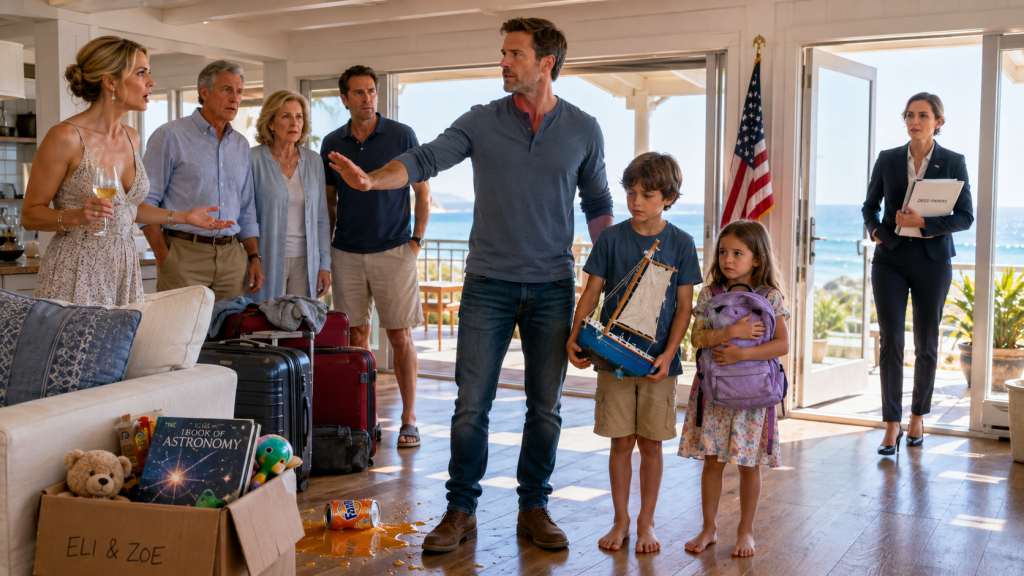
My sister watched her twins snap my ten-year-old son’s sailboat in half, spill orange soda across my hardwood, and claim the guest room in the Malibu cottage I paid $940,000 to buy. Then she raised her wineglass and laughed.

“Your kids can’t stay at our beach house. This summer is for real family.”
My parents lifted their glasses with her.
The sharp crack of Eli’s wooden mast was still hanging in the room. Orange soda hissed beneath the white sofa, spreading sticky and bright between the seams of the refinished floorboards. Outside, warm salt air pushed through the open sliding doors.
Eli stood there holding the broken mast. He had packed an astronomy book, a flashlight, two superhero figures, and a notebook labeled Summer at the Beach House.
Learn to surf.
Sleep on the porch.
See the stars with Dad.
One twin kicked through the cardboard box while the other tracked sand across the floor.
“Oops,” he said.
Jenna barely turned. “Boys, watch where you’re going.”
Then she looked at me. “The guest room belongs to the twins. Your children live with you. They already get enough time with you.”
My six-year-old daughter, Zoe, tightened both hands around her purple backpack. “Where are we sleeping, Daddy?”
Before I could answer, my mother sighed. “Daryl, don’t create a scene. Jenna’s family needs this place more than you do. You’re always at the hospital anyway.”
My father lifted his beer toward the shattered boat. “Kids are kids. It’s just stuff.”
No one helped Eli.
I did.
I knelt beside him and gathered every piece: the chipped blue hull, the snapped mast, the tiny white sail with his initials written underneath.
“Can it be fixed?” he whispered.
“Yes,” I said.
I wasn’t only talking about the boat.
I had bought the cottage after my divorce with six years of extra surgical shifts, missed vacations, careful investments, and every bonus I could save. It was supposed to be the one place my children never had to wonder whether they belonged.
Jenna had asked for one weekend while work was being done at her house.
One weekend became three early arrival days, twelve suitcases, a kitchen stocked with her wine, and our parents being told they were spending the summer at the “family beach house.”
That morning, a locksmith had called because Jenna wanted the keypad changed so she could have “her own code.”
My name was the only one on the deed.
I canceled the request.
Then I made another call.
Jenna walked into the guest room and began pulling Eli’s folded clothes from the closet. “These can go in the hall cabinet. The twins need space.”
She dropped his pajamas on the floor. Zoe bent to pick them up, but my mother stopped her.
“Leave it, sweetheart. Your aunt is organizing.”
Jenna poured more wine. “See? Everyone understands except your father.”
Her husband, Mark, leaned against the kitchen island checking his phone. He had never paid a grocery bill, utility bill, repair invoice, or property tax for the cottage, but he pointed toward the patio and said, “We should put a hot tub out there. It’ll increase the value.”
“We were thinking the same thing,” Jenna said.
We.
Then the orange soda hit the floor.
Jenna glanced at the spreading stain. “Daryl can hire someone.”
My father laughed. My mother lifted her glass.
“To summer,” she said.
Jenna raised hers higher. “To real family.”
The glasses touched.
For a moment, the whole room held still around that little sound. My mother’s fingers stayed curled around the stem. Mark stared at the patio as though he were already pricing it. My father studied the label on his beer. Soda kept creeping beneath the sofa, and Eli stood barefoot in the sand outside, holding the broken boat against his chest.
Nobody moved.
I looked at Eli.
Then Zoe.
Then the people celebrating inside the home I had bought for my children.
I didn’t shout. I checked my watch.
Nineteen minutes.
I sent one message: Proceed as scheduled.
Jenna saw me typing and smirked. “Calling a cleaner?”
“No.”
I picked up the spare key beside her wineglass and slipped it into my pocket.
Her smile thinned. “What are you doing?”
“Everyone out,” I said. “The showing starts in twenty minutes.”
Mark lowered his phone. My mother stared at me. Jenna laughed once, but the sound came out dry.
“Showing? You can’t sell our house.”
A black SUV turned into the driveway.
A woman in a navy suit stepped out carrying a thick folder. A photographer followed her, then three prospective buyers.
She crossed the porch while Jenna’s wineglass trembled against her fingers.
The realtor opened the folder and looked straight at me.
“Mr. Mercer, I have the deed and the lock-change authorization. Shall we begin?”
PART 2
The word deed changed the room faster than shouting ever could.
Jenna set her wineglass down and stepped between the realtor and the living room. “There’s been some kind of misunderstanding. This is our family’s beach house.”
The realtor didn’t argue with her. She looked at me.
I nodded. “Go ahead.”
She opened the folder and confirmed the name on the property paperwork: mine. The lock-change authorization was mine too. Jenna’s request for her own code had never given her ownership, permission to control access, or the right to decide which children belonged in the guest room.
Mark finally put his phone away. “Daryl, nobody said she owned it legally. She means it’s the family place.”
Behind him, Eli was still holding his broken sailboat.
I pointed toward it. “Then explain what ‘family place’ means to him.”
Mark looked at the floor.
My mother tried next. “You’re really going to embarrass your sister in front of strangers over a toy and some spilled soda?”
“No,” I said. “This isn’t about the soda.”
I took Eli’s tiny white sail from my pocket, the one with his initials underneath, and placed it carefully on the kitchen counter.
“It’s about my children being told they don’t belong in the home I bought for them.”
Jenna’s face hardened. “So what, you’re actually selling it because I wanted one bedroom?”
That was the first time she finally asked the right question.
Because the showing had been scheduled before she broke the boat, before the soda, and before her toast to “real family.”
And when I told her why, my parents stopped defending her.
The folder opened on the kitchen counter, and the woman holding the paperwork confirmed what everyone in the room had refused to believe: the beach cottage belonged to Daryl, the lock decision belonged to Daryl, and the family members celebrating inside it had no right to decide who was allowed to feel at home there.
Jenna had spent the afternoon acting like the answer was already settled.
She had poured wine, moved her sister’s nephew’s belongings out of the guest room, and spoken about the Malibu cottage as if it had become a shared family property simply because she wanted it to be.
But ownership was never decided by who arrived first, who brought the most luggage, or who raised a glass the loudest.
The truth was sitting inside a folder.
And for the first time that day, Jenna had to face a reality she had ignored: Daryl had built that place for his children.
The cottage had not appeared by accident. It was the result of years of choices most people never saw.
After his divorce, Daryl worked extra surgical shifts, skipped vacations, watched his savings carefully, and put aside every bonus he could. He was not chasing a luxury property or trying to impress anyone.
He wanted one place where Eli and Zoe would never wonder whether they belonged.
That was the part everyone in the room seemed to forget.
They saw the walls, the beach, the guest room, and the value of the property.
Daryl saw the reason he bought it in the first place.
His son’s broken sailboat was still sitting in his hands when the realtor arrived.
Eli had carried that little wooden boat into the cottage with a notebook full of summer plans. He had written down simple things a ten-year-old child dreams about.
Learn to surf.
Sleep on the porch.
See the stars with Dad.
Those plans were not expensive. They were not complicated. They were about feeling like he belonged somewhere.
Then the twins destroyed the boat.
A wooden mast snapped.
Orange soda spread across the refinished floor.
Sand tracked through the room.
And instead of stopping everything, Jenna treated it like a small inconvenience.
That moment told Daryl more than any argument could have.
The issue was never only the damaged boat.
It was the message behind everyone’s reaction.
Eli was standing there holding something he loved that had been broken, and the adults around him were more concerned about keeping the vacation comfortable than helping him.
Daryl knelt down and picked up every piece.
The chipped blue hull.
The broken mast.
The tiny white sail with his son’s initials underneath.
When Eli asked if it could be fixed, Daryl answered yes.
But the answer was bigger than the boat.
Because some things can be repaired only after someone finally admits they were damaged.
For weeks, Jenna had slowly crossed boundaries.
She originally asked for one weekend because work was being done at her house.
One weekend became several early arrival days.
Suitcases filled the rooms.
Her groceries filled the kitchen.
Her expectations filled the entire cottage.
Soon, she was talking about the place as if she had always owned part of it.
She even contacted a locksmith because she wanted her own keypad code.
That small request became the moment Daryl realized how far things had gone.
A code was not just a code anymore.
It represented control.
It represented someone else deciding that access mattered more than permission.
His name was the only name on the deed.
So he canceled the request.
Then he made a different call.
By the time Jenna understood something was happening, the decision had already been made.
The showing was scheduled.
The realtor was coming.
The cottage that everyone had claimed was about to be treated exactly as what it was: Daryl’s property and Daryl’s choice.
Jenna laughed when he told everyone to leave.
She believed he was bluffing.
That was the mistake.
For a long time, people had confused Daryl’s patience with weakness.
They saw the father who worked long hours.
The brother who helped when asked.
The son who avoided arguments.
They assumed he would always choose peace, even when peace meant allowing people to hurt his children.
But there is a difference between avoiding conflict and protecting what matters.
When the black SUV arrived, the room changed.
The realtor stepped onto the porch with the folder.
The same people who had been laughing moments earlier suddenly needed answers.
Mark, Jenna’s husband, had talked about improvements to the property as if he already had a vote.
He mentioned a hot tub.
He talked about increasing value.
He had never paid for the bills, repairs, taxes, or maintenance that kept the cottage standing.
But he was comfortable imagining what he could add to something he did not own.
That was another part of the conflict Daryl had been carrying quietly.
People often notice the final boundary someone creates.
They rarely notice the years of small moments that made the boundary necessary.
His parents had their own role in the hurt.
His mother told him not to create a scene.
His father dismissed the broken boat as just another thing kids damage.
But to Eli, it was not just a toy.
It was a promise.
It was proof that this summer mattered.
When his family lifted their glasses to celebrate without him, Daryl saw exactly where he stood.
Not in the center of their plans.
Not in the role they expected him to play.
And not in the position of continuing to apologize for protecting his own children.
The realtor did not need to argue.
She only needed to confirm the facts.
The paperwork showed Daryl’s name.
The authorization showed Daryl’s decision.
The cottage was not a family possession simply because relatives gathered there.
Family is not created by taking over someone else’s sacrifice.
Family is created by respecting it.
Jenna tried to reduce the entire situation to one bedroom.
She asked if he was really selling the cottage because she wanted space for the twins.
But that question exposed something important.
She still believed the problem was the room.
Daryl knew the problem was much larger.
The guest room was only the visible part.
The real issue was that his children had been treated like visitors in a home he created for them.
The broken sailboat was only the first thing anyone could see.
The deeper damage was the assumption that Eli and Zoe should simply accept being pushed aside.
Many parents know this feeling.
They work extra hours.
They miss moments.
They make sacrifices quietly because they believe their children will someday feel the love behind those choices.
But love is not only what you provide.
It is also what you protect.
Daryl did not raise his voice.
He did not throw anyone out in anger.
He did not need a dramatic speech.
He simply changed the situation with one decision.
The cottage was no longer a place where people could take what they wanted and call it family.
It was a place where his children were allowed to belong.
And that was the thing Jenna and the others never expected.
They thought the person who paid for the dream would be the easiest person to ignore.
They were wrong.
THE END STORIES! THANK YOU FOR READING GOOD LUCK !❤️
Related Posts