Richard did not move. For the first time since I had known him, he looked frightened of his own family. Not embarrassed. Not defensive. Afraid. The loan application glowed on my laptop screen between us.
$640,000. Our address. Our house. Tomorrow at nine. Evelyn’s name as applicant. Richard’s sister, Melissa, listed as co-borrower. And beneath the documents sat the forged deed transferring my half of the property into a family trust I had never heard of.
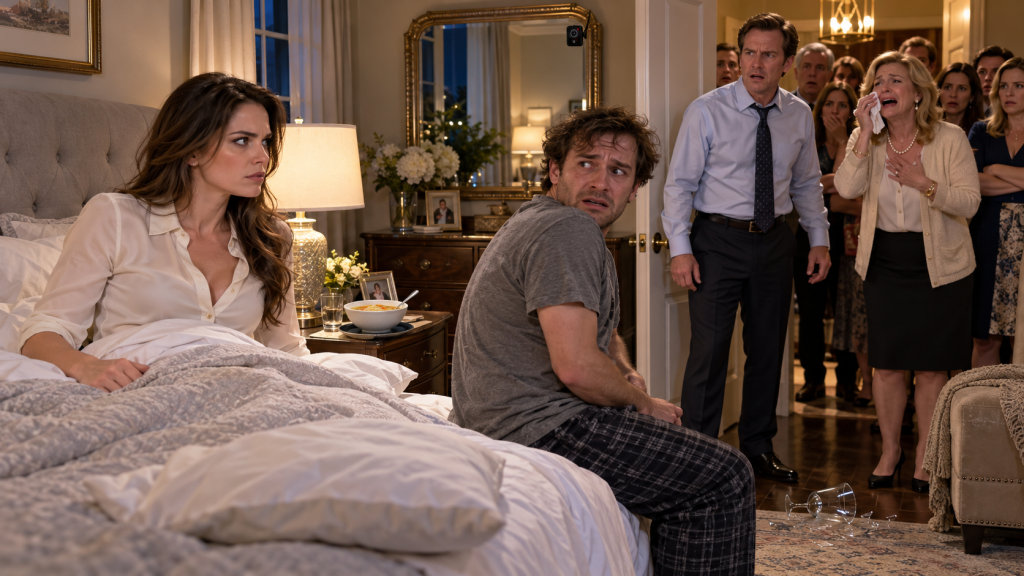
I looked at Richard. “You didn’t know?” His face had gone gray. “No.” I stared at him. For years, he had used those exact words whenever I complained about his mother. I didn’t know she moved your things.
I didn’t know she read your messages.
I didn’t know she told Aunt Carol you were infertile.
I didn’t know she had a key copied.
I didn’t know.
I didn’t know.
I didn’t know.
Now, for once, I believed him.
And somehow that did not make me feel better.
Because ignorance stops being innocence when someone has warned you repeatedly.
Evelyn’s voice rose.
“This is ridiculous.”
Richard turned toward her.
“Mom.”
She lifted her chin.
“It’s paperwork.”
“You transferred Natalie’s interest in our house.”
“I protected the family.”
“You forged her name.”
“She was going to leave you.”
I laughed.
There it was again.
The excuse always came first.
Not:
I did it.
But:
You made me.
Richard stared at her.
“How did you even get access to the deed?”
Evelyn said nothing.
Melissa stepped backward.
Too late.
I saw it.
The tiny movement.
The way her eyes shifted toward the floor.
I looked at her.
“You helped.”
She shook her head immediately.
“No.”
The stranger beside the wall muttered,
“She helped with more than that.”
Every face turned.
Evelyn hissed,
“Shut your mouth.”
He laughed nervously.
“You said I’d get paid tonight.”
I looked at him.
“What’s your name?”
He hesitated.
“Caleb.”
“Caleb what?”
“Dawson.”
“Why are you here?”
Evelyn answered before he could.
“He’s lying.”
I raised the memory card.
“Then he can lie to the police.”
The room changed.
Not dramatically.
Just enough.
Richard’s uncle stepped toward the hallway.
One neighbor quietly left.
The other stayed near the door.
Melissa whispered,
“Natalie, don’t do that.”
I stared at her.
“Don’t call the police?”
“You don’t understand.”
“You were about to borrow six hundred forty thousand dollars against my house tomorrow.”
“It’s not your house alone.”
“No.”
I looked at the screen.
“It was half mine.”
Richard flinched at the past tense.
I had not meant anything by it.
Not yet.
But he heard it.
So did I.
Half mine.
Half his.
Not ours.
Something inside the marriage had already changed shape.
I called 911.
Evelyn exploded.
“You ungrateful little—”
Richard stepped between us.
“Stop.”
She stared at him.
“Richard.”
“No.”
His voice shook.
But he said it again.
“No.”
The room went silent.
His mother looked genuinely stunned.
Maybe because in thirty-four years, her son had learned every version of yes.
Yes, Mom.
Of course, Mom.
She didn’t mean it, Natalie.
That’s just how she is.
Let it go.
She’s family.
Tonight, for the first time, he stood between her and the woman she had been trying to destroy.
Too late to save the marriage.
But not too late to matter.
Evelyn pointed at me.
“She poisoned this family against me.”
I almost smiled.
“You put sleeping pills in my soup.”
“That was to calm you down.”
Caleb actually laughed.
A sharp, disbelieving sound.
Evelyn turned.
He lifted both hands.
“Lady, you told me she had to be unconscious so your son would believe it.”
Richard shut his eyes.
I watched his jaw tighten.
Then I asked Caleb:
“How much did she offer?”
“Five grand.”
“Cash?”
“Half cash, half after you were gone.”
“Gone where?”
He looked at Evelyn.
She stared back like she could still control him.
He swallowed.
“Out of the house.”
I asked,
“Why did you agree?”
His face twisted.
“Because I’m an idiot.”
Not good enough.
But at least honest.
He added,
“I owe people money.”
Evelyn said:
“He’s a criminal.”
Caleb looked at her.
“You hired me.”
That ended that.
Police arrived seventeen minutes later.
Seventeen minutes can be very long when six family members are standing in a bedroom where a staged affair just failed.
No one spoke normally.
Melissa cried.
Evelyn prayed under her breath.
Richard sat on the edge of a chair staring at the fake deed.
Caleb kept asking whether he should call a lawyer.
I did not answer.
When the officers entered, everything became procedure.
Separate people.
Take statements.
Preserve the soup.
Preserve the bowl.
Preserve the napkin.
Preserve the medication container found later in Evelyn’s purse.
Preserve the camera.
Preserve the cloud files.
Preserve the stranger’s phone.
Preserve mine.
The house stopped being a home and became a scene.
That hurt more than I expected.
Not because I wanted to stay.
Because betrayal had contaminated every ordinary object.
The bed.
The soup bowl.
The mirror.
The dining chair where Evelyn once wrapped Christmas presents.
The hallway where Richard and I had danced barefoot after our first anniversary dinner.
Everything became evidence.
An officer asked if I had swallowed any of the soup.
“No.”
“Any dizziness?”
“No.”
“Any medication?”
“No.”
“Can we send the soup for testing?”
“Yes.”
“Do you consent to giving us the memory card?”
I held it tighter.
Then nodded.
“Yes.”
Richard watched me hand it over.
He looked devastated.
Good.
Not because I wanted him hurt.
Because sometimes devastation is the beginning of understanding.
The pills turned out to be prescription sedatives.
Evelyn had taken them from her own medicine cabinet.
The soup contained enough to have made me heavily drowsy.
Not enough, according to later toxicology estimates, to guarantee unconsciousness.
That distinction mattered.
She had not created some movie-perfect knockout drug.
She had crushed medication into my dinner and gambled on what it would do.
That was already enough.
The property scheme turned out to be even worse.
The fake deed had been recorded electronically three weeks earlier using a notary acknowledgment.
The notary was Melissa’s friend.
A woman named Tessa Rourke.
She claimed at first that I had appeared before her remotely.
I had not.
She produced a video log.
Except the video log showed only a blank connection and an identification image.
My driver’s license.
Someone had scanned it.
The audit trail showed the file was uploaded from Melissa’s home computer.
That was the first domino.
The second was the trust.
The Whitmore Family Preservation Trust.
Preservation.
A beautiful word for theft.
The trust named Evelyn as trustee.
Richard and Melissa as successor trustees.
It supposedly held my half of the house, several family investment accounts, and later—if the loan closed—most of the borrowed funds.
Richard swore he had never seen the trust.
At first, I thought he was lying.
Then the metadata supported him.
His electronic signature had been copied from an old insurance form.
His email approval came from an address one letter different from his real one.
Not a sophisticated hack.
A fake account.
Created by Melissa.
That changed everything.
Because until then, part of me believed Richard had been standing beside his mother all along.
Instead, he had been used too.
Not as much as I had.
Not in the same way.
But used.
That did not erase his failures.
It made them more complicated.
The bank froze the closing before nine.
My lawyer, Rachel Cohen, called the fraud department at 7:12 a.m.
By 8:03, the file was suspended.
By 8:26, the title company refused to insure the transfer.
By 8:41, the notary stopped answering her phone.
By 9:00, the closing room sat empty.
No dramatic confrontation.
No one stormed into a bank lobby waving documents.
The theft died quietly in email.
That is how many frauds end.
Not with shouting.
With somebody marking a file:
DO NOT FUND.
The $640,000 had never been disbursed.
That mattered.
No lender lost the full amount.
No house was actually sold.
No money vanished overnight.
But prosecutors later said the preparation itself mattered.
Forgery.
False statements.
Attempted fraudulent financing.
Identity misuse.
Conspiracy.
Not every document became a charge.
Not every ugly act became a felony.
But enough did.
The motive took longer to uncover.
Evelyn’s first explanation was the one she always used.
Family.
She said she wanted to “protect the house” from me because she believed I would divorce Richard and force a sale.
That sounded plausible until investigators traced her finances.
Then we learned about the nursing facility.
Not for her.
For Richard’s father.
Harold Whitmore had been declining for two years.
Early dementia.
Falls.
Heart issues.
Evelyn refused assisted living.
Not because she wanted to care for him at home.
Because she was ashamed.
Her church friends thought Harold was “resting.”
Her relatives believed he was traveling with an old friend.
In reality, he spent most days in a rented room inside a private care residence outside the city.
Expensive.
Discreet.
Fourteen thousand dollars a month.
Evelyn had depleted nearly all of their savings.
Then she borrowed.
Then Melissa borrowed.
Then they tried to sell a small investment property.
Then they lost money on the sale.
By the time of the staged affair, Evelyn and Melissa owed more than $310,000 between loans, credit cards, and care expenses.
I almost felt sorry for them.
Almost.
Then the forensic accountant found another payment.
Eighty-two thousand dollars transferred over eighteen months to Melissa’s boutique.
Not care.
Business.
A boutique that had failed twice and been relaunched under three names.
Evelyn had been funding her daughter while telling everyone Harold’s care was consuming everything.
Melissa cried when confronted.
“I was going to pay it back.”
Of course.
The national anthem of family theft.
I was going to pay it back.
The loan against our house was supposed to solve all of it.
Pay the care bills.
Clear high-interest debt.
Rescue Melissa’s boutique.
Restore Evelyn’s retirement reserve.
And create a “family emergency fund.”
Controlled by Evelyn.
My property was simply the asset large enough to make the math work.
But why stage an affair?
Because the forged deed was vulnerable.
If I challenged it immediately, the loan would fail.
If Richard divorced me first, accused me publicly of infidelity, and pushed me out emotionally before I understood the property records, Evelyn believed she could create enough chaos to finish the closing.
She did not need a court to award Richard the house overnight.
She needed time.
Confusion.
Shame.
A husband angry enough to tell me to leave.
A wife frightened enough to pack first and ask questions later.
Evelyn had spent her entire life learning how people behave when humiliated.
She planned around it.
That was the part that frightened me most.
Not the pills.
Not Caleb.
The psychological architecture.
She believed if Richard walked in and saw a man in our bed, he would not investigate.
He would react.
If he reacted, I would be isolated.
If I was isolated, she could move money.
She had counted on anger being faster than truth.
She almost won.
But I had already stopped trusting the house.
That camera saved me.
Three weeks earlier, I had installed it because small things kept happening.
My phone moved.
Messages deleted.
Clothes rearranged.
One morning, Richard received a text from my number saying:
Sometimes I wonder if marrying you was a mistake.
I had not sent it.
He believed I had.
We fought for two hours.
Evelyn sat in the kitchen afterward and told him:
“Some women get restless when they think they can do better.”
I remembered looking at her face.
Calm.
Helpful.
Too satisfied.
That was the day I bought the camera.
Richard mocked me.
“Do you hear yourself?”
“Yes.”
“You think my mother is sneaking into our bedroom?”
“Yes.”
He laughed.
That laugh came back to him during the investigation.
He apologized for it three times.
Then stopped.
Good.
There are apologies that become another demand.
Please forgive me.
Please reassure me.
Please tell me I’m not terrible.
Eventually, Richard understood that remorse was not supposed to require labor from me.
He learned to say:
“I was wrong.”
Then be quiet.
That was progress.
But the marriage was already broken.
Not because his mother staged an affair.
Because when I told him for months that something was wrong, he trusted his comfort over my reality.
That difference mattered.
People kept asking:
“But he didn’t know.”
Exactly.
He did not know because he had chosen not to know.
There are kinds of ignorance you inherit.
And kinds you maintain.
Richard maintained his.
He loved peace more than truth.
As long as I swallowed my discomfort, the family looked functional.
The moment I asked questions, I became difficult.
That system had protected him.
Until it nearly cost him his house too.
Two weeks after the failed closing, he came to the furnished apartment where I was staying.
I had moved out temporarily.
Not because Evelyn won.
Because I could not sleep in the bedroom where she had touched my face and unbuttoned my blouse.
Richard stood outside holding no flowers.
Good decision.
No grand gesture.
Just a folder.
“What’s that?”
“Everything I found.”
I let him in.
He sat at the small dining table.
Inside the folder were old bank statements.
Emails.
Text printouts.
Copies of family records.
Richard had spent two weeks searching backward.
He found evidence Evelyn had been controlling far more than we knew.
College applications rerouted when he was eighteen because she did not want him leaving the state.
A job offer letter she hid when he was twenty-three because the position required relocation.
An old breakup letter from his first girlfriend that Evelyn never delivered.
“She told me Laura just stopped calling,” he whispered.
I stared.
Richard looked sick.
“My whole life…”
He could not finish.
I understood that feeling.
The horror of discovering your memories had been edited by someone else.
But I did not comfort him.
Not because I lacked sympathy.
Because he needed to sit in it.
He looked at me.
“I thought she loved me.”
“She does.”
He blinked.
I continued.
“That’s what makes this harder.”
He looked down.
“Can someone love you and still control you like that?”
“Yes.”
“Then what does love even mean?”
“Not enough.”
He looked up.
I said:
“Love is not enough if it doesn’t leave room for another person to exist.”
He cried.
Quietly.
I hated seeing him cry.
Still loved him.
That was the worst part.
Leaving would have been easier if I felt nothing.
But I still knew how he took his coffee.
Still knew the scar on his knee from falling off a bike at twelve.
Still knew he hated thunder but pretended not to.
Still wanted to touch his hair when he bowed his head.
Love can survive after trust becomes unusable.
That does not mean you rebuild.
Sometimes love becomes a witness instead of a home.
I told him I wanted a separation.
He nodded.
No argument.
“I understand.”
“Do you?”
“Not completely.”
At least he was honest.
Then he asked:
“Is there anything I can do?”
“Yes.”
His eyes lifted.
“Tell the truth even when it makes your mother look bad.”
His face tightened.
“Okay.”
“And even when it makes you look bad.”
Longer pause.
Then:
“Okay.”
That became the test.
Richard gave investigators his devices.
His records.
His passwords.
He testified before the grand jury.
He admitted he had ignored my complaints.
Admitted Evelyn had unrestricted access to parts of the house.
Admitted Melissa often handled “family paperwork.”
Admitted he had signed documents without reading them in the past.
He did not try to become heroic.
Good.
Heroes are often just people cleaning up messes they helped create.
Caleb cooperated too.
His story was pathetic.
Evelyn found him through a handyman who had done work for Melissa.
He had debts.
She offered him five thousand dollars.
He was supposed to enter after I became drowsy.
Lie beside me.
Leave through the side door when Richard entered.
Evelyn would scream.
Melissa would film the aftermath.
They expected me to wake confused and defensive.
Caleb claimed he was told nothing sexual would happen.
That mattered.
The video supported that he never touched me beyond sitting near the bed and allowing Evelyn to stage the room.
Still horrifying.
Still criminal conduct.
But facts mattered.
He accepted a plea on lesser charges related to conspiracy and unlawful entry, cooperated, and served a shorter sentence.
I did not forgive him.
I did not need to.
He testified truthfully.
That was his responsibility.
Tessa, the notary, lost her commission and faced criminal consequences for false notarization and related fraud.
She later claimed Melissa told her the documents were “just correcting title.”
Maybe she believed some of that.
The electronic record showed she knew I was not present.
That was enough.
Melissa’s case became complicated.
She had actively helped create the fake email account.
Uploaded my identification.
Signed loan documents.
And coordinated with the notary.
But she also turned on Evelyn once charges became serious.
Their relationship shattered.
At one hearing, I watched mother and daughter sit on opposite benches without looking at each other.
That almost made me sad.
Then I remembered they had both been willing to erase me from my own house.
Sadness and accountability can share a room.
Evelyn never fully confessed at first.
She insisted the sleeping pills were “a mistake.”
The staging was “to expose problems.”
The deed was “family protection.”
The loan was “temporary.”
The stranger was “misunderstood.”
She kept changing vocabulary.
Never facts.
That is how some people avoid guilt.
They rename what they did until it sounds survivable.
The prosecutor did not let her.
Neither did the video.
One section of the recording became decisive.
After Evelyn adjusted Caleb’s shirt and before she stepped into the hallway, she whispered:
“Once Richard throws her out, tomorrow becomes easy.”
Caleb asked:
“What happens tomorrow?”
Evelyn answered:
“We save the house from her.”
Clear.
Calm.
No panic.
No accident.
The house was never being saved.
It was being used.
The criminal case lasted almost eighteen months.
Long enough for outrage to cool into paperwork.
Long enough for Richard and me to learn whether we wanted each other without his mother occupying every room between us.
The answer was painful.
We did not.
Not in the old way.
Maybe if the betrayal had been one night.
Maybe if he had believed me earlier.
Maybe if years of dismissal had not made me feel like I was pleading for citizenship inside my own marriage.
But by the time he finally saw his mother clearly, I had already learned something about myself.
I liked being believed the first time.
I liked not explaining why a locked bedroom drawer mattered.
I liked silence without tension.
I liked not checking whether Evelyn had entered.
I liked my own nervous system when nobody was telling me I was overreacting.
I did not want to go back.
Richard understood before I said it.
One evening, six months into separation, he asked:
“You’re not coming home, are you?”
I looked at him.
“No.”
He closed his eyes.
Then nodded.
“Okay.”
That was the end of the marriage.
Not shouting.
Not papers.
Not Evelyn.
One honest word.
No.
We divorced.
The house became the hardest issue.
My forged transfer was voided.
The title restored our original ownership.
Because the attempted loan never funded, there was no $640,000 debt attached to the property.
Thank God.
But the house still belonged to both of us.
We had to decide.
Sell.
Buy one another out.
Keep co-ownership temporarily.
Richard surprised me.
“I want you to have it.”
I shook my head.
“I’m not taking your half for free.”
“I don’t want money.”
“That’s guilt talking.”
He stared.
“Maybe.”
“I won’t build my future out of your guilt.”
So we did it properly.
Appraisal.
Mortgage balance.
Equity calculation.
Credit for documented contributions.
I refinanced and bought out part of his share.
He voluntarily accepted less than the maximum he might have fought for, but not zero.
His lawyer documented it.
Mine approved it.
No secret generosity.
No emotional IOU.
The house became mine.
Legally.
Cleanly.
Ironically, once it was finally mine alone, I did not want it.
I stayed another year.
Then sold it.
People were shocked.
After everything Evelyn did to steal it?
Yes.
Especially after everything Evelyn did.
I refused to turn bricks into proof that I had won.
I bought a smaller place across town.
Sunlight in the kitchen.
No family history.
No room where anyone had staged a lie.
The first night, I hung no pictures.
I slept on a mattress surrounded by boxes.
It was the safest room I had ever been in.
Evelyn eventually pleaded guilty to multiple charges involving attempted financial fraud, forgery-related conduct, unlawful administration of medication, and conspiracy tied to the staged scene.
Not every charge prosecutors originally considered remained.
No attempted murder.
No kidnapping.
No exaggerated headline.
The facts were terrible enough.
Her age mattered.
Her lack of prior criminal history mattered.
The financial loss being prevented before funding mattered.
Her repeated planning mattered too.
She served time.
Not forever.
Long enough.
Melissa received a lesser sentence, restitution obligations, and probation after cooperation.
Tessa faced professional and criminal penalties.
Caleb did too.
Richard was not charged.
Investigators found no evidence he knew about the plan beforehand.
That should have relieved me.
Instead, it made the emotional truth sharper.
He had not conspired against me.
He had simply made the conditions possible by refusing to believe me.
That was harder to explain to people.
Family members told me:
“Then why divorce him?”
Because innocence of conspiracy is not the same as fitness for marriage.
Because I had spent years being disbelieved.
Because his mother had to commit a felony before my discomfort became real enough for him.
Because I was tired.
That was enough.
Richard went to therapy.
Real therapy.
Not two sessions and a self-help podcast.
Years.
He learned words like enmeshment.
Triangulation.
Emotional dependence.
Conflict avoidance.
He hated all of them.
Then he started recognizing them.
He eventually apologized without using Evelyn as the subject.
Not:
I’m sorry Mom hurt you.
But:
I’m sorry I trained you to prove what I should have taken seriously.
That sentence mattered.
He also rebuilt parts of his life that had nothing to do with me.
Applied for jobs outside the city.
Reconnected with the college friend Evelyn once pushed away.
Learned to make decisions without calling family first.
Our divorce improved him.
That sounds cruel.
It is not.
Sometimes consequences remove the insulation around a person.
Then growth finally becomes necessary.
We did not remarry.
Did not become secret lovers.
Did not drift back together at Christmas.
Real healing does not always restore the original shape.
We became cordial.
Later, almost friendly.
Careful.
We could sit across from each other and talk without pretending history disappeared.
That was enough.
Evelyn wrote me from prison.
The first letter was terrible.
Six pages.
Half apology.
Half defense.
She said she had always known I would “separate Richard from his family.”
She said the house had been “meant for the Whitmores.”
She said Harold’s medical bills had driven her into desperation.
She said she never meant to hurt me.
I stopped there.
Never meant to hurt me.
She drugged my soup.
I gave the letter to my lawyer.
Never answered.
The second letter came eight months later.
Shorter.
Better.
I thought losing control of Richard meant losing my son.
Then:
I confused being needed with being loved.
That was true.
She continued.
I saw you as competition because you did not need my permission to be important to him.
I read that line twice.
Then:
I made myself the victim of changes that were normal.
That was also true.
She apologized for the soup.
The forged deed.
The staging.
The years of intrusion.
No excuses.
I still did not answer.
Apology does not create obligation.
Two years after her release, she requested one meeting.
I said no.
Three years later, I changed my mind.
Not for closure.
Curiosity.
We met in a therapist’s office.
Neutral.
Public enough.
Safe enough.
Evelyn looked older.
Smaller.
No dramatic tears.
She said:
“Thank you for coming.”
I nodded.
She asked:
“Do you hate me?”
“No.”
That surprised her.
“I was angry for a long time.”
“And now?”
“I understand you better.”
Her eyes filled.
“That’s not forgiveness.”
“No.”
She nodded.
Fair.
Then she asked:
“Do you know why I hated you?”
“You said because Richard chose me.”
She smiled sadly.
“That was part of it.”
“What was the rest?”
She looked down at her hands.
“You made choices easily.”
I frowned.
“I do not make choices easily.”
“To me you did.”
“You had a career.”
“You traveled.”
“You said no.”
“You bought your own things.”
“You disagreed with him.”
Her mouth trembled.
“I spent my whole life asking men what was allowed.”
That stunned me.
Not because it excused anything.
Because I had never imagined Evelyn as someone who once lacked power.
She continued.
“When Richard married you, I watched him become comfortable with a woman who did not obey.”
“I thought that meant he would eventually see how much I had obeyed.”
I understood then.
I was not only her daughter-in-law.
I was evidence.
Evidence another life had been possible.
Some people see freedom and become inspired.
Others become enraged at the person who embodies it.
I asked:
“So you tried to make me smaller.”
“Yes.”
The honesty hurt.
She whispered:
“I am sorry.”
I nodded.
“I believe you.”
Her eyes lifted.
That was all I gave.
Not forgiveness.
Not reconciliation.
Belief.
She had finally told the truth.
That deserved recognition.
Nothing more.
Harold died while Evelyn was still incarcerated.
That was complicated.
Richard visited him regularly until the end.
Melissa too.
I went once.
Not for Evelyn.
For Harold.
He had never been cruel to me.
Mostly absent.
Quiet.
Possibly aware of more than he admitted.
Dementia had taken much of him.
When I sat beside his bed, he looked at me and whispered:
“Did Evelyn make dinner?”
I almost laughed.
“No.”
“Good.”
Then he closed his eyes.
I still do not know whether he knew who I was.
Maybe not.
After his death, investigators uncovered old records suggesting Evelyn’s control had not begun with us.
She managed every account.
Opened Harold’s mail.
Screened his calls.
Chose who visited.
Some of that may have been caregiving.
Some was not.
Patterns rarely begin on the day they become visible.
That did not make Harold blameless.
He had spent decades surrendering decisions because surrender was easier.
Again, passivity can become participation.
I saw Richard in that.
So did he.
Melissa changed too.
Not dramatically.
She struggled.
Lost the boutique.
Worked retail management.
Paid restitution.
For the first time in her adult life, Evelyn could not rescue her.
One day, years later, she sent me a message.
I used to think you thought you were better than us.
I replied:
No. I thought I was allowed to be separate from you.
She answered:
I didn’t know there was a difference.
That may have been the most important thing she ever said.
Families built on control interpret boundaries as rejection.
You do not have to hate someone to close a door.
You do not have to declare them evil to remove their key.
I learned that slowly.
After the divorce, I replaced every lock.
Even in the new house.
Not because Evelyn had keys.
Because I liked hearing the click.
Mine.
I installed cameras too.
For a while, too many.
Front door.
Back door.
Garage.
Hallway.
Kitchen.
At some point, my therapist asked:
“Do they make you feel safe?”
“Yes.”
Then she asked:
“Or watched?”
I froze.
I removed three that weekend.
That was another kind of healing.
Safety does not have to become surveillance.
The hidden camera had saved me once.
I did not need to spend the rest of my life recording every room.
Years passed.
The memory card stayed in an evidence bag for a long time.
Eventually it was returned.
I placed it in a drawer.
Did not watch the video again.
Once was enough.
Richard asked whether I still had it.
“Yes.”
“Will you ever delete it?”
“I don’t know.”
He nodded.
Years later, I did.
That surprised even me.
I copied the legally necessary archive to my attorney’s records.
Then erased my personal copy.
I did not need Evelyn’s voice living in my house forever.
The story had already been proven.
Evidence had done its job.
It did not deserve permanent residence.
I started dating again slowly.
Very slowly.
The first man asked why I had cameras.
I told him a short version.
He responded:
“That’s crazy.”
I asked:
“What is?”
“Your ex’s mom.”
I laughed.
“Good answer.”
We dated six months.
Nice man.
Wrong fit.
Later, I met Marcus.
A civil engineer.
Divorced.
Two daughters.
He had boundaries so normal they felt exotic.
The first time his mother called during dinner, he silenced his phone.
I stared.
“What?”
“You’re not answering?”
He looked confused.
“We’re eating.”
I nearly proposed on the spot.
We did eventually marry.
Small ceremony.
No family theatrics.
No shared house until after a prenup.
Separate lawyers.
Full financial disclosure.
Richard heard about it through a mutual friend.
Sent one text.
I hope he believes you the first time.
I cried.
Not because I wanted Richard back.
Because he understood what mattered.
Marcus did believe me.
More importantly, he did not treat belief as a gift he could withdraw.
If I said something felt wrong, we investigated.
Sometimes I was wrong.
Sometimes he was.
No punishment.
No mockery.
No jury of relatives.
Just conversation.
Ordinary respect became luxurious.
The old house sold to a young couple.
I met them at closing.
They had no idea what happened there.
Good.
A house should be allowed a new story.
The woman told me she loved the bedroom mirror.
I almost told her.
Then stopped.
Different mirror.
Different life.
I smiled.
“It gets good morning light.”
That was all.
Richard eventually remarried too.
A woman named Claire.
I met her once.
Kind.
Direct.
She told me:
“Richard talks about what happened.”
I raised an eyebrow.
“That sounds dangerous.”
She laughed.
“He does not blame you.”
Good.
I did not need her approval.
But I was glad he had learned something.
Evelyn never became close to Claire.
Interesting.
Claire apparently established boundaries immediately.
No spare key.
No financial mixing.
No surprise visits.
Richard backed her.
Imagine that.
Sometimes the lesson we begged someone to learn with us becomes useful in the next relationship.
That hurts.
It can also be meaningful.
My pain did not become worthless because someone else benefited from what Richard finally understood.
That took maturity I did not possess at first.
At fifty, I found Nana’s old recipe box from my side of the family.
Inside was my mother’s chicken soup recipe.
For years, I had avoided chicken noodle soup.
Ridiculous.
Soup had not hurt me.
Evelyn had.
Still, smell is memory.
The first time I cooked it, my hands trembled.
Marcus came into the kitchen.
“You okay?”
“Yes.”
“Want me to take over?”
“No.”
I tasted the broth.
Salt.
Carrot.
Pepper.
Nothing bitter.
I laughed.
Then cried.
Marcus waited.
I said:
“It’s just soup.”
He smiled.
“Good.”
Yes.
Good.
Just soup.
That became one of the quiet goals of my life.
Return ordinary things to themselves.
Soup becomes soup.
Bedrooms become bedrooms.
Mirrors become mirrors.
Houses become houses.
Marriage becomes choice.
Family becomes people, not authority.
The criminal case once made everything symbolic.
Healing made things ordinary again.
That was better.
When Evelyn died, years later, Richard called me.
I did not go to the funeral.
Not out of hatred.
Our story was finished.
He understood.
Melissa sent a note saying Evelyn had kept one photograph of Richard and me from our wedding.
I stared at the message.
“Why?”
Melissa replied:
I think she regretted what she destroyed.
Maybe.
Regret is real.
It does not reverse consequence.
I asked her to throw the photograph away or keep it.
I did not want it.
My wedding had been real.
So had the end.
I no longer needed objects to prove either.
The thing I remember most now is not Evelyn crushing pills into soup.
It is not Caleb sitting on my bed.
Not Richard’s face when I opened my eyes.
Not even the forged deed.
It is the silence after I asked:
“Do you guys want to see the video first?”
That silence was the first moment the family story stopped belonging to Evelyn.
For years, she narrated everyone.
Richard was loyal.
Melissa was fragile.
Harold was incapable.
I was ungrateful.
She assigned every role.
Then the camera played.
No argument.
No family mythology.
Just sound.
Her voice.
Her instructions.
Her plan.
Truth does not always need to shout.
Sometimes it just needs playback.
And the strangest part is that the hidden camera did not save my marriage.
People assume it did.
It proved I was innocent.
It exposed Evelyn.
It stopped the loan.
It protected the house.
Surely that saved us.
No.
It saved me from a lie.
That was different.
A marriage cannot be saved only by proving one spouse did not cheat.
It also needs trust strong enough that proof is not the first time one person becomes believable.
Richard learned that.
So did I.
Years later, he once said:
“I thought believing you meant accusing my mother.”
I replied:
“That was your mistake.”
He nodded.
“I know.”
Believing me never required convicting Evelyn without evidence.
It required taking me seriously enough to look.
That was all.
Look.
Ask.
Check.
Do not laugh.
Do not dismiss.
Do not tell the woman you love she is imagining things because reality would be inconvenient.
Had Richard done that months earlier, maybe everything would have been different.
Maybe.
But I stopped living in maybes.
There was enough life in what actually happened.
The forged deed was voided.
The loan never funded.
Evelyn faced consequences.
Melissa did too.
Caleb testified.
The notary lost her commission.
Richard learned how expensive avoidance can become.
I left.
Built a quieter life.
Cooked soup again.
Trusted someone again.
And eventually, one morning, I woke beside Marcus and realized I had slept eight hours without checking whether anyone had entered the room.
I lay there listening.
No footsteps.
No camera hum.
No whisper outside the door.
Just sunlight.
That was when I understood I was free.
Not when Evelyn was sentenced.
Not when the divorce became final.
Not when I sold the house.
Freedom arrived when my body stopped expecting someone else’s lie to walk through the door.
I got up.
Made coffee.
Marcus wandered into the kitchen half asleep.
He kissed my forehead.
“What are you smiling about?”
“Nothing.”
He poured coffee.
“Good nothing?”
“Yes.”
The best kind.
And sometimes I still think about the woman I was that night.
Lying perfectly still.
Eyes closed.
Hands clenched under the sheet.
Hearing a stranger ask:
“What if she wakes up?”
Then Evelyn answering:
“She’s not going to wake up.”
She was wrong.
I was already awake.
More awake than I had been in years.
And once I opened my eyes, I never closed them for her again.
THE END STORIES! THANK YOU FOR READING GOOD LUCK !❤️
Related Posts