I knew Blair’s voice. Even through the faint crackle of my mother’s phone, even beneath the traffic noise drifting through the café windows, I knew it. “He found them.” Three words. Three ordinary words that told me the woman I had intended to marry had known about my four sons long before I discovered them.
I looked at Lauren. She was sitting across from me, her fingers wrapped around a coffee cup she hadn’t touched. Six years had passed since I’d last seen her. Six years in which I had convinced myself that she had abandoned me. And now, in the space of a single evening, I had discovered four children, a forged custody petition, and a four-million-dollar payment that appeared to connect my mother to the family I had nearly married into.
My phone vibrated again. Mother. I answered. “Carter,” she said sharply. “Where are you?” I didn’t respond. “Blair is devastated. Do you have any idea what you’ve done tonight?” I stared at Lauren. Her eyes were fixed on my face. “Mother,” I said quietly, “why is Blair with you?”
A pause.
Then my mother laughed.
It was the same elegant, practiced laugh she’d used at charity dinners whenever someone said something inconvenient.
“Because you’ve humiliated the poor girl in front of a hundred and fifty people. Where else would she be?”
“I heard her.”
“What?”
“I heard Blair say I’d found them.”
The silence that followed was different.
It lasted only a few seconds.
But in those seconds, something in me finally stopped trying to protect my mother from the truth.
“Carter,” she began, “there are things you don’t understand.”
“Then explain them.”
“This is not a conversation to have over the telephone.”
“Did you know Lauren had my children?”
She inhaled.
“Carter—”
“Did you know?”
Her voice hardened.
“You need to come home before you do something irreversible.”
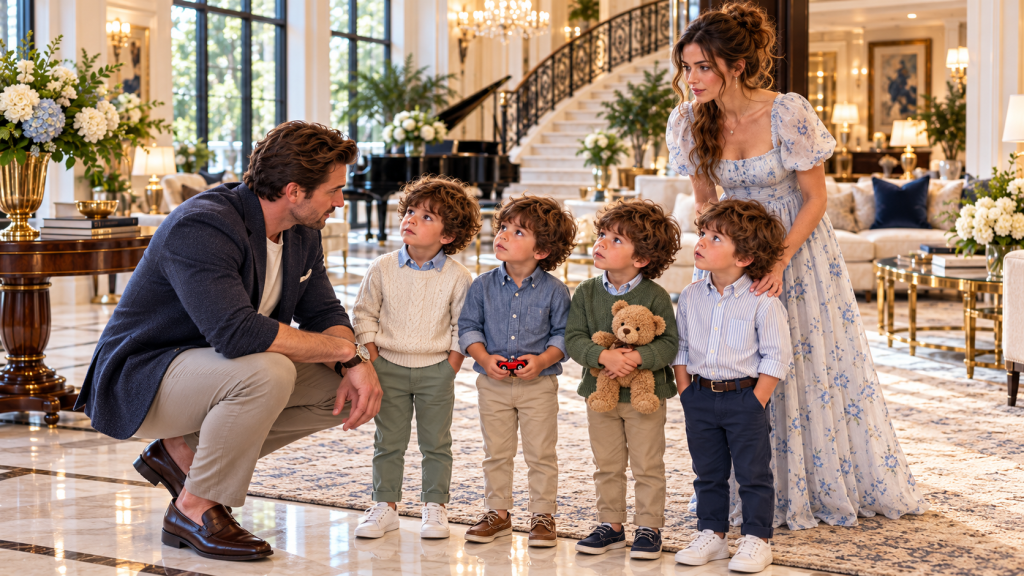
I looked down at the four photographs Lauren had placed between us.
Mason.
Henry.
Theo.
Wyatt.
Four little boys who had lived their entire lives without knowing their father.
“Something irreversible?” I repeated.
My voice trembled.
“Mother, I missed six years of my children’s lives.”
“Don’t be dramatic.”
I closed my eyes.
There was a time when those words would have silenced me.
When I would have apologized for speaking emotionally.
When I would have agreed to discuss everything privately at the family estate, where she and Uncle Walter could tell me what to think.
But that man had walked into a Manhattan restaurant at six forty-two that evening.
He hadn’t walked out.
“Do not contact Lauren,” I said.
My mother went silent.
“Do not contact her children. And do not send anyone to their home.”
“Carter, you cannot dictate—”
“They are my children.”
I paused.
“And if anyone approaches them again with documents carrying my signature, I will make sure every relevant authority knows about it.”
Her voice turned cold.
“You’re making a terrible mistake.”
I looked at Lauren.
“No,” I whispered.
“I made my mistake six years ago, when I believed you.”
I ended the call.
For a long moment, I simply sat there.
Then Lauren spoke.
“She’s never sounded frightened of you before.”
I looked up.
“She isn’t frightened of me.”
Lauren studied my face.
“Then what is she frightened of?”
I looked at the transfer displayed on my phone.
Four million dollars.
Authorized six years earlier.
Sent to a Whitmore company.
Under the words:
Family succession settlement.
“I intend to find out.”
Lauren didn’t smile.
She didn’t reach across the table.
She didn’t tell me she was glad I’d finally come to my senses.
Instead, she looked toward the café entrance.
“Carter, I need to get my boys home.”
I nodded.
“Of course.”
She gathered the photographs.
Then hesitated.
“I didn’t come here tonight to change your life.”
I looked at her.
“I know.”
“No, you don’t.”
Her eyes filled.
“I spent six years trying to build a life that didn’t depend on whether you would ever believe me.”
I swallowed.
She continued.
“When I found out I was pregnant, I tried to call you. Your number stopped working. Your office said you wouldn’t take my calls.”
I stared at her.
“Lauren…”
“I went to the Ashford building. They wouldn’t let me upstairs.”
Her voice trembled.
“Then your mother came to see me.”
I couldn’t speak.
Lauren looked down.
“She told me you wanted nothing to do with me or the pregnancy. She showed me documents that supposedly carried your signature.”
“What documents?”
“A statement saying you disputed paternity and didn’t want contact.”
My stomach tightened.
“I never signed anything like that.”
“I know that now.”
She wiped her cheeks.
“But I was twenty-five, pregnant, frightened, and being told that if I continued trying to contact you, your family’s lawyers would make sure I regretted it.”
I stared at her.
She continued.
“After the boys were born, the threats became worse.”
“How?”
“A lawyer came to the hospital. He offered me money if I signed a confidentiality agreement and agreed not to identify you publicly.”
My hands clenched.
“Did you sign?”
“No.”
Her voice strengthened.
“I told him my children weren’t for sale.”
I closed my eyes.
Lauren continued.
“Then I received letters accusing me of trying to exploit the Ashford name. Someone hired investigators to follow us. My father helped me move. Twice.”
I looked at her.
“Why didn’t you go to the police?”
“I did report some of the threats. But the people contacting me were careful. Their letters were dressed up as legal notices. Their investigators insisted they were acting lawfully.”
She paused.
“And I was raising four babies.”
The words struck me harder than any accusation.
Four babies.
Four feeding schedules.
Four sets of diapers.
Four little voices crying in the night.
And I hadn’t been there.
Not once.
I stared at her.
“I should have found you.”
Lauren’s expression softened slightly.
“You were told I didn’t want to be found.”
“That doesn’t excuse it.”
“No,” she whispered. “It doesn’t.”
I nodded.
She continued.
“But we can’t spend the rest of their childhood arguing about which of us should have known better.”
I looked down.
She was right.
Whatever my mother had done, whatever Uncle Walter had arranged, whatever Blair knew, the boys were not evidence in a dispute.
They were children.
And they needed us to behave like adults.
“Lauren, do they know about me?”
She hesitated.
“They know their father’s name.”
My heart pounded.
“What have you told them?”
“That we loved each other once. That we were separated. And that grown-ups sometimes make choices children can’t understand.”
I swallowed.
“Do they think I abandoned them?”
Her eyes filled.
“Sometimes they’ve asked why you never came.”
I looked away.
The pain was almost physical.
Then she whispered, “I never told them you didn’t love them.”
I covered my mouth.
For the first time that evening, I understood what her restraint had cost her.
She had every reason to hate me.
Every reason to tell those boys their father was selfish, cowardly, or cruel.
But she had left room for a truth she didn’t yet know.
“Thank you,” I whispered.
She shook her head.
“I didn’t do it for you.”
“I know.”
She stood.
I stood too.
“May I see them again?”
Lauren studied me.
“Not until we know what’s happening with those custody papers.”
I nodded.
“Whatever you need.”
She gathered her coat.
“And Carter?”
“Yes?”
“Don’t promise them things just because you’re hurting.”
My throat tightened.
She continued.
“They need someone who will still be there after the shock wears off.”
I looked at her.
Then answered with the only promise I was certain I could keep.
“I’ll start by telling the truth.”
That night, I didn’t return to the Ashford estate.
I went to a hotel and called an attorney who had never represented my family.
Her name was Amelia Park.
She came recommended by a former business associate who had once challenged an Ashford transaction and survived the experience.
At ten the following morning, Amelia sat across from me with a yellow legal pad.
She listened to everything.
The boys.
Lauren’s account of the past six years.
The messages.
The forged custody documents.
The transfer to Whitmore Strategic Holdings.
When I finished, she asked one question.
“Who controls your family trust?”
“My mother and Uncle Walter are trustees.”
“Who benefits from it?”
I frowned.
“Several members of the family. I receive distributions. There are charitable obligations and provisions for descendants.”
Amelia looked up.
“Which descendants?”
I hesitated.
“I don’t know the exact language.”
She put down her pen.
“Carter, I want you to obtain the trust documents.”
I stared at her.
“Why?”
“Because four million dollars is a remarkable sum to describe as a succession settlement. And if your children have rights under the trust, the people controlling it may have had a financial motive to conceal their existence.”
I felt cold.
“You think this is about money?”
She studied me.
“I think the available information supports several possibilities. We need documents before we decide which one is true.”
Then she leaned forward.
“And one more thing.”
“What?”
“Do not let your family turn this into a contest over Lauren’s fitness as a mother.”
I looked at her.
She continued.
“She has raised these children for six years. Whatever your parental rights may be, the boys’ stability matters. Establish the facts, address the forged documents, and approach any decisions about parentage and contact with care.”
I nodded slowly.
It was the first advice anyone had given me since the restaurant that didn’t involve winning something.
And I knew immediately that it was the advice I needed.
Two days later, I saw the boys again.
We met at a small children’s museum in Brooklyn.
Lauren chose it because there were other families around, plenty of things to do, and no reason for four six-year-olds to sit through an uncomfortable conversation with a stranger.
I arrived early.
Then spent fifteen minutes wondering whether I should leave.
I had negotiated acquisitions worth hundreds of millions of dollars.
I had stood before hostile investors and defended decisions that could alter the future of entire companies.
But nothing had ever frightened me more than meeting four little boys who had every reason to ask why I’d never visited them.
Then the entrance door opened.
Lauren walked in with the boys.
Mason came first, holding a folded museum map.
Henry followed, pointing excitedly toward an exhibit.
Theo was carrying a small notebook.
Wyatt walked beside his mother, holding two fingers of her hand.
When they spotted me, all four stopped.
I crouched.
“Hello.”
Mason studied my face.
“You’re the man from the restaurant.”
I smiled nervously.
“Yes.”
Henry stepped forward.
“Mom says your name is Carter.”
“That’s right.”
Theo tilted his head.
“She says you’re our dad.”
The words almost knocked the air from my lungs.
I glanced at Lauren.
She nodded gently.
“We talked last night.”
I looked back at Theo.
“Yes,” I said. “I’m your father.”
Wyatt hid slightly behind Lauren.
Mason folded his arms.
“Then where were you?”
The question was direct.
Honest.
Devastating.
I took a breath.
“I didn’t know you existed.”
Mason frowned.
“How could you not know?”
I swallowed.
“Some adults kept important information from me. I’m finding out what happened.”
Henry looked confused.
“Like a secret?”
I nodded.
“Like a very big secret.”
Theo considered that.
“Are you going to disappear again?”
My eyes filled.
I glanced toward Lauren.
Then answered carefully.
“I’m going to do everything I can to be someone you can count on. Your mom and I will figure out what that looks like together.”
Mason stared at me for a moment.
Then held out his map.
“Do you like dinosaurs?”
I almost laughed through my tears.
“Very much.”
He unfolded the paper.
“There’s a dinosaur room.”
Henry interrupted.
“And a machine that makes bubbles.”
Theo held up his notebook.
“I want to see the space exhibit.”
Wyatt finally spoke.
“Can we get snacks first?”
Lauren smiled.
“Of course you can.”
I looked at her.
And for the first time since the restaurant, she smiled back.
Just a little.
But enough to make the world feel less impossible.
We spent nearly three hours in the museum.
I learned that Mason liked knowing where everyone was going.
Henry loved making people laugh.
Theo asked questions until adults ran out of answers.
And Wyatt, who had seemed the shyest, was fascinated by anything with moving parts.
At one exhibit, he spent twenty minutes studying a mechanical model.
Then he looked at me.
“Do you know how it works?”
I crouched beside him.
“Not exactly.”
He frowned.
“But you’re grown up.”
I smiled.
“Being grown up doesn’t mean knowing everything.”
He considered that.
Then nodded solemnly.
“Mom says that too.”
I laughed.
And for a moment, I saw Lauren as she’d been six years earlier.
Standing in my apartment with a measuring tape around her neck, laughing because I’d tried to assemble a bookshelf without reading the instructions.
I’d loved that laugh.
I’d missed it more than I’d admitted to myself.
Near the end of our visit, Henry asked whether we could take a photograph together.
I looked at Lauren.
She hesitated.
Then nodded.
“One photograph.”
We stood beside a painted mural of the solar system.
Four boys in navy sweaters.
One bewildered father.
And Lauren behind the camera.
Just before she pressed the button, Mason said, “Carter, you’re supposed to smile.”
I looked at him.
Then smiled.
The camera clicked.
It wasn’t a beautiful photograph.
My eyes were red.
Henry was making a ridiculous face.
Theo wasn’t looking at the camera.
Wyatt was holding a plastic rocket.
But I knew I would treasure that picture for the rest of my life.
Because it was the first photograph of me with all four of my sons.
And nobody had arranged it for a corporate announcement.
Nobody had approved the clothing.
Nobody had instructed the children how to stand.
It belonged only to us.
The following week, we arranged a formal paternity test through a process both Lauren and I agreed was appropriate.
I didn’t ask because I doubted her.
I asked because our attorneys anticipated that the people challenging her custody would exploit any uncertainty they could find.
Lauren understood.
“I want the paperwork to say what we already know,” she told me.
When the results arrived, they confirmed that I was the biological father of all four boys.
Mason.
Henry.
Theo.
Wyatt.
I stared at the report in Amelia’s office.
For six years, I’d spent my birthdays surrounded by people who raised glasses to the future of the Ashford name.
Meanwhile, four little boys carrying that name’s bloodline had been learning to walk, speak, read, and tie their shoes without me.
I set down the report.
Then began crying.
Amelia waited.
Finally, she said, “Carter, the test answers one question.”
I looked up.
“It doesn’t answer what kind of father you’re going to be.”
I nodded.
She continued.
“That’s something you’ll answer over time.”
I thought about Mason asking where I’d been.
And Theo asking whether I’d disappear again.
“Then I’d better start showing up.”
The trust documents arrived three days later.
Amelia spread them across the conference table.
Her expression was serious.
“Your grandfather created a separate descendant trust when he established Ashford Industries.”
I nodded.
“I knew that.”
“But did you know what happens when you have biological or legally recognized children?”
I shook my head.
She turned a page toward me.
“The trust reserves a substantial beneficial interest in certain Ashford Holdings shares for your children. It also requires independent administration of those interests once qualifying descendants exist.”
I stared at her.
“How substantial?”
“Based on the current valuation, the combined interests could be worth tens of millions of dollars, although determining their exact value and present rights will require a full accounting.”
My hands went cold.
“That much?”
She nodded.
“And Walter has been exercising trustee authority over assets that may have needed separate administration since the boys were born.”
I stared at the documents.
“You’re saying he was supposed to report their existence.”
“Once he had knowledge of qualifying descendants, he had duties under the trust. We’re investigating what he knew and when.”
I leaned back.
My grandfather had founded Ashford Industries decades earlier.
His estate plan was complicated, filled with trusts, corporate holdings, charitable funds, and restrictions intended to keep the company stable through future generations.
I’d never examined it closely.
Uncle Walter always told me the arrangements were too technical to worry about.
You run the business, Carter. I’ll handle the family paperwork.
I had trusted him.
Just as I’d trusted my mother.
I looked at Amelia.
“What about the four million dollars?”
She pointed to another document.
“The transfer came from an investment account under the trust’s control. The stated purpose was a family succession settlement.”
I swallowed.
“And it went to the Whitmores.”
“Yes.”
She paused.
“But there’s no ordinary transaction file supporting the payment.”
I stared.
“No contract?”
“Not in the records produced so far. We’re requesting the underlying authorizations and communications.”
I thought of Blair.
Her perfect smile.
Her carefully planned charity events.
The engagement celebration she’d arranged with almost military precision.
And her voice behind my mother’s telephone.
He found them.
I looked at Amelia.
“Do you think Blair’s family was paid to help hide my sons?”
She considered the question.
“The timing makes that a serious possibility. But we need to trace what the payment purchased.”
I nodded.
Then she said something even more disturbing.
“The custody documents may explain why your family is suddenly trying to bring the boys into its control.”
I stared at her.
“Why now?”
“Because an independent review of the descendant trust is scheduled in connection with a proposed corporate restructuring. If your children are identified, the review could uncover years of undisclosed interests and questionable transactions.”
My stomach tightened.
She continued.
“Someone may be trying to control the children’s legal representation before the accounting occurs.”
I looked down at the report confirming my paternity.
Four six-year-old boys.
Who wanted to see dinosaurs and eat snacks.
And somewhere in the Ashford empire, people were examining their lives as though they were shares on a balance sheet.
I whispered, “They’re not assets.”
Amelia looked at me.
“I know.”
I shook my head.
“They’re children.”
She nodded.
“That’s why we need to protect their interests without allowing anyone to turn them into instruments of a financial dispute.”
The first unexpected witness came from inside Ashford Industries.
Her name was Celeste Grant.
She had worked for my grandfather for thirty-two years before retiring.
When I was a boy, she used to give me peppermint candies while I waited outside his office.
I hadn’t spoken to her in nearly a decade.
She contacted Amelia after learning that an independent attorney was reviewing the trust.
We met in a quiet office far from the Ashford building.
Celeste arrived carrying an old leather briefcase.
Her silver hair was pinned neatly behind her head.
“Carter,” she said, looking at me, “you have your grandfather’s eyes.”
I smiled sadly.
“Everyone says that.”
She sat down.
Then placed a thick envelope on the table.
“I wish I’d come forward sooner.”
My stomach tightened.
“About what?”
She looked at Amelia.
Then back at me.
“Your uncle altered the family reporting records after your sons were born.”
I stared at her.
“How do you know?”
“Because I was asked to prepare the paperwork.”
The room went silent.
Celeste opened her briefcase.
Inside were copies of memoranda, account records, and correspondence.
“Six years ago,” she said, “Walter told me the family had reached a private agreement concerning a woman named Lauren Ferris.”
My chest tightened.
“He said a payment would settle potential claims and that the information should be kept away from Carter until the corporate transition was complete.”
I stared at her.
“Did you know Lauren was pregnant?”
Celeste nodded slowly.
“I knew there had been a pregnancy. I didn’t know there were four children until much later.”
She looked down.
“I refused to sign the reporting memorandum he prepared.”
“Why?”
“Because it stated that no qualifying descendants had been identified. I told him he couldn’t make that representation without proper verification.”
I clenched my hands.
“What happened?”
“He removed me from the account and replaced the outside advisers.”
She paused.
“Then he told me if I continued asking questions, I’d lose my retirement benefits.”
I looked at the documents.
Celeste continued.
“I was frightened. I had a husband receiving medical treatment, and I was afraid of losing everything we’d saved.”
Her voice trembled.
“So I kept copies of the records I was entitled to retain, and I left.”
I studied her.
“Why come forward now?”
Tears filled her eyes.
“Because I saw a photograph of those little boys.”
She took a shaky breath.
“And I realized that the numbers on those pages were children who had been kept from their father.”
For a long moment, I couldn’t speak.
Then I said, “Thank you.”
Celeste shook her head.
“Don’t thank me yet.”
She pushed another envelope across the table.
“There is something else you need to see.”
On the front were four words.
CONFIDENTIAL: WHITMORE FAMILY AGREEMENT.
And beneath them was Uncle Walter’s signature.
The agreement was thirty-seven pages long.
I read it twice.
Then I pushed it away because I could no longer bear to look at the words.
The document described a private arrangement between Ashford family trustees and Whitmore Strategic Holdings.
The four-million-dollar transfer had not been a payment to Lauren.
It had not been money set aside for the boys.
It had been diverted from a trust account to finance a transaction that helped the Whitmore family acquire a financial interest in Ashford-related assets while concealing the existence of potential beneficiaries.
The agreement also contemplated what would happen if the children were eventually identified.
I stared at the relevant paragraph.
It authorized the parties to coordinate a legal response concerning the children’s parentage, representation, and control of their financial interests.
A later memorandum, prepared just two months earlier, described Lauren as an obstacle to that plan.
Someone had gathered information about her employment.
Her apartment.
The boys’ schools.
Her bank accounts.
Even their medical appointments.
And beside those records, in the margin of a planning document, someone had written:
Obtain custody position before independent trust review.
I looked at Amelia.
“They were going to take the boys.”
She answered carefully.
“They were preparing to seek custody and financial authority over them. Whether any court would have granted that request is another matter.”
My hands shook.
“And they forged my signature to make it look as though I agreed.”
“That’s what the documents appear to show.”
I looked toward Celeste.
“Who knew?”
She hesitated.
“The original agreement carries your mother’s signature and Walter’s. Grant Whitmore signed for his company.”
My chest tightened.
“And Blair?”
Celeste lowered her eyes.
“Her name appears in the recent planning materials.”
Amelia turned to a page near the back.
It was a proposed arrangement in which Blair, following our marriage, would be presented as a suitable member of the children’s prospective household.
There were drafts alleging that Lauren’s finances made her unable to care for four children.
There were incomplete petitions bearing signatures that looked like mine.
And there was a public-relations plan for announcing the boys as newly acknowledged Ashford heirs.
I stared.
The family had spent six years hiding my children.
Now that an independent accounting threatened to uncover the truth, they were preparing to acknowledge them on their own terms.
Without Lauren.
Without telling me what had happened.
And without asking four little boys what they wanted.
I thought of Mason holding his museum map.
Henry laughing at the bubble machine.
Theo carefully writing questions in his notebook.
Wyatt showing me a mechanical exhibit.
They had no idea that people in tailored suits were discussing their childhood as a corporate problem.
I looked at Amelia.
“Make sure Lauren sees this.”
She nodded.
“And Carter?”
“Yes?”
“These are serious allegations. We need to preserve the documents, verify their authenticity, and get the appropriate court protections in place. We can’t assume a forged draft has legal force.”
I nodded.
“I understand.”
Then I looked at the proposed custody papers again.
For the first time, I felt grateful that the boys had a mother who had refused to surrender them, even when she believed their father had abandoned them.
Blair called me that evening.
I nearly ignored her.
But Amelia had advised me to preserve communications from anyone involved, and I wanted to hear what she would say.
“Carter.”
Her voice was soft.
I didn’t answer.
“I know you hate me.”
I looked toward the city lights beyond my hotel window.
“How long have you known about my children?”
She began crying.
“Eight months.”
I closed my eyes.
Eight months.
Eight months in which she’d sat beside me at dinners.
Helped plan our wedding.
Asked whether I wanted children someday.
I remembered one evening when she’d suggested that perhaps we could wait a few years before starting a family.
I’d agreed.
I had four sons already.
And she knew.
“Why didn’t you tell me?”
Her voice broke.
“My father said there were legal issues. He told me your mother was handling everything.”
I stared at the window.
“And you believed him?”
“At first.”
I swallowed.
“What about the custody documents?”
She was silent.
“Blair.”
“I knew lawyers were preparing them.”
My hands clenched.
“Did you know they were using my signature?”
She began sobbing.
“I knew you hadn’t signed anything.”
I closed my eyes.
There it was.
The truth.
She hadn’t merely known about my sons.
She had known someone was preparing legal documents in my name without my consent.
“And you still planned to marry me.”
“I thought once everything was settled, we could tell you.”
I almost laughed.
“After you took them from their mother?”
She cried harder.
“Carter, they told me Lauren would never let you see them.”
I looked down at the museum photograph.
Four smiling boys.
All wearing navy blue.
“Lauren brought them to meet me without anyone forcing her.”
Blair was silent.
I continued.
“She has spent six years protecting them from people you knew were trying to interfere with her life.”
Her voice trembled.
“I’m sorry.”
I believed she was sorry.
But I couldn’t tell whether she regretted the decisions she’d made or simply the consequences finally arriving.
“I cared about you,” she whispered.
I stared at the photograph.
“I cared about you too.”
Then I said, “But you let me stand in front of a hundred and fifty people, ready to promise you my life, while you were hiding my children from me.”
She began crying again.
“I know.”
“No, Blair.”
My voice broke.
“I don’t think you do.”
I ended the call.
And for the first time that evening, I allowed myself to grieve the future I’d nearly chosen.
Blair had not been a stranger.
We’d shared holidays, long conversations, and genuine moments of happiness.
I wouldn’t pretend otherwise simply because I now knew what she’d done.
But affection without honesty had left us standing on opposite sides of something I could not excuse.
I confronted my mother at the Ashford estate the following Sunday.
Amelia had arranged for an independent witness to be present, and I made clear beforehand that I wasn’t coming to negotiate Lauren’s rights or the boys’ future.
I was coming to ask questions.
Evelyn Ashford sat in the drawing room wearing pearls and a pale blue dress.
She looked exactly as she had on the nights she hosted charitable fundraisers.
Perfect posture.
Perfect hair.
Perfect calm.
Uncle Walter stood beside the fireplace.
When I entered, my mother rose.
“Carter.”
I didn’t approach her.
“Sit down, Mother.”
Her expression tightened.
Walter stepped forward.
“Let’s be reasonable.”
I looked at him.
“For six years, you’ve both lied to me.”
He frowned.
“That’s a gross oversimplification.”
I placed copies of the verified financial records on the table.
“Then explain the four million dollars.”
Walter stared.
My mother lowered herself into a chair.
I continued.
“Explain the fabricated paternity documents. Explain the trust reporting. Explain why someone prepared custody petitions bearing my signature.”
Walter looked toward the door.
“These are complex financial matters.”
I stared at him.
“Four children were kept from their father.”
His jaw tightened.
“Everything we did was intended to protect the family.”
I leaned forward.
“Which family?”
Neither answered.
I looked at my mother.
“Did you know about the boys when they were born?”
Her eyes filled.
“Yes.”
The single word seemed to empty the room.
I swallowed.
“Did you know there were four?”
She nodded.
I looked down.
For six years, my own mother had known I was a father.
She had watched me spend birthdays alone.
Listened when I said perhaps I wasn’t meant to have children.
Encouraged me to marry Blair.
And never once told me that four little boys were growing up only a few miles away.
“Why?” I whispered.
My mother’s face crumpled.
“Because you were going to leave us.”
I stared.
“You were going to resign from Ashford Industries and move to Charleston with Lauren. Your grandfather’s trust was already under pressure. Walter said the business couldn’t withstand a succession dispute.”
I shook my head.
“So you decided to separate us.”
She began crying.
“I thought the relationship wouldn’t last. I thought eventually you’d come back and forgive me.”
I remembered the message she’d sent when I told her I might leave the company.
Never contact me again.
I’d been devastated.
Three days later, she’d welcomed me home and told me Lauren had accepted money to disappear.
I had wanted so badly to believe I still had a family that I’d accepted the explanation without demanding proof.
I looked at my mother.
“You knew exactly what those words would do to me.”
She lowered her head.
“I was afraid of losing you.”
My voice rose.
“So you made me lose my sons?”
Walter moved forward.
“Carter, enough.”
I turned toward him.
“No.”
He stopped.
I looked at the man who had taught me how to negotiate.
Who had always insisted that sentiment was a weakness.
“Did you falsify the trust reporting?”
His expression hardened.
“Your grandfather’s estate plan was impractical.”
“Did you?”
He looked away.
I took a breath.
“Did you authorize the transfer to the Whitmores?”
Walter said nothing.
Then my mother whispered, “Yes.”
I stared at her.
She began sobbing.
“Walter told me we needed time. He said the payment would preserve the company until everything could be settled.”
I looked at the two of them.
“You didn’t need time.”
My voice shook.
“You needed me ignorant.”
Silence.
Then I asked my mother one final question.
“Have you ever seen the boys?”
She looked at me.
For the first time, genuine panic crossed her face.
And I knew the answer before she spoke.
“Yes,” she whispered.
My stomach dropped.
“When?”
She began crying.
“At a school charity event last year.”
I stared.
She continued.
“I sponsored a reading program. I wanted to see them, just once.”
I felt sick.
“You met them?”
“Only briefly.”
My voice cracked.
“You stood in front of my children.”
She covered her face.
“And then you came home and let me tell you I hoped to become a father someday.”
She didn’t answer.
I took a step backward.
For six years, my mother had been a grandmother in secret.
And I had been a father without knowing it.
I looked at her.
“I don’t know whether I’ll ever be able to forgive you.”
Her face crumpled.
“Carter, please.”
I shook my head.
“But you will stop making decisions about my children.”
Then I turned and walked out.
Behind me, my mother called my name.
I didn’t stop.
For the first time in my life, leaving the Ashford estate felt less like abandoning my family than refusing to abandon the family I’d finally found.
The investigations that followed changed Ashford Industries forever.
My mother and Walter were removed from their positions as trustees while independent professionals examined the accounts and disputed transactions.
The financial review uncovered years of failures to disclose conflicts of interest, improper payments, and attempts to conceal the existence of beneficiaries.
The four-million-dollar transfer became central to the proceedings.
Records showed that it had helped finance an arrangement designed to preserve the Whitmore family’s business interests while the trust’s obligations to my sons remained undisclosed.
The evidence surrounding the false documents was referred to the appropriate authorities.
Separate family-court proceedings addressed the attempted custody filings.
The petitions bearing my purported signature were challenged, and the court was informed that I denied authorizing them.
Lauren retained care of our sons.
With independent legal advice, we began establishing a parenting arrangement based on the boys’ needs rather than our families’ financial ambitions.
There were legal consequences for people who had believed their positions and money placed them beyond accountability.
Some proceedings took months.
Others continued longer.
Not every loss could be repaired.
But the boys’ financial interests were placed under independent oversight, and the attempts to use them as leverage in a corporate dispute were exposed.
I also stepped away from the position I’d spent my adult life believing I was destined to hold.
For the first time, I understood that being the heir to an empire was not the same as having a meaningful life.
I remained involved in the business where necessary.
But I refused to let its demands determine whether I showed up for my children.
I had already lost six years.
I wasn’t giving away the seventh.
At first, fatherhood was painfully awkward.
I didn’t know which bedtime stories the boys liked.
Which vegetables they hated.
Who needed a nightlight.
Who became frightened during thunderstorms.
I didn’t know that Henry sang when he was nervous, or that Theo slept with three books beside his pillow.
I didn’t know Mason sometimes pretended not to be afraid because he thought being the oldest meant protecting everyone.
And I didn’t know Wyatt liked to hold someone’s hand while falling asleep.
Lauren knew all of it.
She knew the difference between their coughs.
Their footsteps.
Their silences.
And I realized that loving my sons was only the beginning.
I needed to learn them.
So I started small.
Saturday mornings at the park.
Dinner together once a week.
School events when the boys wanted me there.
Phone calls that lasted five minutes because six-year-olds often had better things to do than talk.
Sometimes they were excited to see me.
Sometimes they weren’t.
I tried not to make their reactions about my feelings.
One afternoon, Mason told me he didn’t want to visit because he’d promised to help his mother plant flowers.
I smiled.
“Then help her plant flowers.”
He looked surprised.
“You’re not mad?”
“Of course not.”
He studied me.
Then asked, “Can you come too?”
I glanced at Lauren.
She smiled faintly.
“If you don’t mind getting dirty.”
I laughed.
“I think I can manage.”
That afternoon, I knelt in the garden beside my four sons and planted marigolds.
There were no photographers.
No investors.
No board members.
Just five pairs of muddy hands and Lauren reminding everyone not to trample the seedlings.
At one point, Wyatt handed me a tiny watering can.
“Here, Dad.”
I froze.
He hadn’t planned the word.
He hadn’t looked up to see whether I approved.
He had simply said it.
Dad.
I took the watering can.
“Thank you, sweetheart.”
Then I turned away for a moment because I couldn’t stop crying.
Lauren and I did not immediately become a couple again.
Too much had happened.
She had spent six years believing I’d rejected her.
I’d spent six years believing she’d left me.
Neither of us could erase those experiences because we’d discovered the truth.
There were difficult conversations.
Anger.
Tears.
Questions neither of us could answer.
I apologized for not investigating her disappearance more thoroughly.
She admitted that, after being threatened repeatedly, she’d eventually decided keeping the boys safe mattered more than trying to reach me.
We learned to speak without assuming the other person was an enemy.
Sometimes that meant discussing the past.
Other times it meant choosing not to discuss it when the children needed dinner or someone had a fever.
Months passed.
One evening, after the boys were asleep, Lauren and I sat on her porch.
She looked toward the garden.
“Do you ever think about how different everything could have been?”
I nodded.
“Every day.”
She swallowed.
“We could have raised them together.”
“I know.”
“You could have been there when they were born.”
My eyes filled.
“I know.”
She turned toward me.
“And you would have been a good father.”
I looked down.
“I hope I can still become one.”
For a while, neither of us spoke.
Then she reached for my hand.
Not as a promise that everything was healed.
Not as an invitation to pretend the last six years hadn’t happened.
Just a small act of kindness between two people who had endured more than either of them deserved.
I held her hand.
And for the first time, I didn’t feel compelled to rush the moment into something larger.
We had time to learn what our future might be.
And this time, neither of us would allow anyone else to decide it.
On the boys’ seventh birthday, Lauren organized a party in her backyard.
Four cakes.
Four sets of candles.
Four completely different birthday wishes.
Mason wanted a telescope.
Henry wanted a bicycle.
Theo wanted a microscope.
Wyatt wanted a remote-controlled boat.
I watched them tear open wrapping paper while their friends shouted and laughed.
Then Henry ran toward me carrying a handmade card.
It was covered in drawings.
At the top, in large uneven letters, he’d written:
OUR FIRST BIRTHDAY WITH DAD.
I stared at the words.
My eyes filled.
He looked worried.
“Do you like it?”
I knelt.
“I love it.”
He smiled.
“Next year you can come again.”
My throat tightened.
“I’d like that very much.”
He hugged me.
Then raced back toward his brothers.
I stood there for a long moment.
Seven years old.
Four boys.
Four candles waiting to be blown out on four separate cakes.
I had once believed I needed a grand engagement, an important marriage, and the approval of two wealthy families to prove that my life was successful.
Now I knew what success looked like.
It looked like Mason arguing over the rules of a game.
Henry laughing so hard he could barely speak.
Theo carefully explaining how his new microscope worked.
And Wyatt climbing onto my lap because he’d become tired after the party.
It looked like Lauren standing in the kitchen doorway, smiling as she watched our children.
It looked like being invited back next year.
I kept the velvet engagement-ring box for a long time.
Not because I wanted Blair back.
But because I needed to remember how close I’d come to choosing a future built on lies.
Eventually, I returned the ring.
Then I put the photograph from the museum in its place.
Five people.
Four little boys and their father.
One imperfect picture.
No polished backdrop.
No carefully arranged announcement.
Just the beginning of something real.
Sometimes I still think about that night in Manhattan.
At seven thirty, I was supposed to stand before a room filled with influential people and ask Blair Whitmore to become my wife.
At six forty-two, I walked into a restroom and found four children with my face.
I entered that room believing my greatest responsibility was protecting the Ashford name.
I left understanding that I had responsibilities I didn’t even know existed.
My mother had spent six years trying to preserve a dynasty.
Walter had treated children as financial interests.
The Whitmores had confused power with permission.
And all of them had underestimated the strength of a woman who refused to surrender her sons.
Lauren raised four children without the father they deserved.
She protected their childhood when powerful people tried to turn it into a transaction.
And when the truth finally surfaced, she gave me the chance to earn a place in their lives.
I will spend the rest of mine being grateful for that chance.
Because a family isn’t something you own, inherit, or control.
It’s something you protect.
Something you nurture.
Something you show up for, even when nobody important is watching.
And whenever Wyatt climbs into my arms, whenever Theo asks another impossible question, whenever Henry makes his brothers laugh, or Mason reaches for my hand, I remember the most important decision I ever made.
It wasn’t canceling an engagement.
It wasn’t challenging a family empire.
It was deciding that, from that moment forward, no child of mine would have to wonder whether his father wanted him.
They had waited six years to meet me.
And I intended to spend every year I had left showing them that they were worth being found.
THE END STORIES! THANK YOU FOR READING GOOD LUCK !❤️
Related Posts