Rafael arrived forty-three minutes later. I know because I watched the clock above the stove while the tortillas I had forgotten on the griddle turned black. Brenda sat at my kitchen table. She had stopped crying.
That frightened me more than the tears. People cry when emotion overwhelms them. Silence means they are choosing what to say next. The white DNA envelope lay between us. Mateo’s photograph still hung on the wall.
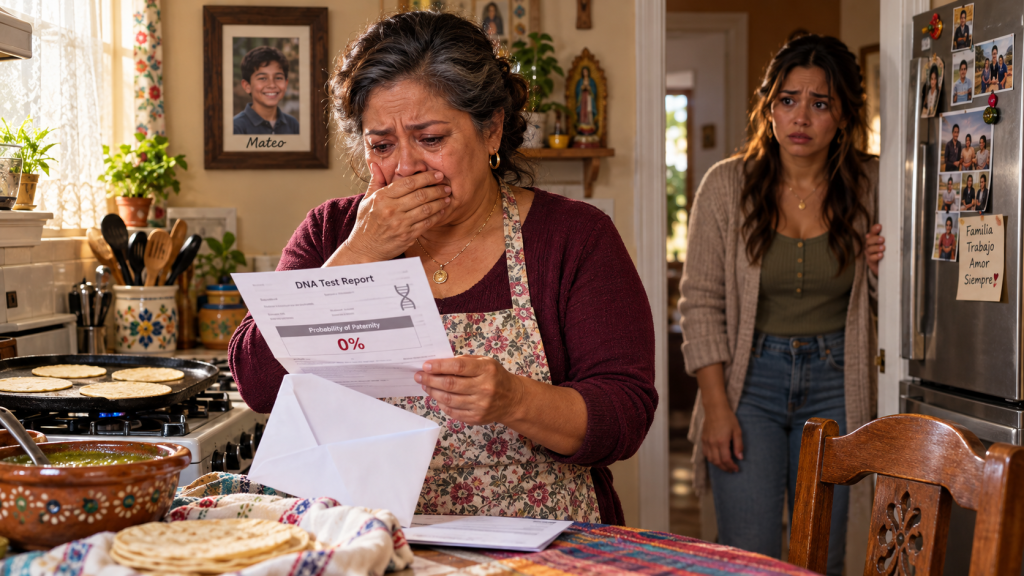
My son smiling in his work shirt, one arm around Alexa and the other around Camilla. The father of two girls who, according to the paper in front of me, were not his daughters. Except they were. That contradiction would eventually become the most important truth in our family.
At that moment, I only knew rage.
When Rafael knocked, I did not open the door immediately.
“Mrs. Elena,” Brenda whispered.
“Please.”
I looked at her.
“Please what?”
“Let him explain.”
“You have both been explaining with lies for years.”
She dropped her eyes.
I opened the door.
Rafael stood outside looking ten years older than he had the week before.
He did not try to hug me.
Smart.
“Elena.”
“Inside.”
He entered.
His gaze landed on Brenda.
Something passed between them.
Fear.
History.
I saw it now.
How had I missed it?
Maybe because betrayal is obvious only after somebody turns on the light.
I closed the door.
“You said Brenda doesn’t know the worst part.”
Rafael rubbed both hands across his face.
“She doesn’t.”
Brenda looked at him.
“What are you talking about?”
He sat across from us.
For several seconds, nobody spoke.
Finally, Rafael looked at me.
“You remember when Mamá died?”
“Of course.”
“Afterward, you let me clean her apartment.”
“Yes.”
“I found a box behind the linen cabinet.”
My stomach tightened.
“What box?”
“Letters.”
“Birth records.”
“An old paternity report.”
I stared at him.
“Whose?”
He looked toward Mateo’s picture.
“Mateo’s.”
Brenda went completely still.
I whispered,
“No.”
Rafael nodded.
“I’m sorry.”
“No.”
“Elena—”
“I gave birth to him.”
“I know.”
“I know who his father was.”
Rafael’s eyes filled with tears.
“That’s the problem.”
Something inside me went cold.
“My husband was Mateo’s father.”
“Carlos raised Mateo for six years.”
I stood so abruptly the chair hit the wall.
“Do not play games with me.”
“I’m not.”
“Then tell me what you mean.”
Rafael opened his coat and pulled out a large brown envelope.
Old.
Creased.
My mother’s handwriting was on the front.
RAFAEL — ONLY AFTER I AM GONE
I recognized every curve.
My mother wrote grocery lists in that handwriting.
Birthday cards.
Church envelopes.
Notes telling me to take soup home.
Now it sat on an envelope that looked capable of destroying the last thirty years of my life.
Rafael slid it toward me.
I did not touch it.
He said:
“Carlos had a DNA test done when Mateo was six.”
My knees weakened.
The age.
Six.
The exact year Carlos disappeared.
The year I had told myself over and over that some men simply wake up one morning and decide fatherhood is too heavy.
“He wasn’t Mateo’s biological father,” Rafael said.
Brenda covered her mouth.
I stared at him.
“No.”
“I saw the report.”
“You could fake a report.”
“I thought that too.”
He took out another page.
A photocopy.
“Then I found letters.”
My voice came out as a whisper.
“Who?”
Rafael looked at me.
“Javier Salazar.”
The kitchen vanished.
Javier.
A name I had not heard spoken aloud in almost thirty years.
A man I had spent years teaching myself not to remember.
Before Carlos and I married, we separated for three months.
Young.
Proud.
Stupid.
Carlos accused me of caring more about my family than our future.
I accused him of wanting a wife before he had learned how to be a partner.
During those three months, I spent time with Javier.
He was older.
Kind.
A family friend.
Or so I believed.
It happened twice.
I never hid that from Carlos when we reconciled.
I told him before the wedding.
When I became pregnant, the timing was close.
Too close.
But the doctor estimated conception during the period after Carlos and I had reconciled.
Carlos said:
“He’s mine.”
I believed him.
I wanted to.
Javier disappeared from our lives before Mateo was born.
My mother told me he had moved to Florida.
I never heard from him again.
Now Rafael whispered:
“Javier was Mateo’s biological father.”
I sat down.
The room sounded far away.
Brenda asked:
“What does that have to do with you?”
Rafael closed his eyes.
Everything inside me knew before he answered.
I simply did not have the courage to name it.
He said:
“Javier was my father too.”
Brenda stood.
“What?”
I stared at Rafael.
“No.”
He looked at me.
“Mamá and Papá didn’t have me.”
I could barely breathe.
“They raised me.”
“They adopted me privately.”
“Javier was my biological father.”
“Who was your mother?”
“A woman named Teresa Ortiz.”
I shook my head.
“You are my brother.”
“In every way that mattered growing up.”
“That isn’t what I asked.”
He swallowed.
“No.”
“We are not biologically related.”
That was what Brenda had repeated upstairs.
Rafael said you and he aren’t brother and sister by blood.
True.
Technically true.
But incomplete.
And incomplete truth can be the most efficient kind of lie.
I looked at him.
“You knew?”
He did not ask what I meant.
He knew.
“When did you find out Javier fathered Mateo?”
“When Mamá died.”
“How long before Mateo married Brenda?”
Rafael started crying.
“Three years.”
Brenda stumbled backward.
“No.”
She looked at him.
“No.”
He would not meet her eyes.
I turned to Brenda.
“You didn’t know?”
She shook her head violently.
“He told me he wasn’t related to you.”
“I’m not,” Rafael whispered.
She slapped him.
Hard.
I did nothing to stop her.
“You told me Mateo wasn’t your family by blood!”
Rafael stood.
“I said Elena and I weren’t related.”
“You let me believe—”
“I never said Mateo and I weren’t.”
Brenda stared at him as if she might be sick.
That was the worst part.
Rafael had known Mateo was his biological half-brother before he slept with Mateo’s fiancée.
Before the wedding.
Before Alexa.
Before Camilla.
He had not betrayed a nephew who was not truly his nephew.
He had betrayed his own brother.
And he had hidden that from Brenda too.
I whispered:
“You fathered two children with your brother’s wife.”
Rafael covered his face.
“Yes.”
The word was so small.
The betrayal was not.
I wanted to hit him.
I wanted to throw him out.
I wanted my mother alive so I could ask why she had stacked secret on top of secret until our family tree looked less like branches and more like rope around our throats.
Instead I asked:
“Why did Carlos leave?”
Rafael wiped his eyes.
“He found out after Mateo had surgery when he was six.”
I remembered.
Appendix.
Emergency room.
Blood typing.
Carlos had gone strangely quiet afterward.
Three weeks later, he packed one suitcase.
He kissed Mateo while he slept.
Then left.
He called twice.
I refused the second call because the first had become an argument.
Then my mother told me:
“He made his choice.”
I believed her.
I spent thirty years hating him.
Rafael reached into the envelope.
“There are letters from Carlos.”
My hands started shaking.
“Letters to who?”
“You.”
“No.”
“Mamá kept them.”
My throat closed.
“She told me he never wrote.”
“He did.”
“How many?”
Rafael looked ashamed.
“Twenty-seven.”
I made a sound I did not recognize.
Brenda sat back down.
Even she looked horrified.
Twenty-seven letters.
Twenty-seven chances to know why my son’s father disappeared.
Twenty-seven pieces of my life hidden in a dead woman’s linen cabinet.
I opened the first.
Elena,
I know leaving the way I did was cowardly. I looked at Mateo and saw six years of my life, and then I looked at the paper and let blood convince me those six years had become false. They were not false. I know that now.
I stopped reading.
My vision blurred.
The letter continued:
Your mother says telling you the truth will destroy you and that Mateo is better believing I abandoned him than learning the circumstances of his birth. I do not agree, but I am ashamed enough that I let her silence me.
I put the page down.
My mother had not simply intercepted letters.
She had spoken to Carlos.
Managed him.
Managed me.
Managed Mateo.
All in the name of keeping us from pain.
People who fear pain often create larger versions of it.
I picked up another letter.
Two years later.
I drove past the food stand today. You were there. Mateo was sitting on a milk crate doing homework. I nearly stopped. I did not. I am still not sure whether that was mercy or cowardice.
I pressed the paper against my mouth.
Mateo had been eight.
I remembered those afternoons.
He would do multiplication beside sacks of masa while I served customers.
Sometimes he would look toward the street.
Was Carlos sitting in a car nearby?
I hated him for leaving.
Now I hated him for watching.
Both could be true.
The final letter had been written when Mateo was fourteen.
I am sending this one last time. If Elena never answers, I will assume she has chosen silence. Tell Mateo I loved him badly, but I loved him.
My mother never gave it to me.
I looked at Rafael.
“Where is Carlos?”
“New Jersey.”
My heart stopped.
“Alive?”
“Yes.”
I laughed.
Then cried.
Then laughed again.
Thirty years of ghosts.
All alive.
All hiding.
Brenda whispered:
“Mrs. Elena…”
I turned toward her.
She flinched.
Good.
For one ugly second, I wanted fear.
Then I remembered Alexa.
Camilla.
Children.
Always children standing underneath adult disasters.
I said:
“Mateo has to know.”
Brenda started sobbing.
“No.”
I stared at her.
“No?”
“Please.”
“You watched him raise two children he believes are his.”
“I love him.”
“That sentence is useless right now.”
“I do.”
“Then why Rafael?”
She looked at the table.
No answer.
I asked again.
“Why?”
She whispered:
“It started before Mateo and I married.”
“I know.”
“I was scared.”
“Of marriage?”
“Of being poor.”
That surprised me.
She continued.
“Mateo was working construction.”
“He wanted to save.”
“He planned everything.”
“Rafael made everything feel easy.”
I looked at Rafael.
He said nothing.
Brenda cried harder.
“He gave me money sometimes.”
There it was.
Not the reason.
But part of the machinery.
“How much?”
“I don’t know.”
“Try.”
“Maybe fifteen thousand before the wedding.”
My stomach turned.
Rafael had always been the uncle with a little more.
New truck.
Nice watch.
Cash in birthday cards.
Mateo admired him.
Asked his advice.
Invited him to stand beside him at the wedding.
I remembered Rafael straightening Mateo’s tie.
Half-brother fixing half-brother’s collar while sleeping with his bride.
Some memories become poisonous after the fact.
Brenda whispered:
“I tried to stop.”
“But?”
“Alexa happened.”
“Happened?”
Her face crumpled.
“I got pregnant.”
“Did you know Rafael was the father?”
“I suspected.”
“Did Mateo?”
“No.”
“Did Rafael?”
“Yes.”
Of course.
“And Camilla?”
She closed her eyes.
“That happened two years later.”
“That is not an accident.”
“I know.”
“You chose him again.”
“Yes.”
I sat back.
“Why did Camilla ask about her other daddy?”
Brenda’s crying turned quiet.
“Rafael came over when Mateo worked nights.”
I looked at him.
“You came into my son’s house?”
Rafael whispered:
“Yes.”
“The girls saw you?”
“Yes.”
“What did you tell them?”
“Nothing at first.”
Brenda interrupted.
“Alexa once asked why Uncle Rafael kissed me.”
The room froze.
“And?”
“I panicked.”
“What did you say?”
“That he loved us in a different way.”
I stared.
“Different way.”
“She asked if he was like another daddy.”
“And you said?”
Brenda covered her face.
“I said sometimes.”
My hands went numb.
Camilla had not invented it.
Children rarely invent the exact truth adults insist is impossible.
She had simply repeated language they gave her.
The cookie over her mouth.
Brenda’s fear.
I saw it all again.
I stood.
“You both leave.”
Brenda looked up.
“Mrs. Elena—”
“Now.”
“What about Mateo?”
“I will tell my son.”
“No.”
She jumped up.
“Please let me.”
I stared at her.
“You had years.”
That ended it.
Rafael reached for the old envelope.
I put my hand over it.
“No.”
“Elena, those are family papers.”
I almost smiled.
“So am I.”
He let go.
They left separately.
Good.
I sat in the kitchen alone.
The griddle was cold.
The tortillas were ruined.
Mateo’s photograph smiled from the wall.
My son.
Biologically Javier’s.
Raised for six years by Carlos.
Raised after that by me.
Half-brother to Rafael.
Legal husband to Brenda.
Legal father to two girls fathered by Rafael.
If I drew it on paper, it looked impossible.
But families are not diagrams.
They are choices repeated until names like mother, father, daughter, grandmother become true.
That night, I did something I should have done before sending the original DNA samples.
I called a lawyer.
Not Rafael.
Not Brenda.
A family-law attorney named Patricia Menendez.
I told her everything.
Almost.
When I reached the part about taking Mateo’s toothbrush and the girls’ hair without permission, she became quiet.
“You understand that was a serious boundary violation.”
My stomach sank.
“Yes.”
“Whatever the results suggest, you should not make legal decisions based solely on a privately collected test with uncertain chain of custody.”
“I understand.”
“Do not confront the girls.”
“I won’t.”
“Do not post anything.”
“I would never.”
“Good.”
“Your son needs independent counsel.”
“And proper testing must be voluntary or court-directed if necessary.”
I thanked her.
Then sat at my kitchen table for an hour thinking about the fact that I had become so hungry for truth that I had taken pieces of my own family without asking.
Hair.
A cup.
A toothbrush.
I had told myself a grandmother’s instinct gave me permission.
It did not.
Being right does not retroactively make every method right.
That was a hard lesson.
The next morning, I asked Mateo to come over alone.
He arrived at 7:12.
Work boots.
Coffee.
That same good face I had spent thirty years protecting.
“Mamá?”
I kissed his cheek.
“Sit.”
He smiled nervously.
“That sounds serious.”
“It is.”
I placed three things on the table.
The DNA envelope.
My mother’s brown envelope.
A box of tissues.
Mateo laughed.
“The tissues are concerning.”
I almost broke.
I sat across from him.
“Before I tell you anything, I need to admit something.”
His smile disappeared.
“I took a DNA sample from your toothbrush.”
“What?”
“And samples from the girls.”
He stared at me.
“Mamá.”
“I was wrong to do it without asking.”
“What were you testing?”
I could not soften it.
“Paternity.”
He stood.
The chair scraped backward.
“What the hell?”
“I thought Brenda was hiding something.”
“So you stole DNA from my children?”
“Yes.”
He stared at me with a kind of anger I had never seen.
“You had no right.”
“I know.”
“No, you don’t.”
“I do.”
“They’re my daughters.”
“I know.”
“Do you?”
That hurt.
Good.
I deserved some of it.
He paced.
“What did it say?”
There it was.
He wanted not to ask.
He had to.
I pushed the envelope toward him.
He did not touch it.
“Tell me.”
I whispered:
“It says you are not their biological father.”
He stopped moving.
The entire room seemed to contract around him.
“No.”
“I’m sorry.”
“No.”
He stared at me.
“Both?”
“Yes.”
“No.”
His voice became smaller.
“Alexa?”
“Yes.”
“Camilla?”
“Yes.”
He sat.
Not because he chose to.
Because his legs stopped holding him.
“Who?”
I could barely say it.
“Rafael.”
Mateo looked at me as if I had started speaking another language.
“My uncle?”
I swallowed.
“There is more.”
He laughed once.
A terrible sound.
“Of course there is.”
I placed my mother’s envelope in front of him.
“Rafael is not my biological brother.”
He stared.
“What?”
“He was raised as my brother.”
“But his biological father was Javier Salazar.”
His face went blank.
I continued.
“Javier was also your biological father.”
Mateo did not move.
I watched comprehension arrive slowly.
“So Rafael…”
“Is your half-brother.”
He stood again.
“No.”
“Mateo—”
“No.”
He shoved the chair away.
“He knew?”
“Yes.”
“Brenda?”
“She knew Rafael wasn’t my biological brother.”
“But she did not know he was your half-brother.”
Mateo looked toward his own photograph on my wall.
Then at me.
“Everybody knew something except me.”
The sentence destroyed me.
I started crying.
“I’m sorry.”
He laughed bitterly.
“You didn’t know either.”
“No.”
“But you took the test.”
“Yes.”
“Why?”
I told him.
The doctor visits.
The papers locked away.
The resemblance I did not see.
Camilla saying “other daddy.”
Brenda covering her mouth.
Mateo’s face changed when I repeated that.
“She said that to you?”
“Three times.”
He closed his eyes.
I watched him remember moments I had never seen.
Trips.
Questions.
Rafael around his house.
Maybe laughter that suddenly sounded different.
He whispered:
“I need to go.”
I stood.
“Mateo.”
He raised his hand.
“No.”
I stopped.
Good.
He needed one choice no one interfered with.
He left.
For thirty-six hours, he did not answer me.
Those were the longest thirty-six hours of my life.
Not because I feared he would hurt himself.
Though I feared everything.
Because I knew I had helped detonate his life and could not demand access to the wreckage.
Then at 8:04 the second evening, he called.
“Mamá.”
I nearly collapsed.
“I’m here.”
“I’m with a lawyer.”
“Good.”
“I want official testing.”
“Okay.”
“And I don’t want you contacting Brenda or Rafael.”
“I won’t.”
“Or the girls.”
“I won’t.”
He paused.
Then:
“I’m angry at you too.”
I closed my eyes.
“I know.”
“You should have come to me before doing that test.”
“Yes.”
“You should have trusted me with your suspicion.”
“Yes.”
Silence.
Then he whispered:
“But thank you for not hiding the result.”
I cried after he hung up.
Not because he forgave me.
He had not.
Because truth had finally been handed to the person whose life it belonged to.
Official testing took time.
Consent.
Lawyers.
A laboratory with documented collection.
No hair from pillows.
No stolen toothbrush.
Mateo submitted his sample.
Brenda eventually agreed to testing for the girls after her attorney advised cooperation.
Rafael submitted his after several weeks of resistance.
The result was not ambiguous.
Mateo was not their biological father.
Rafael was.
And Mateo and Rafael shared enough DNA to confirm they were paternal half-brothers.
The first private test had not been magic.
It had detected a close collateral relationship inconsistent with fatherhood.
That was why the lab flagged it.
The biology finally made sense.
Emotion did not.
Mateo filed for divorce.
Not immediately.
He waited twelve days.
People criticized that later.
As if a man discovering his wife had two children with his hidden half-brother should make elegant decisions by lunchtime.
He needed time.
He slept at a friend’s apartment.
He still picked Alexa and Camilla up from school.
Still packed lunches.
Still took Camilla to dance class.
Brenda asked him once:
“Why are you doing this if you hate me?”
He answered:
“Because they are not you.”
That sentence told me my son would survive.
Broken.
Changed.
But himself.
The legal question of parenthood frightened him more than the divorce.
His attorney explained that biology was only one part of the situation.
Mateo was listed on both birth certificates.
He had held himself out as their father since birth.
The girls knew him as Dad.
Depending on the exact legal route, challenging paternity could create consequences none of us could predict cleanly.
Mateo made his decision before any judge forced one.
“I’m not walking away.”
I was sitting with him in my kitchen.
He looked exhausted.
I asked:
“Are you sure?”
He looked at me sharply.
“Why wouldn’t I be?”
“I just don’t want you deciding from guilt.”
He leaned back.
“I changed Alexa’s first diaper.”
“I slept on the floor beside Camilla when she had pneumonia.”
“I taught them how to ride bikes.”
“I know what Alexa looks like when she lies.”
“I know Camilla needs the hallway light on after a nightmare.”
He swallowed.
“Rafael gave them DNA.”
“I gave them Tuesday nights and fevers and lunches and birthdays.”
Then:
“I am their father.”
I cried.
Not because blood had lost.
Because nobody needed to lose.
Biology was a fact.
Fatherhood was another.
Mateo chose not to disestablish his legal parentage.
The attorneys eventually structured agreements preserving his parental status.
Rafael’s biological paternity was documented privately and in the proceedings where necessary, but he did not replace Mateo.
He had no magic right to arrive after years and become “Dad” because a lab said so.
The court focused on stability.
Best interests.
Existing bonds.
Rafael agreed to financial support placed into protected accounts for Alexa and Camilla.
It was not a purchase.
It did not buy access.
Any future relationship with the girls would be guided by therapists, their age, and eventually their own choices.
Brenda remained their mother.
That angered people who wanted punishment to behave like a fairy tale.
She had betrayed Mateo terribly.
She had also raised her daughters.
Divorce court did not erase motherhood because a marriage failed.
Custody became structured.
Communication limited.
No discussing the affair with the girls beyond therapist-approved language.
No asking them to choose.
That last part mattered most.
Alexa was nine.
Camilla seven.
Too old to understand nothing.
Too young to carry everything.
They already sensed the house had changed.
Camilla asked:
“Why doesn’t Dad sleep here?”
Brenda cried.
Mateo answered:
“Your mom and I are having an adult problem.”
Dr. Hannah Lee, the girls’ therapist, helped them explain gradually.
First:
Families sometimes learn new information about how children were born.
Then:
Mateo would always be Dad.
Then, later:
Rafael was biologically connected to them in a different way.
No dramatic kitchen confession.
No envelope thrown in front of children.
Truth can be honest without being cruel.
Alexa’s first question, when she understood enough, was:
“Did Dad know when I was born?”
Mateo said:
“No.”
She looked at Brenda.
“Did you?”
Brenda cried.
“Yes.”
Alexa walked out of the room.
Nine years old.
No adult had the right to demand she return and forgive.
Camilla asked:
“Is Uncle Rafael still Uncle Rafael?”
Dr. Lee said:
“What would you like to call him right now?”
She thought.
“Rafael.”
Fine.
Children deserve language that makes sense to them.
Mateo remained Dad.
No hesitation.
No confusion.
Just Dad.
Rafael lost almost everyone.
Not through court.
Through consequence.
His friends learned pieces.
The family learned more.
He tried at first to explain.
He had loved Brenda.
He felt invisible beside Mateo.
He had spent his whole life as the “adopted one” without knowing why.
He was confused after discovering Javier was his father.
Every explanation contained truth.
None transformed betrayal into innocence.
I told him once:
“You learned Mateo was your brother.”
“And instead of moving closer to him, you took something from him.”
Rafael cried.
“I hated him.”
That surprised me.
“Why?”
“He had you.”
I stared.
He continued.
“You loved him like there was nothing complicated about it.”
“Mamá always treated me like I should be grateful.”
“For being taken in.”
“For being fed.”
“For having a bed.”
“I never felt fully hers.”
That hurt.
Because I had not known.
“You were my brother.”
“I know.”
“No.”
I leaned forward.
“You were.”
“Whatever Mamá made you feel, I never thought of you as borrowed.”
His eyes filled.
“I know that now.”
“Then why Brenda?”
He looked down.
“Because hurting Mateo made me feel less like the one who had been left.”
There are confessions that explain and condemn at the same time.
That was one.
I said:
“You were hurt.”
“Yes.”
“You became cruel.”
“Yes.”
“Both belong to you.”
He nodded.
I did not hug him.
We did not speak again for almost four years.
Brenda and Mateo’s divorce took fourteen months.
No spectacular courtroom victory.
Property divided.
Debts assigned.
Parenting plan established.
Support calculated.
The daughters’ protected accounts funded partly by Rafael.
Mateo did not sue Brenda for “years of fatherhood.”
He hated when relatives suggested it.
One cousin said:
“You should make her pay back every dollar.”
Mateo answered:
“For what?”
“Shoes I bought my daughters?”
That ended the conversation.
His money had not become wasted because their DNA changed.
That insight made me proud.
The marriage was built partly on deception.
The parenting was not.
Mateo’s love had been real every day.
No laboratory could retroactively cancel it.
Then came Carlos.
The man I had hated for thirty years.
I found him through the address on one of the later letters.
Patricia Menendez advised me not to surprise him.
So I wrote.
Three sentences.
Carlos, I found the letters my mother kept. Mateo knows the truth about Javier. If you are willing to speak with him, please contact this number.
He called four days later.
His voice had changed.
Older.
Slower.
Still Carlos.
“Elena?”
I sat down.
“Yes.”
He cried.
So did I.
Not romance.
Grief for two people who had lived beside the same secret from opposite sides.
“I thought you hated me.”
“I did.”
“I thought you knew.”
“I didn’t.”
“Rosa told me you knew.”
I closed my eyes.
Of course.
My mother had told each person the version necessary to keep everyone apart.
“She told me you never wrote.”
“I wrote.”
“I know now.”
Silence.
Then I asked the question I had carried for thirty years.
“Why didn’t you come anyway?”
Carlos did not hide.
“Cowardice.”
Good.
He continued.
“I saw that test and let it erase six years in one afternoon.”
“I was angry at you.”
“At Javier.”
“At myself.”
“At a child who had done nothing.”
“I left because I could not look at Mateo without hearing that I was not his father.”
I whispered:
“But you were.”
He cried.
“I know.”
“Now.”
“Yes.”
I thought of Mateo.
Then Alexa.
Camilla.
History had given my son the same wound and a different choice.
Carlos walked away after six years when blood contradicted him.
Mateo stayed after nine.
That did not make Mateo morally superior in every way.
But it mattered.
I asked Carlos:
“Do you want to see him?”
His answer came slowly.
“If he wants to see me.”
Good.
Mateo waited six months.
His life already contained enough fathers.
Biological father Javier, dead.
Presumed father Carlos, alive.
Half-brother Rafael.
Two girls calling him Dad.
Sometimes family trees should come with aspirin.
Eventually, Mateo agreed to meet Carlos at a diner in New Jersey.
He asked me to come.
I said:
“Are you sure?”
“Yes.”
So I sat three booths away.
Not at their table.
Available.
Not inserted.
Growth.
Carlos arrived early.
White hair.
Bent shoulders.
Same habit of rubbing his thumb along the coffee cup.
Mateo walked in.
Carlos stood.
Neither hugged.
For a long time, they simply looked at each other.
Then Carlos said:
“You have my father’s posture.”
Mateo almost laughed.
“Apparently I have none of your genetics.”
Carlos closed his eyes.
“I deserved that.”
“No.”
Mateo sat.
“Don’t do that.”
Carlos looked confused.
“Do what?”
“Turn everything into punishment.”
“I’m here for answers.”
They talked for two hours.
Carlos admitted everything.
The blood test.
The rage.
My mother’s interference.
His letters.
His failure to fight harder.
Then Mateo asked:
“Did you love me?”
Carlos cried.
“Yes.”
“Then why wasn’t that enough?”
I had to look away.
Carlos whispered:
“I thought fatherhood was something blood could revoke.”
Mateo nodded slowly.
“I learned the opposite.”
Carlos looked at him.
Mateo said:
“I found out my daughters aren’t biologically mine.”
Carlos went still.
“I know.”
“Mom told you?”
“Only that there was another family crisis.”
Mateo almost smiled.
Then:
“I stayed.”
Carlos lowered his head.
“I’m glad.”
Mateo’s voice remained calm.
“I’m not telling you that to hurt you.”
“I’m telling you because I need you to understand what your leaving taught me.”
Carlos cried harder.
“It taught me exactly what I refused to do to them.”
Silence.
Then Carlos said:
“I am sorry.”
Mateo nodded.
“I believe you.”
Not forgiveness.
Not restoration.
Belief.
Enough for a first meeting.
They developed a limited relationship afterward.
Phone calls.
Birthday cards.
One visit a year.
Carlos never reclaimed “Dad.”
He signed cards:
Carlos
Mateo decided what to call him.
That mattered.
My own anger at my mother became more complicated after she was gone.
Dead people are inconvenient that way.
You cannot confront them.
Cannot demand an apology.
Cannot watch them change.
You are left arguing with handwriting.
I reread her letters.
Her notes.
The back of the photograph:
ELENA MUST NEVER LEARN WHO FATHERED MATEO.
For years, I imagined asking:
“Why?”
Eventually, I found part of the answer in another note Rafael had missed.
A page from her prayer book.
Elena has suffered enough. Carlos loves the boy. Javier is gone. Truth would only destroy what still stands. Sometimes a mother must decide which truth her family can survive.
I cried for an hour.
Because she had loved me.
I knew that.
She had also controlled my reality.
Love did not make that acceptable.
Fear had convinced her that truth belonged to whoever was strongest enough to hide it.
I had inherited a little of that.
I saw it when I remembered taking the DNA samples.
I had told myself:
I’m the grandmother.
I know something is wrong.
I need proof before I hurt Mateo.
My motive was different.
But I had still decided information about other people belonged to me first.
That realization humbled me.
When Alexa turned sixteen, I apologized to her.
She knew by then how the truth had been discovered.
We were making tamales.
Her hands were terrible at folding husks.
I said:
“There is something I owe you.”
She looked suspicious.
“More masa?”
“No.”
I smiled.
“I took your DNA without asking when you were a child.”
She shrugged.
“I know.”
“That doesn’t make it right.”
She looked at me.
“You found out.”
“Yes.”
“But being right about the result does not mean I was right about taking the sample.”
Alexa became quiet.
Then:
“Would you do it again?”
Hard question.
I answered honestly.
“I would tell your father what I suspected first.”
She nodded.
“Good.”
Then she added too much filling to another tamale.
I slapped her wrist lightly.
“Respect the corn husk.”
She laughed.
Normal life.
Camilla processed everything differently.
Alexa wanted records.
Dates.
DNA percentages.
Letters.
Camilla wanted as little as possible.
At fourteen, she said:
“I know Dad is Dad.”
“That’s enough.”
Fine.
No one forced curiosity on her.
At nineteen, she asked to meet Rafael privately.
Mateo struggled with that.
I could see it.
He said:
“I don’t like it.”
Camilla replied:
“You don’t have to.”
He laughed.
Fair.
Then:
“I want you safe.”
“I know.”
She met Rafael at a therapist’s office.
One hour.
Afterward, I asked nothing.
Three days later, Camilla told me:
“He said he loves me.”
I waited.
She continued.
“I told him he loves the idea of me.”
I stared at her.
Nineteen.
Brave.
Sad.
Sharp.
“What did he say?”
“He agreed.”
Then:
“I might see him again someday.”
“Okay.”
“You’re not mad?”
“No.”
“He hurt Mateo.”
“Yes.”
“And Brenda.”
“Yes.”
“And you.”
“Yes.”
“But your relationship with him belongs to you.”
She smiled.
“Dad says that too.”
Good.
Mateo eventually began dating again.
Slowly.
Painfully.
Every woman with a male friend made him nervous.
Every unanswered text could become a story if he let it.
He went to therapy before mistrust became his new religion.
At forty-one, he met Sofia.
A school counselor.
The first time he told her the family history, she apparently sat silent for two minutes.
Then said:
“I need a chart.”
I liked her immediately.
They married three years later.
Small ceremony.
Alexa and Camilla stood beside Mateo.
Brenda attended only because the girls asked.
She sat near the back.
Rafael did not attend.
Carlos did.
So did I.
At the reception, Sofia danced with Mateo while I sat watching.
Brenda approached me.
Older now.
Quieter.
“Elena.”
“Brenda.”
She sat.
For a while, we watched the dance floor.
Then she said:
“I’m sorry.”
I had heard versions before.
Not this one.
She continued.
“I used Mateo’s goodness as camouflage.”
My chest tightened.
“I knew people would never suspect me because he trusted me completely.”
She swallowed.
“And every year I didn’t tell him made the next year easier to justify.”
I looked at her.
“Why didn’t you leave him?”
“Because I loved him.”
I almost laughed.
She raised a hand.
“I know how that sounds.”
“Then say the rest.”
She nodded.
“I loved him.”
“And I wanted Rafael.”
“And I wanted stability.”
“And I wanted the girls to have Mateo.”
“And I wanted not to lose anything.”
There.
Greed is not always money.
Sometimes it is wanting every version of life without paying the moral price of choosing one.
She continued.
“I told myself the girls were better off.”
“They were better off with Mateo.”
“That part was true.”
“But I used that truth to excuse lying to him.”
I nodded.
“Yes.”
She cried.
“I don’t expect you to forgive me.”
“Good.”
That surprised her.
Then I smiled slightly.
“But I’m glad you finally know what you did.”
She nodded.
We never became close again.
Why would we?
But we became capable of sitting in the same room without poisoning it.
That was enough for the girls.
Rafael changed too.
Slowly.
No grand transformation.
He worked.
Paid what he owed under the agreement.
Stopped using childhood pain as a passport.
He apologized to Mateo once in person.
Mateo agreed only after years.
They met in my kitchen.
Of course.
Every disaster in our family eventually returned to my kitchen.
Rafael said:
“I knew you were my brother.”
Mateo stared at him.
“Yes.”
“I knew before Brenda.”
“Yes.”
“I hated you for having what I wanted.”
“What?”
“A mother who loved you without making you feel indebted.”
Mateo looked toward me.
Then back at him.
“You think Mamá was easy?”
I almost protested.
He continued.
“She worked sixteen hours and still checked whether I wore clean socks.”
Rafael laughed despite himself.
Good.
Then Mateo said:
“You could have come to me.”
“I know.”
“You could have told me what you found about Javier.”
“I know.”
“You could have been my brother.”
Rafael cried.
“I know.”
“That’s what you lost.”
Not Brenda.
Not access to the girls.
Brotherhood.
The relationship he had discovered and destroyed almost in the same breath.
Rafael whispered:
“I’m sorry.”
Mateo nodded.
“I believe you.”
Apparently our family had adopted that sentence.
Not forgiveness.
Belief.
A doorway.
Sometimes no more.
They never became brothers in the normal way.
There was no normal way available.
Occasional messages.
Family events when the girls wanted both present.
Respectful distance.
Enough.
Carlos died when Mateo was forty-six.
Heart failure.
Mateo went to the funeral.
He asked me to go.
I did.
At the cemetery, Carlos’s sister hugged Mateo and said:
“You look so much like Javier.”
I nearly laughed at the absurdity.
Wrong funeral for that observation.
Mateo actually laughed.
Healing often arrives with inappropriate humor.
Afterward, he stood beside Carlos’s grave.
“He wasn’t my biological father.”
“No.”
“But he was for six years.”
“Yes.”
“Then he wasn’t.”
I waited.
Mateo shook his head.
“No.”
“That’s not right.”
“He was my father for six years.”
“Then he became a man who left.”
“Both.”
I took his hand.
He squeezed mine.
We had stopped demanding single labels from complicated people.
Years passed.
Alexa became a physician assistant.
Perhaps all those guarded doctor visits pushed her toward medicine.
Perhaps not.
I refused to turn every choice into trauma.
Camilla became a pastry chef.
No symbolic reason whatsoever.
She simply liked butter.
I loved that.
Mateo remained their father.
At graduations.
Breakups.
Flat tires.
First apartments.
He was the person they called.
Rafael was biological history and, later, a limited relationship of their choosing.
Brenda was their mother.
Flawed.
Loved.
Accountable.
Carlos was part of Mateo’s childhood.
Javier was biological fact.
I was Grandma Elena.
And here was the strangest part:
By blood, Alexa and Camilla were not my granddaughters.
Rafael was not biologically my brother.
Therefore his daughters shared no blood with me.
The DNA test I took because I was obsessed with blood had eventually proved something I had not expected.
My little dolls were not genetically mine.
I laughed when I first fully understood that.
Then cried.
Then laughed again.
Because nothing changed.
Alexa still called when she needed my pozole recipe.
Camilla still stole my sweaters.
I still had school pictures covering the refrigerator.
Blood had started the investigation.
Love survived the result.
On my seventy-second birthday, Alexa handed me a small box.
Inside was a DNA kit.
I stared at her.
She burst out laughing.
“Too soon?”
“Twenty years too soon.”
Everyone laughed.
Even Mateo.
Then Alexa took it back.
“Relax, Abuela. It’s empty.”
“You are a terrible child.”
“You raised me.”
“I did not.”
She smiled.
“Exactly.”
That quieted the table.
Not painfully.
Warmly.
Exactly.
I had not given her DNA.
I had given her tamales.
Bandages.
Birthday money.
School pickups.
Bad advice about eyebrows.
The front half of motherhood and grandmotherhood lives in biology.
The rest is built with time.
Later that night, after everyone left, I took out the original white envelope.
I had kept it all those years.
Probability of Mateo’s paternity: 0.00%.
The sentence that once made my world collapse.
I sat beneath Mateo’s old photograph.
Different photograph now.
He was older.
Alexa and Camilla grown beside him.
Sofia at his shoulder.
I looked from the paper to the picture.
Zero percent.
The laboratory had been correct about biology.
Completely useless about fatherhood.
I tore the result in half.
Then again.
Not because truth no longer mattered.
Truth mattered enough to destroy lies.
But paper did not need to become a shrine.
I kept my mother’s letters.
Carlos’s too.
History belonged somewhere.
The DNA report went into the trash.
The next morning, Mateo stopped by before work.
I was heating tortillas.
Of course.
He kissed my forehead.
Still.
Some boys remain themselves no matter how old they get.
He saw the torn envelope.
“What’s that?”
“Old paperwork.”
He reached for a tortilla.
I slapped his hand.
“They’re not ready.”
He grinned.
Then looked at the photograph on the wall.
For a second, both of us were quiet.
He said:
“Mamá?”
“Yes?”
“Do you ever wish you hadn’t done the test?”
I turned the tortilla.
A hard question.
“No.”
He nodded.
Then I added:
“I wish I had trusted you enough to talk to you first.”
He looked at me.
“Me too.”
No defense.
No rewriting.
Then he smiled.
“But if you had, I probably would have called you crazy.”
“Obviously.”
“And defended Brenda.”
“Obviously.”
“And maybe waited another five years.”
“Probably.”
He sighed.
“So we were all a disaster.”
“Speak for yourself.”
He laughed.
Then became serious.
“I used to think the test took my daughters from me.”
I stopped.
“And now?”
“It took the lie.”
My eyes filled.
He continued.
“The girls stayed.”
Yes.
That was the whole story.
The lie left.
The daughters stayed.
The father stayed.
The grandmother stayed.
Even the people who left remained part of the truth without being allowed to control the future.
I placed two tortillas on a plate.
Mateo added salsa.
Too much.
Always too much.
He took a bite.
Then asked:
“Do you know the strangest thing?”
“What?”
“For thirty years, you told everyone you were mother and father to me.”
“I was.”
He smiled.
“Turns out I had enough fathers.”
I laughed so hard I had to sit down.
Carlos.
Javier.
Blood.
Love.
Absence.
Secrets.
Yes.
More than enough.
But when I looked at my son across that kitchen table, I no longer saw a man betrayed by DNA.
I saw the man who had been given the same choice Carlos once faced.
A piece of paper told him the children he loved were not biologically his.
Carlos let that paper send him away.
Mateo let it tell him only one thing:
the truth about their blood.
Then he stayed.
That was the inheritance he chose.
Not Javier’s genes.
Not Carlos’s abandonment.
Not Rafael’s betrayal.
Choice.
And the girls inherited it too.
Years later, Camilla had a little boy.
Mateo held him in the hospital.
The nurse asked:
“Grandpa?”
Mateo froze for half a second.
Then smiled.
“Yes.”
One word.
No DNA chart.
No explanation.
No footnote.
Just yes.
I watched from the doorway and cried.
Alexa slipped her arm through mine.
“You okay, Abuela?”
I nodded.
“Perfect.”
She laughed.
“Nothing in this family is perfect.”
True.
Better word.
Whole.
Not because nothing had broken.
Because we had stopped pretending broken pieces had to be hidden in order to belong.
My mother thought secrecy saved families.
Carlos thought blood ended fatherhood.
Rafael thought pain excused betrayal.
Brenda thought love could coexist forever with deception if nobody discovered it.
I thought a grandmother’s instinct gave me the right to steal a truth before asking.
We were all wrong about something.
But truth did not destroy us.
It reorganized us.
Painfully.
Slowly.
Honestly.
And if I could return to that Tuesday afternoon when the courier placed the white envelope in my hands, I would tell the woman heating green salsa not to confuse what she was about to learn with the value of the people she loved.
I would tell her:
Yes, Mateo is not Alexa and Camilla’s biological father.
Yes, Rafael is.
Yes, your mother hid Mateo’s real paternity.
Yes, Carlos left after learning the truth.
Yes, Rafael is not your biological brother.
Yes, he is Mateo’s biological half-brother.
Yes, Brenda lied.
Yes, nearly every branch of the family tree is about to move.
But listen carefully.
Alexa will still run into your kitchen and call you Abuela.
Camilla will still ask for extra cheese.
Mateo will still kiss your forehead before work.
He will still be their father.
You will still be their grandmother.
Because blood can explain where a body began.
It cannot decide who stayed long enough to become home.
THE END STORIES! THANK YOU FOR READING GOOD LUCK !❤️
Related Posts