The first thing I felt when Denver disappeared behind us was not freedom. It was guilt. That surprised me. I had imagined the moment differently. I thought the city lights would fade in the rearview mirror and some enormous weight would slide off my chest. Instead, I kept seeing my mother standing in the driveway.
My father staring at the folded laundry. Ethan looking at my suitcases as though I had broken a rule no one had bothered to tell me existed. And Avery. Pale. Silent. For once, not crying. Maya glanced at me from the driver’s seat. “You okay?” “No.” “Want to turn around?”
I looked at her. “No.” “Good.” She turned her eyes back to the highway. “I would’ve judged you.” I laughed despite myself. Then my phone vibrated again. Mom. Then Ethan. Then Mom. Then Dad. Then Avery. I turned it facedown. Maya said: “You don’t have to answer.” “I know.”
“You also don’t have to block everybody tonight.”
“I know.”
“You can decide later.”
That was the first beautiful thing about leaving.
Later.
At home, every feeling required an immediate response.
If Avery cried, I needed to apologize.
If Ethan got angry, I needed to stop “starting drama.”
If Mom was disappointed, I had to fix it.
If Dad went quiet, everyone pretended quiet meant neutral.
Now I could have a feeling and do nothing with it yet.
That was new.
We reached Salt Lake City before sunrise.
Maya wanted to sleep for three hours.
I couldn’t.
I sat in the passenger seat outside a twenty-four-hour diner, wrapped in my coat, reading the messages I had ignored.
Mom:
Riley, please answer. You cannot just leave like this.
Then:
At least tell us where you are staying.
Then:
Your father is furious.
Thirty-eight minutes later:
He’s not furious at you. He’s angry at the situation. Please call.
Ethan:
This is ridiculous.
Then:
Mom’s crying.
Then:
Avery won’t come out of her room.
Then:
You’re seriously going to Portland because we went to dinner?
Then, two hours later:
Okay maybe I was a jerk. Just text that you’re safe.
Avery:
I never wanted you to leave.
Then:
I’m sorry about the post.
Then:
Please don’t hate me.
Dad had sent only one message after the one I had already read.
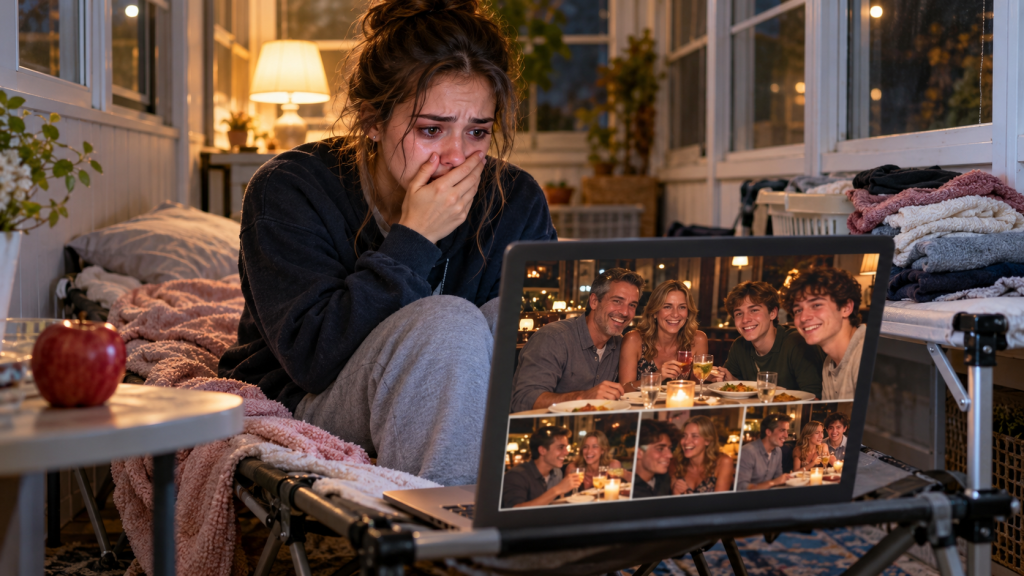
I went onto the sunporch. I sat on your cot. We need to talk when you’re ready.
That one got me.
Not because it fixed anything.
Because he had finally gone into the room.
For months, my father had walked past the sunporch without really seeing it.
Apparently it took an empty cot for him to notice where his daughter had been sleeping.
I cried in a diner parking lot while trucks moved through the darkness around us.
Maya woke ten minutes later.
She did not ask what happened.
She just handed me a napkin.
Portland was wet when we arrived.
Not dramatic movie rain.
Just persistent gray drizzle that made every tree look greener than it had any right to.
Maya’s apartment was tiny.
One bedroom.
One living room.
A kitchen barely large enough for two people to disagree inside.
I slept on her couch.
It was still better than the sunporch.
The first night, I woke at three in the morning confused by the silence.
Nobody had left a basket of clothes for me.
Nobody called from downstairs asking whether I had remembered to defrost something.
Nobody told me I was being selfish for closing a door.
Maya’s cat sat on my chest and stared at me.
I whispered:
“You seem demanding.”
He sneezed.
Fair.
My new job started Monday.
Northline Design Cooperative occupied the third floor of an old warehouse near the river.
I had applied almost as a dare to myself.
A senior brand and packaging role.
Nearly double my old salary.
A relocation stipend.
Health insurance.
Actual paid time off.
When they offered it, I had almost turned it down.
Mom had said:
“Portland is so far.”
Dad said:
“Good opportunity, but you have stability here.”
Ethan said:
“Who even moves to Oregon?”
Avery said:
“I’d miss you.”
So I told myself maybe next year.
Then the group chat happened.
Sometimes one cruel sentence doesn’t create a decision.
It simply removes the excuse you had been using not to make it.
My manager, Priya Shah, met me Monday morning.
She was forty, terrifyingly organized, and wore yellow glasses.
“Riley?”
“Yes.”
“You look exhausted.”
“Long drive.”
“You relocated this weekend?”
“Yes.”
She stared.
“You start work forty-eight hours after moving states?”
“I’m efficient.”
“That sounds unhealthy.”
I laughed.
She did not.
Then she smiled.
“Coffee is there.”
“Bathroom there.”
“We don’t expect people to perform gratitude for having jobs.”
That sentence was so casually delivered I almost cried.
Priya noticed.
She politely pretended not to.
I liked her immediately.
Three days passed before I called Dad.
Not Mom.
Dad.
I sat on Maya’s balcony under a blanket.
He answered on the first ring.
“Riley.”
“Hi.”
For several seconds neither of us spoke.
Then he said:
“Thank you for calling.”
I swallowed.
“You said we need to talk.”
“Yes.”
“Talk.”
He exhaled.
“I owe you an apology.”
I waited.
Not:
We all made mistakes.
Not:
You misunderstood.
A real apology had to survive silence.
Dad continued.
“I have been going through the house.”
That was not what I expected.
“What do you mean?”
“Your room.”
“My former room?”
He closed his eyes.
I could hear it.
“Yes.”
“Your former room.”
“And the sunporch.”
“Okay.”
“I asked your mother how long you had been sleeping there.”
My stomach tightened.
“What did she say?”
“Four months.”
“Five and a half.”
Silence.
Then:
“She told me three at first.”
I laughed once.
Of course.
Dad continued.
“I asked why it had never changed back.”
“And?”
“She said Avery still wasn’t sleeping well.”
“She sleeps fine.”
“I know that now.”
“How?”
“I asked her.”
That surprised me.
“Avery?”
“Yes.”
“What did she say?”
Dad’s voice changed.
“She said she stopped having trouble sleeping after the first week.”
I closed my eyes.
There it was.
One of those truths that feels obvious only after somebody finally says it aloud.
“Then why did she stay in my room?”
Dad answered quietly.
“Because nobody asked her to leave.”
I said nothing.
“She said your mother told her you didn’t mind.”
I laughed.
“Of course.”
“She also said you complained twice.”
“More than twice.”
“I didn’t know.”
“That seems to be everybody’s favorite sentence.”
He took that.
Good.
Then:
“I found your old note.”
“What note?”
“The one on the refrigerator.”
I remembered.
Three months earlier, after Mom had asked me to clean the guest bathroom, do Ethan’s laundry, and pick Avery up from a dentist appointment all in one Saturday, I wrote a list:
My own laundry.
My groceries.
Job application.
Please do not add chores today.
Mom laughed.
Ethan wrote beneath it:
CEO OF DOING NOTHING
Avery added a smiley face.
Dad had apparently never seen it.
“I found it behind the microwave.”
“Why was it there?”
“Your mother took it down.”
Of course.
Dad’s breathing changed.
Then:
“I also went through our bank records.”
My chest tightened.
“Why?”
“Because your mother said you barely contributed financially.”
I sat straighter.
“What?”
“She told me the reason you did chores was because we didn’t charge you real rent.”
I almost stood up.
“I paid six hundred dollars every month.”
Dad was silent.
Then:
“I know.”
I gripped the blanket.
“And I bought groceries.”
“Yes.”
“And paid the internet.”
“Yes.”
“And Ethan’s phone plan for eight months because he got kicked off yours after he broke his second phone.”
Another silence.
Dad whispered:
“I didn’t know that.”
I laughed.
Not because it was funny.
“Dad, where did you think money came from?”
“I thought your mother handled it.”
“That is not an answer.”
“No.”
He sounded tired.
“It isn’t.”
Then:
“Riley, over the past eighteen months, you transferred ten thousand eight hundred dollars to the household account.”
I stared at the rain.
I knew the number vaguely.
I had never totaled it.
Dad continued.
“Internet was another twelve hundred.”
“Groceries?”
“I don’t have all of it.”
“Some were your cards.”
“Maybe three or four thousand.”
I closed my eyes.
“And I slept on a cot.”
“Yes.”
His voice cracked.
That was the moment my father finally understood the equation.
Not emotionally.
Mathematically.
Their adult daughter was paying thousands of dollars into the house while sleeping on a folding cot so a cousin who paid nothing could have her bedroom.
Dad whispered:
“I’m ashamed.”
I believed him.
That did not erase anything.
But I believed him.
Then he said something stranger.
“There’s more.”
I looked up.
“What?”
“Avery has money.”
I frowned.
“What do you mean?”
“Her mother left her money.”
I had known Aunt Claire had life insurance.
I did not know details.
“How much?”
“About eighty-six thousand dollars in a custodial account.”
I went cold.
“Then why is Mom paying for everything?”
Dad answered:
“That’s what I asked.”
“And?”
“Your mother said Claire wanted the money preserved for Avery’s college education.”
“Okay.”
“That makes sense.”
“It does.”
“Then why did I pay extra household expenses after Avery moved in?”
Dad went quiet.
Exactly.
Avery’s inheritance did not mean she should pay rent at seventeen.
But it demolished one of Mom’s favorite arguments:
Avery has nothing. You have more than she does.
Avery had grief.
Avery had lost her mother.
That was real.
But financially, she was not penniless.
And I had been paying household bills while being told I needed to sacrifice because she had “nothing.”
Dad continued.
“I’m not saying her account should have paid our household expenses.”
“Good.”
“She was a minor.”
“Yes.”
“But your mother used her financial situation as a reason you should give up things when that wasn’t accurate.”
I stared at the wet street.
“Why?”
Dad sighed.
“I don’t know yet.”
I did.
Because grief had become a moral weapon.
And I was the easiest person to use it against.
Mom called that night.
I almost ignored it.
Then answered.
“Hi.”
“Riley.”
She sounded exhausted.
“I miss you.”
I said nothing.
Not to punish her.
Because I did not know what to do with the sentence.
Then she said:
“Your father has been treating me like some criminal.”
There it was.
Faster than I expected.
I almost smiled.
“What did you do?”
“He’s interrogating every decision I made.”
“Which decisions?”
“The bedroom.”
“The household money.”
“Avery.”
I leaned back.
“Those seem relevant.”
“Riley, you know why Avery got your room.”
“I know what you told me.”
“She had just lost her mother.”
“Yes.”
“She was traumatized.”
“Yes.”
“You are older.”
There it was again.
Age as obligation.
“You were twenty-three.”
Mom continued.
“You could handle inconvenience.”
“For five and a half months?”
“I thought it would be temporary.”
“So did I.”
Silence.
Then:
“You never insisted.”
That one landed.
I closed my eyes.
“You’re right.”
Mom went quiet.
I continued.
“I asked.”
“You said she still needed the room.”
“I complained.”
“You said I was selfish.”
“I slept there because every time I tried to change something, you told me Avery had suffered more.”
Mom whispered:
“She had.”
“That wasn’t a competition until you made it one.”
Silence.
I surprised myself with that sentence.
Then Mom said:
“You don’t understand what it’s like to lose a sister.”
I almost snapped.
Instead:
“No.”
“I don’t.”
“But you don’t understand what it was like to lose my place in my own family because you were grieving your sister.”
She started crying.
For once, I did not rush to comfort her.
Not because I wanted her pain.
Because her tears did not erase the conversation.
She finally said:
“I thought if Avery felt completely included, it would honor Claire.”
I looked toward Maya’s living room.
The cat was chewing a plant.
“Did honoring Claire require excluding me?”
“No.”
“Then why did it?”
Mom had no answer.
That was more honest than most answers she had given me.
The first week after I left, the house became chaos.
I learned this from Ethan.
Not Mom.
Ethan called me Friday.
“Okay.”
“What?”
“I get it.”
I laughed.
“Do you?”
“No.”
He sighed.
“I get some of it.”
“Progress.”
He sounded irritated.
Good.
“What happened?”
“Mom asked me to do laundry.”
I almost smiled.
“Tragic.”
“Do you know how many settings the washer has?”
“Three that matter.”
“No one told me that.”
“You are nineteen.”
“So?”
I laughed.
Then he said:
“Avery doesn’t know how to do hers either.”
“That seems like a group learning opportunity.”
“Dad made a chore chart.”
I almost dropped the phone.
“He what?”
“A chore chart.”
I laughed so hard Maya came in to see what happened.
Ethan said:
“Shut up.”
“Sorry.”
“No, you’re not.”
“Correct.”
Then his voice changed.
“Riley.”
“What?”
“I read the chat.”
My chest tightened.
“All of it?”
“Yes.”
“Why?”
“Dad made us.”
That surprised me.
“He asked Avery to show him.”
I sat straighter.
“And?”
“I sounded awful.”
I said nothing.
He continued.
“I thought we were joking.”
“You were joking.”
“That doesn’t make it better.”
No.
It didn’t.
He sounded young suddenly.
Not the confident younger brother who had ordered me to apologize because Avery cried.
Just nineteen.
Stupid.
Comfortable.
Protected.
“I said you always caused drama.”
“Yes.”
“You didn’t.”
“Sometimes I did.”
“Not like I said.”
I waited.
He continued.
“I think I liked having somebody in the house who was more annoying to everyone than me.”
That was unexpectedly honest.
“What?”
“When you were the problem, nobody cared that I failed chemistry.”
I almost laughed.
“That’s bleak.”
“I know.”
He swallowed.
“And Avery always agreed with me.”
“Yes.”
“So it felt good.”
There it was.
Family roles.
Not villainy.
Convenience.
He whispered:
“I’m sorry.”
I closed my eyes.
“Thank you.”
“Are you coming home?”
“No.”
He went quiet.
“Ever?”
“To visit?”
“Eventually.”
“To live?”
“No.”
His disappointment was real.
So was my answer.
The next twist came three weeks later.
Dad called while I was touring an apartment.
My apartment.
One bedroom.
Large window.
Awful carpet.
Perfect.
I answered.
“Hey.”
“Are you busy?”
“Looking at apartments.”
He went silent.
Then:
“That’s good.”
I heard the effort.
“What happened?”
“I found out why your mother was so intense about keeping Avery comfortable.”
I frowned.
“What do you mean?”
Dad took a long breath.
“Claire asked us to take Avery in years before she died.”
I stopped walking.
“What?”
“Apparently she and your mother had an agreement.”
“What kind?”
“If anything happened to Claire, Avery would live with us until adulthood.”
“That makes sense.”
“Yes.”
“But your mother made another promise.”
My stomach tightened.
“What?”
“That Avery would never feel like a guest.”
I leaned against the wall.
That phrase.
True home.
Avery’s Instagram caption.
Suddenly it made more sense.
Dad continued.
“Claire wrote your mother a letter during chemotherapy.”
“I read it yesterday.”
“What did it say?”
He hesitated.
“Your aunt said Avery was terrified of becoming a burden.”
“She asked your mother to make her feel like she belonged.”
I closed my eyes.
“That’s not bad.”
“No.”
“What did Mom do with it?”
“She turned it into a mission.”
Of course.
Dad continued.
“She told Avery the first night she moved in that she would never be treated as less than a daughter.”
My chest tightened.
I whispered:
“And somehow I became less than one.”
“Yes.”
Dad’s voice broke.
“At some point, your mother started believing any discomfort Avery experienced meant she was failing Claire.”
I thought about the apple.
Avery asking for it.
Me splitting it.
Mom taking Avery’s half and throwing it away just to prove I had behaved badly.
Absurd.
Unless the real issue was never the apple.
The issue was that Mom could not tolerate Avery experiencing even a moment of scarcity.
Not after Claire.
So somebody else always had to surrender first.
Usually me.
Dad whispered:
“I should have stopped it.”
“Yes.”
“I kept telling myself your mother was grieving.”
“She was.”
“That became my excuse for everything.”
I stared at the empty apartment.
Then said:
“Dad.”
“Yes?”
“Explanation is useful.”
“It is not absolution.”
He was silent.
Then:
“I know.”
Good.
I signed the lease.
My first apartment.
Mine.
The first night, I slept on an air mattress because my furniture had not arrived.
I stared at the ceiling and smiled.
A mattress on the floor in Portland felt more dignified than a cot on my family’s sunporch.
Because I had chosen it.
Choice changes the weight of almost everything.
Avery did not call for a month.
Then I received an email.
Not a text.
Subject:
No excuse.
I almost deleted it.
Then opened it.
Riley,
I keep starting messages that make me sound sad enough that maybe you’ll forgive me. That feels manipulative, so I’m trying again.
That line surprised me.
I liked your room.
I stared.
After the first week, I could have gone back to sharing. I didn’t want to. Your bed was better. Your closet was bigger. Your window faced the trees. Your mom made me feel special for being there.
My jaw tightened.
At least she was honest.
I knew you hated the porch.
I stopped.
There.
Not misunderstanding.
Knowledge.
I told myself you could handle it because everyone else said you could.
I kept reading.
I also knew you were excluded from dinners before the one you saw.
Of course.
At first, your mom said she wanted to take me somewhere without making me feel like a replacement for Claire. Then Ethan came. Then your dad. After that, it became normal.
I felt sick.
So there had been more than one.
I never asked why you weren’t invited because I was afraid if I asked, someone might invite you.
That sentence hurt.
Not because it was cruel.
Because it was nakedly human.
She wanted to be chosen.
And in our family, apparently being chosen required somebody else not to be.
I liked being the daughter your mom was trying so hard to protect.
I knew it was costing you something.
Tears blurred my eyes.
The Instagram post was not a joke.
There.
Finally.
I meant it when I called them my true home.
I stopped reading.
Then continued.
But I also posted it where I thought you wouldn’t see it.
So I knew it would hurt you.
No defense.
I am sorry.
Not because you left.
I’m sorry because before you left, I helped make leaving feel necessary.
I closed the email.
Sat on my floor.
Cried.
Then finished.
I’m staying with Grandma Louise for a while.
That was Claire’s mother.
Avery’s maternal grandmother.
Your dad said the house needs to reset.
My eyebrows rose.
Dad had said that?
I agreed.
I don’t think I should keep sleeping in your room just because you’re gone.
That sentence mattered.
I’m not asking you to answer.
Avery
I did not answer.
Not then.
But I saved it.
Mom hated Dad’s “reset.”
I found that out from Rachel—
No, wrong story.
From my brother.
Ethan called one Sunday.
“They’re fighting.”
“About me?”
“Everything.”
“Be more specific.”
“Dad moved your stuff back into your room.”
I laughed.
“What stuff?”
“Books.”
“Old posters.”
“Your desk.”
“Why?”
“He said your room stays yours until you decide what to do with it.”
My chest tightened.
“I’m not coming back.”
“I know.”
“He knows.”
“Then why?”
Ethan was quiet.
“He said he needed the house to tell the truth.”
That sounded like Dad.
Late.
But Dad.
Ethan continued.
“Mom said that makes Avery feel rejected.”
“And?”
“Dad said making you visible isn’t the same as rejecting Avery.”
I closed my eyes.
There it was.
The sentence someone should have said months earlier.
Maybe years.
Mom did not forgive Dad for discovering a spine.
Not quickly.
They fought about finances too.
Dad changed the household account structure.
Not because Mom had stolen.
She hadn’t.
She had simply managed everything so completely that Dad had stopped looking.
He hated what that said about him.
He began paying his own bills.
Cooking two nights a week.
Doing laundry.
Ethan called it:
“The Great Domestic Awakening.”
I laughed.
Mom called it humiliating.
Dad called it:
“Participation.”
Their marriage nearly broke.
Not because I left.
Because my leaving removed the person who had been absorbing tension.
That distinction mattered.
When one family member is always adapting, the household can look peaceful.
Remove the adapter.
Everybody discovers the machine was never balanced.
Two months after I moved, Dad asked to visit.
Not appear.
Asked.
That mattered.
I said yes.
He booked a hotel.
Also mattered.
He arrived carrying one small suitcase and a cardboard box.
We met at a coffee shop.
He looked older.
Not dramatically.
Just enough.
He pushed the box toward me.
“What’s this?”
“Things from your room.”
I opened it.
My old sketchbooks.
A framed photo of Eleanor—
No, wrong story.
A photo of me and Ethan at a Broncos game.
My grandmother’s bracelet.
Three paperback novels.
And the stupid apple-shaped refrigerator magnet I had bought when I was twelve.
I laughed.
“Seriously?”
Dad smiled faintly.
“Seemed appropriate.”
Then he became serious.
“I owe you money.”
I frowned.
“No.”
“Yes.”
“Dad.”
“I calculated what you paid toward household expenses.”
“I lived there.”
“I know.”
“Some contribution was reasonable.”
“I agree.”
“But six hundred a month while sleeping on a sunporch was not.”
I looked at him.
“What are you doing?”
“Trying not to make apology abstract.”
He slid an envelope toward me.
I did not touch it.
“How much?”
“Four thousand eight hundred.”
“Why that number?”
“Half the rent you paid during the eight months before you left.”
“Why half?”
“Because I think charging you something as a working adult was reasonable.”
“So do I.”
“But not while you were displaced and doing most of the household work.”
I stared.
“I’m not taking guilt money.”
“It isn’t.”
“It feels like it.”
“Then don’t decide now.”
He leaned back.
“Take the envelope.”
“Leave it unopened.”
“Throw it away.”
“Deposit it.”
“Donate it.”
“Your choice.”
That word again.
Choice.
I took it.
Not because money fixed anything.
Because for once Dad had attached cost to what happened.
Not punishment.
Recognition.
Then I asked:
“Did you know about the dinners?”
His face changed.
“Some.”
“How many?”
He looked down.
“Four.”
My chest hurt.
“Four?”
“Yes.”
“I knew about four.”
“How many were there?”
“Six.”
I laughed.
Of course.
“Why didn’t you invite me?”
Dad rubbed his forehead.
“The first time your mother said Avery needed a night where she felt like the center.”
“Okay.”
“I understood that.”
“So do I.”
“The second was Ethan’s grades.”
“The third was Avery’s birthday.”
“You were home for her birthday dinner.”
“She had another one.”
I stared.
“Of course.”
Dad looked ashamed.
“The fourth time…”
He stopped.
“What?”
“Your mother said you had been in a bad mood all week.”
My eyes narrowed.
“I had a deadline.”
“I know.”
“She said if you came, you’d probably complain.”
“And you believed her?”
“I accepted it because it was easier.”
That answer was worse.
Also better.
Honest.
He whispered:
“I let other people describe you instead of checking with you.”
My throat tightened.
“Yes.”
“I’m sorry.”
I looked at him.
“Why didn’t you notice I wasn’t at dinner?”
“I did.”
He swallowed.
“I just told myself you wouldn’t care.”
“Why?”
“Because you stopped asking.”
That sentence hurt.
I looked out the window.
Dad continued.
“You had stopped asking to be included.”
“Yes.”
“I interpreted that as independence.”
“It was resignation.”
“I know.”
There it was.
The difference between someone leaving the room because they want space and someone leaving because they have learned nobody notices.
Dad stayed two days.
He visited my office.
Met Priya.
Took me to dinner.
Paid.
Did not mention Avery unless I did.
Did not ask when I was coming home.
At the airport, he hugged me.
Then said:
“I don’t expect you to trust the family just because I finally understood something.”
I nodded.
“Good.”
“I want to earn a different relationship with you.”
That was the right sentence.
Not:
The old one back.
Different.
Because the old one had brought us here.
Mom took longer.
Six months.
During those six months, her texts became a strange record of someone moving backward and forward at the same time.
I miss you.
Then:
I still think leaving without warning was cruel.
Then:
Your father acts like I’m the only person who made mistakes.
Then:
I found your blue sweater. Want me to mail it?
Then:
Avery apologized to me for letting you give up your room. I told her it wasn’t her fault.
Then:
Maybe that was the wrong thing to say.
That one surprised me.
I answered:
It wasn’t only her fault. That doesn’t mean she had none. Same for everyone.
Mom replied:
Including you?
I stared at the screen.
Then typed:
Yes. My mistake was staying quiet longer than I should have. It was not causing the way I was treated.
She did not respond for two days.
Then:
Fair.
One word.
Progress.
Ethan visited before Mom did.
He arrived with a duffel bag and approximately no life skills.
I made him sleep on my couch.
He looked at it.
“Is this revenge?”
“Yes.”
“Fair.”
I threw him a blanket.
He lasted thirty minutes before saying:
“How did you sleep on that cot for months?”
I looked at him.
“Exactly.”
His face fell.
Good.
Not punishment.
Perspective.
The next morning, he made eggs.
Badly.
We ate them anyway.
Then he said:
“I need to tell you something.”
I stared.
“That phrase never improves breakfast.”
He laughed nervously.
Then:
“I started the group chat.”
I stopped eating.
“What?”
“The family dinner chat.”
“I created it.”
My chest tightened.
“Why?”
“For Avery’s birthday.”
“That’s what it was originally for.”
“Yes.”
“It was called ‘Avery Dinner.’”
He looked ashamed.
“Then Mom used it later for plans.”
“And I was never added.”
“No.”
“Did anybody suggest adding me?”
He looked down.
“Dad once.”
My throat tightened.
“What happened?”
“Mom said you’d see the old messages and misunderstand.”
I laughed.
“That is impressively circular.”
“I know.”
“And you?”
“I said you’d probably make it weird.”
Of course.
He whispered:
“I think I liked having a space where I could talk about you without you answering.”
That hurt.
He continued.
“You always corrected me.”
“I’m your sister.”
“You always knew when I was lying.”
“Again.”
“You’d ask why I hadn’t done something.”
“Tragic oppression.”
He smiled faintly.
Then:
“Avery never did.”
“She thought everything I did was funny.”
“So I sided with her.”
“Because it felt good.”
I looked at him.
“Do you know why this hurts more than the dinner?”
“No.”
“Because you knew me.”
His eyes filled.
“Avery had been in the house a few months.”
“You had known me nineteen years.”
He started crying.
“I know.”
I did not comfort him immediately.
Not cruelty.
Space.
Then I reached across the table.
He took my hand.
“I’m sorry.”
“Thank you.”
“Do you forgive me?”
“No.”
He blinked.
Then I added:
“Probably someday.”
He laughed through tears.
“That’s brutal.”
“It’s accurate.”
He nodded.
“Fair.”
Avery came to Portland almost a year after I left.
Not alone.
Grandma Louise drove her.
Avery had turned eighteen and enrolled in community college.
She asked if I would meet her for lunch.
I almost said no.
Then agreed.
Public place.
One hour.
My rules.
She arrived wearing a denim jacket I recognized.
Mine.
She saw my face.
“Oh my God.”
“What?”
“This is yours.”
“Yes.”
She nearly tore it off.
“I found it in the closet.”
“My closet.”
“I know.”
“Keep it.”
She froze.
“Really?”
“Yes.”
I looked at her.
“It looks better on you.”
She started crying.
I groaned.
“Please don’t make the jacket emotionally significant.”
She laughed.
That helped.
We ordered food.
Then sat in silence.
Finally Avery said:
“I used to steal your stuff.”
“I know.”
“Not steal forever.”
“I know.”
“I’d take makeup.”
“Earrings.”
“Your blue sweater.”
“That one was you?”
“Yes.”
“I blamed the dryer.”
“Sorry.”
I laughed.
Then she became serious.
“I wanted your life.”
That surprised me.
“What?”
“When Mom died, I wanted somebody else’s life.”
“Yours was right there.”
“Parents.”
“Brother.”
“House.”
“Normal.”
I stared.
“You thought my life was normal?”
“From outside.”
That sentence softened something.
Not enough to erase.
Enough to understand.
She continued.
“Your mom started treating me like I was fragile.”
“It felt good.”
“Then every time you got frustrated with me, I thought you were trying to take it away.”
“So you competed.”
“Yes.”
“With someone who didn’t know there was a competition.”
Avery closed her eyes.
“Yes.”
She swallowed.
“The apple…”
I almost laughed.
“We are really going to discuss the apple?”
“I think about it all the time.”
“That is unhealthy.”
She smiled.
Then:
“I didn’t even really want it.”
I stared.
“What?”
“I had eaten one earlier.”
My mouth fell open.
“You demanded my apple after already eating one?”
“I wanted to see what your mom would do.”
That landed.
I sat back.
“What?”
Avery cried.
“I had noticed she always took my side.”
“So I pushed.”
My chest hurt.
“Why?”
“Because I needed to know it would keep happening.”
That was one of the saddest things I had ever heard.
Also one of the cruelest.
She continued.
“When you split it in half, I thought that was fair.”
“But then your mom got mad at you.”
“And I…”
She looked down.
“I liked it.”
I said nothing.
“I’m sorry.”
“That apple made me feel insane.”
“I know.”
“No.”
“I kept thinking: I split an apple.”
“I didn’t refuse.”
“I didn’t insult you.”
“I split it.”
“And somehow I became selfish.”
Avery cried harder.
“I know.”
“Mom threw your half away just to make a point.”
“I know.”
“And then bought you ice cream.”
“I know.”
“What was I supposed to learn from that?”
She whispered:
“That there was no correct answer for you.”
Exactly.
We sat with it.
Then Avery said:
“I’m sorry I helped make you disappear.”
That phrase.
Dad’s phrase.
But from her, it meant something else.
I nodded.
“Thank you.”
“Do you hate me?”
“No.”
“Do you forgive me?”
I thought.
“Partly.”
She laughed through tears.
“Is that a thing?”
“It is now.”
Avery and I did not become sisters overnight.
We texted sometimes.
Memes.
Job advice.
Complaints about Ethan.
Safe topics.
Then deeper things.
She moved out of my parents’ house permanently.
Not because Dad demanded it.
Because she wanted to know who she was outside the role of “grieving girl everyone must protect.”
That phrase came from her therapist.
Mom hated it.
Then eventually admitted she did too.
The biggest change happened when Mom finally came to Portland.
Eighteen months after I left.
She stayed in a hotel.
Dad had apparently insisted.
That mattered.
We walked along the river.
She looked smaller outside the family house.
Not physically.
Contextually.
At home, Mom could make a sentence feel like law.
In Portland, she was just a woman in sensible shoes complaining about drizzle.
She said:
“I brought something.”
I tensed.
Not another sweater.
She handed me an envelope.
Inside was a printed screenshot.
The Instagram post.
Avery’s deleted post.
The four of them smiling.
This “Mom” came into my life a little late, but I finally get to say it. Thank you guys for giving me my true home.
I stared.
“Why would you bring this?”
“Because I want to tell you what I see now.”
I almost gave it back.
Then waited.
Mom pointed to herself in the photo.
“I see a woman who was so desperate to keep her promise to her dead sister that she turned another child’s grief into a test everyone else had to pass.”
My throat tightened.
She pointed at Dad.
“I see your father going along because confrontation exhausted him.”
Then Ethan.
“I see your brother enjoying being on the winning side of something.”
Then Avery.
“I see a girl who needed belonging and learned that in our house belonging meant somebody else losing position.”
Then she looked at me.
“You aren’t in the picture.”
“No.”
“That’s the whole problem.”
My eyes filled.
Mom continued.
“I used to look at that photo and think it proved Avery was healing.”
“Now I look at it and think: Where is Riley?”
I had wanted to hear that question for so long that when it finally came, I did not know what to do.
Mom started crying.
“I’m sorry.”
I looked at her.
“For which part?”
She nodded.
Fair question.
“For moving you out of your room and never setting an end date.”
“For making your chores the price of being the ‘understanding’ one.”
“For using Avery’s grief to dismiss your feelings.”
“For taking you for granted financially.”
“For leaving you out of dinners.”
“For telling myself you were strong enough not to mind.”
Her voice broke.
“And for offering you twenty dollars after excluding you, as if the injury was that you missed restaurant food.”
I laughed through tears.
“That part was spectacular.”
She laughed too.
Then cried harder.
“I thought I was being generous.”
“To Avery.”
“Yes.”
“You were.”
She looked at me.
“That doesn’t make it good.”
No.
It did not.
Generosity funded by someone else’s sacrifice is not generosity from the person taking credit.
Mom finally understood that.
I asked:
“Why me?”
She froze.
“If somebody had to give something up, why was it always me?”
Her face folded.
“Because you were the easiest.”
That hurt.
I waited.
She continued.
“You didn’t scream.”
“You didn’t threaten.”
“You didn’t leave.”
“Until you did.”
There it was.
The quiet child tax.
The competent child tax.
The daughter who could “handle it.”
She whispered:
“I mistook your ability to cope for permission to keep asking you to.”
My throat tightened.
“That’s it.”
She nodded.
“I know.”
I did forgive Mom.
Eventually.
Not that afternoon.
Forgiveness is not a vending machine where the correct apology produces immediate reconciliation.
We built something smaller first.
Monthly calls.
Then visits.
No financial dependence.
No moving back home.
No pretending.
Mom occasionally slipped.
She once said:
“We all suffered.”
I replied:
“That sentence is true and currently unhelpful.”
She became angry.
Then called the next day.
“You were right.”
Growth.
Not perfection.
Dad and Mom stayed married.
Barely.
They started counseling.
Not because therapists magically repair families.
Because Dad had finally learned that silence was a decision.
Mom had finally learned that grief did not grant moral authority.
Ethan moved into an apartment with friends and discovered dishes do not clean themselves.
Avery finished community college, then transferred.
I stayed in Portland.
That part never changed.
Three years after I left, Northline promoted me.
Creative director.
I called Dad first.
Then Mom.
Then Ethan.
Then Avery.
Order mattered less now.
Everybody said congratulations without immediately asking what the promotion meant for them.
That sounds small.
It was not.
I bought a condo.
Nothing extravagant.
Two bedrooms.
One became an office.
When Mom visited, she stood in the doorway of the guest room.
Real bed.
Warm blanket.
Closet.
She touched the bedspread.
Then looked at me.
“You made sure the guest room is nicer than your old sunporch.”
I laughed.
“Low bar.”
She smiled sadly.
Then:
“Do you ever think about coming back to Denver?”
“Yes.”
Her face brightened.
“To visit.”
She laughed.
“Fair.”
Then:
“Home?”
I looked around.
“This is home.”
She nodded.
It hurt her.
She accepted it anyway.
That was love becoming less possessive.
Ethan married young.
Twenty-five.
His wife, Sophie, adored him and refused to fold his laundry.
I sent her flowers.
The card said:
Stand firm.
Ethan called furious.
“You’re encouraging rebellion.”
“Yes.”
At the wedding, there was a family photo.
Mom.
Dad.
Ethan.
Sophie.
Avery.
Me.
Before the photographer took it, Mom said:
“Wait.”
Everyone froze.
She looked around.
“Is Riley in?”
I was standing two feet away.
I laughed.
“Yes, Mom.”
She smiled.
“I know.”
Click.
That photograph replaced the old dinner photo in my mind.
Not because everything was fixed.
Because somebody checked.
The old hidden WhatsApp group still existed.
Nobody used it.
Ethan eventually renamed it:
THE APPLE CRIMES
Then added me.
I almost left immediately.
Avery wrote:
too soon?
I replied:
Absolutely.
Then stayed.
That was forgiveness too.
Stupid group names.
Low-stakes teasing.
The right to leave.
The right to remain.
Years later, Aunt Claire’s letter surfaced again.
Avery gave me a copy.
The original line my mother had taken almost as sacred instruction read:
Please make sure Avery never feels like a guest in the place she has to call home.
I read it.
Then the next sentence.
The sentence Mom had apparently remembered less clearly:
But don’t build her comfort out of another child’s discomfort. She’ll notice, and it will teach her the wrong thing about love.
I stared.
“What?”
Avery nodded.
“My grandma found the full letter in Mom’s papers.”
I felt cold.
“Did my mother know this sentence existed?”
“Yes.”
That hurt.
Not because she had violated it.
Because she had once known better.
Avery continued.
“She said your mom cried for an hour when she reread it.”
I called Mom.
She answered.
“Hi, honey.”
“I read Claire’s letter.”
Silence.
Then:
“Oh.”
“You remembered that line?”
“Yes.”
“How?”
She began crying.
“I don’t know.”
“That is not true.”
“No.”
She took a breath.
“I remembered the part that matched what I wanted to do.”
There it was.
Human memory as accomplice.
She continued.
“I wanted to rescue Avery.”
“Claire told me to love her without displacing you.”
“I turned that into a promise to make sure Avery never felt second.”
“And you made me second.”
“Yes.”
I closed my eyes.
“Why didn’t you tell me this before?”
“Because I was ashamed.”
I understood.
I did not like it.
Both.
Mom sent me the original letter later.
I framed one paragraph.
Not the painful one.
The next:
Children should not have to lose so another child can feel chosen. There is enough love if the adults are brave enough not to make belonging a competition.
I kept that in my office.
Not because Aunt Claire had predicted us.
Because she had understood something my family forgot.
Belonging is not musical chairs.
Someone does not need to stand for someone else to sit.
Dad retired.
He became unexpectedly good at cooking.
Mom hated that everyone praised him for learning basic domestic labor at sixty.
She was correct.
We teased him anyway.
He once made lasagna for a family dinner.
I reached for the last piece at the same time Avery did.
Everybody froze.
The apple hovered over the room without being there.
Avery looked at me.
Then slid the lasagna toward me.
“No.”
I pushed it back.
“Nope.”
Ethan groaned.
“Not this again.”
Dad grabbed a knife.
Cut it in half.
Silence.
Then all of us started laughing.
Mom laughed hardest.
Avery wiped tears.
I said:
“Apparently Dad solved the apple crisis.”
Dad raised his hands.
“I have brought peace.”
Mom said:
“Seven years late.”
Better late than never became less of an excuse and more of a family joke.
When Dad died, it was peaceful.
Heart failure.
Nothing sudden.
I was forty-one.
I flew to Denver.
Sat beside him.
Ethan on the other side.
Mom asleep in a chair.
Avery came later.
Dad opened his eyes.
Looked at me.
“Portland?”
I smiled.
“Yes.”
“You happy?”
“Yes.”
He nodded.
“Good.”
Then:
“I should’ve seen you.”
My throat closed.
“You did eventually.”
He shook his head.
“No.”
“Earlier.”
I knew what he meant.
The cot.
The chores.
The dinners.
All those ordinary disappearances.
I took his hand.
“You repaired what you could.”
Tears moved down his face.
“Enough?”
I thought.
Then answered honestly.
“For me, yes.”
His shoulders relaxed.
That was the last real conversation we had.
After his funeral, Mom asked if I wanted anything from the house.
I said:
“The apple magnet.”
She laughed.
Then brought it to me.
That ridiculous red plastic apple sat on my Portland refrigerator for years.
Not as a wound.
As evidence that sometimes a family can become healthier without pretending it was never sick.
Avery eventually became a grief counselor.
Of course.
When she told me, I nearly choked.
“You?”
She glared.
“People grow.”
“Clearly.”
Then she became serious.
“I kept thinking about what happened after Mom died.”
“How everybody treated grief like it made me fragile.”
“How I learned to use sadness to control rooms.”
My throat tightened.
“And?”
“I want kids to know losing someone doesn’t mean they have to become the center of every relationship to still matter.”
That was beautiful.
I said so.
She cried.
I said:
“You still cry too much.”
She laughed.
Some habits survive healing.
Ethan became a father.
That changed him.
When his daughter was four, she once screamed because Avery’s daughter got a bigger slice of cake.
Every adult at the table froze.
Family trauma is ridiculous that way.
Ethan crouched.
“You both get cake.”
His daughter cried:
“But hers is bigger!”
Ethan looked at me.
I raised an eyebrow.
He cut a tiny piece off the larger slice.
Ate it himself.
“Now I win.”
The children laughed.
Problem over.
No morality play.
No accusations of selfishness.
No one thrown away.
Just cake.
Later Ethan whispered:
“I almost heard Mom’s voice.”
“So did I.”
“Then I heard yours.”
I stared.
“What did mine say?”
“Don’t turn dessert into trauma.”
I laughed.
“That does sound wise.”
Mom softened with age.
Not saintly.
Softened.
She sometimes apologized too much.
That became its own problem.
Once I asked her to stop.
She frowned.
“You wanted accountability.”
“Yes.”
“I do.”
“But I don’t need every Christmas to become a tribunal.”
She looked embarrassed.
“I don’t know how to move forward without pretending.”
I thought.
“By letting the past be true without making it the only true thing.”
She stared.
Then smiled.
“You got very therapy-ish in Portland.”
“Occupational hazard.”
“You’re a designer.”
“Emotional design.”
She rolled her eyes.
Good.
The old Denver house was eventually sold.
Not because of some dramatic collapse.
Dad died.
Mom wanted smaller.
Ethan had his own home.
Avery had moved.
I had Portland.
On the final day, Mom asked me to walk through it with her.
I almost said no.
Then went.
The sunporch was empty.
No cot.
No clothes.
Late afternoon light warmed the floor.
Mom stood beside me.
“I hate this room.”
I looked around.
“I don’t.”
She stared.
“Really?”
“No.”
“It taught me something.”
“What?”
“That discomfort doesn’t become noble just because everyone praises you for tolerating it.”
Mom nodded.
Then:
“I should have protected you.”
“Yes.”
She cried.
I squeezed her hand.
“And I should have left sooner.”
She looked at me sharply.
“No.”
I smiled.
“See?”
“What?”
“You still hate when I take any responsibility.”
She laughed through tears.
“Fine.”
“What should you have done?”
“Asked for more.”
“Louder.”
“Yes.”
“And what should I have done?”
“Listened the first time.”
Exactly.
Before we left, I opened the closet that used to hold my things.
Empty.
One object remained on the shelf.
A plastic grocery bag.
Inside was an apple-shaped cookie cutter.
Mom laughed.
“I don’t know where that came from.”
I held it up.
“This family is ridiculous.”
“Yes.”
I kept it.
Every December after that, I made apple-shaped cookies.
Avery received one in the mail.
Ethan too.
Mom got two.
The first year, Ethan texted:
THIS IS EMOTIONAL WARFARE.
I replied:
Eat your trauma.
Avery sent a photo of hers cut perfectly in half.
That became tradition.
Families sometimes heal through deeply stupid jokes.
I recommend it.
The original $20 Mom CashApped me the night I left?
I never spent it.
I transferred it back.
She transferred it again.
I returned it.
She sent it with a note:
BUY DINNER.
I sent it back:
I HAVE A JOB.
She sent twenty-one dollars:
INFLATION.
I called her.
“Stop.”
She laughed.
That was years later.
The money had become funny because the injury no longer needed it to mean everything.
At fifty, I found the screenshot of Avery’s original post in an old cloud folder.
The smiling four.
The caption.
My comment:
What a gorgeous family. I hope you all stay happy forever.
That comment had once felt like the coldest sentence I had ever written.
Now it looked like a young woman trying to wound people without admitting she was wounded.
I understood her.
I loved her.
I wished she had simply said:
Why wasn’t I invited?
But younger Riley did not believe questions would change anything.
So she packed.
Sometimes leaving is the first honest sentence people hear from you.
I never regretted Portland.
That mattered.
My family sometimes joked that their cruelty “accidentally launched my career.”
I stopped that joke the first time.
“No.”
Ethan blinked.
“What?”
“I launched my career.”
“Fair.”
“The way you treated me removed my hesitation.”
“That is different.”
He nodded.
“You’re right.”
That distinction mattered.
Pain does not deserve credit for what you build afterward.
You do.
Years later, a younger designer at my company came into my office crying.
Twenty-three.
Living with family.
Paying rent.
Doing everyone’s chores.
Sleeping in a converted dining room because her brother and his girlfriend needed “space.”
She apologized for crying.
I handed her tissues.
She said:
“They keep saying I’m lucky they let me stay.”
I asked:
“Are you financially able to leave?”
She nodded.
“Barely.”
“Do you want advice or just someone to listen?”
She stared.
Then:
“Advice.”
I smiled.
“Make a spreadsheet.”
She looked confused.
“Why?”
“Because guilt is vague.”
“Numbers are not.”
She laughed.
I helped her build a budget.
Nothing more.
No dramatic:
Run tonight.
No projection.
Her family was not mine.
She found an apartment two months later.
Sent me a picture of a mattress on the floor.
Caption:
BEST BED EVER.
I cried at my desk.
Priya, now semi-retired, walked by.
“You still crying over furniture?”
“Yes.”
“Unhealthy.”
Probably.
Mom lived long enough to visit my Portland condo one last time at eighty-two.
She moved slowly.
Sat at my kitchen table.
The apple magnet was still on the refrigerator.
She noticed.
“You kept that?”
“Yes.”
She smiled.
Then:
“Riley.”
“What?”
“I’ve wanted to ask you something for years.”
“Ask.”
“Did you really mean it?”
“Mean what?”
“Your comment.”
I knew.
What a gorgeous family. I hope you all stay happy forever.
I thought.
“No.”
She laughed softly.
“I figured.”
“I wanted you to feel how excluded I felt.”
“Did it work?”
“Yes.”
“How do you know?”
“Because you still remember it.”
She looked down.
“Fair.”
Then she reached across the table.
“I wish I could give you back those months.”
I squeezed her hand.
“I don’t want them.”
She looked surprised.
“They’re mine.”
“The ugly parts too.”
“They taught me how I want people to feel in my home.”
“How?”
“Invited.”
Mom cried.
I groaned.
“We are not doing this all afternoon.”
She laughed.
“Bossy.”
“Genetic.”
After Mom died, Avery and I cleaned out her apartment together.
In a drawer beside Mom’s bed, we found a photograph from Ethan’s wedding.
The whole family.
Everyone visible.
On the back, in Mom’s handwriting:
Check that Riley is in the picture.
I sat down.
Avery leaned against me.
Neither of us spoke.
Then she whispered:
“She learned.”
“Yes.”
“So did we.”
I nodded.
That was enough.
The hidden WhatsApp chat had disappeared years earlier when Mom changed phones.
The house was sold.
The sunporch belonged to strangers.
The twenty-dollar payment became a joke.
The apple became cookies.
Avery became more than the grieving cousin who displaced me.
Ethan became more than the brother who mocked me.
Mom became more than the woman who failed me.
Dad became more than the man who stayed quiet.
And I became more than the daughter who left.
That is what time can do when people use it well.
Not erase.
Expand.
People sometimes asked whether leaving was worth it.
The question always annoyed me.
Worth what?
Losing proximity to people who were already making me lonely?
Sleeping on Maya’s couch for six weeks?
Starting over?
Paying deposit money I could barely afford?
Spending holidays on airplanes?
Missing Dad’s ordinary Tuesdays because I lived twelve hundred miles away?
There were costs.
Real ones.
But staying also had a cost.
I had simply been paying it so gradually that nobody called it a bill.
A room.
Time.
Money.
Chores.
Dignity.
Silence.
Belonging.
One little payment after another.
Until a family can take almost everything from a person while sincerely believing she is still fortunate to be included.
Leaving made the bill visible.
That was why everyone panicked.
Not because I abandoned them.
Because suddenly they had to pay their own share.
The strangest part?
They survived.
Laundry got done.
Dinner got cooked.
Avery found another bedroom.
Ethan learned how washing machines worked.
Dad became involved.
Mom learned to ask.
The house did not collapse because I stopped holding up one corner.
That taught me something painful.
Sometimes people tell you they need you when what they really mean is:
We prefer what you absorb for us.
Need and convenience are not the same.
Love and usefulness are not the same.
Being the person everyone relies on is not always proof that you are valued.
Sometimes it means nobody has checked whether you are tired.
I eventually married.
His name was Jonah.
He knew the apple story by our third date.
Not because I trauma-dumped.
Because he ordered apple pie and I laughed for five minutes.
He asked why.
I told him.
He listened.
Then said:
“Your family sounds exhausting.”
I fell in love immediately.
Not really.
But it helped.
When we bought a house, we had one guest room.
The first time Avery visited, she stood in the doorway.
“Are you sure?”
I stared.
“It is literally called the guest room.”
“I know.”
“Sleep.”
She laughed.
The next morning I found a note on the pillow.
Thank you for letting me be a guest without making anyone else homeless.
I laughed until I cried.
Then stuck it to the fridge.
Beside the apple magnet.
Jonah and I had one daughter.
Claire.
Yes.
After Aunt Claire.
Mom cried when I told her.
Avery cried harder.
I said:
“Everybody stop.”
Nobody did.
When little Claire was six, she and Avery’s daughter fought over an apple.
Of course.
I was in the kitchen.
They both grabbed it.
My whole body became sixteen memories at once.
Then Claire shouted:
“I had it first!”
Avery’s daughter yelled:
“No, I did!”
I walked over.
Took the apple.
Cut it in half.
Handed each child a piece.
They looked at me.
“Problem solved.”
Claire frowned.
“Her half is bigger.”
I ate a bite from hers.
“Now yours is smaller.”
She gasped.
“That’s not fair!”
“Life is cruel.”
Jonah shouted from the living room:
“Riley!”
I laughed.
Then gave Claire another apple.
No screaming.
No accusation.
No child turned into villain or victim.
Two apples existed.
That had apparently been the solution all along.
Enough.
There had always been enough.
The scarcity was emotional, not literal.
That night, after Claire fell asleep, I stood in the kitchen with half an apple in my hand.
Jonah came beside me.
“You okay?”
“Yes.”
I smiled.
“Actually, yes.”
I finally understood why that original apple had stayed with me.
It had never been about fruit.
It was the moment my family taught me that fairness could still be called selfishness if fairness inconvenienced the person they had chosen to protect.
Years later, I taught my daughter something simpler.
If two children need something, look for a solution that doesn’t require one child to become morally inferior.
Sometimes the answer really is another apple.
I kept my mother’s final photograph.
The family at Ethan’s wedding.
On the back:
Check that Riley is in the picture.
When Claire was old enough, she found it.
“Why did Grandma write this?”
I told her the story.
Not every bitter detail.
Enough.
She frowned.
“They forgot you?”
“Not exactly.”
“They left you out.”
“Yes.”
“Why?”
“Because families can get used to roles.”
“What role were you?”
“The one who was supposed to understand everything.”
Claire thought.
“That sounds annoying.”
“Very.”
“What role am I?”
I smiled.
“Your own.”
She nodded.
Then ran outside.
Good.
That became the end of it for me.
Not the day I drove out of Denver.
Not Dad’s apology.
Not Mom’s apology.
Not Avery admitting she enjoyed being chosen.
Not Ethan confessing he created the chat.
Not finding Aunt Claire’s full letter.
The real ending came years later when my daughter asked what role she had in our family.
And I could answer:
Your own.
No peacemaker.
No golden child.
No difficult child.
No replacement daughter.
No understanding one.
No person responsible for absorbing everybody else’s grief.
Just herself.
That was the home I had wanted all along.
Sometimes I still think about that afternoon.
A borrowed laptop.
A WhatsApp notification.
One sentence.
Don’t invite Riley.
Then my mother calling to ask me to fold everyone’s laundry while they ate without me.
Then the apple.
The cot.
The hidden Instagram account.
The twenty dollars.
All of it looked small from outside.
That is why it lasted so long.
Families rarely break only because of one enormous betrayal.
Sometimes they erode someone through hundreds of tiny messages:
You can wait.
You can give yours up.
You’ll understand.
You don’t need as much.
Don’t make this difficult.
She has it worse.
He needs it more.
Be mature.
Be grateful.
Stop complaining.
Eventually, one ordinary afternoon, the person receiving those messages realizes the family has been teaching them the same lesson over and over:
You are easiest to love when you require nothing.
That was the lesson I refused to keep.
So I packed two suitcases.
I got in Maya’s car.
I drove west.
And for the first time in years, instead of making myself smaller so everyone else could feel comfortable, I took up exactly enough space for my own life.
I did not destroy my family by leaving.
I forced us to stop pretending the arrangement was love simply because nobody had named the cost.
Some of them changed.
Some changed slowly.
I changed too.
We built something different.
Not perfect.
Not innocent.
Honest.
And in the end, that mattered more than ever getting my old bedroom back.
Because I had found something better.
A home where I did not need permission to belong.
THE END STORIES! THANK YOU FOR READING GOOD LUCK !❤️
Related Posts