The man stepping out of the black car was my nephew, Calvin. And in his right hand, he carried my dead husband’s briefcase. For six years, I had believed that briefcase was lost. George had carried it everywhere. To the bank. To church meetings.
To the county courthouse. Even to the hospital when his heart began failing. It was old brown leather, rubbed pale along the corners, with a brass clasp that never closed properly. I’d bought it for him on our tenth wedding anniversary. Inside the lid, I’d stitched his initials. G.W. I could have recognized that briefcase from a hundred yards away.
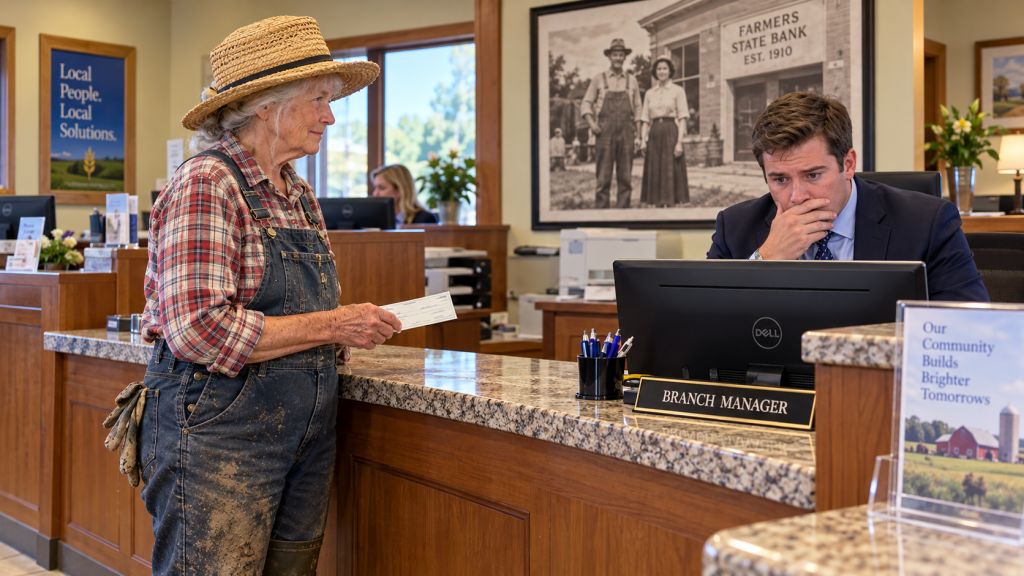
Now Calvin was carrying it toward the bank as though it belonged to him. I felt the blood drain from my face. “Shelly,” I whispered, “why does my nephew have George’s briefcase?” She turned toward the glass doors. Her expression changed. “Oh, Dot.” The way she said my name frightened me more than Brandon’s trembling hands.
“What is it?”
She looked toward the young branch manager.
Then back at me.
“I think you’d better sit down.”
I shook my head.
“No, honey. I’ve been standing on these legs for seventy-nine years. They can hold me a little longer.”
Brandon gripped the edge of his desk.
“Mrs. Whitcomb, perhaps we should move this conversation somewhere private.”
I looked at him.
An hour earlier, he’d spoken to me like I was an inconvenient stranger.
Now he was practically begging me to disappear into a back office.
I smiled.
“That’s a wonderful idea, young man. But first, return my driver’s license.”
He handed it over immediately.
Then I asked, “And may I have my forty-dollar check?”
His face reddened.
“Mrs. Whitcomb, I can process that right now.”
I held out my hand.
“Just the check, please.”
He returned it.
I slipped it into my pocket.
Then I turned toward the entrance.
Because my nephew was coming through the doors.
And judging by the expression on his face, he wasn’t expecting to find me there.
“ Aunt Dot?”
Calvin stopped so abruptly that the lawyer walking behind him nearly collided with his back.
My nephew was fifty-four years old.
Tall.
Silver-haired.
Always dressed as though he had an important meeting with someone more important than himself.
He wore an expensive gray suit and a watch so large it looked uncomfortable.
But when he saw me standing beside Shelly, his confident smile disappeared.
“Aunt Dot,” he repeated. “What are you doing here?”
I looked down at my muddy boots.
Then at him.
“Banking.”
He glanced at Brandon.
Then at Shelly.
Something passed between them.
Something I didn’t like.
Calvin forced a laugh.
“You should have called me. I would’ve sent someone to help you.”
I smiled politely.
“I needed forty dollars, Calvin. Not a rescue helicopter.”
The woman who had been holding a toddler earlier let out a small laugh.
Calvin didn’t.
He tightened his grip on George’s briefcase.
Then lowered his voice.
“Come on, Aunt Dot. Let’s talk outside.”
I looked at the briefcase.
“Where did you get that?”
He followed my gaze.
His expression changed.
“Oh. This old thing?”
I nodded.
“George’s.”
Calvin shrugged.
“I found it among some family papers.”
My stomach tightened.
“Where?”
He hesitated.
“At the farmhouse.”
I stared at him.
“Calvin, you haven’t been inside my farmhouse in six months.”
His jaw tightened.
“Aunt Dot, you’re getting confused.”
And there it was.
That word.
Confused.
The same word he had started using whenever I disagreed with him.
Whenever I refused to sell my land.
Whenever I questioned the bank’s newest plans.
Whenever I told him I could manage my own affairs.
I looked directly into his eyes.
“No, Calvin. I remember perfectly well where I put my husband’s things.”
He glanced toward the lawyer.
Then said, “This isn’t the place.”
I smiled.
“Then perhaps you shouldn’t have brought George’s briefcase into my bank.”
The lawyer stepped forward.
He was a thin man with a neat mustache and a black leather folder.
“Mrs. Whitcomb, I’m Martin Voss. I represent your nephew in a family financial matter.”
I looked at him.
“Then I’m sure you’ll be pleased to meet my own attorney when she arrives.”
His expression flickered.
Calvin turned sharply.
“Your attorney?”
“Yes.”
“When did you call her?”
“I haven’t yet.”
I smiled.
“But I certainly intend to.”
Brandon looked from Calvin to me.
Then the telephone on his desk rang again.
He answered with a shaking hand.
“Farmers & Merchants, Millbrook branch.”
He listened.
His expression became worse.
“Yes, Mr. Harlan.”
A pause.
“She’s here.”
He glanced at me.
“Yes, sir. With Mr. Whitcomb.”
I folded my hands.
For a moment, I remembered George standing in our kitchen in 1968.
Young.
Nervous.
Holding the papers for a bank that didn’t yet exist.
He’d looked at me and said, “Dot, what if nobody believes we can do this?”
I’d kissed his cheek.
Then answered, “Well, George, somebody has to believe in us first.”
We mortgaged our farm.
Sold my mother’s old diamond bracelet.
Borrowed folding chairs from the church.
And built a bank for people who were tired of being told their families weren’t important enough to deserve a chance.
Now, nearly six decades later, the people standing in that lobby were looking at me as though I were an obstacle to be removed.
I looked toward Brandon.
“Tell Mr. Harlan I’ll be staying.”
His mouth fell open.
I continued.
“And tell him I’d appreciate a meeting with the bank’s legal counsel and whoever is responsible for the shareholder records.”
Calvin stepped closer.
“Aunt Dot, that’s completely unnecessary.”
I turned.
“Then you won’t mind.”
His face reddened.
“I’m trying to protect you.”
I looked at him.
“From what?”
He opened his mouth.
Then closed it.
I waited.
Finally, he said, “From making decisions you no longer understand.”
I felt a strange pain move through my chest.
Not because I believed him.
Because this was the boy I had helped raise.
My younger sister Ruth died when Calvin was seventeen.
George and I had no children.
So we took him in.
Fed him.
Helped him finish school.
Paid for college when the scholarships fell short.
When he graduated, George gave him his first suit.
And I stood in the audience crying as though he were my own son.
Now he was looking at me as though age had erased everything I’d ever known.
I took a slow breath.
“Calvin, how old was I when George and I opened this bank?”
He frowned.
“What?”
“How old was I?”
He looked irritated.
“Twenty-one, twenty-two. What does that have to do with anything?”
“Twenty-one,” I answered.
I pointed toward the photograph.
“That girl standing beside George was me.”
Calvin glanced toward it.
I continued.
“She worked fourteen hours a day when we couldn’t afford another teller.”
“She calculated interest by hand.”
“She cleaned the floors herself.”
“And she sat beside farmers who cried because another bank had turned them away.”
My voice trembled.
“So don’t stand here and tell me I don’t understand what this institution means.”
The lobby went silent.
Calvin’s lawyer shifted uncomfortably.
Then Calvin leaned close.
His voice became a whisper.
“Aunt Dot, you’re embarrassing yourself.”
I met his eyes.
“No, Calvin.”
I took a breath.
“I’m beginning to think I’m embarrassing you.”
Just then, a door opened at the back of the bank.
A man in a charcoal suit hurried toward us.
He was tall, with white hair and a face that looked permanently worried.
I recognized him immediately.
Edward Harlan.
Chairman of the board of Farmers & Merchants Bancshares.
A man George had trusted for years.
A man who still sent flowers on the anniversary of George’s death.
“Dorothy!”
He approached with both arms extended.
I didn’t move.
He stopped.
For one moment, his smile faltered.
Then he said, “It’s wonderful to see you.”
I looked at him.
“Edward, that’s strange. According to my nephew, I’m too confused to understand my own bank.”
The color left his face.
“Dorothy—”
“And according to Shelly, someone has been trying to transfer my voting rights.”
He went still.
I continued.
“So perhaps we can skip the pleasantries and discuss why I wasn’t informed.”
He looked toward Calvin.
Calvin shook his head slightly.
I noticed.
So did Shelly.
Edward cleared his throat.
“Dorothy, this is a complicated matter.”
I smiled.
“Good. I’ve always enjoyed complicated matters.”
He gestured toward the back office.
“Why don’t we go somewhere private?”
I nodded.
“That would be appropriate. But I want my independent attorney present before discussing any disputed documents.”
Calvin exhaled sharply.
“Aunt Dot, you’re making everything harder.”
I looked at him.
Then answered quietly:
“Only for the people who expected me not to ask questions.”
Edward said nothing.
Brandon was staring at the floor.
And Shelly, who had worked at the bank for more than thirty years, was looking at me with tears in her eyes.
I took my telephone from my handbag.
Called my attorney.
And waited while the bank’s most powerful men stood around me.
Her name was Margaret Ellis.
She was sixty-three.
Sharp-minded.
Unimpressed by expensive suits.
And, more importantly, one of the few people who knew exactly how George and I had structured our ownership of the bank.
She answered on the second ring.
“Dorothy?”
“Hello, Margaret.”
“Is everything all right?”
I looked at Calvin.
Then at Edward.
“I’m standing in the lobby of Farmers & Merchants.”
A pause.
Then Margaret asked, “What happened?”
I smiled sadly.
“Apparently I’m too old to cash forty dollars.”
Silence.
Then I continued.
“And my nephew has filed something involving my voting shares.”
Margaret’s voice changed.
“What?”
“I’d like you here.”
She didn’t hesitate.
“Don’t sign anything. Don’t surrender any original documents. I’m coming.”
I ended the call.
Then looked toward Edward.
“My attorney will be joining us.”
He nodded stiffly.
“Of course.”
Calvin suddenly laughed.
A short, bitter sound.
“This is ridiculous.”
I turned.
He continued.
“Aunt Dot, you’re making a scene over paperwork designed to protect your own interests.”
I looked at George’s briefcase.
“Then tell me what papers you have in there.”
He tightened his grip.
“Personal records.”
“Whose?”
He hesitated.
“Family records.”
I nodded.
“Wonderful. We can have the ownership and contents properly examined.”
His jaw clenched.
Then he said something that made my blood run cold.
“George understood what needed to happen.”
I stared.
“What?”
Calvin looked away.
“Nothing.”
I stepped closer.
“No. You said George understood.”
He sighed.
“Aunt Dot, please.”
My voice became firm.
“George has been dead six years. If you’re going to use my husband’s name to explain your actions, you’d better be prepared to tell me exactly what you mean.”
Calvin stared at me.
Then whispered, “He wanted the bank protected.”
I felt tears rise.
“Yes.”
I swallowed.
“He did.”
Calvin nodded quickly.
“Exactly.”
I looked into his eyes.
“Protected from what, Calvin?”
He said nothing.
Then I asked the question that changed his expression completely.
“Or should I say protected for whom?”
He stepped backward.
And I knew then that the forty-dollar check had brought me into something far bigger than I imagined.
We waited in a conference room until Margaret arrived.
I refused coffee.
Not because I wasn’t thirsty.
Because I was afraid my hands might shake badly enough for Calvin to point at them and call that evidence of incompetence.
The room was filled with expensive furniture.
A long polished table.
Leather chairs.
A large photograph of the first bank building.
I studied that photograph.
George and I standing beside a sign we’d painted ourselves.
FARMERS & MERCHANTS BANK — MILLBROOK.
Behind us, nothing but gravel and empty land.
I remembered opening day.
Fourteen customers.
A leaking roof.
Two borrowed filing cabinets.
And George staying awake all night because he was afraid we’d made a terrible mistake.
I remembered telling him, “If we fail, at least we’ll know we tried.”
He’d smiled.
Then said, “Dorothy, you’re the bravest person I know.”
Six years after his death, I sat in the bank we built and wondered whether the people running it remembered why it existed.
Margaret arrived forty minutes later.
She entered carrying a leather folder.
Her eyes moved across the room.
Edward.
Calvin.
Martin Voss.
Brandon.
Shelly.
Then me.
“Dorothy.”
I smiled.
“Hello, Margaret.”
She took the chair beside mine.
Then turned toward the others.
“I understand there are concerns involving Mrs. Whitcomb’s ownership interests and capacity.”
Calvin sat forward.
“That’s correct.”
Margaret looked at him.
“And you’re asserting that as a concerned relative?”
“Yes.”
She nodded.
“Please provide the documents supporting your position.”
Calvin looked toward his lawyer.
Martin Voss opened his folder.
He slid several papers across the table.
Margaret read silently.
I watched her expression.
She reached the second page.
Stopped.
Read it again.
Then looked at Calvin.
“Where did you obtain this?”
He frowned.
“Which document?”
Margaret held up the page.
“This purported power of attorney.”
My stomach tightened.
Calvin lifted his chin.
“Aunt Dot signed it.”
I stared.
“No, I didn’t.”
He ignored me.
“She wanted help managing her finances.”
Margaret looked at him.
“When?”
“Last February.”
I frowned.
February.
I remembered February very well.
We’d had an ice storm that knocked out power for two days.
Shelly brought me firewood.
Margaret came over with soup.
And Calvin hadn’t visited once.
Margaret studied the signature.
Then said, “Dorothy, do you recognize this document?”
I looked at it.
My name was printed beneath the signature line.
DOROTHY E. WHITCOMB.
Above it was a signature that looked remarkably like mine.
But something was wrong.
I stared harder.
Then felt my stomach drop.
George always called me Dot.
Most people in Millbrook did.
But when I signed legal documents, I used Dorothy Elaine Whitcomb.
On the paper before me, the signature was written as Dorothy E. Whitcomb.
The exact way I’d signed an old Christmas card.
The card Calvin kept on his office shelf.
I slowly looked up.
“Calvin.”
He met my eyes.
I lifted the paper.
“Where did you get this signature?”
His expression changed.
“Aunt Dot—”
“Answer me.”
He swallowed.
“You signed it.”
I shook my head.
“No.”
My voice trembled.
“I sent you a Christmas card in 2019 with this exact flourish on the W.”
Calvin went still.
Margaret immediately began examining the page more closely.
Martin Voss cleared his throat.
“Let’s not make accusations without an appropriate examination.”
Margaret nodded.
“Agreed.”
Then she looked directly at him.
“Which is why no one should act on a disputed authorization until its authenticity and legal effect have been properly reviewed.”
Edward shifted in his chair.
I turned toward him.
“Edward, have any of my voting rights actually been transferred?”
He hesitated.
“Not completed.”
Margaret looked up sharply.
“What does that mean?”
Edward swallowed.
“There was a request to recognize Calvin as your authorized voting representative.”
I felt cold.
“For which shares?”
Edward looked at Margaret.
Then answered reluctantly.
“Your controlling block in Millbrook Community Bancshares.”
I stared.
For decades, George and I had accumulated voting shares in the holding company that owned Farmers & Merchants Bank.
After his death and the settlement of his estate, my ownership and properly documented voting arrangements represented a majority of the company’s voting power.
Fifty-four percent.
A responsibility I’d never taken lightly.
It wasn’t simply wealth.
It was the ability to influence who governed the bank George and I had built.
I looked at Edward.
“Who requested the transfer?”
He swallowed.
“Calvin.”
“And who supported it?”
Silence.
Margaret put down her pen.
“Edward, I suggest you answer Mrs. Whitcomb.”
He looked toward Calvin.
Then whispered, “The board’s special transaction committee was informed of the request.”
My heart tightened.
“Transaction?”
Nobody spoke.
Then I looked at Calvin.
“What transaction?”
He stared at the table.
Margaret repeated the question.
“What proposed transaction?”
Edward closed his eyes.
Then answered.
“A possible sale of the bank.”
For a moment, the room seemed to spin.
I gripped the edge of my chair.
A sale.
Our bank.
George’s bank.
The place where we’d spent almost sixty years building something for people other institutions had forgotten.
I stared at Edward.
“To whom?”
He hesitated.
Then said:
“Northbridge Financial Group.”
My stomach twisted.
I’d heard the name.
A regional financial company that had been acquiring community banks.
Closing overlapping branches.
Combining operations.
Selling property.
There was nothing automatically wrong with a bank merger.
George and I had discussed that possibility more than once.
But any decision had to be honest.
Informed.
And made for the right reasons.
Not pushed through by quietly stripping an elderly shareholder of her voice.
I swallowed.
“How long has this been discussed?”
Edward looked ashamed.
“Several months.”
I felt tears rise.
“Several months?”
He nodded.
I stared at him.
“Edward, George made you chairman because he believed you’d protect this bank’s customers.”
His face reddened.
I continued.
“And you couldn’t pick up a telephone to tell his widow someone wanted to sell it?”
He looked down.
Then Calvin spoke.
“Aunt Dot, the bank needs to modernize.”
I turned.
He continued.
“Small banks can’t survive forever on sentimental stories about helping farmers.”
Something inside me broke.
Not because he disagreed with me.
But because he spoke about the bank’s purpose as if it were an embarrassing old photograph.
I took a breath.
“Calvin, George and I never believed sentiment could replace sound banking.”
He rolled his eyes.
I continued.
“We made difficult loans.”
“We turned people down when we had to.”
“We worried about capital.”
“Regulations.”
“Interest rates.”
“And whether we could pay our employees.”
I leaned forward.
“But we also understood that the people walking through our doors deserved respect.”
My eyes moved toward Brandon.
The young manager couldn’t meet my gaze.
I continued.
“Especially when they weren’t dressed like somebody worth impressing.”
The room fell silent.
Then Margaret looked toward Edward.
“Has anyone notified the applicable governance, compliance, and regulatory functions about the disputed proxy?”
Edward nodded slowly.
“Not yet.”
Margaret’s expression hardened.
“Then we need to address that immediately.”
Calvin stood.
“This is absurd!”
Margaret looked up.
“Sit down, Calvin.”
He stared at her.
She continued calmly.
“Your aunt has denied executing a document that would authorize you to exercise significant voting power. You have an obvious conflict of interest concerning a proposed sale. The appropriate response is independent verification, not an argument about her age.”
Calvin remained standing.
Then he said something I didn’t expect.
“Fine.”
He reached for George’s briefcase.
“Then let’s see what the founder himself wanted.”
He placed the briefcase on the table.
Opened the brass clasp.
And pulled out a folder.
I recognized the paper.
Old cream stationery.
George’s handwriting across the top.
My breath caught.
Because written in bold letters was a title I’d never seen before.
THE WHITCOMB FAMILY SUCCESSION PLAN.
Calvin looked straight at me.
And smiled.
“George prepared this before he died, Aunt Dot.”
My hands turned cold.
Then he said:
“Maybe it’s time you learned what your husband didn’t tell you.”
I stared at the folder.
George’s handwriting.
George’s stationery.
George’s familiar habit of underlining important words twice.
For one terrible moment, I wondered whether my husband really had made decisions about our bank without telling me.
Calvin watched my face.
He seemed almost pleased by my uncertainty.
“You see?” he said quietly. “Uncle George knew the bank needed a succession plan.”
I swallowed.
“George and I discussed succession planning for years.”
Calvin smiled.
“Then this shouldn’t surprise you.”
Margaret reached for the document.
“May I examine it?”
Calvin hesitated.
Then slid it toward her.
She turned the pages slowly.
I watched her eyes move across the writing.
After a moment, she stopped.
Then looked up.
“Calvin, this is a draft.”
His smile faltered.
“What?”
Margaret pointed toward the top of the first page.
The word DISCUSSION was printed beneath the title.
She continued.
“There’s no executed appointment here. No valid transfer of voting authority. And the document itself refers to additional approvals and future agreements.”
Calvin’s jaw tightened.
“Uncle George wanted me to manage things.”
Margaret looked at him.
“Did he appoint you?”
Silence.
“Did Dorothy appoint you?”
Calvin said nothing.
“Then your belief about what George wanted doesn’t give you the legal authority you’re claiming.”
I leaned forward.
“Margaret, may I see it?”
She handed me the folder.
I turned the pages.
George had written notes in the margins.
Continuity.
Liquidity.
Protect depositors.
Family should not override fiduciary obligations.
Then, halfway down the fourth page, I found something.
A sentence written in George’s unmistakable handwriting.
Dorothy retains final authority over her shares for as long as she chooses and is legally able to exercise it.
I stared.
Then I read it again.
And again.
Tears filled my eyes.
Calvin shifted in his seat.
I looked up.
“Calvin, did you read this part?”
He frowned.
“Of course.”
I held up the page.
“Then why have you spent months telling people I don’t understand my own affairs?”
His face reddened.
“Because things have changed.”
I nodded.
“Yes, they have.”
My voice broke.
“George died.”
For a moment, nobody spoke.
I looked down at the folder.
Then whispered, “But I didn’t.”
Edward turned away.
Shelly began crying quietly.
And Calvin looked at me with an expression I couldn’t read.
Margaret placed her hand beside mine.
“Dorothy, there’s another problem with this draft.”
I turned.
“What?”
She pointed toward the final page.
A handwritten note directed the reader to a separate agreement.
See revised instructions, September 2019.
My stomach tightened.
George died in March 2020.
Six months after those revised instructions.
I looked at Calvin.
“Where are they?”
He blinked.
“What?”
“The September 2019 instructions.”
He stared.
“I don’t know.”
Margaret’s expression hardened.
“This folder specifically references them.”
Calvin gave an irritated shrug.
“Maybe George never finished them.”
I looked at the briefcase.
The old brown leather.
The brass clasp.
The worn handle.
Then a memory surfaced.
George sitting at our kitchen table in the autumn of 2019.
His reading glasses slipping down his nose.
He’d been sorting bank documents.
When I asked what he was doing, he smiled.
“Just making sure the right people can find things if I go first.”
I’d laughed.
“Don’t talk like that.”
He’d reached across the table.
Taken my hand.
And said:
“Dot, promises are only useful if somebody can prove they were made.”
My heart began pounding.
I looked toward Margaret.
“George changed something in September 2019.”
She nodded slowly.
“That appears possible.”
Then Shelly spoke.
Her voice was barely audible.
“Mrs. Whitcomb?”
I turned.
“Yes, honey?”
She glanced nervously toward Edward.
“I think I know what happened to those papers.”
Calvin’s chair scraped the floor.
“Shelly, this is a shareholder matter. You don’t need to involve yourself.”
She flinched.
I noticed.
So did Margaret.
I turned toward Shelly.
“Sweetheart, you can speak to my attorney privately if you prefer. You shouldn’t have to answer questions in front of anyone you’re worried about.”
Her eyes filled.
She nodded.
“Yes, ma’am.”
Calvin laughed.
“Unbelievable.”
Margaret looked at him.
“Calvin, we’re going to pause this meeting until the relevant records can be examined independently.”
He stepped forward.
“I’m not surrendering Uncle George’s property.”
I stared at him.
Then quietly asked:
“Why did you take it in the first place?”
He stopped.
For a moment, his expression changed.
I waited.
Then he answered.
“I was protecting his legacy.”
My eyes filled.
“No, Calvin.”
I looked at the briefcase.
“George’s legacy isn’t something you can carry around by the handle.”
Margaret arranged for the disputed documents to be preserved and their provenance recorded.
Calvin’s lawyer objected to several things.
Edward consulted the bank’s counsel.
And by the time we left that conference room, it was clear that no one would be recognizing Calvin’s disputed voting authority that afternoon without further scrutiny.
That didn’t mean the matter was resolved.
It meant the people who’d expected a quiet transfer had encountered resistance.
And as George used to say whenever a difficult customer tried to rush him into signing something:
That’s usually the moment to slow down and read.
Outside the bank, the sun was shining.
A delivery truck rumbled down Main Street.
A woman walked past carrying groceries.
Ordinary life continued around me.
But I stood on the sidewalk feeling as though someone had moved every piece of furniture inside my heart.
Shelly came outside.
She looked frightened.
“Dot?”
I turned.
“Yes?”
She took my hands.
“I’m sorry about what happened at the counter.”
I smiled sadly.
“You didn’t do it.”
Her eyes filled.
“I should have spoken up sooner.”
I looked at her.
“About what?”
She glanced toward the bank.
Then whispered:
“Brandon wasn’t surprised when you gave him the account number.”
My stomach tightened.
“What do you mean?”
She swallowed.
“He’d been given instructions.”
I stared.
“Instructions?”
She nodded.
“To require additional verification if you came into the branch.”
My heart pounded.
“Why?”
Shelly began crying.
“I think someone wanted an incident.”
I felt cold.
She continued.
“Something they could write down.”
I stared.
Then whispered, “To show I was confused?”
She nodded.
For a moment, I couldn’t breathe.
Then I remembered Brandon raising his voice.
Asking whether I had an account.
Demanding three forms of identification for a forty-dollar check.
Keeping my driver’s license.
Looking toward the security guard.
He hadn’t merely been rude.
Someone might have hoped I would become frightened.
Angry.
Flustered.
That I would lose my temper.
Forget something.
Or say something they could later describe as evidence of impairment.
My stomach twisted.
“Shelly, are you certain?”
She shook her head.
“I don’t know the whole reason.”
Her voice trembled.
“But I saw a written instruction about enhanced verification for your visits. It didn’t look like the normal procedures we use for everyone.”
I swallowed.
“Did it say who approved it?”
She hesitated.
Then whispered, “Brandon said the direction came from senior management.”
I closed my eyes.
For the first time, I understood why the young manager’s face had changed when I asked about account 0001.
He’d expected an elderly woman who could be intimidated.
Instead, he’d discovered the founder whose voting rights were at the center of the dispute.
I took Shelly’s hands.
“Thank you for telling me.”
She began crying.
“Dot, I can’t lose my job.”
My heart broke.
Shelly’s husband had been ill for years.
Her youngest daughter was still paying off college loans.
She depended on that job.
I squeezed her fingers.
“Then let’s make sure any concerns are raised through appropriate protected channels. Don’t take records you aren’t authorized to take, and don’t put yourself at risk to help me.”
She nodded.
Margaret joined us.
After speaking briefly with Shelly, she arranged for an independent attorney to discuss the bank’s reporting procedures and protections.
I watched Shelly walk toward her car.
Her shoulders were hunched.
And I thought about how easily people with power can make others afraid.
A widow afraid of losing her shares.
A teller afraid of losing her job.
A young manager afraid of displeasing his superiors.
Then I looked toward the bank.
George and I had never been perfect employers.
We’d made mistakes.
Argued.
Worried about money.
But we’d tried to build a place where people could tell the truth without wondering whether doing so would cost them their livelihoods.
Somewhere along the way, that promise had begun to disappear.
That evening, I drove home.
My house sat at the edge of Millbrook.
A white farmhouse with green shutters.
A long porch.
And a garden that had been my pride for forty years.
The tomatoes needed watering.
The roses needed trimming.
A stubborn patch of weeds had returned beside the fence.
Usually, I found comfort in those little tasks.
But that afternoon, I couldn’t bring myself to pick up the garden hose.
I went inside.
Took off George’s straw hat.
And placed it on the hook beside the door.
The house was quiet.
Too quiet.
I walked into the kitchen.
Sat at the table.
And looked toward George’s empty chair.
For six years, I’d kept it in the same place.
People told me I should move it.
Buy something new.
Change the room.
But I couldn’t.
George used to sit there every morning.
Reading the newspaper.
Complaining about politicians.
Drinking coffee that was far too hot.
And asking whether I’d made enough toast.
I looked toward his chair.
Then whispered:
“George, what did Calvin do?”
Tears filled my eyes.
I remembered Calvin as a little boy.
Running through our cornfield.
Falling off his bicycle.
Crying because his mother had forgotten to come to his school concert.
After Ruth died, he slept in our guest bedroom for almost a year.
Sometimes I’d hear him crying after midnight.
I’d sit beside him.
Rub his back.
And tell him he wasn’t alone.
George taught him to drive a tractor.
Helped him learn to shave.
Bought him a used truck when he turned eighteen.
When Calvin graduated from college, George hugged him.
Then said, “We’re proud of you, son.”
Son.
That word had meant something.
We had never adopted Calvin legally.
He still carried his own father’s surname.
But in our hearts, he was the child we hadn’t been able to have.
And now he was trying to take away my voice in the institution we’d built.
I began crying.
Not gentle tears.
I bent over the kitchen table and sobbed until my chest hurt.
Because there is a special kind of heartbreak that comes when someone you raised begins treating your love as something they can use against you.
The telephone rang.
I almost didn’t answer.
Then I saw the caller.
Margaret.
“Hello?”
“Dorothy.”
Her voice was gentle.
“Are you home?”
“Yes.”
“How are you holding up?”
I looked toward George’s chair.
Then whispered, “Not very well.”
There was a pause.
Then Margaret said, “I’m coming over.”
I wiped my eyes.
“You don’t have to.”
“I know.”
Her voice softened.
“But I want to.”
Forty minutes later, she arrived carrying a casserole, a folder, and two slices of lemon cake.
I laughed when I saw the cake.
“Margaret, are you trying to bribe me?”
She smiled.
“Only into eating dinner.”
We sat at the kitchen table.
For a while, we didn’t discuss the bank.
She asked about my roses.
The tomatoes.
The church fundraiser.
And whether the rhubarb pies had turned out properly.
I laughed.
“They must have. The church paid me forty dollars.”
Margaret smiled.
“Then I hope you eventually cash that check.”
I looked toward my handbag.
The check was still there.
Forty dollars.
A small piece of paper that had somehow exposed a much larger problem.
After dinner, Margaret opened her folder.
“Dorothy, there’s something I want to review.”
I nodded.
She laid out copies of my existing ownership documents.
Bank holding company records.
Estate papers.
And the voting arrangements George and I had established over the years.
She pointed toward one document.
“Your ownership position is well documented.”
I swallowed.
“Calvin can’t simply declare me incompetent and take it?”
She shook her head.
“No.”
I exhaled.
Margaret continued.
“Legal capacity isn’t determined by a relative’s opinion. And a forged or unauthorized power of attorney doesn’t become valid because someone submits it.”
I felt tears rise.
She continued.
“Questions concerning any proposed sale also involve the company’s governing documents, board responsibilities, shareholder rights, and applicable regulatory approvals.”
I nodded.
“So we have time?”
“We have legal options.”
Her expression became serious.
“But we need to act promptly.”
She explained the immediate steps.
Independent review of the purported power of attorney.
Preservation of the bank’s records.
Appropriate notices to the relevant institutions and authorities.
And, if necessary, court protection to prevent disputed voting rights from being exercised while the matter was examined.
I listened carefully.
Then asked, “Will I have to go to court?”
Margaret considered.
“Possibly.”
I sighed.
“George always hated courtrooms.”
She smiled sadly.
“So did he.”
For a moment, we sat quietly.
Then she said:
“Dorothy, I found something else.”
My heart tightened.
“What?”
She looked toward George’s empty chair.
Then back at me.
“A letter in his estate file.”
I froze.
“What letter?”
She took a folded envelope from her folder.
It was yellowed.
Carefully sealed.
And across the front, in George’s handwriting, were four words.
For Dot, if necessary.
My hands began trembling.
I stared at the envelope.
“Margaret…”
Her eyes filled.
“George gave this to me in September 2019.”
I swallowed.
“Did he tell you what was in it?”
She nodded.
“He asked that it be held with the revised succession documents and released if anyone tried to disregard your authority over the bank.”
I covered my mouth.
For a moment, I couldn’t speak.
Then I whispered:
“He knew?”
Margaret looked at me.
Her voice softened.
“He knew there were people who might try to take advantage of you after he was gone.”
I stared at the letter.
George’s handwriting.
The little crooked G.
The way he made his T too tall.
For six years, I’d wished I could hear his voice again.
Now I was holding words he’d left for a day I never imagined would come.
I opened the envelope.
Carefully.
As though the paper might break.
Inside was a single sheet.
I unfolded it.
And began reading.
My darling Dot,
If Margaret is giving you this letter, then I suppose somebody has forgotten something important.
You were not my assistant.
You were not the woman who poured coffee while I built a bank.
You built it with me.
My eyes filled.
I pressed one hand against my mouth.
Then continued.
You balanced the books when I couldn’t make the numbers work.
You talked the first farmers into trusting us.
You remembered customers’ names when I remembered only their account numbers.
And when the whole county thought we’d fail, you were the one who said we’d find a way.
Tears blurred the page.
I know people see an old farmer when they look at me now.
And someday they’ll see an old woman when they look at you.
Let them.
Age doesn’t erase what we know.
And being gentle doesn’t mean being foolish.
I began sobbing.
Margaret reached for my hand.
I kept reading.
I have revised our succession instructions because I no longer believe certain members of the family should be trusted with financial authority merely because they share our name.
The signed records are held separately and properly documented.
Margaret knows where they are.
My heart pounded.
Then I read the final paragraph.
Dot, if anybody ever tells you you’re too old to protect what we built, I want you to remember something.
The bank was never mine alone.
It was ours.
And if the day comes when you have to stand in a room full of important men and remind them of that, don’t be afraid.
You’ve done it before.
All my love, George.
I couldn’t see the paper anymore.
I pressed it against my chest.
And cried.
For six years, I’d missed his hand in mine.
His laugh.
His terrible jokes.
The sound of his boots crossing the kitchen floor.
Now, even after death, he was reminding me that I’d never been merely the woman standing beside him in the photograph.
I had been his partner.
Margaret sat quietly.
When I could finally speak, I whispered:
“Why didn’t you give me this before?”
Her eyes filled.
“Because George asked me to keep it for a particular circumstance.”
I looked up.
She continued.
“He didn’t want you spending the years after his death frightened by problems that hadn’t happened.”
I wiped my cheeks.
“And the revised instructions?”
Margaret nodded.
“They’re in the estate and corporate records. They confirm your continued authority and establish independent succession arrangements if you ever choose or legally need assistance.”
I closed my eyes.
Relief swept through me.
Then I looked toward George’s chair.
And whispered:
“You stubborn old man.”
Margaret laughed softly.
I laughed too.
Then cried again.
After a moment, Margaret reached toward her folder.
“Dorothy, there’s one more thing.”
I looked up.
“What?”
She hesitated.
Then said:
“George’s letter isn’t the only reason he changed the succession plan.”
My stomach tightened.
“Why did he change it?”
She looked toward me.
Her expression became grave.
“Because in 2019, George discovered a financial discrepancy connected to Calvin.”
I froze.
“What kind of discrepancy?”
Margaret took a breath.
“Money was missing from a community development fund associated with the bank.”
I stared.
“Missing?”
She nodded slowly.
“George believed Calvin had been involved in an unauthorized transaction.”
My chest tightened.
I looked toward the photograph on the wall.
George and Calvin beside the tractor.
George smiling proudly.
Calvin grinning like a little boy.
I whispered:
“Why didn’t George tell me?”
Margaret’s eyes filled.
“Because Calvin begged him not to.”
For a moment, the room was silent.
Then she said something that made the hair rise on my arms.
“Dorothy, George agreed to give Calvin an opportunity to make the money right.”
I swallowed.
“And did he?”
Margaret looked down.
“No.”
I stared.
Then she whispered:
“And we believe the problem may have continued after George died.”
I sat at the kitchen table long after Margaret finished speaking.
Outside, the sun was setting behind the cornfield.
The kitchen window reflected two elderly women sitting beneath a yellow light.
One holding a lawyer’s folder.
The other clutching a letter from her dead husband.
I looked toward Margaret.
“Tell me what happened in 2019.”
She took a slow breath.
“George noticed that a payment approved for the Millbrook Small Farm Assistance Fund didn’t reach the intended borrower.”
I frowned.
“The assistance fund?”
She nodded.
George and I had established it decades earlier.
It wasn’t a source of free money.
It was a carefully governed program intended to help local farmers and small businesses obtain financing when ordinary lending terms weren’t suitable.
Sometimes that meant technical assistance.
Sometimes additional guarantees.
Sometimes a restructuring plan during difficult years.
I remembered sitting with families whose farms had been devastated by floods.
Parents afraid of losing land that had belonged to their grandparents.
Young couples trying to buy equipment.
Widows who didn’t know whether they could keep their businesses open after a spouse died.
The fund mattered to me.
It had mattered even more to George.
Margaret continued.
“George discovered an irregular payment to a consulting company.”
My stomach tightened.
“What company?”
She turned a page.
“Ridgeway Advisory Services.”
I stared.
I’d heard the name.
Calvin had mentioned Ridgeway more than once.
He claimed they advised banks on efficiency and property development.
I swallowed.
“What did they do?”
Margaret’s expression grew serious.
“The original documentation described financial consulting services. George couldn’t find evidence that the services had been performed.”
I felt cold.
“How much?”
She paused.
“Just under seventy thousand dollars in that transaction.”
I pressed my hand against my mouth.
Seventy thousand dollars.
Enough to help a family replace damaged equipment.
Enough to keep a small business operating through a difficult season.
Enough to make a difference in someone’s life.
I whispered, “Did George confront Calvin?”
Margaret nodded.
“He did.”
My throat tightened.
“What happened?”
She looked toward the window.
“Calvin claimed the money had been advanced in anticipation of a larger consulting agreement. George demanded documentation and repayment if the services weren’t delivered.”
I stared.
“And Calvin?”
Margaret sighed.
“He signed a repayment acknowledgment and promised to resolve it.”
My chest tightened.
“Did he?”
She shook her head.
“Only a small amount was recovered before George became seriously ill.”
I closed my eyes.
Then whispered, “George should have told me.”
Margaret nodded.
“He knew that afterward.”
I looked up.
She continued.
“He was torn between his responsibility to the bank and his love for Calvin.”
Tears filled my eyes.
I understood that conflict.
Too well.
Margaret spoke carefully.
“George documented what he knew and sought advice about the next steps. He removed Calvin from the succession arrangements he had been considering.”
I swallowed.
“And he kept copies?”
“Yes.”
I nodded slowly.
“So Calvin knew George had discovered something.”
Margaret’s expression darkened.
“He certainly knew George had challenged the payment.”
I looked down at George’s letter.
The words blurred.
Family should not override fiduciary obligations.
For a long time, I sat silently.
Then I whispered:
“George gave Calvin every chance in the world.”
Margaret reached for my hand.
“Yes.”
My voice broke.
“And Calvin used those chances to keep taking.”
Margaret didn’t answer.
Because the full facts still needed to be established.
But I could see in her eyes that she was worried.
The next morning, I woke before dawn.
Old habits.
When George was alive, he always rose at five.
I would hear the coffee grinder.
The back door.
The familiar sound of his boots.
Now the kitchen was silent.
I made coffee.
Put on George’s straw hat.
And went into the garden.
The tomatoes were growing beautifully.
My roses had begun blooming.
A family of sparrows was making a terrible mess near the birdbath.
For almost an hour, I worked without thinking about the bank.
Pulled weeds.
Watered the beans.
Trimmed dead leaves.
Then I noticed something.
A small brown envelope tucked beneath the flowerpot on my back steps.
I stopped.
My heart pounded.
I hadn’t seen it earlier.
The envelope was plain.
No stamp.
No address.
Just my name.
DOT.
I looked toward the driveway.
No car.
No person.
Nothing but the quiet morning.
I carried the envelope inside.
Placed it on the kitchen table.
Then called Margaret.
“Dorothy?”
“I found something on my back porch.”
Her voice sharpened.
“What?”
“An envelope with my name.”
“Is there a return address?”
“No.”
She paused.
“Don’t assume who left it. Keep it and let me know what’s inside.”
I opened it carefully.
There was a single folded sheet.
A copy of a bank memorandum.
At the top:
CONFIDENTIAL — CUSTOMER INTERACTION DOCUMENTATION.
My stomach tightened.
I read.
The memorandum instructed certain employees to record unusual behavior by selected vulnerable customers.
There was nothing inherently wrong with properly identifying possible fraud or exploitation.
Banks needed to protect people.
Especially those being pressured.
But then I saw my name.
Dorothy E. Whitcomb.
Beneath it, a note:
Escalate resistance to enhanced verification. Document agitation, confusion, or refusal to comply.
I stared.
Then read another sentence.
Relevant observations may support proposed protective arrangements.
My hands went cold.
Someone had been preparing to describe my perfectly reasonable objections as evidence that I couldn’t manage my own affairs.
I looked toward the bottom of the page.
A typed name.
Calvin Whitcomb — Family Representative.
I pressed the paper against my chest.
For a moment, I couldn’t breathe.
Then my phone rang.
An unfamiliar number.
I answered cautiously.
“Hello?”
A young man’s voice whispered:
“Mrs. Whitcomb?”
“Yes?”
There was a pause.
Then he said:
“It’s Brandon Pierce.”
I sat down.
The branch manager.
The man who’d demanded three forms of identification.
The man who’d spoken loudly and slowly to me in front of an entire lobby.
I took a breath.
“Good morning, Brandon.”
His voice trembled.
“Did you get the envelope?”
I went still.
“You left it?”
“Yes.”
I looked toward the window.
“Why didn’t you knock?”
He swallowed.
“Because I didn’t know whether you’d speak to me.”
I was quiet for a moment.
Then said:
“Brandon, I’m listening.”
He began speaking quickly.
He told me that several weeks earlier, he’d been instructed to treat my visits as possible indicators of declining capacity.
Calvin had presented himself as my family representative.
Edward’s office had been copied on certain communications.
The directions were described as protective.
But when I arrived at the bank, Brandon had been encouraged to record how I responded to additional questions.
My stomach turned.
“Did you know what they intended to do with those notes?”
He hesitated.
“Not at first.”
I looked down.
“And afterward?”
His voice broke.
“I started to suspect.”
I closed my eyes.
“Brandon, why didn’t you say anything?”
He was quiet.
Then whispered:
“I wanted the promotion.”
The honesty surprised me.
He continued.
“I’d worked for years to get a management position. Mr. Harlan told me I was being considered for a regional role.”
His voice shook.
“And Calvin kept saying you weren’t well.”
I swallowed.
“So when I arrived looking like a woman who’d spent the morning gardening, you thought I’d be easy to push around?”
Silence.
Then Brandon whispered:
“Yes, ma’am.”
The words hurt.
But I appreciated that he hadn’t tried to dress them up.
I took a breath.
“Brandon, you didn’t know me.”
“No, ma’am.”
“You saw muddy boots.”
“Yes.”
“You saw an old woman.”
His voice broke.
“Yes.”
I stared at George’s photograph on the kitchen wall.
Then said quietly:
“You didn’t see a customer who deserved basic courtesy.”
Brandon began crying.
“I’m sorry.”
I swallowed.
“An apology is a beginning, young man. It doesn’t undo what you did.”
“I know.”
I looked down at the memorandum.
“Why did you send me this?”
He took a shaking breath.
“Because yesterday I found out the observations were being considered alongside paperwork about your voting authority.”
My heart tightened.
He continued.
“And I realized I’d helped them create a record that made you look incapable of managing your affairs.”
I closed my eyes.
Brandon whispered:
“Mrs. Whitcomb, I don’t want to be that kind of banker.”
For a long moment, neither of us spoke.
Then I answered.
“Then don’t be.”
He sniffled.
I continued.
“Speak with independent counsel and the bank’s appropriate compliance or reporting personnel. Give them what you know. Don’t hide your own part in it.”
He whispered, “Will I be fired?”
I considered.
“I can’t promise what the independent review will conclude.”
My voice softened.
“But I’d rather hear someone tell the truth about a mistake than watch them build a career on a lie.”
He began crying again.
Then whispered:
“Thank you, Mrs. Whitcomb.”
When the call ended, I forwarded the information to Margaret.
She immediately arranged for the memorandum to be preserved and reviewed through the appropriate channels.
I looked toward the kitchen door.
George’s straw hat rested beside it.
For a moment, I imagined him standing there.
His hands on his hips.
His eyebrows raised.
He would have been furious.
Not because someone had failed to recognize his wife.
But because bank employees had apparently been encouraged to manipulate a customer’s vulnerability.
I whispered:
“George, we’ve got some cleaning to do.”
The independent investigation began that week.
Not with a dramatic announcement.
Not with me marching into the bank and firing everyone who had offended me.
Ownership of a majority voting block didn’t give me the authority to ignore corporate procedures, banking regulations, employee rights, or basic fairness.
There were proper channels.
Board responsibilities.
Compliance obligations.
And outside professionals who needed access to the records.
Margaret helped coordinate the necessary legal steps.
An independent investigative team examined the disputed proxy.
An outside forensic accountant reviewed transactions involving Ridgeway Advisory Services.
The board’s conflict procedures were scrutinized.
And appropriate regulatory and law-enforcement authorities were notified of the matters that required their attention.
Calvin’s attorney continued to assert that he was merely helping an elderly relative.
But that explanation became harder to accept as documents were examined.
The first major discovery came from accounting records.
Ridgeway Advisory Services had received substantial payments over several years.
Some were associated with legitimate consulting contracts.
Others lacked adequate support.
A complicated trail of transfers connected certain payments to companies in which Calvin held interests.
The exact amounts required a full accounting.
But it was clear that George’s concerns in 2019 had not been imaginary.
I learned that Calvin had invested heavily in a property development project outside Millbrook.
The project failed.
Then he borrowed more money.
Used personal guarantees.
And became trapped in obligations he couldn’t comfortably repay.
When his debts mounted, he began looking for a way out.
And the proposed sale of Farmers & Merchants appeared to offer one.
I didn’t yet know every detail.
But the timing was suspicious.
The merger discussions.
The disputed voting authority.
The attempts to question my capacity.
And Calvin’s growing financial pressure.
Then Margaret showed me another document.
A proposed advisory compensation agreement.
If the Northbridge transaction went forward, companies associated with Calvin stood to receive significant fees.
I stared at the numbers.
My hands shook.
“Margaret…”
She nodded.
“The proposed payments require scrutiny.”
I looked up.
“Calvin wanted to sell the bank because he needed the money.”
She answered carefully.
“That is a possibility supported by the financial interests we’ve identified. We still need to establish the full circumstances.”
I stared toward the window.
For a moment, I remembered Calvin at seventeen.
Standing in our kitchen.
Telling me he was afraid he’d never amount to anything.
I’d taken his face in my hands.
Told him his worth had nothing to do with wealth.
That he didn’t have to become George.
Didn’t have to become anyone else.
And now, thirty-seven years later, he’d built his life around appearing successful.
Expensive suits.
Expensive cars.
Expensive promises.
All while hiding debts he couldn’t pay.
I began crying.
Because sometimes the people we love most are the ones we cannot save from the choices they insist on making.
Then came the discovery that frightened me most.
The proposed merger included a preliminary plan to consolidate several branches.
Millbrook was on the list.
I stared at the page.
“Our branch?”
Margaret nodded.
“It was one of the locations being considered.”
My heart tightened.
I pictured Shelly behind the teller window.
The elderly farmers who still brought in paper checks.
The hardware store owner who came every Friday with his deposits.
The widow who couldn’t drive fifty miles to the nearest larger bank.
I swallowed.
“Did Calvin know?”
Margaret nodded.
“The preliminary materials were available to those involved in the negotiations.”
My eyes filled.
“He knew.”
For a moment, I couldn’t speak.
Then I looked toward Margaret.
“And he still wanted it.”
She reached for my hand.
I remembered what Calvin had said in the conference room.
Small banks can’t survive forever on sentimental stories about helping farmers.
I took a breath.
“Margaret, I don’t oppose change.”
She nodded.
“I know.”
“George and I modernized the bank every decade.”
“Yes.”
“We adopted new systems.”
“Changed lending policies.”
“Recruited younger staff.”
I swallowed.
“But a decision about the future of this bank should be made honestly, with the interests of customers, employees, shareholders, and the community properly considered.”
Margaret smiled faintly.
“Then that’s what we need to insist on.”
I looked down at the papers.
And for the first time, my anger began turning into determination.
I didn’t want to win an argument against Calvin.
I wanted to protect a bank from being controlled through deception.
And I wanted every person who walked into that building wearing muddy boots to know they had as much right to be treated with dignity as the man wearing the nicest suit.
A week later, Calvin came to my farmhouse.
I was working among the roses when his car pulled into the driveway.
For a moment, I almost hid.
Not because I was afraid of him physically.
Because I didn’t know whether my heart could survive another conversation.
He stepped out.
His expensive shoes sank slightly into the damp grass.
I watched him wince.
Then I almost laughed.
George used to say city shoes and farm mud never became friends.
Calvin approached slowly.
“Aunt Dot.”
I straightened.
“Calvin.”
He looked toward the house.
The porch.
The garden.
The old wooden swing George had built.
For a moment, he seemed younger.
Then he said:
“Can we talk?”
I considered.
Then answered:
“We can speak here. Margaret is aware you’ve asked to contact me, and I won’t discuss documents or agreements without counsel.”
He sighed.
“Aunt Dot, must everything be legal?”
I looked at him.
“When someone submits a disputed power of attorney claiming I can’t manage my affairs, yes, Calvin. Legal questions matter.”
He lowered his head.
For a while, neither of us spoke.
Then he whispered:
“I never wanted to hurt you.”
My heart tightened.
I looked at him.
The boy I’d loved.
The man I barely recognized.
I took a slow breath.
“Then tell me why you did.”
He stared at the ground.
Finally, he whispered:
“I’m in trouble.”
I closed my eyes.
Of course.
Not because it excused anything.
But because all those expensive suits and confident speeches had been hiding something smaller and sadder.
Fear.
“How much trouble?”
His eyes filled.
“A lot.”
I waited.
He continued.
“The development project collapsed.”
“I know.”
He looked up sharply.
“You know?”
I nodded.
“The financial review has uncovered some of the obligations.”
His face drained.
He looked toward the road.
Then whispered:
“I thought I could fix it.”
I remembered George saying those exact words after a disastrous harvest in 1977.
Dot, I thought I could fix it.
The difference was that George had come home and told me the truth.
We’d sat together.
Made a plan.
Accepted the loss.
And worked through it.
Calvin had hidden his problems.
Then tried to use other people’s property and authority to escape them.
I took a breath.
“You could have told me you were in debt.”
He laughed bitterly.
“And let you think I was a failure?”
My heart broke.
“Calvin.”
He looked away.
I continued.
“I watched you fail your driver’s test twice.”
A faint smile crossed his face.
“I know.”
“You broke George’s tractor.”
He laughed weakly.
“I know.”
“You changed your college major three times.”
He looked toward me.
“And I loved you through every one of those things.”
His eyes filled.
Then I asked quietly:
“Why did you think losing money would make me stop?”
For a moment, he couldn’t speak.
Then he whispered:
“Because I wasn’t supposed to lose money.”
I shook my head.
“Who told you that?”
He swallowed.
“Everyone expected me to be successful.”
I looked at him.
“George expected you to be honest.”
That landed.
I saw it in his face.
Calvin lowered his head.
Then whispered:
“I thought if the bank sold, everything would be settled.”
My heart tightened.
“And what about my shares?”
He didn’t answer.
“What about the disputed proxy?”
Silence.
“What about the money from the community fund?”
His shoulders slumped.
I waited.
Finally, he whispered:
“I made mistakes.”
I took a breath.
“Calvin, mistakes are things we acknowledge so we can make them right.”
His eyes filled.
I continued.
“What happened here appears to involve deliberate choices made over time.”
He began crying.
“I know.”
For one terrible moment, I wanted to pull him into my arms.
The way I did when he was seventeen.
The way I did after Ruth died.
When he woke from nightmares and asked whether everyone he loved would eventually leave him.
But I stayed where I was.
Because he wasn’t seventeen anymore.
And protecting him from consequences would not undo the harm.
I whispered:
“I will always remember the boy I raised.”
He looked up.
Tears streamed down his cheeks.
“But I cannot use that love to pretend the man standing in front of me has done nothing wrong.”
Calvin began sobbing.
I closed my eyes.
For a moment, the garden was quiet except for the birds.
Then he whispered:
“Will you ever forgive me?”
My heart broke.
I took a slow breath.
“I don’t know.”
His face crumpled.
I continued.
“Forgiveness and trust aren’t the same thing.”
He nodded.
“And if you want any hope of rebuilding trust, you need to tell the truth to the people investigating.”
Calvin wiped his face.
Then looked toward the house.
His voice became small.
“Uncle George would’ve hated what I’ve become.”
I thought about my husband.
The way he always searched for something good in people.
The way he sometimes gave too many chances.
The way he’d struggled to choose between his duty and his affection for Calvin.
I swallowed.
“George would have wanted you to stop lying.”
Calvin covered his face.
For a long time, he stood beneath the roses.
Then he turned.
Walked toward his car.
And drove away.
I watched until the road was empty.
Then I sat down on the porch steps.
And cried.
Not because I was afraid Calvin would take the bank anymore.
But because I finally understood that even if every disputed document was set aside, there would still be a loss I couldn’t recover.
The boy I thought I’d raised to be honest had become a man who believed his family’s love gave him permission to deceive them.
I looked toward George’s straw hat.
Then whispered:
“We tried, George.”
The wind moved gently through the roses.
And for a moment, I imagined his voice answering:
I know, Dot.
Three days after Calvin’s visit, Margaret called with another discovery.
This time, her voice was different.
Quieter.
Almost disbelieving.
“Dorothy, are you sitting down?”
I looked at the tomatoes I was watering.
“No.”
“Perhaps you should.”
I sighed.
“Margaret, if everybody keeps telling me to sit down, I’ll never get my gardening finished.”
She didn’t laugh.
My stomach tightened.
“What is it?”
She took a breath.
“The original medical letter Calvin submitted to support his claims about your capacity has been examined.”
I went still.
The letter.
The document that supposedly described me as confused and unable to manage complex decisions.
I swallowed.
“And?”
“The physician whose name appears on it says he never examined you for that purpose.”
For a moment, I couldn’t breathe.
I closed my eyes.
The summer air felt suddenly cold.
Margaret continued.
“The office has also raised serious questions about the letter’s authenticity.”
I gripped the telephone.
“Calvin forged a doctor’s letter?”
Her voice remained careful.
“That is a central question for the investigators. What we know is that the purported author has disputed the document.”
I sat down on the garden bench.
My hands shook.
For weeks, Calvin had told people I was too old.
Too confused.
Too vulnerable.
And now the very evidence he’d relied upon was being challenged by the doctor supposedly responsible for it.
I looked toward the roses.
Then whispered:
“He didn’t just want my shares.”
Margaret was silent.
I continued.
“He wanted people to believe there was something wrong with me.”
My voice broke.
“Margaret, do you know what that feels like?”
Her answer was gentle.
“I can only imagine.”
I stared toward the farmhouse.
For seventy-nine years, I’d lived inside this body.
These hands had planted fields.
Held dying relatives.
Signed mortgages.
Counted money.
Made mistakes.
Learned.
Changed.
Loved.
And now someone had tried to reduce all those years to a document suggesting my mind was no longer mine to rely upon.
I began crying.
Margaret waited.
Then said something I’ll never forget.
“Dorothy, growing older doesn’t make you less entitled to decide your own future.”
I wiped my face.
She continued.
“And needing assistance someday wouldn’t erase your dignity either.”
I closed my eyes.
Because that distinction mattered.
One day, I might need help.
I might stop driving.
I might need someone to manage parts of my finances.
I might become ill.
But help should be something arranged with care and honesty.
Not a weapon used to remove choices from someone who inconveniently disagreed.
I took a breath.
“Margaret, what happens next?”
She explained that the evidence would be submitted through the appropriate channels, the disputed documents challenged, and the relevant authorities informed.
Then she said:
“Dorothy, Calvin’s attorney has contacted us.”
I went still.
“Why?”
“He wants to discuss a possible resolution.”
I stared.
“Of what?”
Margaret paused.
“The civil claims, the disputed proxy, and certain financial matters.”
I thought about Calvin standing in my garden.
Crying.
Asking whether I could forgive him.
Then I asked:
“Does he want to tell the truth?”
Margaret was quiet.
“We’ll find out.”
The following week, I attended a meeting with Margaret and independent counsel representing the relevant interests.
Calvin came with his attorney.
He looked exhausted.
His expensive suit hung loosely.
His face was pale.
For a moment, I almost didn’t recognize him.
Then he looked up.
“Aunt Dot.”
I nodded.
“Calvin.”
His attorney explained that Calvin was prepared to withdraw his claim to act as my attorney-in-fact and acknowledge that he had no authority to exercise my voting rights.
He was also willing to cooperate with a financial accounting and address disputed payments through the appropriate process.
I listened.
Then asked:
“Will he tell the investigators the same things?”
Calvin looked down.
His lawyer answered carefully.
“Any formal statements will be handled with appropriate legal advice.”
I nodded.
That was fair.
People had rights.
Even people who had hurt me.
But I wasn’t going to accept an agreement that required everyone to pretend the conduct had never happened.
I turned toward Calvin.
“Do you understand what your actions almost did?”
He swallowed.
“Yes.”
I shook my head.
“I’m not sure you do.”
His eyes filled.
I continued.
“You almost let people use a false picture of my health to take control of my voting rights.”
He nodded.
“You endangered the bank’s trust in its own governance.”
His shoulders slumped.
“And you helped create a situation where employees were afraid to treat a customer fairly.”
My voice broke.
“All because you thought you couldn’t tell me you’d lost money.”
Calvin began crying.
I waited.
Then he whispered:
“I was ashamed.”
I looked toward him.
He continued.
“Every time I drove past the bank, I saw that photograph of you and Uncle George.”
His voice trembled.
“I thought about how you built something from nothing.”
I felt tears rise.
Calvin looked down.
“And I thought I had to build something even bigger.”
For a long time, nobody spoke.
Then I answered quietly:
“Calvin, we built a bank because people needed one.”
I swallowed.
“We weren’t trying to win a competition.”
He covered his face.
The meeting didn’t solve everything.
The disputed documents and financial matters still required legal and regulatory attention.
Calvin couldn’t make them disappear merely by apologizing.
But the withdrawal of his claims was an important step.
It made clear that he was no longer asserting the right to vote my shares.
And it reduced the immediate threat of an unauthorized transfer.
When I left the meeting, I felt neither happy nor triumphant.
Just tired.
I went home.
Changed into gardening clothes.
And pulled weeds for almost two hours.
George always said that when the world became too complicated, there was comfort in doing something honest with your hands.
A weed was a weed.
A tomato needed water.
A fence needed mending.
The garden didn’t care whether Calvin had worn a thousand-dollar suit.
It only cared whether someone had done the work.
A month later, the bank’s independent review produced findings that made several senior figures uncomfortable.
The internal handling of the proposed proxy had been inadequate.
Conflicts involving the proposed sale had not been managed properly.
Records documenting my supposed incapacity had been collected under circumstances that raised serious concerns.
And transactions involving Ridgeway required corrective and legal action.
Edward Harlan was called upon to answer difficult questions.
So was Brandon.
So were other people who had seen warning signs and chosen not to challenge them.
I didn’t relish any of it.
Edward had known George for decades.
His grandchildren had played in my garden.
His wife used to bring me peach preserves.
But friendship did not excuse poor governance.
And grief for the history we shared could not be allowed to outweigh the bank’s responsibilities.
When Edward requested a meeting, I agreed to speak with him with Margaret present.
He arrived looking older than I’d ever seen him.
“Dorothy.”
I nodded.
“Edward.”
He sat.
Looked down at his hands.
Then whispered:
“I let you down.”
For a moment, I couldn’t speak.
He continued.
“I thought the sale might be good for the bank.”
I nodded.
“That was a position you were entitled to consider.”
His eyes filled.
“But I should have insisted that every shareholder’s rights were respected.”
I looked at him.
He swallowed.
“And I should have recognized the conflict when Calvin asked us to treat him as your representative.”
I took a breath.
“Edward, when George and I hired our first teller, we told her that trust was the most important asset we had.”
He nodded.
“I remember.”
I looked toward the window.
Then back at him.
“You forgot that trust doesn’t belong to the people at the top of an organization.”
His eyes filled.
“It belongs to the customers too,” he whispered.
I nodded.
“Yes.”
Edward lowered his head.
And for a moment, I saw a man who had spent years believing he was protecting an institution while slowly losing sight of the people who gave it meaning.
He later resigned from his leadership position as the governance review and transition proceeded.
Other personnel decisions followed the appropriate investigations and corporate processes.
I didn’t stand in the lobby announcing who should be fired.
I didn’t use my ownership to demand that everyone agree with me.
Instead, I worked with Margaret and other shareholders to support a properly governed transition.
A new board was elected through the required procedures.
Independent directors with experience in community banking, risk management, and consumer protection joined the institution.
The bank strengthened its controls around shareholder authorizations and conflicts of interest.
And the proposed Northbridge transaction was reconsidered from the beginning, with independent analysis rather than backroom assumptions.
It was not enough to say we wanted the bank to remain independent forever.
We had to determine whether it could remain financially sound.
Whether it could modernize.
Whether it could serve customers responsibly.
And whether the people leading it were willing to do the work.
George would have insisted on exactly the same thing.
The new board commissioned a thorough strategic review.
The findings surprised some people.
Farmers & Merchants faced real challenges.
Technology costs.
Compliance expenses.
Competition from larger institutions.
Changing customer expectations.
Calvin hadn’t invented those problems.
But he had used genuine problems to justify dishonest methods.
The review also found strengths.
Loyal depositors.
A sound core lending business.
Experienced employees.
And a community that still wanted a locally responsive bank.
There were difficult decisions to make.
Some services needed to change.
Certain expenses needed to be reduced.
Technology required investment.
And lending practices needed modernization without abandoning sound judgment.
But the bank wasn’t inevitably doomed.
It had choices.
And for the first time in months, those choices were being discussed honestly.
One afternoon, I attended a properly convened shareholder meeting.
The room was crowded.
Some people had owned shares for decades.
Others represented families whose parents had invested when the bank opened.
I stood near the back.
Wearing a blue dress.
George’s straw hat was in my handbag.
I had considered leaving it at home.
Then decided I wanted it with me.
The new board chair, a woman named Catherine Bennett, addressed the room.
She was in her fifties.
Experienced.
Practical.
And refreshingly uninterested in impressing people with complicated words.
She explained the strategic review.
The financial challenges.
The proposed changes.
And the decisions that would require shareholder approval.
Then she turned toward me.
“Mrs. Whitcomb, would you like to say a few words?”
For a moment, I considered refusing.
I was tired.
My knees hurt.
And I had spent enough time in conference rooms to last several lifetimes.
Then I looked toward the photograph hanging near the entrance.
George and me.
Two young people holding shovels.
I stood.
Walked toward the front.
And looked at the room.
“Good afternoon.”
The room grew quiet.
I smiled.
“Most of you know me as Dot.”
A few people laughed.
I continued.
“Fifty-eight years ago, George and I opened this bank because we believed the people in Millbrook deserved someone willing to listen.”
I looked toward the older shareholders.
“Some of you were here that first week.”
An elderly man raised his hand.
“I remember the leaking roof!”
The room laughed.
I grinned.
“George insisted it didn’t leak. He said the ceiling was simply testing our umbrellas.”
More laughter.
Then I became serious.
“We made plenty of mistakes over the years.”
I paused.
“But we tried to admit them and correct them.”
I took a breath.
“Recently, I learned that some people believed my age meant I no longer understood what was happening here.”
The room became silent.
I continued.
“I won’t pretend age has changed nothing.”
“My knees ache.”
“I lose my reading glasses.”
“And sometimes I walk into the pantry and forget why I went there.”
A few people chuckled gently.
I smiled.
“But none of those things means someone else is entitled to make my decisions without my permission.”
The room grew very still.
I continued.
“And if the day comes when I need help, I expect that help to be honest, respectful, and lawful.”
I looked toward Catherine.
Then back at the shareholders.
“That’s what every customer deserves.”
My voice trembled.
“I don’t oppose change.”
“George didn’t either.”
“We installed our first computer system while he complained that it looked like a refrigerator.”
The room laughed again.
I smiled.
“But modernization must not become an excuse to forget why a business exists.”
I glanced toward the photograph.
Then said:
“People trusted us with their savings.”
“Their mortgages.”
“Their paychecks.”
“Their hopes.”
Tears filled my eyes.
“And some of them trusted us when nobody else would.”
I took a breath.
“Whatever future this bank chooses, I want it chosen honestly.”
“With proper governance.”
“With careful attention to financial realities.”
“And with respect for the people whose lives are affected.”
For a moment, the room was silent.
Then someone began clapping.
I looked up.
It was Shelly.
Standing near the back.
Her eyes filled with tears.
Other people joined.
I shook my head, embarrassed.
Then smiled.
Because I wasn’t asking for applause.
I was asking them to remember.
Afterward, Catherine approached.
“Mrs. Whitcomb.”
I smiled.
“Please call me Dot.”
She nodded.
“Dot, thank you.”
I shook my head.
“Just promise me something.”
Her expression softened.
“What?”
I looked toward the lobby.
“Don’t let another customer feel small because of the clothes they wore into the bank.”
Catherine nodded.
“I won’t.”
I smiled.
“Good.”
The following year, Farmers & Merchants began implementing its new plan.
The bank remained independent following a documented review of its options.
It invested in updated systems.
Strengthened internal controls.
And worked to preserve accessible services for customers who needed in-person assistance.
The Millbrook branch stayed open.
There were changes.
New processes.
New responsibilities.
And a great deal of training.
But the building still stood.
And the people in town still had a place to bring their questions, their concerns, and their savings.
Shelly participated in the new customer-service training program.
Later, after a competitive internal process, she was promoted into a senior branch operations role.
When she called to tell me, I laughed.
“Well, look at you!”
She began crying.
“Dot, I never thought this would happen.”
I smiled.
“Neither did I, honey.”
She swallowed.
“Thank you.”
I shook my head.
“Thank yourself. You spoke when it wasn’t easy.”
Brandon also faced consequences.
The review found that he’d handled my transaction improperly and participated in the questionable documentation process.
He lost the opportunity for the regional promotion he’d been seeking.
He received disciplinary action and was required to cooperate with the investigation.
Eventually, he chose to leave the bank.
Not because I ordered him out.
Because he decided he needed to rebuild his career somewhere he could prove he’d learned from what happened.
Before leaving Millbrook, he sent me a letter.
I opened it at my kitchen table.
Dear Mrs. Whitcomb,
I used to think a good banker was someone who impressed the right people.
Now I understand that a good banker is someone who treats the person holding a forty-dollar check with the same respect as the person holding a million-dollar account.
I smiled sadly.
Then continued.
I was wrong about you.
More importantly, I was wrong about how people deserve to be treated.
I’m sorry.
I folded the letter.
Placed it beside George’s.
And thought about the difference between the two.
George had spent his life teaching people that dignity wasn’t something earned by money.
Brandon had needed to lose an opportunity before he began understanding the same lesson.
I hoped he meant what he wrote.
But I also knew that understanding must eventually show itself in behavior.
As for Calvin, his legal difficulties continued.
The disputed documents.
The financial transactions.
The potential misuse of funds.
All had to be addressed through the proper processes.
Some money was recovered or repaid under legal arrangements.
Other losses remained disputed or unrecovered.
The findings led to civil consequences, and the substantiated misconduct was addressed by the relevant authorities.
Calvin’s reputation suffered.
His financial problems could no longer be hidden behind expensive clothes and confident speeches.
He sold his large house.
Moved into a smaller place.
And began facing the consequences of decisions he’d spent years trying to outrun.
I didn’t rescue him financially.
Not because I stopped caring.
Because I finally understood that love without boundaries could become another way of helping someone avoid responsibility.
I had helped Calvin when he was seventeen.
He needed food.
Shelter.
A family.
And someone to tell him he mattered.
At fifty-four, he needed something different.
He needed to stop lying.
Face the truth.
And learn that other people’s trust wasn’t an asset he could use to cover his own losses.
One Christmas, a card arrived.
The handwriting was familiar.
Calvin’s.
I held it for a long time before opening it.
Inside, he’d written:
Dear Aunt Dot,
I don’t expect you to forget what I did.
I know I’ve damaged something more important than money.
I am trying to make things right where I can.
I think about Uncle George every day.
And I think about the lesson I refused to learn from him.
I hope you’re well.
Love, Calvin.
I read the card twice.
Then placed it on the mantel.
I didn’t call immediately.
I wasn’t ready.
But I didn’t throw it away.
Some relationships do not end neatly.
Some wounds heal slowly.
And some people must spend a long time proving they understand the damage they’ve caused.
I could hope Calvin became a better man without pretending he’d already become one.
That Christmas Eve, I sat beside George’s photograph.
The house was quiet.
Snow fell beyond the windows.
I held Calvin’s card in one hand.
George’s letter in the other.
Then I whispered:
“I wish you were here.”
My voice broke.
“Not because I don’t know what to do.”
I smiled through tears.
“But because you always knew how to make the coffee strong enough for conversations like this.”
I laughed softly.
Then cried.
And for a moment, I imagined George sitting across from me.
His reading glasses low on his nose.
His hand reaching across the table.
I could almost hear him say:
Dot, you don’t need me to tell you what’s right. You never did.
Two years after that Tuesday in June, I returned to Farmers & Merchants wearing the same gardening boots.
They were muddier than before.
My knees were stiffer.
And George’s straw hat had developed a little tear near the brim.
I still wore it.
He always said a good hat should be used until it developed a personality.
It was another Tuesday.
Another beautiful morning.
And I’d been working around my tomato plants since sunrise.
But this time, I wasn’t carrying a forty-dollar check.
I was carrying a small paper envelope.
Inside was a donation for the Millbrook Community Scholarship Fund.
A program established to help local students study business, agriculture, finance, and other fields useful to the community.
I pushed open the bank door.
The familiar bell rang.
And I stopped.
The lobby had changed.
New lighting.
Updated counters.
A digital information display.
And fresh paint.
But the photograph was still there.
George and me.
1968.
Two shovels.
Two young people.
One impossible dream.
I stood looking at it.
For a moment, I felt twenty-one again.
Then I heard a familiar voice.
“Dot!”
I turned.
Shelly was coming toward me.
Her silver hair was neatly arranged.
Her smile was enormous.
“Oh, Shelly!”
She hugged me.
I laughed.
“Careful, honey. These old bones don’t come with a warranty.”
She laughed.
“Oh, Dot.”
Then she looked down at my boots.
Her eyes sparkled.
“I see you’ve been gardening.”
I nodded proudly.
“The tomatoes are doing beautifully.”
She grinned.
“And the roses?”
I smiled.
“George would approve.”
We walked toward the counter.
A young teller stood there.
She looked to be no older than twenty-three.
Her name tag read:
EMILY PARKER.
Shelly introduced us.
“Emily, this is Mrs. Whitcomb.”
The young woman smiled.
“Good morning, ma’am.”
I smiled back.
“Good morning.”
She looked at the envelope.
“How can I help you today?”
I handed it over.
“Just a deposit, please.”
She nodded.
“Of course.”
Then she asked for the identification and account information required for the transaction.
Politely.
Clearly.
Without raising her voice.
Without making assumptions about my age.
Without treating my muddy boots as evidence that I didn’t belong.
I handed over my license.
She thanked me.
Completed the necessary verification.
And processed the deposit.
Then she smiled.
“Anything else I can help you with?”
For a moment, I couldn’t speak.
Because the question was so ordinary.
And that was exactly why it mattered.
I shook my head.
“No, sweetheart. That’s everything.”
She handed me the receipt.
“Have a lovely day, Mrs. Whitcomb.”
I smiled.
“You too.”
As I turned, I noticed Shelly watching me.
Her eyes were full of tears.
I laughed softly.
“Oh, don’t start crying.”
She smiled through them.
“I’m not.”
I raised an eyebrow.
“Shelly, I’ve known you too long for that nonsense.”
She laughed.
Then whispered:
“Dot, this is the way it should have been.”
I looked toward the photograph.
George and me.
Young.
Hopeful.
Completely unaware of what lay ahead.
I nodded.
“Yes.”
My voice trembled.
“It is.”
Before leaving, I stopped beside the old frame.
For years, I’d passed that photograph without thinking much about it.
Just another picture on a wall.
A reminder of a day long gone.
Now I understood why it mattered.
The photograph didn’t show wealth.
George’s shoes were scuffed.
My dress had been sewn by my mother.
The shovels were borrowed.
And the empty lot behind us had cost nearly everything we owned.
What it showed was two ordinary people who believed they could build something worthwhile.
I touched the frame gently.
Then whispered:
“We kept it, George.”
A woman nearby turned toward me.
She was holding a little boy’s hand.
He looked about eight.
His shoes were muddy.
He was staring at the photograph.
“Mom,” he asked, “who are those people?”
His mother smiled.
“I think they started the bank, honey.”
The little boy looked toward me.
Then at the photograph.
Then back at me.
His eyes widened.
“Is that you?”
I laughed.
“I’m afraid it is.”
He stared.
“You looked different.”
I grinned.
“Son, fifty-eight years will do that to a person.”
He giggled.
Then looked toward George’s picture.
“Who’s the man?”
My smile softened.
“My husband.”
“Where is he?”
My throat tightened.
I glanced toward George.
Then answered gently.
“He died a few years ago.”
The boy’s expression became serious.
“I’m sorry.”
I smiled.
“Thank you, sweetheart.”
He looked at the photograph again.
Then asked something that brought tears to my eyes.
“Did you love him?”
For a moment, the bank disappeared.
I was back in our kitchen.
George burning the toast.
George fixing the fence.
George holding my hand after we lost a baby.
George sitting beside me in the hospital when my mother died.
George whispering that he was frightened when the farm loans went bad.
George kissing my forehead every morning.
George looking at me on our wedding anniversary and saying:
“Dot, if I had to do it all over again, I’d still choose you.”
I looked at the little boy.
Then smiled through tears.
“Very much.”
He nodded thoughtfully.
Then asked:
“Did he love you too?”
I laughed softly.
“Oh, sweetheart.”
My voice broke.
“Yes.”
The boy smiled.
Then said:
“That’s good.”
I watched him walk away with his mother.
His little muddy shoes squeaking against the polished floor.
And I smiled.
Because nobody stopped him.
Nobody looked at his clothes and decided he didn’t belong.
That was a small thing.
But it was the kind of small thing George and I had wanted to protect.
Later that afternoon, I went home.
Made tea.
And sat on the back porch.
The garden was beautiful.
Red tomatoes.
Yellow roses.
Beans climbing their poles.
The old oak tree moving gently in the breeze.
My farmhouse was quiet.
But it wasn’t empty.
Not really.
George was there in the floorboards he’d repaired.
In the porch swing he’d built.
In the crooked gate that still needed fixing.
And in the straw hat resting beside me.
I reached for my handbag.
Inside was the little forty-dollar check from the church fundraiser.
Of course, I no longer had the original.
I’d eventually deposited it through the normal process, after all the turmoil began to settle.
But I’d kept a copy.
Not because forty dollars was a fortune.
Not because the bank had eventually treated me differently.
But because that check reminded me how close I’d come to never discovering what was happening.
If Shelly had been working that morning, she probably would have smiled.
Asked about my roses.
Completed the transaction.
And sent me home.
If Brandon had treated me politely, I might never have asked for account number 0001.
If Calvin had arrived an hour later, I might never have seen George’s missing briefcase in his hands.
And if I’d accepted being dismissed as a confused old woman, perhaps the people preparing to take control of my voting shares would have faced far fewer questions.
I looked toward the garden.
Then whispered:
“Funny how life works, isn’t it, George?”
A gentle breeze stirred the roses.
I smiled.
The old briefcase had eventually been returned to me through the appropriate arrangements.
It now rested in George’s study.
I’d cleaned the leather.
Polished the brass clasp.
And placed it on the shelf beside his photograph.
I didn’t keep it because I wanted to remember Calvin’s betrayal.
I kept it because it belonged to my husband.
And because its worn handle reminded me of all the mornings George had carried it out the door while I followed him with his lunch.
I still thought about Calvin.
Of course I did.
He sent a card every Christmas.
Sometimes a letter.
He continued working through the consequences of what he’d done.
I hadn’t promised him forgiveness.
I hadn’t restored his place in my financial affairs.
And I hadn’t pretended our relationship could become what it once was simply because he was sorry.
But I hadn’t stopped wishing for him to become an honest man.
One afternoon, months earlier, he’d written something that stayed with me.
Aunt Dot, I spent my whole life trying to be important.
I forgot that the two people who raised me never asked me to be important.
They asked me to be good.
I’d cried when I read it.
Because perhaps, after all those years, he was finally beginning to understand.
I hoped so.
But the work of proving it was his.
As evening approached, I carried my tea into George’s study.
I sat in his chair.
For a moment, I looked around.
The shelves.
The books.
The framed certificates.
The photograph of us outside the bank.
Then I opened the bottom drawer.
Inside was the small ledger George and I had used when we began.
The first page was dated 1968.
Our handwriting filled the columns.
His neat figures.
My little notes in the margins.
I smiled.
Then I found the entry I was looking for.
Account 0001.
It had been our first personal savings account at the new bank.
Opened not because we were wealthy.
But because George insisted we couldn’t ask other people to trust us with their money unless we were willing to trust ourselves first.
I remembered standing beside him at the counter.
He’d placed a modest deposit into the account.
Then grinned.
“Well, Dot, at least we have one customer.”
I’d laughed.
“One customer who already owns the place.”
He’d kissed my cheek.
Then whispered:
“Every great thing begins somewhere.”
I traced the old handwriting.
The account number had remained associated with me through decades of changes in banking systems.
It wasn’t the source of my voting power.
It wasn’t a magical vault containing millions.
It mattered because it was where our story began.
And when Brandon entered that number into his computer, he hadn’t discovered a poor woman was secretly rich.
He’d discovered that the person he’d judged by her clothes was connected to the very foundation of the institution he represented.
I closed the ledger.
Then looked toward George’s photograph.
For a moment, I remembered my twenty-one-year-old self.
Standing on that empty lot.
Terrified.
Hopeful.
Holding a shovel.
I remembered the woman I’d become.
The loans.
The hard winters.
The deaths.
The disappointments.
The triumphs.
The long marriage.
The quiet grief afterward.
And I thought about the seventy-nine-year-old woman who had walked into a bank wearing muddy boots, expecting nothing more than forty dollars.
That woman hadn’t gone looking for a fight.
She’d simply wanted to be treated fairly.
I looked toward the window.
The sun was setting.
Gold light spilled across the fields.
Then I whispered:
“George, I think you’d be proud.”
I could almost hear his laugh.
Of course I would, Dot.
For a moment, tears filled my eyes.
Then I smiled.
Because I finally understood something the years had been trying to teach me.
A person’s dignity isn’t measured by the clothes they wear, the money they carry, or the age written on their driver’s license.
It lives in the life they’ve built.
The promises they’ve kept.
The work they’ve done.
And the courage they still possess when someone tries to convince them they no longer matter.
I was seventy-nine years old.
My knees ached.
My hearing was still excellent.
My gardening boots were muddy.
And I missed my husband every single day.
But I was not invisible.
I was not helpless.
And I was certainly not finished.
I stood.
Picked up George’s straw hat.
And walked toward the porch.
Tomorrow, the tomatoes would need watering again.
The roses would need trimming.
The church ladies wanted more rhubarb pies.
And I had promised Shelly I’d bring a fresh batch to the bank next Friday.
Life went on.
Beautifully.
Ordinarily.
One day at a time.
Before stepping outside, I looked back toward George’s photograph.
Then smiled.
“Come on, old man.”
My voice trembled.
“We’ve still got work to do.”
And as the evening wind moved through the garden, I thought about the lesson I hoped Millbrook would remember long after I was gone.
Never mistake an elderly person’s kindness for weakness.
Never assume worn clothes mean an empty life.
And never forget that the person standing quietly in front of you may have built the very place where you’re standing.
I put on my hat.
Stepped into the garden.
And went back to work.
THE END STORIES! THANK YOU FOR READING GOOD LUCK !❤️
Related Posts