➡️ PART 3 ENDING PART➡️
“He goes into your medicine drawer first.”
For a few seconds, nobody in Room Four moved.
Not Nurse Anita.
Not Dana Ruiz.
Not me.
Even the shouting in the hallway seemed farther away.
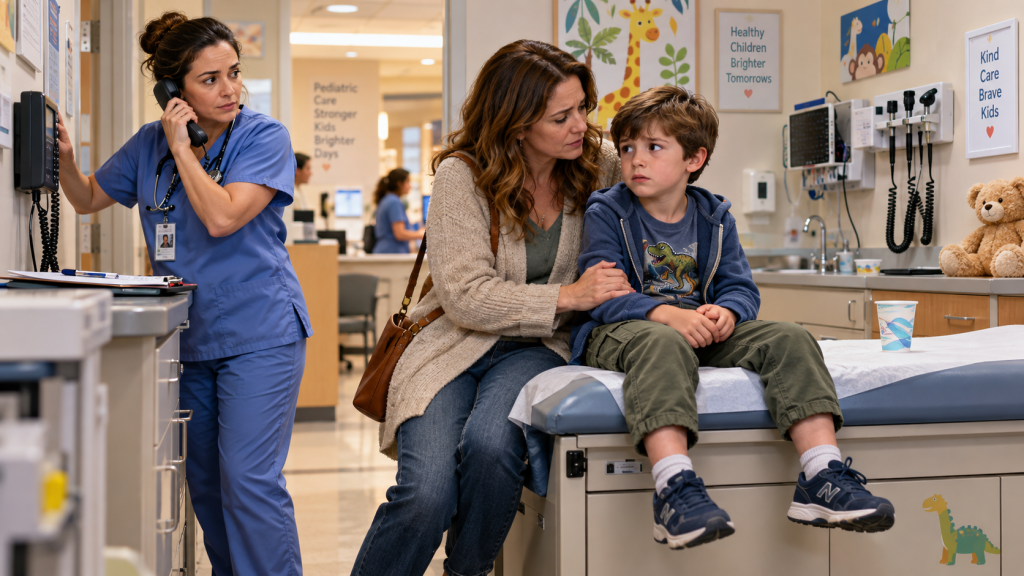
My six-year-old son sat on the exam table with both hands wrapped around the paper cup Anita had given him.
His knuckles were pale.
There was a tiny cartoon dinosaur printed on the cup.
I remember that ridiculous detail because sometimes the mind grabs something harmless when the rest of the room has become too frightening to understand.
Dana crouched a few feet away.
She did not touch Caleb.
She did not lean too close.
She simply said:
“What happens after Mike goes into the medicine drawer?”
Caleb looked at me.
Not Dana.
Me.
His eyes filled.
I had seen my son cry over scraped knees.
Broken crayons.
A balloon escaping into the sky.
This was different.
There was fear in his face.
But there was something worse underneath it.
Guilt.
As though he believed whatever came next would be his fault.
He whispered:
“He takes your sleepy pills.”
My mouth went dry.
“What sleepy pills?”
“The white ones.”
I had a prescription I rarely used.
My doctor had given it to me months earlier after I complained about not sleeping well.
Mike had teased me about it.
Called them my “knockout pills.”
I hated that phrase.
I kept the bottle in the top drawer of the bathroom vanity.
I took half the prescribed amount when I used it.
Sometimes none for weeks.
At least, that was what I remembered.
Caleb continued.
“He opens them.”
I stared at him.
“What do you mean?”
“He puts them in your drink.”
The room tilted.
“No.”
I did not mean to say it.
But I did.
No.
Not because I thought Caleb was lying.
Because the sentence had nowhere to fit inside the life I thought I had.
Caleb flinched.
Immediately.
His whole body folded inward.
“I’m sorry.”
That broke me.
“No.”
I moved toward him.
Dana raised one hand gently.
Not stopping me.
Reminding me.
Let him choose.
So I stopped.
Caleb looked at me.
I opened both arms.
He climbed off the exam table and launched himself into me so hard the back of my shoulder hit the wall.
“I’m sorry, Mommy.”
“You did nothing wrong.”
“I should’ve told.”
“You are telling.”
“I should’ve told before.”
“You are six.”
My voice broke.
“You are six years old.”
He cried against my chest.
“You were sleepy.”
I closed my eyes.
Fragments started arranging themselves.
The mornings I woke with headaches.
The nights I could not remember turning off the kitchen light.
The time Mike told me I had repeated the same story three times.
The time I found cereal in the refrigerator and laughed because Mike said I must have put it there.
The evening I woke on the sofa at two in the morning and could not remember lying down.
Mike had draped a blanket over me.
He kissed my forehead and said:
“You really need to talk to your doctor, babe. You’re getting more scattered.”
I had apologized.
To him.
I had apologized for worrying him.
Dana’s voice came carefully.
“Caleb, when your mom gets sleepy, what happens next?”
He pressed his face deeper into my shoulder.
“I don’t want him to hear.”
Anita said:
“He can’t hear you in here.”
“He hears everything.”
“The door is locked.”
Caleb looked toward it.
Mike shouted from the hallway again.
“What the hell is going on? That’s my family in there!”
A second man’s voice answered.
“Sir, I need you to step back.”
Security.
Caleb began shaking.
Dana did not raise her voice.
“Caleb, listen to me.”
He looked at her.
“Mike is not coming into this room.”
Caleb’s breathing stayed fast.
“He has the car.”
Dana nodded.
“That’s okay.”
“My backpack is home.”
“That’s okay too.”
His face crumpled.
“No, it’s not.”
That surprised me.
“Why?”
He turned toward me.
“My dinosaur is in there.”
I almost cried over a plastic dinosaur.
Instead I asked:
“Why is your backpack packed?”
He looked ashamed.
“For when we run.”
I could not breathe.
“For when?”
“When he gets really mad.”
My son had built an escape bag.
At six years old.
While I slept beside the man I thought was keeping us safe.
Dana asked:
“What’s in the backpack?”
Caleb started counting on his fingers.
“My blue shirt.”
“Socks.”
“Underwear.”
“Two crackers.”
“My toothbrush.”
“Mr. Rex.”
The dinosaur.
Then he hesitated.
“And the bottle.”
I felt every muscle in my body lock.
“What bottle?”
He whispered:
“Your pills.”
The room went still again.
“You have my medicine?”
“One bottle.”
“Why?”
“So he can’t put those ones in.”
My son had been trying to protect me.
Six years old.
Too small to reach the second kitchen shelf without climbing on a chair.
Packing crackers because he thought we might have to run.
Stealing my own medicine from the bathroom because he believed his stepfather was using it against me.
I sat down because my knees stopped working.
“Caleb.”
He stared at me.
“How long?”
He shook his head.
Dana intervened gently.
“You don’t have to know exact days.”
Caleb looked at his shoes.
“Since before Halloween.”
It was March.
Five months.
I covered my mouth.
Five months.
For five months, my child had known something about my marriage that I had not.
Anita quietly slid the tissue box toward me.
I did not use it.
I could not stop staring at Caleb.
Dana asked:
“What happens when Mike gets really mad?”
Caleb’s hand went to the yellow mark on his arm.
“He squeezes.”
“Your arm?”
A nod.
“Anywhere else?”
Caleb did not answer.
Dana waited.
That waiting mattered.
No one filled the silence for him.
Eventually he whispered:
“Sometimes my shoulders.”
“Does he hit you?”
Caleb looked at me.
I wanted to say:
Tell the truth.
Instead, I said nothing.
Dana had told me with one glance that the worst thing I could do now was accidentally become another adult he had to protect.
He shook his head.
“Not like punching.”
Dana nodded.
“Okay.”
“He grabs.”
“Okay.”
“And he puts me in the laundry room.”
My stomach turned.
“Why?”
Caleb answered me.
“If I wake you.”
I closed my eyes.
He continued.
“He says you need sleep.”
“How long are you in the laundry room?”
“I don’t know.”
“Is the door locked?”
He nodded.
My vision blurred.
“We don’t have a lock on that door.”
Caleb’s voice dropped.
“He puts the chair under the knob.”
I remembered the dining chair.
Sometimes in the mornings one chair would be missing from the table.
Mike said Caleb dragged it around to climb things.
I believed him.
Of course I did.
Because every individual thing had an explanation.
A chair.
A headache.
A quiet child.
A missing pill.
A bruise.
An upside-down magazine.
A backpack beside the bed.
Abuse rarely arrives wearing a sign.
Sometimes it arrives as a hundred little explanations offered by the same person.
Dana’s face remained calm, but her eyes had changed.
“Caleb, has Mike ever told you not to tell your mom?”
He nodded.
“What did he say would happen if you told?”
Caleb began to cry again.
“He said you’d go away.”
My heart stopped.
“Where?”
“To the crazy hospital.”
The words cut harder because they were childish.
Not psychiatric facility.
Not inpatient care.
Crazy hospital.
Mike’s language translated through a six-year-old.
Caleb continued.
“He says you forget stuff.”
“He says people know.”
“He says Grandma knows.”
My mother.
Oh God.
Had Mike been telling her?
I remembered her calling two months earlier.
“You sound tired, sweetheart.”
Then:
“Mike says you’ve been misplacing things.”
I became nauseated.
Caleb’s voice dropped even lower.
“He said if I told, they’d think I was lying because I’m a kid.”
I held myself perfectly still.
That was what predators of trust do.
They do not only create fear.
They create a courtroom in the victim’s mind.
They prewrite everybody else’s disbelief.
Dana looked at Anita.
Then at me.
“We need to move.”
“What do you mean?”
“Mike cannot leave here with either of you.”
A fresh wave of panic hit.
“He has my keys.”
“We can address transportation.”
“My purse is in the waiting room.”
“We’ll get it.”
“My phone—”
“Do you have it?”
I touched my pocket.
No.
Mike had asked for it in the parking lot because he said he needed to confirm the clinic address.
I never got it back.
Dana nodded slowly.
“Okay.”
That one word held more concern than shouting would have.
Anita picked up the wall phone.
“Security?”
She listened.
“Yes.”
“Keep him at the front.”
“Police are en route?”
My chest tightened.
Police.
The word made it real.
I whispered:
“Do we need police?”
Dana looked at me.
“We have a child reporting physical intimidation and confinement, a concern that someone may have been tampering with your medication, and an adult in the hallway demanding access to you.”
She did not dramatize it.
She listed it.
Facts.
I heard Mike’s voice again.
“This is ridiculous! Ask my wife. She gets confused when she’s stressed.”
There.
Right through the door.
He was already writing the story.
Dana heard it too.
She looked at me.
“Is that something he says often?”
I nodded.
“How often?”
“I don’t know.”
Then I heard myself.
I don’t know.
The phrase had become my answer for too many things.
Dana said:
“We’re going out through the back.”
My heart raced.
“Where?”
“First, another medical facility.”
“Why?”
“You need to be evaluated.”
“I’m fine.”
Anita spoke gently.
“That may be true.”
“But if Caleb is correct about medication being added without your knowledge, we need to make sure you are medically safe and document what can still be documented.”
That sentence frightened me.
Document.
Not because I did not believe my son.
Because suddenly we were building a record.
Something outside Mike’s version.
Anita retrieved my purse from the waiting area with security.
My phone was not inside.
Mike had it.
Of course.
Police arrived at 11:31.
I remember the clock.
Everything that morning became a timestamp.
11:18 — Dana arrived.
11:31 — officers arrived.
11:39 — we left through the back door.
12:07 — Caleb ate three peanut-butter crackers in the back seat of an unmarked county vehicle because he had not eaten since breakfast.
12:26 — I realized I had not asked where Mike was.
That realization scared me.
Not because I did not care.
Because for the first time in years, his location was not the first thing controlling mine.
Dana sat beside Caleb.
I sat across from him.
An officer drove.
We were taken first to the emergency department.
Not the same hospital where I worked? Wait I don’t work. No job given. Keep generic.
A nurse took blood.
Urine.
Asked what medications I had been prescribed.
I tried to remember.
I felt stupid.
Then stopped.
That feeling—stupid—had become one of Mike’s fingerprints on me.
Every time I hesitated, I heard his voice.
See?
You forget.
I forced myself to slow down.
I listed everything.
The doctor asked when I had last knowingly taken the sleep medication.
“Six nights ago.”
He looked at the lab order.
“Any over-the-counter sleep aids?”
“No.”
“Antihistamines?”
“Only if I’m sick.”
“Alcohol?”
“Rarely.”
“Anything last night?”
“Tea.”
“What kind?”
“Chamomile.”
“Who made it?”
The question landed.
“Mike.”
The doctor did not react.
Good professionals do that.
They let facts stay facts until evidence catches up.
Caleb was taken to a separate child-friendly room with Dana and another interviewer.
I panicked when I realized I could not go in.
“He needs me.”
Dana said:
“He does.”
“But he also needs the chance to talk without watching your face.”
I understood.
Hated it.
Agreed.
For nearly an hour, I sat alone with a hospital blanket around my shoulders.
Nobody to reassure.
Nobody to serve.
Nobody telling me what I remembered.
So memory began coming back in pieces.
Not hidden memories.
Things I had explained away.
Mike insisting he should handle my prescriptions because I “mixed up refills.”
Mike switching us to a family phone plan.
Mike saying my friend Jill was “too dramatic” until I stopped answering her calls.
Mike taking over driving because I “panicked in traffic.”
I had not panicked in traffic before marrying him.
But once, after a night when I barely slept, I missed an exit.
He never let the story die.
“Remember when you almost got us killed?”
I had not almost killed anyone.
I missed an exit.
He told it so often that eventually I remembered his version before my own.
A nurse came in at 2:10.
She sat beside me.
“The doctor will speak with you soon.”
“Is something wrong?”
“We’re waiting on confirmatory testing.”
My stomach tightened.
“Something showed up?”
She hesitated.
“The initial screen suggests exposure to a sedating medication that does not match what you told us you knowingly took.”
The room became very cold.
“What?”
“The physician will explain.”
“No.”
I stood.
“Tell me.”
She looked at me.
“You appear to have a sedating substance in your system.”
“How much?”
“The screening test doesn’t answer everything.”
“But enough that they’re taking your son seriously.”
My son.
Not me.
That sentence saved me.
Because some part of me was already trying to argue with the evidence.
Maybe I forgot.
Maybe I took something.
Maybe Mike was right.
Then I remembered Caleb hiding my pill bottle.
My six-year-old had no reason to invent pharmacology.
I sat back down.
The nurse touched my shoulder.
“Do you feel safe going home?”
The question sounded almost absurd.
“No.”
First clear answer all day.
No.
I did not feel safe.
And for once, nobody tried to convince me otherwise.
By evening, Dana had arranged temporary placement at a confidential family shelter.
I almost refused when she said shelter.
I pictured rows of cots.
Chaos.
Shame.
Women with nowhere to go.
Then I realized:
I was a woman with nowhere safe to go.
That did not make me less intelligent.
Less capable.
Less adult.
It made me someone whose home had become unsafe.
The shelter room had two twin beds.
A small dresser.
One lamp.
A bathroom.
Caleb walked in and immediately checked the lock.
Then the window.
Then behind the shower curtain.
I watched my child conduct a safety inspection.
Six years old.
He looked at me.
“Does Mike know where this is?”
“No.”
“Are you sure?”
Dana answered from the doorway.
“He does not.”
Caleb looked at me again.
“Can he track your phone?”
My stomach dropped.
My phone.
Still with Mike.
Dana said:
“That phone is not coming here.”
She had already arranged a temporary device.
New number.
No shared account.
No location sharing.
I stared at the cheap black phone in my hand.
It felt like freedom.
It also felt terrifying.
When you have lived under someone else’s system long enough, independence feels suspicious.
That first night, Caleb put his backpack beside the shelter bed.
Dana had arranged for police to retrieve essential belongings under supervision.
The backpack came too.
Inside was exactly what Caleb said.
Blue shirt.
Two pairs of socks.
Underwear.
A toothbrush.
Two cracker packages.
Mr. Rex.
And my prescription bottle.
Except the bottle was not full.
Caleb held it out to the detective with both hands.
“I hid it.”
The detective placed it in an evidence bag.
I wanted to snatch it back.
Not because of the medicine.
Because my child had carried it like a weapon he had taken away from a dangerous adult.
Police later searched our house under legal authority.
I was not there.
Thank God.
They found more than I expected.
Not some dramatic laboratory.
No secret basement.
Reality is often uglier because it is ordinary.
My pill organizer.
Two empty prescription containers in a trash bag beneath the garage workbench.
A mortar used for crushing tablets.
I had never owned a mortar.
Mike said he bought it for spices.
Maybe he had.
They found a packet of over-the-counter sedating tablets in his truck.
Legal to buy.
Not legal to secretly give someone.
They found screenshots on my phone.
Messages Mike had sent to my mother over months:
She’s forgetting things again.
I’m worried about her driving.
She gets worked up if I mention doctors.
Please don’t confront her. She gets paranoid when she feels judged.
He had built witnesses.
Not fake witnesses.
People who had been primed.
My mother called the new number after police spoke to her.
I almost did not answer.
Then I did.
She was crying.
“Baby.”
I had not heard her call me that in years.
“Mom.”
“I’m so sorry.”
I closed my eyes.
“For what?”
“I believed him.”
I leaned against the shelter wall.
“What did you believe?”
“That you were struggling.”
“That you were having memory problems.”
“That you didn’t want me involved.”
My chest hurt.
“Did I ever tell you that?”
“No.”
“Did I ever tell you I was afraid to drive?”
“No.”
“Did I ever tell you I was forgetting things?”
“No.”
She sobbed.
“He sounded so worried.”
Of course he did.
Control is more effective when it dresses as concern.
My mother whispered:
“I should have called you directly.”
“Yes.”
I did not rescue her.
She needed the yes.
“I’m sorry.”
“I know.”
“Can I come get you?”
“No.”
That surprised both of us.
“Why?”
“I need to stay here tonight.”
I looked at Caleb sleeping with one arm around Mr. Rex.
“I need to know I can keep us safe without immediately handing the responsibility to somebody else.”
Mom cried softly.
Then:
“Okay.”
Good.
The next morning, Caleb woke at 5:43.
He sat straight up.
Looked around.
Then whispered:
“Mom?”
“I’m here.”
“Did he find us?”
“No.”
He lay back down.
Thirty seconds later:
“Do I have to keep my backpack packed?”
I could not answer immediately.
That backpack had become the saddest object in the world.
I sat beside him.
“No.”
His eyes searched mine.
“Never?”
I almost said never.
Then stopped.
Children know adults cannot promise the universe.
“You don’t have to keep it packed because of Mike.”
I said.
“If we ever need to go somewhere, I’ll tell you.”
“You don’t have to be ready by yourself.”
He stared at me.
“Can I unpack Mr. Rex?”
“Yes.”
He pulled the dinosaur out.
Placed it on the pillow.
Then took out his blue shirt.
Socks.
Toothbrush.
Crackers.
Each item removed was a small surrender of vigilance.
When the backpack was empty, Caleb folded it and put it under the bed.
Then he asked:
“Can it stay close?”
“Yes.”
Healing did not require pretending fear disappeared overnight.
The forensic interview happened later that week.
I was not in the room.
Again.
I hated that.
Again.
But Caleb talked.
Not in one dramatic confession.
Children rarely tell trauma in clean order.
He talked about cartoons.
Kindergarten.
A red truck.
Then Mike.
The interviewer asked open questions.
Caleb explained that Mike sometimes put “extra sleepy stuff” into my tea.
How did he know?
Because one night he came into the kitchen for water.
Mike had the white bottle open.
Caleb saw powder on a spoon.
Mike noticed him.
Told him:
“Mom needs this because she gets crazy when she doesn’t sleep.”
Caleb believed him at first.
Then one night I became so sleepy at dinner that I dropped a fork.
Caleb asked whether I was sick.
Mike laughed.
“Mom’s fine.”
Later that night, Caleb came into our room because he had a nightmare.
He tried to wake me.
I did not wake.
He shook my shoulder.
Nothing.
Mike pulled him away.
Hard enough to leave marks later.
Then dragged? Need non-graphic. “took him by the arm.” He put Caleb in laundry room and told him if he woke me, I would “go crazy” and the police would take me away.
That became the pattern.
Not every night.
Enough.
If Caleb made noise after bedtime, Mike threatened him.
If he asked me questions the next morning, Mike answered first.
“Mom doesn’t remember.”
Eventually Caleb stopped asking.
Then he started preparing.
Backpack.
Crackers.
Medicine bottle.
He said something in that interview I did not hear until months later when the therapist told me.
“I thought if Mom woke up all the way, she would know.”
That sentence nearly destroyed me.
My child had been waiting for me to wake.
Not from sleep.
From a marriage.
Mike denied everything.
Of course.
His first story:
Caleb was imaginative.
Second story:
I had become emotionally unstable.
Third:
I misused my own medication and blamed him.
Fourth:
The mortar was for cooking.
Fifth:
He had only confined Caleb once, briefly, because the child was having a dangerous tantrum.
Every explanation contained a grain of possible reality.
That was Mike’s talent.
He never built lies from nothing.
He wrapped lies around small truths.
Yes, Caleb had tantrums sometimes.
He was six.
Yes, I had insomnia.
Yes, I sometimes forgot where I put keys.
Yes, Mike bought spices.
None of those facts meant he had permission to drug me or terrorize my child.
The toxicology confirmation became important.
The physician explained it carefully.
The levels and combination of sedating substances were not consistent with what I described knowingly taking.
It could not prove every individual night.
It could support the concern that I had been exposed without my knowledge.
Pharmacy records also showed refills requested earlier than expected.
Some pickup records were signed by Mike.
He had told me insurance “auto-refilled” them.
I had believed him.
Police recovered messages from his phone after getting proper warrants.
One to a friend made my stomach turn:
She sleeps like the dead now. Finally some peace.
His friend replied with a laughing emoji.
Maybe the friend thought it was a joke.
I did not care.
Another:
Kid’s getting nosy.
Then:
Need to get him to stop running to her every time he gets upset.
No confession.
No villain monologue.
But context.
Pattern.
Evidence.
My lawyer later explained that cases are rarely built on one perfect sentence.
They are built brick by brick.
A bruise.
A child’s consistent account.
A medical screen.
Medication records.
Messages.
Controlled phone access.
Witnesses.
Behavior.
The same way abuse had entered our house.
Brick by brick.
The emergency protective order came first.
No contact.
Temporary custody provisions? Mike is stepfather, so no parental rights perhaps. Good. Since Mike is stepfather, he may have no custody rights. Still protective order from both. He could challenge property and marriage but not custody. Simpler.
Mike was ordered to stay away from Caleb and me.
I was granted temporary exclusive access to the house for retrieval of belongings.
I did not move back.
That surprised Mike.
Through his lawyer he said I was “abandoning the marital residence.”
My lawyer said:
“Let him write poetry. You’re staying safe.”
Her name was Grace Chen.
I liked her immediately.
She did not speak to me like a fragile woman.
She spoke to me like a client whose reality had been interfered with long enough.
The first time we met, I apologized three times for not having complete financial records.
On the fourth, she said:
“Stop apologizing for documents he controlled.”
I stared.
Then cried.
She waited.
Good lawyer.
We learned Mike had also opened a credit card in both our names that I barely knew existed.
Not enormous debt.
A few thousand.
Tools.
Electronics.
Hotel charges from out-of-town “work trips.”
Maybe there was another woman.
I never investigated deeply.
People expected me to care.
I didn’t.
Infidelity would have been almost ordinary compared with everything else.
I cared that he had created financial dependence.
I cared that he put my phone in his name.
I cared that my paycheck deposited into a joint account he monitored.
I cared that he made me believe I could not drive.
I cared that my son slept beside an escape bag.
Those were the betrayals that mattered.
The first time I drove again, my hands shook so badly I had to pull over.
The shelter advocate, Lena, sat beside me.
“You’re okay.”
“I’m not.”
“Okay.”
She waited.
I gripped the steering wheel.
“What if he was right?”
“About?”
“That I’m dangerous driving.”
Lena looked at the empty parking lot around us.
“You just drove four miles.”
“I missed one turn.”
“That is what roads are for.”
I laughed despite myself.
Then cried.
She said:
“Do another mile.”
I did.
Then another.
By the end of the month, I was driving Caleb to school.
The first morning, he watched me from the back seat.
Very serious.
“What?”
I asked.
“Nothing.”
“Caleb.”
“You’re good at it.”
I almost laughed.
“Thank you.”
“Mike said you were bad.”
“I know.”
He looked out the window.
“He lied a lot.”
“Yes.”
Then:
“Did he lie because he hated us?”
Hard question.
“I don’t know.”
“Did he love us?”
Harder.
I took a breath.
“He may have believed some of what he did was love.”
Caleb frowned.
“That’s confusing.”
“Yes.”
“So what is love?”
I had to pull into the school line before answering.
“Love does not make you scared to tell the truth.”
That was the best answer I had.
He nodded.
Six-year-olds sometimes accept definitions adults spend years avoiding.
Therapy became part of our week.
Caleb hated it at first.
He thought therapy meant Mike had been right and there was something wrong with us.
His therapist, Ms. Naomi, explained it differently.
“Your brain learned to watch for danger.”
“That helped you.”
“Now we’re teaching it that it can rest sometimes.”
Caleb asked:
“Like a guard dog?”
“Yes.”
He loved that.
He drew his brain as a German shepherd wearing sunglasses.
We put it on the refrigerator.
At first, he startled whenever somebody knocked.
Would not close the bathroom door.
Refused to sleep without the hallway light.
Asked where I was going if I stepped outside to take trash.
We worked on predictability.
“I’m going to the mailbox.”
“I’ll be back in two minutes.”
“I’m taking a shower.”
“The door will be unlocked.”
“You’re going to school.”
“I will pick you up at 2:45.”
Again.
Again.
Again.
Safety is boring when it is real.
That became beautiful.
My own therapy was uglier.
I wanted quick answers.
Why didn’t I know?
Why didn’t I protect him?
Why did I marry Mike?
Why did I believe him?
My therapist, Dr. Shah, refused to give me the simple answer I wanted.
“Because you were stupid” would almost have been easier.
Instead:
“Coercive control works by changing the environment around a person.”
“You adapted.”
“That adaptation does not make you responsible for his choices.”
I hated that at first.
It sounded too kind.
Then I realized responsibility and regret could coexist.
I could regret every sign I missed without pretending I caused the signs.
I could say:
I should have asked why Caleb was quiet.
And also:
Mike should not have frightened him.
Both true.
I could say:
I let Mike control the phone account.
And also:
He used that access to isolate me.
Both true.
I could learn without turning learning into self-punishment.
That took months.
The divorce filing came in April.
Mike opposed almost everything.
Not because there was much to divide.
We rented.
Had two used cars.
Some savings.
Debt.
But control does not retire gracefully.
He wanted the marital furniture.
The truck.
Half my retirement account.
He accused me of exaggerating abuse for financial advantage.
Grace read his filing.
Then looked at me.
“Do you want the kitchen table?”
“What?”
“The table.”
“I don’t care.”
“Good.”
She marked it.
“Let him have it.”
I laughed.
That became our strategy.
Not surrender.
Priorities.
I wanted my personal documents.
Caleb’s birth certificate.
School papers.
My mother’s jewelry box.
The quilt my grandmother made.
My car.
A fair financial split.
Safety.
Everything else was replaceable.
Mike could have the television.
The sofa.
The dishes if he wanted.
He did.
Fine.
Every object I stopped fighting over felt like one less thread connecting me to him.
Then he asked for Caleb’s bicycle.
Grace looked at the list.
“Why?”
I stared.
“His bike?”
“Apparently he claims he paid for it.”
I started shaking.
Not because of the bicycle.
Because suddenly the whole case became the blue bike Mike had given Caleb for Christmas.
Red bow.
Caleb had screamed with joy.
For one day, Mike had looked like the stepfather I wanted him to be.
I wanted to fight.
Grace waited.
Then said:
“Ask Caleb.”
I did.
He thought.
Then:
“I don’t want it.”
“You loved that bike.”
“I know.”
“Are you sure?”
“Yes.”
“Why?”
He looked at me.
“Because he taught me on it.”
That memory belonged to Mike.
Caleb wanted a new one.
So I bought a used green bicycle from a neighborhood family.
Twenty-five dollars.
The seat was too high.
We lowered it.
Caleb rode in circles at the park.
First lap, I cried.
Second lap, he yelled:
“Mom, stop being weird.”
Healing.
The criminal case moved slowly.
Months.
Hearings.
Continuances.
Investigators.
I stopped counting.
Mike’s lawyer argued the medication evidence was ambiguous.
That Caleb’s statements were influenced by adults.
That the bruise could come from play.
That confinement was discipline.
That Mike’s messages were jokes.
Piece by piece.
That was his right in court.
I learned something uncomfortable:
Due process can feel like disbelief when you are the person who already lived the facts.
I hated waiting while everyone examined what Caleb had said.
But I came to understand why the system had to examine.
The same system that finally helped us needed rules because accusation alone cannot become punishment.
So I waited.
And kept living.
Caleb turned seven.
We held his birthday at a park.
No big party.
Six children.
Pizza.
A chocolate cake with too much frosting.
My mother came.
So did Nurse Anita.
I had invited her.
She hesitated.
Said nurses rarely attend former patients’ birthday parties.
I said:
“You closed a door.”
She came.
Caleb gave her a drawing.
A door.
Big red lock.
Two stick figures behind it.
One tall.
One small.
Overhead, in crooked handwriting:
SAFE ROOM 4
Anita cried.
So did I.
Dana came too.
She brought no gift except a book about dinosaurs.
Perfect.
At one point Caleb asked:
“Did you call Dana at 11:18?”
Anita laughed.
“How do you know the time?”
“Mom knows all the times.”
True.
Anita looked at me.
“I did.”
Caleb nodded.
“Good.”
That was all.
A life can turn on three buttons pressed into a wall phone.
I sometimes thought about what would have happened if I had canceled the rash appointment.
That thought could swallow me.
So Dr. Shah gave me a rule.
“You may visit that imaginary day once.”
“Then come back.”
So sometimes I imagined:
No appointment.
Cream at home.
Mike still there.
Caleb quieter.
Medication continuing.
Maybe the bruise fading.
Maybe something worse later.
Then I stopped.
Because that day did happen.
I bought cheap detergent.
A rash appeared.
I scheduled the appointment.
Anita asked the routine question.
Caleb answered differently.
That was our life.
Not the alternate one.
The clinic changed its own procedure after our case.
Not because they had done something wrong.
Because Anita advocated for private questions with children more consistently when appropriate.
She later told me:
“Routine questions save lives when we actually listen to unusual answers.”
I never forgot that.
Mike eventually accepted a plea arrangement.
Not to everything originally alleged.
The final charges reflected what prosecutors believed they could prove.
There were offenses connected to child endangerment and unlawful medication conduct, along with violations tied to his coercive behavior.
He received a custodial sentence followed by supervision and strict no-contact conditions.
I did not cheer.
I thought I would.
Instead, when the judge pronounced sentence, I stared at Mike and remembered the day we met.
Hardware store.
He helped me reach a box from a high shelf.
Made Caleb laugh with a tape measure.
For a while, he was kind.
Or seemed kind.
Maybe both.
That was the hardest thing to accept.
People want abusive men to have been monsters every minute.
Mine wasn’t.
If he had been, I would have left sooner.
He packed lunches sometimes.
Fixed my mother’s porch rail.
Sat beside me when I had the flu.
Then slowly, kindness became currency.
Control became concern.
Fear became normal.
The existence of good moments did not cancel the harm.
The harm did not require every earlier moment to have been fake.
Human beings are complicated.
Accountability can still be clear.
At sentencing, the prosecutor read part of my statement.
I had written twelve pages.
Grace made me cut it to three.
Rude.
The line I cared about most was this:
The worst thing you did was not convince me that I was forgetful. It was teach my child that keeping his mother safe was his job.
Mike looked down.
I continued:
He was six.
He packed underwear and crackers because the adult in our home made escape feel like a child’s responsibility.
Whatever happens to you now, I need the court to understand that Caleb and I are spending our lives teaching him the opposite.
Adults protect children.
Children do not protect adults from adult violence.
That was my truth.
Afterward, Mike tried to look at me as officers led him away.
I looked once.
Then at Caleb’s drawing in my bag.
Safe Room Four.
I chose that.
The divorce finalized seven months later.
I restored my own phone account.
Opened a new bank account.
Changed every password.
Froze my credit.
Worked with the pharmacy so only I could pick up certain medications.
My doctor removed the sleep prescription entirely because I did not want it anymore.
For months, I was afraid of tea if someone else made it.
That sounds ridiculous.
It wasn’t.
My mother once brought chamomile.
I stared at the cup.
She noticed.
“Oh, baby.”
“I’m fine.”
“No.”
She took the cup away.
Made a sealed bottle of water instead.
No questions.
That helped.
A year later, I made myself tea.
Drank every drop.
Nothing happened.
I cried.
Recovery is full of strange ceremonies nobody else sees.
The first unlocked phone.
The first solo drive.
The first cup of tea.
The first night you wake and realize no one has moved anything while you slept.
The first time your child closes his bedroom door because he wants privacy, not because he is hiding.
Caleb’s backpack stayed under his bed for months.
Empty.
Then one Saturday, I found it in the hallway.
“What’s this?”
He shrugged.
“School backpack broke.”
“You’re using this one?”
“Yes.”
I froze.
The escape backpack.
Blue and gray.
One torn strap.
He packed pencils.
Homework.
A library book.
Lunch.
Mr. Rex? No.
Mr. Rex stayed home.
I tried not to make a moment of it.
Failed.
Caleb saw my face.
“What?”
“Nothing.”
“You’re doing the weird crying thing.”
“Yes.”
He sighed like a tired old man.
“Mom.”
“Sorry.”
He wore the backpack to school.
For the first time, it carried things meant for where he was going, not things meant for running away.
I stood in the driveway long after the bus left.
The green bicycle leaned against the garage.
My car keys were in my own pocket.
My phone in my own name.
I could breathe.
Two years after Room Four, Caleb had another checkup.
Different rash.
Children apparently exist to keep parents humble.
Anita was still there.
When she opened the door and saw us, she smiled.
“Look who’s tall now.”
Caleb grinned.
“I’m almost fifty pounds.”
“Impressive.”
She checked vitals.
School.
Vegetables.
Sleep.
Screen time.
Then the routine question came.
“Who lives at home with you?”
I stopped breathing.
Caleb did not.
His legs swung casually.
His sneakers tapped the exam table twice.
Not a frightened clang.
Just movement.
“Me and Mom.”
Anita wrote it down.
“Anyone else?”
“Our fish.”
She looked up.
“Fish count?”
“His name is Kevin.”
“Then Kevin counts.”
Caleb smiled.
“That’s everyone.”
That’s everyone.
Three ordinary words.
I had to look away.
Anita saw.
Of course she did.
She finished the exam.
At the door, Caleb said:
“Wait.”
She turned.
“Yeah?”
He looked serious.
“Do you still close the door if kids get scared?”
Her eyes softened.
“Yes.”
“Good.”
Then we left.
In the parking lot, Caleb took my hand.
He did that less now.
Older.
More independent.
I squeezed gently.
“Hungry?”
“Yes.”
“What do you want?”
“Chicken nuggets.”
“Of course.”
We drove ourselves.
No one tracked the phone.
No one held the keys.
No one told me I was too nervous for traffic.
At a red light, Caleb started singing.
I nearly missed the green.
Not because I was confused.
Because my son was singing again.
I had forgotten the silence began before the rash.
I had forgotten how much music he used to make.
Bathtub songs.
Nonsense songs.
Songs about cereal.
For almost a year after leaving Mike, he hummed only when he thought I wasn’t listening.
Then slowly, noise returned.
That afternoon he sang about chicken nuggets being “tiny golden pillows.”
Terrible song.
Best sound I ever heard.
We moved eventually.
Not because Mike knew the old address.
Legal protections existed.
But the house had too many echoes.
Laundry room.
Medicine drawer.
The dining chair.
I wanted Caleb to have a bedroom that had never required an escape plan.
The new place was small.
Two bedrooms.
One bathroom.
Ugly brown carpet.
A kitchen drawer that stuck.
I loved it.
On move-in day, Caleb stood in his room.
“Where should my backpack go?”
I looked at him.
“Where do you want it?”
He thought.
Then hung it on a hook by the desk.
Not beside the bed.
Good.
My mother helped unpack.
She found Mr. Rex.
Held up the battered dinosaur.
“This old thing?”
Caleb grabbed it.
“He’s important.”
Mom smiled.
“I can see that.”
Later she whispered to me:
“I’m sorry I let Mike make me doubt you.”
We had discussed it many times.
Still, she needed to say it.
I answered differently now.
“You didn’t know.”
She looked relieved.
Then I added:
“But next time, ask me.”
She nodded.
“I will.”
Forgiveness without rewriting.
That became another skill.
Jill came back into my life too.
The friend Mike called dramatic.
I texted:
I owe you an apology.
She replied in forty seconds:
No, you owe me coffee.
I cried.
We met.
She did not say:
I knew it.
Thank God.
Instead:
“I thought something was wrong.”
“Why didn’t you push?”
“I did.”
I remembered.
She had asked if I was okay.
I said yes.
Twice.
Then Mike told me Jill was trying to “poison me against my marriage.”
I stopped responding.
Jill sighed.
“I figured if I pushed harder, you’d block me completely.”
She was right.
“Were you mad?”
“Yes.”
“At me?”
“A little.”
Fair.
“Still?”
“No.”
She smiled.
“Coffee fixed it.”
Good.
Caleb grew.
That sounds obvious.
But after trauma, growth feels like proof.
Eight.
Nine.
Ten.
Every birthday further from six.
At nine, he asked if he could read the statement he had given investigators.
I said no first.
Then discussed it with his therapist.
Eventually he was given an age-appropriate summary, not every detail.
He read quietly.
Then asked:
“Was I brave?”
I hated the question.
“You were.”
He smiled.
I continued.
“But I wish you hadn’t needed to be.”
His smile faded.
“Why?”
“Because children shouldn’t have to be brave about adults hurting them.”
He thought.
Then nodded.
“I like that better.”
At eleven, he stopped therapy regularly.
Not because everything disappeared.
Because he had tools.
He knew when fear was memory instead of current danger.
He knew locked doors can mean privacy.
He knew medicine should come from the person prescribed it or a trusted caregiver under clear rules.
He knew grown-ups can be wrong.
He knew grown-ups can be safe too.
Most importantly, he knew telling the truth was not betrayal.
That lesson took longest.
When he made mistakes, he used to panic.
Spilled milk.
Broken lamp.
Bad grade.
“I’m sorry, I’m sorry, I’m sorry.”
We practiced.
Accidents have solutions.
Bad choices have consequences.
Neither means love disappears.
The first time he broke a window playing ball, he stood in the kitchen trembling.
I looked at the shattered glass.
Then at him.
“Anyone hurt?”
“No.”
“Okay.”
“We’ll fix it.”
He stared.
“That’s it?”
“No.”
“You’re helping pay for it.”
His face fell.
“How?”
“Chores.”
He almost smiled.
Consequences without terror.
That became one of my proudest parenting moments.
At twelve, he asked about Mike.
Not what happened.
Why.
“Why did he do it?”
I told the truth.
“I don’t know all of it.”
“But he wanted control.”
“Over what?”
“Me.”
“You.”
“How people saw us.”
Caleb looked angry.
“Was he sick?”
I chose my words carefully.
“Having a mental illness does not explain or excuse abusing people.”
“So he was just bad?”
“People are more complicated than just bad.”
“That sounds like an excuse.”
“No.”
I looked at him.
“Complexity explains why we can miss danger.”
“It doesn’t erase responsibility.”
He sat quietly.
Then:
“Do you hate him?”
I thought.
“Not anymore.”
“Why?”
“Because hate kept him too present.”
“Did you forgive him?”
Another hard word.
“I stopped organizing my life around him.”
“That’s not the same.”
“No.”
“It’s what I needed.”
Caleb accepted that.
Teenagers understand boundaries better when adults stop turning them into slogans.
At thirteen, he joined track.
At fourteen, guitar.
He was terrible for six months.
Then slightly less terrible.
The first time he performed at school, I sat in the front row.
He rolled his eyes when he saw me.
Then looked for me before the first song.
Children grow.
Patterns remain.
I still attended every parent conference with a folder.
Documentation became comfort.
Then eventually, less.
By sixteen, Caleb drove.
That almost killed me emotionally.
He took the wheel.
I gripped the door handle.
“Mom.”
“I’m relaxed.”
“You’re praying.”
“I’m multitasking.”
He laughed.
Then:
“Mike used to say you couldn’t drive.”
I felt the old shadow.
“Yes.”
“He was wrong.”
“Yes.”
Caleb smiled.
“Good.”
Then merged onto the highway.
Terrifying.
Normal.
Beautiful.
We never became the family we were “supposed” to be.
Good.
I stopped wanting that.
Supposed families had nearly killed us.
We became ours.
Me.
Caleb.
My mother nearby.
Jill.
Friends.
Teachers.
Anita Christmas cards.
Dana occasional updates? As professional boundary maybe not continued contact. Better say once got thank-you card via clinic. Keep boundaries.
One year, we mailed Anita a Christmas card.
Front:
A photo of Caleb holding a giant fish.
Inside:
Still saying everyone.
She wrote back:
Still closing doors when needed.
I kept it.
At eighteen, Caleb packed a backpack again.
College.
That nearly destroyed me.
Blue-gray bag long gone.
New black one.
Laptop.
Clothes.
Chargers.
Snacks.
Toothbrush.
Same categories.
Completely different reason.
I watched from his bedroom doorway.
He caught me.
“No.”
“What?”
“Do not cry about the backpack.”
“I wasn’t.”
“You were about to.”
“Maybe.”
He sat on the bed.
“Come here.”
I did.
He was taller than me now.
When did that happen?
He said:
“Do you know what I remember most from the clinic?”
I held my breath.
“Room Four?”
“Yes.”
“What?”
“The water.”
I stared.
“The paper cup?”
“Yes.”
“Why?”
“Because Nurse Anita gave it to me and didn’t tell me to stop crying.”
My eyes filled.
Caleb continued.
“Mike always told me to stop.”
“Stop whining.”
“Stop being dramatic.”
“Stop waking you.”
“Anita gave me water like crying was normal.”
I cried openly now.
“That’s what you remember?”
“And the door closing.”
He smiled.
“It sounded safe.”
My throat closed.
Then he added:
“And you believed me.”
I shook my head.
“Not fast enough.”
“Yes.”
He said it firmly.
“You did.”
“I said he put stuff in your drinks and you looked like the world ended.”
“But you stayed.”
“You didn’t tell me I was making it up.”
“You didn’t tell me to be quiet.”
“You stayed.”
That forgiveness came from the only person whose opinion on that subject mattered to me.
I had spent twelve years wishing I could go back and become a different mother before Room Four.
Caleb loved the mother who existed inside it.
Imperfect.
Confused.
Terrified.
Listening.
That had to be enough.
I helped him zip the backpack.
He stood.
“Ready?”
“No.”
“Mom.”
“For college?”
“Yes.”
“I am.”
He hugged me.
Then:
“You don’t have to know where I am every minute.”
“Absolutely I do.”
He laughed.
“I’m changing my number.”
“Try it.”
We both knew the joke was safe.
He left.
I stood in the driveway.
No six-year-old in the back seat.
No packed escape bag under a bed.
Just a young man going somewhere because he chose to.
That was when the story finally changed shape in my mind.
For years, I thought Room Four was where our life broke.
It wasn’t.
The breaking had happened quietly at home.
Room Four was where somebody noticed the fracture and refused to call it normal.
A routine question.
A closed door.
A bruise.
A child who hesitated.
A nurse who did not rush.
A phone call at 11:18.
That was the hinge.
People sometimes ask me:
“How did you not know?”
I used to hear accusation in the question.
Now I answer differently.
“I knew pieces.”
I knew I was tired.
I knew Caleb was quiet.
I knew Mike made me doubt myself.
I knew I had become smaller.
I just did not know the pieces belonged to the same picture.
Abuse depends on fragmentation.
This happened because you’re tired.
That happened because the child misbehaved.
The phone is in my name because it’s cheaper.
I drive because you’re nervous.
Your friend is dramatic.
Your mother worries too much.
You forgot.
You misunderstood.
You’re confused.
One explanation per crack.
Until you stop seeing the wall is collapsing.
Anita saw one crack.
Then asked another question.
That was enough.
I also learned something more difficult.
Leaving was not one brave moment.
People like stories where a woman discovers the truth and walks out forever.
There was a back door.
Yes.
There was a shelter.
Yes.
There was a protective order.
But there were also mornings I missed Mike.
I hated myself for that.
Dr. Shah told me:
“You can miss the person you thought existed.”
That helped.
There were nights I wanted my old kitchen.
My bed.
The smell of our detergent before it became associated with rash and fear.
There were moments I remembered Mike making Caleb pancakes and thought:
Maybe—
Then I stopped.
Missing good moments is not evidence the bad ones were acceptable.
Leaving is not one decision.
Sometimes you make it again at 2 a.m.
Again when the lawyer calls.
Again when rent is due.
Again when your child asks why you cannot go home.
Again when someone says:
“But he always seemed so nice.”
Again when you feel lonely.
Again when freedom is expensive.
Again.
Again.
Eventually, the decision becomes your life instead of a daily emergency.
That happened to us.
Years after Mike’s sentence ended, I received one letter from him.
Forwarded through counsel.
He apologized.
Sort of.
He wrote that prison had given him time to think.
That he had been controlling.
That he had convinced himself my sleep problems justified “helping” with medication.
That he had been too harsh with Caleb.
Too harsh.
I hated that phrase.
Then:
I never meant to traumatize either of you.
I did not answer.
Intent had dominated enough of our lives.
I did not need to debate whether he meant every bruise, every locked door, every lie.
Impact existed.
Responsibility existed.
I put the letter in a file.
Years later, I shredded it.
Not ceremonially.
I needed space in the cabinet.
That felt healthier.
Caleb knows the letter existed.
He never asked to read it.
Good.
At twenty-one, he came home from college for spring break.
He opened the refrigerator without asking.
I watched.
He noticed me smiling.
“What?”
“Nothing.”
“You’re weird.”
“Yes.”
He took juice.
Drank directly from the carton.
“Use a glass.”
“Make me.”
I laughed.
Then froze for half a second.
Defiance.
Safe defiance.
My child did not scan my face for danger afterward.
He knew I would not punish him with fear.
I threw a dish towel at him.
“Animal.”
He laughed.
Later that night, music played from the shower.
Loud.
Terrible.
I sat at the kitchen table and listened.
The same boy who once stopped singing in the bathtub now sang badly enough to disturb neighbors.
I never asked him to lower the volume.
Some noise is worth keeping.
When Caleb was twenty-four, he became an elementary-school counselor.
That surprised me.
I thought he would choose engineering.
He had the grades.
Instead, he worked with children.
His first year, he called me after a difficult day.
“Mom.”
“Yes?”
“A kid asked me if I had to tell his parents something.”
My heart stopped.
“What did you do?”
“I followed protocol.”
Good.
“I told him what I had to report and what I could keep private.”
“Good.”
“He was scared.”
“I know.”
Silence.
Then:
“I thought about Anita.”
Of course.
He continued.
“I closed the door.”
I cried.
Not because history repeated.
Because care did.
People talk about cycles of abuse.
They should also talk about cycles of protection.
One nurse closed a door for a six-year-old.
Eighteen years later, that six-year-old became a man who knew how to make frightened children feel heard.
That is also inheritance.
The safe things pass forward too.
On Anita’s retirement day, Caleb and I attended the clinic reception.
She was older.
Gray at the temples.
Still the same calm face.
When she saw Caleb, she put both hands over her mouth.
“No.”
He smiled.
“Almost fifty pounds.”
She laughed through tears.
“You liar.”
He hugged her.
Then said:
“I work with kids now.”
She cried harder.
I gave her a small framed photograph.
Not of us.
Of Room Four’s door.
I had asked the clinic manager for permission to photograph it years earlier.
Plain beige door.
Silver handle.
Nothing special.
Underneath, a small engraved line:
Thank you for closing the door and opening one.
Anita stared.
Then looked at me.
“I just did my job.”
“No.”
I shook my head.
“You did your job well.”
That difference matters.
Millions of routines happen every day.
Forms.
Questions.
Checkups.
Safety exists when somebody notices the unusual pause.
Caleb’s sneakers hitting metal once.
A six-year-old looking at a door.
Do I have to say everyone?
Anita could have written:
Mom, stepdad, child.
Next question.
She didn’t.
She put down the clipboard.
That was the beginning.
Years later, she told me:
“I almost kept going.”
“What?”
“I thought he was shy.”
My stomach dropped.
“What made you stop?”
“The door.”
“What?”
“He looked at it before he looked at you.”
She paused.
“Kids look at parents when they’re unsure.”
“He looked at the door.”
So she closed it.
Tiny observation.
Everything after.
I think about that often.
Not to make myself afraid of every small sign.
To respect attention.
When someone becomes unusually quiet, notice.
When a child’s behavior changes, ask.
When a partner repeatedly explains your own mind back to you, pay attention.
When concern always results in less freedom for you, ask who the concern serves.
When someone says:
“You’re too sensitive.”
“You’re confused.”
“You remember wrong.”
“Everyone agrees with me.”
Stop.
Check outside the system they control.
That is what I wish I had known.
But I also refuse to spend the rest of my life punishing the woman who did not know it sooner.
She had enough punishment.
Her name was mine.
Caleb once told me:
“Mom, you’re nicer to old versions of me than old versions of you.”
He was right.
I had compassion for six-year-old Caleb.
None for thirty-eight-year-old me.
So I practiced.
I imagined her.
Sitting in a Dollar General parking lot with cheap detergent.
Counting days until payday.
Trying to keep a household together.
Believing her husband when he said he was helping.
Missing signs because every day required getting through dinner, kindergarten folders, bills, laundry, sleep.
I stopped calling her stupid.
Started calling her tired.
Then manipulated.
Then surviving.
Eventually:
Me.
Just me.
No adjective.
That was freedom too.
The bruise on Caleb’s arm faded within days.
The effects lasted longer.
But even those changed.
He became a man who did not like locked interior doors for years.
Then eventually moved into an apartment with one.
He called me:
“Guess what?”
“What?”
“Laundry room has a lock.”
My chest tightened.
Then he laughed.
“I took it off.”
I laughed too.
His choice.
Not fear.
Choice.
The old escape backpack did not survive childhood.
One zipper broke.
I almost kept it as a symbol.
Then Caleb said:
“Why?”
Good question.
We threw it away.
Objects do not need to become monuments for every bad thing.
Mr. Rex survived.
Of course.
The plastic dinosaur sits on a shelf in Caleb’s office now.
A child once asked:
“Why do you have a baby toy?”
Caleb said:
“He’s security.”
I like that.
My own security looks different.
Keys.
Phone.
Money I control.
Friends who know the truth.
A son who sings.
A mother who asks me directly now.
A life nobody else narrates for me.
I still forget things.
That amused me most.
At fifty, I left my wallet at the grocery store.
At fifty-two, I drove halfway to work wearing two different shoes.
At fifty-five, I put coffee in the cabinet.
When those things happened, I laughed.
Not because memory loss is funny.
Because ordinary forgetfulness no longer belonged to Mike.
A misplaced key was just a misplaced key.
Not evidence against my sanity.
That may be one of the quietest freedoms I regained.
Years after everything, I stood in the clinic waiting room while Caleb filled out paperwork for something unrelated.
A little boy nearby swung his legs from a chair.
Sneakers tapping plastic.
His mother looked exhausted.
His father scrolled his phone.
Completely ordinary.
For a second, my body returned to age thirty-eight.
Highlights magazine.
Rash.
Room Four.
Then Caleb touched my shoulder.
“You okay?”
“Yes.”
He waited.
I smiled.
“Actually, give me a second.”
He did.
No:
You’re fine.
No:
You’re overreacting.
No:
Let’s go.
Just time.
That was the man he became.
I breathed.
The old memory passed.
Then we left.
If you ask me where our story truly ended, I could name many moments.
The protective order.
Mike’s sentence.
The divorce.
The new house.
The empty backpack.
The second checkup.
College.
Anita’s retirement.
Caleb becoming a counselor.
But endings are rarely one clean event.
So I choose a morning.
Caleb was eight.
Two years after Room Four.
Saturday.
Rain.
I woke late.
For one terrifying second, I panicked because the house was quiet.
Then I heard music.
Not a radio.
Caleb.
Singing in the bathtub.
Loud.
Nonsense lyrics about soap.
I lay there listening.
No headache.
No missing time.
No one had put anything in my drink.
No chair blocked any door.
No backpack waited beside a bed.
My phone rested on the nightstand.
My car keys hung by the door.
The world was ordinary.
I started crying.
Caleb shouted from the bathroom:
“Mom! Are you awake?”
“Yes!”
“Can I have pancakes?”
“Yes!”
“Chocolate chips?”
“Absolutely not!”
He groaned dramatically.
I laughed.
Then got out of bed.
That is the ending I keep.
Not the courtroom.
Not Mike.
Not the evidence bags.
A child singing because he no longer had to listen for footsteps.
A mother waking because sleep had become sleep again.
A locked front door that meant safety, not captivity.
Years earlier, at a routine six-year checkup, Nurse Anita asked:
“Who lives in your house?”
My son looked at the door and whispered:
“Do I have to say everyone?”
She closed the door.
And because she did, eventually he could open every other one.
THE END STORIES! THANK YOU FOR READING GOOD LUCK !❤️
Related Posts