“DON’T LET THEM SEE US YET.” The voice drifted through the trees, low and urgent. I stopped breathing. Beside me, Emma tightened her fingers around my wrist. “Mommy,” she whispered, “is that Grandpa?” My heart began pounding so violently that I could feel it in my throat. Because she was right.
I recognized that voice. My father. Gordon Mercer. The man who had carried Emma on his shoulders when she was little. The man who used to tell me that family was the only thing worth protecting. The man who had kissed my forehead the previous night and told me to sleep peacefully because he would take care of everything. Now he was sitting inside a vehicle less than a hundred yards away.
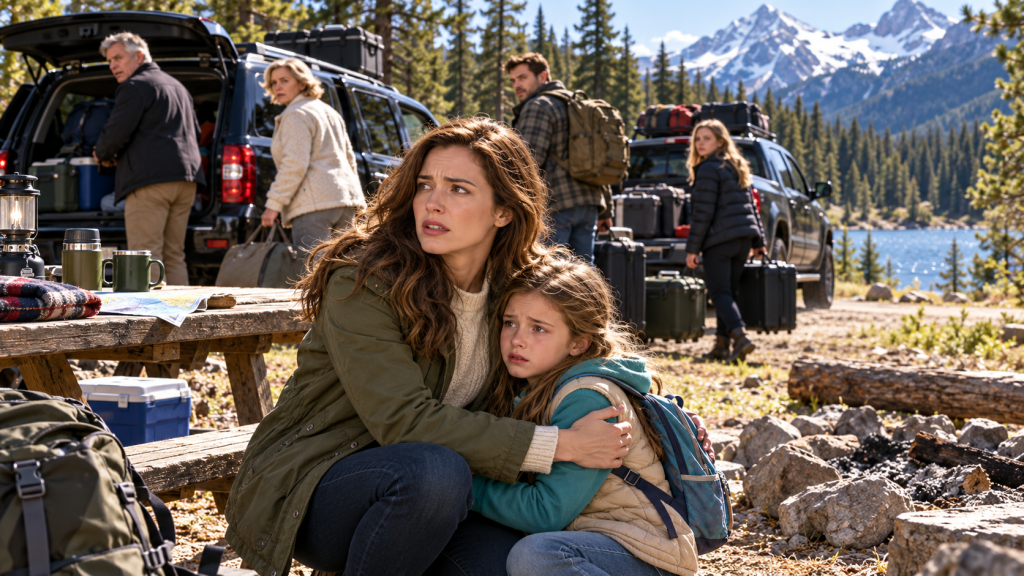
Watching the campsite where his daughter and granddaughter had been abandoned. And telling someone not to let us see him. I crouched beside Emma. “Sweetheart, stay very quiet.” Her eyes widened. “Are they coming to get us?” I couldn’t answer. Because through the trees, another voice replied. “Dad, we can’t stay here all morning.”
Brad.
My older brother.
The man whose handwriting was on the note pinned to the picnic table.
The man who had convinced me that a weekend in the mountains would help my daughter recover from losing her father.
I pressed one hand over my mouth.
My father spoke again.
“Did you check the campsite?”
Brad sounded impatient.
“From the road. Everything’s gone.”
“And the phones?”
“Valerie has them.”
My stomach dropped.
They weren’t here to rescue us.
They were checking whether their plan had worked.
Emma began trembling.
I wrapped an arm around her shoulders.
Then I heard my father’s next question.
“Can Sarah walk out?”
Sarah.
That was me.
Sarah Bennett.
Forty-one years old.
Widow of Nathan Bennett.
Mother of Emma.
And apparently someone whose ability to escape the wilderness had become a topic of discussion among the people I’d trusted most.
Brad gave a short laugh.
“Not before we finish what we started.”
My blood turned cold.
My father remained silent for several seconds.
Then said:
“The girl is only ten.”
I closed my eyes.
For one brief moment, I felt a flash of hope.
Maybe some part of him still understood.
Maybe he would come down the trail and take Emma into his arms.
Maybe this nightmare would end.
But Brad answered:
“She has water. Three bars. They can last until someone finds them.”
I stared at the purple backpack.
Three granola bars.
Two bottles of water.
A cheap lighter.
For two people.
In a forest where the temperatures dropped dangerously at night.
My father sighed.
“We can’t afford mistakes.”
Brad replied:
“Then stop acting like we’ve made one.”
A car door slammed.
I heard gravel crunch beneath tires.
Then my father said something I would remember for the rest of my life.
“Ten days, Brad. After that, the paperwork has to be finished.”
The engine grew louder.
Through a gap in the branches, I saw a dark green SUV reversing along the rough service road.
For an instant, sunlight flashed across its rear window.
I recognized the dent above the bumper.
My father’s vehicle.
The same one that had carried Emma and me to the campsite two days earlier.
I stood.
Every instinct in my body screamed at me to run after it.
To wave my arms.
To demand that they look at us.
But Emma was holding my hand.
Her fingers were freezing.
And the vehicle was already moving away.
“Grandpa!” she cried.
I caught her before she could run.
“Emma, no!”
She struggled.
“Mommy, that’s Grandpa! He’ll help us!”
The words broke me.
I knelt in front of her.
Held her face gently between my hands.
And looked into the eyes Nathan used to say were exactly like mine.
“Sweetheart, listen carefully.”
Tears filled her eyes.
“Grandpa saw us?”
I swallowed.
“I believe he knows we’re here.”
Her little face crumpled.
“Then why didn’t he stop?”
For a moment, the entire forest seemed to go silent.
I wanted to give her an answer that wouldn’t destroy her trust in the world.
But there wasn’t one.
“I don’t know why he made that choice,” I whispered.
Emma began crying.
“Did we do something bad?”
My heart shattered.
I pulled her against me.
“No, baby.”
She sobbed into my jacket.
“You did absolutely nothing wrong.”
I held her until her breathing slowed.
Then I looked toward the empty road.
My family had taken the tents.
The food.
The cars.
The phones.
Even the blanket my mother tucked around me before bed.
And when they returned to check on us, they chose to drive away again.
Whatever this was, it wasn’t a misunderstanding.
It was deliberate.
I took a long breath.
Then whispered into Emma’s hair:
“Your daddy taught us something important about being scared.”
She sniffled.
“What?”
“He said being brave doesn’t mean you aren’t frightened.”
Her eyes lifted.
“It means you keep thinking even when you are.”
I kissed her forehead.
“So that’s what we’re going to do.”
I stood and examined the campsite.
The fire pit was cold.
The picnic table was damp.
A narrow stream ran somewhere beyond the trees.
The access road curved through the forest, but I had no reliable way of knowing where it eventually led.
The nearest town might have been miles away.
I knew better than to lead my exhausted daughter blindly down an unfamiliar route.
Nathan had loved hiking.
He always insisted that if we were ever stranded in an unfamiliar place, we should focus on staying together, conserving energy, and making ourselves easier to find.
I looked toward the open clearing.
At least someone searching could see us there.
“Emma, we need to stay warm.”
She nodded.
“Okay.”
“And we need to make sure somebody knows we’re here.”
Her lower lip trembled.
“What if nobody comes?”
I crouched beside her.
“Then we keep helping each other until they do.”
We gathered dry twigs from beneath fallen branches.
I rebuilt a small fire in the existing fire ring, using the lighter Emma had found in her backpack.
The wood was damp.
It took several attempts.
But eventually, a tiny flame caught.
Emma clapped once.
Then immediately looked ashamed of smiling.
I brushed a strand of hair from her face.
“It’s okay to be happy about something good, sweetheart.”
She gave me a small, frightened smile.
We shared one granola bar.
I made sure she ate most of it.
She protested.
“Mommy, you need some too.”
I kissed her forehead.
“I know.”
Then I broke off a small piece.
“There. See?”
She nodded.
But her eyes kept drifting toward the road.
Waiting.
Hoping.
I knew she was still expecting her grandfather to return.
That hurt almost more than the cold.
Around midday, the clouds thickened.
Wind moved through the evergreens.
Emma shivered beside me.
I took off my outer sweater and wrapped it around her beneath her jacket.
She protested again.
“Mommy, you’ll be cold.”
I smiled.
“I have a little more insulation than you.”
She stared.
Then giggled weakly.
“Are you calling yourself fluffy?”
I laughed.
It came out broken.
“Maybe.”
For a moment, the sound of her laughter filled the empty campsite.
And I clung to it.
We waited.
And waited.
Every crack of a branch made me look up.
Every distant engine sent my heart racing.
But no one came down the road.
By late afternoon, Emma was exhausted.
Her cheeks were pale.
She kept asking how much farther we were from home, even though we hadn’t moved.
I realized she was beginning to lose track of time.
I sat beside her near the fire.
“Sweetheart, tell me something.”
She looked up.
“What?”
“What did Daddy call you when you were little?”
Her eyes brightened slightly.
“Captain Emma.”
I smiled.
“Why?”
“Because I always wanted to steer the boat.”
I laughed softly.
Nathan had owned a shipping and logistics company.
His work involved cargo terminals, warehouses, trucks, and freight vessels.
But whenever Emma visited his office, he made everything sound like an adventure.
Container ships became floating castles.
Forklifts became giant yellow dinosaurs.
And the people who kept everything moving were, in Nathan’s words, the real heroes of the harbor.
“He said I could be captain of the whole ocean,” Emma whispered.
Tears filled my eyes.
“He did.”
She looked down.
“Mommy?”
“Yes?”
“Would Daddy have left us?”
The question struck so hard that I almost couldn’t breathe.
I pulled her close.
“No, sweetheart.”
My voice broke.
“He would have done everything he could to keep us safe.”
Emma buried her face against me.
“I miss him.”
I closed my eyes.
“So do I.”
And there, surrounded by cold mountains and people who’d betrayed us, we cried for Nathan together.
Just before dusk, we heard another engine.
I stood.
My muscles ached.
The sound was faint, coming from a different direction.
Not the road where my father’s SUV had disappeared.
I moved into the clearing.
Then raised both arms.
“HELP!”
Emma stood beside me.
“HELP US!”
The engine grew louder.
Through the trees, I saw a flash of orange.
A utility vehicle.
With a white emblem on the door.
My heart leaped.
“EMMA! WAVE!”
We both waved.
I called again.
The vehicle slowed.
For one terrible moment, I thought it might keep going.
Then it stopped.
A woman wearing a forest-service jacket climbed out.
She had dark hair tucked beneath a cap.
A radio clipped to her shoulder.
And the unmistakable expression of someone who had just discovered something seriously wrong.
“Hello?” she called. “Are you two okay?”
I began crying.
“No.”
My voice broke.
“We’ve been left here.”
She hurried toward us.
“My name is June Ellis. I’m a ranger. Are either of you injured?”
I shook my head.
“Not seriously, but my daughter is cold. We have very little food or water.”
June immediately knelt beside Emma.
“Hey there, sweetheart.”
Emma stared at her.
“Are you really a ranger?”
June smiled.
“I really am.”
Emma began crying.
“Can you take us home?”
June’s expression softened.
“Yes. We’re going to get you somewhere warm and make sure you’re both all right.”
I nearly collapsed with relief.
June radioed for assistance.
Then helped us into her heated vehicle.
She gave Emma an emergency blanket and checked that she was alert and breathing normally.
I sat beside my daughter.
Held her close.
And watched the abandoned campsite disappear through the window.
For the first time since morning, I allowed myself to believe we would survive.
But then June asked a question that made everything inside me go cold again.
“Sarah, did someone report you missing?”
I looked at her.
“No.”
She hesitated.
“Are you certain?”
My heart began pounding.
“Why?”
June glanced toward me.
“Because this morning, our office received a message saying a woman and child were taking a private wilderness retreat and weren’t to be disturbed unless there was an obvious emergency.”
I stared.
“What?”
She continued carefully.
“The caller described your vehicle and campsite. They claimed you wanted to be left alone for several days.”
I felt sick.
Brad.
My father.
Perhaps Valerie.
They hadn’t merely taken our supplies.
They’d apparently tried to discourage anyone from looking for us.
I looked toward June.
“Who made the call?”
She shook her head.
“I don’t have that information here. We’ll preserve the details and pass them to the appropriate investigators.”
I swallowed.
Then whispered:
“My family abandoned us.”
June’s expression changed.
I continued.
“They took our phones. The cars. Everything.”
My voice broke.
“And then my father and brother came back to see whether we were still there.”
June stopped speaking for a moment.
Then said gently:
“Sarah, I’m going to make sure this is documented.”
I nodded.
“And your daughter will be seen by medical professionals.”
Emma pressed against me.
“Mommy?”
I looked down.
“Yes, baby?”
“Are we safe now?”
I kissed her forehead.
“Yes.”
Then I held her a little tighter.
“Right now, we’re safe.”
At the ranger station, someone gave Emma a warm blanket.
A paramedic examined her.
Another checked my temperature and hydration.
Neither of us had serious injuries, but we were cold, exhausted, and badly shaken.
Emma ate a sandwich.
Then another.
She looked almost embarrassed.
The paramedic smiled.
“Hungry?”
Emma nodded.
“Very.”
He laughed kindly.
“Then let’s fix that.”
I sat nearby, holding a paper cup of tea.
My hands would not stop trembling.
June approached.
“Sarah, is there anyone you trust who can help?”
I thought about my parents.
Brad.
Valerie.
All of them had been at the campsite.
All of them were gone.
Then I remembered one person.
“Nora,” I whispered.
June leaned closer.
“Who is Nora?”
“Nora Whitcomb. She’s my husband’s attorney.”
I swallowed.
“She also handles the trust.”
June gave me access to a phone.
I knew Nora’s number by heart.
Nathan used to tease me about it.
You remember our attorney’s number better than our anniversary.
I’d laugh.
That’s because Nora charges by the hour.
Now I couldn’t imagine anyone I wanted to speak with more.
She answered on the fourth ring.
“Whitcomb Law.”
A receptionist.
I swallowed.
“This is Sarah Bennett. I need Nora.”
“One moment, please.”
A pause.
Then Nora’s familiar voice.
“Sarah?”
The relief nearly undid me.
“Nora.”
My voice broke.
“Where have you been?” she demanded.
I closed my eyes.
“What?”
She sounded frantic.
“Sarah, we’ve been trying to reach you all day.”
My stomach tightened.
“Why?”
Nora took a breath.
“Brad contacted the company this morning.”
I stared.
“What did he say?”
A silence followed.
Then Nora answered:
“He said you had suffered a serious breakdown after Nathan’s death and disappeared with Emma.”
For a moment, I couldn’t speak.
My daughter was sitting less than ten feet away, eating a sandwich beneath an emergency blanket.
My family had abandoned us in the wilderness.
And my brother was telling the outside world I was mentally unwell.
“Nora,” I whispered, “that’s a lie.”
“I was hoping you’d say that.”
I covered my mouth.
Then she continued:
“Sarah, Brad has asked the company’s board to recognize him as temporary acting executive.”
My heart stopped.
“What?”
“He claims you’re unable to manage your responsibilities.”
I stared at the wall.
Then Nora said something that made my blood run cold.
“And he’s presented documents bearing your signature, authorizing a major asset sale.”
I closed my eyes.
Suddenly, I understood Brad’s words.
Ten days will be enough.
They didn’t necessarily expect the forest to hide us forever.
They needed us unreachable.
Unable to contradict them.
Long enough to push through a transaction that Nathan had spent his life building the company to avoid.
“Nora,” I whispered, “what are they trying to sell?”
She paused.
Then answered:
“The East Harbor cold-storage terminal.”
My breath caught.
Nathan’s most important expansion project.
The warehouse complex that handled refrigerated cargo for food distributors and medical suppliers.
The one he’d spent six years developing.
The facility he intended to make the foundation of Emma’s future.
I gripped the telephone.
“Brad has no authority to sell that.”
“I agree. We’re challenging his claims and preserving the records.”
My voice shook.
“How much?”
Nora took a breath.
“The proposed transaction is for eighteen million dollars.”
I stopped breathing.
Eighteen million.
For an asset whose value Nathan had told me exceeded thirty million in the right market.
“Nora,” I whispered, “who’s the buyer?”
There was a long silence.
Then she said:
“A company formed three weeks after Nathan died.”
My chest tightened.
“Who owns it?”
“We’re tracing the ownership now.”
I closed my eyes.
Then looked toward Emma.
My little girl had finally fallen asleep in the chair, holding the blanket against her face.
Her cheeks were still pink from the cold.
And somewhere, the people who left her in the forest were trying to sell her father’s legacy.
I took a breath.
“Nora, listen carefully.”
“I’m listening.”
“I’m alive.”
Her voice softened.
“I know.”
“Emma is alive.”
“Thank God.”
“And I am not missing, incompetent, or voluntarily unreachable.”
I looked toward June.
She stood nearby, speaking quietly with another ranger.
Then I continued.
“My family took our phones, supplies, and transportation. They abandoned us. A ranger rescued us.”
Nora was silent.
Then she whispered:
“Sarah, are you saying Brad did this deliberately?”
Tears filled my eyes.
“Yes.”
For several seconds, neither of us spoke.
Then Nora’s voice changed.
No longer frightened.
Focused.
Professional.
“Sarah, do not contact Brad or your parents yet. Let the investigators know everything you remember, and give me the ranger station’s details through a secure channel.”
I nodded.
“I will.”
She continued.
“I’ll notify the company’s authorized officers that you’ve been located and are exercising your rights. We’ll take immediate steps to challenge the documents and stop any unauthorized transaction.”
I swallowed.
“Nora?”
“Yes?”
“Can they sell it before we stop them?”
A pause.
Then she answered:
“Not lawfully on the authority they’re claiming. But we need to act quickly to prevent anyone from relying on the false documents.”
I looked at the clock above the ranger station door.
It was just after eight in the evening.
Less than twenty-four hours had passed since my family drove away.
And already, Brad had begun telling people I was mentally incapable.
Already, he had produced documents supposedly signed by me.
Already, he was trying to sell part of Nathan’s company.
But Brad had made one catastrophic mistake.
He believed that because my husband was dead, I was helpless.
He believed that because I was grieving, I couldn’t think clearly.
And he believed that by taking my phone and leaving me in the wilderness, he had taken away my voice.
I looked toward Emma.
Then whispered into the telephone:
“Nora, I want every document preserved.”
“Of course.”
“Every message.”
“Yes.”
“Every person who helped him.”
“We’ll follow the evidence.”
My voice stopped trembling.
“And when we find out what they did, I don’t want anyone telling me I should forget it because we’re family.”
Nora was quiet for a moment.
Then said:
“Sarah, nobody is going to ask you to surrender your daughter’s safety to protect someone else’s reputation.”
I closed my eyes.
And for the first time since waking to that empty campsite, I felt something stronger than fear.
I felt ready to fight.
Not with my fists.
Not with threats.
With the truth.
The first person who came to see us at the hospital was not my mother.
Not my father.
Not Brad.
It was Luis Romero, Nathan’s closest friend and the chief operating officer of Northstar Freight.
He arrived shortly after midnight.
His jacket was still damp from the rain.
His eyes were red.
And the moment he saw me sitting beside Emma’s hospital bed, he stopped in the doorway.
“Sarah?”
I looked up.
“Luis.”
He covered his mouth.
Then crossed the room and wrapped his arms around me.
For a moment, neither of us spoke.
I hadn’t realized how badly I needed to see someone who had loved Nathan without wanting anything from the company he left behind.
Luis stepped back.
“Are you both all right?”
I nodded.
“Emma’s exhausted. The doctors want to monitor her overnight, but she’s going to be okay.”
He looked toward my daughter.
She was sleeping beneath a warm blanket.
A nurse had found her a stuffed fox from the hospital’s collection of donated toys.
Emma was holding it tightly.
Luis’s eyes filled.
“Nathan would have been terrified.”
My throat tightened.
“He would have come looking.”
Luis nodded.
“Every road. Every trail. Every mountain.”
I closed my eyes.
Then whispered:
“I know.”
Luis pulled a chair beside mine.
“Nora told me what happened.”
I stared at him.
“All of it?”
“Enough.”
His jaw tightened.
“Your family left you out there?”
I nodded.
“And Emma?”
“Yes.”
For a moment, he turned away.
When he looked back, his eyes were shining.
“Sarah, I don’t understand how anyone could do that.”
I looked toward my daughter.
“Neither do I.”
Luis took a breath.
“There’s something you need to know about the company.”
My stomach tightened.
“Brad?”
He nodded.
“He came into the headquarters yesterday morning.”
I stared.
“After he left us?”
“Yes.”
“What did he say?”
Luis looked deeply uncomfortable.
“He told everyone you needed rest after Nathan’s death.”
My chest ached.
“Rest?”
“He said you and Emma had gone away for a private retreat, and that he would be handling urgent matters.”
I shook my head.
“He left us without transportation.”
Luis’s jaw tightened.
“I know that now.”
He continued.
“When our finance director asked for written authorization, Brad showed her a document.”
My stomach tightened.
“Bearing my signature?”
Luis nodded.
“Yes.”
I closed my eyes.
Then he said:
“Priya wouldn’t accept it.”
I looked up.
“What?”
“Priya Shah. Our finance director.”
I knew Priya well.
She had worked beside Nathan for nine years.
Quiet.
Meticulous.
The kind of person who noticed when a decimal point was in the wrong place.
Nathan used to say that Priya had saved him from more bad decisions than any board meeting ever had.
“She called Nora,” Luis continued.
“And Nora told us not to act on Brad’s instructions.”
Relief washed through me.
I covered my face.
“Thank God.”
Luis nodded.
“But Brad wasn’t satisfied.”
I lowered my hands.
“What did he do?”
“He called an emergency management meeting with two outside directors.”
My heart tightened.
“Can he do that?”
“He can request one. That doesn’t mean he has authority to make decisions.”
I swallowed.
“And the terminal sale?”
Luis’s expression darkened.
“Someone had already prepared a purchase agreement.”
I stared.
“Before the camping trip?”
He nodded.
“The draft is dated nine days before you left.”
A chill ran down my spine.
Nine days before we went camping, Brad had already been preparing to sell Nathan’s terminal.
The family weekend wasn’t where the scheme began.
It was where they intended to silence me.
Luis took a breath.
“Sarah, there’s another problem.”
I looked at him.
“What?”
“The buyer has already put down a deposit.”
My stomach tightened.
“How much?”
“Five hundred thousand.”
I stared.
“And where is it?”
“In an escrow arrangement under review.”
I swallowed.
“Who accepted it?”
“That is one of the things Nora and Priya are investigating.”
For a moment, the hospital room seemed unbearably small.
Emma slept beside us.
The monitors beeped softly.
Rain tapped against the windows.
And outside, businesspeople were apparently trying to move millions of dollars through a transaction I had never approved.
I looked toward Luis.
“Is Northstar in trouble?”
His expression softened.
“Not in the way Brad has been telling people.”
I sat up.
“What do you mean?”
He hesitated.
Then said:
“Sarah, the company has debt, like most companies of its size. But it’s operating. Our major contracts are current. Nathan left it in a sound position.”
I closed my eyes.
“Then why does Brad keep saying we have to sell?”
Luis leaned forward.
“That’s exactly what we need to discover.”
At three in the morning, a nurse came to check Emma.
My daughter stirred.
Opened her eyes.
And saw Luis.
For a moment, she stared.
Then her face changed.
“Uncle Luis?”
He smiled gently.
“Hey, Captain.”
Emma began crying.
Luis moved closer.
“What’s wrong?”
Her voice trembled.
“Did you come to get us?”
His eyes filled.
“I came as soon as I knew where you were.”
Emma looked toward me.
Then back at him.
“Grandpa saw us.”
Luis went still.
My daughter continued.
“He didn’t stop.”
For a long moment, nobody spoke.
Then Luis knelt beside her bed.
“Emma, can I tell you something?”
She nodded.
“You deserved to be helped immediately.”
Her lip trembled.
“And you deserved to be safe.”
A tear slipped down his cheek.
“None of this was because of something you did.”
Emma reached for his hand.
He held it.
Then she whispered:
“Daddy would have stopped.”
Luis lowered his head.
“Yes, sweetheart.”
His voice broke.
“He would have.”
The next morning, a detective arrived.
Her name was Detective Mara Collins.
She spoke to me first.
Then, with appropriate care and professional support, arranged for Emma’s account to be obtained without making her relive the experience repeatedly.
I was grateful for that.
My daughter had already been through more than any child should endure.
I wasn’t going to let every adult who wanted answers ask her to tell the same frightening story again.
Detective Collins asked me to describe the trip.
When Brad first suggested it.
Who attended.
What supplies we’d brought.
What happened before we slept.
And what I remembered upon waking.
I told her everything.
The missing tents.
The tire tracks.
The stolen phones.
The note.
The three granola bars.
The sound of my father’s voice.
The conversation about ten days.
And the second departure.
When I finished, Detective Collins remained quiet for a moment.
Then asked:
“Did you agree to remain alone at the campsite?”
I stared at her.
“No.”
“Did anyone tell you they intended to leave?”
“No.”
“Did anyone arrange emergency communication or transportation for you?”
I shook my head.
“Not that I knew of.”
She nodded and made a note.
Then she asked:
“Do you believe your family expected you to remain at the campsite for ten days?”
I swallowed.
“That’s what I heard.”
“And why do you think they wanted that?”
I looked toward Emma.
Then answered:
“Because Brad was trying to use my absence to take control of my husband’s company.”
Detective Collins nodded.
“We’ll examine the evidence relating to the abandonment and coordinate with the relevant authorities on any financial wrongdoing.”
I swallowed.
“Could they have killed us?”
Her expression changed.
I continued.
“It was cold. We had almost no supplies.”
My voice broke.
“And Emma is ten.”
The detective didn’t offer an easy reassurance.
She said carefully:
“Leaving two people without adequate supplies in an isolated area can create serious danger. The evidence concerning what each person knew and intended will be important.”
I nodded.
Then whispered:
“I want them to understand what they did to my daughter.”
Detective Collins looked toward Emma.
Her voice softened.
“We’ll do our job.”
Before she left, I remembered something.
“The note.”
She looked up.
“What note?”
“The one Brad left on the picnic table.”
I swallowed.
“‘This is a necessary reset. Trust me.’”
The detective nodded.
“The ranger documented and preserved an item matching that description at the campsite.”
Relief washed through me.
It hadn’t been lost.
The cruel little message had survived.
Then I said:
“And Brad’s wife collected our phones the night before.”
Detective Collins made another note.
“Do you know where the devices might be?”
“No.”
I swallowed.
“But if someone still has Emma’s phone, please make sure they don’t use it to contact her.”
The detective nodded.
“We’ll document that concern.”
That afternoon, Nora came to the hospital.
She carried a small overnight bag.
Clean clothes.
My glasses.
And Emma’s favorite blue sweater.
I stared.
“Where did you get these?”
“Luis went to your house.”
I looked up.
“My house?”
She nodded.
“He had permission through the arrangements you’d made for company emergencies, and he brought only the items you requested.”
My eyes filled.
For a moment, I couldn’t speak.
Then Nora hugged me.
“Sarah,” she whispered, “I am so sorry.”
I closed my eyes.
“So am I.”
When we sat down, Nora opened her briefcase.
“I need to explain what we’re doing to protect the company.”
I nodded.
“Okay.”
She placed a copy of Nathan’s trust documents in front of me.
I recognized the thick pages.
Nathan and I had spent months working with advisers on the estate plan after his first serious health scare.
He’d wanted to make sure Emma was protected.
He’d wanted the company to survive even if something happened to him.
And he’d wanted me to have the ability to make choices without being bullied by people who treated my grief as weakness.
Nora pointed toward a paragraph.
“Nathan made you the successor trustee for the voting interest held by the family trust, subject to the safeguards in this agreement.”
I nodded.
“I remember.”
“And major transactions involving trust-controlled shares require specific procedures and independent approvals.”
“Yes.”
She looked up.
“Brad cannot simply replace you because he tells people you’re grieving.”
I let out a shaking breath.
“Good.”
Nora continued.
“He can make allegations. He can submit documents. He can request temporary corporate action. But none of those things automatically gives him your authority.”
I nodded slowly.
“And the sale?”
“We’ve notified the relevant parties that the purported authorization is disputed. The company has also taken steps to prevent the transaction from proceeding without valid approvals.”
For the first time, I felt a little of the pressure leave my chest.
But Nora wasn’t finished.
“Sarah, there’s something troubling about the buyer.”
I looked at her.
“What?”
“The company is called Meridian Harbor Holdings.”
I frowned.
“Never heard of it.”
“Neither had Nathan’s regular advisers.”
My stomach tightened.
Nora continued.
“It was recently organized, and the initial public records don’t identify every person who may benefit from it.”
I swallowed.
“So Brad could be connected to it?”
“Possibly. We’re tracing the relationships rather than assuming.”
I looked toward Emma.
She was watching cartoons with the volume low.
For a moment, she looked like an ordinary child again.
A tired little girl in a hospital bed.
Not the daughter of a man whose business interests were being fought over by people who should have been grieving him.
“Nora,” I whispered, “why do they want the terminal so badly?”
She hesitated.
Then pulled out another document.
“Because Nathan had been working on a major expansion contract before he died.”
I frowned.
“What expansion?”
Nora studied me.
“Did he tell you about the federal medical-supply distribution agreement?”
I shook my head.
“He mentioned negotiations.”
She nodded.
“They were close to completion.”
My heart tightened.
“And?”
“If the agreement proceeded, it could significantly increase the value of the terminal.”
I stared.
Then whispered:
“Brad knows.”
Nora considered.
“He was included in some early discussions while Nathan was alive.”
My blood ran cold.
The proposed eighteen-million-dollar purchase was already far below the terminal’s estimated value.
But if a major new contract was about to increase that value, the gap could become even larger.
Someone who bought it cheaply could profit enormously.
I looked at Nora.
“Did Nathan know Brad was interested?”
Her expression changed.
For a moment, she didn’t speak.
Then she reached into her briefcase.
Removed a sealed envelope.
And placed it on the bed between us.
My name was written across the front.
In Nathan’s handwriting.
SARAH — IF ANYONE TRIES TO RUSH YOU.
I stopped breathing.
For a moment, the hospital disappeared.
I saw Nathan sitting at our kitchen table.
His sleeves rolled up.
His glasses slipping down his nose.
The way he always leaned forward when he was concentrating.
“Nora,” I whispered, “what is this?”
She took a breath.
“Nathan left it with me several months before he died. He asked that I give it to you if anyone attempted to pressure you into an urgent transfer involving the company.”
My hands began trembling.
I stared at the envelope.
Nathan had been gone for eight weeks.
Eight weeks without hearing his voice.
Without feeling his hand in mine.
Without listening to him laugh at Emma’s terrible jokes.
And now there was a message from him.
Written before he knew it would become necessary.
“Sarah,” Nora said softly, “you don’t have to open it today.”
I looked at the envelope.
Then at Emma.
Then back at Nora.
I swallowed.
“Yes.”
My voice broke.
“I do.”
I broke the seal.
Inside was a handwritten letter.
And a small flash drive.
My beautiful Sarah,
If Nora is giving you this, it means somebody has tried to make a decision for you before you’re ready.
I hope I’m sitting beside you when you read it.
But if I’m not, I need you to remember something.
You are not fragile because you love deeply.
You are not incapable because you grieve.
And you do not owe anyone the company Emma and I built our lives around merely because they share your last name.
I pressed the letter against my mouth.
Tears streamed down my cheeks.
For a long time, I couldn’t read another word.
Nora waited.
Then I unfolded the page again.
I know you trust Brad.
I want to trust him too.
But I’ve discovered transactions that trouble me, and I need them investigated before anyone gives him additional authority.
I’ve preserved the records with Nora and Priya.
Please do not let anyone convince you to sign away the East Harbor terminal without independent advice.
It represents years of work, and its future is too important to decide under pressure.
My hands began shaking.
Nathan had suspected something.
Before his death.
Before Brad brought casseroles and documents to our house.
Before the camping invitation.
I kept reading.
If I’m gone, I know you’ll be frightened.
I know you’ll worry about Emma.
But remember the woman I married.
The woman who sat beside me on the floor of our first apartment, surrounded by unpaid bills, and told me we would find a way.
The woman who worked nights so I could keep our tiny shipping office open.
The woman who insisted that the people loading our trucks mattered as much as the executives signing contracts.
I sobbed.
Because he remembered.
Before Northstar became a company worth millions, we had lived in a cramped apartment.
Nathan had driven delivery trucks himself.
I had handled invoices and payroll from a folding table.
We had eaten cheap pasta.
Argued about bills.
And celebrated our first profitable month with a grocery-store cake.
The company wasn’t a gift my husband had dropped into my lap.
I had helped build it.
Then stepped back from daily management when Emma was born.
Brad had always acted as though I knew nothing about business.
But Nathan knew better.
I continued reading.
You know more than they think.
You always have.
Don’t let grief make you forget that.
And whatever happens, protect Emma’s right to grow up surrounded by people who love her for who she is.
Not for what she might inherit.
All my love, for every day I get and every day I don’t.
Nathan.
I pressed the letter to my chest.
And cried.
For a moment, I could almost hear him.
You know more than they think.
I looked toward Nora.
She had tears in her eyes.
Then I looked at the flash drive.
“What is on this?”
Nora took a breath.
“Copies of the financial records Nathan was concerned about.”
My heart tightened.
“Concerning Brad?”
“Yes.”
I stared.
Nora continued.
“Nathan had discovered payments to a consulting company that didn’t appear to have provided the services it billed.”
My stomach dropped.
“Who owned it?”
She hesitated.
“We believe it was connected to Brad.”
I closed my eyes.
Then Nora said:
“Sarah, the irregular transactions began long before Nathan died.”
I looked toward the hospital window.
The sun was setting.
My daughter was safe.
Nathan’s letter lay in my hands.
And the outline of my family’s betrayal was becoming clearer.
Brad hadn’t suddenly become greedy when Nathan died.
He’d already been looking for ways to take money from the company.
Nathan had started asking questions.
Then died unexpectedly.
And Brad had used the worst weeks of my life to try to finish what he couldn’t accomplish while my husband was alive.
I looked back at Nora.
“Did Nathan ever confront him?”
She hesitated.
“Not formally. He wanted the records verified first.”
I swallowed.
Then whispered:
“How did Nathan die?”
Nora’s expression softened.
“Sarah, his medical records describe a sudden cardiac event. We have no evidence connecting his death to Brad.”
I nodded.
I hadn’t meant to accuse anyone.
But after what happened in the forest, my mind was reaching for explanations everywhere.
I looked down at Nathan’s letter.
Then took a breath.
“Good.”
Nora looked at me.
I continued.
“Because I don’t want to invent another crime just because I’m frightened.”
I wiped my cheeks.
Then said:
“I want the truth.”
Nora nodded.
“That’s exactly what we’re working toward.”
But before she could answer my next question, her phone rang.
She glanced at the screen.
Her expression changed.
“It’s Priya.”
She answered.
“Hello?”
For several seconds, she listened.
Then sat straighter.
“What?”
My heart began pounding.
Nora looked toward me.
Her eyes widened.
Then she said:
“Send the records immediately.”
She ended the call.
For a moment, she stared at the phone.
“Nora?”
She looked up.
“We found the first documented connection between Meridian Harbor Holdings and your family.”
My stomach tightened.
“Brad?”
She shook her head slowly.
Then whispered:
“Your father.”
“My father?”
The words barely escaped my throat.
Nora was still holding her phone.
Her expression was the same one I’d seen when Nathan’s accountant first told us our tiny freight company was facing a six-figure loss.
Focused.
Troubled.
Already searching for the next document.
“Sarah,” she said, “we’ve traced part of the buyer’s financing.”
I looked at her.
“And?”
“A holding company associated with Gordon Mercer provided funding to Meridian Harbor Holdings.”
For a moment, I couldn’t speak.
My father.
The man who taught me to ride a bicycle.
The man who stood beside me on my wedding day.
The man who told Nathan, Take care of my little girl.
He was helping finance an attempt to buy the most valuable part of my husband’s company.
At a price far below its estimated worth.
While I was stranded in the wilderness.
I sat very still.
“Nora, could it be an ordinary investment?”
She nodded.
“It’s possible for family members to invest in legitimate transactions. That alone doesn’t establish misconduct.”
I swallowed.
“But combined with everything else?”
Her eyes softened.
“We have serious reasons to investigate.”
I thought of my father’s voice behind the trees.
Don’t let them see us yet.
Then his warning to Brad.
Ten days. After that, the paperwork has to be finished.
The pieces were coming together.
And I hated the picture they made.
“Sarah,” Nora said gently, “you should rest.”
I almost laughed.
“How?”
She looked toward Emma.
My daughter was still asleep.
Her face had finally regained its color.
The hospital blanket was tucked around her shoulders.
For a moment, I felt ashamed that I had spent so much time discussing financial documents while she lay only a few feet away.
Then I reminded myself why the documents mattered.
Not because I needed another dollar.
Because my family had endangered Emma to get access to them.
I leaned back.
“Did my father know Nathan was investigating Brad?”
Nora hesitated.
“We’ve found indications that Brad sought Gordon’s help after Nathan began asking questions. We haven’t established everything they discussed.”
I closed my eyes.
There was so much I hadn’t known.
Nathan had always tried to protect me from conflict with my family.
Sometimes I loved him for that.
Now I wished he’d told me sooner.
But I understood why he hadn’t.
I had adored my parents.
And for years, I treated Brad’s selfishness like an inconvenience that would eventually disappear.
I remembered the afternoon Nathan asked me whether I’d ever considered setting limits with my brother.
We’d been sitting on the back porch.
Emma was inside watching a movie.
Nathan had brought me a cup of tea.
“Sarah,” he’d said, “Brad keeps asking me for a position at Northstar.”
I’d sighed.
“I know.”
“He wants authority over purchasing.”
I frowned.
“Isn’t he qualified?”
Nathan had been quiet.
Then said:
“Being your brother doesn’t automatically make him qualified to manage millions of dollars.”
I’d laughed.
“Don’t be dramatic.”
He hadn’t laughed.
Now, remembering his expression, I felt sick.
Nathan had been warning me.
Not because he disliked my family.
Because he had seen something I refused to examine.
The following morning, Emma was discharged.
Before we left, a hospital social worker met with us.
She helped me arrange appropriate support for Emma and explained that children sometimes respond to frightening experiences in unexpected ways.
Some become quiet.
Some cling.
Some seem perfectly cheerful until a memory suddenly frightens them.
I listened carefully.
Then looked toward my daughter.
She was sitting on the hospital bed, putting tiny shoes on her stuffed fox.
“Emma,” I asked gently, “are you ready to go home?”
She looked up.
For a moment, she smiled.
Then her expression changed.
“Are Grandma and Grandpa going to be there?”
My heart tightened.
“No, sweetheart.”
Her shoulders relaxed.
“Okay.”
That one word nearly broke me.
Okay.
As though knowing her grandparents would not be present was the first thing she needed before feeling safe.
Luis drove us home.
Nora had arranged for the locks and access codes to be reviewed because my family had previously had keys and knew how to enter the property.
I wasn’t going to take chances.
Not after what happened.
As we approached the house, Emma sat forward.
“Mommy?”
“Yes?”
“Is Daddy’s tree still there?”
I smiled sadly.
“Of course.”
Nathan had planted an apple tree in the backyard the summer Emma turned six.
He’d told her that one day she could eat apples from a tree they’d planted together.
She’d insisted on watering it every day for two weeks.
Sometimes three times.
Nathan finally had to explain that too much love could drown a tree.
She found that hilarious.
Now, as Luis pulled into the driveway, I saw the tree through the fence.
Its branches were bare.
But it was standing.
Waiting for spring.
Emma climbed out of the car.
Walked slowly toward the back gate.
Then stopped beneath the tree.
I followed.
She placed one small hand against the trunk.
“Hi, Daddy’s tree.”
My throat tightened.
She looked up at me.
“Mommy, do trees remember people?”
For a moment, I couldn’t speak.
Then I crouched beside her.
“I don’t know, baby.”
Her eyes filled.
“But I remember Daddy planting it.”
I smiled through tears.
“So do I.”
She considered.
Then whispered:
“Maybe that’s enough.”
I pulled her into my arms.
And cried.
That evening, my mother called.
Not once.
Not twice.
Eleven times.
I didn’t answer.
At first, I couldn’t even look at her name.
Mom.
The word felt like something sharp.
For forty-one years, my mother had been the person I called when I was frightened.
When I was pregnant with Emma.
When Nathan was sick.
When I’d burned the Christmas roast.
When Emma got her first fever.
When I thought the world was too difficult.
Now she was one of the people who’d taken our blankets and left us in the woods.
At seven thirty, a voicemail arrived.
I stared at it for a long time.
Then played it.
“Sarah, honey, it’s Mom.”
Her voice trembled.
“Please call me.”
A pause.
Then she began crying.
“Brad says you’ve been making terrible accusations. Your father is very upset.”
I closed my eyes.
She continued.
“We need to talk as a family before you do something that can’t be undone.”
I sat motionless.
Then she whispered:
“Your brother made a mistake, sweetheart. But you know he loves Emma.”
I stopped the recording.
I couldn’t listen anymore.
A mistake.
She called leaving a ten-year-old child without shelter or transportation in a remote forest a mistake.
I looked toward the hallway.
Emma was asleep in her own bed.
Bunny-shaped fairy lights glowed above her bookshelf.
Nathan’s photograph stood beside her lamp.
She was safe.
But she had woken twice since coming home, crying because she thought everyone had disappeared again.
I picked up my phone.
Then sent my mother’s voicemail to Detective Collins.
Afterward, I forwarded it to Nora.
I didn’t answer.
The next morning, a message came from Valerie.
My sister-in-law.
The woman who had cheerfully collected every phone for the supposed family digital detox.
Sarah, please talk to Brad before the lawyers turn this into something ugly.
I stared at the words.
Then typed:
You took our phones.
For several seconds, nothing happened.
Then three dots appeared.
Disappeared.
Appeared again.
Finally, Valerie answered.
It was supposed to help everyone disconnect.
My hands began trembling.
I wrote:
Then why did you leave with them?
No response.
An hour later, Valerie sent another message.
I didn’t know they were going to take all the tents.
I stared.
There it was.
Not a full confession.
But the first crack in the family’s carefully arranged story.
I took a screenshot.
Preserved the original message.
And sent it to the detective.
Then I sat at the kitchen table.
For a moment, I wanted to call Valerie and demand answers.
But I knew better.
There was an investigation underway.
And my daughter needed a mother who wasn’t spending every hour arguing with people who’d already proved they could lie.
Instead, I made breakfast.
Scrambled eggs.
Toast.
Strawberries.
Emma came downstairs wearing Nathan’s old college sweatshirt.
It hung nearly to her knees.
She climbed onto the kitchen stool.
Then looked at me.
“Mommy?”
“Yes, sweetheart?”
“Can I ask you something?”
“Always.”
Her expression became serious.
“Are we rich?”
I blinked.
The question caught me off guard.
“Why do you ask?”
She looked down.
“Uncle Brad said Daddy left us too much money.”
My stomach tightened.
I sat beside her.
“What exactly did he say?”
Emma hesitated.
Then whispered:
“He said people get selfish when they think they own everything.”
I closed my eyes.
Brad had spent years telling people he deserved a larger role in Nathan’s company.
He’d called Nathan arrogant.
Said the business was built on Mercer family connections.
Claimed I wouldn’t know how to run it without help.
And now he’d apparently begun saying those things in front of Emma.
I took her hand.
“Sweetheart, your daddy worked very hard to build Northstar.”
She nodded.
“I know.”
“And a lot of other people worked hard too.”
“Uncle Luis?”
I smiled.
“Yes.”
“And Priya?”
“Yes.”
She considered.
“Even the truck drivers?”
“Especially the truck drivers.”
Emma nodded seriously.
Then asked:
“So why did Uncle Brad say it should all be ours?”
My chest tightened.
“Ours?”
She looked up.
“He said the Mercers should have everything because we’re the real family.”
For a moment, I couldn’t breathe.
The real family.
I wondered whether he’d said those words while Nathan was still alive.
Whether my husband had heard them.
Whether he’d carried that quiet insult while trying to preserve peace with my parents.
I looked into Emma’s eyes.
“Sweetheart, your daddy was your family.”
She nodded immediately.
“Of course.”
“And the people who loved him and worked beside him were important too.”
She looked thoughtful.
I continued.
“Money doesn’t decide who’s real family.”
She smiled faintly.
“Love does?”
My eyes filled.
“Yes, baby.”
“Love and how people treat each other.”
Emma considered.
Then whispered:
“Then Uncle Brad wasn’t being family when he left us.”
The words pierced my heart.
I reached for her.
“No, sweetheart.”
My voice broke.
“He wasn’t.”
For a long moment, I held her.
Then she lifted her head.
“Mommy?”
“Yes?”
“Do we have to forgive him?”
I closed my eyes.
There it was.
The question I knew would come.
Not from my parents.
Not from Brad.
From the little girl they’d left behind.
I brushed her hair away from her face.
“Emma, forgiving someone is something you may decide for yourself someday.”
She watched me.
“You don’t have to pretend what happened was okay.”
Her eyes filled.
“And you don’t have to see someone before you feel safe.”
She nodded slowly.
Then whispered:
“Good.”
I kissed her forehead.
“Now, how about breakfast?”
She looked toward her plate.
Then smiled.
“You forgot the ketchup.”
I burst out laughing.
“On scrambled eggs?”
She grinned.
“Daddy always let me.”
I closed my eyes.
For one brief moment, grief and happiness collided so sharply that I could barely breathe.
Then I reached for the ketchup.
“Of course he did.”
Later that afternoon, Priya came to our house.
She brought three thick binders.
A laptop.
And the expression of someone who hadn’t slept properly in several days.
Luis accompanied her.
Emma hugged them both before going upstairs to work on a puzzle.
We sat in Nathan’s old study.
His books were still on the shelves.
A framed photograph of the original Northstar delivery truck hung above the desk.
And beside it was a picture of the three of us standing on a pier, with Emma on Nathan’s shoulders.
Priya opened the first binder.
“Sarah, we have an answer about the consulting payments.”
I took a breath.
“Brad’s company?”
She nodded.
“Greyline Advisory.”
I frowned.
“Brad owns that?”
“Not directly on the initial paperwork.”
My stomach tightened.
Priya continued.
“It was registered using an associate’s name, but payments were later traced to accounts that appear connected with Brad’s interests.”
I stared.
“How much?”
She looked toward Luis.
Then answered:
“Approximately nine hundred thousand dollars in questionable invoices over the period we’ve reviewed.”
I stopped breathing.
Nine hundred thousand.
Money taken from a company Nathan and I built from almost nothing.
Money that could have paid employees.
Supported equipment maintenance.
Helped finance the terminal expansion.
I looked toward Priya.
“Were those services ever provided?”
“Some invoices reference work we can’t verify. Others duplicate services performed by existing employees.”
I closed my eyes.
Luis leaned forward.
“Nathan caught the pattern about six months before he died.”
My heart tightened.
“He suspected Brad?”
“Yes.”
I looked toward Nathan’s photograph.
Then whispered:
“Why didn’t he tell me?”
Luis was quiet.
Then answered:
“He wanted to be certain before accusing your brother.”
I swallowed.
That sounded like Nathan.
Careful.
Fair.
Reluctant to destroy a family relationship without evidence.
Priya continued.
“He began a confidential review with Nora. We preserved records of the payments, the approvals, and the access history.”
I nodded.
“And Brad?”
“His system privileges were reduced after several discrepancies were identified.”
My stomach tightened.
I remembered Brad complaining at Thanksgiving.
He’d said Nathan didn’t trust family.
That outsiders had too much influence over the company.
That Priya was trying to turn Northstar into a corporation where nobody understood loyalty.
I’d believed it was an ordinary argument.
Now I knew.
Priya opened the second binder.
“This is the sale proposal.”
I leaned forward.
There was the East Harbor terminal.
Its acreage.
Warehouses.
Cold-storage facilities.
Loading bays.
Rail connections.
And a proposed sale price of eighteen million dollars.
I looked toward the valuation summary.
“What is the most recent independent estimate?”
Priya hesitated.
“The range depends on the projected contracts, but the appraisal commissioned before Nathan’s death was substantially higher.”
I swallowed.
“How much higher?”
She turned the page.
An estimated value range centered around thirty-two million dollars.
I stared.
Fourteen million dollars.
That was the approximate gap between the proposed purchase price and the valuation’s midpoint.
Before considering the potential value of the expansion contract.
My hands began shaking.
“So Brad was trying to sell an asset for almost half its estimated value?”
Priya answered carefully.
“That’s the broad comparison. We need to examine the assumptions behind each valuation, but the proposed price raises serious concerns.”
I looked toward Luis.
“And the buyer is connected to my father?”
He nodded.
“That’s what the funding records indicate.”
For a moment, I couldn’t speak.
Then Priya opened the third binder.
“This is what worries me most.”
My stomach tightened.
“What?”
She pointed to the signature page.
My name appeared at the bottom.
Sarah Bennett.
The signature looked almost perfect.
Too perfect.
I stared.
“That isn’t mine.”
Priya nodded.
“We’re preserving the original electronic file and authentication records.”
I looked closer.
Then noticed something.
The signature had a tiny upward curl beneath the final letter.
I recognized it.
But not because I wrote it every time.
Because Nathan once teased me about it.
He’d made me sign a stack of bank forms during our first expansion loan.
I’d been tired.
Frustrated.
And rushing.
My pen slipped slightly on the final signature.
Nathan had laughed.
Sarah, that looks like a fishhook.
I’d rolled my eyes.
Then maybe we’ll catch a better interest rate.
I stared at the document.
My stomach turned.
The forged signature looked like that old one.
The one I’d written years earlier.
“Priya,” I whispered, “where did they get this image?”
She looked toward Luis.
Then answered:
“We think it came from an archived business document.”
I closed my eyes.
Brad had once had access to those files.
And now the same old signature appeared beneath a proposed sale I had never approved.
I looked at the papers spread across Nathan’s desk.
Then whispered:
“This wasn’t just about getting me out of the way.”
Priya shook her head.
“No.”
I swallowed.
“They already had the documents ready.”
Luis nodded.
“Yes.”
I looked toward my husband’s photograph.
And understood.
The camping trip had been scheduled around the transaction.
Not the other way around.
They had arranged the sale first.
Then found a way to make me unavailable long enough to pressure everyone else into proceeding.
I took a breath.
“Priya, has any money actually left Northstar?”
She looked toward me.
“Not from the proposed terminal sale.”
Relief washed through me.
Then she added:
“But there is a separate issue.”
My stomach tightened.
“What?”
“A deposit associated with Meridian Harbor Holdings was financed partly through a loan secured against your father’s property.”
I stared.
“Dad borrowed money to fund the buyer?”
Priya nodded.
“That’s what the records suggest.”
I sat back.
For the first time, I saw how dangerous their scheme had become for them.
Brad had promised the buyer a terminal he didn’t control.
My father had apparently risked his own assets to help finance the transaction.
And they were relying on my silence to make the closing happen.
I looked toward the calendar on Nathan’s desk.
Three days had passed since the morning I woke in that empty campsite.
The proposed closing was scheduled for the tenth day.
Seven days remained.
I turned toward Priya.
“Can we stop it?”
She looked directly at me.
“With valid governance procedures, legal remedies, and the evidence we’re preserving, we’re taking the necessary steps.”
I nodded.
Then asked:
“What do you need from me?”
Priya smiled faintly.
For the first time since entering the room, she looked relieved.
“Sarah, we need you to do what Nathan always trusted you to do.”
My throat tightened.
“What?”
She pushed the company’s financial summary toward me.
“Read the numbers.”
I stared at the pages.
For years, Brad had treated me as though my role at Northstar had been decorative.
Nathan’s wife.
Emma’s mother.
The woman who arranged holiday parties for employees.
He forgot that before the company had a finance department, I was the finance department.
I picked up a pen.
And began reading.
Three hours later, I noticed something none of us expected.
A line item buried in the proposed sale schedule.
It was labeled:
Transition Advisory Fee.
Amount:
Two million four hundred thousand dollars.
Payable at closing.
I frowned.
“Priya?”
She looked up.
“Yes?”
“Who receives this?”
She leaned forward.
For several seconds, she examined the page.
Then her expression changed.
Luis stood.
“What is it?”
Priya swallowed.
“The fee is directed to a company called Mercer Strategic Partners.”
I stopped breathing.
Mercer.
My maiden name.
My father’s surname.
Brad’s surname.
“Who owns it?” I asked.
Priya searched her records.
Then slowly looked up.
Her face had gone pale.
“Sarah,” she whispered, “the listed beneficiaries include Brad and your father.”
I stared at the number.
Two million four hundred thousand dollars.
A payment they intended to collect if the terminal sale closed.
Separate from whatever benefit they expected from the buyer’s ownership.
For a moment, I couldn’t breathe.
Then I looked toward Luis.
My voice was barely audible.
“They were going to leave us in the forest for ten days.”
He nodded miserably.
“And collect two million four hundred thousand dollars?”
Priya looked down.
“The proposed fee suggests a substantial financial incentive.”
I stood.
Walked toward the window.
And stared out at Nathan’s apple tree.
For eight weeks, my family had told me they wanted to help me grieve.
They brought food.
Offered advice.
Encouraged rest.
Said I shouldn’t worry about business decisions.
Then they persuaded me to take Emma camping.
They held our phones.
Removed our shelter.
Left us in the cold.
And returned to make sure we were still there.
Not because they loved us too much to let us make difficult decisions.
But because they wanted money.
I closed my eyes.
Then whispered:
“Two million four hundred thousand.”
Behind me, Luis spoke softly.
“Sarah.”
I turned.
His eyes were wet.
He looked toward Nathan’s photograph.
Then back at me.
“Your husband would have trusted you with this.”
My throat tightened.
I nodded.
Then I said something that surprised even me.
“I’m not selling the terminal.”
Priya looked up.
I continued.
“Not like this.”
My voice grew stronger.
“Not to people who think they can steal control by leaving my daughter in the wilderness.”
For a moment, the room was silent.
Then Priya nodded.
“Understood.”
I looked toward Nathan’s desk.
The place where we’d once reviewed payroll on Friday nights.
The place where Emma had drawn pictures while we worked.
The place where Nathan planned a business he hoped would provide stability long after he was gone.
I put my hand on the chair.
And whispered:
“This isn’t about winning.”
Luis watched me.
I continued.
“It’s about making sure the people who trusted Nathan don’t pay for my family’s greed.”
Then Priya’s phone vibrated.
She glanced at the screen.
Her expression sharpened.
“What?” Luis asked.
Priya read the message.
Then looked toward me.
“Brad has called another emergency board meeting.”
My stomach tightened.
“When?”
“Tomorrow morning.”
I stared.
“Why?”
Priya swallowed.
Then answered:
“He’s claiming your return proves you’ve become unstable and are unfit to make decisions.”
For a moment, the room went silent.
Then something unexpected happened.
I laughed.
Not because it was funny.
Because Brad had finally revealed how desperate he was.
When I disappeared, he claimed I was incapable.
When I returned, he claimed my return proved I was incapable.
There was no possible behavior that would satisfy him.
Because he wasn’t evaluating my health.
He was trying to take my authority.
I looked toward Priya.
Then toward Nora’s number on my phone.
And smiled faintly.
“Good.”
Luis frowned.
“Good?”
I nodded.
“Let him call the meeting.”
I reached for Nathan’s letter.
Held it against my heart.
Then said:
“Tomorrow, my brother is going to discover that the woman he left in the forest is still the woman who helped build this company.”
Brad arrived at Northstar headquarters the next morning wearing one of Nathan’s old neckties.
I recognized it immediately.
Dark navy.
Thin silver stripes.
The tie I’d given Nathan on our tenth wedding anniversary.
My husband used to wear it whenever he had an important meeting.
Sometimes he’d joke that it was his lucky tie.
Now my brother was wearing it as though he had inherited not only Nathan’s business, but the right to replace him.
I watched from the far end of the conference room.
Brad hadn’t seen me yet.
He was standing beside the chairman of the board, speaking in a low voice.
Two outside directors sat near the windows.
Priya was arranging documents.
Luis stood beside the projector.
Nora sat at my right.
And at the center of the table was a copy of the alleged authorization Brad had submitted.
“Are you ready?” Nora whispered.
I looked toward my husband’s empty chair.
For a moment, grief caught me so unexpectedly that I couldn’t answer.
Nathan should have been here.
He should have been the one asking questions.
Laughing at Brad’s arrogance.
Turning toward me afterward with that familiar smile.
Well, Sarah, what do you think?
I swallowed.
Then nodded.
“Yes.”
Brad turned.
The moment he saw me, his expression changed.
For one brief second, he looked genuinely frightened.
Then he recovered.
“Sarah.”
I met his eyes.
“Brad.”
He glanced toward Nora.
Then back at me.
“What are you doing here?”
I almost smiled.
“Attending a meeting about the company I help control through Nathan’s trust.”
His jaw tightened.
“Sarah, this isn’t appropriate.”
I raised an eyebrow.
“Why?”
He took a breath.
“You’ve just been through a traumatic experience.”
I stared at him.
“Yes.”
His eyes flickered.
“And frankly, your behavior since returning has concerned everyone.”
I looked around the table.
Priya stared at her laptop.
Luis folded his arms.
The outside directors looked uncomfortable.
“Everyone?” I asked.
Brad swallowed.
“Sarah, please don’t turn this into a confrontation.”
For a moment, I remembered his note on the picnic table.
This is a necessary reset. Trust me.
Then I looked at the man standing across from me.
“Brad, you abandoned me and my daughter in the wilderness.”
The room went silent.
His face hardened.
“That isn’t what happened.”
I stared.
“Then tell us what happened.”
He cleared his throat.
“You agreed to a digital detox.”
“Yes.”
“And a period of rest.”
“A weekend camping trip.”
Brad lifted his chin.
“You were overwhelmed. You said you needed space.”
I took a breath.
“Space is not the same thing as having your transportation, shelter, food, and phone taken away.”
One of the directors leaned forward.
“Brad, is this connected to the police investigation?”
His expression tightened.
“It’s a family misunderstanding.”
I looked directly at him.
“My ten-year-old daughter was examined at a hospital after being left in a remote campsite with almost no supplies.”
The director’s face changed.
Brad quickly interrupted.
“Sarah has been struggling since Nathan’s death.”
I closed my eyes.
There it was again.
My grief.
Used as a weapon.
I opened them.
“Brad, is anything I just said untrue?”
He didn’t answer.
I continued.
“Did you leave the campsite without telling me?”
His jaw tightened.
“That’s under investigation.”
“Did you take our phones?”
“Valerie collected them for the detox.”
“And why were they not returned when you left?”
Silence.
I looked toward the chairman.
“My daughter’s safety is being addressed by the appropriate authorities. I don’t intend to turn this meeting into a criminal proceeding.”
He nodded.
“Understood.”
Then I pointed toward the document in the center of the table.
“But I do intend to address the unauthorized sale proposal.”
Brad’s expression changed.
He looked toward Nora.
“Sarah isn’t in the right emotional condition to discuss this.”
Nora answered calmly.
“Sarah is present, represented, and has given clear instructions. Any concern about her legal authority must be addressed through the applicable procedures and evidence, not repeated assertions.”
Brad opened his mouth.
Then closed it.
I sat.
Placed Nathan’s letter beside me.
And opened the financial summary.
For a moment, my hands trembled.
Then I remembered nights in our first apartment.
Nathan on one side of the folding table.
Me on the other.
Emma hadn’t been born yet.
We had no employees.
No headquarters.
No East Harbor terminal.
Just a little business and a frightening stack of bills.
I took a breath.
“Let’s talk about the purchase price.”
Brad leaned back.
“The valuation is complicated.”
I nodded.
“Of course.”
His expression shifted.
I continued.
“But the proposal is eighteen million dollars.”
“Yes.”
“And the prior independent valuation was substantially higher.”
“Market conditions changed.”
I looked toward Priya.
“Did they?”
She opened the supporting report.
“There have been changes, but the proposed figure is not supported by the materials Brad provided. We would need an updated independent appraisal and a proper competitive process.”
I turned back toward my brother.
“Who chose Meridian Harbor Holdings?”
Brad shrugged.
“A reputable buyer.”
I nodded.
“Who introduced them?”
He hesitated.
“Business contacts.”
I looked at him.
“Which contacts?”
His jaw tightened.
“Sarah, you don’t need every operational detail.”
For the first time, my voice rose.
“When you’re proposing to sell something worth millions using my disputed signature, I need every detail.”
The room became silent.
I took a breath.
Then continued more quietly.
“Who stands to receive the two-million-four-hundred-thousand-dollar advisory fee?”
Brad’s face went white.
Priya looked up from her laptop.
Luis remained perfectly still.
The chairman leaned forward.
“What advisory fee?”
I slid the schedule across the table.
“Page seventeen.”
The chairman examined it.
His eyebrows rose.
One director leaned closer.
The other reached for his glasses.
Brad swallowed.
“That’s standard transaction compensation.”
I nodded.
“Then you’ll have no objection to explaining who receives it.”
He didn’t answer.
I continued.
“Mercer Strategic Partners.”
His jaw tightened.
“It’s an advisory company.”
“Connected to you and Dad.”
Brad stared.
I looked toward the chairman.
“And company records indicate the proposed buyer’s funding may also be connected to my father.”
The directors began exchanging glances.
Brad stood suddenly.
“This is absurd.”
I watched him.
He pointed toward me.
“She’s trying to destroy me because she’s angry about the camping trip!”
For a moment, I couldn’t speak.
Then I looked at the man who had once carried me across a flooded creek when I was eight.
The brother who used to sneak me candy when our mother said I’d had enough.
The person I trusted to protect me from bullies at school.
“Brad,” I whispered, “you left Emma out there.”
His face tightened.
I swallowed.
“She was cold.”
He looked away.
“She was frightened.”
His jaw moved.
“And when she heard Grandpa’s voice, she thought he was coming to save us.”
For a moment, I saw something flicker across his face.
Guilt.
Then it disappeared.
He folded his arms.
“Sarah, don’t be dramatic.”
I stared.
And something inside me finally settled.
I had been waiting for remorse.
For him to look at me and say he was sorry.
For him to admit that whatever he wanted from Nathan’s company wasn’t worth the fear he’d caused my daughter.
But Brad couldn’t even allow himself to see Emma as a child he’d endangered.
In his mind, she was part of an argument he needed to win.
I closed my folder.
“Then let’s return to the documents.”
Nora took over.
She presented the disputed authorization.
The concerns about the signature.
The company’s governance requirements.
The preserved access records.
And the irregular payments connected to Greyline Advisory.
Brad interrupted repeatedly.
Nora did not raise her voice.
She simply continued placing documents on the table.
Eventually, the chairman turned toward Brad.
“These matters must be investigated independently.”
My brother stared.
“What?”
The chairman’s expression was serious.
“We cannot proceed with the proposed sale on the authority you’ve supplied.”
Brad stood.
“You’re making a terrible mistake.”
The chairman shook his head.
“No. We’re stopping until the relevant facts are established.”
Priya confirmed that the company had not released the terminal.
No authorized transfer had occurred.
And the proper transaction controls remained in place.
For a moment, I felt the room tilt with relief.
The terminal was safe.
For now.
Then Brad looked directly at me.
His expression hardened.
“You have no idea what you’ve done.”
I met his eyes.
“I know exactly what I’ve done.”
He took a step toward me.
“You’re destroying this family.”
I stared.
Then answered quietly:
“No, Brad. You’re angry because I survived long enough to tell the truth.”
He opened his mouth.
Nothing came out.
A security officer appeared near the door after the chairman requested that Brad leave the meeting.
My brother stared at everyone.
Then looked toward Nathan’s chair.
For a moment, I thought he might say something about the man who’d given him so many opportunities.
Instead, he grabbed his briefcase.
And walked out.
The door closed.
I let out a breath I hadn’t realized I’d been holding.
Luis sat beside me.
“You did it.”
I shook my head.
“We stopped one meeting.”
He nodded.
“Yes.”
I looked toward the documents.
“The investigation isn’t over.”
“No.”
I swallowed.
“And Brad isn’t going to give up easily.”
Luis’s expression grew serious.
“I know.”
That afternoon, Nora updated me about the next legal steps.
The proposed sale was being blocked through the company’s governance procedures and appropriate legal action.
An independent review was underway.
The relevant parties were on notice that the purported authorization was disputed.
And the financial records were being preserved.
I listened.
Then asked:
“What happens to Brad’s position?”
Nora explained that his claimed authority was not recognized and that any legitimate company roles or access he held would be handled through proper procedures.
I nodded.
That was enough for now.
But while the company meeting had protected Northstar from an immediate unauthorized transaction, another battle was unfolding at home.
Emma had stopped sleeping through the night.
She asked where I was whenever I left the room.
She wanted the hallway light on.
And twice, she woke crying because she dreamed the car had driven away again.
The first time, I rushed into her bedroom.
She was sitting upright.
Her little face wet with tears.
“Mommy!”
I wrapped my arms around her.
“I’m here.”
She clung to me.
“Don’t go!”
“I won’t.”
Her breathing shook.
“Everybody disappeared.”
I closed my eyes.
“I know, baby.”
She pulled back.
“Can you promise you’ll never leave without telling me?”
My heart ached.
I wanted to promise I’d never leave her side.
Never go to work.
Never step outside.
Never allow anything frightening to happen again.
But I couldn’t make promises no human being could guarantee.
Not after watching what a broken promise could do to a child.
So I brushed her hair from her face.
“Emma, if I need to go somewhere, I’ll tell you where I’m going and who will be with you.”
She sniffled.
“And you’ll come back?”
“I’ll always do everything I can to come back.”
Her eyes filled.
I kissed her forehead.
“And I’ll make sure you’re with adults who take your safety seriously.”
She nodded slowly.
Then whispered:
“Like Uncle Luis?”
I smiled.
“Yes.”
“And Nora?”
“Yes.”
She considered.
“And Ranger June?”
I laughed through tears.
“Definitely Ranger June.”
Emma smiled.
Then leaned against me.
The following week, we arranged support with a counselor experienced in helping children after frightening events.
I didn’t ask Emma to forgive anyone.
Didn’t insist she talk about the forest before she was ready.
And didn’t treat every moment of fear as something she needed to overcome immediately.
Sometimes she wanted to draw.
Sometimes she wanted to sit beside me.
Sometimes she asked questions about Nathan.
Sometimes she asked questions I couldn’t answer.
One afternoon, she was drawing at the kitchen table when she looked up.
“Mommy?”
“Yes?”
“Did Grandma know Uncle Brad was going to take the tents?”
I stopped.
For a moment, I considered how to answer.
Then I said:
“I don’t know everything Grandma knew.”
Emma frowned.
“But she left.”
My throat tightened.
“Yes.”
She looked down at her crayons.
Then whispered:
“She took the blanket.”
I stared.
I had almost forgotten that detail.
My mother had tucked the wool blanket around my shoulders the night before.
Smiled.
Kissed my cheek.
Told me I looked exhausted.
Then, at some point during the night, someone had removed it.
“Emma,” I whispered, “you remember the blanket?”
She nodded.
“I woke up when Grandma pulled it.”
My blood ran cold.
I sat beside her.
“Sweetheart, you don’t have to tell me more right now. We can share what you remember with the people helping us.”
She nodded.
Then said quietly:
“I thought she was taking it because it was wet.”
My chest tightened.
I wanted to scream.
I wanted to call my mother and ask how she could take a blanket from her sleeping granddaughter.
But I didn’t.
I placed my arm around Emma.
And held her.
A few days later, with her counselor’s guidance, Emma shared that memory through the appropriate process.
It became another part of the investigation.
Not a child forced to prove her family’s wrongdoing.
Just a memory treated with the care it deserved.
That evening, I received another call from my mother.
This time, I answered.
Not because I was ready to forgive her.
Because I needed to ask one question.
“Sarah?”
Her voice trembled.
I closed my eyes.
“Mom.”
She began crying immediately.
“Oh, sweetheart. Thank God.”
I said nothing.
She continued.
“Your father is furious. Brad says his entire career is ruined.”
I stared at the wall.
“Emma is having nightmares.”
Silence.
Then Mom whispered:
“What?”
I swallowed.
“She wakes up crying because she thinks everyone has abandoned her again.”
My mother’s breathing changed.
“Sarah, please…”
I interrupted.
“Did you take the blanket?”
A long silence followed.
Then she whispered:
“What?”
“The blanket you put around me the night before.”
She didn’t answer.
I took a breath.
“Emma remembers you removing it.”
My mother began sobbing.
For several seconds, I couldn’t speak.
Then she whispered:
“Brad said they needed to look like you’d packed up and moved.”
I closed my eyes.
For a moment, the room seemed to disappear.
“Mom,” I said quietly, “you took a blanket from your sleeping granddaughter?”
She was crying so hard that her words came unevenly.
“I didn’t think—”
I cut her off.
“No.”
My voice broke.
“You did think.”
She went quiet.
“You knew we were out there.”
“Yes.”
“You knew we didn’t have a car.”
“Yes.”
“You knew our phones were gone.”
She began crying again.
I stared at the wall.
Then whispered:
“And you still left?”
A long silence.
Finally, she answered:
“Yes.”
I covered my mouth.
There it was.
The truth.
Not dressed in excuses.
Not hidden behind Brad’s promises.
My mother had left us.
For a moment, neither of us spoke.
Then she whispered:
“Sarah, I was afraid of your father.”
I closed my eyes.
“I understand being afraid.”
My voice trembled.
“But Emma was ten.”
Mom began sobbing.
“I know.”
I swallowed.
“Did you ask anyone to help us?”
A pause.
Then she said something unexpected.
“I called the ranger office.”
My heart stopped.
“What?”
Her voice shook.
“After we got back to the cabin that morning.”
I stared.
“You called?”
“Yes.”
I swallowed.
“What did you tell them?”
My mother began crying.
“I said there might be people in trouble near the upper campground.”
For a moment, I couldn’t speak.
Then I remembered June.
The ranger who found us near dusk.
The woman who stopped her vehicle and wrapped Emma in an emergency blanket.
“Mom,” I whispered, “did you give them our names?”
She hesitated.
“No.”
“Did you tell them we’d been abandoned?”
“No.”
I closed my eyes.
“Why?”
She began sobbing.
“Because I was afraid Brad would get into trouble.”
I pressed my hand against my forehead.
My mother had been frightened enough to make a warning call.
But not brave enough to tell the whole truth.
She had tried to ease her guilt without taking responsibility.
“Did you know the ranger office had also received a message telling people not to disturb us?” I asked.
Mom went silent.
Then whispered:
“No.”
I swallowed.
“Brad apparently made sure nobody would come looking.”
She began crying harder.
For a moment, I almost felt sorry for her.
Then I remembered Emma shivering by the fire.
The three granola bars.
The empty road.
The way she’d asked why Grandpa didn’t stop.
“Mom,” I said quietly, “you need to tell Detective Collins everything.”
She went still.
“Sarah…”
“Everything.”
Her voice shook.
“Your father will never forgive me.”
I closed my eyes.
Then whispered:
“Emma is the one who needed protecting.”
My mother sobbed.
I continued.
“You don’t get to ask me to protect the people who put her in danger.”
For a long moment, she didn’t speak.
Then she whispered:
“I understand.”
I took a breath.
“I hope you do.”
Before ending the call, she asked:
“Will you ever let me see Emma again?”
My heart tightened.
I looked toward the hallway.
My daughter was in her room.
Safe.
Drawing pictures of the apple tree.
“I don’t know, Mom.”
Her breathing shook.
“Please…”
I closed my eyes.
“Right now, Emma needs safety and time.”
Then I whispered:
“And I need to know she can trust every adult I allow near her.”
I ended the call.
And cried.
Because losing trust in my mother felt like losing another piece of my childhood.
The memories didn’t disappear.
Her singing while she cooked.
Her hand on my forehead when I had a fever.
The way she cheered when I graduated.
The woman who’d loved me for forty-one years was still real.
But so was the woman who’d taken my blanket.
Both truths existed.
And I didn’t yet know how to live with them.
The next morning, Detective Collins called.
My mother had contacted her.
She was arranging a formal statement.
And the investigators were following up on the ranger-office calls.
I sat quietly after the conversation.
Then looked at the calendar.
Six days had passed since the campsite.
Four days remained before Brad’s intended closing date.
The terminal sale was on hold.
Northstar’s finances were being reviewed.
My family was under investigation.
And I thought perhaps the worst was behind us.
Then Nora called.
Her voice was urgent.
“Sarah, we have a new problem.”
My stomach tightened.
“What?”
“Meridian Harbor Holdings has demanded immediate performance under the sale agreement.”
I frowned.
“But the authorization is disputed.”
“Yes.”
“And the board hasn’t approved the transaction.”
“Correct.”
“Then what are they doing?”
Nora took a breath.
“They’re threatening litigation and claiming Brad had apparent authority.”
I stared at the window.
Then she added:
“There’s more.”
My chest tightened.
“What?”
“Your father has offered additional personal collateral to keep the buyer’s financing in place.”
I stopped breathing.
My father was still trying to force the transaction.
Even after learning Emma and I had survived.
Even after the alleged forged documents were under scrutiny.
Even after my mother began cooperating with investigators.
I looked toward Nathan’s photograph.
Then whispered:
“He won’t stop.”
Nora’s voice softened.
“Sarah, he’s invested heavily in this outcome.”
I closed my eyes.
For a moment, I felt something very old rise inside me.
The little girl who believed her father always knew best.
Who wanted him to be proud.
Who hated disappointing him.
Then I looked toward Emma’s drawing on the refrigerator.
My daughter beneath a giant apple tree.
Her little arms stretched toward the sky.
I took a breath.
“Then we continue through the proper legal channels.”
Nora nodded over the phone.
“Yes.”
“And we don’t let a financial threat pressure us into signing something invalid.”
“Exactly.”
I swallowed.
Then said:
“Dad has spent my whole life teaching me that family must stand together.”
Nora waited.
I looked toward the window.
“And now he’s going to find out that standing together doesn’t mean standing behind a lie.”
On the seventh day, my father came to the house.
He arrived just before noon.
I was sitting at the kitchen table with Emma, helping her build a cardboard model of a cargo ship.
She’d found the kit in Nathan’s old study.
He’d bought it months earlier and hidden it away for a rainy afternoon.
Neither of us had been ready to open it until that morning.
Emma was carefully attaching a little blue funnel when the doorbell rang.
She looked up.
“Mommy, who’s that?”
I glanced at the security monitor.
And felt my stomach drop.
My father.
He stood on the porch wearing a dark overcoat.
His hair was neatly combed.
His shoulders were straight.
He looked exactly like the man who’d presided over family dinners for decades.
For a brief moment, my mind tried to turn him back into that person.
The father who taught me to fish.
Who applauded when I graduated.
Who carried Emma around the garden, showing her how to identify birds.
Then I remembered him sitting inside the SUV.
Don’t let them see us yet.
“Mommy?” Emma asked.
I forced my voice to remain calm.
“Sweetheart, it’s Grandpa Gordon.”
Her expression changed instantly.
The little blue funnel slipped from her hand.
“Is he coming inside?”
My heart tightened.
“No.”
She stared.
Then whispered:
“Okay.”
I guided her toward the living room.
“Nora will be here soon, and Luis is on his way. Why don’t you finish your ship with the puzzle books?”
Emma hesitated.
Then hugged me.
“Don’t go outside.”
I kissed her forehead.
“I won’t.”
I called Detective Collins and let her know my father had arrived unexpectedly.
She advised me on the immediate safety situation and confirmed I did not have to open the door or engage with him.
Then I used the intercom.
“Dad?”
He looked toward the camera.
“Sarah.”
His face brightened.
“Open the door, sweetheart.”
I closed my eyes.
That familiar word.
Sweetheart.
The same word he’d used when I was little.
The same word he used when he wanted me to do something without asking questions.
“No,” I answered.
His smile vanished.
“What?”
“We can speak through the intercom.”
He looked offended.
“Sarah, I’m your father.”
I took a breath.
“I know.”
“Then open the door.”
“No.”
For a moment, he stared at the camera.
Then his expression hardened.
“This has gone far enough.”
I remained silent.
He continued.
“You’re letting outsiders destroy this family.”
My chest tightened.
“Outsiders?”
“Lawyers. Accountants. Police. People who don’t understand how we handle things.”
I looked toward the living-room doorway.
Emma was sitting on the sofa.
Holding the cardboard ship pieces.
Watching me.
“Dad,” I said quietly, “I understand what happened.”
He shook his head.
“No, you don’t.”
“Then explain it.”
He hesitated.
Then said:
“Brad needed help.”
I closed my eyes.
“There it was.”
Everything.
Reduced to four words.
Brad needed help.
“Brad has always struggled to find his place,” Dad continued.
I stared.
“He grew up watching other people succeed.”
I swallowed.
“Dad, Nathan gave him opportunities.”
“He kept him beneath him!”
My father’s voice rose.
I took a breath.
“Nathan didn’t owe Brad a leadership position he wasn’t qualified to hold.”
Dad’s jaw tightened.
“That’s exactly the arrogance I’m talking about.”
I almost laughed.
For years, my family had referred to Northstar as Nathan’s lucky break.
They hadn’t seen the long nights.
The invoices.
The canceled vacations.
The years we worried whether we could make payroll.
They saw the company when it was successful.
And decided they deserved part of it.
“Dad,” I said, “why did you finance Meridian Harbor Holdings?”
He went still.
For a moment, he looked directly into the camera.
Then answered:
“Because someone had to make a sensible business decision.”
I swallowed.
“By buying the terminal at a fraction of its estimated value?”
He scowled.
“Those valuations are optimistic.”
“Then why was Brad receiving an advisory fee?”
Silence.
I continued.
“Why did the documents bear my disputed signature?”
He didn’t answer.
“And why did you need me unreachable for ten days?”
His jaw tightened.
For several seconds, neither of us spoke.
Then Dad leaned closer to the camera.
“Sarah, you’re focusing on the wrong things.”
I stared.
“The wrong things?”
He exhaled impatiently.
“The company is worth millions. You and Emma will still be secure.”
My heart began pounding.
“Even if you take the terminal?”
He waved one hand.
“Don’t be dramatic.”
I closed my eyes.
He sounded exactly like Brad.
As though taking something without permission became reasonable if the person being robbed had enough left afterward.
“Dad,” I whispered, “you left Emma in the wilderness.”
His face changed.
“She wasn’t alone.”
My breath caught.
“She was with me.”
“Exactly.”
I stared in disbelief.
“She’s ten years old.”
He sighed.
“Sarah, you had camping experience. We knew you’d manage.”
For a moment, I couldn’t speak.
Then anger rose so sharply that my hands began trembling.
“You took the tents.”
He looked away.
“The weather wasn’t supposed to turn.”
“You took our food.”
“We left supplies.”
“Three granola bars!”
He flinched.
“And two bottles of water for two people!”
My voice broke.
“You took Emma’s phone.”
He looked down.
“And the blanket Mom had put around her.”
For the first time, my father seemed uncertain.
Then he said quietly:
“We expected you to stay near the road.”
I stared.
“Then why didn’t you come get us when you returned?”
He didn’t answer.
I felt tears spill down my cheeks.
“You heard us.”
His eyes shifted.
“Sarah—”
“Emma called for you.”
My voice broke.
“She thought you were coming to save her.”
My father looked away.
For a moment, I thought he might finally understand.
Then he said:
“You’re making this harder than it needs to be.”
Something inside me went still.
Not because I stopped loving him.
Because I stopped expecting him to become the father I needed at that moment.
“Dad,” I answered quietly, “the terminal isn’t yours.”
His expression hardened.
“The company never would have existed without family.”
I stared.
“Then tell me which family member loaded trucks with Nathan at four in the morning.”
Silence.
“Which one worked nights to cover payroll?”
He looked annoyed.
“Sarah—”
“Which one refinanced our apartment because the business needed another vehicle?”
He didn’t answer.
I wiped my cheeks.
“Nathan and I did that.”
My voice grew steadier.
“And the employees who stood beside us built the rest.”
My father shook his head.
“You’re not thinking rationally.”
I almost smiled.
“Dad, people keep saying that whenever I refuse to give them what they want.”
He went still.
I continued.
“I was irrational when I wouldn’t hand the company to Brad.”
“I was unstable when I didn’t sign the sale papers.”
“I was supposedly confused when I survived the wilderness.”
My eyes filled.
“And now I’m unreasonable because I won’t pretend leaving my daughter without shelter was a family misunderstanding.”
For a moment, my father didn’t speak.
Then he whispered:
“Sarah, if the deal fails, Brad and I could lose everything.”
I stared.
There it was.
The real reason he’d come.
Not because Emma was having nightmares.
Not because he wanted to apologize.
Not because he missed his daughter.
Because the deal was failing.
I took a breath.
“Dad, did you borrow money against your property to finance it?”
His face tightened.
“Yes.”
“Did anyone force you?”
“No.”
“Did you know Brad intended to use documents I hadn’t approved?”
He looked away.
I waited.
Finally, he whispered:
“I believed he could handle it.”
I closed my eyes.
“That’s not what I asked.”
My father began losing his temper.
“You have no idea what kind of pressure we’re under!”
I looked toward the hallway.
Emma had disappeared from view.
I hoped she wasn’t listening.
“Dad,” I said, “you put yourself under that pressure.”
He stared.
“And then you put me and Emma in danger to escape it.”
For a moment, silence hung between us.
Then his voice changed.
Softened.
Almost pleading.
“Sarah, sweetheart.”
My chest tightened.
“Please.”
He took a breath.
“Call Nora. Tell her to work something out.”
I stared.
“About what?”
“The terminal.”
I swallowed.
“You still want me to sell it?”
He hesitated.
“Even a revised deal could save us.”
For a moment, I felt strangely calm.
My father had come to the house after everything that happened.
Had stood beneath my security camera.
Had heard me describe Emma’s fear.
And still wanted me to rescue his investment.
I closed my eyes.
Then said:
“No.”
His face changed.
“Sarah—”
“No, Dad.”
I took a breath.
“I won’t pressure Northstar into a sale to protect a deal that depended on unauthorized documents.”
His jaw tightened.
“And I won’t interfere with the investigation.”
He stared.
“Do you understand what that means for Brad?”
I swallowed.
“Yes.”
“And for me?”
I nodded.
“Yes.”
He looked at me through the camera.
Then whispered:
“You would let your own father lose everything?”
Tears filled my eyes.
I thought about the campsite.
The fire ring.
The cold.
Emma crying because she believed her grandfather had abandoned her.
I answered:
“Dad, you left your daughter and granddaughter with almost nothing. You don’t get to call me cruel because I won’t give you everything.”
His face went pale.
For a moment, he looked as though I’d struck him.
Then he turned.
Walked down the porch steps.
And got into his car.
I watched until he drove away.
Then I leaned against the wall.
And cried.
Emma appeared in the hallway a few minutes later.
She walked toward me slowly.
“Mommy?”
I wiped my cheeks.
“Yes, sweetheart?”
She studied my face.
“Are you sad?”
I nodded.
“Yes.”
She wrapped her arms around me.
For a long time, we stood together.
Then she whispered:
“I’m glad you didn’t let him come in.”
I kissed her hair.
“So am I.”
On the eighth day, the financial investigation reached another turning point.
The original electronic authorization file had been examined.
The document metadata, communication records, and associated access history supported the allegation that the signature had been inserted from an older archived image rather than obtained through a valid signing process.
The findings were supplied to the relevant investigators and the parties addressing the disputed transaction.
At the same time, records confirmed that the proposed advisory fee would have benefited interests connected to Brad and my father.
The buyer’s financing arrangements showed how deeply they’d committed themselves to the transaction.
They had built their plans around controlling something they did not own.
Nora called me that afternoon.
“Sarah, Meridian’s attorneys have been informed that the required approvals are absent and that the authorization is disputed.”
I nodded.
“And?”
“The proposed closing is not proceeding on the documents Brad supplied.”
Relief washed through me.
I closed my eyes.
Then she added:
“Brad and Gordon’s financing obligations are their own matter. They may face significant losses depending on the agreements they’ve made.”
I swallowed.
“Will Northstar have to cover them?”
“Not simply because they chose to finance this proposed transaction. Any claims will be examined and addressed through the appropriate process.”
I nodded.
For a long moment, I stared toward Nathan’s photograph.
Then whispered:
“We’re going to keep the terminal.”
Nora’s voice softened.
“For now, the unauthorized sale is stopped. Any legitimate future decisions remain yours and the other authorized decision-makers’ to consider.”
I smiled through tears.
“That’s all I wanted.”
That evening, I went to Northstar headquarters.
Luis had invited me to speak briefly with the senior team.
I almost declined.
I was tired.
Grieving.
And still frightened by how quickly everything had changed.
But then I remembered Nathan.
How much he loved the people who worked there.
How he’d spent Christmas Eve delivering meals to employees on overnight shifts.
How he remembered the names of their children.
I looked at Emma.
“Sweetheart, do you want to come with me?”
She smiled.
“To Daddy’s office?”
I nodded.
“Yes.”
Her eyes brightened.
“Can I see the big ship model?”
I laughed.
“Of course.”
We arrived just after five.
The lobby was quiet.
A security officer greeted us warmly.
The receptionist stood when she saw Emma.
“Oh, sweetheart.”
For a moment, the woman couldn’t speak.
Then she stepped around the desk and hugged my daughter.
Emma smiled shyly.
“Hi, Ms. Linda.”
Linda wiped her eyes.
“You’ve gotten so tall.”
Emma grinned.
“Daddy said I was growing like a sunflower.”
Tears filled my eyes.
Upstairs, employees had gathered in the conference room.
Not hundreds.
Just the team leaders and several people who’d worked with Nathan from the beginning.
Priya.
Luis.
Linda.
The warehouse manager.
A few drivers whose careers had grown alongside the company.
When I entered, everyone stood.
For a moment, I froze.
I wasn’t expecting it.
Then an older driver named Frank Delaney stepped forward.
He’d been one of Nathan’s first employees.
His hands were rough.
His hair completely gray.
And he’d known Emma since she was a baby.
“Sarah,” he said softly, “we’re glad you’re here.”
My throat tightened.
“Thank you, Frank.”
He looked toward Emma.
Then crouched.
“Captain Emma.”
She smiled.
“Uncle Frank.”
He laughed.
“Still planning to run the whole ocean someday?”
Emma nodded seriously.
“Maybe.”
For a moment, the room filled with gentle laughter.
Then Frank stood.
And looked at me.
“Your husband believed in you, Sarah.”
My eyes filled.
He continued.
“We do too.”
I covered my mouth.
For a long moment, I couldn’t speak.
Then I stepped toward the front of the room.
“I’m not Nathan,” I began.
My voice trembled.
“And I don’t intend to pretend I am.”
Several people nodded.
I swallowed.
“But I was beside him when Northstar began.”
I looked around.
“I remember our first truck.”
Frank smiled.
“The one that broke down every other Tuesday.”
Laughter moved through the room.
I smiled.
“Yes.”
“And I remember when we had to choose between buying a new printer and replacing a tire.”
Frank raised his hand.
“You chose the tire.”
I laughed through tears.
“Because the printer wouldn’t get the freight delivered.”
The room warmed.
I continued.
“Nathan believed this company was more than an asset on a balance sheet.”
My eyes filled.
“He believed the people who worked here deserved honesty.”
“Fair wages.”
“Safe working conditions.”
“And leadership that remembered what it felt like to worry about next week’s bills.”
I took a breath.
“Recently, some people tried to make major decisions without proper authority.”
The room became quiet.
“Those matters are being addressed.”
I looked toward Priya.
Then Luis.
“But I want everyone here to know that I intend to protect the company’s legitimate operations while we review its future carefully.”
I swallowed.
“Not because I need to prove anything to my brother.”
My voice broke.
“But because Nathan worked too hard, and all of you worked too hard, for our decisions to be made through pressure and secrecy.”
For a moment, nobody spoke.
Then Frank began clapping.
Others joined him.
Soon the room was filled with applause.
I stood there crying.
Not because I’d won something.
Because for the first time since Nathan died, I felt the part of my life we’d built together was still alive.
Afterward, Emma walked toward the large ship model in the corner.
Nathan had commissioned it after Northstar completed its first international shipping contract.
The little vessel had a dark blue hull and the company logo painted near the bow.
Emma studied it.
Then looked up at me.
“Mommy?”
“Yes?”
“Can girls run shipping companies?”
I laughed through tears.
“Of course they can.”
She considered.
Then whispered:
“Maybe I’ll work here someday.”
My heart tightened.
“Maybe.”
I crouched beside her.
“But you don’t have to, sweetheart.”
She frowned.
“Why?”
“Because Daddy wanted you to have choices.”
I kissed her forehead.
“And so do I.”
She smiled.
Then looked toward the ship.
“I think I’d like to be captain first.”
I laughed.
“Then captain it is.”
That night, I received a message from Valerie.
This time, it wasn’t a request to stop the lawyers.
It was an apology.
Sarah, I have spoken with Detective Collins.
I gave them the devices and the messages Brad told me to delete.
I know I helped make the camping trip possible.
I know I left with the others.
I cannot pretend I was innocent just because I didn’t understand every part of the plan.
I am sorry for what happened to Emma.
I read the message twice.
Then forwarded it to Nora.
I didn’t answer.
Later, Detective Collins confirmed that Valerie was cooperating and that her account and the recovered digital records were being reviewed.
Some of the messages contradicted the story Brad had been telling investigators.
Others showed that the family had discussed leaving me unreachable during the transaction period.
For the first time, my brother’s careful plan was becoming visible through his own communications.
On the ninth day, the investigators contacted Brad and my father again.
I wasn’t present.
I learned only the portions they were able to share with me.
Both men were being asked to account for the camping trip, the misleading information given to others, and the related financial conduct.
Formal decisions about charges and liability were still being evaluated.
But one thing had changed.
They could no longer control the story by controlling my phone.
The company transaction was blocked.
Their financial arrangements were in trouble.
Valerie had provided records.
My mother was giving a truthful account.
And I was no longer the frightened widow they’d expected to find waiting for permission to make decisions.
That evening, Nora called.
“Sarah?”
“Yes?”
“Brad wants to meet.”
I went still.
“Why?”
“He says he has something to tell you.”
I stared toward the window.
“Has he told the investigators?”
“He’s communicating through counsel. He wants to ask whether you’d be willing to participate in a separate conversation with attorneys present.”
For a moment, I felt the old familiar pull.
My brother.
My family.
The boy who once taught me how to climb the maple tree behind our childhood home.
The man who’d left a note beneath a stone while my daughter slept.
I took a breath.
“Not tonight.”
Nora nodded.
“All right.”
I looked toward Emma.
She was curled on the sofa, reading a book.
For a moment, she looked peaceful.
Then she glanced up.
“Mommy?”
I smiled.
“Yes?”
“Are we having pancakes tomorrow?”
I laughed.
“Is there a reason?”
She grinned.
“Because I survived your scrambled eggs.”
I burst out laughing.
A real laugh.
One that surprised both of us.
Then I walked toward her.
Sat beside her.
And kissed her forehead.
“Yes, Captain.”
She smiled.
“Blueberry?”
“Blueberry.”
I looked toward the clock.
Nine days since the campsite.
Tomorrow would be the tenth.
The day Brad had apparently counted on to finish the sale.
But the terminal wasn’t being sold.
My daughter was safe.
The evidence was being preserved.
And my family was finally facing the consequences of decisions they’d believed nobody would ever question.
I thought perhaps Brad would call again.
Maybe threaten.
Maybe blame.
Maybe offer another explanation.
Instead, just before midnight, Nora forwarded a message from his attorney.
It contained only one sentence.
Brad is asking Sarah to show mercy before everything is lost.
On the tenth morning, I made blueberry pancakes.
Emma sat at the kitchen counter, watching me carefully.
“Mommy?”
“Yes, sweetheart?”
“Are you going to burn them?”
I gave her an offended look.
“Captain Emma Bennett, I have been making pancakes since before you were born.”
She grinned.
“That doesn’t answer my question.”
I burst out laughing.
For a moment, the kitchen felt almost normal.
The smell of butter.
The sound of the frying pan.
Emma’s little feet swinging beneath the stool.
Sunlight falling across Nathan’s old coffee mug.
Then my phone vibrated.
Nora.
I glanced at the screen.
For a second, my stomach tightened.
But I didn’t answer immediately.
I flipped the pancake.
Placed it on Emma’s plate.
And poured her a glass of orange juice.
“Mommy, aren’t you going to answer?”
I looked at her.
“After breakfast.”
She smiled.
“Good.”
I kissed her forehead.
Because for the past ten days, too many people had been asking me to make their emergencies more important than my daughter.
Today, I wasn’t going to do that.
After breakfast, Luis arrived to spend the morning with Emma.
She was delighted.
He’d promised to help finish her cardboard ship.
When I told her I had an appointment, she looked concerned.
“Are you coming back?”
I crouched beside her.
“Yes, sweetheart. Nora and I have a meeting. Luis will be with you, and I’ll call when I’m finished.”
She studied me.
Then nodded.
“Okay.”
I hugged her.
“And tonight?”
She smiled.
“Movie night?”
“Absolutely.”
I looked toward Luis.
He nodded.
“I’ve got her.”
My throat tightened.
Because those words now meant something different to me.
Not a casual promise.
A responsibility someone understood.
Nora met me outside her office.
Her expression was serious.
“Sarah.”
I nodded.
“Are they here?”
“Yes.”
“Brad?”
“And Gordon.”
My stomach tightened.
“Mom?”
“She’s attending with separate counsel.”
I took a breath.
Then asked:
“Why does Brad want this meeting?”
Nora looked at me.
“His proposed transaction has failed. The financial arrangements he and Gordon entered into are under severe pressure, and they want you to consider a private resolution.”
I nodded slowly.
“Do they expect me to stop the investigation?”
“They’ve raised the possibility of seeking your support for reduced consequences, but I’ve made clear that you cannot simply cancel matters being handled by public authorities.”
I swallowed.
Then looked toward the office doors.
The last ten days had changed everything.
I’d been frightened.
Cold.
Hungry.
Furious.
And heartbroken.
But I’d also learned something about myself.
I could survive terrible things without allowing them to decide who I became.
“I’m ready,” I said.
Inside the conference room sat my family.
My father at one end of the table.
My mother beside him.
Brad on the other side.
Their attorneys nearby.
For a moment, the sight nearly undid me.
I remembered our childhood kitchen.
Dad carving Sunday roast.
Mom passing potatoes.
Brad teasing me about eating dessert first.
Those memories were real.
We had been a family.
There had been love.
Birthdays.
Arguments.
Holidays.
And years when I believed nothing could come between us.
Now we sat in a lawyer’s office because the people I loved had left my daughter and me in a forest while attempting to take control of Nathan’s company.
Brad stood when I entered.
“Sar—”
I lifted one hand.
“Please sit.”
He stopped.
Then slowly lowered himself into his chair.
My father looked older.
His shoulders were hunched.
The confidence he’d worn on my porch three days earlier seemed to have disappeared.
Mom’s eyes were swollen.
She looked as though she hadn’t slept.
I sat beside Nora.
Folded my hands.
And waited.
Brad spoke first.
“Sarah, I know you’re angry.”
I stared at him.
He swallowed.
“I made a terrible mistake.”
For a moment, I couldn’t speak.
Then I asked:
“Which one?”
He looked confused.
“What?”
I leaned forward.
“The questionable consulting invoices?”
His face tightened.
“The forged authorization?”
He looked down.
“The attempted terminal sale?”
Silence.
“Or abandoning Emma and me without shelter?”
Brad covered his face.
For a moment, nobody spoke.
Then he whispered:
“All of it.”
I sat back.
He began crying.
“I never meant for anyone to get hurt.”
I looked at him.
“Brad, you removed our tents.”
His shoulders shook.
“I know.”
“You took our food.”
“Yes.”
“Valerie took our phones.”
He nodded.
“And you returned the next morning and drove away again.”
He looked up.
Tears streamed down his face.
“I thought you’d stay near the campsite.”
I stared.
“For ten days?”
He closed his eyes.
“I thought someone would eventually find you.”
My voice broke.
“Then why didn’t you arrange for someone to find us immediately?”
He didn’t answer.
I looked at him.
“Brad, Emma was ten.”
His chin trembled.
“She couldn’t understand why her grandparents and uncle had disappeared.”
I swallowed.
“She thought she had done something wrong.”
My brother began sobbing.
For a long moment, I couldn’t speak.
Then I whispered:
“She thought Daddy would have saved us.”
Brad covered his mouth.
I looked toward my father.
He sat motionless.
“Dad?”
He raised his eyes.
“Why?”
For a moment, his mouth moved without sound.
Then he whispered:
“Because I thought the transaction would save Brad.”
I stared.
He continued.
“His finances were much worse than you knew.”
My stomach tightened.
“Because of the questionable payments?”
Dad nodded slowly.
“And other obligations.”
Brad lowered his head.
My father continued.
“He was facing serious financial exposure. The terminal transaction was supposed to provide enough money for him to settle what he owed.”
I swallowed.
“And for you?”
Dad looked away.
I pointed toward Nora’s folder.
“You had financing tied to the deal.”
He nodded.
“Yes.”
“You expected a return.”
“Yes.”
“And you were going to profit from an asset neither of you controlled.”
My father began crying.
I had seen him angry.
Proud.
Dismissive.
But rarely crying.
Part of me wanted to comfort him.
The little girl inside me still believed her father shouldn’t have to suffer.
Then I remembered Emma asking why he didn’t stop.
And I stayed in my chair.
Mom spoke next.
“Sarah, please.”
Her voice trembled.
“We know what happened was wrong.”
I looked at her.
“Do you?”
She nodded frantically.
“I’ll never forgive myself.”
Tears ran down her cheeks.
“I hear Emma calling for us every time I close my eyes.”
My throat tightened.
“Then why didn’t you come back?”
Mom sobbed.
“I was frightened.”
I nodded.
“Of Dad?”
“And Brad.”
She covered her mouth.
“They told me you could manage.”
I swallowed.
“Did you believe them?”
A long silence followed.
Then she whispered:
“No.”
For a moment, the room was completely silent.
I stared at her.
Mom continued.
“I told myself you would find your way out.”
Her voice broke.
“I told myself the road was close enough.”
She began crying harder.
“But when we got back, I couldn’t stop thinking about Emma.”
I looked toward Nora.
Then back at my mother.
“You called the ranger office.”
She nodded.
“Yes.”
I swallowed.
“But you didn’t tell them the whole truth.”
“No.”
For several seconds, I couldn’t speak.
Then I whispered:
“Mom, I wish you’d loved us loudly enough to tell the truth.”
She covered her face.
Brad leaned forward.
“Sarah, please. We can fix the financial situation.”
I turned toward him.
His eyes were desperate.
“Meridian is threatening to pursue us over the failed deal.”
I nodded.
“That’s something your attorneys will need to address.”
He swallowed.
“Dad could lose his house.”
My chest tightened.
I looked toward my father.
He lowered his eyes.
Brad continued.
“And the investigators are talking about serious criminal charges.”
I sat quietly.
He reached toward me.
“Sarah, please.”
His voice broke.
“Tell them you weren’t really in danger.”
I stopped breathing.
There it was.
After ten days.
After all the tears.
After the apologies.
My brother was still asking me to change the truth so he could escape the consequences.
I stared at him.
“Brad…”
He began crying.
“Please. Just tell them we had a family disagreement.”
My hands began shaking.
“That you agreed to the camping arrangement.”
I closed my eyes.
“That you weren’t abandoned.”
I looked toward Nora.
She was watching me carefully.
Then I turned back to my brother.
My voice was quiet.
“You want me to tell people Emma wasn’t frightened?”
Brad didn’t answer.
“That she wasn’t cold?”
His eyes filled.
“That she didn’t wake up and find every tent gone?”
Silence.
“That she didn’t hear her grandfather and uncle drive away?”
I leaned forward.
“Brad, which part of her suffering would you like me to erase?”
He began sobbing.
I sat back.
Tears rolled down my cheeks.
Then my father spoke.
“Sarah, have some mercy.”
I turned toward him.
He looked desperate.
“Please.”
For a moment, I remembered the morning he’d left us.
The sound of his voice behind the trees.
The car engine.
The way Emma had called for him.
I swallowed.
“Dad, mercy doesn’t mean I have to lie.”
He stared.
I continued.
“Mercy doesn’t mean I have to give you Nathan’s terminal.”
My voice broke.
“And mercy doesn’t mean Emma has to pretend she was safe when she wasn’t.”
My father lowered his head.
Mom reached for a tissue.
Then whispered:
“Will you ever forgive us?”
I looked at her.
For a moment, I felt a deep ache.
Not anger anymore.
Something heavier.
The grief of realizing that the people who raised you were capable of choices you would never have imagined.
“I don’t know,” I answered.
She began crying.
I continued.
“But I’m not going to decide that today.”
Brad looked up.
His eyes were wet.
“Sar—”
I stopped him gently.
“Brad, listen.”
He went quiet.
“I want you to receive fair treatment.”
His expression shifted.
“But I won’t interfere with the investigation.”
I looked toward my father.
“I won’t ask anyone to ignore evidence.”
Then toward Mom.
“And I won’t put Emma in a position where she feels responsible for protecting adults who harmed her.”
For a long moment, nobody spoke.
Then I stood.
“Ten days ago,” I said, “I woke up in the forest with my daughter sleeping across my lap.”
My voice shook.
“Everything was gone.”
“The tents.”
“The food.”
“The cars.”
“The phones.”
My eyes filled.
“I thought we might die out there.”
Mom began crying.
I continued.
“And the worst part wasn’t the cold.”
I looked at Brad.
“It was realizing someone had planned it.”
For several seconds, the room was silent.
Then I said:
“You had ten days to finish your transaction.”
I swallowed.
“And during those ten days, Emma and I were supposed to be silent.”
I looked around the table.
“But we weren’t.”
My voice grew steadier.
“We survived.”
I wiped my cheeks.
“We told the truth.”
“And we’re going to keep telling it.”
Then I reached for my handbag.
Nora stood beside me.
Brad whispered:
“Sarah, please don’t leave.”
I stopped.
For one brief moment, I was back at the campsite.
Watching the SUV drive away.
Hearing Emma call for her grandfather.
I turned.
My brother was crying.
My father was staring at the table.
My mother looked as though her heart had shattered.
Then I said the words I had been carrying for ten days.
“When Emma needed you, you left her. Now that you need me, you’re asking me to stay.”
For a moment, nobody breathed.
I swallowed.
“I’m not abandoning you in the wilderness, Brad.”
His eyes filled.
“You have lawyers. You have food. You have shelter. You have every opportunity to tell the truth and receive the protections the law provides.”
I looked at my father.
“That’s more than you gave Emma.”
Then I walked out.
Outside Nora’s office, the morning air felt impossibly cold.
I stood beside my car with my hands trembling.
For a moment, I couldn’t move.
Ten days earlier, my family had left me without transportation.
Now I had keys in my hand.
Ten days earlier, I had no phone.
Now I could call anyone I trusted.
Ten days earlier, my daughter and I had been alone in a forest.
Now there were people who would come when I asked for help.
I looked toward the sky.
Then began crying.
Not because I’d lost the argument.
Because I’d finally stopped trying to convince people who hurt me that I deserved kindness.
Nora stood beside me.
She didn’t rush me.
After a while, she asked:
“Are you all right?”
I shook my head.
“No.”
Then I laughed weakly.
“But I think I will be.”
She smiled.
“I think so too.”
I drove home slowly.
When I opened the front door, I heard Emma laughing.
A beautiful sound.
A sound I had feared I might never hear again.
Luis was sitting on the living-room floor beside her.
The cardboard cargo ship was finished.
It had a blue hull.
White windows.
And a crooked paper flag.
Emma had drawn a tiny captain standing on the deck.
“Mommy!”
She jumped up.
Ran toward me.
And wrapped her arms around my waist.
“You’re back!”
I held her close.
“Yes, sweetheart.”
She looked up.
“Did everything go okay?”
I considered.
Then answered:
“It was difficult.”
Her expression grew serious.
“But I told the truth.”
She smiled.
“Daddy would be proud.”
My heart broke open.
I knelt in front of her.
Tears filled my eyes.
“Yes.”
I kissed her forehead.
“I think he would.”
Emma took my hand.
“Come see our ship.”
I followed her into the living room.
She pointed proudly toward the little cardboard vessel.
On the side, in uneven blue letters, she’d written:
THE CAPTAIN EMMA.
Luis grinned.
“She insisted on naming it herself.”
I laughed.
“Excellent choice.”
Emma smiled.
“Daddy said ships need good captains.”
I nodded.
“They do.”
Then she looked at me.
“And good people who help.”
My eyes filled.
I put my arm around her.
“That might be the most important part.”
The legal matters did not end that day.
They continued for months.
The evidence concerning the campsite was examined by investigators and prosecutors.
The removed supplies.
The missing transportation.
The communications intended to keep us unreachable.
The misleading information given to others.
And the accounts of what happened when my father and Brad returned to the area.
Brad, my father, and the others involved faced scrutiny and, where supported by the evidence, formal consequences for their respective roles.
Cooperation mattered.
So did responsibility.
But the fact that we were related did not make the danger disappear.
The separate financial investigation also continued.
The questionable consulting payments were examined.
The attempted terminal transaction remained blocked.
The forged authorization was formally disputed and could not be relied upon to transfer my authority.
And the arrangements involving Mercer Strategic Partners and Meridian Harbor Holdings came under close review.
Brad’s business interests suffered.
My father faced serious financial problems arising from obligations he’d voluntarily undertaken.
And the image of effortless success they’d both worked so hard to maintain collapsed.
I didn’t celebrate.
I didn’t send them photographs of my comfortable house.
Didn’t call to remind them what they’d lost.
Didn’t tell friends that my brother had finally gotten what he deserved.
Because revenge had never been my goal.
I wanted the truth established.
I wanted Emma protected.
And I wanted the company Nathan and I had built to be governed honestly.
That was enough.
Northstar survived.
Not unchanged.
But stronger in some ways.
Priya led a complete review of vendor approvals and financial controls.
Luis improved oversight of major purchasing and operational contracts.
The board strengthened procedures for transactions involving significant assets.
And I took a more active role in the decisions Nathan had once managed.
I didn’t become an expert overnight.
Some days, I sat in meetings surrounded by reports I needed to read twice.
I asked questions.
Requested explanations.
Listened to people who knew more about particular operations than I did.
And refused to pretend I understood something when I didn’t.
That was one of Nathan’s favorite rules.
Never be embarrassed to ask a question when the answer matters.
I thought about that often.
Especially when someone treated my questions as inconvenient.
One afternoon, Priya handed me a quarterly report.
The company had completed its first full review since the attempted sale.
I read through the figures carefully.
Then looked up.
“Are we doing all right?”
She smiled.
“We have work ahead, but our operations are stable, and we’re addressing the problems we found.”
I nodded.
“And the East Harbor terminal?”
“Still ours.”
My throat tightened.
Priya leaned forward.
“Sarah, we have an update on the medical-supply distribution agreement.”
My heart began pounding.
“The one Nathan was negotiating?”
She nodded.
“The parties are moving forward with revised terms.”
I stared.
Then smiled through tears.
“He would have been thrilled.”
Priya’s expression softened.
“Yes.”
I looked toward the window.
For a moment, I imagined Nathan walking into the room.
His sleeves rolled up.
His phone ringing.
That familiar smile when something finally worked after months of uncertainty.
Then I whispered:
“We’ll do it properly.”
Priya nodded.
“Absolutely.”
The agreement was finalized later, after the company completed the necessary review and approvals.
It created new work for the terminal.
Supported additional jobs.
And helped strengthen Northstar’s future.
On the day the company announced the contract, Luis asked me to say a few words.
I stood in front of a room filled with employees.
Some had worked with Nathan for decades.
Others had joined after his death.
I looked around.
Then smiled.
“When Nathan and I started Northstar, we owned one truck that seemed determined to break down every Tuesday.”
Laughter filled the room.
Frank raised his hand.
“It was usually Wednesday!”
I laughed.
“That’s because you were the one fixing it!”
The room warmed.
I took a breath.
“My husband believed good businesses were built by people who trusted one another.”
My eyes filled.
“He wasn’t naive. He knew trust required records, clear responsibilities, and accountability.”
I looked toward Priya.
“Sometimes people disappoint us.”
The room became quiet.
“But that doesn’t mean honesty stops mattering.”
I swallowed.
“Today, I’m grateful to everyone who helped protect this company by doing the right thing when it was difficult.”
My voice broke.
“And I hope Nathan would be proud of the work we’re continuing.”
For a moment, nobody spoke.
Then applause filled the room.
I stood there with tears on my cheeks.
Not because I’d become a powerful businesswoman.
Not because I’d defeated my brother.
Because something Nathan loved had survived.
And I had discovered I was capable of protecting it.
Emma’s recovery was slower.
There was no business report that could measure how frightened she’d been.
No court order that could erase the sound of her grandfather driving away.
No financial settlement that could return the simple trust she had lost.
Some nights, she still needed the hallway light on.
Sometimes she asked me to sit beside her until she fell asleep.
And occasionally, when a car drove away unexpectedly, she’d go quiet.
We kept attending counseling.
We talked when she wanted to talk.
Stayed silent when she didn’t.
And built new routines that helped her know what to expect.
Every school morning, I told her who would collect her.
Every afternoon, I made sure she knew the plan.
If something changed, I explained it clearly.
I never asked her to pretend she wasn’t afraid.
One evening, she was sitting beneath Nathan’s apple tree when she asked:
“Mommy?”
“Yes?”
“Do you think I’ll ever like camping again?”
I sat beside her.
“I don’t know, sweetheart.”
She looked down.
“I used to love it.”
I nodded.
“You did.”
“Daddy taught me how to make those little boats from leaves.”
I smiled.
“I remember.”
She looked toward the sky.
Then whispered:
“But now trees make me think everyone is going to disappear.”
My heart tightened.
I reached for her hand.
“We don’t have to go camping again unless you want to.”
She considered.
Then asked:
“What if I want to someday?”
I smiled gently.
“Then we can make a plan with people you trust.”
She nodded.
After a moment, she said:
“Could Ranger June come?”
I laughed softly.
“We could ask whether she’d be willing to meet us somewhere appropriate.”
Emma smiled.
“She’s really nice.”
“She is.”
Several months later, June invited us to a public nature program at a ranger station.
It wasn’t a remote campsite.
There were families.
Marked trails.
Staff members.
Bathrooms.
A visitor center.
And a parking lot only a short walk away.
Emma was nervous when we arrived.
She held my hand tightly.
June met us near the entrance.
“Captain Emma!”
My daughter smiled.
“Ranger June!”
June crouched.
“Ready to learn about animal tracks?”
Emma hesitated.
Then nodded.
“Maybe.”
June grinned.
“Maybe is a perfectly good answer.”
We spent the morning identifying birds.
Looking at animal footprints.
And walking a short trail that Emma could leave whenever she wanted.
At one point, she stopped beneath a tall evergreen.
For a moment, her face grew pale.
I crouched beside her.
“Sweetheart?”
She swallowed.
“This tree looks like the ones at the campsite.”
My chest tightened.
“We can go back.”
She looked toward June.
Then toward the visitor center.
Then at me.
For several seconds, she didn’t speak.
Finally, she whispered:
“Can we stay a little longer?”
I smiled gently.
“Of course.”
She took my hand.
And we continued.
When we reached a little wooden bridge crossing a stream, Emma stopped again.
This time, she smiled.
“Mommy.”
“Yes?”
“Daddy would’ve liked this.”
My eyes filled.
“He would have.”
She watched the water.
Then whispered:
“Maybe the woods aren’t bad.”
I looked at her.
She continued.
“Maybe what happened to us was bad.”
For a moment, I couldn’t breathe.
Then I knelt beside her.
And wrapped my arms around her.
“Yes, sweetheart.”
My voice broke.
“That’s exactly right.”
The forest hadn’t betrayed us.
The people we trusted had.
And slowly, Emma was beginning to understand that one terrible experience didn’t have to take away everything she’d once loved.
As the seasons changed, my relationship with my mother remained distant.
She sent letters.
Sometimes photographs.
Occasionally small gifts for Emma, which I discussed with my daughter’s counselor and handled according to what felt appropriate and safe.
I didn’t promise visits.
I didn’t tell Emma she had to forgive her grandmother.
My mother continued cooperating with the relevant proceedings.
In her letters, she stopped making excuses.
She wrote about her choices.
Her fear.
Her failure to protect us.
And her regret.
One letter stayed with me.
Sarah,
I have spent my life believing that keeping the family together meant avoiding conflict.
Now I understand that silence can become its own kind of betrayal.
I loved you.
I loved Emma.
But when you needed me to act, I was afraid of upsetting your father and Brad.
I can never undo that.
I hope one day I become someone you can trust again, even if you decide not to let me close.
I read it several times.
Then placed it in a drawer.
I wasn’t ready to answer.
But I didn’t throw it away.
Brad wrote too.
His letters were shorter.
At first, they focused on what he’d lost.
His business.
His reputation.
The money he expected from the terminal transaction.
Later, the tone changed.
He began acknowledging the harm he’d caused.
I didn’t know whether those changes would last.
I hoped he would become a better man.
But I no longer believed it was my job to finance his redemption.
My father remained the hardest person to think about.
Sometimes I remembered the good things.
The fishing trips.
The birthday cakes.
The way he’d cheer when I won a school award.
Then I remembered his SUV.
And the voice behind the trees.
Don’t let them see us yet.
For a long time, I couldn’t reconcile those memories.
Eventually, my counselor helped me understand something.
I didn’t have to choose one version of my father and pretend the other never existed.
He had loved me.
And he had made choices that endangered me.
Both were true.
But love wasn’t a reason to ignore harm.
And memories weren’t a substitute for safety.
One year after Nathan’s death, Emma and I visited the harbor.
The weather was beautiful.
The sky clear.
The water calm.
We stood near the viewing platform overlooking the terminal.
Cargo trucks moved along the access roads.
Workers guided containers into place.
A large vessel waited beside the loading docks.
Emma leaned against the railing.
“Mommy?”
“Yes?”
“Did Daddy build all this?”
I smiled.
“Not by himself.”
She looked up.
I continued.
“He had a dream.”
“And a lot of people helped him turn it into something real.”
Emma nodded.
“Like you?”
My throat tightened.
“Yes, sweetheart.”
“Like Uncle Luis?”
“Yes.”
“And Priya?”
I smiled.
“Especially Priya.”
Emma grinned.
Then looked toward the harbor.
For a long moment, she was quiet.
Finally, she asked:
“Does it make you sad to come here?”
I considered.
“Sometimes.”
She nodded.
“Me too.”
Then she reached for my hand.
“But it makes me happy also.”
My eyes filled.
“Why?”
She looked toward the ships.
“Because Daddy made something good.”
I swallowed.
“Yes.”
My voice broke.
“He did.”
We stood there together.
A mother and daughter.
Both carrying grief.
Both learning to live with memories that hurt.
And both beginning to believe the future could still contain beautiful things.
That evening, I opened the drawer in Nathan’s study.
Inside were the remaining letters he’d prepared for Emma.
Small envelopes.
Birthday messages.
Notes for milestones he feared he might miss after his health scare.
He hadn’t known how soon we would need them.
I chose one marked:
FOR EMMA — WHEN YOU NEED TO REMEMBER YOU’RE BRAVE.
I carried it upstairs.
Emma was sitting on her bed reading.
“Sweetheart?”
She looked up.
“Yes?”
“I found something Daddy left for you.”
Her eyes widened.
“What?”
I handed her the envelope.
She stared at his handwriting.
Then carefully opened it.
Inside was a short letter.
She read it slowly.
Then passed it to me.
“Can you read it out loud?”
My throat tightened.
“Of course.”
My Captain Emma,
I hope you’re having a wonderful adventure today.
If you’re scared of something, remember what we always say.
Being brave doesn’t mean you aren’t frightened.
It means you take one good step, then another.
You don’t have to do everything alone.
Ask for help when you need it.
And remember that the people who love you should want you safe, not simply obedient.
My voice broke.
Emma leaned against me.
I continued.
You don’t have to be captain of a ship to make me proud.
You can be a teacher, an artist, a scientist, or the person who invents the world’s best strawberry ice cream.
Emma giggled.
I smiled through tears.
Whatever you choose, be kind.
Be curious.
And never let anyone tell you that being small means your voice doesn’t matter.
I love you more than all the oceans.
Daddy.
For a long time, neither of us spoke.
Then Emma pressed the letter against her chest.
“Mommy?”
“Yes, baby?”
“Daddy knew.”
My eyes filled.
“Knew what?”
She looked at me.
“That we could be brave.”
I wrapped my arms around her.
And cried.
Months passed.
Emma grew taller.
Her laughter returned more often.
She made friends.
Learned to ride a bicycle with confidence.
And began keeping a little notebook full of drawings of ships, mountains, animals, and the apple tree Nathan planted.
Sometimes she still asked about the camping trip.
Sometimes she didn’t.
We made room for both.
One afternoon, I found her sitting beneath the apple tree.
She was writing something.
I sat beside her.
“What are you working on, Captain?”
She smiled.
“A story.”
I laughed.
“Oh?”
She nodded.
“About a girl who gets lost in the forest.”
My heart tightened.
“And what happens?”
She looked toward the branches.
“Her mom helps her.”
I smiled.
“That’s good.”
She continued.
“And then a ranger finds them.”
I nodded.
“An excellent ranger.”
Emma grinned.
Then she looked at me.
“And when the girl gets home, she learns that she’s stronger than she thought.”
For a moment, I couldn’t speak.
Then I reached for her hand.
“Does she?”
Emma nodded.
“Yes.”
She looked down at her notebook.
“But she doesn’t have to be strong all the time.”
Tears filled my eyes.
“No, sweetheart.”
I kissed her forehead.
“She doesn’t.”
That evening, I sat alone in Nathan’s study.
The room was quiet.
His photograph stood beside the lamp.
The original Northstar delivery truck looked out from the frame above the desk.
And his letter lay safely in the drawer.
I thought about the morning everything changed.
The silence.
The dead fire.
The flattened patches of grass.
The empty road.
The note beneath the stone.
This is a necessary reset. Trust me.
Brad had called it a reset.
He’d imagined ten days would be enough to erase my authority.
Ten days to make people question my judgment.
Ten days to transfer something he had no right to sell.
Ten days to turn my grief into his opportunity.
But he hadn’t understood something.
You cannot erase a person simply by taking away her phone.
You cannot make a mother helpless simply by leaving her in the wilderness.
And you cannot turn betrayal into love by calling it family.
On the tenth day, my relatives had begged for mercy.
My father feared losing the property he’d risked.
Brad feared the consequences of the documents he’d submitted and the danger he’d created.
My mother feared losing the daughter and granddaughter she’d failed to protect.
I had listened.
I had cried.
And I had refused to lie.
I didn’t need to ruin them.
Their own choices had brought them to that moment.
My responsibility was different.
Protect Emma.
Honor Nathan.
Preserve the truth.
And build a life where love would never again be confused with obedience.
I walked toward the window.
Outside, the apple tree was beginning to bloom.
Tiny white flowers covered its branches.
The same tree Nathan had planted with Emma.
The same tree that stood waiting when we returned from the hospital.
I watched the blossoms move in the breeze.
Then whispered:
“We’re still here, Nathan.”
For a moment, I imagined his smile.
The warmth of his hand.
The way he’d look at Emma and call her Captain.
I smiled through tears.
“She is too.”
Then I heard footsteps.
“Mommy?”
I turned.
Emma stood in the doorway holding her notebook.
“Yes, sweetheart?”
She smiled.
“Can we go outside?”
I looked toward the garden.
The sunshine.
The apple tree.
The little patch of grass where Nathan once helped Emma build a toy harbor from sticks and stones.
I smiled.
“Of course.”
She ran toward me.
Took my hand.
And together, we walked out into the afternoon.
For so long, I’d thought Nathan’s greatest legacy was the company he left behind.
The warehouses.
The ships.
The trucks.
The trust.
The millions of dollars.
But standing beneath the apple tree with our daughter, I finally understood.
His greatest legacy wasn’t money.
It was what he’d taught us to value.
Honesty.
Courage.
Kindness.
And the belief that love should make people safer, not smaller.
Emma looked toward the blossoms.
“Mommy?”
“Yes?”
“Do you think Daddy would be proud of us?”
My eyes filled.
I bent down.
Wrapped my arms around her.
And whispered:
“Oh, sweetheart.”
I kissed her forehead.
“More than you could ever imagine.”
She smiled.
Then ran across the grass.
Her laughter filled the garden.
And I stood watching her with tears on my cheeks.
Because my family had taken every car.
Every tent.
Every scrap of food.
They had left us with almost nothing.
And they’d believed that was enough to take everything that mattered.
They were wrong.
They could take our supplies, but they couldn’t take our courage.
They could forge my signature, but they couldn’t steal my voice.
They could abandon us in the wilderness, but they couldn’t decide what happened to the rest of our lives.
Ten days after they left us, they begged for mercy.
And I chose something more important than revenge.
I chose to protect my daughter without becoming cruel.
I chose truth without pretending the pain had disappeared.
And I chose a future that belonged to us.
My name is Sarah Bennett.
I’m Nathan’s widow.
Emma’s mother.
And the woman my family thought would disappear quietly into the forest.
But I didn’t disappear.
I came home.
And I made certain my daughter would never again have to wonder whether the people who claimed to love her would leave her behind.
THE END STORIES! THANK YOU FOR READING GOOD LUCK !❤️
Related Posts



