At my dad’s seventy-first birthday picnic, my mother looked straight at my eight-year-old son and said, “Next time, leave him at home.”
She didn’t lower her voice.
She didn’t wait until he was out of earshot.
Everyone at the table heard her.
And no one said a word.
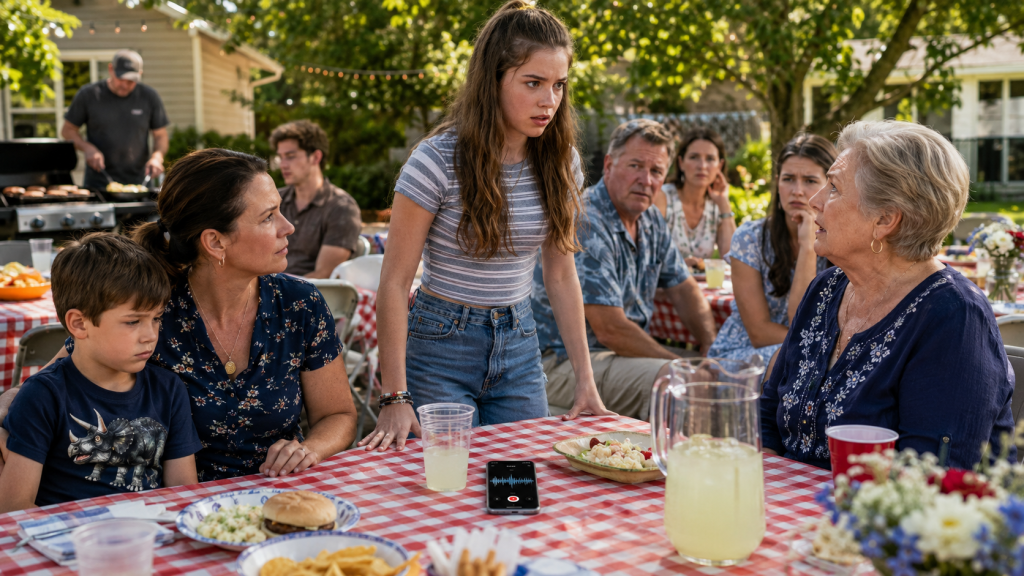
Then my seventeen-year-old daughter suddenly pushed back her chair, stood up, stared directly at her grandmother, and said,
“Say that again.”
The entire picnic went silent.
Up until that moment, everything had been completely ordinary.
Burgers were cooking on the grill.
Pitchers of lemonade sat on folding tables covered with paper plates and napkins.
Children were running through the yard while the adults talked and laughed.
Then Mom turned toward Noah.
“Next time, don’t bring the kid.”
My brothers heard it.
My aunts heard it.
My cousins heard it.
My father heard it.
And worst of all, Noah heard every single word.
My son froze with his plastic fork halfway to his mouth.
He was wearing his favorite navy dinosaur shirt, the one with a Triceratops on the front.
He had chosen to sit on the bench instead of the grass because he had noticed ants crawling nearby.
From the moment we arrived, Noah had been doing everything he could not to bother anyone.
Earlier, my brother’s dog had run into him and knocked over his lemonade.
Noah apologized immediately.
Twice.
Even though the accident hadn’t been his fault.
Then he grabbed paper towels and cleaned the entire spill while everyone else laughed and continued eating.
That was how hard he was trying to belong.
I stared at my mother.
“What did you just say?”
She calmly wiped her mouth with a napkin.
“I said what everyone else is thinking, Marissa. He changes the atmosphere whenever he comes.”
The words hurt, but they didn’t completely surprise me.
This wasn’t the first time Mom had made comments about Noah.
For years, they had come disguised as smaller things.
Little jokes.
Little complaints.
Little remarks everyone pretended not to notice because she was Grandma.
People excused her because she hosted holidays.
Because she remembered birthdays.
Because she could be charming and warm whenever she wanted to be.
But adults sometimes forget something important.
Children remember every cruel comment the adults dismiss.
Noah’s face went pale.
His shoulders folded inward.
Then he slowly placed his fork on his plate so carefully that it barely made a sound.
As though even making too much noise might give someone another reason not to want him there.
I looked around the table.
My sister suddenly became fascinated by her phone.
My brother turned toward the grill.
My father cleared his throat and looked away.
Nobody defended Noah.
Not one person told my mother she was wrong.
I opened my mouth to speak.
Before I could, the chair beside me scraped loudly against the pavement.
Lily stood up.
My seventeen-year-old daughter hated confrontation.
She hated attention.
She usually rehearsed difficult conversations in her head long before saying anything.
So seeing her stand there with both hands planted firmly on the table shocked everyone.
She stared straight at her grandmother.
“Say it again.”
Mom blinked.
“Excuse me?”
Lily didn’t move.
“Say it again. Look Noah in the face and tell him he shouldn’t come to family gatherings because having him here makes you uncomfortable.”
One of my aunts spoke quietly.
“Lily…”
“No.”
Her voice shook slightly.
But her eyes never left Grandma.
“Everyone keeps acting like Grandma doesn’t mean these things. Noah knows she means them. He always knows.”
Beside me, Noah stared down at the dinosaur on his shirt.
I reached under the table and took his hand.
His fingers immediately tightened around mine.
My mother leaned back in her chair.
“You’re seventeen. Stay out of conversations between adults.”
Lily’s expression stayed firm.
“This stopped being an adult conversation the second you decided to humiliate an eight-year-old in front of the entire family.”
No one moved.
The only sound came from the grill crackling behind us.
Somewhere near the driveway, someone slammed the lid of a cooler.
Then Lily reached toward the backpack hanging from the back of her chair.
For the first time, something changed in my mother’s face.
It wasn’t quite fear.
It looked more like recognition.
That was when I realized Lily hadn’t simply snapped.
She had been expecting this.
She pulled out her phone.
Unlocked it.
Then placed it in the center of the table.
An audio recording appeared on the screen.
The date showed it had been made three nights earlier.
My mother stared at it.
Lily rested her finger just above the play button.
“You told me I was old enough to understand why Noah shouldn’t be invited anymore.”
Mom’s napkin slipped from her fingers.
Everyone looked at Lily.
Then at my mother.
Because whatever had happened three nights earlier had clearly taken place without any of us knowing.
And Lily had recorded it.
She had proof of what Grandma really said when she believed no one else would ever hear.
Within seconds, everyone sitting at that table was about to discover that her feelings toward Noah went much deeper—and had lasted much longer—than any of us had realized.
PART 2: THE RECORDING GRANDMA NEVER MEANT US TO HEAR
Lily’s finger hovered over the play button.
Nobody moved.
My mother stared at the phone like it was something alive.
Something dangerous.
Something she had spent years assuming no one would ever place in the middle of a family table.
“Lily.”
Her voice changed.
Not softer.
Sharper.
“Turn that off.”
Lily looked at her.
“It isn’t even playing yet.”
Mom’s mouth tightened.
“I said turn it off.”
My father finally looked up.
“Linda…”
That was Mom’s name.
Linda Bennett.
And hearing Dad say it with that warning underneath told me something important.
He knew enough to be worried.
Maybe not everything.
But enough.
Lily pressed play.
My mother’s voice came through the phone.
Clear.
Casual.
Unmistakable.
You’re almost eighteen now, so I think you’re old enough to understand that some people make a family harder to be around.
My stomach turned.
Noah’s hand tightened around mine.
Lily did not look at him.
I knew why.
If she did, she might cry.
The recording continued.
Lily’s voice, quieter:
You mean Noah?
Then Mom.
I mean exactly Noah.
The table went completely still.
My brother Eric stopped pretending to focus on the grill.
My sister Claire lowered her phone.
One of my aunts covered her mouth.
Noah stared at his plate.
Mom reached across the table.
“Enough.”
Lily moved the phone out of reach.
“No.”
“Give me that.”
“No.”
Her voice shook.
But she did not back down.
Mom looked at me.
“Marissa, control your daughter.”
I almost laughed.
Not because anything was funny.
Because there it was.
The same instinct.
Control.
Always control.
I stood.
“No.”
Mom stared.
“What?”
“I’m not stopping her.”
Her face changed.
“Then you’re going to let a teenager humiliate me in front of the entire family?”
I looked at Noah.
Eight years old.
Shoulders folded inward.
Trying to disappear inside a dinosaur shirt.
Then back at her.
“You humiliated a child first.”
Mom’s cheeks flushed.
“That is not the same thing.”
“No.”
My voice hardened.
“It’s worse.”
Lily pressed play again.
My mother’s voice returned.
Your mother has always been too soft with him.
Lily:
He’s eight.
Mom:
Exactly. Old enough to know better.
Then Lily:
Know better than what?
There was a pause.
My mother answered:
Than to make every gathering about what he needs.
My chest tightened.
Noah made gatherings about what he needed?
The child who packed his own headphones because loud rooms overwhelmed him.
The child who brought the crackers he liked so no one had to prepare special food.
The child who apologized when other people bumped into him.
The child who once stood outside my parents’ house crying quietly because Grandma told him not to touch the Christmas decorations after he accidentally moved one ceramic angel.
Lily’s recorded voice came back.
He doesn’t make everything about himself.
Mom laughed.
A short, dismissive sound.
Of course you think that. You’re his sister.
Then:
But the whole family changes whenever he comes.
I looked at Noah.
His face had gone completely white.
I wanted to stop the recording.
I wanted to cover his ears.
Take him home.
Undo every second.
But he had already heard enough over the years to understand the shape of Grandma’s contempt.
Stopping now would protect adults from discomfort more than it protected him from truth.
So I kept holding his hand.
The recording continued.
Lily:
What does that even mean?
Mom:
People have to watch what they say.
He takes things personally.
He gets overwhelmed.
He wants to leave early.
He doesn’t eat half the food.
He sits by Marissa instead of playing normally with the other kids.
Each sentence hit me differently.
Because every “problem” she listed was something we had worked hard to help Noah manage without shame.
He became overwhelmed by noise.
So we took breaks.
He was cautious around food.
So we brought options.
He stayed near me when nervous.
Because I was his mother.
Not a character flaw.
A safe place.
Mom continued.
And honestly, Lily, everyone notices. They just don’t say it.
That line changed the table.
My eyes lifted slowly.
Everyone notices.
They just don’t say it.
I looked around.
At Eric.
Claire.
My father.
Aunt Denise.
Cousin Paul.
People who had just spent several minutes refusing to defend an eight-year-old.
My voice came out quietly.
“Is that true?”
Nobody answered.
I looked at Eric first.
“Do you all talk about Noah when we’re not here?”
He immediately shook his head.
“No.”
Claire said:
“Marissa…”
I turned.
“What?”
She stared at the table.
“Mom complains.”
My chest tightened.
“And?”
“She complains about everybody.”
“That wasn’t my question.”
Claire looked up.
Her eyes were wet.
“No.”
I waited.
Then she whispered:
“Not everyone agrees with her.”
Another careful answer.
Not everyone agrees.
Which meant some did.
I looked at Dad.
He looked old suddenly.
Seventy-one today.
Birthday hat abandoned beside his plate.
“Dad.”
He sighed.
“Your mother gets frustrated.”
My entire body went cold.
“Frustrated.”
“She doesn’t understand Noah.”
“No.”
I shook my head.
“She understands enough to know exactly where to hurt him.”
Dad looked away.
Lily pressed pause.
Then she said:
“There’s more.”
Mom stood.
“No.”
This time, actual fear appeared.
Not recognition.
Fear.
“I said enough.”
Lily stared at her.
“You were okay saying it when you thought nobody else would hear.”
Mom pointed toward her.
“You recorded me without telling me.”
Lily’s mouth trembled.
“Yes.”
“That is dishonest.”
Lily almost laughed.
“You told me to lie to Mom.”
The table erupted.
My head snapped toward her.
“What?”
Lily looked at me.
“I’m sorry.”
My heart began pounding.
“What did she tell you to lie about?”
Mom stepped closer.
“Lily.”
My daughter ignored her.
“She asked me to tell you I didn’t want Noah at my graduation dinner next spring.”
I stopped breathing.
“What?”
Lily’s eyes filled.
“She said if it came from me, you’d listen.”
My chest tightened painfully.
“Why?”
“She said…”
Lily looked at Grandma.
Then back at me.
“She said you’re too protective of Noah to admit he makes things harder.”
I stared at my mother.
“You tried to use my daughter to exclude my son.”
Mom’s face hardened.
“I was trying to avoid conflict.”
I almost laughed.
“Avoid conflict?”
“Yes.”
She gestured toward Noah.
“Look at what happens whenever anyone raises a concern.”
I stepped closer.
“You mean look at what happens when someone finally refuses to let you insult a child?”
Mom threw up both hands.
“This is exactly what I mean.”
Noah flinched.
I immediately stopped.
Not because Mom deserved calm.
Because Noah deserved not to hear another fight built around whether his presence was a burden.
I crouched beside him.
“Hey.”
He did not look at me.
“Noah.”
His eyes slowly lifted.
They were wet.
“Do you want to leave?”
His mouth trembled.
Then he whispered:
“Is everybody mad because I came?”
The question destroyed me.
“No.”
My answer came immediately.
“No.”
He looked around the table.
Nobody knew where to put their faces.
That silence answered too much.
Noah whispered:
“I can stay home next time.”
My throat closed.
“I don’t mind.”
He said it quickly.
Too quickly.
“I have Legos.”
“I can watch movies.”
“I don’t have to come.”
I cupped his face.
“No.”
He blinked.
“You are not the problem.”
“But Grandma said—”
“I know what Grandma said.”
My voice shook.
“And Grandma was wrong.”
Mom snapped:
“Do not tell him that I’m—”
I stood so quickly the bench scraped.
“No.”
Everyone froze.
“You do not get to correct me while I am repairing something you just broke.”
Mom went silent.
I looked back at Noah.
“You belong with me.”
His eyes filled.
“You belong with Lily.”
Lily was crying now.
“You belong anywhere you are invited.”
I swallowed hard.
“And if someone wants family gatherings without you, then they can have them without me too.”
Mom’s face drained.
“Marissa.”
I did not look at her.
Noah whispered:
“What about Grandpa?”
That hurt.
Dad closed his eyes.
I looked toward him.
For the first time all day, the birthday itself mattered.
This was his party.
His seventy-first birthday.
And somehow, the cruelest thing happening had nothing to do with him.
Dad pushed back his chair.
Walked around the table.
Then crouched beside Noah.
I watched carefully.
Noah watched him too.
Dad said:
“I should’ve said something.”
His voice cracked.
Noah looked confused.
“When?”
“Right away.”
Dad swallowed.
“When Grandma said you shouldn’t come.”
He glanced toward Mom.
Then back at Noah.
“I heard it.”
“And I stayed quiet.”
Noah stared at him.
Dad’s eyes filled.
“That was wrong.”
The table was completely silent.
Noah asked:
“Do you want me here?”
Dad’s face broke.
“Yes.”
The answer was immediate.
“I do.”
Noah looked down.
“Then why didn’t you say anything?”
There are questions children ask that leave adults nowhere to hide.
Dad stared at him.
Then whispered:
“Because I was afraid of making your grandmother angry.”
My chest tightened.
Dad continued.
“And I decided avoiding an argument mattered more than stopping something cruel.”
He shook his head.
“That was cowardly.”
Mom hissed:
“Robert.”
Dad looked at her.
“No.”
It was the first real no I had heard from him all afternoon.
Maybe in years.
“You said it.”
He pointed gently toward Noah.
“He heard you.”
“Everyone heard you.”
“And we all sat here.”
His eyes moved around the table.
“That part belongs to us.”
The words landed heavily.
Because cruelty rarely survives on one cruel person alone.
It survives on witnesses who decide silence is easier.
Eric put the grilling tongs down.
“I’m sorry too.”
Noah looked at him.
Eric walked closer.
“When the dog knocked your drink over…”
His voice broke.
“…you apologized.”
Noah nodded.
“I saw it.”
Eric looked ashamed.
“I knew it wasn’t your fault.”
“Then why did everybody laugh?”
Eric closed his eyes.
“I don’t know.”
Noah did.
“Weird question.”
He looked at me.
“Was I funny?”
“No.”
I rubbed his back.
“No, sweetheart.”
Eric whispered:
“You weren’t.”
Then:
“We were careless.”
Noah looked down.
One apology after another.
Too late to undo.
Still better than silence.
Then Mom laughed bitterly.
“Oh, for heaven’s sake.”
Everyone turned.
She stood beside the folding table with her arms crossed.
“You’re all acting as if I abused him.”
The word hit me.
Abused.
Nobody else had used it.
Mom continued.
“I said I’d prefer one family event without disruption.”
Lily looked at her.
“Play the rest.”
Mom’s face changed again.
“Lily.”
“Play it.”
I looked at my daughter.
“What else is there?”
She swallowed.
“The part where Grandma told me why she doesn’t think Noah really counts.”
Everything inside me stopped.
“What?”
Noah’s hand tightened around mine again.
Mom said:
“Do not play that in front of him.”
My stomach dropped.
Not:
That is false.
Not:
I never said that.
Do not play that in front of him.
Lily looked at me.
“What do I do?”
Finally.
She asked me.
Not decided alone.
I loved her for that.
I looked at Noah.
Then at the rest of the family.
“Take Noah inside.”
He immediately clung to my hand.
“No.”
I crouched.
“I’m not sending you away.”
His eyes widened.
“I’m coming in five minutes.”
“You promise?”
“Yes.”
“Lily too?”
Lily knelt beside us.
“I’ll come.”
Noah looked toward Grandma.
Then whispered:
“Are you going to talk about me?”
My heart broke again.
I answered truthfully.
“Yes.”
He looked scared.
“But only because I need to understand what’s been said.”
I kissed his forehead.
“You are not in trouble.”
My cousin Jenna offered to take him inside.
Noah refused.
Then Dad said:
“I’ll go.”
Noah hesitated.
Dad extended one hand.
“You can show me your dinosaur game.”
That worked.
Barely.
Noah went with him.
I watched them walk toward the house.
My son looked back twice.
Both times, I smiled.
Both times, he checked whether I was still there.
When the door closed, I turned.
“Play it.”
Lily did.
The recording resumed.
My mother’s voice:
Noah is not like you.
Lily:
Obviously. He’s eight.
Mom sighed.
That isn’t what I mean.
Then:
You’re a Bennett.
My body went cold.
Lily’s recorded voice changed.
So is Noah.
Mom answered:
Legally, maybe.
The air left my lungs.
Lily pressed pause.
Nobody moved.
I stared at my mother.
“Legally?”
Mom looked away.
“Keep playing.”
My voice barely worked.
Lily did.
Mom:
Your mother may have chosen him, but that doesn’t mean the rest of us have to pretend there’s no difference.
My knees almost gave out.
Noah was adopted.
There it was.
The sentence beneath every small comment.
The thing my mother had never said directly to me.
Not blood.
Not really ours.
Different.
My daughter’s recorded voice came back immediately.
He is my brother.
Mom:
I know you feel that way.
Lily:
I don’t “feel” that way. He is.
Mom:
You’re young. One day you’ll understand that biology matters.
I pressed both hands against the table.
My stomach turned.
Years of memories rearranged themselves.
When Lily was born, Mom made a scrapbook.
For Noah’s adoption day, she brought a gift card.
When Lily lost her first tooth, Mom saved it in a tiny silver box.
When Noah lost his, she said:
“Tell his other family he’s growing fast.”
I had corrected her.
We are his family.
She smiled.
Said:
“Of course.”
At Christmas, Lily’s stocking said:
GRANDDAUGHTER.
Noah’s said:
NOAH.
I told myself I was oversensitive.
At Easter, Mom introduced Lily to a friend as:
“My first grandbaby.”
Then Noah as:
“Marissa’s little boy.”
I noticed.
Then explained it away.
I had spent years translating my mother into a gentler language so I could continue bringing my son around her.
The recording continued.
Lily:
If biology matters so much, why do you call Uncle Eric’s wife family?
Mom:
That’s different.
Lily:
Why?
Mom:
Because marriage joins families. Adoption complicates them.
I closed my eyes.
There are sentences so ugly that hearing them does not make you angry first.
It makes you tired.
Deeply.
Bone tired.
Because suddenly every argument you avoided comes back and asks why.
Lily’s voice:
You think Noah isn’t really your grandson.
A long pause.
Then my mother answered:
I think pretending there is no difference is dishonest.
Silence.
Lily had stopped talking on the recording.
So had Mom.
Then a chair scraped.
My mother’s voice came closer.
Do not tell your mother I said that. She makes everything about defending him.
Lily:
Because he’s her son.
Mom:
He’s the child she chose after the doctors told her she probably couldn’t have another baby.
I stopped breathing.
She went farther.
Of course she did.
Marissa was grieving.
She wanted to fill a hole.
That doesn’t make Noah bad.
But it doesn’t make him the same as you.
Lily’s recorded voice cracked.
You are awful.
Mom replied:
I’m realistic.
Then:
And if you’re smart, you’ll stop letting your mother make Noah’s feelings the center of everything. You have college coming. Your graduation. Your own life. There will be times when he shouldn’t be included.
The recording ended.
Nobody spoke.
Lily stood beside me, crying silently.
My mother stared at the table.
I could hear children laughing in a neighboring yard.
A bird landed on the fence.
The world had the nerve to remain ordinary.
I looked at Mom.
“How long?”
She lifted her head.
“What?”
“How long have you felt this way?”
Her face hardened.
“I don’t know.”
“Since we adopted him?”
“I never said I opposed it.”
“That wasn’t the question.”
“Marissa…”
“How long?”
She exhaled sharply.
“From the beginning, I thought you were rushing.”
My chest tightened.
Noah was eighteen months old when we finalized the adoption.
We had fostered him for almost a year before that.
There had been court dates.
Home inspections.
Caseworkers.
Sleepless nights.
Nothing about him had been rushed.
“You thought I adopted him because I couldn’t have another biological child.”
“I thought grief played a role.”
“My fertility was none of your business.”
“You talked to me about it.”
“I talked to my mother because I was hurting.”
Her expression changed.
I continued.
“You took something I told you in grief and turned it into an explanation for why my son is less real.”
“No.”
“That is exactly what you did.”
Mom’s eyes filled.
“I never mistreated him.”
Lily laughed through tears.
“You told him to stay home from family events.”
“I was frustrated.”
“You told me he wasn’t the same.”
“I was trying to explain—”
“Explain what?”
Lily’s voice rose.
“That you love me more because we share DNA?”
Mom went silent.
That answer told us enough.
Lily stepped backward as though she had been struck.
My heart broke for her too.
Because favoritism damages the favored child differently.
It makes love feel contaminated.
Makes affection feel purchased by someone else’s exclusion.
Lily whispered:
“I don’t want love that works like that.”
Mom stared.
“What?”
“I don’t want to be your favorite because Noah isn’t biological.”
“Lily…”
“No.”
She wiped her face.
“If the reason you love me more is something he can’t change…”
Her voice broke.
“…then it doesn’t feel like you’re loving me.”
Mom began crying.
“You’re twisting everything.”
“No.”
I stepped between them.
“Stop telling children they misunderstand your cruelty.”
Mom’s face changed.
“Children?”
“She is seventeen.”
“She is still my child.”
I looked toward the house.
“And Noah is eight.”
Then:
“And neither one of them will be asked to carry your feelings anymore.”
Mom stared.
“What does that mean?”
“It means we’re leaving.”
Her mouth fell open.
“On your father’s birthday?”
“Yes.”
“That’s incredibly selfish.”
I almost smiled.
Old me would have flinched.
Old me would have stayed another hour.
Cut cake.
Smiled for photographs.
Taken Noah home afterward.
Cried in the car.
Then called Mom three days later when guilt won.
Not today.
“I am not making Noah eat birthday cake beside someone who just announced she wishes he hadn’t come.”
Mom cried harder.
“You’re punishing your father.”
Dad’s voice came from behind us.
“No, she isn’t.”
We turned.
He stood near the back door.
Noah was not with him.
“He’s inside with Jenna.”
Dad walked toward us.
His face looked wrecked.
“I heard enough from the kitchen.”
Mom whispered:
“Robert.”
He shook his head.
“No.”
She stared.
“You’re taking their side?”
Dad looked exhausted.
“This is not sides.”
He looked toward the house.
“There is an eight-year-old boy in there asking me if he can eat his birthday cake inside so you don’t have to see him.”
My mother’s face collapsed.
I covered my mouth.
Dad continued.
“He asked whether next year he could stay with a babysitter so everybody would be happier.”
Lily sobbed.
I could not breathe.
“He said that?”
Dad nodded.
Then looked directly at Mom.
“You did that.”
Mom sat down.
“No.”
“Yes.”
“I didn’t mean—”
“He doesn’t care what you meant.”
Dad’s voice cracked.
“He is eight.”
“He heard what you said.”
“He understood it.”
“And now he is trying to solve the problem by removing himself.”
My chest hurt so badly I pressed a hand against it.
That was Noah.
Always adjusting himself to make other people comfortable.
Dad looked at me.
“I’m sorry.”
I shook my head.
“This is your birthday.”
“I don’t care.”
He swallowed.
“I care about that boy inside my house thinking he is ruining it by being here.”
I cried.
Dad turned toward Mom again.
“I have let you say little things for years.”
Her face went still.
There it was.
Admission.
“You noticed?”
I asked.
Dad looked ashamed.
“Yes.”
My anger sharpened.
“And you said nothing.”
“I told myself she didn’t mean it.”
“You knew.”
“I knew enough.”
He closed his eyes.
“I did not want the fights.”
There it was again.
Peace.
Family harmony.
The altar where children are often asked to sacrifice dignity so adults can keep eating dinner comfortably.
Dad whispered:
“I’m sorry.”
I looked at him.
“I believe you.”
His eyes filled.
“That doesn’t fix it.”
“No.”
He nodded.
“I know.”
That mattered.
No instant absolution.
No:
But I apologized.
Just accountability.
Eric spoke from behind him.
“I knew too.”
Claire started crying.
“So did I.”
I turned.
“How much?”
Eric stared at his hands.
“Mom made comments.”
“About the adoption?”
“Yes.”
My stomach dropped.
“How long?”
He swallowed.
“Years.”
I laughed once.
A terrible sound.
“And nobody thought I should know?”
Claire wiped her face.
“We thought you knew.”
“Did I look like I knew?”
“No.”
“Did Noah?”
She started crying harder.
“I’m sorry.”
I looked around the table.
All those people.
Aunts.
Uncles.
Cousins.
People who bought Noah birthday gifts.
Hugged him hello.
Told me he was adorable.
And apparently some of them had heard my mother question whether he belonged.
“How many of you heard it?”
Nobody moved.
Then Aunt Denise raised her hand.
Not literally high.
Just enough.
“I did.”
Another cousin nodded.
Then Eric.
Claire.
My father already had.
My stomach turned.
Lily whispered:
“Mom.”
I looked at her.
Her face was pale.
“There’s one more thing.”
I almost laughed.
Of course.
“What?”
She looked toward Grandma.
“Three nights ago wasn’t the first time she tried talking to me about Noah.”
My body went cold.
“When?”
“Last Christmas.”
I closed my eyes.
“What happened?”
Lily swallowed.
“She asked if I knew about Grandpa’s will.”
Dad looked confused.
“My will?”
Mom stood abruptly.
“Lily.”
Everyone turned.
There it was again.
Fear.
Not anger.
Fear.
Dad stared at Mom.
“What does my will have to do with Noah?”
She said nothing.
Lily reached into her backpack.
Pulled out a folded photocopy.
“I found this after Grandma left my room.”
My pulse began pounding.
“What is it?”
Lily unfolded it.
Dad took one look.
His face drained of color.
“That’s my estate plan.”
Mom whispered:
“Robert…”
He did not look at her.
“How did Lily get this?”
No answer.
Dad read.
Then stopped.
“What?”
I asked.
His hands began trembling.
“There’s an amendment.”
“To what?”
“The grandchildren’s trusts.”
My stomach dropped.
Dad looked at Mom.
“I never signed this.”
Every sound disappeared.
He turned the paper toward me.
The amendment divided a family education-and-inheritance trust between biological descendants.
That phrase.
Biological descendants.
Lily’s name appeared.
My brothers’ children appeared.
Noah did not.
At the bottom was Dad’s signature.
Except Dad was shaking his head.
“That is not mine.”
My mother went completely still.
The cruelty at the picnic suddenly changed shape.
This was no longer only about cruel remarks.
Noah had been erased on paper.
From money.
From family planning.
Using a document Dad said he never approved.
I stared at Mom.
“What did you do?”
She whispered:
“You don’t understand.”
Dad looked at her.
His face had become something I had never seen before.
Not angry.
Devastated.
“Linda.”
She started crying.
“I was trying to protect what your parents built.”
Dad’s voice dropped.
“From my grandson?”
“He isn’t—”
She stopped.
Too late.
Nobody moved.
Dad stared at her.
“Finish that sentence.”
Mom covered her mouth.
He stepped closer.
“Finish it.”
She cried harder.
“I didn’t mean—”
“Yes, you did.”
His voice broke.
“You have meant it for years.”
I looked down at the forged amendment.
Then at the date.
Six months earlier.
My heart started pounding.
Six months earlier, Dad had been hospitalized briefly after a heart rhythm problem.
Mom handled paperwork.
Insurance.
Bills.
Everything.
I suddenly remembered her calling me.
Asking for Noah’s full legal name.
His Social Security number.
His adoption date.
She claimed Dad’s attorney needed updated family information.
I gave it to her.
My stomach turned.
“What else did you change?”
Mom stopped crying.
Not because she was calmer.
Because she realized the question had widened.
Dad looked at her.
“Linda.”
She said nothing.
“What else?”
Lily slowly reached into her backpack again.
And this time, what she pulled out was not an audio recording.
Not a photocopy.
It was a small blue folder.
My father’s attorney’s name was printed across the front.
Mom looked at it.
Then sat down so quickly the chair nearly tipped.
Dad whispered:
“Where did you get that?”
Lily looked at Grandma.
“Her car.”
My entire body went cold.
“You went through Grandma’s car?”
“She told me to get her sweater three nights ago.”
Lily’s voice shook.
“The folder was open on the passenger seat.”
“I saw Noah’s name.”
She looked at me.
“So I took pictures.”
Mom whispered:
“You had no right.”
Lily stared.
“Neither did you.”
Then she handed the folder to Grandpa.
Dad opened it.
One page.
Two.
Three.
His expression changed with each.
Finally he looked up.
“Marissa.”
I swallowed.
“What?”
His eyes filled.
“I need you to take Noah home.”
My stomach dropped.
“Why?”
“Not because he doesn’t belong here.”
He shook his head quickly.
“Because I don’t want him hearing what comes next.”
I stared at the folder.
“What did she do?”
Dad closed it.
Then looked at the woman he had been married to for forty-eight years.
His voice came out almost inaudible.
“She didn’t only try to remove Noah from my will.”
The picnic went silent again.
Dad swallowed.
“She tried to remove you too.”
I froze.
“What?”
His eyes dropped to another page.
“And Lily.”
My daughter stopped breathing.
Mom whispered:
“Robert, please.”
He looked at her.
Then back at me.
“There are draft documents transferring nearly everything into a new family trust.”
My stomach tightened.
“For whom?”
Dad read the beneficiary names.
Eric.
Claire.
Their biological children.
Not me.
Not Lily.
Not Noah.
I stared at my mother.
“Why?”
She said nothing.
Then Dad reached the final page.
His face changed again.
Worse.
“What?”
I whispered.
He looked at Lily.
Then at me.
“The attorney made a note.”
“What note?”
Dad’s hands shook.
“He wrote that your mother said I had already agreed.”
“Agreed to what?”
Dad looked at Mom.
Then read the handwritten line aloud.
Client’s wife reports husband intends to exclude daughter Marissa and her children due to concerns regarding adoption-related family conflict. Husband must confirm personally before any amendment is executed.
Nobody breathed.
The attorney had not accepted Mom’s word.
He had insisted on Dad confirming.
That was why the changes had not gone through.
Dad whispered:
“You told my lawyer I wanted to cut out my own daughter.”
Mom started crying.
“I was trying to keep the estate from being divided unfairly.”
“To whom?”
Dad’s voice rose.
“To your biological family?”
My mother covered her face.
And suddenly everything made sense.
The picnic comment.
The private conversation with Lily.
The pressure.
The years of little remarks.
Mom was not simply hoping Noah would stop attending.
She had been trying to reorganize the family so that one day, on paper, he would never have been there at all.
Dad stared at her.
Then said:
“Give me your keys.”
Mom looked up.
“What?”
“House keys.”
“Car keys.”
“Safe-deposit key.”
“Everything.”
Her face drained.
“Robert.”
“Now.”
He held out his hand.
For the first time in my life, my mother looked genuinely afraid of my father.
Not because he threatened her.
Because he had stopped protecting her from consequences.
She slowly opened her purse.
One key ring.
Then another.
Then a small brass key.
Dad took them.
And just when I thought the worst was finally in front of us, Lily looked at the brass key and went pale.
“Grandpa.”
He turned.
“What?”
“I know what that opens.”
Mom’s head snapped toward her.
Dad frowned.
“How?”
Lily looked at Grandma.
Then back at him.
“Because three nights ago, after she finished talking about Noah…”
Her voice dropped.
“…Grandma took me to the bank.”
My skin turned cold.
“What?”
Dad stared.
“Why?”
Lily swallowed.
“She said she wanted me to learn where important family papers were kept.”
Mom whispered:
“Stop.”
Lily did not.
“She opened a safe-deposit box.”
My heartbeat pounded.
“What was inside?”
Lily looked directly at me.
“Letters.”
“What letters?”
She hesitated.
Then:
“From Noah’s birth mother.”
Every part of me stopped.
Noah’s birth mother.
A woman I had not heard from since the adoption was finalized.
A woman whose last known letter to us had been forwarded through the agency.
My mother whispered:
“Lily.”
But my daughter kept going.
“There were a lot of them.”
My throat went dry.
“How many?”
“At least twelve.”
I could barely breathe.
“Addressed to who?”
Lily looked at me.
“You.”
The world tilted.
Mom said:
“She was unstable.”
I turned so slowly that even she stopped talking.
“What did you just say?”
“She had no right to interfere after the adoption.”
My chest tightened.
“You kept letters from my son’s birth mother?”
Mom began crying again.
“I was protecting you.”
“From what?”
“She wanted contact.”
My heart stopped.
“She changed her mind?”
“No.”
Mom shook her head quickly.
“Not about the adoption.”
“She wanted updates.”
“Pictures.”
“She wanted Noah to know things about his history someday.”
I could not breathe.
Things about his history.
Medical information.
Family stories.
Questions he might ask one day.
Pieces of himself.
And my mother had been holding them in a bank box.
“How long?”
She looked away.
“Marissa…”
“How long?”
“Six years.”
Lily gasped.
My knees weakened.
Six years.
Noah was eight.
Mom had been intercepting letters since he was two.
The picnic disappeared.
The insult.
The will.
The inheritance.
All of it became smaller beside one terrible fact.
My mother had decided she had the right to control my son’s connection to the woman who gave birth to him.
Not because I asked.
Because she believed Noah’s story belonged to her to manage.
Dad looked at the brass key.
Then at Mom.
“What else is in that box?”
She said nothing.
He asked again.
“What else?”
Mom’s silence answered.
Dad turned toward me.
His face looked devastated.
“We’re going to the bank tomorrow.”
I stared at the key.
Then toward the house where Noah waited.
And for the first time that afternoon, I understood that my mother’s cruelty had never really been about picnics.
Or noise.
Or food.
Or Noah making gatherings “different.”
She had spent years deciding which parts of his life counted.
Which family connections mattered.
Which letters reached us.
Which inheritance recognized him.
Which rooms he belonged in.
And which ones he did not.
The comment at the picnic had only been the first time she said the quiet part loudly enough for everyone to hear.
I took Lily’s hand.
“We’re leaving.”
Dad nodded.
“I’ll call tonight.”
I looked at him.
“Not until Noah’s asleep.”
He understood.
We walked toward the house together.
Halfway there, Lily stopped me.
“Mom.”
“What?”
Her face crumpled.
“I’m sorry I didn’t tell you about the letters sooner.”
I pulled her into my arms.
“No.”
She cried against me.
“You were trying to figure out something adults should never have put in your hands.”
I kissed her hair.
“You did not create this.”
She nodded weakly.
Then we went inside.
Noah was sitting at the kitchen table.
A slice of birthday cake untouched in front of him.
He looked at me.
“Can we go home now?”
“Yes.”
His face relaxed.
Then he glanced toward the backyard.
“Is Grandma still mad at me?”
I crouched beside him.
My throat hurt.
“No.”
He frowned.
“She looked mad.”
I took both his hands.
“Grandma has feelings she is responsible for.”
His eyes searched mine.
“They are not your fault.”
He looked down.
“Do I have to come next year?”
“No.”
That answer came easily.
“Do I have to see her?”
I swallowed.
“Not unless you want to.”
Noah looked surprised.
Children raised around adults who demand obedience often mistake choice for a gift.
It should not feel like one.
Then he asked:
“Am I really family?”
My heart broke.
I pulled him against me.
“Yes.”
No hesitation.
No technical explanation.
No legal language.
“Yes.”
He buried his face against my shoulder.
Behind me, Lily started crying again.
I held one child with one arm.
Reached for the other with my hand.
And I realized something.
My mother had spent years treating belonging as something she could grant.
A chair at the picnic.
A stocking at Christmas.
A name in a will.
A letter allowed through.
But family was never hers to distribute.
Noah did not belong because Linda Bennett approved him.
He belonged because he was my son.
Lily’s brother.
A child loved in the ordinary, exhausting, beautiful way that makes biology irrelevant to the daily work of being family.
I took my children home.
That evening, after Noah fell asleep with his dinosaur shirt still on, Lily and I sat on the floor outside his bedroom.
Neither of us spoke for a while.
Then she whispered:
“Mom.”
“Yes?”
“What do you think is in the box?”
I stared toward Noah’s closed door.
“I don’t know.”
That was the truth.
Letters.
Maybe photographs.
Maybe medical history.
Maybe answers to questions Noah had not yet learned how to ask.
Maybe nothing worse.
Maybe something much worse.
Then my phone buzzed.
Dad.
One message.
I found something in Linda’s desk after you left.
My chest tightened.
Another message appeared.
It is from Noah’s adoption agency.
I stopped breathing.
Then:
Marissa, your mother has been intercepting more than letters.
My fingers went numb.
I called immediately.
Dad answered on the first ring.
“What did you find?”
His breathing sounded strange.
“Dad?”
He finally spoke.
“There’s a form.”
“What form?”
His voice broke.
“A request to update contact preferences after the adoption.”
My stomach dropped.
“What does that mean?”
“Your mother filled it out.”
I stopped breathing.
“With whose name?”
Silence.
Then Dad whispered:
“Yours.”
Every part of me went cold.
“What did she request?”
He cried before answering.
And when he finally did, the words changed the entire shape of the story.
“She told the agency you wanted no future contact from Noah’s birth family.”
I closed my eyes.
Six years of silence.
Six years I believed came from Noah’s birth mother.
Six years she may have believed came from me.
Two mothers separated by a lie neither one of us had chosen.
Dad continued:
“And there’s one more thing.”
I could barely speak.
“What?”
“The agency sent a notice three years ago.”
His voice dropped.
“They said Noah’s birth mother had requested contact because of an urgent family medical update.”
My heart stopped.
“What medical update?”
Dad was quiet too long.
“Dad.”
He whispered:
“The letter says it may be hereditary.”
I stared toward Noah’s bedroom.
At the child sleeping peacefully on the other side of the wall.
My son.
And suddenly my mother’s prejudice was no longer only cruel.
It may have kept medical information from us.
Information about Noah’s own body.
Information I should have had years ago.
My voice shook.
“What condition?”
Dad took a breath.
Then said:
“I don’t know yet.”
“There’s a sealed packet with the agency letter.”
My entire body turned cold.
“Where?”
He answered:
“In the safe-deposit box.”
The same box Grandma had taken Lily to see.
The box containing six years of letters.
The box she had apparently believed would stay closed until she decided otherwise.
I looked at my daughter.
She was staring at me.
She had heard enough.
“Tomorrow,” I whispered.
“We open everything.”
Lily nodded.
And as I sat outside my eight-year-old son’s bedroom, listening to him breathe, I finally understood how deep my mother’s need for control had gone.
She had not simply tried to decide whether Noah belonged at birthday picnics.
She had tried to decide whether he belonged in our family history.
Whether his first mother could reach us.
Whether medical truth could reach us.
Whether his name belonged in my father’s estate.
Whether Lily should see him as fully her brother.
Whether I should know any of it.
For years, everyone had excused Linda Bennett because she was Grandma.
Because she hosted Christmas.
Because she baked cakes.
Because cruelty becomes strangely easy to ignore when the person delivering it also sends birthday cards.
But now there was a bank key on my father’s table.
A safe-deposit box full of unopened years.
And somewhere inside it was a sealed medical packet concerning my son.
The boy Grandma wanted me to leave at home.
The boy who had spent the entire picnic trying not to bother anybody.
The boy who still thought the problem was that he had arrived.
I looked toward his door.
Then whispered the promise I should have made years earlier.
“You never have to earn your place here.”
And tomorrow, I was going to find out exactly how much of Noah’s life my mother had hidden from us simply because she believed she had the right to decide what counted as family.
PART 3: THE LETTERS SHE NEVER LET US READ
The next morning, my father was waiting outside the bank before it opened.
He looked as though he had not slept.
Neither had I.
Lily sat beside me in the passenger seat, both hands wrapped around a paper cup of hot chocolate she had barely touched.
Noah was with my sister-in-law Jenna.
I had not told him about the medical packet.
Not yet.
There are truths children deserve.
There are also truths adults should carry until they understand what they actually mean.
Before I closed the car door, Lily caught my sleeve.
“Mom.”
I turned.
“What if it’s really bad?”
I looked at my seventeen-year-old daughter.
The girl who had stood up at a picnic because every adult around her had forgotten how.
“You don’t have to be brave today.”
Her eyes filled.
“I’m not trying to be.”
“I know.”
I squeezed her hand.
“That’s why I’m reminding you.”
Dad was pacing near the entrance.
The moment he saw us, he stopped.
“Your mother called me fourteen times.”
I said nothing.
“I didn’t answer.”
That mattered.
Not because silence was revenge.
Because for forty-eight years, Linda Bennett had been able to turn urgency into authority.
A ringing phone meant something had to be handled immediately.
Usually her way.
Dad was learning that not every demand deserved an answer.
When the bank opened, we met with the branch manager and Dad’s attorney.
The safe-deposit box was technically in both my parents’ names.
Dad had the legal right to access it.
Even so, his attorney insisted everything be documented.
Photographs.
Inventory.
No papers removed until they were listed.
Dad agreed.
“I don’t want another person in this family deciding what happened based on memory.”
That sentence told me he had changed overnight.
The vault was colder than I expected.
Quiet too.
The bank employee placed the long metal box on a private table.
Dad inserted the small brass key.
The lock clicked.
Lily flinched.
So did I.
Such a tiny sound.
Yet all I could think was:
Six years.
Six years of my son’s history sitting behind that click.
Dad lifted the lid.
The first thing I saw was a stack of envelopes tied with blue ribbon.
My name was written on every one.
MARISSA BENNETT
Some had the adoption agency’s return address.
Others came directly from a woman named:
HANNAH REYES
Noah’s birth mother.
I touched the top envelope but did not open it.
My hand was shaking too badly.
Dad whispered:
“I’m sorry.”
I looked at him.
“For what?”
“For not knowing.”
I almost told him it wasn’t his fault.
Then stopped.
We had spent too many years using that phrase to avoid looking closely at responsibility.
“You didn’t know.”
I said instead.
“But now we both do.”
He nodded.
That was enough.
Beneath the letters was a clear plastic folder.
Inside was the medical packet.
The front page carried the agency logo.
Across the top:
IMPORTANT FAMILY MEDICAL UPDATE — PLEASE FORWARD TO ADOPTIVE PARENT
The date was three years old.
My stomach twisted.
I opened it.
Hannah had written that her older brother had been diagnosed with an inherited heart rhythm disorder after fainting unexpectedly.
Further testing showed several relatives carried the same inherited risk.
She did not write in panic.
She did not claim Noah was sick.
She simply wanted his pediatrician to know his biological family history so appropriate evaluation could be considered.
At the bottom, in Hannah’s handwriting:
I am not trying to frighten Marissa. I only want her to have information I would want if our places were reversed. Please tell her Noah may never have any problem at all. I just don’t want silence to become the reason she finds out too late.
I stopped reading.
The room blurred.
Lily whispered:
“Mom?”
I put one hand against the table.
Three years.
Noah had played soccer.
Run fevers.
Complained once that his heart felt “fast” after a nightmare.
Normal childhood things.
Probably nothing.
But I had made decisions without information someone had tried repeatedly to give me.
Not because Hannah failed to send it.
Because my mother decided I did not need it.
I turned toward Dad.
“Did she open this?”
He looked inside the folder.
The original envelope had been slit cleanly across the top.
“Yes.”
My throat closed.
Lily covered her mouth.
“She read it.”
“Yes.”
“And kept it.”
Dad shut his eyes.
“Yes.”
I began crying.
Not loudly.
There was no room in me for drama.
Only rage so deep it felt like grief.
Dad’s attorney spoke gently.
“We should notify Noah’s pediatrician today.”
“I will.”
“And the agency.”
“Yes.”
Lily touched my arm.
“Is Noah sick?”
I turned immediately.
“We don’t know that.”
“But—”
“This says there may be a family risk.”
I wiped my face.
“That’s all we know.”
“Okay.”
I could see her trying not to race ten steps ahead.
I understood.
I was doing the same.
I called Noah’s pediatrician from the parking lot.
We were seen that afternoon.
I will not turn that appointment into a miracle or a catastrophe.
Life is usually less theatrical.
Noah was examined.
Records were reviewed.
Additional testing was arranged with a specialist because of the updated family history.
For the first time in three years, the information had reached the people who were supposed to use it.
That was what mattered.
Noah asked:
“Am I in trouble?”
I almost cried.
“No.”
“Why are we at the doctor?”
“Because we learned something about your biological family that your doctor should know.”
He thought about that.
“Like allergies?”
“Sort of.”
“Do I have it?”
“We don’t know.”
He nodded.
Then:
“Can I still have pizza?”
The doctor laughed.
“So far, yes.”
That was Noah.
A whole family collapsing around paperwork and secrets, and he wanted to know whether pepperoni had been revoked.
Later testing did not show an immediate problem.
His doctors recommended that we keep the family history in his record and follow appropriate monitoring over time.
Relief came.
Not clean relief.
Anger lived beside it.
Because favorable results did not make the secrecy harmless.
My mother did not get credit because the risk had not already hurt him.
The fact remained:
She had decided medical information belonged in a bank vault instead of my hands.
Back at Dad’s house that evening, we opened the first letter.
Hannah had written it when Noah was two.
Dear Marissa,
I hope this is okay. I think about Noah on his birthday and wonder whether he still laughs with his whole body.
My eyes filled.
He did.
He still did.
I am not asking to change anything about the adoption. I signed those papers knowing you were his mother. I only hope someday, if it feels right, you can tell him that the woman who gave birth to him did not forget him.
I stopped.
Lily was crying beside me.
Dad stared at the floor.
The next letter came six months later.
A family photograph.
Hannah.
Her mother.
Two brothers.
A little girl who was apparently Noah’s biological half sister.
The note said:
For whenever he starts wondering whose nose he has. It’s my father’s. Unfortunately, so is the stubbornness.
I laughed through tears.
Noah was extraordinarily stubborn.
We had blamed my husband’s side.
Apparently genetics had filed a correction.
Another letter contained family recipes.
Another told the story of Hannah’s grandfather immigrating to the United States.
Another contained a photograph of Hannah at eight years old.
She looked so much like Noah that Lily whispered:
“Oh my God.”
I touched the picture.
My son had spent years asking why no one in our family had dimples like his.
There they were.
Hannah’s.
Waiting in a safe-deposit box.
The final unopened letter was only four months old.
That meant Mom had never stopped.
Not even after Noah became old enough to ask questions.
Not after Hannah kept writing despite receiving nothing back.
Inside:
Marissa,
I don’t know whether you receive these anymore. I worry I may be crossing a line because I have never heard from you. If silence is what you want, I will respect it.
My stomach turned.
Silence is what you want.
No.
It wasn’t.
But I need to ask one last time that the medical update reach Noah’s doctor. I am not asking for contact with him. I only need to know someone responsible has the information.
Then:
If you truly want me to stop writing, please tell the agency yourself. I will listen. I just don’t want to be answering a decision nobody actually made.
I folded the letter.
Nobody spoke.
The sentence felt aimed at our entire family.
A decision nobody actually made.
How many of those had Linda created?
Noah doesn’t belong.
Marissa doesn’t want contact.
Robert wants only biological descendants.
Lily should exclude her brother.
Everybody is uncomfortable around Noah.
Over and over, Mom created consensus by speaking before anyone else could.
Then counted everyone’s silence as agreement.
Dad found the forged agency form beneath the letters.
My name.
My signature.
My request for no future contact.
I held it beside my actual signature on an old adoption document.
Not close enough once you knew what you were looking for.
Dad whispered:
“What are you going to do?”
“I’m correcting it.”
“With the agency?”
“Yes.”
“What about Mom?”
I looked toward the backyard.
Yesterday’s folding tables had been taken down.
One paper napkin still clung to the grass near the fence.
Less than twenty-four hours earlier, my mother had looked at an eight-year-old boy and told me to leave him home next time.
Now I knew she had been trying to remove him from places he had never even seen.
Legal papers.
Medical history.
Family memory.
My answer surprised even me.
“I’m not talking to her yet.”
Dad nodded.
“Good.”
I looked at him.
“You don’t get to call and prepare her.”
His face tightened.
“I wasn’t going to.”
“You’ve spent decades smoothing things over.”
“I know.”
“I need you not to smooth this.”
His eyes filled.
“I won’t.”
Two days later, I spoke to Hannah.
Through the adoption agency.
Not directly at first.
A counselor arranged the call.
I sat at my kitchen table.
Lily stayed upstairs.
Noah was at school.
My hands shook as badly as they had on the day we finalized his adoption.
Then Hannah’s face appeared on the screen.
She was thirty-four.
Dark curls.
Noah’s dimples.
She looked terrified.
“Hi.”
“Hi.”
Neither of us knew what came next.
Then I said:
“I got your letters.”
She covered her mouth.
All the color left her face.
“All of them?”
“Yes.”
She began crying.
“I thought you hated me.”
My chest broke.
“I thought you stopped writing.”
We stared at each other.
Two women separated for six years by someone else’s decision.
“I never asked the agency to cut contact.”
Hannah wiped her cheeks.
“They told me you did.”
“I know.”
I showed her the form.
“That isn’t my signature.”
She stared.
Then whispered:
“Who?”
I could have protected Mom.
Old habit.
Family shame.
Privacy.
The instinct rose for half a second.
Then died.
“My mother.”
Hannah went still.
“Why?”
“Because she never fully accepted Noah.”
There.
The ugliest truth spoken plainly.
Hannah’s eyes hardened.
“Because he’s adopted?”
“Yes.”
She looked away.
Then back.
“I’m sorry.”
I almost laughed.
“For what?”
“That he had to grow up around someone who made him feel temporary.”
That sentence shattered me.
Temporary.
Yes.
That was exactly what Mom had done.
Made Noah feel as though belonging could be revoked.
I swallowed.
“He’s loved.”
“I know.”
She smiled faintly.
“I never doubted that about you.”
My eyes filled.
“You didn’t know me.”
“I met you twice before the adoption.”
“You were terrified and still asked me whether I had eaten.”
I laughed.
I had forgotten.
Hannah continued.
“I knew what kind of mother you were going to be.”
The kindness hurt.
We talked for nearly two hours.
She did not ask to see Noah immediately.
Good.
I did not offer immediately.
Good.
We discussed what he knew.
What he didn’t.
What would be healthy.
How future contact should belong to him as he grew.
No dramatic reunion.
No adults satisfying their emotions at the expense of a child’s stability.
We started with letters.
Real ones.
Delivered.
Three months later, Noah received his first.
I told him:
“This is from Hannah.”
He knew her name.
We had always told him age-appropriate truths about his adoption.
His eyes widened.
“My birth mom?”
“Yes.”
“Why now?”
There was no gentle lie available.
So I chose a gentle truth.
“She tried writing before.”
He frowned.
“What happened?”
I looked at him.
“Grandma kept the letters.”
Silence.
He stared.
“Why?”
I swallowed.
“Because Grandma believed she should decide whether we had contact.”
His face changed.
“She didn’t want me?”
There it was again.
His brain returning cruelty to himself.
I moved closer.
“No.”
I said it firmly.
“She wanted control.”
“Those are different things.”
Noah stared at the envelope.
“Is Hannah mad at me?”
“No.”
“Does she want me back?”
“No.”
“Then what does she want?”
I smiled through tears.
“To know you’re okay.”
He thought.
Then opened the letter.
Hannah had written simply.
No guilt.
No adult history.
Hi Noah. I hear you like dinosaurs. When I was eight, I wanted to be a paleontologist until I learned digging up bones involved more dirt than I expected.
He laughed.
Good beginning.
By age ten, they exchanged letters regularly.
At eleven, after counselors and conversations, Noah asked to meet her.
We met at an aquarium.
His choice.
He liked sharks.
Hannah arrived with no huge gift.
No dramatic speech.
She crouched.
“Hi, Noah.”
He stared at her.
Then:
“You have my face.”
She laughed and cried at the same time.
“Technically, you have mine.”
He considered this.
“Fair.”
Then they went to look at stingrays.
That was enough.
No one tried to make biology replace family.
Hannah did not become Mom.
I did not become less Mom.
Noah simply gained more truth.
Children have room for that when adults stop turning love into territory.
My mother’s consequences began quietly.
Dad confronted her without me.
He recorded the conversation on advice of counsel.
Mom admitted submitting the contact form.
She admitted keeping the letters.
She admitted giving the estate attorney false information about Dad’s intentions.
The signature on the draft amendment became part of a legal review.
Fortunately, the attorney had never executed the changes because Dad had not personally confirmed them.
No money had moved.
No inheritance had actually been changed.
But the attempt mattered.
Dad revised his estate plan completely.
With an independent attorney.
Without Mom present.
Not to punish her.
To remove ambiguity.
Each grandchild received equal treatment.
Not “biological descendants.”
Names.
Lily.
Noah.
My siblings’ children.
Specific.
Human.
Dad also changed financial authorizations so Mom could no longer unilaterally manage certain accounts or estate documents.
That decision damaged their marriage.
For a while, I thought it would end it.
Maybe part of me wanted it to.
Dad did not.
He moved into the guest room for six months.
They entered counseling.
Mom hated that.
Of course.
For years, therapy had been something she suggested other people needed.
Now someone asked her to sit in a room and hear what she had done without being allowed to redefine it as concern.
She almost quit.
Then Dad told her:
“If you leave, I will assume protecting your version matters more than repairing our family.”
She stayed.
Not because she suddenly became gentle.
Change is rarely that elegant.
At first, she argued.
Then minimized.
Then cried.
Then blamed her upbringing.
Then biology.
Then “traditional values.”
Eventually the excuses ran out.
What remained was uglier and simpler.
She believed blood created hierarchy.
She believed adoption was second-best.
She believed she had the right to manage family relationships when she thought other people were making emotional choices.
Once she said those things plainly, she finally had something real to change.
I did not speak to her for nine months.
Neither did Lily.
Noah asked no questions about seeing her for almost three months.
Then one night:
“Is Grandma dead?”
I almost choked on my tea.
“No.”
“Oh.”
He went back to drawing.
I waited.
Then asked:
“Do you miss her?”
He shrugged.
“I miss Grandpa.”
That answered something too.
Dad visited us alone.
He did not carry Mom’s messages.
I had made that boundary clear.
If Mom wanted to apologize someday, she would have to do it without using Dad as a bridge.
Lily struggled differently.
She felt guilty for recording Grandma.
For taking photographs of the folder.
For not telling me immediately.
One night she sat on my bed and said:
“I feel like I caused everything.”
I looked at her.
“No.”
“If I didn’t play the recording—”
“Then Mom might still be doing it.”
“So I did cause it.”
“No.”
I took her hand.
“You revealed it.”
“There’s a difference.”
She cried.
“But Grandpa’s marriage—”
“Belongs to Grandpa and Grandma.”
“The will?”
“Grandma’s choice.”
“The letters?”
“Grandma’s choice.”
I squeezed her hand.
“You are responsible for one thing.”
She looked terrified.
“What?”
“Stealing a folder from a car.”
She blinked.
Then laughed through tears.
“Seriously?”
“Technically.”
“Mom.”
“I’m trying to keep you humble.”
She threw a pillow at me.
Good.
Seventeen-year-old girls deserve pillow fights too.
Not only family investigations.
A year after the picnic, Mom wrote Noah a letter.
She sent it to me first.
As required.
I read it.
Then discussed it with his therapist.
Then asked Noah whether he wanted it.
“Yes.”
The letter began:
Dear Noah,
I told you, in front of people who should have protected you, that you should not come to family gatherings.
Specific.
Good.
I also treated your adoption as if it made your place in our family smaller. That was wrong.
No excuses.
I kept letters that belonged with your mother and information your doctors should have received. I did that because I believed I knew better. I did not.
Then:
You did not make family gatherings uncomfortable. My behavior did.
Noah stopped reading.
Looked at me.
Then said:
“That’s true.”
I laughed.
“Yes.”
He finished.
Mom did not ask forgiveness.
Did not ask to see him.
The last line read:
If you never want a relationship with me again, I will be sad, but I will respect it.
Noah folded the letter.
“What do I have to do?”
“Nothing.”
“Do I have to answer?”
“No.”
“Can I?”
“Yes.”
He thought for several days.
Then wrote:
Grandma,
What you said hurt me.
I thought you didn’t want me because I was annoying. Mom says that isn’t why. That makes me feel better and worse.
My heart broke reading that.
I don’t want to come to your house yet.
You can come to my soccer game if Mom says okay.
Don’t say anything mean about Hannah.
Noah.
Mom came.
Sat far from us.
Did not approach.
Noah scored nothing.
He mostly chased the ball badly.
Afterward he walked over.
Mom stood.
She did not hug him.
Good.
She waited.
He said:
“Hi.”
“Hi.”
Then:
“Did you watch?”
“Every minute.”
“Even when I fell?”
“Yes.”
“I meant to do that.”
She almost smiled.
“I’m sure.”
Noah looked at her.
Then asked:
“Do you think I’m your grandson?”
Mom’s face crumpled.
“Yes.”
He stared.
“Like really?”
“Yes.”
“Because Mom says?”
“No.”
She swallowed.
“Because I was wrong about what makes someone family.”
Noah thought.
Then:
“Okay.”
That was all she got that day.
It was enough.
Their relationship rebuilt in inches.
Not because family deserved automatic access.
Because Mom changed her behavior long enough for Noah to choose some access.
She learned not to introduce him as adopted unless he wanted that information shared.
Learned not to praise Lily by comparing her to him.
Learned to ask about Hannah without making her a threat.
Learned that grandchildren are not proof of grandparents’ values.
Years passed.
Dad turned seventy-six.
Then eighty.
His birthday picnics continued.
The first one after everything was smaller.
Mom asked:
“Should I invite Marissa?”
Dad answered:
“You invite the whole family or don’t host.”
So she invited us.
I asked Noah.
His choice.
He wanted to go.
He wore another dinosaur shirt.
Older size.
Same navy blue.
When we arrived, Mom said:
“I’m glad you came.”
Nothing more.
No performance.
No emotional speech.
No making him reassure her.
He nodded.
“Thanks.”
Then ran toward the dessert table.
At lunch, my brother’s dog knocked over his lemonade.
For one terrible second, everyone froze.
The old scene returned.
Noah looked at the spilled drink.
Eric immediately grabbed paper towels.
“My dog.”
He began wiping.
“Noah, don’t you dare apologize.”
Noah grinned.
“I wasn’t going to.”
We all laughed.
Even Mom.
That tiny moment told me more about healing than any apology letter had.
Nobody asked the child to clean up a mess he had not made.
Today, Noah is sixteen.
Lily is twenty-five.
She is in law school, which surprises absolutely no one.
Noah sees Hannah several times a year.
She came to his middle-school graduation.
I stood beside her for photographs.
Someone once asked which of us was his “real mother.”
Noah answered before either of us could.
“Don’t be weird.”
I nearly died laughing.
Then he said:
“They both are.”
Not the same kind.
But real.
That was his answer.
His life.
His language.
My mother heard that story later.
She cried.
Then said:
“He understands family better than I did at seventy.”
I replied:
“Yes.”
No cushioning.
Some truths deserve to stay sharp.
Dad and Mom remained married.
Their marriage changed permanently.
Dad stopped disappearing behind peacekeeping.
If Mom said something cruel, he corrected it then.
Not in the car later.
Not privately after everyone had absorbed the wound.
Then.
That may have been his greatest change.
At eighty-one, Dad told me:
“I used to think keeping the peace meant nobody raised their voice.”
I asked:
“What do you think now?”
He smiled sadly.
“Sometimes peace is the result you get after somebody finally raises it.”
I thought of Lily.
Seventeen.
Hands planted on a picnic table.
Say that again.
She had not destroyed our family.
She had interrupted the version of it that depended on Noah accepting less.
There is a difference.
Mom never again touched Dad’s estate planning without him.
Never intercepted mail.
Never decided who counted on paper.
The safe-deposit box was closed.
Eventually emptied.
Dad gave Hannah’s letters to me.
Then, when Noah became old enough, I gave them to him.
All twelve.
He kept the blue ribbon.
One evening, when he was fourteen, I found him sitting on his floor surrounded by them.
“You okay?”
He nodded.
Then:
“She kept writing.”
“Yes.”
“Even when she thought you didn’t want her to.”
“Yes.”
He looked at the letters.
“Grandma really messed up.”
I laughed softly.
“Yes.”
He stared at me.
“Why didn’t you notice?”
There it was.
A fair question.
I sat beside him.
“Because I trusted my mother.”
“Was that stupid?”
“No.”
I thought.
“Trusting someone isn’t stupid.”
“Continuing not to look when something hurts can be.”
He nodded.
Then asked:
“Do you feel bad?”
“Yes.”
“Because you brought me around Grandma?”
“Yes.”
“Even after she said little stuff?”
“Yes.”
He considered that.
Then leaned against my shoulder.
“I knew you liked me.”
My throat closed.
“Liked you?”
He shrugged.
“Loved me.”
I wrapped an arm around him.
“I’m glad.”
Then he said:
“But sometimes I thought you wanted Grandma to like me so much because maybe if she didn’t, that meant something was wrong with me.”
I cried.
Quietly.
That was the deepest wound she left.
Not:
Grandma is cruel.
Children understand that eventually.
The harder poison is:
Maybe Grandma sees something about me Mom refuses to admit.
I held him tighter.
“There was never anything wrong with you.”
“I know now.”
Now.
That word mattered.
Healing often lives inside now.
Not then.
Not always.
Now.
At Dad’s eighty-fifth birthday, Noah arrived late because of a school event.
Mom was sitting beneath the maple tree.
She saw him coming through the gate.
For a second, I remembered the picnic where everything broke open.
The dinosaur shirt.
The fork.
His pale face.
Next time, leave him at home.
Mom stood.
Noah walked toward her.
She smiled.
“You made it.”
He nodded.
“Sorry I’m late.”
Then she said:
“You don’t ever have to apologize for showing up.”
I looked away because suddenly I could not see through my tears.
It had taken her fourteen years to learn the sentence.
Too long.
Still worth learning.
After dinner, Lily leaned against me.
“Do you remember?”
“Every detail.”
“She looks different.”
“Grandma?”
“No.”
Lily smiled.
“Noah.”
I looked across the yard.
He was arguing with Eric about basketball.
Loudly.
Taking up space.
Not watching anyone’s face to see whether he had become inconvenient.
He dropped a plate.
It cracked.
The yard went quiet.
Noah stared.
Then said:
“Well, that seems like an adult problem.”
Everyone burst out laughing.
I laughed hardest.
Because once, my son had apologized twice when someone else’s dog spilled his lemonade.
Now he could break a paper plate and remain exactly where he was.
That was healing.
Not becoming fearless.
Becoming certain that mistakes did not threaten belonging.
Years ago, my mother thought family was something blood proved.
Then she treated invitations, inheritance, information, and affection like gates she had the right to guard.
Lily forced us to see the gatekeeper.
But Noah taught us the greater lesson.
Belonging cannot depend on the mood of whoever sits at the head of the table.
Not real belonging.
Real family does not say:
You may stay if you are easy.
You may stay if you are biologically connected.
You may stay if you never need too much.
You may stay if Grandma approves.
It says:
There is your chair.
Sit down.
Eat.
Talk.
Spill something.
Ask questions.
Be difficult sometimes.
Grow.
Change.
Come home.
The picnic where my mother told me to leave Noah behind was not the day our family broke.
We were already broken.
It was simply the day Lily made enough noise that we stopped calling the cracks normal.
She pressed play.
The truth came out.
And once we heard it, none of us could return comfortably to silence.
That was the gift.
Painful.
Ugly.
Necessary.
My mother once told Noah his presence changed the atmosphere.
She was right about one thing.
It did.
Because after that day, every room he entered forced us to decide what kind of family we wanted to be.
One that merely tolerated him.
Or one that deserved him.
It took us too long.
But eventually, we chose correctly.
And Noah?
He stopped trying so hard to belong.
That was how I knew he finally did.
THE END STORIES! THANK YOU FOR READING GOOD LUCK !❤️
Related Posts