“Zach knows I’m here?” My voice sounded strange in that little yellow kitchen. Jordyn nodded, her face pale. “He has your location on his phone, Winona.” I stared at her. “My location?” She swallowed. “The family tracking app. He installed it after Dwight died.
Remember? He said it would help if you fell or had an emergency.” I remembered. Of course I remembered. I’d been standing in my kitchen while Zach tapped away at my phone, explaining how dangerous it was for a widow to live alone. I’d thought he was being thoughtful.
Now, standing in Wendell’s kitchen with a folder of fraudulent loan documents in my hands, I realized my son had been able to see where I went for nearly two years. My stomach tightened. “He knows every time I leave my house?” Jordyn looked down. “Pretty much.” Wendell stepped toward the window.
“Winona, let’s close the garage door.”
I looked at him.
“Why?”
Jordyn’s phone vibrated again.
She glanced at the screen and went completely white.
“Because he’s coming.”
For thirty-four years, I’d worked in emergency rooms.
I’d learned that panic rarely helped anyone.
When a patient arrived bleeding, you didn’t stand there imagining the worst.
You checked breathing.
Circulation.
Consciousness.
You gathered facts, called the right people, and did what needed doing.
But standing in that beautiful yellow kitchen, I wasn’t a nurse.
I was a sixty-four-year-old mother discovering that her own son might have forged her name to borrow nearly a hundred thousand dollars against her home.
And I was terrified.
Wendell touched my arm.
“Winnie, look at me.”
I met his eyes.
“We don’t have to argue with him.”
“He’ll be angry.”
“Then he can be angry somewhere else.”
I looked toward the garage.
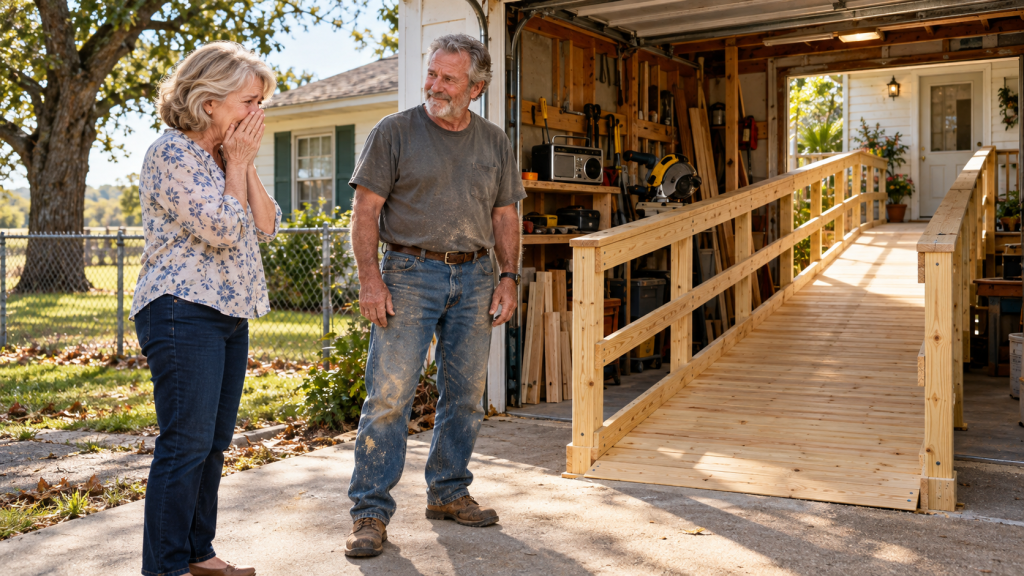
The new wooden ramp.
The neatly sanded railings.
The wide doorway.
The kitchen painted the exact shade my mother had loved.
All those little clues I’d been collecting for months suddenly made sense.
Wendell hadn’t been hiding a wife.
He’d been quietly making room for the possibility of a life with me.
And my son, who’d been so certain Wendell wanted my money, had apparently been trying to get his hands on it himself.
Jordyn’s phone rang.
ZACH.
She stared at the name.
“Answer it,” I said.
She looked frightened.
“Winona—”
“Put him on speaker.”
Wendell shook his head gently.
“You don’t have to do that.”
I considered it.
He was right.
I didn’t owe my son a confrontation simply because he’d discovered where I was.
Instead, I looked at Jordyn.
“Let it ring.”
She nodded.
The ringing stopped.
A text arrived immediately.
Tell Mom to get out of that man’s house. I’ll be there in fifteen minutes.
Then another.
And bring back the folder.
I looked at Jordyn.
“What folder?”
She held the papers tighter.
“This one.”
A chill traveled down my spine.
Zach knew she had found the documents.
Wendell closed the garage door and locked the entrance.
Then he called the local sheriff’s office, explained that an angry family member had threatened to come to the property, and asked for help if the situation escalated.
He didn’t make dramatic accusations.
He didn’t tell anybody to rush over with sirens.
He described what we knew.
I appreciated that more than I could explain.
We sat at his kitchen table.
The buttercup-yellow walls glowed in the afternoon light.
On the counter sat the two coffee mugs.
WEND.
WINNIE.
Beside them was a jar of paintbrushes and a small stack of hardware-store receipts.
I stared at the papers Jordyn had brought.
“Tell me everything.”
She took a shaky breath.
“Zach’s body shop is in trouble.”
I waited.
“Really bad trouble.”
“How bad?”
She looked down.
“He owes suppliers. Equipment payments are behind. There are business taxes that need to be sorted out. And he’s been borrowing money to cover other money.”
I felt sick.
“Why didn’t he tell me?”
Jordyn gave a sad little laugh.
“He told you enough to keep you helping.”
She explained that business had slowed after a major commercial customer changed repair providers.
Zach had taken out financing for expensive equipment, expecting the work to return.
It hadn’t.
Instead of reducing expenses or admitting he needed advice, he borrowed more.
Whenever a payment came due, he found another temporary solution.
A credit card.
A personal loan.
Money from a friend.
Then money from me.
“But why the ninety-six thousand?” I asked.
Jordyn unfolded another page.
“Because a lender was willing to consider a home-equity loan if the owner qualified and approved the security.”
I stared.
“And Zach told them I approved?”
She nodded.
“He said you wanted to help protect the business Dwight had encouraged him to build.”
My throat tightened.
Dwight.
My husband.
The man who’d spent his life telling our children to work hard and live within their means.
His name had become another tool Zach could use to persuade people.
I looked at the signature.
It was close to mine.
Almost close enough to fool someone who’d never watched me sign a document.
But the W curled the wrong way.
“I didn’t sign this.”
“I know,” Jordyn whispered.
“Did you sign anything?”
“No.”
“Did you help prepare it?”
Tears filled her eyes.
“I helped gather ordinary business records earlier this year. I didn’t know he was going to use your information.”
I studied her.
“And how did you get these?”
“They were in our shared office files. Yesterday I found the application and an unsigned closing checklist. He’d left the folder beside the printer.”
She swallowed.
“I asked him why your name was on a loan. He said you’d agreed.”
I shook my head.
“Then what?”
“He got angry.”
Her voice broke.
“He said I was trying to ruin everything and that the family owed him help because he’d stayed close when Dwight died.”
For a moment, I couldn’t speak.
Zach had taken over my online banking after the funeral.
He’d helped me pay bills when I couldn’t stop crying long enough to look at the screen.
He’d arranged repairs.
Handled paperwork.
Called the insurance company when I couldn’t bear to hear the words death benefit.
I’d trusted him.
Not because I was incapable of handling money.
I’d managed a household through thirty-four years of nursing shifts.
I’d simply been grieving.
And my son had told me he’d take care of things until I was stronger.
Jordyn reached for my hand.
“Winona, I should have told you sooner.”
I looked at her.
“How long have you known?”
“About the loan? Since yesterday.”
“And the money problems?”
She hesitated.
“Longer.”
“How long?”
Her eyes filled.
“Almost a year.”
I felt an ache behind my ribs.
She continued.
“He kept saying the next contract would fix it. I wanted to believe him.”
I knew that feeling.
I knew it painfully well.
Then headlights swept across the front window.
Jordyn froze.
Wendell looked toward the driveway.
A black pickup had pulled up beside the pecan tree.
Zach’s truck.
He climbed out wearing his work clothes.
His face was red.
He slammed the door and strode toward the house.
Wendell remained beside the window.
“Stay inside, both of you.”
I looked at him.
“Wendell, he’s my son.”
He turned toward me.
“I know.”
His voice softened.
“And you don’t have to open a door to somebody who’s furious with you.”
Zach pounded on the front door.
“Mom!”
The sound made Jordyn flinch.
“Mom, I know you’re in there!”
I closed my eyes.
Then he shouted:
“Wendell, open this door before I call the police!”
Wendell picked up his phone.
“I’ve already called for assistance, Zach. We’re not having a shouting match.”
There was a moment of silence.
Then Zach laughed.
“Of course. He’s turned you against me.”
He pounded again.
“Mom, you’re embarrassing yourself!”
I stared at the door.
My heart was hammering.
But beneath the fear, something else was growing.
Anger.
Not the hot, reckless kind.
The quiet kind that comes when a person realizes someone has been treating their trust like a weakness.
“Zachary,” I called through the closed door.
He went silent.
“I’m here.”
“Then come outside.”
“No.”
A pause.
“What?”
“I said no.”
His voice hardened.
“Mom, you’re being manipulated.”
I looked down at the loan application.
“Did you put my name on a ninety-six-thousand-dollar loan?”
Silence.
Then he said:
“That’s not what it looks like.”
I felt my stomach sink.
“Did you?”
“Mom, I can explain.”
“Then explain it to the lender and the investigators.”
Another silence.
When he spoke again, the tenderness was gone.
“You have no idea what you’re doing.”
I closed my eyes.
For months, he’d told me Wendell was hiding something.
He’d made me question my judgment.
Made Megan question it.
Used the grandkids to make me afraid of being lonely.
Now I understood why.
If I kept doubting Wendell, I might never question Zach.
The sheriff’s vehicle pulled into the driveway a few minutes later.
Zach stepped back from the porch.
A deputy got out and spoke with him near the truck.
I watched through the window.
Zach pointed toward the house.
Waved his arms.
Shook his head.
Then looked directly at me through the glass.
For one awful moment, he reminded me of Dwight.
The same dark eyebrows.
The same stubborn set to his jaw.
But my husband had never made me afraid to say no.
The deputy approached the door and identified himself.
After confirming who he was, Wendell let him inside.
We explained the situation.
Jordyn showed him the threatening texts.
I showed him the disputed loan application.
The deputy took information for a report and explained how to follow up with the appropriate financial-crime investigators.
He also spoke with Zach outside.
There was no magical arrest over paperwork he hadn’t examined.
But Zach was told that Wendell didn’t consent to him entering the property and that any financial dispute needed to be handled through lawful channels.
When the deputy returned, his expression was serious.
“Ma’am, your son says he was worried about your safety.”
I nodded.
“I understand.”
Then I held up the application.
“I’m worried about mine too.”
He looked at the documents.
“Have you contacted the lender?”
“Not yet.”
“Do that immediately. Also contact your bank and preserve these papers and messages.”
I nodded.
I knew what I had to do.
What frightened me was knowing how many questions I hadn’t asked.
Outside, Zach climbed back into his truck.
Before leaving, he sent me one final message.
Daddy would be ashamed of you.
I stared at those words.
Then slowly locked my phone.
For twenty-six years, I’d loved that boy.
Held him through fevers.
Cheered at baseball games.
Comforted him when his first girlfriend broke his heart.
Watched him marry Jordyn.
Held his children the day they were born.
And now he was using his dead father’s memory to frighten me into signing away the security Dwight and I had built together.
Wendell came to stand beside me.
“Winnie?”
I looked up.
He didn’t ask what Zach had said.
He didn’t tell me to forget about it.
He just held out his hand.
I took it.
And for the first time since Dwight died, I allowed myself to cry in front of a man who wasn’t trying to make my grief useful to him.
I didn’t drive home that afternoon.
My knees were aching, my hands wouldn’t stop trembling, and I knew that if I walked back into my quiet house alone, I would spend the evening staring at the bank statements and imagining every terrible possibility.
Wendell didn’t ask me to stay.
He didn’t suggest I move in.
He simply made another pot of coffee and said, “There’s a good chair by the window. Your knees might appreciate it.”
I almost laughed.
For months, he’d paid attention to the little things.
How I braced myself before standing.
How I favored my left knee on porch steps.
How I always looked for a chair with arms in case I needed help getting up.
He’d noticed my vulnerabilities without using them to make me feel helpless.
That distinction suddenly seemed enormous.
Jordyn sat across from us.
She’d turned her phone off.
Her face was drawn, and she kept glancing toward the front door.
“Are Ella and Ben safe?” I asked.
My granddaughter Ella was eleven. Her younger brother, Ben, had just turned eight.
Jordyn nodded.
“They’re with my sister. Zach thinks they’re at a friend’s house.”
I studied her.
“Are you going home tonight?”
She looked down.
“I don’t know.”
I reached across the table.
“Sweetheart, you don’t have to decide your marriage this afternoon. But you do need to decide where you and those babies will be safe tonight.”
Her eyes filled.
“I never thought I’d be afraid of him.”
I was quiet.
Because I had never thought I’d be afraid of my own son either.
After Jordyn left for her sister’s house, Wendell walked me through the little frame home.
Not as a salesman showing off a property.
As a man embarrassed by the amount of unfinished work he’d taken on.
He pointed out a crooked cabinet door.
A half-painted hallway.
A bathroom with new grab bars waiting to be installed.
There were wider doorways and sturdy handles instead of round knobs.
The floors were level and clear of loose rugs.
He’d even lowered some kitchen shelving.
I stared.
“Wendell, you did all this because I told you my knees hurt?”
He looked away.
“Partly.”
“Partly?”
He leaned against the counter.
“Winnie, I’m sixty-six. I’m not getting any younger myself.”
I smiled faintly.
Then he added, “And I’ve been through something like this before.”
His late wife, Ruthie, had lived with a progressive neurological illness during the final years of their marriage.
For a long time, she’d managed the stairs in their old house by holding the banister and pretending everything was fine.
Wendell believed her.
Or perhaps he’d wanted to.
When her mobility worsened, he began planning modifications.
But he kept postponing them.
There was work to finish.
Bills to pay.
A contractor who never returned his calls.
By the time the ramp was ready, Ruthie had already spent months unable to get outside without help.
“She never complained,” Wendell said quietly.
I looked at him.
He gave a sad smile.
“That was part of the problem. I kept mistaking her silence for being comfortable.”
My throat tightened.
“After she died, I promised myself I wouldn’t wait until somebody was trapped before making a home easier to live in.”
He looked around the kitchen.
“When you told me about your mother’s yellow walls, I remembered how your face changed.”
I swallowed.
“You remembered the exact shade?”
He smiled.
“I brought home five paint samples. None looked right. Then you mentioned buttercups at the grief group one morning.”
I looked at the walls.
My mother’s kitchen.
Sunday biscuits.
The old radio playing gospel music.
The sound of her laughing while she rolled dough.
I pressed a hand against my mouth.
“Wendell, you should’ve told me.”
“I know.”
He looked sheepish.
“I wanted to get it finished first. I thought if you came over and saw boards everywhere, you’d think I was trying to impress you with a construction site.”
I laughed through tears.
“That might have worked.”
He smiled.
Then his expression grew serious.
“Winnie, this isn’t a proposal hidden inside a kitchen remodel.”
I looked at him.
“It’s my house. I wanted it to be easier to live in. And I wanted you to know there’d be room for you here if you ever chose that.”
My eyes filled.
He continued.
“You don’t owe me an answer. You don’t owe me your money. You don’t even owe me another Sunday supper.”
I stared at him.
He took my hand.
“I just wanted you to have a place where you wouldn’t have to apologize for needing a railing.”
I began crying again.
He held me gently.
And I realized something that embarrassed me.
In thirty-four years of nursing, I’d helped thousands of people.
I’d washed frightened patients.
Held grieving families.
Worked holidays.
Stayed late when the emergency department was overflowing.
But I had somehow convinced myself that needing help was a failure.
Wendell had noticed that too.
He hadn’t tried to take charge of my life.
He’d simply made room for me to make my own choices.
The following morning, Jordyn and I went to my bank.
I insisted on driving.
My knees were stiff, but my hands were steady again.
I wore my navy-blue blouse and the pearl earrings Dwight gave me for our twenty-fifth anniversary.
I wanted to feel like myself.
Not like the frightened woman who’d spent the previous afternoon staring at a fake signature.
The bank manager, Mr. Talley, had known our family for years.
He’d attended Dwight’s funeral.
He’d watched Zach grow up.
When I told him what had happened, his face became serious.
“Mrs. Bennett, I want you to know we take this very seriously.”
I nodded.
“Then I need to see every account Zach has been able to access.”
He asked for identification and began arranging a review with the bank’s fraud department.
We went through the necessary steps to secure my online banking, change credentials, and remove access I no longer wanted Zach to have.
The investigation would take time.
But I could begin protecting myself immediately.
Then Mr. Talley brought up the transaction history.
I stared at the screen.
There were transfers from my savings account to an account associated with Zach’s business.
Not every month.
Not large enough to make me notice all at once.
A few hundred dollars here.
A thousand there.
Sometimes more.
The descriptions were deliberately ordinary.
Household assistance.
Repair reimbursement.
Family expense.
I felt cold.
“I didn’t authorize those.”
Mr. Talley didn’t assume the answer.
He asked questions.
Who had access?
Had I previously made any gifts to Zach?
Had I signed any transfer authorizations?
I answered as carefully as I could.
Yes, I had helped him with money before.
No, I hadn’t approved these transfers.
Yes, he knew my login.
No, that didn’t mean he owned the account.
After the initial review, Mr. Talley showed me a preliminary total.
$32,780.
I stared at the number.
Nearly thirty-three thousand dollars.
Gone.
I thought about the little repairs I’d postponed.
The trip to see an old nursing friend I’d decided was too expensive.
The way I’d begun worrying that Dwight’s insurance money was disappearing faster than I expected.
I had blamed inflation.
Property taxes.
My own poor planning.
Now I was looking at transfers I didn’t remember making.
Jordyn covered her mouth.
“Oh, Winona.”
I shook my head.
“Don’t.”
Tears were building behind my eyes.
“Not yet.”
I turned toward Mr. Talley.
“Can you tell where the money went?”
He nodded.
“The bank will investigate the receiving accounts and the authorizations. I’ll also give you copies of the records we’re able to provide.”
I swallowed.
“And the loan?”
He studied the document I’d brought.
“This application is with a separate lender. You’ll need to dispute it with them immediately and verify whether anything has been approved or recorded against your property.”
I nodded.
“I will.”
We contacted the lender that afternoon.
The representative confirmed that the proposed $96,000 loan had not been funded.
The application was under review, and the lender placed it on hold after I disputed my signature and consent.
I almost collapsed with relief.
The money hadn’t been released.
There was no confirmed new lien from that application.
But the documents were real enough to require a fraud investigation.
And somebody had gone to considerable trouble to make the lender believe I’d agreed.
I asked for written confirmation of the dispute.
I contacted the appropriate agencies about possible identity misuse.
I arranged to review my credit reports and property records, and to place additional protections where available.
For thirty-four years, I’d been the person filling out forms for frightened people.
Now I was the frightened person trying to understand which forms might protect me.
The irony wasn’t lost on me.
When we returned to my house, I walked straight to Dwight’s recliner.
I sat on its arm.
My hand rested on the worn brown leather.
I remembered him sitting there on Sunday afternoons, reading the newspaper with his glasses halfway down his nose.
“Dwight,” I whispered, “I thought I was doing right by our boy.”
My throat tightened.
“I don’t know where I went wrong.”
A voice came from behind me.
“Winona?”
Jordyn stood in the doorway.
Her eyes were full of tears.
“You didn’t make Zach do this.”
I looked at her.
She continued.
“You trusted your son. You gave him access because you were grieving and he said he wanted to help.”
I swallowed.
“He’s still responsible for what he chose to do with that trust.”
I closed my eyes.
For months, I’d listened to Zach tell me I was getting old.
Too trusting.
Too lonely.
Too willing to believe a man with a nice smile.
Now I was starting to understand that the person who’d most carefully cultivated those fears was the one who stood to profit from them.
Then my phone rang.
Megan.
My daughter.
I stared at the screen.
For a moment, I didn’t want to answer.
The last time we’d spoken, she’d told me lonely people got taken.
Now I knew someone had been taking from me.
But not the man she’d suspected.
I answered.
“Megan?”
Her voice was breathless.
“Mama, Zach says Jordyn has taken his business records and you’re helping her ruin his company.”
I closed my eyes.
“Did he tell you about the loan?”
There was a pause.
“What loan?”
I took a slow breath.
“The ninety-six-thousand-dollar loan he tried to secure against my house.”
Silence.
Then Megan whispered:
“He told me you offered to mortgage the house to save his business.”
My stomach dropped.
“Sweetheart, I never offered that.”
Another silence.
Then her voice broke.
“Mama, he showed me a form with your signature.”
I stared at the window.
Suddenly, the deception was wider than I’d imagined.
Zach hadn’t simply used my name on financial documents.
He’d been showing those documents to my own daughter to make his story look true.
Megan drove down from Longview the next morning.
She arrived just after nine, still wearing the sweater she’d probably pulled on in the dark.
When I opened the door, she looked at my face.
Then burst into tears.
“Mama.”
I stepped aside.
She came in and wrapped her arms around me.
For a moment, I was angry enough to pull away.
She’d believed Zach.
She’d questioned my judgment.
She’d allowed him to threaten me with losing the grandchildren.
But she was also my daughter.
And I could feel how badly she was shaking.
We sat at the kitchen table.
Jordyn joined us.
Wendell remained at his own house after I assured him I was comfortable meeting my daughter without him.
That mattered to me.
This was my family.
My table.
My decision.
I placed the disputed loan application in front of Megan.
She read it.
Then slowly looked up.
“That’s the same document Zach showed me.”
I nodded.
“He told me you’d signed because you wanted to save the shop.”
“I didn’t.”
She looked toward the signature again.
“Lord, Mama.”
Tears rolled down her cheeks.
“He said you’d been forgetting things.”
I went very still.
“What things?”
“He said you were missing bill payments. Getting confused about transfers. That Wendell was filling your head with stories.”
I stared at her.
Megan continued miserably.
“He told me you were so lonely after Daddy died that you were beginning to believe anybody who paid attention to you.”
I felt sick.
“He said that?”
She nodded.
“He kept saying you wouldn’t listen to reason.”
I looked at Jordyn.
Her face had gone pale.
Then I looked back at Megan.
“Did he ever tell you I was having trouble doing my own banking?”
Megan hesitated.
“Yes.”
I closed my eyes.
I’d complained once that the bank’s new app was difficult to navigate.
Zach offered to set it up.
From that moment, he’d treated every question I asked as evidence that I couldn’t manage my affairs.
“Megan,” I said quietly, “I worked in an emergency department until I was sixty-two.”
She began crying.
“I know.”
“I managed medication records, clinical emergencies, and families under tremendous pressure. I raised two children. I paid our bills. I helped Daddy with the shop’s taxes when Zach was first starting out.”
My voice shook.
“Having bad knees and asking someone how to change a banking password doesn’t make me incapable of making my own decisions.”
“I know, Mama.”
“Then why did you believe him?”
She stared at the table.
For a long moment, she didn’t answer.
Then she whispered:
“Because he sounded so certain.”
I sat back.
That hurt more than I wanted to admit.
Zach sounded certain.
I sounded lonely.
And the child I’d raised had decided certainty was more trustworthy than her mother’s own words.
Megan reached for my hand.
“I should have asked you directly.”
“Yes,” I said.
She began crying harder.
“And I shouldn’t have helped him threaten you with the grandkids.”
My eyes filled.
She whispered:
“He told me if Wendell got control of your money, we’d lose everything Daddy worked for.”
I shook my head.
“Your father worked so we could live. He didn’t spend his life working so our children could fight over what we’d leave behind.”
There was a long silence.
Then Megan asked:
“Have you checked your accounts?”
I slid the transaction history toward her.
Her face changed.
“Thirty-two thousand dollars?”
I nodded.
“Nearly thirty-three.”
She read the entries.
Then looked at Jordyn.
“Did you know?”
Jordyn shook her head.
“No.”
Megan looked back at me.
“Mama, how much did Daddy leave you?”
I hesitated.
Then answered.
“The life insurance benefit was one hundred and eighty thousand dollars. Some went toward funeral expenses and household needs. I put most of what remained aside to help support me in retirement.”
Megan nodded slowly.
“And Zach had access?”
“He helped me set up the accounts after the funeral.”
My daughter covered her mouth.
I looked toward Dwight’s recliner.
“I didn’t want to spend that money.”
The words surprised me.
Megan frowned.
“What do you mean?”
I swallowed.
“Every time I used some of it, it felt like I was spending another little piece of your father.”
Tears filled my eyes.
“I know that doesn’t make much sense.”
Megan reached across the table.
“It makes perfect sense, Mama.”
I looked down.
“That’s why I kept letting Zach handle things. He said I didn’t need to worry.”
Jordyn began crying.
Then she said something I hadn’t expected.
“There’s something else in the folder.”
I looked up.
She pulled out a printed email exchange.
It was between Zach and the prospective lender.
In one message, Zach explained that his mother found online forms confusing and preferred him to manage paperwork.
He asked whether verification could be completed through the contact number listed on the application.
I stared at the number.
It wasn’t mine.
It was Zach’s.
Megan covered her mouth.
“He was trying to keep them from speaking to you.”
Jordyn nodded.
I read the message again.
It wasn’t proof that the lender had accepted his claim.
In fact, a later message requested independent confirmation from the property owner.
But it showed the story Zach had been constructing.
A widowed mother.
A worried son.
A confusing financial world.
And a family member who supposedly needed someone else to speak for her.
I looked at Megan.
“Does that sound familiar?”
Her face crumpled.
“Yes.”
For weeks, Zach had been preparing people to doubt me.
Not by announcing some enormous lie.
By repeating little ones.
Mama forgot a payment.
Mama’s getting confused.
Mama doesn’t understand the bank.
Mama shouldn’t be driving that far.
Mama’s lonely.
Mama doesn’t know what men want.
Each statement could sound like concern.
Together, they formed a cage.
And I’d nearly stepped inside it willingly.
Megan began crying again.
“I feel like such a fool.”
I looked at her.
“You were misled.”
She nodded.
“But I also chose not to ask.”
I swallowed.
“Yes.”
She met my eyes.
“I won’t do that again.”
I wanted to believe her.
But I’d lived long enough to know a promise mattered most after someone had to keep it.
We spent the afternoon sorting documents.
Megan helped me organize the statements by date.
Jordyn prepared copies of the shared business records she’d already lawfully obtained.
We kept originals safe.
I made a written timeline of what I remembered about Zach’s access to my accounts.
The insurance payment.
The banking setup.
The first time he’d asked to handle a bill.
The Sundays he began watching Wendell so closely.
The day he’d told me I shouldn’t trust a man who wouldn’t show me his house.
As I wrote, another memory surfaced.
A month earlier, Zach had asked whether I still kept Dwight’s old papers in the filing cabinet beside our bedroom.
I’d said yes.
He’d offered to organize them.
I let him.
The following week, I couldn’t find our property-tax statements.
Zach told me I’d probably misplaced them.
I felt a chill.
“Megan,” I said, “come with me.”
We went to the bedroom.
The filing cabinet stood beside the dresser.
I opened the bottom drawer.
Several folders were missing.
Copies of our deed.
Old mortgage satisfaction papers.
My insurance documents.
The folder containing Dwight’s death certificate.
Megan stared.
“Are those supposed to be here?”
“Yes.”
I closed my eyes.
Zach had taken the records he needed.
Then he’d made me feel foolish for not knowing where they were.
That evening, we arranged for a lawyer who handled elder financial abuse and property matters to review everything.
I didn’t want revenge invented out of anger.
I wanted the facts.
I wanted my money protected.
My home secured.
And the people who’d been deceived to know what had happened.
Before Megan left, she stood beside Dwight’s chair.
For a moment, she looked like the little girl who used to curl up on his lap.
“Mama?”
I looked up.
“Do you think Daddy would be angry at us?”
I considered the question.
Then said:
“I think your father would be heartbroken.”
Her eyes filled.
“But he wouldn’t want us spending the rest of our lives hiding from the truth.”
She nodded.
Then crossed the room and hugged me.
After she drove away, I sat in the recliner.
For the first time since Dwight died, I sat all the way back.
The leather creaked.
The cushion dipped where his shoulders had worn it down.
I rested my hands on the arms.
And suddenly, I could remember him laughing.
Not the hospital.
Not the funeral.
Not the terrible final weeks.
Just Dwight, leaning back after supper, telling me I’d made the best biscuits in Texas.
I began crying.
Then, through the tears, I smiled.
My phone vibrated.
A message from Wendell.
How’s your knee?
I laughed softly.
After a day of missing money, forged signatures, and family betrayals, he wanted to know whether I’d been standing too long.
I typed:
Hurts like the devil.
A moment later, he replied:
Then put your feet up. Doctor’s orders from a retired lineman who knows nothing about medicine.
I smiled.
Then typed:
Come for supper Sunday.
His answer arrived almost immediately.
Two creams in your coffee?
I looked toward the brown recliner.
And for the first time in a very long while, the thought of someone coming to sit beside me didn’t feel like a betrayal of the man I’d lost.
It felt like the beginning of something I might still be allowed to have.
The attorney’s name was Kathleen Mercer.
She had silver hair, red reading glasses, and a voice that reminded me of the head nurses I used to work with.
Calm until someone tried to waste her time.
I liked her immediately.
Her office was in Waxahachie, inside an old brick building with tall windows and a pecan tree out front.
I brought bank statements, the loan application, screenshots, and the folder Jordyn had found.
Megan drove down to join me.
Wendell offered to come, but I told him I needed to handle this part myself.
He smiled.
“I’ll be right here if you want me.”
That was enough.
Kathleen examined everything carefully.
Then she looked at me.
“Winona, I want to make something clear. A child helping a parent with banking doesn’t automatically give that child authority to use the parent’s money.”
I nodded.
“I know that now.”
She continued.
“Nor does being named as a possible heir give someone ownership of a living parent’s house.”
Megan lowered her eyes.
Kathleen tapped the loan application.
“We’ll work with the lender to preserve the documents, dispute your signature, and make sure there isn’t an unauthorized security interest recorded against the property.”
I swallowed.
“Can he take my house?”
“An application with a disputed signature doesn’t simply transfer your house. But we need to verify the records rather than assume nothing else was filed.”
I breathed out.
She arranged for a title review and helped coordinate the formal disputes.
The lender confirmed in writing that the proposed loan had not been funded.
The disputed application was flagged for investigation.
The property records showed no new lien arising from that transaction.
I read the confirmation twice.
Then cried.
My house was still mine.
The home where Dwight and I had raised our children.
Where we’d paid off the mortgage after years of double shifts and careful saving.
Where his recliner still sat by the window.
It hadn’t been taken.
But my son had tried to put it at risk without telling me.
The bank investigation was more complicated.
Some transfers had gone directly toward Zach’s business expenses.
Others passed through an account he controlled before being used for payments that weren’t clearly connected to the shop.
His exact use of the money required further examination.
The bank began resolving the disputed transactions under its procedures and preserved relevant records for investigators.
One afternoon, Kathleen pointed to an old bank authorization I’d signed after Dwight’s death.
It gave Zach limited permission to help communicate about account matters and assist with certain bill payments.
It did not give him unrestricted ownership of my money.
Nor did it authorize borrowing against my home.
I stared at my signature.
I remembered signing it.
I remembered how tired I’d been.
I remembered Zach telling me he would take care of everything.
“I trusted him,” I whispered.
Kathleen looked up.
“Of course you did.”
My eyes filled.
“He’s my son.”
She nodded.
“Trusting him wasn’t permission for him to exceed the authority you gave.”
She helped me revoke the existing banking permissions through the proper process, secure my accounts, and update the emergency contacts I actually wanted.
Megan offered to replace Zach as my financial helper.
I looked at her.
Then shook my head.
“Not right now, honey.”
Her expression changed.
“I wasn’t trying to—”
“I know.”
I took her hand.
“But I need to remember that I’m capable of running my own life.”
Her eyes filled.
Then she nodded.
“Okay, Mama.”
I began paying my bills myself again.
At first, I was embarrassed by how many passwords I’d forgotten.
I wrote them down in a secure password manager with Ruth from the senior center helping me learn how to use it.
I checked every transaction.
Set up alerts.
Spoke directly with the bank when I had questions.
The process was ordinary.
Sometimes annoying.
But every time I completed a task Zach had told me I couldn’t handle, a little more confidence returned.
Jordyn continued living apart from Zach with Ella and Ben while she considered what was safest and best for their family.
She obtained her own legal advice.
I didn’t tell her to divorce him.
I didn’t tell her to forgive him.
I had spent enough years allowing other people to decide what I should do.
I wouldn’t make that mistake with her.
One Saturday, she brought the children to my house.
Ella ran straight into my arms.
“Nana!”
I hugged her.
Ben followed carrying a plastic dinosaur.
Wendell was fixing a loose porch board, and Ben immediately became fascinated by his toolbox.
“Are you building a spaceship?”
Wendell laughed.
“Not today.”
“Could you?”
“Depends how many snacks you’ve got.”
Ben considered this seriously.
Then offered him half a cracker.
For the first time in weeks, I laughed until my stomach hurt.
Later, Ella sat beside me on the porch.
She looked toward the driveway.
“Nana?”
“Yes, sweetheart?”
“Is Daddy mad at you?”
My throat tightened.
I looked at her carefully.
“Your daddy and I are dealing with some grown-up problems.”
She stared at her shoes.
“Mommy said it’s not our fault.”
I took her hand.
“She’s right.”
Ella looked up.
“Are you going to stop loving us?”
I nearly broke.
“Oh, darling.”
I pulled her close.
“Never.”
She began crying against my shoulder.
I held her until she stopped shaking.
Then whispered:
“Even when grown-ups make mistakes, children don’t have to carry them.”
She nodded.
I looked toward the yard, where Wendell was patiently explaining a screwdriver to Ben.
And I made myself a promise.
I would not let the children become weapons in another adult’s argument.
Not against Jordyn.
Not against Zach.
Not against me.
By January, the financial investigation had become serious enough that Zach obtained a lawyer.
He stopped calling me directly after being advised to communicate through appropriate channels.
For a while, I heard very little.
Then Kathleen called.
“Winona, we have a response from Zach’s attorney.”
My stomach tightened.
“What does it say?”
“He claims he believed you had agreed to help refinance the property as part of a plan to support the business.”
I stared at the wall.
“I never agreed to that.”
“I understand. His claim will have to be compared against the documents and other evidence.”
She paused.
“He also says some of the bank transfers were gifts.”
I closed my eyes.
I had given him gifts.
Birthday money.
Help with equipment when the shop opened.
A loan when a supplier failed to pay on time.
I’d never pretended otherwise.
But there was a difference between the money I’d chosen to give and the money he’d taken while controlling my online account.
Kathleen continued.
“The evidence includes communications in which he specifically asked that the lender contact him rather than you. Those are important.”
I nodded.
“Does he understand what he’s done?”
There was a pause.
Then she answered gently:
“Winona, I can’t tell you what he understands. I can tell you what the records show.”
The following week, I received a letter through Kathleen.
It was from Zach.
He wrote that he’d been under terrible pressure.
That the shop was failing.
That employees depended on him.
That he’d felt abandoned after Dwight died.
Then came the sentence that made my hands shake.
Dad built his life to leave something for us, and you’re letting another man enjoy it.
I stared at the page.
For years, I’d thought Zach objected to Wendell because he wanted to protect me.
Now he was admitting something uglier.
He was afraid that if I loved someone again, there might be less money for him someday.
I read the sentence aloud to Megan.
She went quiet.
Then whispered:
“I think that’s what he was trying to tell me all along.”
I looked at her.
She swallowed.
“He kept saying you’d marry Wendell, change your will, and leave everything to him.”
I stared.
“Wendell and I haven’t even talked about getting married.”
“I know that now.”
Her eyes filled.
“But Zach kept saying we needed to intervene before it was too late.”
I shook my head slowly.
Before it was too late.
Before I made decisions they couldn’t control.
Before I spent money enjoying the years I still had.
Before I chose companionship instead of waiting quietly for my children to inherit what remained.
I walked into the living room.
Dwight’s portrait hung above the mantel.
He was smiling in the photograph, squinting against the Texas sun.
I stood beneath it.
Then spoke aloud.
“You didn’t work all those years so I’d be afraid to buy myself a cup of coffee.”
My voice shook.
“Did you, Dwight?”
The house remained quiet.
But I remembered him telling me that when we retired, we’d drive to New Mexico and see the mountains.
We never made that trip.
There was always another expense.
Another family obligation.
Another reason to wait.
Now I was sixty-four.
My knees hurt.
And my son was acting as though the rest of my life belonged on a balance sheet.
That evening, I called Wendell.
He answered on the second ring.
“Winnie?”
“Do you still have those two coffee mugs?”
He laughed.
“Last I checked.”
I took a breath.
“Would you like to take a trip with me?”
A pause.
“Where?”
“New Mexico. To see the mountains.”
He was quiet.
Then he asked:
“Can we stop for good pie along the way?”
I smiled through tears.
“I think we can arrange that.”
We didn’t leave immediately.
There were still legal matters.
Property questions.
Financial records.
Family conversations.
But I bought a road atlas and placed it beside Dwight’s recliner.
For the first time since my husband’s death, I had made a plan that wasn’t about preserving the past or solving somebody else’s emergency.
It was about living.
And I refused to apologize for it.
The first formal hearing about the financial case took place in late winter.
I sat in a quiet waiting room with Kathleen beside me.
Megan had driven down from Longview.
Jordyn was there with her own attorney.
Wendell had offered to come, but I told him I needed to do this surrounded by the people directly involved.
He kissed my forehead before I left.
“Go tell the truth, Winnie.”
I smiled.
“I intend to.”
I hadn’t seen Zach in person since the day he stood outside Wendell’s house pounding on the door.
When he entered the courthouse, I almost didn’t recognize him.
He looked tired.
Older.
His shoulders were hunched beneath his jacket.
For a moment, my heart reacted before my mind could.
I wanted to stand.
Ask if he was eating properly.
Make sure he’d been sleeping.
Then he saw me.
And I remembered the forged signature.
The money.
The way he’d used his father’s memory to frighten me.
I remained seated.
The financial records had been examined over the preceding months.
Investigators had obtained information about the disputed transactions, the loan application, and how certain electronic authorizations had been submitted.
The evidence showed that Zach had exceeded the limited access I’d originally allowed and had submitted information representing that I consented to a loan I had never approved.
The lender had stopped the transaction before funding.
The disputed bank withdrawals were addressed through the bank’s investigation and the legal proceedings.
Not every dollar had been recovered immediately.
Some had already been spent on business debts.
Some remained subject to restitution.
But the records had finally separated what I’d given willingly from what had been taken without my permission.
Zach’s attorney argued that his client had been under severe financial pressure and had not intended to cause lasting harm.
Kathleen didn’t interrupt.
Neither did I.
Because I knew something the attorney’s explanation couldn’t change.
My son had been desperate.
But desperation hadn’t written my signature.
Desperation hadn’t changed the lender’s contact number.
Desperation hadn’t made him tell Megan I was losing my ability to manage money.
Those were choices.
During a later court proceeding, after the disputed facts had been addressed through the legal process, Zach accepted responsibility for specified financial offenses and agreed to restitution terms.
The court imposed consequences that included supervision and obligations related to repayment and compliance.
His shop eventually closed.
Equipment was sold to satisfy part of its debts.
Several employees found positions elsewhere.
The business he’d been so determined to save was gone.
I didn’t feel triumphant.
I’d watched that shop begin in a rented garage.
I’d seen Dwight help Zach paint the walls.
I’d brought sandwiches when the two of them worked late installing shelves.
When Zach opened officially, his father had been so proud he cried.
Now the sign was down.
And I wondered how much differently things might have gone if my son had admitted the shop was failing instead of trying to make me responsible for keeping it alive.
After one of the hearings, Zach asked through our attorneys whether I would consider a brief, supervised conversation.
I thought about it for several days.
Then I agreed.
Not because anyone pressured me.
Because I wanted to hear what he had to say without giving him access to my accounts, my house, or my decisions.
We met in a neutral office.
Kathleen helped arrange the boundaries.
Zach sat opposite me.
For several moments, neither of us spoke.
Then he looked at my hands.
“You still wear Dad’s ring?”
I glanced down.
Dwight’s wedding band hung on a chain around my neck.
“Yes.”
His eyes filled.
“I miss him.”
I swallowed.
“So do I.”
Zach stared at the floor.
“I thought if the shop failed, everything he’d been proud of would disappear.”
I looked at him.
“Your father was proud of you before you owned a shop.”
His eyes filled.
He shook his head.
“You don’t understand.”
“Then explain it.”
He rubbed his hands together.
“I kept thinking if I could borrow a little more, I could catch up. Every time something went wrong, I thought the next contract would fix it.”
His voice cracked.
“And when I couldn’t get more credit, I started looking at what you had.”
I stared at him.
He continued.
“I told myself Dad would’ve wanted to help me.”
I took a slow breath.
“Zach, your father would have wanted you to tell the truth.”
He covered his face.
“I know.”
For a long moment, I watched my grown son cry.
Then I asked the question that had been sitting inside me since the bank manager showed me the withdrawals.
“Why did you make Megan think I was confused?”
He lowered his hands.
His face was wet.
“I wanted her to believe me.”
“About what?”
“That you needed help.”
I waited.
He swallowed.
“If everybody thought I was the one looking out for you, nobody would question why I handled the money.”
The honesty struck harder than an excuse would have.
I sat very still.
“You used my age against me.”
He nodded.
“You used my knees.”
Another nod.
“And you used the fact that I was lonely after Daddy died.”
His mouth trembled.
“Yes.”
My chest felt painfully tight.
I looked toward the window.
For years, I’d been terrified of ending up helpless.
I’d watched patients lose their independence.
Watched families argue over care.
Watched people become invisible when others started speaking for them.
My son had known that.
He’d known exactly which fears would hurt me most.
And he’d used them.
“Zach,” I said quietly, “you didn’t just take money.”
He looked up.
“You tried to take my confidence.”
He began crying again.
I continued.
“You made me question whether I could trust myself. You made me afraid that loving someone new meant I was doing something foolish.”
My voice broke.
“And you tried to turn your sister against me.”
He nodded.
“I know.”
I looked at him.
“Do you?”
He swallowed.
Then whispered:
“I’m starting to.”
I studied his face.
For the first time, he wasn’t telling me that everything was an accident.
He wasn’t blaming Jordyn.
He wasn’t accusing Wendell of stealing his father’s place.
He wasn’t insisting the insurance money belonged to him.
But I knew one conversation couldn’t repair months of deception.
He looked toward me.
“Mom, do you hate me?”
My eyes filled.
“No.”
His face crumpled.
I continued.
“I love you. I probably always will.”
He began crying.
“But love isn’t the same as trust, Zach.”
He nodded.
“And you won’t get that back because you’re sorry today.”
“I understand.”
I took a breath.
“Show me you can respect a decision you don’t like. Pay what you owe. Be honest with Jordyn. Treat your children as people, not as a way to pressure the rest of us.”
He wiped his face.
“I’ll try.”
I looked at him.
“That’s where you start.”
Before leaving, he asked:
“Is Wendell still around?”
I almost smiled.
“Yes.”
He looked down.
“Does he make you happy?”
I considered the question.
Then answered:
“He makes me feel respected.”
Zach closed his eyes.
I continued.
“And I hadn’t realized how long it had been since I felt that.”
He didn’t ask me to leave Wendell.
Didn’t ask for money.
Didn’t ask to move home.
We said goodbye without a hug.
Not because I wanted to punish him.
Because I wasn’t ready.
And for once, my son accepted a boundary without trying to make me feel guilty about it.
That spring, I received the first restitution payment.
It wasn’t enough to replace everything I’d lost.
But I stared at the deposit for a long time.
Not because the amount mattered.
Because I knew Zach had earned the money himself.
He’d found work at an auto-parts supplier after the shop closed.
He was attending financial counseling and complying with the court’s requirements.
Jordyn continued making her own decisions about the marriage, with support from her family and legal advisers.
Nobody promised me everything would become normal again.
I wasn’t sure I wanted the old normal back.
I called Megan that evening.
“Your brother made a payment,” I said.
There was a pause.
Then she answered softly.
“That’s something, Mama.”
“Yes.”
I looked toward Dwight’s photograph.
“It is.”
Later, Wendell came over for supper.
He brought a small paper bag.
Inside were two maps.
One showed the mountains of northern New Mexico.
The other marked little towns along the roads we might take.
He’d circled several pie shops.
I stared at the map.
“Wendell, how many places do you expect us to stop?”
He grinned.
“As many as your knees and my appetite will allow.”
I laughed.
Then looked at him.
“You really want to go?”
He took my hand.
“Winnie, I didn’t spend six months building a ramp just so we could sit in my kitchen and worry about what everybody else thinks.”
My eyes filled.
He smiled.
“There’s still a whole world out there.”
We left for New Mexico in May.
I packed too many sweaters.
Wendell packed a toolbox, three flashlights, and enough snacks to feed a church picnic.
When I asked whether we were going on vacation or preparing for a natural disaster, he gave me a serious look.
“Winnie, a man doesn’t survive thirty years with the electric co-op by trusting things not to break.”
I laughed so hard I had to sit down.
We took the back roads whenever we could.
Stopped for coffee in little towns with one traffic light.
Bought peaches from a roadside stand.
Argued about whether a diner outside Amarillo really served the best pie in Texas.
Wendell insisted it did.
I told him his judgment couldn’t be trusted because he’d ordered three slices.
He smiled.
“Had to make sure.”
For the first time since Dwight died, I allowed myself to enjoy a day without feeling guilty.
That surprised me.
Grief has a strange way of convincing you that happiness is disloyal.
For two years, every time I laughed too hard, I remembered my husband wasn’t there to hear it.
Every time I considered taking a trip, I thought about the journeys we’d planned and never taken.
Every time Wendell held my hand, some part of me wondered whether I was letting go of Dwight.
One evening, we stopped at a scenic overlook.
The mountains stretched across the horizon, purple beneath the fading light.
Wendell opened the passenger door and offered his hand.
I stepped out carefully.
My knees protested.
He didn’t rush me.
We walked to a wooden bench overlooking the valley.
Then sat in silence.
After a while, I reached into my handbag.
Inside was a photograph of Dwight and me on our twenty-fifth anniversary.
We were standing outside our house, laughing because the wind had blown my hair across my face.
I held it carefully.
“Dwight wanted to see these mountains,” I whispered.
Wendell looked toward the photograph.
“He had good taste.”
My eyes filled.
“In mountains or women?”
Wendell smiled.
“Both.”
I laughed through tears.
For a moment, I stared at the landscape.
Then I whispered:
“I wish he’d made it here.”
Wendell took my hand.
“So do I.”
I turned toward him.
“You don’t mind when I talk about him?”
He looked almost surprised.
“Winnie, you loved that man for most of your adult life.”
I swallowed.
He continued.
“I’m not interested in pretending those years didn’t happen.”
His voice softened.
“And I don’t need you to forget him to care about me.”
I began crying.
Not because I was sad.
Not entirely.
Because I had spent so long believing that every relationship came with a price.
Zach wanted access to my money.
Megan had wanted reassurance that the family inheritance was safe.
Even I had expected myself to prove I could keep everybody happy.
But Wendell wasn’t asking me to erase my past.
Or surrender my independence.
Or choose between remembering Dwight and enjoying the years I still had.
He was simply sitting beside me.
Holding my hand.
Watching the mountains.
When we returned to Texas, the financial case hadn’t disappeared.
The restitution payments continued.
The bank completed further reviews of the disputed transactions.
The loan application remained unfunded and closed as a disputed transaction.
I maintained my own passwords, monitored my accounts, and kept my property information secure.
Kathleen occasionally called with updates.
There were forms to sign.
Questions to answer.
Records to preserve.
But those tasks no longer consumed my life.
Megan and I began having Sunday lunch again.
Not every Sunday.
Sometimes I went out with friends.
Sometimes I visited Wendell.
And sometimes I simply stayed home with a book.
At first, Megan asked whether I needed help with everything.
My bills.
My appointments.
My medication refills.
One afternoon, I smiled and said:
“Honey, you’re welcome to ask how I’m doing. But you don’t need to supervise me.”
She blushed.
Then laughed.
“I guess I deserved that.”
I took her hand.
“You meant well. Just remember to listen when I tell you what I need.”
She nodded.
“I will, Mama.”
And slowly, she began doing exactly that.
Jordyn brought Ella and Ben to visit regularly.
The children stopped looking frightened whenever somebody mentioned their father.
They had counseling and steady support from the adults around them.
Zach’s relationship with them continued according to arrangements that considered their safety and well-being.
I tried not to interfere.
Not because I didn’t care.
Because I’d learned that loving my family didn’t mean taking control of every decision.
One Saturday, Ben came running into my kitchen.
“Nana!”
I turned.
“Yes, sweetheart?”
He held up a little wooden bird.
“Mr. Wendell helped me make this.”
I smiled.
The bird’s wings were crooked.
Its beak was too large.
It was absolutely beautiful.
“Did he now?”
Ben nodded proudly.
“He said it doesn’t have to be perfect to be worth keeping.”
I looked toward the porch.
Wendell stood beside the railing, pretending not to listen.
My eyes filled.
That evening, after the children left, I sat in Dwight’s recliner.
Wendell brought two cups of coffee.
He hesitated beside the empty chair across from me.
“Mind if I sit?”
I looked up.
Then smiled.
“Wendell, you’ve been eating supper here for nearly a year. I think you’re allowed to sit down.”
He laughed.
“Just checking.”
He settled beside the window.
For a while, we watched the sunset through the pecan trees.
Then I said:
“I used to think that recliner was the only way I could keep Dwight close.”
Wendell looked toward me.
“And now?”
I ran my hand along the worn leather.
“Now I think I can remember him without keeping the whole house exactly the way he left it.”
Wendell nodded.
We sat quietly.
And the memory of my husband felt warm instead of unbearable.
On my sixty-fifth birthday, I brought out my mother’s old buttercup-yellow tablecloth.
It had been folded in the linen cabinet for years.
I spread it across the dining table.
Then made biscuits, scrambled eggs, bacon, and coffee.
Megan brought flowers.
Jordyn arrived with the grandkids.
Carla from the grief group brought a homemade cake.
And Wendell came carrying a small wooden box.
Inside was a brass key.
I looked at him.
“What’s this?”
He smiled.
“A spare key to my house.”
My heart skipped.
He continued quickly.
“Not an obligation, Winnie.”
I laughed.
“Lord, Wendell.”
He took my hand.
“I finally finished the bathroom and the last of the kitchen cabinets. I figured you ought to be able to come over without standing outside while I find my keys.”
I smiled through tears.
Then asked:
“Is the garage still full of sawdust?”
He sighed.
“Some things will never change.”
Everyone laughed.
I looked around the table.
My daughter.
My grandchildren.
My friends.
The man who’d quietly helped me believe I could have a future.
There was an empty place where Zach might someday sit.
I felt its absence.
I probably always would.
But I no longer believed I had to fill it at any cost.
After breakfast, my phone buzzed.
A message from Zach.
Happy birthday, Mom. I hope you have a wonderful day. I’m keeping up with the payments and my job is going well. No need to answer. Love you.
I read it carefully.
There was no demand.
No accusation.
No attempt to make me feel guilty for enjoying my own birthday.
I smiled sadly.
Then typed:
Thank you, Zach. I’m glad you’re doing the work. I love you too.
I put the phone away.
I had no way of knowing what our relationship would look like five years from then.
I hoped we would continue rebuilding it.
But hope was no longer the same as handing over my house keys and pretending the past hadn’t happened.
That afternoon, I drove to Wendell’s house.
I used my own key.
Walked through the garage.
And rested my hand on the smooth wooden railing he’d built.
I remembered the first afternoon I’d stood there, convinced I might discover he had a secret wife.
Instead, I’d found a yellow kitchen, two coffee mugs, and a man who’d spent months preparing a home that would remain accessible as we grew older.
Then I’d learned that the person warning me about being deceived had been deceiving me himself.
I stopped in the doorway.
Wendell was standing beside the sink, washing dishes.
He looked up.
“There you are.”
I smiled.
“Here I am.”
He dried his hands.
“Coffee?”
“Two creams.”
He grinned.
“Already made.”
I walked toward him.
For a moment, I thought about all the things I’d nearly lost.
My savings.
My home.
My confidence.
My relationship with my daughter.
My ability to trust my own judgment.
And I thought about everything I’d gained by refusing to let fear make my decisions.
The truth.
A stronger relationship with Megan.
A chance for Zach to face his responsibilities.
And the freedom to love someone without turning my life over to him.
Wendell held out my mug.
WINNIE.
I took it.
Then looked around the yellow kitchen.
“Do you know why I came here that first afternoon?”
He smiled faintly.
“Because I wouldn’t let you see the house?”
“Yes.”
I swallowed.
“And because Zach had convinced me I was too lonely to know when somebody was lying to me.”
Wendell’s expression softened.
I continued.
“I thought the garage door would show me what you were hiding.”
He took my hand.
“And did it?”
I looked toward the ramp.
The careful railings.
The smooth floor.
The sunlight falling across the yellow walls.
Then I smiled through tears.
“It did.”
For months, my son had insisted that the man who wouldn’t show me his home must want my husband’s insurance money.
He was wrong about Wendell.
But he was right about one thing.
Someone had been hiding a terrible secret from me.
It simply wasn’t the man with sawdust on his jeans.
It was the son I’d trusted with my bank accounts while I was grieving.
The garage door had been standing wide open that afternoon.
And walking through it changed my life.
Not because I found a hidden wife.
Not because I uncovered a fortune.
But because I finally saw the difference between someone who wanted to control what I owned and someone who wanted me to feel safe in a home.
I had spent thirty-four years taking care of other people.
Two years mourning my husband.
And too many months letting fear convince me that being sixty-four meant my best days were behind me.
But standing beside Wendell in that buttercup-yellow kitchen, I knew better.
My husband’s love had given me a beautiful past.
My own courage had protected my future.
And the man standing beside me wasn’t asking for either one.
He was simply asking whether I’d like another cup of coffee.
I smiled.
“Only if you’ll have one with me.”
He laughed.
“Winnie, I thought you’d never ask.”
THE END STORIES! THANK YOU FOR READING GOOD LUCK !❤️
Related Posts