I stared through the glass at the newborn girl. Tiny fists. Pink blanket. A dark curl pressed against her forehead. Somewhere inside that room was the daughter I had imagined when I was nineteen. Except she was not mine.
She was Lena’s. And Lena was dead. Marcus stood beside me with tears sliding silently into his beard. Then he asked the question I would remember more clearly than anything else from that hospital.
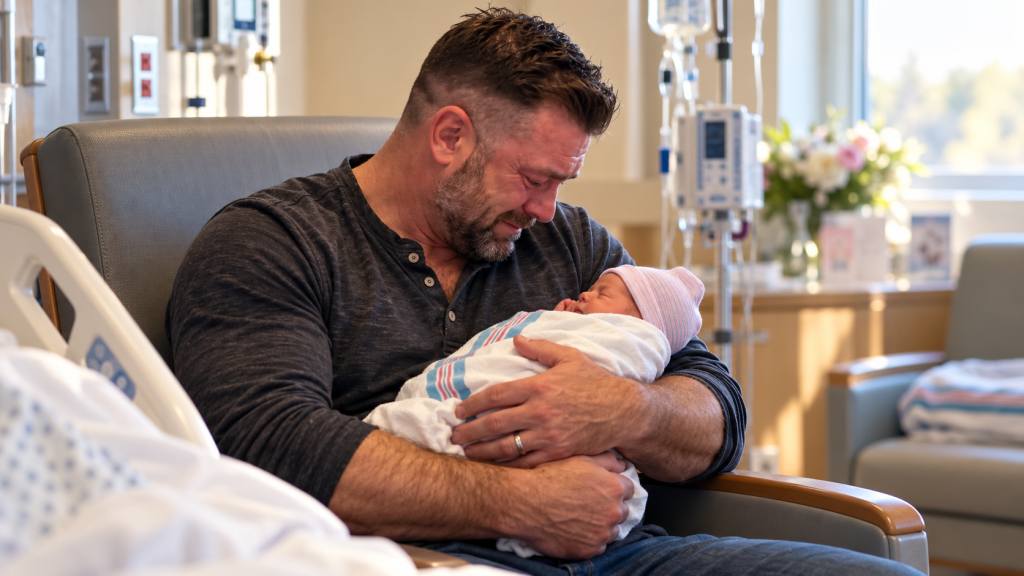
“Can you love her without making her the daughter we lost?” I looked at him. He swallowed. “Because if we do this, I need you to promise me something.” “What?” “We never tell her she completed our family.” My chest tightened. Marcus looked through the glass.
“She didn’t come here to complete anything.”
“She had a mother.”
“She lost her.”
“If she becomes ours, it has to be because we can carry that truth with her.”
“Not because God finally gave us the girl we wanted.”
I started crying.
Not gently.
Not beautifully.
I sat down against the hallway wall in my kitchen-cleaning shirt and cried until a nurse quietly placed a box of tissues beside me.
Marcus crouched in front of me.
“I’m sorry.”
“For what?”
“All of it.”
I looked at him.
“What aren’t you telling me?”
His face changed.
There it was.
Another thing.
“Marcus.”
He sat beside me.
“I spoke to Lena three weeks ago.”
The grief inside me sharpened.
“What?”
“She called.”
“You told me you hadn’t spoken to her in six years.”
“I hadn’t.”
“Until three weeks ago.”
“Yes.”
I stared at him.
“You talked to your sister after six years and didn’t tell me?”
“She asked me not to.”
I stood.
“So?”
“I know.”
“No.”
I wiped my face.
“You don’t get to say ‘I know’ and make this reasonable.”
“She was scared.”
“Of what?”
Marcus looked toward the nursery.
“The baby’s father.”
My stomach tightened.
“You said he disappeared.”
“He did.”
“That isn’t what I asked.”
Marcus took a breath.
“His name is Evan Cole.”
“They were together for almost two years.”
“He struggled with pills before Lena met him.”
“He had been sober for a while.”
“Then he relapsed.”
I closed my eyes.
Marcus continued.
“Lena found out she was pregnant around the same time.”
“She tried to help him.”
“Then money started disappearing.”
“He missed appointments.”
“He disappeared for days.”
“She finally told him to leave.”
“Did he hurt her?”
“Not physically, from what she told me.”
“Threaten her?”
“She said no.”
“Then why was she scared?”
“Because he was unpredictable.”
Marcus rubbed his hands together.
“She didn’t know whether he would come back sober, high, angry, apologetic, or not at all.”
“And three weeks ago she called you?”
“Yes.”
“Why?”
“She was being admitted for monitoring.”
My chest tightened.
“She knew something was wrong?”
“Her blood pressure was dangerously high.”
“Preeclampsia.”
“She thought they might deliver early.”
“Why didn’t you tell me?”
Marcus looked at me.
“I was going to.”
“When?”
“After I understood what she wanted.”
“And what did she want?”
He looked down.
“She asked if I would be temporary guardian if something happened to her.”
The hallway went silent.
“You knew.”
“I knew she had listed me.”
“For three weeks.”
“Yes.”
“And you let me wake up every morning, pack lunches, drive the boys to school, argue about laundry, while somewhere your pregnant sister was asking us to raise her baby if she died?”
“I did not think she was going to die.”
“That doesn’t answer me.”
“No.”
His eyes filled.
“I was afraid.”
“Of me?”
“Of what the question would do to you.”
That hurt more than I expected.
“What would it do to me?”
Marcus looked toward the baby.
“You spent four years trying to bury wanting a daughter.”
“I watched you cry after the doctor appointment.”
“I watched you pretend you were fine every time someone announced they were having a girl.”
“You were fine.”
“But you hurt.”
I stared at him.
“And so you decided I couldn’t handle the truth?”
“Yes.”
The honesty stopped me.
Marcus continued.
“And I was wrong.”
“You were.”
“I know.”
This time I let him say it.
I sat again.
“You should have told me.”
“Yes.”
“I should have had three weeks to think about this before there was a dead woman and a newborn behind glass.”
“Yes.”
“I am furious with you.”
“I know.”
“And I still love you.”
His face broke.
“I know that too.”
I looked at him.
“Good.”
Because more than one thing could be true.
I could understand why Marcus stayed silent.
And still believe the silence was wrong.
I could love him.
And be angry.
I could look through that glass and want to pick up that baby with every part of my body.
And still know wanting her did not make her ours.
The nurse came back.
“Would you like to hold her?”
My breath stopped.
Marcus looked at me.
He did not answer for me.
That mattered.
I nodded.
“Yes.”
They put me in a rocking chair.
A nurse placed the baby into my arms.
Six pounds, one ounce.
Warm.
Fragile.
Sleeping.
I expected fireworks.
Destiny.
Some enormous maternal revelation.
Instead, I felt terrified.
She made a tiny sound.
I looked down.
“Hi.”
My voice cracked.
Her eyes opened briefly.
Dark.
Unfocused.
I whispered:
“I’m your Aunt…”
Then stopped.
What was I?
Aunt by marriage.
Potential guardian.
A woman who had wanted a daughter too badly and now had one placed against her chest under the worst possible circumstances.
Marcus sat beside me.
“She looks like Lena.”
I nodded.
Around the nose.
The same crease between the eyebrows.
“What did Lena name her?”
Marcus looked at me.
“Elise.”
My chest tightened again.
My name.
The daughter-name I had chosen when I was nineteen.
I whispered:
“How?”
Marcus looked almost ashamed.
“I told Lena.”
“When?”
“Years ago.”
“Before the fight.”
“We were driving to Mom’s house one Christmas.”
“She asked whether we were done having kids.”
“I said we wanted a girl someday.”
“She asked what we’d call her.”
“And you told her?”
“Yes.”
I laughed through tears.
“So she didn’t read my mind.”
“No.”
“I’m relieved.”
He smiled faintly.
Then the smile disappeared.
“She remembered.”
That was the part that hurt.
Six years without speaking.
And Lena remembered the name.
I looked down at Elise.
“She named her after my dream?”
Marcus shook his head.
“No.”
“She explains it in the letter.”
The envelope.
I had almost forgotten.
Marcus handed it to me.
My name across the front.
I opened it with one hand while Elise slept against me.
The first line made me cry again.
I’m sorry this letter exists.
I kept reading.
If you are reading it, either I am very sick or I am gone. I hope it is the first one. If it is the second, please do not let guilt make this decision for you.
I paused.
Marcus stared at the floor.
Marcus told me years ago that if you ever had a daughter, you wanted to name her Elise. I loved it because our grandmother used to hum “Für Elise” badly while washing dishes, and because the name sounds like something soft surviving in a loud house.
I laughed through tears.
Marcus whispered:
“I forgot about Grandma.”
I continued.
I did not choose the name to hand you the daughter you couldn’t have.
My chest tightened.
I chose it because I liked it too.
She is not your wish granted.
She is herself.
I looked down at the baby.
“She knew.”
Marcus nodded.
I kept reading.
If I am gone, I want you and Marcus considered first for temporary guardianship. Not because you wanted a girl. Actually, that almost made me choose someone else.
I blinked.
That surprised me.
Then Marcus told me what your doctor said after your third boy.
My eyes moved to my husband.
He nodded.
I returned to the letter.
He told me you asked three times whether there was any safe way to try again, and when the answer stayed no, you stopped because your boys needed their mother.
Tears blurred the words.
That is why I chose you.
You already proved you could love the children you had more than the child you wanted.
I covered my mouth.
Marcus began crying beside me.
If you raise Elise, please never make her responsible for healing that grief.
Tell her about me.
Tell her I was stubborn.
Tell her I laughed too loudly.
Tell her I hated mushrooms and loved thunderstorms and once broke Marcus’s nose with a softball.
Marcus whispered:
“She did.”
I laughed.
The baby stirred.
I lowered my voice.
Tell her I loved her before she existed.
And if her father becomes healthy enough to be in her life safely, do not erase him just because you are afraid to lose her.
There it was.
The sentence that would shape the next two years.
Love her enough to let the truth be complicated.
I finished the letter.
At the bottom:
P.S. Marcus keeps baby clothes because he is sentimental and weird. Please make fun of him for me.
I started laughing so hard the nurse looked over.
Marcus covered his face.
“Even dead.”
“Yes.”
I wiped my eyes.
“Even dead.”
That night we did not take Elise home.
People imagine that when a relative dies and leaves a baby, someone signs a paper and walks out carrying a car seat.
That is not how it happened.
Social workers came.
Hospital administration.
A child-welfare investigator because the mother had died and the father’s location was uncertain.
Questions.
Background checks.
Our house.
Our children.
Our finances.
Our marriage.
The gun safe in the garage.
Whether we had smoke detectors.
Where Elise would sleep.
Whether we understood temporary guardianship was temporary.
That word was repeated often.
Temporary.
I needed it repeated.
Because every time I looked at her, my body wanted to start building forever.
Marcus’s mother came to the hospital that evening.
Her name was Diane.
She and Lena had spoken occasionally, but never repaired the relationship fully.
Diane walked into the corridor, saw the bassinet, and collapsed against the wall.
“My baby.”
For a second I thought she meant Elise.
Then I understood.
Lena.
A mother had lost her daughter.
No matter how old Lena was.
No matter how many fights they had.
Diane looked at Marcus.
“Why didn’t she call me?”
Marcus cried.
“I don’t know.”
That was a lie.
I heard it immediately.
So did he.
He corrected himself.
“She was still angry.”
Diane closed her eyes.
“For what?”
Marcus said nothing.
Diane looked at me.
Then back at him.
“For the intervention?”
He nodded.
I knew pieces of the story.
Six years earlier, Lena had been drinking too much after a terrible breakup.
Diane and Marcus confronted her.
But according to Marcus, the confrontation had gone badly.
I had assumed Lena was simply furious at being challenged.
Now Marcus explained the part he had never told me.
Diane had threatened to contact Lena’s employer.
Threatened to tell relatives.
Threatened to “save her from herself.”
Marcus joined in.
Lena left.
Later she got sober largely on her own.
She never forgave them for turning her worst months into a family emergency she no longer controlled.
Diane whispered:
“I was trying to help.”
Marcus answered:
“I know.”
The phrase hung there.
Trying to help.
How much damage has been done by people who believed intention made impact irrelevant?
Diane looked at Elise.
“Who gets her?”
My body tensed.
Marcus answered carefully.
“Right now, no one ‘gets’ her.”
“Lena listed us for temporary guardianship.”
Diane looked at me.
Not with hostility.
With grief.
“You?”
I nodded.
“She chose you?”
“Yes.”
Diane sat down.
Then whispered:
“She didn’t choose me.”
No one answered.
What could we say?
The next day, the court approved an emergency kinship placement with us pending further proceedings.
Elise came home at forty-eight hours old.
We used the box.
The box Marcus would never let me give away.
I carried it down from the garage shelf.
Dust on top.
Inside:
Two newborn sleepers.
Swaddles.
The tiny hat.
I held it and cried.
Marcus leaned against the garage door.
“Told you.”
I looked at him.
“This is not the time to be right.”
“Fair.”
We washed everything.
The boys came home from school knowing only that Aunt Lena had died and there was a baby who needed somewhere safe.
Nine-year-old Caleb stood in the kitchen.
“Is she ours?”
I knelt.
“No.”
He frowned.
“She lives here.”
“Yes.”
“So ours.”
Seven-year-old Owen said:
“She can be ours and not ours.”
Caleb stared.
“That makes no sense.”
Owen shrugged.
“She’s family.”
Four-year-old Noah climbed onto a chair to inspect the bassinet.
“Can she play dinosaurs?”
“Not yet.”
“When?”
“Maybe two years.”
He looked disappointed.
Then:
“Can we keep her until then?”
I swallowed.
“We don’t know.”
The boys hated that answer.
So did I.
The first weeks were beautiful and terrible.
Newborn nights at thirty-eight were different from newborn nights at twenty-nine.
My back hurt.
My patience was thinner.
The boys still needed homework help.
Lunches.
Soccer.
Baths.
Marcus returned to work after compassionate leave.
Diane came most afternoons.
Elena—no, sorry, Lena was gone.
I kept almost calling her.
That was grief too.
Reaching mentally for a person whose absence your body has not accepted.
We hung photographs of Lena in Elise’s room.
Not a shrine.
A mother.
One picture showed Lena laughing with wind in her hair.
Another holding a fish she was clearly disgusted by.
One with Marcus when they were children.
I put the letter in a fireproof box.
Not mine.
Elise’s.
At night, sometimes I would stand beside the crib and whisper:
“You have a mother.”
It sounded strange.
Of course she had a mother.
But I needed to remember.
So did everyone else.
People congratulated us.
I hated that.
At church:
“What a blessing!”
At school pickup:
“You finally got your girl!”
That sentence made my skin crawl.
The first time someone said it, I smiled automatically.
Then went home and cried.
The second time, I corrected them.
“She is our niece.”
The woman looked embarrassed.
“I just meant—”
“I know.”
I softened my voice.
“Her mother died.”
“She isn’t the prize at the end of our fertility story.”
The woman apologized.
Afterward, Marcus squeezed my hand.
“You okay?”
“No.”
“Good answer.”
“I hated saying it.”
“I know.”
Love required uncomfortable sentences.
Then, seventeen days after Elise came home, Evan appeared.
Not at our door.
At the courthouse.
I knew him immediately from Lena’s old social media photographs.
Tall.
Thin.
Unshaven.
Thirty-one.
He wore a borrowed button-down shirt and looked like he had not slept.
Marcus stood so fast his chair scraped.
I grabbed his wrist.
“Don’t.”
Evan saw us.
Then saw the baby carrier beside me.
His face collapsed.
“Elise?”
I pulled the carrier closer instinctively.
His eyes filled.
“Can I see her?”
Marcus said:
“No.”
I looked at him.
Then at Evan.
A social worker approached immediately.
She had expected this.
Evan had contacted the court that morning.
He had been in a residential treatment program in Arizona.
Not hiding from Lena.
Not exactly.
He had relapsed badly enough that his sister and sponsor drove him there three months earlier.
Lena knew where he was.
She had stopped taking most of his calls.
He had learned about her death four days late because treatment staff had restrictions on outside access during his intake phase.
The story was not:
Father abandons pregnant woman and returns for baby.
It was uglier and sadder.
He was sick.
He had left.
He had also gone somewhere meant to help him stop being sick.
Both true.
Evan asked again.
“Can I see her?”
Every part of me wanted to say no.
Lena’s letter entered my mind.
If her father becomes healthy enough to be in her life safely, do not erase him just because you are afraid to lose her.
I looked at the social worker.
“Is it allowed?”
She nodded.
“Supervised.”
My chest hurt.
I said:
“Okay.”
Marcus stared at me.
I whispered:
“Lena asked.”
His jaw tightened.
Then relaxed.
“Okay.”
We took Elise into a small family room.
Evan washed his hands twice.
Then sat.
The social worker placed Elise in his arms.
He started crying before she touched his chest.
Not movie crying.
No sound.
His whole face simply folded.
“Hi, Ellie.”
I froze.
Ellie.
Lena had called her that in the letter once.
No one had told him.
He knew his daughter.
At least in some ways.
He whispered:
“Your mom hated when I called you Peanut.”
Marcus looked away.
Evan touched one finger to Elise’s cheek.
“I’m sorry.”
Over and over.
“I’m sorry.”
I wanted to hate him.
It would have made everything easier.
But grief is cruel enough without simplifying people for convenience.
Afterward, Evan looked at us.
“Thank you.”
Marcus said nothing.
I asked:
“Did Lena want you involved?”
Evan swallowed.
“Before I relapsed?”
“Yes.”
“After?”
His eyes filled.
“She told me I needed to get sober before I could be anyone’s father.”
“Did she say you couldn’t see the baby?”
“She said she would decide based on how I was doing.”
He looked down.
“I was doing badly.”
Honest.
That mattered.
The legal process began.
Paternity confirmed.
Evan was Elise’s biological father.
That changed everything.
Emergency guardianship did not erase his rights.
The court ordered evaluations.
Treatment documentation.
Supervised visitation.
Drug testing.
Parenting classes.
A reunification plan.
I went home from the first major hearing and vomited.
Marcus found me sitting on the bathroom floor.
“We could lose her.”
I whispered.
He sat beside me.
“She isn’t ours to lose.”
I looked at him furiously.
“Don’t.”
“I know.”
“No, you don’t.”
“I wake up when she breathes differently.”
“I know which cry means hungry and which means overtired.”
“She curls her hand around my shirt.”
“She knows my voice.”
“And now somebody says if he checks enough boxes, she leaves?”
Marcus’s eyes filled.
“He’s her father.”
“I know that!”
I hated how loud I sounded.
Then I whispered:
“I know.”
That was the problem.
If Evan were cruel, the answer would be easy.
If he disappeared again, easy.
If he failed every test, easy.
He didn’t.
He did well.
Not perfectly.
But well.
He completed residential treatment.
Moved into sober housing.
Found warehouse work.
Attended every supervised visit.
Every one.
Even when a bus broke down and he walked the final mile.
He learned bottles.
Diapers.
Infant CPR.
He sent no angry messages.
Made no demands beyond what his attorney advised.
When Elise was four months old, the social worker extended one visit from one hour to two.
I cried in the parking lot.
Not because anything bad happened.
Because something good did.
For him.
And that terrified me.
I told the therapist the court required us to see as guardians:
“I want him to fail.”
The words disgusted me.
The therapist did not flinch.
“Do you want him to hurt Elise?”
“No.”
“Do you want him to relapse?”
“No.”
“Then what do you mean?”
I covered my face.
“I want some objective reason that makes keeping her righteous.”
There.
The ugliest truth.
I did not want evil for Evan.
I wanted moral certainty for myself.
The therapist said:
“That is different.”
“Is it better?”
“It is more honest.”
I started crying.
She continued.
“You can love Elise and still want her to remain with you.”
“You can also support her father’s recovery and be afraid of what success means.”
“Those feelings can coexist.”
“Your behavior is where ethics enters.”
That became another sentence I carried.
Feelings can be ugly.
Behavior is where ethics enters.
So we did not sabotage Evan.
We did not cancel visits for convenience.
We did not tell the boys he was dangerous.
We did not teach Elise to call Marcus “Daddy” during infancy to create evidence of attachment.
Marcus was Uncle Marcus.
I was Auntie.
Even when those words hurt.
Diane hated it.
“She has lived with you since birth.”
“She knows you as parents.”
I answered:
“She knows us as safety.”
“That is enough right now.”
Diane said:
“Lena wanted you to raise her.”
“No.”
I showed her the letter.
“She wanted us to protect her.”
“That is not exactly the same thing.”
Diane cried.
Then apologized.
That was growth.
At six months, Elise laughed for the first time while Evan was visiting.
At him.
Not me.
I had been trying for three days.
Ridiculous noises.
Peekaboo.
Nothing.
Evan sneezed.
She laughed.
I wanted to resent him for sneezing.
That was how irrational love had made me.
He looked at me, startled.
“Did she…”
“Yes.”
He cried.
I took out my phone and recorded the next laugh.
Then sent him the video.
That night, I hated myself for being sad.
Marcus lay beside me.
“She laughed for him.”
“I know.”
“I wanted the first one.”
“You got the first rollover.”
“That’s not the same.”
“No.”
He turned toward me.
“You’re allowed to be sad.”
“Am I allowed to want him to disappear?”
He thought.
“To want the problem to disappear?”
“Maybe.”
“To want him harmed?”
“No.”
“I don’t.”
“I know.”
I stared at the ceiling.
“Do you?”
“Yes.”
“How?”
“Because you sent him the video.”
That mattered.
Behavior.
Months passed.
Elise became round-cheeked.
Curious.
Her hair lightened.
She loved bananas.
Hated peas.
Caleb learned to make her laugh by pretending to fall down.
Owen read picture books to her.
Noah became obsessed with protecting her from imaginary wolves.
Our house reorganized around her.
Then, when Elise was eleven months old, Evan relapsed.
One test.
Positive for opioids.
My first feeling was relief.
Instant.
Hot.
Shameful.
Then fear.
Then guilt for the relief.
His unsupervised visits, which had been scheduled to begin the next month, were canceled.
Supervision returned.
Treatment intensified.
Evan called Marcus.
Not me.
I heard Marcus in the garage.
“You need to tell the court.”
“I already did.”
Silence.
“No, I’m not proud of you for relapsing.”
Another silence.
“I’m proud you told them before the test came back.”
I sat on the stairs.
Marcus continued.
“No.”
“You don’t get points.”
“You get another chance to do the work.”
I cried quietly.
Later I asked:
“Did you mean that?”
“Yes.”
“What if he keeps doing this?”
“Then the court decides based on evidence.”
“What if he gets better again?”
Marcus looked at me.
“Then we keep doing what we said.”
I hated him for five minutes.
Then loved him more.
Evan did get better again.
But the relapse changed him.
Or maybe humbled him.
At the next visit he asked to speak to both of us.
The social worker remained nearby.
He said:
“I need to tell you something before my lawyer does.”
My stomach tightened.
“I’m not asking for immediate reunification anymore.”
Marcus frowned.
“Why?”
Evan looked at Elise playing on the floor.
“Because I don’t trust myself enough yet.”
I stared.
He continued.
“I want to keep visits.”
“I want to keep working.”
“I want to be her father.”
“But I don’t want her moved into sober housing because I need to prove I can win a case.”
My throat tightened.
“That isn’t what the plan says.”
“I know.”
“The plan gives me a path.”
He looked at me.
“I’m saying I don’t think the path should move faster than I do.”
I wanted to hug him.
I didn’t.
He continued.
“Could we talk about guardianship?”
Marcus went still.
“What kind?”
“Long-term.”
“Where she stays with you.”
“I keep rights and contact.”
“I contribute support.”
“I get more time if everyone agrees it’s safe.”
I stared.
“You would do that?”
His eyes filled.
“I love her.”
“That is why.”
There are moments when the thing you most wanted arrives and still does not feel like victory.
That was one.
I had wanted Elise to stay.
Now her father was asking for exactly that.
And all I felt was grief for him.
The lawyers worked.
The court reviewed.
No hallway promise became law overnight.
A long-term guardianship arrangement was eventually approved.
Evan remained her legal father.
We became guardians.
Not adoptive parents.
Not yet.
The arrangement preserved his contact and responsibilities.
He paid support once his income stabilized.
Not much.
Consistent.
He visited.
Birthdays.
Parks.
Therapy when needed.
He relapsed once more when Elise was two.
Shorter.
He disclosed it.
Visits returned to supervision temporarily.
Then expanded again.
Recovery was not a staircase.
It was weather.
Progress.
Storm.
Repair.
The boys learned age-appropriate truths.
Caleb, then eleven, asked:
“Why doesn’t Elise live with her dad?”
I answered:
“Because he is working on being healthy enough to take care of himself.”
“Is he bad?”
“No.”
“Then why can’t he keep her?”
“Because good people can still be unsafe sometimes.”
He thought.
“Like when Dad drives angry?”
Marcus looked offended.
I laughed.
“Exactly like that.”
Marcus muttered:
“Fantastic parenting moment.”
Caleb smiled.
Life continued.
When Elise was three, she called me Mom for the first time.
By accident.
She was tired.
She tripped.
Reached for me.
“Mom!”
I picked her up.
My whole body froze.
She cried into my shoulder.
Then pulled back.
“Auntie.”
Like she had made a mistake.
My heart cracked.
I kissed her forehead.
“You can call me whatever feels right.”
She sniffed.
“Mom-Auntie?”
I laughed.
“Sure.”
For six months, I was Mom-Auntie.
Marcus became Dad-Uncle.
The boys found this hilarious.
Evan heard it at a visit.
His face changed.
I noticed.
Later, privately, I said:
“If you want us to discourage it—”
He shook his head.
“No.”
His eyes filled.
“I’m not going to make her vocabulary carry my insecurity.”
That sentence told me more about his growth than any clean drug test.
He remained Daddy Evan.
Not because we designed it.
Because Elise did.
Children create language to fit reality when adults stop forcing reality to fit language.
At four, Elise began asking about Lena.
“Where is my first mommy?”
We had always shown pictures.
Now questions became real.
“She died after you were born.”
“Why?”
“Her body got very sick.”
“Did I make her sick?”
My heart stopped.
“No.”
Immediate.
“No, sweetheart.”
“But it happened when I came out.”
I knelt.
“Your birth and her illness happened at the same time.”
“You did not cause her death.”
She looked at Marcus.
“Really?”
He knelt too.
“Really.”
“Would she be alive if I stayed inside?”
God.
Children ask questions no adult can survive cleanly.
I said:
“You could not stay inside forever.”
“Her body had a medical emergency.”
“None of that was your fault.”
She cried.
So did I.
Later we told the therapist.
She said we had done well.
I didn’t feel like we had done well.
I felt like I had watched a four-year-old discover mortality.
Parenting is mostly being congratulated for surviving moments you would have preferred never happened.
At five, Elise asked why she lived with us instead of Daddy Evan.
By then Evan had been sober almost three continuous years.
Stable apartment.
Steady job.
Relationship with Elise.
He could probably have asked the court to reconsider guardianship.
He didn’t.
He told her:
“Because when you were a baby, I was sick in a way that made it hard for me to take care of you.”
She frowned.
“You look fine.”
He smiled sadly.
“I’m better now.”
“Then can I live with you?”
Every adult in the room stopped breathing.
Evan looked at us.
Then at her.
“You already have a home.”
“With Mom-Auntie?”
“Yes.”
“And Dad-Uncle?”
“Yes.”
“Can I have two?”
He smiled.
“You kind of do.”
She accepted that.
For the moment.
Afterward, Evan sat in his car for forty minutes.
Marcus went out.
I watched through the window.
Two men.
One loved Elise because she was his daughter.
One loved her because his sister trusted him with her.
Neither had to defeat the other.
That was the family we were building.
When Elise was six, Evan asked to meet us without her.
He looked nervous.
“I want to talk about adoption.”
My stomach dropped.
Marcus went still.
“What about it?”
Evan looked at his hands.
“My lawyer says I can consent if we structure continued contact separately.”
I stared.
“Why would you?”
“Because I want her legally secure if something happens to me.”
“You’re healthy.”
“Today.”
He looked at us.
“I have a history.”
“I have no wife.”
“My parents are dead.”
“My sister lives in another state.”
“If I die, I don’t want anybody arguing that her guardianship should be reopened because I’m gone.”
Marcus said:
“She is secure now.”
“Yes.”
“But adoption is more permanent.”
Silence.
I asked:
“Are you doing this because you think you owe us?”
“No.”
“Because you relapsed?”
“No.”
“Because you think you’re less her father?”
His eyes filled.
“No.”
“Then why?”
He smiled sadly.
“Because being her father taught me that my title matters less than her stability.”
I had to look away.
The sentence echoed Marcus’s first question in the hospital.
Can you love her without making her the daughter we lost?
Now Evan was asking himself another version.
Can you love her without making legal possession the proof that you matter?
We did not answer that day.
We brought in therapists.
Lawyers.
A child specialist.
At six, Elise could understand some things.
Not all.
We did not ask:
“Do you want us to adopt you?”
That would put an impossible burden on her.
We asked what names felt right.
What relationships felt right.
What frightened her.
She said:
“I don’t want Daddy Evan to disappear.”
He cried.
“I won’t.”
The eventual adoption took almost a year.
Voluntary.
Reviewed.
Open contact outlined.
Not perfect.
No legal document can force human beings to remain kind forever.
But we built as much structure as we could.
On the day it became final, the judge asked Evan whether he understood what he was consenting to.
He said:
“Yes.”
“Do you understand that your legal parental rights will end?”
His voice broke.
“Yes.”
“Are you doing this voluntarily?”
He looked at Elise.
Then at us.
“Yes.”
I cried so hard Marcus had to hold my hand.
Afterward, outside the courthouse, Evan knelt in front of Elise.
She was seven.
He said:
“Do you know what changed today?”
She thought.
“Mom-Auntie is just Mom now?”
I laughed through tears.
“If you want.”
She looked at Marcus.
“And Dad-Uncle is Dad?”
Marcus cried.
“Yes.”
Then she looked at Evan.
“What are you?”
His face broke.
He answered:
“I’m still Daddy Evan if you want me to be.”
She threw her arms around him.
“Obviously.”
Everyone laughed.
That word saved us.
Obviously.
Love had survived the legal labels.
Not because it was easy.
Because adults stopped demanding exclusivity as proof.
At home that evening, we opened Lena’s letter box.
We had added things over the years.
Pictures.
Court documents.
Evan’s first sober-year chip.
A drawing Elise made of five people and labeled:
MOM
DAD
CALEB
OWEN
NOAH
Then another figure squeezed beside the edge:
DADDY EVAN
Above them, a crooked yellow star:
MOMMY LENA
The first time she drew Lena in the sky, I worried.
“Do you think she lives in the sky?”
Elise shrugged.
“I don’t know where dead people go.”
Fair.
Neither did I.
I added one more letter.
Mine.
For Elise someday.
I wrote:
You did not arrive because we needed a daughter.
You arrived because tragedy made adults responsible for deciding what love would look like next.
Sometimes we did it well.
Sometimes we were selfish in our own hearts and tried not to let that become selfish behavior.
Your mother Lena loved you.
Your father Evan loved you.
Your uncle Marcus loved you.
I loved you.
None of those loves had to erase another to be real.
I did not show it to her yet.
Some truths need adulthood.
Not secrecy.
Timing.
There is a difference.
Our boys grew up around this strange family geometry.
Caleb became fiercely protective of Elise.
Sometimes too much.
At fifteen, when a boy insulted her at school, Caleb threatened him.
I sat him down.
“You do not defend your sister by deciding she cannot handle conflict.”
He stared.
“Dad would punch someone.”
Marcus shouted from the kitchen:
“I would not!”
Every child looked at him.
Marcus sighed.
“Okay, historically, maybe.”
We laughed.
Then Marcus became serious.
“Your mom is right.”
Elise rolled her eyes.
“I did handle it.”
“What did you do?”
“I told him his hair looked like wet broccoli.”
I tried not to laugh.
Caleb said:
“That’s my sister.”
Normal.
Blessedly normal.
Owen became the quiet one.
The reader.
He remembered more about Lena because he had met her as a toddler before the estrangement became complete.
One day he asked Marcus:
“Why did you stop talking to Aunt Lena for so long?”
Marcus could have simplified.
Instead he said:
“Because I was hurt and proud.”
“And she was hurt and proud.”
“And every month we didn’t call made the next call harder.”
Owen frowned.
“So why didn’t one of you just call?”
Marcus looked at him.
“I ask myself that a lot.”
No grand lesson.
Regret.
Sometimes that is enough.
Noah barely remembered life before Elise.
To him she was simply the sibling who stole his Legos and won arguments with crying.
At thirteen he complained:
“She gets away with everything because she has a tragic backstory.”
Elise shouted from upstairs:
“I can hear you!”
Good.
Normal.
We never turned her grief into immunity.
Lena would have hated that.
Diane remained complicated.
She loved Elise deeply.
She also struggled with jealousy toward Evan.
“Why does he get Christmas morning?”
she asked one year.
“Because the schedule says he gets two hours.”
“I’m her grandmother.”
“He is her biological father.”
Diane’s face tightened.
I understood the grief beneath it.
But boundaries mattered.
“You lost Lena.”
I said gently.
“You do not get to use Elise to undo that loss.”
Diane cried.
Then nodded.
“I know.”
She eventually built a good relationship with Evan too.
Not close.
Respectful.
At Elise’s ninth birthday, I caught them arguing over who gave her the worse present.
That counted as progress.
Evan remained sober.
Not magically.
He still attended meetings.
Still called his sponsor.
Still had hard anniversaries.
When Elise was ten, he told her in age-appropriate language about addiction.
She asked:
“Could I get it?”
He answered:
“You might have some risk.”
“So I should never take medicine?”
“No.”
He laughed.
“That’s why we talk to doctors and use medicine safely.”
“And when you’re older, you’ll understand more.”
He refused to make his history either a secret or a prophecy.
I respected him enormously for that.
People sometimes asked whether I resented sharing motherhood.
No.
Not exactly.
I had resented fear.
Uncertainty.
The possibility of losing her.
But Lena’s memory did not steal motherhood from me.
Neither did Evan.
Love is not a chair with one person sitting in it.
I wish I had understood that sooner.
When Elise was twelve, she read Lena’s original letter.
Her choice.
Therapist-approved.
We sat at the kitchen table.
The same boys—now teenagers and young men—pretended not to listen from other rooms.
Elise read silently.
When she reached:
She is not your wish granted. She is herself.
she stopped.
Then looked at me.
“Did you really want a girl that badly?”
I smiled sadly.
“Yes.”
“Were you disappointed when the boys were boys?”
Marcus nearly choked on his coffee.
I answered carefully.
“No.”
“Not disappointed in them.”
“But when each pregnancy began, I wondered.”
“With Noah, especially.”
“When the ultrasound showed another boy, I cried in the car.”
Noah shouted from the living room:
“I KNEW IT.”
We all laughed.
I continued.
“I cried because I knew one dream was probably ending.”
“That didn’t mean I loved him less.”
Elise looked at the letter.
“Then when you got me…”
I took her hand.
“At first, part of me felt something dangerous.”
Her eyebrows lifted.
“What?”
“Like maybe life had returned the dream.”
Marcus went quiet.
I continued.
“That feeling scared me.”
“Because you were not compensation.”
“You were a grieving newborn.”
“You had your own story before ours.”
Elise stared.
“Did you ever think of me as the daughter you always wanted?”
I could have lied.
“No.”
But love does not need false purity.
“Yes.”
Her face changed slightly.
“For a while.”
I squeezed her hand.
“Then I learned to want you.”
“Not a daughter.”
“You.”
Her eyes filled.
“What’s the difference?”
“Everything.”
She cried.
So did I.
She came around the table and hugged me.
Then whispered:
“I like being me.”
I laughed into her hair.
“Good.”
At fifteen, Elise asked to visit the hospital where she was born.
We went.
Marcus.
Me.
Evan.
Elise.
The maternity wing had been renovated.
The hallway looked different.
But I found the approximate place.
There.
The spot where Marcus said:
“Can you love her without making her the daughter we lost?”
I started crying.
Elise looked embarrassed.
“Mom.”
“This is where your father ruined my mascara.”
Marcus protested:
“You arrived without mascara.”
“Exactly.”
Evan laughed.
Then grew quiet.
We stood by the nursery window.
Different babies.
Different families.
Elise asked:
“Did Mommy Lena know she was dying?”
The question hung there.
We had medical records.
Doctors had explained.
Lena deteriorated quickly from severe complications after delivery—massive postpartum hemorrhage compounded by organ failure after severe preeclampsia.
She had moments of awareness.
Enough to ask about Elise.
Enough to confirm Marcus’s name on paperwork.
Enough to tell a nurse:
“Make sure my brother comes.”
Marcus had learned that later.
He cried whenever he repeated it.
I answered:
“I think she understood she was very sick.”
“Was she scared?”
“Yes.”
Elise nodded.
“Did she hold me?”
My heart hurt.
Briefly.
Skin to skin for less than a minute before the emergency escalated.
There was one photograph.
A nurse had taken it on Lena’s phone.
Lena pale.
Exhausted.
Elise against her chest.
We had waited until Elise was older to show her.
She had seen it at thirteen.
She whispered:
“I’m glad she did.”
“So are we.”
She looked at Evan.
“Were you there?”
He swallowed.
“No.”
She already knew.
But sometimes children repeat questions because answers need new meaning as they age.
He continued.
“That is something I will regret forever.”
Elise took his hand.
“You were sick.”
“Yes.”
“That doesn’t make it okay.”
Evan’s eyes filled.
“No.”
“But it explains it.”
“Yes.”
I watched them.
Explanation without erasure.
Another thing our family had learned slowly.
When Elise graduated high school, she wore a small locket.
Inside:
Lena’s photograph.
On the other side:
A picture of all of us.
Not all the same kind of family.
Still family.
During her graduation speech—yes, she became one of those children who volunteers to speak publicly while I would rather die—she said:
“People often ask me who my real parents are.”
My heart stopped.
She smiled.
“I tell them they need a more specific question.”
Everyone laughed.
She continued.
“I had a mother who gave me life and died.”
“A father who loved me enough to get well and later loved me enough to choose stability over ownership.”
“An aunt and uncle who raised me.”
“Three brothers who taught me self-defense mainly by being annoying.”
More laughter.
“And a grandmother who gave too many opinions.”
Diane shouted:
“Correct!”
The auditorium laughed.
Elise continued.
“My family taught me that love is not made less real by being shared.”
I cried so hard Caleb handed me a napkin.
“Mom, control yourself.”
“You control yourself.”
“I am.”
“Then you are emotionally underdeveloped.”
He rolled his eyes.
Elise finished:
“Sometimes the people who love us cannot give us the life they imagined.”
“And sometimes they give us something better.”
“The freedom to become someone they didn’t design.”
Marcus took my hand.
Lena’s letter.
All those years.
She is herself.
Elise had understood.
After graduation, Evan hugged her.
She whispered something.
He cried.
Later I asked what she said.
He smiled.
“Private.”
Good.
Not everything belonged to me.
That lesson took years too.
When Elise left for college, I found the old newborn box in the garage.
Empty except for one tiny orange-sized hat.
I sat on the concrete floor holding it.
Marcus found me.
“You want to give it away now?”
I looked up.
He was grayer.
So was I.
The boys were mostly gone.
The house was quieter.
Our daughter—yes, our daughter—was driving three states away with two suitcases and enough anxiety to power a city.
I held up the hat.
“You kept this box for fourteen years.”
“More.”
“Why?”
He leaned against the shelf.
“The truth?”
“Please.”
“After Noah was born, I knew we were done.”
“I knew the doctor was right.”
“I knew another pregnancy was not happening.”
“But throwing those clothes away felt like agreeing that a whole version of our future was dead.”
I nodded.
“So I kept the box.”
“Even though it hurt you?”
“Yes.”
He smiled sadly.
“Humans are bad at funerals for lives that never happened.”
That sentence stayed with me.
We held funerals for people.
Not always for possibilities.
The daughter we imagined before Elise never existed.
She still required grieving.
Elise did not replace her.
That was why we were able to love Elise clearly.
Eventually.
I put the hat back.
“Keep this one.”
Marcus smiled.
“What about the box?”
I thought.
Then filled it.
Not with newborn clothes.
Lena’s copied letters.
Court records.
Photographs.
Evan’s old sobriety chip.
Drawings.
The first tiny hospital bracelet.
Elise’s adoption-day picture.
Her graduation program.
Not a shrine.
A history.
We gave the box to Elise at twenty-one.
She opened it at our kitchen table.
One item at a time.
When she found the yellowed emergency guardianship paperwork, she looked at Marcus.
“You were my guardian before you were my dad.”
“Yes.”
“When did you feel like my dad?”
He thought.
“The first night.”
I looked at him.
He corrected himself.
“No.”
“That’s not true.”
Elise smiled.
Marcus continued.
“The first night I felt responsible for you.”
“That’s different.”
“When did I feel like your dad?”
He paused.
“When you were two and threw up down the back of my shirt at Target.”
Elise laughed.
“Romantic.”
“Fatherhood arrived violently.”
I said:
“That is accurate.”
She looked at me.
“When did you feel like my mom?”
Harder.
I thought about the hospital.
The first laugh.
The court hearings.
Mom-Auntie.
The adoption.
None felt singular.
“I don’t know.”
She frowned.
“No moment?”
I shook my head.
“I think motherhood grew around me so slowly that by the time I noticed, I was already inside it.”
Her eyes filled.
“That is annoyingly beautiful.”
“Thank you.”
She hugged me.
Years later, when Marcus and I became grandparents through Caleb first, then Owen, I watched Elise hold each baby.
She was gentle.
Terrified.
At twenty-eight, she called me one evening.
“Mom.”
My chest still warmed at that word.
“Yes?”
“I’m pregnant.”
I screamed.
Then immediately:
“Are you okay?”
She laughed.
“Yes.”
“Doctor?”
“Yes.”
“Everything safe?”
“So far.”
My history entered the room between us.
The pregnancy that could have killed me.
The daughter I could never safely carry.
Elise knew.
She said:
“Mom.”
“Yes?”
“Please don’t turn this into your trauma.”
I stopped.
Then laughed.
“Wow.”
“You raised me.”
“Apparently too well.”
She softened.
“I’m scared too.”
That helped.
“What do you need?”
“For you to be my mom.”
“Not my medical researcher.”
I put down the browser I had already opened.
“Fine.”
She laughed.
Her pregnancy went well.
Not perfectly.
No pregnancy is guaranteed.
But well.
She delivered a boy.
Marcus whispered:
“Justice.”
I elbowed him.
Elise laughed from the hospital bed.
They named him Lucas.
No symbolic connection.
They simply liked it.
Good.
When she placed him in my arms, I thought about our old dream.
A daughter.
Then a daughter who became herself.
Then her son.
Life had become something none of us would have designed at nineteen.
Thank God.
Evan came to meet the baby.
He was fifty-eight.
Twenty-six years sober except those early relapses.
He held Lucas and cried.
“Grandpa Evan?”
Elise teased.
He looked at her.
“Are you serious?”
“You’re my dad.”
He cried harder.
Titles kept evolving.
Love kept surviving them.
Diane lived long enough to hold Lucas too.
She whispered:
“I wish Lena could see this.”
Elise answered:
“So do I.”
No one said she could.
No one pretended certainty.
We simply missed her together.
Marcus’s question in that hallway followed me my entire life.
Can you love her without making her the daughter we lost?
At first, I thought the answer was something I had to give once.
Yes or no.
I learned it was a question we answered repeatedly.
When strangers congratulated us for “finally getting a girl.”
When Evan appeared.
When reunification seemed possible.
When he relapsed.
When he recovered.
When Elise called me Mom.
When she wanted Daddy Evan at Christmas.
When she cried over Lena.
When she became angry that her first mother was gone.
When she asked whether her birth killed Lena.
When she wanted independence from all of us.
When she became a mother herself.
Every time, we had a choice.
Make her story about our need.
Or make room for hers.
We did not always get it right.
Sometimes I was jealous.
Sometimes Marcus became overprotective because losing Lena had made him afraid of losing Elise.
Sometimes Evan felt replaced.
Sometimes Diane felt excluded.
Sometimes Elise shouted:
“I have too many parents!”
And slammed a door.
Fair.
Family was messy.
But she always knew the truth.
That mattered.
We never told her Lena “gave” her to us.
Children are not gifts adults exchange.
We told her Lena chose who should protect her if she could not.
We never told her Evan loved her enough to disappear.
He did not.
He loved her enough to remain connected while respecting what was safest.
We never told her we saved her.
She changed us too much for that story to make sense.
And we never told her she completed our family.
Because she didn’t.
Our family was already complete before she came.
Then it changed shape.
That is different.
A family can be complete and still grow.
A heart can be full and still make room.
A dream can die without life becoming smaller.
And a child can enter a home without being asked to repair every grief waiting inside it.
Years after Marcus died—peacefully, much older, after a life that gave him enough time to become unbearably sentimental—I found Lena’s original letter again.
The paper was soft at the folds.
I read the line:
You already proved you could love the children you had more than the child you wanted.
I cried.
Then smiled.
Because Lena had been wrong about one thing.
She thought that was why we were suited to raise Elise.
Maybe it was only the beginning.
The real test came later.
Could we love the daughter we received more than the story we wanted to tell about receiving her?
Could we let her first mother remain her mother?
Could we let her father remain someone she loved?
Could we survive not being the only people she needed?
Could we choose truth over possession?
Mostly.
Yes.
And in the end, that mattered far more than the color of the blanket she came home wrapped in.
I kept the tiny newborn hat.
Elise knows where it is.
She jokes that when I die she is throwing away half my sentimental boxes.
I told her:
“Fine.”
“But read them first.”
She rolled her eyes.
Just like Marcus.
Just like Lena.
Just like herself.
Always herself.
That was the promise.
And that was the daughter I finally learned to love—not the one I had dreamed of at nineteen, but the one who arrived carrying a whole history of her own and trusted us, slowly, to help her carry it.
THE END STORIES! THANK YOU FOR READING GOOD LUCK !❤️
Related Posts