For one terrible moment, nobody moved. Sienna stood at the bottom of the porch steps, holding a folded document with both hands. The autumn breeze lifted a strand of her honey-blonde hair across her face, but she didn’t brush it away. She was staring at Logan.
And for the first time since I’d learned her name, she looked frightened. “What did you just say?” Logan asked. Sienna swallowed. “This agreement.” She raised the paper. “The one you asked me to sign before we left Italy.” Logan’s face changed.
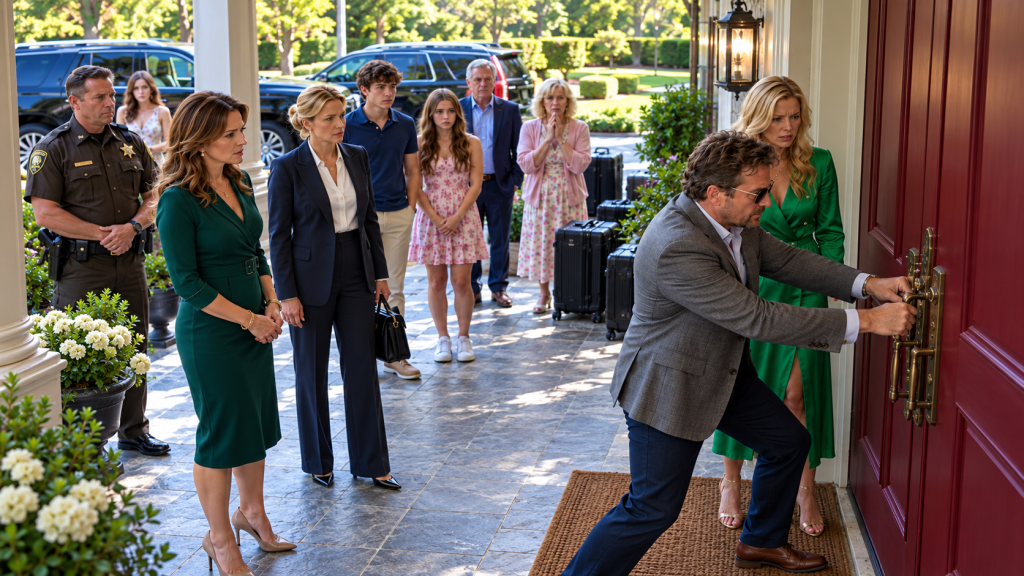
It happened so quickly that somebody who hadn’t lived with him for nineteen years might have missed it. His jaw tightened. His eyes flickered toward Dana. Then toward the waiting SUVs. Finally, he looked back at Sienna. “Put that away.” She didn’t. “Logan, you told me this was paperwork for the renovation.”
“It is.”
“Then why does it say purchase and development agreement?”
My heart began pounding.
Dana held out her hand.
“May I see that document?”
Logan stepped forward.
“Absolutely not.”
Deputy Vance shifted slightly beside the doorway.
“Mr. Sterling, please keep your distance and lower your voice.”
Logan stopped.
Sienna looked from him to Dana.
Then, without another word, she climbed the porch steps and placed the papers in Dana’s hand.
My husband made a sound I’d never heard from him before.
Not anger.
Not frustration.
Fear.
Dana unfolded the document.
Her eyes moved across the first page.
Then the second.
By the third page, her expression had become completely still.
“Eleanor,” she said quietly, “we need to discuss this with your attorney’s office before anyone makes assumptions about its legal effect.”
I nodded.
“What’s in it?”
She looked toward Logan.
“An agreement purporting to transfer development rights and eventually convey this property to a company called Blue Harbor Estates.”
I stared at her.
The words seemed to reach me from a great distance.
“This property?”
“Yes.”
“Our home?”
Dana nodded.
I looked toward Logan.
Nineteen years.
I’d spent nineteen years making that house a home for us.
I’d watched our children take their first steps on those polished floors.
I’d sat beside my father during his final illness in the upstairs guest suite because he wanted to spend his last weeks near the oak trees he’d planted.
I’d buried our old golden retriever beneath the willow beside the garden.
And now my husband had apparently tried to sell the place while I was still living in it.
“Logan,” I whispered, “what have you done?”
He spread his hands.
“Eleanor, you’re overreacting.”
There it was.
The same sentence he’d used for years whenever the truth became inconvenient.
When I’d questioned a suspicious hotel charge.
When he’d missed Lily’s school concert.
When he’d forgotten Marcus’s sixteenth birthday because he was entertaining clients.
You’re overreacting.
I looked at Dana.
She continued examining the agreement.
“Mr. Sterling, this document identifies you as the authorized owner and representative of the Montgomery estate.”
Logan said nothing.
Dana turned another page.
“And it includes a signature purportedly belonging to Eleanor.”
My stomach dropped.
I held out my hand.
“Let me see.”
She showed me the page.
There was my name.
Eleanor Montgomery Sterling.
Written in a graceful slant.
But it wasn’t my signature.
The final letter curved differently.
The underline was too straight.
And the date was one I’d spent attending Lily’s parent-teacher conference.
“I didn’t sign this.”
Dana nodded.
“We’ll preserve the document and examine how it was created.”
Sienna stepped backward.
Her face had gone white.
“You told me she agreed to sell.”
Logan looked at her.
“Sienna, sweetheart—”
“Don’t.”
Her voice shook.
“Don’t call me that.”
Behind us, somebody began crying.
I turned.
Lily stood beside the last SUV, her hands pressed against her mouth.
Marcus was next to her.
My son looked furious.
Not the ordinary teenage anger I’d seen when Logan criticized his grades or complained about how long he spent on the basketball court.
This was something deeper.
Something that frightened me.
“Dad,” Marcus said, “you told us Mom was moving to Richmond.”
Logan rubbed his forehead.
“Marcus, this is adult business.”
“You said she was selling the house because she wanted a different life.”
I looked at my son.
His eyes were wet.
“Mom, he told us you’d already agreed.”
I closed my eyes.
Then I walked down the steps.
“Marcus, Lily, come here.”
Lily moved first.
She ran into my arms and began sobbing.
Marcus hesitated.
For a moment, he looked toward his father.
Then he crossed the driveway and stood beside us.
I reached for his hand.
He took it.
“I’m sorry,” he whispered.
I looked at him.
“For what?”
“For believing him.”
My throat tightened.
“Oh, sweetheart.”
I pulled him close.
“You didn’t do anything wrong.”
He shook his head.
“I should’ve called you.”
“You did call me. Both of you.”
I looked into his face.
“And none of this is your responsibility.”
He started crying.
I held both my children while Dana spoke quietly with Deputy Vance.
Behind us, Logan was protesting.
His parents were whispering.
Sienna stood by herself near the steps, clutching the edge of her white jumpsuit.
And for one strange moment, I understood exactly how far my husband had fallen.
He’d gone to Italy expecting a celebration of his new life.
He’d returned expecting a mansion, an obedient former wife, and two children who would accept whatever explanation he offered.
Instead, he stood in a driveway surrounded by people who were beginning to ask questions he couldn’t control.
Deputy Vance explained that the court order restricted Logan’s access to the property while the emergency proceedings were pending.
Dana gave him information about retrieving his personal belongings from secure storage through an arranged process.
His parents protested.
His brother accused me of humiliating the family.
One of the guests suggested that we should settle everything privately.
I looked at the people who’d attended Logan’s Italian ceremony.
People who had eaten at my table.
People who’d watched my children grow up.
And none of them had thought to ask whether my marriage was actually over before celebrating my husband’s new one.
I didn’t argue.
I simply said, “Please leave.”
Logan turned toward me.
“You think you’ve won something?”
I looked at him.
“No.”
He laughed bitterly.
“Then what is all this?”
I glanced toward our children.
“Consequences.”
His expression hardened.
“You’ll regret this.”
Dana stepped closer.
“Mr. Sterling, you should direct any legal communications through counsel.”
For a moment, Logan seemed ready to continue.
Then he looked toward Deputy Vance and stopped.
He walked back toward the SUVs.
Sienna didn’t follow him immediately.
She stood near the bottom of the porch, staring at the house.
Then she looked at me.
“I didn’t know,” she whispered.
I studied her.
She was twenty-six.
Young enough that I remembered being that age myself, newly married and convinced love could survive anything.
I didn’t know how much of Logan’s deception she’d participated in willingly.
I did know she’d celebrated a marriage to a man who was still legally married to me.
And I wasn’t ready to comfort her.
“Then perhaps you should find out what else he hasn’t told you,” I answered.
She lowered her head.
A moment later, she walked toward the final vehicle.
Logan called her name.
She didn’t answer.
The SUVs turned around one by one.
Their tires crunched over the gravel.
The gates opened.
Then closed behind them.
And suddenly, the property was quiet.
I stood on the porch, unable to move.
The oak trees swayed in the breeze.
A few leaves drifted onto the driveway.
Somewhere in the garden, a bird called.
The same house.
The same afternoon.
Yet everything had changed.
Dana touched my elbow.
“Eleanor?”
I looked at her.
“He’s really gone?”
“For today,” she answered carefully. “There will be legal proceedings, and we’ll need to address property and parenting issues properly.”
I nodded.
I knew there were months of difficult decisions ahead.
But for that moment, I wasn’t thinking about courts or money.
I was looking at my children.
Lily’s mascara had run down her cheeks.
Marcus stood with his hands shoved into his pockets, staring at the gates.
They looked exhausted.
Confused.
Older than they’d been when they left for Italy.
I opened the front doors.
“Come inside, both of you.”
Lily looked at me.
“Can we?”
The question nearly broke me.
I swallowed.
“Sweetheart, this is your home.”
Her eyes filled.
“Always.”
That evening, Lily slept in my bed.
She hadn’t done that since she was eight, when a thunderstorm knocked out the power and she convinced herself the shadows on the walls were moving.
Now she lay beside me in her pajamas, staring at the ceiling.
I waited for her to speak.
Eventually, she whispered, “Mom?”
“I’m here.”
“Was Dad already married to Sienna when we went to Italy?”
I took a slow breath.
“No, honey. Your father and I were still legally married. We still are until the divorce is properly completed.”
She was quiet.
“Then why did everybody call it a wedding?”
“Because your father arranged a ceremony and told people something that wasn’t true.”
I heard her swallow.
“Does that mean the whole trip was a lie?”
I turned toward her.
“Not every moment of it. You saw beautiful places. You spent time with your brother. Those memories are yours.”
She looked at me.
“But Dad lied about why we were there.”
“Yes.”
Tears slipped down her cheeks.
“He said if we didn’t go, we’d hurt his feelings.”
My chest tightened.
“What?”
“He told me you’d already decided not to be part of his life. He said the kind thing was to support him.”
I closed my eyes.
Logan had turned our children into witnesses at a ceremony that celebrated the destruction of their family.
Then he’d told them attending was a test of their loyalty.
I reached for Lily’s hand.
“Sweetheart, you never have to prove you love one parent by hurting the other.”
She began crying.
“I didn’t want you to think I picked Sienna.”
I pulled her close.
“I know.”
She clung to me.
For a long time, neither of us spoke.
Then she whispered, “Are we going to lose the house?”
I kissed her forehead.
“No one has established any right to take it from the trust. Dana is handling the claims, and I’m doing everything I can to keep our home secure.”
She nodded.
“Can we still have Christmas here?”
I looked toward the dark windows.
For the first time in weeks, I allowed myself to imagine December.
The staircase wrapped in greenery.
The smell of cinnamon.
Marcus complaining that the lights were tangled.
Lily insisting that the angel at the top of the tree leaned slightly to the left.
“Yes,” I whispered. “That’s the plan.”
She smiled faintly.
Then closed her eyes.
After she fell asleep, I stayed awake.
I listened to her breathing and thought about how carefully Logan had constructed his new life.
The expensive ceremony.
The designer clothes.
The luxury accommodations.
The elaborate speeches about happiness.
All while two teenagers wondered whether their mother still wanted them.
There were things I could forgive in time.
But making our children feel abandoned to make his betrayal more convenient was going to take far more than an apology.
The following morning, Marcus was waiting in the kitchen when I came downstairs.
He’d made coffee.
Two mugs sat beside the toaster.
One was Lily’s old yellow-flower mug.
The other was a plain blue one that had belonged to my father.
Marcus looked up.
“Morning, Mom.”
I smiled.
“Good morning.”
He hesitated.
Then pushed the blue mug toward me.
“I wasn’t sure how you take it anymore.”
My heart tightened.
“Two sugars. A little milk.”
He nodded.
“I remembered the milk.”
I sat beside him.
For a while, neither of us spoke.
Then he asked, “Did Dad really try to sell Grandpa’s house?”
I looked into his eyes.
“He signed an agreement claiming authority he doesn’t have. Dana is examining the documents and working with the other parties.”
Marcus nodded.
Then stared at the table.
“Can I tell you something?”
“Anything.”
He swallowed.
“Dad said you never helped him build the company.”
I felt the words like a small blow.
“What?”
“He said he earned everything while you stayed home and spent money.”
I looked away.
For years, I’d managed the parts of our life Logan didn’t consider work.
I’d organized the dinner parties where he entertained clients.
Helped him prepare presentations late into the night.
Cared for the children when he traveled.
Handled contractors, appointments, repairs, school meetings, sick days, holidays, and all the ordinary details that allowed him to walk out the door each morning knowing someone else would keep our home running.
I hadn’t done those things to earn a percentage of his business.
I’d done them because we were supposed to be partners.
Marcus continued.
“He said you’d never survive without his money.”
I turned back.
“Did you believe him?”
He looked ashamed.
“For a while.”
I nodded slowly.
“Thank you for telling me.”
He looked surprised.
“You’re not mad?”
“I’m hurt by what he said. But I’m not angry with you for trying to understand two different stories.”
His eyes filled.
Then he whispered, “In Italy, I heard him telling somebody he needed to get you out before the investors came.”
My stomach tightened.
“What investors?”
Marcus shook his head.
“I don’t know. He was on the balcony with his phone. He said something about a development deal closing before the end of the month.”
I leaned back.
The agreement.
The forged signature.
The hurried demand that I leave before he returned.
Suddenly, his timing made sense.
Logan hadn’t simply expected to move Sienna into the manor.
He may have needed the property empty before somebody came looking for what he’d promised them.
I reached for my phone.
“Marcus, I need to tell Dana that.”
He nodded.
Then he looked frightened.
“Is Dad going to get arrested?”
I took a breath.
“I don’t know. That’s for investigators and the courts to determine.”
He stared at his hands.
“I don’t want that.”
I reached across the table.
“I know, sweetheart.”
His voice broke.
“But I don’t want him hurting you anymore either.”
I squeezed his hand.
“Those are two different feelings, and it’s all right to have both.”
He began crying.
I moved beside him and wrapped my arms around his shoulders.
For a moment, he was five years old again, climbing into my lap after scraping his knees in the driveway.
But this wasn’t a scraped knee.
It was the first time my son had looked at his father and discovered that loving someone didn’t guarantee they would tell the truth.
Two days later, Sienna asked to meet with Dana.
She didn’t ask to come to the estate.
I appreciated that.
We met at Dana’s office in Richmond, in a conference room overlooking a courtyard filled with autumn leaves.
Sienna arrived alone.
She looked nothing like the woman who’d stepped out of Logan’s SUV in a white designer jumpsuit.
Her hair was tied back.
She wore jeans and a plain black sweater.
There were dark shadows beneath her eyes.
Dana introduced herself formally.
Then invited her to sit.
Sienna placed a thick folder on the table.
“I brought everything I have.”
I looked at her.
“Why?”
Her eyes filled.
“Because Logan lied to me. And because I helped him hurt you without knowing how much of the story wasn’t true.”
I didn’t respond.
She continued.
“He told me you were separated. He said the divorce paperwork had been completed months earlier and that you were delaying the public announcement because of the children.”
I felt anger rise.
“Did you ever ask to see the decree?”
Sienna lowered her head.
“No.”
“Did you ever speak to me?”
“No.”
I took a breath.
“Then you chose to believe the version that suited you.”
She nodded.
“Yes.”
I hadn’t expected her to agree.
She looked up.
“That’s part of why I’m here.”
Dana opened the folder.
Inside were hotel invoices, messages, the Italian ceremony documents, and correspondence with a development company.
Then she found an email.
Sienna watched her read it.
“Logan sent that to me before we left for Italy,” she said.
Dana turned the page toward me.
The email was dated eleven days before the ceremony.
It came from Logan’s private account.
Once Eleanor vacates, we can proceed with the property presentation. Her emotional response is predictable, but she has no appetite for litigation.
I stared at the words.
Sienna’s voice trembled.
“He told me you’d already moved out.”
I looked at her.
“I was living there with his children.”
She began crying.
“I know that now.”
Dana continued reading.
Then she stopped at a page near the bottom of the folder.
“Sienna, why is your name listed as the managing partner of Blue Harbor Estates?”
Sienna looked confused.
“What?”
Dana showed her.
Blue Harbor Estates LLC — Managing Member: Sienna Vale.
Sienna stared.
Then whispered, “That’s impossible.”
I looked from her to Dana.
Sienna shook her head.
“Logan told me it was a design company he wanted to create for us. He asked me to sign formation documents so I could have my own business after the wedding.”
Dana leaned forward.
“Did he explain the company’s liabilities?”
“No.”
“Did he tell you it was involved in an agreement concerning Eleanor’s property?”
Sienna began shaking.
“No.”
Dana turned another page.
Then asked quietly, “Were you aware that an investment advance had been paid in connection with this agreement?”
Sienna stared at her.
“What advance?”
Dana pointed to a figure.
$325,000.
For several seconds, nobody spoke.
Then Sienna whispered, “He told me the wedding was paid for by a bonus.”
My stomach tightened.
Dana folded her hands.
“That payment needs to be traced. We can’t conclude where it went without the financial records.”
Sienna covered her mouth.
Then began sobbing.
I watched her.
I wasn’t ready to forgive her involvement with my husband.
But I understood something I hadn’t expected.
Logan had promised both of us a future built around his desires.
He’d told me our marriage was a burden.
He’d told Sienna she was his new beginning.
And he’d apparently used our names, signatures, and trust to make promises that could expose both of us to financial harm.
He hadn’t simply replaced one woman with another.
He’d treated both of us as pieces on a board he believed he controlled.
By the following week, the situation had become more complicated than anything I’d imagined while standing on the porch.
Dana arranged for an independent forensic accountant to review the financial documents connected to the estate and the proposed development transaction.
The preliminary findings were disturbing.
Logan had attempted to obtain an additional $486,000 from an account administered for the Montgomery trust, using an authorization bearing my forged signature.
That request had been rejected and preserved for review.
Separately, approximately $325,000 had been advanced to Blue Harbor Estates by the proposed development partner, apparently on the understanding that Blue Harbor could secure rights to the property.
Another substantial amount had moved through accounts Logan and I had used during our marriage.
Some of those funds originated from distributions connected to my protected inheritance, but their legal ownership and recoverability needed careful examination.
Not every dollar could simply be declared mine because I wanted it to be.
Dana was clear about that.
“We need the source of every payment,” she explained. “And we need to distinguish marital funds from trust property before making claims.”
I nodded.
But the emotional truth was already devastating.
Logan had spent extraordinary sums on an Italian ceremony while telling me to leave my own home.
And he’d funded that celebration with money he apparently expected to replenish by trading away property he didn’t own.
One afternoon, Dana placed a large spreadsheet in front of me.
The entries included private yacht rentals, luxury accommodation, jewelry, designer clothing, catering, and transfers to overseas vendors.
Near the bottom, one line caught my attention.
Montgomery House — Advance Architectural Feasibility Study.
I frowned.
“What’s that?”
Dana looked down.
“An invoice from a design firm.”
I stared.
“Logan commissioned plans for the estate?”
“Apparently.”
I remembered the email Sienna had provided.
Once Eleanor vacates, we can proceed with the property presentation.
Dana opened another document.
It contained renderings of my father’s home.
The colonial manor had been transformed into an exclusive private-event property.
The gardens were redesigned as ceremony spaces.
The carriage house was labeled BRIDAL SUITE.
The west lawn contained a proposed glass pavilion.
And the old library where Dad had taught me to read contracts had become a cocktail lounge.
I felt my eyes fill.
They hadn’t merely pictured themselves living in my home.
They’d planned to turn it into a business.
I stared at the drawing of the library.
For years, my father had sat beside its fireplace on winter afternoons.
When I was little, he’d let me sit on the floor while he worked.
Sometimes he’d put down his papers and ask me to explain what I thought a particular legal phrase meant.
I’d always answer too quickly.
He’d smile.
“Read it again, Eleanor. Words matter.”
Now those same rooms had been assigned prices.
Packages.
Projected revenue.
And a schedule for demolition and renovations.
My husband’s plans showed no trace of the life that had happened there.
I turned the page.
At the top of the next rendering was a proposed name.
STERLING HOUSE.
Not Montgomery House.
Sterling House.
My throat tightened.
He’d even planned to remove my father’s name.
I closed the folder.
Dana watched me.
“Are you all right?”
I took a breath.
“No.”
She waited.
Then I looked up.
“But I will be.”
The first major court hearing took place three weeks later.
I wore a navy suit my father had bought me for an interview when I was twenty-four.
It still fit, although I hadn’t worn it in years.
Dana stood beside me in the courthouse hallway.
Logan arrived with two attorneys.
He looked older.
His expensive suits and confident smile had always helped him dominate a room.
Now he seemed irritated by the fact that nobody was treating his version of events as settled truth.
Sienna attended separately with her own attorney.
Marcus and Lily remained at school.
I’d made that decision deliberately.
They were already carrying enough.
I wasn’t going to turn them into witnesses to every ugly argument between their parents.
Inside the courtroom, Dana presented the trust documents, the postnuptial acknowledgments, the disputed transfer authorization, and evidence concerning the development agreement.
The opposing lawyers argued about access, ownership claims, and the limits of the emergency orders.
No single hearing could resolve every issue.
The judge reviewed the records carefully.
Then she looked toward Logan.
“Mr. Sterling, the evidence currently before this court does not establish that you own the trust property or have authority to convey it.”
Logan shifted in his chair.
The judge continued.
“The property is subject to the trust’s governing documents, and the attempted transaction raises serious questions that require further examination.”
I looked down.
My hands were trembling.
The judge extended appropriate protections against unauthorized transfers while the issues were litigated, preserved the parties’ opportunity to present evidence, and directed counsel to address the disputed finances through the proper proceedings.
She did not declare the entire divorce resolved.
She did not magically return every dollar.
She did not order Logan taken away in handcuffs simply because I was angry.
But she made something clear.
He could not transform a false claim of ownership into a genuine one by repeating it loudly enough.
When we left the courtroom, Logan approached me in the hallway.
Dana remained beside me.
“Eleanor.”
I stopped.
He looked toward my suit.
“You’re enjoying this, aren’t you?”
I stared at him.
“Enjoying what?”
“Making me look like a criminal.”
I took a slow breath.
“Logan, you submitted documents claiming rights you didn’t have. You used a signature that wasn’t mine. And you told our children I was abandoning them.”
His eyes hardened.
“You don’t understand the pressure I was under.”
I looked at him.
“Then explain it to your lawyers.”
He glanced toward Dana.
Then back at me.
“I built my whole career around providing for this family.”
My eyes filled.
“And I built my life around believing we were one.”
For a moment, he looked away.
Then he whispered, “I never meant for it to go this far.”
I studied him.
That was the first sentence he’d spoken since the affair began that sounded remotely like regret.
But I wasn’t going to confuse regret with responsibility.
“Then the next step is to tell the truth about how far you let it go.”
I turned and walked away.
The children had a harder time than either of us expected.
Marcus became quiet.
He stopped going out with friends after school.
His basketball coach called because he’d missed two practices without explanation.
Lily started asking whether we would need to move every time she heard a door close.
Neither child wanted to speak openly about their father.
And both tried to protect me by pretending they were fine.
One evening, I found Marcus sitting in the garden beside the oak tree my father had planted before I was born.
He was holding a basketball but hadn’t been playing.
I sat beside him.
For a while, we watched leaves drift across the lawn.
Then I said, “Your coach called.”
Marcus nodded.
“I know.”
“Do you want to talk about it?”
He stared at the ball.
Then whispered, “I feel stupid.”
I looked at him.
“Why?”
“Because I wanted Dad to be proud of me so badly that I believed whatever he said.”
My chest tightened.
“Marcus—”
“He told me if I supported him, he’d help me get an internship at his company next summer.”
I went still.
“He said that?”
Marcus nodded.
“And he said if I stayed with you, you’d turn me against him.”
Tears filled my eyes.
My son swallowed.
“I didn’t want to lose him.”
I reached for his hand.
“You aren’t supposed to earn your father’s love by agreeing with him.”
He looked at me.
“What if he stops talking to me?”
I took a breath.
“Then that will be a choice he’s responsible for. It won’t mean you did something wrong.”
Marcus looked down.
Then whispered, “I still love him.”
I squeezed his hand.
“I know.”
“Even after everything.”
“Of course.”
My voice broke.
“He’s your father.”
For a long moment, we sat together.
Then Marcus asked, “Do you still love him?”
The question caught me completely unprepared.
I considered.
“I love parts of the life we shared.”
I looked toward the house.
“I love that he gave me you and Lily. I love the memories that were genuine.”
I paused.
“But I don’t trust the man he’s chosen to be.”
Marcus nodded slowly.
“That makes sense.”
I smiled sadly.
“It’s all right if your feelings are complicated too.”
He leaned against my shoulder.
And I held him while the evening light disappeared behind the trees.
We began family counseling the following month.
Not because my children were broken.
Because their world had been shaken, and I wanted them to have somewhere safe to speak without worrying about protecting either parent.
Our counselor, Dr. Miriam Reed, helped us establish one simple rule.
The children would not carry messages between adults.
If Logan needed to discuss appointments, parenting arrangements, or finances, he would communicate through the agreed channels.
Marcus and Lily would not be asked to choose sides.
They would not be expected to explain their father’s behavior.
And they would not be responsible for comforting me through the divorce.
One afternoon, Lily asked a question that stayed with me.
“Mom, if you were married for nineteen years and Dad could still lie, how do you know when someone loves you?”
I sat beside her.
I wanted to offer a beautiful answer.
Something reassuring.
Something that would make everything simple again.
But she was old enough to recognize empty promises.
So I told her the truth.
“Love isn’t proven by expensive trips or beautiful speeches.”
She watched me.
“It’s shown in the way someone treats you when you disagree. Whether they respect your choices. Whether they tell the truth when it costs them something.”
Her eyes filled.
“Did Dad ever love you?”
I looked toward the garden.
“I believe he did.”
She waited.
“But I also believe he made choices that hurt us. Loving someone doesn’t make those choices acceptable.”
Lily nodded.
Then she asked, “Does being young make Sienna better than you?”
I felt my heart break.
I reached for her hands.
“No, sweetheart.”
I looked directly into her eyes.
“People don’t become less valuable because they get older.”
Her lips trembled.
“Because Dad said he hated old things.”
I closed my eyes.
The message I’d received at 2:13 in the morning returned to me.
I hate old things. I deserve a new life.
I took a breath.
“Lily, your father was trying to justify a decision he’d already made.”
I squeezed her fingers.
“But wrinkles aren’t failures. Growing older isn’t something to be ashamed of. And a person’s worth doesn’t disappear because somebody else wants something different.”
She began crying.
I pulled her close.
Then whispered, “And I hope you never let anyone convince you that being replaced means you were never enough.”
By February, Logan’s carefully constructed new life had begun to collapse.
His company’s board had initiated an internal review after receiving documents concerning the disputed transactions.
The development company demanded an explanation of the ownership representations in the agreement.
Sienna provided her attorney with the messages and financial documents she had preserved.
And Logan’s lawyers finally acknowledged that the proposed sale could not proceed on the authority he’d claimed.
The estate remained protected.
There was no completed transfer to Blue Harbor Estates.
The supposed purchasers had never obtained valid ownership of my father’s property.
The $325,000 investment advance became part of a separate financial dispute. Some of the money remained traceable, while other amounts had been spent. The parties pursued repayment through legal channels.
Our own financial proceedings were equally complicated.
Dana and the forensic accountant traced payments, documented unauthorized transactions, and challenged the disputed transfers.
Some funds were recovered from accounts placed under appropriate restrictions.
Other losses remained contested.
I learned that justice rarely arrived as one magnificent moment when every wrong was corrected.
Sometimes it looked like a stack of bank statements.
A hearing postponed for another month.
A careful examination of signatures.
A settlement negotiation.
And the quiet satisfaction of knowing that the truth was finally receiving the attention it deserved.
Eventually, the divorce was finalized.
The court addressed our marital finances and the obligations established by the evidence, while the Montgomery trust remained governed by its separate legal terms.
The estate stayed mine to administer under the trust.
The children’s living arrangements were addressed through a parenting plan that recognized their needs, schooling, and relationship with both parents.
Logan didn’t lose his place as their father simply because he’d been a terrible husband.
But he could no longer use them as messengers or demand that they participate in his attempts to control me.
I didn’t receive everything I wanted.
Neither did he.
But I walked out of the final hearing knowing that my home was secure and my future would no longer depend on his promises.
That was enough.
Sienna sent me one final letter in March.
By then, she’d ended her relationship with Logan.
The Italian ceremony had never produced a valid marriage between them, and the business arrangement he’d asked her to sign had become a matter for attorneys rather than wedding planners.
I opened her letter at my kitchen table.
Eleanor,
I won’t ask you to forgive me for becoming involved with your husband. I knew he had been married, and I chose to believe his explanation that your marriage had already ended.
I should have asked questions. I should have recognized that his version of events was designed to make his choices seem harmless.
I wanted to believe I was beginning a beautiful life. I didn’t stop to consider whose life he was dismantling to build it.
I paused.
The next paragraph was shorter.
I want you to know I gave my attorney everything I had concerning the property transaction. Not because it makes me innocent, but because the truth should not depend on whether telling it benefits me.
At the bottom, she’d written:
You were never the obstacle to my happiness. I understand that now.
I folded the letter.
For a moment, I felt an unexpected sadness.
I had spent weeks imagining Sienna as the woman who’d stolen my marriage.
But marriages are not objects that can be lifted from a shelf.
Logan had made choices.
So had she.
And so had I, when I’d ignored the little humiliations because I believed enduring them was the price of keeping my family together.
I didn’t write back immediately.
I wasn’t ready to be Sienna’s friend.
But I no longer needed to think about her as the woman who’d replaced me.
She hadn’t.
No one could replace the nineteen years I’d lived.
Or the mother I was to Marcus and Lily.
Or the daughter I’d been to Thomas Montgomery.
Or the woman I was still becoming.
That spring, I opened the carriage house for the first time in almost a year.
It stood beyond the east garden, beneath two enormous oak trees.
Dad had used part of it as a workshop when I was young.
Later, I’d stored old furniture, holiday decorations, and boxes of things I kept promising to organize.
Lily came with me.
We opened the windows and let the sunlight pour inside.
Dust rose from the floorboards.
The room smelled of old wood and forgotten summers.
Near the back wall, I found a cardboard box with my maiden name written across the top.
ELEANOR MONTGOMERY — ARTWORK.
I stared.
Lily hurried over.
“Mom, what’s that?”
I knelt beside the box.
Inside were sketchbooks.
Paintings.
Drawings I’d made before marrying Logan.
I had studied art history and taken architectural drawing classes in college.
I used to spend entire afternoons sketching old Virginia houses, imagining how their rooms might look after another hundred years.
Then came marriage.
Children.
Responsibilities.
And slowly, without noticing, I’d stopped drawing.
Lily opened a sketchbook.
Her eyes widened.
“Mom, you made these?”
I smiled faintly.
“A long time ago.”
She turned another page.
There was a watercolor of the manor.
The oak trees.
The porch.
The library windows glowing in evening sunlight.
Lily looked up.
“Why did you stop?”
I considered the question.
For years, I’d told myself there simply wasn’t time.
There were meals to plan.
Appointments to remember.
Events to organize.
A husband whose career always seemed to require one more sacrifice from me.
But standing in that old carriage house, I realized that somewhere along the way, I’d begun treating my own interests as less important than everyone else’s.
“I suppose I kept putting it off,” I answered.
Lily looked around.
Then said, “You should make this your studio.”
I laughed.
“Oh, sweetheart.”
“I’m serious.”
She gestured toward the windows.
“There’s so much light.”
I looked around.
For the first time in years, I saw more than a storage building.
I saw space.
Possibility.
A room that didn’t have to serve anybody’s ambitions except mine.
I smiled.
“Maybe I will.”
Lily grinned.
Then she picked up a clean sheet of paper.
“Can I draw with you?”
My eyes filled.
“Always.”
We spent the summer restoring the carriage house.
Marcus helped repair the old worktables.
Lily chose the wall colors.
I found a local carpenter to repair the windows and make the building comfortable for year-round use.
I bought new pencils.
Watercolors.
Brushes.
And a proper easel.
Some mornings, I painted for hours.
Other mornings, I simply sat looking at the garden, allowing myself to think without somebody interrupting to ask what I was doing for dinner.
I still had responsibilities.
Bills.
Appointments.
Two teenagers who needed their mother.
But I was learning that my life didn’t have to disappear inside those responsibilities.
One afternoon, Marcus came into the studio and found me painting the old oak trees.
He stood behind me for a moment.
Then smiled.
“Mom, that’s really good.”
I laughed.
“You’re biased.”
“Maybe.”
He pulled up a stool.
Then looked toward the house.
“Do you ever miss Dad?”
I set down my brush.
“Sometimes.”
He nodded.
“Me too.”
I turned toward him.
“You don’t have to feel guilty about that.”
He looked at me.
“I know.”
Then he smiled faintly.
“But I think I miss who he used to be.”
My throat tightened.
I reached for his hand.
“Sometimes we have to grieve a person who’s still alive.”
He squeezed my fingers.
Then leaned against my shoulder.
We sat together, looking through the open door toward the estate.
And I understood that the home my father had protected wasn’t valuable merely because of its land, architecture, or enormous oak doors.
It was valuable because it gave us somewhere to heal.
Christmas arrived beneath a sky full of soft gray clouds.
For the first time in nineteen years, I didn’t plan the holiday around Logan’s clients, his business associates, or the elaborate dinners he’d insisted were necessary for his reputation.
I invited a few close friends.
Dana came with her husband.
Marcus brought two friends from school.
Lily decorated the tree with handmade paper stars and the ceramic ornaments she’d been collecting since kindergarten.
We ate in the dining room beneath the old chandelier.
There were no luxury gifts designed to impress strangers.
No speeches about success.
No need to pretend that everything was perfect.
There was laughter.
Good food.
Music drifting through the hall.
And two children who no longer had to wonder whether their mother wanted them.
After dinner, Lily asked me to follow her outside.
Marcus was waiting near the oak tree my father had planted.
Between them stood a small wooden bench.
It wasn’t particularly fancy.
The paint was still fresh.
One leg was slightly uneven.
I looked at my children.
“What’s this?”
Marcus smiled.
“We made it.”
Lily grinned.
“For you.”
I placed my hand over my mouth.
“Why?”
Marcus looked toward the house.
“Because you always say Grandpa loved sitting out here.”
I nodded through tears.
“He did.”
Lily stepped closer.
“And because we thought you should have somewhere to sit when you’re tired.”
I began crying.
For nineteen years, I’d spent so much time making sure everyone else had everything they needed.
Now my children had noticed that I needed something too.
Not an expensive gift.
Not a grand gesture.
Just somewhere to sit.
Somewhere to rest.
Somewhere to enjoy the life I’d spent so many years building.
I hugged them both.
Then sat on the bench.
Marcus sat on one side.
Lily on the other.
The three of us watched the Christmas lights glowing through the manor’s windows.
After a while, Lily leaned against my shoulder.
“Mom?”
“Yes, sweetheart?”
“Are you happy?”
I looked toward the house.
I thought about the morning Logan announced he wanted a divorce.
The messages he’d sent from Italy.
The ceremony.
The forged documents.
The night I’d lain awake wondering whether I’d somehow become too old to deserve love.
Then I thought about my children.
My studio.
The garden.
The quiet mornings I’d reclaimed.
And the little wooden bench beneath my father’s oak tree.
I smiled through tears.
“Yes.”
I squeezed their hands.
“I really am.”
People sometimes ask whether I regret waiting on the porch the day Logan returned from Italy.
I don’t.
But not because I enjoyed watching him discover that the locks had changed.
And not because the estate was worth more money than he’d imagined.
I remember that afternoon for another reason.
It was the day my children came home frightened, uncertain whether they were still wanted.
And I was able to open the doors and tell them they belonged.
For years, I’d believed being a good wife meant keeping the peace, even when it required me to lose pieces of myself.
But peace built on silence is fragile.
And love that requires someone to surrender their dignity is not the kind of love I want my daughter to accept or my son to offer.
Logan told me he hated old things.
He believed youth made Sienna more valuable than me.
He believed a grand wedding could transform dishonesty into romance.
And he believed nineteen years of marriage gave him the right to claim a home that had never been his.
He was wrong.
My father hadn’t protected the estate because he expected his daughter to become a wealthy woman who never faced disappointment.
He’d protected it because he wanted me to have choices.
And for too long, I’d forgotten that.
Now, every morning, I walk through the garden before breakfast.
Sometimes I carry my sketchbook.
Sometimes I sit beneath the oak trees and listen to the wind.
On the wall of my studio hangs a small framed note in Dad’s handwriting.
I’d found it tucked inside the old leather binder.
Eleanor, a home should be a place where you are loved, not a place you must earn the right to remain.
I read those words often.
Because the greatest thing my father left me wasn’t five acres of Virginia land.
It was the certainty that my life belonged to me.
My husband went to Italy believing he’d found a younger woman and a better future.
He returned to discover that he could neither erase my past nor take ownership of my tomorrow.
And the woman he told to disappear?
She stayed.
She protected her children.
She found her own voice.
And she began living again.
Not as Logan Sterling’s discarded wife.
But as Eleanor Montgomery.
A mother.
An artist.
A woman with a future still waiting to be painted.
THE END STORIES! THANK YOU FOR READING GOOD LUCK !❤️
Related Posts