I knew my mother’s handwriting before I finished unfolding the paper. The letters leaned slightly to the right. Her capital T had an exaggerated curve, and she always put a little line beneath the dates. I hadn’t seen that handwriting in twenty-three years.
Yet the moment I looked at it, I was eight years old again, sitting at our kitchen table while she wrote my name inside a library book. My hands began shaking. The note was written on pale blue stationery, folded twice, with a small drawing of a bird in the corner.
At the top were three words. My darling Thomas. I sat down. For several seconds, I couldn’t make myself read further. My mother had died when I was eight. I remembered her voice only in pieces now. The way she said my name when I came inside with muddy shoes.
The songs she hummed while making breakfast.
The quiet way she laughed when Dad told a joke she didn’t find particularly funny.
But I remembered her handwriting perfectly.
I held the paper closer.
My darling Thomas,
If you’re reading this, it means there’s something I wanted to tell you and couldn’t say enough times while I was here.
You are a gentle boy, and sometimes the world makes gentle people believe they must apologize for being that way.
Don’t.
I stopped reading.
My throat closed.
For eighteen years, I’d carried my father’s final words like a stone inside my chest.
Maybe it’ll toughen you up.
And now, twenty-three years after my mother’s death, I was holding a letter telling me the exact opposite.
I forced myself to continue.
Your father and I have different ideas about what makes a person strong. I hope someday he understands what I already know.
You are strong when you tell the truth even though you’re frightened. You are strong when you help someone who cannot help you back. You are strong when you remain kind after the world has given you reasons not to be.
Tears slipped onto the paper.
I wiped them away before they could damage the ink.
The final paragraph was written more slowly.
If life ever feels too heavy, please find Aunt Diane. She knows how much I love you, and she has promised me you will never have to carry everything alone.
Nothing you could ever do would make you less worthy of love.
Not one single thing.
All my love,
Mom.
Below her name was a date.
April 14.
Six weeks before she died.
I read the letter again.
Then again.
By the fourth time, I couldn’t see the words anymore.
I folded forward over the kitchen table and cried harder than I had in years.
Not the quiet tears I’d learned to hide.
Not the controlled grief that came when I visited my mother’s grave.
I cried the way I’d wanted to cry at eight, when Dad told me to stop embarrassing him.
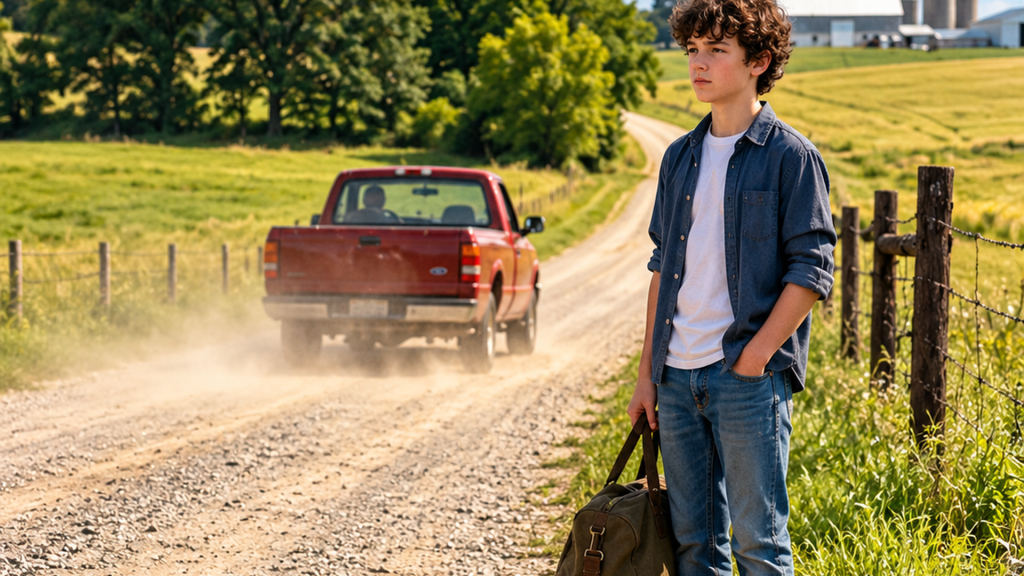
I cried the way I’d wanted to cry at thirteen, standing beside an empty road.
And I cried for the thirty-one-year-old man who’d spent nearly two decades believing there had been something weak or shameful about the boy he’d once been.
When I could finally breathe, I picked up my phone.
There was only one person I wanted to call.
Aunt Diane answered after the second ring.
“Thomas? Everything all right?”
I stared at the letter.
“No.”
Her voice changed immediately.
“What’s happened?”
I swallowed.
“Do you remember Mom’s handwriting?”
There was a pause.
“Of course I do.”
I closed my eyes.
“Aunt Diane, I have a letter from her.”
The silence on the other end was so complete that I checked whether the call had disconnected.
Then I heard her whisper.
“Oh, sweetheart.”
I covered my mouth.
“She wrote it before she died.”
Diane took a shaky breath.
“Where did you find it?”
“Ray’s house. Or Megan found it there.”
I told her about the invitation.
The photograph.
The custody papers.
The letter Megan had written.
When I finished, Diane was crying.
“I didn’t know he still had those.”
I went still.
“Those?”
She hesitated.
“Thomas, your mother wrote several letters while she was sick.”
My heart began pounding.
“Several?”
“One for when you turned thirteen. One for your eighteenth birthday. A few others.”
I stared at the wall.
“Where are they?”
Diane’s voice broke.
“I don’t know, honey.”
Then she told me something that changed the meaning of every birthday I’d spent waiting for a message that never came.
“After your mother died, I asked Ray for the letters. He told me she’d changed her mind and destroyed them.”
I looked down at the pale blue page.
My father had kept my mother’s words from me.
And then he’d told the only person who might have asked questions that the letters no longer existed.
For a moment, anger burned so fiercely through me that I wanted to get in my truck and drive straight to his house.
Instead, I heard Diane say softly, “Thomas, are you listening?”
“Yes.”
“Please don’t let him take tonight from you too.”
I closed my eyes.
She continued.
“Your mother wrote those letters because she loved you. That’s what matters right now.”
I looked at her signature.
Then whispered, “Why didn’t he give them to me?”
Diane was quiet.
“I can’t answer for Ray.”
Her voice grew firmer.
“But whatever his reason, you didn’t deserve it.”
I nodded, even though she couldn’t see me.
And for the first time since the invitation arrived, I began to understand that Megan might not have sent me merely a request to attend her wedding.
She’d opened a door into a part of my childhood I thought was gone forever.
The next morning, I called the number Megan had written beneath her letter.
I stood outside my workshop with the phone pressed against my ear.
One of my technicians, Luis, was loading equipment into a service van.
Inside, our office manager was arguing with a supplier about a missing furnace motor.
Everything around me was ordinary.
My whole life had continued without Ray for eighteen years.
Yet I felt as nervous as a teenager calling someone for the first time.
The phone rang three times.
Then a young woman answered.
“Hello?”
I swallowed.
“Megan?”
“Yes?”
“This is Thomas.”
There was silence.
Then a little gasp.
“Oh.”
I looked toward the parking lot.
“Your letter arrived.”
She began crying immediately.
“I’m sorry. I didn’t know if I should send it.”
“You don’t have to apologize.”
“I didn’t know whether you’d even remember me.”
I looked down at the birthday photograph I’d brought with me.
A small girl in pink pajamas.
A teenage boy holding a cake with uneven white frosting.
“I remember you.”
She made a small sound.
“Really?”
I smiled through tears.
“You liked chocolate cake, but you didn’t like chocolate frosting.”
She laughed shakily.
“I still don’t.”
I stared toward the morning sun.
Something in my chest loosened.
Then she whispered, “Thomas, I need to tell you something.”
I waited.
“I found more letters.”
My heart stopped.
“From Mom?”
“Yes.”
“How many?”
“Seven. Maybe eight. Some are still sealed.”
I gripped the phone.
“Where are they?”
“At my apartment. I took them because Dad was going to throw the box away.”
I closed my eyes.
Megan continued.
“When I asked him about the custody papers, he got angry. He said you chose Aunt Diane over us and never wanted to come home.”
My jaw tightened.
“He left me on a road.”
“I know.”
She started crying again.
“I found Diane’s letter. I asked him about it, and he finally admitted you’d been left there.”
I couldn’t speak.
Then she said quietly, “He told me he was teaching you a lesson.”
I looked toward my service vans.
A man called my name from the workshop.
I raised one hand to signal I’d be a few minutes.
Megan took a breath.
“I asked Dad what lesson a thirteen-year-old was supposed to learn from being abandoned.”
I swallowed.
“What did he say?”
“He told me I was too young to understand.”
I almost laughed.
It was the kind of answer Ray always gave when he didn’t have a good one.
Megan continued.
“So I asked him whether he’d ever done that to me.”
I went still.
“He said no.”
“Then I asked why you deserved something I didn’t.”
For a long moment, neither of us spoke.
Finally, Megan whispered, “He couldn’t answer.”
I shut my eyes.
Eighteen years.
It had taken eighteen years and a young woman preparing for her wedding to ask the question I’d never been brave enough to ask.
Then she said, “Thomas, would you meet me?”
I looked at the photograph again.
“Yes.”
Her breath caught.
“Really?”
“Really.”
I paused.
“But Megan, I need you to understand something.”
“Okay.”
“I’m not ready to see Ray.”
Her answer came immediately.
“You won’t have to.”
I closed my eyes.
She continued.
“I didn’t send the invitation because I wanted you to forgive him.”
Her voice trembled.
“I sent it because I want to know my brother.”
And somehow, that was more frightening than any confrontation with our father could have been.
Because anger was familiar.
Disappointment was familiar.
But being wanted?
That was something I hadn’t known how to trust for a very long time.
We met on Saturday at a diner forty minutes outside town.
I arrived twenty minutes early.
That was a habit I’d developed in business. If a customer expected me at nine, I showed up at eight-fifty. If an employee needed help, I tried to be there before the problem became urgent.
Being early gave me the comforting illusion that I could prepare for whatever happened next.
But as I sat in that diner, staring at a cup of coffee I hadn’t touched, I realized there was no way to prepare for meeting a sister I hadn’t seen since she was five.
At nine-oh-three, the door opened.
A young woman stepped inside wearing jeans, a blue cardigan, and white sneakers.
Her brown hair was pulled into a loose ponytail.
She looked around nervously.
Then her eyes found mine.
I knew immediately.
Not because she looked like Ray.
Although she did, around the mouth.
I knew because she was carrying the same small pink handbag she’d had in one of her old birthday photographs, only this one was clearly an adult version.
Something about that detail nearly made me laugh.
She approached slowly.
“Thomas?”
I stood.
“Hi, Megan.”
She smiled, then began crying.
“I’m sorry.”
I shook my head.
“Stop apologizing.”
She laughed through tears.
Then hesitated.
“Can I hug you?”
The question caught me off guard.
Ray had never asked permission before grabbing my shoulder, pulling me aside, or deciding where I belonged.
Megan waited.
I opened my arms.
And my little sister hugged me.
She was taller than I’d expected.
Her hair smelled faintly of lavender.
For a moment, I stood awkwardly with my hands on her shoulders.
Then I hugged her properly.
She began crying harder.
“I can’t believe you’re really here.”
I closed my eyes.
Neither could I.
When we sat down, she placed a canvas bag on the table.
I recognized it immediately.
It had belonged to my mother.
The faded green fabric.
The little embroidered flowers beside the zipper.
Mom used to carry books in it when she took me to the library.
I stared.
“Where did you get that?”
Megan looked down.
“It was in the attic with the letters.”
My throat tightened.
“That’s Mom’s bag.”
She nodded.
“I thought it should be yours.”
I ran my fingers over the stitching.
A memory came back without warning.
I was seven.
Rain was falling.
Mom and I were walking from the library to our car.
She’d held the bag over my head to keep my books dry while her own hair got soaked.
I remembered laughing.
I remembered her laughing too.
And now, twenty-four years later, I was holding the same bag.
Megan watched me quietly.
Then she opened it.
Inside were several envelopes.
Some had dates.
Others had my name written across the front.
One said:
For Thomas on his thirteenth birthday.
I stared at it.
My thirteenth birthday had been three months before Ray left me on the road.
I remembered that birthday.
I’d asked for a new set of drawing pencils.
Dad told me I was too old to be asking for childish things.
Cheryl made a cake because Megan wanted one.
I spent most of the afternoon helping Aunt Diane fix a loose cabinet door.
And I’d gone to bed believing thirteen was simply another year when nobody missed my mother as much as I did.
Now I held an envelope she’d prepared for that exact day.
I looked at Megan.
“Can I open it?”
She nodded.
“Of course.”
I slid a finger beneath the seal.
Inside was a single page.
My dear Thomas,
Thirteen sounds impossibly grown-up to me. I wish I could see how tall you’ve become.
I hope you still love books. I hope you still draw pictures of the houses you imagine building someday.
My eyes blurred.
I’d stopped drawing when I was fourteen.
Not because I’d lost interest.
Because earning money and proving I could support myself had begun to feel more important than anything that made me happy.
I continued.
I hope you have people around you who know when you’re being quiet because you’re thinking and when you’re being quiet because you’re hurting.
Those are not the same thing.
I pressed my fingers against my mouth.
You don’t have to be the loudest person in a room to deserve a place in it.
Happy birthday, sweetheart.
I love you.
Mom.
I put the letter down.
For a long time, I couldn’t speak.
Megan reached across the table and placed a napkin beside my coffee.
I laughed shakily.
“Thank you.”
She smiled.
“I brought tissues too.”
I looked at her.
“Prepared for everything?”
“Not remotely.”
We laughed.
And for the first time, I felt some of the distance between us begin to soften.
We spent nearly three hours in that diner.
Megan told me about growing up.
She’d studied elementary education and now taught second grade.
She loved old movies, hated mushrooms, and kept forgetting to water the plants in her apartment.
Kyle was an electrician she’d met when they were both volunteering to repair storm damage at a community center.
He was twenty-five.
Quiet.
Patient.
The sort of man who remembered small things, she said.
I liked him before I’d met him.
Then she asked about my business.
I told her about the first service van Diane had co-signed for.
About the summer I slept four hours a night trying to keep up with repair calls.
About Luis, who’d been with me since I had only three employees.
About the satisfaction of fixing a broken heating system in January and knowing a family would sleep warm that night.
Megan listened as though every detail mattered.
When I finished, she smiled.
“Dad told me you never amounted to anything.”
I went still.
She immediately looked ashamed.
“I’m sorry. I shouldn’t have said that.”
“No.”
I shook my head.
“I’m glad you did.”
She stared at me.
I continued.
“Ray used to say things like that when I was a kid.”
Megan looked down.
“He’s proud of you when you’re doing something he understands.”
I considered.
“Was he proud of you becoming a teacher?”
She gave a small, sad laugh.
“He wanted me to study business.”
I nodded.
“That sounds like him.”
She looked toward the window.
“Sometimes I think he’s more comfortable with people being useful than being happy.”
I sat quietly.
Then Megan said, “Thomas, there’s something I need to ask.”
“All right.”
“Do you remember making my fifth birthday cake?”
I looked at the photograph on the table.
For a moment, I remembered nothing.
Then the image stirred something.
Chocolate batter.
A cracked mixing bowl.
White frosting that wouldn’t spread properly.
And a little girl standing on a stool, insisting that the cake needed exactly five pink candles.
I smiled faintly.
“You wanted strawberries.”
Megan’s face brightened.
“Yes!”
“I couldn’t find any fresh ones, so I used strawberry jam between the layers.”
She laughed.
“I remember.”
I stared.
“You do?”
She nodded.
“I remember sitting beside you while you decorated it. You let me lick the spoon.”
I smiled.
“Cheryl hated that.”
Megan laughed.
Then her expression softened.
“That was the last birthday I remember you being there.”
I looked down.
She continued.
“Afterward, I kept asking where you went.”
My throat tightened.
“What did they tell you?”
“That you’d run away because you didn’t want to live with us.”
I stared at the table.
She swallowed.
“Dad said you were ungrateful and Aunt Diane had encouraged you to leave.”
I felt the old anger rising.
“But you were thirteen,” Megan whispered. “I know that now.”
I looked at her.
She wiped her eyes.
“At five, I thought maybe I did something that made you stop liking me.”
My heart broke.
I reached across the table.
“Megan.”
She looked up.
“You didn’t.”
Tears rolled down her cheeks.
“I know.”
“No, listen.”
I squeezed her hand.
“You were a little girl. None of what happened was your fault.”
She nodded.
I paused.
“And I didn’t leave because I stopped loving you.”
She covered her mouth.
For a moment, she was five again in my memory.
A little girl in pink pajamas.
Waiting beside a birthday cake with crooked candles.
Then she whispered, “I wish somebody had told me.”
I nodded.
“Me too.”
Near the end of lunch, Megan took a photograph from her wallet.
It showed Ray and Cheryl standing in front of a hospital.
Cheryl held a newborn baby.
Ray looked younger, with dark hair and a broad smile.
On the back was a date.
I read it once.
Then again.
It was the same spring my mother had died.
I looked up.
“Megan, when were you born?”
She told me.
My hands went cold.
For all those years, I’d known roughly how old my sister was.
I’d known she was five when I was thirteen.
But I’d never allowed myself to think too carefully about what the dates meant.
The months around Mom’s death had been a blur of hospital visits, medication, relatives whispering in the hallway, and adults refusing to answer questions.
Cheryl had been introduced to me as an old friend of Dad’s.
Someone who helped after Mom died.
Then, two years later, she’d become my stepmother.
I stared at the photograph.
“Megan, did you know Dad before he married your mother?”
She looked confused.
“Of course. He’s my father.”
I swallowed.
“I mean, did anyone ever tell you when they met?”
Her expression changed.
She looked down at the photograph.
Then whispered, “I was hoping you wouldn’t have to find out like this.”
I stared.
She reached for my hand.
“Thomas, I only learned recently.”
My heart began pounding.
She continued.
“Mom told me Dad had been separated from your mother before I was born.”
I shook my head.
“He wasn’t.”
Megan’s eyes filled.
“I know.”
For several seconds, neither of us spoke.
Then she whispered, “They were together while your mom was sick.”
I looked out the window.
Cars moved through the parking lot.
A waitress laughed behind the counter.
Somewhere nearby, a child dropped a spoon.
The world continued.
But inside me, something old and painful finally settled into place.
Ray hadn’t simply replaced my mother after she died.
He’d begun building another family while she was still alive.
And years later, when he left me on that road, he’d removed the last person who reminded him of the life he wanted to forget.
I looked toward Megan.
She was crying.
“I’m sorry.”
I shook my head.
“No.”
She swallowed.
“I know I’m part of why—”
“Stop.”
My voice came out firmer than I’d intended.
She stared at me.
I took a breath.
“Megan, you were a baby.”
Her eyes filled.
“You didn’t choose any of this.”
I looked down at our joined hands.
“And I’m not going to let what Ray did turn you into somebody I have to blame.”
She began sobbing.
I moved around the table and hugged her.
For eighteen years, I’d believed my father had left me because I wasn’t good enough to keep.
Now I was beginning to understand something much uglier.
He’d been protecting a story in which he was always the innocent man.
And the people who didn’t fit that story had simply been written out.
But Megan was standing in front of me, choosing not to repeat it.
And that mattered more than any explanation Ray could have given.
I told Aunt Diane about Megan that evening.
She was sitting in her garden when I arrived, trimming the dead flowers from her rosebushes.
At seventy, she still moved with the energy of someone who considered resting a suspicious activity.
She looked up when my truck pulled into the driveway.
“Well?”
I climbed out.
“She’s lovely.”
Diane smiled.
“I was hoping you’d say that.”
I sat beside her.
For a while, I told her about lunch.
Megan’s teaching job.
Kyle.
The birthday cake.
The letters.
Then I told her what I’d learned about Ray and Cheryl.
Diane’s hands went still.
She didn’t look surprised.
And that told me everything.
“You knew,” I said.
She lowered the pruning shears.
“Not all of it.”
I waited.
“I knew your father had been seeing Cheryl while your mother was ill. I didn’t know about the baby until shortly before your mother died.”
I stared at the grass.
“Did Mom know?”
Diane took a long breath.
“Yes.”
My throat tightened.
I hadn’t expected that answer to hurt so much.
I pictured Mom in her hospital bed.
Thirty-one years old.
Frightened.
Exhausted.
Trying to comfort a little boy who didn’t understand why her hair was gone.
And somewhere in those final months, she’d learned that her husband had begun another life.
“Why didn’t you tell me?” I asked.
Diane’s eyes filled.
“Because you were eight when she died. And thirteen when I took you in.”
She paused.
“You already believed your father disliked you because there was something wrong with you. I didn’t want you to think your mother’s illness or her marriage had somehow been your responsibility too.”
I looked down.
“I could have handled the truth.”
“Maybe.”
She reached for my hand.
“But I was trying to help you survive what had already happened.”
I thought about that.
For years, Diane had been the one person who answered my questions honestly.
She’d never pretended Ray was a good father.
But she’d allowed me to decide when I wanted to speak about him.
And she’d never asked me to carry her anger on top of my own.
I squeezed her hand.
“I’m not angry with you.”
She looked relieved.
Then I asked something that had troubled me since reading Mom’s letter.
“Why did she trust you so much?”
Diane smiled sadly.
“Because we were sisters.”
She looked toward the roses.
“And because she knew your father could be unkind when people disappointed him.”
I swallowed.
“Did she know he’d leave me?”
“No.”
Diane answered immediately.
“Thomas, nobody could have predicted exactly what Ray would do.”
She paused.
“But your mother wanted you to have somewhere safe to go if life became difficult.”
I thought about those two hours on the road.
The heat.
The dust.
The terrible certainty that nobody was coming back.
Then I remembered the gas station.
The woman behind the counter letting me use the phone.
Diane arriving.
Her hand on my shoulder.
You’re staying with me now.
I looked at my aunt.
“You kept your promise.”
She blinked.
“What?”
“To Mom.”
My voice broke.
“You said you’d never let me carry everything alone.”
Tears filled her eyes.
She set down the shears.
“Oh, Thomas.”
I leaned forward and hugged her.
She held me for a long time.
Then, in her usual practical voice, she whispered, “Now, I made a casserole. Are you going to help me eat it or sit out here making us both cry?”
I laughed.
And followed her inside.
Ray appeared at my workshop ten days later.
It was a Thursday afternoon.
I’d just returned from inspecting a commercial heating system when Luis stepped into my office.
“Boss, there’s a man out front asking for you.”
I looked up.
“Did he say who?”
Luis hesitated.
“He says he’s your father.”
My stomach tightened.
For a moment, I couldn’t move.
I’d spent eighteen years imagining what I’d say if Ray ever walked through my door.
Sometimes I pictured shouting.
Sometimes I pictured telling him exactly what that August afternoon had done to me.
Other times, I pictured turning my back and walking away without a word.
Now he was standing twenty feet away, and none of my rehearsed speeches seemed useful.
“Thomas?”
I looked at Luis.
“Can you stay nearby?”
He nodded immediately.
“Of course.”
I stood.
Then walked into the reception area.
Ray was older.
Much older than the man I remembered.
His hair had gone almost entirely gray.
His shoulders were slightly stooped.
But his eyes were the same.
Hard.
Evaluating.
Always searching for the part of a person that might be easiest to criticize.
He looked around the office.
“Twelve employees, huh?”
I said nothing.
He gave a small laugh.
“Not bad.”
I folded my arms.
“What do you want, Ray?”
His expression changed.
“That’s how you greet your father?”
I looked at him.
“You haven’t been my father in any meaningful way for eighteen years.”
He flinched.
Then recovered.
“Megan says she invited you to the wedding.”
“She did.”
Ray shook his head.
“She’s getting herself worked up over things that happened a long time ago.”
I stared.
“Things?”
He sighed.
“Thomas, I was trying to make you stronger.”
There it was.
The same explanation.
Eighteen years had passed, and he still hadn’t found a better one.
“You left a thirteen-year-old on an empty road,” I said.
He looked away.
“I expected you to walk home.”
“Then why did you sign custody papers the following week?”
His jaw tightened.
“Because Diane interfered.”
I felt something settle inside me.
I’d spent years wondering whether he’d regretted what happened.
Whether he’d tried to call.
Whether he’d asked about me.
But the answer was standing in front of me.
He still believed the problem was that somebody had refused to let him define abandonment as discipline.
“Ray, you never came looking for me.”
He said nothing.
“You never called on my birthday.”
His eyes moved toward the floor.
“You never asked Diane whether I was safe.”
He rubbed his forehead.
“You’re remembering things through a child’s eyes.”
I nodded slowly.
“Yes.”
I looked directly at him.
“Because I was a child.”
For the first time, he didn’t have an immediate answer.
I continued.
“I’ve spent eighteen years trying to understand why you left me there.”
My voice trembled.
“But I don’t need an explanation anymore.”
He looked up.
“I know what happened.”
I took a breath.
“You drove away. Diane came for me. And she raised me.”
Ray’s face reddened.
“So you’re going to turn Megan against me now?”
I shook my head.
“No.”
“Then why are you digging up old letters?”
“Because they’re mine.”
He stared.
I continued.
“Mom wrote them to me. You had no right to keep them.”
His expression hardened.
“That woman was always filling your head with nonsense about being sensitive.”
For a second, I felt thirteen again.
A boy trying to find words that wouldn’t make his father angrier.
Then I looked through the glass wall into the workshop.
Luis was speaking with a technician.
My service vans stood outside.
Employees were doing work I’d taught them to do.
I had a home.
A business.
People who trusted me.
I wasn’t standing beside Ray’s truck anymore.
So I answered calmly.
“My mother loved me.”
He stared.
“And Diane loved me.”
I paused.
“And whatever you think of either of them, you don’t get to insult them in my workplace.”
He opened his mouth.
Then closed it.
Finally, he said, “Megan wants you at the wedding.”
I nodded.
“Yes.”
“I told her I wouldn’t attend if you came.”
I looked at him.
“That’s between you and Megan.”
Ray seemed startled.
“She’s my daughter.”
“She’s an adult.”
He stared.
“You think you can just walk back into this family?”
I took a slow breath.
“Ray, I didn’t ask to walk back into your family.”
My voice softened.
“My sister asked me to be part of hers.”
For a moment, he looked almost wounded.
Then his expression hardened again.
He turned toward the door.
“Don’t expect me to apologize for raising you the way I thought best.”
I watched him.
“I wasn’t asking for one.”
He stopped.
Then looked back.
I continued.
“An apology you don’t believe wouldn’t mean anything.”
He stood there for another moment.
Then left.
I watched his truck disappear from the parking lot.
My hands were shaking.
But I wasn’t.
Not inside.
For the first time in my life, I’d spoken to my father without begging him to understand me.
And when he drove away, I didn’t wait for him to come back.
Megan called that evening.
She sounded exhausted.
“Dad came to see you?”
I looked toward the workshop window.
“Yes.”
“I’m sorry.”
I smiled faintly.
“Megan, you apologize more than anybody I’ve ever met.”
She gave a tired laugh.
“I think I’ve been doing it my whole life.”
I understood that better than she knew.
Then she took a breath.
“He says he won’t help pay for the wedding if you’re there.”
I closed my eyes.
“I’m sorry.”
“Don’t be.”
Her voice was steadier now.
“Kyle and I talked about it. We don’t want a wedding where somebody gets to decide which people are welcome because they’re paying.”
I sat down.
“What are you going to do?”
“We’re changing the plans. The community hall has an opening in October. It’s smaller, but Kyle’s aunt can make the flowers, and his brother knows somebody who does catering.”
I looked down.
“Megan, I can help with the expenses.”
“No.”
Her answer came so quickly that I laughed.
She softened.
“I appreciate it, Thomas. But I don’t want to replace Dad’s financial conditions with money from you.”
I considered that.
Then smiled.
“Fair enough.”
She hesitated.
“There’s something you could help with, though.”
“What’s that?”
“The community hall’s heating system makes a terrible rattling noise.”
I burst out laughing.
“That I can handle.”
And for the first time in eighteen years, I began looking forward to a family celebration without dreading who would be there.
The morning before the wedding, Diane came to my house carrying a garment bag.
Inside was a dark blue suit.
“I bought it for you,” she announced.
I stared.
“Aunt Diane, I have suits.”
She raised an eyebrow.
“Work suits. You need something for a wedding.”
I laughed.
“I’m thirty-one years old.”
“And I’m seventy. We’re both allowed to buy clothes.”
I hugged her.
Then showed her the letters Megan had brought.
We sat together in my living room.
One envelope remained unopened.
It was addressed:
For Thomas on his eighteenth birthday.
Diane touched the handwriting.
“Your mother would’ve loved seeing you grow up.”
I swallowed.
Then opened the envelope.
Inside was a photograph of Mom and me sitting on our front steps.
I was perhaps six.
She had one arm around my shoulders.
We were laughing.
On the back she’d written:
My favorite place was wherever you were.
I pressed my fingers against my mouth.
Then unfolded the letter.
Dear Thomas,
Eighteen. I can hardly imagine it.
Perhaps you’re taller than your father now. Perhaps you’ve fallen in love. Perhaps you’ve discovered what you want to do with your life.
Whatever has happened, I hope you know you don’t owe the world a version of yourself that makes other people comfortable.
You don’t have to become hard to become strong.
And you don’t have to stop loving someone simply because you have learned to live without them.
I stopped.
Diane reached for my hand.
The final paragraph was short.
One day you may find yourself standing at the beginning of a new life, uncertain whether you belong there.
I hope you’ll walk forward anyway.
Love, Mom.
I looked toward the window.
For eighteen years, I’d believed the little boy on that road had been left behind because he wasn’t worth keeping.
Now I knew there had always been people who wanted him.
His mother.
His aunt.
And, in her own small way, a five-year-old sister who remembered a chocolate cake with strawberry jam between the layers.
I folded the letter.
Then looked at Diane.
“Will you come with me tomorrow?”
Her eyes filled.
“To the wedding?”
I nodded.
“I don’t think I want to go without you.”
She smiled through tears.
“Then you won’t have to.”
The wedding took place on a bright October afternoon.
The community hall stood beside a little park filled with yellow and red maple trees.
Someone had hung white ribbons along the entrance.
There were flowers in mismatched glass jars, simple white tablecloths, and a little wooden sign that read:
MEGAN & KYLE — OUR BEGINNING.
I’d spent Friday afternoon inspecting the heating system and replacing a worn blower component.
Kyle insisted on paying the business for the parts.
I told him the labor was a wedding gift.
He shook my hand and said something that almost brought me to tears.
“I’m glad Megan found you.”
I looked at him.
“So am I.”
On the wedding day, Diane and I arrived early.
Megan was standing near the hall entrance, wearing a simple ivory dress.
Her hair was pinned back with small white flowers.
When she saw us, her face lit up.
“Thomas!”
She ran toward me.
I laughed as she wrapped her arms around my neck.
“Careful. You’ll wrinkle your dress.”
“I don’t care.”
She stepped back.
Then looked at Diane.
“Aunt Diane?”
Diane smiled.
“Hello, sweetheart.”
For a moment, they simply stared at each other.
Then Megan reached for her hands.
“Thank you for taking care of him.”
Diane’s eyes filled.
“Oh, honey.”
She pulled Megan into a hug.
“I was the lucky one.”
I stood beside them with my throat tight.
For years, I’d thought family meant the people who shared your name.
Now I understood it could also mean the people who chose to stay.
Ray didn’t attend.
Cheryl sent a short message wishing Megan well, but she didn’t come either.
I knew their absence hurt my sister.
I could see it whenever she glanced toward the entrance.
But Kyle was beside her.
His family welcomed us warmly.
And when the ceremony began, Megan walked down the aisle on her own.
Not because nobody wanted to accompany her.
Because she had decided she didn’t need to be given away.
I watched her move toward Kyle, her face bright with nervous happiness.
And I thought about the little girl in pink pajamas who’d once waited for me to cut her birthday cake.
She’d grown into a woman who understood that love shouldn’t require surrendering the right to choose.
I was proud of her.
More proud than I knew how to say.
At the reception, Megan asked me to give a toast.
I hadn’t prepared anything elaborate.
I stood with a glass of lemonade in my hand while the guests settled.
Then I looked toward my sister.
“When Megan invited me to this wedding, we hadn’t spoken in eighteen years.”
The room grew quiet.
“I wasn’t sure whether I should come.”
Megan’s eyes filled.
I continued.
“But she sent me something I thought I’d lost forever.”
I glanced toward Diane.
“A letter from our family. And a photograph of a birthday cake I made when she was five.”
A few guests smiled.
“Megan reminded me that even when people are separated for a long time, the kindness they once shared doesn’t necessarily disappear.”
My voice trembled.
“I can’t give my sister back the years we missed.”
I looked directly at her.
“But I’m grateful she’s given us the chance to begin knowing each other now.”
Megan began crying.
I raised my glass.
“To Megan and Kyle. May you always make room for the truth, even when it’s difficult. May you be gentle with each other when life gets hard.”
I smiled.
“And may you never forget that love is something you show by staying.”
The guests raised their glasses.
Megan stood.
She crossed the room and hugged me so tightly that I nearly dropped mine.
“Thank you,” she whispered.
I held her.
“No,” I answered.
“Thank you.”
Two weeks after the wedding, Megan and I drove to the old gas station.
It had changed owners years earlier.
The pumps were new.
The building had been repainted.
But the road beside it was the same.
I parked near the entrance.
For a moment, neither of us moved.
Then Megan asked, “Is this where you called Aunt Diane?”
I nodded.
“Yes.”
She looked through the windshield.
“What did you feel when you got here?”
I considered.
“Relief, I think.”
I swallowed.
“And shame.”
She turned toward me.
“Shame?”
“I thought if I’d been a better son, Dad wouldn’t have left me there.”
Her eyes filled.
“Thomas, you were thirteen.”
I smiled sadly.
“I know that now.”
We drove farther down the road until I found the stretch where the gravel shoulder widened beside an old fence.
I recognized it immediately.
Not because the landscape was unchanged.
The fields had different crops.
A new mailbox stood near the bend.
And the fence posts had been replaced.
But something in my body recognized the place.
I pulled over.
For a moment, I sat gripping the steering wheel.
Then I opened the door.
The October air was cool.
No brutal August sun.
No dust cloud disappearing around the bend.
No thirteen-year-old boy holding a duffel bag, hoping his father would return.
Megan stepped out beside me.
We stood together.
She didn’t ask me to explain what happened.
She didn’t tell me I should forgive Ray.
She simply stood there.
After a while, she reached for my hand.
I took it.
And for the first time, that road felt like something other than the place where my childhood ended.
It was also the road that had led me to Diane.
To an apprenticeship.
To a business I loved.
To friendships built on honesty.
And, eventually, to the sister standing beside me.
I looked toward the bend.
For eighteen years, I’d imagined Ray’s truck coming back.
I’d imagined the relief of seeing his brake lights.
I’d imagined him opening the door and telling me to climb inside.
Now I understood that even if he’d returned, it wouldn’t have made what he’d done right.
And the years I’d spent waiting for him had already taken enough from me.
I looked at Megan.
“Ready to go?”
She nodded.
“Where to?”
I smiled.
“How about lunch?”
She laughed.
“Only if you let me pay this time.”
I opened the driver’s door.
“Deal.”
We climbed back into the truck.
And I drove away without looking in the mirror.
That winter, I hung three photographs in my office.
One showed Mom and me on our front steps.
One showed Diane standing beside my first service van, smiling as though we’d just bought a fleet of trucks instead of one battered vehicle.
And the third showed Megan and Kyle on their wedding day, with Diane and me standing beside them.
Sometimes, when work became difficult, I’d look at those photographs.
They reminded me that my life wasn’t defined by one afternoon on a dirt road.
It was defined by all the people who had helped me move forward afterward.
Ray eventually sent a letter.
It arrived without a return address.
Inside, he’d written that he’d been too hard on me and that he regretted how things had ended.
It was the closest he’d ever come to admitting he’d abandoned me.
I read it.
Then put it away.
I didn’t respond immediately.
Perhaps someday we’d have an honest conversation.
Perhaps we wouldn’t.
But I no longer believed my happiness depended on whether my father finally understood what he’d done.
Megan and I kept talking.
Sometimes we met for lunch.
Sometimes she called to complain about school paperwork or ask whether I’d found the book I’d been looking for.
At Christmas, she and Kyle came to Diane’s house.
We made chocolate cake with strawberry jam between the layers.
Megan insisted on five pink candles.
“Why five?” Kyle asked.
She smiled at me.
“Because that’s when my brother made the first one.”
I laughed.
Then helped her light them.
Diane stood beside the kitchen counter, wiping her eyes with a dish towel.
For a moment, I looked around that room.
At my aunt.
My sister.
My new brother-in-law.
At the little cake with its crooked candles.
And I felt something I’d spent most of my life believing was beyond my reach.
I belonged.
Not because I’d become successful.
Not because I owned a business or had proved I could survive without Ray.
I belonged because there were people who were glad I was there.
I thought of Mom’s letter.
You don’t have to become hard to become strong.
For years, I’d tried to prove I was strong enough not to need anybody.
But the truth was that every good thing in my life had grown from somebody choosing to care.
A woman at a gas station who let a frightened boy use her telephone.
An aunt who drove out and brought him home.
Friends who stood beside him while he built a business.
And a sister brave enough to question the story she’d been told.
At thirteen, I believed the worst thing my father could do was leave me beside that road.
At thirty-one, I understood that the greater tragedy would have been spending the rest of my life believing I deserved it.
I hadn’t been abandoned because I was too gentle.
Or too quiet.
Or too difficult to love.
I was a child whose father failed him.
And I had spent eighteen years surviving something that was never mine to be ashamed of.
That Christmas evening, Megan handed me the first slice of cake.
“Here you go, big brother.”
I smiled.
“Thanks, little sister.”
She leaned against my shoulder.
And for the first time since I was thirteen, I stopped wondering whether somebody was coming back for me.
The people who loved me had already come.
And this time, I knew I was home.
THE END STORIES! THANK YOU FOR READING GOOD LUCK !❤️
Related Posts