For a moment, I simply stared at Joanna’s message. Outside my little rented house in Óbidos, Portugal, church bells were ringing. The narrow stone street beyond my blue shutters glowed beneath Christmas lights. Somewhere nearby, a woman was laughing, and the smell of freshly baked bread drifted through my open kitchen window.
Everything around me was peaceful. But on my telephone screen was a question that made my stomach tighten. Mom, check the document Cassandra sent the guests. That’s not your signature, is it? A photograph appeared beneath the message. I enlarged it. Across the top, in elegant gold lettering, were the words:
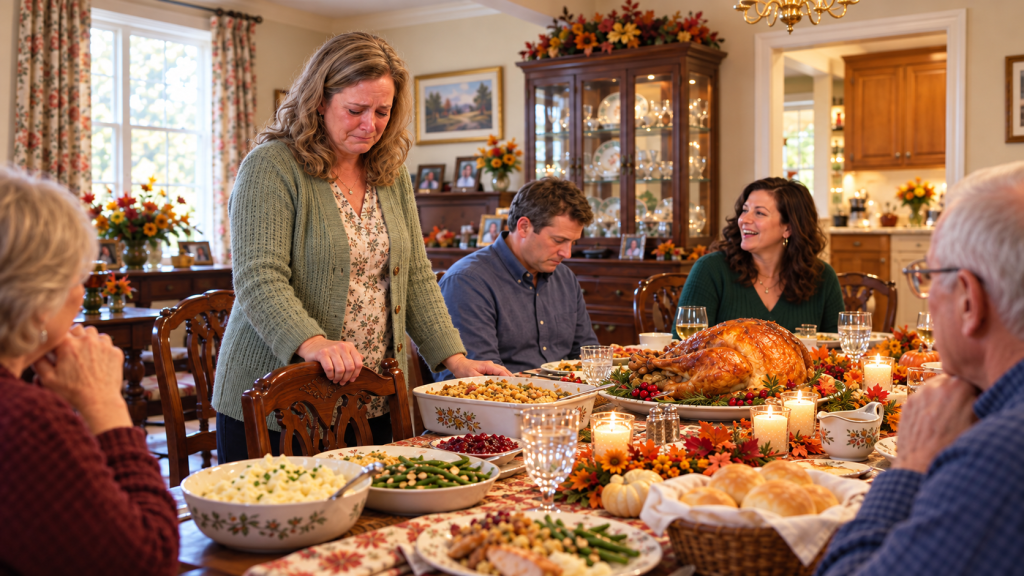
DIANE’S CHRISTMAS TABLE — AN EXCLUSIVE HOLIDAY DINING EXPERIENCE. Beneath them was a photograph of me wearing an apron in Derek’s kitchen. I recognized the picture immediately. Joanna had taken it three Christmases earlier while I was decorating gingerbread cookies with my grandchildren.
I was laughing, flour dusting my cheek, completely unaware that the photograph would someday be used to advertise something I had never agreed to do.
Below the photograph was a description.
Join beloved home cook Diane for a beautiful, traditional Christmas meal prepared from cherished family recipes.
Then came the price.
Ninety-five dollars per person.
Forty reservations.
I felt my mouth go dry.
Cassandra wasn’t merely expecting me to cook dinner.
She had turned my unpaid labor into a business.
I scrolled farther.
There was a paragraph describing my supposedly lifelong passion for hosting.
It mentioned how I had spent decades perfecting holiday recipes and how delighted I was to share them with a wider circle of guests.
At the bottom appeared a scanned signature.
Diane.
My signature.
Except I had never signed that document.
I knew where Cassandra had found it.
Two years earlier, I’d written her a thank-you card after she hosted a birthday dinner for Derek.
I’d ended it with the words, With love, Diane.
The signature on this document had the same long upward curve on the final letter.
Even the little ink blot beside the D was identical.
I sat down slowly.
My friend Teresa, who lived in the adjoining house, was pouring tea into two blue ceramic cups.
She looked at my face.
“Diane? What is wrong?”
I had met Teresa only a week earlier.
She was sixty-eight, a retired schoolteacher whose English was excellent and whose opinion of most things was refreshingly direct.
We had become friends after I got lost returning from the market and stopped outside her courtyard to ask directions.
She had invited me in for tea.
Three hours later, we were still talking.
Now she placed the teapot down.
“Something has happened at home?”
I nodded.
“My daughter-in-law is charging strangers to eat a Christmas dinner I’m supposed to prepare.”
Teresa blinked.
“From here?”
I gave a small, miserable laugh.
“Apparently.”
She considered this.
“That would be a very expensive delivery.”
Despite everything, I smiled.
Then my telephone rang.
Derek.
I answered.
“Mom, did you see Joanna’s message?”
“Yes.”
He exhaled.
“Okay. Before you get upset—”
“Derek.”
He stopped.
“Did you know Cassandra was selling seats at this dinner?”
Silence.
“Derek?”
“She mentioned doing something small.”
I stared at the courtyard wall.
“Something small?”
“Mom, she thought it would be a good way to launch her event business.”
I closed my eyes.
“Using my photograph?”
He didn’t answer.
“My recipes?”
“Yes.”
“My signature?”
Another silence.
I looked toward the ancient stone street outside.
“Derek, did you see that document before she sent it?”
He hesitated.
Then said, “I saw a draft.”
I felt something cold settle inside my chest.
“And you didn’t think to ask me?”
He sighed.
“We thought you’d come around.”
There it was.
The same assumption that had governed our relationship for years.
My preferences were temporary inconveniences.
My refusals were invitations to negotiate.
My time belonged to them until I could somehow prove otherwise.
“Did you know I was going to Portugal?” I asked.
“Yes.”
“Did you know I’d booked the house and my flight?”
“Yes.”
“Did you know I’d told you I wouldn’t cook Christmas dinner?”
“Mom, I know what you said.”
I waited.
Then he whispered, “We didn’t think you’d really go.”
I looked down at my hand.
My wedding ring was no longer there. I’d stopped wearing it on my finger a few years after Leonard died and kept it on a chain around my neck instead.
I touched the chain.
For so long, I had believed being a good mother meant making sure nobody in my family was disappointed.
But my son had grown accustomed to using that fear against me.
“Derek,” I said, “I am in Portugal.”
“I know.”
“I am not flying home.”
He breathed sharply.
“What are we supposed to tell everyone?”
“The truth.”
“People will be furious.”
“They have a reason to be.”
He was silent.
I continued.
“You and Cassandra accepted money for a dinner without the cook’s knowledge or consent. You have to notify every guest that the event cannot proceed as advertised and arrange refunds.”
He sounded almost offended.
“But we already spent some of the deposits.”
I closed my eyes.
“On what?”
“The venue equipment. Decorations. Rentals.”
“Then you’ll have to work out how to repay what you owe.”
“Mom, that’s thousands of dollars.”
I looked toward Teresa.
She was sitting very still, respectfully pretending not to hear.
“Derek, I spent thousands of hours doing things for this family without being asked whether I wanted to.”
My voice trembled.
“But I will not spend my retirement rescuing a business venture that used my name without permission.”
He made a frustrated sound.
“You’re going to let us fail?”
The words stung.
I took a breath.
“No, Derek.”
I paused.
“I’m going to let you take responsibility.”
Then I ended the call.
For several seconds, my telephone remained in my hand.
I felt sick.
Not triumphant.
Not powerful.
Just terribly sad.
Teresa reached across the table.
“Diane?”
I looked up.
Her expression softened.
“Are you all right?”
I considered lying.
Then shook my head.
“No.”
She moved her chair closer.
I began crying.
Teresa didn’t tell me to cheer up.
She didn’t say that my children would eventually understand.
She simply placed a warm cup of tea between my hands and waited until I could speak.
Finally, I whispered, “I think my son loves what I do for him more than he loves me.”
Teresa looked at me for a long moment.
“Perhaps he has never had to learn the difference.”
I wiped my eyes.
“When my husband died, Derek was fourteen. Joanna was eleven. I was terrified all the time.”
Teresa nodded.
“I worked at a dental clinic. I took extra shifts. I learned how to fix leaking faucets because I couldn’t afford to call a plumber for everything.”
I swallowed.
“I made every birthday special. Every Christmas. Every Thanksgiving. I thought if I could keep those traditions going, my children wouldn’t feel how much we’d lost.”
Teresa listened.
“Then they grew up, and somehow I never stopped.”
I looked toward the courtyard.
“I don’t even know when helping became something they expected.”
Teresa touched my arm.
“Was your husband kind to you?”
My eyes filled.
“Very.”
“Then what would he say if he saw you here?”
I smiled sadly.
“He’d ask why I was crying when there was a whole beautiful country outside waiting for me.”
Teresa laughed softly.
“A sensible man.”
I nodded.
“He used to say I was always saving the good china for a special occasion.”
“And?”
“He’d tell me Tuesday was a special occasion if we were both alive to enjoy it.”
Teresa lifted her cup.
“Then today is Christmas Eve.”
I looked at her.
“And you are alive.”
A tear slipped down my cheek.
She smiled.
“I think we should use the good cups.”
I looked down.
The cups she had brought were blue and white, decorated with little painted birds.
They were beautiful.
I laughed through tears.
“These are your good cups?”
“Of course.”
She leaned back.
“I was saving them for a woman who finally came to Portugal instead of spending another Christmas washing somebody else’s dishes.”
For the first time that afternoon, I laughed properly.
And I realized that sometimes a person who had known you for one week could see something your own family had overlooked for years.
That evening, Joanna called.
I answered immediately.
“Mom?”
“Hello, sweetheart.”
“Did you see everything?”
“Yes.”
She exhaled.
“I’m so sorry.”
I looked toward the Christmas lights outside.
“What happened?”
Joanna explained that one of Cassandra’s guests, a former coworker, had forwarded her the promotional document while asking whether the advertised dinner really featured our mother’s cooking.
At first, Joanna thought Cassandra had made an unauthorized announcement.
Then she noticed the signature.
She recognized the handwriting from an old Christmas card I’d once given her.
“I knew you wouldn’t sign something like that without telling me,” Joanna said.
“I didn’t.”
“I know.”
She paused.
“There’s something else.”
My stomach tightened.
“What?”
“Cassandra put a paragraph in the booking terms saying that Diane’s Christmas Table would provide the meal and that the event organizer could use your photograph and recipes.”
I closed my eyes.
“She promised I would provide everything?”
“Yes.”
“And who received the money?”
“Cassandra’s new event-planning business.”
I nodded slowly.
At least that clarified one thing.
The guests had paid Cassandra.
I hadn’t handled reservations, accepted deposits, or entered into agreements.
But the use of my name and signature was deeply troubling.
“I need to speak with someone about protecting myself,” I said.
“Mom, I already found a lawyer in Raleigh who handles business disputes and unauthorized use of people’s names. I can send you the contact information.”
My eyes filled.
“Joanna, you didn’t have to do that.”
Her voice softened.
“Yes, I did.”
I was quiet.
Then she said, “You’ve spent enough years solving everybody else’s problems. Let somebody help you for once.”
I pressed my hand against my mouth.
She continued.
“And Mom?”
“Yes?”
“Please don’t come home.”
I laughed shakily.
“I wasn’t planning to.”
“Good. Because Derek called me and asked whether I’d convince you to return.”
My heart sank.
“What did you say?”
“I told him I wasn’t a travel agent, and I certainly wasn’t a magician.”
I laughed.
Joanna continued.
“Then I told him he needs to stop treating you like the emergency exit for every bad decision he makes.”
I looked down at my tea.
For years, I’d thought Joanna was the independent one.
The child who never seemed to need very much.
Now I wondered whether I’d overlooked how much she understood.
“Thank you,” I whispered.
She paused.
“Mom, can I tell you something?”
“Of course.”
“When Dad died, you taught us we could survive hard things.”
My eyes filled.
“But I think Derek learned that you would always keep him from experiencing the hard parts.”
She took a breath.
“And I learned to solve my own problems because I didn’t want to add to yours.”
I stared at the wall.
I had spent so many years trying to protect both children equally.
Yet somehow, they’d learned completely different lessons.
Joanna continued gently.
“You don’t need to fix that tonight.”
I swallowed.
“All right.”
“Go enjoy Christmas, Mom.”
I looked toward Teresa’s courtyard.
“I think I will.”
Christmas morning arrived with a sky the color of pale silver.
I woke before seven, as I always did.
For thirty years, Christmas morning had meant hurrying downstairs, switching on the oven, checking the turkey, stirring gravy, and wondering whether I’d remembered to buy enough butter.
This year, I lay in bed listening to church bells.
No alarm.
No shopping list.
No casserole waiting to be assembled.
I almost felt guilty.
Then I remembered that I had paid for this little house myself.
I had worked for decades.
I’d raised two children through grief, illness, school examinations, broken hearts, and financial difficulties.
And I was allowed to spend one Christmas morning looking at the ceiling without immediately making myself useful.
I stayed in bed another fifteen minutes.
It felt wonderfully rebellious.
At nine, Teresa knocked on my door.
She was carrying a paper bag and wearing a red scarf.
“Feliz Natal!”
I smiled.
“Merry Christmas!”
She held up the bag.
“Breakfast.”
Inside were warm pastries from a nearby bakery.
We ate them in my courtyard with strong coffee.
Teresa told me stories about growing up in Portugal, and I told her about Leonard.
I described the way he used to sing Christmas carols completely off-key.
How he’d sneak pieces of turkey from the roasting pan.
How he once wrapped a new vacuum cleaner in gift paper, realized my expression had become dangerously cold, and hurried back outside to retrieve the necklace he’d actually bought me.
Teresa laughed until she cried.
“He was a clever man to have a second present.”
“He was a clever man to realize he needed one.”
I laughed too.
Then, without warning, I began crying.
Because the memory was beautiful.
Because I missed him.
And because I wondered whether I’d spent so many years trying to keep our family traditions alive that I’d forgotten the person who made them worth keeping.
Teresa reached for my hand.
“You can miss your husband and still enjoy your morning,” she said.
I nodded.
That seemed important.
Grief and happiness weren’t opposites.
They could sit beside each other at the same table.
After breakfast, I called my grandchildren.
Derek answered the video call.
He looked exhausted.
The house behind him was crowded with cardboard boxes and unassembled decorations.
“Hi, Mom.”
“Hello, Derek. Merry Christmas.”
He looked at me for a moment.
Then said quietly, “Merry Christmas.”
My grandson Noah appeared behind him.
“Grandma!”
I smiled.
“Hello, sweetheart!”
He was ten, all elbows and enthusiasm.
His little sister, Ellie, pushed in beside him.
“Grandma, are you really in Portugal?”
“I certainly am.”
“Can you show us?”
I turned the camera toward the courtyard.
They gasped.
“Look at the blue tiles!”
“Is that a lemon tree?”
I laughed.
“No, that’s Teresa’s orange tree.”
Ellie looked delighted.
“Can you bring us oranges?”
“I’ll see what I can find that travels better.”
Then Noah asked, “Grandma, why aren’t you cooking Christmas dinner?”
The question caught me off guard.
I looked at Derek.
He glanced away.
Then I looked back at the children.
“Because this year I decided to take a trip.”
Ellie frowned.
“But Daddy said Christmas got ruined.”
My heart tightened.
Derek closed his eyes.
I took a slow breath.
“Sweetheart, Christmas isn’t ruined because one person goes away.”
She considered.
“But we don’t have your pies.”
I smiled.
“Then maybe when I get home, you can help me make some.”
Her face brightened.
“Really?”
“Of course. I’ll teach you.”
Noah leaned closer.
“Can I make the crust?”
“Absolutely.”
Ellie frowned.
“I want to make the crust.”
I laughed.
“Then we’ll make two pies.”
For a moment, the children argued happily about which filling was better.
Then Derek asked them to go help with breakfast.
When they disappeared, he looked back at the screen.
“Mom, I’m sorry Ellie said that.”
I studied him.
“Did you tell the children Christmas was ruined because I wasn’t there?”
He looked down.
“I was frustrated.”
I felt the familiar ache.
“Derek, they’re children. They shouldn’t carry responsibility for the decisions we adults make.”
He nodded.
“I know.”
“Do they know the dinner was canceled?”
“Yes.”
“And have you notified everyone?”
He swallowed.
“Cassandra sent the cancellation messages last night. We’re working through refunds.”
I nodded.
“Good.”
He looked toward the kitchen.
Then whispered, “Mom, I’m sorry.”
I waited.
He continued.
“I knew you didn’t agree to this. I saw the flyer. I should’ve stopped it.”
I felt tears fill my eyes.
“Yes, Derek. You should have.”
He nodded slowly.
Then said, “I don’t know why I thought you’d just fix everything.”
I looked toward the bright courtyard.
“I think I helped teach you that.”
His eyes filled.
I continued.
“But you’re grown now. We both have to learn something different.”
He was quiet.
Then he whispered, “I miss you.”
I swallowed.
“I miss you too.”
And that was the hardest part.
I did miss him.
I missed the boy who used to build Christmas villages out of cardboard.
I missed the teenager who’d helped Leonard put lights on the roof.
I missed the young man who’d held my hand at his father’s funeral.
But missing him didn’t mean I needed to go home and rescue him.
It meant we still loved each other.
And love, I was beginning to understand, could survive disappointment.
Three days later, I spoke with attorney Caroline Miles in Raleigh.
Joanna had arranged an introductory appointment, and Caroline agreed to meet with me by video.
She was straightforward.
I appreciated that immediately.
We reviewed the promotional materials, the apparent copying of my signature, the booking terms, and the fact that all payments had been directed to Cassandra’s business.
Caroline explained that unauthorized use of my identity in promotional or contractual documents raised serious concerns, but the exact legal consequences depended on how the materials had been used and what representations had been made.
She advised preserving the original files, messages, and dates.
She would communicate with Cassandra’s business about removing my name and photograph from its advertisements and clarifying that I had never consented to provide catering services.
We also needed to make sure nobody was claiming I had personally accepted payments or agreed to refund guests.
“Do you want to pursue damages?” Caroline asked.
I hesitated.
“I want my name taken off everything.”
She nodded.
“And?”
“I want the guests to know I didn’t deceive them.”
“Reasonable.”
I looked down.
“And I want this to stop.”
Caroline folded her hands.
“Then let’s begin there. We can reassess if more information emerges.”
I appreciated that she didn’t urge me toward the most expensive or aggressive option.
I wasn’t interested in turning Christmas into a legal battlefield for entertainment.
I wanted boundaries that people would have to take seriously.
And I wanted the freedom to continue enjoying my retirement.
Before ending the call, Caroline asked one more question.
“Does Cassandra have access to your financial accounts or any ongoing payment arrangements?”
I thought about the monthly transfers and recurring expenses I’d reviewed on Thanksgiving night.
“Not direct access. But I’ve been paying several bills for Derek’s household.”
“Then I recommend reviewing those commitments individually, including whether any legal obligations exist, and ensuring you retain control of your own funds.”
I nodded.
After the call, I opened my banking app.
I had already ended the informal monthly transfers after giving Derek notice.
I’d canceled subscriptions registered under my account that were used by his household.
And I’d told him that future requests for money would have to be discussed honestly rather than treated as an automatic payment.
I hadn’t demanded repayment for every gift I’d ever given.
Those gifts had been my choices.
But I wasn’t going to keep making them simply because everyone expected me to.
For the first time, my finances looked like the budget of a retired woman planning to enjoy her life.
Not an invisible emergency fund for her adult son.
The truth about Cassandra’s business emerged in January.
And it was more painful than I expected.
Renee, Cassandra’s mother, called me directly.
We had never been close.
Renee was always beautifully dressed, confident, and inclined to compliment people in ways that somehow left them feeling smaller.
She’d been the one who told me I was happiest when I was busy.
When I saw her name on my screen, I almost let the call go unanswered.
But I picked up.
“Hello, Renee.”
“Diane.”
Her voice sounded strained.
“I owe you an apology.”
I was silent.
She continued.
“I saw the documents.”
I looked toward the window.
“Which documents?”
“The Christmas event materials.”
I waited.
Renee took a breath.
“Cassandra told me you’d agreed to help launch her business.”
“I hadn’t.”
“I know that now.”
She paused.
“And I saw your signature.”
My stomach tightened.
Renee continued.
“I asked where she got it. She finally admitted she copied it from a card you’d given her.”
I closed my eyes.
Hearing it stated so plainly hurt.
It wasn’t just an enthusiastic daughter-in-law making an assumption.
She’d deliberately placed my name on something she knew I hadn’t signed.
Renee’s voice trembled.
“I told her she had to correct it.”
I looked down.
“Did she?”
“She’s sent the guests written clarification. She’s also begun arranging repayment of the deposits.”
I nodded.
“Good.”
Renee hesitated.
“There’s more, Diane.”
I braced myself.
“Cassandra borrowed money from me last summer to start the business.”
I was quiet.
“She spent it on a website, branding, and an office she didn’t really need.”
Renee sighed.
“She thought the Christmas dinner would make everything look successful enough to attract future clients.”
I stared at the stone floor.
“By using me.”
“Yes.”
Renee began crying.
“I encouraged her. I told her that if she’d grown up with somebody who cooked like you, she’d be foolish not to build a business around it.”
I felt a bitter sadness.
There it was again.
The belief that my skills, my time, and my experience existed for other people to use.
Renee continued.
“And when I saw that you weren’t coming home, I told her she needed to convince Derek to bring you back.”
I closed my eyes.
“I see.”
“Diane, I was wrong.”
I didn’t speak.
She took a shaky breath.
“You spent three hours in that kitchen on Thanksgiving. I watched you do it. And instead of helping you, I told you that being busy made you happy.”
My eyes filled.
She whispered, “I never asked whether it did.”
For a long time, neither of us spoke.
Then I answered quietly.
“Thank you for acknowledging that.”
Renee exhaled.
“I don’t expect you to forgive us immediately.”
“Good,” I said gently. “Because I’m not ready.”
She nodded, even though she couldn’t see me.
Before ending the call, she said something that surprised me.
“I hope you’re enjoying Portugal.”
I looked toward the courtyard.
“I am.”
Her voice softened.
“Then stay.”
And for once, she didn’t add a request.
By the middle of January, I had become a familiar face in Óbidos.
The woman at the bakery knew I preferred coffee with a little milk.
A bookseller near the town wall set aside English-language novels whenever something interesting arrived.
Teresa introduced me to a retired art teacher named Helena, who invited me to join a small watercolor group.
At first, I refused.
“Oh, I haven’t painted properly in years.”
Helena smiled.
“Then you have years of things to paint.”
I laughed.
But the following Wednesday, I arrived carrying a new sketchbook and a box of watercolors.
We sat near a window overlooking the whitewashed buildings.
I tried painting the blue shutters of a house across the street.
The proportions were wrong.
The colors bled.
My first attempt looked as though somebody had left it outside in the rain.
I was embarrassed.
Helena studied the page.
Then said, “You were enjoying yourself before you started judging the result.”
I looked at her.
She smiled.
“Try again.”
So I did.
And something unexpected happened.
I forgot to check my telephone.
For nearly two hours, I didn’t worry about Derek, Cassandra, bills, cooking, or whether anybody needed me.
I thought about color.
Light.
The shape of an old doorway.
The way sunlight gathered against the stone.
When class ended, I felt a kind of happiness I hadn’t experienced in years.
Not the satisfaction of finishing a long list of chores.
Not the relief of solving a problem.
Simply the happiness of doing something because I wanted to.
I bought another sketchbook on the way home.
Then I sat in my courtyard and painted until the afternoon light disappeared.
Joanna visited during my final full week in Portugal.
She paid for her own airfare and insisted on staying in a nearby guesthouse, although I offered her the spare room.
“I want to visit my mother,” she said, “not turn her vacation into another hosting assignment.”
I laughed.
“You’re getting very strict.”
“Someone has to.”
We spent four lovely days together.
We explored Lisbon, visited markets, admired tiled buildings, and took photographs beside the sea.
One afternoon, we sat at a café with pastries and coffee.
Joanna watched me taking pictures of a painted doorway.
“You look different, Mom.”
I smiled.
“Older?”
“No.”
She shook her head.
“More like yourself.”
The words stayed with me.
I thought about who I’d been before Leonard died.
A young woman who loved painting.
Who wanted to see the world.
Who stayed up late reading novels and occasionally burned dinner because she’d become absorbed in a book.
Then life had demanded something different.
I became a widow.
A provider.
The person everybody called when something broke.
Those roles mattered.
But somewhere along the way, I’d allowed them to become my entire identity.
I looked at Joanna.
“Do you know what frightened me most about coming here?”
She shook her head.
“That I wouldn’t know what to do if nobody needed anything.”
Joanna’s eyes filled.
I continued.
“For nearly thirty years, I always had somebody to take care of. When you and Derek were grown, I kept finding ways to be needed.”
I paused.
“I think I was afraid that if I stopped being useful, people would stop wanting me around.”
Joanna reached across the table.
“Mom, I don’t love you because you make casseroles.”
I laughed through tears.
“I know.”
“No, I don’t think you do.”
She squeezed my hand.
“I love you because you’re the person who taught me to notice beautiful things. Because you cried when I graduated. Because you used to leave little notes in my lunchbox that made me laugh on awful school days.”
My throat closed.
She smiled.
“And because you’re the only person I know who can get lost in a foreign country and come home with three new friends.”
I laughed.
Then she grew serious.
“Derek loves you too. But he’s going to have to learn how to show it without asking you to sacrifice something.”
I nodded.
“I hope he does.”
Joanna looked toward the street.
“And even if that takes time, you still get to have a good life.”
I reached for her hand.
For a long while, we sat together in the winter sunshine.
No errands waiting.
No dishes to wash.
No one calling us back to a kitchen.
Just a mother and daughter, enjoying a beautiful afternoon.
A few days before I returned to North Carolina, Derek sent me an email.
The subject was simply:
Mom, I owe you the truth.
I opened it while sitting beside the courtyard window.
He wrote that he had known Cassandra was advertising the Christmas dinner before I’d left for Portugal.
He’d seen my photograph on the website.
He’d seen the draft promising I’d prepare the food.
And he’d known I hadn’t agreed.
He admitted that he’d encouraged Cassandra to leave the advertisement online because he believed he could persuade me to change my plans.
He also admitted that he’d noticed my signature on the final version before Christmas.
He hadn’t asked how it got there.
He hadn’t wanted to know.
I told myself Cassandra was excited about her business, he wrote. But the truth is that it was easier to let her use your name than to admit we’d promised something we had no right to promise.
I kept reading.
When you refused to come home, I was angry because I had to face a problem I couldn’t hand to you.
My eyes filled.
Then came the sentence I hadn’t realized I needed to hear.
You didn’t embarrass me at Thanksgiving. I embarrassed myself when I watched Cassandra make fun of you and said nothing.
I stopped.
I remembered the dinner table.
The awkward smiles.
The photograph of New Zealand.
My son’s eyes fixed on his plate.
For weeks, that silence had hurt more than Cassandra’s remark.
I continued.
I should have told her to stop. I should have said how proud I was of everything you’ve done. Instead, I acted as though keeping everyone else comfortable mattered more than protecting your dignity.
Tears slid down my cheeks.
The final paragraphs explained that the refunds were being processed and that he and Cassandra were working through the remaining costs without asking me for money.
They had also sent written corrections to the guests.
I know an email won’t repair this, Derek wrote. I want to learn how to be your son without expecting you to manage my life.
At the bottom were six words.
Enjoy the rest of your trip.
I read the email twice.
Then closed my laptop.
I didn’t reply immediately.
I went outside instead.
Teresa was watering her plants.
She looked up.
“Good news?”
I thought about it.
“Maybe.”
She smiled.
“Then let it have time to become good.”
And I realized something important.
I didn’t have to rush toward reconciliation simply because somebody had finally said the right words.
I could appreciate Derek’s honesty.
I could hope he meant it.
And I could still take the time I needed.
For once, I was allowed to choose the pace of my own life.
I returned to Raleigh in February.
When my plane landed, I felt a surprising mixture of emotions.
I was glad to come home.
I missed my own bed, my garden, and the little grocery store where the cashier always asked about my grandchildren.
But I also felt a deep sadness leaving Portugal.
For eight weeks, I’d lived as a woman whose days belonged to her.
I’d painted.
Walked.
Read novels in cafés.
Made friends.
Sat beside the ocean without checking whether anybody needed me.
And I’d discovered that the world didn’t collapse when I stopped managing everybody else’s life.
Joanna met me at the airport.
She hugged me tightly.
“Welcome home, world traveler.”
I laughed.
“Thank you.”
Then she stepped back and looked at my suitcase.
“How many souvenirs did you buy?”
“Not many.”
She raised an eyebrow.
“Mom.”
I smiled.
“Well, there may be a few.”
We laughed all the way to the parking garage.
When I reached my house, everything was exactly as I’d left it.
The furniture.
The familiar hallway.
The photographs on the mantel.
And a framed picture of Leonard smiling beside the garden fence.
I stood in front of it for a long moment.
“Well, darling,” I whispered, “I finally did it.”
I could almost hear him laughing.
About time, Diane.
I smiled through tears.
Then I opened the curtains.
Let the afternoon sunshine fill the living room.
And began unpacking my sketchbooks.
Derek asked to visit the following Saturday.
I agreed.
But I told him we weren’t going to discuss money, holiday arrangements, or future family gatherings until we’d talked honestly about what had happened.
He arrived alone.
For a moment, he stood awkwardly in my doorway.
Then he stepped forward.
“Hi, Mom.”
“Hello, sweetheart.”
He looked tired.
But different.
Less defensive.
We sat in the living room.
He apologized again for Thanksgiving.
For the event.
For allowing Cassandra to copy my signature.
And for expecting me to return from Portugal and solve the consequences.
He showed me copies of the written corrections sent to the guests and documentation of the refunds.
Not every expense had been recovered.
The equipment rental and other business costs were theirs to absorb.
Cassandra had suspended the event-planning venture while resolving the remaining obligations and reviewing how it had been operated.
It wasn’t a happy ending for her business.
But it was a necessary one.
I looked at Derek.
“Do you understand why I was so hurt?”
He nodded.
“Because we treated you like you belonged to us.”
My eyes filled.
He continued.
“We didn’t ask whether you wanted to cook. We didn’t ask whether you wanted to spend Christmas with us. We just assumed that because you always had, you always would.”
I swallowed.
“And when I finally said no?”
He looked down.
“I treated it like you were doing something wrong.”
For a moment, neither of us spoke.
Then I said, “Derek, I love being your mother.”
He looked up.
“I love being Noah and Ellie’s grandmother.”
My voice trembled.
“But I’m also a woman with dreams that existed before you were born.”
His eyes filled.
“I know.”
“I don’t want to spend the rest of my life waiting for everyone else’s needs to be satisfied before I’m allowed to enjoy mine.”
He wiped his face.
“Then don’t.”
I looked at him.
He smiled sadly.
“Please don’t.”
And for the first time in a very long while, I believed my son was beginning to see me as someone beyond the role I’d always played in his life.
Cassandra came to see me two weeks later.
I hadn’t invited her.
She called first and asked whether I would be willing to talk.
I agreed.
When she arrived, she carried no flowers.
No expensive gift.
No elaborate peace offering.
Just a small folder.
Inside were copies of the corrections made to her business documents and confirmation that my photograph, name, and supposed signature had been removed from the promotional materials.
She placed the folder on the coffee table.
“I know I can’t undo what I did,” she said.
I waited.
She took a breath.
“At Thanksgiving, I embarrassed you in front of people who should have been thanking you.”
My throat tightened.
She continued.
“Then I assumed I could build a business around your work without asking for your permission.”
She looked down.
“I told myself you loved cooking, so you’d eventually be happy about it.”
I watched her.
“But that wasn’t really what I believed,” she whispered.
I waited.
“I knew you had said no. I just thought Derek could change your mind.”
Her eyes filled.
“I’m sorry, Diane.”
For once, she didn’t laugh.
She didn’t explain that she’d been stressed.
She didn’t insist that I had misunderstood her joke.
She simply acknowledged what she’d done.
I nodded.
“Thank you for saying that.”
She looked relieved.
Then I continued.
“But things will be different from now on.”
Her expression became serious.
“I understand.”
“If you invite me somewhere, I’ll decide whether I want to come.”
She nodded.
“If you need help, you can ask. But you cannot assume I’ll provide it.”
“Yes.”
“And you will never again use my photograph, name, signature, recipes, or personal history to promote a business without my permission.”
She swallowed.
“I won’t.”
I studied her.
There was a time when I would have hurried to assure her everything was forgiven.
I would have made tea, offered her cake, and spent the afternoon helping her feel better.
But I wasn’t responsible for making every difficult conversation comfortable.
So I said something simpler.
“I hope we can build a healthier relationship, Cassandra.”
Her eyes filled.
“Me too.”
Then she left.
And I didn’t feel guilty for letting the conversation end there.
In March, Derek invited me to Sunday lunch.
I hesitated when I saw his message.
Then I noticed something unusual.
Mom, we’re cooking. You don’t need to bring anything. We’d just like to see you.
I smiled.
I decided to go.
When I arrived, Noah and Ellie ran toward me.
“Grandma!”
I hugged them both.
Their arms felt like home.
But this time, I wasn’t carrying a turkey.
Or pies.
Or a casserole balanced against my hip.
I was carrying a small box of painted tiles I’d brought from Portugal.
Inside, Derek was standing at the stove wearing an apron.
He looked nervous.
“Mom, I think I overcooked the chicken.”
I laughed.
“Probably.”
He grinned.
“Well, we’re going to eat it anyway.”
Cassandra had made a salad.
The children had decorated the table with construction-paper flowers.
Nothing matched.
There were no gold-rimmed glasses.
No perfectly folded linen napkins.
No elaborate centerpiece.
And it was one of the loveliest family meals I’d attended in years.
After lunch, Ellie asked if we could make a pie together someday.
I smiled.
“Of course.”
She looked delighted.
“Can Daddy help?”
I glanced toward Derek.
He raised both hands.
“I can try.”
I laughed.
“Then we’ll teach him.”
For the first time, making a pie with my family sounded like something I might enjoy.
Not because I was expected to do all the work.
But because we’d finally begun learning how to share it.
That summer, I held a small gathering at my house.
Not a dinner party.
Not a holiday feast.
An afternoon showing the watercolor paintings I’d made in Portugal.
Joanna brought flowers.
Derek helped arrange chairs.
Noah and Ellie put little handwritten labels beside the paintings.
Cassandra offered to bring refreshments.
I thanked her and said simple drinks would be enough.
She didn’t argue.
My friends wandered through the living room, admiring the paintings of stone streets, tiled courtyards, fishing boats, and blue shutters.
One painting showed Teresa’s little courtyard.
Two blue-and-white cups sat on a table beneath an orange tree.
I had titled it Christmas Morning.
Joanna stood beside it for a long time.
Then she looked at me.
“That’s my favorite.”
I smiled.
“Mine too.”
Later, Derek approached.
He studied the painting of the sea.
“Mom, I didn’t know you could do this.”
I laughed softly.
“Neither did I, anymore.”
His expression changed.
For a moment, he looked sad.
Then he said, “I’m glad you found it again.”
I looked at him.
“Thank you.”
He hesitated.
Then added, “I’m proud of you.”
My eyes filled.
For years, I’d waited for someone to appreciate the meals I cooked.
The errands I ran.
The sacrifices I made.
Now my son was standing in front of something I’d created for no reason other than the joy of creating it.
And telling me he was proud.
I hugged him.
Not because everything had been forgotten.
But because something between us was beginning to change.
I still cook.
I still bake lemon bars.
I still love having my grandchildren around my kitchen table.
But I no longer confuse those pleasures with obligations.
Sometimes I say yes.
Sometimes I say no.
Sometimes I spend an entire Saturday painting without answering my telephone until evening.
And next spring, I’m planning another trip.
Teresa has already invited me back to Portugal.
Joanna wants to join me for part of it.
I’ve also been looking at a little art retreat in Italy.
Derek asked whether I’d be home for Easter.
I told him I hadn’t decided.
And do you know what he said?
“Okay, Mom. Let me know when you figure it out.”
I nearly laughed.
Such an ordinary answer.
Such an extraordinary change.
Sometimes I think about that Thanksgiving dinner in Charlotte.
The beautifully arranged table.
The eucalyptus branches.
The expensive glassware.
Cassandra laughing as she announced that cooking and cleaning were my whole personality.
At the time, I felt as though somebody had reduced my entire life to a list of chores.
But now I understand something I didn’t understand then.
People can only define you by what you do for them if you allow their definition to become your own.
I was a wife who had loved her husband.
A mother who had raised two children through extraordinary grief.
A dental-clinic employee who had worked hard and saved carefully.
A grandmother who adored her grandchildren.
But I was also a traveler.
A painter.
A friend.
A woman who loved books, beautiful places, quiet mornings, and the delicious freedom of making plans that belonged entirely to her.
I hadn’t lost those parts of myself.
I’d simply stopped giving them enough room to breathe.
My trip to Portugal didn’t destroy my family.
It showed us that our family needed to change.
I could love Derek without financing every mistake.
I could care about Cassandra without becoming her unpaid employee.
I could enjoy my grandchildren without organizing my entire retirement around their schedules.
And I could keep Leonard’s memory alive without spending every Christmas trying to recreate the life we’d had before he died.
One evening, I sat on my porch with a cup of tea and looked at the photograph of myself standing on that windswept hillside in New Zealand.
I remembered how free I’d felt.
Then I looked at my watercolor of the Portuguese courtyard.
And smiled.
Because I’d finally understood what Leonard used to tell me.
There was no point saving all the beautiful things for someday.
Someday wasn’t guaranteed.
Today was here.
And it belonged to me.
At sixty-three, I finally stopped asking my family for permission to enjoy the life I’d worked so hard to build.
And when I stopped living only to be needed, I discovered how wonderful it felt simply to be alive.
THE END STORIES! THANK YOU FOR READING GOOD LUCK !❤️
Related Posts