PART 1
For four years, my family believed I was paying eighty-nine dollars a month to store junk. Last month my son-in-law found the receipt in my checkbook, made some phone calls, and on Tuesday he sat me down at my own kitchen table, with my daughter beside him and a folder in front of him, to talk about “managing my finances going forward.” I let him give his whole speech. Then I stood up and said, “Get your coats. We’re going to the unit.”
My name is June. I am seventy-five. My Bud has been gone four years, and this story is really his, so listen close.
Bud kept a 1967 Mustang fastback in our garage for fifty years. Candy-apple red. He and that car went steady before I ever came along, and I made my peace with being the second-prettiest thing he owned.
When Bud had his stroke, the family got very helpful, very fast. And nobody was more helpful than my son-in-law Greg.
Greg, who sells boats, and knows what things are worth, and wants you to know he knows.
Greg stood in our garage that spring, while my husband was upstairs learning to hold a spoon again, and said, “We should really talk about the car. Sitting money, June. I know a guy.”
Bud heard about it. Bud could not say many words yet that year, but he said two to me that night, very clearly, holding my wrist: “Not. Greg.”
There was history there. A twenty-two-thousand-dollar “bridge loan” for Greg’s boat business, back in 2011, that built no bridge and came back in no boats. We were not allowed to mention it at dinners. Bud wrote it down in his little ledger, though. Bud wrote everything down.
My husband passed on a Thursday in October. Greg waited until the Saturday after the funeral to say, in my kitchen, with a casserole still warm on the stove, “I can have the garage cleared by Monday. The car too. I know a guy.”
By Monday, the car was gone.
Everyone assumed I sold it. I let them assume. Greg told people he had “helped me get a fair number for it,” which was interesting, since he had done no such thing, but a man who lies that easily does half your work for you.
What actually happened is that Whitey Dunn from Bud’s old bowling team drove that Mustang, slow as a funeral, seven miles to a storage place on Route 9, and I have paid eighty-nine dollars a month ever since, and every February I go sit in it with a thermos and talk to my husband for a while.
Because before he died, Bud asked me for one thing. Eli gets the car at twenty-one. Whole. Running. No family discount, no helpful guys who know guys.
Eli is my grandson. He turns twenty-one in June.
You see the problem with the timing. Two months short of the finish line, Greg finds my receipt, and suddenly there is a folder on my kitchen table with the words “financial oversight” in it, and my own daughter Kathy is saying, gently, “Mom, eighty-nine dollars every month for years, and you can’t even tell us what’s in there? You see how that looks.”
“It looks like my money paying my bill,” I said. But I stood up anyway. “Get your coats.”
Greg drove us all to Route 9 doing sixty in a forty, ready to catalog my decline. I could see him building the story in the rearview mirror. Poor June, renting a room for trash.
I called Eli on the way and told him to meet us there. Then I made one more call, short and quiet, to a number Bud made me memorize.
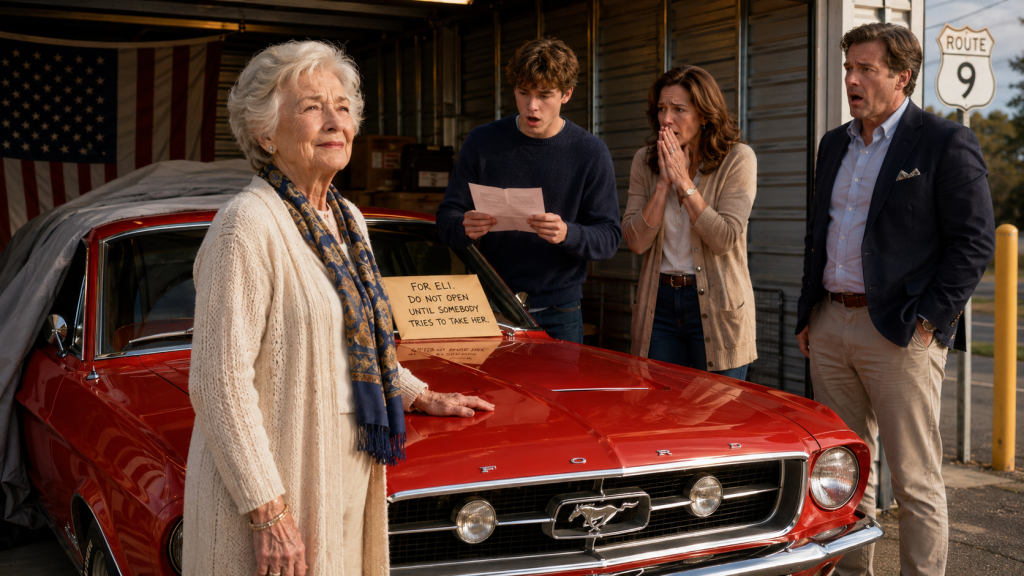
Unit 44. I turned my key, and Eli helped me lift the roll-up door, and the afternoon light walked in ahead of us and landed on a shape under a gray cover that every man who has ever loved anything recognized instantly.
Greg went very still.
“June,” he said. “Is that—”
“Pull it off, Eli.”
My grandson pulled the cover, and there she was, candy-apple red, waxed every spring by Whitey, and my daughter made a sound like a hiccup, and Greg took one step forward with his boat-salesman eyes doing arithmetic, and that is when everyone noticed the envelope taped to the windshield.
Bud’s handwriting. Big block letters.
“FOR ELI. DO NOT OPEN UNTIL SOMEBODY TRIES TO TAKE HER.”
Four years that envelope has waited, and I never knew what he put in it, because some things between a man and his grandson are not a wife’s business.
Eli peeled it off with two fingers, opened it, and started reading out loud.
He got through “Dear Eli, if you are reading this, then it finally happened, and I would bet my good wrench I know exactly who is standing in that unit with you,” and then my grandson stopped, and looked up at Greg, and read the next line slowly:
“Before anybody leaves, son, ask your Uncle Greg what happened to the..
PART 2: What Happened to the Twenty-Two Thousand Dollars.
“Before anybody leaves, son, ask your Uncle Greg what happened to the twenty-two thousand dollars I loaned him in 2011.”
Nobody moved.
Eli lowered the letter.
Kathy looked at her husband.
“What twenty-two thousand dollars?”
Greg laughed too quickly.
“That was business stuff. Your father and I settled that years ago.”
“No, you didn’t,” I said.
Greg turned toward me.
“You don’t know what Bud and I discussed privately.”
I reached into my handbag and removed Bud’s little brown ledger.
“I know what he wrote down.”
Greg’s face changed.
Bud had recorded every loan he ever made, every payment received, every promise somebody expected him to forget.
I opened to a page marked March 2011.
“Twenty-two thousand dollars. Gregory Mason. Bridge loan. Ninety days.”
Kathy stared at him.
“You borrowed twenty-two thousand from Dad?”
“It was an investment.”
I shook my head.
“Bud wrote loan.”
Greg stepped toward me.
“June, you’re confused.”
Eli moved between us.
“My grandmother isn’t confused.”
That was the first moment I saw something in Greg’s eyes that had nothing to do with the Mustang.
Fear.
Eli looked back at the letter and continued.
“If Greg says the loan was repaid, ask Grandma for my ledger. If Greg says it was an investment, ask him why he signed a promissory note. If Greg says the paperwork is gone, tell him Whitey has a copy.”
Greg swore under his breath.
From behind us came a familiar voice.
“I sure do.”
Whitey Dunn stood outside Unit 44 wearing an old Browns jacket and carrying a metal document box.
That was the second call I had made from the car.
Greg stared at him.
Whitey smiled.
“Hello, Greg.”
Kathy looked as if somebody had rearranged the world while she wasn’t watching.
“What is happening?”
Whitey placed the box on the hood of the Mustang.
“Your father knew he was getting sick. He gave me copies of certain documents because he didn’t trust Greg around the car.”
Greg pointed toward the door.
“This is ridiculous. We came here because June is wasting money on storage.”
“Eighty-nine dollars a month,” I said. “For forty-eight months.”
I looked at Eli.
“How much is that?”
He pulled out his phone.
“Four thousand two hundred seventy-two dollars.”
I nodded toward the Mustang.
“And what’s the car worth?”
Greg answered before anyone else could.
“At least sixty-five thousand. Maybe more.”
Then he realized what he had done.
I smiled.
“So storing a sixty-five-thousand-dollar car for forty-two hundred dollars wasn’t financial decline after all.”
Kathy closed her eyes.
Greg’s folder about managing my finances suddenly looked very silly under his arm.
But Eli kept reading.
“Grandma, if you’re there, I’m sorry you had to deal with this. You always protected people longer than they deserved. So I arranged something you can’t soften.”
I frowned.
That sounded exactly like Bud.
Whitey opened the metal box.
Inside was the promissory note.
Greg’s signature appeared at the bottom.
Twenty-two thousand dollars.
Interest.
No repayment.
There was also something else.
A second document.
Whitey handed it to Kathy.
She read the first paragraph twice.
Then she looked at Greg.
“You used Dad’s Mustang as collateral?”
Greg said nothing.
My stomach turned cold.
Whitey explained.
Three months after Bud loaned Greg the money, Greg had approached a private lender for additional funds.
He had represented the Mustang as collateral.
A car he did not own.
Apparently Greg had copied the vehicle information while helping Bud organize insurance documents.
The lender discovered the title problem before releasing the full amount, but not before Greg signed paperwork claiming he had authority over the car.
Bud found out.
That was why he had said, “Not. Greg.”
Kathy’s voice broke.
“You tried to borrow money against Dad’s car?”
“I was trying to save my business.”
“You told me Dad refused to help you.”
“He embarrassed me!”
The words exploded through the unit.
Even Greg looked surprised by how loudly he had said them.
“He had money sitting everywhere while I was struggling.”
I stared at him.
“That was Bud’s money.”
Greg pointed toward the Mustang.
“And this thing sat in a garage for decades!”
Eli folded his grandfather’s letter carefully.
“It wasn’t yours.”
Greg looked at him.
“You stay out of this.”
“No,” Kathy said.
Her voice was quiet.
But something had changed.
“You stay away from him.”
Greg stared at his wife.
“Kathy.”
She held up the financial-oversight folder.
“You brought me into Mom’s house and told me she was becoming irresponsible.”
“I was protecting her.”
“You found one storage receipt.”
“She’s seventy-five!”
“And apparently sharper than both of us.”
I almost smiled.
Then Whitey handed me the final page from Bud’s box.
It was dated six weeks before his death.
Bud had transferred the Mustang into a trust.
Eli was the beneficiary.
I was trustee until his twenty-first birthday.
Greg could not sell it.
Kathy could not sell it.
Even I could not sell it for my own benefit.
Bud had made certain his final promise could survive everybody.
Eli looked at me.
“Grandma, you knew?”
“About the trust, yes.”
“The rest?”
I shook my head.
“Your grandfather apparently enjoyed surprises.”
Whitey laughed.
“He enjoyed insurance.”
Then we heard tires on the gravel outside.
A black sedan stopped beside our cars.
A woman in a gray suit stepped out carrying a briefcase.
Greg looked at me.
“Who is that?”
“My lawyer.”
His face went pale.
She walked into the unit and introduced herself as Caroline Mercer.
Then she handed Greg an envelope.
“What’s this?”
“A formal demand concerning the unpaid 2011 promissory note.”
Kathy stared at me.
“You’re collecting it?”
I looked at Greg.
“For years, no. Bud wouldn’t let me.”
Greg swallowed.
“And now?”
I glanced at the folder he had brought to my kitchen to take control of my finances.
“Now I’ve decided I may need help managing my money.”
Whitey laughed so hard he had to lean against the storage door.
Greg didn’t.
Caroline continued calmly.
“With accrued interest under the agreement, the balance is considerably higher than twenty-two thousand dollars.”
Greg opened the envelope.
His eyes moved down the page.
“How much?”
Caroline told him.
Forty-one thousand eight hundred dollars.
Kathy sat down on an old toolbox.
Greg stared at me.
“You’d do this to family?”
I walked toward the Mustang and rested my hand on its roof.
“No, Greg.”
I looked directly at him.
“Family is why I waited fourteen years.”
Then Eli noticed one final line at the bottom of Bud’s letter.
He read it aloud.
“And Eli, if your grandmother kept my promise until your twenty-first birthday, take her for the first ride. She spent fifty years pretending she wasn’t jealous of this car.”
I laughed before I could stop myself.
Then I cried.
Because for just one second, inside Unit 44, I could hear Bud saying it.
Eli put his arm around me.
But Greg was staring at the Mustang again.
Not with admiration anymore.
With desperation.
And that was when Caroline quietly told me there was one more thing we needed to discuss.
Greg had made another phone call before we arrived.
He had already found a buyer for Bud’s Mustang.
THE END! THANK YOU FOR READING!❤️
Related Posts