For my 73rd birthday, my daughter-in-law handed me a $2 scratch-off ticket and laughed as I uncovered the numbers. I smiled, thanked her, and kept silent about what appeared beneath the silver layer. 10 months later, my son showed me a brochure for the senior residence he and his wife had already selected for me. I calmly replied, “That seems fine.” The following morning,

a letter was delivered to their home. When my son finished reading it, he looked at me as though he had never truly known his own mother.
That scratch ticket was the only present they gave me for my birthday that year. The price label was still attached to the card.
“Perhaps you’ll win enough money to buy a bus ticket, Evelyn,” my daughter-in-law, Paige, teased.
My son, Graham, joined in laughing.
My grandchildren laughed as well because they saw their parents doing it.
I used my thumbnail to scratch the ticket while Paige sliced the cake I had made for my own celebration.
Then the winning symbols appeared.
I examined them carefully.
Then I checked a second time.
My heart started racing.
No one paid attention.
Graham was filling the wineglasses. Paige was saying the icing tasted too sugary. The children were focused on their phones.
I folded the ticket in half and tucked it inside the pocket of my cardigan.
“Didn’t win anything?” Graham asked.
I gave him a smile.
“Not even enough for the bus.”
Paige laughed again.
I thanked her for the birthday card and started collecting the dirty dishes.
That evening showed me just how much a woman can conceal behind a peaceful expression.
I am Evelyn Mercer, and I am 73 years old.
I had been living with Graham and Paige for almost 4 years, ever since my husband, Thomas, di.
In the beginning, Graham had urged me to come and stay with them.
“You shouldn’t live by yourself, Mom.”
I honestly thought he wanted me in his home.
But little by little, I became more helpful than wanted.
I prepared meals because Paige often stayed late at work.
After cooking, I cleaned the kitchen as well.
I bought groceries, folded their clothes, cared for the children, and changed my schedule whenever someone asked me for help.
Nobody ever formally told me those duties belonged to me.
They simply became my responsibility over time.
Then, one night, as I carried clean towels past the kitchen, I heard Paige say:
“Your mother is starting to become a problem.”
Graham breathed out heavily.
“What do you expect me to do? She’s still my mother.”
His response wounded me more deeply than Paige’s comment.
I had devoted most of my life to taking care of him.
Now, showing concern for me seemed like an unwanted duty.
That was why I said nothing when I learned that the silly ticket hidden in my cardigan was worth several million dollars.
The next Monday, after everyone had left the house, I hired a taxi and traveled downtown.
A lawyer who specialized in estates, Martin Hale, inspected the ticket.
“Have you told anyone about this?” he asked.
“No.”
“Then continue keeping it private until we make sure you’re protected.”
During the weeks that followed, Martin helped me collect the winnings with as much privacy as the law permitted, arrange the funds, revise my will, and establish several trusts.
Because of taxes and the payment conditions, the amount I actually collected was much smaller than the advertised $11 million prize.
Even so, it was far more money than I would ever need.
I created educational trusts for my grandchildren that neither Graham nor Paige would be able to access.
I also reserved enough money to secure my own future.
Afterward, Martin offered me one important suggestion.
“Don’t transform your entire life all at once.”
I followed his advice.
I returned to the house.
I prepared the evening meal.
I cut out discount coupons for Paige.
I folded the clean towels.
For several months, no one suspected a thing.
Quietly, however, I started building a future that was entirely my own.
In March, Martin learned that the older gentleman who owned Graham’s rented home was thinking about putting it on the market.
The man lived in Florida and had become weary of managing a rental property from another state.
I told Martin to investigate the possibility.
That was the only information Graham ever received.
Several weeks later, Graham announced during dinner that the house apparently had a new owner.
“Some business purchased it,” he explained.
“Is that so?” I replied.
“T&E Property Holdings. They’re probably some kind of investment group.”
The initials immediately reminded me of Thomas.
Years earlier, his small fishing company had operated under the name T&E Outdoor Supply.
Thomas and Evelyn.
Throughout Graham’s childhood, boxes marked with those initials had been stacked around him.
But he never recognized the connection.
Once the sale was completed, Graham simply started mailing his monthly rental payments to a new location.
From time to time, he complained about the company that had become his landlord.
I quietly handed him the bowl of potatoes.
In June, I made another purchase.
It was a small yellow cottage near Wilmington, only 15 minutes away from my sister, Ruth.
The home had 2 bedrooms, blooming rose bushes, a broad front porch, and a softly colored yellow kitchen.
The moment I entered it, I imagined spending my remaining years there without feeling as though I was slowly being erased.
Ruth and my lawyers were the only people who knew about it.
I decorated the cottage a little at a time.
A sofa upholstered in blue fabric.
A sturdy oak dining table.
A comfortable chair for reading beside the window.
I still had not chosen the exact day when I would move out of Graham’s home.
Then, 2 weeks ago, he made that choice for me.
We were having dinner when Graham placed his fork on the table.
“Mom, Paige and I have discussed something.”
Paige gave me a warm-looking smile.
“We discovered a place that we believe you’re going to enjoy.”
Graham passed a brochure across the table.
Pine Harbor Senior Living.
I studied the picture of a cheerful elderly couple printed on its front.
“You’ve been searching for retirement residences?”
“We visited this one,” Paige answered.
They had gone without me.
She tapped a picture of a compact studio apartment in the independent-living wing.
“They provide food, rides, and activities. You would be surrounded by people your age.”
I turned toward Graham.
“And you arranged all of this before speaking with me?”
“We thought you might become anxious,” he said.
Paige quickly continued, “We only placed a refundable deposit to reserve the room. You still need to attend the assessment and complete the paperwork.”
“Then the decision hasn’t been finalized?”
“Not officially.”
“When were you expecting me to leave?”
Graham paused before answering.
“January 1.”
We were only halfway through November.
“Why does it have to be January 1?”
For a moment, neither of them spoke.
Finally, Graham admitted that Owen wanted to take over the bedroom I occupied downstairs.
He was growing up.
He needed a larger room.
Apparently, they had been making these plans for several months.
Paige stretched her hand across the table.
“You’ll enjoy yourself more when you’re with others in your age group.”
I stared at my son.
“This really is the best choice, Mom.”
A deep stillness settled inside me.
Then I smiled at them.
“I think you’re right.”
Both of them looked surprised.
“You really agree?” Paige asked.
“Yes.”
The relief on their faces appeared instantly.
That reaction hurt even more than seeing the brochure.
They thought their difficulty had simply disappeared.
Later that evening, I telephoned Martin.
“I’m prepared.”
He understood exactly what I was saying.
Together, we went over every detail once more.
Graham and Paige rented the home on a month-to-month basis, and Martin verified that their agreement could lawfully be terminated after they received the proper notice.
The house would be placed on the market afterward.
I no longer wished to have my money connected to my son’s family.
The official notice was scheduled to reach them on December 1.
I also instructed Martin to place a letter written in my own hand inside the envelope.
Tonight is November 30.
My packed suitcase is waiting beside my bedroom entrance.
Tomorrow morning, a courier is scheduled to arrive at 8:30.
At 9:15, a taxi will come to take me to my new life.
The courier showed up at 8:27.
I was seated at the kitchen table, slowly drinking my coffee.
Graham went to open the front door.
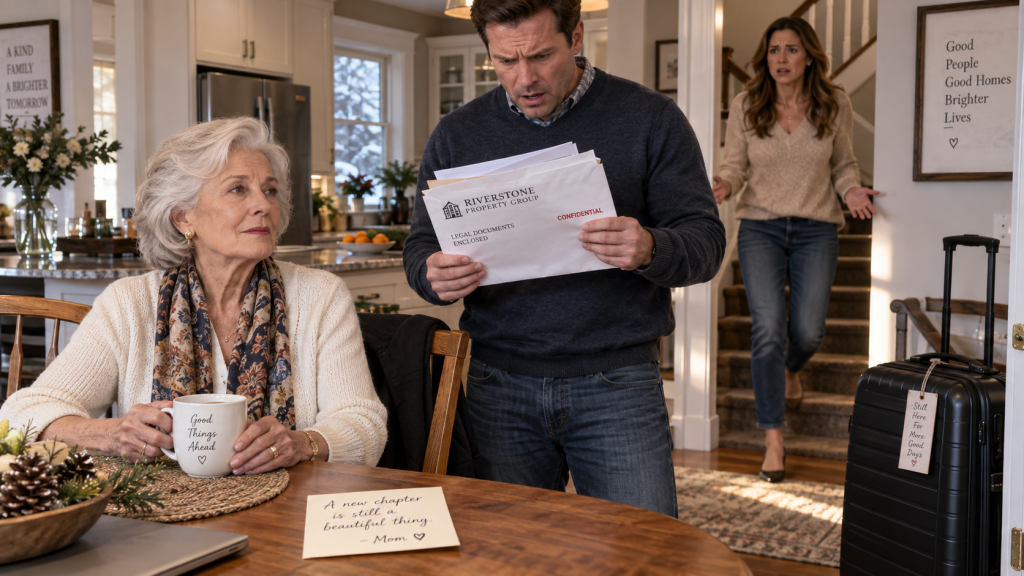
About a minute later, he walked back in holding a thick envelope.
“T&E Property Holdings,” he said under his breath.
He tore it open.
His brow tightened as he read.
“What is this?”
Paige walked down the stairs.
“What’s wrong?
PART 2 — THE HOUSE HE THOUGHT BELONGED TO SOMEONE ELSE
“What is this?”
Graham’s voice was quiet at first.
Not angry.
Confused.
He held the notice in both hands and read the first paragraph again.
Paige came down the stairs tying the belt of her robe.
“What’s wrong?”
Graham did not answer.
He looked toward me.
Then back at the paper.
The kitchen clock clicked loudly above the refrigerator.
8:31.
My taxi would arrive in forty-four minutes.
I took another sip of coffee.
Paige snatched the letter from Graham.
Her eyes moved quickly across the page.
Then stopped.
“What do you mean the tenancy is being terminated?”
Her voice rose.
Graham looked at me again.
“Mom.”
I set my cup down.
“Yes?”
“What is T&E Property Holdings?”
I folded my hands on the table.
“You know what it is.”
“No.”
His voice sharpened.
“I know the name on the company that owns this house.”
“Who owns the company?”
There it was.
The first real question.
I looked at my son.
“I do.”
For several seconds, neither of them moved.
Paige actually laughed.
Not kindly.
The way people laugh when reality sounds too ridiculous to accept.
“No.”
she said.
“You don’t.”
I nodded.
“I do.”
Graham’s face changed slowly.
Not all at once.
First disbelief.
Then calculation.
Then memory.
T&E.
Thomas and Evelyn.
Boxes in our old garage.
Fishing lures.
Catalogs.
Invoices.
The initials he had seen thousands of times as a child.
He whispered:
“Dad.”
“Yes.”
The color drained from his face.
Paige looked between us.
“What is she talking about?”
Graham did not answer.
He walked to the counter.
Placed both hands on it.
Then turned toward me.
“You bought this house?”
“Yes.”
“When?”
“In March.”
He stared.
“We’ve been paying rent to you?”
“Through the company.”
“You let me complain about the landlord to your face.”
I almost smiled.
“You complained about the late-fee policy.”
“That was the property manager.”
“You complained about the landscaping schedule.”
“That was also the property manager.”
“You said the company was greedy.”
“That was you.”
His eyes narrowed.
“You knew.”
“Yes.”
“And you just sat there.”
“Yes.”
I did not apologize.
Not yet.
Paige looked furious now.
“Why would you do something like that?”
“I bought an investment property that was already occupied.”
“No.”
She pointed at me.
“You bought our home.”
“It was never your home in the sense you mean.”
Her face hardened.
“We have lived here for six years.”
“I know.”
“We have raised our children here.”
“I know.”
“And now you’re throwing us out?”
“No.”
Graham looked at the notice.
“It says the tenancy ends.”
“Yes.”
“That means we have to leave.”
“Yes.”
“Mom.”
His voice cracked.
“Then don’t sit there saying you aren’t throwing us out.”
I took a breath.
“You have proper notice.”
“The tenancy is month to month.”
“No one is changing locks today.”
“No one is putting your belongings on the sidewalk.”
“You have time to find another place.”
Paige laughed bitterly.
“How generous.”
I looked at her.
“More generous than January 1.”
The room went silent.
Graham flinched first.
That surprised me.
Paige looked away.
I continued.
“You had already selected a place for me to live.”
“Paid a deposit.”
“Picked the room.”
“Decided the date.”
“And the reason was that Owen wanted my bedroom.”
“That is not the same thing.”
Graham said.
“No.”
I nodded.
“It isn’t.”
“Because this house belongs to me.”
That landed.
Hard.
Paige folded her arms.
“So this is revenge.”
“No.”
“What would you call it?”
“A boundary.”
She laughed again.
“Of course.”
I looked at her.
“I am not selling the house because you hurt my feelings.”
“Then why are you selling it?”
“Because I no longer want to own property tied to a family arrangement that has become unhealthy.”
“That sounds like revenge with better vocabulary.”
Graham closed his eyes.
“Paige.”
She stopped.
Good.
For once, he heard how she sounded too.
I looked at my son.
“Read the rest.”
He stared at me.
Then unfolded the notice again.
The formal letter from Martin was dry.
Professional.
Proper notice of termination under the month-to-month tenancy.
Date by which possession was expected.
Information about security-deposit accounting.
Contact information for the property manager.
No insults.
No family history.
No mention of Pine Harbor.
Then came my handwritten letter.
Graham reached it.
Stopped.
He recognized my writing immediately.
His hands began to shake.
Paige moved closer.
“Read it.”
He did.
Silently.
I watched his eyes.
First line.
Second.
Third.
Then he sat down.
That frightened Paige more than shouting would have.
“What does it say?”
Graham did not answer.
So she took the letter.
I knew every word by heart.
I had rewritten it six times.
Graham,
By the time you read this, I hope you understand that I am not trying to punish you. I am trying to stop disappearing inside the life you built around me.
Paige’s mouth tightened.
She kept reading.
When your father died, you asked me to move in because you said you did not want me alone. I believed you. Over time, I became cook, cleaner, babysitter, grocery buyer, and the person who adjusted whenever everyone else’s schedule changed. None of those things were terrible by themselves. I did many of them willingly. What hurt was realizing that my usefulness had become more important than my presence.
Graham looked down.
I continued watching him.
I had never said those words aloud.
Maybe I should have.
That was part of mine.
Paige kept reading.
I heard you call caring for me a burden. I watched both of you plan my next home without asking what I wanted. I saw the relief on your faces when I agreed to leave. That was when I understood something important: I had been waiting for permission to have a life that was still mine. I no longer need that permission.
Paige stopped.
Her eyes moved toward me.
Then back to the page.
You have time to find another home. The grandchildren will not be left without educational support. I will not discuss money with the children, and I expect you not to involve them in this conflict.
Graham looked up sharply.
That sentence mattered.
He knew me.
He knew if I was writing about educational support, there was more.
Paige knew it too.
Her expression changed.
“Educational support?”
I said nothing.
Not yet.
She finished.
I love you. That has not changed. What has changed is my willingness to prove that love by making myself smaller.
Mom
The kitchen was silent.
Then Paige folded the letter.
Slowly.
“Where are you going?”
I looked toward the hallway.
My suitcase was visible from the table.
“I’m leaving this morning.”
Graham turned.
He saw it.
His face changed again.
“Today?”
“Yes.”
“To where?”
“My home.”
“What home?”
“My cottage.”
Paige stared.
“What cottage?”
“One I bought in June.”
The silence became almost comical.
Almost.
Graham stood.
“You bought another house?”
“Yes.”
“Where?”
“Near Wilmington.”
“Why didn’t you tell me?”
That question hurt.
Not because it was unfair.
Because once, I would have told him first.
I would have called before closing.
Sent photographs.
Asked his opinion about curtains.
I looked at him.
“Because I wanted one thing in my life that existed before somebody else told me what to do with it.”
His face fell.
There.
Not anger.
Pain.
I had hurt him too.
That mattered.
He sat again.
“You planned all of this for months.”
“Yes.”
“And you never said anything.”
“Yes.”
“So how are you different from us?”
There it was.
The question I had been expecting from Martin.
Not legally.
Morally.
I took a breath.
“I’m not completely different.”
Paige looked surprised.
Graham did too.
“I should have told you sooner that I felt used.”
“I should have said something when I heard the kitchen conversation.”
“I should have stopped doing things I resented instead of smiling while I did them.”
My voice softened.
“That part is mine.”
Graham looked at the table.
Then I continued.
“But I did not make decisions about your body, your home, or where you would live before telling you.”
“You still made decisions that affect us.”
“Yes.”
“That is also true.”
No perfect innocence.
I did not need it.
Paige said:
“You could have just moved out.”
“I am.”
“You didn’t need to buy the house.”
“No.”
“Then why did you?”
I thought of Martin asking me the same thing.
At first, the answer had been simple.
Because I could.
Then it had changed.
“The owner wanted to sell.”
“I knew the property.”
“The numbers made sense.”
“And yes…”
I looked at Graham.
“I wanted to know whether I was ready to stop having my financial security depend on whether my son believed I belonged in his house.”
Graham flinched.
“This was never my house either.”
“No.”
“That’s part of the problem.”
He looked confused.
“You were renting.”
“I was living in a room inside a house where everyone began behaving as though they had more right to decide my future than I did.”
“That is what I mean.”
Paige stared at me.
“How did you afford any of this?”
Finally.
The question.
Graham turned toward her.
Then toward me.
The scratch ticket sat like an invisible third person at the table.
I had known this moment would come.
I had even rehearsed answers with Martin.
Truth.
Not every detail.
But enough.
“I came into money.”
Paige’s eyes narrowed.
“What does that mean?”
“It means I have enough to take care of myself.”
“How much?”
I smiled sadly.
“That is not information I’m sharing.”
Her face hardened.
Graham whispered:
“Mom.”
“What?”
“Where did the money come from?”
I looked at him.
Then decided.
“The birthday ticket.”
Silence.
Complete.
Almost holy.
Paige laughed.
Once.
Then stopped.
“The scratch ticket?”
“Yes.”
“The one I gave you?”
“Yes.”
Graham stared.
“No.”
I nodded.
“It won.”
“How much?”
I said nothing.
His eyes widened.
“How much?”
“Enough.”
Paige stood.
“Oh my God.”
She began pacing.
“I gave you that ticket.”
“Yes.”
“And you lied.”
“Yes.”
That word was mine to own too.
I looked at Graham.
“I lied when I said it lost.”
He stared at me like I had become someone else.
Maybe I had.
“How much, Mom?”
he asked again.
I did not answer.
Paige’s mind had already sprinted ahead.
“Millions?”
Her voice sharpened.
“It was one of those tickets with a big jackpot.”
I stayed quiet.
Her eyes widened.
“It was millions.”
Graham looked sick.
Not excited.
Sick.
That mattered.
He whispered:
“You’ve had millions for ten months?”
“Not exactly the advertised number.”
“After taxes and the payment structure—”
He held up one hand.
“Stop.”
Then:
“You sat in our house for ten months with millions of dollars.”
“Yes.”
“Cooking dinner.”
“Yes.”
“Using coupons.”
“Yes.”
“Watching us struggle.”
That word caught me.
“Struggle?”
I asked.
He gestured around.
“Rent.”
“College savings.”
“Everything.”
I looked at him carefully.
“You were paying rent before I won.”
“Yes.”
“You chose this house before I won.”
“Yes.”
“Your income did not decrease because I won.”
“No.”
“Then what exactly changed except your knowledge of my bank account?”
He had no answer.
Paige did.
“If we had known, we could have planned.”
There it was.
We.
Could have planned.
My money.
Their plans.
I almost laughed.
Instead I said:
“That is exactly why I did not tell you.”
Her face went red.
“So you were testing us.”
“No.”
“Yes, you were.”
“You wanted to see whether we’d treat you differently if we thought you were poor.”
I thought about it.
Then answered honestly.
“At first, no.”
“I kept quiet because Martin advised me to protect myself before announcing anything.”
“Later…”
I paused.
“Later, I did pay attention.”
Graham’s face tightened.
“To us.”
“Yes.”
“To how we treated you.”
“Yes.”
He looked hurt.
“That’s a test.”
“Maybe.”
I said.
“But it was not one you knew you were taking.”
“That makes it worse.”
“Maybe.”
Again.
I was not going to defend everything simply because I had money.
Graham stood and walked toward the window.
His back to me.
“You thought I would steal from you.”
“No.”
“Then why the trusts?”
I froze.
Paige turned.
“What trusts?”
Graham faced me.
“You mentioned the kids.”
His voice shook.
“What did you do?”
I sighed.
There it was.
I had wanted to explain this later.
Maybe at the cottage.
Not beside cold coffee.
“I established educational trusts for Owen and Lily.”
Paige’s expression changed instantly.
“How much?”
I ignored her.
“The money is for school and certain education-related expenses.”
“Neither you nor Paige controls it.”
Graham stared.
“You don’t trust us.”
“I trust that money intended for children should remain intended for children.”
“That isn’t an answer.”
“It is mine.”
Paige snapped:
“You think we’d steal from our own children?”
“No.”
“Then why lock us out?”
“Because the trusts are not about punishing you.”
“They are about removing temptation, confusion, and family pressure.”
She scoffed.
“That is unbelievably insulting.”
I looked at her.
“Paige, ten months ago you gave me a two-dollar ticket and joked that maybe I could buy a bus ticket.”
Her mouth closed.
“I am not going to pretend our relationship has always been respectful just because there is money in the room now.”
That landed.
Graham turned back.
“What else?”
I looked at him.
“What do you mean?”
“What else did you change?”
His voice had gone quiet.
“The will?”
There it was.
My son knew me well enough to know the answer before I spoke.
“Yes.”
He laughed bitterly.
“Of course.”
I felt my heart ache.
Not because I regretted it.
Because inheritance carries strange emotional weight.
Even when no one should be planning around a living parent’s death.
“I removed you as financial power of attorney.”
I said.
Graham looked at me.
“I was your power of attorney?”
“Potentially, if I became unable to act.”
His face fell.
He had not known.
“Your father and I arranged it years ago.”
“You were the backup.”
“I changed it.”
“To who?”
“Martin and a professional fiduciary arrangement for finances.”
“And medical?”
“My sister Ruth first.”
“Then you, depending on the circumstances outlined.”
He stared.
“You trust Aunt Ruth more than me?”
The question hurt because there was no answer that would not.
I chose truth.
“Right now, I trust her more to ask what I want before deciding.”
Graham looked away.
The doorbell rang.
8:58.
Not my taxi yet.
The property manager.
Martin had arranged for him to document delivery and answer tenancy questions if needed.
I almost laughed at the timing.
Graham did not.
He looked at the clock.
“Are you really leaving in seventeen minutes?”
“Yes.”
Paige stared at me.
“You can’t just walk out after dropping all of this on us.”
The irony almost defeated me.
I stood.
“I can.”
She opened her mouth.
I continued.
“And I am not walking out on children who depend on me.”
“You are their parents.”
“I am their grandmother.”
“I love them.”
“I will see them.”
“I hope they visit my cottage.”
“But I am not their unpaid childcare plan.”
Silence.
That sentence had needed saying four years earlier.
Better late than never.
Graham looked at me.
“What do we tell the kids?”
“The truth.”
His eyebrows rose.
I clarified.
“Age-appropriate truth.”
“Grandma bought a home near Aunt Ruth.”
“She is moving.”
“The family will be finding another house because the landlord is selling this one.”
“No lottery details unless you and I agree on what to tell them later.”
“No telling them Grandma evicted you because she’s angry.”
Paige crossed her arms.
“And if that’s how we feel?”
“Then tell a therapist.”
I said.
“Not the children.”
Graham almost smiled.
Almost.
My taxi arrived at 9:13.
Two minutes early.
My suitcase waited by the door.
For a moment, nobody moved.
Then Graham walked toward it.
“I’ll carry it.”
I looked at him.
He looked exhausted.
Older.
Still my son.
“Thank you.”
He picked it up.
That simple gesture nearly broke me.
We walked outside.
The morning was cold.
The taxi driver opened the trunk.
Graham placed my suitcase inside.
Then stood beside me.
Paige remained in the doorway.
Arms crossed.
Bare feet against the threshold.
I wondered if she would say goodbye.
She did not.
That was all right.
Some relationships need silence before they can find a better language.
Graham whispered:
“Were you ever going to tell me?”
“Yes.”
“When?”
“When I felt confident you could hear the news without immediately turning it into a plan.”
His face crumpled.
“Mom.”
I touched his cheek.
Old habit.
He did not pull away.
“You are not a bad son.”
I said.
Tears filled his eyes.
“You don’t get to say that after all this.”
“Yes.”
“I do.”
“Because this is not a punishment story.”
“You became careless with me.”
“That is different from being incapable of becoming better.”
He started crying.
That made me cry too.
“I thought you needed us.”
he whispered.
“I did.”
“Then why didn’t you tell me things had gotten this bad?”
Because I was proud.
Because I was hurt.
Because I wanted him to notice without being told.
Because part of me had spent seventy-three years believing a good mother should never make her children feel guilty.
So I answered:
“I should have.”
His face tightened.
“But you should have looked.”
He nodded.
Both true.
Then he asked:
“Do you still love me?”
I almost laughed.
“What a ridiculous question.”
“Mom.”
“Yes.”
I took his hand.
“I love you.”
“Money does not change that.”
“Houses do not change that.”
“What changes is what I will allow while loving you.”
His eyes closed.
That was the boundary.
Finally spoken.
I got into the taxi.
Graham stepped back.
As we pulled away, I looked through the rear window.
My son stood in the driveway.
The house behind him.
The home he believed some faceless investment company owned.
The home I had quietly purchased and now quietly chosen to leave.
He looked smaller from a distance.
Not defeated.
Just human.
For the first time in years, I did not feel responsible for immediately fixing whatever he felt.
That frightened me.
Then freed me.
The cottage near Wilmington was even prettier than I remembered.
Ruth stood on the porch holding flowers.
Yellow roses.
“Too obvious?”
she asked.
I laughed.
“Yes.”
Then hugged her.
The house smelled like fresh paint and lemon cleaner.
My blue sofa waited by the window.
The oak table stood beneath a pendant light.
My reading chair faced the rose bushes.
Nothing belonged to anyone else.
No pile of laundry waiting for me.
No dinner expected.
No child calling from upstairs.
No sigh because I had forgotten to buy almond milk.
Just quiet.
I stood in the middle of the yellow kitchen and cried.
Ruth let me.
Then she made coffee in the wrong cabinet because neither of us remembered where I had stored anything.
It was perfect.
Graham called that night.
I almost did not answer.
Then did.
“Hi.”
“Hi.”
He was quiet.
Then:
“Paige is furious.”
“I assumed.”
“I’m furious too.”
“I assumed that too.”
He sighed.
“But I read your letter again.”
I waited.
“I didn’t realize you heard us that night.”
“In the kitchen?”
“Yes.”
“I did.”
He was silent.
Then:
“I’m sorry.”
The words came slowly.
“I should never have made being my mother sound like something I had to endure.”
My throat tightened.
“You were frustrated.”
“That doesn’t make it okay.”
No.
It did not.
I let him own it.
Then he said:
“Paige thinks you planned this whole thing to humiliate us.”
“I didn’t.”
“I know.”
That surprised me.
“You do?”
“I think…”
He stopped.
“I think maybe you planned it so you wouldn’t have to ask us for permission.”
There.
My son still knew me somewhere beneath all the resentment.
“Yes.”
I whispered.
“That is closer.”
The family found another rental before the notice period ended.
Not as large.
Different school district unless they drove the children.
They chose to drive.
I did not interfere.
The property manager handled the final inspection.
Security deposit deductions were ordinary.
A damaged closet door.
Carpet cleaning.
No theatrical penalties.
The house went on the market.
Sold three months later.
I made a reasonable profit.
Nothing magical.
Just real estate.
I closed T&E Property Holdings afterward.
Martin asked whether I wanted to keep the company for future investments.
“No.”
I said.
“It did what I needed.”
“What was that?”
I thought.
“Helped me understand I could own something without asking my son whether it was convenient.”
Martin smiled.
“Expensive lesson.”
“I’ve had worse birthdays.”
The grandchildren learned about the lottery much later.
Not the amount.
Just that Grandma had won money and used some to create education funds.
Owen’s first response was:
“You won from Mom’s joke ticket?”
Children are merciless.
“Yes.”
He laughed for five minutes.
Paige did not.
Still, over time, even she softened.
Not quickly.
Not completely.
She apologized first for the birthday joke.
Then, months later, for the senior-living plan.
Her apology was not perfect.
She said:
“We genuinely thought Pine Harbor would be easier.”
I answered:
“For whom?”
She looked down.
Then:
“For us.”
There.
Honesty.
That was enough for that day.
Graham’s apology took longer.
Real ones often do.
A year after I moved, he visited the cottage alone.
He stood in the yellow kitchen looking around.
“This is nice.”
“I know.”
“Smaller.”
“Yes.”
“You like it?”
“I love it.”
He looked almost offended by how much I meant that.
Then he sat at my oak table.
For a while, neither of us spoke.
Finally he said:
“I think I was angry because I thought your money meant you had never needed me.”
That sentence surprised me.
I sat across from him.
“I needed you very much.”
“Then why didn’t you tell me?”
“Because needing you was not the same thing as needing you to run my life.”
He stared at his hands.
He told me something I had not understood.
When Thomas died, Graham had been terrified too.
Terrified I would decline.
Fall.
Get sick alone.
He asked me to move in partly because he loved me.
Then responsibilities accumulated.
Children.
Work.
Marriage.
My grief.
His.
The arrangement became harder.
Instead of changing it honestly, he became resentful.
Then ashamed of being resentful.
Then quieter.
Paige became the person willing to say out loud what he felt.
“Your mother is becoming a problem.”
And Graham, rather than defend me, answered from exhaustion.
“What do you expect me to do?”
Not because he hated me.
Because he had begun seeing my life as something he had to solve.
That was his mistake.
Mine was letting him.
“I’m sorry.”
he said.
Not for Pine Harbor alone.
Not for laughing at the scratch ticket.
“For deciding what was best for you because asking felt harder.”
That was the sentence I needed.
I reached across the table.
Took his hand.
“Thank you.”
He looked up.
“Do I get to know how much you won now?”
I laughed.
“No.”
He laughed too.
Progress.
The educational trusts remained.
So did my revised estate plan.
Forgiveness did not mean returning every control to where it had been.
That would have taught the wrong lesson.
Graham stopped asking.
Eventually, I volunteered more information.
Not all.
Enough.
Transparency chosen freely feels very different from surrender.
I never moved into Pine Harbor.
I did visit once.
Curiosity.
The lobby was lovely.
The people seemed happy.
Activities board.
Shuttle service.
Good coffee.
There was nothing wrong with the place.
That mattered.
The injury had never been senior living.
It had been being assigned a future before anyone asked whether I wanted it.
I toured the gardens.
Bought a muffin.
Then drove back to my yellow cottage.
Choice transformed everything.
On my seventy-fifth birthday, Graham arrived with a card.
Inside was a scratch-off ticket.
Two dollars.
I stared at him.
He started laughing.
I laughed too.
Paige covered her face.
“Absolutely not.”
Owen and Lily cheered.
I scratched it at the kitchen table.
Everyone watched.
I won four dollars.
Graham said:
“Don’t hide it from us.”
I said:
“I’m calling Martin immediately.”
Even Paige laughed.
That may have been the moment I knew our family had survived.
Not returned to what it was.
Something better.
More honest.
Less comfortable in the right ways.
But the thing I remember most is still that first morning.
The courier.
The envelope.
My son reading.
His face when he realized his seventy-three-year-old mother had been building a life he knew nothing about.
For years, Graham thought he knew me because he knew what I needed.
Medication reminders.
A bedroom downstairs.
Someone to drive me if my eyes got worse.
He knew my vulnerabilities.
That is not the same as knowing a person.
I had forgotten that too.
I had reduced myself to mother.
Grandmother.
Widow.
Helper.
The woman folding towels.
Then a cheap scratch ticket changed my bank balance.
But the money did not change me as much as everyone assumed.
What it gave me was something quieter.
Options.
And once I had options, I discovered how many choices I had been calling obligations.
I did not win freedom for eleven million dollars.
Freedom is not sold at gas stations.
The ticket simply made it harder for me to pretend I had nowhere else to go.
The real change happened when my son slid that senior-living brochure across the table and I realized everyone in the room had already decided what the rest of my life should look like.
That was the moment I finally decided too.
Not against them.
For myself.
There is a difference.
My name is Evelyn Mercer.
I am a mother.
A grandmother.
A widow.
A woman with more money than anyone in my family expected.
But before all of those things, I am still a person whose life belongs to her.
At seventy-three, that should not have been a revelation.
It was.
And when Graham finished reading that letter and looked at me as though he had never truly known his own mother, maybe he was right.
Maybe he hadn’t.
Maybe I hadn’t either.
Not yet.
But I was about to.
PART 3 — THE LIFE I REFUSED TO LEAVE EARLY
For the first three weeks after I moved into the yellow cottage, I woke up too early.
Not because I slept badly.
Because for nearly four years, my body had learned to wake before everyone else.
Coffee.
Lunches.
School bags.
Laundry moved from washer to dryer before Paige came downstairs.
Breakfast started before Graham left for work.
At 5:47 every morning, my eyes still opened.
And every morning, I lay in bed for a few seconds waiting to remember what somebody needed from me.
Then I would hear nothing.
No footsteps upstairs.
No cupboard doors.
No grandchild shouting because a shoe had vanished.
No Paige asking whether I had seen her dry-cleaning receipt.
No Graham calling:
“Mom, are you awake?”
Only birds.
The refrigerator humming.
Wind moving through the rose bushes beside my porch.
At first, the quiet frightened me.
Then I realized something.
Nobody needed me before breakfast.
And I was still alive.
That sounds obvious.
At seventy-three, it was not.
For most of my life, usefulness had been the language I understood best.
When Thomas was alive, we took care of each other.
When Graham was little, motherhood filled every corner.
Then came grandchildren.
Meals.
Errands.
School pickups.
Appointments.
I rarely asked whether I enjoyed being useful because usefulness felt like proof that I belonged.
The cottage forced me to meet myself without a task list.
I was not immediately impressed.
The first Monday, I cleaned the entire kitchen twice.
The second Tuesday, I reorganized my linen closet.
Ruth came over, opened it, and stared.
“You folded your hand towels by color.”
“Yes.”
“You need hobbies.”
“I have hobbies.”
“Coupon clipping is not a hobby.”
“It saves money.”
“You have several million dollars.”
“Waste is still waste.”
She looked at me.
Then laughed.
Some habits survive wealth.
Good.
I did not want money to erase Thomas from me completely.
I started walking every morning instead.
Not far.
Around the block.
Then two blocks.
Eventually to a little café near the river.
The waitress learned my name.
Not Mrs. Mercer.
Evelyn.
I liked that more than I expected.
I joined a book club at the library.
The first novel was terrible.
I said so.
Everyone stared.
Then a woman named Joan laughed and said:
“Thank God. I thought I was the only one.”
I made friends.
Not family friends.
Not Graham’s neighbors.
Not women who knew me first as somebody’s mother.
Mine.
That felt indecently luxurious.
The money remained mostly quiet.
Martin invested conservatively.
I did not buy a sports car.
I did not start wearing diamonds to breakfast.
I did replace my old mattress.
That was the most satisfying purchase of the entire fortune.
Thomas and I had owned the previous one for sixteen years because he believed a mattress was “still good if springs aren’t coming through.”
The first night on the new one, I called Ruth.
“This is obscene.”
“What?”
“I paid three thousand dollars to sleep.”
“Do you like it?”
“I may never stand again.”
“Then it was worth it.”
Maybe wealth is partly the ability to stop negotiating with your spine.
Graham called every Sunday.
At first, the calls were stiff.
“How are you?”
“Fine.”
“How are the kids?”
“Fine.”
“Found a new house?”
“Yes.”
Then silence.
He was angry.
I was hurt.
Neither of us knew how to speak without returning to the letter.
So we discussed weather.
School.
Gas prices.
The absurd cost of eggs.
Ordinary conversation became a bridge we crossed carefully.
Paige did not call.
That was all right.
I was not ready to hear her anyway.
Owen called separately.
He was twelve then.
Old enough to understand that something had changed.
Young enough that nobody had given him details.
“Grandma?”
“Yes?”
“Did Mom and Dad make you leave?”
My chest tightened.
“No.”
“Then why did you move so fast?”
Children notice timing adults think they can disguise.
I thought carefully.
“Because I realized I wanted my own home.”
“Did they know?”
“Not until I was ready.”
He was quiet.
Then:
“Dad says you were unhappy.”
“He’s right.”
“Were you unhappy because of us?”
“No.”
Immediate.
“Never because of you or Lily.”
“Promise?”
“Promise.”
There are promises I do not hesitate over.
Then he asked:
“Can we come over?”
I almost cried.
“Of course.”
“When?”
“Ask your parents what works.”
He sighed.
“Why do grown-ups make everything scheduling?”
“Because otherwise children take over civilization.”
“That would be better.”
Possibly.
Their first visit happened two Saturdays later.
Graham drove them.
Paige did not come.
He stood on my porch while Owen and Lily raced inside.
He looked around.
Rose bushes.
Blue sofa visible through the window.
Wind chimes Ruth had given me.
“You really like it here.”
“Yes.”
He sounded surprised.
That stung.
Did he think I had left only to make a point?
Maybe.
He handed me the children’s overnight bags.
“Pickup tomorrow at four?”
“Fine.”
Then he hesitated.
“Do you need anything?”
Old question.
Different meaning now.
I smiled.
“No.”
He nodded.
For once, neither of us confused that with rejection.
The grandchildren loved the cottage.
Not because it was nicer.
It was not.
Their old house had four bedrooms, a media room, and a backyard large enough for a trampoline.
My cottage had two bedrooms.
When they stayed, Lily slept in my guest room and Owen complained about the pullout sofa.
But it felt different.
No one arrived expecting beds made by magic.
I made Owen help prepare dinner.
Lily set the table.
They both complained.
I ignored them.
At Graham’s house, I had made being Grandma indistinguishable from service.
At mine, Grandma owned the dishwasher and had rules.
This shocked them.
Good.
One evening, Lily asked:
“Are you rich now?”
She was nine.
I nearly dropped a plate.
“Why do you ask?”
“Mom and Dad were talking.”
Of course.
“What did they say?”
“That you have a lot of money.”
I dried my hands slowly.
“Adults sometimes discuss things children don’t need to worry about.”
“That means yes.”
Sharp child.
I sat beside her.
“I have enough to take care of myself.”
“How much?”
I laughed.
“Nice try.”
“Dad asked too?”
“Yes.”
“And you didn’t tell him?”
“No.”
Her eyes widened.
“Can moms do that?”
That question stopped me.
“Yes.”
I said.
“Mothers are allowed to have private information.”
She thought.
“Even from their kids?”
“Especially grown ones sometimes.”
She nodded.
Then returned to coloring.
A revolution in six sentences.
Paige finally called in February.
Nearly three months after I moved.
“Evelyn.”
“Hello, Paige.”
Silence.
Then:
“I think we need to talk.”
I almost said:
Do we?
Instead:
“Okay.”
She exhaled.
“I was angry.”
“I know.”
“I still am, actually.”
“Okay.”
That annoyed her.
I could hear it.
“You secretly bought our house.”
“The house you rented.”
“You know what I mean.”
“Yes.”
“And then you terminated the lease after we suggested Pine Harbor.”
“Yes.”
She paused.
“I still think that was retaliatory.”
I thought carefully.
“Partly, perhaps.”
Silence.
She had not expected agreement.
“I was hurt.”
I continued.
“And hurt influenced the timing.”
“I’m not going to pretend otherwise.”
“But I had already begun separating my future from your household before Pine Harbor.”
“I bought my cottage months earlier.”
“I had been considering selling the rental before you gave me the brochure.”
“That night made me stop delaying.”
Paige was quiet.
Then:
“That’s more honest than you were before.”
The sentence irritated me.
Then I realized she was right.
My Part 2 self, as Ruth jokingly called the first months after winning, had become very good at secrecy.
Some necessary.
Some satisfying.
Not all healthy.
“Yes.”
I said.
“It is.”
Paige sighed.
“I shouldn’t have joked about the bus ticket.”
“No.”
“I shouldn’t have complained about you living with us while still letting you cook, clean, and help with the kids.”
“No.”
Her voice tightened.
“You could say something besides no.”
“I could.”
She almost laughed.
Almost.
Then:
“I really did think Pine Harbor might be good.”
“I know.”
“And I also wanted the room.”
“I know.”
“And I liked the idea of not having another adult in the house.”
There.
Finally.
Not concern dressed as charity.
Truth.
I felt something unclench.
“Thank you.”
She sounded confused.
“For what?”
“For saying the whole thing.”
Then Paige said:
“I don’t think I treated you like a person.”
The words sat between us.
I did not rush to soften them.
She continued.
“I treated you like…”
She stopped.
“A resource?”
I offered.
She exhaled.
“Yes.”
“That’s what it felt like.”
“I’m sorry.”
I believed her.
Not completely.
Belief also needed time.
But enough to continue.
By spring, she started coming with Graham when they dropped off the children.
At first, she stayed on the porch.
Then one day, rain started.
I said:
“You can come inside, Paige.”
She looked embarrassed.
“I didn’t know if you wanted me to.”
Interesting.
Once, she had walked into my bedroom without knocking when she needed my steamer.
Now she waited at the door.
Boundaries teach quickly when everyone finally understands they exist.
She came in.
I made coffee.
We talked about Lily’s grades.
Nothing profound.
Sometimes reconciliation enters through a cup placed on a table without history attached.
The lottery money created new problems too.
People found out.
Not the whole amount.
Enough.
A cousin called about a business idea.
A church acquaintance mentioned her son’s medical bills.
Someone I barely remembered from Thomas’s fishing days messaged me about an “investment opportunity.”
Money changes the acoustics around relationships.
Suddenly, every request sounds suspicious even when it may be sincere.
I hated becoming that person.
Martin helped.
“Decide what generosity means before people ask.”
So I did.
I created an annual charitable budget.
I gave to the library.
A local food bank.
A scholarship program for nursing students because my mother had once wanted to become a nurse but could not afford school.
Not every sad story became my responsibility.
That was new.
Money did not obligate me to solve every problem simply because I could.
Neither did motherhood.
Same lesson.
Different numbers.
Graham struggled with that most.
Not because he kept asking for cash.
He did not.
Almost stubbornly.
When their car transmission failed, I heard about it from Owen, not Graham.
I called.
“Do you need help?”
“No.”
“Are you sure?”
“Yes.”
They financed the repair.
Part of me felt rejected.
Then I laughed at myself.
For months I had begged everyone to stop assuming access to my money.
Now I was offended my son respected the boundary.
Human beings are ridiculous.
Eventually, Graham admitted why.
We were sitting on my porch one afternoon.
He said:
“I don’t want you wondering whether every call is about money.”
My heart hurt.
“I don’t.”
“You might.”
“Sometimes.”
He nodded.
“I would.”
Fair.
Then:
“So if I need something, I’ll ask.”
“Good.”
“And if you say no?”
“I may.”
He smiled faintly.
“That’s the part I’m still practicing.”
“Me too.”
The first real test came when Owen was accepted into an expensive summer engineering program.
The educational trust could cover it.
Graham asked.
Properly.
Not:
You have millions.
Not:
It’s for your grandson.
He brought me the information.
Cost.
Curriculum.
Dates.
Then said:
“Would this qualify under the trust?”
I almost cried.
Not because of the program.
Because he had finally stopped treating family love and financial permission as the same thing.
Martin confirmed it qualified.
The trustee approved payment directly to the program.
No money passed through Graham.
He did not complain.
That was when I began trusting the new version of us.
Two years after I moved, I had a health scare.
Nothing dramatic in the end.
But dramatic enough at first.
I woke one morning dizzy and unable to stand without holding the wall.
Ruth found me because we were supposed to meet for breakfast.
She took me to the emergency room.
Dehydration and an inner-ear problem.
Treatable.
Still, for several hours, doctors worried about stroke.
I called Graham.
He arrived before Martin could.
That surprised me.
He sat beside my bed.
No brochures.
No decisions made in hallways.
When the doctor explained discharge instructions, Graham started asking questions.
Then stopped.
Looked at me.
“Do you want me to handle this?”
My throat tightened.
I smiled.
“No.”
“Okay.”
He sat back.
That one word told me more than any apology.
Later, in the parking lot, he asked:
“Do you want to stay with us tonight?”
The old offer.
Same words.
Different meaning.
“I’ll stay with Ruth.”
He nodded.
“No argument?”
“No.”
I laughed.
He smiled.
Then:
“Call if you change your mind.”
There.
Support.
Not control.
So simple once you see the difference.
That health scare made me revisit my estate plan.
Not because I thought I was dying.
Because I realized wealth required clarity after death too.
Martin and I reviewed everything.
Grandchildren’s education trusts.
Charitable gifts.
My cottage.
Personal items.
Graham would inherit something.
So would Ruth.
So would the grandchildren later.
But Graham would not inherit control.
That distinction mattered.
I wrote letters.
Not legal instructions.
Personal ones.
One to each grandchild.
One to Graham.
One to Paige.
Martin asked:
“Do you want Graham to know now what he may inherit?”
“No.”
“Why?”
“Because I want whatever relationship we have left to belong to the living.”
He smiled.
“Good answer.”
It felt like one.
I also changed one thing.
I made Graham co-agent for certain medical decisions with Ruth, but only under a structure requiring clear consultation and honoring my written wishes.
Years earlier, I had removed him entirely because I did not trust him to ask.
Now I believed he had learned.
Not perfectly.
Enough.
When I told him, he cried.
I had not expected that.
“Mom.”
“What?”
“You didn’t have to.”
“I know.”
That was why it mattered.
He asked:
“Is this forgiveness?”
I thought.
“Partly.”
“What’s the rest?”
“Evidence.”
He laughed through tears.
I had spent my whole life believing trust was a feeling.
At seventy-five, I learned it was also a record.
Repeated behavior.
Small moments.
Questions asked.
Nos accepted.
Promises kept without applause.
Trust is what remains after enough ordinary days agree with the apology.
Paige changed too.
Not into a different species.
She still liked control.
Still over-scheduled Christmas.
Still complained that my pie crust made hers look bad.
But she learned to ask.
“Are you available to watch Lily Friday?”
Instead of:
“We’ll drop Lily at six.”
That sentence alone improved our relationship more than all the money in my accounts.
Sometimes I said yes.
Sometimes no.
The first time I said no without explanation, Paige paused.
Then:
“Okay.”
I nearly applauded.
Didn’t.
Growth should not always become theater.
The children became teenagers.
Then young adults.
Their educational trusts paid for college expenses according to the terms.
Not luxury cars.
Not spring-break villas.
Tuition.
Books.
Housing within limits.
Owen once complained because the trust would not pay for a new gaming computer.
I said:
“Tragic.”
“But it’s educational.”
“You play zombies.”
“Strategic reasoning.”
“Ask the trustee.”
He did.
The trustee said no.
I bought him socks for Christmas.
He survived.
Lily eventually discovered the full lottery story when she was old enough.
Paige told her by accident during an argument about money.
Lily called me furious.
Not at me.
At her parents.
“Grandma, Mom said they tried to put you in a home after you won millions!”
I sighed.
“Not exactly.”
“She said—”
“Come over.”
Some stories should not be repaired over a phone.
At my kitchen table, I told Lily everything in simpler language.
The scratch ticket.
The secrecy.
The house.
Pine Harbor.
My hurt.
My own mistakes.
She listened.
Then said:
“So Mom and Dad were terrible.”
“No.”
“They behaved badly.”
“That is different.”
She frowned.
“Why are you defending them?”
“I’m not.”
I touched her hand.
“I’m refusing to turn one chapter into their entire character.”
That mattered.
I did not want my grandchildren inheriting our conflict as family scripture.
Their parents had failed me.
They had also learned.
Both true.
Lily asked:
“Did you buy their house just so you could kick them out later?”
“No.”
“Would you have kept renting it to them if they hadn’t shown you Pine Harbor?”
I thought.
Maybe.
For a while.
That was honest.
“So it was revenge.”
“Some anger was involved.”
She smiled.
“Grandma.”
“What?”
“That means yes.”
I laughed.
“Fine.”
Then:
“But revenge would have been changing the locks overnight or raising rent to punish them.”
“I gave proper notice.”
“I sold because I wanted out of the financial relationship.”
“You can be angry and still make a lawful, reasonable decision.”
She considered that.
“Adults are annoyingly complicated.”
“Wait until taxes.”
She groaned.
Conversation over.
At seventy-eight, I took my first solo trip.
Italy.
Thomas had always wanted to go.
We never did.
Money.
Work.
Timing.
Life.
I carried his old watch in my suitcase.
Not because I believed he was somehow traveling with me.
Because I wanted one thing of his nearby when I saw Florence.
I stood inside a church older than every argument our family had ever had and cried.
Then I ate gelato twice in one day.
Thomas would have approved of one of those things.
Possibly both.
I sent Graham a photograph from Rome.
He replied:
Who are you and what have you done with my mother?
I wrote:
Your mother finally got a passport stamp.
Then he answered:
Dad would’ve loved this.
I sat on a bench and cried again.
Not all tears are damage.
Some are the body making room for a life that arrived late.
The yellow cottage changed over the years.
Rose bushes grew wild.
I replaced the blue sofa after Ruth spilled red wine on it and denied everything despite being the only other person in the room.
I painted the kitchen pale green.
The yellow was cheerful.
Eventually too cheerful.
I hosted Thanksgiving twice.
Then declared the second one my last because cooking for fourteen people reminded me too much of my old life.
Now we rotated.
Graham hosted.
Paige hosted.
Sometimes Ruth.
Shared responsibility.
Imagine that.
On my eightieth birthday, everyone came to the cottage.
Graham.
Paige.
Owen.
Lily.
Ruth.
Friends from my book club.
Martin even stopped by with a bottle of champagne and strict instructions not to discuss trusts.
There was cake.
Store-bought.
My demand.
I had baked enough birthday cakes for myself.
After dinner, Graham stood.
I groaned.
“No speeches.”
“Too late.”
He held up a small envelope.
“Mom, eight years ago, Paige gave you a scratch ticket.”
Paige covered her face.
“Why are we revisiting this?”
Everyone laughed.
Graham continued.
“And somehow that two-dollar ticket exposed every terrible thing about our family.”
“Not every thing.”
I said.
“Thank you, Mom.”
He smiled.
Then handed me the envelope.
Another scratch ticket.
Two dollars.
Price sticker still attached.
Of course.
I scratched it at the table.
Everyone watched.
Nothing.
Not even four dollars.
I looked at Paige.
“Cheap gift.”
She laughed so hard she cried.
I did too.
That mattered more than winning again ever could have.
The original joke had once made me feel small.
Years later, we could touch the same memory without reenacting the cruelty.
That is one form of healing.
Not forgetting.
Changing what the memory is allowed to do.
After everyone left, Graham stayed behind.
He helped me stack dishes.
I said:
“Leave them.”
He looked alarmed.
“You?”
“Yes.”
“Are you sick?”
“Go home.”
He laughed.
Then saw Thomas’s photograph on the shelf.
“Do you think Dad would be angry with me?”
The question surprised me.
“For what?”
“For how I treated you.”
I looked at my son.
He was older now.
Gray at his temples.
No longer the tired middle-aged man who sat at a table and told me Pine Harbor was the best choice.
Still carrying that version of himself somewhere.
“Your father loved you.”
“That’s not an answer.”
“No.”
I smiled.
“He would have told you that you were being an ass.”
Graham laughed.
Thomas would have used stronger language.
Then I became serious.
“He also would have expected you to learn.”
Graham nodded.
“I hope I did.”
“So do I.”
He looked offended.
“Mom.”
“What?”
“I’m eighty.”
“No.”
“I’m eighty.”
“You’re still my child.”
Some truths survive every boundary.
He hugged me before leaving.
At the door, he turned.
“Do you regret not telling me about the ticket right away?”
I thought for a long moment.
“Yes.”
That surprised him.
“Really?”
“Yes.”
“Not because I think I owed you the amount.”
“I didn’t.”
“But secrecy changed me too.”
He listened.
“I became suspicious.”
“Watchful.”
“I started treating every kindness like evidence.”
“That isn’t how I want to live.”
Graham looked down.
“So you think you should have told us?”
“Eventually.”
“Sooner than I did.”
“But I also think I needed time to protect myself before everyone else’s plans arrived.”
Both things could be true.
At eighty, I had stopped demanding cleaner answers.
He asked:
“If you had told us, do you think we would’ve treated you differently?”
“Yes.”
“Better?”
I looked at him.
“More carefully.”
He nodded.
Not the same thing.
He understood.
That may have been the most honest moment we ever had about the money.
The lottery changed many practical things.
It paid for security.
Travel.
Education.
Healthcare.
Comfort.
But the most valuable thing it bought was not the cottage.
Not investments.
Not even freedom from worrying about long-term care.
It gave me room to discover which relationships survived once people could no longer confuse my dependence with love.
Some changed.
Some ended.
Some became better.
And some, like the one with my son, had to be rebuilt after both of us admitted uncomfortable truths.
He had treated my life like a responsibility he could arrange.
I had treated my hurt like a test he should somehow notice without being told.
Neither was love at its best.
I am old enough now to know that family is not proven by how much access we give one another.
Not to houses.
Not to money.
Not to time.
Not to decisions.
Love without boundaries becomes entitlement surprisingly quickly.
And boundaries without honesty can become punishment.
I learned both sides.
That may be the real ending.
Not that I won millions.
Not that my son lost his rental house.
Not that Paige’s two-dollar joke returned to embarrass her.
The ending is that eventually we stopped keeping score.
The educational trusts did what they were meant to do.
Owen graduated.
Lily did too.
Graham rebuilt his savings.
Paige changed jobs and became happier.
Ruth remained impossible.
Martin retired before I could.
The cottage mortgage never existed.
The rose bushes survived every winter.
And I grew older in a home where nobody had chosen the room for me.
That mattered every single morning.
Sometimes people ask whether I ever considered moving into senior living eventually.
The answer is yes.
Of course.
Independence is not pretending bodies never change.
At eighty-two, stairs tire me more.
Driving at night became unpleasant.
So I toured several communities myself.
Including Pine Harbor.
Yes.
That Pine Harbor.
The woman showing me around had no idea why I started laughing in the lobby.
I told her nothing.
I liked the gardens.
The dining room was better than I expected.
The apartments were bright.
I went home.
Thought about it.
Talked to Ruth.
Talked to Graham.
Asked questions.
Then chose somewhere else when I was ready.
That was the difference.
Not where I lived.
Who decided.
When I eventually moved, Graham helped carry boxes.
He did not choose the apartment.
Did not sign anything for me.
Did not ask whether I was sure seventeen times.
He carried the lamp.
Put it where I pointed.
Then said:
“Anything else?”
I looked around.
“No.”
He smiled.
“Okay.”
All those years.
All that money.
All that hurt.
And somehow our family’s greatest achievement became learning how to say okay when someone else chose differently.
I kept the yellow cottage and rented it for a while.
Then sold it.
On my terms.
The proceeds went back into my estate.
No secret company.
No lesson.
Just a sale.
Before closing, I stood in the kitchen one last time.
The walls were pale green by then.
My oak table was already gone.
The reading chair too.
I touched the counter where I had once stood on my first morning and cried because no one needed breakfast.
That woman felt both distant and close.
I wanted to tell her:
You were not disappearing.
You were arriving.
The scratch ticket itself is gone.
Martin kept a copy in the original claim file.
I never framed it.
I never needed to.
Winning was an event.
Choosing became the life.
And if anyone remembers me after I am gone, I hope they do not tell the story as:
Evelyn won millions and taught her greedy family a lesson.
That would be easier.
Less true.
I would rather they say:
Evelyn spent too many years believing love required usefulness.
Then, very late in life, she discovered she was allowed to be loved without earning her chair at the table.
She learned to say no.
Then learned to say yes without fear.
She bought a cottage.
She traveled.
She forgave slowly.
She kept boundaries.
She let people change.
She changed too.
And when her son finally learned to ask what she wanted instead of deciding what was best, she let that count.
Because consequences matter.
But so does growth.
For my seventy-third birthday, my daughter-in-law gave me a two-dollar scratch ticket and laughed that perhaps I would win enough for a bus ride.
She could not have known how right she was.
The ticket did buy me transportation.
Not a bus.
Something better.
A way out of a life I had allowed to become too small.
But money only opened the door.
I still had to walk through it.
And after spending decades taking care of everyone else, the strangest thing I ever learned was that choosing myself did not require abandoning the people I loved.
It simply required accepting that I was one of them.
THE END STORIES! THANK YOU FOR READING GOOD LUCK !❤️
Related Posts