PART 1
I opened the cage in her mother’s backyard and found my little girl inside—then she grabbed my shirt and begged me not to look at the pool
The backyard smelled like rust, sour chlorine, and wet leaves baking under a hard Sunday sun. Beyond the fence, a lawn mower coughed, stopped, then started again, as if the whole neighborhood had agreed to pretend this was an ordinary afternoon.
The chain across Sarah’s gate was hot against my palm. When it scraped the metal post, the sound went straight through my teeth.
Every excuse I had made for months died right there.
My name is Michael Carter. After the divorce, our ten-year-old daughter, Emily, split her time between my house and the suburban home Sarah and I had once bought together. Sundays were supposed to end with Emily climbing into my SUV carrying her backpack, a library book, and some breathless story about recess.
Lately, Sundays had changed.
Emily started asking to sit in my driveway for a few extra minutes before I took her back. She rubbed her thumb over the seat belt until the skin around her nail turned red. Whenever Jason’s name came up, she went quiet in a way no ten-year-old should know how to do.
I asked Sarah twice what was happening. Both times, she said I was trying to turn Emily against her new husband. Jason was strict, she insisted, not cruel. I was jealous. I was trying to play the hero after losing the house.
For longer than I want to admit, I believed her because believing her was easier than admitting I might be returning my daughter to a place where she was learning how to survive.
At 8:12 Friday morning, the school office marked Emily absent.
Sarah did not answer my text.
By 6:47 that evening, Emily’s phone went straight to voicemail. I requested a welfare check and wrote the incident number on the back of a gas receipt because my hands were shaking too badly to trust the notes app.
Saturday passed without a call, a picture, or even a careless excuse. By Sunday afternoon, three full days had passed since I had heard my daughter’s voice.
I drove to Sarah’s house and found the cracked front step, dead flower beds, and closed curtains under a white-hot sky. A heavy chain hung across the gate. I rang the bell until my thumb hurt.
Nothing answered.
Then Mrs. Harris hurried over from next door in house slippers, a rosary twisted around one hand. Her knuckles were white.
“Michael,” she whispered. “Thank God you’re here.”
She told me she had heard screaming for weeks—arguments, crying, something heavy striking a wall. She had called twice, but Sarah smiled through the screen door and refused to let anyone inside.
Then Mrs. Harris told me what she had seen the night before.
Jason had carried several black contractor bags into the backyard.
“He threw them into the pool,” she said.
The air seemed to leave the yard.
Mrs. Harris opened her side gate. I climbed over the fence between the properties and tore my palm on rusted metal. I barely felt it. All I could hear was my breathing and the faint slap of pool water behind the house.
The backyard looked abandoned. Toys were stacked against the wall. Patio chairs lay upside down. The pool had gone green, its surface thick and still, with dark shapes resting underneath.
Then I saw a blue tarp behind the shed.
It was torn at one corner and weighed down with a brick and a plastic bucket. The wind lifted it just enough for me to see metal bars.
I yanked it back.
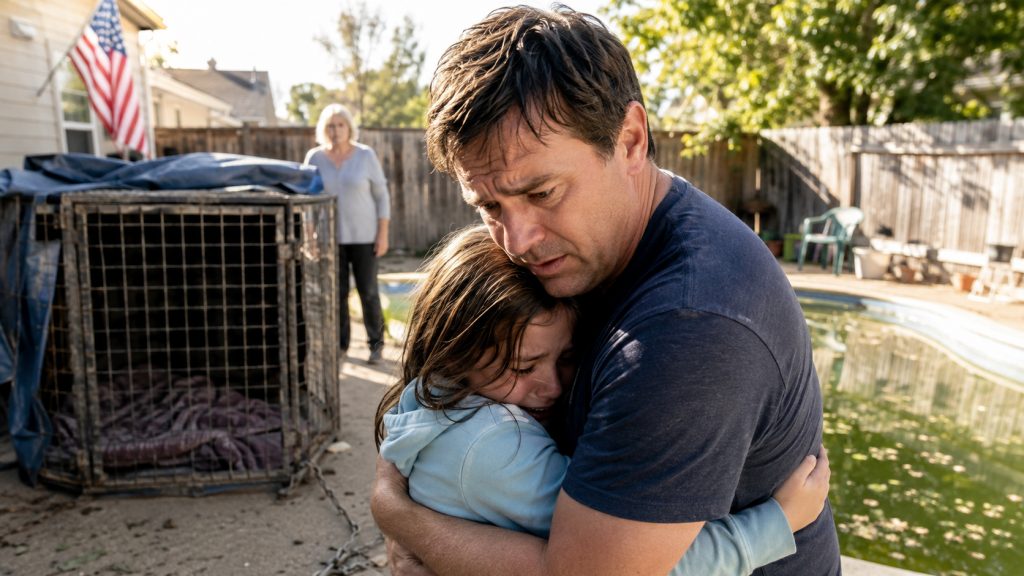
A large dog cage sat on the concrete.
Emily was inside.
She was curled on a filthy blanket in a pale blue hoodie, knees pulled to her chest, hair tangled around her face. Her lower lip was split. Her eyes were painfully dry, as though she had run out of tears before I arrived.
Children are supposed to run when they see their parents. They are supposed to cry, reach, and fall apart.
Emily only stared at me, trying to decide whether I was real.
“Daddy?”
That one word nearly broke me.
I dropped to my knees and grabbed the padlock. My fingers slipped against the hot metal. Near a flowerpot, I found an old pair of pliers and clamped them around the lock until the cage rattled across the concrete.
For one heartbeat, I imagined Jason coming through the back door. I imagined abandoning the lock and going after him.
I stayed with the lock.
My daughter did not need another angry man in that yard. She needed her father to get her out.
The padlock snapped at 3:26 p.m.
Emily shot forward, hit my chest with both fists, and wrapped herself around my neck like the ground might pull her back. She felt frighteningly light, all elbows and shaking breath.
I carried her toward the fence, telling her I had her, that she was safe, and that I was sorry I had not understood sooner.
Then her entire body went rigid.
She was not looking at the house.
She was staring at the pool.
Emily grabbed the back of my shirt and pulled me sharply away from the water.
PART 2
I stopped with Emily still clinging to me.
The pool was only a few yards away, but suddenly it felt like the one place in that backyard I should not approach.
The green water sat perfectly still. Beneath the surface, several black contractor bags rested in uneven lumps, each one tied tightly at the top. Near the shallow end, a strip of silver duct tape drifted across the surface.
Emily’s fingers tightened in my shirt.
“Daddy,” she whispered. “Please don’t look at the pool.”
I turned my face toward her instead. Her breathing came fast and shallow, and she buried her forehead against my shoulder as if she could keep me from seeing whatever she believed was there.
I wanted answers. I wanted to know why she had been locked in that cage, what Jason had put into those bags, and where Sarah was.
But Emily needed me more than I needed an explanation.
Then a faint shape passed behind the closed curtains on the second floor.
Something moved upstairs.
A shadow crossed the upstairs curtain before I could turn Emily toward the fence.
Someone was still inside the house.
I tightened my arm around my daughter and backed away from the pool instead of moving closer.
Emily felt it immediately.
Her fingers released a little of my shirt.
Not much.
Enough.
I kept my voice low. I kept Emily against my chest. I kept my eyes on the upstairs window.
“Is your mom in there?”
Emily nodded once.
Then she whispered, “I think so.”
That answer scared me more than a scream would have.
Mrs. Harris was still standing near the side fence, one hand pressed against her mouth. I carried Emily toward her gate without looking back at the green water.
The black bags could wait.
My daughter could not.
I set Emily down only when we reached Mrs. Harris’s patio, and even then she kept both hands twisted in my shirt.
“I’m not leaving you,” I told her.
She stared at my face like she was checking every word for a trap.
That hurt.
I deserved it.
I called emergency services and gave the address slowly enough to be understood. I told the dispatcher I had found my ten-year-old daughter locked inside a dog cage behind the house. I said another adult might be trapped upstairs. I said I did not know where Jason was.
Then I told them about the pool.
The dispatcher asked whether I could see a weapon.
“No.”
“Do not enter the house. Stay somewhere safe with your daughter.”
For once, doing nothing reckless was the hardest thing I had ever done.
The back door was twenty yards away.
Sarah might have been behind it.
Jason might have been behind it too.
I wanted to run inside.
I didn’t.
Emily had already spent too much time watching adults make their anger more important than her safety.
So I stayed beside her.
Mrs. Harris brought a kitchen towel for my bleeding palm and a glass of water for Emily. Emily held the glass with both hands but barely drank.
Her eyes kept pulling toward the fence.
Toward the house.
Toward the pool she had begged me not to see.
“Em,” I said, “I need to ask one thing. You don’t have to tell me everything right now.”
She looked at me.
“Is Jason inside?”
Her face changed.
“I don’t know.”
“When did you last see him?”
“Last night.”
Mrs. Harris sat down hard in a lawn chair.
Emily swallowed.
“He took Mom’s bags outside. Mom was yelling from upstairs. He told me to stop crying. Then he threw everything in the pool.”
Everything.
That word mattered.
Not someone.
Everything.
I asked, “What was in the bags?”
Emily shook her head quickly.
“I couldn’t see. He wouldn’t let me. He said if I looked, I’d wish I hadn’t.”
Her breathing shortened again.
I stopped asking.
A few minutes later, the first responders came through the front of the property while another pair entered from the side. I stayed where I was told to stay, with Emily wrapped in one of Mrs. Harris’s old blankets even though the afternoon was hot.
The blanket covered the dirty blue hoodie.
It did not cover her shaking.
One responder crossed the yard toward the cage.
Another looked up at the second floor.
Then the upstairs curtain moved again.
This time, a hand appeared against the glass.
Emily saw it before I did.
“Mom.”
She said it so quietly I almost missed it.
The hand vanished.
Everything sped up after that.
The front door was opened from inside by the responders. Voices carried through the house. A heavy thump came from upstairs, followed by someone calling out that they had found Sarah.
Alive.
That was the first word I understood.
Alive.
My knees nearly gave out.
Emily did not cry.
She simply pressed her forehead against my chest and stayed there.
Sarah came out later wrapped in a blanket, moving slowly between two responders.
I had spent three days furious with her.
I had spent three months resenting every excuse she made for Jason.
I had spent the last hour wondering whether one of those contractor bags contained what was left of the woman I had once planned an entire life with.
Seeing her alive did not erase any of that.
She looked exhausted, dehydrated, and smaller than I remembered. One wrist was discolored where something had pressed hard against it. Her hair hung loose around her face.
But her eyes went straight to Emily.
“Baby.”
Emily’s whole body tightened.
Sarah stopped walking.
She did not reach for her.
That mattered too.
For years, Sarah had been the person who filled every silence with an explanation. Jason was stressed. Jason had a temper. Jason did not mean it. Emily was sensitive. I was jealous. Divorce made everyone dramatic.
Now Sarah said nothing.
She waited.
Emily stayed against me.
Sarah lowered her eyes.
A responder asked me to move Emily farther down the driveway while they dealt with the backyard.
I carried her again.
She was ten years old, and I could feel every rib through that hoodie.
At the SUV, she finally asked the question I had been avoiding.
“Are they going to open the bags?”
“Yes.”
“Do I have to watch?”
“No.”
Her shoulders dropped a fraction.
“Do I ever have to go back there?”
That answer came easier.
“Not today.”
I wanted to say never.
I wanted to promise a future I did not control.
Instead I gave her the truth I could keep.
“Today, you’re coming with me.”
She nodded.
Behind us, the backyard filled with careful movement.
No shouting.
No spectacle.
The pool was treated like a scene that needed to be preserved, because that was exactly what it had become.
The first contractor bag came out heavy with water.
I did not let Emily see it.
I saw enough.
Clothes.
Shoes.
A woman’s purse.
The second bag held more household belongings, including a damaged phone and chargers tangled together. Another contained Emily’s school backpack, notebooks swollen by water, a library book turned into a thick block of pulp, and several framed family photographs with the glass broken before they ever reached the pool.
The last bag held a small suitcase.
Sarah’s suitcase.
That changed the story.
Not completely.
But enough.
Later that evening, after Emily had been examined and given food she could keep down, Sarah told me what had happened.
She did not make herself the hero.
I would not have listened if she had.
Thursday night, Emily had told her again that she was afraid of Jason.
This time she had shown Sarah the cage behind the shed.
Sarah said she had stared at it for several seconds before understanding why an old blanket was inside.
She had asked Jason what it was doing there.
He told her it was for the dog they were thinking about getting.
There was no dog.
Sarah knew that.
For months, she had treated each ugly moment as a separate problem because putting them together would have forced her to admit what her marriage had become.
The missing phone.
The locked bedroom door.
The way Jason decided who Emily could call.
The way he checked Sarah’s messages and then laughed when she objected.
The way Emily started sitting in my driveway before going back.
Separate, each excuse could survive.
Together, they couldn’t.
Sarah packed a suitcase before dawn Friday.
She put Emily’s backpack beside it.
She planned to take Emily and leave before Jason woke up.
Jason woke up first.
He took both phones.
He took Sarah’s keys.
He locked Sarah upstairs.
Then he put Emily in the cage.
“Why didn’t she scream?” I asked before I could stop myself.
Sarah looked at me.
“She did.”
I thought about Mrs. Harris saying she had heard crying and heavy impacts through the wall.
I thought about all the ordinary houses on that street, every one of them holding people who probably believed they knew what was happening next door.
Sarah continued.
On Saturday night, Jason dragged the bags outside while Emily watched from behind the bars.
He threw Sarah’s packed belongings into the pool first.
Then Emily’s.
Then the phones.
He told Emily that people who tried to leave him lost everything.
Emily asked where her mother was.
Jason looked toward the upstairs window and told her to quit asking questions unless she wanted to see something worse go into the water.
That was why she had grabbed my shirt.
That was why the pool terrified her more than the cage.
She did not know what was inside those bags.
She only knew what Jason wanted her to imagine.
Fear had done the rest.
I sat with that for a long time.
The pool had not hidden a body.
It had hidden an ultimatum.
Jason had taken ordinary things that meant leaving was possible—keys, phones, clothes, a school bag, a suitcase—and turned them into a threat a ten-year-old could understand.
Stay, or lose everything.
Stay, or someone disappears.
Stay, and maybe nothing worse happens.
Sarah had finally tried to leave.
Too late to prevent what happened to Emily.
Soon enough to survive it herself.
Those two truths had to exist together.
Sarah cried when she said, “I should have believed her the first time.”
I did not tell her it was okay.
It wasn’t.
I did not tell her she had done her best.
She hadn’t.
I said, “She needed you before Friday.”
Sarah nodded.
“I know.”
Then she asked the only question that mattered.
“What does she need from me now?”
For the first time since the divorce, I did not hear Sarah defending herself inside the question.
So I answered.
“Space.”
She gave it.
Jason was located later that evening and taken into custody.
I did not take Emily to see it happen.
I did not tell her every detail of what adults were doing with reports, photographs, interviews, or the broken padlock from the cage.
She already had enough pictures in her head.
What she needed was dinner.
A shower.
Clean pajamas.
A bedroom door she could close without hearing a lock turn from the other side.
The first night at my house, she did not sleep in her room.
She dragged her pillow into the hallway and lay down outside my bedroom door.
I found her there at 1:17 in the morning.
“You can sleep in my room,” I said.
“No.”
“Okay.”
“Can the door stay open?”
“Yes.”
So it stayed open.
The next night she slept on the couch.
The night after that, she made it to her own bed but left the hall light on.
Progress did not look dramatic.
It looked like doors.
It looked like choices.
It looked like a kid deciding where to put her pillow.
The school had already documented her absence from Friday, the first timestamp in a chain that adults had failed to understand fast enough. My welfare-check incident number became part of that timeline. Mrs. Harris gave her account of the screaming, the bags, and Jason at the pool.
The cage spoke for itself.
So did the lock.
So did the suitcase pulled from green water.
There was no single magical piece of evidence that explained everything.
There rarely is.
There were small facts that finally stopped being treated as separate accidents.
That lesson followed me home.
For months, I had noticed Emily’s thumb rubbing the seat belt.
I had noticed the extra minutes in my driveway.
I had noticed the silence after Jason’s name.
I kept waiting for one fact big enough to give me permission to believe what the smaller facts were already saying.
I will live with that.
Emily never asked me to punish myself.
Children have enough work carrying their own fear.
They should not have to manage ours too.
About two weeks later, Sarah asked whether Emily wanted to speak with her.
I did not answer for Emily.
I handed her the choice.
She said no.
Sarah accepted it.
Three weeks after that, Emily asked if Sarah could send a letter.
Not call.
Not visit.
A letter.
Sarah wrote one page.
No excuses.
No mention of Jason being convincing, charming, controlling, difficult, stressed, or anything else that would have shifted the weight away from her own decisions.
She wrote that Emily had told the truth and she had failed to listen.
She wrote that Emily did not owe her forgiveness.
Emily read it twice.
Then she put it in the bottom drawer of her desk.
She did not throw it away.
That was not forgiveness.
It was not rejection either.
It was hers.
Months passed before Emily agreed to see Sarah in person.
She chose my house.
She chose the kitchen table.
She chose forty-five minutes.
I stayed nearby but did not sit between them.
Sarah arrived without gifts.
That surprised me.
The old Sarah would have brought a shopping bag full of things and called it love.
This Sarah brought nothing but herself.
Emily asked one question.
“Why didn’t you believe me?”
Sarah’s hands tightened around each other.
“Because believing you meant admitting I had made a terrible choice, and I was scared of what would happen next.”
Emily looked down at the table.
Sarah added, “I made you carry the cost of my fear.”
No speech followed.
No dramatic embrace.
Emily got up when the forty-five minutes were over.
Sarah did too.
At the door, Sarah asked, “Can I write again?”
Emily thought about it.
“Maybe.”
Sarah nodded and left.
That was enough.
The old house did not become a symbol of healing. None of us needed that.
The pool was drained as part of the investigation and the damaged belongings were eventually released or discarded according to what could still be used.
Emily never went back to watch.
I never asked her to.
Her library book was ruined.
Her old backpack was ruined too.
One Saturday before school started again, I took her to buy another one.
I expected her to choose something completely different.
She stood in the aisle for ten minutes and picked a blue backpack almost the same shade as the hoodie she had been wearing inside the cage.
I must have looked surprised.
“What?” she asked.
“Nothing. You sure about that one?”
She slung it over one shoulder.
“Yeah. I like blue.”
That sentence stayed with me.
Jason had not taken blue from her.
He had not taken school.
He had not taken Sunday afternoons forever.
He had taken three days.
He had taken trust that would need years to rebuild.
He had taken things we could not pretend were replaceable.
But he did not get everything.
One Sunday, months after the backyard, Emily came out of my house with that blue backpack, a library book tucked under her arm, and one shoe untied.
She climbed into my SUV and pulled the seat belt across her chest.
Her thumb touched the strap.
I noticed.
She noticed me noticing.
Then she rolled her eyes in the very specific way only a ten-year-old can.
“Dad.”
“What?”
“Stop watching me do everything.”
I laughed before I could help it.
She smiled.
Small.
Real.
Then she handed me the library book because she wanted both hands free to tie her shoe.
I took it.
That was all.
No cage.
No chain.
No green water waiting behind a fence.
Just my daughter giving me something ordinary because she trusted I would hand it back.
THE END! THANK YOU FOR READING GOOD LUCK IN LIFE !❤️
Related Posts