➡️ PART 3 ➡️
For thirty-four years, I taught children that honesty was the foundation of every relationship worth keeping. I told them that mistakes could be forgiven, misunderstandings could be corrected, and even broken trust could sometimes be repaired.
But standing on the porch of my little cabin beside Lake Anders, holding a document bearing a signature I had never written, I discovered something that sixty-seven years of living had not prepared me for. The people who wanted to take my home hadn’t simply misunderstood my silence.
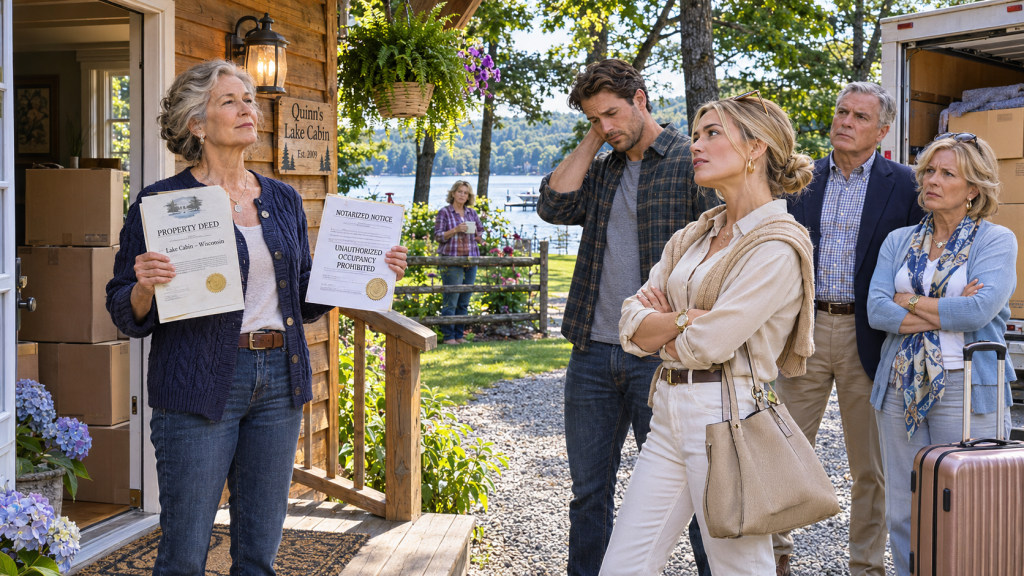
Someone had apparently tried to turn that silence into written permission. At the bottom of the document were two names. Quinn Burn. And beneath it: Witness: Daniel Burn. My son. The boy I’d raised. The child whose scraped knees I’d bandaged, whose school plays I’d attended, and whose college tuition Robert and I had saved for by postponing our own dreams.
I stared at the signature. Then looked toward Daniel. “Son,” I whispered, “what is this?” He seemed unable to breathe. Brooke stepped forward. “It’s just a family agreement.” I didn’t look at her. I kept my eyes on Daniel. “Did you sign this?” His face went pale.
For a long moment, he said nothing.
Then he whispered, “Mom, I can explain.”
And my heart sank.
Because those four words rarely come before a simple truth.
Gary Halloway stood near the moving truck, rubbing his aching knee.
His wife, Denise, had stopped directing the movers.
Even Brooke seemed uncertain now.
I unfolded the agreement completely.
It stated that I had voluntarily authorized Gary and Denise to occupy my cabin indefinitely, without rent, in exchange for occasional property maintenance.
It also included a provision suggesting that I would relocate temporarily if additional space was needed.
I read that sentence twice.
The owner agrees to vacate the premises upon reasonable family request.
My stomach tightened.
There it was.
Brooke’s suggestion that I could return to my old apartment hadn’t been a careless remark.
Someone had written it into a document.
I looked toward Daniel.
“Did you know this says I can be asked to leave?”
His eyes filled.
“Mom—”
“Answer me.”
He swallowed.
“Yes.”
For a moment, the world seemed strangely quiet.
Even the lake birds had stopped calling.
I was suddenly reminded of a little boy standing in our old kitchen.
Daniel was seven.
He’d broken one of Robert’s favorite mugs and hidden the pieces beneath the sink.
When I discovered them, he cried.
“Daddy will be angry.”
I knelt beside him.
“Maybe he’ll be disappointed,” I said. “But telling the truth is how we fix things.”
He eventually confessed.
Robert hugged him.
They repaired the mug as best they could, although it never held coffee again.
For years, we kept it on a shelf.
A reminder that mistakes didn’t have to become secrets.
Now that same boy was forty-one years old.
Standing on my porch.
And apparently helping other people claim my home.
I felt something inside me crack.
“Daniel,” I said quietly, “tell me exactly what happened.”
He looked toward Brooke.
She immediately shook her head.
“Don’t start making this into something ridiculous.”
I turned toward her.
“I’m speaking to my son.”
Her mouth tightened.
Daniel rubbed his forehead.
“Brooke showed me the agreement last week.”
I nodded slowly.
“And?”
“She said you’d agreed to let her parents stay.”
I stared at him.
“Did you ask me?”
He lowered his eyes.
“No.”
My throat tightened.
“Did you see me sign anything?”
He hesitated.
“No.”
“Then why does your name appear as a witness?”
His face crumpled.
“Because Brooke asked me to sign.”
I closed my eyes.
For several seconds, I couldn’t speak.
Then I whispered, “You witnessed something you never saw.”
He nodded.
“Yes.”
Brooke stepped forward angrily.
“Oh, please. It’s a technicality.”
Across the fence, Marilyn stopped watering her tomatoes.
She looked toward Brooke.
“A signature falsely witnessed isn’t just a technicality.”
Brooke glared at her.
“This is a family matter.”
Marilyn calmly placed the watering can on the ground.
“Then your family should have handled it honestly.”
I almost smiled.
Marilyn had always possessed the rare ability to make a simple sentence sound like a courtroom ruling.
But I wasn’t smiling now.
I looked toward Gary.
“Did you know I hadn’t signed this?”
He shook his head immediately.
“No.”
Denise turned toward Brooke.
“You told us Quinn had approved everything.”
Brooke folded her arms.
“She would have, if everyone hadn’t started making such a scene.”
I stared at her.
“You don’t get to decide what I would have agreed to.”
One of the movers approached.
“Ma’am, should we keep unloading?”
I took a breath.
“No.”
He nodded.
“Understood.”
I glanced toward the spare bedroom.
Four boxes and a suitcase sat inside.
That was all.
I hadn’t allowed anyone to unpack furniture or settle in.
And I was grateful I’d acted before the situation became more complicated.
I turned toward Gary.
“You can collect the belongings already inside.”
He nodded.
“Thank you.”
I continued.
“And I’m sorry you were told something that wasn’t true.”
His expression softened.
“I’m sorry too.”
Denise looked devastated.
“But where are we supposed to go?”
I hesitated.
I knew they were frightened.
They had lost their previous housing.
Their belongings were in a truck.
Their daughter had promised them a home.
But I couldn’t allow another person’s emergency to become the permanent surrender of my retirement.
I swallowed.
“I can help you find information about temporary housing and storage.”
Then I looked toward Brooke.
“But the responsibility for arranging your parents’ accommodation belongs to the people who made those promises.”
Brooke’s face reddened.
“Unbelievable.”
Daniel stepped toward her.
“Brooke, stop.”
She stared at him.
“What?”
He looked toward the document in my hands.
“You told me Mom had agreed.”
“She was going to!”
“That isn’t the same thing.”
Brooke began crying.
“Oh, so now you’re turning against me?”
Daniel shook his head.
“I’m asking you to tell the truth.”
For a moment, she seemed genuinely shocked.
Perhaps because he rarely challenged her.
Perhaps because she’d believed everyone would eventually give in simply to avoid an argument.
I had spent most of my life doing exactly that.
But not today.
By eleven, the boxes had been returned to the truck.
Gary stood beside the driveway, speaking quietly with the moving company.
They arranged temporary storage while he and Denise explored accommodation options.
Daniel offered to help cover a short hotel stay.
Brooke objected immediately.
“We can’t afford that!”
I looked toward her.
“Then you should have considered the cost before booking a moving truck for a house that wasn’t yours.”
She glared at me.
But I didn’t look away.
Then Gary spoke.
“Brooke, enough.”
Everyone turned.
He looked older than he had that morning.
More tired.
But his voice was steady.
“Your mother and I trusted you.”
Brooke’s eyes widened.
“Dad—”
“You told us Quinn invited us.”
His voice broke.
“We gave up our previous arrangement because you said everything was settled.”
Denise covered her mouth.
Gary continued.
“And now we’re standing in somebody else’s driveway with our belongings because you couldn’t be honest.”
For the first time, Brooke had no immediate response.
When the truck finally pulled away, I stood beside my porch railing.
My coffee had gone cold.
The sunlight had shifted across the lake.
And the quiet I’d worked so hard to purchase had returned.
But it didn’t feel peaceful.
Not yet.
Daniel remained behind.
He stood near the steps, staring at the gravel.
“Mom?”
I looked toward him.
“Can we talk?”
I considered saying no.
Part of me wanted to close the door.
Put the documents away.
And spend the rest of the day pretending my son hadn’t just admitted signing a false witness statement.
But I had spent thirty-four years teaching children that difficult truths were worth hearing.
I wasn’t going to abandon that belief simply because the truth now involved my own child.
“Come inside,” I said.
We sat at the kitchen table.
The window overlooked Lake Anders.
Robert had always wanted a kitchen with a view like that.
I looked toward the water.
Then back at Daniel.
“Why didn’t you ask me?”
He swallowed.
“About the agreement?”
“About any of it.”
His eyes filled.
“I thought Brooke had handled everything.”
I shook my head.
“Daniel, I’m your mother.”
“I know.”
“You have my telephone number.”
He looked down.
“You visited me last Sunday.”
Tears filled my eyes.
“You sat at this table and ate blueberry pie.”
His face crumpled.
“Mom—”
“And you never once mentioned that someone had prepared a document asking me to give up my home.”
He covered his face.
“I know.”
For a long time, we sat quietly.
Then Daniel whispered, “I was afraid of another fight with Brooke.”
My heart tightened.
There it was.
The truth beneath the excuses.
He hadn’t signed because he believed the document was legitimate.
He’d signed because challenging his wife would have been uncomfortable.
I took a breath.
“So you let me bear the consequences instead.”
He began crying.
“Yes.”
I looked away.
That answer hurt more than any attempt to justify himself.
Because it was honest.
And because it revealed how easily my needs had become less important than keeping peace inside someone else’s marriage.
“Daniel,” I whispered, “your father and I never expected you to agree with us about everything.”
He nodded.
“We raised you to think for yourself.”
“I know.”
“But I never imagined you’d sign your name beneath mine without knowing whether I’d given permission.”
His eyes filled.
“I’m sorry.”
I studied him.
“Sorry matters.”
He looked up.
“But it doesn’t erase what happened.”
He nodded.
“I understand.”
I wasn’t sure he did.
Not yet.
But perhaps he was beginning to.
That afternoon, I called Pria Whitfield.
My attorney listened carefully as I explained the document.
When I finished, she asked me to send a copy.
I did.
She reviewed it while we spoke.
“Quinn, this needs to be preserved.”
I nodded.
“Of course.”
She continued.
“We should identify who prepared it, whether it was used anywhere beyond the family, and whether anyone represented it as an authentic agreement.”
My stomach tightened.
“Could it affect my ownership?”
“A document like this doesn’t automatically transfer title. But any false representation of your consent is serious, and we should address it promptly.”
I felt a little relief.
Then she added something that made me sit upright.
“Quinn, there’s a section on the second page that concerns me.”
I frowned.
“What section?”
“Did you read the financial provisions?”
I looked down.
“I thought it was only about occupancy.”
Pria paused.
“Turn to paragraph nine.”
I unfolded the document.
Paragraph nine was printed in smaller type than the rest.
I read it once.
Then again.
The owner acknowledges that the occupants may undertake improvements to the property and seek reimbursement for expenses reasonably incurred in reliance upon this agreement.
My stomach tightened.
“What does that mean?”
Pria answered carefully.
“It could be used to support a claim for reimbursement if someone spends money believing they have permission to occupy or improve the property.”
I stared at the page.
“But I never gave permission.”
“I understand.”
She paused.
“That’s why the circumstances matter.”
Then she asked, “Have they made any improvements?”
I thought about the cabin.
The dock.
The porch.
The spare bedroom.
“No.”
“Have they paid any money toward the property?”
“Not that I know of.”
Pria nodded.
“Then we should document the present condition and preserve the communications.”
I swallowed.
“Okay.”
But something bothered me.
Why had Brooke included a financial clause in a supposedly simple family arrangement?
The answer began emerging three days later.
Marilyn came over carrying a plate of cinnamon muffins.
She found me sitting on the porch, staring at the lake.
“You look like a woman thinking too hard,” she said.
I smiled weakly.
“I’ve had practice.”
She sat beside me.
For a while, we watched a pair of ducks cross the water.
Then Marilyn asked, “Did Pria find anything useful?”
I nodded.
I explained the financial provision.
Marilyn listened carefully.
Then frowned.
“That sounds familiar.”
I turned toward her.
“What does?”
“The reimbursement language.”
She set down her coffee.
“I saw something like that in a dispute years ago.”
My stomach tightened.
“What kind of dispute?”
“A family member claimed they’d spent money improving another person’s property based on a promise they’d be allowed to live there.”
I stared at her.
“And?”
“The owner hadn’t agreed to the arrangement.”
She paused.
“The claim was disputed, but it caused months of unnecessary expense.”
I looked down at the document.
Suddenly, Brooke’s confidence seemed less accidental.
The following morning, Daniel called.
“Mom, I need to tell you something.”
My stomach tightened.
“What?”
“Brooke and I had an argument.”
I sighed.
“I’m sorry.”
He hesitated.
“She admitted she’d been talking to a contractor.”
I sat upright.
“A contractor?”
“Yes.”
“For what?”
Daniel swallowed.
“Renovations at your cabin.”
I stared toward the lake.
“What renovations?”
He took a breath.
“She wanted to convert the spare bedroom and part of the living room into a separate suite for her parents.”
For several seconds, I couldn’t speak.
Then I whispered, “Without asking me?”
He sounded ashamed.
“Yes.”
I closed my eyes.
“And the contractor?”
Daniel continued.
“She’d requested an estimate.”
My heart tightened.
“Did she sign anything?”
“I don’t know.”
I took a breath.
“Daniel, I need you to find out.”
He nodded.
“I will.”
That evening, Pria received a copy of the renovation estimate.
The proposed work was substantial.
Walls.
Plumbing.
A kitchenette.
A separate entrance.
The total estimate exceeded sixty thousand dollars.
I stared at it.
Sixty thousand dollars.
For alterations to a cabin I’d purchased because I wanted quiet.
I imagined workers tearing into the pine walls.
Changing the rooms Robert and I had dreamed about.
Turning my home into something designed around other people’s plans.
My chest tightened.
Pria looked toward me.
“Quinn, did you authorize any of this?”
I shook my head.
“No.”
She nodded.
“Then we should notify the contractor clearly that no work is approved.”
I took a breath.
“Please do.”
Two days later, the contractor confirmed he had not begun work.
He’d received preliminary information from Brooke and had assumed she was acting with the owner’s approval.
Pria clarified that she wasn’t.
The contractor apologized and closed the proposed project.
No construction had taken place.
No money had been paid.
That should have been the end of it.
But something still troubled me.
Brooke had organized a moving truck.
Prepared an occupancy agreement.
Included financial reimbursement language.
And requested a costly renovation estimate.
All without asking me.
Why?
What was she planning beyond simply moving her parents into my spare room?
The answer arrived unexpectedly during a conversation with Gary.
He called me on Thursday afternoon.
“Quinn?”
His voice sounded hesitant.
“Hello, Gary.”
He cleared his throat.
“I hope I’m not disturbing you.”
“Not at all.”
There was a pause.
Then he said, “I owe you an apology.”
I looked toward the lake.
“You were given inaccurate information.”
He sighed.
“Yes.”
“But I’m sorry we didn’t contact you ourselves.”
I appreciated that.
“Thank you.”
Then he continued.
“There’s something I think you should know.”
My stomach tightened.
“What?”
He hesitated.
“Brooke told us the arrangement was only temporary.”
I frowned.
“She told me you were moving in indefinitely.”
Gary sighed.
“That’s what I’m trying to explain.”
He paused.
“She said after six months, we’d have a permanent place.”
My heart tightened.
“Where?”
Gary’s voice became quiet.
“Your cabin.”
I stared at the water.
“But that’s where she wanted you to live.”
He swallowed.
“She told us you’d eventually move back to the apartment.”
For several seconds, neither of us spoke.
Then I asked, “Did she explain why?”
Gary hesitated.
“She said the lake house would be more practical for us.”
My chest tightened.
“And what about me?”
He sighed.
“She said you didn’t really need a house that size.”
I closed my eyes.
Two bedrooms.
One bathroom.
A tiny kitchen.
A porch.
It wasn’t a mansion.
It was the first home I’d ever owned outright in my own name.
I swallowed.
“Gary, did Brooke say anything about buying the cabin from me?”
He hesitated.
Then whispered, “She said you might eventually transfer it into a family arrangement.”
My stomach tightened.
“What family arrangement?”
He sounded embarrassed.
“She said Daniel would inherit it anyway, so there was no reason to keep everything so formal.”
I stared toward the lake.
For years, I’d believed Brooke was simply overconfident.
Now I was discovering she’d apparently been discussing my property as though my future were already decided.
After the call, I sat on the porch for a long time.
The water was calm.
A fishing boat moved slowly across the far shore.
I thought about Robert.
About the wedding rings I’d sold.
The farmland.
The summers I’d spent teaching extra classes.
Every sacrifice that had brought me here.
Then I remembered Brooke’s words.
If you don’t like it, go back to the apartment.
It hadn’t been a careless insult.
It had been part of her plan.
She expected me to leave.
She expected her parents to stay.
And she expected everyone to accept that as reasonable because I was older, widowed, and accustomed to accommodating other people.
I felt anger rise.
Then something steadier.
Resolve.
That evening, I called Daniel.
He answered immediately.
“Mom?”
I took a breath.
“Did Brooke tell her parents that I was going to transfer the cabin to the family?”
Silence.
Then he whispered, “She mentioned something about estate planning.”
My heart tightened.
“What did she say?”
He sighed.
“She thought it would make sense for the house to go into a trust eventually.”
I stared at the wall.
“A trust controlled by whom?”
He hesitated.
“I don’t know.”
I took a breath.
“Daniel, did you discuss this with her?”
He sounded miserable.
“Not seriously.”
I closed my eyes.
“That’s not the same as no.”
He swallowed.
“No.”
I sat quietly.
Then asked, “Son, what did you think would happen to me?”
His voice broke.
“Mom, I never wanted you to lose your home.”
I stared toward the lake.
“But you let your wife make plans for it.”
Silence.
“You signed a document you hadn’t witnessed.”
He began crying.
“And you let her parents believe they could move in.”
“I know.”
I took a breath.
“Daniel, I spent my life making sure you had somewhere safe to come home to.”
My voice trembled.
“And now I need you to respect that this is mine.”
He whispered, “I will.”
I closed my eyes.
For the first time, I wanted to believe him.
But promises were no longer enough.
The following week, Pria helped me review my estate planning.
Not because I intended to punish Daniel.
And not because I wanted to make a dramatic announcement.
But because I realized my wishes needed to be clear.
The cabin belonged to me.
I would decide who could live there.
What happened to it during my lifetime.
And how it would be handled after my death.
Pria explained several options.
I listened carefully.
Asked questions.
And chose arrangements that reflected my values rather than anyone else’s expectations.
I also updated my emergency contacts and reviewed who had access to information about my property.
For the first time since Robert died, I felt like I was building something with intention rather than simply trying to survive another day.
A few days later, Marilyn came over.
She found me painting the porch railing.
“Look at you,” she said. “Back to work.”
I laughed.
“Apparently retirement is exhausting.”
She smiled.
Then looked toward the lake.
“Peaceful morning.”
I nodded.
“Yes.”
She watched me for a moment.
“Quinn, can I ask you something?”
“Of course.”
“Are you afraid of losing Daniel?”
My hand stopped moving.
For several seconds, I didn’t answer.
Then I whispered, “Yes.”
Marilyn nodded.
“I thought so.”
My eyes filled.
I looked toward the water.
“He’s my son.”
“I know.”
“I love him.”
“Of course you do.”
I swallowed.
“But I can’t give up my home just to make sure he keeps loving me.”
Marilyn’s expression softened.
“Then don’t.”
That afternoon, I received a letter from Daniel.
Not a text.
Not a quick apology during an argument.
A handwritten letter.
I recognized his writing immediately.
The same uneven letters he’d used in childhood when he made cards for Robert and me.
I sat at the kitchen table.
Then opened it.
Mom,
I’ve spent the last few days thinking about what happened.
My throat tightened.
You asked me why I signed something without seeing you sign it.
I swallowed.
The truth is that I knew it was wrong.
My eyes filled.
I told myself it was harmless because Brooke said everything had already been discussed.
I continued.
But I didn’t really believe that.
Tears rolled down my cheeks.
I was afraid of making her angry.
I covered my mouth.
Then read the next line.
So I let you become the person who would have to deal with the consequences.
For several seconds, I couldn’t see the page.
Daniel continued.
Dad used to tell me that doing the right thing wasn’t always comfortable.
My chest tightened.
I remembered Robert saying that.
Usually when Daniel had made a mistake and wanted someone else to explain it away.
I thought I understood what he meant.
The letter blurred.
Now I realize I’ve spent years confusing peace with avoiding difficult conversations.
I swallowed.
You deserved better from me.
Then came the final paragraph.
I don’t expect you to trust me immediately. But I want to earn that trust again. Not by asking you to forget what happened, but by changing how I behave.
I pressed the letter against my chest.
For a long time, I cried.
Not because everything had been repaired.
But because my son had finally begun speaking the language of responsibility.
Two days later, Daniel came to visit.
Alone.
He stood on the porch with a small paper bag.
“Mom?”
I opened the door.
He smiled nervously.
“I brought blueberry muffins.”
I almost laughed.
“You remembered.”
He nodded.
“Dad always said you liked them better than flowers.”
My throat tightened.
I stepped aside.
“Come in.”
We sat beside the kitchen window.
The lake glimmered beyond the glass.
For a while, we drank coffee.
Then Daniel said quietly, “Brooke and I are having problems.”
I looked toward him.
“I’m sorry.”
He nodded.
“She thinks I betrayed her.”
I took a breath.
“And what do you think?”
He stared at his hands.
“I think I’ve been letting her make decisions I should have questioned.”
I nodded.
He continued.
“And I think I’ve been asking you to absorb the consequences.”
My eyes filled.
“Yes.”
Daniel looked up.
“Mom, I need you to know something.”
I studied him.
“I’ve asked Brooke to stop discussing your property as though it belongs to us.”
I nodded.
“And?”
“She agreed.”
I considered that.
“Did she understand why?”
He hesitated.
“I don’t know.”
I appreciated his honesty.
Then he continued.
“I also told her I won’t sign anything again without understanding it.”
I smiled sadly.
“That would be a good start.”
He nodded.
“I know.”
For a moment, the room felt almost peaceful.
Then Daniel reached into his pocket.
He removed a folded piece of paper.
“There’s something else.”
My stomach tightened.
“What?”
He placed it on the table.
It was a copy of an email.
The sender was Brooke.
The recipient was someone named Marcus Halloway.
I frowned.
“Who’s Marcus?”
Daniel looked uncomfortable.
“Brooke’s cousin.”
I nodded.
“What does he do?”
“He works in property management.”
I unfolded the page.
The subject line read:
LAKE ANDERS PROPERTY — LONG-TERM ARRANGEMENT.
My heart began pounding.
I read the first paragraph.
Brooke had described the cabin.
Its location.
The estimated market value.
And the possibility of converting it into a short-term rental property.
I stared at Daniel.
“What is this?”
He swallowed.
“Brooke was asking Marcus about rental income.”
My chest tightened.
“But she told her parents they were moving in.”
He nodded.
I looked back at the email.
Then reached the sentence that made my hands tremble.
Once Gary and Denise are established at the property, Quinn will probably return to the apartment. After that, we can discuss how to generate income from the lake house.
I stared at the words.
For several seconds, I couldn’t speak.
Then I whispered, “She wasn’t planning to let her parents stay permanently.”
Daniel looked miserable.
“No.”
My heart pounded.
I read the next line.
If we can get Quinn to sign the family arrangement, we may be able to manage bookings without involving her in every decision.
The room seemed to tilt.
I looked toward my son.
“Daniel, did Brooke intend to rent out my cabin?”
He nodded slowly.
“That’s what it looks like.”
I swallowed.
“And where was I supposed to live?”
He lowered his head.
“I don’t know.”
I sat motionless.
Then I noticed an attachment reference.
A proposed financial forecast.
I opened it on Daniel’s phone.
It listed projected weekly rental rates.
Maintenance expenses.
Occupancy estimates.
And a line titled:
MANAGEMENT DISTRIBUTION — BROOKE HALLOWAY.
My stomach tightened.
Not Gary.
Not Denise.
Brooke.
I stared at the numbers.
For months, she’d insisted her parents desperately needed somewhere stable to live.
Now I was looking at a plan to generate income from my home.
A home I’d sacrificed my wedding rings to purchase.
A home Robert and I had dreamed about for years.
I looked toward Daniel.
“Did her parents know?”
He shook his head.
“I don’t think so.”
I swallowed.
Then asked, “Does Brooke know you brought me this?”
Daniel hesitated.
“No.”
I looked down.
For the first time, my son’s decision to tell me the truth had required him to risk an argument at home.
I knew that couldn’t have been easy.
But the next discovery would be worse.
Because at the bottom of the attachment was a note about financing.
A proposed renovation loan.
And beside the estimated loan amount was a sentence that made my heart stop.
OWNER AUTHORIZATION: EXPECTED THROUGH FAMILY CONSENT AGREEMENT.
I stared at the words.
Then slowly looked up.
“Daniel,” I whispered, “was Brooke planning to use that false agreement to borrow money against my cabin?”
He went pale.
“I don’t know.”
I looked toward Robert’s photograph above the fireplace.
Then back at the document.
And suddenly, I realized the moving truck hadn’t been the beginning of Brooke’s plan.
It had been the final step in something she’d been arranging long before anyone asked whether I wanted strangers living in my home.