➡️ PART 3 ➡️
Sterling Vain stood outside my pickup with rain streaming down his expensive gray suit, holding his phone like it was a weapon. “Get out of that truck,” he demanded. I looked at him through the open window. “Why?” “Because you’re trespassing on private property.” I glanced toward the hotel. The stone walls.
The tall windows glowing against the darkness. The entrance where my wife Evelyn had planted white roses every spring for twenty-three years. Then I looked back at him. “Are you certain you want to make that accusation?” His jaw tightened. “Absolutely.” I nodded. “Then call whoever you need to call.” Beside me, Marisol sat perfectly still. Her hands were clasped around the empty coffee thermos. I could see she was frightened.
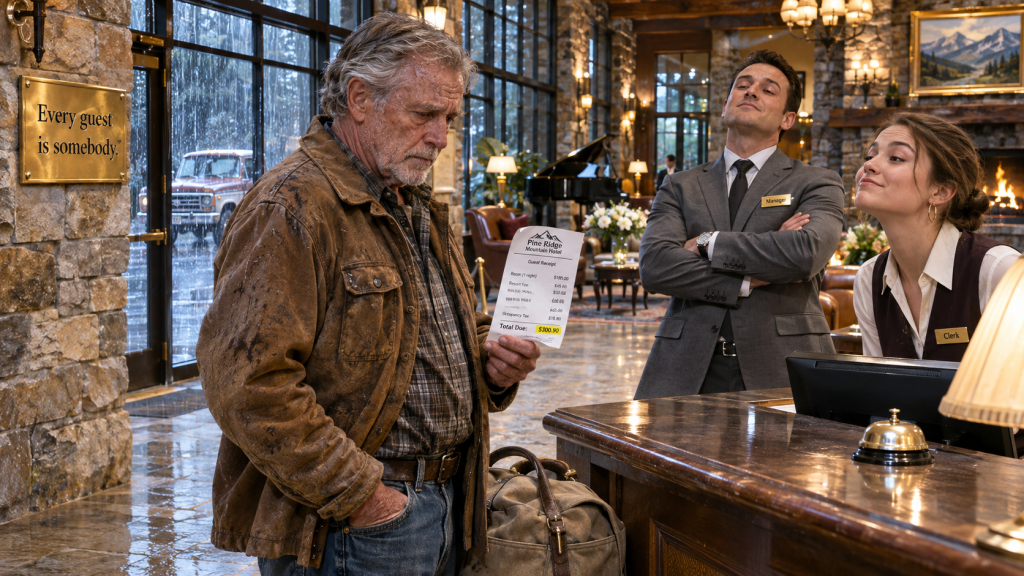
Not of the rain. Not of Sterling. But of what losing her job might mean when morning came. I turned toward her. “Do you have family depending on you?” She swallowed. “Two children.” My chest tightened. “How old?” “Seven and eleven.” I nodded. “And you’ve worked here how long?” “Six years.” Six years. Long enough to know which rooms had leaking faucets.
Which guests needed extra blankets. And which managers couldn’t be trusted. I looked toward Sterling again. “You just fired a six-year employee for bringing somebody coffee?” His expression hardened. “She violated company policy.” I leaned back. “Which policy?” He didn’t answer.
Instead, he pressed his phone against his ear.
The police arrived twenty minutes later.
Two officers stepped from their patrol vehicle beneath the hotel entrance lights.
Sterling hurried toward them.
I watched him gesture toward my truck.
Then toward Marisol.
His movements were sharp.
Angry.
Confident.
He was accustomed to people moving when he pointed.
One officer approached my window.
“Evening, sir.”
“Evening.”
“I’m Officer Daniels. We’re told there’s been a disagreement.”
I nodded.
“There has.”
He glanced at the hotel.
“The manager says you’ve been asked to leave.”
“That’s correct.”
“And you’re refusing?”
I looked at him.
“No, officer. I left the lobby when instructed. I’ve been sitting in my truck because the roads are dangerous and I needed somewhere safe to rest.”
The officer studied me.
Then noticed the receipt lying on my dashboard.
“What’s that?”
“A bill for fourteen hundred dollars on a room advertised for a hundred and eighty.”
His eyebrows rose.
“That’s quite a difference.”
I nodded.
“Yes, sir.”
Sterling approached.
“He’s leaving out the important part.”
Officer Daniels turned.
“Which is?”
Sterling pointed toward Marisol.
“That employee stole confidential hotel records and handed them to him.”
Marisol went pale.
I looked at Sterling.
“You’d better be careful with that accusation.”
He laughed.
“Or what?”
I held his gaze.
“Or you might find yourself explaining it.”
The second officer stepped forward.
“Let’s everybody keep this calm.”
I nodded.
“That’s fine with me.”
Officer Daniels asked whether I had somewhere else to stay.
I looked through the windshield at the rain.
“Not nearby.”
Then I paused.
“Officer, may I ask you something?”
“Go ahead.”
“If a business refuses service, does that automatically mean somebody has committed a crime?”
He shook his head.
“No. Not necessarily. We’d need to understand the circumstances.”
I nodded.
“Then I’d appreciate an explanation of what law I’ve broken.”
For several seconds, nobody spoke.
Sterling crossed his arms.
“He’s being difficult.”
Officer Daniels looked toward him.
“Sir, asking questions isn’t a crime.”
I almost smiled.
Sterling didn’t.
The officer turned back toward me.
“Is there anything else we should know?”
I considered my answer.
There was still a part of me that wanted to remain anonymous.
I wanted to understand how deep the problem ran.
How many employees were afraid.
How many guests had been charged money they didn’t owe.
And whether the people I’d trusted to manage this hotel had quietly transformed Evelyn’s dream into something ugly.
But there was also Marisol.
A woman with two children who might lose her livelihood for offering a stranger a blanket.
I had no intention of letting my silence cost her another night of sleep.
I took a breath.
“Officer, I’d like to make one thing clear.”
He waited.
“I own this property.”
Sterling laughed.
It was a short, ugly sound.
Then he pointed at my truck.
“You own this hotel?”
I nodded.
“Yes.”
He shook his head.
“That’s ridiculous.”
Officer Daniels looked between us.
“Sir, can you establish that?”
“Certainly.”
I reached into my glove compartment.
Inside was a folder containing insurance papers, registration documents, and a copy of the ownership information I’d brought along for the trip.
I handed him the relevant pages.
Then opened my phone.
I pulled up the corporate directory for our hospitality company.
My name appeared as its founder and principal owner.
The hotel was listed among our properties.
Officer Daniels studied the documents.
Then looked toward me.
“You’re telling me you’re the owner of the Ridgehaven Mountain Hotel?”
“Yes, sir.”
Sterling’s smile disappeared.
I watched the color drain from his face.
For several seconds, he stared at me.
Then he laughed nervously.
“Well, that’s obviously some sort of misunderstanding.”
I didn’t answer.
He took a step closer.
“Mr. Hartwell?”
I nodded.
My full name was Arthur Hartwell.
For twenty-nine years, I’d signed payroll checks, approved renovations, and sat through endless meetings about the future of this hotel.
But that night, I’d been nothing more than an old man in a worn jacket.
Sterling swallowed.
“Sir, I had no idea.”
I looked at him.
“That’s the problem.”
His eyes shifted toward the officers.
Then back to me.
“If you’d identified yourself—”
I raised my hand.
“Would you have treated me differently?”
He didn’t answer.
I continued.
“Because that’s exactly what I’m trying to find out.”
Officer Daniels returned the documents.
The officers explained that the ownership and employment disputes would need to be addressed through the appropriate processes.
They also advised everyone to avoid further confrontation.
I thanked them.
Before leaving, Officer Daniels looked toward Marisol.
“Ma’am, are you alright?”
She nodded.
“Yes, sir.”
He glanced at Sterling.
Then toward me.
“Make sure everybody gets somewhere safe tonight.”
I promised we would.
When the patrol car disappeared down the mountain road, Sterling stood beneath the hotel entrance lights.
His suit was soaked.
His face looked pale.
For the first time that evening, he seemed unsure what to say.
I opened my truck door.
Then turned toward Marisol.
“Come inside with me.”
She looked frightened.
“Sir, I don’t want to make things worse.”
I smiled gently.
“Marisol, you brought me coffee in a storm.”
My throat tightened.
“The least I can do is make sure you don’t have to stand in one.”
We walked into the lobby.
Kendall was still behind the front desk.
She looked up.
Then froze when she saw Sterling following me.
I set the fourteen-hundred-dollar receipt on the marble counter.
“Good morning, Kendall.”
She swallowed.
“Sir?”
I glanced toward the wall clock.
It was nearly three.
“Actually, I suppose it’s still tonight.”
She looked toward Sterling.
He stared at the floor.
I continued.
“My name is Arthur Hartwell.”
Her expression remained uncertain.
“Alright.”
“I’m the owner of this hotel.”
For several seconds, she said nothing.
Then she laughed nervously.
“You’re joking.”
I shook my head.
“No, ma’am.”
Sterling finally spoke.
“Mr. Hartwell is conducting a property review.”
I looked at him.
“Not exactly the review I planned.”
Kendall’s hands began trembling.
She glanced at the receipt.
Then toward my wet jacket.
“I’m sorry.”
I nodded.
“We’ll talk about that.”
Her eyes filled.
“I didn’t know.”
I looked at her carefully.
“Would it have mattered?”
She stared at me.
I continued.
“If I were a retired truck driver looking for somewhere warm to sleep, would that have made the way you treated me acceptable?”
Her lower lip trembled.
“No.”
I nodded.
“Then perhaps we should start there.”
Sterling stepped closer.
“Mr. Hartwell, I think it would be best if we discussed this privately.”
I looked toward him.
“Why?”
He glanced at Kendall.
“There are sensitive matters involved.”
I nodded.
“Then we’ll discuss them with the appropriate people present.”
His expression tightened.
I continued.
“Tonight, I want the financial records preserved.”
He swallowed.
“Of course.”
“All guest charges associated with the heritage preservation fee.”
He nodded.
“Certainly.”
“All refund requests concerning disputed surcharges.”
His shoulders stiffened.
“And any records relating to complaints employees have made about those practices.”
Sterling stopped nodding.
For a moment, the lobby was silent.
Then he said, “That could take some time.”
I looked directly at him.
“Then you’d better make sure nothing disappears.”
I called my chief operating officer, Eleanor Price.
It was almost three-thirty in the morning.
She answered on the fourth ring.
“Arthur?”
“Eleanor, I’m at Ridgehaven.”
There was a pause.
“I thought you weren’t going until next week.”
“Plans changed.”
She heard something in my voice.
“What happened?”
I looked toward Marisol.
Then toward Kendall.
“I was refused a room because the manager thought I couldn’t afford it.”
Eleanor went silent.
I continued.
“I was charged fees we eliminated months ago.”
Another pause.
“And an employee who tried to help me was fired on the spot.”
Her voice sharpened.
“Who?”
“Marisol. Housekeeping.”
Eleanor exhaled.
“Arthur, are you safe?”
“Yes.”
“Then I’ll arrange for our independent compliance team to review everything immediately.”
I nodded.
“That’s what I need.”
After ending the call, I turned toward Marisol.
She stood beside the fireplace.
Her hands were trembling.
“Sit down, please.”
She hesitated.
“I’m still on shift.”
I looked at her.
“Marisol, your employment status isn’t going to be decided by a shouted accusation in a parking lot.”
Her eyes filled.
“We’ll review what happened properly. In the meantime, I want you treated with respect.”
She sat down slowly.
For a moment, she looked as though she might cry.
Then whispered, “Thank you.”
I looked around the lobby.
The same stone floor.
The same fireplace.
The same piano.
And I wondered how many people had walked through those doors and felt unwelcome.
I asked Kendall for the current room inventory.
She looked toward Sterling.
He didn’t move.
Then she opened the computer.
“Room 312 is available,” she whispered.
I stared at the screen.
“Available?”
She nodded.
“Yes, sir.”
My throat tightened.
“Your manager told me it was reserved for important guests.”
Kendall’s eyes filled.
“I know.”
I looked toward Sterling.
“Explain that.”
He rubbed his forehead.
“Mr. Hartwell, the room is usually held for premium guests.”
I nodded slowly.
“And who’s considered premium?”
He didn’t answer.
I looked toward Kendall.
She whispered, “People management approves.”
I stared at them.
Then asked, “Was my reservation canceled?”
Kendall nodded.
“Yes.”
“Why?”
Her voice trembled.
“Mr. Vain told me to remove it.”
The lobby went quiet.
For a moment, I couldn’t speak.
Room 312.
The room where Evelyn and I spent our wedding night.
The balcony where we’d watched snow settle on the pine trees.
The place she’d asked me to visit again after her illness began.
I had reserved it six weeks earlier.
Not because I wanted luxury.
But because I’d finally found the courage to return.
And Sterling had canceled that reservation because he didn’t like the look of my truck.
I closed my eyes.
For the first time all evening, I felt my anger giving way to grief.
Marisol approached quietly.
“Mr. Hartwell?”
I opened my eyes.
“Yes?”
She looked toward the piano.
“Are you alright?”
I swallowed.
“Not entirely.”
She nodded.
Then said, “My mother used to play that piano.”
I looked at her.
“Your mother?”
She smiled faintly.
“She worked here years ago. In the dining room.”
My heart tightened.
“What was her name?”
“Lucia Alvarez.”
For a moment, the entire lobby seemed to stop.
Lucia.
I remembered her.
A young waitress with a beautiful singing voice.
She’d worked here when Evelyn and I first restored the property.
Evelyn loved her.
Every Friday evening, she’d ask Lucia to sing while she played piano.
I stared at Marisol.
“Lucia was your mother?”
Marisol nodded.
“Yes.”
I swallowed.
“She had a beautiful voice.”
Marisol’s eyes widened.
“You remember her?”
I nodded.
“Of course.”
My throat tightened.
“Your mother and my wife made Friday evenings something special.”
Marisol began crying.
“My mother used to tell us about Mrs. Hartwell.”
I smiled through tears.
“Did she?”
She nodded.
“She said your wife always remembered the employees’ birthdays.”
I laughed softly.
“That sounds like Evelyn.”
Marisol wiped her eyes.
“My mother passed away three years ago.”
My chest tightened.
“I’m sorry.”
She looked toward the piano.
“She kept one of the old hotel blankets because Mrs. Hartwell gave it to her when I was born.”
I stared at the folded blanket she’d brought me.
The embroidered initials.
E.H.
My throat tightened.
“That blanket?”
Marisol nodded.
“No, sir. That one’s from storage. My mother’s blanket is at home.”
She smiled faintly.
“But when I saw you sitting in the rain, I remembered what she used to say.”
I waited.
Her voice broke.
“She said Mrs. Hartwell never let anybody leave this place feeling smaller than when they arrived.”
I turned toward the brass plaque near the entrance.
Every guest is somebody.
Evelyn had insisted on those words.
I’d thought they were too simple.
She told me simple promises were the hardest ones to keep.
Standing in that lobby, I finally understood what she meant.
The building was still beautiful.
The fireplaces worked.
The furniture gleamed.
The room rates had increased.
But somewhere along the way, the people responsible for its operation had forgotten why Evelyn and I built it.
By nine the next morning, Eleanor arrived with two members of the compliance team.
I hadn’t slept much.
I’d spent the remaining hours in room 312.
The room smelled faintly of cedar.
I sat beside the balcony doors, looking toward the mountains.
Rainwater dripped from the pine branches.
The valley disappeared beneath pale clouds.
And for a moment, I imagined Evelyn standing beside me.
She would have been furious about the fees.
But even angrier about the way Marisol had been treated.
I could almost hear her voice.
“Arthur, you can’t call a place welcoming if the people who work there are afraid.”
Eleanor met me in the conference room.
She’d brought preliminary reports.
The numbers were troubling.
The heritage preservation charge had continued appearing on certain guest accounts despite the corporate instruction to remove it.
Some charges were categorized under other names.
Others were presented as optional packages without a clear record that guests had agreed to purchase them.
And several complaints had been marked resolved without evidence of refunds or meaningful follow-up.
I stared at the documents.
“How long?”
Eleanor sighed.
“We’re still determining that.”
I nodded.
“And who’s responsible?”
“We don’t know the full extent yet.”
I looked toward her.
“Find out.”
Then she placed another report on the table.
“This concerns employee complaints.”
I opened it.
There were several entries.
A front-desk employee who’d questioned the surcharges.
A night auditor who’d reported discrepancies.
And a housekeeper who’d complained about guest treatment.
Marisol.
Her name appeared twice.
Both complaints had been closed.
The notes said:
Employee misunderstanding of revenue policy.
I stared at the words.
“Who closed these?”
Eleanor hesitated.
“Sterling.”
I looked up.
“Both?”
She nodded.
My chest tightened.
“Then the complaints went straight back to the person they concerned.”
Eleanor looked ashamed.
“Yes.”
I closed the folder.
For years, I’d believed our reporting system protected employees.
Now I realized it might have been protecting managers instead.
Around noon, Kendall asked to speak with me.
She entered the conference room looking exhausted.
Her eyes were red.
I gestured toward a chair.
“Sit down.”
She did.
For several seconds, she stared at her hands.
Then whispered, “I’m sorry about last night.”
I nodded.
“Tell me what happened.”
She swallowed.
“Mr. Vain told us to add the experience package to certain walk-in reservations.”
I leaned forward.
“Certain reservations?”
She nodded.
“People who looked like they wouldn’t complain.”
My stomach tightened.
“How did he decide that?”
She looked ashamed.
“Sometimes it was people who seemed tired, unfamiliar with the area, or worried about finding somewhere to stay.”
I thought about the elderly couple Marisol had mentioned.
The ones celebrating fifty years of marriage.
Then I asked, “Why did you follow the instructions?”
Kendall began crying.
“Because I need this job.”
She told me she’d started at the hotel eight months earlier.
Her mother was recovering from surgery.
Her younger brother was still in school.
And she was helping pay their household expenses.
I listened.
Then said, “Kendall, needing a job doesn’t make it acceptable to mistreat people.”
She nodded.
“I know.”
I continued.
“But I also need to understand whether you were pressured or threatened.”
Her eyes filled.
“Mr. Vain said anybody who questioned the fees could be replaced.”
I sat back.
“And the way you spoke to me?”
She looked down.
“That was me.”
For a moment, she couldn’t continue.
Then whispered, “I was cruel because I thought you couldn’t do anything about it.”
I stared at her.
It was the most honest thing she’d said.
And it hurt.
I took a breath.
“Thank you for telling me the truth.”
She wiped her eyes.
“Am I fired?”
I considered her question carefully.
“That decision will follow a proper review.”
She nodded.
I continued.
“But whatever happens, I hope you remember something.”
She looked up.
“The person standing in front of you doesn’t become more deserving of kindness when you discover they have money.”
Her face crumpled.
“I understand.”
I nodded.
“Good.”
That afternoon, I met with Sterling.
Eleanor was present.
So was a representative from human resources.
Sterling wore another expensive suit.
His hair was perfectly combed.
He looked as though he expected a negotiation.
“Mr. Hartwell,” he began, “I want to apologize for the misunderstanding.”
I looked at him.
“Which misunderstanding?”
He hesitated.
“The situation at check-in.”
I shook my head.
“That wasn’t a misunderstanding.”
His face tightened.
I continued.
“You quoted me charges that shouldn’t have existed.”
He looked toward Eleanor.
“You refused a confirmed reservation.”
He swallowed.
“And you fired an employee for offering a stranded guest coffee.”
He opened his mouth.
I raised my hand.
“Before you answer, I want you to understand that we are reviewing the records, not relying solely on anybody’s recollection.”
Sterling leaned back.
For the first time, he appeared genuinely worried.
Then he said, “I was under tremendous pressure to improve revenue.”
I stared at him.
“Who pressured you?”
He hesitated.
“The regional office.”
Eleanor frowned.
“What regional office?”
Sterling looked toward her.
Then away.
I leaned forward.
“Sterling, be specific.”
His hands tightened around the chair arms.
Finally, he whispered a name.
“Graham Whitlock.”
Eleanor went still.
So did I.
Graham Whitlock was our regional operations director.
He’d worked for our company for almost seventeen years.
He’d attended Evelyn’s funeral.
He’d stood beside me afterward and promised that Ridgehaven would always be looked after.
I stared at Sterling.
“You’re saying Graham authorized these charges?”
Sterling swallowed.
“He knew about them.”
I looked toward Eleanor.
Her expression had changed.
I turned back toward Sterling.
“Do you have evidence?”
He hesitated.
Then nodded.
“Emails.”
My chest tightened.
“Where are they?”
He looked toward his phone.
“On my work account.”
Eleanor spoke immediately.
“Those records are being preserved.”
Sterling stared at her.
Then looked toward me.
“Mr. Hartwell, I wasn’t acting alone.”
I sat back.
For several seconds, the room was silent.
Then I said, “That doesn’t excuse how you treated people.”
His shoulders sagged.
“I know.”
I nodded.
“But if there’s more to this, we’re going to find it.”
Eleanor and I left the conference room.
We walked into the hallway.
She looked deeply troubled.
“Arthur, Graham approved the fee removal notice.”
I nodded.
“I know.”
“He was responsible for confirming compliance across the region.”
I looked through the window toward the mountains.
“And Sterling says he continued collecting it.”
Eleanor swallowed.
“Yes.”
For a moment, I felt older than my seventy-one years.
Not because I lacked the energy to fight.
But because I was beginning to understand how much damage could happen when people trusted reports more than the people living with their consequences.
That evening, Eleanor received the first preserved email extracts.
She brought them to room 312.
I sat at the desk while she opened her laptop.
The first message was dated four months earlier.
It was from Graham Whitlock to Sterling.
The subject line read:
REVENUE RETENTION — RIDGEHAVEN.
I read the message carefully.
Graham instructed Sterling to maintain certain supplementary charges while reporting compliance with the corporate fee-removal directive.
My hands went cold.
Then I saw the next instruction.
“Avoid itemizing discretionary packages for guests who are unlikely to question them.”
I stared at the screen.
For several seconds, I couldn’t speak.
Then whispered, “He knew.”
Eleanor nodded.
“Yes.”
I looked toward the window.
The rain had finally stopped.
And the mountains were visible beneath the evening sky.
I thought about the elderly couple Marisol had described.
The tired travelers who’d driven for hours.
The guests who had stood at the front desk believing the price they were quoted was the price they were required to pay.
Then I thought about Evelyn.
The piano.
The plaque.
The promise we’d made when we first opened Ridgehaven.
Every guest is somebody.
I closed my eyes.
For years, I’d told myself the hotel was in good hands.
But the hands I’d trusted had been quietly reaching into the pockets of people who expected honesty.
Then Eleanor opened another email.
This one was more recent.
Sent just three days before my arrival.
The subject line read:
OWNER VISIT — CONTINGENCY PLAN.
I leaned forward.
“What’s that?”
Eleanor looked uneasy.
“It’s from Graham to Sterling.”
I read the first line.
“Hartwell may be visiting Ridgehaven this month. Make sure the property appears fully compliant if he arrives.”
My heart began pounding.
Then I read the next paragraph.
“If anyone resembling him appears, notify me immediately before offering special accommodation.”
I stared at Eleanor.
She looked as shocked as I felt.
For several seconds, neither spoke.
Then I whispered, “They knew I might come.”
Eleanor nodded.
I looked back at the email.
And suddenly, the last line caught my eye.
It said:
“If he arrives without advance notice, do not allow him access to room 312 until I have cleared it.”
My breath caught.
Room 312.
The room where Evelyn and I spent our wedding night.
The room I’d reserved six weeks before arriving.
The room Sterling had refused to give me.
I looked toward Eleanor.
“Why would Graham care which room I slept in?”
She shook her head.
“I don’t know.”
Then I noticed an attachment.
A maintenance report.
Dated the previous week.
Eleanor opened it.
And as I read the first few lines, my hands began trembling.
The report wasn’t about plumbing.
Or furniture.
Or the balcony.
It documented unauthorized work inside room 312.
Work Graham had personally approved.
I looked around the room.
The desk.
The fireplace.
The wall behind Evelyn’s piano photograph.
Then I whispered:
“Eleanor, what exactly have they been doing in my wife’s room?”
She stared at the report.
Her face went pale.
And suddenly, I understood that the inflated fees might only be the beginning.
Whatever Graham Whitlock had been hiding, he’d been hiding it in the one room he knew I would eventually come back to.