➡️ PART 3 ➡️
Brandon stood in my kitchen with his father’s envelope in his hand, looking at it like it might contain a winning lottery ticket. His wife, Courtney, had stopped halfway to the back door. Willadean stood beside the counter, her fingers resting on the bowl of pecans. And I stood there in the kitchen where Harlis had eaten breakfast for fifty-one years, wondering whether the words he’d left behind would finally reach our son.
Brandon turned the envelope over. “Daddy wrote this?” “Yes, honey.” “When?” “A few months before he passed.” He looked toward Courtney. She nodded impatiently. “Well, open it.” Brandon tore along the edge. Inside were two sheets of yellow legal paper. Harlis always wrote on yellow paper. Said white made his eyes tired. Brandon unfolded the first page.
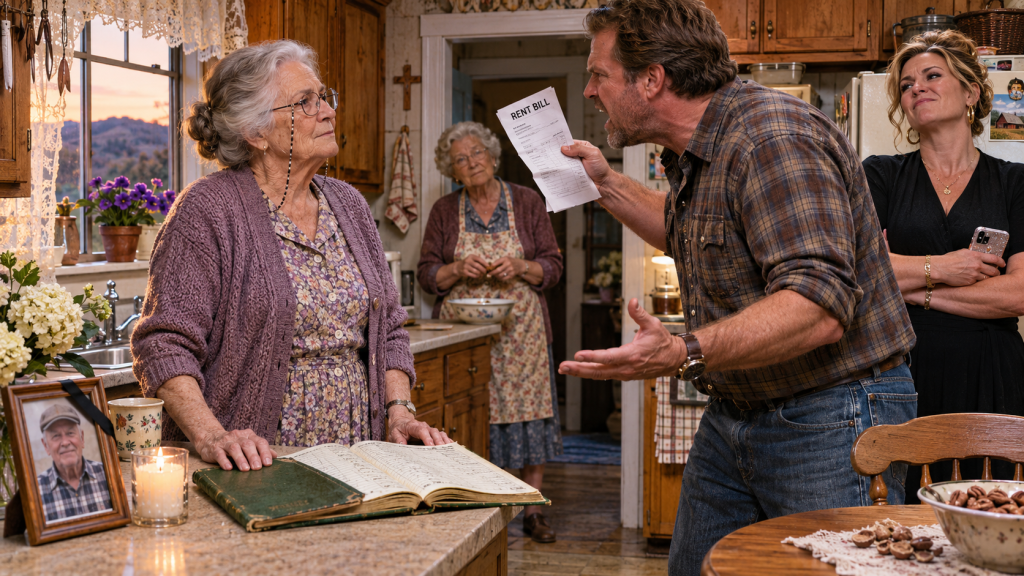
And began reading aloud. “Son, if you’re holding this letter, I reckon your mama has finally had enough of being called a burden in a house she helped pay for.” His face turned red. He looked up at me. “What’s this supposed to mean?” “Keep reading.” He swallowed. Then continued. “I’ve spent my whole life trying to give you a good start. Somewhere along the way, I started giving you things you should’ve learned to earn yourself.”
Brandon stopped. The kitchen was so quiet I could hear the clock ticking above the refrigerator. Then he read the next sentence. “The house you live in was never your inheritance. It was your second chance.” Brandon lowered the letter. “Daddy wouldn’t write something like that.” Willadean crossed her arms. “Honey, I knew Harlis forty-eight years. That’s his handwriting, and that’s his plain way of talking.”
Courtney stepped closer.
“Jeanie, this is ridiculous. You’re trying to turn a grieving family against each other.”
I looked at her.
“Courtney, nobody’s making you stay.”
She tightened her jaw.
Brandon stared at the page.
Then reluctantly continued reading.
“When your flooring business failed, you came to me ashamed. You said you couldn’t look your children in the eyes because you’d lost their home.”
I remembered that evening.
It was raining.
Brandon sat on our back steps with his head in his hands.
Harlis took two cups of coffee outside.
They stayed there nearly three hours.
When they came back inside, my husband told me we’d be letting Brandon’s family move into the brick house on Highway 62.
I hadn’t hesitated.
They were our children.
What else were we supposed to do?
Brandon’s voice became quieter.
“I told you the nine hundred dollars would help your mama, because I knew your pride couldn’t stand calling it rent.”
His hands trembled.
“I didn’t mind giving you a bargain. But I hoped you’d understand the bargain was a gift.”
Brandon stopped reading.
Courtney reached for the page.
“Let me see.”
He pulled it away.
“Wait.”
For the first time since arriving, he wasn’t shouting.
He looked frightened.
Like a little boy who’d discovered something about his father that he didn’t know how to understand.
Then he read:
“You were paying nine hundred dollars for a house that would have rented for considerably more. Your mama and I paid the taxes, insurance, repairs, and upkeep. We didn’t do it because you were incapable. We did it because we loved you.”
A tear slipped down my cheek.
I wiped it quickly.
I’d promised myself I wouldn’t cry in front of Courtney.
But hearing Harlis’s words in our son’s voice was more than I could bear.
Brandon turned the page.
There was another paragraph.
“But son, love is not the same as an endless handout. Your mama is getting older. So am I. One day I won’t be here to stand between her kindness and your demands.”
Brandon’s voice cracked.
He stopped.
Looked toward his father’s empty chair.
Then tried again.
“When that day comes, I want you to remember something. The measure of a man isn’t how much help he receives. It’s whether he remembers who helped him when he had nothing.”
Willadean quietly wiped her eyes.
Even Courtney looked down.
Then Brandon reached the final line.
“If you ever make your mother feel ashamed for needing help, remember whose house sheltered your family when nobody else would.”
He lowered the paper.
And for a long time, nobody spoke.
Then Courtney broke the silence.
“Well, that doesn’t change anything legally.”
I looked toward her.
“No, ma’am. It doesn’t.”
She seemed surprised by my answer.
I continued.
“The deed and the rental records establish who owns the house. Harlis’s letter just explains why we let you live there.”
Brandon rubbed his face.
“Daddy never told me any of this.”
I sighed.
“He told you parts of it, honey. You just heard what you wanted to hear.”
His eyes filled.
For a moment, I felt sorry for him.
Then I remembered him handing me that nine-hundred-dollar check beside his father’s grave.
This is the last one, Mom.
Not an hour after we buried my husband.
I straightened my shoulders.
“Brandon, you’re welcome to stay through the arrangements we legally agree upon. But from now on, business is business.”
Courtney frowned.
“What does that mean?”
“It means we’re going to put everything in writing.”
The following Monday, I drove to Harrison to meet with Ruth Talley, the attorney who’d handled our property papers.
Ruth was sixty-two, with silver hair and a habit of speaking plainly.
Harlis trusted her because she never charged us for a phone call without explaining why.
I brought the deed.
The old rental agreement.
Harlis’s ledger.
And the letter he’d left Brandon.
Ruth examined everything carefully.
Then looked at me.
“Jeanie, the property records support your ownership, subject to confirming the estate formalities.”
I nodded.
“And the rent?”
“The existing agreement needs to be reviewed alongside Arkansas landlord-tenant requirements. If you want to change the arrangement or end the tenancy, we’ll make sure the notices and procedures are proper.”
I sat back.
“Good.”
She studied me.
“Are you planning to evict your son?”
I looked toward the window.
“No.”
Then I took a breath.
“I’m planning to stop pretending the house belongs to him.”
Ruth explained that Harlis’s handwritten ledger was useful as a record of our financial arrangements, but it wasn’t a substitute for proper legal documentation.
I appreciated that.
I wasn’t interested in surprising Brandon with some trick he couldn’t understand.
I wanted the truth on paper.
Clear enough that nobody could pretend it was something different.
Together, we prepared an itemized statement showing what Harlis and I had paid toward the property.
Property taxes.
Insurance.
Roof repairs.
A replacement water heater.
Plumbing work.
Heating and cooling maintenance.
And years of other expenses.
Then Ruth calculated the difference between Brandon’s payments and the approximate market rent for a comparable house.
The number made me sit back in my chair.
“That much?”
She nodded.
“Those are estimates, Jeanie, not money he automatically owes. But they show how substantial the discount has been.”
I stared at the page.
For six years, Brandon had believed he was supporting me.
The truth was almost the opposite.
That evening, I made myself a pot of chicken soup.
Harlis always said mine needed more pepper.
I caught myself reaching for his bowl.
Then remembered.
I stood there holding it until the tears came.
Nobody tells you how much grief lives in ordinary objects.
The empty chair.
The second coffee cup.
The work boots by the back door.
The toothbrush you can’t bring yourself to throw away.
I had been so busy dealing with Brandon that I hadn’t allowed myself to sit with losing the man I’d loved since I was twenty-two.
I carried my soup to the table.
Set it down.
And whispered, “Well, Harlis, I reckon we’re making a mess of things.”
Then I laughed.
A small, broken laugh.
Because I could almost hear him answering.
“You always did worry too much, Jeanie.”
Three days later, Courtney called.
Her voice was sweet.
Too sweet.
“Jeanie, I’ve been thinking about everything.”
I held the phone away from my ear and looked at it.
“Have you?”
“Yes. And I think emotions are running high.”
“That’s probably true.”
She continued.
“Brandon’s very upset about his father’s death.”
“So am I.”
There was a pause.
Then she said, “We think it’d be best if you just signed the house over to us.”
I nearly dropped the phone.
“I’m sorry?”
“You know, to simplify the estate.”
I looked toward Harlis’s empty chair.
“Courtney, that house is mine.”
“Well, eventually it would go to Brandon, wouldn’t it?”
I took a breath.
“That’s not a decision I’ve made.”
Her voice sharpened.
“He’s your only child.”
“I know exactly who my son is.”
She sighed.
“Jeanie, you don’t need two houses.”
I closed my eyes.
There it was.
Not a question about how I was sleeping.
Not a word about Harlis.
Just the house.
Again.
“Courtney,” I said, “I’m going to hang up now.”
She sounded startled.
“Why?”
“Because I have soup on the stove, and I’m not discussing my property over the telephone.”
“Jeanie—”
“Goodbye, honey.”
I ended the call.
Then sat quietly.
For the first time in my life, I’d told my daughter-in-law no without explaining myself for twenty minutes.
It felt strange.
And, I’ll admit, a little wonderful.
The next Sunday, I went to church.
I almost stayed home.
Every pew reminded me of Harlis.
Every hymn sounded like something he should’ve been singing beside me.
But Willadean came knocking at eight-thirty.
“Get dressed, Jeanie.”
I opened the door in my robe.
“Willadean, I’m tired.”
She looked at me.
“Honey, you can be tired sitting in church just as well as sitting here.”
I laughed.
She brought a covered dish for the fellowship lunch and waited while I found my shoes.
At church, people hugged me.
Asked how I was managing.
Some cried when they mentioned Harlis.
I cried too.
Then Mrs. Dobbins caught my arm near the coffee table.
“Jeanie, I heard Brandon and Courtney are moving because you’re charging them rent.”
My stomach tightened.
“Is that what you heard?”
She nodded sympathetically.
“Such a difficult thing for a family.”
I looked at her.
And suddenly understood.
The story had already started traveling around Yellville.
I wasn’t angry with Mrs. Dobbins.
Small towns run on stories.
Some true.
Some not.
Most somewhere in between.
But I knew exactly where this one had come from.
I smiled politely.
“Brandon’s been renting our house for six years. We’re just clarifying the arrangement.”
She blinked.
“Oh.”
I nodded.
“Harlis and I owned the property the whole time.”
Her mouth opened.
Then closed.
Willadean appeared beside me carrying two paper cups of coffee.
“Come on, Jeanie. Pastor’s looking for you.”
As we walked away, she whispered, “That’ll give Mrs. Dobbins something new to chew on.”
I nearly choked laughing.
For a moment, I felt like myself again.
That afternoon, Brandon called.
He sounded furious.
“Mom, did you tell people at church we’re renting?”
I closed my eyes.
“Yes.”
He exhaled sharply.
“Now everybody thinks I’m some kind of freeloader.”
I took a breath.
“Brandon, I didn’t call you that.”
“You didn’t have to!”
I looked through the window.
A cardinal stood on the bird feeder Harlis had built.
“Son, I told the truth.”
He was quiet.
Then said, “Courtney’s embarrassed.”
I swallowed.
“Your wife told people she was supporting me.”
He didn’t answer.
“Was I supposed to keep repeating something that wasn’t true so she wouldn’t feel embarrassed?”
Silence.
Then Brandon muttered, “You don’t understand.”
I closed my eyes.
“Maybe not.”
My voice softened.
“But I’m ready to understand if you want to explain.”
He hung up.
A week later, Ruth called.
“Jeanie, I received an inquiry from an attorney representing Brandon and Courtney.”
I sat down.
“What kind of inquiry?”
“They’re asking whether Harlis intended the property to be a gift.”
I stared at the wall.
“A gift?”
“Yes.”
I took a breath.
“But the deed is in my name.”
Ruth nodded.
“That’s important. We’ll respond through the proper channels.”
I swallowed.
“Do they have a claim?”
“Not one we should assume is valid. We’ll examine any documents they produce and deal with the issue according to the facts.”
I looked toward Harlis’s desk.
For years, he’d kept every receipt.
Every tax statement.
Every payment record.
I’d teased him about it.
Now I was grateful.
Two days later, Ruth asked me to come to her office.
She had received a copy of a document Brandon’s attorney had supplied.
I stared at it.
Across the top were the words:
PROPERTY TRANSFER AGREEMENT.
My stomach tightened.
Below was the address.
4112 Highway 62.
And at the bottom was a signature.
Harlis’s signature.
Or something meant to look like it.
I sat very still.
“Ruth, what’s this?”
She watched me carefully.
“Brandon’s attorney says his clients found it among their papers.”
I swallowed.
“It says Harlis agreed to transfer the property to them.”
“Yes.”
I looked closer.
The signature was dated just six weeks before my husband’s death.
My heart began pounding.
Harlis had been sick that week.
He’d barely left the house.
I stared at the paper.
Then shook my head.
“Something’s wrong.”
Ruth leaned forward.
“What?”
I pointed toward the bottom.
“Harlis didn’t sign his name that way.”
She examined it.
“Tell me what you notice.”
I swallowed.
“He always crossed the H in Harlis with a long stroke.”
My eyes filled.
“And when his hands started shaking, he stopped writing his full middle initial.”
I pointed.
“This has both.”
Ruth nodded thoughtfully.
“We’ll need the original and an appropriate examination before reaching conclusions.”
I looked down.
For the first time since the funeral, I felt frightened.
Not because I thought Brandon could simply take the house.
But because someone had produced a document that appeared to contradict everything Harlis and I had arranged.
That evening, I called Willadean.
“Come over.”
She arrived with a bag of biscuits and a jar of blackberry jam.
I showed her the document.
She studied it.
Then frowned.
“Harlis didn’t write that.”
I looked at her.
“You can tell?”
She pointed at the signature.
“Honey, he signed the birthday card he gave me two months before he died. I’ve still got it.”
My heart began pounding.
“Would you bring it?”
She nodded.
“Of course.”
Then she looked at me.
“Jeanie, what are you going to do?”
I stared toward the window.
“I don’t know.”
And for the first time, I meant it.
That night, I barely slept.
I kept thinking about Brandon as a child.
The way he’d bring home drawings from school.
How he’d run toward Harlis whenever the propane truck pulled into the driveway.
The night he graduated high school, when his father hugged him so tightly they both cried.
I couldn’t reconcile that boy with the man now questioning my ownership of the house.
I wondered whether I had failed him.
Whether we’d helped too much.
Whether our kindness had taught him to expect things without understanding their cost.
Then I remembered something Harlis used to say.
“You can give a man a ladder, Jeanie. But you can’t climb it for him.”
I closed my eyes.
Maybe we’d spent too many years climbing.
The next morning, I opened Harlis’s green ledger again.
I turned past the rent entries.
Past the property taxes.
Past the repair costs.
Then found a page marked with a folded grocery receipt.
There was a handwritten note.
Brandon asked about the deed again. Told him no. House stays with Jeanie. Need to update attorney.
My hands trembled.
Below it was a date.
Three months before Harlis died.
I sat down.
He’d known.
My husband had known our son wanted the house.
I read further.
The next entry said:
Courtney says they’re spending money on improvements. Reminded them not to make changes without written approval.
My chest tightened.
Then I saw another note.
Talked to Ruth about protecting Jeanie’s ownership. Documents to be reviewed.
I reached for the telephone.
Ruth answered immediately.
“Jeanie?”
“I found something.”
She listened as I read the ledger entries aloud.
Then said, “Bring the book in. We’ll compare it with our office records.”
I swallowed.
“Ruth, did Harlis talk to you about Brandon?”
There was a pause.
“Yes.”
My chest tightened.
“What did he say?”
Her voice softened.
“He was worried that your son misunderstood the arrangement.”
I looked down.
“Why didn’t he tell me?”
Ruth hesitated.
“He believed he could straighten it out without upsetting you.”
I closed my eyes.
That was Harlis.
Always trying to keep trouble away from my doorstep.
Even when the trouble had already found its way into the family.
At Ruth’s office, she retrieved a file from the cabinet.
Inside were notes from a meeting with Harlis.
He had asked her to confirm that the house remained in our ownership and that Brandon had no automatic right to it merely because he’d lived there.
He’d also discussed updating our estate documents.
I stared at the file.
“Did he finish?”
Ruth looked toward me.
“Some of the planning was completed. Other matters remained pending when he died.”
I nodded.
Then she showed me something unexpected.
A letter Harlis had written but apparently never mailed.
It was addressed to Brandon.
I recognized my husband’s handwriting immediately.
Son, I love you. But your mama’s home and security come first. Don’t ever confuse my willingness to help you with a promise to give away what we worked for.
My eyes filled.
Ruth continued.
“There’s something else, Jeanie.”
I looked up.
She placed another document on the desk.
It was a copy of an email sent to her office.
From Courtney.
Dated two months before Harlis died.
The subject line read:
TRANSFER OF HIGHWAY 62 PROPERTY — URGENT.
My stomach tightened.
“What does it say?”
Ruth answered carefully.
“Courtney asked whether Harlis could transfer the property without your involvement.”
For several seconds, I couldn’t breathe.
Then I whispered, “What did you tell her?”
Ruth looked directly at me.
“That the ownership records didn’t support that, and any valid transfer would require the appropriate owners’ participation.”
I closed my eyes.
But she wasn’t finished.
“Jeanie, Courtney sent a second message after I refused to prepare the paperwork.”
My heart pounded.
“What message?”
Ruth turned the page.
There was one sentence.
“If Harlis won’t sign willingly, Brandon says we may have another way.”
I stared at the words.
My hands went cold.
For years, I’d believed Courtney was simply impatient and proud.
Now I wondered whether she’d been planning something far more serious.
Then Ruth said something that made my chest tighten.
“Jeanie, we also checked the county property records this morning.”
I looked toward her.
“What did you find?”
She hesitated.
“Someone submitted a document concerning the Highway 62 house shortly after Harlis’s funeral.”
My throat tightened.
“What document?”
Ruth took a breath.
“A deed purporting to transfer your ownership interest to Brandon and Courtney.”
For a moment, I couldn’t hear anything.
I stared at her.
Then whispered:
“Ruth, I never signed a deed.”
Her expression hardened.
“I know, Jeanie.”
She slid the recorded copy across the desk.
At the bottom was a signature bearing my name.
And beside it, a notary acknowledgment.
I looked at the date.
It was the day after we buried Harlis.
The same day Brandon handed me that final nine-hundred-dollar check.
And suddenly, I understood that the fight over the house had started before I ever mailed my first rent bill.