➡️ PART 3 ➡️
For sixty-eight years, I had believed that the hardest part of growing older would be watching the people I loved disappear. I had already buried my husband, Bruce, after forty-three years of marriage. I had learned to sleep on one side of a bed that suddenly seemed too large. I had learned to make coffee for one, to attend church without his hand resting beside mine, and to celebrate anniversaries nobody else remembered.
But nothing prepared me for the morning I discovered that my own son had begun treating my life savings as an inheritance he was entitled to collect while I was still alive. I stood on my front porch, holding my phone. The notification from the bank glowed on the screen. TRANSFER DECLINED: $80,000.
Destination account: Monica Elaine Foster. My daughter-in-law’s maiden name. I looked toward Jeffrey. He was standing three steps below me, his face pale. Monica stood beside him, staring at the screen as though she could somehow make the evidence disappear. For several seconds, nobody spoke.
Then I asked the question that would change our family forever. “Jeffrey, were you trying to take eighty thousand dollars from your father’s life insurance?” His mouth opened. Nothing came out. Monica stepped forward. “That’s not what happened.” I looked at her.
“Then explain it.”
She folded her arms.
“We were borrowing it.”
I stared at her.
“Without asking me?”
Her expression hardened.
“We were going to tell you.”
I looked back at my son.
“And when exactly were you planning to do that?”
He lowered his eyes.
“After the closing.”
The morning air suddenly felt colder.
I gripped the porch railing.
“Closing?”
Jeffrey swallowed.
“We found a house.”
I nodded slowly.
“A house.”
He looked miserable.
“It’s in a better school district.”
Monica immediately interrupted.
“And Oliver and Stella deserve a proper backyard.”
I stared at her.
My grandchildren already lived in a comfortable three-bedroom home.
They had bedrooms of their own, a small garden, and a neighborhood playground two streets away.
I had helped with their mortgage payments more than once.
Now Jeffrey and Monica were apparently purchasing something larger.
With my money.
“Where is this house?” I asked.
Jeffrey hesitated.
“Westbrook Estates.”
I recognized the neighborhood.
Large houses.
Expensive landscaping.
Private gates.
A community where the property taxes alone could swallow a considerable portion of my annual pension.
I took a breath.
“How much?”
Monica answered before Jeffrey could.
“Eight hundred and forty thousand.”
For a moment, I couldn’t speak.
Then I whispered, “You were planning to buy an eight-hundred-and-forty-thousand-dollar house using money your father left to help me survive without him.”
Monica rolled her eyes.
“Why do you always make everything sound so dramatic?”
I looked directly at her.
“Because you tried to transfer eighty thousand dollars from an account funded by my husband’s life insurance.”
She crossed her arms.
“Jeffrey said the money was available.”
I turned toward him.
“Did you?”
His eyes filled.
“Mom, I thought—”
“What did you think?”
He swallowed.
“That you weren’t using it.”
For several seconds, I stared at him.
Then I laughed.
Not because anything was funny.
But because the answer was so painfully revealing.
I wasn’t using it.
As though money left untouched automatically belonged to whoever wanted it most.
As though financial security stopped mattering once a woman turned sixty-eight.
As though the savings Bruce and I had built together existed merely to solve the next expensive problem Jeffrey and Monica created.
I took a breath.
“Your father didn’t leave that money so you could buy a bigger kitchen.”
Jeffrey lowered his head.
“He left it so I wouldn’t have to worry about losing my home.”
Monica stepped forward.
“You’re acting like we’re strangers.”
I looked at her.
“No.”
My voice trembled.
“That’s what makes this so painful.”
She opened her mouth.
I raised my hand.
“For three years, I’ve rearranged my life around your family’s needs.”
I swallowed.
“I’ve collected Oliver and Stella from school when you couldn’t leave work. I’ve paid bills you promised to reimburse. I’ve cooked meals when you were overwhelmed.”
Jeffrey stared at the driveway.
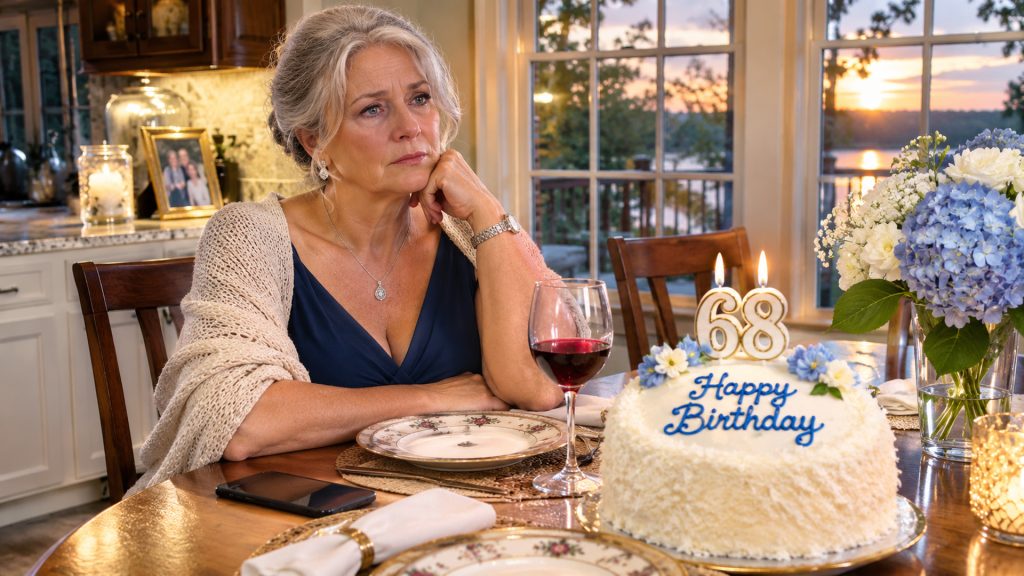
“And yesterday, on my birthday, you told me Monica had a migraine.”
Monica looked away.
I continued.
“You didn’t tell me you’d made other plans. You didn’t ask whether we could celebrate another day.”
My throat tightened.
“You left me sitting beside a table set for five.”
Jeffrey’s face crumpled.
“Mom—”
“And when your card was declined, you called me from the restaurant.”
I looked directly at him.
“Not to wish me a happy birthday.”
Tears filled my eyes.
“But to demand my money.”
For a long time, the porch was silent.
Then Jeffrey whispered, “I’m sorry about yesterday.”
I nodded.
“Thank you.”
He looked relieved.
But I wasn’t finished.
“Now explain the transfer.”
His shoulders fell.
“Mom, we didn’t think it would be a problem.”
I held up my phone.
“An eighty-thousand-dollar transfer from an account you were not authorized to empty?”
Jeffrey looked toward Monica.
She shook her head slightly.
It was such a small movement that I might have missed it.
But I didn’t.
After forty-three years of marriage, I knew what a silent warning between spouses looked like.
I leaned against the railing.
“Jeffrey, I want the truth.”
He swallowed.
Then whispered, “Monica had the account information.”
I went still.
“What information?”
He hesitated.
“From the paperwork Dad left.”
My heart began pounding.
Bruce had always been meticulous about documents.
He kept insurance policies, bank statements, and property records in labeled folders.
After his death, Jeffrey helped me organize the files because I could barely bring myself to enter Bruce’s study.
I remembered sitting at the kitchen table while my son sorted documents into piles.
I remembered thanking him.
I remembered believing he’d been helping me through the worst weeks of my life.
Now I stared at him.
“Did you copy the banking information?”
Jeffrey’s eyes filled.
“Yes.”
My chest tightened.
“And you gave it to Monica?”
He nodded.
I closed my eyes.
There were different ways to betray someone’s trust.
Some happened loudly.
Others began with a son sitting beside his grieving mother, quietly copying information she assumed he would protect.
Monica suddenly spoke.
“Can we stop pretending you’re destitute?”
I opened my eyes.
She gestured toward the house.
“You own this place outright. You have a pension. You have savings.”
I looked at her.
“And?”
She frowned.
“And you’re not exactly spending eighty thousand dollars on anything.”
I studied her.
“Monica, do you know how much assisted living costs?”
She blinked.
“What?”
“Or home repairs?”
I took a breath.
“Or medical expenses that insurance might not fully cover?”
She said nothing.
I continued.
“Do you know how much money Bruce and I saved because we wanted to make sure neither of us became a financial burden on our children?”
Jeffrey looked up.
My voice broke.
“We spent forty-three years planning for a future we hoped we’d share.”
I glanced toward the front door.
“But now he’s gone.”
And for the first time that morning, my son began crying.
I wasn’t ready to comfort him.
Not yet.
I took another breath.
“I’m going inside.”
Monica stepped forward.
“We haven’t finished discussing the house.”
I looked toward her.
“Yes, we have.”
She stared at me.
“You can’t just refuse to help your grandchildren.”
My chest tightened.
“Helping Oliver and Stella doesn’t require financing a house their parents can’t afford.”
Jeffrey looked down.
I continued.
“I love those children.”
My voice softened.
“And I always will.”
Then I looked at both of them.
“But loving them doesn’t mean I have to surrender my financial independence.”
I opened the storm door.
“Please leave.”
Inside, I walked straight to Bruce’s study.
The room still smelled faintly of his old leather chair and the cedar polish he used on the desk.
His reading glasses rested beside a framed photograph of us at Niagara Falls.
I sat down.
For several minutes, I simply stared at his picture.
Then I whispered, “Bruce, I don’t know what happened to our boy.”
My voice broke.
“He used to be so thoughtful.”
I remembered Jeffrey at eight years old, saving his allowance to buy me a little glass bird for Mother’s Day.
He’d wrapped it in newspaper because he couldn’t afford gift paper.
I still had it.
It sat on the shelf above Bruce’s desk.
Now that same child was forty-two years old.
And he had just admitted helping his wife access financial information he knew wasn’t hers.
I covered my face.
Then I began crying.
That afternoon, I called the bank.
I spoke with the fraud department and explained the attempted transfer.
The representative reviewed the account activity.
She confirmed that the blocked transaction required investigation and helped me secure the account against further unauthorized access.
I also asked about the money market account I’d shared with Jeffrey.
The answer worried me.
Jeffrey had been listed as a joint account holder.
That meant the situation was more complicated than simply changing a password.
The representative advised me that his access rights depended on the account agreement and that any disputed transactions needed to be reviewed carefully.
I understood.
I didn’t want to accuse anyone of something the records couldn’t support.
But I wanted to know exactly what had happened.
So I requested complete statements.
Then I contacted an attorney.
Her name was Eleanor Price.
She was a calm woman in her fifties who specialized in estate planning and financial matters affecting older adults.
We met the following morning.
I brought everything.
Credit card statements.
Bank records.
The insurance paperwork.
Copies of the messages from Jeffrey and Monica.
And a photograph of the birthday dinner I’d prepared for five people who never came.
Eleanor examined the documents carefully.
Then asked a question that made me pause.
“Why did you make Jeffrey a joint account holder?”
I looked down.
“Bruce and I wanted someone who could help if I became ill.”
She nodded.
“That’s understandable.”
I swallowed.
“I trusted him.”
She looked toward me.
“Trust isn’t a mistake. But financial arrangements should reflect exactly what authority you intend to give someone.”
I nodded slowly.
She continued.
“We need to review how the account was established, what rights Jeffrey had, and whether any transactions were outside the authority you intended.”
For the first time, I felt the situation becoming clearer.
Painful.
But clearer.
Over the next several days, Eleanor helped me examine my accounts and estate documents.
Some arrangements were outdated.
Others gave Jeffrey access I hadn’t realized was so broad.
We discussed alternatives for handling emergencies without leaving large amounts of money exposed to unnecessary risk.
I also reviewed my healthcare directives, emergency contacts, and the people authorized to make decisions if I couldn’t speak for myself.
For years, I’d assumed Jeffrey would naturally handle everything.
Now I understood that being someone’s child wasn’t the same as being trustworthy with every responsibility.
That realization broke my heart.
But it also gave me a chance to make thoughtful changes.
Three days after my birthday, Jeffrey called.
His voice sounded exhausted.
“Mom?”
I sat beside the kitchen window.
“Yes?”
“Can we talk?”
I looked toward the garden.
“About what?”
He hesitated.
“The house deal fell through.”
I swallowed.
“I’m sorry.”
There was a pause.
Then he said, “We lost the deposit.”
My chest tightened.
“How much?”
“Ten thousand.”
I closed my eyes.
“And you couldn’t recover it?”
He sighed.
“Not all of it.”
I took a breath.
“Jeffrey, why did you make an offer before knowing whether you could afford the purchase?”
He was quiet.
Then whispered, “Monica thought we’d be able to work something out.”
I stared at the window.
“And you?”
He swallowed.
“I wanted to give the kids more.”
My throat tightened.
“Jeffrey, children need security.”
I paused.
“They don’t need a house that requires taking money from their grandmother.”
He began crying.
“Mom, everything is falling apart.”
I closed my eyes.
For most of my life, those words would have sent me reaching for my checkbook.
I’d have asked how much he needed.
What bill was due.
Whether I could make the problem disappear.
But I was beginning to understand that solving every crisis for Jeffrey had prevented him from learning how to solve some of them himself.
“I know you’re frightened,” I said gently.
He sniffed.
“But I can’t rescue you from this.”
There was a long silence.
Then he whispered, “You sound different.”
I looked toward Bruce’s photograph on the mantel.
“Maybe I am.”
The following afternoon, Monica arrived alone.
I saw her car pull into the driveway.
For a moment, I considered not answering.
Then I stepped onto the porch.
She looked tired.
Her makeup was smudged.
Her usual confidence had disappeared.
“Can we talk?” she asked.
I nodded.
“Here.”
Her expression tightened.
“You’re still not letting us inside?”
I took a breath.
“Not until we rebuild some trust.”
She looked away.
Then whispered, “Jeffrey says you’re changing your will.”
I felt cold.
“Did he?”
She nodded.
I studied her.
“Monica, what I do with my estate is private.”
Her eyes filled.
“But you’re punishing the children.”
I shook my head.
“No.”
I swallowed.
“I’m making decisions about my own future.”
She wiped her cheeks.
Then said something that surprised me.
“Do you know how much pressure Jeffrey puts on himself?”
I looked at her.
“He thinks he has to give us everything.”
I nodded slowly.
“I understand wanting to provide for your family.”
Monica’s voice broke.
“But he feels like he’s failing.”
I took a breath.
“Then he needs to make a financial plan based on what he actually earns.”
She stared at me.
“And accept that some things have to wait.”
For a moment, I thought she might finally understand.
Then she whispered, “But Bruce would have wanted Jeffrey to have the money.”
My chest tightened.
I looked directly at her.
“Monica, please don’t tell me what my husband would have wanted.”
She flinched.
I continued.
“You knew him for twelve years.”
My voice trembled.
“I was married to him for forty-three.”
She lowered her eyes.
“Bruce spent his final months worrying about whether I’d be comfortable.”
Tears filled my eyes.
“He wanted me to have enough money to remain independent.”
I took a breath.
“And I won’t let you turn his love into an argument for taking away my security.”
Monica began crying.
For several seconds, neither of us spoke.
Then she walked back to her car.
That evening, I received a message from Oliver.
He was thirteen.
Grandma, are you mad at us?
My heart broke.
I sat at the kitchen table and stared at the words.
Then I called him.
He answered immediately.
“Grandma?”
“Hello, sweetheart.”
His voice sounded small.
“Mom says you don’t want us coming over anymore.”
I closed my eyes.
“Oh, Oliver.”
He sniffed.
“Did we do something?”
“No, darling.”
My throat tightened.
“You and Stella haven’t done anything wrong.”
He was quiet.
Then whispered, “Why weren’t we allowed to come to your birthday?”
I froze.
“What?”
Oliver hesitated.
“Mom said you’d canceled dinner.”
I stared at the wall.
For several seconds, I couldn’t speak.
Then I whispered, “She told you that?”
He nodded, although I couldn’t see him.
“Yeah.”
My eyes filled.
“Oliver, I didn’t cancel.”
There was a long silence.
Then he asked, “You made cake?”
I began crying.
“Yes, sweetheart.”
Oliver was quiet.
Then whispered, “I made you a card.”
My chest tightened.
“You did?”
“Yeah.”
He sniffed.
“Stella drew flowers on it.”
I covered my mouth.
“We were going to give it to you.”
My voice broke.
“Oh, Oliver.”
He continued.
“Mom said you weren’t feeling well.”
I stared toward the kitchen.
The birthday cake was still in the refrigerator.
A few slices remained.
The candles were in a drawer.
And suddenly, the empty chairs felt even more painful.
Not because my grandchildren had chosen not to come.
But because someone had prevented them from knowing they were expected.
I took a breath.
“Sweetheart, I would love to see you and Stella.”
His voice brightened.
“Really?”
“Of course.”
I swallowed.
“And your grandmother will always love you.”
When I ended the call, I sat quietly.
For years, I’d believed Monica was simply thoughtless.
Demanding.
Sometimes careless with money.
But now I was discovering something more troubling.
She had told me the children weren’t coming because she had a migraine.
Then she’d told the children I’d canceled the dinner.
She had controlled both sides of the story.
And I’d been too hurt to ask questions.
I looked toward Bruce’s photograph.
“Something isn’t right,” I whispered.
The next morning, I called Jeffrey.
He answered after several rings.
“Mom?”
I took a breath.
“Why did Monica tell the children I canceled my birthday dinner?”
Silence.
Then he whispered, “What?”
“Oliver told me.”
Jeffrey didn’t answer.
I continued.
“He said Stella made me a card.”
My throat tightened.
“And they thought I was sick.”
Jeffrey sighed.
“Monica said it would be easier that way.”
I stared at the wall.
“Easier for whom?”
He was silent.
“Jeffrey, your children believed I didn’t want them there.”
His voice broke.
“I know.”
I closed my eyes.
“And you let them believe that?”
He whispered, “Yes.”
For a long moment, I couldn’t speak.
Then I said quietly, “Your father and I raised you to understand that avoiding discomfort doesn’t justify dishonesty.”
Jeffrey began crying.
“I know.”
I swallowed.
“You keep saying that.”
He sniffed.
“But you keep letting other people pay for your decisions.”
There was silence.
Then he whispered, “Mom, I need to tell you something.”
My stomach tightened.
“What?”
He hesitated.
“The money market account.”
I sat down.
“What about it?”
His voice trembled.
“Monica thought you wouldn’t notice the transfer because we’d already arranged to move the money back.”
My heart began pounding.
“From where?”
He didn’t answer immediately.
Then whispered, “From the sale of our current house.”
I stared at the wall.
“Jeffrey, you haven’t sold your house.”
He swallowed.
“No.”
My chest tightened.
“So how were you going to replace eighty thousand dollars?”
For several seconds, he was silent.
Then he said something that made my blood run cold.
“Mom, we weren’t planning to replace all of it.”
I gripped the telephone.
“What?”
Jeffrey began crying.
“We thought part of it could count toward what Dad would have wanted me to inherit.”
I closed my eyes.
There it was.
The assumption beneath every unpaid loan.
Every restaurant charge.
Every financial demand.
The belief that my husband’s death had turned his savings into money my son could begin collecting whenever he wished.
I took a breath.
“Jeffrey, your father left that money to me.”
“I know.”
“Then why are you treating it as yours?”
He sobbed.
“I don’t know.”
I sat quietly.
Then whispered, “I think you do.”
Later that afternoon, Eleanor called.
She had finished reviewing the account history.
“There’s something we need to discuss,” she said.
My stomach tightened.
“What?”
“Your joint money market account was used to establish an additional linked account several months ago.”
I sat upright.
“Linked how?”
She explained that the records showed a separate account associated with Jeffrey’s banking profile.
Some transfers between the accounts had occurred.
The total wasn’t yet clear.
My heart pounded.
“Did he move money?”
“There are transactions we need to review carefully.”
I swallowed.
“How much?”
Eleanor paused.
“Based on the statements we’ve received so far, approximately thirty-six thousand dollars was transferred over several months.”
For a moment, I couldn’t breathe.
Thirty-six thousand dollars.
Before the attempted eighty-thousand-dollar transfer.
Before the birthday dinner.
Before I froze the card.
I gripped the edge of the table.
“Where did it go?”
Eleanor took a breath.
“Some payments appear connected to household expenses.”
I swallowed.
“And the rest?”
She hesitated.
“There’s a recurring transfer to an account we haven’t fully identified.”
My heart tightened.
“Whose account?”
Eleanor paused.
“That’s what concerns me.”
I stared toward the window.
Then she said quietly:
“The available records suggest the account may be associated with someone other than Jeffrey or Monica.”
I closed my eyes.
“What does that mean?”
Eleanor took a breath.
“There’s one more document I want you to see before we draw conclusions.”
My hands began trembling.
“What document?”
She answered slowly.
“An authorization form submitted three months ago. It appears to bear your signature, but the transaction records indicate it was created while you were hospitalized for your knee replacement.”
I stared at Bruce’s photograph.
My heart pounded.
Because three months earlier, while I was recovering from surgery, Jeffrey and Monica had been the ones collecting my mail, bringing groceries, and assuring me they were handling everything.
And now I was beginning to wonder exactly what they’d handled.


