➡️ PART 3 ➡️
For thirty-eight years, I had believed my father was the simplest man in the world. He wore the same brown work boots until the soles split. He drank his coffee black, saved every screw in old peanut-butter jars, and considered a perfectly good Saturday one spent fishing without catching anything. He never talked about money.
Never bragged about what he owned. And never made me feel that the size of a man’s bank account mattered more than the promises he kept. But sitting in Hank’s marina office, staring at a photograph of my stepmother beside a stranger my father had apparently been investigating, I began to understand how much he’d kept to himself.
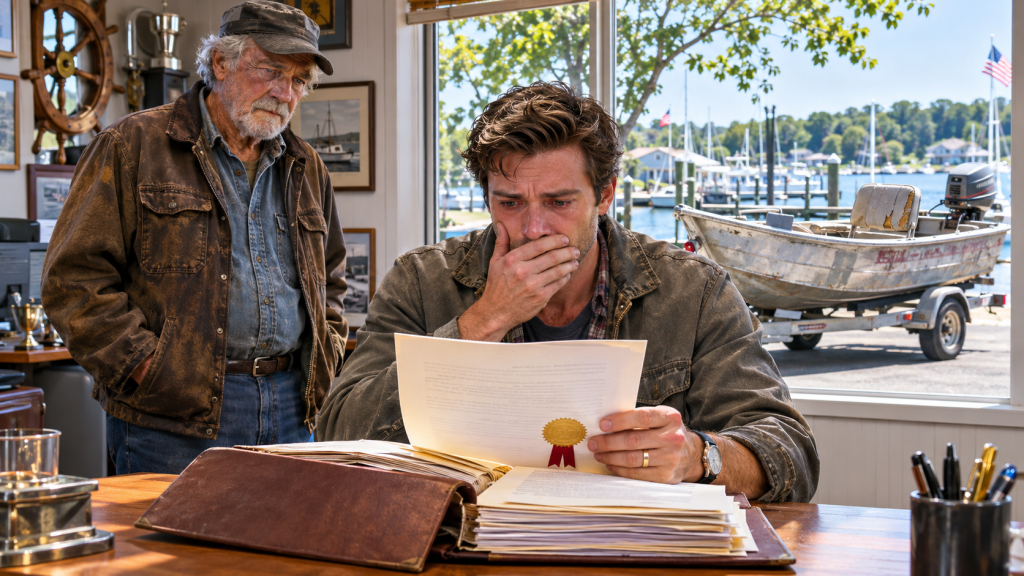
The man in the photograph had attended Dad’s funeral. He’d worn a navy suit and stood behind Sheila during the graveside service. I remembered him because he’d approached me afterward, shaken my hand, and said something peculiar. “Your father was a careful man.” At the time, I’d thought it was a compliment. Now I wasn’t so sure. I looked at Hank.
“What did he want yesterday?” Hank folded his arms. “He asked whether the old aluminum boat was still here.” My stomach tightened. “And?” “Told him it was.” “Did he ask about the box?” Hank nodded. “Said your father had left some papers that belonged to the family.” I stared at him. “What did you say?”
Hank’s expression hardened.
“I told him the only person authorized to collect anything was Daniel.”
For the first time that afternoon, I felt grateful that my father had spent forty years building a friendship with a man who understood the value of keeping his word.
I gathered the documents carefully.
The wooden box.
The brass key.
The letter from Dad.
And the photograph.
Then I looked toward Hank.
“Who is that man?”
Hank hesitated.
“His name is Victor Lang.”
I frowned.
“Do you know him?”
“Not personally.”
He lowered his voice.
“But your dad mentioned him twice before he died.”
My heart began pounding.
“What did he say?”
Hank looked toward the boat through his office window.
“He said Victor was helping Sheila with some financial arrangements.”
I swallowed.
“What arrangements?”
“Your dad wouldn’t tell me.”
Hank paused.
“But the last time he came fishing, he wasn’t himself.”
I remembered that Saturday.
It had been in late August, three weeks before the stroke.
Dad barely touched his coffee.
He kept looking toward the shore, as though expecting someone.
When I asked what was wrong, he smiled and said he was getting old.
Now I wondered whether he’d been afraid.
I drove straight to Mr. Pruitt’s office.
The same office where Sheila had laughed at my inheritance.
The same room where I’d learned that the house, cars, lake property, and $2.1 million had been left to her.
Mr. Pruitt was sitting behind his desk when I arrived.
He looked up.
“Daniel.”
I placed the wooden box in front of him.
“Hank said Dad wanted me to bring this.”
Mr. Pruitt’s expression changed.
He removed his glasses.
Then looked toward the door.
“Would you mind closing that?”
My stomach tightened.
I closed it.
He gestured toward the chair.
“Sit down, son.”
I remained standing.
“Who is Victor Lang?”
Mr. Pruitt was silent.
Then he leaned back.
“I was hoping your father would have the opportunity to discuss this with you himself.”
I swallowed.
“He didn’t.”
The attorney nodded slowly.
“No. He didn’t.”
I handed him the letter.
He read it without speaking.
Then examined the photograph.
When he reached the handwritten words on the back, his jaw tightened.
Ask Pruitt about the other will.
I stared at him.
“There’s another will?”
He looked up.
“There’s an earlier will, Daniel. More than one, actually.”
My chest tightened.
“Then why did Sheila receive everything?”
“Because the most recent properly executed will generally controls, subject to applicable law and any valid challenge.”
I shook my head.
“Did Dad change his mind?”
Mr. Pruitt paused.
“That’s what we need to examine.”
I sat down.
For the first time since Dad died, I felt something colder than grief.
Fear.
Not because Sheila might have received money that should have been mine.
But because my father might have spent his final months trying to tell me something he never got to say.
Mr. Pruitt opened a cabinet and retrieved an older file.
He placed a document on the desk.
It was dated 2018.
Five years before Dad’s death.
I recognized his signature immediately.
The provisions were different.
Dad had intended to leave Sheila the marital home and a substantial share of his investments.
The lake property was to be sold, with part of the proceeds going to a scholarship fund in my mother’s name.
And I was to receive a share of the remaining estate.
I stared at the page.
“Why didn’t he tell me?”
Mr. Pruitt smiled sadly.
“Your father didn’t like discussing inheritances. He said he wanted you to build your own life without waiting for his money.”
That sounded exactly like Dad.
Then the attorney slid another document forward.
“This is the will read after his death.”
I examined the date.
Eight months earlier.
My stomach tightened.
“Did you prepare it?”
Mr. Pruitt shook his head.
“No.”
I looked up.
“What?”
“It was prepared by another attorney. Your father later brought it to me for safekeeping.”
I stared at him.
“Did he explain the changes?”
“He said he wanted time to think.”
I leaned forward.
“Mr. Pruitt, did Dad tell you he was unhappy with it?”
The attorney chose his words carefully.
“He expressed concerns about several provisions. We discussed whether he wished to make revisions.”
My heart pounded.
“And?”
“He requested information about preparing a new estate plan, but he never executed a replacement through my office.”
I looked down.
There it was.
A painful truth.
My father had apparently reconsidered the arrangement.
But reconsidering wasn’t the same as changing a will.
I couldn’t simply wish the older document back into effect.
I needed to understand what had happened.
I took a breath.
“Who prepared the newer will?”
Mr. Pruitt opened the file.
A letterhead appeared at the top.
Lang Financial and Estate Services.
My stomach dropped.
“Victor Lang?”
Mr. Pruitt nodded.
“He’s associated with the firm that coordinated the documentation, although a licensed attorney is identified as the drafter.”
I stared at the name.
The man at Dad’s funeral.
The man standing beside Sheila outside the bank.
The man who’d visited Hank asking about the box.
Suddenly, Dad’s handwriting on the photograph felt less like a warning from the past and more like a hand reaching through it.
“What did my father suspect?” I asked.
Mr. Pruitt looked toward the wooden box.
“He told me he was reviewing certain financial transactions.”
I swallowed.
“Did he think Sheila was stealing from him?”
“I can’t say that’s what he concluded.”
He paused.
“But he was concerned enough to preserve records.”
I reached into the box and removed the inventory.
It listed a safe-deposit box at a bank in town, along with the date Dad had arranged storage.
2019.
Four years earlier.
I frowned.
“He started keeping records that long ago?”
Mr. Pruitt examined the page.
“Apparently.”
Then I pointed toward the brass key.
“Can we open the box?”
“We need to verify the bank’s access requirements and the authority associated with it.”
I nodded.
For once, I didn’t want shortcuts.
Whatever Dad had left behind needed to be handled properly.
Two days later, after the bank confirmed the access arrangements and my identification, Mr. Pruitt accompanied me to retrieve the contents of the safe-deposit box.
It was smaller than I expected.
A metal container barely wider than a shoebox.
The bank employee set it on a private table and stepped away.
My hands trembled as I opened it.
Inside were three thick envelopes.
A small leather notebook.
Several bank statements.
And a photograph of my mother.
She was standing beside our aluminum fishing boat, laughing, her hair blowing across her face.
I hadn’t seen that photograph in years.
My throat tightened.
On the back, Dad had written:
The first person who believed I could build something worthwhile.
I sat down.
For a moment, the money and legal documents disappeared.
All I could see was my mother.
Her smile.
Her hands covered in flour on Sunday mornings.
The way she used to stand on the dock and wave as Dad and I headed out fishing.
I pressed the photograph gently against my chest.
Then I opened the first envelope.
The contents were financial statements.
Dad had highlighted numerous withdrawals.
Some were ordinary household expenses.
Others involved transfers to accounts I didn’t recognize.
The amounts varied.
Eight thousand dollars.
Twelve thousand.
Twenty-six thousand.
Several larger transfers.
I looked toward Mr. Pruitt.
“Do these belong to Sheila?”
He examined the documents.
“Some accounts appear to be connected to her. We’ll need the underlying records to establish ownership and authorization.”
I nodded.
I turned another page.
A company name appeared repeatedly.
Lang Advisory Holdings LLC.
My stomach tightened.
“Victor again.”
Mr. Pruitt leaned forward.
I showed him the entries.
He examined them carefully.
Then said, “These warrant further review.”
I swallowed.
“How much money moved?”
“We shouldn’t reach a conclusion from a partial set of statements.”
He paused.
“But the pattern is significant enough to investigate.”
The second envelope contained correspondence.
Letters from a financial institution.
Account summaries.
And copies of emails Dad had printed.
One message was from Sheila.
It was addressed to Victor.
The subject line read:
Revised estate allocation.
My mouth went dry.
I read the message.
Sheila wanted Victor to ensure that the lake property and the investment accounts were included in the revised estate documents.
She also asked whether the boat could be omitted because it was “worthless.”
I stared at the word.
Worthless.
The boat where Dad taught me to fish.
Where he’d told me about his first job.
Where we’d sat in silence after Mom died because neither of us knew what words could possibly help.
Worthless.
I looked toward Mr. Pruitt.
“She knew what the will said.”
He nodded.
“The correspondence suggests she was involved in discussing the proposed changes.”
I swallowed.
“Did Dad know?”
“We need to determine what was presented to him and what he understood.”
Then I reached the third envelope.
On the front, in my father’s handwriting, were two words.
FOR DANIEL.
My hands began shaking.
I opened it.
Inside was a letter.
Not a legal document.
Not a bank statement.
A letter from my father.
I recognized the uneven handwriting he’d developed after arthritis stiffened his fingers.
Danny,
If you’re reading this, then I didn’t get around to telling you everything. That sounds like me, doesn’t it? Always thinking there’ll be another Saturday.
My eyes filled.
I kept reading.
First, I need you to understand something. The boat is yours because it always was. Your mother said that when you were nine years old and caught your first bass, she had never seen two people happier over a fish that small.
I laughed through tears.
I remembered that fish.
Dad insisted it weighed two pounds.
It barely weighed one.
He’d kept the photograph on his workshop wall for decades.
The letter continued.
Second, I made mistakes after your mother passed. I was lonely, and loneliness can make a man grateful for attention he should examine more carefully.
My chest tightened.
I trusted people because I wanted the house to feel alive again.
I swallowed.
Then came the words that made me sit perfectly still.
There are things happening with the money that I don’t understand. I’ve kept copies because I don’t want accusations without proof.
Please don’t make yourself miserable fighting over what I leave behind. But if someone used my trust to hurt you, or anyone else, don’t look away simply because confronting it is unpleasant.
I covered my face.
For a long time, I couldn’t read another word.
Mr. Pruitt waited quietly.
Finally, I continued.
I don’t know how much time I have. I’m going to speak with Pruitt about putting things right.
If I don’t get the chance, remember that the best part of my life wasn’t the house or the lake property or any money in an account.
It was your mother, and it was you.
At the bottom, Dad had written:
Take the boat fishing. That’s where you’ll find me.
I pressed the letter against my chest.
For the first time since his funeral, I cried without trying to stop myself.
Not because of Sheila.
Not because of the inheritance.
But because my father had loved me enough to leave words he hoped I would never need.
The following week, Mr. Pruitt arranged for an independent review of the documents with another attorney experienced in estate disputes and financial accounting.
I learned quickly that suspicion wasn’t proof.
The fact that Sheila received most of Dad’s estate didn’t automatically make the will invalid.
The fact that Victor helped coordinate financial arrangements didn’t necessarily establish wrongdoing.
And transfers made from accounts Dad controlled could have been authorized.
We needed records.
Witnesses.
Dates.
And an accurate understanding of Dad’s condition when he signed documents.
I agreed.
The last thing I wanted was to turn my father’s memory into a courtroom argument built on anger rather than facts.
But then the accountant found something we couldn’t ignore.
Several substantial transfers had occurred after Dad began questioning his finances.
And one involved the lake property.
The lake house had belonged to Dad for twenty-seven years.
He bought it when I was eleven.
Mom chose the blue shutters.
We spent summer weekends there, grilling hamburgers and listening to thunderstorms roll across the water.
When she died, Dad stopped going for a while.
Then Sheila began using it for holidays.
I never objected.
It was Dad’s property.
He could welcome whoever he wanted.
But according to the new records, a home-equity line had been established against the lake property approximately eighteen months before his death.
The amount available was substantial.
Some funds had been drawn.
And several transfers led toward accounts associated with Lang Advisory Holdings.
I stared at the report.
“Did Dad know?”
The accountant answered carefully.
“We’ve confirmed the transactions. We haven’t yet established who initiated each one or whether all were properly authorized.”
I looked toward Mr. Pruitt.
“What do we do?”
He folded his hands.
“We request the relevant documentation, preserve the evidence, and determine what legal remedies may be available.”
I nodded.
For years, I’d watched Dad straighten fishing line before casting.
He never hurried when something was tangled.
He worked patiently until he found the knot.
I was beginning to understand why.
Then Sheila called.
I hadn’t spoken to her since the will reading.
Her voice was sharp.
“Daniel.”
“Sheila.”
She took a breath.
“I hear you’ve been asking questions about your father’s estate.”
I looked toward the documents spread across my kitchen table.
“Yes.”
She sighed.
“Your father made his decisions.”
I swallowed.
“I’m trying to understand them.”
Her voice hardened.
“You’re upset because he left me the money.”
I closed my eyes.
“Sheila, you laughed when you heard what he left me.”
There was silence.
Then she snapped, “Oh, don’t be so sensitive.”
I looked toward the photograph of Mom beside the boat.
Something inside me settled.
“I’m not calling about the boat.”
She hesitated.
“Then what?”
I took a breath.
“The financial records.”
Silence.
Then she whispered, “What records?”
For several seconds, neither of us spoke.
Then I said, “Dad kept copies of some transactions.”
Her breathing changed.
“Daniel, you have no business going through private marital finances.”
I stared at the wall.
“He specifically left the records for me to review.”
She became angry.
“That old man was confused near the end!”
My chest tightened.
I remembered Dad three weeks before his stroke.
He knew every fishing spot on the lake.
Remembered the names of the nurses who treated Mom.
And corrected me when I misidentified a bird flying over the water.
He’d been worried.
But worried wasn’t the same as confused.
I swallowed.
“That question can be addressed through the proper records, Sheila.”
She was silent.
Then said something strange.
“Victor told me you wouldn’t understand.”
My heart began pounding.
“Understand what?”
She stopped.
For several seconds, all I heard was her breathing.
Then she whispered, “Nothing.”
And hung up.
The next morning, Hank called.
“Danny, somebody came by the marina again.”
My stomach tightened.
“Victor?”
“Yep.”
I sat upright.
“What did he want?”
Hank sounded angry.
“He asked whether your father had left any additional documents inside the boat.”
I frowned.
“Inside the boat?”
“That’s what he said.”
I looked toward my desk.
The brass key.
The wooden box.
The marina agreement.
The safe-deposit records.
“Did you let him near it?”
Hank snorted.
“Son, I’ve spent forty years keeping strangers from touching other people’s boats. I’m not starting to fail now.”
Despite everything, I smiled.
Then he continued.
“But Danny, there’s something you need to know.”
My stomach tightened.
“What?”
“Your dad brought that boat here two days before his stroke.”
I went still.
I remembered our last Saturday together.
He’d told me the motor sounded rough.
Said he wanted Hank to inspect it.
I hadn’t thought about it since.
Hank continued.
“He asked me to keep it out of the water until you inherited it.”
My heart pounded.
“Why?”
“He said he’d tucked something into the hull and wanted you to find it when the time was right.”
I stared at the wall.
“Something else?”
“That’s what he told me.”
I drove to the marina immediately.
Hank met me beside the boat.
The aluminum hull looked exactly as it always had.
Scratched.
Dented.
Paint worn thin along the sides.
The patched bench seat was still held together by silver duct tape.
I ran my hand over it.
For a moment, I could almost hear Dad’s voice.
Don’t sit too far to the left, Danny. You’ll tip us both into the lake.
Hank leaned into the boat.
“Your dad told me not to remove anything unless you were here.”
He pointed beneath the rear bench.
There was a narrow metal plate.
I’d seen it thousands of times.
Never given it a thought.
Hank removed two screws.
Then carefully lifted it.
Behind the plate was a sealed waterproof pouch.
My heart began pounding.
I reached inside.
The pouch was heavier than I expected.
I set it on the bench.
Then opened it.
Inside were a small flash drive, several folded documents, and another envelope in Dad’s handwriting.
This one said:
DANNY — ONLY IF THINGS GO WRONG.
My hands trembled.
Hank stepped back.
“I’ll give you some privacy.”
I nodded.
Then opened the envelope.
The letter was short.
Danny,
I hope I was wrong about Sheila and Victor. I hope there’s an explanation for everything.
But I found something that frightened me.
The documents in this pouch are copies of what I was shown, along with notes about what I remember signing.
I have not authorized everything they’re claiming.
My throat tightened.
Then came the final paragraph.
If anybody tells you I wanted to leave you with nothing, don’t believe that without asking questions.
I wanted to protect you. I just wasn’t sure whom I could trust.
I closed my eyes.
Dad.
The man who never raised his voice.
Who fixed broken chairs instead of replacing them.
Who believed most arguments could be settled with patience and a cup of coffee.
He’d been frightened.
And he’d carried that fear alone.
I examined the documents.
The first was a copy of a proposed financial authorization.
It identified Sheila and Victor as individuals who could help manage certain transactions.
A second document contained Dad’s handwritten objections to some of the terms.
Then I found a schedule of property interests.
The residence.
The lake property.
Several accounts.
And an entry marked:
Private Family Holdings — Separate Schedule.
I frowned.
There was an attached note.
Not included in the estate summary presented by Victor.
My stomach tightened.
I turned the page.
A list of deposits appeared beneath a company name I’d never heard before.
North Shore Preservation LLC.
I stared at the amount shown on the statement.
Then looked again.
It was far larger than the figures discussed at the will reading.
But the document was several years old.
I had no way of knowing whether the account still existed, whether Dad owned it, or what the entries represented.
I needed the complete records.
Then I noticed a handwritten message in the margin.
Ask about mother’s land.
I froze.
Mother’s land?
My mother had inherited a small parcel from her grandparents years before she died.
I remembered Dad saying it was mostly woods and rocky shoreline.
We’d never done anything with it.
I’d assumed it had been sold long ago.
I called Mr. Pruitt from the marina.
When I explained what we’d found, he went quiet.
Then said, “Daniel, bring those documents to my office. We’ll need to verify the property records and the ownership structure.”
I swallowed.
“Could this change the will?”
“Not necessarily. But it may affect what property was actually part of your father’s estate and what he had authority to transfer.”
I stared toward the boat.
For the first time, I understood that a will wasn’t the same as a complete picture of a person’s finances.
Some assets passed through trusts.
Some through beneficiary designations.
Some through ownership arrangements created years earlier.
And some required questions nobody had thought to ask.
I nodded.
“I’ll be there.”
That evening, after reviewing the copies, Mr. Pruitt looked at me with an expression I couldn’t read.
“Daniel, your father mentioned a family property arrangement in 2019.”
My chest tightened.
“Is that what the marina agreement was about?”
“Possibly connected. But the marina document itself doesn’t establish ownership of land or money.”
He turned toward the newly discovered schedule.
“What matters is whether these references correspond to a validly executed arrangement.”
I swallowed.
“And do they?”
He paused.
“We’re checking.”
Then he pointed toward the name North Shore Preservation LLC.
“I recognize this company.”
My heart began pounding.
“From where?”
He looked toward me.
“Your father consulted me about it several years ago.”
I leaned forward.
“What did he say?”
Mr. Pruitt took a breath.
“He said he wanted to preserve something that had belonged to your mother.”
I stared at him.
“The land?”
He nodded slowly.
“Possibly more than the land.”
For the next forty-eight hours, I barely slept.
I thought about Dad’s boat.
The photographs.
The handwritten letters.
And the years he’d spent quietly building a life after losing Mom.
I’d always assumed he was a practical man who didn’t care much about possessions.
Now I wondered whether he’d been carefully preserving something important all along.
Not for wealth.
But for memory.
For family.
For the person he’d loved before Sheila entered our lives.
Then, on Friday afternoon, Mr. Pruitt called.
“Daniel, we’ve located the original formation documents for North Shore Preservation.”
I stood up.
“And?”
He paused.
“The company was established while your mother was still alive.”
My chest tightened.
“Why?”
“To hold interests connected to her inherited property.”
I swallowed.
“What interests?”
He took a breath.
“Daniel, the land had certain contractual rights associated with it. Your parents placed those interests into a separate ownership structure.”
My heart began pounding.
“Does Sheila know?”
“We can’t establish that yet.”
I looked toward the window.
Then asked the question that had been forming since Hank first opened the wooden box.
“Mr. Pruitt, who owns North Shore Preservation now?”
There was a pause.
Then he answered:
“That’s where things become complicated.”
I closed my eyes.
He continued.
“Your father signed documents in 2019 indicating that he intended certain interests to pass to you.”
My throat tightened.
“But?”
“The records suggest a later attempt was made to change control of the company.”
I gripped the phone.
“By whom?”
He hesitated.
Then said:
“The later filing identifies Sheila and Victor Lang.”
For several seconds, I couldn’t breathe.
Then I asked, “Did Dad sign it?”
Mr. Pruitt answered carefully.
“There’s a signature attributed to him. But given the documents he preserved and the objections he wrote, we’ll need to examine whether it was validly authorized.”
I stared toward the lake beyond my apartment window.
Sheila had laughed when I inherited the boat.
She thought she’d received everything valuable.
But the boat had led me to records my father had hidden from anyone who might misuse them.
And those records pointed toward a separate family asset whose ownership was now in question.
I swallowed.
“Is North Shore worth much?”
Mr. Pruitt was quiet.
Then he answered:
“Daniel, the most recent valuation we’ve located is significantly higher than the value of the estate discussed at the will reading.”
My heart pounded.
“How much higher?”
He hesitated.
Then said:
“The documents reference interests valued at approximately eight million dollars.”
I sat down.
Eight million.
For several seconds, I couldn’t speak.
Then I thought about Mom.
Her photograph beside the fishing boat.
Dad’s letter.
The years he spent protecting the things that mattered to him.
And I realized something.
Sheila might have believed that taking the house, cars, and investment accounts meant she’d won.
But my father had left behind something she couldn’t laugh away.
A trail of evidence.
A collection of unanswered questions.
And a son who finally understood why that old aluminum boat mattered so much.
Then Mr. Pruitt spoke again.
“Daniel, there’s one more issue.”
My stomach tightened.
“What?”
He lowered his voice.
“Victor Lang contacted our office this morning.”
I went still.
“What did he want?”
“He claims he has a newer document transferring control of North Shore Preservation.”
My heart pounded.
“To Sheila?”
“To an entity associated with her.”
I closed my eyes.
Then asked, “Did Dad sign it?”
Mr. Pruitt paused.
And his next words made the room seem to stop moving.
“Daniel, according to the date on that document, your father signed it three days after he died.”