A BOY ARRIVED WITH TWELVE DOLLARS AND EMPTY BOTTLES TO HAVE HIS BRO/KEN LEG TREATED, BUT THE DOCTOR DISCOVERED HE WAS THE SON WHO HAD BEEN TAKEN FROM HER FIVE YEARS EARLIER: “DON’T HIT ME, I’LL BE GOOD.”
“If you can’t pay, at least leave the bottles and go.”
The nurse said it quietly near the end of a long, rainy day, but the little boy standing inside my neighborhood clinic wasn’t asking for charity.
He was asking for help.
I was getting ready to lock up when I noticed him in the doorway. Rainwater dripped from his oversized T-shirt onto the tile. His worn sneakers squeaked when he moved, and a plastic grocery bag crackled inside his clenched fist.
“Doctor,” he whispered through chattering teeth. “Can you fix me? I have money.”
He opened the bag.
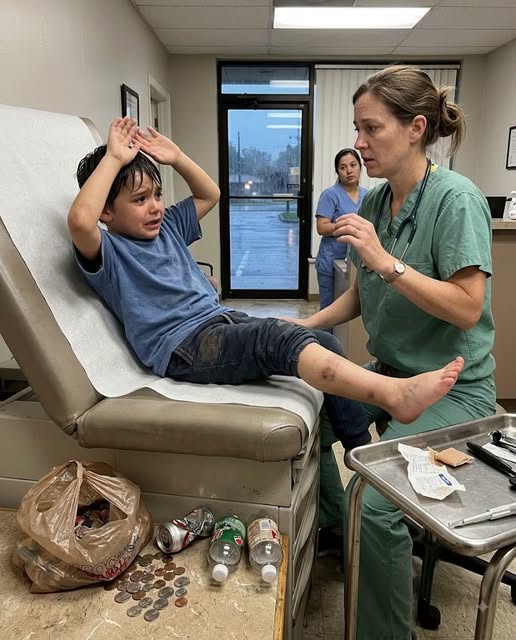
Sticky coins. Two crushed cans. Three empty soda bottles with peeling labels.
“The recycling man said it makes twelve dollars,” he told me. “I can bring more tomorrow.”
His name was Noah.
At least, that was what he said everyone called him.
His right leg was badly swollen and bent wrong. I moved him toward the exam table, but when I carefully lifted his pant leg, I saw more than one injury.
There were older bruises in different stages of fading. Small marks on his skin. Lines that didn’t belong on any child.
Then I looked at his face.
The straight brow.
That stubborn little chin.
Those wide brown eyes.
Features I had spent five years trying not to search for in every child who passed me on the sidewalk.
“What’s your father’s name?” I asked.
Noah looked down.
“Michael Hayes.”
My hands went cold.
Five years earlier, Michael Hayes had been my husband.
His family had money, influence, private clinics, hospital connections, charity events, and framed newspaper photos showing everyone what generous people they were.
I had a rented storefront, secondhand scrubs, and a stubborn belief that medicine was supposed to help people who needed it.
When our son was born, Michael’s family decided I was the problem.
His mother placed papers in front of me and said my baby deserved a better life. Then she put a check beside them as though a number could make what she was asking reasonable.
I signed.
For five years, I had lived with that signature.
Now my son was sitting in front of me with twelve dollars and empty bottles because someone had taught him that even with a broken leg, help had to be earned.
“Who hurt you?” I asked.
Noah folded inward.
“I was bad,” he whispered. “I spilled water. I didn’t clean it fast enough. I fell asleep before the dishes were done.”
Cruelty gets renamed when adults don’t want to admit what it is.
Fear becomes discipline.
Silence becomes respect.
Children still know the difference.
I reached toward his ankle.
Noah jerked backward so fast his shoulder hit the exam table. Both hands flew over his head.
“Don’t hit me!” he cried. “Please. I’ll be good now.”
My hand stopped in midair.
I turned away long enough to control what was rising inside me, washed my hands, opened a clean bandage pack, and made my voice as steady as I could.
“Noah, nobody is hitting you here.”
At 6:18 p.m., I started documenting what I saw.
The swelling.
The bruises.
The condition of his leg.
Every detail went into his medical file because I already knew what people with money and influence could do to an inconvenient truth.
I photographed the swelling and kept the X-ray plate beside him.
Then I warmed some soup and gave him half a boiled egg from my lunch bag.
He ate carefully, almost nervously, as though taking too much might get him in trouble.
When he finished, he looked at the bowl.
“Do I wash this?”
That question hurt almost as much as the bruises.
A few minutes later, he tried to stand.
Pain folded him in half.
I caught him before he hit the floor, and he grabbed my shirt with both hands.
“I’m sorry,” he whispered against me. “I’m sorry. I’m sorry.”
The clinic smelled like rubbing alcohol, wet pavement, and coffee that had been sitting on the warmer too long.
I held the child I had lost five years earlier and still couldn’t make myself tell him the truth.
Not yet.
“Noah,” I asked softly, “if I take you back tonight, are they going to hurt you?”
He didn’t answer immediately.
His fingers tightened around my shirt.
Then he closed his eyes.
“I’m going to try not to cry.”
PART 2
I knew what his answer meant.
At 6:47 p.m., I opened a medical incident note and photographed the bottles, the coins, his damaged sneakers, and every injury I could document without causing him more pain.
The grocery bag sat beside the exam table, still holding the twelve dollars he had brought because he believed broken children had to pay before adults would help them.
I stared at it for several seconds.
Then I looked at the phone.
There was one number I had promised myself I would never call again.
Michael answered on the second ring.
“Emma?”
I didn’t say hello.
“I found Noah.”
The silence on the other end changed immediately.
“Is he with you?”
“Yes.”
My voice almost broke, but I forced it steady.
“And I need you to answer something. Did you know your son’s leg was healing wrong because someone kept hurting him?”
Michael didn’t answer fast enough.
Behind me, Noah had finally fallen asleep on the cot, one hand tucked under his cheek and the other resting close to his head as if even sleep wasn’t safe enough to make him stop protecting himself.
I looked again at the bruises.
At his wet sneakers.
At those empty bottles.
Whatever Michael knew—or didn’t know—could no longer change the decision I had already made.
I was not sending my son back into that house without answers.
Twenty minutes later, headlights cut through the rain outside my clinic.
A black SUV stopped beside the mailbox near the curb.
About twenty minutes after I ended the call, a pair of headlights washed across the rain-streaked front windows of my clinic. A black SUV eased to the curb beside the mailbox and stopped.
By then, Noah was asleep on the cot behind me, one hand tucked beneath his cheek and the other resting close to his head as if sleep itself still required protection.
The grocery bag he had carried through the rain sat beside the exam table.
Inside were twelve dollars, two crushed cans, and three empty soda bottles with peeling labels.
That was all he had brought to pay for a broken leg.
And somehow, that was the least frightening thing I had learned that evening.
A little more than an hour earlier, I had been preparing to close my neighborhood clinic after a long, wet day.
The kind of day when the floor never quite dried near the entrance, coffee stayed too long on the warmer, and everyone who came through the door seemed tired before they even sat down.
I was checking what still needed to be put away when I noticed a small figure standing in the doorway.
He was soaked.
Rainwater ran from an oversized T-shirt and collected on the tile beneath him. His worn sneakers squeaked when he shifted his weight, and he held a plastic grocery bag so tightly in one fist that the thin material crackled.
He looked cold.
He looked scared.
But he was trying very hard not to look helpless.
“Doctor,” he whispered, his teeth chattering. “Can you fix me? I have money.”
Then he opened the bag.
Sticky coins slid against the plastic. Two crushed cans rolled to one side. Three empty soda bottles lay on top, their labels peeling from being handled and carried around.
“The recycling man said it makes twelve dollars,” he told me. “I can bring more tomorrow.”
There are moments in medicine when your training tells you what to examine first.
There are other moments when something human interrupts every professional instinct you have.
This was both.
His right leg was badly swollen and bent in a way no healthy leg should have been.
I moved him carefully toward the exam table and asked what people called him.
“Noah,” he said.
At least, that was the name he knew.
I helped him settle, then reached for his pant leg so I could examine the injury more closely.
The swelling was obvious.
The rest was worse.
There were older bruises in different stages of fading. There were small marks on his skin. There were lines and discolorations that did not belong on a child who had simply fallen once and gotten hurt.
Every bruise suggested time. Every mark suggested repetition. Every flinch suggested something he had learned before entering my clinic.
I had seen injured children before.
I had treated frightened children before.
But then I looked at his face.
Really looked.
The straight brow.
The stubborn little chin.
Those wide brown eyes.
For five years, I had trained myself not to search for those features.
Not at grocery stores. Not on sidewalks. Not in waiting rooms. Not when a boy of the right age passed me holding an adult’s hand.
I had told myself that searching strangers would not undo what happened.
Still, some habits do not disappear just because they hurt.
“What’s your father’s name?” I asked.
Noah lowered his eyes.
“Michael Hayes.”
My hands went cold.
Five years earlier, Michael Hayes had been my husband.
For a second, the clinic around me felt painfully ordinary.
The exam paper beneath Noah. The cabinet doors. The smell of rubbing alcohol. Rain ticking against the windows. Coffee that should have been thrown away an hour earlier.
Nothing in the room had changed.
Everything in my life had.
I remembered the papers. I remembered the check. I remembered my own signature.
When our son was born, Michael’s family had already decided what kind of future they believed he deserved.
They had money, influence, private clinics, hospital connections, charity events, and framed newspaper photographs that presented them as generous people who helped others.
I had a rented storefront, secondhand scrubs, and a stubborn belief that medicine was supposed to reach people who needed it, not only people who could impress someone at a fundraiser.
Michael’s mother never hid what she thought of that difference.
She placed papers in front of me and told me my baby deserved a better life.
Then she placed a check beside the papers.
As though money could turn surrender into reason.
As though a number could make the choice clean.
I signed.
For five years, I lived with that signature.
I did not know what Noah had been told about me. I did not know what name he had heard for the woman who gave birth to him. I did not know whether he had been told I left, whether I did not want him, or whether I had simply been erased from the story.
What I knew was sitting in front of me.
My son had arrived alone, injured and soaked from the rain, carrying recyclables because he believed medical care had to be earned twelve dollars at a time.
I kept my voice steady.
“Who hurt you?”
His whole body seemed to fold inward.
“I was bad,” he whispered.
I waited.
“I spilled water. I didn’t clean it fast enough. I fell asleep before the dishes were done.”
He said each thing the way a child repeats rules that have been explained too many times.
Not as accusations.
As evidence against himself.
Cruelty gets renamed when adults do not want to admit what it is. Fear becomes discipline, and silence becomes respect, but children still understand what happens when a mistake brings pain.
I reached toward his ankle.
Noah moved before I touched him.
He jerked backward so hard that his shoulder struck the exam table. Both hands flew over his head.
“Don’t hit me!” he cried. “Please. I’ll be good now.”
My hand stopped in the air.
That movement told me something his earlier words had not.
He had not merely been warned.
He had learned to protect his head.
I turned away long enough to get control of my face and my breathing.
Then I washed my hands, opened a clean bandage pack, and made my voice as calm as I could.
“Noah, nobody is hitting you here.”
He watched me closely.
Not with trust yet.
With calculation.
Children who feel safe can be impatient, noisy, stubborn, demanding, silly.
Noah watched every movement I made as if he were studying for an exam where the wrong answer hurt.
At 6:18 p.m., I began documenting everything I could observe.
The swelling.
The bruises.
The condition of his leg.
The older marks.
The way he reacted when I reached toward him.
I wrote details into his medical file because five years earlier I had learned what money and influence could do when an inconvenient truth stood in the way of a powerful family.
I photographed the swelling.
I kept the X-ray plate beside him.
I did not want memory to be the only thing standing between Noah and whatever explanation might come later.
Facts mattered.
Times mattered.
Condition mattered.
After I finished the first round of documentation, I warmed some soup.
I had half a boiled egg left in my lunch bag, so I gave him that too.
He ate slowly.
Carefully.
Almost nervously.
He did not eat like a hungry child who had finally been handed food.
He ate like someone expecting to be told he had taken too much.
When he finished, he stared at the bowl.
“Do I wash this?”
I had spent years imagining what I would say if I ever saw my son again.
None of those imagined conversations included explaining that he did not have to wash a soup bowl after receiving treatment for a broken leg.
None included empty bottles.
None included bruises.
None included him calling himself bad.
I told him to leave the bowl alone.
A few minutes later, he tried to stand.
Pain folded him almost immediately.
I caught him before he hit the floor.
His hands grabbed the front of my shirt, and for one second I thought he was simply holding on because his leg hurt.
Then he began apologizing.
“I’m sorry,” he whispered against me. “I’m sorry. I’m sorry.”
I held him.
The clinic smelled like rubbing alcohol, wet pavement, and burned coffee.
My son was in my arms for the first time in five years, and he did not know who I was.
I could have told him.
Every part of me wanted to.
But he was injured, frightened, exhausted, and trapped in a reality I still did not fully understand.
The truth about me could wait a little longer.
His safety could not.
“Noah,” I asked softly, “if I take you back tonight, are they going to hurt you?”
He did not answer right away.
His fingers tightened in my shirt.
Then he shut his eyes.
“I’m going to try not to cry.”
That was his answer.
Not yes.
Not no.
A promise to control his own pain so someone else might not punish him for showing it.
I knew what he meant.
At 6:47 p.m., I opened a medical incident note.
This time I documented more than the injuries.
I photographed the bottles.
The coins.
His damaged sneakers.
Every injury I could record without causing him additional pain.
The grocery bag remained beside the exam table, still holding the twelve dollars he had brought with him.
Twelve dollars.
He had arrived believing that was the part adults would care about.
I stared at the bag for several seconds, then looked at my phone.
There was one number I had promised myself I would never call again.
For five years, not calling Michael had been part pride, part grief, and part survival.
Calling him now was not reconciliation.
It was not forgiveness.
It was not even about our marriage anymore.
It was about the boy sleeping only a few feet away.
I called.
Michael answered on the second ring.
“Emma?”
He recognized my number or my voice immediately.
I did not say hello.
“I found Noah.”
The silence that followed did not feel empty.
It changed.
“Is he with you?” Michael asked.
“Yes.”
My voice nearly broke, but I held it steady.
“And I need you to answer something. Did you know your son’s leg was healing wrong because someone kept hurting him?”
Michael did not answer quickly enough.
That pause did not prove anything by itself.
I knew that.
I was a doctor, and I had spent enough time documenting details that evening to understand the difference between what I feared and what I could actually establish.
But the delay still mattered to me as his mother.
Behind me, Noah had finally fallen asleep on the cot.
One hand was tucked beneath his cheek.
The other rested close to his head.
Even sleeping, his body seemed unwilling to abandon the position it had learned for protection.
I looked at his bruises again.
Then at his wet sneakers.
Then at the plastic bag containing the bottles and coins.
Michael could tell me what he knew.
He could tell me what he did not know.
He could tell me who had been caring for Noah, what had happened to his leg, or why a child connected to a family with money and medical access had shown up at a small neighborhood clinic carrying recyclables.
But none of those answers could change the decision I had already made.
I was not sending Noah back into that house without answers.
That decision did not come from the five years I had spent missing him.
It came from what was in front of me now.
A leg that needed treatment.
Bruises in different stages of fading.
A defensive reaction to a gentle hand.
A child apologizing for collapsing in pain.
A child asking whether he should wash a bowl after eating soup.
A child telling me that if I returned him, he would try not to cry.
Those were the facts I could not talk myself around.
The clinic had grown quieter as the evening moved on.
Rain continued outside.
The medical file remained open with the times and observations I had entered. The photographs were preserved. The X-ray plate stayed near the cot. The grocery bag remained beside the exam table.
Nothing about the scene looked powerful.
There was no expensive office.
No charity photograph.
No framed newspaper article.
Just a small clinic, a tired doctor, an injured boy, and twelve dollars gathered from things other people had thrown away.
Yet for the first time in five years, I had something I had not possessed when Michael’s family placed those papers in front of me.
I had Noah in front of me.
I had his condition documented.
I had heard his words myself.
And this time, no one had placed a check beside the truth and asked me to sign it away.
I kept thinking about the first thing he had said when he entered.
“Can you fix me? I have money.”
He had not walked in asking to be rescued.
He had not demanded anything.
He had gathered coins, cans, and bottles, then come through the rain prepared to bargain for relief.
That was what someone had taught him about needing help.
And the second lesson was even worse.
“Don’t hit me. I’ll be good.”
Those words had come out before I touched him.
No explanation Michael could give me over the phone could erase that reflex.
No family reputation could erase it.
No money could make me forget it.
I had already spent five years living with one signature.
I was not going to spend another night pretending that fear looked like discipline simply because the people involved were powerful enough to rename it.
Then time moved again.
Roughly twenty minutes after the call, headlights swept through the rain beyond the clinic windows.
A black SUV pulled in beside the curbside mailbox and came to a stop.
Noah was still sleeping.
The twelve dollars were still in the grocery bag.
And the person I had called had arrived.
THE END STORIES! THANK YOU FOR READING GOOD LUCK !❤️
Related Posts