“Dad… Please Don’t Let My Stepmother Come In,” My 8-Year-Old Daughter Whispered From Her Hospital Bed — As She Told Me What Had Been Happening At Home, I Realized The Truth I Had Been Avoiding Was Far Worse Than I Ever Imagined

The phone rang at 6:11 a.m., and I almost ignored it.
I was sitting in my car with a cold coffee in the cup holder, thinking about work, bills, and everything I had convinced myself I was doing right as a father.
Then I saw the name on the screen.
Ridgeview Children’s Hospital.
The moment I heard the nurse say Lily’s name, every excuse I had built around my life started falling apart.
My daughter was eight years old.
After her mother died, I told myself keeping the house running was the same as being present. I paid the bills. I worked long hours. I made sure there was food in the kitchen and clothes in the closet.
I thought that meant I was protecting her.
Then Vanessa came into our lives.
She looked like the answer I needed when grief made everything harder. She organized the house. She remembered appointments. She made everything appear controlled.
I confused control with care.
That was my mistake.
Because little by little, Lily changed.
She stopped laughing the way she used to. She started asking permission for simple things. She looked toward Vanessa before answering questions, like every word needed approval.
Whenever I asked if something was wrong, Vanessa always had an explanation.
“She’s just sensitive.”
“She misses her mother.”
“She’s testing boundaries.”
And I listened to the adult who sounded calm instead of the child who looked afraid.
At the hospital, I learned Lily had been brought in by our neighbor, not Vanessa.
The intake form said she arrived with serious dehydration, bruising observed, and altered responsiveness.
My hands went cold when I saw the words.
My daughter had been in my house.
And somehow, I had not seen the truth.
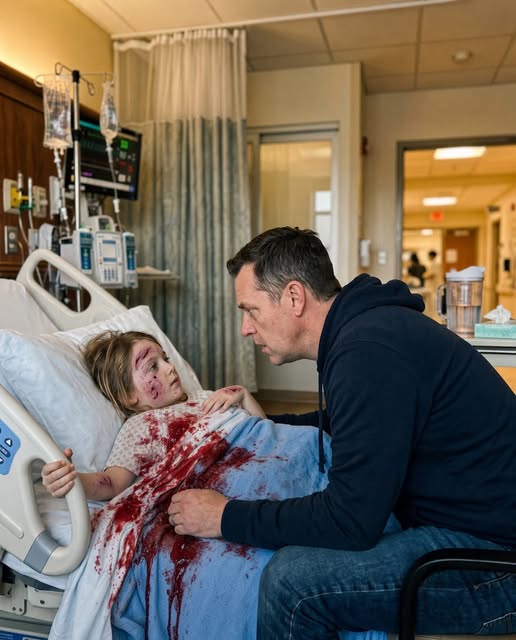
When the doctor finally let me into her room, Lily looked smaller than she ever had before. Her brown curls were tangled against the pillow. An IV was taped to her tiny hand. The monitor beside her kept making that steady sound that reminds you how fragile a person can be.
She looked at me and whispered, “Daddy.”
I grabbed her hand.
“I’m here, sweetheart.”
Then her eyes moved toward the door.
Her fingers tightened around mine.
“Dad…”
Her voice shook.
“Please don’t let my stepmother come in.”
I froze.
Because in that moment, I knew this was not just about what happened that morning.
It was about every time I chose the easier explanation.
And then I heard Vanessa’s heels coming closer down the hospital hallway.
The door handle slowly began to turn.
PART 2: THE MORNING I STOPPED BELIEVING HER
The door handle turned.
Lily’s fingers clamped around mine so hard that the IV tubing trembled.
“Daddy.”
I had never heard that kind of fear in her voice before.
Not even when her mother died.
Not even when she woke from nightmares asking why Mommy could not come home.
This was different.
This was fear of someone still alive.
Someone she expected to walk through that door.
I stood immediately.
The door opened two inches.
Then Vanessa’s face appeared.
Her makeup was perfect.
Her hair was pulled back.
She looked irritated more than worried.
“There you are.”
Her eyes moved past me toward Lily.
I stepped into the doorway.
“No.”
Vanessa blinked.
“What?”
“You’re not coming in.”
Her face changed.
Not much.
Just enough.
A tiny crack.
“Daniel, move.”
“No.”
She laughed quietly.
“This is ridiculous.”
Behind me, Lily’s breathing sped up.
I heard the monitor react.
Beep.
Beep.
Beep.
Faster.
I looked over my shoulder.
Lily had pulled the blanket closer to her chest.
Her eyes were fixed on Vanessa.
Not curious.
Not angry.
Terrified.
That was the moment I stopped doubting her.
Completely.
Vanessa saw my face change.
She softened immediately.
“Daniel.”
Her voice became gentle.
Measured.
The voice she used whenever she wanted me to feel unreasonable.
“She’s been confused all morning.”
I stared at her.
“Confused?”
“She had some kind of episode.”
“What kind?”
Vanessa hesitated.
“I don’t know.”
“You don’t know?”
“I found her acting strange.”
I looked toward the nurse’s station.
“You found her?”
“Yes.”
I thought about the intake paperwork.
Neighbor brought child to emergency department.
Not parent.
Not stepmother.
Neighbor.
I looked back at Vanessa.
“Then why did Mrs. Patel bring her here?”
Something flickered in her eyes.
A delay.
Half a second.
“I called her.”
“You called Mrs. Patel?”
“Yes.”
“Why?”
“I had to get ready for work.”
For a moment, I just stared at her.
My daughter had arrived at a children’s hospital dehydrated, bruised, barely responsive—
and Vanessa’s explanation was work.
“You had to get ready?”
Vanessa frowned.
“Don’t twist this.”
I felt something dangerous rising inside me.
Not the kind that wanted to hit.
The kind that wanted answers so badly it hurt.
Before I could speak, Lily whispered behind me.
“She’s lying.”
Vanessa’s head snapped toward the bed.
“Lily.”
The way she said her name changed everything.
It was not concern.
It was warning.
My daughter flinched.
I stepped fully into the doorway.
“Leave.”
Vanessa stared at me.
“What?”
“Go sit in the waiting room.”
“Daniel—”
“Now.”
Her expression hardened.
Then she looked toward Lily again.
“You have no idea what she’s been doing lately.”
I moved closer.
“Do not talk to her.”
“I’m trying to explain.”
“You can explain to me outside.”
Vanessa crossed her arms.
“Oh, so suddenly I’m the bad guy?”
I said nothing.
That irritated her more.
“Fine.”
She took one step backward.
Then pointed toward the room.
“But when she tells you some ridiculous story, remember who has actually been raising her while you work.”
That sentence hit me harder than she intended.
Because she was right about one thing.
I had not been there enough.
Not nearly enough.
And the shame of that truth had made me easy to control.
Vanessa had always known exactly where to press.
You work too much.
Lily needs structure.
You’re too soft because you feel guilty.
Let me handle this.
For years, every time I questioned her, she somehow turned the conversation into evidence of my failure.
And because part of me already believed I was failing, I let her.
I looked at her.
“Get out.”
She stared at me for another second.
Then turned.
Her heels clicked sharply down the hallway.
I waited until she disappeared.
Then I closed the door.
Locked nothing.
Just closed it.
When I turned around, Lily was crying.
Silently.
Tears slid down both sides of her face into her hair.
I walked back to the bed.
“Hey.”
She wiped at her cheek.
“I’m sorry.”
My chest hurt.
“For what?”
“She’s mad.”
“I don’t care.”
Her eyes widened.
I sat down.
“Listen to me.”
I took her hand carefully.
“You are not responsible for Vanessa’s feelings.”
Lily looked down.
“She says I make everyone miserable.”
Something inside me broke.
“What?”
She did not look at me.
“She says you’re always tired because of me.”
I could barely breathe.
“She says if I wasn’t so difficult, you wouldn’t have to work so much.”
“No.”
The word came too quickly.
Too loudly.
Lily flinched.
I immediately softened my voice.
“No, sweetheart.”
I leaned closer.
“That is not true.”
Her lower lip trembled.
“She said you wanted to send me away.”
My throat closed.
“What?”
“To boarding school.”
I stared at her.
“I never said that.”
“She said you were thinking about it.”
“I wasn’t.”
“She said if I behaved, maybe she could convince you not to.”
I had to look away.
For years, Lily had become quieter.
More obedient.
More careful.
And I had praised it.
I told people she was growing up.
Maturing.
Becoming responsible.
Now I understood.
She had not matured.
She had become afraid.
I turned back toward her.
“Lily.”
She looked at me.
“I have never wanted to send you away.”
Her eyes filled again.
“Never?”
“Never.”
“What if I’m bad?”
“You’re not bad.”
“What if I am?”
“Then we talk.”
My voice broke.
“We figure it out.”
“We love you anyway.”
Her face crumpled.
She started crying harder.
I moved carefully onto the edge of the mattress and wrapped my arms around her.
She was so light.
Too light.
I could feel every bone in her back.
How did I not notice?
How did I hug my daughter and not know she was losing weight?
The answer came immediately.
Because I barely hugged her anymore.
Morning meetings.
Late calls.
Emails.
Deadlines.
Bills.
All the things I told myself mattered because they kept the house safe.
Safe.
I almost hated the word.
I had provided a roof.
Not safety.
There is a difference.
Lily buried her face against my chest.
“I tried to tell you.”
My eyes closed.
The sentence hurt more than anything else.
“When?”
She sniffed.
“Lots of times.”
I pulled back just enough to look at her.
“What did you say?”
“I said Vanessa was mean.”
I remembered.
Months ago.
Lily standing beside the refrigerator.
Vanessa had gone upstairs.
Lily whispered,
“I don’t think Vanessa likes me.”
I laughed softly.
Not because it was funny.
Because I thought Lily was jealous.
I told her,
“She loves you in her own way.”
What an awful sentence.
Lily continued.
“I said I didn’t like being home alone with her.”
I remembered that too.
I told her not to be dramatic.
God.
I had used Vanessa’s word.
Sensitive.
Dramatic.
Testing boundaries.
Every phrase had been handed to me.
I repeated them like they were mine.
“I’m sorry.”
Lily looked confused.
“What?”
“I’m sorry.”
My voice shook.
“You tried to tell me.”
She stared at me.
“And I didn’t listen.”
A child should never have to comfort a parent for failing them.
So when Lily immediately said,
“It’s okay,”
I shook my head.
“No.”
Her eyes widened.
“It’s not okay.”
I squeezed her hand.
“But I’m going to make it different.”
She watched me carefully.
“How?”
“I’m going to listen now.”
Her expression told me that promise was not enough.
And she was right.
Words had already failed her.
So I said,
“And I’m not taking you home with Vanessa there.”
Her eyes widened.
“Really?”
“Really.”
“What if she gets mad?”
“She can be mad somewhere else.”
For the first time that morning, something almost like relief crossed Lily’s face.
Tiny.
Fragile.
But there.
Then the door opened.
I stood instinctively.
It was a doctor.
Behind him was a woman wearing hospital identification.
The doctor introduced her.
“Mr. Harper, this is Marlene Brooks. She’s one of our hospital social workers.”
My stomach dropped.
Social worker.
I knew what that meant.
Lily did too.
She gripped my hand.
Marlene immediately noticed.
She pulled a chair closer but did not sit beside Lily.
She sat farther away.
No pressure.
No sudden movement.
“Hi, Lily.”
Lily said nothing.
“That’s okay.”
Marlene smiled gently.
“You don’t have to talk to me until you’re ready.”
Then she looked at me.
“Mr. Harper, can I speak to you outside for a moment?”
Lily’s fingers tightened.
“No.”
She said it immediately.
Marlene looked back at her.
“You want Dad to stay?”
“Yes.”
“All right.”
No argument.
That mattered.
Marlene turned toward me.
“Then we can talk here as long as Lily is comfortable.”
I nodded.
She opened a folder.
“I want to explain something first.”
My heart was pounding.
“When a child arrives with certain injuries or health concerns, the hospital is required to make sure they are safe.”
I looked at Lily.
“Of course.”
“That may include asking questions about home.”
I nodded.
“Ask.”
Marlene did not.
Not immediately.
Instead she looked at Lily.
“Would you like Dad to hold your hand while I talk to you?”
Lily nodded.
I took her hand.
Marlene began with simple questions.
School.
Teacher’s name.
Favorite subject.
Friends.
Nothing frightening.
Lily relaxed slightly.
Then Marlene asked,
“Who lives at your house?”
“Dad.”
“Vanessa.”
“Anyone else?”
“No.”
“What happens when Dad works late?”
Lily looked toward me.
Marlene gently said,
“You’re not going to get Dad in trouble by answering.”
That sentence crushed me.
Because Lily clearly thought she might.
She looked down.
“Vanessa takes care of me.”
“What kinds of things do you do after school?”
“Homework.”
“Dinner.”
“Sometimes chores.”
“What chores?”
Lily swallowed.
“Kitchen.”
“Bathroom.”
“Laundry.”
I frowned.
Those were not the chores I knew about.
I had assigned Lily three things.
Make her bed.
Put away toys.
Feed the dog.
That was it.
Marlene noticed my reaction but kept her attention on Lily.
“Does Vanessa help?”
Lily shook her head.
“How long do chores take?”
“I don’t know.”
“Until they’re right.”
“What happens if they’re not right?”
Lily went silent.
I felt her hand go cold.
Marlene waited.
No pushing.
No repeating.
Eventually, Lily whispered,
“She makes me start over.”
“That sounds frustrating.”
Lily nodded.
“Sometimes I don’t get dinner until I finish.”
My stomach turned.
“What?”
Lily looked at me.
“I’m sorry.”
“No.”
My voice cracked.
“Don’t apologize.”
Marlene held up one hand.
She was not stopping me.
Just asking me to stay calm.
For Lily.
I swallowed.
Sat back.
Marlene asked,
“How often does that happen?”
Lily shrugged.
“When I’m bad.”
“What does bad mean?”
“Leaving water on the sink.”
“Not folding towels straight.”
“Talking back.”
“What counts as talking back?”
Lily stared at the blanket.
“Saying I’m tired.”
I closed my eyes.
Marlene’s voice stayed steady.
“Do you ever miss meals?”
Lily nodded.
“How many?”
“I don’t know.”
“Yesterday?”
Lily hesitated.
“Breakfast.”
“Lunch?”
“No lunch.”
“Dinner?”
She shook her head.
My hands started trembling.
“When did you last eat?”
Lily whispered,
“Yesterday morning.”
I stood so quickly the chair slid backward.
The doctor looked at me.
“Mr. Harper.”
I walked toward the window.
I had to.
Because if I stayed beside the bed, Lily would see exactly how furious I was.
I stared at the parking lot.
Cars moving.
People walking.
Normal lives.
Behind me, my daughter was explaining that she had gone nearly a full day without food in my house.
My refrigerator was full.
Pantry stocked.
I paid the grocery bill every week.
There had never been a lack of food.
There had been control.
I turned back.
“Why didn’t you eat at school?”
Lily looked embarrassed.
“I don’t have lunch money anymore.”
I stared.
“What?”
“She said you stopped it.”
My chest tightened.
I had automated the school lunch account.
Or thought I had.
I pulled out my phone.
Opened the banking app.
The recurring payment had been cancelled.
Six months earlier.
I had not cancelled it.
Vanessa had access to household accounts.
I had given her access because she handled bills.
My vision blurred.
“Did she pack lunch for you?”
Lily shook her head.
“Sometimes.”
“What did you eat?”
“Crackers.”
Marlene continued gently.
“Lily, did anyone ever hurt you physically?”
The room changed.
My daughter froze.
Completely.
I had never seen an eight-year-old become that still.
Marlene noticed too.
“You don’t have to answer fast.”
Lily stared at the door.
Then at me.
“Is she outside?”
“Vanessa?”
“Yes.”
I looked toward the doctor.
He nodded.
“She’s in the family waiting area.”
I turned back.
“She cannot come in.”
Lily whispered,
“Promise?”
“I promise.”
Her eyes filled.
Then she looked at Marlene.
“She grabs me.”
My breathing stopped.
“Where?”
Marlene asked.
“My arms.”
“My shoulder.”
“Sometimes my hair.”
Lily’s hand moved unconsciously toward the back of her head.
The doctor looked at me.
Not dramatic.
Just serious.
Marlene continued.
“Anything else?”
Lily’s face tightened.
“She locks the pantry.”
My stomach twisted.
“If I’m bad.”
Marlene nodded slowly.
“What happened yesterday?”
That was the question.
The one that brought us here.
Lily’s breathing changed.
I moved closer.
“It’s okay.”
She looked at me.
“I spilled juice.”
My heart sank.
“On the rug.”
She swallowed.
“Vanessa got mad.”
“What happened?”
“She said I did it on purpose.”
“Did you?”
“No.”
“I tried to clean it.”
“She said I was making it worse.”
Lily started crying.
“She made me scrub it.”
“For how long?”
“I don’t know.”
“My arms hurt.”
“She said I couldn’t drink anything until it was clean because I waste everything.”
The room blurred.
Dehydration.
The doctor had said serious dehydration.
I understood now.
Marlene’s expression changed slightly.
“How long were you not allowed water?”
Lily whispered,
“From after lunch.”
I felt sick.
“What happened this morning?”
Lily cried harder.
“I got dizzy.”
“I was going downstairs.”
“I fell.”
My eyes moved toward the bruising visible near her elbow.
“She told me to get up.”
“I couldn’t.”
“What did Vanessa do?”
Lily covered her face.
I sat beside her immediately.
“Sweetheart.”
“She got mad because Mrs. Patel was at the door.”
Our neighbor.
The woman who brought her here.
“Why was Mrs. Patel there?”
Lily sniffed.
“She heard me fall.”
Marlene looked at me.
“Does Mrs. Patel live next door?”
“Yes.”
Lily nodded.
“She came in.”
“Was the door unlocked?”
Lily shook her head.
“She has Grandma’s old emergency key.”
I remembered giving it to Mrs. Patel after Lily’s mother died.
She used to help.
Before Vanessa slowly pushed everyone away.
“She came inside and saw me.”
“What did Vanessa say?”
“She said I was pretending.”
Lily began shaking.
“She told Mrs. Patel to leave.”
“Did she?”
“No.”
For the first time, Lily smiled faintly.
“Mrs. Patel yelled at her.”
Despite everything, I almost smiled too.
That sounded like Mrs. Patel.
Marlene continued.
“Then what?”
“She called an ambulance?”
“No.”
Lily looked confused.
“She drove me.”
The doctor nodded.
“She arrived at the emergency entrance in her personal vehicle.”
I looked at him.
“Why didn’t Vanessa call an ambulance?”
Nobody answered.
But I knew.
Calling an ambulance creates records.
Questions.
People.
Witnesses.
I felt cold.
Marlene asked a few more questions.
Nothing graphic.
Enough.
Enough that I finally understood why she was there.
Why the doctor kept exchanging looks with her.
Why a nurse had quietly positioned herself near the door earlier.
This was not a misunderstanding.
This was not strict parenting.
This was not grief.
Or sensitivity.
Or boundaries.
My daughter had been deprived of food and water as punishment.
Controlled.
Frightened.
Physically handled.
Isolated.
And I had trusted the person doing it.
Marlene closed the folder.
“Thank you, Lily.”
My daughter looked exhausted.
“Am I in trouble?”
I nearly broke in half.
Marlene leaned forward.
“No.”
“Not even a little?”
“Not even a little.”
Lily looked at me.
I shook my head.
“Never.”
The doctor suggested she rest.
A nurse adjusted the IV.
Marlene motioned for me to step into the hallway.
This time, Lily let me go.
Barely.
“I’ll be right outside.”
“Promise?”
“Promise.”
I left the door open a few inches.
Marlene stood beside me.
Her voice remained quiet.
“We’ve made a report.”
I nodded.
“To who?”
“Child protective services and law enforcement.”
My stomach tightened.
“Good.”
She studied my face.
“You need to understand that they will also ask you questions.”
“I know.”
“About what you observed.”
“I didn’t observe enough.”
“About who had access.”
“Vanessa.”
“About discipline.”
“I didn’t know.”
My voice broke.
“I didn’t know.”
Marlene’s expression softened, but she did not offer easy comfort.
I appreciated that.
Because I did not want to be told I was innocent.
Not yet.
I had missed things.
Maybe not because I wanted this.
Maybe not because I knew.
But I missed them.
I needed to face that.
“What happens now?”
“Lily stays here while the medical team continues treatment.”
“And Vanessa?”
“She should not have access to Lily.”
“I already said that.”
“Yes.”
“Can she come home?”
Marlene paused.
“That depends on what law enforcement determines and what safety arrangements are made.”
I looked at her.
“She is not coming home.”
She nodded.
“That boundary is appropriate.”
“What if she refuses?”
“Then let the authorities handle it.”
I looked toward the waiting area.
I could barely see Vanessa from where we stood.
She was sitting with her phone in her hand.
Angry.
Typing.
Probably building a story.
For once, I was not interested in hearing it.
A police officer arrived twenty minutes later.
Then another.
Vanessa immediately stood.
I watched from down the hall.
She smiled.
Actually smiled.
The polite smile she used for professionals.
She shook the first officer’s hand.
Spoke calmly.
Gestured toward me once.
I could almost hear her.
Overworked father.
Grieving child.
Difficult behavior.
Strict routines.
Accident.
Misunderstanding.
The same language that had worked on me.
It did not seem to work on them.
Mrs. Patel arrived next.
Still wearing the sweater she threw on that morning.
Her gray hair was barely combed.
She saw me.
Stopped.
Then walked straight toward me.
I expected anger.
She slapped me.
Not hard.
But enough.
The hallway froze.
One officer turned.
Mrs. Patel immediately started crying.
“I’m sorry.”
I touched my cheek.
“No.”
I shook my head.
“Don’t be.”
She stared at me.
“You idiot.”
“I know.”
“I tried to tell you.”
My chest tightened.
“What?”
She wiped her face.
“Three months ago.”
Memory returned.
Mrs. Patel calling me at work.
Saying Lily looked thin.
Saying Vanessa had stopped letting her visit.
I told her Lily was going through a phase.
Vanessa said Mrs. Patel was intrusive.
I believed Vanessa.
Again.
Mrs. Patel whispered,
“She used to come to my back door after school.”
My stomach dropped.
“What?”
“For snacks.”
I stared.
“She said she wasn’t hungry at home.”
Mrs. Patel’s voice broke.
“I thought maybe Vanessa was dieting her or something.”
“Why didn’t you tell me?”
“I did!”
She cried.
“You told me to stop interfering.”
My stomach turned.
I remembered.
I had.
I had defended my wife against the neighbor who had known Lily since birth.
Because Vanessa told me boundaries were important.
I covered my face.
“I’m sorry.”
Mrs. Patel looked toward Lily’s room.
“I should have done more too.”
“No.”
I shook my head.
“You brought her here.”
“I waited too long.”
“So did I.”
We stood together in that hallway.
Two adults realizing a child had been trying to survive in the space between our assumptions.
An officer approached me.
“Mr. Harper?”
“Yes.”
“We’d like to speak with you.”
I nodded.
“Anything.”
The interview lasted almost an hour.
Accounts.
Schedules.
Who handled food.
Who handled school.
Where I worked.
How late.
Whether I had seen bruises.
I remembered two.
One on Lily’s upper arm.
Vanessa said she got it at gymnastics.
One near her knee.
Vanessa said she fell.
I accepted both explanations.
The officer wrote everything down.
Then asked,
“Has your wife ever asked you to discipline Lily physically?”
“No.”
“Has she ever suggested limiting food?”
“No.”
“Water?”
“No.”
“Have you personally done either?”
“Never.”
He nodded.
Then asked,
“Has Lily’s school contacted you?”
My stomach tightened.
“About what?”
“Attendance?”
I frowned.
“Her attendance is good.”
The officer looked at his notes.
“According to the social worker, the hospital contacted the school counselor.”
My heart sank.
“And?”
“She’s missed eleven days this semester.”
I stared.
“That’s impossible.”
“She’s been marked excused.”
“By who?”
The officer looked toward Vanessa.
I already knew.
Vanessa.
More control.
More isolation.
More things happening in my own house while I believed everything was organized.
The officer closed his notebook.
“Mr. Harper, there may be additional information we need.”
“Take everything.”
“What?”
“My phone.”
“Bank records.”
“Cameras.”
“Emails.”
“I don’t care.”
My voice shook.
“Take whatever helps you figure out what happened.”
He nodded.
Then Vanessa’s voice exploded down the hallway.
“You are not taking my phone!”
Every head turned.
The calm mask was gone.
An officer stood in front of her.
She pointed toward me.
“This is because of him!”
I stared.
“He’s trying to destroy me because his daughter hates having rules.”
My daughter.
Not our daughter.
His daughter.
Interesting.
Vanessa saw me watching.
Her face hardened.
“You did this.”
I walked toward her.
The officers immediately moved slightly between us.
I stopped several feet away.
“No.”
She laughed bitterly.
“You’re really going to believe an eight-year-old over your wife?”
That sentence answered every remaining question inside me.
I looked at her.
“Yes.”
Her expression froze.
“What?”
“Yes.”
I repeated it.
“I believe my daughter.”
The hallway went silent.
Vanessa’s mouth opened.
Nothing came out.
For years, I had chosen the calmest adult voice in the room.
That morning, I finally understood calm can be manufactured.
Fear cannot.
Lily’s shaking hand had told me more truth than every explanation Vanessa ever gave.
Vanessa recovered.
“She lies.”
“She manipulates.”
“She wants me gone because she never accepted me.”
I stared at her.
“She asked me not to let you into a hospital room.”
Vanessa scoffed.
“Children say things.”
“She hadn’t eaten since yesterday morning.”
Her face changed.
“She refused dinner.”
“She said you withheld it.”
“She was being punished.”
The words escaped before Vanessa could stop them.
The officer beside her looked up.
So did I.
Vanessa froze.
Then tried to recover.
“I mean consequences.”
I felt something inside me go still.
“Food is not a consequence.”
“She needed discipline.”
“Water?”
She said nothing.
“Was water discipline too?”
“Daniel.”
“No.”
My voice stayed quiet.
“You don’t get to explain this to me anymore.”
Her eyes filled with tears.
Whether they were real did not matter.
“I loved that child.”
My jaw tightened.
“Then why was she afraid you’d walk through the door?”
Vanessa looked away.
That was the last conversation I had with her that day.
Authorities separated us.
By late afternoon, she was told not to return to the house while the investigation continued.
I changed the locks anyway.
Every one.
Front door.
Back door.
Garage.
I removed her access to the alarm.
Accounts.
School portal.
Medical records.
Everything.
The house felt strange when I returned that evening to collect clothes for Lily.
Too clean.
Too organized.
I stood in the kitchen.
The counters were spotless.
The refrigerator labeled.
The pantry arranged in perfect rows.
Then I saw the lock.
Small.
Metal.
Attached to the pantry handles.
I stared at it.
I had walked past that pantry every day.
How had I not noticed?
Maybe because Vanessa always said she was keeping Lily from sneaking candy.
I had laughed.
A lock.
On food.
I touched it.
Then stepped back like it burned.
I walked upstairs.
Lily’s room looked almost empty.
Too empty.
No posters.
No stuffed animals on the bed.
No toys on the floor.
My daughter had always been messy.
I used to complain.
Where did everything go?
I opened the closet.
Boxes.
Inside were her things.
Stuffed animals.
Books.
Photographs of her mother.
A little jewelry box.
All packed away.
On top was a note.
Privileges removed until behavior improves.
I sat down on the floor.
And cried.
Not because I had finally discovered the truth.
Because I realized how visible it had always been.
I had simply accepted explanations.
That night, I went back to the hospital carrying one thing.
Lily’s old stuffed rabbit.
The one her mother gave her.
When I walked into the room, Lily’s face changed.
“Bunny!”
She reached for it.
I handed it over.
She hugged it against her chest.
“Where was he?”
“In your closet.”
Her smile disappeared.
“Vanessa said she threw him away.”
My eyes burned.
“She didn’t.”
Lily held the rabbit tighter.
I sat beside her.
“Sweetheart.”
She looked at me.
“Vanessa isn’t at the house.”
Her body relaxed immediately.
“I changed the locks.”
“Really?”
“Yes.”
“And she can’t come back?”
“Not unless people much smarter than me say it’s safe.”
Lily thought about that.
Then asked,
“What if she says sorry?”
My heart broke.
I leaned closer.
“Saying sorry does not mean someone gets to come back.”
She looked at me.
“Really?”
“Really.”
She considered that for a long moment.
Then whispered,
“Dad?”
“Yes?”
“Can we make the house messy?”
I almost laughed.
“What?”
“When I come home.”
Her eyes filled.
“I don’t want it perfect anymore.”
My throat closed.
I took her hand.
“We can make it as messy as you want.”
She smiled faintly.
“Even the living room?”
“Especially the living room.”
“Can I put Mom’s pictures back?”
I froze.
“What do you mean back?”
She looked confused.
“Vanessa took them down.”
I had noticed fewer pictures.
I told myself redecorating was healthy.
Moving forward.
God.
How many warning signs had I renamed?
“Yes.”
My voice broke.
“Every picture.”
“All of them.”
Lily leaned toward me.
I held her.
For a while, neither of us spoke.
Then she whispered into my shirt,
“Are you mad at me?”
I pulled back immediately.
“No.”
“Because I told?”
“No.”
“Vanessa said if I told, you’d hate me.”
Something inside me cracked one final time.
I took her face gently between my hands.
“Listen to me.”
She stared into my eyes.
“You will never lose me for telling the truth.”
Her lower lip trembled.
“Even if the truth is bad?”
“Especially then.”
She cried.
So did I.
We held each other until the nurse came in to check her IV.
That night, after Lily fell asleep, I sat beside her bed and watched the monitor glow.
For years, I thought protecting my daughter meant earning enough money that she never lacked anything.
A good school.
A nice house.
Health insurance.
A stable routine.
I had confused providing with parenting.
Providing is important.
But children need something money cannot automate.
Attention.
The uncomfortable kind.
The kind that notices silence.
The kind that asks the same question twice when the first answer does not feel right.
The kind that believes fear before believing appearances.
I had not done that.
Not enough.
And I would carry that knowledge for a long time.
Maybe forever.
But guilt was not going to become another excuse.
I had spent years telling myself I worked too much because I loved Lily.
From that day forward, love had to look different.
It had to sound like listening.
It had to feel like safety.
It had to mean showing up before the hospital called.
I reached over and touched my daughter’s hand.
She moved slightly in her sleep.
Then whispered,
“Daddy?”
“I’m here.”
Her eyes stayed closed.
“Don’t go.”
My chest tightened.
“I won’t.”
And for once, it was not something I said because I wanted to calm her.
It was a promise I intended to build my life around.
Because Vanessa’s cruelty was not the only truth I discovered that morning.
I discovered something worse about myself.
I had been waiting for undeniable proof before trusting my own child.
That would never happen again.
By sunrise, Vanessa’s carefully controlled house had begun falling apart.
Her access was gone.
Her lies were documented.
The hospital had made its report.
The school had started providing records.
Mrs. Patel had agreed to give a statement.
And my daughter—
my quiet, terrified eight-year-old daughter—
had finally been heard.
But the biggest shock came the next morning.
Because when Detective Ramirez returned to Lily’s room, he was carrying a sealed evidence bag.
Inside was a small black notebook.
He placed it on the table.
“Mr. Harper,” he said quietly, “we found this hidden behind a loose panel in your daughter’s closet.”
I looked at Lily.
Her face went pale.
My stomach dropped.
“What is it?”
Ramirez opened the bag carefully.
The first page was covered in Vanessa’s handwriting.
Dates.
Times.
Rules.
Punishments.
Food withheld.
Privileges removed.
And beside some entries—
dollar amounts.
I stared at the numbers.
“What are those?”
Ramirez looked at me.
“We were hoping you could tell us.”
I read the first line again.
Lily — Tuesday — refused to clean bathroom. $250 transferred.
Another.
Lily — Friday — spoke to neighbor without permission. $500.
Another.
Lily — Monday — missed dinner. $300.
My blood went cold.
These were not random notes.
They were transactions.
And suddenly, this was no longer only about what Vanessa had done to my daughter.
It was about why she had been documenting it.
Detective Ramirez turned to the final page.
There was one name written at the bottom.
Not Vanessa’s.
Not mine.
Someone I knew.
Someone who had been asking questions about Lily for months.
My late wife’s brother.
And beneath his name was one final note:
When Daniel finally loses custody, payment doubles.
PART 3: THE MAN WHO WAS PAYING HER TO BREAK MY DAUGHTER
For several seconds, I could not speak.
The notebook lay open on the hospital table.
Vanessa’s handwriting.
Dates.
Punishments.
Money.
And at the bottom of the page—
When Daniel finally loses custody, payment doubles.
My late wife’s brother.
Michael.
I stared at the name until the letters stopped looking real.
“No.”
Detective Ramirez watched me carefully.
“You know him?”
I laughed once.
It came out broken.
“He’s Lily’s uncle.”
Lily’s fingers tightened around the stuffed rabbit.
My stomach dropped.
I immediately closed the notebook.
She had already heard enough.
Ramirez noticed.
“We can continue outside.”
I nodded.
Then I looked at Lily.
“I’m going to step into the hallway for a minute.”
Her eyes widened.
“Is Vanessa coming?”
“No.”
“Promise?”
“I promise.”
“Michael?”
I froze.
She knew.
Maybe not everything.
But she recognized the name.
I crouched beside the bed.
“Has Uncle Michael been around Vanessa?”
Lily stared at the rabbit.
Sometimes silence answers faster than words.
“Sweetheart.”
She whispered,
“He comes when you’re working.”
The room went cold.
“How often?”
“I don’t know.”
“Lots.”
I looked at Ramirez.
His expression changed immediately.
“Did he talk to you?”
Lily nodded.
“What did he say?”
She squeezed Bunny tighter.
“He said Mommy would be disappointed in me.”
My chest broke open.
Her mother.
They had used her dead mother too.
Of course they had.
People who want control usually search for the place that already hurts.
Michael knew exactly where Lily’s grief lived.
He had lost his sister.
But somehow he had decided Lily’s grief belonged to him more than it belonged to her.
“What else did he say?”
Lily’s voice became smaller.
“He said you weren’t taking care of me right.”
I closed my eyes.
“He said maybe I should live with Grandma.”
That confused me.
“Grandma?”
My late wife’s mother.
Margaret.
She lived almost two hours away.
Arthritis.
Heart problems.
She loved Lily, but she had never asked for custody.
Never even suggested it.
“Did Grandma say that?”
Lily shook her head.
“Uncle Michael did.”
Ramirez leaned forward slightly.
“Did he say why?”
Lily looked scared.
“He said if I lived with Grandma, Mommy’s house would be safe.”
My breathing stopped.
“Mommy’s house?”
She nodded.
I looked at Ramirez.
He looked back at me.
Something had just clicked for both of us.
My house had belonged to my wife before we married.
Her father left it to her.
When she died, ownership passed according to her estate plan.
To Lily.
Not me.
I had a life estate and custodial control while Lily was a minor.
But ultimately?
The property was hers.
It had always been hers.
And the house had appreciated enormously over the last several years.
I had never thought about it that way.
It was home.
Not an asset.
But Michael?
Michael thought differently.
He always had.
After his sister died, he asked twice whether I planned to sell.
I said no.
He asked if Lily would eventually inherit.
I said yes.
I remember him laughing.
“That’s a lot of property for one little girl.”
At the time, I thought he was making conversation.
Now I felt sick.
I looked at Ramirez.
“He wants the house.”
He did not answer immediately.
“We don’t know that yet.”
I pointed toward the notebook.
“He’s paying Vanessa.”
“We need to establish that.”
“He told Lily I would lose custody.”
“Yes.”
“And if I lose custody, who becomes guardian?”
Ramirez looked at me.
“Do you know?”
I did.
Or at least I knew who Michael had been trying to make look suitable.
Margaret.
Lily’s grandmother.
A grieving older woman who trusted her son.
And if Margaret became guardian?
Michael would manage everything.
He handled her finances.
Her appointments.
Her legal paperwork.
The room suddenly felt too small.
“They were trying to make me look negligent.”
The words barely came out.
Ramirez said nothing.
I continued.
“Vanessa hurts Lily.”
“Starves her.”
“Controls her.”
“Then I look like a father who doesn’t notice.”
My throat tightened.
“And Michael steps in.”
Ramirez’s expression hardened.
“That is one possibility.”
I looked at Lily.
She was watching me.
I immediately softened my face.
None of this was hers to carry.
“Sweetheart.”
She blinked.
“You didn’t cause any of this.”
“I know.”
She said it too quickly.
I crouched closer.
“No.”
“I need you to really hear me.”
Her eyes filled.
“You didn’t make Vanessa mean.”
“You didn’t make Michael lie.”
“And you did not make me miss what was happening.”
My voice broke.
“That part belongs to me.”
Her lip trembled.
“But you came.”
Three words.
That was all.
But you came.
I nearly collapsed.
I touched her cheek.
“Yeah.”
“I came.”
Then I stepped into the hallway with Ramirez.
He closed the door most of the way.
I could still see Lily through the glass.
“She recognized Michael’s name immediately,” he said.
“Yes.”
“That matters.”
“What happens now?”
“We interview him.”
“Today?”
“Yes.”
“What about Vanessa?”
“We’re already examining the financial transfers.”
I stared at him.
“Do the dollar amounts match actual payments?”
“We found several transfers into an account connected to her.”
My jaw tightened.
“How much?”
He hesitated.
“Approximately eighteen thousand dollars over nine months.”
My stomach turned.
Eighteen thousand dollars.
My daughter had lost meals for eighteen thousand dollars.
Had been frightened for eighteen thousand dollars.
Had been taught that her father wanted to abandon her for eighteen thousand dollars.
I had spent more than that renovating the kitchen.
Money had never been the problem in our house.
People were.
“Who sent it?”
“Some transfers came from a company.”
“What company?”
“Ridgeway Property Consulting.”
I knew the name.
Michael’s company.
A tiny property management and appraisal business.
My skin went cold.
“So we know.”
“We know money moved.”
Ramirez remained careful.
“We still need to know why.”
I laughed bitterly.
“You’re very good at not jumping.”
“It’s my job.”
“Mine apparently was.”
He looked at me.
“What?”
“Jumping to explanations.”
I leaned against the wall.
“She’s sensitive.”
“She misses her mom.”
“She’s testing boundaries.”
I swallowed.
“I kept jumping to whichever explanation allowed me to go back to work.”
Ramirez did not comfort me.
Good.
I did not need comfort yet.
I needed the truth.
He asked,
“Did Michael ever discuss your parenting with you?”
“Yes.”
“When?”
“All the time after my wife died.”
“What did he say?”
I thought back.
Michael had never screamed.
Never openly threatened.
He was subtler than Vanessa.
“You work too much.”
“Lily needs her mother’s family.”
“You’re not handling grief well.”
“Maybe she should stay with Mom for a while.”
I had heard those sentences as concern.
Maybe some were.
At first.
But then Vanessa came into my life.
And strangely, Michael approved immediately.
Too immediately.
I frowned.
“They knew each other before.”
Ramirez looked up.
“What?”
I straightened.
“At our wedding.”
“Vanessa and Michael barely spoke.”
“At least that’s what I thought.”
“But during the reception, she already knew what he drank.”
Ramirez waited.
I continued.
“She handed him bourbon before he ordered anything.”
I had forgotten that.
Completely.
“Could be nothing.”
“Yes.”
“But when did you meet Vanessa?”
“About eighteen months after my wife died.”
“Where?”
“Charity fundraiser.”
“Who invited you?”
I stopped breathing.
Michael.
He had insisted I come.
Told me I needed to “get out of the house.”
Vanessa happened to be there.
Beautiful.
Warm.
Attentive.
She asked about Lily within twenty minutes.
I thought that meant she cared.
I looked at Ramirez.
“Michael introduced us.”
He wrote that down.
My knees suddenly felt weak.
This had not started recently.
Maybe not even after the marriage.
Maybe Vanessa had never been an accident.
That thought was worse than anything.
Because it meant my wife had not slowly changed.
She had arrived with a purpose.
I looked through the hospital window.
Lily was talking quietly with the nurse.
Still holding Bunny.
“What kind of person marries someone to get access to a child?”
Ramirez’s voice stayed calm.
“We don’t know that was the original plan.”
I nodded.
He was right.
But my mind had already started ripping apart every memory.
Vanessa helping with school pickup.
Vanessa asking for passwords.
Vanessa volunteering to organize legal documents.
Vanessa suggesting she take over Lily’s medical appointments because my schedule was unpredictable.
All the moments I had interpreted as partnership.
Were they access?
Was I loved?
Or managed?
I hated that question.
But not as much as I hated knowing Lily had probably been asking the same one about me.
That afternoon, hospital staff moved Lily to a quieter room.
The IV came out later.
She ate soup.
Then half a grilled cheese.
I had never been so grateful watching a child eat.
She dipped the sandwich into soup.
Made a mess.
I said nothing.
She noticed.
“You’re not telling me to use a napkin.”
I almost laughed.
“No.”
“Can I wipe it on my sleeve?”
“Absolutely not.”
She smiled.
There.
For half a second, I saw the old Lily.
The one who used to paint her fingernails two different colors because matching was “boring.”
The one who danced badly in the kitchen.
The one I had been losing slowly while calling it growing up.
I smiled back.
“Napkin.”
She rolled her eyes.
And I nearly cried because my daughter rolled her eyes at me.
Normal.
Defiant.
Safe enough to be mildly annoying.
It was beautiful.
Around four that afternoon, Margaret arrived.
Lily’s grandmother.
She hurried through the door using a cane, her face pale.
“Where is she?”
I stood.
“Here.”
The second Lily saw her, she smiled.
“Grandma.”
Margaret rushed to the bed.
“Oh, baby.”
She hugged Lily carefully.
Then pulled back.
Looked at the bruises.
The IV mark.
The hospital wristband.
Her expression changed.
She looked at me.
“What happened?”
I had spent the whole day dreading that question.
Because Margaret had every right to blame me.
“I missed things.”
Her face tightened.
“What things?”
I told her.
Not every detail.
Not with Lily listening.
Enough.
Vanessa.
Food.
Water.
Punishments.
The hospital.
Michael.
At his name, Margaret’s face changed completely.
She sat down.
“What about Michael?”
I handed her a photocopy Ramirez allowed me to keep of one page from the notebook.
Her hand started shaking.
“No.”
I watched her.
“You knew something?”
“No.”
She looked up sharply.
“Not this.”
Then she closed her eyes.
“But he has been asking questions.”
My stomach tightened.
“What questions?”
“About the house.”
There it was.
“He wanted to know whether you could sell it.”
“When?”
“Months ago.”
“What did you tell him?”
“That the house belongs to Lily.”
She swallowed.
“He asked what would happen if you couldn’t care for her.”
My hands curled.
“What exactly did he say?”
Margaret stared at the floor.
“He said you seemed overwhelmed.”
“I thought he was worried.”
Of course.
That was the genius of people like Michael.
They did not begin with lies.
They began with truths tilted slightly.
I was overwhelmed after my wife died.
I did work too much.
Lily did need family.
All true.
He simply arranged the truths into a weapon.
Margaret began crying.
“He asked me to sign something.”
I froze.
“What?”
“He said it was just paperwork.”
My heart started pounding.
“What paperwork?”
“I didn’t sign.”
Relief came so hard I almost swayed.
“Why not?”
She laughed weakly.
“Because your wife was my daughter.”
Her eyes filled.
“And she told me before she died never to sign anything Michael put in front of me without reading it.”
I stared at her.
“What?”
Margaret nodded.
“She loved her brother.”
“But she didn’t trust him with money.”
That changed everything.
My late wife knew.
Not about this.
But about him.
“How bad was it?”
Margaret sighed.
“Michael borrowed from her.”
“Never paid it back.”
“Tried to talk her into co-signing.”
“When their father died, he pressured her to sell this house.”
My stomach dropped.
“She never told me.”
“She was embarrassed.”
Margaret wiped her eyes.
“She thought he’d grow up.”
I almost laughed.
That sentence had probably protected more terrible adults than any other.
He’ll grow up.
She’ll change.
It’s family.
Give it time.
All phrases that sound compassionate until a child pays for them.
Margaret took my hand.
“Daniel.”
I looked at her.
“I should have told you.”
I shook my head.
“We can divide guilt later.”
She stared at me.
“I have plenty.”
“So do I.”
I looked toward Lily.
“But right now?”
“We protect her.”
Margaret nodded.
“Yes.”
For the first time since my wife died, I felt like we were on the same side again.
That evening, Detective Ramirez called.
Michael had agreed to an interview.
Then cancelled.
Then called an attorney.
That did not prove guilt.
But it did not calm me either.
Vanessa, meanwhile, had been formally told she could not contact Lily.
She tried calling me seventeen times.
I blocked her.
Then she emailed.
Daniel, you are making the biggest mistake of your life.
I stared at the message.
Strange.
Forty-eight hours earlier, that sentence would have terrified me.
Now it made me tired.
Another email.
Michael is setting me up.
Interesting.
I forwarded it to Ramirez without replying.
Ten minutes later, another appeared.
I can explain everything if you just talk to me without police around.
No.
The old me might have agreed.
Private conversation.
Calm voices.
No witnesses.
Exactly where people like Vanessa were strongest.
I deleted nothing.
Forwarded everything.
Then I sat beside Lily.
She was coloring.
The nurse had brought crayons.
A purple house filled most of the page.
I pointed.
“That ours?”
She nodded.
“What’s that?”
“A dog.”
“It looks like a potato.”
“It’s Max!”
“My apologies to Max.”
She smiled.
Then I noticed something.
The front door on the drawing was huge.
Almost half the house.
And beside it, Lily had drawn three locks.
My chest tightened.
“Lots of locks.”
She shrugged.
“For safety.”
I swallowed.
“We’ll have locks.”
She looked up.
“And who gets keys?”
That question.
Eight years old.
Already understanding boundaries better than I had.
“You.”
“Me.”
“Grandma, if you want.”
“Mrs. Patel.”
She smiled.
“Mrs. Patel definitely.”
“And anyone else?”
I thought.
“People we both trust.”
She looked back at the drawing.
“Not Vanessa.”
“No.”
“Not Uncle Michael.”
I took a breath.
“No.”
She nodded.
Then continued coloring.
Simple.
Children often know exactly what they need.
Adults make it complicated.
Two days later, Lily came home.
Not to the house as it was.
I had changed everything I could in forty-eight hours.
Locks.
Passwords.
Kitchen access.
School contacts.
Vanessa’s belongings had been removed under supervision.
Her decorative rules chart came down.
The pantry lock came off.
I threw it away myself.
Every photograph of Lily’s mother went back up.
All of them.
Some were crooked.
I left them that way.
Lily walked through the front door holding my hand.
She stopped in the hallway.
Looked around.
Then saw the pictures.
Her mother laughing at the beach.
Holding baby Lily.
Christmas.
A birthday.
Wedding photo.
Lily’s eyes filled.
“You put Mommy back.”
My throat closed.
“She was always supposed to be here.”
Lily walked to one photograph.
Touched the frame.
Then turned toward me.
“Did Vanessa hate Mommy?”
I paused.
“I don’t know.”
“Then why did she hide her?”
I crouched.
“Sometimes adults remove things that remind them they don’t control everything.”
Lily thought about that.
“Mommy was before her.”
“Yes.”
“And after too.”
I frowned.
“What do you mean?”
She touched her chest.
“Because she’s still here.”
My eyes burned.
“Yes.”
“She is.”
That night, we ordered pizza.
Lily dropped cheese on the couch.
She froze.
Completely.
I saw the fear before she could hide it.
“Sorry.”
I picked up the napkin.
Handed it to her.
“Clean it.”
She blinked.
“That’s it?”
“That’s it.”
She wiped the cheese.
Looked at me.
Then started crying.
I did too.
Not because of the pizza.
Because for months, accidents had apparently carried consequences far larger than the mistake.
And now something as ordinary as spilled cheese had become proof that the world could stay safe after imperfection.
That broke me.
The investigation moved quickly after that.
Michael’s financial records showed eleven payments to Vanessa.
He had labeled them consulting fees.
She had never consulted for his company.
Text messages recovered from her phone made the arrangement clearer.
At first, Michael had apparently paid Vanessa to keep records of what he called my “neglect.”
Missed dinners.
Late work nights.
School pickups delegated.
Nothing criminal.
Just a campaign.
Build a file.
Make me look absent.
Then the messages changed.
Michael began suggesting that Lily needed to appear unhappy.
“Unstable.”
“Poorly supervised.”
“Underfed” appeared once.
That word made me nauseous.
Vanessa responded,
She eats too much anyway. I can manage that.
I had to stop reading.
The police told me not every ugly message proved every allegation.
But enough existed.
Enough to show a pattern.
Enough to show intent.
Enough to show money changing hands.
The worst message came three weeks before Lily went to the hospital.
Michael:
We need Daniel to look completely unfit before summer.
Vanessa:
He won’t notice. He barely sees her.
That sentence destroyed me.
Because it was cruel.
And because it was partly true.
Not completely.
I loved Lily.
I showed up sometimes.
I attended school plays when I could.
I read to her.
Took her for pancakes.
But love does not erase absence just because the absence has an explanation.
Vanessa had counted on me not noticing.
And for too long, she had been right.
I sat in my car after reading that message and cried until my chest hurt.
Then I went home.
Not back to the office.
Home.
That became a habit.
A good one.
Michael was arrested six weeks later on charges connected to conspiracy, fraud, financial exploitation, and child endangerment.
Vanessa faced her own charges related to the treatment of Lily and the financial arrangement.
The legal process took much longer than I expected.
Justice moves slower than fear.
There were hearings.
Continuances.
Interviews.
Experts.
Therapy notes.
Statements.
Vanessa’s lawyer claimed she had only been enforcing discipline.
Michael’s lawyer claimed the money was unrelated to Lily.
Then investigators found the draft petition.
Saved on Michael’s laptop.
A proposed emergency guardianship filing.
It described me as neglectful.
Absent.
Emotionally unstable.
It described Lily as underweight.
Isolated.
Fearful.
All conditions they themselves were creating.
And in the financial section, Michael had written that Margaret was willing to serve as guardian.
She was not.
Attached to the draft was an unsigned property-management agreement giving Michael authority over Lily’s inherited home if guardianship changed.
There it was.
The house.
Millions in property.
The thing hidden beneath all the concern.
Michael had been willing to harm his niece emotionally and physically by proxy so he could create the evidence needed to remove her father and gain control of an asset.
When Margaret saw the document, she threw up.
Literally.
Then cried for two days.
Because he was still her son.
That was another lesson I learned.
Consequences do not only hurt guilty people.
They travel through families.
Margaret loved Michael.
She also testified against him.
Both were true.
At one hearing, he looked at her and said,
“You’re choosing Daniel over your own son.”
Margaret stood.
Shaking.
Old.
Heartbroken.
Then said,
“No.”
“I’m choosing Lily over your greed.”
I will remember that sentence until I die.
Lily did not attend court.
I refused.
She knew enough.
Her therapist helped us explain the rest slowly.
Appropriately.
Without making her responsible for adult consequences.
Her biggest concern was simple.
“Is Vanessa coming back?”
“No.”
“Is Uncle Michael?”
“No.”
“Do I have to see them?”
“No.”
That was all she needed at eight.
The rest could wait.
Healing did not.
Healing started immediately.
And badly.
Lily had nightmares.
She hid cups of water in her room.
I found three behind books one morning.
My stomach dropped.
When I asked why, she shrugged.
“In case.”
In case.
Two words.
Months of fear inside them.
I bought her a bedside water bottle.
Then another.
Then told her she could fill ten.
Eventually, she stopped hiding them.
Food took longer.
For months, she asked permission before opening the refrigerator.
“Can I have yogurt?”
“Yes.”
“Can I have an apple?”
“Yes.”
“Can I have both?”
“Yes.”
One day, finally, she opened the refrigerator without asking.
I stood in the kitchen and pretended not to notice.
Then went into the laundry room and cried.
That was healing.
Not dramatic.
Not a courtroom win.
A child taking yogurt without fear.
I changed my work life too.
Not because quitting would magically make me a good father.
But because I had used work as a shield for years.
I stepped down from one leadership role.
Rejected overtime.
Started working from home two afternoons a week.
My salary dropped.
We survived.
Funny.
I thought providing more money made Lily safer.
In reality, she needed more of something that cost nothing.
Me.
Mrs. Patel became family again.
Real family.
She had a key.
Lily insisted.
Margaret visited every other weekend.
Sometimes she cried when Lily was not looking.
Sometimes Lily caught her anyway.
They learned to cry together.
I started therapy.
I resisted.
Then hated it.
Then needed it.
I had to learn the difference between guilt and responsibility.
Guilt says,
You failed, so suffer.
Responsibility says,
You failed somewhere, so change.
That difference saved me.
A year after the hospital, Lily turned ten.
She wanted a backyard birthday party.
Nothing fancy.
Pizza.
A sprinkler.
Cupcakes.
Six friends.
Max running around stealing napkins.
At one point, Lily spilled an entire cup of punch on the outdoor rug.
The world stopped for her.
I saw it.
That old fear flashed.
Then she looked at me.
I raised one eyebrow.
“You planning to clean that?”
She hesitated.
Then smiled.
“Maybe.”
“Lily.”
She laughed.
“Fine.”
She grabbed a towel.
Her friends kept playing.
Nobody screamed.
Nobody withheld dinner.
Nothing terrible happened.
Later, after everyone left, she sat beside me on the porch.
Her legs did not reach the ground.
“Dad?”
“Yes?”
“Do you still feel bad?”
I looked at her.
“About what?”
“Not knowing.”
Children remember more than adults think.
I stared into the yard.
“Yes.”
She nodded.
“Okay.”
I smiled faintly.
“That’s all?”
She shrugged.
“I feel bad about stuff too.”
“Like?”
“I told Emma her drawing looked like a dead chicken.”
I laughed.
“That’s not quite the same.”
“I know.”
She leaned against my arm.
Then said,
“But you listened when I told you.”
I looked down.
Her head rested against my shoulder.
“I did.”
“And you made her go away.”
“Yes.”
“So maybe stop being sad forever.”
My throat tightened.
“I’m working on it.”
She nodded.
“Good.”
Then she asked the question I had been expecting eventually.
“Why did Uncle Michael want my house?”
There it was.
Ten years old.
Old enough for some truth.
Not all.
I chose carefully.
“Because some adults confuse money with safety.”
She frowned.
“He had money.”
“Yes.”
“Then why want mine?”
“Because for some people, enough never feels like enough.”
She thought.
“Was that why Vanessa was mean?”
“Partly.”
“And partly because she chose to be.”
I needed Lily to understand that too.
Greed explains.
It does not excuse.
She looked toward the house.
“Mom gave it to me?”
“Eventually.”
“You live there too.”
“I do.”
“Can you stay when I’m grown?”
I laughed.
“Are you asking me not to move out of your house?”
“Yes.”
“Interesting reversal.”
She smiled.
“You can stay.”
“Thank you.”
“But no dating mean ladies.”
I almost choked.
“Fair.”
She laughed.
So did I.
And suddenly, for the first time, Vanessa’s name did not change the air.
That mattered.
The cases ended when Lily was eleven.
Michael accepted a plea agreement after more evidence surfaced.
Vanessa did too.
Neither outcome felt triumphant.
There was no cheering.
No dramatic satisfaction.
Just exhaustion.
The judge spoke about manipulation.
Financial motive.
Breach of trust.
Harm to a child.
I heard every word.
But when the hearing ended, the only thing I wanted was to go home.
Because court was never going to give Lily back the months she spent afraid.
It could only stop the people responsible from doing more harm.
We drove home.
Stopped for ice cream.
Lily got chocolate.
Dropped some on her shirt.
Did not apologize.
I smiled.
That felt more like justice than anything the judge said.
Years later, I still think about the hospital call.
6:11 a.m.
Cold coffee.
Work on my mind.
A life I thought was under control.
Then one phone call.
One frightened sentence.
“Dad… please don’t let my stepmother come in.”
For a long time, I believed that was the moment I became aware of Vanessa.
It was not.
That was the moment I became aware of Lily.
Really aware.
Not as a child I loved in theory.
Not as someone I provided for.
As a person whose fear deserved weight.
Whose silence meant something.
Whose behavior could be language.
Lily is fourteen now.
Too tall.
Sarcastic.
She steals my hoodies and denies it while wearing them.
She keeps snacks everywhere.
Not from fear anymore.
Because teenagers apparently believe every room needs crackers.
She still sees a therapist occasionally.
So do I.
We are not healed in the way movies like to show healing.
There is no clean line between before and after.
There are echoes.
Bad dreams.
Questions.
Anger.
Then ordinary days.
More and more ordinary days.
That is enough.
A few months ago, Lily had to write an essay for school.
The title was:
What Makes A Home Safe?
I tried not to read over her shoulder.
Failed.
The first line said:
A safe home is not the one with the strongest locks. It is the one where telling the truth does not make you afraid of losing love.
I had to leave the room.
She yelled after me,
“Dad, are you crying?”
“No.”
“You’re definitely crying.”
“I have allergies.”
“In December?”
“Severe winter allergies.”
She laughed.
That sound filled the house.
The same house Michael wanted to control.
The same house Vanessa tried to turn into a prison.
Now there were shoes by the door.
Pictures crooked on the wall.
Snack wrappers where they did not belong.
Water glasses left upstairs.
Sometimes laundry stayed unfolded for days.
The house was no longer perfect.
Thank God.
One evening, I stood in the kitchen while Lily did homework.
She looked up.
“What?”
“Nothing.”
“You’re staring.”
“I’m allowed.”
“That’s weird.”
“You’ll survive.”
She rolled her eyes.
I smiled.
Then she went back to writing.
And I thought about the man I had been before that phone call.
I wanted to hate him.
Sometimes I still do.
The father who chose convenience.
The father who believed calm adults over frightened children.
The father who mistook paying bills for paying attention.
But Lily does not need me to spend the rest of my life punishing that man.
She needs me to keep becoming someone better.
So I do.
Every day.
Not perfectly.
When she gets quiet, I ask.
When she says she is fine but does not look fine, I ask again.
When another adult explains her feelings for her, I listen to Lily first.
That does not mean children are always right.
It means they are always worth hearing.
There is a difference.
That was the lesson I learned too late.
But not too late to matter.
Sometimes people ask whether I will ever forgive Vanessa.
I do not know.
Michael either.
Maybe one day.
Maybe not.
Forgiveness is not the same thing as access.
Lily taught me that before I understood it myself.
You can let go of hatred and still keep the door locked.
You can wish someone healing and still never allow them to hurt you again.
You can forgive yourself without pretending you did nothing wrong.
That is the one I am still learning.
The hospital door became the symbol of everything for me.
The handle turning.
Lily’s fingers tightening around mine.
Her whisper.
“Please don’t let her come in.”
I stopped Vanessa that morning.
But I often think about all the earlier doors I failed to guard.
The pantry door.
The bedroom door.
The front door Michael used when I was not there.
The invisible door between what my daughter showed me and what I was willing to see.
I cannot go back and close those.
I can only protect the ones in front of us now.
So every night, before bed, I check the locks.
Not because Lily is afraid anymore.
Habit.
Then I walk past her room.
Sometimes the door is closed.
Sometimes open.
I never enter without knocking.
Small thing.
But small things matter.
“Lily?”
“Yeah?”
“You good?”
Usually she answers,
“Yes, Dad.”
Sometimes she says,
“No.”
Those are the nights I sit down.
Because now I know something I should have known from the beginning.
The most important moment in parenting is not when your child says,
“I love you.”
It is when they believe they can say,
“I’m scared.”
Or,
“I’m hurt.”
Or,
“Something is wrong.”
And they know the person hearing it will not explain it away.
I failed that test once.
Terribly.
But my daughter gave me another chance.
Not because I deserved one.
Because children love with a courage adults often underestimate.
And every day since, I have tried to earn what she gave me.
Trust.
One truthful conversation at a time.
The house still belongs to Lily.
It always will.
But I finally understand the thing Michael never did.
Ownership is not the same as family.
Control is not the same as love.
And a locked door is not what makes a child safe.
Sometimes safety is simply an eight-year-old whispering,
“Daddy, please believe me.”
And hearing her father answer—
“I do.”
THE END STORIES! THANK YOU FOR READING GOOD LUCK !❤️
Related Posts