
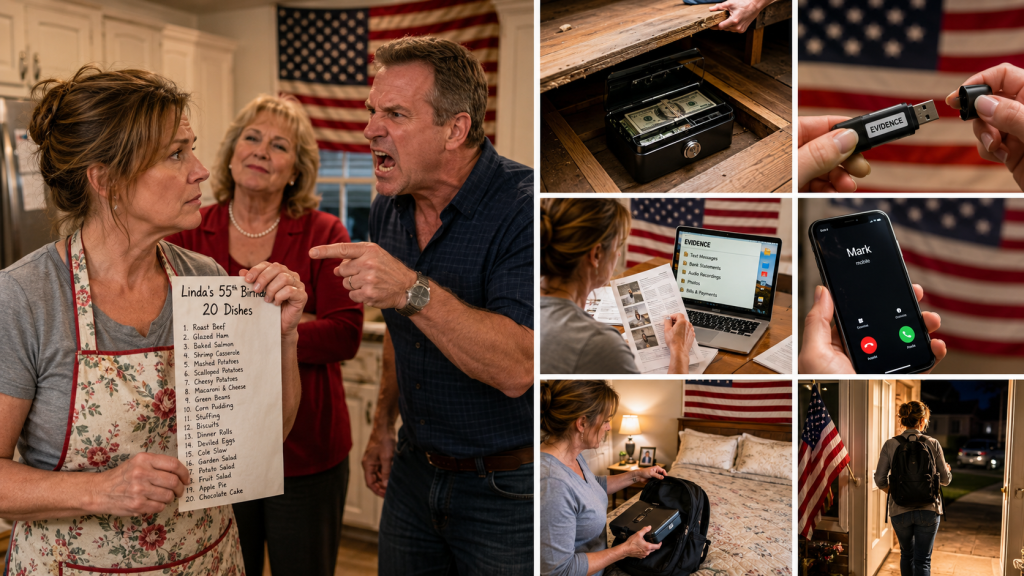
For Her 55th Birthday, She Insisted on 20 Dishes. I Told Her It Was Impossible. My Husband Exploded and Said, “Cook or Leave!” He Assumed I Had Nowhere Else to Go. What He Didn’t Know Was That I Had $6,000 Hidden Away and an Entire Year of Evidence.
“Twenty dishes. Not eighteen. Not nineteen. Twenty.”
Linda Mercer pressed the handwritten menu against my chest as though she were handing down an official order. It was her fifty-fifth birthday, and she had decided that the whole family—all twenty-three of them—would celebrate at our home in suburban Columbus, Ohio.
I looked down at the list: roast beef, glazed ham, baked salmon, shrimp casserole, three different kinds of potatoes, macaroni and cheese, green beans, corn pudding, stuffing, biscuits, two salads, deviled eggs, four desserts, and even more.
“Linda, that’s impossible,” I said. “Not with only one oven. Not by six o’clock.”
My husband, Mark, stood just behind me.
The second I refused, something in his expression shifted.
He moved toward me, and the argument intensified so fast that even Linda fell silent for a moment.
Then he barked,
“Cook or get out.”
Linda smiled.
That was the exact moment I stopped pretending I still belonged to a family.
For eleven years, I had cooked, cleaned, paid the bills, covered Mark’s debts, and apologized for things that were never my fault.
Linda called me ungrateful anytime I pushed back.
Mark called me selfish whenever I questioned where his paycheck had gone.
But neither of them knew about the small metal cash box hidden beneath a loose floorboard in the storage room.
Inside was $6,000.
Next to it sat a flash drive holding an entire year of evidence: screenshots of threatening messages, records of arguments that kept getting worse, bank statements showing money moved from our joint account to his mother, recordings of Linda telling him to “teach me my place,” and copies of every household bill I had covered by myself.
I had gathered all of it quietly because I knew there might come a day when I would need to leave without giving anyone warning.
That day was finally here.
I looked directly at Mark.
“Fine,” I said.
Linda pushed the menu into my hands.
“Good. And don’t make me look bad in front of my sisters.”
I walked into the kitchen and started chopping onions.
For the next three hours, I cooked exactly the way they expected me to.
I smiled as the guests came through the door.
I accepted every compliment.
I kept everyone’s drinks filled.
I even carried Linda’s birthday cake into the dining room while the entire family sang to her.
Then, at exactly 5:47 p.m., I quietly went upstairs.
I changed into jeans, grabbed the backpack I had packed two months before, lifted the loose floorboard, pulled out the cash box and flash drive, and ordered a rideshare to meet me on the side street.
Before I left, I placed a single envelope on our bed.
Inside was a copy of the police report I had filed earlier that morning.
At 5:58, while Linda was blowing out all fifty-five candles, I stepped through the back door and walked away.
At 6:12, Mark finally called me.
I watched his name light up across my phone screen.
For the first time in eleven years, I didn’t feel afraid of what might happen if I refused to answer.
Then I blocked his number.
PART 2: THE NIGHT THEY REALIZED I HAD NOT LEFT EMPTY-HANDED
The first strange thing about freedom was how quiet it sounded.
No one was shouting my name.
No cabinet doors were slamming.
No footsteps were coming down the hallway.
No one was asking where the serving spoon was, why the roast was dry, whether Linda had enough ice, or why I had made only two kinds of salad instead of three.
There was only the soft hum of the rideshare engine and the faint tapping of rain against the passenger-side window.
I sat in the back seat with my backpack between my knees.
Inside it were six thousand dollars in cash.
A flash drive.
Three changes of clothes.
My passport.
A folder of documents.
And eleven years of marriage reduced to what I could carry without help.
The driver glanced at me in the mirror.
“Long night?”
I looked at my reflection in the glass.
My hair still smelled like cooking oil.
There was flour on the sleeve of my sweatshirt.
My hands smelled faintly of onions and cinnamon.
Behind us, somewhere across Columbus, twenty-three people were probably still eating the dinner I had spent three hours preparing after my husband told me to cook or leave.
“Something like that,” I said.
He nodded and left me alone.
I was grateful.
The hotel I had chosen was not glamorous.
That was intentional.
It was an extended-stay place near the interstate, the kind designed for contractors, nurses on temporary assignments, families between apartments, and people who did not want to answer questions.
I had booked the room under my maiden name.
Emily Carter.
Not Emily Mercer.
Seeing those two words on the reservation screen had made me cry the night I created the account.
Not because I hated being a Mercer.
Because I had almost forgotten I had been someone before it.
When the driver pulled beneath the hotel awning, I paid through the app, then added a tip I probably could not afford.
Old habit.
I still worried about inconveniencing strangers.
Inside, the lobby smelled of industrial carpet cleaner and burnt coffee.
The young woman at the front desk barely looked at me.
“ID?”
I handed it over.
She typed.
My heart hammered anyway.
I kept expecting the doors to open.
Mark.
Linda.
His brother Kevin.
Someone from the family.
Someone sent to drag me back into the life I had just walked out of.
But nobody came.
The woman handed me a plastic key card.
“Third floor.”
“Thank you.”
I took the elevator.
Entered room 318.
Locked the door.
Then locked the deadbolt.
Then slid the metal safety latch into place.
I stood there staring at it.
A tiny strip of metal.
That was all.
Nothing dramatic.
Nothing expensive.
But when it clicked into place, my knees almost gave out.
For eleven years, I had lived in a four-bedroom house.
Granite counters.
Two-car garage.
Finished basement.
A dining room Linda liked to call “perfect for entertaining.”
And somehow, this cheap hotel room with beige carpet and one ugly lamp felt safer than any square foot of it.
I dropped the backpack onto the bed.
Sat down.
Then started shaking.
Not crying at first.
Shaking.
My hands.
My shoulders.
Even my jaw.
It was as if my body had spent years holding itself perfectly still and finally realized no one was watching.
I pressed both palms between my knees.
“Stop.”
The word came out as a whisper.
My body ignored me.
So I let it.
A minute later, my phone vibrated.
Unknown number.
I froze.
Then another.
Then another.
I did not answer.
A message appeared.
You embarrassed me in front of my whole family.
Mark.
Of course.
Another followed.
Come home before this gets worse.
Then:
Mom is hysterical.
Then:
You’re making me look abusive.
That one made me laugh.
It came out broken.
Half laugh.
Half sob.
Not:
Are you safe?
Not:
Where are you?
Not:
I’m sorry.
He was worried I was making him look abusive.
I took a screenshot.
Saved it into the evidence folder on my phone.
Then copied it to a secure email account Mark did not know existed.
I had learned to do that automatically.
Screenshot.
Save.
Backup.
Date.
Time.
Evidence.
That was what the last year had done to me.
It turned my marriage into something I documented like a case file.
And the worst part was that I still felt guilty doing it.
As though preserving the truth were somehow more disloyal than living through it.
My phone rang again.
Unknown number.
I silenced it.
Then I opened the cash box.
I counted every bill.
Six thousand one hundred twenty dollars.
I had told myself for months that it was six thousand.
Apparently I had forgotten the last one hundred twenty.
The money had taken nearly three years to save.
Twenty dollars hidden after groceries.
Cashback from the pharmacy.
Forty dollars from a birthday card.
Money from a small catering job I never told Mark about.
A bracelet I sold after Linda mocked me for “never wearing anything nice.”
Every bill represented a tiny decision not to disappear completely.
It was not enough to start a new life.
But it was enough to buy time.
That was what I needed.
Time before panic could push me back home.
Time before guilt could make Mark sound reasonable.
Time before Linda could turn the entire family against me.
Time to remember what I already knew.
I opened the flash drive on my laptop.
Folders filled the screen.
BANK.
MESSAGES.
AUDIO.
BILLS.
PHOTOS.
POLICE.
I clicked the audio folder.
February 12.
I knew the recording before it played.
Mark’s voice.
“If you walk out that door, don’t come back.”
Then mine.
“I’m going to the grocery store.”
“You don’t need to go anywhere.”
“Mark, move.”
A scraping sound.
His hand against the doorframe.
Then Linda’s voice in the background.
Calm.
Almost amused.
“Stop letting her control you.”
A pause.
Then:
“She needs to learn marriage has consequences.”
I shut the recording off.
My stomach turned.
At the time, I had told myself it was not abuse.
Because Mark had not punched me.
He had only blocked the doorway.
Only grabbed my wrist once hard enough to leave fingerprints.
Only thrown my phone across the kitchen when I told him his mother was taking too much money.
Only punched the wall beside me.
Only told me nobody else would tolerate me.
Only made me explain every charge on the debit card while moving hundreds of dollars to Linda without discussion.
Only.
That word can become a prison if you use it long enough.
The phone buzzed again.
This time it was Kevin.
Mark’s younger brother.
I did not answer.
Kevin was not cruel like Linda.
But he was weak around her.
And weakness inside a controlling family can become its own kind of participation.
A voicemail notification appeared.
I listened.
“Emily, it’s Kevin.”
His voice was low.
“There’s kind of a situation here.”
I almost laughed.
Kind of.
“Mark found the envelope.”
Pause.
“Mom says you planned this to ruin her birthday.”
I closed my eyes.
Of course she did.
“Everyone’s leaving.”
Another pause.
“Mark’s really angry.”
He lowered his voice.
“I think maybe you should stay wherever you are tonight.”
That surprised me.
Then:
“I’m not asking where you are.”
I sat straighter.
“Just… stay there.”
The voicemail ended.
I listened again.
The second time, I heard what was underneath it.
Fear.
Not of me.
Of Mark.
I saved the voicemail.
Then I took a shower.
The water was barely hot.
The pressure was terrible.
I stood beneath it anyway until the smell of birthday dinner disappeared from my skin.
When I got out, I put on the soft gray T-shirt I had packed two months earlier.
I sat on the edge of the bed.
Then realized I was waiting for permission to sleep.
That thought nearly destroyed me.
I lay down fully dressed.
Every light on.
Phone on the pillow beside me.
Backpack under my arm.
At some point, exhaustion won.
At 2:17 in the morning, someone knocked on my door.
Three firm knocks.
I woke instantly.
My heart slammed against my ribs.
Another knock.
“Ms. Carter?”
I did not move.
“Columbus Police.”
For one second, I could not breathe.
Then I got up.
Walked toward the door.
Did not open it.
“Can I see identification?”
There was a pause.
Then a male voice.
“Yes, ma’am.”
He held a badge near the peephole.
I called the front desk.
Confirmed police were in the hallway.
Then opened the door with the safety latch still engaged.
Two officers stood outside.
One man.
One woman.
The male officer spoke.
“Are you Emily Mercer?”
My throat tightened.
“Yes.”
“Your husband reported you missing.”
I almost laughed.
“I’m not missing.”
“We can see that.”
The female officer looked at me carefully.
“Are you here voluntarily?”
“Yes.”
“Are you safe?”
“Yes.”
“Did you leave your residence willingly?”
“Yes.”
The man nodded.
“Your husband said you were emotionally unstable.”
There it was.
I looked at him.
“Did he mention the police report I filed this morning?”
Both officers changed.
The woman took out a small notebook.
“What report?”
I gave them the number.
She stepped away and made a call.
The male officer stayed.
“What happened this morning?”
I swallowed.
“Last night we argued.”
“About?”
“His mother’s birthday dinner.”
“That’s all?”
“No.”
I hated how small my voice became.
He waited.
I continued.
“Mark threw a coffee mug into the sink.”
“It shattered.”
“One piece cut my hand.”
I showed him the thin bandage along the side of my palm.
“He blocked the kitchen doorway until I apologized.”
“For what?”
“For making him angry.”
The officer’s expression changed.
“And you filed a report?”
“Yes.”
“Was he arrested?”
“No.”
“I didn’t ask for that.”
I swallowed.
“I wanted documentation.”
The female officer returned.
“She’s correct.”
She looked at me.
“Officer Jacobs took the report.”
Then she turned toward her partner.
“Domestic incident.”
The words made my stomach twist.
Domestic.
Such a soft word for something that can hollow out a person.
The male officer asked,
“Did your husband know you planned to leave?”
“No.”
“Does he know where you are?”
“No.”
The woman nodded.
“We won’t disclose your location.”
Relief moved through me so quickly I nearly cried.
Then the male officer said,
“He also reported that you stole six thousand dollars.”
My fear vanished.
Replaced by something almost funny.
Of course he did.
“I did not.”
“Can you explain the money?”
“Yes.”
I walked to the desk.
Pulled my notebook from the backpack.
Three years of handwritten amounts.
Dates.
Sources.
$40 — grocery cash.
$75 — catering.
$20 — birthday card.
$180 — bracelet sale.
Page after page.
I placed it on the table.
“This is money I saved personally.”
The officer looked through it.
“I have bank withdrawal records for some of it.”
“Receipts for the jewelry sale.”
“I can show you.”
He raised one hand.
“That’s enough for tonight.”
The female officer handed me a small card.
Domestic-violence advocacy services.
Emergency housing.
Legal resources.
A hotline.
I stared at it.
The words seemed too serious.
Too official.
I almost handed it back.
Then I remembered the doorway.
The wrist.
The phone against the wall.
The coffee mug.
The birthday ultimatum.
Cook or leave.
I put the card into my wallet.
The officers left.
I locked the door again.
Then sat on the floor.
And cried harder than I had in years.
Not because I was afraid.
Because a stranger had asked whether I was safe and accepted the answer as important.
The next morning, I called the advocacy number.
A woman named Denise Carter answered.
Same last name as my maiden name.
No relation.
She had a voice that made me feel as though she had heard every version of my story before.
Maybe she had.
She did not call Mark a monster.
She did not tell me what to do.
She asked practical questions.
“Does he know your passwords?”
“Some.”
“Change them.”
“Does he have access to your email?”
“Possibly.”
“Create a new account.”
“Cloud photos?”
“Yes.”
“Check location sharing.”
My stomach dropped.
I had forgotten that.
We turned it off.
Shared phone plan.
Family tracking.
Old tablet still logged into my email.
One by one, Denise showed me all the invisible strings that can remain attached after you leave a house.
Then:
“Freeze your credit.”
I frowned.
“Why?”
“Because financial control often overlaps with unauthorized credit.”
My chest tightened.
“I don’t think Mark would—”
I stopped.
Denise waited.
Not judgment.
Just silence.
I changed the sentence.
“I don’t know.”
“Good answer.”
That became the phrase I carried with me.
I don’t know.
Not denial.
Not accusation.
Permission to check.
That afternoon, Denise connected me with an attorney named Elena Brooks.
Elena wore tortoiseshell glasses and asked questions like she had no interest in making me comfortable.
I liked her immediately.
She reviewed the flash drive.
Not everything.
Enough.
Messages.
Recordings.
Bank transfers.
The police report.
Then she said,
“You need a full credit report.”
I looked at her.
“Why?”
“Because I see unexplained household transfers.”
“Your husband is moving money to his mother.”
“Yes.”
“And you said he handled some refinancing paperwork last year.”
“I think so.”
“You think?”
“He mentioned it.”
“What happened?”
“He said rates were bad and he dropped it.”
Elena wrote that down.
“Whose names are on the house?”
“Both.”
“Mortgage?”
“Both.”
“Any home equity line?”
“No.”
She looked at me.
“You’re sure?”
“Yes.”
Then I thought about it.
“I think.”
Elena gave me the same look Denise had.
I knew.
Good answer.
We pulled my credit.
The room went silent.
A revolving account appeared.
Secured against the house.
Opened ten months earlier.
Original limit:
$45,000.
Current balance:
$38,912.
My heart stopped.
“What is that?”
Elena leaned toward the screen.
“Home equity line.”
“No.”
“Yes.”
“No.”
I stood.
“I never signed for that.”
She looked at me carefully.
“Then we need the application.”
My hands started shaking.
“Mark would not—”
Again, the old instinct.
Defend.
Explain.
Soften.
I sat down.
“I don’t know.”
Elena nodded.
“Better.”
Two days later, the bank produced preliminary copies.
My name.
Mark’s name.
My supposed electronic signature.
I stared at it.
“That isn’t how I sign.”
Elena looked up.
“You’re certain?”
“Yes.”
“My middle initial is wrong.”
My legal name was Emily R. Mercer.
The application said Emily E. Mercer.
Elena circled it.
“Anything else?”
“I was at my sister’s in Dayton that date.”
“How do you know?”
“It was her surgery.”
“Can you prove it?”
“Hotel receipt.”
“Texts.”
“Pictures.”
“Good.”
Then we reached the disbursements.
First draw:
$10,000.
Transfer destination:
An account ending 9081.
I knew those numbers.
Linda.
My stomach turned.
Next:
$15,000.
Same account.
Then:
$8,000.
Different account.
Then:
$5,000.
Then smaller payments.
Elena stared at the screen.
“How much did you know he was giving his mother?”
“Some.”
“How much?”
“I don’t know.”
She waited.
I swallowed.
“Maybe twenty thousand over the last few years.”
She looked at the equity line.
“Emily.”
“I know.”
No.
I did not.
Not really.
My mind returned to the previous winter.
Our washing machine had leaked for three months.
I placed towels around it because Mark said replacing it was impossible.
Money was tight.
Property taxes.
Insurance.
Inflation.
Everything was expensive.
That was what he told me.
So I postponed dental work.
Stopped buying coffee out.
Cancelled a weekend trip with my friend Rachel.
Picked up more freelance bookkeeping.
All while he had opened forty-five thousand dollars against our home.
And moved much of it to his mother.
I whispered,
“He made me live poor.”
Elena looked at me.
“What?”
“He made me feel guilty for spending twelve dollars.”
My voice broke.
“He told me we were barely keeping up.”
I stared at the numbers.
“He wasn’t just hiding money.”
“He was making sure I behaved like there wasn’t any.”
That realization hurt differently.
Money had not simply disappeared.
Fear had replaced it.
I had been made to feel irresponsible inside a financial reality someone else controlled.
My phone buzzed.
Unknown number.
A message.
We can fix this if you stop involving outsiders.
Mark.
Then:
Mom doesn’t know the full situation.
Another:
Whatever you think you found in the accounts, I can explain.
I showed Elena.
She read the final message twice.
Then looked at me.
“He knows you’re reviewing finances.”
My stomach dropped.
“How?”
“Did you tell anyone?”
“No.”
“Kevin?”
“No.”
“Friends?”
“No.”
She leaned back.
“Then either he’s guessing, or something alerted him.”
The bank.
Credit report.
Account review.
Possible.
Still, the message made my skin crawl.
Elena said,
“Do not answer.”
I didn’t.
That evening, another message came.
That $6,000 is marital money. You stole from me.
Then:
You think recordings make you powerful?
My entire body went cold.
I stared at the sentence.
How did he know about the recordings?
Only a few people knew.
Me.
Denise.
Elena.
Police had copies of some material.
Mark should not.
Then Linda texted.
First time directly since I left.
You have no idea what you’ve done to this family.
Then:
If you destroy my son with those recordings, don’t expect to get the house.
I stared.
The house.
As though it were hers to give.
As though I were still negotiating for a place in my own marriage.
Then another:
We know what you’ve been saving.
My stomach dropped.
I called Elena.
She answered immediately.
“They know about the flash drive.”
“How?”
“I don’t know.”
Then I remembered.
Three weeks earlier, Linda had shown up unexpectedly.
She said she needed a serving platter.
She went into the storage room.
Stayed there almost fifteen minutes.
At the time, I thought she was snooping.
Now I wondered if she had seen the loose floorboard.
Maybe moved it.
Maybe found the box.
Maybe found the drive.
Maybe Mark had known for weeks that I was building evidence.
The thought made me nauseous.
Elena’s voice sharpened.
“Change hotels.”
“What?”
“Tonight.”
That scared me more than anything she had said.
“Do you think they know where I am?”
“I don’t know.”
There it was.
Good answer.
I moved.
Different hotel.
Different side of Columbus.
The cash box.
The backpack.
The flash drive.
Except by then, the flash drive itself no longer mattered.
Copies existed.
Elena had one.
The police had records.
Denise had secure documentation.
The bank investigation had begun.
For years I thought keeping evidence meant hiding one object well enough.
Now I understood real protection meant making sure no single object could disappear with the truth.
The following morning, Elena called.
“Come in.”
Her voice was strange.
Not alarmed.
Careful.
“What happened?”
“I found something.”
Those words never brought good news anymore.
At her office, she placed a property record in front of me.
Limited liability company.
MERCER RIDGE PROPERTIES LLC.
Owner:
Mark Mercer.
My chest tightened.
“What is that?”
Elena slid another page over.
Property address:
A two-bedroom condominium in Dublin.
Purchased fourteen months earlier.
I stared.
“I’ve never seen this.”
“I know.”
“How much?”
“Two hundred thirty-eight thousand.”
My mouth went dry.
“How?”
“Down payment appears to have come from a separate account we’re still tracing.”
“Some expenses appear connected to the equity line.”
I stared at the condo photograph.
Brick exterior.
Balcony.
Neutral landscaping.
Ordinary.
That made it worse.
Secret things are supposed to look sinister.
This looked like somewhere you might rent after college.
“Who lives there?”
Elena was quiet.
Then she turned over one final page.
Tenant:
Sarah Keene.
The name meant something.
Not immediately.
Then I remembered Christmas.
Blonde hair.
Green dress.
Standing beside Mark near the office-party bar.
“Coworker.”
My voice barely came out.
Elena nodded.
“Mark listed her as tenant.”
“Rent is substantially below market.”
“Security deposit waived.”
“He is also listed as emergency contact.”
My stomach turned.
“No.”
I stood.
Walked toward the window.
“No.”
Elena did not say anything.
She did not need to.
Sarah.
I remembered Mark saying she was “basically one of the guys.”
Remembered her laughing too hard at his stories.
Remembered Linda telling me once that women who “let themselves go” should not be surprised when husbands stopped looking.
I had cried in the bathroom after that.
Mark told me not to take everything his mother said personally.
Now a woman nearly ten years younger than me was living in a condo my husband owned secretly.
I whispered,
“Is he having an affair?”
Elena answered carefully.
“I can’t prove that from property records.”
Good.
Facts.
Not assumptions.
But my body already knew something.
Maybe not the exact truth.
Something.
Then my phone rang.
Kevin.
I almost ignored it.
Elena said,
“Answer if you want.”
I did.
“Hello?”
Kevin sounded out of breath.
“Emily.”
“What?”
“Mark and Mom are fighting.”
“That’s not my problem.”
“I know.”
He lowered his voice.
“I’m at the house.”
“Why?”
“Mark called me.”
“Mom’s screaming about money.”
My heart tightened.
Kevin continued.
“She said something about Sarah.”
I stopped breathing.
“What exactly?”
Pause.
Then:
“She said, ‘If you hadn’t been so stupid about Sarah, none of this would’ve happened.’”
The room disappeared.
Elena watched my face.
Kevin whispered,
“Emily?”
“I’m here.”
“I don’t know who Sarah is.”
“I do.”
Silence.
“Oh.”
That single word.
Then Kevin said,
“There’s more.”
Of course.
“There are papers on the dining-room table.”
“What papers?”
“I don’t know if I should touch them.”
“Don’t.”
Elena nodded approvingly.
“Just tell me what you see.”
Kevin moved.
I heard paper rustling.
Then silence.
“Kevin?”
“Emily.”
His voice changed.
“What?”
“There’s a divorce petition.”
My knees weakened.
“What?”
“It says draft.”
I sat down.
Kevin read.
“Petition for dissolution of marriage.”
“Mark Mercer.”
“Emily Mercer.”
I could not breathe.
“Date?”
“Three months ago.”
Three months.
Before Linda’s birthday.
Before the police report.
Before I left.
Before Mark told me to cook or get out.
He had already spoken to someone about ending our marriage.
Kevin continued.
“There are notes.”
“What notes?”
“I don’t understand.”
“Read them.”
He hesitated.
Then:
“Respondent currently has no independent income sufficient for relocation and is expected to remain in marital residence pending negotiated settlement.”
The words hit harder than the affair.
Harder than the condo.
Harder than the money.
I stared at nothing.
Expected to remain.
Not:
Emily wants to remain.
Not:
Emily may remain.
Expected.
As though my life had already been turned into an assumption.
She has no money.
No independent income.
Nowhere to go.
She will stay.
She will wait.
She will negotiate from fear.
The room became very quiet.
Elena held out her hand.
I placed the phone on speaker.
She asked,
“Kevin, can you photograph only what is openly visible on the table without moving anything?”
“Yes.”
“Do not open drawers.”
“Do not search.”
“Do not take documents.”
“Understood?”
“Yes.”
Photos arrived minutes later.
The draft petition.
Notes.
A timeline.
Then one handwritten line beside my financial information.
I zoomed in.
If she leaves voluntarily, easier argument re: occupancy.
My stomach turned.
Easier.
Occupancy.
House.
Control.
Suddenly Mark’s words returned.
Cook or get out.
I had thought it was rage.
An ultimatum.
A threat meant to remind me I had nowhere else to go.
Now I wondered if part of him had wanted exactly that.
For me to leave voluntarily.
For him to stay.
For the house to become another leverage point.
Elena took the phone.
Read everything twice.
Then looked at me.
Her expression was serious.
“Emily.”
I waited.
“This may explain why your financial dependence mattered to him.”
My throat tightened.
“What do you mean?”
“If Mark was already preparing for divorce while controlling your access to money, opening credit in your name, moving assets, and keeping you financially constrained…”
She chose each word carefully.
“…then dependence may have been useful.”
I felt sick.
I thought about the last three months.
Mark discouraging me from applying for a full-time bookkeeping position.
We don’t need you working forty hours.
Telling me he preferred me home.
Mom relies on you.
Telling me the job market was terrible.
You’ve been out too long.
Telling me health insurance would become complicated.
Why create problems?
I thought he wanted a wife at home.
Maybe he wanted something else too.
A woman easier to negotiate with.
I whispered,
“Was he planning to leave me?”
Elena looked at the condo photo.
Then the divorce draft.
“I think we need more evidence before answering exactly what he planned.”
I nodded.
Good answer.
But the deeper question had already formed.
If Mark had wanted the marriage to end for at least three months—
why spend those same three months convincing me I could not survive without him?
That night, I sat on the edge of another hotel bed.
Different room.
Different walls.
Same backpack.
I took out the six thousand dollars.
Counted it again.
I thought the money had been my escape plan.
It wasn’t.
Not really.
The money bought the hotel.
The rideshare.
Food.
A lawyer.
A new phone.
A deposit if I needed one.
But something else had gotten me through the back door at 5:58.
Evidence helped.
Planning helped.
The police report helped.
But the most important thing I had hidden beneath that floorboard was not cash.
It was the belief that Mark was wrong.
I did have somewhere to go.
I just had not known the address yet.
My phone lit up.
Another unknown number.
This time, the message said:
Whatever you think is happening with Sarah, it isn’t what you think.
I stared at it.
Then another:
You were never supposed to find out like this.
My chest tightened.
Not:
Nothing happened.
Not:
There is no Sarah.
Just:
Not like this.
I took a screenshot.
Saved it.
Backed it up.
Then I turned off the phone.
For the first time since I walked away from Linda’s birthday cake, I did not feel like I was running.
I felt like I had finally stopped running in circles.
And somewhere across town, Mark was beginning to understand something he should have understood eleven years earlier.
He had spent years making sure I believed I had nowhere else to go.
But while he was planning a secret condo, hidden debt, and perhaps even a divorce—
I had been saving twenty dollars at a time.
Recording one argument at a time.
Keeping one statement at a time.
Building one small piece of proof after another.
He thought I was trapped because I had no visible exit.
What he never understood was that I had been building one quietly beneath his feet.
And now that I was outside the house—
I was finally going to find out exactly how long he had been planning to live without me.
PART 3: THE DIVORCE HE PLANNED BEFORE HE TOLD ME TO LEAVE
The sentence I could not stop thinking about was not the one about Sarah.
It was not the secret condo.
It was not the forty-five-thousand-dollar line of credit opened in my name.
It was not even the draft divorce petition dated three months before Linda’s birthday.
It was one sentence typed beneath my financial information.
Respondent currently has no independent income sufficient for relocation and is expected to remain in marital residence pending negotiated settlement.
Expected to remain.
I read those words until they stopped sounding like English.
Expected.
As if I were not a person.
As if I were a predictable condition.
Like weather.
Like property.
Like furniture that could be counted on to stay exactly where someone had placed it.
I sat in Elena’s office the next morning with the draft petition on the table between us.
The hotel coffee beside me had gone cold.
Outside her window, Columbus moved through an ordinary Tuesday.
Cars stopped at red lights.
People carried briefcases.
Someone walked a golden retriever past a pharmacy.
My life felt as if it had split open.
The rest of the world did not notice.
Elena removed her glasses.
“Emily.”
I looked at her.
“You need to hear this carefully.”
I nodded.
“A draft petition does not prove what Mark intended to do in every detail.”
“I understand.”
“It does show he was considering divorce.”
“Yes.”
“It also shows someone was thinking about your financial dependence as part of the situation.”
My throat tightened.
“Yes.”
“And if he intentionally kept you financially dependent to improve his position…”
She paused.
“…that matters.”
I looked down at the page.
“Can he really say I abandoned the house because I left?”
Elena shook her head.
“Leaving because you feel unsafe does not automatically mean surrendering ownership.”
My chest loosened slightly.
“Then why did he write that?”
“We don’t know that Mark wrote the note himself.”
She tapped the page.
“But whoever prepared this was thinking about occupancy.”
“Leverage.”
“Negotiation.”
I looked at her.
“Fear.”
She was quiet.
I continued.
“He knew I didn’t have enough visible money to leave.”
“Yes.”
“He knew I had been out of full-time work.”
“Yes.”
“He encouraged me not to go back.”
“Yes.”
“He told me we couldn’t afford things.”
“Yes.”
“And all the while he had a condo.”
Elena’s expression hardened.
“Yes.”
Something inside me settled.
Not healed.
Settled.
There is a moment after shock when the pieces stop flying long enough for you to see the shape of the damage.
I saw it now.
Mark had not simply lied about money.
He had built an environment in which I was supposed to believe leaving was impossible.
That was different.
Worse.
And strangely—
clarifying.
I whispered,
“He wanted me afraid of the door.”
Elena looked at me.
“Maybe.”
“I think we should let documents tell us how far that goes.”
So we did.
For the next two weeks, we followed the money.
Carefully.
Legally.
Patiently.
Patience was not my strength then.
Every morning I wanted answers.
Every evening I discovered another reason answers take time.
The bank began investigating the home-equity line.
I provided handwriting samples.
Travel receipts.
Photos proving I was in Dayton on the date of the electronic application.
Old documents showing how I actually signed my name.
The middle initial mattered.
So did the device record.
So did the verification phone number.
It was Mark’s.
The bank did not immediately declare fraud.
Real institutions move slower than rage.
But the account was formally disputed.
That mattered.
Then Elena traced the money used to purchase the condo.
Part came from a private account Mark had opened eighteen months earlier.
Part came from the home-equity line.
Part came from money I had believed was going toward taxes and household expenses.
The condo had been purchased through Mercer Ridge Properties LLC.
Mark was the listed owner.
Sarah Keene was the tenant.
Her rent was almost eight hundred dollars below market.
Deposit waived.
Utilities partially covered.
Mark’s number listed for emergencies.
Still, Elena remained careful.
“This does not prove an affair.”
I nodded.
“I know.”
I hated good lawyers.
Then Sarah called me.
I almost dropped the phone.
Unknown number.
I nearly ignored it.
Then something made me answer.
“Hello?”
A woman’s voice.
“Emily?”
I stopped breathing.
“Yes?”
“This is Sarah Keene.”
For several seconds, I said nothing.
She continued.
“I think we need to talk.”
My hand tightened around the phone.
“Why?”
“Because I found out what Mark told me about you wasn’t true.”
There are sentences that change your pulse immediately.
That was one.
I did not meet Sarah alone.
Elena insisted.
So three days later, Sarah sat across from me in Elena’s conference room.
She looked nothing like the villain I had imagined.
That almost irritated me.
She was thirty-four.
Brown hair instead of the blonde I remembered—apparently Christmas lighting had lied.
No dramatic makeup.
No expensive jewelry.
Just a tired woman holding a paper cup in both hands.
She looked at me.
“I’m sorry.”
I said nothing.
She continued.
“I know that probably means nothing.”
“It means less before the truth.”
Sarah nodded.
“That’s fair.”
Elena sat beside me.
Silent.
Watching.
Sarah took a breath.
“I started seeing Mark about eleven months ago.”
There it was.
No euphemism.
No complicated beginning.
An affair.
Eleven months.
My stomach twisted.
I stared at the table.
Sarah continued.
“He told me your marriage had been over emotionally for years.”
Of course.
“He said you both stayed in the house because neither of you wanted the financial disruption.”
My eyes lifted.
“What else?”
She swallowed.
“He said you refused to work.”
Something cold moved through me.
“What?”
“He said you liked being supported.”
I laughed.
One short, ugly sound.
Sarah flinched.
“Sorry.”
“No.”
I shook my head.
“Keep going.”
“He said you controlled the house.”
“That you made him feel guilty about his mother.”
“That you would make the divorce ugly.”
“And that you stayed because you couldn’t afford to leave.”
There it was.
Again.
That story.
Emily cannot leave.
Emily has nowhere to go.
Emily is dependent.
A lie repeated often enough that Mark had begun selling it to other people as fact.
I asked,
“Did he tell you why I stopped working full-time?”
Sarah looked uncertain.
“He said you preferred being home.”
I closed my eyes.
“No.”
My voice broke.
“I stopped full-time work because Linda had hip surgery.”
Sarah stared.
“What?”
“She needed help for almost eight months.”
“Mark asked me to reduce my hours.”
“My employer wouldn’t accommodate the schedule.”
“So I left.”
Sarah’s face drained.
I continued.
“After she recovered, I started freelance bookkeeping.”
“Mark said there was no reason to rush back.”
I laughed bitterly.
“He said one income was enough.”
Sarah looked sick.
“I didn’t know.”
“No.”
I looked at her.
“You knew what he told you.”
That was different.
I was not going to make her responsible for every lie Mark invented.
But neither was I going to make her innocent just because she had been lied to too.
I asked,
“Did you know he was still living with me as husband and wife?”
She hesitated.
“Yes.”
“That should have mattered.”
Her eyes filled.
“I know.”
Good.
At least she did not run from it.
Sarah continued.
“He said he was waiting until after Linda’s birthday to file.”
My chest tightened.
“Why?”
“He didn’t want family drama before then.”
I almost laughed.
Of course.
Linda’s birthday.
Twenty dishes.
The great sacred event around which everyone else’s life apparently had to bend.
Sarah looked down.
“He said once things were settled, he’d move into the condo.”
I frowned.
“I thought the condo was yours.”
“So did I.”
My stomach dropped.
“What?”
Sarah looked embarrassed.
“He told me it was an investment he bought for our future.”
“Your future together?”
“Yes.”
“Did you pay rent?”
“Yes.”
“Below market.”
“I didn’t know that.”
She laughed bitterly.
“He told me he was giving me a discount because I was helping cover furniture.”
My head spun.
Mark had somehow turned his secret girlfriend into a tenant inside the property he intended to move into after leaving me.
Even betrayal had bookkeeping.
Sarah reached into her bag.
“I brought messages.”
Elena leaned forward.
Sarah handed over printed screenshots.
I read.
Mark:
She has no clue about the HELOC.
My hands went cold.
Another.
She says she might look for work after the holidays.
Linda:
Discourage it. Tell her you need her at home.
I stopped breathing.
Sarah whispered,
“I found those on his laptop.”
I looked at her.
“Linda sent that?”
“Yes.”
There were more.
Mark:
If Emily gets a job now, it complicates everything.
Linda:
Then make her feel needed at home. She always falls for that.
My vision blurred.
Another.
Mark:
Sometimes I feel guilty. She trusts me completely.
Linda:
Then stop acting guilty. You’re doing what you have to do.
I placed the pages down.
My hands were shaking too badly to hold them.
Sarah looked toward Elena.
“There’s more.”
Of course there was.
The next screenshot involved the house.
Mark:
If she leaves on her own, I may have a better argument to stay.
Linda:
Then give her a reason to go.
I stopped breathing.
The room disappeared.
Cook or get out.
That sentence returned with terrifying clarity.
Not only anger.
Maybe strategy.
Maybe not fully planned.
Maybe a moment Linda and Mark believed would push me somewhere they had already decided I could not afford to stay.
Sarah continued.
“I think that’s why Linda kept provoking you.”
My stomach turned.
“What do you mean?”
“Mark talked about it.”
“He said his mom knew how to make you lose your temper.”
I almost smiled.
“She failed.”
Sarah frowned.
“What?”
“I didn’t lose it.”
No.
I had cooked twenty dishes.
Smiled.
Carried the cake.
Left through the back door.
For the first time, I saw that evening differently.
They had expected a fight.
Maybe yelling.
Maybe me storming out.
Maybe Mark following me into the driveway while twenty-three relatives watched.
Something messy.
Something they could retell.
Instead, I gave them dinner.
Then disappeared with evidence.
Sarah said,
“Linda knew about me.”
That did not surprise me.
“How long?”
“Almost from the beginning.”
Of course.
“What did she think?”
Sarah gave a sad little laugh.
“She liked me.”
That hurt more than it should have.
“Why?”
“She said I was more suitable.”
Suitable.
Career.
No history of challenging her.
No eleven years of resentment.
Sarah continued.
“She said once you were out, Mark could finally stop pretending he respected you.”
I looked away.
That sentence found the last soft place still protecting my marriage.
It cut cleanly through it.
Sarah whispered,
“I ended things with him two weeks before the birthday.”
I turned back.
“Why?”
“Because I realized I didn’t know which version of Mark was real.”
I said nothing.
“He complained about you.”
“Then his mother.”
“Then his boss.”
“Then his brother.”
“Everybody was unfair to him.”
She looked at me.
“And I started wondering what he would say about me once I became inconvenient.”
That was smarter than anything Mark had given either of us credit for.
She continued.
“The last time I saw Linda, she said something that scared me.”
“What?”
Sarah looked down.
“She said once you were out of the house, Mark could stop pretending.”
I waited.
“And then?”
Sarah swallowed.
“She said people like you needed to be pushed because you were too proud to ask anyone for help.”
My throat tightened.
There it was.
They had counted on my isolation.
Not simply my finances.
My pride.
My missing friendships.
My fear of burdening people.
They had mapped me emotionally.
That felt more invasive than the bank account.
I looked at Sarah.
“Why are you telling me now?”
Tears filled her eyes.
“Because I was part of something ugly.”
She wiped her cheek.
“I didn’t know all of it.”
“But I knew enough to know I was sleeping with a married man.”
She took a breath.
“And because Mark kept telling me you were helpless.”
“I believed him.”
“Then I heard what you did at the birthday.”
A tiny smile appeared.
“You cooked twenty dishes and left.”
I almost laughed.
She continued.
“That didn’t sound helpless.”
No.
It didn’t.
Sarah left us the messages.
Provided a written statement.
Then walked out of my life.
We did not become friends.
I did not need that.
She sent me one message months later.
I hope you build something peaceful.
I replied:
You too.
That was enough.
With Sarah’s evidence, the picture became clearer.
Not simpler.
Clearer.
Mark had been preparing to leave.
Linda knew.
The condo existed.
The affair existed.
The home-equity line existed.
The draft petition existed.
And while Mark prepared his future, he worked to keep me financially still.
Not because he needed me forever.
Because dependence gave him leverage while he arranged his exit.
When Elena finally said those words aloud, I cried.
Not loudly.
I sat in her office and covered my face.
“I wasted eleven years.”
She answered immediately.
“No.”
I looked up.
She leaned toward me.
“You lived eleven years.”
“Some were good.”
“Some were bad.”
“You made decisions using information you had.”
“Do not hand him your entire past just because he lied near the end.”
That mattered.
I had begun rewriting every memory as fraud.
Our first apartment.
The year Mark slept beside me in a hospital chair after my surgery.
The Christmas we had no money and exchanged handwritten coupons.
The night we danced barefoot in our kitchen.
Were those moments fake?
Maybe some.
Not all.
People are rarely only one thing.
Mark could have loved me once.
And later betrayed me.
Both truths could live in the same marriage.
One did not erase the other.
I filed for divorce.
My version.
My timeline.
My attorney.
My decision.
When Mark received the papers, he called from a new number.
I answered once.
“Emily.”
His voice broke.
“Please.”
I almost hung up.
Then he said,
“I need to explain.”
“No.”
“Sarah is lying.”
“No.”
“Mom didn’t know everything.”
“No.”
“I never wanted you homeless.”
That one stopped me.
I whispered,
“Then why did you build your plan around me being afraid I would be?”
Silence.
He had no answer.
So I ended the call.
A week later, he requested a meeting through attorneys.
Elena asked if I wanted to refuse.
I almost did.
Then I said yes.
Her office.
Her present.
No private conversation.
Mark arrived wearing the same navy coat he had owned for years.
He looked thinner.
Older.
Ordinary.
That bothered me.
I wanted betrayal to change someone’s face.
It doesn’t.
He sat across from me.
For several seconds, we simply looked at each other.
Eleven years.
Reduced to opposite chairs.
Finally, he said,
“I’m sorry.”
I did not answer.
“I had the affair.”
“Yes.”
“I opened the credit line.”
My stomach tightened.
“You used my signature.”
He looked down.
“Yes.”
“Say it correctly.”
His eyes lifted.
“I copied your electronic signature from an old authorization.”
There.
Truth.
Ugly.
Precise.
“I thought I’d repay it.”
I almost laughed.
“With what?”
He had no answer.
I continued.
“You bought a condo.”
“Yes.”
“You gave Sarah below-market rent.”
“Yes.”
“You planned divorce before Linda’s birthday.”
“Yes.”
“And you helped your mother keep me from working.”
His eyes filled.
“Yes.”
That hurt the most.
Not because I needed confirmation.
Because now it had a voice.
His.
I asked,
“Why?”
Mark covered his face briefly.
Then looked at me.
“I was afraid.”
I almost laughed.
“Of me?”
“Of losing everything.”
His voice cracked.
“The house.”
“Money.”
“Mom.”
“Sarah.”
“My whole life.”
I stared.
“You were afraid of losing everything…”
My voice shook.
“…so you made sure I had nothing.”
Mark closed his eyes.
That sentence sat between us.
I continued.
“You made me ask before replacing a broken washing machine.”
“I know.”
“You made me feel guilty over groceries.”
“I know.”
“You told me we couldn’t afford a weekend away while you were making payments on a condo.”
“I know.”
“You let your mother call me lazy after I left work to care for her.”
His face collapsed.
“I know.”
I looked at him.
“No.”
“You know now.”
“That’s different.”
He started crying.
I did not enjoy it.
That surprised me.
I had imagined this moment.
Hoped he would finally understand.
But watching someone you loved break does not feel like victory.
It feels like standing in the ruins after a storm and realizing the roof belonged to both of you.
Mark whispered,
“I loved you.”
I believed him.
That was the strangest part.
“I know.”
His eyes lifted.
“You do?”
“Yes.”
I swallowed.
“I think you loved me.”
“And I think you betrayed me.”
“Those things can both be true.”
He cried harder.
“Then maybe—”
“No.”
I stopped him.
“Love does not save us from what you built around my helplessness.”
He went still.
“That is why I’m divorcing you.”
“Not because of one fight.”
“Not because of twenty dishes.”
“Not even because of Sarah.”
My voice broke.
“I’m divorcing you because you made a plan that worked better if I was afraid.”
He looked down.
“That is not marriage.”
For once, Mark did not argue.
When the meeting ended, he stood near the door.
“Will you ever forgive me?”
I thought.
Then answered honestly.
“Probably.”
He looked surprised.
“But forgiveness is not reconciliation.”
His face fell.
I continued.
“I do not need to hate you forever.”
“But I also do not need to rebuild a home with someone who taught me to fear leaving it.”
Then I walked away.
Linda reacted exactly as Linda always reacted.
Loudly.
She told relatives I had abandoned Mark.
Told church friends I stole money.
Told neighbors I had invented abuse because I was jealous of Sarah.
She called me unstable.
Vindictive.
Ungrateful.
For a while, I wanted to correct everyone.
Elena stopped me.
One afternoon she said,
“Emily, you do not have to attend every trial where someone puts you on trial in their own mind.”
I stared at her.
“That sounds expensive.”
“It’s free.”
Best legal advice I ever received.
So I stopped defending myself publicly.
People who wanted facts eventually found them.
People who preferred Linda’s story kept it.
I learned something powerful.
Being misunderstood is uncomfortable.
It is not fatal.
The bank investigation eventually concluded I had not authorized the disputed home-equity application.
The exact financial cleanup took months.
Some debt remained contested between Mark and me.
Some money was recovered.
Some was not.
The condo had to be sold.
Not as punishment.
Because its financing and ownership were tangled into the divorce.
Sarah had already moved out.
The marital house was sold too.
I could have fought to keep it.
I didn’t.
I had spent enough nights inside those walls afraid of footsteps.
I did not want the building.
I wanted my share of what was lawfully mine.
Then I wanted distance.
When the proceeds finally landed in an account under my name alone, I stared at the balance for a long time.
No one could move it.
No one could question a grocery purchase.
No one could transfer money to Linda.
Mine.
That word felt strange.
I rented a one-bedroom apartment on the third floor of an ugly beige building.
The view was terrible.
Parking lot.
Dumpster.
Half a tree.
I loved it.
My first furniture was embarrassing.
Used couch.
Secondhand table.
New mattress.
One saucepan.
Two towels.
A blue ceramic mug.
I stood inside that apartment the first night and laughed.
No formal dining room.
No granite.
No birthday parties for twenty-three people.
Perfect.
At the grocery store, I discovered I did not know what cereal I liked.
For eleven years, I bought Mark’s.
I stood in aisle seven staring at boxes like I was facing a philosophical crisis.
Eventually I bought three.
Ridiculous.
Liberating.
The six thousand dollars dropped quickly.
Hotel.
Attorney retainer.
Food.
Transportation.
Phone.
Apartment deposit.
By the time I moved in, less than two thousand remained.
I did not feel sad.
The money had done its job.
It had never been meant to make me rich.
It bought distance from panic.
That may have been the most valuable thing I ever purchased.
Then I got a job.
Full-time.
Administrative coordinator at a medical office.
My manager, Carmen, was fifty-eight and had the energy of someone who had consumed coffee intravenously.
On my first morning, I apologized for asking where the supply closet was.
She stared.
“Emily.”
“Yes?”
“You’re allowed to ask questions.”
My throat tightened.
Such a small thing.
I cried in the bathroom ten minutes later.
Healing is humiliating sometimes.
My first paycheck arrived two weeks later.
I saved one hundred dollars.
Not under a floorboard.
In a bank account.
The next paycheck, fifty.
Then another fifty.
No secret box.
No fear.
Just savings.
The divorce became final fourteen months after Linda’s birthday.
Fourteen months.
It felt like a lifetime.
Outside the courthouse, Mark stood near the steps.
No Linda.
No Sarah.
Just him.
He looked at me.
“Therapy has been awful.”
I almost smiled.
“Good?”
He laughed weakly.
“My therapist asked why every person telling me the truth felt like an attack.”
I said nothing.
He continued.
“I’m sorry.”
Again.
Different this time.
Quieter.
No request attached.
“I know.”
We stood awkwardly.
Then he said,
“I hope you’re happy.”
“I’m getting there.”
He nodded.
“So am I.”
I believed him.
Then I said something I had been waiting to understand.
“I forgive you.”
Mark froze.
I continued.
“But I am not coming back.”
His eyes filled.
“I know.”
I smiled sadly.
“I’m tired of carrying you into rooms you’re not in.”
That was the truth.
Anger had kept him inside my apartment.
My job.
My grocery aisle.
My sleep.
Forgiveness was not a gift to him.
It was eviction.
We shook hands.
Then walked in opposite directions.
I saw Linda once more.
Almost two years later.
Grocery store.
Of course.
She stood near produce holding a bag of oranges.
For a second, neither of us moved.
She looked smaller.
Plain coat.
No jewelry.
No audience.
“Emily.”
“Linda.”
She looked down.
Then surprised me.
“I owe you an apology.”
I waited.
“I thought you made Mark weak.”
My eyebrows lifted.
She continued.
“His father disappointed me.”
“He lied.”
“He left debts.”
“I spent years convincing myself Mark had to become the opposite.”
Her eyes filled.
“And somehow I taught him that disappointing me was more dangerous than lying to you.”
I said nothing.
That was the most honest thing Linda had ever said.
She continued.
“I treated your work like something I was entitled to.”
“Your cooking.”
“Your money.”
“Your time.”
Her mouth trembled.
“I treated you like family meant access.”
My throat tightened.
“I’m sorry.”
I nodded.
“Thank you.”
She looked hopeful.
Maybe she wanted more.
So I gave her what was true.
“I hope you forgive yourself enough to become better.”
Her face changed.
“But I don’t need us to become family again.”
She looked down.
Then nodded.
“I understand.”
We walked away.
That was our final conversation.
No screaming.
No perfect reconciliation.
Just two women beside oranges, finally speaking accurately.
Three years after I left, I found the metal cash box again.
I had packed it without opening it.
It sat in the back of my closet.
Inside was the original flash drive.
The notebook.
A few old receipts.
I held the drive in my palm.
For years I thought it was a weapon.
It wasn’t.
It was a witness.
Proof for the version of me who might someday have doubted herself.
Proof that the shouting happened.
The money moved.
The threats were real.
The doorways were blocked.
I did not invent it.
I copied the files one final time.
Then put the original somewhere secure.
Not because I still expected battle.
Because I had learned something about truth.
Truth deserves a backup.
By then, my apartment had changed.
The terrible couch was gone.
I painted one wall yellow.
Awful yellow.
The first coat looked like mustard.
Carmen came over and said,
“You’re fixing that, right?”
I said,
“No.”
“Why?”
“Because I chose it.”
She laughed for ten minutes.
I kept that wall for five years.
I joined a book club.
Reconnected with my old friend Rachel.
Went to dinner alone.
Saw a movie by myself and discovered nobody cared.
Bought a new washer when the old one broke.
No towels around the floor for three months.
No asking permission.
Just a washer.
Freedom turned out to be painfully ordinary.
That was what made it beautiful.
People who heard how I left always focused on the dramatic part.
Twenty dishes.
The birthday.
The hidden money.
The flash drive.
The police report.
They imagined I must have felt brave walking through the back door at 5:58.
I didn’t.
I felt terrified.
Bravery came later.
The truth is, I had been brave before I knew the word applied.
Every twenty-dollar bill I saved was bravery.
Every screenshot.
Every date written in the notebook.
Every recording.
Every time I resisted deleting evidence because Mark had been kind the next morning.
Every time I quietly told myself,
This happened.
That was courage.
The birthday was simply the day all those small acts finally agreed with each other.
Mark told me:
“Cook or get out.”
He meant it as a threat.
He assumed the sentence had only one possible answer.
Cook.
Stay.
Obey.
What neither he nor Linda understood was that for months I had been preparing a third answer.
I cooked.
Then I left anyway.
Maybe that was why the story bothered them so much.
I did not give them the scene they expected.
No screaming.
No broken dishes.
No relatives restraining anyone.
I let Linda blow out fifty-five candles.
I let Mark think I was upstairs changing.
Then I walked away with enough money to buy time and enough truth to make sure no one could rewrite why.
Years later, I sometimes think about the house.
The bedroom where I left the police report.
The kitchen where I chopped onions.
The storage room with the loose floorboard.
For a while, I thought leaving meant losing my home.
I know better now.
A house stops being home when you are afraid of what happens if you say no inside it.
Home became something else.
A third-floor apartment with a terrible view.
A yellow wall.
A used couch.
Three boxes of cereal.
A bank account no one else controlled.
A phone that could ring without making my stomach tighten.
A front door nobody blocked.
That was home.
And the six thousand dollars?
People always think that was what saved me.
It helped.
Of course it helped.
Money creates options.
I will never romanticize escaping without it.
But the cash was not the most important thing under that floorboard.
Neither was the flash drive.
The most important thing I hid there was the belief that Mark was wrong about me.
I was not helpless.
I was not too old to start again.
I was not too dependent to survive.
I was not some woman who had nowhere else to go.
I simply had not gone yet.
There is a difference.
And once I finally stepped through that back door, I discovered something I wish every frightened person could know before they need it.
Sometimes you do not know where you are going because the destination is not a place yet.
Sometimes it is a person.
The person you were before someone taught you to doubt her.
The person quietly saving twenty dollars.
The person documenting the truth.
The person packing a backpack months before she is ready.
The person who has not left yet—
but has already begun.
That was where I was going that night.
Toward myself.
Toward the woman I had been quietly saving right alongside the money.
Twenty dollars at a time.
One screenshot at a time.
One piece of evidence at a time.
And once I finally found her again—
I never left her behind.
THE END STORIES! THANK YOU FOR READING GOOD LUCK !❤️
Related Posts


