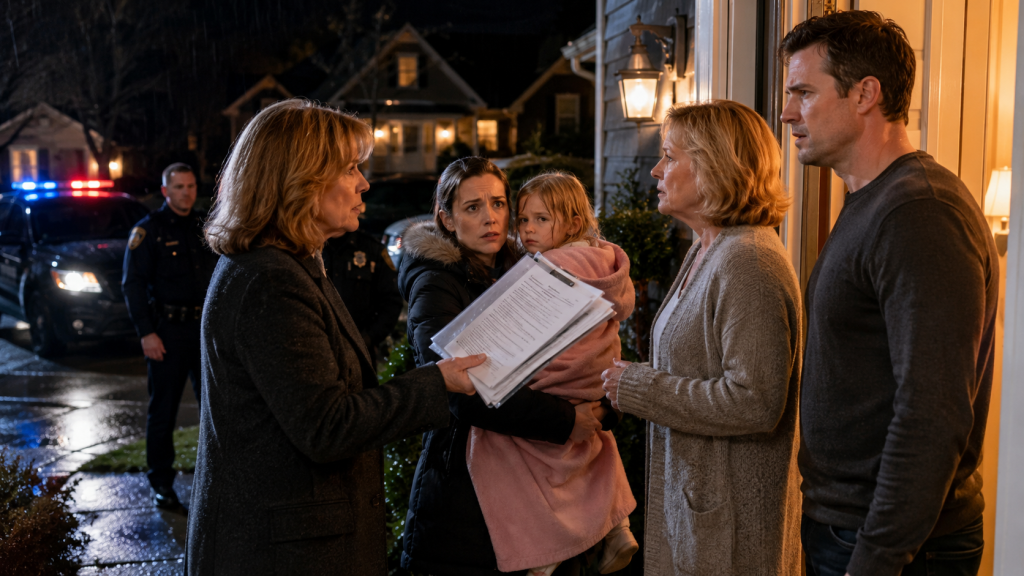
On a freezing December night, my daughter showed up at my door carrying my s3aked 3-year-old granddaughter. “He brought his mistress home,” she whispered. “His mother packed our bags and locked us out.” I grabbed my keys and told her, “Get in the car.

They picked the wrong family to mess with.”
On a freezing December night in suburban Ohio, my daughter stood on my porch holding my soaked three-year-old granddaughter.
Emily’s hair was plastered to her face. Her coat was unbuttoned, and little Sophie was trembling beneath a thin pink blanket.
“He brought his mistress home,” Emily whispered. “His mother packed our bags and locked the door.”
For one second, I thought I had misunderstood her.
“Daniel brought another woman into your house?”
Emily nodded, tears mixing with the rain on her cheeks.
“And Lorraine threw you and Sophie outside?”
Another nod.
I grabbed my keys from the hall table.
“Get in,” I said. “They picked the wrong family.”
Twenty minutes later, my SUV stopped outside the two-story house Emily had shared with Daniel Carter for six years.
Every downstairs light was glowing.
Through the living-room window, I saw Daniel sitting on the sofa beside a blonde woman I recognized from photographs Emily had once shown me. Rachel Monroe. Daniel’s “coworker.”
Lorraine, Daniel’s mother, stood near the Christmas tree drinking wine as though she had just won something.
Emily grabbed my arm.
“Mom, please. I don’t want Sophie seeing a fight.”
“She won’t.”
I called my brother, Michael, who lived ten minutes away.
“Bring your truck,” I told him. “And bring the folder from my office marked Carter.”
Emily stared at me.
“What folder?”
“The one I hoped I’d never need.”
The house had been purchased three months before Emily married Daniel. Daniel had told everyone his parents had helped with the down payment.
They hadn’t.
I had.
When Daniel’s credit collapsed after a failed business venture, I had loaned Emily $82,000. My attorney insisted the money be documented properly. Because Daniel couldn’t qualify for the mortgage, the deed had originally been placed solely in Emily’s name.
Two years later, Daniel convinced her to refinance.
But there was one detail Daniel apparently forgot.
My loan had never been repaid, and the lien securing it had never disappeared.
Michael arrived carrying the file.
I walked to the front door and rang the bell.
Lorraine opened it.
Her smile vanished.
“You need to leave,” she said.
I held up a certified copy of the lien.
“No,” I replied. “You need to explain why you illegally removed a legal homeowner and a three-year-old child from property securing eighty-two thousand dollars of my money.”
Daniel appeared behind her.
“Patricia, stay out of our marriage.”
“I was staying out of it,” I said. “Until you put my granddaughter in the rain.”
Then flashing lights reflected across the wet driveway.
Emily looked at me.
“You called the police?”
“No,” I said.
Lorraine’s face suddenly went pale.
Because the police cruiser wasn’t the only vehicle turning onto the street.
A sheriff’s deputy was directly behind it.
And he was carrying paperwork..
PART 2: THE PAPERWORK DANIEL NEVER EXPECTED TO SEE
The sheriff’s deputy stepped out into the freezing rain with a thick envelope tucked beneath one arm.
For the first time since I had known Daniel Carter, I watched confidence leave his face before he had time to hide it.
He stared past me.
Past Emily.
Past Michael’s truck.
Straight at the deputy.
“What is this?”
The deputy did not answer him immediately.
Instead, he looked at the address on the paperwork.
Then at Daniel.
“Daniel Carter?”
Daniel hesitated.
“Yes.”
“I have documents for you.”
Lorraine lowered her wine glass.
“What kind of documents?”
The deputy looked at her.
“Ma’am, I need to speak with Mr. Carter.”
Lorraine’s mouth tightened.
“This is my son’s house.”
Emily flinched beside me.
I felt it.
That sentence.
Not Daniel and Emily’s house.
Not their family home.
My son’s house.
As if Emily had been a guest for six years.
As if Sophie had been sleeping beneath someone else’s roof by permission.
As if one angry mother-in-law could pack a woman’s bags, throw a toddler into December rain, and then announce ownership loudly enough to make it true.
I turned toward Lorraine.
“No.”
My voice came out quieter than hers.
“That is exactly what we are about to establish.”
The police officer approached Emily first.
A woman in a dark winter uniform.
She looked at Sophie trembling beneath the pink blanket.
Her expression changed immediately.
“Ma’am, do you need medical attention?”
Emily shook her head.
“My daughter’s cold.”
The officer crouched.
“What’s her name?”
“Sophie.”
“How long was she outside?”
Emily looked at Daniel.
“Maybe twenty minutes.”
Daniel spoke quickly.
“She had access to the car.”
Emily turned toward him.
“You took the keys.”
The officer looked at Daniel.
His face changed.
“I thought she had the spare.”
“You took my purse.”
Emily’s voice cracked.
“My keys were inside it.”
Rachel appeared behind Daniel.
Still in the living room.
Still wearing the soft cream sweater I had seen through the window.
Her makeup was perfect.
Her hair was dry.
There are details you notice in moments like that.
Not because they matter legally.
Because they hurt emotionally.
My daughter was soaked through.
The other woman was warm.
The contrast felt obscene.
Rachel looked at the police officer.
“I think I should leave.”
Daniel spun around.
“Rachel, stay inside.”
Her expression shifted.
I caught it.
So did Emily.
Something between them.
Not love.
Fear.
The deputy stepped toward Daniel.
“Sir, I need you to accept service.”
Daniel looked down at the envelope.
“For what?”
“Temporary restraining order regarding transfer or encumbrance of the real property located at this address.”
Silence.
Even the rain seemed quieter.
Emily turned toward me.
“Mom?”
I did not look away from Daniel.
He did.
Slowly.
His face went pale.
“How did you get that?”
That was the wrong question.
Not:
What is that?
How did you get that?
He knew.
My stomach settled into something cold.
Michael heard it too.
He stepped closer.
“You knew there was a problem.”
Daniel said nothing.
The deputy held out the papers.
“Mr. Carter.”
Daniel finally took them.
Lorraine moved beside him.
“What does it mean?”
I answered.
“It means nobody sells this house.”
“Nobody transfers it.”
“Nobody takes another loan against it.”
“And nobody records another document affecting title until a judge has had a chance to review what has already been filed.”
Emily stared at me.
“What has already been filed?”
My throat tightened.
This was the part I had hoped to verify quietly.
The part I had wanted to be wrong about.
I turned toward my daughter.
“Two weeks ago, my attorney called me.”
Daniel’s jaw clenched.
Emily whispered,
“About what?”
“The lien.”
The cold rain hit the porch roof in hard little drops.
I continued.
“My attorney checks the county records every year before tax season.”
“Routine.”
“He found a release recorded against my lien.”
Emily frowned.
“A release?”
“Yes.”
“As though the eighty-two thousand dollars had been repaid.”
Her eyes widened.
“But it hasn’t.”
“No.”
Daniel interrupted.
“This is ridiculous.”
I turned toward him.
“Is it?”
“My loan to Emily was secured by this property.”
“You know that.”
“We all signed the closing documents.”
“You attended.”
He shook his head.
“That was years ago.”
“Debt doesn’t disappear because you get tired of remembering it.”
Lorraine stepped forward.
“Patricia, you gave that money to your daughter.”
“No.”
“I loaned it.”
“You never expected it back.”
I almost smiled.
People become remarkably generous with your intentions when documentation starts becoming inconvenient.
“I expected the agreement to be respected.”
Lorraine scoffed.
“She’s your child.”
“Yes.”
“And that is why the interest rate was almost nothing.”
“That is why I never demanded aggressive repayment when they were struggling.”
“That is why I let years pass.”
I looked at Daniel.
“But kindness is not cancellation.”
Emily stared at him.
“Daniel.”
He did not look at her.
My stomach turned.
The police officer straightened.
“We need to deal with the immediate situation first.”
She looked at Emily.
“Are you an owner of this property?”
“Yes.”
Daniel spoke over her.
“She hasn’t lived here permanently for months.”
Emily stared at him.
“What?”
The officer’s gaze moved between them.
Emily’s voice rose.
“I slept here last night.”
Daniel’s face tightened.
“You’ve been staying with your mother a lot.”
“I stayed with Mom twice because Sophie had the flu and you were traveling.”
Lorraine snapped,
“You were hardly acting like a wife.”
The officer held up a hand.
“Ma’am.”
Lorraine went quiet.
Barely.
The officer looked at Emily.
“Do you have identification showing this address?”
Emily nodded.
“My purse is inside.”
The officer turned to Daniel.
“Go get her purse.”
He hesitated.
“Sir.”
Daniel went inside.
Rachel stepped out of the way.
I watched her.
She would not meet Emily’s eyes.
That told me almost as much as Daniel’s silence.
When he returned, he handed over Emily’s purse.
The officer checked her license.
Then asked the simplest question of the night.
“Did you voluntarily move out?”
“No.”
“Did you give anyone permission to remove your belongings?”
“No.”
“Did you agree that you no longer live here?”
“No.”
The officer nodded.
Then turned to Daniel.
“Then you don’t get to decide unilaterally tonight that she no longer has access.”
Lorraine opened her mouth.
The officer looked at her.
She closed it again.
The officer continued.
“This is not a final determination of ownership.”
“This is not a divorce order.”
“But based on what I’m seeing, she has documentation tying her to this address, she says she resides here, and there is an active dispute.”
She looked at Emily.
“Do you want to go inside?”
Emily looked down at Sophie.
Then at the front door.
Her face changed.
I knew my daughter.
I knew what she was seeing.
Not a house.
Six years.
Sophie’s first steps.
Birthday balloons.
Christmas mornings.
A nursery painted pale yellow.
Daniel carrying their daughter around the kitchen while she laughed.
People think betrayal destroys every good memory retroactively.
It doesn’t.
That would almost be easier.
Instead, good memories remain good.
They simply become painful because the person inside them is no longer someone you understand.
Emily whispered,
“Yes.”
The officer nodded.
“We’ll accompany you.”
Daniel stepped forward.
“No.”
Every head turned.
He looked at the officer.
“I don’t want her in there.”
Emily stared.
Not angry.
Wounded.
So deeply wounded that anger had not arrived yet.
The officer’s voice hardened.
“That isn’t a decision you get to make for everyone in this driveway.”
Daniel looked toward the house.
Then toward Rachel.
That tiny glance was enough.
Emily saw it.
Her face changed again.
This time, something broke cleanly.
She walked past him.
Not hurried.
Not crying.
Just carrying Sophie.
I followed.
Michael came behind us.
Lorraine stepped into my path.
“You are not coming inside.”
I looked at her.
Then at Michael.
He held up the Carter folder.
“Actually,” he said, “I think she is.”
Lorraine stared at him.
Michael smiled without warmth.
“I’m a witness to the original loan agreement.”
“And Patricia’s personal property is still stored in the basement workshop.”
That was true.
A cedar chest.
Old furniture.
Two boxes of family photographs Emily had asked me to store there while I renovated my attic.
Small things.
Enough to complicate Lorraine’s fantasy that the house belonged entirely to her son.
The police officer allowed us inside while the immediate occupancy dispute was documented.
The first thing I noticed was the smell.
Vanilla candles.
Wine.
Roast chicken.
Warmth.
The second thing was Sophie’s little red boots sitting neatly beside the coat rack.
My stomach turned.
Emily stopped when she saw them.
Her daughter had been sent into freezing rain without her boots.
Barely three years old.
Only socks beneath the shoes Emily had hastily found near the back door.
She pressed her face into Sophie’s wet hair.
For the first time that night, my control slipped.
I turned toward Lorraine.
“You packed their bags.”
Lorraine crossed her arms.
“Yes.”
“You packed Emily’s clothes.”
“Yes.”
“Sophie’s clothes.”
“Yes.”
“You remembered toys.”
“I packed what mattered.”
My eyes went to the boots.
“Not everything.”
Her face hardened.
“She was supposed to go straight to your house.”
Emily turned.
“You knew I was going to Mom’s?”
Lorraine looked annoyed.
“Where else would you go?”
That sentence.
Where else would you go?
It was meant to sound practical.
Instead, it revealed something ugly.
They had planned the destination.
Maybe not in detail.
Maybe not with legal strategy.
But they had counted on me catching whatever they threw away.
I looked at Daniel.
“You knew she had somewhere safe to go.”
He said nothing.
“That made it easier, didn’t it?”
“Patricia—”
“No.”
I stepped closer.
“You brought Rachel here.”
“You let your mother pack your wife’s belongings.”
“You let your three-year-old daughter stand outside in December rain.”
“And somewhere inside your head, you made it acceptable because you assumed I would clean up after you.”
His face tightened.
“That is not what happened.”
“Then tell me what did.”
Silence.
Rachel finally spoke.
“I didn’t know Emily would be here.”
Everyone turned toward her.
Daniel’s face changed instantly.
“Rachel.”
She ignored him.
Emily stared.
“What?”
Rachel looked miserable.
“He told me you had separated.”
Emily’s expression became blank.
“He said what?”
Rachel swallowed.
“He said you had been staying with your mother for almost two months.”
Emily laughed.
One broken sound.
“I was here yesterday.”
Rachel looked at Daniel.
He looked away.
She continued.
“He said tonight was the first night after you had moved the rest of your things out.”
Lorraine snapped,
“You don’t need to explain yourself to her.”
Rachel turned sharply.
“Yes.”
“I do.”
Something inside the room shifted.
Not toward friendship.
Never that quickly.
Toward truth.
Rachel looked at Emily.
“I knew he was married.”
She said it plainly.
“I am not going to pretend I didn’t.”
Emily flinched.
Rachel’s eyes filled.
“He told me the marriage was over.”
“That you had agreed not to announce it until after Christmas for Sophie.”
Emily whispered,
“No.”
Rachel nodded miserably.
“I understand that now.”
Daniel stepped closer.
“Rachel, we discussed this.”
She turned on him.
“You told me she knew.”
Lorraine scoffed.
“Oh, please.”
Rachel stared at her.
“You told me too.”
Emily turned toward Lorraine.
My blood ran cold.
Rachel continued.
“You said Emily had become controlling.”
“That she was using Sophie to keep Daniel trapped.”
“You said tonight would be uncomfortable but necessary.”
Lorraine’s face went white.
Daniel said,
“Stop.”
Rachel laughed bitterly.
“No.”
“I’m done being the only person in this room who didn’t know what game I was walking into.”
She picked up her coat from the chair.
Emily’s voice stopped her.
“How long?”
Rachel froze.
“How long have you been sleeping with my husband?”
Daniel snapped,
“Emily.”
She did not even look at him.
Rachel swallowed.
“Seven months.”
Emily closed her eyes.
Sophie stirred against her shoulder.
I moved closer.
Not touching her until she leaned slightly toward me.
Seven months.
That meant summer.
Sophie’s third birthday.
Emily’s anniversary.
The weekend Daniel supposedly attended a conference in Indianapolis.
I saw memories marching across my daughter’s face.
Each one changing shape.
She opened her eyes.
“Did you come here before?”
Rachel looked at Daniel.
Then at Emily.
“Yes.”
Emily’s mouth trembled.
“How many times?”
“I don’t know.”
“Rachel.”
“Maybe five.”
The room became completely silent.
My daughter had been sleeping inside a house where another woman had already been invited into her absence.
I wanted to scream.
Instead, I looked at Daniel.
“You are going to remember tonight for the rest of your life.”
He laughed without humor.
“Is that a threat?”
“No.”
I shook my head.
“It’s a prediction.”
Rachel left.
She did not ask Daniel to follow.
He tried.
The police officer told him to remain until the immediate matter was sorted.
Lorraine poured herself more wine.
That detail told me everything about how she coped with losing control.
She pretended she still had it.
The sheriff’s deputy stepped inside.
“Mr. Carter, I need your acknowledgment of service.”
Daniel signed reluctantly.
Emily looked at the restraining order.
“Mom.”
“Yes?”
“What exactly were they trying to do with the house?”
My chest tightened.
Daniel answered before I could.
“Nothing.”
The deputy looked at him.
“That’s not accurate.”
Daniel stared.
The deputy opened one of the attached exhibits.
“There’s a pending deed record under review.”
Emily’s face went white.
“What deed?”
I took the folder from Michael.
This was the part I had hoped never to show her on a night like this.
I opened it.
Removed a copy.
Placed it on the dining table.
Emily stared down.
QUITCLAIM DEED.
Her name.
Daniel’s name.
A transfer from:
Emily Carter
to:
Daniel Carter and Lorraine Carter, as joint tenants.
My daughter stopped breathing.
“What is this?”
Daniel spoke quickly.
“It was estate planning.”
I turned toward him.
“No.”
His jaw tightened.
“It was.”
“Then why didn’t Emily know?”
“She did.”
Emily looked up.
“No, I didn’t.”
“You signed it.”
“No.”
Daniel pointed.
“That is your signature.”
Emily stared at the page.
Her hands started trembling.
The signature looked close.
Too close.
But I had watched Emily sign birthday cards, checks, loan agreements, school forms.
The E was wrong.
So was the final loop in Carter.
She whispered,
“That isn’t mine.”
Lorraine set down her wine.
“For heaven’s sake.”
Michael turned toward her.
“Interesting reaction.”
She glared.
“This was paperwork Daniel handled.”
Emily looked at her.
“You’re named on it.”
Lorraine’s face tightened.
“It was temporary.”
My stomach turned.
Temporary.
That word.
Another family favorite.
Temporary debt.
Temporary affair.
Temporary removal of a wife from her own home.
Apparently permanence only mattered when they benefited from it.
Emily looked at Daniel.
“Why is your mother on a deed to my house?”
Daniel’s face hardened.
“Because she was going to help us refinance.”
Emily stared.
“You already refinanced us two years ago.”
“That loan is expensive.”
“What loan?”
Silence.
The room changed.
I looked at him.
“What loan?”
Daniel closed his eyes.
There it was.
Another layer.
I pulled out the county property report.
The restraining order had not been issued because of the quitclaim alone.
My attorney, Helen Price, had discovered something else.
A pending application for a home-equity line.
Proposed amount:
$165,000.
Emily sank into a dining chair.
“No.”
Her voice barely existed.
I sat beside her.
“Sophie?”
Michael reached for the little girl.
Emily hesitated.
Then allowed him to take her.
Sophie curled against his chest.
Still damp.
Still sleepy.
Too young to understand that the adults around her had turned home into evidence.
Emily looked at me.
“One hundred sixty-five thousand?”
I nodded.
“Application only.”
“It had not fully funded when Helen caught the title problem.”
Her face went blank.
“What was it for?”
Daniel spoke.
“Debt consolidation.”
Emily turned slowly.
“What debt?”
No answer.
“Daniel.”
He rubbed both hands over his face.
“My business.”
My stomach tightened.
“What business?”
Emily asked.
“You told me you closed it before we got married.”
He said nothing.
Her face collapsed.
“Daniel.”
“I restarted some things.”
“When?”
“Two years ago.”
Emily laughed.
Not because anything was funny.
“You told me those late nights were consulting.”
“They were.”
“For your own company?”
“Yes.”
“You said the company was dissolved.”
“It was.”
“Then?”
“I opened another one.”
Her voice became strangely calm.
“What is it called?”
Daniel hesitated.
“DC Strategic Holdings.”
Michael looked at me.
I knew the name.
It had appeared twice in the preliminary title search.
Not as owner.
As a recipient of proposed loan proceeds.
I opened another section of the folder.
Daniel saw it.
His eyes closed.
“You had no right to pull my business records.”
“I didn’t.”
I replied.
“Your business name appeared in documents tied to my collateral.”
“That gave my attorney every reason to ask questions.”
Emily whispered,
“How much debt?”
Daniel sat down.
For the first time, he looked small.
Not arrogant.
Not angry.
Small.
“About one hundred ten.”
“Thousand?”
He nodded.
Emily stared at him.
Her lips parted.
No sound came out.
I watched my daughter understand that the affair was only one betrayal.
The deeper betrayal was that Daniel had been building an entirely separate financial life underneath hers.
Rachel.
The LLC.
The proposed home-equity line.
The attempted deed transfer.
And Lorraine.
Always Lorraine.
Emily looked at her mother-in-law.
“Did you know?”
Lorraine crossed her arms.
“Daniel needed help.”
“That isn’t what I asked.”
Lorraine’s voice sharpened.
“He was trying to protect this family.”
Emily laughed.
“By putting you on my deed?”
“You are too emotional to understand the financial side.”
That sentence changed my daughter.
I saw it.
Not rage.
Clarity.
Maybe because Lorraine had said versions of it for years.
You’re too emotional.
Daniel handles money.
Let the men worry about it.
You worry too much.
Emily looked down at the false signature.
Then up at Lorraine.
“My name is on the original deed.”
“Yes.”
“My mother loaned the down payment.”
“Yes.”
“My income has paid part of the mortgage for six years.”
Lorraine rolled her eyes.
“Of course.”
“And you think I’m too emotional to understand the house?”
Lorraine said nothing.
Emily stood.
Her wet coat still clung to her.
Hair damp.
Mascara streaked.
She looked exhausted.
And more powerful than I had ever seen her.
“Get out.”
Lorraine blinked.
“What?”
“Get out of my house.”
Daniel stood.
“You cannot throw my mother out.”
Emily looked at him.
“Watch me.”
I almost smiled.
The officer stepped forward carefully.
“Let’s avoid escalating this.”
Emily nodded.
“You’re right.”
She looked at Lorraine.
“I am asking you to leave voluntarily.”
“I do not consent to you staying here tonight.”
Lorraine looked at Daniel.
He opened his mouth.
Then saw the officer.
The deputy.
The paperwork.
Me.
Michael.
The false deed sitting on the table.
And for once, Daniel Carter did not know which woman in the room he could order to make things easier.
Lorraine grabbed her purse.
“This family will regret humiliating me.”
Emily looked at her.
“No.”
Her voice was quiet.
“I regret trusting you.”
Lorraine left.
The front door slammed.
Sophie woke and started crying.
That sound broke whatever strength Emily had been borrowing.
She rushed toward Michael.
Took her daughter.
Pressed her face into Sophie’s hair.
“I’m sorry, baby.”
Sophie wrapped both arms around her neck.
“Home?”
One word.
Emily closed her eyes.
My heart shattered.
“Yes, sweetheart.”
Then she looked around the room.
The Christmas tree.
The stockings.
Family photographs.
Daniel’s coat.
The wine Lorraine had left.
And her face changed.
“No.”
She whispered it.
Sophie pulled back.
“No home?”
Emily kissed her forehead.
“This is a house.”
She looked at me.
“We’re going to Grandma’s.”
That night, Emily did not stay.
Not because Daniel expelled her.
Because she chose.
There is a difference large enough to rebuild a life around.
The police documented the dispute.
Photographed the bags Lorraine had packed.
Noted Sophie’s condition.
Recorded Emily’s statement.
They did not arrest Daniel simply because he was a terrible husband.
Nor Lorraine because she was a terrible mother-in-law.
Real consequences are usually slower.
More boring.
Paperwork.
Interviews.
Records.
Attorneys.
But they also last longer than shouting.
Before we left, the deputy reminded Daniel that the temporary order prohibited alteration of title and additional borrowing against the property until the court hearing.
Daniel nodded.
Silent.
Then Emily turned toward him.
“Where is your phone?”
He frowned.
“What?”
“Your phone.”
“That’s none of your business.”
“You’re right.”
She inhaled.
“Not anymore.”
She took Sophie’s hand.
Then stopped.
“One question.”
Daniel looked at her.
Emily’s voice trembled.
“Did you ever plan to tell me?”
He said nothing.
She nodded.
That was answer enough.
We drove back to my house in silence.
Sophie fell asleep before we reached the highway.
Emily stared out the passenger window.
The rain had turned to sleet.
Streetlights stretched across the windshield.
I did not ask what she was thinking.
There are moments when questions become another demand.
So I drove.
Halfway home, she whispered,
“Mom?”
“Yes?”
“You knew something was wrong with the lien.”
“Yes.”
“How long?”
“Two weeks.”
She turned toward me.
“Why didn’t you tell me?”
Fair question.
“I wanted proof.”
“That sounds like you.”
I smiled sadly.
“And I didn’t want to blow up your marriage over a filing error.”
Her eyes filled.
“You were protecting me.”
“I thought I was.”
She looked out the window again.
“Everyone keeps protecting me by not telling me things.”
That hurt.
Because she was right.
Daniel had protected her from financial “stress.”
Lorraine protected Daniel from consequences.
Rachel had accepted his version of the separation.
And I had quietly investigated a possible forged lien release because I did not want to upset my daughter before Christmas.
Different motives.
Still silence.
I said,
“I’m sorry.”
Emily turned.
“I should have told you as soon as Helen found the release.”
“Yes.”
No quick forgiveness.
No comforting me.
Good.
I nodded.
“I won’t do that again.”
She reached over.
Took my hand.
“Thank you.”
When we reached my house, I put Sophie into the warmest pajamas I owned.
They were too big.
She looked like a tiny pink cloud.
Emily sat on the kitchen floor while I made tea.
Not at the table.
The floor.
Sometimes devastation makes furniture feel too formal.
I sat beside her.
For a while, we said nothing.
Then she whispered,
“I loved him.”
I looked at her.
“I know.”
“I still do.”
“I know.”
She started crying.
“I hate that.”
I wrapped my arm around her.
“Love doesn’t receive breaking news as quickly as the brain does.”
She laughed through tears.
“That sounds like something from a greeting card.”
“It’s two in the morning.”
“My material is limited.”
She rested her head on my shoulder.
“I keep thinking about Rachel.”
“Don’t.”
“I invited her to Sophie’s birthday.”
My chest tightened.
“I know.”
“She stood in my kitchen.”
“I know.”
“She brought a unicorn puzzle.”
“I remember.”
Emily cried harder.
“Daniel took a picture of us together.”
I closed my eyes.
Some betrayals are cruel because they rewrite ordinary kindness into humiliation.
I let her cry.
Eventually, she whispered,
“Did you know about the debt?”
“No.”
“The business?”
“No.”
“The deed?”
“Not until Helen searched the record.”
She looked at me.
“Why would he put Lorraine on it?”
“I don’t know yet.”
That answer frustrated her.
I could see it.
But truth deserved patience.
By morning, Helen had an explanation for part of it.
She arrived at my house at nine carrying coffee, a laptop, and the expression of a woman who had not slept enough.
Emily sat wrapped in one of my robes.
Sophie watched cartoons in the next room.
Helen opened the county records.
“The quitclaim was submitted electronically twelve days ago.”
Emily’s face tightened.
“Before last night.”
“Yes.”
“So throwing me out wasn’t the beginning.”
“No.”
Helen continued.
“The document had not completed every stage of recording because the title system flagged Patricia’s lien.”
I looked at Emily.
“My lien slowed it down.”
Helen nodded.
“Then the proposed lender did its own title review.”
“They found the same problem.”
“That is when Patricia called me.”
Emily whispered,
“Who notarized my signature?”
Helen looked at the page.
“A mobile notary named Kevin Strauss.”
“Do we know whether he actually witnessed Emily sign?”
“No.”
“That needs investigation.”
Grounded.
Careful.
No dramatic accusation before evidence.
Then Helen pulled up another document.
“The home-equity application listed three intended uses.”
She rotated the screen.
Business debt consolidation — $91,000
Property renovation — $34,000
Personal obligations — $40,000
Emily frowned.
“What personal obligations?”
Helen clicked.
A supporting worksheet opened.
One line.
L. Carter personal loan reimbursement — $38,500
Lorraine.
Emily stared.
“She was going to get almost forty thousand dollars?”
“According to this application.”
“For what?”
Daniel later claimed his mother had loaned money to his company.
Maybe she had.
Maybe that part was real.
The problem was not that Lorraine expected repayment.
The problem was whose house they planned to use to get it.
Emily sat back.
“They were going to borrow against my house to repay his mother for money she gave his secret business.”
Helen nodded carefully.
“That appears consistent with the paperwork.”
Emily laughed.
Then covered her face.
“It’s so much worse than Rachel.”
Nobody answered.
Because it was.
An affair breaks trust between two people.
This had become a network.
Daniel.
Lorraine.
Money.
Title.
Debt.
Deception.
A house Emily believed was the safest thing in her life.
Helen continued.
“There’s one more thing.”
I hated that sentence already.
Emily lowered her hands.
“What?”
Helen opened another file.
“Patricia’s original lien release wasn’t merely recorded.”
“It includes a notarized acknowledgment.”
My stomach tightened.
“I never signed one.”
“I know.”
She looked at me.
“The signature is yours.”
“Or intended to resemble yours.”
Emily stared.
My pulse slowed.
There are betrayals against your child that make you furious.
There are betrayals using your own name that make you cold.
I looked at the document.
My signature.
Wrong.
But close.
Very close.
Then I saw the notary.
Different name.
Lorraine Carter.
I blinked.
“What?”
Helen leaned forward.
“Lorraine is a commissioned notary.”
My stomach dropped.
I had forgotten.
Years earlier, Lorraine worked in a real-estate office.
She had mentioned keeping her commission active.
Emily went completely still.
“She notarized Mom’s signature?”
“The record says she acknowledged Patricia’s signature.”
Helen chose every word carefully.
“That does not establish what actually happened.”
“But Patricia says she did not sign.”
“I didn’t.”
Emily whispered,
“Mom…”
I stared at the page.
Lorraine’s name.
My supposed signature.
My supposedly released lien.
Then I remembered something.
Thanksgiving.
Three weeks earlier.
Lorraine had asked to use my printer.
She said she needed to print insurance forms.
I had let her into my study.
Alone.
There were old closing documents inside the desk.
Documents bearing my signature.
Examples.
My stomach turned.
Again, suspicion.
Not proof.
But enough to make my skin crawl.
Emily said,
“What happens now?”
Helen closed the laptop halfway.
“Now you stop thinking one dramatic conversation solves this.”
“You preserve records.”
“You protect accounts.”
“You change passwords.”
“You review credit.”
“You speak through counsel when necessary.”
“You let the court decide title issues.”
“And you do not sign anything Daniel brings you.”
Emily gave a broken laugh.
“That last one I can manage.”
Helen looked toward Sophie.
“And you make decisions about contact based on Sophie’s welfare, not revenge.”
Emily nodded.
Immediately.
That mattered.
No matter what Daniel had done to her, Sophie still had a father.
A terrible husband is not automatically an unsafe parent in every respect.
But locking a three-year-old outside in freezing rain?
That mattered.
Deeply.
And it would be documented.
After Helen left, Emily stood at my kitchen window.
Sophie was building a tower from wooden blocks.
Finally Emily said,
“Mom.”
“Yes?”
“I need to ask you something.”
“Anything.”
“If the house is mine…”
I waited.
“…why did I feel like Lorraine could throw me out of it?”
My throat tightened.
That question had nothing to do with deeds.
Not really.
I walked beside her.
“Because ownership on paper and ownership inside a relationship are different things.”
She looked at me.
“You spent six years letting Daniel act like the final authority.”
“And Lorraine acted like being his mother gave her a permanent vote.”
Emily looked down.
“I let her.”
“Sometimes.”
My answer hurt her.
I let it.
Then I added,
“You were also taught that keeping peace was more important than checking whether the peace was fair.”
She started crying.
“I thought marriage meant compromise.”
“It does.”
“Compromise is two people moving.”
I touched her shoulder.
“It isn’t one person slowly disappearing.”
She covered her face.
That afternoon, Daniel sent his first message.
Not to Emily.
To me.
You have turned this into something it didn’t need to become.
I stared.
Then another.
Emily and I could have worked this out privately.
Then:
Rachel is irrelevant.
I almost laughed.
Then:
Your lien was supposed to be released years ago. Lorraine believed you had agreed.
There it was.
Believed.
The cousin of assumed.
I forwarded everything to Helen.
Did not reply.
Daniel sent one more message.
If Emily destroys this family, Sophie will be the one who suffers.
My anger rose so sharply I had to set the phone down.
Emily saw my face.
“What?”
I hesitated.
Then remembered my promise.
No more protecting her by withholding truth.
I handed her the phone.
She read.
Her face hardened.
Then she took a screenshot.
Sent it to herself.
Handed the phone back.
No tears.
No argument.
Just evidence.
I felt strangely proud.
Three days later, the temporary title order went before a judge.
Not a dramatic courtroom packed with relatives.
A routine hearing.
Lawyers.
Documents.
Questions.
The judge continued the restraint on title changes while the disputed deed and lien release were investigated.
The house stayed legally frozen.
No new loan.
No transfer.
No sale.
Daniel could not turn confusion into cash.
That was enough for the moment.
Emily did not move back in.
She requested temporary arrangements through her attorney.
Daniel stayed elsewhere voluntarily after his lawyer apparently explained that remaining in the house while arguing over an allegedly forged transfer would not improve anyone’s week.
Lorraine disappeared from our conversations.
Until Christmas Eve.
She came to my house alone.
I opened the door but did not invite her in.
She looked older than she had twelve days earlier.
No expensive coat.
No lipstick.
No wine.
Just a woman holding an envelope.
“Patricia.”
“Lorraine.”
“I need to talk to Emily.”
“No.”
“She’s my daughter-in-law.”
“Not tonight.”
Her mouth tightened.
“I have a right—”
“No.”
The word stopped her.
She looked toward the lit windows.
Sophie’s paper snowflakes hung against the glass.
Emily was inside helping her decorate cookies.
Lorraine’s eyes filled.
“I love that little girl.”
I believed her.
That was what made everything harder.
“Then you should have remembered her boots.”
Lorraine closed her eyes.
The words landed.
She whispered,
“I was angry.”
“She was screaming.”
“Daniel was upset.”
“Rachel was already there.”
“I just wanted Emily gone before everything got uglier.”
I stared.
“So you packed a three-year-old into December rain.”
Her face crumpled.
“I thought you were coming immediately.”
That excuse again.
I would catch them.
Therefore they could let go.
I said,
“My availability did not make what you did safe.”
She nodded through tears.
“I know.”
Then she held out the envelope.
“What is this?”
“A statement.”
My chest tightened.
“About?”
“The lien release.”
I did not take it immediately.
Lorraine cried.
“I signed the notary acknowledgment.”
“I know.”
“I did not see you sign.”
There it was.
My stomach turned.
She continued.
“Daniel brought me the release.”
“He said you had already signed it.”
“I knew I shouldn’t notarize it without you present.”
“But I did.”
No grand conspiracy yet.
A serious choice.
A false acknowledgment.
She looked down.
“I told myself it was paperwork.”
I finally took the envelope.
“And the quitclaim?”
Her silence answered before her mouth did.
“You knew.”
“Yes.”
“Did Emily sign it?”
Lorraine shook her head.
My pulse changed.
“Who did?”
“I don’t know.”
“Lorraine.”
“I swear.”
She cried harder.
“Daniel gave me the document already signed.”
“I was supposed to become co-owner temporarily so we could qualify for the loan.”
“Then after the business debt was paid, I would sign it back.”
I laughed once.
No humor.
“Of course.”
Temporary.
Always temporary.
“Did you ever ask Emily?”
“No.”
“Why?”
Lorraine looked toward the window.
Then whispered,
“Because Daniel said she’d say no.”
There.
The whole story.
He knew she would say no.
So they built a plan that did not require asking.
I stared at her.
“Fear of someone’s no is not permission to remove the question.”
She cried.
“I know.”
“Do you?”
She nodded.
“For the first time, yes.”
I looked at the envelope.
“Your attorney knows you’re giving me this?”
“Yes.”
“Good.”
That mattered.
No secret confession I could later be accused of twisting.
Documentation.
Accountability.
She turned to leave.
Then stopped.
“Will Emily ever forgive me?”
I looked through the window.
My daughter was holding Sophie while my granddaughter pressed too many silver sprinkles onto one cookie.
“I don’t know.”
Lorraine’s face fell.
I continued.
“But forgiveness is not the first thing you should be asking for.”
“What is?”
“Change.”
She cried.
Then walked away.
I watched until her car disappeared.
When I went back inside, Emily looked at the envelope.
“What happened?”
I told her everything.
All of it.
No softening.
No protecting.
When I finished, she sat quietly.
Then Sophie came running toward her holding a cookie shaped like a snowman.
“Mommy!”
Emily lifted her.
Sophie pushed the cookie toward her mouth.
“You eat.”
Emily took one bite.
“Perfect.”
“It has too many sprinkles.”
Michael called from the kitchen.
“That’s impossible.”
Sophie giggled.
And for one beautiful second, life became small again.
Cookie.
Child.
Warm room.
Family.
Later that night, after Sophie was asleep, Emily asked me,
“Do you think Daniel forged my signature?”
I looked at her.
“I think there is enough reason to investigate.”
She nodded.
Not the answer she wanted.
The answer she needed.
Then she asked,
“What if he did?”
I thought carefully.
“Then you deal with what is proven.”
“Financially.”
“Legally.”
“Emotionally.”
“One piece at a time.”
She looked toward the Christmas tree.
“And our marriage?”
I took her hand.
“That part isn’t mine to decide.”
She swallowed.
“I think it’s over.”
I squeezed her fingers.
“Then let it be over because of what you know.”
“Not because I tell you to hate him.”
Her eyes filled.
“I don’t hate him.”
“I know.”
“That makes me feel stupid.”
“No.”
I shook my head.
“It makes you a woman whose heart has not caught up with the evidence yet.”
She laughed through tears.
“There you go again with greeting-card lines.”
“I’m improving.”
She leaned against me.
Outside, snow had finally replaced the rain.
Soft.
Quiet.
Covering the driveway where my daughter had arrived soaked and shivering only days earlier.
I thought about my first words that night.
They picked the wrong family.
At the time, I meant it like a threat.
I imagined confrontation.
Documents.
Money.
Consequences.
But by Christmas Eve, I understood something different.
The strength of our family was not that I could outspend Daniel.
Not that Michael could bring a folder.
Not that Helen could get a temporary court order.
Not even that my eighty-two-thousand-dollar lien had prevented the house from becoming easy money.
Our strength was that when Emily arrived at my door, I opened it.
No questions about whether she should try harder.
No lecture about preserving a marriage.
No concern about what neighbors would think.
I saw my daughter holding a freezing child—
and believed that safety mattered before appearances.
That was the family Daniel had underestimated.
Not powerful.
Not wealthy.
Not connected.
Present.
And as the legal review continued after Christmas, one final discovery would prove just how important that presence had been.
Because the disputed quitclaim deed did not contain only Emily’s questionable signature.
Attached to the lender’s file was a second document.
One Daniel had apparently believed no one would ever compare against the original closing records.
A sworn statement claiming the eighty-two-thousand-dollar family loan had been repaid in full.
At the bottom were two signatures.
Daniel’s.
And mine.
Only one of them was real.
Which meant this was no longer simply about a cheating husband, an interfering mother-in-law, or a marriage falling apart.
Someone had tried to erase my money from the record.
Someone had tried to erase Emily’s ownership from the house.
And after six years of convincing my daughter that keeping the peace was more important than asking questions—
they had finally created one question none of us were willing to ignore.
How many signatures had Daniel Carter borrowed from the women in his life before one of us finally looked closely enough to say:
That is not mine.
PART 3: THE LAST SIGNATURE DANIEL EVER USED WITHOUT PERMISSION
The first signature belonged to Emily.
Or rather, it was supposed to.
The second belonged to me.
Or rather, someone hoped nobody would look closely enough to notice that it did not.
By the first week of January, the disputed documents were spread across Helen Price’s conference table like pieces of a family life someone had tried to rewrite with a pen.
The quitclaim deed.
The lien release.
The sworn statement claiming my eighty-two-thousand-dollar loan had been repaid.
The proposed home-equity application.
And beneath all of them—
signatures.
Names that looked familiar.
Consent that did not exist.
Emily sat beside me wearing a navy sweater and no makeup.
She had lost six pounds since the night she arrived on my porch.
Sophie was with Michael that morning.
That had become one of the quiet blessings of the disaster.
My brother did not ask whether Emily was ready to be alone.
He simply said,
“I’ll take Sophie to the children’s museum.”
Then showed up with snacks.
Presence without interrogation.
That mattered.
Helen placed two documents side by side.
My actual signature from the original loan agreement.
The disputed one from the supposed repayment acknowledgment.
“You see this?”
she asked.
I nodded.
“My P always closes.”
“Yes.”
“And this one doesn’t.”
“No.”
Helen pointed to the lower stroke.
“The spacing is wrong too.”
Emily stared.
“So someone copied it?”
Helen remained careful.
“We don’t know exactly how it was produced yet.”
My daughter looked frustrated.
“Everything is always ‘we don’t know yet.’”
Helen leaned back.
“That is how competent people keep from turning suspicion into mistakes.”
Emily closed her eyes.
Then nodded.
“I know.”
“Good.”
Helen softened.
“I understand you want one clean answer.”
“You want someone to tell you exactly what Daniel did, why he did it, what Lorraine knew, who signed what, and what happens next.”
Emily looked at her.
“Yes.”
“You may not get that all at once.”
My daughter’s eyes filled.
“I hate that.”
“I know.”
Helen tapped the documents.
“But you do not need every answer before protecting yourself.”
That sentence became the structure of the next year.
We did not wait for certainty before changing passwords.
We did not wait for a final ruling before separating finances.
We did not wait for a confession before preserving messages.
Emily did not wait for Daniel to understand the damage before filing for legal separation.
Protection came first.
Explanation could catch up later.
The handwriting examiner’s report arrived three weeks later.
It did not use dramatic words.
Experts rarely do.
The conclusion was careful.
The questioned signatures attributed to Emily and me showed significant inconsistencies when compared with verified samples.
The report could not establish with absolute certainty who had created them.
But it stated that neither signature was consistent with natural execution by the purported signer.
Emily read the sentence twice.
Then a third time.
Finally she whispered,
“So I wasn’t losing my mind.”
I looked at her.
“No.”
Her mouth trembled.
“I kept thinking maybe I signed something and forgot.”
My chest tightened.
Daniel had told her that.
Repeatedly.
You sign things without reading.
You forget conversations.
You’re too emotional about money.
Maybe you misunderstood.
Small sentences.
Years of them.
Enough to make a competent woman doubt her own memory when a deed appeared carrying her name.
Emily looked at me.
“He made me distrust myself before he ever needed me to.”
That realization hurt more than the document.
Because the forgery, if proven, was one act.
The self-doubt had been cultivated slowly.
I reached for her hand.
“You trust yourself now.”
She shook her head.
“Not completely.”
“Then start smaller.”
“How?”
“Trust what you can verify.”
She laughed weakly.
“You sound like Helen.”
“Terrifying compliment.”
Helen ignored us.
The investigation around the notarial documents moved separately.
Lorraine cooperated through counsel.
That did not erase what she had done.
She admitted she had notarized my supposed lien release without witnessing my signature.
She admitted Daniel had brought it to her already signed.
She admitted she knew Emily had not agreed to the quitclaim transfer before her name was added as proposed co-owner.
What she denied was creating either signature herself.
And, eventually, evidence supported at least part of that distinction.
A forensic review of Daniel’s laptop found scanned copies of old closing documents.
Documents carrying both Emily’s signature and mine.
The files had been opened repeatedly in the weeks before the disputed paperwork was prepared.
There were also draft versions of the release and quitclaim forms.
Not proof of every keystroke.
Enough to matter.
Helen called me the morning the report came in.
“Patricia.”
“Yes?”
“You were right to keep your original paperwork.”
I looked toward the old file box in my study.
George—
No.
Different family.
There was no George here.
That caught me.
Stress was turning everyone’s memories into piles.
I sat down.
“What did they find?”
She explained.
Daniel’s computer.
The scans.
The drafts.
Then one detail.
A PDF editor had been used to isolate signature images from prior documents.
My stomach went cold.
“Mine?”
“Yours and Emily’s.”
I closed my eyes.
There it was.
Not proof that he personally placed them onto every document.
But no longer a vague family suspicion.
A digital trail.
When I told Emily, she became completely silent.
Then she asked,
“Did he keep copies of everything?”
“Apparently.”
She laughed once.
“That sounds like him.”
“What?”
“He kept every receipt.”
“Every warranty.”
“Every old tax form.”
Her face twisted.
“I used to think that made him responsible.”
Sometimes the same trait can serve honesty and deception equally well.
Organization is not character.
Neither is charm.
Neither is intelligence.
People are not trustworthy because they look competent.
They are trustworthy because of what they choose when competence gives them power.
The court kept the title restrictions in place while the property dispute moved forward.
The proposed home-equity loan died.
The lender withdrew.
The quitclaim deed was challenged and, after review, did not stand as a valid transfer of Emily’s ownership.
My lien remained.
The supposed release was treated as disputed and ultimately ineffective.
The house did not become Daniel and Lorraine’s asset.
It remained part of the marital dispute with Emily’s ownership interest protected while the divorce proceeded.
That was the legal version.
The emotional version was simpler.
They had tried to move my daughter out of her own house.
Then documents showed someone had been trying to move her out of ownership too.
Paperwork can be quieter than violence.
That does not make it harmless.
Daniel’s financial records exposed the next layer.
DC Strategic Holdings had lost more than anyone knew.
Not one hundred ten thousand.
Closer to one hundred forty-three by the time fees, private loans, and unpaid obligations were counted.
Lorraine had indeed loaned him money.
Thirty-eight thousand five hundred dollars.
That part was real.
She had emptied a portion of her own retirement savings to keep his company alive.
Maybe that explained why she became so desperate to get onto the deed.
It did not excuse it.
Fear explains many bad choices.
It does not convert them into good ones.
Daniel had also used marital funds for the company.
Not every transfer was unauthorized.
Some accounts were jointly accessible.
But Emily had not known what the money was funding.
He called it consulting.
Business development.
Temporary cash flow.
Never:
A failing company I restarted without telling you.
Never:
Debt that may cost us the house.
Never:
A reason I am asking my mother for nearly forty thousand dollars behind your back.
Then Rachel came back into the story once.
Only once.
She contacted Emily through her attorney.
I expected drama.
Instead, she provided records.
Messages.
Travel dates.
Copies of what Daniel had told her.
One message stayed with Emily.
Daniel had written:
Emily doesn’t understand finances. I keep the big decisions away from her because she panics.
My daughter stared at that sentence for a long time.
Then laughed.
Not bitterly.
Sadly.
“I balanced our household budget for six years.”
“I know.”
“I handled the school tuition.”
“I know.”
“I renegotiated the insurance.”
“I know.”
“He had three late fees last year because he forgot automatic payments.”
“I remember.”
She looked at me.
“But he told Rachel I couldn’t understand finances.”
I nodded.
“People sometimes invent a weaker version of you because it makes their choices easier to justify.”
Emily’s eyes filled.
“That sounds exhausting.”
“It is.”
“Is that why you don’t defend yourself much?”
I smiled.
“At my age, I have learned not to attend every fictional trial someone holds in their head.”
She laughed.
That was one of the first real laughs I heard from her after Christmas.
I held onto it.
The divorce filing came in February.
Emily cried when she signed.
She stared at her name at the bottom of the petition.
Her real signature.
Not copied.
Not scanned.
Not borrowed.
Hers.
She touched the ink with one finger.
Then whispered,
“That feels strange.”
“What?”
“Signing something that ends my marriage after months of finding things I never signed.”
I looked at her.
“You know what it means this time.”
“Yes.”
“You chose it.”
“Yes.”
“Then let the difference matter.”
She nodded.
Then cried anyway.
Divorce did not make Daniel disappear.
Sophie was still his daughter.
That was the hardest part.
Emily wanted to protect Sophie from everything.
But “everything” included a father the little girl loved.
The court and the attorneys focused on conduct relevant to parenting.
Not adultery.
Not Lorraine’s personality.
Not my anger.
The night Sophie was outside in freezing rain mattered.
The instability in the house mattered.
Whether Daniel could provide safe care mattered.
The financial deception mattered in the broader divorce, but parenting decisions required their own analysis.
Temporary arrangements were structured carefully.
At first, Daniel’s parenting time was shorter and more controlled while everyone established routine.
No Rachel.
No Lorraine supervising.
No spontaneous changes.
No using Sophie as a messenger.
Emily hated handing Sophie over the first time.
I stood beside her in the parking lot.
She had packed three sweaters.
Two pairs of socks.
Snacks.
Medicine.
A stuffed rabbit.
Then another bag.
I looked at her.
“How long is she going?”
“Six hours.”
I looked at the luggage.
“You packed for a minor expedition.”
“Mom.”
“I’m serious.”
“She gets cold.”
“I know.”
“She likes the green cup.”
“I know.”
“What if he forgets her nap?”
“Then she will survive one bad nap.”
Emily’s eyes filled.
“I hate this.”
“I know.”
“What if he makes her think this is my fault?”
My heart tightened.
“Then you stay steady long enough for Sophie to know your love is not a campaign.”
She cried.
I hugged her.
Then Daniel arrived.
He looked nervous.
Good.
Parenthood should make careless people nervous for a while.
Emily handed him the bag.
Then knelt in front of Sophie.
“Have fun with Daddy.”
No poison.
No bitterness.
Nothing about mistresses or deeds or rain.
I was proud of her in a way that hurt.
Sophie ran toward Daniel.
He picked her up.
She kissed his cheek.
And Emily broke after his car turned the corner.
Not because she wanted him back.
Because children can still love people who have hurt you.
Adults must learn not to make children pay for that complexity.
That took strength I had not known my daughter possessed.
Daniel did attend therapy.
At first, I assumed it was strategic.
Maybe some of it was.
People often begin changing for mixed reasons.
Fear.
Loss.
Court.
Shame.
Love.
Eventually motive matters less than consistency.
He never became Emily’s husband again.
That door closed.
But over time, he became a more reliable father.
Not perfect.
Reliable.
He followed schedules.
Stopped sending angry messages.
Stopped using Lorraine to communicate.
Stopped bringing romantic relationships into Sophie’s time.
When he apologized to Emily six months into the divorce, she did not forgive him immediately.
He said,
“I thought if I controlled the paperwork, I could control what happened.”
Emily looked at him across the mediator’s table.
“That is not an apology.”
He swallowed.
Then tried again.
“I used your signature without your permission.”
There.
Precise.
“I hid business debt.”
“Yes.”
“I lied about Rachel.”
“Yes.”
“I let my mother remove you and Sophie from the house.”
Emily’s eyes filled.
“Yes.”
“And I made you feel like you were too emotional to understand decisions I was hiding from you.”
Her mouth trembled.
“Yes.”
He looked down.
“I’m sorry.”
Emily cried.
But did not rescue him.
She asked,
“Why?”
Daniel took a long time.
Then said,
“Because every honest option required me to admit I had failed.”
That was probably the truest thing he ever said.
His business had failed.
His marriage had problems.
His mother had loaned him money.
He was having an affair.
Every truthful conversation threatened the image he wanted to keep.
So he built a life where each lie supported the previous one.
That is how deception grows.
Not always through one enormous decision.
Sometimes through a person repeatedly choosing the next easier lie.
Emily asked,
“Did you ever love me?”
Daniel started crying.
“Yes.”
She believed him.
So did I.
That was the tragedy.
Love had existed.
It simply had not been disciplined by honesty.
Emily said,
“I believe you.”
Daniel looked up.
Then she added,
“And that makes what you did worse, not better.”
He nodded.
That was the last conversation they ever had about reconciliation.
There was none.
The divorce took fourteen months.
The house became the largest financial issue.
Emily could not afford to keep it comfortably alone.
Daniel could not buy out her interest while carrying his business obligations.
The emotional temptation was to fight forever.
My daughter surprised me.
“Sell it.”
I stared.
“What?”
“The house.”
“You’re sure?”
“No.”
Good answer.
She continued.
“But I don’t want Sophie growing up hearing adults talk about this building like it is the body of our marriage.”
My throat tightened.
“It was her first home.”
“Yes.”
“It was mine too.”
She looked around the living room.
The Christmas tree was long gone by then.
A faint mark remained on the wall where Sophie once drew with purple crayon.
Daniel had wanted to paint over it.
Emily never had.
She touched the mark.
“I thought keeping the house would mean winning.”
“And?”
“I don’t want a prize that requires me to stay inside the worst year of my life.”
That was enough.
The house sold.
Not immediately.
Not magically above asking.
A normal sale.
Inspections.
Repairs.
Negotiations.
The valid debts were handled.
My secured loan was addressed from proceeds according to the legal arrangements.
The remaining equity was divided under the divorce settlement.
Daniel’s business debt remained his responsibility to the extent the settlement and law assigned it.
No one walked away with a fortune.
No one ended penniless.
Real life.
Messy.
Expensive.
Finite.
The day before closing, Emily asked if she could spend one last night there.
Just her and Sophie.
I almost said no.
Too painful.
Then stopped myself.
Her choice.
She took an air mattress.
Pizza.
Two blankets.
Sophie’s stuffed rabbit.
They slept in the empty living room.
In the morning, I came over with coffee.
Sophie ran through the bare rooms making echoes.
“Grandma!”
I smiled.
“Grandma!”
She laughed because the house threw my name back at her.
Emily stood near the kitchen.
Eyes red.
“You okay?”
She nodded.
Then corrected herself.
“No.”
I smiled.
“Better answer.”
She laughed.
We walked through every room.
The nursery.
The kitchen.
The bedroom.
The back porch.
Then the front hallway.
The place where Lorraine had stacked their bags.
Emily stopped.
I knew.
She could still see the pink blanket.
The rain.
The door closing.
She touched the wall.
Then whispered,
“I thought this was the night I lost my home.”
I looked at her.
“It wasn’t.”
“No.”
She smiled through tears.
“It was the night I found out the house and home weren’t the same thing.”
My own eyes filled.
Then Sophie ran back carrying the red boots.
The same ones from that night.
Emily had kept them.
Too small now.
She stared.
“Mommy, mine?”
“You used to wear them.”
Sophie tried to put one on.
It stopped halfway.
She frowned.
“Too little.”
Emily laughed.
“Yes.”
Too little.
Such a simple truth.
Some things stop fitting.
Shoes.
Houses.
Marriages.
Roles.
That does not mean they were never yours.
It means you grew past the version of yourself that wore them.
Emily took the boots.
Placed them in a donation box.
I stared.
“You’re giving those away?”
She looked at me.
“For months I thought I needed to keep them as proof.”
My throat tightened.
“Proof of what?”
“That night happened.”
She looked toward the front door.
“I don’t need the boots to know anymore.”
That was healing.
Not forgetting.
No longer needing evidence for your own memory.
We locked the door.
Emily placed the key in the realtor’s box.
Then did not look back.
Lorraine’s consequences were quieter.
Her notarial conduct was reviewed.
She faced disciplinary consequences tied to acknowledging a signature she had not witnessed.
She lost the privilege she had treated casually.
For someone who always believed paperwork was merely an inconvenience between her family and what they wanted, that mattered.
She also lost something no board could order back.
Access.
Emily did not allow Lorraine unsupervised time with Sophie for a long while.
Not punishment.
Trust.
The night in the rain had consequences.
Lorraine wrote apology letters.
The first was terrible.
Three pages about how much she loved Sophie.
Two pages explaining stress.
One paragraph saying she was sorry.
Emily returned it.
No comment.
The second letter was shorter.
Better.
It said:
I removed you from your home because I had decided my son’s comfort mattered more than your safety.
Then:
I put Sophie at risk because I was angry and because I assumed Patricia would protect her from whatever I did.
Emily cried when she read that.
Lorraine continued:
Your mother’s reliability became an excuse for my irresponsibility.
I had to sit down.
That was the truth.
Then:
I do not expect access to Sophie because I am sorry. I understand that access depends on whether I become safe enough to trust.
Emily kept that letter.
Slowly, carefully, contact resumed.
Public places.
Then supervised visits.
Then longer periods.
Years later, Lorraine became a decent grandmother.
Not because everyone forgot.
Because she learned that loving a child does not grant unlimited authority over the child’s mother.
That lesson took her longer than it should have.
Still, she learned it.
Rachel disappeared from our lives.
Not dramatically.
She gave what documentation she had.
Moved out of state.
Once, years later, Emily saw her in a grocery store when she was visiting Columbus.
Rachel approached slowly.
Said,
“I’m sorry.”
Emily looked at her.
“For what part?”
Rachel’s face crumpled.
Good question.
She answered,
“For believing what was convenient for me.”
Emily nodded.
That was enough.
No hug.
No friendship.
No scene beside frozen vegetables.
They walked away.
By then, Emily had built something new.
She rented for the first year after the divorce.
A small townhouse fifteen minutes from me.
Two bedrooms.
Tiny patio.
Kitchen cabinets she hated.
Sophie loved the stairs.
The first night, Emily stood in the middle of the living room surrounded by boxes.
I brought takeout.
Michael brought a toolbox.
Sophie ran around wearing pajamas with dinosaurs.
Emily held the new key.
Then started crying.
I hugged her.
“What?”
She looked around.
“It’s small.”
“Yes.”
“The carpet is ugly.”
“Extremely.”
“The dishwasher sounds like machinery from 1974.”
“Historically significant.”
She laughed through tears.
Then whispered,
“Nobody can throw me out.”
My heart broke.
I tightened my arms around her.
“No.”
She corrected herself.
“Actually, the landlord probably can.”
I laughed.
“There’s my daughter.”
“But not because his mother gets angry.”
“No.”
“Not because somebody brought another woman home.”
“No.”
“Not because they decided I don’t understand paperwork.”
“No.”
She smiled.
“Good.”
That townhouse became home.
Not because she owned it.
Because she could say no inside it.
She could close the door.
Choose who entered.
Choose what happened to her money.
Choose who slept there.
Choice made the rooms larger than they were.
Emily went back to work full-time.
She had scaled back after Sophie was born.
Daniel had encouraged it.
At the time, it seemed practical.
After everything, she wanted independence.
Not because stay-at-home motherhood was wrong.
Because she wanted to know the next decision belonged to her.
She started with a bookkeeping firm.
Then earned additional certifications.
Within three years, she managed financial operations for a regional nonprofit.
I teased her.
“Too emotional for money?”
She glared.
“Don’t.”
I laughed.
She eventually laughed too.
Some jokes need healing before they become funny.
Sophie grew.
The pink blanket disappeared into a closet.
The red boots went to another child.
The memories softened.
When she was six, she asked why Mommy and Daddy lived in different houses.
Emily told her:
“Because we were better at being your parents than being married.”
Simple.
True enough for a child.
No mistress.
No forged documents.
No lien.
Children deserve truth in portions their hearts can digest.
When Sophie was ten, Emily told her more.
Still not everything.
Enough.
She said,
“Daddy made some choices that hurt me.”
Sophie asked,
“Did Grandma Lorraine hurt you too?”
Emily paused.
Then answered,
“Yes.”
“Do you still love her?”
“Yes.”
Sophie frowned.
“How?”
Emily looked at me across the kitchen.
Then smiled sadly.
“Love and trust aren’t the same thing.”
My granddaughter considered this.
Then said,
“That sounds complicated.”
Emily laughed.
“It is.”
Good answer.
Daniel eventually closed his failing business.
He worked for someone else.
For years, that would have humiliated him.
Apparently therapy had finally taught him that earning an honest paycheck was less shameful than building dishonest success.
He became stable.
Paid what he was ordered to pay.
Maintained his relationship with Sophie.
When she was twelve, he apologized to her.
Age-appropriate.
No dragging her into adult details.
He said:
“There was a night when I let you be outside in weather that wasn’t safe. Adults should have handled things differently. I’m sorry.”
Sophie looked at him.
Then asked,
“Did Grandma Patricia yell at you?”
Daniel laughed.
“Not as much as I deserved.”
I accepted that review.
Years passed.
Emily dated eventually.
Slowly.
The first man did not last.
Neither did the second.
She stopped apologizing for that.
Then she met Aaron Wells.
A high-school science teacher.
Divorced.
One son.
Patient.
He did something the first time he visited Emily’s townhouse that told me more about him than any résumé could.
He knocked.
Emily shouted from the kitchen,
“Come in!”
Aaron opened the door slightly.
Then called,
“Are you sure?”
I was sitting at the table.
I looked at Emily.
She looked at me.
We both smiled.
Are you sure?
Such ordinary words.
Such beautiful ones.
Aaron never tried to rescue Emily.
I liked that.
He listened.
Fixed things when asked.
Left them alone when not asked.
He met Daniel respectfully.
Did not compete for Sophie.
Did not call himself her father.
Over time, Sophie decided what she wanted to call him.
Aaron.
Then sometimes “A.”
Never forced.
When Emily married him seven years after the December night, the wedding was small.
Sixty people.
A restored barn in early autumn.
Before the ceremony, I found her alone near the bridal suite.
No wet hair.
No shaking child.
No packed bags.
She looked peaceful.
Almost.
“You nervous?”
“Yes.”
“Good.”
She laughed.
Then took my hands.
“Mom.”
“What?”
“Do you remember what you said that night?”
My throat tightened.
“Which part?”
“They picked the wrong family.”
I smiled.
“I was dramatic.”
“You were terrifying.”
“Also true.”
She looked at me.
“I used to think you meant you were going to destroy them.”
“So did I.”
She laughed softly.
“What did you mean in the end?”
I thought.
Then answered.
“I meant you were not alone.”
Her eyes filled.
“That’s all?”
“That’s everything.”
She cried.
So did I.
Then she whispered,
“I think that’s what saved me.”
Not the lien.
Not the lawyer.
Not the deputy.
Not the paperwork.
The door opening.
Belief.
Warmth.
Someone saying:
Get in.
We will figure out the rest.
Aaron waited for her at the end of the aisle.
Sophie, ten years old by then, carried flowers.
Daniel attended.
That surprised people.
Not me.
Emily invited him because he was Sophie’s father and because peace no longer felt like surrender.
Lorraine sat farther back.
She cried quietly.
No drama.
No demands.
When Emily passed, Lorraine did not reach for her.
She simply smiled.
Permission had become part of her love.
At the reception, Michael gave a speech.
I threatened him beforehand.
“No mention of liens.”
He looked offended.
“I have standards.”
He immediately mentioned the folder marked Carter.
Everyone laughed.
Even Emily.
Even Daniel, eventually.
Then Michael became serious.
He looked at Emily.
“The strongest thing Patricia did that night was not call the police.”
“I didn’t.”
“Details.”
More laughter.
“She didn’t save the house.”
“She didn’t save eighty-two thousand dollars.”
He looked toward me.
“She opened the door.”
My eyes filled.
Michael raised his glass.
“May everyone in this room have one door in life they can reach in bad weather.”
That was the best toast I had ever heard.
Years later, Sophie asked me about that night herself.
She was sixteen.
Old enough to know more.
We sat on my porch.
Different December.
No rain.
Just cold stars.
She said,
“Mom told me Grandma Lorraine packed our bags.”
“Yes.”
“And Dad had Rachel there.”
“Yes.”
“And you came over.”
“Yes.”
She smiled.
“Were you scared?”
That question surprised me.
I thought about it.
“Yes.”
She frowned.
“You didn’t seem scared in Mom’s story.”
“Adults leave that part out.”
She laughed.
“What were you scared of?”
“Everything.”
I looked toward the street.
“What I would find.”
“What Daniel had done.”
“Whether Emily would go back.”
“Whether Sophie—”
I stopped.
She smiled.
“Me.”
“Yes.”
I looked at her.
“I was scared you would grow up learning that people could hurt your mother and still expect her to make everyone comfortable afterward.”
Sophie became quiet.
Then asked,
“Did Mom forgive Dad?”
“Yes.”
“Grandma Lorraine?”
“Eventually.”
“Does that mean what they did wasn’t that bad?”
“No.”
I shook my head.
“Forgiveness is not a verdict that nothing serious happened.”
“What is it?”
I thought.
“Sometimes it is the decision that what happened will not control every future room you enter.”
She looked toward the porch light.
Then smiled.
“I like that.”
“So do I.”
The original lien document is gone now.
Satisfied years ago.
The house belongs to another family.
I drove past it once.
Children’s bicycles in the driveway.
Blue curtains.
A basketball hoop where Daniel once parked his car.
For a moment, I expected grief.
Instead, I felt nothing sharp.
Just memory.
That surprised me.
I realized I had spent years thinking the house was part of us.
It wasn’t.
It was a place.
A meaningful one.
Then not ours.
The folder marked Carter still exists.
Michael refuses to let me throw it away.
Most of the documents are outdated now.
Copies of court orders.
Title reports.
The questionable signatures.
The temporary restraint.
Lorraine’s statement.
Evidence from a life everyone has moved beyond.
Once, Emily asked why I still kept it.
I said,
“Habit.”
She laughed.
“No.”
I thought.
Then told her the truth.
“Because there was a night when paper helped you believe what your instincts already knew.”
Her expression softened.
Then she said,
“You can throw it away.”
I looked at her.
“Are you sure?”
She smiled.
There it was.
Always that question.
“Yes.”
So we shredded most of it.
Not the original loan agreement.
That one I kept.
Not because of the money.
Because at the bottom were two real signatures.
Mine.
Emily’s.
Both placed there knowingly.
Both given.
Consent preserved in ink.
That document came to mean something completely different after everything.
People think this story is about revenge.
It isn’t.
If it were, I would end by telling you Daniel lost everything.
He didn’t.
He lost a marriage.
A business.
Trust.
Some money.
Then he rebuilt parts of his life.
Lorraine did too.
Rachel moved on.
Emily remarried.
Sophie grew.
I got older.
Life is rarely satisfying enough to leave one person permanently ruined and another permanently victorious.
Thank God.
Ruined people create more ruin.
Changed people sometimes create something better.
The victory was never Daniel suffering.
The victory was Emily no longer shrinking.
The victory was Sophie growing up with doors that opened.
The victory was Lorraine learning love without authority.
The victory was Daniel eventually becoming a father who did not make his daughter responsible for his shame.
And for me?
The victory was understanding that strength did not mean controlling every outcome after my daughter showed up in the rain.
Strength meant helping her recover ownership of her own decisions.
That was harder.
On that first December night, I grabbed my keys and said,
“They picked the wrong family.”
I meant:
We have documents.
We have money.
We have a lien.
We have people who know how to fight.
Years later, I know the better meaning.
They picked a family where a daughter could arrive soaked, frightened, and ashamed—
and nobody asked what she had done to deserve it.
Nobody told her to go back.
Nobody said marriage was hard.
Nobody told her to stay for the child.
Nobody asked what the neighbors would think.
We gave Sophie dry pajamas.
We made tea.
We called an attorney.
We told the truth.
Then we let Emily decide what came next.
That was our strength.
Not the lien.
Not the sheriff.
Not the paperwork.
The door.
The night Daniel closed one on my daughter—
I opened another.
And in the end, that was the only piece of property that ever truly saved her.
A place where she never had to prove she belonged before someone let her inside.
THE END STORIES! THANK YOU FOR READING GOOD LUCK !❤️
Related Posts