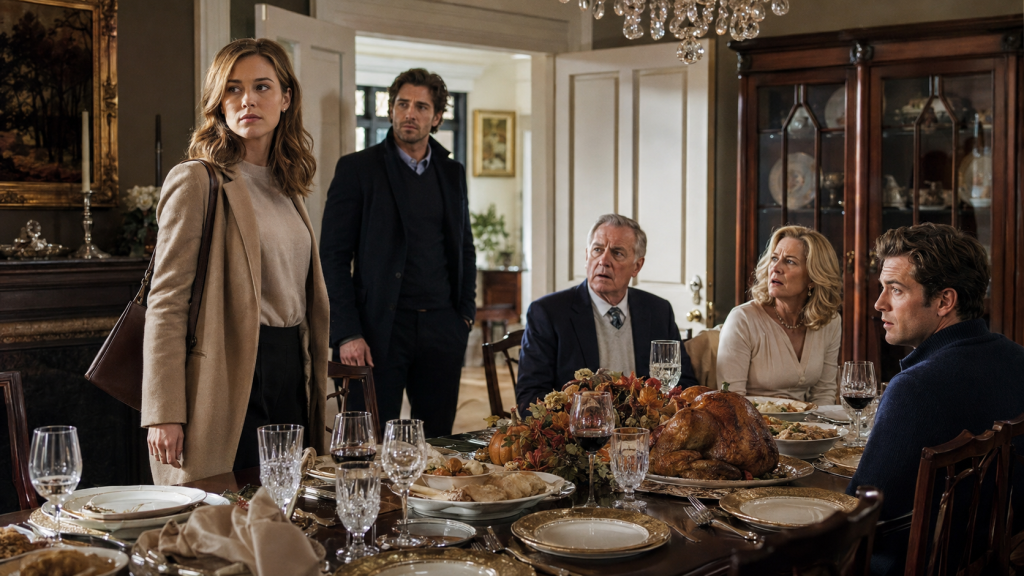
At Thanksgiving dinner, my parents looked at me and said, “Your job is to work while your brother enjoys his life. If you don’t like it, there’s the door.” I didn’t argue. I simply stood up and replied, “Fine. I’ll leave—and from now on, you can start paying your own bills.”

The table went completely silent. They thought I was only walking out of dinner. They had no idea how much of their lifestyle I had been quietly funding…
My name is Sloan Whitmore. I was twenty-nine years old when one Thanksgiving dinner finally forced my family to say out loud what I had been pretending not to see for years.
We were sitting around the mahogany table in my parents’ Connecticut colonial. Crystal glasses caught the chandelier light. My mother had used the expensive linen napkins I bought her two Christmases earlier. My father was carving turkey, and my older brother Carter was sitting across from me in a tailored navy jacket, talking about his newest business like he was already ringing the opening bell on Wall Street.
Carter had always been the dreamer.
I had always been the dependable one.
At least, that was how my parents described us.
I worked in Manhattan as a portfolio manager for a private wealth firm. I spent my days studying risk, cash flow, debt, and the uncomfortable difference between what people wanted to believe and what the numbers actually showed.
Carter spent his twenties launching one idea after another.
A digital marketing company.
A subscription fitness platform.
A luxury travel app.
A food-delivery concept.
Every venture started with glossy presentations and enormous confidence.
Every one ended with somebody else helping him clean up the bills.
Usually my parents.
And eventually, me.
Halfway through dinner, Carter tapped his fork gently against his glass.
“I’ve got something big.”
My fiancé Marcus, sitting beside me, glanced over.
Carter opened a glossy presentation folder.
His newest company was a premium botanical beverage brand aimed at luxury hotels and upscale restaurants.
He talked about packaging.
Market positioning.
Corporate events.
National distribution.
Then came the number.
“I need a hundred thousand to lock in production.”
He looked directly at me.
I almost laughed.
“You need a hundred thousand from me?”
“Seed capital.”
“For a company that hasn’t made a sale.”
“We have interest.”
“Signed orders?”
“Not yet.”
“Outside investors?”
“They want to see family commitment first.”
That phrase stayed in the air.
Family commitment.
My mother set down her wineglass.
“Sloan, your investments have done extremely well this year.”
I slowly turned toward her.
“How would you know?”
“The market is public.”
“My accounts aren’t.”
She ignored that.
“You could sell a small portion Monday morning and barely notice.”
Marcus’s posture stiffened beside me.
He was a corporate restructuring attorney. He knew exactly what the conversation had become.
But he didn’t interrupt.
He waited for me.
“I’m not liquidating my portfolio,” I said. “And I’m not putting a hundred thousand dollars into Carter’s company.”
The room changed.
Not loudly.
Just a shift.
My father stopped cutting turkey.
Carter leaned back.
Mom’s expression hardened.
“You haven’t even read the full proposal.”
“I asked basic questions. He doesn’t have purchase orders, outside equity, or proven revenue.”
Carter shook his head.
“This is why nobody likes talking business with you.”
“Because I ask where the money goes?”
“Because everything becomes an audit.”
“That usually happens before someone asks me for six figures.”
Dad finally spoke.
“Your brother deserves a real chance.”
“He has had real chances.”
“That’s not supportive.”
I looked at him.
“Who paid the vendor balance from his last company?”
Dad looked down.
Nobody answered.
I already knew.
I had.
Not directly to Carter.
That would have made the pattern too obvious.
My parents had called me after one of his previous ventures closed.
They said they were temporarily short because they had helped him settle a few obligations.
I sent the money.
Just like I had paid part of their property taxes.
Just like I had covered minimum payments when two of their cards became stretched.
Just like I contributed toward a roof repair.
Just like I paid a country club assessment Mom said would be “embarrassing” to miss.
Five years of little emergencies.
Every one described as temporary.
Every one quietly becoming mine.
Mom leaned toward me.
“Carter is the creative one in this family.”
I stared at her.
“And?”
“You have stability.”
“Yes.”
“You have a reliable income.”
“Yes.”
“You don’t have children yet. You have flexibility.”
Marcus slowly put down his fork.
I knew what was coming before she finished.
“Your brother is trying to build something,” Mom said. “Your job is to work so he can have the freedom to reach his potential.”
The dining room went silent.
Even Carter looked slightly uncomfortable.
I waited for Dad to correct her.
He didn’t.
Mom continued.
“That is how family works. Some people contribute in different ways.”
“So my contribution is money.”
“You’re twisting my words.”
“I’m repeating them.”
Carter pushed his chair back slightly.
“Sloan, nobody is forcing you.”
I looked at him.
“You’re asking me for a hundred thousand dollars while Mom explains that financing you is my role in life.”
“That’s dramatic.”
“No. It’s unusually clear.”
Mom’s patience disappeared.
“If supporting your own brother is such a problem, maybe you should stop pretending you care about this family.”
She lifted one manicured hand and pointed toward the hallway.
“If you don’t like it, there’s the door.”
For twenty-nine years, that sentence would have worked.
That was the real power in our family.
Not money.
Belonging.
The quiet suggestion that disagreement could cost you Christmas dinners, birthdays, phone calls, and your place at the table.
I looked at the doorway.
Then at my mother.
Then at my brother, who had spent years accepting help without ever asking what it cost me.
I picked up my linen napkin.
Dabbed the corners of my mouth.
Folded it neatly beside my plate.
Then I stood.
“Fine.”
Mom blinked.
“I’ll take the door.”
Marcus stood beside me.
Dad looked up sharply.
“Sloan.”
I slipped my handbag over my shoulder.
“And starting tomorrow, you can pay your own bills.”
Nobody moved.
My mother’s face changed.
“What does that mean?”
“It means exactly what it sounds like.”
“The property taxes?”
“Yours.”
Dad’s chair shifted.
Mom stared.
“The credit cards?”
“Yours.”
“The club assessment?”
“Yours.”
Carter gave a short laugh.
“You’re really doing this because I asked for an investment?”
“No.”
I looked at him.
“I’m doing this because Mom finally explained the arrangement clearly enough that I stopped pretending it was temporary.”
Marcus opened the front door.
Cold November air rushed into the foyer.
I walked out.
Behind me, nobody followed.
The next morning, Manhattan was bright and freezing.
I stood at the kitchen island with black coffee while Marcus opened his laptop.
“You still want to do this?”
“Yes.”
“Then do it correctly.”
That mattered.
There was no magic switch that let me erase every financial connection overnight.
Some things I paid voluntarily.
Those could stop immediately.
Others involved existing contracts.
Those had to be reviewed properly.
By nine-thirty, I had canceled the automatic property-tax payment from my account.
Stopped the credit-card minimum payments I had been covering.
Removed my card from several recurring family expenses.
No dramatic phone call.
No speech.
Just a series of small confirmations appearing on my screen.
Payment canceled.
Autopay removed.
Funding source changed.
At 1:17, Dad called.
“Your mother says the tax payment was canceled.”
“Yes.”
“We built our budget around that.”
I closed my eyes.
That sentence told me everything.
Their budget.
Built around my money.
“Then the budget needs to change.”
“You’ve paid it for three years.”
“I know.”
“You’re really going to do this?”
“Yes.”
Mom called ten minutes later.
I let it go to voicemail.
Then Carter called.
“Happy now?”
“No.”
“My business line is suddenly under review.”
“That has nothing to do with your tequila—or botanical drink—or whatever you’re calling this one.”
“You told the lender you won’t renew your support.”
“Yes.”
“I need that facility.”
“Then find another guarantor.”
Silence.
Finally he said, “Do you want me to fail?”
I stared out at the city.
“No, Carter.”
“Sure sounds like it.”
“I want you to succeed without making me responsible if you don’t.”
He hung up.
For two weeks, nothing spectacular happened.
That surprised me.
Nobody lost a house overnight.
Nobody’s life disappeared.
My parents canceled a few expenses.
Carter delayed his production deposit.
The world kept moving.
Then one afternoon, an email from a property-record alert service appeared on my phone.
NEW FILING RECORDED.
My parents’ Connecticut address was underneath.
I opened it.
A home-equity line had been placed against their house months earlier.
Not after Thanksgiving.
Before it.
The amount made me sit down.
$225,000.
Purpose: business investment.
I called Dad.
No answer.
Mom.
No answer.
Finally, the next morning, Dad called back.
“What did you find?”
“The equity line.”
Silence.
“How much went to Carter?”
“Sloan.”
“How much?”
Another silence.
Then:
“Two hundred thousand.”
I closed my eyes.
“You borrowed against the house for him?”
“It wasn’t supposed to be permanent.”
“Did an attorney review the deal?”
“No.”
“Did an accountant review his projections?”
“We trust our son.”
I stared at the filing on my laptop.
“When was the last payment made?”
Dad said nothing.
That was when the situation stopped being about Thanksgiving.
I printed the lien record.
Then I opened the old financial folder Carter had—.
PART 2: THE FAMILY BUDGET THAT ONLY WORKED IF I NEVER SAID NO
I printed the lien record.
Then I opened the old financial folder Carter had once given me after his last company collapsed.
It was still in the bottom drawer of my home office.
Gray cardboard.
Bent corner.
His name written across the tab in black marker.
CARTER — 2022
I had kept it because that was what I did.
I kept records.
Receipts.
Statements.
Contracts.
The paper trail everyone else in my family found boring until something went wrong and they needed me to remember exactly where the fire had started.
I carried the folder to the kitchen island.
Marcus came in from the bedroom fastening one cuff.
He stopped when he saw my face.
“What did you find?”
“I don’t know yet.”
He looked at the lien record beside me.
“That answer usually means something bad.”
“It means I’m trying not to make assumptions.”
He pulled out the stool beside mine.
“Good.”
I opened the folder.
The first few pages were familiar.
Carter’s previous company.
A subscription fitness platform that had promised personalized coaching, meal planning, and “AI-driven behavioral optimization,” which sounded impressive until customers realized most of the workouts were links to videos that already existed.
The business lasted thirteen months.
When it failed, Carter owed vendors.
A web developer.
A marketing contractor.
A fulfillment company that had somehow been contracted even though the product barely required fulfillment.
Mom and Dad had called me crying.
Not because Carter asked them to.
That was always the technical defense.
He never asked me directly.
They did.
And because they were “temporarily overextended,” I sent thirty-two thousand dollars.
I remembered exactly how Dad described it.
“Just enough to help everybody land safely.”
Everybody.
That word had cost me more money than any investment mistake I had ever made.
I flipped through the pages.
Marcus watched without touching anything.
Then I found it.
A one-page letter.
My own letterhead.
My own signature.
I stopped.
“What?”
Marcus asked.
I slid it toward him.
Two years earlier, one of Carter’s vendors had agreed not to pursue collections immediately if he could demonstrate that enough family support existed to close the remaining obligations.
I had agreed to something narrow.
Very narrow.
The letter said:
I am willing to contribute up to $25,000 toward settlement of specifically identified vendor obligations associated with Carter Whitmore’s former business, provided any payment is made directly to approved creditors. This statement is limited to those obligations and does not constitute an ongoing guarantee of Mr. Whitmore’s debts, future ventures, or credit facilities.
Marcus read it twice.
Then looked at me.
“This is good.”
“Good?”
“It is specific.”
“I wrote it that way on purpose.”
“I can tell.”
I had forgotten how angry I had been when I drafted it.
Mom wanted me to simply transfer the money to Carter.
I refused.
Payments went directly to vendors.
No blank check.
No access to my account.
No ongoing guarantee.
At the time, Carter called me controlling.
Mom said I was humiliating him.
Dad said sometimes family should trust one another without “lawyer language.”
I used lawyer language anyway.
Thank God.
Marcus tapped the final sentence.
“This ends the issue for that situation.”
I looked at him.
“Then why did Carter’s current lender say my support wasn’t being renewed?”
Marcus’s expression changed.
There it was.
The question I had been trying not to ask.
I had never guaranteed Carter’s new botanical beverage company.
I had never agreed to backstop a line of credit.
I had never promised new money.
Yet when I withdrew what Carter called my “support,” his business facility suddenly went under review.
At Thanksgiving, I assumed he meant the lender had been counting on me informally.
Now I wasn’t so sure.
I reached for my phone.
Marcus stopped me.
“Who are you calling?”
“Carter.”
“No.”
I looked at him.
“He used my name.”
“Maybe.”
“That isn’t enough?”
“It’s enough to ask questions correctly.”
His voice remained calm.
“That means no angry call where he has time to improvise an explanation before you know what document exists.”
I hated when he was right.
Which, professionally, was often.
I set the phone down.
“So what do I do?”
“Start with the lender.”
“I don’t know who it is.”
“Carter told you his facility was under review after you withdrew support.”
“Yes.”
“Ask him in writing what facility and what support he was referring to.”
I stared.
“That’s still contacting him.”
“Yes.”
“But with one question.”
Marcus slid my phone toward me.
“No accusation.”
“No theory.”
“Just make him identify what he thinks you agreed to.”
So I did.
I typed:
Carter, when you said your business line was under review because I would not renew my support, what specific financial support or document were you referring to? Please send me a copy of anything bearing my name.
I showed Marcus.
He nodded.
“Send.”
I did.
Nothing happened.
For six minutes.
Then my phone rang.
Carter.
I declined it.
He called again.
Declined.
Then a text.
Why are you making this formal?
I read it aloud.
Marcus looked unimpressed.
“Because the question is formal.”
Another message.
You know exactly what I mean.
I answered:
I don’t. Please identify the document.
Three dots appeared.
Disappeared.
Returned.
Then:
The family support paperwork from the last company.
My stomach went cold.
I looked at the letter sitting on the island.
“That letter is expired.”
Marcus shook his head.
“Not expired.”
“Limited.”
“Even better.”
I typed:
That letter applied only to identified vendor settlements for the prior company and expressly excluded future ventures and credit facilities. Did you provide it to your current lender?
This time, Carter did not answer for almost twenty minutes.
Then:
It was part of the background package.
Background package.
I laughed once.
Sharp.
Joyless.
The language of someone trying to make an important thing sound administrative.
I replied:
Did you represent to the lender that I remained willing to provide financial support?
No answer.
Then my father called.
I stared at his name.
Marcus said nothing.
I answered.
“Hi, Dad.”
“What are you doing to Carter?”
Not hello.
Not good morning.
Not are you okay after learning we borrowed two hundred twenty-five thousand dollars against our home without telling you?
What are you doing to Carter?
I closed my eyes.
“I asked him what document he gave his lender.”
Dad exhaled.
“Sloan, please.”
“Please what?”
“He’s under enormous pressure.”
“So am I.”
“This company could actually work.”
“Then its financing should survive basic questions.”
Dad went quiet.
I continued.
“Did you know Carter gave his new lender a support letter I wrote for an old company?”
“It was just part of his history.”
“Did you know?”
Silence.
“Dad.”
“Yes.”
My stomach dropped.
“Did you read the letter?”
“I’ve seen it.”
“Then you saw the sentence saying it was not a guarantee of future ventures.”
“He wasn’t using it as a guarantee.”
“Then what was he using it as?”
Dad hesitated.
“As evidence that the family supports him.”
I stared at the Manhattan skyline beyond my window.
The sun was bright against buildings that suddenly looked very far away.
“Family.”
There was that word again.
“What exactly did Carter tell the lender about me?”
“I don’t know every detail.”
“What details do you know?”
“Sloan, this is turning into another audit.”
I laughed softly.
“You put two hundred thousand dollars of home equity into his company.”
“You knew he was showing lenders my old financial-support letter.”
“And you still think the problem is that I’m asking too many questions?”
Dad’s voice tightened.
“We were trying to help your brother establish credibility.”
“With my credibility?”
“No.”
“Yes.”
I stood.
“My income.”
“My career.”
“My investment history.”
“My history of paying family obligations.”
“That’s credibility he didn’t earn.”
“That’s mine.”
Dad became defensive.
“Nobody took anything from you.”
“Not yet.”
The silence after that was ugly.
Then he said,
“You always assume the worst about him.”
That one hurt.
Not because it was true.
Because for years I had done exactly the opposite.
I had paid vendors.
Covered property taxes.
Paid cards.
Kept quiet.
Rescued.
Smiled.
Protected.
And apparently none of that counted as faith.
Only the next yes did.
I asked,
“How much is the monthly payment on the home-equity line?”
Dad stopped.
“Why?”
“Because I asked.”
“It varies.”
“Dad.”
“About eighteen hundred right now.”
I closed my eyes.
“And if the rate adjusts?”
“It could be more.”
“How much more?”
“Twenty-three hundred.”
“Can you afford that?”
No answer.
“Without me?”
Still nothing.
My throat tightened.
“Dad.”
He finally whispered,
“Not comfortably.”
There it was.
Not comfortably.
The Whitmore family translation for:
We made commitments based on the assumption Sloan would continue funding the gap.
I sat back down.
“How much are Mom’s cards?”
“Sloan…”
“How much?”
“I don’t know exactly.”
“You do.”
A long pause.
“About forty-seven thousand.”
My mouth went dry.
Forty-seven.
I had been paying minimums on two cards.
I thought the balances were closer to twenty.
“Dad.”
“I know.”
“What about yours?”
“Mine are fine.”
“What does fine mean?”
“Thirteen.”
Thirteen thousand.
I pressed two fingers against my forehead.
“So you have sixty thousand in revolving card debt.”
“We had expenses.”
“You have a mortgage.”
“Yes.”
“A home-equity line for two hundred twenty-five thousand.”
“Yes.”
“Sixty thousand in cards.”
“Yes.”
“And you gave Carter two hundred thousand dollars.”
“It was an investment.”
“Do you own equity?”
Silence.
My pulse slowed.
“Dad.”
“He said paperwork was coming.”
I closed my eyes.
“You gave him two hundred thousand dollars without an executed investment agreement?”
“We have emails.”
“That wasn’t my question.”
“No.”
There are moments when financial numbers stop being numbers.
They become character.
Choices.
Fear.
Denial.
I spent my career explaining risk to wealthy people who hated hearing that their lifestyles were more fragile than they looked.
I knew the symptoms.
High fixed costs.
Illiquid assets.
Debt layered on debt.
Dependence on cash flow that was not contractually guaranteed.
My parents had built exactly that.
Except the cash flow they were counting on had a name.
Mine.
I asked quietly,
“What did you think would happen if I stopped paying?”
Dad’s answer came so softly I almost missed it.
“We didn’t think you would.”
My eyes filled.
There.
The whole family system in five words.
Not:
We thought we could afford it.
Not:
We had a backup.
We didn’t think you would.
My reliability had been listed as an asset.
Not on paper.
In their minds.
I looked at Marcus.
He had heard.
His expression was sad.
Not triumphant.
He understood what that sentence had done to me.
I said,
“Dad, I’m going to send you the name of a financial counselor.”
“No.”
“Yes.”
“We don’t need one.”
“You have more than two hundred eighty thousand dollars in non-mortgage debt and no clear repayment agreement on the largest asset you advanced.”
“You need one.”
“Sloan—”
“I am not the repayment plan.”
His voice hardened.
“So that’s it?”
“What?”
“You’re going to watch us lose everything to prove a point?”
My throat tightened.
“No.”
“I’m going to stop preventing you from seeing the cost of your own decisions.”
He hung up.
I stared at the silent phone.
Then I cried.
Not dramatically.
Just enough that Marcus quietly moved the box of tissues closer.
I laughed through tears.
“Very romantic.”
“It’s what you get for marrying a restructuring attorney.”
“We’re not married yet.”
“Technicality.”
That made me laugh harder.
Then my phone buzzed.
Carter.
A PDF attachment.
No message.
I opened it.
The first page was his current lender’s underwriting summary.
The facility was larger than I expected.
A revolving business line with a maximum commitment of $350,000, subject to milestones.
Not all drawn.
Not all approved.
Under Sources of Support, three items were listed:
Founder capital — $40,000
Family home-equity investment — $200,000
And:
Additional family liquidity support — Sloan Whitmore
I stopped.
Marcus leaned closer.
“What does the actual document say?”
I kept scrolling.
There was my old letter.
The one capped at twenty-five thousand.
The one explicitly excluding future companies.
Then behind it—
another page.
I froze.
At the top:
FAMILY LIQUIDITY SUPPORT STATEMENT
My name.
My Manhattan address.
My employer.
Estimated annual compensation.
Estimated liquid investment assets.
I stopped breathing.
“Marcus.”
He was already reading.
The letter said:
I, Sloan Whitmore, confirm that I remain financially committed to supporting Carter Whitmore’s entrepreneurial activities and am prepared, subject to reasonable need, to provide up to $100,000 in additional liquidity during the first twelve months of operations.
My hands went numb.
At the bottom was a signature.
Mine.
Except I had never seen the document.
I whispered,
“I didn’t sign this.”
Marcus did not react emotionally.
That was why he was good at what he did.
He zoomed in.
Compared it to the old letter.
Then sat back.
“Do not say forgery yet.”
I stared at him.
“That is not my signature.”
“I believe you.”
“But we need to establish how it got there.”
I read the letter again.
Prepared to provide up to one hundred thousand dollars.
Exactly the number Carter asked me for at Thanksgiving.
My stomach turned.
He had not asked me to make a new investment.
He had asked me to fulfill a financial commitment someone had already told the lender existed.
I whispered,
“Oh my God.”
Marcus looked at me.
“What?”
“Thanksgiving wasn’t the beginning.”
“No.”
“He already told them I was in.”
“It appears someone did.”
I scrolled farther.
A page titled:
Family Financial Capacity
My estimated portfolio value was listed.
Not exactly.
Close enough to frighten me.
My mother’s voice from Thanksgiving returned.
Your investments have done extremely well this year.
I had asked how she knew.
She said the market was public.
My accounts were not.
My stomach went cold.
I looked at Marcus.
“They estimated my portfolio.”
“How close?”
“Too close.”
He frowned.
“Who has seen statements?”
“My financial adviser.”
“My accountant.”
“You?”
“Obviously.”
“Anyone in your family?”
“No.”
Then I stopped.
Three years earlier.
My parents’ printer had broken during tax season.
I had stayed at their house for a weekend.
Printed a consolidated investment summary in Dad’s study because I needed it for my accountant.
I remembered leaving the papers in the printer tray while Mom called me into the kitchen.
I went back later.
They were there.
I thought.
Maybe.
Memory is dangerous when fear starts editing it.
I shook my head.
“No.”
“What?”
“I’m not doing that.”
“Doing what?”
“Building a theory from a printer three years ago.”
Marcus nodded.
“Good.”
I hated being proud of myself for basic restraint.
I opened Carter’s message thread.
Typed:
I did not sign or authorize the Family Liquidity Support Statement you sent. Do not submit any further representation that I have committed capital or support to your company. Please preserve all communications and original files relating to this document.
Marcus read it.
“Add that your attorney will follow up.”
“You’re my fiancé.”
“Not in this matter.”
He was right.
He practiced corporate restructuring.
This needed independent counsel.
I added:
My counsel will contact you regarding the document.
Sent.
Carter called within seconds.
I did not answer.
He called again.
Then:
Don’t do this.
Another:
Mom said you were going to help.
My heart stopped.
I read it again.
Mom said you were going to help.
Marcus saw my face.
“What?”
I turned the phone toward him.
His expression changed.
Not guilt proven.
Not authorization established.
But another thread.
My mother.
I typed nothing.
Carter sent:
She said you always come around once you see the numbers.
Then:
Nobody thought you’d embarrass us like this.
Embarrass us.
I nearly laughed.
My name had been placed on a $100,000 liquidity-support statement I had never signed, and somehow the danger was still my refusal to cooperate quietly.
I forwarded everything to an attorney Marcus recommended.
Her name was Dana Cho.
She specialized in commercial disputes and financial fraud.
By four that afternoon, she had the documents.
At five-thirty, she called.
“First question.”
“Yes?”
“Did you sign this letter electronically?”
“No.”
“Verbally authorize it?”
“No.”
“Tell anyone they could represent you as providing up to one hundred thousand dollars?”
“No.”
“Ever give Carter authority to sign for you?”
“No.”
“Power of attorney?”
“Absolutely not.”
“Good.”
Her voice remained neutral.
“Second question.”
“Yes?”
“Do you want the lender corrected?”
“Immediately.”
“That may suspend or terminate Carter’s financing.”
I closed my eyes.
There it was.
The old trap.
If I protect myself, Carter may suffer.
If Carter suffers, I caused it.
Except this time, I could see the mechanism.
“I understand.”
“Still want it corrected?”
“Yes.”
“Good.”
Dana sent a formal notice that evening.
Short.
Professional.
No accusations beyond what I could state personally.
I had not signed the document.
I had not authorized it.
I had not committed one hundred thousand dollars.
Any representation otherwise should not be relied upon.
The lender acknowledged receipt the next morning.
Carter’s line was frozen pending review.
At 8:12, my mother called.
I answered.
Not because I wanted to fight.
Because I needed to hear what she would say.
“Sloan.”
Her voice was shaking.
“Yes?”
“You contacted the bank.”
“The lender.”
“You froze Carter’s company.”
“No.”
“You did.”
“I corrected a document using my name.”
“He needed time.”
“Then he should have asked for time using his own assets.”
My mother started crying.
“You’re destroying your brother.”
The words entered me and found an old room.
A familiar one.
Sloan is responsible.
Carter needs freedom.
Sloan is stable.
Carter has potential.
Sloan can absorb it.
For once, I did not enter that room with her.
I stayed outside.
“Did you tell Carter I would provide one hundred thousand dollars?”
Silence.
“Mom.”
“I told him you would probably help.”
“That isn’t my question.”
She cried harder.
“He was under pressure.”
“Did you tell him I would provide up to one hundred thousand dollars?”
“I said you had the ability.”
I closed my eyes.
“Did you see the liquidity-support letter?”
Silence.
My heart sank.
“Mom.”
“Yes.”
There.
One word.
My own mother.
I sat down slowly.
“Before or after it was sent to the lender?”
She did not answer.
My chest tightened.
“Mom.”
“Before.”
Marcus looked up from across the room.
He had heard.
I asked,
“Did you write it?”
“No.”
Immediate.
“Did you sign it?”
“No.”
“Did you tell Carter he could use my signature?”
“No.”
“Then what did you do?”
My mother’s crying became quieter.
“I told him you would agree eventually.”
I stared at nothing.
“And he had a letter saying I already had.”
“I know.”
“Did that bother you?”
Silence.
“Mom.”
“I thought it was preliminary.”
I laughed.
A terrible little sound.
“Preliminary fraud?”
“Sloan!”
“You don’t get to be offended by the word before you explain the document.”
“I didn’t forge anything.”
“Good.”
“Then help me understand why you saw a letter carrying my signature, promising one hundred thousand dollars I never agreed to provide, and your response was to assume I would catch up with the paperwork later.”
She sobbed.
“I thought you would help your brother.”
There.
The answer beneath the answer.
My consent had become a timing issue.
Not a requirement.
Something they expected to obtain eventually because I always came around.
I pressed my palm against the counter.
“Where did the portfolio estimate come from?”
Mom stopped crying.
That silence frightened me more than the tears.
“What portfolio estimate?”
“The one in Carter’s lender packet.”
“I don’t know.”
“You told me at Thanksgiving my investments had done extremely well.”
“The market did well.”
“My account values are not the market.”
“Sloan…”
“Did you see my financial statements?”
“No.”
Too fast.
I waited.
She corrected herself.
“Not recently.”
My pulse slowed.
“When?”
Silence.
“Mom.”
“A few years ago.”
My eyes closed.
The printer.
Of course.
“I found a statement.”
“Found?”
“It was in Dad’s study.”
“I printed it there.”
“I know.”
“You kept it?”
“I put it in a file.”
“What file?”
“The family financial file.”
I stood so quickly the stool scraped the floor.
“The what?”
Mom started crying again.
“Your father keeps records.”
“Of my assets?”
“Not like that.”
“What does ‘family financial file’ mean?”
“It has information for emergencies.”
“Whose emergencies?”
She said nothing.
I already knew.
Everyone’s.
Except apparently mine.
My voice came out very quiet.
“Did Carter see it?”
“I don’t know.”
“Did Dad?”
“Yes.”
“Did either of you give him my portfolio estimate?”
“I don’t know.”
“Mom.”
“I don’t know.”
This time, it sounded real.
Which meant the problem was larger than one act.
My private financial information had existed in my parents’ house as something they considered family material.
Accessible enough that nobody could tell me who had seen it.
I whispered,
“You had no right.”
“I know.”
“No.”
My voice broke.
“You know now.”
“There’s a difference.”
She cried.
“I was trying to keep records in case something happened.”
“To me?”
“Yes.”
“Then why didn’t I know the file existed?”
No answer.
Because emergencies were the excuse.
Access was the reality.
I said,
“I need space.”
“Sloan, please don’t do this before Christmas.”
There it was.
The calendar.
Another tool.
Thanksgiving.
Christmas.
Birthdays.
Family events used like emotional due dates.
I looked at the city outside.
“No.”
“What?”
“I’m not scheduling my boundaries around holidays anymore.”
She went quiet.
“I love you.”
My throat tightened.
“I love you too.”
And then I ended the call.
Love.
Still there.
That was the hardest part.
People like clean stories because they are easier to survive from a distance.
Parents exploit daughter.
Brother uses her money.
Daughter walks away.
Justice.
But real families do not stop being loved the moment they become unhealthy.
My mother still knew how I liked my coffee.
Dad still texted me every first snow of the year.
Carter once drove three hours to sit beside me when Marcus had emergency surgery for appendicitis.
There had been goodness.
That did not make the financial entitlement imaginary.
Both could be true.
For the next month, I did something that felt almost unnatural.
Nothing.
At least financially.
I did not rescue.
My parents hired a financial counselor.
Not because they wanted to.
Because Dad finally realized the HELOC payment, mortgage, cards, club dues, and normal living expenses did not fit inside their income.
They dropped the country club.
Mom sold a second car.
Dad stopped pretending retirement meant never touching principal.
They built a real budget.
For the first time in years, the number called “Sloan” disappeared from it.
Nobody lost the house.
That mattered.
Because my parents had talked as though stopping my payments would push them onto the street.
It did not.
They had options.
Unpleasant options.
Different thing.
They cut.
Sold.
Adjusted.
The colonial remained.
The chandelier still hung over the mahogany table.
Life continued.
Apparently they had never needed my sacrifice as much as they needed to avoid changing.
Carter’s situation was worse.
The lender’s review continued.
The company delayed production.
Two tentative hotel relationships disappeared.
His business did not instantly collapse.
But the version he had pitched could no longer rely on an imaginary one hundred thousand dollars from me.
He called me exactly once.
Two weeks before Christmas.
I answered.
“Sloan.”
His voice sounded tired.
“Yes.”
“Did you ever believe in me?”
The question hurt.
I sat on my sofa.
“Sometimes.”
He laughed bitterly.
“Wow.”
“You asked.”
“I’m your brother.”
“Yes.”
“You’re supposed to say yes.”
“No.”
Silence.
Then I continued.
“I believed you were talented.”
“You are.”
“I believed some of your ideas were good.”
“They were.”
“I also believed you had a habit of treating optimism like due diligence.”
He said nothing.
“I believed you got rescued too quickly to learn from failure.”
“And I believed Mom and Dad helped create that.”
His breathing changed.
“What about you?”
My chest tightened.
“What about me?”
“You helped too.”
There it was.
And he was right.
I closed my eyes.
“Yes.”
“I did.”
He seemed surprised.
I continued.
“I paid bills that should have remained visible.”
“I protected Mom and Dad from the cost of helping you.”
“I told myself I was stabilizing the family.”
“But every rescue kept the same arrangement alive.”
Carter was quiet.
Then:
“So this is some kind of lesson?”
“No.”
“Stop calling consequences lessons.”
“That’s what Dad does.”
“It makes the person experiencing them sound like a child.”
He exhaled.
“Fine.”
Then he said,
“I didn’t sign your name.”
I sat straighter.
“I didn’t ask.”
“I know.”
“But you think I did.”
“I think a document exists carrying a signature I did not make.”
“Who created it is being reviewed.”
His voice tightened.
“It wasn’t me.”
“Okay.”
“You don’t believe me.”
“I heard you.”
“That is not the same.”
“No.”
“It isn’t.”
Silence.
Then I asked,
“Who prepared the liquidity letter?”
Another silence.
My stomach tightened.
“Carter.”
“The lender package was assembled by Trevor.”
“Who is Trevor?”
“My finance consultant.”
“Full name.”
“Trevor Lang.”
“Did Trevor write the letter?”
“He prepared drafts.”
“Where did the signature come from?”
“I don’t know.”
“Did you give him my old support letter?”
“Yes.”
There.
One piece.
“Why?”
“He wanted evidence of family backing.”
“The letter explicitly said it was not future backing.”
“I know.”
“Then why give it to him?”
“Because…”
He stopped.
“Because what?”
“Because I thought if the lender saw you had helped before, it would make the company look stronger.”
I closed my eyes.
“That is using my history as your asset.”
“Maybe.”
“Not maybe.”
He sighed.
“Fine.”
Then his voice broke.
“I was desperate.”
That word changed the temperature of the conversation.
Not because it excused him.
Because it sounded honest.
I asked,
“How bad is it?”
He went quiet.
“Carter.”
“I owe the production company eighty-five thousand on the reservation.”
“You haven’t started production.”
“I put down a deposit.”
“From Mom and Dad’s money?”
“Yes.”
“How much?”
“Seventy.”
My stomach dropped.
“So seventy thousand of the two hundred thousand is already committed.”
“Yes.”
“What about the rest?”
“Packaging design.”
“Consultants.”
“Ingredient sourcing.”
“Warehouse deposit.”
“Travel.”
“Marketing.”
I closed my eyes.
“How much cash is left?”
Silence.
“Carter.”
“Twenty-six.”
Twenty-six thousand.
From two hundred.
Before a single meaningful sale.
My throat tightened.
“What were you planning to do if I said no at Thanksgiving?”
He did not answer.
There it was.
He had never built a version where I said no.
Finally he whispered,
“I thought you’d say yes.”
“Why?”
“Because you always do.”
The sentence hurt more from him than it had from Dad.
Maybe because Carter was the one benefiting most.
I asked,
“Did you know Mom thought my job was to work so you could have freedom?”
He became quiet.
“No.”
“Did you agree?”
“No.”
Too fast.
Then:
“Not like that.”
“What does that mean?”
He sighed.
“I thought you didn’t mind.”
My eyes filled.
“Did you ever ask?”
No answer.
“Carter.”
“No.”
There.
We stayed silent.
Then I said,
“I do want you to succeed.”
He gave a humorless laugh.
“I know you keep saying that.”
“Because it’s true.”
“But I need you to understand something.”
“What?”
“If your company only works because I absorb the downside, then it does not work.”
He was silent.
“That isn’t me insulting you.”
“That is math.”
He whispered,
“I hate when you say things like that.”
“I know.”
“Because you’re usually right.”
“That too.”
For one second, we both almost laughed.
Then Carter became serious.
“I’m going to fix the lender issue.”
“Good.”
“And the letter.”
“Through attorneys.”
He sighed.
“Of course.”
“Yes.”
“Because my signature stopped being a family discussion the second it appeared on a document I didn’t sign.”
He did not argue.
That mattered.
We ended the call without saying I love you.
I noticed.
So did he, probably.
Sometimes distance begins not with dramatic silence but with the absence of one familiar sentence.
Christmas came.
Marcus and I spent it with his sister in Brooklyn.
My parents invited us to Connecticut.
I declined.
Mom cried.
Dad said he understood.
Carter did not come either.
That surprised me.
Apparently he spent Christmas at home reviewing his company’s finances.
For the first time in years, no Whitmore child sat at that mahogany Thanksgiving table pretending the system still worked.
Maybe that was necessary.
In January, Dana called me.
“We received documents from the lender.”
I sat straighter.
“And?”
“Your denial has been incorporated into the underwriting file.”
“Good.”
“The lender is not relying on the purported one-hundred-thousand-dollar support commitment.”
“Good.”
“Carter’s facility is being re-evaluated based on actual capital.”
My chest loosened.
Then Dana paused.
“There’s also information about the document creation.”
My pulse slowed.
“What did they find?”
“The PDF metadata identifies Trevor Lang as the original author of the support statement.”
I closed my eyes.
Carter’s finance consultant.
“But that does not tell us who directed the language.”
“No.”
“Or who placed the signature.”
“Correct.”
She continued.
“The lender retained the version originally uploaded.”
“The signature image appears visually identical to the signature on your old twenty-five-thousand-dollar letter.”
My stomach went cold.
“Identical?”
“Enough that we’re having it examined.”
I stared at the original letter sitting in my locked desk drawer.
A signature I had given once.
For one purpose.
Possibly lifted and reused for another.
The metaphor was almost too perfect.
That was exactly what my family had done with my generosity.
I had said yes once.
Then they treated the yes like a reusable asset.
Dana continued.
“There’s one more detail.”
“What?”
“The upload record.”
I waited.
“The support statement was not uploaded from Trevor Lang’s office.”
My grip tightened around the phone.
“Where?”
“A residential IP connection.”
“That alone won’t identify a person.”
“I know.”
“Whose residence?”
Dana hesitated.
Then said,
“Your parents’ address in Connecticut.”
The room became very still.
I looked across the apartment.
Marcus was at the dining table reading.
He saw my face and stood.
I whispered,
“My parents’ house?”
“Yes.”
“The lender records show the final support statement was uploaded from a connection associated with that address.”
My mind immediately tried to build conclusions.
Mom.
Dad.
Carter.
Carter was there often.
Trevor could have visited.
Wi-Fi could be shared.
An IP address is location evidence, not a fingerprint.
I forced myself to breathe.
“What does that prove?”
“Only that the upload appears to have originated from that connection.”
“Good.”
I swallowed.
“What else?”
Dana went quiet.
“Sloan.”
I hated when lawyers said my name like that.
“What?”
“There is a scanned attachment in the same submission package.”
My pulse slowed.
“What kind?”
“A personal financial summary.”
My stomach dropped.
“Mine?”
“Yes.”
“Which one?”
She gave me the date.
Three years earlier.
The exact statement I remembered printing in my father’s study.
The one my mother admitted she had kept in the “family financial file.”
I sat down.
My private portfolio summary had been uploaded to Carter’s lender alongside a support letter I had never signed.
From my parents’ home internet connection.
My mother had seen the letter.
My father knew Carter was relying on my past financial support.
Carter had given his consultant my old signed letter.
And somewhere between those facts—
my consent had disappeared.
Dana said,
“I need you to stay disciplined.”
I almost laughed.
“I’m trying.”
“We do not know who uploaded the package.”
“We do not know who copied the signature.”
“We do not know whether Carter knew the final document contained your signature before submission.”
“I understand.”
“Good.”
Then she asked,
“Do your parents still have that family financial file?”
I stared at nothing.
“I don’t know.”
“Find out through counsel.”
“Not by showing up.”
“I wasn’t planning to.”
Mostly.
Dana continued.
“And Sloan?”
“Yes?”
“There may be another reason the portfolio summary matters.”
My stomach tightened.
“What?”
“The asset amount listed in Carter’s lender packet is not the amount from the three-year-old statement.”
I froze.
“What do you mean?”
“It has been updated.”
My mouth went dry.
“How close?”
“To your current actual liquid portfolio?”
“Yes.”
A pause.
“Very.”
I stopped breathing.
That changed everything.
An old statement could explain old numbers.
It could not explain an estimate that had somehow been revised to closely reflect what I held now.
My voice came out barely above a whisper.
“Dana…”
“I know.”
“Who has access to my current account values?”
“That is now the question.”
I stared toward the window.
My mother’s Thanksgiving words came back again.
Your investments have done extremely well this year.
I had asked how she knew.
She had smiled.
The market is public.
My accounts were not.
And for the first time since I walked out of Thanksgiving dinner, I realized the most expensive thing my family might have taken from me was not the property-tax money.
Not the credit-card payments.
Not the country club assessment.
Not even the years of quietly underwriting Carter’s failures.
It was the assumption that everything I had built—
my income,
my savings,
my investment portfolio,
my signature,
my future labor—
was somehow available to the family before I had agreed to give any of it.
I had walked out of dinner thinking I was ending the payments.
I was wrong.
The real question was much larger.
How far had they already gone in planning around money they still believed belonged to me only technically?
And as Dana began tracing how anyone could have obtained an updated estimate of my portfolio, one fact became impossible to ignore.
Someone in my family had not merely expected me to keep paying.
They had been presenting my financial life to outsiders as though my permission was a detail they could collect later.
PART 3: THE DAY MY FAMILY LEARNED THAT “SLOAN WILL PAY” WAS NOT A FINANCIAL PLAN
The updated portfolio number bothered me more than the false signature.
That surprised me.
A signature can be copied.
A document can be manipulated.
A PDF can be altered by somebody with mediocre software and too much confidence.
But my current portfolio value?
That lived behind passwords.
Security questions.
Two-factor authentication.
A private portal I checked from my apartment, my office, and almost nowhere else.
The number in Carter’s lender packet was not exact.
But it was close enough that whoever provided it had seen something recent.
And once I understood that, the question stopped being abstract.
Someone had been looking.
Dana Cho told me not to call my parents.
Marcus told me the same thing.
So naturally, every part of me wanted to drive to Connecticut immediately.
Instead, I did something much less satisfying.
I called my financial institution.
The fraud and security team reviewed access logs.
They asked me to verify devices.
My work laptop.
My personal laptop.
My phone.
Then the woman on the line said,
“There are several successful logins from a device we don’t recognize.”
My body went cold.
“What kind of device?”
“A Windows desktop.”
I did not own one.
“Location?”
She paused.
“Connecticut.”
My heart slowed.
Not because I was calm.
Because sometimes fear becomes so sharp it makes the rest of your body quiet.
“Can you tell me the city?”
She did.
My parents’ town.
I closed my eyes.
Marcus was sitting across from me at the kitchen island.
He saw my face.
Reached for my hand.
The security specialist continued.
“The first login I can see was approximately eleven months ago.”
“How many?”
“Seven successful sessions.”
Seven.
Not one accidental visit.
Not an old computer remembering a page.
Seven.
The most recent had occurred nine days before Thanksgiving.
I swallowed.
“Was anything transferred?”
“No.”
“Any withdrawal requests?”
“None.”
“Any beneficiary changes?”
“No.”
Relief came.
Small.
Important.
Then I asked,
“What did they view?”
“We cannot always reconstruct every page interaction.”
“But the account dashboard and consolidated holdings page were accessed.”
The holdings page.
The page with my current values.
There it was.
I thanked her.
Reset everything.
Changed the username too.
Added stronger authentication.
Then I sat completely still.
Marcus did not speak for almost a minute.
Finally he said,
“You know location is not identity.”
“Yes.”
“Your parents’ house has guests.”
“Yes.”
“Carter visits.”
“Yes.”
“Do not decide who logged in until we know.”
“I know.”
My voice broke.
“I hate that you’re right.”
“Occupational hazard.”
I laughed once.
Then started crying.
He moved around the island and held me.
I pressed my face against his shirt.
“I don’t care about the number.”
“I know.”
“I care that somebody thought looking was normal.”
“I know.”
“That’s worse.”
He said nothing.
Because it was.
For years, my family had treated my money like weather.
Something everyone could discuss because it affected their plans.
Sloan had a good year.
Sloan’s bonus should be strong.
Sloan doesn’t have children yet.
Sloan can absorb it.
Sloan will help.
Sloan always does.
I had spent my career managing other people’s wealth while my own family quietly treated mine as communal information.
Not ownership exactly.
Something almost more dangerous.
Availability.
Dana sent a preservation request regarding the lender package and communications surrounding it.
Then she contacted Trevor Lang.
Carter’s finance consultant.
He had assembled the underwriting materials.
Three days later, Trevor retained his own attorney.
That told me something.
Not guilt.
Concern.
Still important.
His written response arrived the following week.
Dana read it with me in her office.
Marcus was not there.
That mattered to me.
He was my fiancé.
Not my lawyer.
I wanted one corner of my life where our relationship did not become another professional file.
Dana adjusted her glasses.
“Trevor acknowledges preparing the Family Liquidity Support Statement.”
I inhaled.
“Does he admit inserting the signature?”
“Yes.”
The room went quiet.
I stared at her.
“He admits it?”
“He says Carter sent him your prior support letter and instructed him to use it as a formatting reference.”
Dana turned the page.
“Trevor states that Carter told him you had verbally committed to continued family support but were too busy to prepare updated documentation.”
My stomach tightened.
“Did Carter tell him to copy the signature?”
Dana continued.
“Trevor says he asked whether he should leave the signature line blank.”
“According to Trevor, Carter responded…”
She stopped.
“What?”
Dana looked at me.
“‘Use the same signature. She already agreed in principle.’”
I closed my eyes.
There are sentences that leave no room for the story you wanted.
For weeks, I had tried not to assume Carter created the false commitment.
Maybe Trevor misunderstood.
Maybe Mom had overstated my support.
Maybe Dad had given the wrong impression.
Maybe.
But now there was a direct allegation from the person who made the document.
Still not a court finding.
Still not something I was going to scream as established fact.
But enough that my brother had to answer.
I whispered,
“Anything else?”
“Yes.”
Trevor says the updated financial figures did not come from him.”
My heart tightened.
“Who gave them to him?”
“Carter emailed them.”
Of course.
Dana slid the email across the table.
Updated Sloan liquidity approx. $2.3M. Use for family capacity section.
My throat closed.
Two point three.
Close.
Painfully close.
Then below it:
Mom confirmed current range.
I stared at those four words.
Mom confirmed current range.
My eyes filled.
The betrayal suddenly felt less like a financial scheme and more like a family meeting I had somehow been excluded from.
My brother.
My mother.
My money.
Discussed as capacity.
A number.
Something available to strengthen his company’s file.
Dana said quietly,
“We still need to establish how your mother got the number.”
“I think we know.”
“Do not skip steps.”
I nodded.
The access logs.
Connecticut.
Seven sessions.
Nine days before Thanksgiving.
Mom saying my investments had done well.
She had known.
I knew it in my bones.
Evidence still deserved its own pace.
Dana continued.
“Trevor claims he believed the commitment was authorized.”
“Do you believe him?”
“That is not my job.”
I almost smiled.
She really was perfect for this.
“He created a financial document bearing someone else’s signature without confirming with that person.”
“That is significant regardless of what Carter told him.”
“What happens?”
“The lender handles its relationship with Trevor.”
“His professional obligations are his problem.”
“Our job is correcting the record and assessing any damages or legal remedies available to you.”
I looked at the email again.
Mom confirmed current range.
Then I asked,
“Can I call her now?”
Dana sighed.
“I knew we’d get here.”
“Can I?”
“As your lawyer, I prefer written communication.”
“As Sloan?”
“You’ll do what you want and then tell me afterward.”
“Accurate.”
She looked at me for a long moment.
“Do not threaten.”
“I won’t.”
“Do not bargain.”
“I won’t.”
“Do not promise not to pursue anything.”
“I won’t.”
“And record only if lawful and after we discuss it.”
“I’m not recording.”
“Good.”
I called Mom from the sidewalk outside Dana’s office.
She answered on the first ring.
“Sloan.”
Her voice was cautious.
Not warm.
Not angry.
Waiting.
I said,
“I know about the portfolio logins.”
Silence.
Long enough that I heard traffic passing behind me.
Finally:
“What logins?”
“Mom.”
Another silence.
Then she started crying.
I closed my eyes.
Not because tears proved guilt.
Because this time, I knew the pattern.
Cry.
Wait for Sloan to soften.
Sloan did not.
I asked,
“Did you access my investment account?”
She whispered,
“Yes.”
The answer hurt more than I expected.
Direct truth often does.
“How?”
She was crying harder.
“You logged in once on Dad’s computer.”
Memory arrived immediately.
Not three years ago.
Eleven months earlier.
Dad had called me during a visit because one of his retirement accounts was confusing him.
I sat at his desktop.
Logged into my own account first because I wanted to show him how asset allocation appeared on a dashboard.
I remembered the browser asking:
Save password?
I thought I clicked no.
Apparently I had not.
Mom continued.
“The password filled automatically.”
I closed my eyes.
“And you used it.”
“Yes.”
“Once?”
Silence.
“Mom.”
“No.”
My throat tightened.
“How many times?”
“I don’t know.”
“Seven.”
She started sobbing.
I looked toward the winter sky above Manhattan.
Gray.
Flat.
Cold.
“Why?”
She tried the old word.
“I was worried.”
I almost laughed.
“About what?”
“Your father and I had money problems.”
“That doesn’t explain looking at my portfolio.”
“We were trying to decide whether to ask you for help.”
My chest tightened.
“So before asking me how I felt, you checked how much I had.”
Silence.
I continued.
“You wanted to know what I could afford before deciding what you were entitled to request.”
“No.”
“Yes.”
“No, Sloan.”
Her voice rose.
“I was trying to understand your situation.”
“You could have asked.”
“You hate talking about your money.”
“I hate having my money discussed like family inventory.”
She cried.
“I know that now.”
Again.
Now.
Everyone knew after.
I asked,
“Did you give Carter my current portfolio estimate?”
She stopped crying.
That silence answered first.
Then:
“Yes.”
I looked down at the pavement.
A woman passed me holding a little boy’s hand.
Someone laughed across the street.
The city kept moving while one of my oldest beliefs quietly died.
My mother believed my private finances were hers to inspect if family needs were serious enough.
Not steal.
Not transfer.
Inspect.
Evaluate.
Allocate mentally.
I asked,
“Did you know he put the number in a lender package?”
“Yes.”
“Did you know he was representing me as an additional source of liquidity?”
She cried again.
“I thought you were going to help.”
“That was not my question.”
“Yes.”
There.
I swallowed.
“Did you know the support statement had my signature on it?”
“Yes.”
“Did you know I hadn’t signed it?”
Her voice became tiny.
“Yes.”
I closed my eyes.
That was the part I would remember.
Not because she created it.
She didn’t.
Not because she copied the signature.
According to Trevor, he did.
But my mother saw a false document carrying my name and decided the lie was temporary because eventually I would behave as expected.
I whispered,
“Why didn’t you stop him?”
She cried.
“Because I thought you’d say yes.”
The same sentence.
Again.
From Dad.
From Carter.
Now Mom.
They had built an entire financial system around predicting my consent.
And because I had said yes so many times before, prediction slowly became permission.
I leaned against the building.
“Mom.”
“Yes?”
“You keep saying you thought I would help.”
“I did.”
“But if you believed I would say yes, why did anyone need to fake the yes before asking?”
Silence.
No answer.
Because there wasn’t one.
If my consent were guaranteed, they could have waited for it.
They didn’t.
That was the truth.
Finally Mom whispered,
“We were scared you were becoming less willing.”
My stomach turned.
Not less able.
Less willing.
My boundaries were already emerging before Thanksgiving.
I had questioned Carter’s previous bills.
Asked about Mom’s card balances.
Stopped offering automatically.
They saw it.
They knew access was becoming uncertain.
So they started building around the old Sloan before the new one could say no.
My eyes filled.
“That is exactly why the answer had to become no.”
She cried.
“Are you going to sue your brother?”
There it was.
Fear immediately redirected toward Carter.
I closed my eyes.
“I don’t know what the legal outcome will be.”
“Please.”
“No.”
“Sloan—”
“Do not ask me to protect him from consequences before you ask what using my name cost me.”
She went silent.
Then said something I did not expect.
“You’re right.”
Two words.
No defense.
My anger paused.
Mom whispered,
“You’re right.”
She sounded different.
Smaller.
Not performatively.
Maybe simply tired.
“I kept thinking Carter was the child in danger.”
My throat tightened.
“And me?”
She cried.
“You were the child who could handle it.”
There it was.
The family mythology.
Carter needed.
Sloan handled.
Carter dreamed.
Sloan worked.
Carter fell.
Sloan caught.
I whispered,
“I got tired.”
Mom sobbed.
“I know.”
“No.”
I shook my head.
“I don’t think you did.”
“I think you thought competence meant I never paid a price.”
She had no answer.
“I need space.”
“I know.”
“I mean real space.”
She inhaled.
“Christmas?”
I almost laughed.
“Mom.”
“Sorry.”
That tiny apology mattered.
I continued.
“I’m changing my emergency contacts.”
She cried quietly.
“I understand.”
“And you are never accessing my finances again.”
“I won’t.”
“I need Dad to understand that too.”
“He will.”
“No.”
“You tell him what you did.”
“Do not make me do it.”
Silence.
Then:
“I will.”
We ended the call.
I stood outside for almost ten minutes afterward.
Then I went back upstairs.
Dana looked at me.
“Well?”
“She admitted it.”
I told her everything.
No embellishment.
No revenge.
Just what she said.
Dana took notes.
Then she looked at me.
“You okay?”
“No.”
Good answer.
“But I will be.”
The lender terminated Carter’s facility two weeks later.
Not because I demanded they destroy his company.
Because underwriting had relied on inaccurate representations of family liquidity.
Without my supposed commitment, the risk profile changed.
Without the facility, Carter could not meet the production contract as originally planned.
He lost part of the deposit.
Negotiated down another portion.
Canceled the warehouse lease.
Cut marketing commitments.
The luxury beverage empire did not launch.
At least not then.
Carter called me after the lender’s decision.
For once, he did not sound angry.
He sounded exhausted.
“Can we meet?”
I said yes.
Public place.
A quiet restaurant near Grand Central.
Marcus offered to come.
I told him no.
This was between siblings.
Carter arrived in jeans.
No tailored jacket.
No glossy pitch deck.
No company swagger.
Just my brother.
He sat across from me.
For a long time, we said nothing.
Then he whispered,
“I did it.”
I looked at him.
“What exactly are you admitting?”
His eyes filled.
“I told Trevor you’d committed.”
My throat tightened.
“I told him to use the old signature.”
There.
No lawyer wording.
No passive voice.
He continued.
“I told myself it was temporary.”
I almost laughed.
“Of course you did.”
He flinched.
“I thought Thanksgiving was going to be the formality.”
“Formality?”
“I thought I’d show you the business.”
“You’d see the opportunity.”
“You’d say yes.”
“And then the document would become true retroactively.”
My stomach turned.
“Do you hear yourself?”
“Yes.”
He started crying.
“That’s why I’m saying it.”
I stared at my brother.
My older brother.
The person our parents had spent years telling me needed freedom.
He looked anything but free.
I asked,
“Why one hundred thousand?”
“Because that’s what the lender wanted in additional family liquidity.”
“So Thanksgiving was not you deciding to ask me for a hundred thousand.”
“No.”
“It was you trying to collect money you had already represented as committed.”
“Yes.”
I closed my eyes.
There is relief in confirmation.
Even ugly confirmation.
It ends the exhausting work of making excuses for someone.
I opened my eyes.
“Why did you think I would agree?”
Carter laughed bitterly.
“You know.”
“Say it.”
His mouth trembled.
“Because you always did.”
There it was.
I let silence sit between us.
Then Carter said,
“I hated you for walking out.”
“I know.”
“I thought you wanted to humiliate me.”
“I didn’t.”
“I know that now.”
He looked down.
“Trevor asked me why I didn’t just get your signature before submitting.”
“What did you say?”
“I told him you were difficult about paperwork.”
I laughed.
Actually laughed.
Carter did too.
Weakly.
“I deserved that.”
“Yes.”
Then he became serious.
“I made your caution sound like a flaw because I needed it to be.”
My eyes filled.
That was insight.
Real insight.
He continued.
“If I admitted you were right to ask questions, then I had to admit I was asking everyone to fund something that wasn’t ready.”
I swallowed.
“So was the company bad?”
“No.”
He shook his head.
“The idea was probably okay.”
“The financing was terrible.”
That sounded more like growth than anything he had ever said before.
I asked,
“What happens now?”
“I’m winding it down.”
“Completely?”
“For now.”
He smiled sadly.
“I got a job.”
I blinked.
“What?”
He laughed at my face.
“I know.”
“Doing what?”
“Business development for a beverage distributor.”
I stared.
“So you’re going to work for someone else?”
“Yes.”
“Like a common person?”
“Shut up.”
I laughed.
He did too.
And for a few seconds, we were brother and sister again.
Not investor and founder.
Not rescuer and dreamer.
Just us.
Then I became serious.
“You know the legal issue doesn’t disappear because you got a job.”
“I know.”
“Dana will handle it.”
“I know.”
“Do not ask me to make it go away.”
“I won’t.”
He looked at me.
“I’m sorry.”
I nodded.
“I believe you.”
His eyes filled.
“Do you forgive me?”
I thought.
“No.”
His face fell.
Then I added,
“Not yet.”
He nodded.
“Fair.”
That mattered.
No tantrum.
No accusation.
No demand that his apology produce immediate relief.
Growth often looks disappointingly small from the outside.
Inside a family like mine, that was enormous.
The legal resolution did not become a criminal spectacle.
The lender documented the false support statement.
Trevor’s professional relationship with the lender ended.
His own conduct was handled separately.
Carter, through counsel, acknowledged that the support statement was not authorized by me.
He covered legal costs tied to correcting the record.
We reached an agreement barring any further use of my name, financial information, or prior support materials in his business financing.
I preserved my right to pursue additional remedies if anything surfaced later.
Nothing did.
I chose not to spend years turning my brother into litigation.
That was not mercy purchased by family pressure.
It was my choice.
Important difference.
Mom and Dad had their own reckoning.
Without my payments, the numbers became honest.
The Connecticut colonial was still valuable.
Their lifestyle was simply too expensive.
The HELOC payment.
Cards.
Maintenance.
Taxes.
Club dues.
Travel.
All of it had been assembled around a retirement income that did not support the performance.
For six months, Dad tried to make the math behave through optimism.
Apparently Carter inherited that honestly.
Then one afternoon, he called.
“We’re selling the house.”
I became completely still.
“The colonial?”
“Yes.”
My childhood home.
Thanksgiving table.
Chandelier.
The hallway Mom had pointed toward when she told me there was the door.
My chest tightened.
“Are you sure?”
“Yes.”
Then he laughed softly.
“Look at you asking.”
I smiled.
“I’m learning.”
“So are we.”
They sold in spring.
Not distressed.
Not foreclosed.
Not thrown onto the street because I stopped paying property taxes.
A normal sale.
They paid off the mortgage.
The HELOC.
Most of the revolving debt.
Then bought a smaller condominium with manageable fees.
Mom gave up the country club.
Dad complained about losing the garage for approximately four months.
They survived.
More than survived.
They became lighter.
The first time I visited the condo, Mom opened the door wearing socks and carrying a grocery-store pie.
No linen napkins.
No mahogany table.
No performance.
She looked nervous.
“Come in.”
I did.
The dining table seated six.
Not fourteen.
I loved it immediately.
Dad made coffee.
Mom sat across from me.
Then she handed me an envelope.
I stiffened.
She noticed.
“Not money.”
“Good.”
“It’s an apology.”
I almost smiled.
“Those can be more expensive.”
Dad laughed once.
Mom did not.
She said,
“I want to say it out loud too.”
So she did.
“I accessed your private account without permission.”
My throat tightened.
“I kept information that did not belong to me.”
“I gave your brother an estimate of your assets.”
“I saw a document carrying your signature that I knew you had not signed, and I did not stop him because I had decided your eventual agreement was more important than your present consent.”
No excuses.
No childhood story.
No tears yet.
Just truth.
Then:
“I am sorry.”
My eyes filled.
She continued.
“I treated your competence like a family utility.”
That sentence broke something open in me.
Because yes.
That was exactly it.
Water.
Electricity.
Sloan.
Always available.
Always expected.
Mom started crying.
“I thought Carter needed support because he was unstable.”
“I thought you needed less because you were stable.”
She looked at me.
“But I understand now that I rewarded instability and taxed responsibility.”
I covered my mouth.
Dad looked down.
Mom continued.
“I taught both of you the wrong lesson.”
“I taught Carter that failure produced rescue.”
“And I taught you that success produced obligation.”
There it was.
Years of my life in two sentences.
I cried.
Quietly.
Mom reached across the table.
Then stopped before touching me.
Asked.
“Can I?”
That mattered more than she knew.
I put my hand in hers.
“Yes.”
Dad cleared his throat.
“My turn.”
I laughed through tears.
“Family therapy really has ruined casual conversation.”
“Completely.”
Then his face became serious.
“I knew more than I admitted.”
My stomach tightened.
“About what?”
“Not the signature.”
“I did not know that.”
He looked ashamed.
“But I knew your mother had checked your account.”
I pulled my hand back.
Mom looked at him.
Dad continued.
“She told me after the second time.”
My chest hurt.
“And you did nothing.”
“No.”
“Why?”
He swallowed.
“Because I wanted the information too.”
Truth.
Ugly.
Clean.
He continued.
“I wanted to know how much we could ask from you without hurting you.”
I stared.
“And neither of you realized that deciding what would hurt me was not your job.”
His eyes filled.
“We do now.”
I nodded slowly.
Dad whispered,
“I’m sorry.”
I believed him too.
Trust did not return that afternoon.
Forgiveness did not arrive in a cinematic rush.
But something important happened.
For the first time, my parents apologized without asking me to erase the consequences of what they had done.
That was enough to begin.
Carter and I rebuilt more slowly.
He worked for the beverage distributor for two years.
Then three.
He learned margins.
Inventory.
Retail agreements.
Actual purchase orders.
Boring things.
Beautiful things.
The first time he mentioned starting another company, I nearly dropped my drink.
He laughed.
“Relax.”
“I have spreadsheets.”
“I’m terrified.”
“Outside investors.”
“Suspicious.”
“Customers.”
“Now you’re just showing off.”
We laughed.
Then he handed me a folder.
I stared at it.
“No.”
“I’m not asking you for money.”
“Then why are you giving me this?”
“Because I wanted your opinion.”
I opened it.
The numbers were conservative.
He had invested his own savings.
Two outside partners had signed agreements.
There were actual customer commitments.
No family guarantee.
No parents’ home equity.
No Sloan.
I looked at him.
“This is annoyingly responsible.”
His eyes filled.
“I learned from someone.”
My throat tightened.
I smiled.
“Charge him consulting fees.”
He laughed.
That company survived.
Not spectacularly.
It became a small regional brand.
Profitable in year two.
Carter never rang the opening bell on Wall Street.
He also never asked me to save it.
I was prouder of the second fact.
Marcus and I married the following autumn.
Small ceremony.
Eighty people.
My parents came.
Carter came.
Nobody discussed my portfolio.
A miracle.
Before the ceremony, Dad found me alone near the garden where we were taking photographs.
He looked at my dress.
Then at me.
“You happy?”
“Yes.”
He smiled.
“Good.”
Then he reached inside his jacket.
For one horrifying second, I thought he had a check.
Instead, he pulled out his wallet.
“What are you doing?”
He handed me forty dollars.
I stared.
“Dad.”
He grinned.
“You paid for parking the last eight times we went somewhere.”
I started laughing.
“I think we’re even.”
“Not remotely.”
He pressed the bills into my hand.
“Let an old man make symbolic progress.”
I cried so hard the photographer had to fix my makeup.
That forty dollars meant more to me than any repayment check could have.
Not because of the amount.
Because Dad had finally noticed the direction money always moved.
At the reception, Carter gave a toast.
I became immediately suspicious.
He raised his glass.
“My sister taught me two things.”
“One, never ask a portfolio manager for money unless you want eighteen follow-up questions.”
Everyone laughed.
“Two…”
His voice softened.
“Love is not a credit facility.”
The room went quiet.
My eyes filled.
Carter looked at me.
“For years, I thought Sloan helping me meant Sloan believed in me.”
“And when she stopped helping, I thought that meant she had stopped loving me.”
He swallowed.
“I was wrong.”
“She stopped paying because she loved me enough to return my life to me.”
I covered my mouth.
Marcus took my hand.
Carter continued.
“She gave me the one thing none of us had been willing to give me before.”
“Responsibility.”
My mother started crying.
Dad looked down.
Then Carter smiled.
“It was terrible.”
Everyone laughed.
“So, Sloan…”
He raised his glass.
“Thank you for closing the family bank.”
I laughed through tears.
We toasted.
Years later, I found the old Thanksgiving linen napkins in a box Mom gave me after the colonial sold.
The expensive ones I had bought her for Christmas.
Cream.
Monogrammed.
I held one and remembered that dinner perfectly.
The chandelier.
Turkey.
Carter’s proposal.
Mom pointing toward the door.
Your job is to work while your brother enjoys his life.
At the time, I thought walking out meant losing something.
A place.
A family role.
Belonging.
Instead, I had walked out of a job I never applied for.
Family provider.
Emergency fund.
Silent guarantor.
The dependable daughter whose success could always be converted into somebody else’s second chance.
I kept one napkin.
Not as evidence.
As a reminder.
Then I donated the rest.
By then, Mom and Dad had lived in their condo for years.
Dad discovered he liked having no yard.
Mom joined a book club that did not require country-club dues.
They traveled less extravagantly.
Enjoyed it more.
Sometimes the lifestyle people are terrified to lose is mostly a collection of obligations they have become too proud to question.
Carter married eventually.
A woman named Elise who ran a bakery and had absolutely no interest in venture capital.
At their rehearsal dinner, he introduced me to one of her relatives.
“This is my sister Sloan.”
The man smiled.
“Carter says you work in finance.”
I waited.
Once, that introduction would have been followed by:
She’s the successful one.
She manages money.
She saved us.
She’s terrifying with spreadsheets.
Instead Carter said,
“She’s my little sister.”
That was all.
My throat tightened.
Little sister.
Not investor.
Not safety net.
Not proof of family liquidity.
Just sister.
I had not realized how badly I wanted to be ordinary inside my own family.
The old false support letter still exists in Dana’s archived file.
I have a copy too.
For years, I could not look at it without becoming furious.
One hundred thousand dollars.
My name.
My copied signature.
A promise I never made.
Eventually, what bothered me most became strangely simple.
The signature had been real once.
Taken from the old twenty-five-thousand-dollar letter.
A real yes.
Given freely.
For one specific purpose.
Then someone lifted it and tried to turn that old yes into a new one.
That was exactly what my family had done to me for years.
Sloan helped once.
Therefore Sloan helps.
Sloan paid last year.
Therefore Sloan pays this year.
Sloan covered one emergency.
Therefore Sloan covers emergencies.
Sloan said yes before.
Therefore no new question is required.
The false document was simply the financial version of our family dynamic.
My signature kept being reused long after I had stopped signing.
That is why the ending matters to me.
Not because Carter’s company failed.
It didn’t, ultimately.
Not because my parents lost their home.
They didn’t.
Not because everyone finally suffered enough to make things equal.
That would have been another terrible accounting system.
The ending is that everybody learned to ask again.
Every time.
Mom once called because her refrigerator broke.
She said,
“We can replace it, but I wanted your opinion on brands.”
I laughed.
“You’re not asking me to buy it?”
She sounded offended.
“Sloan.”
“I had to check.”
Then she laughed too.
Dad wanted investment advice after selling an old insurance policy.
He asked,
“Professional advice or daughter advice?”
I said,
“Professional advice costs more.”
He paid me in wine.
Carter once needed a bridge loan for inventory during a seasonal rush.
He did not call me.
I found out six months later.
“You could have asked.”
He looked horrified.
“Absolutely not.”
I laughed until I cried.
That was progress.
Not never needing anyone.
Learning that asking is different from assuming.
Receiving is different from taking.
Generosity is different from assignment.
And love?
Love is not measured by how much one person is willing to lose so everyone else can avoid changing.
I know that now.
On that Thanksgiving night, my mother pointed toward the hallway and said,
“If you don’t like it, there’s the door.”
She thought the door was leverage.
A threat.
A reminder that belonging had conditions.
I believed that too.
For twenty-nine years.
Then I walked through it.
And the strangest thing happened.
The family did not disappear.
The relationship did not end.
The world did not collapse.
Their bills became theirs.
Carter’s risk became Carter’s.
My parents’ budget became honest.
And my money became mine again.
But something even more important happened.
So did my time.
My joy.
My choices.
My future.
For the first time, I could succeed without immediately calculating who might need a piece of it.
I could receive a bonus without guilt.
Take a vacation without explaining the price.
Buy something beautiful without wondering whether Mom’s card balance made it selfish.
Invest for my own retirement without hearing Carter’s next company knocking at the door.
I had spent years thinking financial independence meant earning enough that nobody could control me.
I was wrong.
I had earned enough for years.
Independence arrived when I learned that having the ability to help did not create the obligation to help.
That was the sentence I needed.
Not:
I can afford it.
Not:
They need it.
Not:
Family comes first.
Simply:
I get to choose.
The final time I saw that old Connecticut dining room was the day my parents moved.
The mahogany table had already been sold.
The chandelier remained for the new owners.
The walls were bare.
Mom stood in the hallway where she had pointed that Thanksgiving.
I stopped.
She noticed.
For a moment, neither of us spoke.
Then she whispered,
“I think about that night.”
“So do I.”
“I’m sorry I told you to leave.”
I looked toward the front door.
The same door.
Then back at her.
“I’m not.”
She looked surprised.
I smiled.
“You finally gave me one piece of advice I needed.”
Her eyes filled.
Then she laughed.
“Fair.”
We hugged.
And when I walked out of that house for the last time, I did not feel rejected.
I felt grateful.
Because some doors are threats only until you realize you are allowed to use them.
My family once thought my job was to work so everyone else could live more freely.
They were wrong.
My job was never to finance Carter’s potential.
Never to preserve my parents’ lifestyle.
Never to make every family emergency painless.
My job was to live my own life responsibly, generously, and freely—
and decide for myself where my money, labor, and love belonged.
That Thanksgiving, I thought I was only walking away from a table.
In truth, I was resigning from a position my family had assigned me years earlier.
And once I stopped showing up for that job—
they finally had no choice but to learn how to live without an employee named Sloan.
Only then did they learn how to love the daughter instead.
THE END STORIES! THANK YOU FOR READING GOOD LUCK !❤️
Related Posts