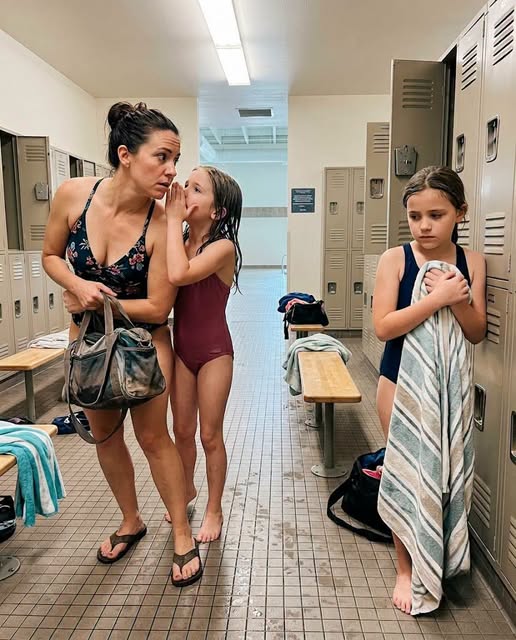
My sister asked me to watch my niece for the weekend, so I took her to the community pool. Inside the locker room, my daughter whispered, “Mom… look at Lily.”

The sharp smell of chlorine still hung in the air, and water squeaked under our sandals as kids moved in and out of the changing area. Lily stood beside the bench holding her towel against herself in a way I hadn’t noticed before.
I stepped closer and gently adjusted the strap of her swimsuit near her shoulder. Something about the way she immediately tried to cover herself made me stop.
“Did your mom do something?” I asked quietly.
Lily’s eyes dropped.
“Turn around,” she whispered.
I did.
A few seconds later, her small voice came from behind me. “Can you help me change?”
There was nothing unusual about a kid asking an adult for help after swimming. But Lily sounded different. Careful. Like she was trying to decide which words were safe to say.
When I turned back, she tugged at the swimsuit again and whispered, “Mom… look.”
I didn’t press her.
I didn’t want to frighten her or put words in her mouth. I only asked if she wanted help getting dressed, and she nodded.
Emma suddenly grabbed my hand.
“Is something wrong with Lily?”
“No,” I said immediately. “Lily didn’t do anything wrong.”
That mattered.
I crouched so Lily could see my face without feeling like I was standing over her. “You’re safe with me. We’re just going to let a doctor make sure everything is okay.”
She gave me the smallest nod.
But the fear never left her eyes.
I helped both girls get dressed, gathered the wet towels and swim bags, and walked out of the recreation center as calmly as I could. I didn’t rush them. I didn’t start asking questions in the parking lot. I didn’t want Lily to feel as though she had caused an emergency.
Only after all three of us were inside my locked SUV did I realize my hands were shaking.
I started driving toward the children’s hospital.
Emma sat beside Lily in the back seat. Neither girl spoke much. I kept both hands on the wheel and tried to focus on traffic instead of replaying every second in the locker room.
Then my phone vibrated against the center console.
Sarah’s name appeared on the screen.
My sister.
Lily’s mother.
A message followed.
“Turn around. Now.”
I stared at those three words at the next stoplight.
Sarah hadn’t asked where we were going.
She hadn’t asked whether Lily was okay.
She hadn’t asked why I had suddenly left the pool.
She had simply ordered me to come back.
That changed something.
Not because the message proved what had happened. It didn’t.
But it told me Sarah understood there was something I might discover.
I thought about Lily’s careful voice. The way she had hidden herself without being asked. The way she seemed relieved when I said she hadn’t done anything wrong.
Then I looked at Sarah’s message again.
“Turn around. Now.”
Every instinct in me said the same thing: whatever was happening, Lily needed a safe adult and a proper medical check before anybody tried to explain it away.
The light turned green.
I placed the phone facedown on the console and kept driving toward the children’s hospital..
PART 2: THE MOMENT LILY BEGGED ME NOT TO TAKE HER HOME
By the time I pulled into the children’s hospital parking garage, Sarah had called eleven times.
I did not answer once.
The final message arrived as I was helping Emma unbuckle her seat belt.
You are making a huge mistake.
I stared at those words for several seconds.
Then another message appeared.
Lily is fine. Bring her back before you make this worse.
Not:
Is she scared?
Not:
What happened?
Not even:
Please call me.
Lily is fine.
A conclusion.
Already prepared.
I locked my phone and slipped it into my coat pocket.
Then I turned toward the back seat.
Emma was watching me carefully.
She was eight years old.
Old enough to notice tension.
Too young to be asked to carry any of it.
“Are we in trouble?”
she whispered.
My heart tightened.
“No.”
I crouched beside her.
“You didn’t do anything wrong.”
Her eyes moved toward Lily.
“Did Lily?”
“No.”
I said it immediately.
“Especially not Lily.”
That mattered.
Lily sat on the other side of the car with the pink towel folded across her lap.
She had changed into dry clothes at the pool.
Still, she held her arms tightly against herself as though the cold had followed her inside.
I reached toward her.
Then stopped before touching her.
“Can I hold your hand?”
She nodded.
Her fingers were small and damp against mine.
We walked into the emergency department together.
Two girls.
One frightened aunt.
And a question I was trying very hard not to answer before professionals had actually looked.
The waiting room smelled like disinfectant and stale coffee.
A television played quietly in one corner.
A toddler cried near the vending machines.
Life continued with almost insulting normality.
At check-in, the nurse asked why we were there.
I kept my words simple.
“My niece has some marks I’m concerned about.”
The nurse looked at Lily.
Then at me.
“Do you know how they happened?”
“No.”
That was the truth.
“I noticed them while helping her change after swimming.”
The nurse’s expression became more serious.
“Is her parent here?”
“Her mother is my sister.”
“Does she know you brought Lily?”
“Yes.”
“What did she say?”
I hesitated.
Then handed over my phone.
The nurse read Sarah’s messages.
Her face did not change dramatically.
Professionals learn not to react too quickly.
She handed the phone back.
“Okay.”
Then she crouched beside Lily.
“Hi, sweetheart. I’m Nina.”
Lily looked down.
“My job is to help kids feel better.”
No response.
Nina smiled gently.
“Would you rather walk or have your aunt carry you?”
Lily immediately grabbed my hand.
“Walk.”
“Perfect.”
No pressure.
No interrogation.
Just choices.
We were taken to a private room faster than I expected.
That frightened me more than waiting would have.
Emma sat in a chair with a coloring book a receptionist found for her.
Lily climbed onto the examination bed.
Her sneakers did not reach the floor.
I sat beside her.
A pediatrician came in fifteen minutes later.
Dr. Priya Patel.
Dark hair pulled into a loose bun.
Soft voice.
Eyes that missed nothing.
She spoke to me first.
Then to Lily.
Not over her.
To her.
“Lily, your aunt told us she noticed something while helping you change.”
Lily’s fingers tightened around the edge of the paper sheet beneath her.
Dr. Patel continued.
“You don’t have to tell me anything you don’t want to tell me right now.”
“I’m going to make sure your body is okay.”
“If something hurts, you can tell me.”
“If you want me to stop, you can say stop.”
Lily looked at me.
I nodded.
“You’re okay.”
She whispered,
“Can Auntie stay?”
Dr. Patel smiled.
“If that’s what you want.”
“Yes.”
Emma looked up from her coloring book.
“What about me?”
I nearly laughed from sheer nerves.
Dr. Patel smiled at her.
“We’re going to have another grown-up sit with you right outside for a few minutes.”
Emma immediately frowned.
“I’m not a baby.”
“Excellent.”
Dr. Patel nodded seriously.
“Then you can help choose whether you want crayons or markers.”
Emma considered that.
“Markers.”
Naturally.
A child-life specialist took her just outside.
The door remained partly open.
Then Dr. Patel examined Lily.
I will not describe every detail.
Some things belong to children, not stories.
What mattered was this:
The doctor became quieter as she looked.
There were bruises.
More than one.
Some faded.
Some newer.
Marks in places that did not fit easily with ordinary playground falls.
Nothing about Lily’s body announced one simple explanation.
But enough looked concerning that Dr. Patel stopped and asked a nurse to join us.
My stomach dropped.
Lily stared at the ceiling.
I held her hand.
Dr. Patel said gently,
“Lily, do you know how this bruise happened?”
Lily did not answer.
The doctor waited.
No pressure.
No repeated question.
Then Lily whispered,
“I fall.”
Dr. Patel nodded.
“Kids fall a lot.”
She moved on.
A few minutes later:
“Do you know how this one happened?”
Lily’s lower lip trembled.
“Bathroom.”
“What happened in the bathroom?”
Silence.
Dr. Patel stopped.
“That’s okay.”
She did not ask again.
I wanted to.
Every instinct in me wanted to say:
Who did this?
Was it Sarah?
Was it someone else?
Tell me.
Please.
But I didn’t.
Because Lily was not evidence.
She was a little girl.
And the most important thing I could do was stop making her responsible for my need to understand quickly.
When the examination ended, Dr. Patel covered Lily with a warm hospital blanket.
Then she asked me to step into the hallway.
My legs felt weak.
Emma was sitting with the child-life specialist, drawing what appeared to be a purple cat with six legs.
Lily stayed with the nurse.
Dr. Patel closed the door behind us.
“I’m concerned.”
Three words.
That was all it took.
My throat tightened.
“What does that mean?”
“It means there are injuries that need further evaluation.”
Her voice remained measured.
“Some bruising is common in children.”
“Knees.”
“Shins.”
“Foreheads.”
“Kids run into things.”
I nodded.
“But some of what I observed is in locations we pay closer attention to.”
My stomach turned.
“Do you think someone hurt her?”
“I think we have enough concern that we need to involve our child-protection team.”
I closed my eyes.
There it was.
Real.
Not proof of who.
Not proof of why.
But real enough that a doctor was not sending us home with ice and reassurance.
“What happens now?”
“A specialized pediatric clinician may examine her.”
“A social worker will speak with you.”
“And because Lily is a minor and the findings are concerning, a report will be made to child protective services.”
My breath caught.
Dr. Patel touched my elbow.
“You did the right thing bringing her in.”
That sentence almost broke me.
Not because I needed praise.
Because somewhere in the back of my mind, Sarah’s messages were still whispering.
You are making this worse.
Maybe I had overreacted.
Maybe I had misunderstood.
Maybe I had just changed my sister’s life because a child bruised easily.
Dr. Patel must have seen something on my face.
She continued.
“Reporting concern is not the same as deciding what happened.”
I opened my eyes.
That helped.
“Your job was not to solve it.”
“You noticed something concerning.”
“You brought her somewhere appropriate.”
“Now we let the process do its job.”
I nodded.
Then my phone rang.
Sarah.
Again.
I declined it.
Immediately, a message appeared.
I’m at the hospital.
My blood went cold.
I looked toward the waiting area.
“Dr. Patel.”
“Yes?”
“Her mother is here.”
The doctor’s expression became careful.
“Okay.”
Then Lily screamed.
Not loudly.
Not like a child in pain.
A sharp little sound from inside the room.
I turned immediately.
The nurse opened the door.
Lily was sitting upright on the bed.
Her face had gone white.
“She heard someone in the hallway.”
The nurse said.
Then Sarah’s voice carried from the front desk.
“I am her mother!”
Lily grabbed the blanket.
Her entire body changed.
Not crying.
Not speaking.
Just shrinking.
I went to her.
“Lily.”
She grabbed my coat with both hands.
“Don’t.”
My heart stopped.
“Don’t what?”
Her eyes were huge.
“Don’t make me go home.”
The room inside me went silent.
I crouched beside the bed.
“You’re not going anywhere right now.”
She started crying.
Quiet.
Almost soundless.
The kind of crying children learn when being loud has consequences.
I looked at Dr. Patel.
Her face had changed too.
That sentence mattered.
Not proof of every suspicion.
But important.
Very important.
Sarah’s voice came closer.
“Where is she?”
Security intercepted her before she reached the pediatric rooms.
I could hear her arguing.
Then:
“My sister took my child without permission!”
That accusation hit me hard.
I stood.
Dr. Patel stopped me gently.
“Stay with Lily.”
“But she’s telling them—”
“Hospital security can handle the hallway.”
I looked at Lily.
She was holding my sleeve.
Dr. Patel was right.
The family habit would have been to run toward the loudest adult.
Explain.
Defend.
Manage.
This time, the quiet child mattered more.
So I stayed.
Twenty minutes later, a hospital social worker came in.
Her name was Marisol Vega.
She introduced herself to Lily.
Then to me.
She never called it an investigation.
She said,
“I help families when doctors have safety concerns.”
Lily watched her.
Marisol pulled a chair near the bed.
Not too close.
“Lily, I’m going to ask Auntie some questions first.”
“You can color if you want.”
Lily shook her head.
She wanted to listen.
So Marisol asked me what happened.
I told her.
The pool.
The locker room.
Lily asking me to turn around.
The marks.
Sarah’s message.
The drive.
I stuck to exactly what I knew.
No theories.
No childhood grievances against my sister.
No:
Sarah has always been selfish.
No:
I knew something was wrong with her boyfriend.
Just facts.
Marisol asked,
“Who lives in Lily’s home?”
“Sarah.”
“Lily.”
“And Sarah’s boyfriend, Evan Brooks.”
“How long has he lived there?”
“About eight months, I think.”
“Does Lily have contact with her father?”
“Yes.”
“Her father, Thomas, lives in Pennsylvania.”
“He has her some school breaks.”
“Was he aware she was with you this weekend?”
“I don’t know.”
“Sarah asked me to babysit.”
Marisol nodded.
Then:
“Has Lily ever disclosed anyone hurting her before?”
“No.”
I stopped.
Then remembered something.
“Not directly.”
“What do you mean?”
“A month ago, Lily said she didn’t like bath time anymore.”
Marisol waited.
I swallowed.
“Sarah said Lily had become difficult about routines.”
“And I…”
My voice cracked.
“I believed her.”
Marisol’s expression stayed gentle.
“That doesn’t mean you missed something obvious.”
I nodded.
Still, guilt had already entered.
Every strange comment.
Every quiet moment.
Every time Lily clung to me when Sarah came to pick her up.
Memories become dangerous after revelation.
You start forcing new meaning onto every old moment.
Marisol seemed to understand.
“Try not to reconstruct everything today.”
“Let the professionals gather information.”
Another version of:
You do not have to solve it.
I needed that sentence repeatedly.
Then she spoke with Lily.
Not a forensic interview.
Just enough to assess immediate safety.
I stayed silent unless Marisol asked me something.
“Lily, who helps you when you’re scared at home?”
Lily looked at me.
Then down.
“Auntie.”
My eyes burned.
Marisol continued.
“Who lives with you?”
“Mommy.”
“And?”
Lily’s face changed.
“Evan.”
“What happens when Evan gets upset?”
Silence.
Marisol waited.
Lily whispered,
“Mom says I have to be good.”
“What does being good mean?”
Another silence.
“Not crying.”
My throat tightened.
Marisol’s voice stayed steady.
“Anything else?”
“Not waking Mommy.”
“What happens if you wake Mommy?”
Lily’s mouth trembled.
“Evan gets mad.”
I wanted to close my eyes.
I didn’t.
I wanted Lily to see one adult who was not afraid to hear her.
Marisol asked,
“What does Evan do when he gets mad?”
Lily pulled the blanket toward her chin.
Then whispered,
“He grabs.”
That was all.
Marisol did not ask where.
Did not push.
“Okay.”
Then Lily added on her own,
“Mom says he doesn’t mean it.”
My heart cracked.
Marisol nodded slowly.
“Okay.”
Lily continued.
“He says sorry after.”
A pause.
“Mom says I make him tired.”
I covered my mouth.
Not to hide a smile this time.
To keep myself from making a sound.
There are sentences no child should know how to carry.
I make him tired.
As though a three-year-old were responsible for an adult’s temper.
Marisol asked one more question.
“When you have a bruise, what does Mommy say?”
Lily froze.
Long enough that I saw the answer scare her.
Then:
“Long shirts.”
The room went completely still.
My body became cold from the inside.
Marisol did not react dramatically.
“Mommy tells you to wear long shirts?”
A tiny nod.
“Why?”
Lily whispered,
“So people don’t ask.”
That was when I understood Sarah’s message.
Turn around.
Now.
She had not been afraid I would upset Lily.
She had been afraid someone would ask.
A knock sounded at the door.
Another social worker stepped in and whispered something to Marisol.
Marisol nodded.
Then looked at me.
“Sarah is demanding to see Lily.”
Lily immediately grabbed my arm.
“No.”
Marisol looked at her.
“You don’t want Mommy to come in?”
Lily shook her head violently.
“No.”
“Okay.”
Marisol said it calmly.
Not forever.
Not a custody ruling.
Just:
Okay.
For now, the adults could absorb discomfort.
Sarah did not need immediate access simply because she was the loudest person in the building.
A police officer came next.
Not to interrogate Lily.
To speak with me and Sarah separately about the circumstances.
Sarah had told security I kidnapped Lily.
That collapsed quickly.
Her own texts from Friday showed she had asked me to watch Lily for the entire weekend.
I still had them.
Can you take Lily Friday through Sunday? Evan and I need a break.
I had responded:
Of course. Emma will love it.
Sarah:
You’re saving my life.
Forty-eight hours later, apparently I was a kidnapper.
The officer read the messages.
Then said,
“This part is clear enough.”
I nearly laughed.
At least one thing was.
Sarah was allowed to speak with the hospital team separately.
I did not hear most of that conversation.
Later, Dr. Patel told me Sarah had offered several explanations.
Lily fell off playground equipment.
She bruised easily.
She had bumped against a dresser.
Evan sometimes played too roughly.
Sarah had not known about some of the marks.
Each sentence, by itself, could have been possible.
Together, they were being documented.
Not judged by me.
Documented.
That distinction kept me from losing control.
At around eight that night, Sarah finally got close enough to me that security allowed us to speak in a consultation room.
No Lily.
No Emma.
A hospital staff member remained nearby.
My sister looked terrible.
Mascara smeared.
Hair half out of its clip.
Coat hanging open.
For one painful second, I wanted to hug her.
That surprised me.
She was my little sister.
The girl who used to crawl into my bed during thunderstorms.
The teenager who called me crying after her first breakup.
The woman whose hand I held when Lily was born.
Love does not disappear simply because fear enters the room.
It becomes more complicated.
Sarah stared at me.
“What have you done?”
I almost laughed.
Not because anything was funny.
Because even now, the sentence was about me.
“I brought Lily to a doctor.”
“You called CPS.”
“The hospital did.”
“Because of you.”
“Because of what the doctor saw.”
Sarah’s face tightened.
“She bruises easily.”
“I hope that’s the explanation.”
That stopped her.
Maybe she expected accusation.
Instead I said,
“I genuinely hope every concern has an innocent explanation.”
She stared.
“Then take her home.”
“No.”
Her face hardened.
“She is my daughter.”
“Yes.”
“Not yours.”
“I know.”
“Then stop acting like you know what’s best for her.”
I looked at my sister.
“I know she asked me not to take her home.”
Sarah went still.
Everything changed.
Not dramatically.
Just the smallest tightening around her mouth.
I saw it.
“Why would she say that?”
Sarah asked.
Too quickly.
I did not answer.
She continued.
“She’s three.”
“She says things.”
My chest tightened.
“She said Evan grabs her when he’s angry.”
Sarah looked away.
There.
Tiny.
Enough.
“Does he?”
Silence.
“Sarah.”
“He gets frustrated.”
My stomach turned.
“With a three-year-old?”
“You don’t understand.”
“Then explain.”
She started crying.
“You have one child.”
“What does that have to do with anything?”
“You have Emma.”
“You have your husband.”
“You have help.”
“Evan works all day.”
“I work.”
“Lily doesn’t sleep.”
“She screams.”
“She throws tantrums.”
I stared.
“You are describing a three-year-old.”
Sarah wiped her face angrily.
“You always do this.”
“Do what?”
“Make everything sound simple because you’re not living it.”
I felt anger rise.
Then forced it back down.
This was not about winning against Sarah.
I asked,
“Has Evan hurt her?”
Sarah cried.
“He never means to.”
There it was.
Not no.
My hands went cold.
“Has he hurt Lily?”
Sarah closed her eyes.
“Once.”
My stomach dropped.
“Once?”
“He grabbed her too hard.”
“When?”
“A few months ago.”
“What happened?”
“She had a bruise.”
“Where?”
Sarah looked at me.
Then realized what she had admitted.
My voice became quiet.
“Did you take her to a doctor?”
“No.”
“Why?”
“Because she was fine.”
“Did you tell Evan to leave?”
“He apologized.”
I stared.
The room suddenly felt too small.
“You let him stay.”
Sarah’s face crumpled.
“He promised.”
“Sarah.”
“He promised.”
Her voice rose.
“He cried.”
“He felt terrible.”
“And then?”
Silence.
My heart broke.
“And then it happened again.”
She looked down.
That was answer enough.
I whispered,
“Oh my God.”
“Don’t.”
She pointed at me.
“Do not look at me like that.”
“Like what?”
“Like I’m a monster.”
I looked at my sister.
She was crying so hard her shoulders shook.
And the terrible truth was—
I did not see a monster.
I saw someone who had made increasingly unforgivable choices because admitting the first one would have blown up the life she wanted to keep.
That was somehow worse.
Monsters are easy.
Sisters are not.
I asked,
“Why did you keep sending Lily back into the same room with him?”
Sarah whispered,
“I thought I could control it.”
My throat tightened.
“How?”
“I stopped leaving them alone.”
“I made rules.”
“I told Evan he could never discipline her.”
“I watched.”
I stared.
“You watched?”
Her face changed.
She realized how that sounded.
“No.”
“I mean—”
“You knew enough to supervise him around your own daughter.”
She started sobbing.
“I thought if I managed it, we could fix things.”
I closed my eyes.
There it was.
The adult desire to preserve a relationship placed above a child’s right not to need management around danger.
I whispered,
“And the long shirts?”
Sarah froze.
I looked at her.
“Lily told the social worker you tell her to wear long shirts so people won’t ask.”
Sarah covered her face.
For several seconds, neither of us spoke.
Then she whispered,
“I was afraid.”
“Of CPS?”
“Yes.”
“Of losing Lily?”
“Yes.”
My voice broke.
“Then why didn’t you get rid of the person hurting her?”
Sarah sobbed.
“I don’t know.”
I stared.
“No.”
“That’s not enough.”
“I know.”
She looked at me.
“He kept saying he was getting help.”
“He said I was overreacting.”
“Then he’d be wonderful for weeks.”
“He’d make breakfast.”
“He’d take us to the zoo.”
“He’d buy Lily toys.”
“He’d apologize.”
“And every time something happened, I thought…”
She stopped.
“What?”
“Maybe this was the last time.”
My eyes filled.
I hated how human the explanation sounded.
Cycles do not become harmless because they contain good mornings.
I said,
“You should have told me.”
“You would have made me leave him.”
“Yes.”
“That’s why I didn’t.”
There.
Another truth.
She knew.
She knew what a safe adult would say.
So she avoided the safe adult.
That hurt more than I expected.
I whispered,
“You asked me to watch Lily this weekend.”
Sarah nodded.
“Why?”
No answer.
“Did something happen before you brought her?”
Sarah looked away.
My stomach dropped.
“What happened?”
“Nothing serious.”
My entire body went cold.
“Sarah.”
“She spilled juice.”
I stared.
My sister started crying again.
“Evan lost his temper.”
The room disappeared around me.
I did not ask for details.
I did not need them.
Not there.
Not from Sarah.
“Is that why you sent her to me?”
Sarah whispered,
“I needed time to calm him down.”
I stood.
I could not sit anymore.
“You sent Lily to my house so you could calm down the adult who scared her.”
Sarah cried.
“I was trying to protect her.”
I turned toward her.
“No.”
The word came out quietly.
“You removed her from danger for a weekend.”
“That is not the same as protecting her.”
Sarah covered her mouth.
I continued.
“And then when I noticed something, you told me to turn around.”
She cried harder.
“Because I panicked.”
“I know.”
“I thought if you brought her back, I could explain.”
“To who?”
“To you.”
“And then what?”
Silence.
“Would Evan still be there?”
Sarah did not answer.
That was the moment something inside me changed.
I loved my sister.
I did.
But love could no longer make me pretend uncertainty existed where her own answers had removed it.
I said,
“You need a lawyer.”
Her head snapped up.
“What?”
“You need to cooperate.”
“You need to tell the truth.”
“All of it.”
She stared.
“Are you taking my child?”
“No.”
I shook my head.
“This is not about what I want.”
“But if Lily cannot safely go home tonight, I will take care of her.”
Sarah cried.
“You always wanted to prove you were a better mother.”
That sentence was designed to hurt.
Years ago, it might have worked.
I looked at her.
“No.”
“I wanted to be your sister.”
“You made me become the adult Lily was afraid to lose.”
Sarah looked down.
She had no answer.
When I returned to Lily’s room, she was asleep.
Emma had curled into a chair beside the bed beneath a hospital blanket.
My daughter woke when I entered.
“Mom?”
“Yes?”
“Is Aunt Sarah mad?”
My throat tightened.
“She’s upset.”
“Because of us?”
“No.”
I sat beside her.
“This is grown-up stuff.”
She looked toward Lily.
“Can Lily come home with us?”
“I don’t know yet.”
Emma nodded.
Then whispered,
“I think she should.”
I touched her hair.
“Why?”
Emma looked embarrassed.
“At sleepovers, she always asks if my bedroom door locks.”
My stomach dropped.
“What?”
Emma immediately became worried.
“Was I supposed to tell you?”
“No.”
I grabbed her hand.
“No, sweetheart.”
“You did nothing wrong.”
Again.
Those words.
I seemed to be saying them all night.
Because children absorb blame faster than adults realize.
Emma continued.
“She said she likes our house because nobody gets mad when she gets out of bed.”
My eyes filled.
I kissed her forehead.
“Thank you for telling me.”
A child-protection investigator arrived before midnight.
Her name was Denise Holloway.
She spoke with the hospital team.
Sarah.
Me.
Not Lily in depth.
That would happen later with appropriately trained professionals if necessary.
For that night, the question was immediate safety.
Could Lily go home?
The answer was no.
At least not to Sarah’s home while Evan remained there and the allegations were being assessed.
Sarah was offered a safety plan.
Evan could leave.
Lily could potentially remain with Sarah under defined conditions, depending on the agency’s assessment.
Sarah hesitated.
That hesitation cost her.
Not legally by itself.
Emotionally.
I watched it happen.
Denise asked,
“Can Mr. Brooks leave the residence tonight?”
Sarah stared at the floor.
“He doesn’t have anywhere to go.”
I stopped breathing.
Denise’s expression did not change.
“Your daughter may not have somewhere safe to return tonight.”
Sarah looked up.
I saw the moment the comparison reached her.
Evan’s inconvenience.
Lily’s safety.
She started crying.
“He can leave.”
Good.
Late.
Still good.
But because Sarah had admitted previous incidents and concealment, Denise was not comfortable sending Lily home immediately.
A temporary safety arrangement was made.
Lily would stay with me while the agency assessed the home and created next steps.
Not permanent custody.
Not adoption.
Not some instant courtroom fantasy.
A temporary placement with family.
Sarah signed reluctantly.
Her hand shook.
I watched from across the room.
I felt no victory.
Only grief.
Because no decent person dreams of receiving a child this way.
At 1:38 in the morning, Lily woke.
Dr. Patel had cleared her medically for discharge with follow-up.
She looked confused.
“Are we going home?”
I crouched.
“You’re coming to my house.”
Her eyes widened.
“With Emma?”
“Yes.”
A pause.
“Mommy?”
My throat tightened.
“Mommy knows where you’ll be.”
That answer was enough for the moment.
Lily wrapped both arms around my neck.
Then whispered,
“Can I sleep in Emma’s room?”
“Yes.”
“Door open?”
“Whatever you want.”
She nodded.
“Open.”
We left the hospital just after two.
Sarah watched from the hallway.
She did not approach.
Maybe staff told her not to.
Maybe she finally understood Lily needed one departure that did not require managing her mother’s feelings.
Outside, the night air was cold.
Emma held Lily’s hand.
I carried both girls’ bags.
For a few seconds, the three of us stood beneath the hospital lights.
Then Lily looked at me.
“Are you mad?”
My heart broke.
“At you?”
She nodded.
“No.”
“Never for telling someone you’re scared.”
Her lip trembled.
“Mom says I tell stories.”
I crouched.
“What you remember matters.”
I chose the words carefully.
“And grown-ups are going to help figure out what happened.”
She nodded.
Then got into the car.
I drove home.
No music.
No phone.
Just the soft sound of two children breathing in the back seat.
The next morning, Lily woke before six.
She stood beside my bed.
I opened my eyes.
She whispered,
“I spilled water.”
I sat up.
“What?”
“In Emma’s room.”
She looked terrified.
“I’m sorry.”
I got out of bed.
Walked with her upstairs.
A plastic cup had tipped beside the bed.
Maybe four ounces of water across the hardwood floor.
Lily stood in the doorway.
Waiting.
I grabbed a towel.
Wiped it up.
Then said,
“There.”
She stared at me.
“That’s it?”
I looked at her.
“What else?”
Her eyes filled.
Nothing needed to be said.
I understood.
And I hated Evan for one second so intensely that it frightened me.
Then I forced that hatred somewhere Lily could not see.
“It was an accident.”
I smiled.
“We clean accidents.”
“That’s all.”
Lily started crying.
Not loudly.
She ran into me.
I held her.
And suddenly I understood something I would remember for the rest of my life.
Safety is sometimes so ordinary that a frightened child does not recognize it at first.
A spilled cup.
A towel.
No shouting.
No grabbing.
No punishment.
Just water drying on a floor.
Later that morning, Denise called.
Her voice was serious.
“We found something in the agency history.”
My stomach tightened.
“What?”
“There was a prior report involving Lily.”
I sat down.
“When?”
“Approximately six months ago.”
My mouth went dry.
“What kind of report?”
“I can’t disclose every detail over the phone yet.”
“But it involved concerns about unexplained bruising and harsh discipline.”
I closed my eyes.
“Who reported it?”
“That information may be protected.”
“Okay.”
My mind raced.
Preschool.
Neighbor.
Doctor.
Someone had noticed.
Someone before me.
I whispered,
“What happened?”
“The initial assessment did not result in removal.”
“That does not mean the concerns were necessarily disproven.”
“There were conflicting explanations.”
“Limited corroboration.”
“And Lily was younger.”
My chest tightened.
“Did anyone call family?”
Denise hesitated.
“That’s why I’m calling.”
I stopped breathing.
“What?”
“Sarah listed you as a possible collateral family contact.”
“Yes.”
“But the phone number in the file does not match the number you gave us yesterday.”
My body went cold.
“What number did she give?”
Denise read it.
My number.
Almost.
One digit wrong.
Just one.
I stared at the wall.
“That could be a mistake.”
“It could.”
Good.
Careful.
Always careful.
“But there’s more.”
I closed my eyes.
Of course there was.
“The prior worker documented that she asked Sarah twice to provide an updated number because the first contact attempt failed.”
My hand tightened around the phone.
“What did Sarah say?”
Denise paused.
Then read from the note.
Mother states sister is traveling extensively for work and is unavailable. Requests that agency not involve extended family because it will create unnecessary drama.
The room went silent around me.
Six months ago.
Sarah had been asked for me.
Not socially.
Not for babysitting.
Because someone was worried about Lily.
And my sister had kept me away.
Not because I was unavailable.
Because she knew exactly what would happen if I saw enough to ask questions.
I whispered,
“I wasn’t traveling.”
“I understand.”
“I was thirty minutes away.”
“I understand.”
“She saw me that week.”
Denise remained quiet.
I remembered it.
A Sunday lunch.
Lily wore a cardigan even though the weather had been warm.
Sarah joked that Lily was going through a phase where she refused short sleeves.
My stomach turned.
A memory I had laughed at.
An explanation I had accepted.
I covered my mouth.
Denise said gently,
“Please don’t start blaming yourself.”
I shut my eyes.
“I’m trying not to.”
“We’re going to review the prior file in light of the current concerns.”
“Okay.”
“There may also be records from a pediatric urgent-care visit referenced in the old assessment.”
My pulse slowed.
“What urgent-care visit?”
Another pause.
“Sarah reportedly took Lily in for an injury four days before that prior report.”
I could barely speak.
“What injury?”
“I’d rather let the medical team and investigator review it before describing conclusions.”
Good.
Facts.
Still—
my skin had gone cold.
Then Denise said one last thing.
“And there’s a note indicating the worker asked whether there was another safe adult Lily frequently stayed with.”
My throat tightened.
“What did Sarah say?”
Denise read:
Mother reports child has no consistent caregiver outside the home.
I stopped breathing.
No consistent caregiver.
I had watched Lily at least twice a month since she was born.
Birthdays.
Weekends.
Doctor appointments when Sarah worked.
Preschool pickup.
Christmas mornings.
I was not perfect.
But I had been there.
Consistently.
Sarah had erased me from the safety map.
On purpose or out of fear, I did not yet know.
But she had done it.
I looked toward the living room.
Lily and Emma were sitting cross-legged on the carpet building a tower from wooden blocks.
Emma placed one crooked piece on top.
Lily laughed.
A real laugh.
Bright.
Loose.
For one beautiful second, she looked exactly three.
Denise asked,
“Are you still there?”
“Yes.”
My voice broke.
“I’m here.”
Those words stopped me.
I’m here.
That was all Lily had needed from me.
Not an investigator.
Not a savior.
Not someone who already knew the answer.
A safe adult willing to stay long enough for the truth to be heard by people trained to hear it.
I ended the call.
Then Sarah sent me a message.
One sentence.
Please don’t let them use the old report against me.
I stared at it.
She knew.
Of course she knew.
My hands stopped shaking.
For the first time since the locker room, I felt something colder than fear.
Clarity.
The old report.
The wrong phone number.
The long sleeves.
The urgent-care visit.
Sarah asking me to take Lily immediately after Evan “lost his temper.”
None of those things alone told the entire story.
But together, they told me one thing with painful certainty.
My sister had not been surprised when I drove Lily toward the hospital.
She had been terrified that this time—
I would keep driving far enough for someone outside the family to finally see what she had spent months trying to keep covered.
And as Lily laughed beside Emma in my living room, I understood the real meaning of Sarah’s first message.
Turn around. Now.
She had not been asking me to bring Lily home.
She had been asking me to return to the version of our family where everyone looked away.
This time, I didn’t.
PART 3: THE DAY LILY FINALLY STOPPED ASKING IF SHE WAS IN TROUBLE
The old report changed everything.
Not because it proved every fear in one neat page.
It didn’t.
Real life is rarely kind enough to hand you one document labeled:
Here is the whole truth.
Instead, it gave us fragments.
Dates.
Clinic notes.
A preschool observation.
A failed phone call.
A mother who had been asked to provide a safe relative and had quietly made sure that relative could not be reached.
And a little girl who had learned, long before I understood why, that long sleeves could keep adults from asking questions.
By Monday morning, child protective services had formally reopened the earlier concerns alongside the new hospital report.
Lily was still staying with me.
Emma had moved her collection of stuffed animals to one side of her room so Lily could choose which ones she wanted near the bed.
That first night, Lily chose three.
The second night, five.
By the fourth, she had created what Emma called “the wall.”
A rabbit.
A fox.
A faded bear.
Two unicorns.
A stuffed dog missing one ear.
All lined along the edge of the mattress between Lily and the bedroom door.
I noticed.
I did not ask.
Not everything children do needs interpretation out loud.
Sometimes safety begins when adults stop demanding explanations for every protective habit.
Sarah called repeatedly at first.
Then, after her attorney got involved, the calls stopped.
Messages replaced them.
Short.
Careful.
No accusations.
No demands.
That alone told me someone had explained the seriousness of what was happening.
One message said:
Please tell Lily I love her.
I stared at it for a long time.
Then I asked the caseworker what was appropriate.
That had become my rule.
Not what did I want?
What was safe?
What was allowed?
What put Lily first?
The answer was simple.
I could tell her.
So that night, while Lily was coloring at the kitchen table, I said,
“Your mom asked me to tell you she loves you.”
Her crayon stopped.
She did not look up.
“Okay.”
Nothing else.
No tears.
No smile.
Just okay.
I left it there.
The old version of me would have tried to fix the silence.
“She misses you.”
“She’s sorry.”
“She loves you very much.”
Anything to make the moment feel less painful.
I did not.
Love should never be forced into a child’s mouth as an answer they are expected to give back.
Two days later, Denise Holloway called.
“Your sister has given consent for us to contact Lily’s father.”
My stomach tightened.
Thomas.
I had not seen him in almost a year.
Sarah and Thomas had divorced when Lily was eighteen months old.
Their marriage had ended badly.
Not violently, as far as I knew.
Just bitterly.
Arguments.
Money.
Custody.
Two people who had once loved each other becoming experts in each other’s worst qualities.
Thomas moved to Pennsylvania for work.
He had regular contact with Lily, but geography made it uneven.
Summer weeks.
Some holidays.
Video calls.
I had always accepted Sarah’s version that Thomas was “more interested in looking like a father than being one.”
Now I was much less comfortable accepting anyone’s version without checking.
Denise said,
“He’s driving in today.”
“Does Lily know?”
“Not yet.”
“Should I tell her?”
“Yes.”
“Keep it simple.”
So I did.
That afternoon, I sat beside Lily on the couch.
“Your dad is coming to see you.”
She froze.
Then looked at me.
“Daddy?”
“Yes.”
“Today?”
“Yes.”
Her face changed in a way I had not expected.
Relief.
Not fear.
Not confusion.
Relief.
She threw both arms around my neck.
“Can I stay with you too?”
My throat tightened.
“You don’t have to choose anybody today.”
Her grip loosened.
I continued.
“Grown-ups are figuring out what happens next.”
“You’re safe here right now.”
She nodded.
Then asked the question she asked almost every day.
“Am I in trouble?”
“No.”
Immediate.
Always immediate.
“You are not in trouble.”
She stared into my face for confirmation.
Then nodded.
Thomas arrived just before five.
He looked older than I remembered.
Not dramatically.
Tired around the eyes.
Unshaven.
He stood in my entryway holding a duffel bag and looking like a man terrified to step into the wrong room.
“Hi.”
“Hi.”
He glanced behind me.
“Is she okay?”
The question nearly undid me.
Is she okay?
Not:
What did Sarah do?
Not:
Can I take her?
Not:
Who is responsible?
“Physically, she’s okay.”
His face collapsed slightly.
“And otherwise?”
I shook my head.
“I don’t know yet.”
He closed his eyes.
Then nodded.
“Okay.”
That was when Lily saw him.
“Daddy!”
She ran.
Thomas dropped the bag.
Dropped to his knees.
Caught her.
The sound he made when he held her was not quite a sob.
Not quite a laugh.
Something caught between both.
He pressed his face into her hair.
“Hi, bug.”
Lily wrapped herself around him.
For several minutes, nobody said anything.
Emma stood in the hallway watching.
I moved beside her.
She whispered,
“Is he nice?”
I looked at Thomas.
Then back at my daughter.
“I think he loves Lily.”
Emma considered that.
Then nodded.
“Good.”
That evening, Denise and another caseworker met with Thomas separately.
I did not sit in.
Not my conversation.
That boundary was becoming important.
For days, I had been absorbing information simply because I happened to be the adult Lily trusted enough to come home with.
But being safe did not mean being entitled to every detail.
When Thomas came out of the room, his eyes were red.
He looked at me.
“Why didn’t anyone call me six months ago?”
My stomach tightened.
I knew enough to answer carefully.
“There was an earlier report.”
“I know.”
His jaw trembled.
“They told me.”
“I didn’t know about it either.”
He stared.
“Sarah had my number.”
I said nothing.
“She told them I was difficult to reach.”
His voice cracked.
“I wasn’t.”
I believed him.
He continued.
“I called Lily every Sunday.”
“I had her for two weeks in July.”
“How does that become difficult to reach?”
I had no answer.
Then Thomas looked toward the living room.
Lily was playing with Emma.
“She told me she hated coming back.”
My chest tightened.
“When?”
“After summer.”
He wiped his face.
“I thought it was normal.”
“A kid wanting vacation to continue.”
“She said Evan got mad a lot.”
I went cold.
“What did you do?”
Thomas looked ashamed.
“I asked Sarah.”
“And?”
“She said Lily was being dramatic because she didn’t like rules.”
He closed his eyes.
“I believed her.”
There it was.
Another adult.
Another warning softened into something manageable.
He whispered,
“I should have kept asking.”
I understood that guilt.
I also knew how useless it could become if left alone.
“You know now.”
He looked at me.
“Is that supposed to help?”
“No.”
I shook my head.
“It’s supposed to tell you where responsibility begins from this point forward.”
Thomas stared at me for a moment.
Then nodded.
That night, the agency extended the temporary family placement while assessing both parents.
Not because Thomas was accused of hurting Lily.
Because changing placement immediately, in the middle of a crisis, was not automatically best for her.
He agreed.
That mattered.
He rented a hotel room nearby.
Visited daily under the developing safety plan.
He did not demand overnight time.
Did not tell Lily she was coming with him.
Did not promise anything adults had not yet decided.
I respected him for that.
Sarah did something different.
She asked for a supervised visit.
I expected Lily to refuse.
Instead, Lily said,
“Can you come?”
The social worker explained the visit would happen with professionals present.
I could wait nearby.
Lily thought about it.
Then asked,
“Can Daddy come?”
That required more discussion.
Eventually, the professionals decided against putting both parents in the same room during the first visit.
Too much tension.
Too much history.
So I took Lily.
Sarah was already inside when we arrived.
She looked smaller.
No makeup.
Hair tied back.
Hands folded tightly in her lap.
When Lily entered, Sarah started crying immediately.
Then stopped herself.
That mattered.
She did not run toward her.
She waited.
“Hi, baby.”
Lily stood beside me.
“Hi.”
Sarah’s face crumpled.
“I missed you.”
Lily did not answer.
The social worker guided us gently.
No pressure.
No forcing hugs.
No adult apology speech that Lily would be expected to understand.
Sarah asked,
“Do you want to color?”
Lily nodded.
They sat.
Colored.
For fifteen minutes, almost nothing happened.
A sun.
A purple house.
Two badly drawn cats.
Then Sarah whispered,
“I’m sorry.”
Lily stopped coloring.
The social worker leaned slightly forward.
Sarah looked at her.
Then corrected herself.
“You don’t have to say anything.”
Good.
Lily stared at the page.
Then asked,
“Is Evan home?”
The room changed.
Sarah’s mouth trembled.
“No.”
“Where is he?”
“He’s not living at our house.”
Lily looked at her.
“Forever?”
Sarah closed her eyes.
The social worker intervened.
“Right now, Evan is not living there.”
Lily nodded.
Then colored again.
That was enough.
After the visit, Sarah asked to speak with me in the parking lot.
The caseworker stayed within sight.
Sarah stood beside her car.
Cold wind moved loose strands of hair across her face.
For a few seconds, I saw my sister.
Not Lily’s mother.
Not the woman who had hidden bruises.
My sister.
And that made the next part harder.
She whispered,
“I hate myself.”
I closed my eyes.
“Don’t make me fix that for you.”
Her face broke.
“I’m not.”
“Good.”
She wiped her eyes.
“I keep replaying everything.”
“Every time he apologized.”
“Every time I made an excuse.”
“Every long-sleeve shirt.”
She started crying.
“I thought if I admitted what was happening, I would lose everything.”
My throat tightened.
“What did you think you were protecting?”
“My home.”
“My relationship.”
“My job.”
“Lily.”
I looked at her.
“You weren’t protecting Lily.”
“I know.”
Good.
No defense.
Sarah whispered,
“I thought if CPS got involved, they’d take her.”
“So you hid the things that made CPS necessary.”
She nodded.
Tears ran down her face.
“I know.”
I took a breath.
“Did Evan ever threaten you?”
Sarah hesitated.
“Yes.”
My anger shifted.
Not away from her responsibility.
Toward something more complicated.
“How?”
“He said if I told anyone, he’d tell them I was unstable.”
“He said no one would believe me because I stayed.”
“He said Thomas would use everything to take Lily.”
My chest tightened.
“Did he hurt you?”
Sarah looked down.
“Sometimes.”
I closed my eyes.
There it was.
Another piece.
Not absolution.
Context.
She continued.
“It started with yelling.”
“Then holes in doors.”
“Then grabbing me.”
Her voice dropped.
“And when he started losing patience with Lily…”
She covered her face.
“…I told myself I could keep it from becoming the same thing.”
I whispered,
“Sarah.”
“I know.”
She cried harder.
“I know.”
There are situations where compassion becomes dangerous because people use it to erase accountability.
This was not one of them.
I could feel sorry for my sister.
I could understand fear.
I could understand coercion.
I could even understand why leaving felt impossible.
And still—
she had hidden what was happening to Lily.
Both truths belonged in the room.
I said,
“You were being harmed.”
She nodded.
“That matters.”
Her eyes lifted.
“And you still had a responsibility to protect Lily.”
She closed her eyes.
“Yes.”
That answer was the beginning of the only repair that ever became possible.
Not:
I’m a victim too, so forgive me.
Not:
Evan made me.
Just:
Yes.
The investigation into Evan moved separately.
I stayed out of most of it.
That was important.
I learned enough to understand the broad shape.
The hospital findings.
Lily’s statements.
Sarah’s admissions.
The earlier report.
Urgent-care records.
Photographs gathered during the child-protection process.
The case was referred to law enforcement.
There were interviews.
Legal counsel.
Court appearances.
No dramatic handcuffs in my driveway.
No screaming confession.
Real systems move slowly.
Sometimes painfully slowly.
Eventually, Evan faced criminal charges related to conduct toward Sarah and Lily.
I will not turn those details into entertainment.
The important part was that the court took the allegations seriously.
He was ordered to have no contact with Lily while proceedings continued.
Later, a negotiated criminal resolution resulted in supervision, mandated intervention, and restrictions.
The exact sentence never mattered to me as much as one fact:
He could no longer be treated as a private family problem everyone was expected to manage quietly.
There was a record.
There were boundaries he did not control.
Sarah’s consequences were different.
She was not treated as though Evan’s conduct belonged to her.
But her failure to protect Lily mattered.
The family court required her to complete parenting work, domestic-violence counseling, and cooperate with the safety plan before unsupervised parenting could resume.
She hated it at first.
Not because she thought she had done nothing wrong.
Because shame makes even necessary help feel like punishment.
She once told me,
“Every class feels like someone telling me I’m a terrible mother.”
I answered,
“Maybe stop asking whether the class thinks you’re terrible and ask whether it teaches you something Lily needs.”
She did not speak to me for four days.
Then texted:
I hate you. You were right.
I smiled.
That was progress too.
Thomas filed for temporary custody.
Sarah’s attorney opposed some parts.
The hearings were hard.
Not vicious.
Hard.
Eventually, the court placed Lily primarily with Thomas while Sarah worked through the reunification requirements.
That meant another transition.
Lily would move to Pennsylvania.
I hated it.
There.
I said it.
I wanted her with me.
I wanted Emma to wake beside her.
I wanted to keep checking the bedroom door.
I wanted to know every adult in her world.
That feeling frightened me.
Because protection can become control if you do not notice when fear takes over.
Thomas noticed.
One evening, while we packed Lily’s clothes, he said,
“You can say you don’t trust me yet.”
I looked at him.
“I don’t.”
“Fair.”
He folded one of Lily’s sweaters.
“I don’t trust me entirely either.”
I frowned.
“What does that mean?”
“It means I missed things too.”
He looked at me.
“So if you have questions, ask.”
Good.
Then he added,
“But I need you to let me be her father.”
That hurt.
Because he was right.
I had become the safe adult during an emergency.
That did not automatically make me Lily’s parent.
Love had to know its lane.
I nodded.
“I will.”
He smiled sadly.
“And I’ll make room for you.”
My throat tightened.
“Deal.”
Before Lily moved, we did everything slowly.
Video calls from Thomas’s home.
Pictures of her bedroom.
A calendar.
Visits.
She chose yellow sheets.
A night-light shaped like the moon.
Emma gave her one of the stuffed unicorns from “the wall.”
The night before she left, both girls slept in the same room.
Door open.
Hallway light on.
At midnight, I checked.
Lily was awake.
She whispered,
“Auntie?”
“Yes?”
“What if I spill something at Daddy’s?”
My heart broke all over again.
I sat on the floor beside her bed.
“Then Daddy cleans it with you.”
“What if he gets mad?”
“Everyone gets mad sometimes.”
She stared.
I continued.
“But being mad does not make it okay to scare or hurt someone.”
“Okay.”
“What if I wake him?”
“He’ll survive.”
That made her smile.
Then:
“What if I want to come back?”
My throat tightened.
“You can call me.”
“Even at night?”
“Even at night.”
She thought.
Then whispered,
“Promise?”
“Yes.”
That promise I could make.
The next morning, Thomas loaded the car.
Lily hugged Emma so hard they both fell sideways.
Then she hugged me.
Would not let go.
I cried into her hair.
No pretending.
Children can survive seeing safe adults cry.
They just should not be made responsible for fixing it.
I whispered,
“I love you.”
“I love you too.”
“You are not in trouble.”
She pulled back.
Her eyes filled.
“I know.”
Those two words nearly destroyed me.
I know.
Months earlier, she had needed reassurance every day.
Now she knew.
Not perfectly.
Enough.
Thomas drove away.
I stood in the driveway until the car disappeared.
Then I went inside.
Emma was crying at the kitchen table.
I sat beside her.
“She took my unicorn.”
“You gave it to her.”
“I know.”
We cried together.
Then ordered pancakes for dinner.
Healing is rarely dignified.
Sometimes it is syrup at six-thirty because everyone is too tired to cook.
The first year was uneven.
Lily did well with Thomas.
Then poorly.
Then well again.
Nightmares.
Bedtime fear.
Tantrums.
Regression.
Progress.
She started therapy with a child specialist experienced in trauma.
Thomas attended parent sessions.
So did Sarah separately.
I attended only when invited.
That was another boundary I had to learn.
I was not the owner of Lily’s healing.
I was part of her support.
Different thing.
Sarah’s supervised visits slowly became longer.
Then community visits.
Then unsupervised daytime visits.
Not because everybody forgot.
Because she did the work.
She moved to a smaller apartment.
Changed jobs.
Ended every remaining connection to Evan.
Joined a support group.
Stopped blaming Thomas.
Stopped blaming me.
Most importantly, stopped asking Lily to reassure her.
The first time I truly believed Sarah was changing happened almost eighteen months later.
We were at a park during one of her visits.
Lily was climbing a small rope structure.
She slipped.
Not badly.
Just enough to scrape her knee.
Sarah ran toward her.
Then stopped two feet away.
“Can I help?”
Lily nodded.
Sarah crouched.
Cleaned the scrape.
Lily cried.
Sarah let her.
No:
Stop crying.
You’re okay.
It’s nothing.
Just:
“That hurt.”
“I’m here.”
I looked away because tears filled my eyes.
Such small sentences.
Such enormous repair.
Later Sarah sat beside me.
“Did you see?”
“Yes.”
She smiled through tears.
“I didn’t tell her to stop crying.”
“I noticed.”
“I wanted to.”
“I know.”
She laughed.
“My therapist says wanting the old response and choosing a new one is still progress.”
“Your therapist sounds expensive.”
“She is.”
We laughed.
Then Sarah became quiet.
“Do you forgive me?”
The question had taken almost two years to arrive.
I thought carefully.
“I’m getting there.”
She nodded.
No collapse.
No pressure.
Then I added,
“But forgiveness is not what makes you safe for Lily.”
Her eyes filled.
“I know.”
“What does?”
“What I do.”
Good answer.
Three years after the pool, the custody arrangement changed again.
Not back to the old version.
Something new.
Lily remained primarily with Thomas during the school year.
Sarah had extended parenting time during breaks and parts of summer.
By then, she had rebuilt enough trust that visits no longer required supervision.
The court order became less restrictive.
The adults became more cooperative.
Nobody “won.”
That word stopped making sense.
Lily had two parents.
One aunt.
One cousin who felt more like a sister.
A therapist.
Teachers.
Safe adults.
That was the win.
A network.
Not one rescuer.
One Christmas, Sarah brought Lily to my house.
Snow had started falling.
Emma and Lily ran upstairs before taking off their boots.
Sarah called after them,
“Shoes!”
Then stopped.
Looked at me.
We both laughed.
Some parenting problems are wonderfully ordinary.
She handed me a casserole.
“I made it.”
I stared.
“You?”
“Rude.”
“You once burned pasta.”
“That was a hard year.”
Fair.
We stood in the foyer for a moment.
Then Sarah whispered,
“I still think about the hospital.”
“So do I.”
“I think about your car driving away from the pool.”
My chest tightened.
“I kept telling myself if I could get you to turn around, I could contain it.”
She looked toward the stairs.
“Like the danger was people finding out.”
“Not what was happening.”
“Yes.”
She wiped her eyes.
“I’m sorry.”
I nodded.
“I know.”
She looked surprised.
“What?”
“I believe you.”
That was when I realized I had forgiven her.
Not forgotten.
Not restored everything.
Forgiven.
It did not feel dramatic.
No music.
No sudden disappearance of pain.
Just a quiet sense that I no longer needed her to suffer in order to prove she understood mine.
I hugged her.
She cried into my shoulder.
Then Lily shouted from upstairs,
“Mom! Emma says I can’t use the blue blanket!”
Sarah pulled away.
“Why?”
“Because she says it’s hers!”
Emma yelled,
“IT IS!”
I smiled.
“Go parent.”
Sarah laughed.
“Gladly.”
Years passed.
The marks disappeared long before the habits did.
That is something people misunderstand about children.
Skin heals quickly.
Fear can be patient.
For a long time, Lily still apologized whenever something broke.
Asked permission for food at houses where everyone had already told her to help herself.
Flinched at raised voices.
Wanted doors open.
Then gradually—
not all at once—
those habits loosened.
At seven, she spilled chocolate milk at my kitchen table.
The glass tipped.
Milk ran everywhere.
Emma jumped up.
I reached for a towel.
Lily froze.
Old fear.
Visible for half a second.
Then she looked at me.
I looked at her.
And before I could say anything, she said,
“It’s just a spill.”
My throat closed.
“Yes.”
I smiled.
“It’s just a spill.”
She grabbed a towel.
We cleaned it together.
No tears.
No panic.
Just chocolate milk.
I went into the pantry afterward and cried where she could not see.
Not because she would have been harmed by my tears.
Because some joy belongs privately to the adult who remembers how far a child has traveled.
At ten, Lily joined swim team.
That surprised all of us.
Especially me.
The first meet was held at another community pool.
Same smell.
Chlorine.
Wet tile.
Echoing voices.
I sat in the bleachers with Sarah on one side and Thomas on the other.
Emma sat beside me waving a ridiculous homemade sign.
Lily stood on the starting block.
Tall now.
Strong.
Goggles pressed against her eyes.
No towel held protectively against her body.
No careful voice.
No fear that someone would notice.
The whistle sounded.
She dove.
Beautifully.
When she surfaced, Sarah started crying.
Thomas handed her a tissue without looking.
I smiled.
There we were.
Not friends exactly.
Not the family configuration any of us expected.
But safe enough to sit in one row.
Lily finished third.
Emma screamed as though she had won the Olympics.
Afterward, Lily ran toward us dripping water everywhere.
“Auntie!”
I opened my arms.
She hugged me.
Wet.
Freezing.
Perfect.
I laughed.
“You’re soaking me.”
She grinned.
“You’ll survive.”
I stopped.
Then laughed harder.
“Yes.”
I whispered.
“I will.”
Years later, when Lily was old enough to understand more, Sarah told her the truth herself.
Not every detail.
Not all at once.
Truth should match the age of the person receiving it.
She told Lily that Evan had behaved in ways that were unsafe.
That Sarah had been afraid.
That fear had made her hide things she should have told safe adults.
That none of it was Lily’s fault.
Lily listened.
Then asked,
“Why didn’t you leave sooner?”
Sarah cried.
But answered.
“Because I was scared and ashamed.”
Then:
“And because I made bad choices while I was scared.”
That distinction mattered.
Lily asked,
“Were you a bad mom?”
Sarah looked at her for a long time.
Then said,
“I was your mom, and I failed to protect you the way I should have.”
No label.
No escape.
Just responsibility.
Lily cried.
So did Sarah.
Then Lily asked,
“Do you still love me?”
Sarah’s face broke.
“Yes.”
“Always.”
Lily whispered,
“I love you too.”
That was their moment.
Not mine.
I left the room.
Closed the door halfway.
Then stopped.
Opened it again.
Habit.
Lily noticed.
She smiled.
“You can close it.”
I froze.
“What?”
“I’m okay.”
My eyes filled.
“Are you sure?”
She nodded.
“Yes.”
I closed the door.
That may have been the most beautiful sound in the entire story.
A door closing softly.
Not trapping anyone.
Not hiding anything.
Just privacy.
Chosen.
Safe.
The first message Sarah ever sent me that day is still saved in an old phone backup.
Turn around. Now.
For a long time, I kept it because I thought I might need it as evidence.
Eventually, the case was closed.
The legal records existed elsewhere.
I no longer needed that message.
One afternoon, years later, I opened it.
Read the three words.
Then deleted it.
Not because the past disappeared.
Because I finally understood I did not need to carry every piece of proof forever.
Lily was proof.
Not of what happened to her.
Of what happened after.
A child who laughed loudly.
Swam competitively.
Slept with the bedroom door closed when she wanted.
Left it open when she didn’t.
Dropped glasses.
Made mistakes.
Got angry.
Cried.
Asked questions.
Said no.
All the ordinary freedoms that once would have looked invisible to me.
That was the ending.
Not Evan’s legal case.
Not Sarah losing custody for a time.
Not the old report.
Not the hospital.
Not even the day professionals finally believed enough to act.
The ending was Lily learning that safety was boring.
Predictable.
A towel when something spilled.
An adult asking before touching.
A mother who could hear tears without demanding silence.
A father who did not make promises he could not keep.
An aunt who stopped confusing love with ownership.
A cousin who guarded the blue blanket like national treasure.
A home where fear no longer needed long sleeves.
When I think back to the community pool now, I still remember chlorine.
Wet sandals.
That bench.
Lily holding her towel too tightly.
My own hands shaking inside the car.
I remember Sarah’s message.
Turn around.
For years, those words felt like the moment everything changed.
Now I think the more important moment came later.
In the hospital.
When Lily looked at me and said,
“Don’t make me go home.”
And I finally understood that home is not the address where a child’s belongings happen to be.
Home is the place where fear does not have to negotiate for permission to speak.
Lily has several homes now.
Thomas’s.
Sarah’s.
Mine when she visits.
She belongs in all of them.
But the safest thing she carries no longer has an address.
It is the knowledge that when something hurts—
she is allowed to say so.
And someone will listen.
No long sleeves required.
No hiding.
No apology.
No asking whether she is in trouble.
Just truth.
And room enough for a child to breathe inside it.
THE END STORIES! THANK YOU FOR READING GOOD LUCK !❤️
Related Posts