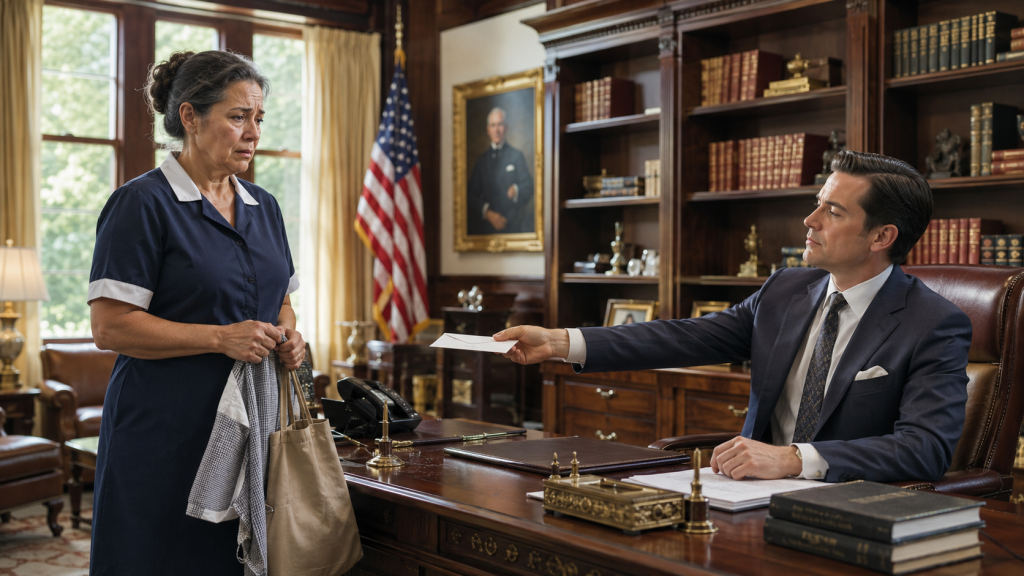
I cleaned the same mansion for 18 years — the new heir fired me with one week’s pay. Three days later, a lawyer called and told me to sit down before he said another word.

My name is Marta.
I’m 58 years old.
For eighteen years, I worked inside Mr. Whitaker’s mansion.
He was a widower, and somewhere along the way, he stopped feeling like an employer.
Every Monday, he asked about my grandson.
When my daughter died, he didn’t give me some empty speech about staying strong.
He simply sat beside me for almost an hour because he understood there were no words big enough for that kind of grief.
Some days, Mr. Whitaker felt more like family than anyone I had left.
When he passed away in March, I cried at his funeral as though I had lost my own father.
His only son, Julian, was completely different.
In all the years I worked there, I barely saw him.
He rarely visited.
Rarely called.
And whenever he did come around, he always seemed impatient to leave.
But after the funeral, Julian walked through the mansion differently.
Opening doors.
Inspecting rooms.
Looking at paintings and furniture like he had been waiting years for everything to become his.
Three weeks later, he called me into the study.
He didn’t offer me a chair.
“We won’t be needing you anymore, Marta.”
I stared at him.
He slid an envelope across the desk.
“One week’s severance. Please have your things out by sundown.”
I opened it.
Four hundred dollars.
Eighteen years of work.
Four hundred dollars.
I wanted to remind him that I had cared for that house longer than he had.
That I knew which window leaked when the rain came from the east.
Which floorboard outside the library creaked.
Which flowers his father wanted beside his wife’s photograph every anniversary.
Instead, I said nothing.
I packed my apron.
My little radio.
And the framed photograph Mr. Whitaker had once given me.
Then I walked out.
When I closed the front door behind me, the reality finally hit.
I had just lost the only job I’d had since my daughter passed away.
That evening, I stood in my small kitchen staring into a nearly empty refrigerator.
My grandson was asleep in the next room.
And one thought kept circling through my head.
How am I supposed to take care of him now?
For three days, I barely slept.
Then my phone rang.
Unknown number.
I almost didn’t answer.
“Hello?”
“Is this Marta?”
“Yes.”
“My name is Nathaniel. I was Mr. Whitaker’s attorney.”
I immediately sat straighter.
“Is something wrong?”
There was a pause.
Then his voice became serious.
“Before I explain why I’m calling, I need you to sit down.”
My hands began shaking.
“I’m already sitting.”
Another pause.
“Marta, I need to ask you one question first.”
“What question?”
He took a breath.
“Did Julian give you anything to sign before he fired you?”
I froze.
“No.”
“Did he ask whether Mr. Whitaker ever gave you documents, keys, or instructions before he died?”
“No.”
Nathaniel went quiet.
Then I heard papers moving on his end of the line.
“Good,” he finally said.
My stomach tightened.
“Why?”
“Because Julian apparently believes his father left him everything.”
I gripped the phone.
“Didn’t he?”
The lawyer was silent for several seconds.
Then he said:
“No, Marta.”
And the way he said my name made my heart start pounding.
“Mr. Whitaker left very specific instructions concerning you.”
I couldn’t speak.
Nathaniel continued.
“And after what Julian did three days ago, those instructions just became extremely important.
PART 2: THE HOUSE HE THOUGHT WAS HIS
“Mr. Whitaker left very specific instructions concerning you.”
I stopped breathing.
Nathaniel’s voice was calm.
Professional.
Careful.
But there was something underneath it.
Something almost like disbelief.
I tightened my grip around the phone.
“What instructions?”
Another rustle of papers.
Then silence.
The kind of silence that makes your mind run ahead and invent terrible things.
“Marta,” he said gently, “when can you come to my office?”
My stomach dropped.
“Why?”
“I think this conversation should happen in person.”
“I don’t have a car.”
“I’ll send one.”
“No.”
The word came out too quickly.
I had never liked feeling indebted to anyone.
Not even when I needed help.
Nathaniel seemed to understand.
“All right.”
I looked toward the narrow hallway.
My grandson, Eli, was still asleep.
Ten years old.
Too young to know how afraid I had been for three nights.
Too young to understand that I had spent most of the previous evening calculating whether I could stretch forty-three dollars until the end of the week.
“Can you just tell me now?”
Nathaniel exhaled.
“I can tell you part of it.”
I swallowed.
“Please.”
He paused.
“Mr. Whitaker revised his estate plan fourteen months before he died.”
I stared at the chipped edge of my kitchen table.
“Okay.”
“Julian was informed that changes had been made, but he was not given the details.”
My chest tightened.
“Why not?”
“Because Mr. Whitaker specifically requested that certain provisions remain confidential until after his death.”
I looked down at my hands.
They were shaking.
I curled one around the other.
“What does any of that have to do with me?”
Nathaniel’s voice softened.
“A great deal.”
For some reason, that frightened me more.
I had expected a small pension.
Maybe a letter.
Maybe Mr. Whitaker had remembered that I once told him I worried about Eli’s college someday.
Something kind.
Something modest.
Nothing that required a lawyer to tell me to sit down.
Nathaniel continued.
“Do you remember a conversation you had with Mr. Whitaker last year in the library?”
I frowned.
“I had many.”
“This one was about Julian.”
My body went still.
I remembered.
It had been late October.
Rain had pressed gray against the tall windows.
Mr. Whitaker was sitting by the fireplace with a blanket across his knees.
He had become thinner by then.
His hands shook sometimes when he lifted his tea.
That afternoon, he had watched me polish the silver frame holding his wife’s photograph.
Then he said:
Marta, do you think a person can leave a house to someone who never made it a home?
I had laughed softly.
I thought he was being philosophical.
He often became like that in his final year.
I answered:
A house is walls, sir. Home is what people do inside it.
He had looked at me for a long time.
Then nodded.
I had forgotten that conversation.
Until now.
“Yes.”
My voice came out faint.
“I remember.”
Nathaniel went quiet.
“What did he ask you?”
I closed my eyes.
“He asked if a house belonged more to the person whose name was on the deed or the person who knew how to keep it alive.”
Nathaniel exhaled slowly.
“And what did you say?”
“I told him that wasn’t a question for a housekeeper.”
For the first time, I heard Nathaniel almost laugh.
“Yes.”
“He told me you said that.”
I opened my eyes.
“He told you?”
“He told me quite a lot about you.”
Something inside my chest tightened painfully.
I looked toward the little framed photograph beside my sink.
Mr. Whitaker at seventy-five.
Silver hair.
Blue sweater.
That small crooked smile.
The picture had been taken in the garden.
I had been the one behind the camera.
“What did he say?”
Nathaniel did not answer immediately.
“He said you were the only person in that house who had never asked him for anything.”
I looked down.
“That isn’t true.”
“What did you ask for?”
“A raise once.”
Nathaniel laughed quietly.
“Apparently he did not count that.”
My eyes burned.
Then his tone became serious again.
“Marta, Mr. Whitaker left you the mansion.”
The room disappeared.
Not literally.
But for several seconds, nothing around me made sense.
The refrigerator.
The kitchen light.
The calendar on the wall.
The cup beside my hand.
Everything became distant.
I whispered:
“What?”
“The property on Hawthorne Avenue.”
“No.”
“Yes.”
“No.”
I stood up so quickly the chair scraped backward.
“You’re mistaken.”
“I’m not.”
“He had a son.”
“I know.”
“He would not leave his house to me.”
“He did.”
I shook my head.
“That’s impossible.”
“Marta.”
“No.”
My voice broke.
“Julian grew up there.”
Nathaniel’s answer came quietly.
“Julian left.”
I stared at nothing.
“He was still his son.”
“Yes.”
“And I was his employee.”
There was a pause.
Then Nathaniel said:
“He did not describe you that way.”
My throat closed.
“What did he call me?”
Nathaniel’s voice softened.
“Family.”
I sat back down.
Slowly.
Carefully.
As though the floor beneath me had changed.
Tears filled my eyes before I could stop them.
I covered my mouth.
I remembered Mr. Whitaker at Christmas.
Sitting at the kitchen table instead of the formal dining room because he said food tasted better where people actually talked.
I remembered him giving Eli a wooden train set when he was six.
I remembered bringing soup upstairs when he had pneumonia.
I remembered the night my daughter died.
The call.
The hospital.
The unbearable drive back.
I had gone to the mansion the following week because grief made sitting at home impossible.
Mr. Whitaker found me crying in the laundry room.
I apologized.
He did not.
He simply sat beside me.
No speech.
No advice.
Just presence.
And now, eighteen years later, that silence returned to me like a hand resting gently on my shoulder.
I wiped my face.
“Nathaniel.”
“Yes?”
“Why?”
He took a breath.
“There is more.”
Of course there was.
My heart began pounding again.
“What?”
“The mansion is not the only thing.”
I stared at the wall.
“What else?”
“Mr. Whitaker established a trust.”
I gripped the edge of the table.
“For what?”
“For the continued maintenance of the property and for your benefit.”
My mouth went dry.
“How much?”
Nathaniel hesitated.
That hesitation frightened me.
“How much?”
“Just over three million dollars.”
I stood again.
Then immediately sat back down because my knees failed me.
“No.”
“Marta—”
“No.”
I laughed once.
A broken sound.
“That cannot be right.”
“It is.”
“Three million?”
“Yes.”
I pressed my hand against my forehead.
I had spent the previous night worrying about groceries.
Now a lawyer was telling me I had inherited a mansion and millions of dollars.
It felt cruel somehow.
Too much.
Too sudden.
Like grief had opened one door and wealth had walked through wearing someone else’s shoes.
I whispered:
“I don’t understand.”
Nathaniel’s voice became gentler.
“I know.”
“Why wouldn’t he tell me?”
“He believed you would refuse.”
My eyes filled again.
He was right.
Of course he was.
Had Mr. Whitaker told me while he was alive, I would have argued.
I would have told him Julian was his son.
I would have said I had been paid fairly for my work.
I would have begged him not to complicate things.
Mr. Whitaker knew me too well.
“What did Julian get?”
I asked.
Nathaniel went quiet.
That answer was clearly more complicated.
“He received money.”
“How much?”
“Two hundred fifty thousand dollars.”
I blinked.
That was still more money than I had ever seen.
But compared with the mansion and trust, it was far less than Julian had apparently expected.
“Why?”
“Mr. Whitaker left a letter explaining his decision.”
“To Julian?”
“Yes.”
“Has he read it?”
“No.”
“Why not?”
“Because the formal reading has not yet occurred.”
I frowned.
“But Julian already moved into the mansion.”
“Yes.”
“And fired me.”
“Yes.”
My stomach twisted.
“Does he know the house isn’t his?”
“No.”
A strange silence came over me.
For three days, Julian had been walking through that mansion as owner.
Opening wine.
Calling contractors.
Telling staff what furniture would be sold.
Perhaps already imagining what room he would redecorate first.
All while legally standing inside someone else’s inheritance.
Mine.
I should have felt satisfied.
I didn’t.
I felt tired.
Nathaniel continued.
“This is why I asked whether he had given you anything to sign.”
My chest tightened.
“What would he have asked me to sign?”
“Possibly a waiver.”
“A waiver of what?”
“Your interest in the estate.”
I stared.
“But he doesn’t know I have one.”
“He may suspect.”
My mind went back to the study.
Julian standing behind his father’s desk.
The envelope.
The four hundred dollars.
The cold way he had said:
Please have your things out by sundown.
Then another memory surfaced.
He had asked:
Did Dad ever give you any keys I should know about?
At the time, I thought he meant house keys.
Now I wondered.
“He asked about keys.”
Nathaniel became alert.
“What kind?”
“He didn’t say.”
“When?”
“The day he fired me.”
“What did you tell him?”
“That I left my work keys in the kitchen drawer.”
“Anything else?”
I hesitated.
There was one key.
Mr. Whitaker had given it to me years ago.
A small brass key.
It opened the locked cabinet beneath his library desk.
Inside were personal papers.
Old family photographs.
His wife’s letters.
He trusted me to dust inside once a month because he said I was the only person who put things back exactly where they belonged.
I had forgotten the key was still on my ring.
I looked toward my purse.
“Nathaniel.”
“Yes?”
“I have one.”
His voice changed instantly.
“One what?”
“A key.”
“To what?”
“A cabinet in the library.”
Silence.
Then:
“Do not give it to Julian.”
My pulse accelerated.
“Why?”
“Because Mr. Whitaker mentioned that cabinet in his instructions.”
I stared at my purse.
“What’s in it?”
“I don’t know.”
That frightened me.
“You were his lawyer.”
“Yes.”
“And you don’t know?”
“He requested that certain personal materials remain sealed unless a specific condition occurred.”
“What condition?”
Nathaniel paused.
“Julian attempting to remove you from the property.”
My whole body went cold.
He had planned for this.
Mr. Whitaker had known.
Not known exactly.
But suspected.
Enough to write instructions.
Enough to hide something.
“What’s supposed to happen now?”
“You bring the key to my office.”
“And then?”
“I accompany you back to the mansion.”
My stomach tightened.
“Julian will be there.”
“Yes.”
“I don’t want to see him.”
“I understand.”
“I mean it.”
My voice shook.
“I spent eighteen years caring for that house. He made me feel like a thief packing my own apron.”
Nathaniel’s voice softened.
“You do not have to speak to him.”
I looked toward Eli’s bedroom.
“And my grandson?”
“Bring him if necessary.”
“No.”
I shook my head immediately.
“He doesn’t need this.”
Then I thought again.
Maybe he did not need the confrontation.
But he needed to know his grandmother had not failed.
For three nights, I had hidden my fear from him.
He had watched me count coins.
He had heard me call old employers.
He had asked whether we would have to move.
I had told him:
We’ll be okay.
Even though I did not know whether that was true.
Now, apparently, it was.
I wiped my eyes.
“When should I come?”
“Tomorrow morning.”
I looked at the clock.
It was almost noon.
“Why not today?”
Nathaniel hesitated.
“Because I need to file several documents first.”
My heartbeat changed.
“What documents?”
“Ones ensuring Julian cannot sell, transfer, or remove significant property from the estate before being formally notified.”
I laughed bitterly.
“That bad?”
“Worse.”
I frowned.
“What do you mean?”
“I received a call this morning from an auction house.”
My stomach dropped.
“What auction house?”
“Julian contacted them about several paintings.”
I stood.
“He’s selling the paintings?”
“He tried.”
I saw the grand staircase.
The library.
The blue landscape above the fireplace.
The small portrait of Mr. Whitaker’s wife in the upstairs hall.
Those paintings were not just expensive objects.
Some had hung there longer than I had worked in the house.
One had belonged to Mrs. Whitaker’s mother.
Mr. Whitaker dusted that frame himself every year on his anniversary.
My hands curled.
“He has no right.”
“No.”
Nathaniel’s voice hardened.
“He does not.”
For the first time since the call began, anger cut cleanly through my confusion.
Not because of the money.
Because Julian was dismantling his father’s life before the earth on the grave had settled.
“Stop him.”
“I intend to.”
That afternoon passed like a dream.
I made Eli lunch.
Burned the grilled cheese.
He looked at the blackened side and smiled.
“Grandma, you okay?”
I sat across from him.
His face was so much like my daughter’s sometimes that it hurt.
Same brown eyes.
Same little crease between the eyebrows when he was worried.
“I got a phone call.”
“About a job?”
I almost cried.
He had been trying to help.
That morning, he had left a handwritten list beside my coffee.
Places Grandma can work.
Hotel.
School.
Hospital.
Big houses.
My ten-year-old grandson was searching for employment for me because he thought we were in trouble.
“No.”
I reached across the table.
“Do you remember Mr. Whitaker?”
He nodded.
“The old man with the trains.”
I smiled.
“Yes.”
He had given Eli one antique train every Christmas.
Never something flashy.
Always one carriage.
One engine.
One little piece at a time.
Eli had an entire shelf now.
“He left us something.”
Eli looked interested.
“A train?”
I laughed.
Then cried at the same time.
“No.”
He frowned.
“Then what?”
I looked around our little kitchen.
Peeling wallpaper near the window.
One cabinet that never closed properly.
The refrigerator with three magnets from places we had never visited.
How did I tell a child that his entire life had just changed?
I didn’t.
Not yet.
“He left us some help.”
Eli smiled.
“That was nice.”
Yes.
That was Mr. Whitaker.
Nice.
As though millions of dollars and a mansion were merely an extension of the same kindness that made him sit beside a grieving woman in a laundry room.
I brushed crumbs from Eli’s shirt.
“It was.”
That night, I barely slept.
Again.
Only this time, fear was not the reason.
Memory was.
I kept thinking about all the moments that now looked different.
Mr. Whitaker asking me what color I would paint the kitchen if it were mine.
I had said yellow.
He laughed.
Julian hated yellow.
Mr. Whitaker asking whether the downstairs bedroom could be made accessible if someone’s knees got bad.
I told him yes.
Mr. Whitaker asking whether Eli liked the garden.
He did.
I had thought these were random questions.
Maybe they had not been.
At eight the next morning, I put on my best coat.
Not the housekeeping uniform.
Not the apron.
A navy coat my daughter bought me thirteen years ago.
I had almost donated it after she died because wearing it hurt.
Then I decided the opposite.
I would wear it when I needed courage.
Nathaniel’s office was downtown.
Glass doors.
Marble floors.
The kind of place where I suddenly became aware of every scratch on my shoes.
A receptionist led me into a conference room.
Nathaniel stood when I entered.
He was older than I expected.
Maybe sixty-five.
Silver hair.
Kind eyes.
He came around the table and shook my hand.
“Marta.”
“Yes.”
“I’m sorry we’re meeting under these circumstances.”
“So am I.”
He gestured toward a chair.
This time, unlike Julian, someone offered me one.
That small difference almost made me cry.
On the table sat three folders.
One blue.
One black.
One cream.
Nathaniel placed his hand on the black folder.
“This is the will.”
Then the blue.
“This is the property trust.”
Then the cream.
“And this is a personal letter addressed to you.”
My breath caught.
“From him?”
“Yes.”
My hands shook.
“Can I read it?”
“Of course.”
He slid the envelope toward me.
My name was written across the front.
Marta.
Mr. Whitaker’s handwriting had become shaky near the end.
But I knew it.
I opened the envelope carefully.
There were two pages.
Marta,
If Nathaniel has given you this letter, then I am gone, and I am sorry for making you cry one more time.
I covered my mouth.
That sounded exactly like him.
Dry.
Gentle.
I continued.
You spent eighteen years caring for a house everyone assumed belonged to me.
The truth is, I was merely its longest occupant.
A house is entrusted to us.
We do not truly own the memories inside it.
You taught me that.
You were there when my wife died.
You were there when my son stopped coming home.
You were there when I grew old enough to need help tying my own shoes but was too proud to admit it.
You protected my dignity without ever making me feel weak.
Julian shares my blood.
You shared my life.
Tears spilled onto the page.
I wiped them quickly.
I could hear Mr. Whitaker saying every word.
You never asked me for anything except fair pay and the occasional Friday off.
You raised your grandson while carrying grief I do not think most people could survive.
I watched you give that boy stability when life gave you almost none.
So I have decided to give you some in return.
The house is yours.
Not because you cleaned it.
Because you loved the people inside it.
I stopped reading.
Nathaniel quietly pushed a box of tissues toward me.
I laughed through tears.
“Does everyone keep tissues near me now?”
He smiled.
“Today, perhaps.”
I read the final paragraph.
If Julian becomes angry, let him.
Anger is sometimes the first emotion a person feels when entitlement meets reality.
Do not allow guilt to convince you that accepting this is stealing from him.
I am not taking something from my son.
I am giving something to the person who cared for what he abandoned.
Live there.
Sell it.
Fill it with children.
Paint the kitchen yellow.
Do whatever makes it a home again.
You have my blessing.
Thank you for making my last years less lonely.
Your friend,
Arthur Whitaker.
I pressed the letter against my chest.
Arthur.
I had almost never called him that.
Only Mr. Whitaker.
Even after eighteen years.
Nathaniel waited.
He did not rush me.
Eventually I whispered:
“He remembered the yellow kitchen.”
Nathaniel smiled.
“He talked about that often.”
I wiped my eyes.
Then I placed the letter carefully back into the envelope.
“What happens now?”
Nathaniel’s expression became serious.
“We go to the mansion.”
My stomach tightened.
“You said there’s something in the cabinet.”
“Yes.”
I reached into my purse and placed the little brass key on the table.
Nathaniel stared at it.
Then nodded.
“He instructed me that if Julian terminated your employment before the will was formally read, we were to retrieve the contents immediately.”
“Why?”
“He believed Julian might try to destroy them.”
A cold feeling moved through me.
“What are they?”
“Evidence.”
“Of what?”
Nathaniel looked toward the conference-room door.
Then lowered his voice.
“Financial misconduct.”
I stared.
“What?”
“He suspected Julian had been using his name to secure private loans.”
I thought about Julian.
The expensive watch.
The leased sports cars.
The constant talk about investments.
I knew Mr. Whitaker had stopped giving him money several years earlier.
At least, that was what he told me.
“How much?”
“We’re not sure.”
Nathaniel closed the folder.
“But possibly millions.”
My mouth went dry.
“And the cabinet contains proof?”
“We believe so.”
“Why didn’t Mr. Whitaker tell you?”
“He feared my office could be subpoenaed if Julian discovered an investigation.”
I sat back.
This had become larger than inheritance.
Larger than me.
“Does Julian know?”
“He may.”
“Is that why he fired me?”
Nathaniel looked at the brass key.
“That is what we are about to find out.”
An hour later, we pulled up outside the mansion.
My mansion.
The thought still felt absurd.
The iron gates stood open.
Julian’s black car was parked near the front steps.
A moving truck sat beside it.
My anger rose instantly.
“What is that?”
Nathaniel’s jaw tightened.
“He is moving things.”
We got out.
I stood at the bottom of the steps.
For eighteen years, I had entered through the side door.
Staff entrance.
Even when it rained.
Even when I carried groceries.
Even when Mr. Whitaker told me I could use the front.
Habit is powerful.
I almost turned automatically toward the side path.
Then Nathaniel said:
“Marta.”
I looked at him.
“The front door.”
Something changed inside me.
Small.
But permanent.
I climbed the steps.
Then I entered through the front door.
Julian was in the foyer.
He turned.
His expression froze.
“What are you doing here?”
Nathaniel stepped beside me.
“Good morning, Julian.”
Julian’s face darkened.
“Nathaniel.”
He looked at me.
“I told you to remove your belongings.”
“I did.”
“Then leave.”
Nathaniel opened his briefcase.
“She is not leaving.”
Julian laughed.
“This is my house.”
“No.”
One word.
Nathaniel said it calmly.
Almost pleasantly.
Julian stared.
“What?”
“This house does not belong to you.”
The color drained from Julian’s face.
For the first time since I had known him, he had no immediate answer.
Nathaniel continued.
“Your father left the Hawthorne Avenue property to Marta Alvarez.”
Julian looked at me.
Then back at him.
Then laughed.
It was too loud.
Too sharp.
“That’s ridiculous.”
Nathaniel did not react.
“The transfer was properly executed.”
“My father had dementia.”
“No.”
“He was sick.”
“Yes.”
“That means he wasn’t competent.”
“His cognitive assessments say otherwise.”
Julian’s jaw clenched.
“You manipulated him.”
I almost laughed.
Me?
I had barely known enough about the will to sit upright during the phone call.
“I didn’t know.”
My voice came out quiet.
Julian looked at me.
“What?”
“I didn’t know he left me anything.”
He stared.
I continued.
“You fired me before I found out.”
Something changed in his expression.
A flicker.
Fear.
Nathaniel saw it too.
“Why did you terminate her so quickly?”
Julian’s eyes hardened.
“Because she was staff.”
There was the word again.
Staff.
Eighteen years compressed into one syllable.
Nathaniel closed his briefcase.
“Then you won’t object to returning the property belonging to the owner.”
Julian scoffed.
“What property?”
“Everything currently being loaded into that truck.”
Julian looked toward the movers.
Nathaniel spoke calmly.
“I suggest you tell them to stop.”
Julian’s face went red.
“You cannot do this.”
“Marta can.”
The room went silent.
Nathaniel turned toward me.
“It is your house.”
My house.
Those words still did not fit.
I looked toward the moving crew.
One man was holding a framed painting I recognized.
Mrs. Whitaker’s favorite.
A meadow in spring.
She had bought it on their honeymoon.
I pointed.
“Put that back.”
The mover froze.
Julian stared at me.
I repeated:
“Please put it back.”
The man looked at Nathaniel.
Nathaniel nodded.
He carried it inside.
Julian stepped toward me.
“You think this makes you important?”
I looked at him.
For eighteen years, I had lowered my eyes around wealthy guests.
Stepped aside in hallways.
Cleaned glasses after parties where people forgot my name before I left the room.
But Mr. Whitaker remembered my name.
Every Monday.
Every Christmas.
Every time it mattered.
“No.”
I shook my head.
“I think it makes me responsible.”
Julian laughed bitterly.
“For what?”
“For making sure your father’s home isn’t stripped before he’s cold in the ground.”
His face twisted.
“You were paid to scrub his floors.”
The words hurt.
Of course they did.
But not enough to break me.
I stepped closer.
“And you were born his son.”
My voice shook.
“Only one of us showed up.”
The silence afterward was absolute.
Julian’s face went pale.
Nathaniel touched my elbow lightly.
“The library.”
I remembered the key.
We walked past Julian.
He followed.
“What are you doing?”
Nathaniel ignored him.
We entered the library.
Dust danced in the morning light.
Mr. Whitaker’s chair remained beside the window.
My chest tightened at the sight.
For a second, I expected him to look up from a book.
Marta, you missed a spot.
I almost heard it.
I crossed to the desk.
Kneeling, I found the small brass lock beneath the bottom shelf.
My hand shook.
The key turned easily.
Click.
Inside was a black document box.
Nathaniel lifted it onto the desk.
Julian’s face changed.
He recognized it.
That was enough.
“What is that?”
Nathaniel looked at him.
“You tell us.”
“I’ve never seen it.”
A lie.
Too fast.
Nathaniel opened the box.
Inside were folders.
Loan agreements.
Bank statements.
Copies of signatures.
Letters.
My stomach tightened.
Nathaniel lifted the first document.
Then the second.
His expression hardened.
Julian moved toward the desk.
Nathaniel closed the box immediately.
“You’re not touching these.”
Julian’s face went white.
“They’re private family documents.”
Nathaniel looked at me.
“No.”
Then back at Julian.
“They are now potential evidence.”
Julian stopped moving.
For the first time, fear completely replaced arrogance.
“What did he know?”
Nathaniel did not answer.
Julian’s voice rose.
“What did my father know?”
I stared at him.
And suddenly I understood.
The haste.
The firing.
The questions about keys.
The moving truck.
Julian had not only wanted me gone because I was an employee he considered disposable.
He wanted me gone because I knew the house.
Every drawer.
Every cabinet.
Every key.
He had been afraid I might find something.
Or worse.
That Mr. Whitaker had trusted me with something.
Nathaniel closed the box.
“Julian, I strongly recommend that you contact counsel.”
His face tightened.
“You can’t prove anything.”
Nathaniel looked at the stack of documents.
“We’ll see.”
Julian turned toward me.
“This is your fault.”
That sentence almost made me laugh.
“No.”
My voice stayed quiet.
“This is the first thing here that isn’t.”
His expression hardened.
“You think Dad loved you more than me?”
I shook my head.
“No.”
That surprised him.
“I think he loved you enough to keep hoping you would become someone he could trust.”
Julian’s face changed.
Pain.
Real pain.
For one second, he looked less like an arrogant heir and more like a little boy whose father had finally stopped waiting.
I almost felt sorry for him.
Almost.
Then he whispered:
“He should have given me another chance.”
I looked around the library.
At the books.
At the chair.
At eighteen years of waiting.
“Maybe he did.”
Julian said nothing.
I continued.
“Maybe you just kept missing them.”
Nathaniel called security.
The moving truck was unloaded.
Julian was given forty-eight hours to remove only his confirmed personal belongings under supervision.
He argued.
Threatened lawsuits.
Called me a thief.
Called Nathaniel worse.
But by sunset, he left.
And for the first time in eighteen years, I stood alone in the mansion.
Not as an employee.
Not as staff.
As the person Arthur Whitaker had trusted to decide what happened next.
I walked room to room.
Slowly.
The dining room.
The upstairs hall.
The library.
The kitchen.
Everything looked the same.
Yet nothing felt the same.
Then I entered the small breakfast room.
Mr. Whitaker used to sit there every Monday.
Coffee in one hand.
Newspaper in the other.
He always asked:
How’s Eli?
I sat in his chair.
And cried.
Not for the money.
Not for the house.
For him.
Because what I wanted most was impossible.
I wanted him sitting across from me.
Alive.
Complaining that the coffee was weak.
I wanted one more Monday.
One more question about my grandson.
One more ordinary morning.
Inheritance does not replace a person.
Nothing does.
Weeks passed.
Julian challenged the will.
He lost.
The medical records were clear.
The witnesses were clear.
Arthur had known exactly what he was doing.
The financial documents triggered an investigation.
Several loans had been obtained using forged guarantees tied to Whitaker assets.
Julian eventually faced civil and criminal consequences.
I stopped following every detail.
That was not my life.
I had spent enough years cleaning up after other people.
I did not intend to spend the rest watching Julian’s collapse.
The trust remained intact.
The house remained mine.
And the first thing I did was paint the kitchen yellow.
Soft yellow.
Warm.
The kind of color that catches morning light.
Eli hated it.
“Grandma, it looks like a banana.”
I laughed until my stomach hurt.
Then I made him help anyway.
We did not move into the mansion immediately.
It was too much.
Too large.
Too full of ghosts.
We started with weekends.
Then summers.
Eventually, the small downstairs bedroom became mine.
Eli chose a room overlooking the garden.
I turned two unused guest rooms into apartments for women rebuilding their lives after loss.
Widows.
Grandmothers raising grandchildren.
Women who had spent years caring for everyone except themselves.
Nathaniel helped establish a small charitable foundation from part of the trust income.
I called it the Whitaker Home Fund.
Not Mansion Fund.
Home.
Because Arthur had been right.
There was a difference.
One year after his death, I stood in the garden with Eli.
Spring had returned.
Daffodils leaned toward the sunlight.
The same flowers Arthur used to request beside his wife’s photograph.
Eli placed one beside a small plaque we had installed beneath the oak tree.
Arthur James Whitaker
Beloved Husband.
Father.
Friend.
Then one line beneath:
A home belongs to the people who fill it with love.
Eli read it.
“Did he really say that?”
“Almost.”
“He talked fancy.”
I laughed.
“Yes.”
Eli took my hand.
“Grandma?”
“Yes?”
“Are we rich now?”
I looked at him.
Such a child’s question.
Direct.
Uncomplicated.
I thought about the bank account.
The trust.
The mansion.
The things I could suddenly afford.
Then I looked toward the house.
Through the kitchen window, I could see yellow walls.
A pot of soup on the stove.
Two women staying upstairs laughing together at the table.
A stack of Eli’s schoolbooks near the door.
Life.
Noise.
Mess.
Home.
“Yes,” I said.
His eyes widened.
“Really?”
I smiled.
“But not because of the money.”
He frowned.
“That doesn’t make sense.”
“It will someday.”
He rolled his eyes.
Arthur used to do the same thing when I became sentimental.
I squeezed Eli’s hand.
Eighteen years earlier, I had entered that mansion carrying rubber gloves and a lunch packed in a paper bag.
I thought my job was to clean rooms.
What I did not understand was that over time, I became part of the life inside them.
I knew which windows leaked.
Which floorboards creaked.
Which flowers belonged beside a photograph.
But more importantly, I knew when an old man needed company more than clean silver.
And somehow, he knew when a grieving woman needed stability more than pride.
Julian had given me four hundred dollars and told me to leave before sundown.
For three days, I thought those eighteen years had meant nothing.
I thought loyalty had made me foolish.
I thought I had given too much of my life to a house that would forget me the moment its owner died.
I was wrong.
Arthur remembered.
Not because I washed his floors.
Not because I polished his glassware.
Because I stayed.
And sometimes staying matters.
Not staying where you are mistreated.
Not staying because you are afraid to leave.
But staying for people who see you.
People who respect you.
People who sit beside you when grief has emptied the room of words.
Those are the people worth showing up for.
I looked toward the mansion.
My home.
Our home.
Then I thought about the day Julian fired me.
He believed one week’s pay was the final measure of what I was worth.
Four hundred dollars.
That was his mistake.
Your worth is rarely determined by the person most eager to dismiss you.
Sometimes the people who truly see you are quieter.
Sometimes their gratitude arrives late.
Sometimes it arrives after they are gone.
And sometimes—
it arrives through a lawyer who tells you to sit down before he says another word.
I smiled.
Eli tugged at my hand.
“Come on, Grandma. I’m hungry.”
“I made soup.”
He groaned.
“Again?”
“Yes.”
“We’re rich and still eating soup?”
I laughed.
“Especially now.”
We walked toward the house together.
The yellow kitchen glowed through the windows.
The front door stood open.
And this time, I did not enter through the side.
PART 3: THE WOMAN IN THE EAST WING
“She has the original deed.”
For several seconds, I forgot how to breathe.
Nathaniel stared at Julian.
I stared at both of them.
And somewhere upstairs, a floorboard creaked.
A house I had known for eighteen years suddenly felt unfamiliar.
Every hallway seemed deeper.
Every closed door seemed to contain a secret.
Margaret Whitaker.
The woman whose photograph I had dusted every Friday.
The woman whose birthday I had remembered because Arthur could not bear to forget it.
The woman whose favorite white roses I planted each spring.
Alive.
I looked at Julian.
“No.”
He swallowed.
“Yes.”
“You told me she died.”
“My father told everyone she died.”
Nathaniel stepped closer.
“Julian, when did you find out?”
Julian looked away.
“I always knew.”
That answer hit harder than I expected.
“You were a child?”
“Fifteen.”
My heart tightened.
He had been fifteen when his mother disappeared.
Old enough to understand loss.
Too young, perhaps, to understand why adults turned it into a lie.
“What happened?”
Julian rubbed both hands over his face.
“My mother left my father.”
Nathaniel’s expression hardened.
“For whom?”
Julian shook his head.
“It wasn’t that simple.”
“It never is.”
I heard my own voice sound colder than I felt.
Julian looked toward the staircase.
“She wanted a different life.”
“My father didn’t.”
“They fought for years.”
“He became controlling.”
“She became reckless.”
“I don’t know which version is true anymore.”
That sentence was the first honest thing he had said all day.
Nathaniel lowered his voice.
“And the death story?”
“My father invented it after she disappeared.”
“Why?”
Julian laughed bitterly.
“Pride.”
That answer fit too easily.
Arthur had been kind to me.
Generous.
Gentle.
But kind people can still carry ugly pride.
Goodness does not erase every flaw.
Julian continued.
“My mother left the country.”
“She didn’t want custody.”
“She didn’t want the house.”
“She didn’t want anything.”
“Then why is she here now?”
He looked at me.
“Because Dad’s dead.”
The words felt cruel.
But perhaps they were simply true.
Nathaniel glanced toward the black document box.
“And you think she has the original deed.”
“I know she does.”
“How?”
Julian hesitated.
“She called me after the funeral.”
My stomach tightened.
“You’ve been talking to her?”
“Yes.”
“How often?”
“Almost every day.”
Nathaniel’s jaw set.
“And you didn’t think to mention this?”
Julian snapped.
“To whom?”
“Your father’s attorney.”
“The housekeeper.”
“The police?”
He pointed toward me.
“She wasn’t the owner then.”
I stepped forward.
“And now?”
He looked at me.
I held his gaze.
For once, he looked away first.
Then a door slammed upstairs.
The sound echoed through the mansion.
Nathaniel straightened.
“We need to find her.”
Julian moved immediately.
“No.”
Nathaniel turned.
“No?”
“She won’t talk to you.”
“That is not your decision.”
Julian’s face tightened.
“You don’t understand my mother.”
Nathaniel replied calmly.
“I understand trespassing.”
Julian’s mouth opened.
Then closed.
I looked toward the staircase.
For eighteen years, I had cleaned every room in that mansion.
Except one.
The east bedroom.
Arthur kept it locked.
Always.
When I first started working there, I asked once.
He said:
Leave that room alone, Marta.
Nothing more.
I never asked again.
Now I knew.
I whispered:
“The east wing.”
Julian’s face changed.
Nathaniel looked at me.
“What?”
“She’s in the east bedroom.”
“How do you know?”
“I don’t.”
I stared toward the stairs.
“But if Arthur hid her life anywhere in this house, it would be there.”
Julian suddenly looked frightened.
Not of us.
Of what might be found.
That was enough.
I started upstairs.
“Marta.”
Nathaniel followed.
Julian swore under his breath and came after us.
The hallway on the second floor was colder than downstairs.
Tall windows let in winter light.
Family portraits lined the walls.
Arthur.
Margaret.
Julian as a child.
I had passed those faces thousands of times.
Now every photograph felt like evidence.
At the end of the corridor stood the east bedroom.
The door was closed.
For eighteen years, I had never touched the knob.
Nathaniel knocked.
No answer.
He knocked again.
“Mrs. Whitaker?”
Silence.
Then a woman’s voice.
Older.
Sharp.
But unmistakably present.
“Go away.”
My skin prickled.
Julian closed his eyes.
“Mom.”
That word changed him.
He sounded younger.
Small.
The locked door opened.
A woman stood on the other side.
I knew her immediately.
Age had changed her.
Of course it had.
Silver hair fell to her shoulders.
Lines marked her face.
She was thinner than the photographs.
But the eyes were the same.
Dark.
Intelligent.
Piercing.
The woman I had mourned for eighteen years stared directly at me.
“You’re Marta.”
It was not a question.
I nodded.
“Yes.”
She looked me over.
Slowly.
Then smiled faintly.
“Arthur talked about you.”
My throat tightened.
“Apparently everyone in this family talked about me except to me.”
Something flickered across her face.
Perhaps amusement.
Perhaps shame.
Nathaniel stepped forward.
“Margaret Whitaker?”
She looked at him.
“You must be Nathaniel.”
“Yes.”
“I always hated your ties.”
Nathaniel glanced down at the navy silk tie he was wearing.
“That is unexpectedly personal.”
She almost smiled.
Then Julian spoke.
“You shouldn’t have come here.”
Margaret’s face changed.
Whatever softness existed vanished.
“I didn’t come for you.”
He flinched.
That hurt to watch.
No matter what Julian had done, some wounds began long before adulthood.
Margaret looked at me again.
“This house is not yours.”
My stomach tightened.
Nathaniel stepped between us slightly.
“That remains to be determined.”
“No.”
She shook her head.
“It doesn’t.”
She held up a brown leather folder.
“The property was transferred to me twenty-two years ago.”
Julian stared.
“I told you.”
Nathaniel extended one hand.
“May I see it?”
“No.”
“Then I cannot evaluate your claim.”
“You don’t need to evaluate it.”
“I assure you, I do.”
Margaret’s eyes narrowed.
“You lawyers always speak as though reality requires your permission.”
Nathaniel remained calm.
“And people carrying disputed deeds usually speak as though paper cannot be forged.”
Silence.
Margaret’s expression hardened.
I almost admired him.
Then she looked at me.
“Do you know why Arthur gave you the house?”
I swallowed.
“He said I cared for it.”
She laughed once.
A sad sound.
“No.”
“Margaret,” Julian warned.
She ignored him.
“He gave it to you because he was afraid.”
I frowned.
“Afraid of what?”
“Me.”
The hallway seemed to grow colder.
Nathaniel folded his arms.
“Explain.”
Margaret looked toward one of the portraits.
Her younger self stared back from twenty years ago.
Elegant.
Beautiful.
Alive.
“I left Arthur in 2003.”
She spoke slowly.
“We had been unhappy for years.”
“He loved the house more than he loved movement.”
“I loved movement more than I loved staying.”
Her eyes shifted toward Julian.
“And somewhere in between, we damaged our son.”
Julian looked away.
Margaret continued.
“I signed documents before I left.”
“Arthur said they were necessary for tax purposes.”
“I trusted him.”
“Later, I discovered one document transferred the house entirely into a family trust controlled by him.”
Nathaniel frowned.
“That is not unusual.”
“No.”
Margaret’s mouth tightened.
“But the original deed I signed before that transferred fifty percent to me.”
Julian stared.
“What?”
She looked at him.
“Your father never told you?”
“No.”
“Of course he didn’t.”
Nathaniel extended his hand again.
“Now I definitely need to see the deed.”
Margaret hesitated.
Then handed it over.
Nathaniel opened the folder.
The hallway became silent.
He examined the document for almost a minute.
Then another.
Finally, he looked up.
“This deed is real.”
My stomach dropped.
Julian exhaled sharply.
Margaret smiled.
Not triumphantly.
Almost sadly.
I whispered:
“Then the house is hers?”
Nathaniel shook his head.
“Not necessarily.”
Margaret’s smile vanished.
He looked at her.
“This deed transferred half interest to you.”
“Yes.”
“But six months later, you signed another document.”
“What document?”
“A quitclaim.”
Her face went still.
“No.”
Nathaniel looked at Julian.
“Do you have access to Arthur’s old property records?”
Julian frowned.
“Maybe.”
Nathaniel handed the deed back.
“I do.”
Margaret stared.
“You’re lying.”
“No.”
“I never signed a quitclaim.”
Nathaniel’s expression sharpened.
“Then perhaps someone forged your name.”
That sentence changed the room.
Margaret went pale.
Julian looked toward the stairs.
I thought about the documents in the black box.
Forged signatures.
Borrowed money.
A family history built around paper people had trusted.
Nathaniel took out his phone.
“I’m going to have my office pull the recorded deed chain.”
Margaret folded her arms.
“I already did.”
“And?”
She looked away.
That was answer enough.
Nathaniel’s voice softened.
“You knew.”
Her jaw tightened.
“I suspected.”
“You came here hoping to remove the original deed before anyone compared it to later filings.”
“No.”
“Yes.”
“You logged into Arthur’s investment accounts this morning.”
Julian snapped his head toward her.
“What?”
Margaret’s face changed.
Only slightly.
But enough.
Nathaniel saw it.
“So that was you.”
She said nothing.
Julian stepped toward her.
“Why would you do that?”
Margaret stared at him.
“Because I need money.”
The bluntness shocked me.
Julian laughed bitterly.
“There it is.”
“Don’t.”
“No, say it.”
His voice rose.
“You disappeared for twenty years and came back because you need money?”
Margaret’s face hardened.
“I came back because your father left me with nothing.”
“You left us.”
“You don’t know what happened.”
“I was fifteen!”
His voice cracked.
That was the first time I heard the boy inside the man.
“You left me.”
Margaret flinched.
Julian continued.
“You didn’t call.”
“You didn’t write.”
“You didn’t come to graduation.”
“You didn’t come when I got married.”
“You didn’t even come when I got divorced.”
His chest heaved.
“And now you walk into the house after he dies and call yourself cheated?”
Margaret whispered:
“I thought staying away would be easier.”
Julian laughed.
“For who?”
No one answered.
Because everyone knew.
For her.
Not for him.
Margaret looked suddenly older.
“I was ashamed.”
Julian shook his head.
“No.”
“You were comfortable.”
That hurt her.
I saw it.
Then he pointed toward me.
“You know who remembered Dad’s birthday?”
“Marta.”
“Who planted Mom’s roses?”
“Marta.”
“Who sat with him when he was sick?”
“Marta.”
He laughed bitterly.
“And I hated her for it.”
My breath caught.
Julian looked at me.
“For years.”
His voice cracked.
“Every time Dad talked about you, I hated you.”
I stared.
“Why?”
“Because you were there.”
Two words.
That was all.
And suddenly so much of his cruelty made sense.
Not excuse.
Sense.
He had looked at me and seen every absence in his family reflected back.
His mother gone.
His father emotionally distant.
And me, the woman who stayed.
Julian wiped his eyes angrily.
“I thought Dad replaced me with you.”
I shook my head.
“He didn’t.”
“You don’t know that.”
“Yes.”
My voice softened.
“Because he talked about you.”
Julian stopped.
“What?”
“Constantly.”
He stared.
I continued.
“He knew your university grades.”
“Your first job.”
“He kept the photograph from your wedding in the library even after the divorce.”
“He complained when you stopped calling.”
“He defended you when the gardener said you were spoiled.”
Julian almost smiled.
“Thomas said that?”
“Every spring.”
The smile disappeared quickly.
I stepped closer.
“Your father was angry with you.”
“Yes.”
“Disappointed.”
“Yes.”
“But he did not stop loving you.”
Julian looked down.
“He just stopped paying for your mistakes.”
The words landed.
Not cruelly.
Truthfully.
Margaret looked toward him.
“I’m sorry.”
Julian did not answer.
Nathaniel’s phone rang.
He stepped away.
For several minutes, no one spoke.
Then he returned.
His expression was serious.
“I have the deed chain.”
Margaret looked at him.
“And?”
Nathaniel took a breath.
“The quitclaim was recorded twenty-one years ago.”
“Signature matches yours.”
Margaret’s face went white.
“No.”
Nathaniel continued.
“More importantly, there is a notarized video deposition attached to the trust file.”
She froze.
“What video?”
“Arthur anticipated a future challenge.”
Julian whispered:
“Of course he did.”
Nathaniel looked at Margaret.
“In the recording, you confirm voluntarily relinquishing your interest in the house in exchange for a financial settlement.”
Margaret sank against the wall.
“No.”
Nathaniel’s voice softened.
“The amount was eight hundred thousand dollars.”
Julian’s head snapped toward her.
“You took money?”
Margaret covered her face.
“I was leaving.”
“You took eight hundred thousand dollars and disappeared?”
“It was different then.”
“That was millions in today’s money!”
“I know.”
“And now you came back for the house?”
Margaret began crying.
“I lost it.”
Silence.
Julian stared.
“What?”
“The money.”
“How?”
“Bad investments.”
“A second marriage.”
“Medical bills.”
“Everything.”
She wiped her face.
“I have almost nothing left.”
For the first time, I saw her not as a ghost.
Not as the beautiful woman in the portrait.
Not as the villain who abandoned a family.
As an old woman who had spent twenty years running from decisions that finally caught her.
I understood fear.
That did not make her entitled to the house.
Nathaniel spoke gently.
“Margaret, you do not own the property.”
She closed her eyes.
“I know.”
Julian stared.
“You knew before coming here?”
She whispered:
“Yes.”
There it was.
The truth.
Ugly.
Plain.
Final.
“You came to steal?”
Julian asked.
“I came to retrieve what I thought I could still claim.”
“That’s stealing.”
She looked at him.
“You forged your father’s signature.”
His face hardened.
“Don’t compare us.”
“Why not?”
“Because at least I stayed.”
The sentence silenced her.
He looked almost surprised by his own words.
Then ashamed.
Perhaps because staying badly does not become virtue just because someone else left.
Nathaniel stepped forward.
“We need to address the investment login.”
Margaret looked down.
“I tried.”
“Why?”
“I thought Arthur might have left an account in my name.”
“You knew you weren’t authorized.”
“Yes.”
“Did you transfer anything?”
“No.”
Nathaniel nodded.
“That matters.”
She looked up.
“Will you call the police?”
He did not answer immediately.
Then looked at me.
That surprised me.
“Why are you looking at me?”
“Because Arthur’s instructions grant you discretion regarding certain civil estate claims.”
My stomach tightened.
Margaret stared at me.
Suddenly, I felt something I had never wanted.
Power over another person.
I hated it.
I thought about Arthur.
What would he do?
Then I remembered his letter.
Do not allow guilt to decide for you.
I looked at Margaret.
“Did you take anything from this house?”
She hesitated.
Then opened her coat.
Inside was a small velvet jewelry box.
My chest tightened.
I recognized it.
Mrs. Whitaker’s sapphire brooch.
Arthur kept it beside her photographs.
Margaret held it out.
“It was mine.”
I looked at Nathaniel.
He nodded.
“That item was specifically left to Julian.”
Julian blinked.
“To me?”
Nathaniel nodded.
“Your father wrote that your mother wore it when you were born.”
Julian stared at the box.
Margaret’s hand shook.
Then she crossed the space between them.
She offered it.
Julian did not move.
For a long moment, neither did she.
Then he took it.
Their fingers touched.
Margaret began crying.
“So much for twenty years,” she whispered.
Julian looked at the brooch.
Then, after a long silence, placed it back in her palm.
“Keep it.”
She stared.
“Why?”
“Because I don’t want another thing in this family that feels stolen.”
My eyes burned.
Margaret closed her fingers around it.
“Thank you.”
Julian did not answer.
I looked at Nathaniel.
“I don’t want charges over the login.”
He nodded slowly.
“As long as no funds moved, we can likely resolve it privately.”
Margaret stared at me.
“Why?”
I thought about it.
Then answered honestly.
“Because I’ve spent enough of my life cleaning up bitterness.”
Her eyes filled.
“But you leave the house today.”
“Yes.”
“And you return everything else.”
“Yes.”
“And you do not enter again without invitation.”
She nodded.
No argument.
No entitlement.
Just exhaustion.
That mattered.
We walked downstairs together.
The mansion felt strangely quiet.
At the front door, Margaret stopped.
She touched the stone wall.
Just once.
“Arthur hated yellow.”
I smiled through my tears.
“I know.”
“He’ll haunt you.”
“Then he can complain from the kitchen.”
She laughed softly.
It was the first warm sound I heard from her.
Then she looked at Julian.
“May I call you?”
His face tightened.
I held my breath.
He took a long time to answer.
“Not today.”
Margaret nodded.
“Fair.”
She stepped outside.
Then disappeared down the front walk.
No dramatic embrace.
No instant forgiveness.
Real life rarely heals that efficiently.
Julian remained in the foyer.
Nathaniel held the black box.
I stood beneath the chandelier wondering how one house could contain so much love and damage at the same time.
Julian looked at me.
“So.”
I waited.
“You own it.”
“Yes.”
He laughed faintly.
“That’s going to take some getting used to.”
“For both of us.”
He looked around.
“What are you going to do?”
“I don’t know.”
His mouth curved.
“You really don’t?”
“No.”
I thought of Eli.
Our tiny kitchen.
The bedroom he shared with boxes because our apartment had no storage.
The school district near the mansion.
The garden.
The yellow kitchen.
Then another thought came.
“What about you?”
He frowned.
“What about me?”
“What are you going to do?”
His face closed.
“Apparently hire a criminal lawyer.”
Nathaniel cleared his throat.
“That would be wise.”
Julian laughed bitterly.
I looked at him.
“After that.”
He stared.
“I don’t know.”
“Then maybe that’s where you start.”
He said nothing.
A week later, the financial records were turned over to authorities.
Julian cooperated.
Not because he became good overnight.
Because something in him had cracked open.
He admitted the forged guarantees.
The debt.
The lies.
He sold his cars.
His watches.
A vacation property Arthur had legitimately left him.
He used the proceeds to repay creditors.
There were penalties.
Probation.
Years of financial restrictions.
But because he cooperated and because several loans had already been partially repaid, he avoided prison.
Some people called that mercy.
Others called it privilege.
Maybe both were true.
Julian moved into a one-bedroom apartment.
Got a job.
A real one.
Not prestigious.
Not glamorous.
He worked for a construction company managing logistics.
The first time he told me, I laughed.
“What?”
“Your father would be horrified.”
Julian smiled.
“Probably.”
Then he added:
“And proud.”
That one hurt us both.
Margaret called him six months later.
He answered.
That was all I knew.
I did not ask.
Some relationships deserve privacy while they rebuild.
As for me, I moved into the mansion gradually.
Eli chose the room overlooking the garden.
The first night, he slept with the hallway light on because the house was too quiet.
By the third week, he raced down the stairs like he had always lived there.
And yes.
I painted the kitchen yellow.
Bright yellow.
Sunrise yellow.
Ridiculous yellow.
Nathaniel walked in one afternoon, stared at it, and said:
“Arthur is definitely haunting us.”
I laughed until I cried.
The trust gave me security.
But I did not stop working.
I simply changed the work.
One unused wing of the mansion became temporary housing for women raising grandchildren after family loss.
Another room became a tutoring space.
The old formal dining room hosted Sunday dinners.
Not elegant ones.
No crystal.
No polished silver.
Big pots of soup.
Bread.
Children talking too loudly.
People passing plates.
Life.
That was when the mansion finally became a home.
One year after Arthur died, I hosted a small memorial in the garden.
White roses bloomed beside the stone path.
Eli helped place chairs.
Nathaniel came.
Julian came too.
He stood near the back.
No expensive suit.
No arrogance.
Just a man trying to become someone his father might have recognized.
After everyone left, Julian approached me.
He held an envelope.
“What’s this?”
“Something Dad wrote.”
My chest tightened.
“For me?”
“No.”
He smiled faintly.
“For me.”
I frowned.
“Then why are you giving it to me?”
“I want you to hear one part.”
He opened the letter.
His voice shook slightly.
“Julian, I have spent too many years rescuing you from consequences because I mistook rescue for love.”
He stopped.
Swallowed.
Then continued.
“If I finally stop, you may hate me.”
“I hope one day you understand that I am trying to leave you something money never gave you.”
“A chance to become someone you respect.”
Julian folded the page.
For a long moment, neither of us spoke.
Then he looked toward the house.
“He was right.”
I smiled sadly.
“He usually was.”
“Not always.”
“No.”
We both laughed.
That mattered too.
Years later, I still kept Arthur’s photograph on my kitchen shelf.
Not in some grand frame.
The same little one he gave me.
He sat in the garden.
Blue sweater.
Crooked smile.
Beside it was the brass key.
I never used it again.
I kept it because it reminded me of something.
For eighteen years, I thought my work was invisible.
I thought cleaning meant disappearing behind whatever I had made shine.
Julian proved how easily some people could reduce a life to a wage.
One week’s severance.
Four hundred dollars.
Out by sundown.
But Arthur had seen everything Julian missed.
The late nights.
The white roses.
The quiet cups of tea.
The years I kept showing up while carrying my own grief.
And in the end, that mattered more than the size of the inheritance.
The mansion changed my bank account.
Arthur changed the way I understood my worth.
Those are not the same thing.
One evening, years later, Eli came home from college.
He dropped his bag in the yellow kitchen and opened the refrigerator.
“Grandma.”
“What?”
“There’s nothing to eat.”
I stared at the shelves.
They were full.
“There is soup.”
He groaned.
“Of course there is.”
I laughed.
Then he looked toward Arthur’s photograph.
“You know, I barely remember him.”
My heart tightened.
“You were little.”
“He was nice.”
“He was.”
Eli looked at me.
“Do you miss him?”
I thought about the answer.
Every Monday.
Every white rose.
Every time sunlight hit the library chair.
“Yes.”
He nodded.
Then came over and kissed my cheek.
“I’m glad he picked you.”
Tears filled my eyes.
“He didn’t pick me over someone else.”
Eli frowned.
“What do you mean?”
“He picked what he wanted the house to become.”
I looked around the kitchen.
Children’s drawings still taped to one wall.
Soup simmering on the stove.
A stack of donated schoolbooks by the pantry.
Yellow everywhere.
Life everywhere.
“He wanted it to stay alive.”
Eli smiled.
“Mission accomplished.”
After he walked away, I stood alone for a moment.
Outside, evening settled over the garden.
The roses moved gently in the breeze.
I thought about the day Julian fired me.
The envelope.
The four hundred dollars.
The shame I felt walking down those front steps.
I believed then that I had lost everything.
The job.
The house.
The only stability I had known for eighteen years.
Three days later, a lawyer told me to sit down.
And nothing in my life was ever the same again.
But the greatest surprise was not the mansion.
Not the money.
Not the hidden deed.
Not even the woman in the east wing.
It was learning that being dismissed by one person did not erase eighteen years of being valued by another.
Sometimes the person who tries hardest to make you feel small is simply revealing how little they ever understood you.
And sometimes the life you think is ending is only making room for the door you were always meant to walk through.
I looked toward the front entrance.
I remembered how many years I had used the side door.
Then I smiled.
I never used it anymore.
THE END STORIES! THANK YOU FOR READING GOOD LUCK !❤️
Related Posts