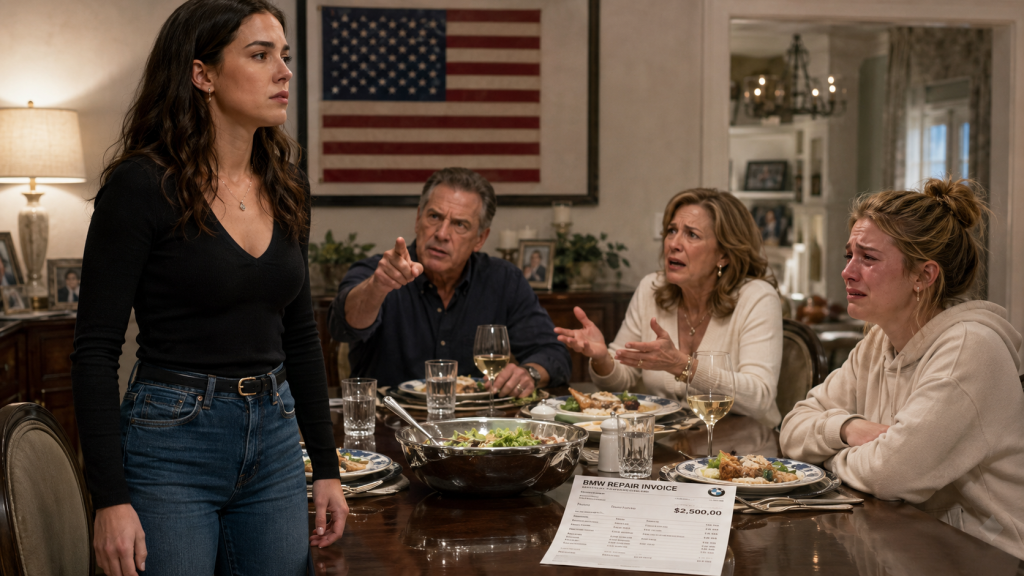
“When my family gave me an ultimatum to pay my sister’s 2,500 dollar BMW bill or leave, my heart broke, but I calmly said “”then I’m out”” and walked away—ultimately saving enough to buy my own dream house.

The dining room table felt like a war zone, and the atmosphere was thick enough to choke on. My mother slammed her hand down onto the polished wood, the silverware rattling violently against the porcelain plates. At the center of the dispute was a printed invoice for a brand-new BMW transmission repair totaling precisely two thousand five hundred dollars. It belonged to my twenty-two-year-old sister, Chloe, who sat across from me with a tear-stained face, playing the helpless victim to perfection.
“”You are going to pay for this, Maya, and that is final,”” my father declared, his voice booming with absolute authoritarian rage. “”Your sister needs her car for her internship, and you’re sitting on a healthy corporate tech salary while she has nothing. It is your family duty!””
“”My duty?”” I echoed, my voice chillingly calm as I stared them down. “”Chloe blew her entire salary on a luxury weekend trip to Miami last week instead of her car payment. Why should I bail her out for her own financial recklessness? This is the third time this year!””
My mother gasped, clutching her pearls as if I had committed a mortal sin. “”How dare you speak to us like that! After everything we’ve sacrificed for you? Here is your final ultimatum, Maya: either you transfer the two thousand five hundred dollars into Chloe’s account right now, or you pack your bags, walk out that front door, and consider yourself entirely disowned. You are dead to this family!””
The rest of the family members at the table held their breath, waiting for me to break, waiting for me to panic, cry, and submit to their emotional blackmail just like I had done a hundred times before. They thought I was trapped. They thought my need for their conditional love was stronger than my self-respect.
Instead, a profound sense of peace washed over me. I slowly pushed my chair back, stood up, and looked each one of them dead in the eye.
“”Then I’m out,”” I said clearly, my tone unwavering.
I turned around, grabbed my coat from the rack, and walked out the door without looking back. But as I pulled out of their driveway, my phone lit up with a notification from a banking app I had completely forgotten about, revealing a massive, hidden secret that would change everything forever.
PART 2: THE ACCOUNT THEY NEVER EXPECTED ME TO FIND
As I pulled out of my parents’ driveway, my phone lit up with a notification from a banking app I had completely forgotten about.
At first, I almost ignored it.
My hands were shaking too badly.
My mother’s words were still ringing in my ears.
You are dead to this family.
It is strange how a sentence can sound dramatic when you hear someone else say it.
But when your own mother looks into your eyes and says it as if she means every syllable, it does not feel dramatic.
It feels physical.
Like a door closing somewhere inside your chest.
I drove three blocks before finally pulling into the parking lot of a closed pharmacy.
Then I sat there.
Engine running.
Coat still buttoned.
Hands gripping the steering wheel.
For the first time in my life, I had nowhere I was expected to return to.
That realization should have terrified me.
Instead, beneath the grief, there was something else.
Silence.
Beautiful, unfamiliar silence.
No mother demanding I fix Chloe’s latest disaster.
No father reminding me that family loyalty meant obedience.
No Chloe sending crying emojis until I transferred money.
Nobody asking what I could give them.
Nobody telling me what I owed.
Just me.
Then my phone buzzed again.
I looked down.
The notification came from Northbridge Financial.
I frowned.
I knew the name.
Barely.
Years earlier, my grandmother Evelyn had insisted that I open some kind of investment account.
I had been twenty-one.
Fresh out of college.
Working my first miserable entry-level tech job.
I remembered sitting in Grandma’s kitchen while she tried explaining compound interest to me using sugar packets.
I had laughed.
“Grandma, I have four hundred dollars in checking. I’m not exactly Warren Buffett.”
She had pointed a spoon at me.
“People who wait until they’re rich to learn how money works usually stay dependent on people who already know.”
That was Grandma.
Tiny.
Sharp.
Impossible to intimidate.
She had died seven years ago.
Afterward, there had been funerals.
Paperwork.
Family arguments.
My parents told me she had left “a few personal things” to each grandchild.
I received her old fountain pen.
A box of photographs.
A handwritten cookbook.
Chloe received jewelry.
At least, that was what I believed.
I had not thought about Northbridge in years.
Now the notification said:
ANNUAL BENEFICIARY REVIEW COMPLETED.
Underneath it:
Updated portfolio value available.
I almost laughed.
Portfolio?
What portfolio?
I opened the app.
It asked for a password.
I stared at the screen.
Then tried the one I used in college.
Wrong.
I tried another.
Wrong.
Finally, I clicked Forgot Password.
A verification code arrived.
I entered it.
Then the screen opened.
I stopped breathing.
At first, I thought I was looking at the wrong account.
There were too many digits.
I blinked.
Looked again.
Total Portfolio Value: $186,442.17
I stared.
Then refreshed the screen.
Same number.
One hundred eighty-six thousand four hundred forty-two dollars and seventeen cents.
“No.”
I actually whispered it.
“No way.”
My heart began pounding.
I opened the account history.
There were investments.
Mutual funds.
Bonds.
Dividend reinvestments.
Quarterly contributions.
I kept scrolling.
Some deposits were small.
Some were not.
Then I found the original account.
Seven years earlier.
Initial Trust Distribution: $75,000.
My grandmother.
I stopped moving.
She had left me seventy-five thousand dollars.
Not a pen.
Not only photographs.
Seventy-five thousand dollars.
And nobody had told me.
I stared at the number until my vision blurred.
Then anger arrived.
Not yet explosive.
Confused first.
Because I was certain there had to be an explanation.
Maybe Mom had mentioned it and I forgot.
Maybe Grandma had arranged it privately.
Maybe it was inaccessible until a certain age.
Maybe—
Then I saw the administrator.
Account Trustee of Record until beneficiary age 30: Patricia Morgan.
My mother.
I was thirty-one.
My mother had controlled that account until the previous year.
My stomach turned.
I clicked deeper.
There were documents.
Letters.
Beneficiary notices.
Statements.
Some digital.
Some scanned.
One document was titled:
Distribution Acknowledgment — Evelyn Morgan Family Trust.
I opened it.
My name appeared.
Maya Morgan.
My address.
My social security information partially hidden.
Then a signature.
My signature.
Except it wasn’t mine.
I stared at it.
The M was wrong.
I always looped the bottom of the Y in Maya.
This signature didn’t.
My breathing changed.
Someone had signed my name.
I zoomed in.
Looked again.
Still wrong.
A memory surfaced.
Three years after Grandma died, my mother had once asked me to sign “tax paperwork” at the kitchen table.
There had been six or seven pages.
I barely read them.
I trusted her.
God.
I trusted her.
I scrolled.
Another file.
Trustee Withdrawal Request — $18,000.
Reason:
Beneficiary Educational Assistance.
Date:
Six years ago.
I had not been in school six years ago.
Another withdrawal.
$12,500.
Beneficiary Housing Support.
I had been paying my own rent.
Another.
$9,000.
Emergency Family Expense on Behalf of Beneficiary.
My hands began shaking.
Nearly forty thousand dollars had been withdrawn.
Under my name.
For expenses I never received.
I sat in that parking lot while years of my life rearranged themselves.
Six years earlier, my parents remodeled their kitchen.
Five years earlier, they helped Chloe buy her first car.
Four years earlier, they paid for Chloe’s semester abroad.
Three years earlier, Dad bought a fishing boat he claimed he had “saved forever” to afford.
I felt sick.
I called Northbridge.
A woman named Karen answered.
“Northbridge Financial, beneficiary services.”
I struggled to make my voice work.
“My name is Maya Morgan.”
“Yes, Ms. Morgan. How can I help you?”
“I’m looking at an account.”
She verified my identity.
Then asked what I needed.
I swallowed.
“Can you tell me who currently has authority over it?”
There was typing.
“As of your thirtieth birthday, you are the sole authorized account holder.”
My eyes closed.
“And before that?”
“The designated trustee.”
“My mother.”
“Yes.”
“Could she withdraw money?”
“Within the terms of the trust.”
“What terms?”
“Expenses deemed beneficial to you. Education, housing, medical needs, certain emergencies.”
My stomach twisted.
“What happens if she withdrew money but I never received it?”
Silence.
Professional silence.
Careful.
“Ms. Morgan, if you believe funds were misused, I would recommend speaking with an attorney and requesting a complete trustee accounting.”
I gripped the phone.
“Could she have signed forms in my name?”
“She could sign as trustee.”
“That’s not what I asked.”
Another pause.
“There should not be a need for a trustee to imitate a beneficiary signature.”
I looked at the document again.
My fake signature.
“Can you lock the account?”
“You currently have sole authority.”
“Can anyone else still access information?”
“I can add an enhanced security restriction requiring verbal verification and an additional security code.”
“Do it.”
“Certainly.”
She walked me through the process.
Then I changed every password.
New email password.
New banking password.
New security questions.
Everything.
By the time I finished, I was sweating despite the cold.
Karen asked, “Is there anything else I can help you with?”
I almost said no.
Then something stopped me.
“The current value.”
“Yes?”
“How did seventy-five thousand become almost one hundred eighty-seven thousand if nearly forty thousand was withdrawn?”
“There were additional deposits.”
My pulse jumped.
“From who?”
“I can see contributions from another trust-linked account.”
“Whose?”
“One moment.”
Keyboard clicks.
Then:
“Daniel Morgan.”
My breath caught.
Grandpa.
He had died when I was nineteen.
“Daniel Morgan?”
“Yes.”
“How much?”
“There were annual contributions for several years before the trust transferred fully into beneficiary status.”
I closed my eyes.
Grandma and Grandpa.
They had been planning for me.
Quietly.
While my parents spent years telling me everything I had came from their sacrifice.
Suddenly, I remembered Grandma helping me apply for computer science scholarships.
Grandpa buying me a refurbished laptop when Dad said spending money on “another computer hobby” was foolish.
Grandma telling me once:
“Never let gratitude become a chain, Maya.”
I had been seventeen.
I thought she was talking about college.
Maybe she had known exactly what she was saying.
I thanked Karen.
Then ended the call.
I sat there for ten more minutes.
Then my phone began vibrating.
Mom.
I watched it ring.
Stopped.
Then Dad.
Stopped.
Then Chloe.
I almost laughed.
They had disowned me less than twenty minutes earlier.
Apparently being dead to the family still involved a lot of phone calls.
I opened Chloe’s message.
Are you seriously doing this over $2,500?? Mom is crying.
Another came immediately.
Dad says if you come back now and apologize we can forget this happened.
Then:
I NEED MY CAR MAYA.
That last message did something to me.
I stared at it.
Not Are you okay?
Not I’m sorry.
Not even Can we talk?
I need my car.
Of course.
My entire value to Chloe had been reduced to whether I solved her problem.
I typed:
Then pay for it.
Three dots appeared instantly.
I DON’T HAVE $2500.
I replied:
Neither did you have money for Miami, but somehow you figured that out.
She called.
I declined.
Again.
Declined.
Then Mom sent:
Your father is furious. Come home before you make this worse.
I stared at the words.
Come home.
It was amazing how quickly I stopped knowing what that meant.
That house had never been mine.
Not emotionally.
Not really.
I had moved back six months earlier after the lease on my apartment ended because Mom convinced me it was “silly to waste money on rent.”
“You can save for your future,” she said.
At the time, it sounded loving.
Now I wondered.
Had they wanted me nearby because I earned more?
Because they had become comfortable treating my salary like family reserve money?
I opened my banking app.
Not the trust.
My personal checking and savings.
I began calculating.
Rent I had not paid for six months.
Family groceries I had covered.
Utility bills Dad “forgot.”
Chloe’s insurance twice.
Mom’s new refrigerator.
Dad’s dental bill.
Christmas flights.
Emergency car repairs.
Over the previous three years, I had probably given them more than twenty thousand dollars.
Not counting gifts.
Not counting small things.
Not counting the emotional tax of never being allowed to say no.
And they had just threatened to disown me over $2,500.
I laughed.
Then I cried.
Both happened at the same time.
I covered my face with both hands.
The grief was not really about money.
It was about discovering the math behind their love.
My family had always told me I was “the strong one.”
The responsible one.
The successful one.
I used to be proud of those labels.
Now I saw the hidden translation.
Strong meant they did not need to worry about hurting me.
Responsible meant I paid when someone else failed.
Successful meant my money belonged to the group.
Meanwhile Chloe got to be “young.”
“Finding herself.”
“Still learning.”
She was twenty-two.
At twenty-two, I had worked fifty-hour weeks.
Shared a tiny apartment with two roommates.
Paid student loans.
Sent my mother grocery money after Dad temporarily lost work.
Nobody called me young.
Nobody said I was learning.
They said:
“Maya can handle it.”
I wiped my face.
Then my phone rang again.
This time it was someone I wanted to hear.
My friend Lena.
I answered.
“Hey.”
There was silence.
Then:
“You sound horrible.”
That was enough.
I started crying again.
Lena had been my best friend since university.
She knew my family.
Not every detail.
But enough.
“Where are you?”
“Parking lot.”
“Why?”
“I got kicked out.”
Another silence.
“What?”
I explained.
The BMW.
Chloe.
The ultimatum.
Then I’m out.
When I finished, Lena said one sentence.
“Come to my place.”
I looked at the steering wheel.
“I don’t want to impose.”
“Maya.”
“I can get a hotel.”
“Maya.”
I closed my eyes.
“What?”
“You have spent ten years showing up for everybody.”
Her voice softened.
“Let someone show up for you.”
That broke something open in me.
I nodded even though she could not see me.
“Okay.”
“Do you have clothes?”
“No.”
“Toothbrush?”
“No.”
“Laptop?”
“At the house.”
“Important documents?”
“Also at the house.”
“Then you are not going back alone.”
I almost smiled.
“Lena.”
“I’m serious.”
“I can handle my parents.”
“That is not the same as needing to.”
Again.
That word.
Need.
I had spent my entire life being the person who did not need.
Maybe that was why receiving help felt so uncomfortable.
“I’ll meet you there,” she said.
Thirty minutes later, Lena pulled into my parents’ driveway behind me.
She stepped out wearing sweatpants, an enormous university hoodie, and slippers.
I stared.
“You came in slippers?”
“You called during my Sunday nap.”
Despite everything, I laughed.
“Very intimidating.”
“I brought pepper spray.”
“That improves it.”
We walked to the front door.
I still had my key.
But before I could use it, Dad opened the door.
He looked at Lena.
Then me.
His face hardened.
“So now you’re bringing witnesses?”
Lena smiled sweetly.
“I prefer emotional support human.”
Dad ignored her.
“Maya, come inside.”
“I’m getting my things.”
His expression shifted.
“What things?”
“My clothes. Laptop. Documents.”
“You’re seriously leaving?”
I stared at him.
“You told me to.”
“That was because you were being selfish.”
“No.”
“You were supposed to understand the point.”
I almost laughed.
“What point?”
“That families sacrifice for each other.”
I looked at him.
“And apparently only one daughter is required to sacrifice.”
His face reddened.
“Do not start this again.”
“I’m not.”
I stepped past him.
“I’m ending it.”
Mom appeared from the dining room.
Her eyes were red.
For half a second, guilt stabbed me.
Old reflex.
Then she said:
“Have you transferred Chloe’s money yet?”
And the guilt died.
“No.”
Mom’s face twisted.
“So you brought this girl here to help you humiliate us?”
Lena looked around.
“I promise you I have other hobbies.”
“Stay out of this.”
Lena raised both hands.
“Gladly.”
I walked upstairs.
My bedroom looked exactly the same.
Bed neatly made.
Work monitor.
Books.
Family photographs.
I stared at one from Chloe’s high school graduation.
I had flown home during a product launch.
Paid three hundred dollars extra to change my flight.
Bought her a laptop for college.
She complained the color was wrong.
At the time, I laughed.
Now the memory tasted different.
I pulled a suitcase from the closet.
Then another.
I packed quickly.
Clothes.
Shoes.
Laptop.
Documents.
Passport.
Birth certificate.
Grandma’s fountain pen.
The old cookbook.
When I picked it up, an envelope slipped from between the pages.
I froze.
My name was written on the front.
For Maya — when you finally need this.
Grandma’s handwriting.
My heart stopped.
I sat on the bed.
Lena appeared in the doorway.
“What happened?”
I held up the envelope.
“I’ve never seen this.”
The paper was yellowed.
Sealed.
I opened it carefully.
Inside was a short letter.
I recognized Grandma’s handwriting immediately.
My sweet Maya,
If you have found this, I hope it is because you were looking through my recipes and not because your mother finally made you feel unwelcome.
My breath disappeared.
Lena whispered, “Oh my God.”
I kept reading.
You are a generous girl, and generous people are often taught that boundaries are selfish. They are not.
Tears blurred the page.
Your grandfather and I created an account for you because we wanted you to have choices that did not depend on anyone’s approval.
My hands began shaking.
Patricia insisted on serving as trustee while you were young. I agreed because she is your mother, but I have sometimes worried she sees your independence as something the family can borrow from.
I covered my mouth.
Grandma knew.
Years ago.
She knew.
When you turn thirty, the account becomes yours alone. Use it for a home, education, travel, security, or nothing at all. The point is not what you buy.
The point is that no one should ever be able to tell you, “Do what I say or you will have nowhere to go.”
I stopped reading.
Completely.
My whole body began trembling.
That was exactly what had happened downstairs.
Pay Chloe.
Or leave.
Grandma had predicted the shape of my future before I understood it myself.
Lena sat beside me.
I finished the final lines.
Money does not create freedom by itself. Sometimes freedom is simply knowing you can walk through a door without begging the people behind you to open it again.
Love, always,
Grandma Evelyn.
I pressed the letter against my chest.
For the first time since leaving the dining room, I did not cry because my family rejected me.
I cried because someone had known me.
Really known me.
Someone had seen the way I gave too much.
Seen the way Mom demanded loyalty.
Seen the possibility that one day I would need a door.
And she had quietly built one.
Lena held my hand.
“You were loved.”
I nodded.
It hurt beautifully.
“Yes.”
From downstairs, Mom shouted:
“Maya!”
I folded Grandma’s letter carefully.
Put it in my handbag.
Then stood.
Something had changed.
I was not the daughter being thrown out anymore.
I was a woman choosing to leave.
There is an enormous difference between those two things.
I carried the first suitcase downstairs.
Dad stood near the front door.
Mom was beside him.
Chloe had come downstairs too.
She wore an oversized sweatshirt from the Miami resort.
I almost laughed at the symbolism.
Chloe crossed her arms.
“This is insane.”
I kept walking.
“All this because I needed help?”
I stopped.
“No.”
I looked at her.
“This is because you have never learned that your emergencies belong to you.”
Her mouth fell open.
“I’m your sister.”
“Yes.”
“So?”
“So being your sister does not make me your bank.”
She looked at Mom.
“See?”
Mom stepped toward me.
“Your sister is twenty-two.”
“I know.”
“She’s still young.”
“At twenty-two, you made me pay rent.”
Mom flinched.
“That was different.”
“Why?”
“You had a job.”
“So does Chloe.”
“Her internship barely pays anything.”
“Then she cannot afford a BMW.”
Dad snapped, “Enough.”
I looked at him.
“No.”
His face changed.
I smiled faintly.
“You used that word my whole childhood.”
“What?”
“Enough.”
I put my suitcase near the door.
“Whenever I asked why rules were different for Chloe.”
Dad’s jaw tightened.
“Whenever I questioned money.”
Another bag.
“Whenever I asked why helping this family somehow always meant me giving and everyone else receiving.”
Mom folded her arms.
“You’re rewriting history.”
That sentence almost made me tell them about the trust.
Almost.
But Grandma’s letter was still warm inside my handbag.
The point was choice.
And for once, I did not need to reveal everything I knew immediately.
I looked at Mom instead.
“Did Grandma leave me money?”
Her face changed.
Tiny.
But unmistakable.
Dad’s eyes moved toward her.
Chloe frowned.
“What?”
I stared directly at my mother.
“Did Grandma leave me money?”
Mom recovered.
“Grandma left things to everyone.”
“That isn’t what I asked.”
Dad stepped forward.
“What does this have to do with Chloe’s car?”
“Nothing.”
I kept looking at Mom.
“That’s why I’m asking.”
She sighed.
“She left an investment account.”
My heartbeat stayed steady.
“How much?”
“I don’t remember.”
Lie.
I knew immediately.
My mother remembered the price of every Christmas gift I had ever bought.
She remembered how much I earned.
She remembered Chloe’s tuition down to the semester.
She did not forget seventy-five thousand dollars.
“You were the trustee.”
Her face went pale.
Dad looked at her.
“What is she talking about?”
Interesting.
Dad did not know everything.
That surprised me.
Mom’s voice sharpened.
“This is not something we need to discuss right now.”
I almost smiled.
“Why?”
“Because you’re upset.”
“I’m actually remarkably calm.”
“Maya.”
“Did you withdraw money?”
She froze.
Chloe looked confused.
Lena moved closer to me.
Mom glanced toward her.
“This is private.”
“No.”
I shook my head.
“You made my salary public at dinner when you demanded I pay Chloe’s bill.”
Mom’s face reddened.
“So we can talk about money.”
I reached into my handbag.
I did not pull out Grandma’s letter.
I pulled out my phone.
Opened the trustee records.
Then held the screen toward Mom.
Her entire face changed.
“You accessed that?”
The question was so revealing I almost laughed.
Not:
What is that?
Not:
I can explain.
You accessed that?
Like the account still belonged to her.
“Yes.”
“How?”
“It’s mine.”
Dad moved closer.
“What account?”
Mom snapped, “Charles, stay out of it.”
Wrong name? Wait user dad unnamed. Need avoid. We introduced Charles erroneously? No user’s dad not named. We should fix. Say Dad. Need continue with no name.
Dad stared at her.
“Why are you telling me to stay out of it?”
Mom looked trapped.
For the first time that night, she was the person searching the room for rescue.
None came.
I lowered the phone.
“Grandma left me seventy-five thousand dollars.”
Chloe’s eyes widened.
“What?”
Dad looked at Mom.
“Patricia?”
So we can establish mother Patricia now. Fine. Dad says Patricia. Need father’s name maybe Robert later? Could avoid.
Mom lifted her chin.
“It was family money.”
“No.”
My voice became quiet.
“It was my money.”
“I managed it.”
“You withdrew almost forty thousand dollars.”
Chloe’s mouth fell open.
Dad looked genuinely shocked.
“What?”
Mom spun toward him.
“It paid for family expenses.”
I felt ice move through me.
“So you did take it.”
“You were young!”
“I was twenty-four.”
“You didn’t need that kind of money.”
There it was.
The same logic.
Again.
Chloe needs.
Maya doesn’t.
Therefore Maya pays.
“You signed my name.”
Mom went silent.
Dad looked from her to me.
“What do you mean she signed your name?”
I opened the scanned document.
Then handed him the phone.
He stared at it.
Mom’s voice rose.
“I handled paperwork as trustee.”
“That form doesn’t have your trustee signature.”
I pointed.
“It has mine.”
Dad looked at Mom.
“Patricia.”
She snapped, “Do not look at me like that.”
He lowered the phone.
“Did you sign Maya’s name?”
“I was managing the account!”
“That isn’t an answer.”
For once, my father sounded less angry at me than confused by the woman beside him.
Mom turned toward me.
“That money helped this household.”
I almost whispered the next question.
“Did it pay for Chloe’s car?”
Silence.
Chloe stared at Mom.
“What?”
My chest tightened.
“The first car.”
The one Mom and Dad gave Chloe when she turned eighteen.
A nearly new BMW.
They had told me Dad received a huge work bonus.
At eighteen, I drove Grandma’s twelve-year-old Honda.
I loved that car.
But the difference suddenly felt cruel.
Mom said nothing.
Chloe whispered, “Mom?”
Dad looked sick.
I asked again.
“Did Grandma’s money help buy Chloe’s BMW?”
Mom finally exploded.
“You had everything!”
Her voice echoed through the house.
“You had scholarships. A career. A good salary. You didn’t need us!”
There.
The sentence I had apparently been punished for my entire adult life.
I didn’t need them.
And because I needed less, I deserved less.
Because I succeeded, I became easier to take from.
I looked at my mother.
Tears filled my eyes.
“I needed a mother.”
Her anger faltered.
“I needed parents who were proud of me without immediately asking what my success could do for Chloe.”
My voice broke.
“I needed someone to tell me I was allowed to keep something for myself.”
Mom’s mouth trembled.
“But every time I became more capable, you gave me more responsibility and gave her more protection.”
Chloe was crying now.
I looked at her.
She looked young.
For the first time, truly young.
Not helpless.
Just shocked.
Perhaps she had never known where some of the money came from.
That did not excuse how she treated me.
But it changed one small piece.
Dad stared at Mom.
“How much did you use?”
She said nothing.
“How much?”
“Thirty-nine thousand five hundred.”
The exactness made me almost laugh.
She remembered after all.
Dad backed away.
“You told me the kitchen money came from your investment account.”
Mom looked at him.
“It was family money.”
I whispered, “Stop calling it that.”
She turned toward me.
“It would have eventually been yours anyway.”
“It already was mine.”
My voice shook now.
“You didn’t even ask.”
Silence.
“You taught me my whole life that taking something without permission was stealing.”
Mom flinched.
“So what do you call this?”
Nobody answered.
I picked up my suitcase.
Dad said my name.
“Maya.”
I stopped.
For years, that tone would have turned me around.
I looked back.
He seemed older suddenly.
Not softer.
Just smaller.
“You can stay tonight.”
The offer was so absurd it almost hurt.
I smiled sadly.
“Twenty minutes ago, I was dead to this family.”
He looked away.
“I was angry.”
“No.”
I shook my head.
“You were confident.”
His eyes returned to mine.
“You were confident I would surrender.”
I opened the front door.
Cold evening air rushed in.
“I didn’t.”
Mom started crying.
“Maya, don’t leave like this.”
I looked at her.
“You gave me the ultimatum.”
“I didn’t mean forever.”
That was the sentence that finally freed me.
Because she had never expected the threat to cost her anything.
It was supposed to frighten me.
Control me.
Make me pay.
The possibility that I might actually accept it had never entered her mind.
I stepped outside.
Then looked back.
“Neither did I.”
Lena carried the second suitcase.
We loaded everything into my car.
Chloe followed me onto the porch.
“Maya.”
I kept packing.
She came closer.
“I didn’t know about Grandma’s money.”
I looked at her.
“I believe you.”
She wiped her face.
“I thought Mom and Dad bought me the car.”
“I believe that too.”
She hesitated.
Then said, “But I still need the repair.”
I stared at her.
For one second, I genuinely wondered whether I had heard correctly.
Then I laughed.
Not cruelly.
Not angrily.
I simply could not help it.
Chloe frowned.
“What?”
I closed the trunk.
“Sell the Miami handbags.”
Her mouth fell open.
“You’re serious?”
“Completely.”
“Maya!”
I got into my car.
For once, I did not solve it.
That felt almost intoxicating.
At Lena’s apartment, I slept on her sofa.
Or tried.
At two in the morning, I was still awake.
My phone contained seventeen messages.
Mom apologizing and defending herself in the same paragraph.
Dad insisting we needed a “family meeting.”
Chloe asking whether I could at least loan her half.
I turned the phone off.
Then stared at the ceiling.
I expected fear to come.
The terrifying question:
What now?
Instead, another question arrived.
What do I want?
I did not know.
That was the extraordinary thing.
At thirty-one years old, I realized I had built my entire life around what other people needed.
What did Maya want?
Not Mom.
Not Dad.
Not Chloe.
Me.
The question felt almost embarrassing.
Then exciting.
I sat up.
Opened my laptop.
Logged into the trust account again.
$186,442.17.
Then I opened my own savings.
$48,700.
I had been saving aggressively while living with my parents.
My retirement accounts were separate.
My job was secure.
I had no credit-card debt.
For the first time, I saw the numbers not as money waiting for the next emergency.
But as choices.
Grandma’s letter was on the coffee table.
Use it for a home, education, travel, security, or nothing at all.
A home.
My heart shifted.
For years, I had dreamed about owning a house.
Not enormous.
Not flashy.
A small place with windows.
A backyard.
A room I could turn into an office.
A kitchen no one could slam their hand against while demanding money from me.
I opened a real-estate website.
Just looking.
That was what I told myself.
One listing became five.
Five became twenty.
Then I saw it.
A small craftsman house twenty-five minutes outside the city.
Three bedrooms.
Two bathrooms.
A porch.
Oak floors.
A garden badly in need of attention.
And a kitchen with morning light pouring through two large windows.
I stared.
The price was $329,000.
My chest tightened.
I could afford a serious down payment.
Maybe even more if I waited.
For years, whenever I imagined buying something for myself, Mom’s voice appeared immediately.
Do you really need that?
Then Chloe’s.
Must be nice.
Then Dad’s.
Family helps family.
That night, their voices were still there.
But quieter.
And beneath them, I could almost hear Grandma.
Choices.
I bookmarked the house.
I did not buy it.
Not yet.
But something had begun.
Over the next three months, I rented a small furnished apartment.
It was only seven hundred square feet.
The bedroom barely fit my bed.
The dishwasher sounded like a helicopter preparing for takeoff.
The upstairs neighbor apparently practiced bowling at midnight.
I loved every inch of it.
Because when I came home, nothing waited for me except peace.
No invoice on the dining table.
No emergency I was expected to fund.
No mother sighing because Chloe wanted something.
I made pasta at eleven at night.
Played music too loudly.
Bought ridiculous yellow pillows.
And for the first time, when my paycheck arrived, it stayed mine.
The change was startling.
I created a strict savings plan.
Automatic transfers.
Investments.
House fund.
Emergency fund.
I began working with a financial adviser recommended by Lena.
Then an attorney reviewed Grandma’s trust.
The withdrawals were real.
The signatures were a problem.
A serious one.
I had choices.
Legal choices.
I could pursue my mother.
Demand an accounting.
Seek repayment.
For weeks, I did not know what to do.
Then Mom sent me a check.
$39,500.
No message.
Just a check.
I stared at it.
My phone rang ten minutes later.
Dad.
I answered.
“What?”
He sounded exhausted.
“Your mother sold the boat.”
I blinked.
“What?”
“The boat. Some jewelry. We used savings for the rest.”
I sat down.
“She repaid you.”
I looked at the check again.
“Why?”
Dad was silent for a moment.
“Because I told her she had to.”
That surprised me.
He continued.
“I should have known.”
“Yes.”
“I should have asked more questions.”
“Yes.”
“I treated you unfairly.”
I closed my eyes.
My father had apologized maybe three times in my entire life.
Every instinct wanted to make it easier for him.
Say:
It’s okay.
You did your best.
Forget it.
I did not.
Instead, I said:
“Thank you for saying that.”
There was silence.
Then Dad asked, “Are you coming home?”
I looked around my tiny apartment.
The ugly yellow pillows.
The coffee cup beside my laptop.
The quiet.
“No.”
His voice changed.
“You have your money back.”
And there it was.
He thought the debt had been financial.
It wasn’t.
“Dad.”
“What?”
“Home was the place where you told me I was dead to you because I wouldn’t pay for Chloe’s BMW.”
He said nothing.
“I’m not coming back because a check cleared.”
I heard him breathe.
“So what do you want?”
For once, I knew.
“Time.”
He did not like the answer.
But he accepted it.
Mostly.
Chloe did not.
Her messages became increasingly dramatic.
She sold two designer bags to repair the BMW.
Then complained for three weeks that I “forced her” to do it.
I did not respond.
Then, something unexpected happened.
She got promoted at her internship.
Full-time offer.
Better salary.
Six months later, she traded the BMW for a used Honda.
The same sister who once acted like driving anything without a luxury badge was a human-rights violation sent me a picture.
Look. Responsible era.
I stared at it for a long time.
Then replied:
About time.
She sent back:
Rude.
I almost smiled.
Maybe boundaries were doing something nobody’s rescuing ever had.
They were forcing Chloe to grow.
I kept saving.
Month after month.
My trust investments grew.
My personal savings grew faster now that family emergencies were no longer automatically mine.
I received a raise.
Then a performance bonus.
I put almost all of it into the house fund.
The craftsman house I had bookmarked sold before I was ready.
I was strangely heartbroken.
Then Lena said:
“That wasn’t your house.”
“How do you know?”
“Because someone else bought it.”
Annoying.
Correct.
Nine months after the dinner ultimatum, my real-estate agent called.
“Maya, I found something.”
The house was twenty minutes farther out.
Brick and cedar.
Three bedrooms.
A small office with built-in shelves.
A fireplace.
Old oak trees.
A deep backyard.
And a kitchen with wide windows facing east.
The moment I walked inside, morning light was pouring across the floor.
I stopped.
My agent smiled.
“I know that face.”
I whispered, “Oh no.”
She laughed.
“Yes.”
I walked through every room.
The house was not perfect.
The upstairs bathroom needed renovation.
The basement was aggressively 1980s.
One bedroom had wallpaper covered in tiny blue ducks.
But it felt—
Mine.
Not yet legally.
But emotionally.
Possible.
I stood in the kitchen.
Ran my hand over the counter.
Then imagined a dining table there.
A different one.
A table where nobody would slam invoices down and threaten exile.
A table where money was never proof of love.
I made an offer.
Two days later, it was accepted.
I sat in my car outside work when the call came.
Then I cried so hard my agent thought something was wrong.
“Are you okay?”
“Yes.”
I laughed through tears.
“I’m buying a house.”
The sentence felt impossible.
Grandma’s trust did not pay for all of it.
I refused to do that.
I used part of it for the down payment.
My own savings covered another portion.
I kept the majority of Grandma’s account invested.
Because I finally understood what she had really left me.
Not a house.
Not money.
A foundation.
The freedom to build without begging.
Closing day was scheduled for the following month.
I told nobody in my family.
Not Mom.
Not Dad.
Not even Chloe.
Only Lena knew.
I wanted one thing in my life to become real before my family got the chance to have an opinion about it.
Then, exactly eleven days before closing, I received an unexpected email from my attorney.
Subject:
Additional Evelyn Morgan Trust Documentation
I opened it.
My heart started pounding almost immediately.
They had found another document in the original estate records.
Not another account.
Something stranger.
A letter from Grandma to my mother.
Dated two months before Grandma died.
The first line read:
Patricia, if Maya ever discovers you used her trust to support Chloe, you are to repay every dollar immediately.
I froze.
Grandma had known.
Not suspected.
Known.
I kept reading.
I have watched you turn Maya’s competence into an excuse to require more from her while giving Chloe less responsibility. I have warned you before that this will eventually cost you your older daughter.
My breathing stopped.
Grandma had predicted everything.
Then came the final paragraph.
And that was the part that changed the entire story.
There is one final provision you have not been informed of. If Maya reaches thirty years of age and the trust accounting reveals unauthorized withdrawals on behalf of another beneficiary, Maya becomes eligible to receive sole title to the Cedar Ridge property.
I stared at the screen.
Cedar Ridge?
I had never heard of it.
I called my attorney immediately.
“What is Cedar Ridge?”
There was a pause.
Then:
“Your grandmother’s second property.”
“My grandmother didn’t have a second property.”
“Apparently she did.”
My heart began racing.
“Where?”
“About forty miles north of the city.”
I stood.
“What kind of property?”
Another pause.
“A house.”
I felt the office around me disappear.
“A house?”
“Yes.”
“How much is it worth?”
“We’re getting a current appraisal.”
I gripped my desk.
“And who owns it now?”
“That is where things become complicated.”
Of course they did.
“What does that mean?”
“The property has been managed by your mother since Evelyn’s death.”
My stomach turned.
“Does Mom live there?”
“No.”
“Then who does?”
Silence.
I suddenly knew I was not going to like the answer.
“Who?”
My attorney exhaled.
“Your sister.”
I stopped breathing.
“Chloe?”
“Yes.”
My voice disappeared.
“The apartment she tells everyone she rents?”
Another pause.
“It appears to be part of the Cedar Ridge property.”
I sank into my chair.
For two years, Chloe had bragged about her “cute little rental.”
Mom had occasionally complained about helping her with rent.
Dad had once asked me to cover Chloe’s utilities because “city housing is expensive.”
And apparently Chloe had not been renting anything at all.
She had been living in a property that may legally have belonged to me.
My attorney continued.
“Maya, there’s more.”
I closed my eyes.
“Of course there is.”
“Your mother submitted paperwork last month.”
My stomach tightened.
“What paperwork?”
“A deed transfer request.”
“To who?”
He hesitated.
Then said:
“Chloe.”
The room went completely silent.
Eleven days before I was supposed to close on the first home I believed I had ever owned, I discovered my grandmother may already have left me one.
And my mother was apparently trying to give that away too.
I looked at Grandma’s letter on my screen.
One sentence stood out above all the rest.
This will eventually cost you your older daughter.
Grandma had been right.
But this time, I was not walking away with only a coat and a broken heart.
This time, I had documents.
An attorney.
A trust.
A house of my own waiting to close.
And something my family had never expected me to develop.
The willingness to let them face the consequences of taking from me.
I picked up my phone.
My attorney was still on the line.
“Maya?”
“Yes.”
“What do you want us to do?”
I looked through my office window at the city below.
Then I thought about the dining table.
The BMW invoice.
My mother’s ultimatum.
Pay or leave.
I had left.
And somehow, walking away had led me directly to everything they had tried to hide.
My voice was perfectly steady when I answered.
“Stop the transfer.”
A pause.
“Immediately?”
“Immediately.”
“And after that?”
I looked again at Grandma’s letter.
Then I smiled.
Not because I wanted revenge.
Because for once, I was finally ready to protect what belonged to me.
“After that,” I said, “I think it’s time my family learns whose house Chloe has actually been living in.”
PART 3: THE HOUSE THEY TRIED TO GIVE AWAY
“After that,” I said, “I think it’s time my family learns whose house Chloe has actually been living in.”
My attorney went quiet for half a second.
Then I heard paper moving.
“All right.”
His voice became sharper.
Professional.
Focused.
“I’ll file the emergency notice today.”
“Can the transfer be stopped?”
“If the documents say what we think they say, yes.”
“What happens to Chloe?”
“That depends.”
“On what?”
“Whether she knew the property was not your mother’s to give.”
I leaned back in my office chair.
That question hurt more than I expected.
Did Chloe know?
For most of my life, I had blamed her for taking whatever my parents handed her.
Money.
Cars.
Trips.
Attention.
Excuses.
But there was a difference between accepting favoritism and knowingly helping someone steal a house.
I wanted to believe she had not crossed that line.
Then I remembered the BMW.
The Miami trip.
Her standing on the porch asking whether I could still pay half.
And I honestly did not know anymore.
“How soon will we know?”
“I’ll request the full title history.”
“Do it.”
“And Maya?”
“Yes?”
“Do not call your family until we secure the records.”
I almost smiled.
“Trust me.”
That phrase felt strange now.
Trust.
Once, I handed it out because people shared my blood.
Now I was learning to give it more carefully.
“I’m not calling anybody.”
I ended the call.
Then I sat there.
Motionless.
My computer screen still showed Grandma Evelyn’s letter.
The sentence glowed in front of me.
This will eventually cost you your older daughter.
For years, I thought Grandma’s greatest gift was the account.
Then I thought it was the letter hidden inside her cookbook.
Now I understood.
Her greatest gift had been clarity.
She had seen our family long before I had the courage to.
She saw what my parents called “helping Chloe.”
She saw what they called “Maya can handle it.”
She understood that favoritism rarely announces itself as cruelty.
Sometimes it dresses itself as necessity.
One child is sensitive.
One child is strong.
One needs more.
One will understand.
Again.
And again.
And again.
Until the strong child becomes a resource instead of a daughter.
I closed the laptop.
Then I cried.
Not dramatically.
I just sat there with tears running down my face while people walked past my office glass and pretended not to notice.
I cried for the money.
For the house.
For Grandma.
For twenty-two-year-old me working two jobs while Chloe’s car may have been paid for using money left in my name.
But mostly, I cried because I was finally beginning to understand how many years of my life had been shaped by decisions made in rooms where nobody thought I deserved a vote.
That evening, Lena came over.
She brought Thai food.
I gave her wine.
Then I told her about Cedar Ridge.
She stared at me over a carton of noodles.
“Your grandmother left you a house.”
“Apparently.”
“Your mother knew.”
“Yes.”
“Your sister is living there.”
“Yes.”
“And your mother tried to transfer the deed to her.”
“Yes.”
Lena slowly put down her fork.
“Maya.”
“I know.”
“No, I mean Maya.”
“What?”
“Your family needs a hobby.”
I laughed.
Hard.
Unexpectedly.
The kind of laugh that hurts your ribs because grief has occupied too much space there.
Lena smiled.
“There she is.”
I wiped my eyes.
“I feel insane.”
“You are not insane.”
“I keep finding things.”
“I know.”
“It’s like every time I think I’ve reached the bottom, someone opens another trapdoor.”
Lena nodded.
“So stop trying to reach the bottom.”
I frowned.
“What?”
“You don’t need to discover every bad thing they ever did before you’re allowed to leave.”
That sentence settled deeply.
I looked down.
“I know.”
“Do you?”
I did not answer.
She softened.
“You keep searching because some part of you thinks there will be one final piece of evidence that makes walking away completely guilt-free.”
My throat tightened.
“That evidence doesn’t exist.”
I stared at her.
“Because they’re still your family.”
She took my hand.
“You can know they hurt you and still miss them.”
Tears returned.
“You can be right and still grieve.”
I nodded.
Slowly.
“And you can protect yourself before you finish understanding them.”
That night, I slept better than I had in months.
Two days later, my attorney called.
The deed transfer had been stopped.
Cedar Ridge could not legally be transferred while ownership was disputed.
More importantly, the original trust provision was valid.
The property had been held under a separate trust arrangement.
When I turned thirty, and once the trustee accounting showed unauthorized use of my money for another beneficiary, ownership should have transferred to me.
It never did.
Instead, Mom continued managing the property.
Rent-free.
Quietly.
Chloe moved in two years earlier.
I asked the question I had been dreading.
“Did Chloe know?”
My attorney hesitated.
“She signed an occupancy agreement.”
My stomach dropped.
“What kind?”
“It identifies Patricia as property manager.”
“Not owner?”
“No.”
“So Chloe knew Mom did not own it.”
“She knew enough to know your mother was acting in a management capacity.”
My chest tightened.
“Did my name appear anywhere?”
“Yes.”
I closed my eyes.
There it was.
Not total ignorance.
Not innocence.
Maybe Chloe did not understand the legal details.
But my name had been on the paperwork.
She had known something.
“How much rent was she paying?”
“According to the agreement, eighteen hundred dollars a month.”
I laughed once.
“Did she?”
“No payments were recorded.”
Of course not.
And Mom had asked me to help with Chloe’s utilities.
I pressed my fingers against my forehead.
“So she lived there for free.”
“Yes.”
“In a house Grandma left me.”
“Yes.”
“And my parents told me she was struggling with rent.”
“Yes.”
I could hear the embarrassment in his voice even though none of this was his doing.
“Can she stay there?”
“That is your decision once title is corrected.”
My decision.
Those words felt enormous.
My whole childhood, decisions flowed downward.
Dad decided.
Mom enforced.
Chloe received.
Maya adjusted.
Now an entire house sat inside a sentence that ended with:
Your decision.
I took a breath.
“I want the title corrected.”
“Understood.”
“I want an independent inspection.”
“Yes.”
“And I don’t want anyone removing anything from the property until we document what’s there.”
“Good.”
“Can we do that?”
“We can seek appropriate protective measures.”
“Do it.”
Then I added:
“I’m not kicking Chloe onto the street tonight.”
My attorney paused.
“You don’t have to.”
“But I’m also not letting them pretend this never happened.”
“That is entirely reasonable.”
Three days later, Mom called me.
I did not answer.
Then Dad.
Then Chloe.
I let all three go to voicemail.
Mom left the first message.
“Maya, I don’t know what some lawyer has told you, but this is getting out of control.”
Of course.
Not:
I’m sorry.
Not:
We need to explain.
Out of control.
Meaning beyond hers.
Dad’s voicemail was shorter.
“Call me.”
That was it.
Chloe’s message came last.
Her voice was shaking.
“Maya, are you trying to take my house?”
I stared at the phone.
My house.
She had already absorbed it.
The story.
The entitlement.
The idea that possession became ownership if nobody challenged it long enough.
I called her back.
Not Mom.
Not Dad.
Chloe.
She answered instantly.
“What are you doing?”
“Hello to you too.”
“This isn’t funny.”
“No.”
“You put some kind of legal block on the house.”
“I did.”
“You can’t do that!”
“I can.”
“It’s my home.”
“Chloe.”
“What?”
“Do you know who owns Cedar Ridge?”
Silence.
Then:
“Mom.”
“No.”
“She manages it.”
“Exactly.”
Another silence.
I continued.
“My name was on your occupancy agreement.”
She said nothing.
“Did you see it?”
“I don’t remember.”
“Try.”
“Maya, I signed whatever Mom gave me.”
I almost laughed bitterly.
“That sentence sounds familiar.”
She snapped.
“What is that supposed to mean?”
“Nothing.”
I took a breath.
“Grandma left Cedar Ridge to me under the trust.”
“No.”
“Yes.”
“Mom said Grandma wanted the family to use it.”
“That isn’t the same thing.”
“She said it would eventually go to me.”
My chest tightened.
There.
The truth.
“She told you that?”
“Yes.”
“When?”
Chloe hesitated.
“When I moved in.”
My stomach sank.
“So you knew there was a future transfer.”
“She said it was complicated.”
“To you.”
“Yes.”
“Did she say I had any claim?”
Silence.
“Chloe.”
“She said you didn’t care about it.”
My heart broke in a new place.
“What?”
“She said you had your career and your investments and probably wouldn’t want some old house outside the city.”
I closed my eyes.
Mom had spoken for me.
Again.
Decided what I did not need.
Again.
Just like the trust money.
Just like family help.
Just like everything else.
“And you believed her?”
“What was I supposed to think?”
“You could have asked me.”
“You never talk to me about money.”
I nearly laughed.
“Because every time we talk about money, you need some.”
“That’s not fair.”
“No.”
My voice went quiet.
“Fair would have been someone telling me Grandma left me a house.”
Chloe started crying.
I hated that it still worked on me.
My chest tightened automatically.
Old reflex.
Protect Chloe.
Comfort Chloe.
Fix it.
I let the silence stay.
She whispered, “Are you kicking me out?”
“I haven’t decided.”
“Maya.”
“You have a job.”
“I just started saving.”
“Good.”
“I can’t afford rent right now.”
“Then you understand how useful rent-free housing is.”
“That’s cruel.”
“No.”
I closed my eyes.
“Cruel was Mom asking me to help with your expenses while you were living rent-free in a property she knew belonged to me.”
Chloe said nothing.
“Did you know she used Grandma’s trust money for your first BMW?”
“No.”
I believed her.
“Did you know she used money from that account for your semester abroad?”
Her breathing changed.
“What?”
I froze.
“You didn’t know?”
“No.”
The word came out small.
“Oh my God.”
I sat down.
For the first time, Chloe did not sound entitled.
She sounded sick.
“Maya.”
“What?”
“I thought Dad’s bonus paid for that.”
“So did I.”
Silence.
Then Chloe whispered:
“What else did they pay for with your money?”
“I don’t know.”
She started crying harder.
“I swear I didn’t know.”
“I believe you.”
It hurt to say.
Because believing her meant accepting something more complicated.
Chloe had been favored.
Yes.
Entitled.
Yes.
Careless.
Absolutely.
But she had also been raised inside a story our parents wrote for both of us.
Maya is strong.
Chloe needs help.
Maya can afford it.
Chloe is still learning.
And after enough years, children become adults who repeat whatever role got rewarded.
I had become useful.
Chloe had become helpless.
Neither of us had been loved well.
Different damage.
Same parents.
Chloe whispered:
“Why didn’t they just tell us?”
I looked out the window.
“Because then we might have had choices.”
That silenced her.
A week later, we had the family meeting.
Not at my parents’ house.
I refused.
Not at Cedar Ridge.
I refused that too.
We met in my attorney’s conference room.
Neutral walls.
Neutral chairs.
No childhood photographs.
No dining table.
Nothing that belonged to my parents’ authority.
Mom hated it immediately.
She sat stiffly beside Dad.
Chloe sat across from me.
My attorney had the trust documents in front of him.
Lena was not there.
Neither was anyone else.
Just us.
Family.
And paper.
I had never realized how much paper can protect a person from revision.
Mom spoke first.
“This is humiliating.”
I looked at her.
“For who?”
Her face tightened.
“This could have been discussed privately.”
“We are discussing it privately.”
“You involved lawyers.”
“Because you involved deeds.”
Dad sighed.
“Maya.”
I looked at him.
“We all made mistakes.”
There it was.
The communal apology.
We all.
No.
“I didn’t forge anyone’s name.”
Dad looked away.
Mom snapped, “I was acting as trustee.”
My attorney calmly slid the disputed signature page toward her.
“Not on this document.”
She did not touch it.
He placed another document beside it.
Then Grandma’s letter.
Then the trust clause.
Then the deed.
Piece by piece.
The version of reality my mother preferred was buried beneath evidence.
Mom stared at the papers.
“I did what I thought was best.”
I felt my whole body go still.
“Best for who?”
“For the family.”
“No.”
I leaned forward.
“You keep saying family when you mean Chloe.”
Chloe flinched.
Mom turned toward her.
“Don’t listen to that.”
I laughed.
“See?”
Mom glared at me.
“She needed more help.”
“And you decided that meant taking from me.”
“You had more.”
“I earned more.”
“You were lucky!”
Something in me cracked.
“Lucky?”
I stared at her.
“I worked through college.”
“So did lots of people.”
“I took internships nobody wanted.”
“Everyone works.”
“I built my career while sending money home.”
“Because you could.”
There it was.
Again.
Because you could.
I looked at Dad.
“Do you agree with her?”
He looked exhausted.
“No.”
Mom turned sharply.
“What?”
Dad swallowed.
“No.”
For once, his voice was not loud.
“I don’t.”
Mom stared.
Dad continued.
“I think we treated Maya like having more meant owing more.”
My throat tightened.
Mom’s face went pale.
“You’re blaming me?”
“I’m blaming both of us.”
That surprised me.
He looked at me.
“I did not know about the original trust withdrawals.”
“I know.”
“But I knew we leaned on you.”
“Yes.”
“I told myself you could handle it.”
I felt tears fill my eyes.
Dad looked down.
“That doesn’t mean we should have made you.”
For one second, I saw a version of my father I wished had existed sooner.
Then Mom said:
“So what? We just hand Maya everything?”
I turned toward her.
Everything.
That word.
As if receiving what was legally mine counted as being spoiled.
I almost smiled sadly.
“Mom.”
“What?”
“I don’t want everything.”
She laughed bitterly.
“You’re taking the house.”
“It is mine.”
“You have enough money.”
My heart went quiet.
“And there it is.”
She looked confused.
“That sentence.”
I leaned back.
“That is the entire problem.”
I wiped one tear away.
“You look at what I have and decide I can survive without what belongs to me.”
Mom opened her mouth.
“No.”
I continued.
“You look at Chloe and decide needing something makes her entitled to it.”
Chloe began crying.
I looked at her.
“I’m not blaming you for all of this.”
She nodded through tears.
“But I am asking you to stop participating in it.”
Mom snapped:
“She isn’t participating in anything.”
Chloe turned toward her.
“Yes, I am.”
Everyone went silent.
Mom stared.
“What?”
Chloe wiped her face.
“I knew Maya’s name was on the occupancy paperwork.”
Mom stiffened.
“I knew you said she didn’t want the house.”
“Because she didn’t.”
“You never asked her.”
“She was too busy.”
“That isn’t the same thing!”
Chloe’s voice rose.
I had rarely heard her challenge Mom.
Dad looked stunned.
Chloe continued.
“And I should have asked too.”
She looked at me.
“I didn’t because the answer I had was convenient.”
That sentence mattered.
Not because it fixed anything.
Because accountability had finally entered the room.
Mom stared at Chloe as if betrayal were happening to her.
“After everything I did for you.”
Chloe’s face crumpled.
“I know.”
“No, you don’t.”
Mom stood.
“I protected you.”
Chloe looked at her.
“From what?”
“Struggling.”
The room went quiet.
Chloe gave a sad laugh.
“You protected me from learning how to handle my own life.”
Mom’s mouth opened.
No sound came.
Chloe looked at me.
“Maya paid for things.”
Then Dad.
“You fixed things.”
Then Mom.
“And whenever I messed up, someone made it disappear.”
She wiped her face.
“I thought that meant I was loved more.”
My throat tightened.
“What do you think now?” I asked.
She looked at me.
“I think it made me worse.”
Mom sat down.
For the first time, she seemed smaller.
Not because we had defeated her.
Because the story she had told herself no longer worked even on the daughter she used it to protect.
My attorney cleared his throat.
“The immediate issue is Cedar Ridge.”
Everyone looked toward him.
“Title will be transferred to Maya.”
Mom said nothing.
Dad nodded.
Chloe lowered her eyes.
I took a breath.
“Chloe can stay for ninety days.”
Her head lifted.
Mom immediately said:
“She needs more time.”
I held up a hand.
“No.”
Mom stopped.
“Three months.”
I looked at Chloe.
“No rent.”
Her face changed.
“But you use those three months to save.”
She nodded.
“And after that?”
“You move.”
Tears filled her eyes.
“Okay.”
No argument.
No demand.
Just okay.
That mattered too.
Then I added:
“I’m not moving into Cedar Ridge.”
Mom looked up.
“What?”
Dad frowned.
Chloe stared.
I smiled slightly.
“I’m closing on my house next week.”
Silence.
Dad blinked.
“You bought a house?”
“Yes.”
Mom looked genuinely shocked.
“Without telling us?”
The irony was so enormous I almost laughed.
“Yes.”
Her face hardened.
“That is a huge decision.”
“I know.”
“You should have discussed it with family.”
I stared at her.
Then all four of us began laughing.
Even Dad.
Even Chloe.
Mom did not.
But for the first time, her inability to understand the irony no longer made me angry.
It made me tired.
The meeting ended without reconciliation.
But it ended with truth.
Sometimes that is the best beginning available.
I closed on my house eleven days later.
Lena came.
She brought champagne.
My real-estate agent brought flowers.
I signed my name so many times my hand cramped.
But every signature was mine.
That mattered.
When they handed me the keys, I stared at them.
Two little pieces of metal.
Nothing dramatic.
Yet I began crying.
My agent smiled.
“First house?”
“Yes.”
Lena corrected her.
“First house she chose.”
I looked at her.
She knew.
Of course she knew.
We drove there together.
The house was empty.
Quiet.
Sunlight poured across the kitchen floor.
I walked from room to room.
Touched walls.
Opened closets.
Stood in the ridiculous duck-wallpaper bedroom.
Then I sat on the living room floor.
No furniture.
No dining table.
No demands.
Just possibility.
Lena sat beside me.
“You okay?”
I nodded.
Then shook my head.
Then laughed.
“I don’t know.”
She handed me the champagne bottle.
I took a sip straight from it.
“Elegant.”
“I own property now. I make rules.”
She laughed.
We ordered pizza.
Ate it on the floor.
That first night, after Lena left, I slept on a mattress in the bedroom.
At three in the morning, I woke up.
For one second, panic came.
The old kind.
The feeling that someone was about to call.
Need money.
Need help.
Need Maya.
My phone was silent.
I walked downstairs.
Moonlight stretched across the kitchen.
I stood there barefoot.
Then I whispered:
“This is mine.”
Not the house.
Not only.
The life.
My life.
Mine.
I cried.
Then I went back to bed.
Chloe moved out of Cedar Ridge sixty-eight days later.
Not ninety.
Sixty-eight.
She found an apartment with a coworker.
Sold more designer things.
Started budgeting.
She sent me a photograph of a spreadsheet.
Look who learned Excel.
I replied:
Please don’t embarrass the family by becoming responsible.
She sent a laughing emoji.
Then:
I’m sorry, Maya. For more than the house.
I stared at the message for a long time.
Then replied:
I know. Keep changing.
That became our relationship.
Not instant closeness.
Not pretending childhood had been fair.
She changed.
I watched.
Trust returned slowly.
She stopped asking me for money.
The first time she called with a flat tire, I braced myself.
Then she said:
“I already paid for the tow. I’m just mad and need to complain.”
I laughed.
“Proceed.”
That was the first time being her sister felt like being her sister instead of being her emergency fund.
Cedar Ridge became another question.
I could sell it.
Rent it.
Live there.
For months, I did nothing.
Then I visited.
The house was older than mine.
Two stories.
Wide porch.
Tall maple trees.
Grandma’s rose bushes still grew along the side.
I had memories there.
Summer afternoons.
Grandpa grilling.
Grandma yelling at everyone to stop slamming the screen door.
I stood in the kitchen and cried.
Not because the house was mine.
Because they were gone.
Eventually, I made a decision.
I did not sell it.
I turned it into a long-term rental.
But part of the income went into a small scholarship fund.
Grandma Evelyn and Grandpa Daniel’s names.
For first-generation students studying technology, engineering, or design.
Especially students working while in school.
The first recipient was a nineteen-year-old woman named Priya.
When I read her essay, one sentence stayed with me.
I want enough independence that I never have to choose between staying safe and staying supported.
I cried at my desk.
Grandma would have loved her.
Mom and I did not speak for six months.
Dad called occasionally.
Mostly short conversations.
Weather.
Work.
Updates about Chloe.
Then one day, he asked:
“Can I come see the house?”
My house.
I hesitated.
Then said yes.
He arrived carrying a toolbox.
I frowned.
“What is that?”
“You said the downstairs bathroom door sticks.”
I laughed.
“When did I say that?”
“Christmas text.”
I had mentioned it once.
He remembered.
Dad spent two hours fixing the door.
Then a cabinet hinge.
Then a loose porch board I had not noticed.
At the end, he sat at my kitchen table.
A new table.
Mine.
He looked around.
“You did well.”
My throat tightened.
Three words.
Simple.
But I had waited a lifetime to hear them without a request following.
No:
You did well, so help Chloe.
No:
You did well, so pay for this.
Just:
You did well.
“Thanks, Dad.”
He nodded.
Then he looked down.
“I’m sorry I told you to leave.”
I swallowed.
“That hurt.”
“I know.”
“I believed you.”
He looked at me.
“What?”
“When you said I was dead to the family.”
His face changed.
“I didn’t mean it.”
“I know that now.”
Tears filled his eyes.
“I thought you’d give in.”
“I know.”
He looked ashamed.
“That might be worse.”
We sat in silence.
Then he said:
“I think I confused authority with being right.”
I almost smiled.
“Maybe.”
He laughed faintly.
“That was polite.”
“I’m growing.”
We were not magically repaired.
But something honest began.
Mom took longer.
Much longer.
Almost a year after the family meeting, she sent me a letter.
Actual paper.
No text.
No voicemail.
Three pages.
The first page was defensive.
The second was sad.
Then on the third, she finally wrote something I had never heard her say.
I was wrong to decide that because you were stronger, you deserved less protection.
I read that sentence five times.
Then another.
I was wrong to treat Chloe’s needs as urgent and yours as optional.
I cried.
Then the hardest one.
I think part of me resented that you needed me less as you got older, so I kept creating ways for the family to need you.
That sentence hurt because it was honest.
Not flattering.
Not convenient.
Honest.
I did not forgive everything instantly.
But I wrote back.
One page.
I told her I appreciated the truth.
I told her I needed more time.
And for once, she did not argue.
She gave it.
That was the beginning.
Two years after I walked out over a $2,500 BMW repair, I hosted Thanksgiving at my house.
Not because tradition demanded it.
Because I wanted to.
Lena came.
Dad came.
Chloe came with her boyfriend.
Mom came last.
She stood on my porch holding a pie.
For a second, both of us looked awkward.
Then she smiled.
“Do I need to pay admission?”
I almost laughed.
“Depends. What kind of pie?”
“Apple.”
“Acceptable.”
She stepped inside.
Her eyes moved around the room.
The photographs.
Plants.
Books.
The yellow pillows from my tiny apartment somehow still sitting on the sofa.
She saw the dining table.
Then looked at me.
Something passed between us.
The memory.
That other table.
The invoice.
The ultimatum.
Mom touched the back of one chair.
“This is beautiful.”
“Thank you.”
Dinner was imperfect.
Dad overcooked the turkey.
Chloe complained that nobody bought enough wine.
Mom criticized my mashed potatoes, then caught herself and apologized.
Lena laughed so hard she nearly dropped a plate.
At one point, Chloe stood.
Everyone froze.
She raised her glass.
“I would like to say something.”
I narrowed my eyes.
“No BMW invoices.”
She rolled her eyes.
“Very funny.”
Then she looked at me.
Her expression changed.
“When I was younger, I thought Maya had everything.”
The table went quiet.
“She was smart.”
“Successful.”
“Independent.”
“I thought because she could take care of herself, it was okay for the rest of us to keep asking her to.”
My throat tightened.
Chloe continued.
“I didn’t understand that strong people still get tired.”
Mom looked down.
Dad too.
“I also didn’t understand that being helped constantly was making me weaker.”
She smiled faintly.
“Maya walking away was probably the most useful thing she ever did for me.”
I laughed through tears.
“You’re welcome.”
Everyone laughed softly.
Chloe lifted her glass.
“To Maya.”
I looked around my table.
Not perfect family.
Not healed completely.
But different.
“To boundaries,” Lena said.
Dad groaned.
“Not this again.”
We laughed.
And for the first time, laughter at a family table did not feel dangerous.
That mattered.
Later that night, after everyone left, Mom stayed behind.
She helped me stack dishes.
Then she stood near the front door.
“Maya?”
“Yes?”
She looked toward the kitchen.
“You know, I thought when you left that night, you were choosing money over family.”
I leaned against the wall.
“And now?”
She looked at me.
“I think you were choosing yourself.”
Tears filled my eyes.
“Yes.”
She nodded.
“I wish I had taught you earlier that you were allowed to.”
I swallowed.
“So do I.”
Then something I never expected happened.
Mom hugged me.
Not the dramatic hug she used when she wanted a conflict to disappear.
Not the tight emotional hug that silently asked me to forgive.
Just a hug.
No demand attached.
I hugged her back.
After she left, I locked the door.
Then I walked into the kitchen.
My kitchen.
Morning-light kitchen.
The place I had once only imagined while lying awake on Lena’s sofa.
I touched the counter.
And thought about Grandma.
Her trust.
Her letter.
Her warning.
People sometimes say money cannot buy happiness.
That is true.
Money did not make my mother fair.
It did not make Chloe responsible.
It did not undo years of favoritism.
It did not repair my childhood.
But money did something else.
Used wisely, it gave me room to choose.
And choice was what my family had always tried to control.
Pay or leave.
Help or be selfish.
Give or be ungrateful.
Stay or be disowned.
Every option they gave me had once been designed to make obedience feel safer than freedom.
Until I finally chose the door.
I left.
I saved.
I learned.
I bought my home.
And something surprising happened.
Leaving did not destroy the family.
It forced the family to exist without using me as its support beam.
Dad learned to apologize.
Mom learned that help without boundaries becomes control.
Chloe learned that adulthood starts when somebody stops rescuing you.
And I learned the most important lesson of all.
Being needed is not the same thing as being loved.
For years, I confused the two.
Whenever my phone rang, I felt useful.
Whenever someone needed money, advice, a ride, a solution, I felt important.
But usefulness is fragile.
The moment you stop providing, people reveal whether they valued you or merely your function.
That dinner with the BMW invoice taught me exactly where I stood.
At first, that knowledge broke my heart.
Eventually, it rebuilt my life.
Three years later, I refinanced my house at a better rate.
Not because I needed to.
Because numbers no longer frightened me.
I understood my accounts.
My investments.
My property.
My choices.
I kept Grandma’s letter framed in my office.
Not the whole thing.
Just one sentence:
No one should ever be able to tell you, “Do what I say or you will have nowhere to go.”
Every morning before work, I saw it.
Every night, I came home to proof.
A front door.
My key.
My house.
Not gifted to me.
Not conditional.
Not tied to obedience.
Mine.
One Sunday afternoon, Chloe came over carrying grocery bags.
“What’s all this?”
“I’m cooking.”
I stared at her.
“You?”
“Don’t be rude.”
“What are we eating?”
“Pasta.”
“Safe.”
She rolled her eyes.
While she chopped vegetables, she said casually:
“I paid off the Honda.”
I smiled.
“Nice.”
“And I started a house fund.”
I looked at her.
“A what?”
She grinned.
“Don’t make it weird.”
“I’m proud of you.”
That stopped her.
Her expression softened.
“Really?”
“Yes.”
She looked down.
“Thanks.”
Then she said:
“I used to hate when you talked about saving.”
“Why?”
“Because it made me feel irresponsible.”
I laughed.
“You were irresponsible.”
“I know.”
She threw a piece of pepper at me.
I caught it.
Then she became serious.
“I thought money just appeared when something went wrong.”
I nodded.
“That’s because someone always made it appear.”
She looked at me.
“Usually you.”
“Usually.”
“I’m sorry.”
“I know.”
She smiled.
Then returned to cooking.
That moment meant more to me than the old BMW ever could.
Because the sister standing in my kitchen no longer needed saving.
She just needed seasoning.
Which, honestly, was almost as serious.
Five years after the ultimatum, Chloe bought a small townhouse.
Not a BMW.
Not a luxury apartment.
A modest place with ugly carpet and a tiny patio.
She called me from the closing office crying.
“I have keys.”
I smiled.
“I remember that feeling.”
She became quiet.
Then:
“Maya?”
“Yes?”
“Thank you for not paying that bill.”
I laughed.
“That might be the weirdest thank-you I’ve ever received.”
“I mean it.”
“I know.”
“If you had paid it, I probably would’ve kept going.”
“Probably.”
“You really saved me twenty-five hundred dollars by refusing to give me twenty-five hundred dollars.”
“That is not how math works.”
“It does emotionally.”
I laughed.
Then cried after we hung up.
Because sometimes love is helping.
And sometimes love is finally refusing to.
Grandma would have understood that.
I visit Cedar Ridge twice a year.
The roses still grow.
The scholarship fund has helped eleven students now.
Every time I approve a new recipient, I use Grandma’s fountain pen.
It barely works.
Leaks constantly.
Gets ink all over my fingers.
I refuse to replace it.
Some things do not need to be efficient to matter.
Last spring, I sat on Cedar Ridge’s porch alone.
Wind moved through the trees.
A renter’s child had left chalk drawings on the walkway.
I thought about the first night after I left my family.
Me in a pharmacy parking lot.
Hands shaking.
Heart broken.
Phone glowing with an account I did not know existed.
I had thought the money would change everything.
It did.
But not in the way I expected.
The money did not save me.
Grandma did not save me.
Lena did not save me.
Even walking away did not magically save me.
What changed my life was what happened after.
I stopped returning to situations that required me to betray myself to stay included.
I stopped treating guilt as proof that I was wrong.
I stopped calling manipulation love just because it came from people whose faces appeared in my childhood photographs.
And most importantly, I stopped waiting for my family to give me permission to build a life that belonged to me.
I had the money.
Then I had the house.
Then eventually, I had something more valuable.
Peace.
Real peace.
The kind that does not depend on everyone else being happy with you.
The kind that survives an unanswered phone call.
A disappointed parent.
A sister solving her own problem.
The kind where silence in your home feels restful instead of threatening.
I looked across the Cedar Ridge yard.
Grandma had known.
Maybe not every detail.
She could not have predicted a BMW transmission.
Or Miami.
Or an ultimatum across a dining table.
But she understood people.
She understood me.
And years earlier, she wrote the sentence I would eventually need most.
Freedom is knowing you can walk through a door without begging the people behind you to open it again.
That is exactly what I did.
I walked out.
They thought I was losing my family.
I thought so too.
In reality, I was losing a role.
The fixer.
The provider.
The obedient daughter.
The sister who always paid.
Once that role disappeared, something healthier had the chance to grow.
Not perfectly.
Not quickly.
But honestly.
And if you had told me that night, while I drove away crying, that one day Mom would apologize, Dad would sit at my kitchen table telling me he was proud, Chloe would own her own home, and I would be sitting on Grandma’s porch deciding which student received a scholarship…
I would not have believed you.
I barely believed I could afford a hotel.
That is how small fear can make the future feel.
But life is larger than the door someone closes behind you.
Sometimes enormously larger.
I stood from the porch chair.
Locked Cedar Ridge.
Then drove home.
My actual home.
The one with oak trees.
The one with east-facing windows.
The one where nobody had ever slammed down an invoice and told me my place in the family depended on paying it.
As I pulled into the driveway, my phone buzzed.
Chloe.
I answered.
“Hey.”
“Emergency.”
My entire body tensed automatically.
Old reflex.
“What happened?”
“My washing machine is making a horrible noise.”
I closed my eyes.
Then she added quickly:
“Relax. I already called a repairman.”
I smiled.
“What do you need from me?”
“To tell me whether forty-five minutes counts as too long to complain.”
I laughed.
“Go ahead.”
She launched into a dramatic explanation about leaking water and socks.
I sat in my car listening.
And slowly, I began smiling.
Because this was what I had wanted all along.
Not a sister who never needed me.
A sister who did not need my wallet.
Not parents who never made mistakes.
Parents who stopped treating my forgiveness like something they were owed.
Not endless independence.
Choice.
I finally went inside.
The evening sun filled the kitchen.
Grandma’s framed sentence hung in my office.
My keys landed on the counter.
Mine.
All mine.
And sometimes I still think about the dining room table where everything changed.
Mom’s hand striking the wood.
Dad’s voice.
Chloe crying.
The BMW invoice.
Two thousand five hundred dollars.
Such a small number compared with everything that came after.
My mother thought the ultimatum would teach me loyalty.
My father thought it would teach me sacrifice.
Chloe probably thought it would get her car fixed.
Instead, it taught all of us something else.
Love that requires payment is not love.
Support without responsibility creates dependence.
Strength should not be punished with more burdens.
And walking away is not always abandonment.
Sometimes it is the first honest thing a person has done for themselves in years.
That night, my family told me:
Pay.
Or leave.
My heart broke.
I stood.
I looked at them.
And I said:
“Then I’m out.”
At the time, I thought I was walking away with nothing but a coat and a bruised heart.
I was wrong.
I walked away with my salary.
My future.
My grandmother’s faith in me.
My ability to choose.
And eventually, the keys to a home where no one could ever threaten to throw me out for saying no.
My family thought they were forcing me to leave.
They had no idea they were finally teaching me how.
And once I learned, I never forgot.
THE END STORIES! THANK YOU FOR READING GOOD LUCK !❤️
Related Posts