My two-year-old daughter was turning blue in my arms while my husband kept repeating, “She just fell.” But the moment we reached the ER, a nurse saw him and froze. Her chart slipped from her hands. Then she whispered, “Why is he here?” I stared at her, confused—until she turned to me and asked, “Did he tell you about the last time?” That was when my whole body went cold. Whatever had happened to my baby was not an accident.

Part 1: The ER Visit He Never Told Me About
My two-year-old daughter was turning blue in my arms while my husband sat on the couch repeating one sentence.
“She just fell.”
I barely heard him. All I could feel was how heavy and terrifyingly still Mia felt against my chest as I rushed into the emergency room, with Daniel only a few steps behind me.
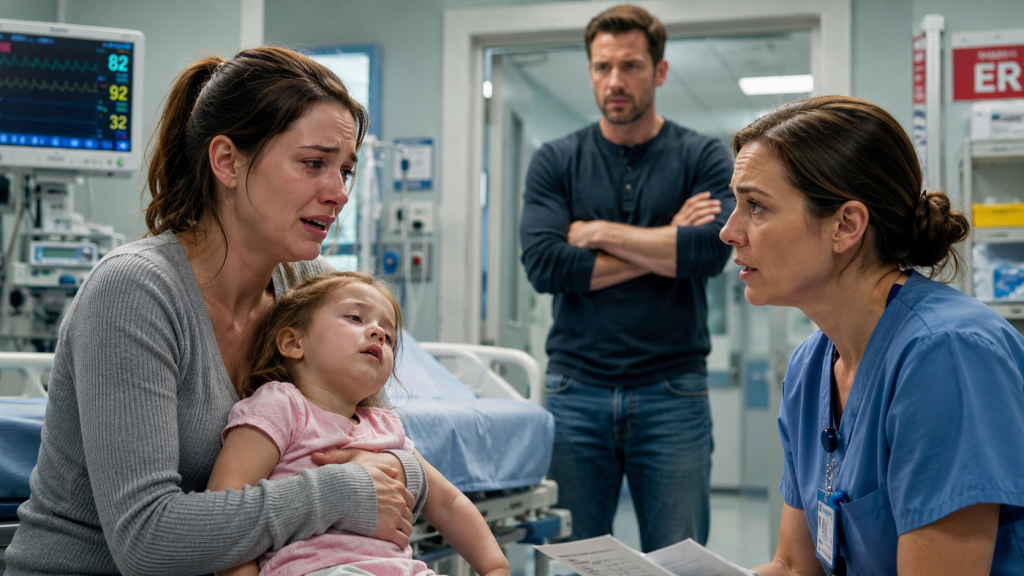
The moment a pediatric nurse looked past me and saw him, she froze.
The chart slipped from her hands.
When she bent to pick it up, her face had gone pale.
“Why is he here?”
I stared at her, confused, but she quickly recovered and led us toward the treatment area. Daniel started explaining before anyone even asked.
“She was climbing. I told you, she fell.”
The medical team took Mia from my arms and moved around her with frightening urgency. I stood beside the bed, useless and shaking, while the nurse who recognized Daniel stayed close enough to watch both of us.
A few minutes later, she touched my elbow and lowered her voice.
“Can I ask you something?”
I nodded.
“Did he tell you about the last time?”
I went still.
“What last time?”
Her expression changed. She glanced toward Daniel, then asked another staff member to stay near the doorway before telling him the team needed more space and he should wait outside.
He protested immediately.
“I’m her father. I need to be here.”
The nurse stayed calm. “The team needs room.”
Before he left, I looked straight at him.
“When was she here before?”
For the first time since I had picked up our daughter, Daniel had no answer ready.
His silence scared me more than any excuse.
The nurse explained carefully that one week earlier, Daniel had brought Mia to the same emergency department without me. He had said she fell at home, received written instructions about warning signs, and signed the discharge papers himself.
A week earlier, I had come home and found Mia unusually clingy.
When I asked what happened, Daniel had laughed softly.
“She bumped herself playing.”
I had believed him.
Now the nurse showed me the record.
Daniel’s name was there.
His signature was there.
The warning instructions were there.
He had known.
He had hidden it.
Through the glass, I saw him standing in the hallway with folded arms. He did not look like a terrified father.
He looked like someone waiting for the problem to disappear.
And for the first time, I stopped asking whether Mia had fallen.
I started wondering what happened before she did.
PART 2: THE SECOND STORY
For several seconds, I could not look away from Daniel’s signature.
It sat at the bottom of the hospital form in thick black ink.
Confident.
Ordinary.
The signature of the man who kissed me goodbye every morning.
The signature of the man who had held our daughter in this exact emergency room one week earlier and then gone home and looked me directly in the face.
Mia bumped herself playing.
That was what he had said.
Not:
I took her to the hospital.
Not:
The doctors told me to watch her carefully.
Not:
Something happened while you were gone.
Just—
She bumped herself playing.
I lifted my eyes toward the nurse.
“What did he tell you happened last week?”
Her badge said KARA REYNOLDS, RN.
Kara looked toward the glass doors.
Daniel was still in the hallway.
He had stopped staring at his phone.
Now he was staring at us.
“Let me get the physician.”
“No.”
My voice came out too quickly.
“Please.”
I looked at the papers again.
“Just tell me what he said.”
Kara hesitated.
Then pulled a chair closer.
“He reported that Mia fell from a low piece of furniture.”
“What furniture?”
“A couch.”
I stared at her.
“Our couch?”
“I can only tell you what was documented.”
My mouth went dry.
“What was wrong with her?”
“She was alert when she arrived.”
Kara spoke carefully.
“She had bruising and vomiting. They examined her, monitored her, and gave your husband detailed instructions about symptoms that should bring her back immediately.”
I looked toward the treatment room.
Doctors were still moving around Mia.
Machines beeped.
Someone adjusted her oxygen.
My knees felt weak.
“What symptoms?”
“Unusual sleepiness.”
Kara looked at me.
“Repeated vomiting.”
Another pause.
“Changes in behavior.”
My heartbeat quickened.
“Difficulty walking.”
I thought of Tuesday morning.
Mia wobbling toward me after breakfast.
I had laughed.
“You’re walking like a little penguin today.”
Daniel had been standing at the kitchen sink.
He did not turn around.
“She didn’t sleep well.”
That was his explanation.
Wednesday she slept almost four hours in the afternoon.
She normally slept ninety minutes.
I asked Daniel if we should call the pediatrician.
He told me toddlers sometimes needed extra sleep during growth spurts.
Thursday she cried when I tried washing her hair.
She pushed my hand away from the left side of her head.
Daniel said she was being dramatic because she hated shampoo.
Friday she barely ate breakfast.
Saturday she seemed better.
And now Sunday—
My daughter had turned blue in my arms.
I looked at Kara.
“He knew all of those things could matter.”
“Yes.”
“And he didn’t tell me.”
Kara said nothing.
She did not need to.
A doctor entered.
Dr. Patel.
She introduced herself quickly, but I barely heard her name.
I only heard:
“Mia is stable.”
My legs almost gave out.
Stable.
I grabbed the edge of the chair.
“Is she going to be okay?”
“We are doing everything we can.”
That sentence was not the same as yes.
I heard the difference.
“What happened to her?”
“We’re still determining that.”
“Did she fall?”
Dr. Patel’s expression became unreadable.
“We are ordering imaging and additional tests.”
I stared at her.
“Why?”
She pulled a chair closer.
“Mrs. Bennett—”
My name.
Rachel Bennett.
I suddenly hated hearing it.
It made everything feel official.
“We need to understand whether what we’re seeing today is connected to last week’s incident.”
My stomach dropped.
“Connected how?”
“We need more information first.”
I looked at Kara.
Then Dr. Patel.
Both women were being very careful.
Too careful.
“What aren’t you saying?”
Neither answered immediately.
My heartbeat pounded in my ears.
“Please.”
Dr. Patel lowered her voice.
“There are some findings that require us to ask additional questions about how Mia was injured.”
Cold spread through my body.
“What findings?”
She paused.
“Bruising.”
I thought of Mia’s little legs.
Toddlers bruise.
They fall.
They crash into tables.
They throw themselves off furniture as though gravity is a rumor.
I had told myself that a hundred times.
“Toddlers get bruises.”
“They do.”
Dr. Patel nodded.
“But sometimes the location, age, or pattern of injuries gives us reason to look more carefully.”
I felt as though the floor shifted.
I looked toward Daniel again.
He was talking to a security officer now.
Gesturing.
Annoyed.
Not crying.
Not asking whether Mia was stable.
Arguing because he had been told to wait outside.
I whispered:
“Are you saying someone hurt her?”
Dr. Patel answered softly.
“I’m saying we don’t know yet.”
That was when Daniel walked back toward the doorway.
The security officer immediately followed.
“Rachel.”
I turned.
Daniel looked at the doctor.
“What are you telling her?”
Dr. Patel stood.
“We asked you to remain outside.”
“I’m her father.”
“Yes.”
“And my wife is sitting here terrified while everyone whispers around her.”
He looked at me.
“Rachel, come here.”
I did not move.
His face changed.
Only slightly.
But I saw it.
Daniel was used to me moving when he said my name like that.
Not because he controlled me.
At least I had never called it that.
It was simply our pattern.
Daniel spoke confidently.
I second-guessed myself.
Daniel got impatient.
I tried to calm things down.
Daniel said I was overthinking.
I apologized for making everything harder.
Small things.
Marriage is made from small things.
So is fear.
“What happened last week?”
I asked.
Daniel looked at Kara.
I watched him realize she had told me.
His jaw tightened.
“Mia fell.”
“You took her here.”
“Yes.”
“And never told me.”
He exhaled.
“I was going to.”
“When?”
“Rachel.”
“When?”
His voice lowered.
“You were already stressed.”
That answer made something inside me go still.
“So you lied because I was stressed.”
“I didn’t lie.”
“You said she bumped herself playing.”
“She did.”
“At the hospital?”
He rubbed his forehead.
“Why are we fighting about vocabulary right now?”
Vocabulary.
I stared at him.
Our daughter was behind a curtain with oxygen near her face, and the distinction between a bump and an emergency-room visit was vocabulary.
“What did she fall from?”
“The couch.”
I looked toward Kara.
That matched.
“Which couch?”
Daniel frowned.
“What?”
“Our couch.”
“Yes.”
“Living room?”
“Yes.”
“When?”
“After lunch.”
I watched his face.
“What day?”
“Sunday.”
One week ago.
“Where was I?”
“With your sister.”
Correct.
I had spent three hours helping my sister move some furniture.
“How did she fall?”
Daniel’s irritation grew.
“She climbed onto the arm and slipped.”
“Did you see it?”
He stopped.
One second.
Two.
“Daniel.”
“I was in the kitchen.”
“So you didn’t see it.”
“I heard it.”
“What did you hear?”
“A thump.”
My heart hammered.
“And then?”
“She cried.”
“Immediately?”
His eyes narrowed.
“What is this?”
“A question.”
“Yes.”
He looked away.
“She cried.”
I knew him.
After eleven years, I knew the slight twitch near his mouth when he was choosing words.
Not lying necessarily.
Selecting.
Editing.
“What happened today?”
“She fell again.”
“From where?”
His answer came too quickly.
“Changing table.”
I froze.
Mia had not used the changing table in months.
She hated it.
We changed her on a mat on the floor because she twisted too much.
I stared at Daniel.
“What?”
His face changed.
“The dresser.”
“You said changing table.”
“Same thing.”
“No, it isn’t.”
He sighed.
“Rachel, she climbed.”
“Onto what?”
“The dresser.”
“How?”
Silence.
Mia was two.
Our dresser had smooth drawer fronts with recessed handles.
I knew because I picked it specifically after she began climbing everything.
There was nothing obvious for her feet.
Daniel snapped:
“I don’t know every movement she makes.”
Nobody spoke.
Kara looked toward Dr. Patel.
Daniel noticed.
His face hardened.
“You’ve already decided something.”
Dr. Patel said:
“No one has decided anything.”
“Oh, come on.”
“Mr. Bennett—”
“My daughter is sick and everyone is looking at me like I did something.”
My skin went cold.
Nobody had accused him.
Not yet.
But Daniel had said it.
Dr. Patel remained calm.
“We are gathering information.”
Daniel laughed bitterly.
“Then gather information instead of gossiping with my wife.”
Kara went very still.
I looked at him.
“Don’t.”
He turned.
“What?”
“Don’t speak to her like that.”
His expression changed completely.
Not anger.
Surprise.
It was the first time that night I had publicly placed myself on the other side of a line from him.
Daniel stared at me.
Then he softened his face.
“Baby.”
I hated the tenderness instantly.
“We’re scared.”
He stepped toward me.
“Both of us.”
I moved backward.
Barely.
But enough.
He saw it.
So did the security officer.
Daniel stopped.
“Rachel?”
I looked at the man I loved.
The man whose photograph sat beside my bed.
The man who learned how to braid Mia’s hair from YouTube because she would not sit still for me.
The man who cried when the pregnancy test turned positive.
The man who once drove twenty minutes back to a grocery store because Mia dropped her stuffed rabbit in the shopping cart.
People want danger to look consistent.
That would make life easier.
We want monsters to be monsters every minute.
But real fear often arrives wearing the same face that packed your lunch.
That kissed your forehead.
That knows which side of the bed you sleep on.
I whispered:
“Why didn’t you tell me?”
Daniel’s expression cracked.
“Because I knew you’d do this.”
My whole body went cold.
“Do what?”
“Panic.”
I stared at him.
“Our daughter was in the ER.”
“And she was fine.”
“Then why is she here again?”
His mouth closed.
The question hung between us.
A voice came from behind the curtain.
“Dr. Patel.”
Something in the tone changed everything.
The doctor immediately turned.
“Excuse me.”
She disappeared into Mia’s treatment space.
Kara followed.
I stood.
Daniel stepped toward me.
“Rachel.”
I put up one hand.
He stopped.
“Don’t.”
“You need to calm down.”
I almost laughed.
There it was.
The sentence women hear when their fear has become inconvenient.
“Don’t tell me to calm down.”
“Fine.”
He looked toward the curtain.
“But whatever they’re suggesting—”
“They haven’t suggested anything.”
“You know what I mean.”
“No.”
I looked directly at him.
“I don’t think I do anymore.”
The curtain opened.
Dr. Patel stepped out.
Her expression was serious.
“Mrs. Bennett, I need you.”
Daniel moved too.
She held up one hand.
“Only Mrs. Bennett for the moment.”
His face flushed.
“I’m her father.”
“We’ll speak with you separately.”
“Why?”
Security stepped closer.
Daniel looked at me.
“Rachel, tell them.”
I stared.
There had been a time, less than an hour earlier, when I would have.
I would have said:
“He should come.”
“He’s her dad.”
“We need each other.”
Instead I asked the doctor:
“Is Mia awake?”
“Yes.”
I followed her.
Daniel called my name.
I did not turn around.
Mia looked impossibly small in the hospital bed.
A white blanket reached her chest.
Her curls stuck damply against her forehead.
She had color again.
Not enough.
But some.
I sat beside her.
“Mama.”
The word shattered me.
“I’m here.”
I kissed her hand.
“I’m right here.”
She tried lifting her arm.
Then winced.
I froze.
“Does that hurt?”
Mia nodded.
“Where?”
She touched her side.
My throat tightened.
Dr. Patel stood behind me.
Another woman had entered.
She introduced herself as Dr. Monroe from the hospital’s child-protection team.
The title made my blood turn cold.
I looked toward the door.
“No.”
Dr. Monroe spoke gently.
“This doesn’t mean we’ve reached conclusions.”
I started shaking.
“Then why are you here?”
“Because Mia’s evaluation raised concerns we need to understand.”
I covered my mouth.
“What concerns?”
She explained without graphic detail.
Some injuries appeared to be from different times.
Not all looked consistent with one fall.
There were signs that something might have happened before today.
Possibly before last week.
I listened.
But after a certain point, the words stopped having shape.
Different times.
Earlier.
Not consistent.
Questions.
Concerns.
My daughter.
My two-year-old daughter.
I thought about bath time.
Little bruises.
A mark near her shoulder Daniel said came from the crib.
A fading spot on her thigh.
The day she suddenly started crying whenever Daniel carried her upstairs.
No.
I stopped myself.
Children cry.
Toddlers bruise.
A child can love a parent and still scream because she wants Mom.
I would not retroactively turn every ordinary moment into evidence.
But I could no longer dismiss everything either.
Dr. Monroe asked:
“Who regularly cares for Mia?”
“Me and Daniel.”
“Daycare?”
“Three days a week.”
“Anyone else?”
“My sister sometimes.”
“Grandparents?”
“Occasionally.”
She wrote everything down.
“Has Mia had any behavioral changes recently?”
I stared at my daughter.
Mia was rubbing the edge of her blanket between two fingers.
“She stopped wanting baths.”
“When?”
“Maybe three weeks ago.”
“What else?”
I thought.
“She started waking at night.”
“How often?”
“Almost every night.”
“What happens?”
“She cries.”
I swallowed.
“She says no.”
Dr. Monroe’s eyes stayed gentle.
“Anything else?”
I looked down.
“She doesn’t like the basement door.”
Daniel’s workshop was downstairs.
Mia used to follow him everywhere.
Recently, she screamed if I carried laundry toward the basement.
I had assumed the furnace scared her.
It made strange noises.
“Has she ever said why?”
“She’s two.”
My voice cracked.
“She says things, but not always clearly.”
Dr. Monroe nodded.
“We won’t pressure her.”
Good.
That mattered.
No leading.
No forcing.
No adults putting words inside my daughter’s mouth.
She had already lived inside enough adult explanations.
Then Mia looked toward the doorway.
Her body tightened.
I followed her eyes.
Daniel stood beyond the glass.
Security beside him.
He could not hear us.
Mia saw him.
Her little hand grabbed mine.
“No.”
I looked at her.
“What, baby?”
She pressed herself toward me.
“No Daddy.”
Everything inside me stopped.
Daniel saw her reaction.
His face changed.
I looked back at him.
For the first time all night, he looked afraid.
I turned to Mia.
“You don’t want Daddy in here?”
She shook her head.
Hard.
“No Daddy.”
I started crying.
Daniel knocked against the glass.
Once.
Not loudly.
He pointed toward himself.
Then toward Mia.
His face twisted with confusion.
Or grief.
Or anger.
I could not tell anymore.
Dr. Monroe quietly pulled the privacy curtain.
Daniel disappeared.
Mia relaxed slightly.
That was when I understood something I would remember for the rest of my life.
A two-year-old cannot explain a marriage.
She cannot analyze motive.
She cannot understand hospital policy.
But fear lives in the body before language learns how to name it.
And my daughter’s body had just answered a question I was terrified to ask.
An hour later, police arrived.
Not lights.
Not sirens.
Two detectives.
A man named Lewis and a woman named Avery.
They spoke to hospital staff first.
Then me.
Daniel was taken to a separate room.
I could hear his voice through the hallway occasionally.
Raised.
Defensive.
Then quiet.
Detective Avery sat across from me.
“Mrs. Bennett, when did you last leave Mia alone with your husband?”
“Today.”
“For how long?”
I checked the clock.
It felt obscene that time still worked.
“About two hours.”
“Where were you?”
“Grocery store.”
“Why was she home?”
“She had a runny nose.”
“What time did Daniel call you?”
“He didn’t.”
Avery looked up.
“What?”
“I came home.”
My stomach turned as the memory returned.
The front door.
Grocery bags cutting into my fingers.
Daniel sitting on the couch.
Mia in his arms.
Too quiet.
“Where was Mia?”
“On the couch with him.”
“What did he say?”
“She fell.”
“Anything else?”
“No.”
“What did you observe?”
“She was sleepy.”
I swallowed.
“Then her lips looked wrong.”
“Wrong how?”
“Blue.”
My voice broke.
“I grabbed her.”
“What did Daniel do?”
I stared at Avery.
That was the first time anyone had asked me that.
What did Daniel do?
Not what did he say.
What did he do?
I replayed it.
Me dropping groceries.
Me screaming Mia’s name.
Me grabbing my bag.
My keys.
My baby.
Daniel—
Daniel stayed sitting down.
Only for a few seconds.
Maybe ten.
Maybe less.
Then he stood.
I had not noticed because I was panicking.
“He didn’t move immediately.”
Avery wrote something.
“What happened next?”
“I said we had to go.”
“And?”
“He said she just fell.”
“Did he suggest calling an ambulance?”
“No.”
“Did he drive?”
I shook my head.
“I did.”
“Why?”
“I don’t know.”
Yes, I did.
Because Daniel stood beside the passenger door.
Because he climbed in without arguing.
Because I was the one holding Mia while putting her into her car seat.
Because panic made my decisions.
Avery asked:
“Did he seem reluctant to come?”
I thought.
“No.”
Then:
“Maybe.”
I hated every uncertain answer.
I wanted facts.
Something hard.
Clean.
Not maybe.
Avery seemed to understand.
“You don’t need to solve this for us.”
I looked at her.
“What?”
“Just tell me what you remember.”
That helped.
So I did.
Everything.
The previous week.
The sleepiness.
The vomiting.
The bruise.
The basement.
The bath.
The changing-table lie.
The couch.
The fact Daniel had never told me about the first ER visit.
When I finished, Avery closed her notebook.
“Thank you.”
“What happens now?”
“We investigate.”
“Is Daniel being arrested?”
“I can’t answer that yet.”
“Can he take Mia home?”
Avery’s expression softened.
“Hospital staff and child-protection services are discussing a safety plan.”
My heart pounded.
“Meaning?”
“Meaning nobody is going to send Mia somewhere they believe may be unsafe.”
I looked through the glass.
My daughter was asleep.
I whispered:
“Can I stay with her?”
“Yes.”
That one word almost destroyed me.
A little after midnight, my sister Olivia arrived.
I had called her.
Said only:
“Come to the hospital.”
She walked into Mia’s room and took one look at me.
Then she hugged me.
I fell apart.
Not graceful crying.
I gripped her coat and sobbed until my chest hurt.
Olivia held me.
“What happened?”
“I don’t know.”
I said it again.
And again.
“I don’t know.”
Eventually, we sat beside Mia.
Olivia stared at the monitors.
Then whispered:
“Where’s Daniel?”
“Talking to police.”
Her face changed.
“What?”
I looked at her.
And something in her expression made me stop.
Not confusion.
Something else.
“Olivia.”
She looked away.
My heart began pounding.
“What?”
“Nothing.”
“No.”
I sat straighter.
“Look at me.”
She did.
And I saw fear.
The same fear I had seen on Nurse Kara’s face.
My stomach dropped.
“What do you know?”
Olivia shook her head.
“Rachel.”
“What do you know?”
She stood.
“I don’t know anything.”
“You’re lying.”
“No.”
“Yes.”
My voice rose.
Mia stirred.
I lowered it immediately.
Olivia walked toward the window.
I followed.
“Tell me.”
She stared through the glass.
“I saw something.”
My blood turned cold.
“When?”
“Two weeks ago.”
“What?”
She pressed both hands against her face.
“I should have told you.”
My body began shaking.
“What did you see?”
“I came by.”
“When?”
“Wednesday.”
I remembered.
She had texted.
Dropped something at your place. You weren’t home.
I thought she left it on the porch.
“What happened?”
Olivia spoke quietly.
“Daniel was outside.”
My throat tightened.
“With Mia?”
“Yes.”
“What happened?”
“She was crying.”
“Toddlers cry.”
“I know.”
Olivia nodded desperately.
“That’s what I told myself.”
My skin went cold.
“Tell me the rest.”
She closed her eyes.
“He grabbed her arm.”
I froze.
“How?”
“I don’t know.”
“Olivia.”
“Too hard.”
The words came out broken.
“He grabbed her too hard.”
My vision blurred.
“Did he hit her?”
“No.”
“Did he push her?”
“I didn’t see that.”
“What did you see?”
“Mia was trying to pull away.”
Olivia cried now.
“Daniel grabbed her arm and pulled her toward him. She screamed.”
I could barely breathe.
“And?”
“I got out of my car.”
“What did Daniel say?”
“He let go.”
Her face collapsed.
“He smiled.”
That detail made my stomach turn.
“He said Mia was having a tantrum because he wouldn’t let her play near the driveway.”
I whispered:
“And you believed him.”
Olivia looked at me.
“No.”
That surprised me.
“No?”
“I didn’t believe him.”
My chest tightened.
“Then why didn’t you tell me?”
Tears rolled down her face.
“Because I remembered last Christmas.”
I went still.
Last Christmas.
Olivia and Daniel had argued.
He accused her of judging our parenting because she told him not to yell near Mia.
I defended him.
Not because I thought Olivia was wrong.
Because I hated tension.
I had told her:
“You always assume the worst about him.”
The memory struck me like a slap.
Olivia whispered:
“I thought if I called you and said Daniel grabbed Mia, you’d think I was trying to start something again.”
My eyes filled.
“You should have called me.”
“I know.”
“Why didn’t you?”
“I was scared you’d stop talking to me.”
The sentence broke my heart in two directions.
At my sister.
At myself.
“What did you do?”
“I drove around the block.”
She wiped her face.
“Then I came back.”
“What happened?”
“They were inside.”
“Did you knock?”
“Yes.”
“Daniel answered.”
“And?”
“He wouldn’t let me see Mia.”
I stopped breathing.
“What?”
“He said she was asleep.”
My hands went cold.
Two weeks ago.
One week before the first ER visit.
I stared at Olivia.
“What did you drop off?”
She looked confused.
“What?”
“You said you left something.”
“Oh.”
She swallowed.
“Mia’s birthday sweater.”
I remembered the bag.
It appeared on our porch later that night.
Daniel told me Olivia must have left it while we were gone.
Another lie.
My marriage suddenly felt like a house where every wall had a door hidden behind the wallpaper.
“How many times?”
Olivia frowned.
“How many times what?”
“How many times have you seen him act differently with her?”
She hesitated.
My stomach dropped again.
“Olivia.”
“Three.”
I closed my eyes.
Of course.
There is always a number after the first admission.
Three.
She told me.
One time at the park, Daniel screamed at Mia for running toward the parking lot.
Understandable fear.
But he continued yelling after she was already safe.
Another time, Olivia saw Mia recoil when Daniel reached toward her.
And then the driveway.
None of those alone proved anything.
Together, they formed something I could no longer ignore.
“Why didn’t you tell me?”
“I tried.”
She cried.
“Rachel, I did.”
I shook my head.
“No.”
“Yes.”
“Once at Mom’s birthday, I asked if Daniel had been stressed.”
I remembered.
I laughed.
I said:
“He’s always stressed.”
Olivia continued.
“I asked whether Mia seemed nervous around him.”
I remembered that too.
I became defensive.
I said Olivia was projecting because her divorce was ugly.
Oh God.
I covered my face.
“She tried telling me.”
Olivia touched my shoulder.
“Rachel.”
“Mia tried telling me.”
“She’s two.”
“She cried.”
“Rachel.”
“She stopped wanting him to do bedtime.”
“You didn’t know.”
“I should have.”
“No.”
Olivia turned me toward her.
“You should have had a husband you didn’t need to investigate.”
I started sobbing again.
That sentence stayed.
Because guilt is seductive.
It gives you the illusion that if you had simply been smarter, more observant, less trusting, you could have controlled everything.
But marriage is not supposed to be surveillance.
Parenthood is not supposed to mean searching the person beside you for danger.
Trust had not been my crime.
Still, now that trust was gone, I would never hand it back blindly.
At two in the morning, Detective Avery returned.
Her expression had changed.
“Mrs. Bennett.”
I stood.
“Did Daniel tell you what happened?”
“He gave a statement.”
“What did he say?”
“That Mia climbed furniture while he was in another room.”
“Which furniture?”
“He initially said a dresser.”
Initially.
My stomach turned.
“And then?”
“He later said he was unsure.”
Of course.
Avery continued.
“We also obtained permission to speak with your sister.”
“I know.”
“There’s something else.”
My heart pounded.
“What?”
“The prior emergency visit.”
“What about it?”
“The chart documents something unusual.”
I stared.
“What?”
Avery looked toward Mia’s room.
“Your husband told the physician last week that Mia had fallen twice.”
I froze.
“Kara said once.”
“The primary complaint involved the couch.”
Avery nodded.
“But during the assessment, he mentioned another fall earlier that week.”
My mouth went dry.
“From where?”
“Stairs.”
I nearly stumbled backward.
“What stairs?”
“He did not specify.”
“We have one staircase.”
“Yes.”
“Thirteen steps.”
Avery did not answer.
I stared at her.
“So he told the hospital she fell down the stairs.”
“He said she slipped on several steps.”
“And then fell off the couch days later.”
“That was his account.”
“And today the dresser.”
Avery’s eyes met mine.
Three accidents.
Three stories.
One week.
I whispered:
“That’s not normal.”
Avery did not confirm.
She did not need to.
Then she said:
“We’re requesting additional medical records.”
“For what?”
“To determine whether Mia has had other treatment elsewhere.”
I stopped breathing.
“Other treatment?”
“We don’t know yet.”
The nurse.
Did he tell you about the last time?
Maybe the last time had not actually been the first time.
I looked at Mia.
My baby.
Sleeping.
Tiny chest rising.
Falling.
Rising.
“What are you saying?”
Avery’s voice softened.
“I’m saying we don’t want to assume this hospital has the full history.”
Cold moved through me.
“Daniel handles Mia sometimes when I travel.”
“How often?”
“Work.”
I swallowed.
“I travel every few months.”
“When was your last trip?”
“November.”
“What happened when you returned?”
I stared.
Nothing.
Then memory.
Mia had a bandage near her hairline.
Daniel said she hit the corner of a cabinet.
I had kissed it.
Asked if he had called the pediatrician.
He said yes.
I never checked.
Why would I?
“November.”
My voice barely worked.
“She had a cut.”
Avery made a note.
“Where?”
I showed her.
“Did you see a doctor’s bill?”
“No.”
“Any discharge paperwork?”
“No.”
“Did you call the pediatrician afterward?”
“No.”
Another memory.
September.
Daniel sent me a photo while I was at a photography workshop.
Mia asleep on his chest.
Little monster finally crashed.
I thought it was adorable.
Now all I could see was how pale she looked.
No.
Stop.
Not every photograph could become evidence.
I would not destroy my own memories before facts demanded it.
Then Avery’s phone buzzed.
She read the message.
Her face changed.
“What?”
She looked at me.
“We found another visit.”
My knees weakened.
“Where?”
“An urgent-care center about twenty miles from your home.”
“When?”
“November.”
The cut.
My hand flew to my mouth.
“He did take her.”
“Yes.”
Relief came for half a second.
Then Avery continued.
“But the record says he reported she fell in the garage.”
I stared.
“He told me kitchen cabinet.”
Avery said nothing.
There it was again.
Another story.
The same injury.
Different room.
My whole body turned cold.
“Anything else?”
She looked at the phone again.
“There may be another.”
My heart stopped.
“When?”
“September.”
I sat down because I could not remain standing.
September.
Another work trip.
Another Daniel-and-Mia weekend.
“What happened in September?”
Avery’s voice remained careful.
“We don’t have the record yet.”
“Where?”
“A different emergency department.”
“Why a different hospital?”
“We’re trying to determine that.”
Different hospitals.
Different stories.
No shared pattern obvious unless someone looked.
Unless someone finally put the records beside each other.
I covered my mouth.
Daniel had not simply been hiding accidents.
He had been moving them.
Spreading them across places.
Or maybe that was coincidence.
I hated myself for still searching for coincidence.
Then Avery said:
“There is one thing you need to prepare for.”
I looked up.
“What?”
“A child-welfare investigator will likely ask that Daniel have no unsupervised contact with Mia while this is being reviewed.”
My heart twisted.
He was her father.
The sentence hurt even after everything.
“Okay.”
Avery watched me carefully.
“You agree?”
I looked through the glass.
Mia had rolled slightly toward the side of the bed.
Her stuffed rabbit was beside her.
Kara had found one from the pediatric toy cabinet.
Not hers.
But close enough.
I thought of the way she said:
No Daddy.
“Yes.”
My voice cracked.
“Yes.”
Daniel was not allowed back into Mia’s room that night.
At 3:26 in the morning, he texted me.
They’re treating me like a criminal.
I stared.
No question about Mia.
Another message.
You know I would never hurt her.
Then:
Rachel, say something.
I typed nothing.
One minute later:
This is getting out of control.
I looked at my daughter through the hospital glass.
No.
For the first time, I thought maybe things were finally coming under control.
At dawn, Mia woke.
Her eyes searched immediately.
“Mama?”
I leaned over her.
“Right here.”
She touched my cheek.
“Home?”
My throat tightened.
“Soon.”
She looked toward the door.
“Daddy?”
I paused.
“No Daddy today.”
Her body relaxed.
That hurt worse than fear would have.
Children should miss their fathers.
She simply sighed.
Then whispered:
“Okay.”
I kissed her forehead.
A nurse brought juice.
Mia took two sips.
Then pointed toward my purse.
“Phone.”
“You want my phone?”
She nodded.
“For what?”
“Baby.”
I frowned.
“What baby?”
“My movie.”
Ah.
Videos.
Mia loved watching videos of herself.
I handed her my phone.
She knew exactly which icon opened my gallery.
Toddlers can barely put on socks but somehow understand smartphones better than adults.
She scrolled.
Videos.
Birthdays.
Bath bubbles.
Mia dancing.
Mia eating spaghetti.
Then she stopped.
Tapped one.
A video started.
Daniel had sent it to me two weeks earlier while I was at work.
Mia sitting on the kitchen floor.
Daniel behind the camera.
“Tell Mommy what you did.”
Mia stared toward him.
Her face was serious.
Then she said:
“Fall.”
Daniel laughed.
“That’s right. You fell because you don’t listen.”
My entire body froze.
I had watched that video before.
I remembered replying with laughing emojis because I thought Daniel was teasing her after she had tripped over toys.
Now I listened again.
Not to the words.
To Mia.
She did not smile.
She stared at Daniel.
“Tell Mommy.”
“Fall.”
“Where?”
Mia pointed.
Not toward the floor.
Toward the basement door.
My blood went cold.
I replayed it.
Once.
Twice.
Three times.
In the background, behind Mia, something sat on the counter.
A red towel.
I zoomed in.
There was a dark stain on it.
Maybe juice.
Maybe paint.
Maybe nothing.
But Daniel’s words—
You fell because you don’t listen.
I stopped the video.
My hands shook.
Then Mia touched the screen.
“No.”
I looked at her.
“What?”
She pointed toward Daniel’s frozen image.
“No fall.”
Every nerve in my body went still.
I crouched beside her.
“What did you say?”
Mia looked at me.
Two years old.
Tiny.
Tired.
“No fall.”
I could barely breathe.
I would not question her.
Not beyond that.
The professionals had made that clear.
Do not lead.
Do not suggest.
Let trained people speak with her appropriately.
So I kissed her hand.
“Okay.”
Then I walked straight to the nurses’ station.
“Get Detective Avery.”
Twenty minutes later, they copied the video.
Avery watched it twice.
Then asked:
“Do you recognize the date?”
I showed her.
Two days before Olivia saw Daniel grab Mia in the driveway.
Avery made a note.
Then Dr. Monroe joined us.
She watched too.
Nobody said what they thought.
Professionals are good at silence when conclusions matter.
I was becoming good at it too.
Around eight that morning, Daniel called.
I did not answer.
Then his mother called.
My mother-in-law, Diane.
I almost ignored that one too.
Something made me pick up.
“Rachel.”
She sounded breathless.
“What is going on?”
I closed my eyes.
“I can’t talk right now.”
“Daniel called us.”
“Okay.”
“He says the hospital won’t let him see Mia.”
“That’s true.”
“Why?”
I did not answer.
Diane’s breathing changed.
Then she whispered:
“Oh God.”
Something in her voice made me sit straighter.
“What?”
“No.”
“What, Diane?”
“I told him.”
My heart started pounding.
“Told him what?”
She began crying.
Months of air seemed to leave her lungs.
“I told him this would happen again.”
Again.
That word.
Again.
My whole body went cold.
“Diane.”
Silence.
“What happened before?”
She cried harder.
“Not Mia.”
My stomach dropped.
“What do you mean not Mia?”
“Daniel.”
Every sound around me disappeared.
“What about Daniel?”
“When he was younger.”
I gripped the phone.
“How young?”
“Seventeen.”
My mouth went dry.
Diane whispered:
“There was a baby.”
I could not understand the sentence.
“What baby?”
“His sister’s.”
My heart stopped.
Daniel had an older sister, Jessica.
We barely saw her.
She lived in Oregon.
She and Daniel had not spoken in years.
I always thought it was because of some family inheritance fight.
Diane continued.
“Jessica had a little boy.”
My pulse pounded.
“Daniel was babysitting.”
I stopped breathing.
Diane sobbed.
“There was an accident.”
The word made me sick.
“What kind?”
“He said the baby fell.”
I closed my eyes.
Of course.
He fell.
Everything suddenly narrowed to one sentence.
One repeated sentence.
Through years.
Across children.
She just fell.
I whispered:
“What happened to Jessica’s baby?”
Diane did not answer.
“Diane.”
Her sob broke over the line.
Then she said:
“He survived.”
I exhaled so hard my chest hurt.
“But Jessica never believed Daniel’s story.”
My whole body went cold again.
“Why?”
“Because the story changed.”
I stared through the hospital glass at Mia.
Diane continued.
“First it was a couch.”
My knees weakened.
“Then stairs.”
I sat down.
The same words.
The same sequence.
Seventeen-year-old Daniel.
Adult Daniel.
Different children.
Same explanations.
I whispered:
“Why didn’t you tell me?”
Diane cried.
“Because Daniel swore it wasn’t what Jessica said.”
“And you believed him?”
“I wanted to.”
The answer was so painfully human I hated it.
“What happened afterward?”
“Jessica took her son and moved.”
“Why don’t they speak?”
“Because she said she would never let Daniel near him again.”
My stomach turned.
“And you let me marry him without telling me.”
“I know.”
“You watched me have Mia.”
“I know.”
“You let him stay alone with her.”
“Rachel—”
“No.”
My voice shook violently.
“You do not get to say my name like that.”
“I’m sorry.”
I could barely breathe.
“Does Jessica have records?”
A pause.
“Yes.”
“What records?”
“Hospital paperwork.”
“Photos.”
“Messages.”
My heart pounded.
“And she kept them?”
“Yes.”
“Why?”
Diane whispered:
“Because she always said someday Daniel would do it again.”
The hallway seemed to tilt beneath me.
I looked toward Mia.
My daughter was drinking apple juice.
A cartoon played quietly on the television.
Alive.
Safe for the moment.
Then I heard myself ask:
“Give me Jessica’s number.”
Diane went silent.
“Now.”
She gave it to me.
I hung up.
Saved the number.
For three minutes, I stared at it.
Then I called.
One ring.
Two.
Three.
A woman answered.
“Hello?”
Her voice sounded like Daniel’s.
Older.
Softer.
I swallowed.
“Jessica?”
“Yes?”
“This is Rachel.”
Silence.
Complete.
Then she whispered:
“Daniel’s Rachel?”
My eyes filled.
“Yes.”
Her breathing changed.
“What happened?”
Not hello.
Not how are you.
What happened?
She had been waiting for this call for years.
I looked at Mia.
Then said:
“It’s Mia.”
Jessica made a sound.
“Oh God.”
“She’s alive.”
I said it immediately.
“She’s stable.”
Jessica began crying.
I heard her move somewhere.
A door closing.
Then:
“What did he say?”
I closed my eyes.
The answer felt inevitable.
“He said she fell.”
Jessica went completely silent.
Then she whispered:
“Couch or stairs?”
Every hair on my arms rose.
I could not speak.
Jessica started crying harder.
“Rachel?”
I looked through the glass at my daughter.
And for the first time since entering the emergency room, I understood that Nurse Kara’s question had only opened the first door.
Did he tell you about the last time?
There had been another last time.
And another.
A hidden family history built from the same explanation.
Different houses.
Different children.
Different years.
The same man.
The same sentence.
I whispered:
“Both.”
Jessica stopped breathing.
Then she said something so quietly I almost missed it.
“Get Mia somewhere he cannot reach her.”
My fingers tightened around the phone.
“She’s protected.”
“No.”
Jessica’s voice sharpened.
“You don’t understand.”
“What?”
There was a pause.
Then:
“Daniel doesn’t lose control when he’s angry.”
My blood ran cold.
“He loses control when he thinks someone is about to tell the truth.”
I stared through the glass.
“What truth?”
Jessica inhaled shakily.
“The truth about what happened to my son.”
My heart hammered.
“You said he survived.”
“He did.”
“Then what haven’t you told me?”
Jessica cried silently for a moment.
Then said:
“My son was too young to tell anyone what happened.”
I waited.
“But there was someone else in the house.”
Everything inside me stopped.
“Who?”
Jessica whispered:
“Our father.”
Daniel’s father.
The man who died four years before I met Daniel.
I sat completely still.
Jessica continued.
“He saw everything.”
My mouth went dry.
“What did he see?”
She did not answer immediately.
Then:
“I’ll send you the statement he wrote before he died.”
My entire body went cold.
“What statement?”
“The one my mother made him promise never to give police.”
The hallway disappeared.
Jessica’s voice became smaller.
“Rachel, Daniel has spent twenty years believing that statement was destroyed.”
I looked toward Mia.
Then toward the entrance to the pediatric unit.
For the first time, I did not feel confused.
I felt clear.
Whatever happened next, I was no longer asking Daniel for his version.
I was done living inside versions.
“Send it.”
Jessica exhaled.
“I will.”
Then she added:
“And Rachel?”
“Yes?”
“When Daniel realizes you know it exists…”
She stopped.
“What?”
Her voice dropped.
“Do not be alone with him.”
The call ended.
Three seconds later, my phone buzzed.
A document arrived.
Twenty-three pages.
Scanned.
Yellowed.
Old.
The first page contained a handwritten title:
Statement of Michael Bennett regarding incident involving Daniel Bennett and infant Noah Collins.
I stared at the words.
Then another message appeared.
Not from Jessica.
From Daniel.
We need to talk before you hear lies from my family.
My whole body went cold.
He knew.
Somehow, already, he knew I had called her.
I looked through the glass at Mia.
Then down at the twenty-three pages written by a dead man who had apparently carried a secret until the end of his life.
Daniel had spent years telling everyone children fell.
Now his own father was about to tell me what happened before one of them did.
And this time, Daniel would not get to edit the story first.
PART 3: THE STATEMENT HIS FATHER LEFT BEHIND
The first page was dated twenty-one years earlier.
The paper had yellowed around the edges.
Michael Bennett’s handwriting was neat at the beginning.
By the third paragraph, it was not.
I sat in a plastic hospital chair beneath fluorescent lights while my two-year-old daughter slept ten feet away.
And I read the words of a dead man who had apparently spent years carrying something my husband had spent years burying.
I am writing this because I do not believe the account Daniel gave regarding the injury to Noah Collins is complete.
My hands went cold.
I kept reading.
Michael had been home that afternoon.
Jessica had gone to the pharmacy.
Daniel, seventeen, was supposed to watch baby Noah.
At first, Michael heard crying.
Normal crying.
Then louder.
Then Daniel shouting.
Not words Michael could remember exactly.
Only frustration.
Then silence.
Michael walked toward the living room.
What he described next was not an accident.
Not in the way the family later told it.
Daniel had become overwhelmed.
He handled the baby roughly.
Then, when Michael entered, Noah was on the floor beside the couch, crying weakly.
Daniel immediately said:
“He fell.”
I stopped reading.
My hands shook so badly the pages rattled.
The couch.
Again.
Always the couch first.
Michael wrote that he did not actually see the exact moment Noah reached the floor.
But he did see Daniel’s hands on him just before.
He did see Daniel’s anger.
And he did hear the sentence afterward.
He fell.
Michael insisted they go to the hospital.
Daniel begged him not to say anything.
Then begged again.
Then cried.
Then said Jessica would never forgive him.
Michael wrote:
I made the worst decision of my life next.
I closed my eyes.
I already knew what it would be.
He protected his son.
He told the hospital he had been in another room.
He repeated Daniel’s version.
Later, when Jessica asked questions, Michael softened what he had seen.
Diane did too.
They convinced themselves they were preventing one terrible afternoon from destroying Daniel’s future.
Noah survived.
That became their excuse.
No permanent disability.
No death.
No criminal case.
So they called it mercy.
But Jessica never believed them.
She knew Daniel.
She knew Noah’s cry.
She knew too many details changed.
Michael’s statement continued.
Years later, guilt apparently broke him.
He wrote the truth down.
He gave a copy to Jessica.
Then made Diane promise that if Daniel ever harmed another child, she would release it.
I stopped.
Read that line again.
If Daniel ever harms another child.
My stomach turned.
Michael had anticipated this.
Not because he thought it was certain.
Because once was enough to make him afraid of twice.
I looked through the glass.
Mia shifted in her sleep.
Her curls lay across her forehead.
One hand rested beside her stuffed rabbit.
Alive.
Safe.
For now.
I kept reading.
Michael wrote:
What frightens me is not that Daniel lost his temper once. What frightens me is how quickly he became concerned with the story instead of the child.
My breath caught.
The story.
The same thing happening now.
What furniture?
What room?
What explanation?
What hospital?
What version?
Not:
Is Mia all right?
The story.
Always the story.
Michael wrote:
He asked me what I was going to tell Jessica before he asked whether Noah would recover.
I lowered the pages.
My eyes filled.
The same pattern.
Twenty-one years later.
Daniel texted me that police were treating him like a criminal before he asked about Mia.
He asked whether I was hearing lies before he asked whether our daughter was awake.
The past had not repeated perfectly.
It did not need to.
It rhymed loudly enough.
Detective Avery entered about fifteen minutes later.
I held up the pages.
“Jessica sent these.”
Her expression changed.
“What are they?”
“Daniel’s father wrote a statement about what happened to Jessica’s son.”
Avery sat down.
“May I see?”
I handed them over.
She did not read every word in front of me.
She scanned.
Stopped several times.
Then looked up.
“Do you have the original message showing Jessica sent this to you?”
“Yes.”
“Keep it.”
“I will.”
“And don’t forward these to anyone else right now.”
“Okay.”
I stared through the glass.
“What happens if this is true?”
Avery answered carefully.
“We look at what can be corroborated.”
“Twenty-one years later?”
“Yes.”
“Can something that old matter?”
“It can matter as context.”
She closed the file.
“But Rachel, I need you to understand something.”
I looked at her.
“Mia’s case does not depend on proving what happened to Noah.”
That mattered.
Because part of me had already begun believing I needed the old story to make the new one real.
Avery continued.
“We have Mia’s medical findings.”
“The hidden prior visits.”
“Your sister’s observations.”
“The conflicting explanations.”
“The video.”
“And now whatever additional records we obtain.”
I swallowed.
“So I don’t have to prove Daniel has always been dangerous.”
“No.”
Her eyes stayed on mine.
“You only have to tell the truth about what happened now.”
I started crying.
Because that was the first time all night someone gave me permission to stop solving Daniel’s entire life.
I did not need to understand his childhood.
His anger.
His parents.
His sister.
His guilt.
I needed Mia safe.
That was enough.
Around ten that morning, child-protection services arrived.
A woman named Maribel Santos sat with me in a family room.
She spoke gently.
No dramatics.
No accusations.
She explained the immediate plan.
Daniel would not have unsupervised access to Mia while the investigation continued.
I would remain with her.
Our home would be assessed.
If Daniel returned there, I needed another safe place.
I nodded.
“My sister.”
“Olivia?”
“Yes.”
“She has a spare room.”
Maribel wrote it down.
“Do you feel safe going home to collect things?”
I thought about Daniel.
Not the husband I had loved.
The man texting me about family lies while our daughter slept beneath hospital monitors.
“No.”
The word came easier than expected.
Maribel nodded.
“Then don’t.”
Simple.
For years, I thought courage would feel larger.
It often sounds like one small word spoken at the right time.
No.
Olivia brought clothes.
Diapers.
My laptop.
Mia’s favorite blanket.
And one pink stuffed elephant Daniel hated because it squeaked.
She brought that too.
When she entered, she looked at me.
“Anything else?”
I shook my head.
Then remembered.
“Wedding album.”
Olivia blinked.
“What?”
“I don’t know why.”
My voice cracked.
“But I want it.”
She did not question me.
She returned with it that evening.
For weeks afterward, the album sat unopened in her closet.
I was not ready to look at a version of us that did not know what came later.
Daniel was arrested two days after Mia entered the hospital.
I learned through Detective Avery.
Not social media.
Not family gossip.
A phone call.
“There has been an arrest.”
I sat beside Mia’s hospital bed.
My daughter was eating applesauce.
Badly.
Half of it was on her chin.
“What charges?”
Avery named them.
Child endangerment.
Assault-related allegations tied to the medical findings.
Additional charges connected to giving investigators false information were still under review.
My hand tightened around the phone.
“Did he confess?”
“No.”
Of course not.
“What did he say?”
“He maintains Mia fell.”
I looked at my daughter.
She held up her spoon.
“Moon.”
The applesauce on it vaguely resembled one.
I smiled through tears.
“Yes.”
“Moon.”
Then I told Avery:
“I don’t care what version he’s on anymore.”
And for the first time, I meant it.
The September records arrived next.
Different emergency department.
Daniel had brought Mia in while I was away at a workshop.
He reported she had fallen from a bed.
He told me nothing.
The November urgent-care visit?
Garage fall.
He told me kitchen cabinet.
The first recent ER visit?
Couch.
Then he mentioned stairs.
The latest emergency?
Changing table.
Then dresser.
Different buildings.
Different explanations.
Same child.
Same parent present.
Same mother uninformed.
Once the records were lined up, the pattern no longer looked like bad luck.
It looked like concealment.
That realization nearly crushed me.
For days, I kept returning to one question.
How did I not know?
My therapist eventually asked me something better.
“What did Daniel do to make sure you didn’t know?”
That changed everything.
He used different hospitals.
He minimized injuries.
He scheduled appointments while I was away.
He hid discharge paperwork.
He told me partial truths.
He called me anxious whenever I asked questions.
He created distance between Olivia and me when she raised concerns.
He treated my trust as a weakness he could manage.
I had not failed to notice one obvious sign.
I had been given pieces designed not to form a picture.
That distinction saved me from drowning in guilt.
Not completely.
But enough.
Mia came home with me eight days later.
Not to our house.
To Olivia’s.
We converted her guest room into a toddler room overnight.
Purple sheets.
A small lamp.
Her books.
The pink elephant.
For the first week, Mia slept in my bed.
Then beside it.
Then eventually in her own room with the door open.
She cried whenever a man raised his voice on television.
She cried when she heard the garage door at Olivia’s house.
She screamed during her first bath after the hospital.
We stopped.
No forcing.
No:
You’re okay.
No:
There’s nothing to be afraid of.
Because something had happened.
Her fear deserved respect.
Instead I said:
“I’m here.”
“You’re safe.”
“We can stop.”
Those became our words.
Sometimes recovery is not teaching a child that nothing bad happened.
It is teaching her that when she says stop now, someone listens.
Daniel’s mother, Diane, came to Olivia’s house three weeks later.
I nearly refused to see her.
Then she sent me a message.
I am not asking to see Mia. I only want to give you everything I should have given you before you married my son.
I agreed to meet her alone.
Olivia sat in the next room.
Diane looked twenty years older.
She carried a banker’s box.
Inside were copies.
Jessica’s old records.
Letters.
Michael’s original notes.
A family therapist’s correspondence from the year after Noah was injured.
And one envelope addressed to Daniel that had never been sent.
Michael wrote it.
Diane had kept it after his death.
I stared at her.
“Why?”
She cried immediately.
“Because I was ashamed.”
“That doesn’t answer me.”
“I kept believing Daniel had changed.”
I said nothing.
“He was seventeen.”
Her voice broke.
“He went to counseling.”
“He grew up.”
“He got married.”
“He seemed gentle with Mia.”
Her face crumpled.
“And every year that passed without anything happening made it easier to call what happened to Noah a terrible one-time mistake.”
I looked at her.
“But Jessica didn’t.”
“No.”
“You chose Daniel over her.”
Diane closed her eyes.
“Yes.”
“And then you chose him over me by staying silent.”
“Yes.”
“And Mia paid for it.”
She sobbed.
“Yes.”
I appreciated the lack of defense.
Too late.
But honest.
Diane whispered:
“I am sorry.”
I looked at the box.
“Sorry doesn’t make this safe.”
“I know.”
“You don’t get to see Mia because you’re sorry.”
“I know.”
“You don’t get to tell me you’re her grandmother.”
Tears ran down her face.
“I know.”
I believed she finally did.
For nearly a year, Diane saw Mia only under professional guidance and only after I agreed.
At first, not at all.
Then short supervised visits.
Then longer ones.
She never complained.
Never said I was punishing her.
Never called me cruel.
That restraint mattered.
Because remorse is measured partly by what people stop demanding.
Jessica flew in from Oregon two months after the hospital.
I recognized her instantly at the airport.
Same eyes as Daniel.
That was hard.
She hugged me.
Then stepped back.
“I’m sorry.”
I shook my head.
“You warned everyone you could.”
She looked away.
“I stopped.”
“What?”
“Years ago.”
Her voice trembled.
“I got tired of being called bitter.”
My heart cracked.
She had spent two decades carrying truth nobody wanted because truth made family gatherings uncomfortable.
“I should have found you before you married him.”
“You didn’t know me.”
“I knew he had a serious girlfriend.”
“You couldn’t spend your life following Daniel’s relationships.”
She looked at me.
“I thought if he had changed, I’d destroy something good.”
We both cried.
There it was again.
Silence pretending to be mercy.
Silence almost always charges someone else for the comfort it creates.
Jessica met Mia months later.
Not immediately.
Nothing became immediate anymore.
We moved slowly.
Safely.
Jessica brought a photograph of Noah.
He was twenty-three now.
Alive.
Healthy.
Working as an electrician.
He wanted no relationship with Daniel.
He did not want to participate in the case beyond providing records and, if needed, a statement.
I respected that.
His childhood did not belong to our prosecution.
He had already survived it once.
He did not owe us another performance.
Daniel’s case took almost a year.
There were evaluations.
Experts.
Records.
Motions.
Words I had never wanted to learn.
The medical testimony mattered.
The history of concealed visits mattered.
The inconsistent stories mattered.
Michael’s statement was not treated as some magical document that decided everything.
Reality is rarely that neat.
But it helped investigators understand why Jessica had cut contact years earlier.
It helped explain the family secrecy.
And it forced Diane to finally tell the whole truth.
Daniel eventually accepted a plea agreement.
Not because he admitted every detail.
He never did.
But he accepted responsibility for harming Mia and concealing important medical information.
The sentencing hearing was the first time I saw him in almost nine months.
I thought I would hate him.
Instead, I felt grief.
He looked smaller.
Not physically.
Humanly.
He had once occupied so much space in my life.
Now he sat behind a table beside an attorney, and I realized power can vanish the second you stop giving someone control over your reality.
When it was my turn to speak, my hands shook.
I looked at the judge.
Not Daniel.
Then I said:
“My daughter is two years old.”
My voice cracked immediately.
“She cannot explain a pattern.”
“She cannot organize hospital records.”
“She cannot compare one story to another.”
“She cannot tell an adult that the couch story changed into stairs, then a garage, then a dresser.”
I swallowed.
“But she could say two words.”
I finally looked at Daniel.
“No Daddy.”
His face collapsed.
I continued.
“And I am ashamed that it took a hospital room for me to understand how much those two words mattered.”
Daniel started crying.
I did not stop.
“I am not here to say he never loved her.”
That surprised everyone.
Including him.
“I believe he did.”
I took a breath.
“That is exactly why I need to say this.”
“Love is not evidence of safety.”
The courtroom went silent.
“A person can love a child and still become unsafe for that child.”
“A person can regret what they did and still need consequences.”
“And a family can love someone and still be wrong for hiding what they know.”
I looked toward Diane.
She cried.
Then toward Jessica.
She nodded once.
I finished:
“My daughter’s job is not to protect her father’s future.”
“It is not to protect our family name.”
“It is not to make adults comfortable.”
“Her job is to grow up.”
“And my job is to make sure she gets the chance.”
I sat down.
My knees nearly gave way.
Olivia took my hand.
Daniel later asked through his attorney whether he could write Mia letters.
My answer was not automatically no.
It was:
“Not until her therapist believes it could help her.”
That difference mattered to me.
I did not want revenge making decisions either.
For years, Daniel had decided what Mia could handle.
I would not simply become the opposite version of him.
Professionals guided us.
Mia guided us as she grew.
At four, she did not ask about Daniel.
At five, she asked where he lived.
I answered simply.
“He lives somewhere else because he made choices that were not safe.”
“Is he bad?”
Children love categories.
Good.
Bad.
Easy.
I said:
“He did bad things.”
She frowned.
“But is he bad?”
I thought carefully.
“I don’t think you have to decide that yet.”
She accepted that.
Then asked for crackers.
Children are merciful like that.
They do not require every emotional question to become a ceremony.
At six, she started kindergarten.
I cried harder than every other parent.
Olivia made fun of me.
“You know she’s coming home at three.”
“Shut up.”
Mia ran into school wearing a red backpack.
She did not look back.
That hurt.
And healed.
At seven, she asked whether Daniel loved her.
I told her:
“I believe he did.”
“Then why did he hurt me?”
There it was.
The impossible question.
I sat beside her.
“Because loving someone doesn’t automatically make a person healthy or safe.”
She looked confused.
Good.
She was allowed to be confused.
I continued.
“Sometimes adults have problems inside themselves they are responsible for fixing.”
“Did I cause his problem?”
“No.”
Immediate.
Certain.
“Never.”
She stared at me.
“Not when you cried.”
“Not when you were loud.”
“Not when you didn’t listen.”
“Not when you climbed.”
“Not when you had tantrums.”
My eyes filled.
“Nothing you did made you deserve to be hurt.”
Mia cried.
Then climbed into my lap even though she was getting too big.
I held her.
That conversation happened more than once.
Children revisit truth as they grow.
At nine, she understood more.
At twelve, more still.
Healing is not one explanation.
It is answering the same wound in language a child can carry at each age.
Diane rebuilt trust slowly.
Very slowly.
She became Grandma Diane again only because Mia chose to call her that.
I never instructed it.
Jessica visited every summer.
Noah came once when Mia was ten.
He was kind.
Quiet.
He knelt to speak to her instead of towering over her.
Mia knew only that he was Cousin Noah.
Later, when she was older, she learned more.
She asked him one day:
“Were you scared of Dad too?”
Noah looked at me.
I started to answer.
Then stopped.
Not my story.
He looked back at Mia.
“Yes.”
She nodded.
That was all they needed.
Two children separated by twenty-one years.
Both surviving the same man’s refusal to face what he did.
Noah eventually told her:
“You don’t have to understand him to stop blaming yourself.”
I wrote that sentence down afterward.
The strangest healing happened between Olivia and me.
We had to forgive each other too.
She had stayed quiet when she saw enough to worry her.
I had made her afraid to tell me.
Both were true.
One night, years later, we sat on her porch drinking wine.
She said:
“I still wish I had called you that day.”
I answered:
“I still wish I had made myself safer to call.”
She looked at me.
Then we both cried.
Not blame.
Responsibility.
There is a difference.
Mia grew.
That is the part of the story I love most.
She grew.
She learned to swim.
She broke her wrist at eleven falling off a skateboard and screamed at the ER doctor:
“This one actually was an accident!”
Everyone laughed.
Including me.
That laugh felt miraculous.
She hated broccoli.
Loved horses.
Was terrible at algebra.
Excellent at drawing.
She stopped being afraid of the basement after we moved to a different house.
Yes.
We moved.
I could not stay in the home where every room had become a question.
I sold it two years after the hospital.
The basement door was the last thing I looked at.
I stood there with the realtor.
She asked:
“Do you want to go down one more time?”
“No.”
And that was that.
We bought a smaller house.
Yellow kitchen.
Huge maple tree.
No history in the walls.
Mia chose her bedroom.
Upstairs.
Blue.
For years, I kept the discharge papers from her hospital visits in a locked file.
Not because I needed evidence anymore.
Because some part of me was still afraid the truth could disappear if I stopped holding the paper.
Eventually, when Mia was sixteen, I shredded copies I no longer legally needed.
She helped.
One page at a time.
The machine made a horrible grinding sound.
Mia laughed.
“Very dramatic.”
I smiled.
“You get that from your father.”
The joke slipped out before I could stop it.
We both froze.
Then Mia laughed harder.
I did too.
That moment mattered.
Daniel could exist in language without owning the room.
At eighteen, Mia asked to read Michael Bennett’s statement.
I did not answer immediately.
“You sure?”
“Yes.”
“Why?”
“Because everyone says Grandpa Michael tried to tell the truth eventually.”
She looked at me.
“I want to know what ‘eventually’ means.”
So I gave it to her.
She read all twenty-three pages at my kitchen table.
Quietly.
When she finished, she folded them.
Then said:
“He waited too long.”
“Yes.”
“But he wrote it.”
“Yes.”
She thought.
“Both things can be true.”
I smiled.
“Yes.”
She had become better at complexity than the adults who raised Daniel.
Mia decided not to contact her father at eighteen.
Then at twenty-one, she changed her mind.
Not to reconcile.
To ask questions.
I worried.
Of course I worried.
But she was an adult.
My entire journey had taught me what happens when love becomes control.
So I said:
“Do you want me there?”
“No.”
“Do you want someone else?”
“My therapist knows.”
“Okay.”
She met Daniel in a supervised setting.
I waited at a coffee shop two blocks away.
Longest ninety minutes of my life.
When she came in afterward, I stood.
“How was it?”
She sat down.
“Sad.”
I waited.
“He cried.”
I nodded.
“He said he thought I hated him.”
“What did you say?”
Mia looked out the window.
“I told him hate wasn’t the problem.”
My throat tightened.
“What was?”
She looked at me.
“I didn’t feel safe with him.”
Simple.
Clean.
Two-year-old Mia had said it first.
No Daddy.
Twenty-one-year-old Mia finally had the language.
Daniel apologized.
She listened.
She did not promise forgiveness.
He asked whether she might see him again.
She said:
“Maybe.”
Her choice.
Always.
That became the ending I wanted for her.
Not a perfect father restored.
Not a villain erased.
Choice.
The thing Daniel had taken from her when she was too young to name what was happening.
Today, Mia is twenty-four.
She works with children.
Not because of what happened.
I am careful about saying that.
Trauma does not deserve credit for the life a person builds afterward.
She became a pediatric occupational therapist because she likes children, hates boring offices, and has endless patience with tiny people who throw blocks.
She calls me almost every day.
Usually for something ridiculous.
“How long can soup stay in the refrigerator?”
“Can you wash this sweater?”
“Is buying a third plant irresponsible?”
Ordinary questions.
Beautiful questions.
Sometimes, when I watch her laugh, I remember the emergency room.
Her blue lips.
Daniel repeating:
“She just fell.”
The chart slipping from Kara’s hands.
Then the question:
“Did he tell you about the last time?”
I thought the horror was that there had been one hidden visit.
Then two.
Then three.
Then Noah.
Then Michael’s statement.
The deeper truth was not just that Daniel lied about accidents.
It was that an entire family had once learned how dangerous silence could be…
…and still practiced it.
Michael stayed quiet.
Diane stayed quiet.
Jessica spoke until nobody listened, then stopped.
Olivia hesitated.
I defended.
Every silence had a reason.
Fear.
Love.
Shame.
Loyalty.
Conflict avoidance.
None of those reasons made Mia safer.
That is what I learned.
Silence is not neutral simply because it is understandable.
Sometimes silence chooses a side before anyone means it to.
Years later, Kara—the nurse who dropped the chart—sent me a Christmas card.
I had kept in touch.
Inside she wrote:
I still think about the night Mia came in. I’m glad you asked the second question.
I knew what she meant.
The first question was:
What happened?
The second was:
What happened before?
That question changed our lives.
Not because the past automatically proves the present.
But because patterns hide inside isolated stories.
One fall.
Then another.
One hospital.
Then another.
One person saying:
Don’t worry.
One wife believing him.
Until somebody places the stories beside each other.
Mia once asked me whether I regret marrying Daniel.
I thought for a long time.
Then said:
“No.”
She stared.
“You’re serious?”
“Yes.”
“But…”
“I regret what he did.”
I touched her hand.
“I regret what I didn’t know.”
“I regret the pain.”
“But I will never regret the road that gave me you.”
Her eyes filled.
She hugged me.
That is the strange mercy of complicated lives.
You do not have to wish away your own past to condemn what happened inside it.
Daniel was my husband.
I loved him.
He harmed our daughter.
All three statements can sit in one sentence.
Life does not owe us simpler grammar.
What matters is what we do once truth arrives.
I believed Mia.
I stopped protecting the marriage.
I stopped needing Daniel’s explanation.
I stopped treating his mother’s silence as a reason to doubt my own eyes.
And most importantly, I stopped asking my daughter’s fear to be logical before I respected it.
Two words.
No Daddy.
That was enough to begin.
Today, when young mothers ask me what I wish I had known, I never tell them to become suspicious of everyone.
That would be its own kind of prison.
I tell them something else.
Trust people.
But trust yourself too.
If a story changes, notice.
If someone makes you feel foolish every time you ask a reasonable question, notice.
If your child’s body changes before their words can explain why, notice.
And if the truth frightens you, do not soften it simply because the person involved is someone you love.
Love should make us more willing to face truth.
Not less.
The last time I saw Daniel, years after Mia met him as an adult, he stood outside a courthouse after completing another required review connected to his sentence.
He looked older.
So did I.
He said:
“Rachel.”
I stopped.
“I’m sorry.”
I nodded.
“I know.”
“I wish I could go back.”
“So do I.”
He looked at me.
“Would you change everything?”
I thought of Mia.
Her blue bedroom.
Her college graduation.
Her terrible plants.
Her laughter.
“No.”
Daniel looked confused.
I continued.
“I would change what you did.”
My voice softened.
“But I would not erase the daughter who survived it.”
He cried.
Then asked:
“Does she hate me?”
I looked at him.
“You need to stop asking other people to tell you what Mia feels.”
He froze.
“She is not two anymore.”
I stepped backward.
“If you want to know, ask her when she allows you to.”
Then I walked away.
That may have been the last thing I ever needed to teach him.
Mia’s story belonged to Mia.
Not her father.
Not me.
Not the hospital.
Not the family that stayed silent.
Her.
My two-year-old daughter entered the emergency room turning blue while her father repeated:
“She just fell.”
For a long time, I thought saving her meant discovering exactly how she fell.
I was wrong.
Saving her meant something bigger.
It meant making sure she never again had to live inside a story someone else chose for her.
She grew up.
She found her own words.
And one day, years after she could barely say:
“No Daddy,”
she looked at me across my kitchen table and said:
“Mom, I know what happened to me does not get to decide who I become.”
I cried.
Of course I did.
Then she rolled her eyes.
Of course she did.
And I looked at the woman my frightened little girl had become.
Alive.
Safe.
Speaking.
Choosing.
And finally understood that the opposite of fear was never forgetting.
It was having enough freedom to build a life bigger than the thing you survived.
THE END STORIES! THANK YOU FOR READING GOOD LUCK !❤️
Related Posts