My parents told Grandma they were taking her out to lunch. Three hours later, a nursing facility called me. Her suitcase was sitting in their lobby, and my parents were nowhere to be found. I drove 190 miles to bring her back with me. She clicked her seatbelt into place, looked straight at me, and said, “Don’t call them. I’ll tell you exactly where we’re going.”

My parents told Grandma Eleanor they were taking her to lunch.
Three hours later, a nursing facility in Ohio called me.
“Is this Daniel Mercer?” the woman asked. “Your grandmother listed you as her emergency contact. Her suitcase is still here in our lobby, but the family members who brought her left before the admission paperwork was finished.”
I was standing in the kitchen of my Indianapolis apartment, holding a cup of coffee I suddenly had no desire to drink.
“What do you mean, they left?”
The administrator hesitated. “They said they had to get some paperwork from their car. They never came back.”
I called my father. It went straight to voicemail.
Then my mother. Same thing.
I drove 190 miles with both hands locked around the steering wheel.
When I got there, Grandma was sitting beside a single brown suitcase and a grocery bag packed with medications. She was still wearing her church coat even though the lobby was warm. Her gray hair remained carefully pinned, and her face had that calm expression it always took on whenever she was furious.
I crouched beside her. “Grandma.”
She looked at me for several long seconds. Then she got to her feet.
No tears. No questions.
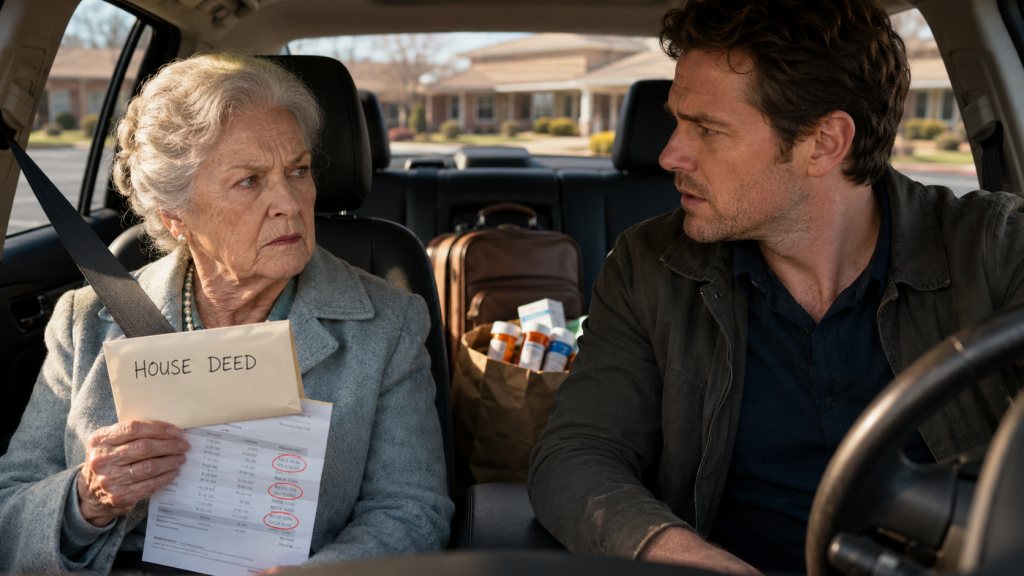
She walked out toward my car, climbed into the passenger seat, and buckled her seatbelt.
“Don’t call them,” she said.
I looked at her.
“I’ll tell you where to drive.”
“Where?”
“First, the county courthouse.”
That got my attention immediately.
Once we were back on the highway, she opened her purse and handed me a folded bank statement. Three withdrawals had been circled in red. Twelve thousand dollars. Eighteen thousand. Twenty-five thousand.
All taken within six weeks.
“Your father has power of attorney,” she explained. “Temporary. I signed it after my surgery because I trusted him.”
My stomach tightened.
“He told me I was starting to become forgetful. He said I needed help handling the bills.” She stared out the window. “Then yesterday, I found this.”
“Did you confront him?”
“I did.”
“And?”
“He said the money was being used to pay for my care.”
I glanced toward the lone suitcase sitting in the back seat.
Grandma let out a humorless laugh.
“At lunch today, your mother told me we were stopping somewhere that had a garden. They walked me into that facility, finished none of the paperwork, and vanished.”
My phone buzzed. Dad.
Grandma reached over and turned it face down.
“Courthouse first,” she repeated. “Then the bank. Then there’s one more place.”
“What place?”
She looked directly into my eyes.
“My house.”
I swallowed hard. “Why?”
“Because if they’ve done what I think they’ve done, your parents didn’t just leave me there today.”
She reached inside her coat and pulled out a small envelope. Across the front, written in my grandfather’s handwriting, were two words: HOUSE DEED.
“I hid this before they came to pick me up,” she said. “I wanted to know whether they would go looking for it.”
Her voice dropped.
“They wanted me out of the way.”
PART 2: THE HOUSE THEY WERE ALREADY SELLING
“They wanted me out of the way.”
Grandma said it without raising her voice.
That was how Eleanor Mercer sounded when she was truly angry.
She did not shout.
She became precise.
The envelope marked HOUSE DEED rested across her knees while the highway rolled beneath us.
For several miles, I said nothing.
Rain had begun to mist against the windshield.
The wipers moved slowly.
Left.
Right.
Left.
Right.
I kept thinking about the suitcase in the back seat.
One suitcase.
That was apparently what my parents believed eighty-one years of life could be reduced to.
Two sweaters.
Three nightgowns.
Medication.
A pair of sensible shoes.
And whatever dignity they expected Grandma to carry for herself.
“What do you think they did?” I finally asked.
Grandma looked through the windshield.
“I think your father has been trying to take control of my house.”
My hands tightened around the steering wheel.
“Take control how?”
“He has been bringing me papers.”
“What papers?”
“Things he calls routine.”
Her mouth twisted around the word.
“Insurance forms.”
“Tax papers.”
“Bank authorizations.”
“Something about the trust your grandfather created.”
I glanced at her.
“You signed them?”
“Some.”
The shame in her voice made my stomach turn.
Grandma saw my expression.
“Do not look at me like that.”
“I’m not.”
“Yes, you are.”
She lifted her chin.
“I was foolish.”
“No.”
I shook my head.
“You trusted your son.”
“That may amount to the same thing.”
“Grandma.”
She looked back out the window.
For a moment, neither of us spoke.
Then she whispered:
“After my surgery, I needed help.”
Her voice had changed.
Less angry.
More tired.
“I couldn’t drive for several weeks.”
“I got dizzy.”
“I forgot whether I had taken one blood-pressure pill.”
“One.”
She held up a finger.
“Your father treated that one mistake like evidence that my mind had started disappearing.”
My jaw clenched.
“He said that?”
“Not at first.”
She folded the envelope more tightly between her fingers.
“At first, he was kind.”
That somehow sounded worse.
“He brought groceries.”
“He paid my bills online.”
“He drove me to appointments.”
“He called every night.”
Her eyes darkened.
“Then kindness started acquiring instructions.”
I looked at her.
“What kind?”
“Don’t drive.”
“Don’t use the stove when you’re alone.”
“Don’t go downstairs.”
“Don’t sign anything unless Richard has seen it.”
She paused.
“Don’t call Daniel because he’s busy.”
My head snapped toward her.
“What?”
Grandma looked at me.
“Watch the road.”
“Dad told you not to call me?”
“He said you had enough on your plate.”
“When?”
“Many times.”
A strange pressure filled my chest.
For the last two years, Dad had told me Grandma wanted more privacy.
That she was tired.
That too many calls overwhelmed her.
That I should stop treating her like she was lonely just because Grandpa had died.
I had believed him.
Not completely.
But enough.
“I thought you didn’t want me calling so much.”
Grandma stared at me.
“Oh, Daniel.”
Two words.
Soft.
Heartbroken.
They hurt worse than anger.
“I called Dad every week asking how you were.”
“I know.”
I frowned.
“How?”
“He told me.”
“Then why didn’t you call?”
“Because he told me you were working long hours and driving back and forth would exhaust you.”
I almost laughed.
Not because anything was funny.
Because the shape of the manipulation had become suddenly clear.
Dad had told each of us the other wanted distance.
Two people separated by concern manufactured in both directions.
Grandma looked at the envelope.
“I think he needed me isolated.”
The courthouse appeared forty minutes later.
By then, Grandma had told me more.
The power of attorney had been signed three months earlier after her hip surgery.
Dad described it as temporary convenience.
He could pay utilities.
Talk to insurance.
Handle banking while she recovered.
She trusted him.
Why wouldn’t she?
He was her son.
She had changed his diapers.
Paid for his braces.
Stayed awake beside his bed when he had pneumonia at ten.
People rarely imagine the child whose fever they once cooled might someday use their trust against them.
Inside the courthouse, we were directed to a legal-aid office.
A woman named Priya Shah met us in a small room with beige walls and a clock that ticked too loudly.
She read the power of attorney carefully.
Grandma sat perfectly straight.
I sat beside her.
Ms. Shah finally looked up.
“This gives your son broad financial authority.”
Grandma’s eyes narrowed.
“How broad?”
“Banking.”
“Investments.”
“Contracts.”
Then:
“Certain real-estate matters.”
I felt Grandma go still beside me.
“Can he sell my house?”
Ms. Shah chose her words carefully.
“He may have some authority relating to the property, depending on how your trust is structured.”
Grandma put both palms on the table.
“I want it revoked.”
“Mrs. Mercer—”
“Today.”
Ms. Shah nodded.
“If you are acting voluntarily and you understand what you’re signing, yes.”
Grandma leaned forward.
“I understand exactly what I’m signing.”
She looked directly at her.
“I am taking my name back from my son.”
That sentence stayed with me.
Forms appeared.
Explanations.
Witnesses.
Notarization.
Grandma read every line.
Every single one.
When Ms. Shah tried to summarize one page for speed, Grandma lifted her hand.
“No.”
The attorney stopped.
“I have spent three months being told not to worry about what I’m signing.”
Grandma adjusted her glasses.
“I’m going to read this.”
And she did.
Slowly.
Carefully.
Fully.
There was something deeply moving about watching an old woman reclaim the right to be inconvenient.
When the revocation was complete, Ms. Shah gave us certified copies.
Then asked:
“Has anyone suggested you are no longer mentally competent?”
Grandma stared at her.
“My son says I’m forgetful.”
“Has he used the word dementia?”
Grandma hesitated.
“Yes.”
My stomach dropped.
“When?”
“Last week.”
“What happened?”
“He asked whether my doctor had ever tested me.”
Grandma frowned.
“I told him I forget names sometimes, but I remember enough to know he still owes me eighty dollars from 1987.”
Ms. Shah almost smiled.
Then her expression became serious again.
“Has anyone discussed guardianship?”
“No.”
“Assisted living?”
Grandma gave a small humorless laugh.
“I suppose that discussion occurred without me.”
The nursing facility.
The suitcase.
The fake lunch.
Ms. Shah wrote something.
“You should consider having your physician document your current capacity.”
Grandma nodded.
“And I recommend checking the property record immediately.”
“We were going to.”
“Do that before the bank.”
That frightened me.
“Why?”
“Because if there has been any attempt to transfer title or alter a trust interest, time matters.”
Grandma stood.
“Then we’re done talking.”
The county recorder’s office was downstairs.
A clerk searched the address.
28 Oak Hollow Lane.
The house where my father grew up.
The house where my grandfather George had planted an oak tree the year Dad was born.
The house where I spent summers eating peaches over the kitchen sink because Grandma said sticky children belonged outdoors.
The house where Grandpa died eleven years earlier.
The house Grandma still called home.
The clerk typed.
Then stopped.
Her forehead tightened.
She typed again.
Grandma noticed.
“What?”
The woman did not answer immediately.
She printed several pages.
Then called a supervisor.
That was when I knew.
People only call supervisors when ordinary becomes complicated.
A man with silver hair walked over.
He looked at the screen.
Then at Grandma.
“Mrs. Eleanor Mercer?”
“Yes.”
“Are you currently living at Twenty-Eight Oak Hollow?”
“Yes.”
“Have you recently authorized a trustee amendment?”
Grandma’s face went still.
“No.”
The supervisor turned the document toward us.
ELEANOR MERCER LIVING TRUST
Beneath it:
AMENDMENT OF SUCCESSOR TRUSTEE
Filed nine days earlier.
Successor trustee:
RICHARD MERCER.
My father.
Grandma stared at the page.
“That’s wrong.”
The supervisor pointed lower.
“There is also a property-management authorization filed with it.”
“What does that mean?”
He hesitated.
“I cannot give you legal advice.”
“Tell me what the paper says.”
He nodded.
“It appears to expand your son’s authority to act regarding the residence.”
Grandma looked at the signature.
Her own name was written there.
Eleanor Mercer.
She touched it.
Then withdrew her finger as though the paper had burned her.
“That isn’t mine.”
I leaned closer.
The signature looked convincing.
At least to me.
Grandma shook her head.
“I do not make the E like that.”
She took a pen from her purse.
On the back of an old receipt, she wrote:
Eleanor Mercer.
Her capital E began with a loop.
The filed document’s did not.
Grandma stared at it.
Then whispered:
“My own son forged my name.”
I put a hand over hers.
“We don’t know who signed it.”
She looked at me.
There were tears in her eyes now.
“Yes.”
Her voice broke.
“We do.”
The supervisor became very careful.
“If you dispute the signature, preserve a certified copy and contact counsel.”
Grandma straightened.
“I want the certified copy.”
We obtained everything.
The amendment.
The authorization.
Filing record.
Dates.
Names.
Nine days.
Dad had filed the documents nine days earlier.
Then, today, he had taken Grandma to a nursing facility and disappeared.
The pieces were beginning to fit together in a way I hated.
As we walked back toward the parking lot, my phone buzzed.
Dad.
Again.
I had stopped counting.
Grandma looked at the screen.
“Don’t answer.”
I put it away.
Then another message arrived.
Where are you?
Another.
The facility says Mom left with you. This is not safe.
Then:
Daniel, she is confused. Do not let her sign anything.
Grandma read the last one.
She laughed once.
A dry, bitter sound.
“Well.”
“What?”
“Apparently I became incompetent precisely when I started disagreeing.”
I looked at her.
She folded the courthouse documents and slipped them into her handbag.
“Bank.”
We drove to the branch she had used for more than thirty years.
The manager recognized her immediately.
“Eleanor?”
Mrs. Hanley came out from behind her desk.
She took one look at Grandma’s face.
Then at me.
“What happened?”
Grandma placed the statement down.
Three withdrawals circled in red.
$12,000.
$18,000.
$25,000.
Fifty-five thousand dollars.
“I want to know where these went.”
Mrs. Hanley’s expression changed.
“Come with me.”
We sat inside her office.
She pulled the transaction records.
Dad had used the power of attorney each time.
The first transfer went to:
RMC Property Solutions LLC.
I stared.
“RMC.”
Grandma’s mouth hardened.
“Richard Mercer.”
The second transfer went to the same company.
The third had gone to a title agency.
“What is RMC Property Solutions?” I asked.
Mrs. Hanley shook her head.
“I can only tell you where the money went.”
Grandma leaned forward.
“I never authorized payments to that company.”
The manager nodded slowly.
“Then I need to involve fraud services.”
A second bank employee joined us.
Questions followed.
Did Grandma approve the transactions?
No.
Did she know the company?
No.
Had Dad told her withdrawals were being made?
Only after she noticed.
What explanation did he give?
Care expenses.
The fraud officer frowned.
“Do you have invoices?”
“No.”
“Statements from a facility?”
“No.”
“Home-health expenses?”
“No.”
Grandma looked at him.
“Until this morning, I lived by myself.”
The man stopped writing.
“What facility was supposed to receive payment?”
Grandma looked at me.
“Apparently the one I was abandoned in.”
I hated the way she said it.
Not dramatic.
Almost factual.
As if she were trying to make the sentence small enough to survive.
The bank began revoking access tied to Dad’s authority.
Passwords were changed.
Account alerts reset.
Then the fraud officer paused.
“There’s another transaction request.”
My stomach tightened.
“When?”
“This morning.”
Grandma frowned.
“How much?”
“Seventy-five thousand dollars.”
I looked at her.
Her face went white.
“Was it processed?”
“No.”
The man shook his head.
“It was flagged because of the amount.”
Grandma let out a slow breath.
“What was it for?”
The fraud officer looked at the request.
“Real-estate transaction.”
Nobody spoke.
Then Grandma whispered:
“My house.”
I wanted to tell her we did not know that.
I could not.
Too much pointed there already.
The trust amendment.
The title company.
The nursing facility.
The timing.
Grandma leaned back.
Then said:
“Freeze everything.”
Mrs. Hanley nodded.
“We’re doing that.”
“No.”
Grandma pointed toward the screen.
“I mean everything Richard can touch.”
“New accounts if necessary.”
“New security questions.”
“New PIN.”
“Whatever you have to do.”
Her voice hardened.
“I want my son locked out of my money before he remembers what else he wants.”
The manager did not argue.
When we left the bank, it was nearly dark.
I expected Grandma to finally say she was tired.
Instead, she clicked her seatbelt.
“My house.”
“Grandma.”
“My house, Daniel.”
“You’ve been through enough today.”
She turned toward me.
“I have spent all day discovering what happened while I was not looking.”
Her eyes sharpened.
“I would very much like to start looking.”
So we went.
Twenty-Eight Oak Hollow Lane sat in a quiet neighborhood outside Dayton.
The old oak tree still leaned over the driveway.
Grandpa had planted it too close to the pavement.
Grandma complained about the roots every summer.
He always said:
“When I’m dead, cut it down.”
She never did.
I slowed as we approached.
Then stopped.
Grandma looked at me.
“What?”
I pointed.
There was a lockbox hanging from the front door.
A realtor’s lockbox.
Grandma stared.
“What is that?”
My stomach tightened.
“I think someone has been showing the house.”
She unbuckled immediately.
I followed.
The porch looked wrong.
Her rocking chair was gone.
So were the two flowerpots beside the door.
Grandma pushed her key into the lock.
It would not turn.
She tried again.
Nothing.
“Daniel.”
Her voice changed.
I stepped closer.
“Let me.”
My key did not work either.
They had changed the locks.
Grandma stared at the door.
For the first time all day, I saw fear.
Not anger.
Fear.
“My key doesn’t work.”
I touched her arm.
“We’re not forcing our way in.”
“This is my house.”
“I know.”
“Then open it.”
“I’m calling police first.”
She looked like she wanted to argue.
Then she saw the lockbox again.
“Call them.”
While we waited, I looked through the living-room window.
My heart sank.
Grandpa’s recliner was gone.
The side table beside it.
The lamp.
Grandma’s crocheted blanket.
Family photographs.
Gone.
The room had been emptied enough to stage.
I whispered:
“Oh no.”
Grandma came beside me.
She looked through the glass.
Then stopped breathing.
“Where is George’s chair?”
I closed my eyes.
The recliner was ugly.
Brown leather.
Cracked arm.
One cushion permanently flattened.
Dad hated it.
Everyone hated it.
Except Grandma.
Grandpa had sat in that chair every night for more than twenty years.
He read newspapers there.
Watched baseball there.
Held grandchildren there.
Died there.
Grandma touched the window.
“They took his chair.”
Her voice cracked.
That was when a car stopped at the curb.
Mrs. Becker from next door got out.
She recognized Grandma immediately.
“Eleanor?”
Grandma turned.
Joan Becker hurried across the lawn.
“Oh my God.”
She hugged her.
Then stepped back.
“I thought you had moved.”
Grandma stared.
“Who told you that?”
“Richard.”
My jaw tightened.
“When?”
“A week ago.”
Grandma looked toward her house.
“What exactly did he say?”
“That you were going into assisted living.”
Mrs. Becker looked uncomfortable.
“He said the house had become too much for you.”
Grandma whispered:
“Did I tell you that?”
“No.”
Joan looked ashamed.
“I assumed…”
Grandma nodded.
“Yes.”
“Everyone has been doing a lot of assuming lately.”
Mrs. Becker glanced toward the living room.
“There were movers.”
“When?”
“Wednesday.”
Grandma had slept in the house Wednesday night.
She had told me she went to bed early because Mom said they were having lunch together the next morning.
“What did they move?”
“Furniture.”
Grandma’s eyes filled.
“George’s chair?”
Joan looked down.
“Yes.”
Grandma turned away.
I watched her shoulders rise once.
Then fall.
She refused to cry in front of the neighbor.
“What else?”
“Boxes.”
“Some tables.”
“I didn’t see everything.”
Then Joan hesitated.
“There were people here yesterday.”
“What people?”
“A couple.”
“With a woman holding paperwork.”
My pulse jumped.
“A realtor?”
“I think so.”
Grandma turned toward me.
The police cruiser arrived five minutes later.
We explained everything.
The nursing facility.
Power of attorney.
Bank withdrawals.
Disputed signature.
Changed locks.
Lockbox.
The officer listened carefully.
Then made a call.
A second officer arrived.
They checked the property address.
Then one of them looked at us.
“There is an active real-estate listing.”
Grandma became completely still.
“Listed?”
“Yes, ma’am.”
“For sale?”
“Yes.”
I felt sick.
“When was it listed?”
“Three days ago.”
Three days.
Grandma had been living inside a house already being advertised as though she were gone.
I looked at the listing on the officer’s tablet.
Bright photographs.
Empty rooms.
Open curtains.
Her kitchen table removed.
Grandpa’s chair gone.
Grandma’s life edited away for buyers.
“What’s the status?” I asked.
The officer scrolled.
Then frowned.
“Pending.”
Grandma whispered:
“What does that mean?”
My chest tightened.
“It means someone made an offer.”
“And?”
“The seller accepted.”
Grandma gripped my arm.
“How much?”
The officer gave the amount.
Four hundred and eighty-five thousand dollars.
I knew the neighborhood.
The house was worth more.
At least fifty or sixty thousand more.
Maybe seventy.
It had been priced to move quickly.
I looked at the listing agent.
Then stopped.
“No.”
Grandma looked at me.
“What?”
The name on the screen was:
Karen Holloway.
My mother’s sister.
Aunt Karen.
Grandma read it.
Her face changed.
“Karen?”
I nodded.
She closed her eyes.
This had spread beyond my parents.
Mom’s sister had listed Grandma’s house.
Whether Karen understood everything or not, she had participated.
Grandma whispered:
“They were already selling it.”
I put an arm around her.
She pulled away gently.
Not rejecting me.
Holding herself upright.
Then Dad called again.
Grandma looked at my phone.
“Answer.”
I stared.
“You sure?”
“Yes.”
I put him on speaker.
“Dad.”
His voice came immediately.
“Where are you?”
“At Grandma’s.”
Silence.
Then:
“You need to leave.”
I almost laughed.
“Why?”
“That property is under my management.”
Grandma stepped closer.
“Your management?”
Dad stopped.
“Mom.”
“Yes.”
“What are you doing there?”
She looked at the changed lock.
“I tried coming home.”
“Mom, we talked about this.”
“No.”
Her voice remained calm.
“You talked.”
Dad exhaled heavily.
“You cannot live alone anymore.”
“That is not the same as giving you permission to sell my house.”
“We discussed selling.”
“You discussed it.”
“You agreed.”
“No.”
“Mom—”
“No.”
The word cracked through the speaker.
Even the officers looked toward her.
“I did not agree.”
Dad’s voice hardened.
“This is exactly why we were trying to handle things for you.”
Grandma stared at the phone.
“Because I say no?”
“Because you forget conversations.”
There it was.
The weapon.
Not anger.
Not authority.
Her age.
Grandma flinched.
Then recovered.
“Did I forget you left me at Rosebrook?”
“That is not what happened.”
“What happened?”
“We had to get additional paperwork.”
“For three hours?”
“We got delayed.”
“Both of you?”
Dad went silent.
Grandma continued.
“Did you change my locks?”
“For safety.”
“Did you remove my furniture?”
“For staging.”
The admission hung there.
“Did you list my house?”
Dad exhaled.
“Yes.”
Grandma closed her eyes.
“Without my permission.”
“You gave me authority.”
“I revoked it.”
Silence.
A long one.
Then Dad shouted:
“You did what?”
Grandma looked almost satisfied.
“I revoked the power of attorney.”
“Mom, you have no idea what you signed.”
She smiled bitterly.
“I knew you would say that.”
Dad’s voice rose.
“Who took you to do this?”
I answered:
“I did.”
“Daniel, stay out of it.”
“No.”
“This is between me and my mother.”
Grandma said:
“My bank account became between you and me when you removed fifty-five thousand dollars.”
Dad stopped.
Mom’s voice appeared faintly in the background.
“What did she say?”
Dad moved away from the phone.
Then returned.
“That money was for her care.”
Grandma looked at me.
“Which care?”
“Rosebrook.”
“I never agreed to live there.”
“You need care.”
“That is not what I asked.”
Dad snapped:
“You’re eighty-one!”
The sentence echoed across the porch.
Grandma did not move.
Dad continued.
“You fall.”
“You forget your pills.”
“You cannot keep maintaining that huge house.”
Grandma listened.
Then quietly asked:
“So you decided I was dead before I had the courtesy to die?”
Dad stopped breathing.
The officers looked away.
Grandma’s voice broke.
“You cleared my rooms.”
“You photographed my house.”
“You changed my locks.”
“You accepted an offer.”
“And today you packed one suitcase and left me somewhere else.”
Mom began crying in the background.
Dad said:
“That is unfair.”
Grandma laughed.
“Unfair?”
“You think we wanted this?”
“I don’t know what you wanted.”
Her eyes hardened.
“That is why I intend to find out.”
Dad said:
“Do not go inside the house.”
Grandma stared at the door.
“Why?”
“Because you’ll upset yourself.”
“No.”
Her voice sharpened.
“Why don’t you want me inside?”
Silence.
That was the first moment Dad sounded frightened.
Not irritated.
Frightened.
“Mom.”
“What is in my house?”
“Nothing.”
Grandma looked at me.
Then at the lockbox.
Then she said:
“You were looking for the deed.”
Dad went completely silent.
The envelope was still inside her coat.
The original deed Grandpa had told her never to lose.
Grandma touched it.
“You went through my papers, didn’t you?”
Dad answered quickly.
“I was organizing.”
“You searched.”
“No.”
“Did you find it?”
Nothing.
Grandma almost smiled.
“No.”
Her voice softened.
“You didn’t.”
Dad snapped:
“Mom, listen to me.”
She ended the call.
Just pressed the button.
Finished.
The officer asked:
“Is there anything inside you believe is important to preserve?”
Grandma looked toward the second floor.
“Yes.”
“What?”
“Documents.”
“Where?”
“My bedroom closet.”
A locksmith was contacted.
Because the ownership record still showed the trust and Grandma was disputing recent authority, police documented everything before entry.
When the door finally opened, Grandma stepped inside.
Then stopped.
The house echoed.
Her furniture was missing.
Photographs gone.
Coats gone.
The small table where Grandpa left his keys for fifty years—
gone.
Grandma touched the wall.
“They erased me.”
“No.”
I stood beside her.
“They tried.”
She looked at me.
That word mattered.
Tried.
We went upstairs.
In her bedroom, the closet had been disturbed.
Boxes shifted.
Clothes pushed aside.
One shelf nearly empty.
Grandma climbed onto the edge of the bed and reached toward the back.
“Blue box.”
I found it.
An old metal document case.
Dusty.
Heavy.
She took a small key from her purse.
Inside were tax records.
Insurance policies.
Grandpa’s military papers.
Their original mortgage.
Then the trust agreement.
Grandma handed it to me.
“Find the house.”
I read.
Page after page.
Then saw an underlined clause.
I read it again.
My heart started pounding.
“What?”
Grandma asked.
I looked up.
“The residence cannot be sold by a successor trustee while you are alive without your independent written consent witnessed by an attorney who does not represent the trustee.”
Grandma stared.
“What?”
“They can’t sell it.”
Her hand flew to her mouth.
“Not legally under this document.”
Tears filled her eyes.
“George.”
She touched Grandpa’s signature.
“That suspicious old man.”
I laughed through tears.
Then I noticed another clause.
“If sale proceeds…”
I stopped.
“What?”
Grandma leaned closer.
The trust said that if Grandma ever voluntarily sold the home, the proceeds remained solely for her benefit during her lifetime.
After her death, any remaining property passed according to a separate schedule.
I turned the page.
Then stopped.
Beneficiary:
Daniel Mercer.
Me.
I stared.
Grandma looked almost embarrassed.
“You were going to inherit the house?”
“Yes.”
“Did Dad know?”
She hesitated.
“Yes.”
My stomach dropped.
That changed everything.
Dad did not merely want to sell his mother’s property.
He knew that house was eventually supposed to pass to me.
If he converted it into cash while he controlled the trust—
Cash was easier to move.
Easier to call care expenses.
Easier to route through companies.
Easier to disappear.
I looked at Grandma.
“He knew.”
“Yes.”
“Why didn’t you tell me?”
“Because gifts discussed too early become expectations.”
She took my hand.
“And I never wanted you loving me for a house.”
My throat tightened.
“I wouldn’t.”
“I know.”
She smiled.
“That is why you were getting it.”
Then I noticed another envelope inside the box.
Sealed.
My name across the front.
FOR DANIEL
I looked at her.
“What is this?”
Grandma stared.
“I wrote that three years ago.”
“Why?”
“Open it.”
Inside was one page.
Her handwriting.
Daniel,
If you are reading this while I am still alive, then something has happened that I hoped would not.
My throat tightened.
I kept reading.
Your father has always believed being responsible for someone gives him the right to decide for them. Your grandfather worried about this too.
I glanced at her.
Grandma looked away.
The letter continued.
If Richard ever tries to sell this house before I have chosen to leave it, do not fight him because you want the property. Fight him because I am still here to choose what happens to it.
My eyes blurred.
Then:
The house is yours after me because you never asked for it. Richard has asked about it many times.
I stopped.
Grandma whispered:
“Keep reading.”
He calls it planning. Your grandfather called it counting before the funeral.
I closed my eyes.
That line hurt.
Because suddenly Dad’s urgency had an older history.
Not six weeks.
Maybe years.
The final lines read:
Do not confuse inheritance with entitlement. The house is not yours until I am gone. Until then, it belongs to me. That is the whole point.
I folded the letter carefully.
A noise came from downstairs.
The front door.
One officer called out:
“Sir, please stop there.”
Then Dad’s voice.
“Where is my mother?”
Mom was with him.
Footsteps climbed the stairs.
Dad appeared in the bedroom doorway.
He saw Grandma.
Then me.
Then the blue metal box.
And every bit of anger disappeared from his face.
For one second.
Only one.
But I saw what replaced it.
Fear.
He stared at the trust documents in my hands.
Then at the envelope.
“Give me those.”
I stood.
“No.”
His face hardened again.
“Daniel, those are private.”
Grandma spoke from behind me.
“They are mine.”
Dad looked at her.
“Mom, you are exhausted.”
She almost laughed.
“No.”
“I think I’m finally awake.”
Mom stepped forward.
“Eleanor, please.”
Grandma turned.
“Please what?”
“We were trying to do what was best.”
“Then why didn’t you tell me?”
Mom began crying.
“We knew you’d refuse.”
The room went silent.
Dad turned toward her.
“Linda.”
But it was too late.
Grandma stared at my mother.
“You knew I would refuse.”
Mom wiped her face.
“Yes.”
“And you did it anyway.”
“We were scared.”
“No.”
Grandma shook her head.
“You were inconvenienced.”
“That’s not fair.”
“I was inconvenient.”
Her voice trembled.
“My house was inconvenient.”
“My medicine was inconvenient.”
“My opinions were inconvenient.”
“And instead of helping me live…”
She swallowed.
“…you started organizing my disappearance.”
Mom covered her mouth.
Dad snapped:
“That is enough.”
Grandma looked at him.
“No.”
Her voice became quiet.
“This is the first time in months I have decided when enough is enough.”
Dad looked toward the blue case again.
Then toward the closet.
Something passed across his face.
I saw it.
So did Grandma.
Her eyes narrowed.
“What?”
Dad said nothing.
She turned toward the closet.
“Daniel.”
“What?”
“Move those coats.”
I did.
Dad stepped forward.
The officer at the doorway stopped him.
“Sir.”
Dad froze.
Behind a row of winter coats, there was another box.
Smaller.
Black.
Fireproof.
Grandma stared.
“I forgot about that.”
She reached for it.
Dad looked confused now.
Actually confused.
That interested me.
If he had searched the closet, he had not found this.
Grandma pulled it onto the bed.
A tiny brass key was taped underneath the shelf.
She removed it.
Opened the lock.
Inside were photographs.
A flash drive.
Several envelopes.
And one document packet wrapped in plastic.
Across the front, in Grandpa George’s handwriting, were the words:
FOR ELEANOR — IF RICHARD EVER TRIES TO TRANSFER THE HOUSE
Dad stopped breathing.
Grandma looked at the words.
Then slowly lifted her eyes toward her son.
“Your father knew.”
Dad’s face turned white.
Mom whispered:
“Oh my God.”
I looked at Grandpa’s handwriting.
Then at Dad.
For the first time all day, my father did not look like a man trying to manage an elderly mother.
He looked like a man realizing the person he thought was safely buried had left behind one last obstacle.
Grandma rested her palm over the packet.
Then said:
“Everyone sit down.”
Dad stared at her.
“What?”
“You heard me.”
Her voice had become steady again.
The Eleanor Mercer voice.
The one no age, power of attorney, nursing facility, or forged signature had managed to erase.
“Sit down.”
She looked at the packet Grandpa left behind.
“Because before anyone takes another thing from me…”
Her eyes lifted toward Dad.
“…we are going to find out exactly what your father was afraid you would do.”
And for the first time since I answered the nursing facility’s call, I realized the fifty-five thousand dollars might not be the biggest secret in the room.
It might only be the part Grandma discovered first.
PART 3: THE LAST THING GRANDPA LEFT BEHIND
“Everyone sit down.”
Grandma’s voice was quiet.
That made it stronger.
Dad remained in the bedroom doorway.
Mom stood behind him, her face wet with tears.
One police officer stayed in the hall.
The other stood near the stairs.
And between us, on Grandma’s stripped bed, sat the black fireproof box my grandfather had hidden years before his death.
Across the document packet were the words:
FOR ELEANOR — IF RICHARD EVER TRIES TO TRANSFER THE HOUSE
Dad stared at them.
Then laughed once.
It was not amusement.
It was panic dressed as contempt.
“This is ridiculous.”
Grandma looked at him.
“What is?”
“Dad writing secret letters.”
“He wrote many things.”
“He was paranoid.”
Grandma’s eyes sharpened.
“No.”
She put one hand on the packet.
“He knew you.”
Dad’s mouth tightened.
For one strange second, he looked like a boy again.
Not my father.
Grandpa’s son.
Caught somewhere between shame and defiance.
Mom touched his arm.
“Richard.”
He shook her off.
“What?”
“You should sit.”
Dad looked at her as though she had betrayed him too.
Then he pulled the desk chair toward himself and sat.
Mom sat beside him on the edge of the mattress.
Grandma remained standing.
Eighty-one years old.
Church coat still buttoned.
Hair still pinned.
A woman who had been abandoned beside one suitcase only hours earlier.
And somehow, she was the strongest person in the room.
“Daniel.”
I looked at her.
“Open it.”
I slid the packet from the plastic sleeve.
Inside were several documents.
A handwritten letter.
Copies of old financial statements.
A notarized memorandum.
And one envelope marked:
RICHARD — 2009
Dad’s face changed.
Grandma noticed.
“So you recognize that.”
Dad looked away.
“What is it?”
Grandma asked.
He said nothing.
I opened the handwritten letter first.
Grandpa’s writing was larger than Grandma’s.
Heavy.
Blocky.
The kind of handwriting that looked carved rather than written.
I began to read.
Eleanor,
If this envelope is open, then either I worried for nothing or I worried correctly. I hope it is the first.
Grandma closed her eyes.
I kept going.
Richard is not a bad man.
Dad looked up.
Something flickered in his face.
Relief perhaps.
Then I read the next sentence.
But he has always been dangerous when he convinces himself that wanting something badly enough makes it responsible.
Dad’s face went still.
Mom covered her mouth.
Grandma whispered:
“Keep reading.”
I did.
In 2009, Richard came to me owing more money than Linda knew.
My head snapped toward Dad.
Mom’s tears stopped.
“What?”
Dad stared at the floor.
I continued.
He had borrowed against the business, used personal credit, and guaranteed a property investment that failed. He asked me to borrow against this house to help him.
Mom stood.
“What property investment?”
Dad said:
“This was seventeen years ago.”
She stared at him.
“What property?”
“Linda.”
“What property?”
Grandma lifted one hand.
“Let Daniel finish.”
My pulse pounded.
Grandpa’s letter continued.
I refused.
Richard was angry.
He told me the house was only sitting here and that family money should serve the family while people were alive instead of becoming inheritance after they were dead.
My stomach turned.
The house.
Only sitting here.
The same logic.
If something was unused, it could be redirected.
If Grandma did not need control in Dad’s opinion, control became waste.
I read on.
A week later, I learned he had contacted our lender pretending he had authority to discuss refinancing. Nothing was completed. I confronted him. He apologized.
Dad stood.
“That is not what happened.”
Grandma stared at him.
“Sit down.”
He did not.
The officer in the hallway shifted.
Dad finally sat again.
I continued.
I believed Richard was ashamed. I also believed he loved us. Both things were true.
Grandma’s mouth trembled.
But love does not erase appetite.
Nobody moved.
That is why I changed the trust.
There it was.
Grandpa had not created the protections around Grandma’s house because of some abstract concern.
He had done it because Dad had already tested the boundary once.
Seventeen years earlier.
Before Grandpa died.
Before Grandma needed surgery.
Before anyone could call her confused.
Grandpa knew exactly what he was guarding against.
I turned the page.
The house cannot be sold by Richard without Eleanor’s independent consent because I do not trust any consent obtained under pressure, urgency, or dependency.
Dad looked toward the window.
If Eleanor wants to sell, she should sell.
If Eleanor wants to move, she should move.
If Eleanor wants to live in this house until the roof falls onto the kitchen table, then repair the roof.
Despite everything, Grandma laughed.
A tiny sound.
“That sounds like him.”
I smiled.
Then kept reading.
What matters is not the house.
What matters is that Eleanor chooses.
The room went silent.
Grandma sat slowly beside me.
I felt her shoulder touch mine.
Then I reached the final paragraph.
If Richard ever tells you he knows what you need better than you do, remember that being loved by someone does not make you their property.
Grandma’s eyes filled.
I stopped reading.
She touched the page.
“George.”
Just his name.
Nothing else.
Dad rubbed both hands over his face.
Then he said:
“He never forgave me.”
Grandma looked at him.
“That is what you heard?”
He looked up.
“What?”
“Your father writes six pages trying to protect me, and your first concern is whether he forgave you?”
Dad’s face crumpled.
For one second, anger disappeared.
What remained was hurt.
Old hurt.
Boyhood hurt.
“He thought the worst of me.”
Grandma shook her head.
“No.”
Her voice softened.
“He thought enough of you to believe you could choose differently.”
Dad stared.
Grandma continued.
“That is why he did not go to police in 2009.”
“That is why he did not tell Linda.”
Mom looked at Dad.
Pain spread across her face slowly.
“You never told me any of this.”
Dad whispered:
“I was embarrassed.”
“How much?”
He said nothing.
“How much debt?”
“Linda.”
“How much?”
Dad’s jaw tightened.
“Two hundred and six thousand.”
Mom sat down hard.
Grandma closed her eyes.
I stared at him.
Dad had always lectured me about money.
Credit cards.
Savings.
Living within my means.
I had spent my entire adult life believing Richard Mercer was the most financially disciplined person I knew.
Maybe that discipline had been born from surviving his own mess.
Maybe shame had turned into control.
People can build a virtue over the grave of a mistake and still never admit where it came from.
Mom whispered:
“How did you get out?”
Dad looked at Grandma.
She answered.
“George loaned him seventy thousand.”
Mom turned toward her.
“You knew?”
“I knew about part of it.”
Dad closed his eyes.
Grandma continued.
“George made Richard sign a repayment agreement.”
I looked at the old financial statements.
There it was.
Seventy thousand.
Repaid over six years.
Grandpa had helped him.
But he had also protected the house.
Dad looked at me.
“You don’t understand what Dad was like.”
Grandma laughed bitterly.
“I was married to him fifty-three years.”
She folded her hands.
“I believe I had a sample.”
Dad ignored her.
“He could make one mistake feel like a character sentence.”
Grandma’s expression softened again.
“That may be true.”
Dad looked surprised.
She continued.
“Your father was not perfect.”
“No.”
“He was stubborn.”
“Yes.”
“Judgmental.”
“Yes.”
“Terrible at apologizing.”
A faint smile almost passed between them.
Then Grandma said:
“But none of that explains why you left me at Rosebrook today.”
The smile vanished.
Dad looked down.
There it was.
The center.
Not 2009.
Not Grandpa.
Not old resentment.
Today.
Grandma pointed toward the packet.
“You had seventeen years to prove your father worried for nothing.”
Dad’s eyes filled.
“And instead…”
Her voice broke.
“…you proved he needed a fireproof box.”
Mom started crying again.
Dad remained still.
I opened the envelope marked RICHARD — 2009.
Inside was a photocopy of the repayment agreement.
And a handwritten note from Dad to Grandpa.
Short.
I almost did not read it aloud.
Grandma told me to.
So I did.
Dad,
I understand why you said no to using the house. I was scared and thought fixing the problem quickly mattered more than asking what my choices were doing to everybody else.
My voice slowed.
The next line almost hurt more than anything.
I promise I will never put Mom’s security at risk because of my own mistakes.
The room went still.
Dad stared at the floor.
Grandma closed her eyes.
Then whispered:
“You promised him.”
Dad began crying.
Not loudly.
His shoulders simply dropped.
His hands covered his face.
“I know.”
Grandma watched him.
No triumph.
No revenge.
Only grief.
“That is what hurts.”
Dad shook his head.
“I thought I was helping.”
“No.”
Grandma said it gently this time.
“You thought you were solving.”
He looked up.
“What’s the difference?”
“Helping asks.”
She touched her chest.
“Solving decides.”
Nobody spoke.
That sentence changed Dad’s face.
Maybe because it was simple enough that he could no longer hide behind words like care, safety, management, future, responsibility.
Grandma continued.
“You decided I should leave.”
“You decided the house should sell.”
“You decided the price.”
“You decided how much of my money could move.”
“You decided I was forgetful.”
Her eyes filled.
“And when I kept saying no…”
She swallowed.
“…you decided no was proof I could no longer decide.”
Dad cried harder.
Mom whispered:
“We really were afraid for you.”
Grandma looked at her.
“I believe you.”
Mom blinked.
“You do?”
“Yes.”
Grandma’s voice softened.
“And that is why this is so terrible.”
Mom looked confused.
Grandma explained.
“If you hated me, this would be easier.”
Tears rolled down her cheeks.
“But you love me.”
She looked at both of them.
“And somehow you loved me so badly that you stopped seeing me.”
No one had anything to say to that.
The officers preserved the documents.
Grandma gave a statement.
Dad and Mom gave theirs separately.
The active house sale was formally challenged the next morning.
Because the original trust required Grandma’s independent consent, the title company halted closing almost immediately once her attorney provided the documents.
The buyers walked away.
I felt bad for them.
They had done nothing wrong.
They had simply made an offer on a home whose owner had been edited out of the transaction.
Aunt Karen called me six times.
Then Grandma.
Grandma finally answered.
I was sitting beside her at my apartment by then.
We had driven back to Indianapolis after spending one night in Oak Hollow gathering clothing, medication, photographs, and whatever else Grandma wanted.
Not what Dad said she needed.
What she wanted.
Grandma put Karen on speaker.
“Eleanor.”
Karen sounded frantic.
“I didn’t know Richard didn’t have authority.”
Grandma waited.
“I swear.”
“Did you speak to me?”
Silence.
“No.”
“Did you call?”
“No.”
“Did you ask why I was not signing anything?”
Karen began crying.
“Richard said you were overwhelmed.”
Grandma nodded slowly.
“And you believed the person receiving control instead of calling the person losing it.”
Karen had no answer.
Grandma sighed.
“I do believe you did not understand all of it.”
Karen sniffed.
“Thank you.”
“That is not forgiveness.”
Karen went silent.
Grandma continued.
“You are a real-estate agent.”
“You know better than most people what ownership means.”
“Yes.”
“And you helped list my home without ever hearing me say I wanted it sold.”
Karen whispered:
“I’m sorry.”
“I know.”
Grandma looked toward my kitchen window.
“Now you will live with being sorry.”
Then she ended the call.
Karen later faced a professional complaint.
She did not lose her career.
But she lost the listing, paid penalties connected to the failed transaction, and for nearly two years Grandma refused to speak to her.
Dad’s consequences were more serious.
The bank investigation determined that some of the fifty-five thousand dollars had been used for legitimate expenses related to Grandma’s property and medical care.
But not all.
A substantial amount had gone through RMC Property Solutions.
Dad claimed those were reimbursements for time, renovations, cleaning, and management.
The problem was that Grandma had never agreed to pay him management fees.
Nor had she agreed to fund the condo he and Mom intended to buy.
The seventy-five-thousand-dollar transaction had been tied to a down payment.
Their down payment.
Mom finally admitted the plan.
They intended to sell Grandma’s house.
Place her at Rosebrook.
Use part of the proceeds for her future care.
Then use money Dad claimed he was entitled to as reimbursement to buy a smaller condominium near the facility.
“So we could visit every day,” Mom told Grandma.
Grandma stared at her.
“You were going to purchase yourselves a home with money from mine.”
Mom cried.
“That wasn’t how we saw it.”
“That is how arithmetic sees it.”
The disputed funds were frozen.
Some were recovered immediately.
Others took months.
The allegedly forged signatures were examined.
Dad insisted he had believed Grandma authorized the amendment and that a prepared signature page had been attached incorrectly.
The investigation did not become the dramatic courtroom spectacle some relatives expected.
Real life rarely behaves that neatly.
There were lawyers.
Bank records.
Depositions.
A civil action.
A financial exploitation investigation.
Eventually, Dad agreed to repay money that could not be documented as authorized expenses.
He surrendered all authority over Grandma’s finances.
Permanently.
He also agreed not to challenge the restored trust documents.
The attempted house sale died.
The condo purchase died with it.
And Rosebrook?
Grandma sent the administrator a handwritten note.
Thank you for calling my grandson when the people who brought me disappeared.
She included flowers.
Not because the facility had done anything wrong.
They had been handed a story too.
They just happened to ask one more question.
That mattered.
Grandma stayed with me for seven weeks.
My Indianapolis apartment was not built for an eighty-one-year-old woman with opinions.
She hated my sofa.
My coffee.
My inability to own “proper” bath towels.
She moved my spice rack on day three.
I moved it back.
She moved it again.
“This is my apartment.”
“And those spices were living incorrectly.”
I laughed more during those seven weeks than I expected.
Also cried more.
At night, I sometimes heard her moving in the guest room.
Once, I found her sitting on the edge of the bed at two in the morning.
“You okay?”
“Yes.”
“You’re awake.”
“Excellent observation.”
I sat beside her.
She stared at the floor.
Then whispered:
“I keep seeing the lobby.”
My chest tightened.
“Rosebrook?”
She nodded.
“The suitcase.”
I waited.
“I kept thinking they were coming back.”
Her voice broke.
“Every time the door opened, I looked.”
I put my arm around her.
“They told the receptionist they were getting papers.”
“I know.”
“So I waited.”
I closed my eyes.
That was the wound.
Not the money.
Not even the house.
Waiting.
Believing someone who had already left was still returning.
Grandma cried against my shoulder.
“I defended him.”
“What?”
“The administrator asked if she should call someone.”
Grandma wiped her face.
“I told her Richard would be right back.”
My heart broke.
She had protected Dad’s image even after his car had already left the parking lot.
I held her.
Then she whispered:
“Never make someone wait after you already know you’re not coming back.”
“I won’t.”
Three months later, Grandma moved home.
Not because everyone agreed.
Because she chose to.
We made changes.
Handrails.
Better lighting.
A safer shower.
Medication dispensers.
A medical-alert system she complained about constantly.
A part-time home aide named Patrice came four mornings a week.
Grandma hated the idea.
Then Patrice told her on day one:
“If you fall off a ladder because you refuse to ask for help, I am not listening to the story afterward.”
Grandma stared at her.
Then laughed.
They became inseparable.
The house slowly came back.
Grandpa’s chair was located at an estate-clearance warehouse before auction.
Grandma and I drove there.
It sat among hundreds of unwanted things.
Brown.
Cracked.
Ugly.
A paper tag hung from the arm.
LOT 218
Grandma stopped ten feet away.
Her face crumpled.
She walked toward it.
Touched the worn leather.
Then whispered:
“There you are.”
I looked away.
Because sometimes grief deserves privacy.
The company returned the chair once they learned it had been removed from disputed property.
We recovered the porch bench.
Two lamps.
Several boxes of photographs.
Some things were gone.
The silver tea service had sold.
One side table disappeared.
A set of crystal glasses too.
Grandma mourned those for about five minutes.
Then said:
“I never liked the glasses anyway.”
“Grandpa did.”
“George liked anything he could fill with bourbon.”
Fair.
The house never looked exactly the same again.
Maybe that was good.
Restoration is not rewind.
Neither are families.
Dad did not speak to Grandma for almost eleven months.
At first, because lawyers advised distance.
Later, because shame did.
Then one Sunday, Grandma asked me to drive her to a park.
He was waiting there.
I had not known.
“Grandma.”
“You would have argued.”
“Yes.”
“That is why I did not tell you.”
She walked toward the picnic table.
Dad stood.
He looked older.
Not ruined.
Consequences had not destroyed him.
They had simply removed his authority.
He no longer entered a room assuming he would make the decisions.
Grandma sat.
Dad stayed standing.
“Sit down, Richard.”
He sat.
For nearly a minute, neither spoke.
Then Dad said:
“I’m sorry.”
Grandma looked at him.
“For what?”
Dad froze.
She waited.
A general apology was not enough.
Not after specific harm.
Dad swallowed.
“For the money.”
Grandma said nothing.
“For the house.”
Still nothing.
“For changing the locks.”
Her eyes filled.
“For making decisions without you.”
She waited.
Dad started crying.
“And for leaving you.”
There.
That was the one.
Grandma’s lower lip trembled.
Dad continued.
“I knew if we stayed at Rosebrook, you would refuse.”
“Yes.”
“So we left.”
“Yes.”
“I told myself once you calmed down, you would understand.”
Grandma stared at him.
“I was not confused.”
“I know.”
“I was not incapable.”
“I know.”
“I needed help.”
Dad nodded.
“Yes.”
“Those things are not the same.”
“No.”
Grandma leaned back.
Then said:
“I believe you love me.”
Hope appeared in Dad’s face.
She continued.
“But I do not trust you.”
The hope vanished.
Dad nodded.
“I understand.”
“No.”
Grandma shook her head.
“You understand the sentence.”
Her eyes stayed on him.
“You will understand the reality when you want to help me and I say no.”
Dad cried silently.
“And I may never trust you with money again.”
“I know.”
“No financial authority.”
“Yes.”
“No access to my accounts.”
“Yes.”
“No medical conversations without me present unless I ask.”
“Yes.”
“No deciding what house I live in.”
“Yes.”
“And never again tell Daniel I am too tired to speak to him.”
Dad looked at me.
Shame crossed his face.
“I’m sorry.”
I nodded.
“I know.”
That relationship took longer.
Because I had my own grief.
Years of calls I did not make.
Birthdays when Dad told me Grandma had gone to bed early.
Weekends I stayed in Indianapolis because he said she was overwhelmed.
I could not get those moments back.
I could only stop losing new ones.
So Grandma and I started Sunday calls.
Seven o’clock.
Every week.
If I was five minutes late, she called me.
“You dead?”
“No.”
“Then you own a clock.”
The first Christmas after everything, Dad and Mom came for dinner at Grandma’s house.
They asked first.
That mattered.
Dad brought nothing except dessert.
No forms.
No folders.
No advice.
Mom asked Grandma where she wanted to sit.
Such a small question.
Grandma noticed.
So did I.
Healing entered our family disguised as ordinary manners.
Dad still slipped sometimes.
Once, he said:
“You really shouldn’t be driving at night.”
Grandma looked at him.
He stopped.
Then corrected himself.
“Would you like me to drive?”
She smiled.
“Yes.”
Progress does not always sound profound.
Sometimes it sounds like a sentence repaired halfway through.
Mom’s apology came later.
She confessed she had been tired.
Afraid.
Overwhelmed by Grandma’s recovery.
She said Rosebrook looked safe.
The house felt like one more responsibility.
“I thought once you were settled there, everything would become easier.”
Grandma asked:
“For who?”
Mom cried.
“For me.”
That honesty finally gave them something real to work with.
Grandma nodded.
“That answer I can respect.”
Mom looked surprised.
“You can?”
“No.”
Grandma almost smiled.
“I respect the truth.”
That distinction became important.
Three years after the nursing-facility call, Grandma turned eighty-four.
We had dinner at Oak Hollow.
Just family.
Patrice too.
Grandma insisted.
“She has seen me without pants.”
Patrice choked on her drink.
“That makes us related.”
Dad laughed so hard he had to leave the table.
For a moment, the family sounded ordinary again.
But ordinary after truth is different from ordinary before it.
Before, peace meant avoiding what hurt.
After, peace meant we could name what happened without letting it control every room.
Grandma stayed in the house until she was eighty-six.
Then one winter morning, she called me.
“I’m done.”
My stomach dropped.
“With what?”
“This house.”
I drove over.
She was sitting in Grandpa’s chair.
Coffee beside her.
“What happened?”
“Nothing.”
“Then why—”
She looked around.
“I’m tired of stairs.”
I stared.
“You want to sell?”
“Yes.”
I almost laughed.
After everything.
The house.
The fight.
The trust.
The police.
The bank.
Now she wanted to sell it herself.
“Are you sure?”
She gave me a look.
“Do not become your father.”
I shut my mouth.
She smiled.
“Good.”
Then we laughed.
Grandma chose the realtor.
Not Karen.
She chose the price.
She rejected the first offer.
Accepted the second.
Signed every page with an attorney of her own choosing.
And on closing day, she sat at the table with a fountain pen and said:
“You know what the best part of this is?”
“What?”
“Nobody is making me.”
That was the whole story in five words.
The house sold for significantly more than Dad’s rushed listing had accepted years earlier.
Grandma used part of the money to move into an independent-living community fifteen minutes from Oak Hollow.
Not Rosebrook.
Her choice.
She had a bright apartment overlooking a garden.
The irony made her laugh.
“So they were right about the garden.”
I smiled.
“They were just wrong about everything else.”
She traveled once.
Savannah.
Hated flying.
Loved the food.
Bought a ridiculous hat.
She paid for Patrice to come with her.
“Security,” Grandma said.
Patrice replied:
“Babysitter.”
Grandma gave her the finger.
At eighty-eight, Grandma died.
Not alone.
Not abandoned.
Not waiting for someone who had already decided not to return.
Dad sat beside her bed.
Mom on the other side.
I held her hand.
Patrice stood near the window.
Her breathing became softer.
Then slower.
Before she stopped speaking, Grandma looked at me.
“Daniel.”
“I’m here.”
“House.”
I laughed through tears.
“You sold it.”
“I know.”
She smiled.
“Good.”
Then:
“Choose.”
One word.
That was her last clear word to me.
Choose.
She died the next morning.
After the funeral, Dad gave me a small envelope.
Grandma had left it with her attorney.
Inside was not a deed.
No house anymore.
Just a letter.
Daniel,
You once drove one hundred and ninety miles because somebody called and told you I had been left somewhere.
My eyes blurred immediately.
Thank you for not deciding where to take me after that.
I stopped.
Dad looked away.
I continued reading.
You let me tell you where to drive.
That mattered more than the miles.
I cried.
Then laughed when I read the next line.
You still make terrible coffee.
Of course.
The last paragraph said:
People will call what you did saving me. Do not let them. I saved myself. You drove.
Remember the difference.
I folded the letter.
That became the line I kept.
Not because it made my role smaller.
Because it made Grandma’s life larger.
I had not rescued an old woman who could no longer choose.
I had helped a capable woman reach the places where she could make her choices matter again.
Courthouse.
Bank.
House.
Later, attorney.
Doctor.
Real-estate office.
New apartment.
Every destination hers.
I drove.
Dad and I eventually rebuilt something too.
Never what we had before.
Better in some ways.
Harder in others.
He became quieter around decisions that were not his.
Years after Grandma died, he needed knee surgery.
He called me.
“Can you come to the appointment?”
“Yes.”
A week later, he asked:
“Would you handle the bills while I recover?”
I paused.
He heard it.
Then laughed sadly.
“I know.”
“What?”
“I know what that question sounds like in this family.”
I smiled.
“So what do you want?”
He said:
“Help.”
Not control.
Help.
That mattered.
We set things up together.
Temporary.
Limited.
Written clearly.
When he recovered, I gave everything back.
Every password.
Every document.
Every key.
Dad stared at the folder.
Then said:
“Your grandfather would like this.”
I thought about it.
“No.”
Dad looked at me.
“Grandma would.”
His eyes filled.
He nodded.
“Yes.”
She would.
Today, the house on Oak Hollow belongs to another family.
I drove past it once.
Only once.
The oak tree is still there.
The crooked brass numbers are gone.
New owners fixed them.
Grandpa would be furious.
There are children’s bicycles in the driveway.
Blue curtains in the front window.
No sign of the brown chair.
That came with Grandma to the independent-living apartment and later came to me.
Yes.
I kept that hideous thing.
It sits in my study.
Cracked arm and all.
Sometimes I sit in it when I call Dad.
The blue metal box sits in a closet.
Empty now.
The important documents are long settled.
But I kept the box because it reminds me of something.
Grandpa believed protection meant preparing a door Grandma could open herself.
Dad believed protection meant closing doors before she reached them.
That was the difference.
Love is not proved by how many decisions you make for someone.
Sometimes it is proved by how many decisions you leave in their hands.
The nursing facility called me because my parents disappeared.
For years, I thought that was the worst part.
It wasn’t.
Leaving her in the lobby was only the loudest part.
They had been leaving her gradually for months.
Every time they discussed her instead of with her.
Every time they called disagreement confusion.
Every time they converted fear into authority.
Every time they treated her age like a transfer of ownership.
Grandma did need help.
That part was true.
But needing help did not make her a child.
Being slower did not make her stupid.
Forgetting a pill did not erase eight decades of judgment.
Getting old did not turn her life into a family project everyone else could manage.
And love did not make anyone owner of her choices.
The day she sat in my passenger seat, she had one suitcase behind her.
Her whole house was already being photographed without her.
Her money was moving.
Her keys no longer worked.
Her own son was telling people she could no longer decide for herself.
She looked at me and said:
“Don’t call them.”
Then:
“I’ll tell you exactly where we’re going.”
At the time, I thought she was asking for a ride.
She wasn’t.
She was asking for something far more important.
She was asking someone to listen.
So I did.
I drove.
Grandma chose the road.
And in the end, that was how she got her life back.
Not because someone took control for her.
Because someone finally stopped trying to.
THE END STORIES! THANK YOU FOR READING GOOD LUCK !❤️
Related Posts