
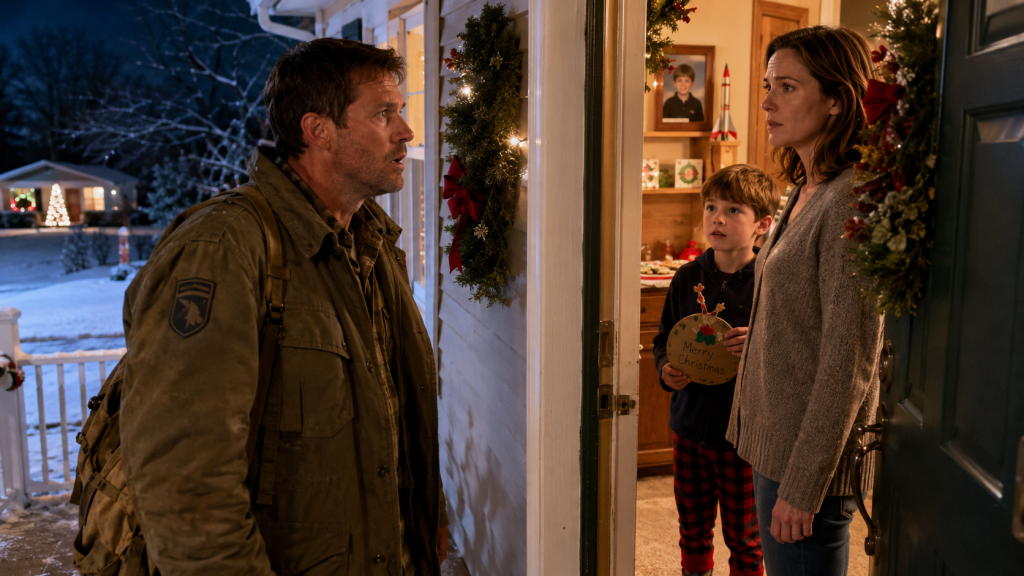
Seven years after our divorce, I went to my ex-wife’s house on Christmas Eve, hoping to apologize and finally admit I had been wrong about her. But when she opened the door, a little boy appeared behind her. He looked up at me with eyes that looked exactly like mine. I asked how old he was. She answered quietly, “Seven.” I thought that was the biggest shock of the night. Then she brought out a letter with my name written on it.

Part 1: The Boy Behind My Ex-Wife’s Door
Seven years after our divorce, I stood on my ex-wife’s porch on Christmas Eve, ready to apologize for the lie that had destroyed us.
Snow melted across the shoulders of my old Army coat as Claire opened the door. Before I could speak, a little boy ran up behind her in red Christmas socks, holding a crooked cardboard ornament.
“Mom, the star fell off again.”
Then he saw me.
He tilted his head with the same suspicious expression I had worn in every childhood photo. But it was his eyes that made my chest tighten.
Blue-gray.
Exactly like mine.
“Who are you?” he asked.
“My name is Daniel,” I said. “I used to know your mother.”
It was true.
But it was painfully incomplete.
I used to know how Claire took her coffee, what song she hummed while cooking, and why she always left one lamp on whenever I was deployed.
The boy noticed the Army patch on my coat.
“Were you a soldier?”
“Yes.”
His face lit with questions, but Claire quickly sent him to check the cookies. He obeyed, glancing back at me twice before disappearing into the kitchen.
The second we were alone, I asked, “How old is he?”
Claire folded her arms. “Daniel, don’t do this on the porch.”
“How old?”
“Seven.”
The word hit me harder than the cold.
Our divorce had been finalized seven years earlier, three weeks before I left on an overseas assignment that kept me away for almost fourteen months.
I looked past her into the living room. Children’s decorations covered the walls, and a school photo sat on a shelf beside a model rocket.
The boy’s smile looked like my father’s.
“Is he mine?” I asked.
Claire did not deny it.
Instead, she stepped outside and pulled the door nearly shut behind her.
“His name is Noah,” she said. “And he doesn’t know who you are.”
I wanted answers. But seven years ago, anger had already cost me enough.
So I asked quietly, “Did you ever try to tell me?”
Pain crossed her face.
“I wrote twice. One letter came back. The other reached your mother’s house and disappeared.”
Then Noah opened the door again with three crooked cookies.
Later, Claire brought out a small wooden box.
Inside was his hospital bracelet, a lock of dark baby hair, and a sealed letter with my name on it.
At the bottom, Claire had written:
Please come yourself, Daniel. Do not let your mother answer for you.
Then I turned the envelope over.
Beneath the return stamp was my mother’s handwriting.
**He has chosen the Army and wants nothing to do with this child.
PART 2: THE LETTER MY MOTHER BURIED
For a long time, I did not move.
The envelope trembled between my fingers.
Outside, snow brushed softly against the porch railing.
Inside, I could hear Noah laughing at something on television.
A child’s laugh.
My child’s laugh.
Seven years of life were happening ten feet away from me.
And on the back of the envelope was my mother’s handwriting.
He has chosen the Army and wants nothing to do with this child.
I read it once.
Then again.
Then a third time because some betrayals look impossible until your mind has exhausted every easier explanation.
Claire stood across from me.
She said nothing.
She did not need to.
I recognized that handwriting.
The tall H.
The hard downward slash in the y.
The way my mother always pressed too deeply into paper, as though every sentence needed to leave a bruise behind.
I whispered:
“She wrote this?”
Claire looked at me.
“Yes.”
My stomach turned.
“Did you see her write it?”
“No.”
“Then how do you know?”
“Because I called her.”
My eyes lifted.
“What?”
Claire looked toward the living room to make sure Noah was still occupied.
Then she sat in the chair opposite me.
“Three days after I mailed that letter, your mother called.”
I could barely breathe.
“What did she say?”
Claire’s mouth tightened.
“She said you had received it.”
I stared.
“She said you wanted me to stop writing.”
My fingers went numb.
“No.”
“I know that now.”
“No.”
I shook my head harder.
“I never saw this.”
Claire’s eyes filled.
“I know.”
“How?”
“Because you’re still looking at it like it’s a bomb.”
That almost made me laugh.
Almost.
Instead, I lowered myself into the chair.
The old wooden floor creaked beneath me.
“How pregnant were you?”
“Four months.”
My chest tightened.
“When we divorced?”
“Almost five.”
I stared at her.
“You knew?”
“Yes.”
“During the hearings?”
“Yes.”
The answer hurt.
Not because she had hidden it.
Because suddenly I remembered the final day in court.
Claire had been pale.
Exhausted.
She sat with one hand across her stomach for most of the morning.
I thought she was nervous.
Maybe she had been protecting Noah without even thinking.
“Why didn’t you tell me then?”
Claire’s expression changed.
“Because you had accused me of sleeping with someone else.”
The room went still.
There it was.
The old wound.
The lie that destroyed us.
Seven years earlier, someone sent me photographs.
Claire outside a hotel.
Claire hugging a man I did not recognize.
Claire getting into his car.
My mother was the first person to see them.
She called me while I was stationed two states away for training.
Her voice had been soft.
Sympathetic.
Almost reluctant.
“Daniel, I think you deserve to know.”
I confronted Claire by phone.
Not kindly.
Not calmly.
I asked who he was.
She told me.
Her cousin, Thomas.
The cousin whose father had just died.
The hotel belonged to the family gathering after the funeral.
I did not believe her.
Not because the explanation was weak.
Because by the time she gave it, my mother had already handed me a complete story.
Claire had grown tired of deployments.
Claire resented military life.
Claire wanted somebody who stayed home.
My mother had always disliked her.
But at twenty-nine, angry and proud, I confused my mother’s certainty with evidence.
I filed.
Claire tried to explain.
I heard excuses.
She cried.
I called it manipulation.
And eventually she stopped trying.
I whispered:
“I was wrong about Thomas.”
Claire gave me a tired smile.
“Yes.”
“I know that now.”
“I figured.”
“I spoke to him last year.”
That surprised her.
“You did?”
“I found him online.”
My voice broke.
“He sent me the obituary.”
Her father’s brother.
The funeral.
The hotel.
Dates.
Everything matched.
Every detail Claire had told me seven years earlier had been true.
I had discovered that truth eleven months ago.
It took me eleven months to find the courage to stand on her porch.
Pathetic.
But true.
Claire looked at me.
“And that’s why you came tonight.”
“Yes.”
“To apologize.”
“Yes.”
She nodded slowly.
Then glanced toward the letter in my hands.
“And now you found Noah.”
I closed my eyes.
“Now I found seven years.”
The words came out broken.
Seven Christmas mornings.
Seven birthdays.
Seven first-day-of-school pictures.
First tooth.
First word.
First fever.
First nightmare.
Seven years of scraped knees and bedtime stories and questions about stars.
Gone.
Not dead.
That would have been easier to understand.
Living.
Existing somewhere without me.
I looked toward the kitchen.
Noah was humming.
The same way I did when distracted.
My chest hurt so badly I pressed a fist against it.
Claire said quietly:
“I didn’t know if you wanted him.”
“I didn’t know he existed.”
“I know.”
“But you thought I did.”
“For a while.”
Her eyes dropped.
“For a long while.”
I looked at the envelope.
“What exactly did my mother tell you?”
Claire inhaled slowly.
“She said the divorce had humiliated you.”
My jaw tightened.
“She said you were relieved to be leaving.”
I almost laughed.
Relieved.
The night before deployment, I slept on the floor of my empty apartment because Claire had taken the bedroom furniture we bought together.
I held one of her old coffee mugs like an idiot until two in the morning.
Relieved.
No.
I was angry enough to pretend I was.
That was different.
Claire continued.
“She said the Army was your real family.”
My stomach turned.
“And she said you had told her that if the baby was yours, you still didn’t want contact.”
I stood.
The chair scraped loudly.
Noah called from the other room.
“Mom?”
Claire answered immediately.
“Everything’s okay, sweetheart.”
Sweetheart.
My son.
I turned away.
The window beside the dining room showed my reflection.
Older.
Gray beginning near my temples.
A face Noah should have known before tonight.
“I never said that.”
“I know.”
“No.”
I faced Claire.
“I need you to hear me say it.”
She looked up.
“I never said I didn’t want him.”
Her eyes filled.
“I never knew.”
“I believe you.”
That almost destroyed me.
Not because forgiveness was there.
It wasn’t.
Because she believed me now, when believing me could not return a single day.
I sat again.
“How long did you keep trying?”
Claire stared at the Christmas tree.
“Until Noah was eleven months old.”
My throat closed.
“What?”
“I wrote another letter.”
“The one that came back?”
She nodded.
“Return to sender.”
“Where did you send it?”
“To your APO address.”
I stared.
“I never received it.”
“I know.”
“How?”
“Because I kept it.”
She stood.
Walked to the wooden box.
Pulled out a second envelope.
This one was worn.
Creased.
Stamped across the front:
UNDELIVERABLE — FORWARDING EXPIRED
I held it.
The date was seven years old.
My hands shook.
“What did it say?”
“You can read it.”
I opened it.
The paper inside had been folded three times.
Claire’s handwriting covered both sides.
Daniel,
I don’t know if this will reach you. Your mother said you do not want contact, but I need to hear that from you before I stop trying.
My throat tightened.
I kept reading.
His name is Noah James Mercer.
James.
My middle name.
I looked at Claire.
“You gave him my middle name.”
She stared at the floor.
“At the time, I still thought maybe one day…”
She stopped.
I looked back at the letter.
He was born on March 8 at 4:12 in the morning. He weighed seven pounds, two ounces. He has dark hair and your eyes.
The page blurred.
I blinked hard.
He makes a small angry face before he sneezes. You do that too.
A laugh escaped me.
Then became a sob.
I covered my mouth.
Claire looked away to give me dignity I did not deserve.
I read the last paragraph.
If you truly want nothing to do with him, write that to me yourself. I will never contact you again. But I cannot let somebody else speak for you about your own son.
Signed:
Claire
Beneath it, smaller:
Please come yourself.
I lowered the letter.
There are moments when anger feels clean.
Useful.
Easy.
This was not one.
I wanted to hate my mother.
I did.
But underneath it was another uglier truth.
She could only bury a letter because I had already built the grave.
I had already divorced Claire.
Already accused her.
Already made her believe I was capable of abandoning her.
My mother did not create every crack.
She widened them.
Used them.
But I had given her somewhere to work.
“I’m sorry.”
Claire looked at me.
“I know that isn’t enough.”
“No.”
“It isn’t.”
The honesty hurt.
I nodded.
“You should have believed me.”
“Yes.”
“You should have come home.”
“Yes.”
“You should have asked one person besides your mother what those photographs were.”
“Yes.”
Every answer stripped away another excuse.
I did not defend myself.
I had come to apologize.
Not negotiate the size of my guilt.
Claire’s voice shook.
“I was pregnant and terrified.”
I closed my eyes.
“I know.”
“No, you don’t.”
I opened them.
She was crying now.
Quietly.
“I was throwing up every morning while packing our apartment.”
My throat tightened.
“I sat across from you in that lawyer’s office with your baby inside me while you looked at me like I disgusted you.”
I could barely breathe.
“You signed the papers.”
Her voice cracked.
“Then you left.”
A tear slid down my face.
“I know.”
“I called your mother because I thought maybe she could reach you.”
Claire laughed bitterly.
“That was how desperate I was.”
I looked at the Christmas lights reflected in the window.
“What happened when Noah was born?”
Her expression softened.
“Nothing dramatic.”
She wiped her face.
“My sister drove me to the hospital.”
“My mother stayed for three weeks.”
“He had jaundice.”
“He hated being swaddled.”
She almost smiled.
“He still hates blankets touching his feet.”
I smiled too.
Then hated myself for enjoying a detail I should have known years ago.
Claire continued.
“Your mother came once.”
My smile disappeared.
“What?”
“To the hospital?”
“No.”
“Three weeks later.”
I stared.
“She came here?”
“To my old apartment.”
“What did she want?”
Claire’s jaw tightened.
“To see him.”
My heart stopped.
“My mother saw Noah?”
“Yes.”
“When he was three weeks old?”
“Yes.”
I stood again.
This time I could not stay seated.
“She held him?”
Claire nodded.
My chest felt hollow.
My mother had held my son before I had ever known his name.
“What did she say?”
“At first?”
Claire thought.
“She cried.”
That surprised me.
“She said he looked like you as a baby.”
I had to grip the chair.
“She knew.”
“Yes.”
“She knew he was mine.”
“Yes.”
The room seemed to tilt.
“And then?”
Claire’s face hardened.
“She offered me money.”
Everything went quiet.
“How much?”
“Ten thousand dollars.”
I laughed once.
Sharp.
Disbelieving.
“For what?”
“To leave you alone.”
I stared.
Claire continued.
“She said you were finally becoming the man the family always expected.”
“What does that even mean?”
“The Army.”
“Your career.”
“She said you were being considered for advanced training.”
“She said a custody issue could hurt you.”
My stomach turned.
“It wouldn’t have.”
“I didn’t know that.”
“She did.”
Claire looked at me.
“She said scandals mattered.”
“This wasn’t a scandal.”
“No.”
“But she called it one.”
I walked toward the window.
Snow covered the street now.
Cars glowed behind white roofs.
Across the road, another family had hung colored lights along their porch.
Normal Christmas Eve.
Meanwhile, mine had just split open.
“Did you take the money?”
Claire gave me a look.
I almost apologized for asking.
“No.”
“Of course not.”
“I told her to leave.”
“What did she do?”
“She left.”
“And never came back?”
Claire hesitated.
“Once more.”
I turned.
“When?”
“Noah was four.”
My pulse jumped.
“Why?”
“She showed up at his preschool.”
My stomach dropped.
“What?”
Claire nodded.
“She watched him from the parking lot.”
“How do you know?”
“One of the teachers asked if she was family.”
My hands curled into fists.
“Did she speak to him?”
“No.”
“Did you confront her?”
“Yes.”
“What did she say?”
Claire’s voice became cold.
“She said she only wanted to see whether he still looked like me.”
I felt sick.
My mother had watched my son grow from a distance.
A boy she helped erase from my life.
“What did you tell her?”
“That if she came near him again without permission, I would call police.”
I nodded.
“Good.”
Claire studied me.
“Daniel.”
“What?”
“There’s more.”
Of course there was.
I looked at her.
“What?”
She walked to the wooden box again.
This time she removed a stack of birthday cards.
Seven.
Each still sealed.
My chest tightened.
“What are those?”
“Cards I wrote from Noah.”
I stared.
“Every birthday?”
“Yes.”
“You never mailed them.”
“Not after the first two letters.”
She touched the top envelope.
“I wrote them because I didn’t know what else to do.”
I picked up one.
Daniel — Noah, age 1
Another.
Age 2
Another.
Age 3
My throat closed.
“What’s inside?”
“Pictures.”
“Things he did that year.”
“Whatever I thought a father might want to know someday.”
I looked at her.
“Why?”
She shrugged weakly.
“Because anger and hope are exhausting together.”
That sentence hurt.
“So I put the hope in a box.”
I sat down.
I opened the first card.
A photograph slipped out.
Noah at one.
Cake across his entire face.
I laughed through tears.
The second had a photo of him holding a toy airplane.
At three, he wore plastic soldier boots.
I stopped.
Claire noticed.
“He went through an Army phase.”
My eyes filled.
“Did you tell him?”
“No.”
“He just liked uniforms.”
I looked down.
At five, he had lost both front teeth.
At six, he was standing beside a science-fair volcano.
And now seven.
Behind the last card was a school worksheet.
MY FAMILY
A child’s handwriting.
My mom is Claire.
My grandma is Nana.
My grandpa is in heaven.
Then:
My dad is unknown.
I stopped breathing.
Unknown.
Not dead.
Not gone.
Unknown.
A category.
That was what I had become to my own son.
I pressed the page against my knee.
“I need a minute.”
Claire nodded.
I walked into the small guest bathroom.
Locked the door.
And fell apart.
There is no elegant way to mourn a living child’s childhood.
I leaned over the sink and sobbed.
Seven years compressed themselves into photographs.
Birthday cake.
Toy airplane.
Missing teeth.
Science project.
A boy becoming a person while I was somewhere else believing I had no son.
I thought of Afghanistan.
Germany.
Fort Hood.
Hotels.
Airports.
Christmases I spent drinking with other soldiers because I told myself I had no family waiting.
Meanwhile, Noah existed.
Maybe opening presents.
Maybe asking why other kids had dads.
Maybe learning how to ride a bicycle with Claire running behind him.
I cried harder.
Then someone knocked softly.
“Daniel?”
A small voice.
Noah.
I froze.
“Are you okay?”
I looked at myself in the mirror.
Red eyes.
Broken face.
I opened the door carefully.
Noah stood there.
Cardboard ornament still in one hand.
He looked worried.
“You were crying.”
I wiped my face.
“A little.”
“Why?”
How do you explain regret to a seven-year-old?
You don’t.
Not all at once.
“I found out I missed something important.”
He tilted his head.
“What?”
I looked toward Claire.
She stood at the end of the hallway.
Watching.
Not stopping me.
Not rescuing me.
I crouched.
“You.”
Noah blinked.
“Me?”
“Yes.”
His eyebrows pulled together.
“I don’t understand.”
“I know.”
I swallowed.
“I think your mom should be here when we talk about it.”
He looked toward Claire.
She approached slowly.
Noah looked between us.
Then asked the question before either of us was ready.
“Are you my dad?”
The entire house went silent.
Claire stopped breathing.
So did I.
Noah stared at me.
Seven years old.
Blue-gray eyes.
My father’s smile.
My suspicious expression.
I looked at Claire.
She nodded once.
Permission.
Not forgiveness.
Permission to tell the truth.
I turned back to him.
“Yes.”
Noah did not move.
For one terrible second, I feared he would cry.
Instead he said:
“Oh.”
Just that.
Oh.
Children sometimes meet earthquakes with one syllable because they do not yet know what size reaction adults expect.
He looked at my Army coat.
Then at my face.
“So you’re really my dad?”
“Yes.”
“Where were you?”
My heart broke.
Claire closed her eyes.
I could have softened it.
Blamed distance.
Deployment.
My mother.
The divorce.
Instead, I said:
“I didn’t know about you.”
He frowned.
“Mom knew.”
“Yes.”
“Grandma knew.”
I froze.
Claire did too.
“What grandma?”
Noah looked confused.
“Your mom.”
My whole body went cold.
Claire whispered:
“Noah.”
“What?”
“You remember her?”
He nodded.
“She came to the park.”
Claire’s face drained of color.
“When?”
Noah shrugged.
“Last summer.”
I stood.
“What?”
Claire crouched beside him.
“What park?”
“The one by school.”
“Who was with you?”
“Mrs. Jensen.”
His summer program teacher.
Claire looked terrified now.
“What did she say?”
Noah thought.
“She said she was my grandma.”
My chest turned to ice.
“What else?”
“She said Daddy was far away.”
I could barely breathe.
“Did she tell you my name?”
Noah nodded.
“Daniel.”
Claire stood.
Her face was white.
“I didn’t know.”
I believed her immediately.
No hesitation.
“When exactly?”
“Maybe July?”
Noah shrugged.
“She gave me a little Army man.”
My stomach dropped.
Claire looked at him.
“What Army man?”
He ran upstairs.
Thirty seconds later, he came back holding a small plastic soldier.
I knew it instantly.
Because it had been mine.
A green plastic figure with one bent rifle.
My father bought me the set when I was six.
I had kept three of them in a cigar box at my mother’s house.
My hands started shaking.
Noah handed it to me.
“She said it was yours.”
Claire looked at me.
Fear replaced every other emotion.
My mother had not simply hidden Noah.
She had been watching him.
Approaching him.
Giving him pieces of my childhood.
While keeping him from me.
“Did she say anything else?”
Noah thought.
“She said maybe someday you’d be ready.”
I closed my eyes.
Ready.
My mother had spent seven years controlling the timing of a relationship that never belonged to her.
Claire whispered:
“Daniel.”
I opened my eyes.
“I need to call her.”
“No.”
Claire’s answer came immediately.
I looked at her.
“She has lied for seven years.”
“I know.”
“She approached Noah.”
“I know.”
“Without telling you.”
“Yes.”
“Then why—”
“Because he is standing right here.”
I stopped.
Noah looked between us.
Of course.
Again, Claire was protecting the child while I was preparing for war.
I took a breath.
“You’re right.”
That sentence would have been almost impossible for me seven years earlier.
Now it came easily.
Claire looked surprised.
Maybe I deserved that.
I handed Noah the toy soldier.
“You keep it.”
He looked pleased.
“Really?”
“Yes.”
“It was yours.”
“I know.”
“So it’s old.”
I laughed.
“Thank you.”
He grinned.
Then Claire sent him upstairs to finish wrapping a gift for Nana.
He went reluctantly.
At the staircase, he turned.
“Daniel?”
“Yes?”
“Are you staying for Christmas?”
The question shattered me.
I looked at Claire.
This time she did not nod.
Did not give me an answer.
Because that one belonged to her.
I looked back at Noah.
“I don’t know yet.”
His smile faded slightly.
“But I’d like to.”
He nodded.
“Okay.”
Then went upstairs.
When he disappeared, Claire sat down.
I did too.
For several minutes, neither of us spoke.
Finally I said:
“I’m sorry I almost called my mother in front of him.”
Claire nodded.
“Thank you.”
Then:
“What are you going to do?”
I looked at the letters.
“I don’t know.”
That was new too.
Seven years ago, I always knew immediately.
Or believed I did.
Now I had learned certainty could be expensive.
Claire folded her hands.
“You can’t just walk into his life because you’re angry about what you lost.”
I swallowed.
“I know.”
“He is not proof that your mother betrayed you.”
“I know.”
“He’s not a second chance at us.”
That one hurt.
“I know.”
“And he is not responsible for making you feel like a father.”
I looked at her.
“I know.”
Claire’s eyes filled.
“If you want to know him, you need to understand that it has to be slow.”
“Yes.”
“If he decides he doesn’t want you around—”
My chest tightened.
“I’ll respect it.”
“You say that now.”
“I mean it.”
She studied me.
Maybe looking for the man who once believed photographs more than his wife.
I could not erase him.
All I could do was behave differently long enough that she stopped expecting him.
“I’m not asking you to trust me tonight.”
Claire looked down.
“Good.”
“I haven’t earned it.”
“No.”
“But I’d like the chance to earn something with him.”
She looked toward the stairs.
“Maybe.”
That one word felt larger than forgiveness.
Maybe.
Not yes.
Not no.
A door barely open.
I would take it.
Then I asked:
“Does my mother know where you live now?”
Claire’s expression changed.
“Yes.”
“How?”
“I don’t know.”
“Has she contacted you recently?”
“Not directly.”
“What does that mean?”
Claire stood.
Went to a drawer.
Pulled out an envelope.
Another one.
This one had arrived only three days earlier.
No return address.
Inside was a Christmas card.
I opened it.
No signature.
Just one sentence.
Some truths hurt children more than silence does.
My stomach turned.
“Her handwriting?”
Claire nodded.
I stared at the card.
The same pressure marks.
The same letters.
The same certainty.
My mother knew.
She knew I had learned the truth about Thomas.
Maybe she knew I was coming here.
The thought made my skin cold.
“How did she know?”
Claire asked.
“I didn’t tell her.”
“Did you tell anyone?”
“My brother.”
“Mark?”
“Yes.”
Claire’s face changed.
“What?”
I stared.
“Why?”
“Daniel.”
“What?”
“Your brother called me two weeks ago.”
Everything inside me stopped.
“What did he say?”
Claire folded her arms.
“He asked whether you had contacted me.”
My pulse began pounding.
“Why didn’t you tell me?”
“You hadn’t contacted me yet.”
Fair.
“What did you tell him?”
“Nothing.”
“Did he know about Noah?”
Claire hesitated.
My stomach dropped.
“Claire.”
“Yes.”
I stood.
“My brother knew?”
“He knew after Noah was born.”
“How?”
“Your mother told him.”
The room spun.
Mark.
My younger brother.
The man who picked me up from the airport after deployment.
The man who listened to me complain for years that Claire had betrayed me.
The man who never once said:
You have a son.
I whispered:
“How long?”
“All seven years.”
I sat back down.
Another chair.
Another betrayal.
Another person who had decided silence was kinder than truth.
“Why?”
Claire shook her head.
“You’ll have to ask him.”
Then she added:
“But Daniel…”
I looked at her.
“Mark sent me something.”
“What?”
“A voicemail.”
My chest tightened.
“From who?”
“Your mother.”
Claire picked up her phone.
“Recorded seven years ago.”
I could not breathe.
“How do you have it?”
“Mark forwarded it two weeks ago.”
“Why?”
“He said he was done carrying it.”
Claire looked at me.
“And he told me that if you ever came here asking for the truth, I should let you hear it.”
My hands turned cold.
“What’s on it?”
Claire hesitated.
Then pressed play.
My mother’s younger voice filled the room.
Clear.
Controlled.
Familiar.
Mark, I need you to understand something. Daniel cannot know about the baby. Not now. Claire will use that child to drag him back into a marriage that is already finished. He finally listened to us. He finally left her. I will not let a baby ruin the future he has worked for.
I stopped breathing.
The recording continued.
If Claire contacts you, send her to me. Daniel does not need distractions before deployment. Someday, when he is settled and emotionally stronger, maybe we can decide what should be done.
We.
Decide.
What should be done.
About my son.
Claire stopped the recording.
I stared at the phone.
My mother had not panicked.
Had not misunderstood.
Had not made one cruel decision and regretted it.
She had planned.
She had told Mark.
She had appointed herself gatekeeper.
And for seven years, everyone let her.
I whispered:
“Play the rest.”
Claire looked at me.
“There’s more?”
“One minute.”
She pressed play again.
My mother’s voice returned.
And Mark, if Daniel ever finds out, you tell him I was protecting him. He may hate me at first, but eventually he’ll understand. Mothers sometimes have to make the decisions their children are too emotional to make themselves.
The voicemail ended.
I sat perfectly still.
Then I laughed.
Not because it was funny.
Because life has a cruel sense of symmetry.
My mother believed she had the right to make my decisions because I was too emotional.
Seven years earlier, I believed I had the right to decide Claire was guilty because I was too angry to listen.
Control travels well through families.
Sometimes you inherit it without realizing.
Claire whispered:
“Daniel?”
I stood.
Picked up my coat.
She looked alarmed.
“Where are you going?”
“Not to my mother.”
She relaxed slightly.
“Then where?”
“Outside.”
I swallowed.
“I need air before I do something stupid.”
Claire stared at me.
Then nodded.
“Good.”
I stepped onto the porch.
Snow fell harder now.
The neighborhood had become quiet.
Christmas lights blurred through it.
I stood there alone.
Not a soldier.
Not an ex-husband.
Not even a father yet.
Just a man discovering how many people had mistaken control for love.
After several minutes, the door opened.
Noah stepped outside wearing no coat.
I turned immediately.
“Hey.”
“You’re going to freeze.”
He shrugged.
“Mom says that too.”
I smiled despite myself.
He stood beside me.
Small.
Seven.
My son.
He looked up.
“Do you like rockets?”
I blinked.
“What?”
“I saw you looking at mine.”
“Yeah.”
“I do.”
He nodded seriously.
“I want to build a real one.”
“That might upset your neighbors.”
He considered this.
“Probably.”
I laughed.
He smiled.
Then asked:
“Were you scared when you were a soldier?”
The question caught me.
“Yes.”
“All the time?”
“No.”
“Sometimes.”
He kicked snow off the porch.
“What did you do?”
I thought.
“Usually I tried not to pretend I wasn’t scared.”
That answer surprised me.
Maybe because it was something I had learned too late.
Noah looked at me.
“Mom says being brave is doing stuff when you’re scared.”
“She’s right.”
“She usually is.”
I laughed.
Then he became serious.
“Are you scared now?”
I looked at him.
Seven years old.
Waiting.
“Yes.”
“Why?”
Because I loved him already.
Because I did not know whether I was allowed to.
Because I had missed everything.
Because one wrong move could make him feel responsible for my regret.
So I chose the smallest truth.
“Because I want to do this right.”
He frowned.
“Do what?”
I looked toward the door.
Claire stood behind the glass.
Watching.
I looked back at Noah.
“Get to know you.”
His expression softened.
Then he asked:
“Do you know how to fix cardboard stars?”
I laughed.
“I was in the Army, buddy.”
He looked impressed.
“That means yes?”
“No.”
I held up both hands.
“It means I’ve learned confidence is not the same as skill.”
He grinned.
And for the first time that night, I heard my own laugh reflected back at me from my son.
A sound I had never known I was missing.
We went inside.
Claire handed me glue.
Noah handed me the crooked ornament.
I stayed for twenty more minutes.
Not Christmas.
Not yet.
I left before bedtime.
Because Claire had said slow.
And this time, when someone I loved asked me to move carefully, I listened.
At my car, I looked back once.
Noah stood at the window.
He waved.
I waved back.
Then my phone rang.
MOM
I stared at the screen.
For seven years, that name had meant certainty.
Home.
Loyalty.
The person who told me what was true when I was too angry to see clearly.
Now it looked like evidence.
I answered.
“Daniel.”
Her voice sounded cautious.
“Where are you?”
I said nothing.
She continued.
“Mark called me.”
Of course.
My chest tightened.
“He told me you might be doing something foolish tonight.”
I looked back at Claire’s house.
Snow gathering on the roof.
A child behind the window.
“What would be foolish?”
“Reopening old wounds.”
I almost smiled.
“You mean meeting my son?”
The silence was immediate.
No surprise.
No confusion.
Just silence.
Then my mother whispered:
“Daniel.”
I closed my eyes.
“You knew.”
Her breathing changed.
“You knew for seven years.”
“It isn’t that simple.”
“It actually is.”
“No.”
Her voice sharpened.
“Claire was unstable after the divorce.”
“She was pregnant.”
“She was manipulative.”
“She told the truth.”
My mother went silent.
I continued.
“Thomas was her cousin.”
“I know.”
The words came too easily.
My whole body went cold.
“You knew that too?”
Nothing.
“Mom.”
She sighed.
“I learned later.”
“When?”
Silence.
“When?”
“A few months after you deployed.”
I leaned against my car.
“So you knew I divorced an innocent woman.”
“I knew there had been a misunderstanding.”
“A misunderstanding?”
“Daniel—”
“You let me spend seven years believing she cheated.”
“I was trying to help you move on.”
I laughed.
There it was.
Help.
The word people use when they do not want to say control.
“Why?”
“Because every time Claire entered your life, you became someone else.”
“What does that mean?”
“You questioned everything.”
“You changed your plans.”
“You talked about leaving the Army.”
My mouth went dry.
I had considered it.
Before the divorce.
Claire never asked me to leave.
I wanted to because I was tired of being gone.
My mother hated the idea.
She came from three generations of military men.
To her, my career was not work.
It was identity.
Legacy.
Status.
“You wanted the Army more than you wanted my marriage.”
“That’s not fair.”
“You wanted your version of me.”
Silence.
I looked toward Noah’s window.
The small shape still stood there.
Watching.
Then my mother said:
“The boy has had a good life.”
I almost could not speak.
“The boy.”
“Daniel.”
“His name is Noah.”
“I know.”
My heart stopped.
Of course she knew.
She had always known.
I whispered:
“You saw him last summer.”
Silence.
My anger went perfectly calm.
“You approached him.”
“I only spoke to him for a minute.”
“Without Claire’s permission.”
“He’s my grandson.”
“No.”
The word left me before I thought.
My mother stopped.
“You don’t get to use that word as permission.”
“Daniel.”
“You don’t get to deny me seven years and then claim access because of blood.”
She started crying.
“You think I don’t regret things?”
“I don’t know what you regret.”
My voice shook.
“Losing control?”
“Being caught?”
“Or what you actually did?”
She cried harder.
“I thought I was protecting you.”
I looked at the Christmas lights.
Then said:
“You protected me from my own child.”
That silenced her.
I continued.
“You protected me from knowing my wife told the truth.”
“You protected me from making my own decisions.”
“And you protected yourself from ever having to admit you were wrong.”
She whispered:
“I love you.”
My eyes filled.
“I know.”
That was what made it worse.
“I love you too.”
Her breath caught.
“But I don’t trust you.”
The words sounded enormous.
She began sobbing.
“Daniel, please come home.”
“No.”
“Christmas is tomorrow.”
“I know.”
“We can talk.”
“No.”
“Your brother is coming.”
“Then talk to Mark.”
“Daniel—”
“I’m not coming.”
Silence.
I looked at Claire’s house one final time.
“And do not go near Noah.”
My mother inhaled sharply.
“I am his grandmother.”
“You are someone who approached a child his mother told you not to approach.”
“He deserves family.”
“He has family.”
My voice softened.
“He has Claire.”
She said nothing.
“And if someday he decides he wants me…”
I swallowed.
“…then I will spend the rest of my life being grateful for whatever space he gives me.”
My mother cried quietly.
“But you do not decide that.”
“No one does but Claire and Noah.”
I hung up.
For several minutes, I stayed beside the car.
Then a text arrived.
Not Mom.
Mark.
I’m sorry. I should have told you years ago. There’s something else you need to see.
I stared.
My stomach turned.
Another message appeared.
Mom didn’t only stop the letters.
Then:
She tried to make sure Claire could never legally come after you for Noah.
My pulse jumped.
I called immediately.
Mark answered.
“What did she do?”
He exhaled.
“Daniel.”
“What did she do?”
“She had papers prepared while you were overseas.”
My hand tightened around the phone.
“What papers?”
“Acknowledgment forms.”
“Custody waivers.”
“I don’t know exactly what they were.”
“Did I sign anything?”
“No.”
“Then what—”
Mark interrupted.
“She signed your name.”
The world stopped.
“What?”
“I found copies after Dad died.”
My heart hammered.
Our father had died three years earlier.
“What was on them?”
“I’m sending them.”
My phone buzzed.
A file.
Scans.
I opened the first page.
My name.
Daniel Mercer.
Signature beneath it.
It looked almost right.
Almost.
But I knew instantly it was not mine.
Because the date beside it was from a week when I was deployed overseas.
Mark whispered:
“She tried to create a paper trail that made it look like you knew about Noah and voluntarily gave up parental involvement.”
I could barely breathe.
“Did Claire ever see these?”
“I don’t think so.”
“Were they filed?”
“I don’t know.”
My whole body went cold.
The voicemail had been bad.
The letters worse.
This was something else.
My mother had not simply hidden the truth.
She had tried to manufacture a version of me that agreed with her.
A father who knew.
A father who refused.
A father who signed away the child.
The same false man Claire had spent seven years believing existed.
I looked through the windshield.
Claire’s house glowed warmly behind falling snow.
My son was somewhere inside.
And for the first time, I understood that finding Noah was only one part of what came next.
Because if those documents had ever been used anywhere—
if my mother had ever submitted my forged signature—
then seven years of lost fatherhood were no longer only a family betrayal.
They were evidence.
And somewhere in those papers was the answer to a question I was suddenly terrified to ask.
Had my mother simply kept me from Noah…
or had she legally made it appear that I had abandoned him myself?
PART 3: THE FATHER THEY FORGED OUT OF HIS OWN SON’S LIFE
For several minutes, I sat inside my car without turning the engine on.
Snow gathered quietly across the windshield.
My phone glowed in my hand.
On the screen was a signature pretending to be mine.
Daniel Mercer.
Almost right.
Close enough to fool someone who did not know how I crossed my D.
Close enough to create a man who had never existed.
A father who knew about his son.
A father who chose deployment over him.
A father who signed papers and walked away.
My mother had not merely hidden Noah from me.
She had built a version of me that deserved to lose him.
I stared at the document until the letters blurred.
Then Mark spoke through the phone.
“Daniel?”
I had forgotten he was still there.
“Were these ever filed?”
“I don’t know.”
“Don’t tell me you don’t know.”
My voice came out colder than I intended.
“You knew they existed.”
“I found them after Dad died.”
“That was three years ago.”
“I know.”
“And you said nothing.”
“I know.”
“Why?”
Silence.
The question filled the car.
Finally Mark whispered:
“Because I was afraid if I told you, you’d hate Mom.”
I laughed.
It sounded awful.
Not amusement.
Exhaustion.
“So you protected my relationship with her by helping her keep me from my son.”
“No.”
“That is exactly what you did.”
“I know.”
Another silence.
Then Mark said:
“I’m sorry.”
I closed my eyes.
There had been too many apologies that night.
Claire.
Mark.
My mother.
Me.
The words were starting to feel small beside the damage.
“What else do you have?”
“Copies of letters.”
“What letters?”
“Between Mom and an attorney.”
My hand tightened around the phone.
“What attorney?”
“I’m not sure if he ever represented you officially.”
“He did not.”
“I know.”
Mark exhaled.
“Mom contacted him before Noah was born.”
My whole body went cold again.
“For what?”
“To ask how paternal rights worked if the father was overseas.”
I sat perfectly still.
“She planned this before he was born.”
“I think so.”
“Think?”
“There are emails.”
“Send them.”
“Daniel—”
“Send everything.”
He did.
One file after another.
Screenshots.
Scans.
Old messages.
A letter drafted on legal stationery but never signed by me.
A document describing “voluntary noninvolvement.”
Another discussing whether Claire could pursue child support if I was deployed.
Then an email from my mother.
Short.
Practical.
Terrifying.
My son is emotionally vulnerable and preparing for overseas service. His former wife may use pregnancy to force continued contact. I am trying to prevent unnecessary disruption.
I read the sentence twice.
Pregnancy.
Not Noah.
Not grandson.
Not child.
Pregnancy.
Something Claire might use.
A weapon.
I thought about my mother holding him at three weeks old.
Crying because he looked like me.
Then offering Claire money to disappear.
People are capable of love and cruelty in the same hour.
That is what makes betrayal so difficult to understand.
If someone hates you, their harm makes sense.
But my mother loved me.
That love had simply swollen until it believed it had authority over my life.
I ended the call with Mark.
Then I sat in silence.
At some point, Claire opened the front door.
She stood beneath the porch light.
No coat.
Arms folded against the cold.
Watching my car.
I got out.
Walked toward her.
She waited.
“I have to show you something.”
Her expression changed.
“Tonight?”
“Yes.”
“Daniel, Noah is upstairs.”
“I know.”
“I don’t want shouting.”
“There won’t be any.”
She studied me.
Then stepped aside.
I entered quietly.
Noah had finally gone to bed.
The cardboard ornament we repaired hung crookedly on the Christmas tree.
Of course it did.
The star leaned left.
I almost smiled.
Then I placed my phone on the dining table.
Claire sat opposite me.
I showed her the first document.
Her face drained of color.
“What is this?”
“Something my mother had prepared.”
Claire read.
Then read again.
Her hand flew to her mouth.
“That signature.”
“Isn’t mine.”
She looked up.
“Daniel.”
“I know.”
“Did anyone ever send this to you?”
“No.”
“Did you ever authorize anything like this?”
“No.”
She picked up the phone.
Scrolled.
Another page.
Another.
Her breathing changed.
Then she stopped on one document.
I saw recognition immediately.
“What?”
Claire did not answer.
“What is it?”
She turned the screen toward me.
A form titled:
Acknowledgment of Paternal Nonparticipation
She whispered:
“I saw this.”
My heart stopped.
“When?”
“After Noah was born.”
“Who showed it to you?”
“Your mother.”
Of course.
“What did she say?”
Claire stared at the screen.
“She said you had signed it.”
My mouth went dry.
“She told me you wanted no legal contact.”
I could barely speak.
“And you believed her.”
“For a while.”
Her eyes filled.
“Daniel, it looked real.”
“I know.”
“It had your name.”
“I know.”
“It had your signature.”
“I know.”
“She said an attorney had prepared it.”
“I know.”
Claire pressed her fingers against her lips.
“Oh my God.”
For seven years, she had lived with proof that I rejected Noah.
Not merely my mother’s words.
Paper.
My forged name.
A document solid enough to crush hope.
Claire whispered:
“I hated you.”
I looked at her.
“I know.”
“No.”
She shook her head.
“I need you to understand.”
Her voice broke.
“I hated you.”
She started crying.
“I would wake up feeding him at three in the morning and think about you sleeping somewhere overseas without knowing what he sounded like.”
My chest tightened.
“And I thought you knew.”
I closed my eyes.
“I thought you had looked at his name…”
She covered her face.
“…and signed.”
I wanted to reach across the table.
I did not.
Claire deserved control over distance now.
“I’m sorry.”
She looked up sharply.
“For what?”
“For giving my mother enough credibility in our marriage that something like this could work.”
Claire cried harder.
“She did this.”
“Yes.”
“You didn’t forge it.”
“No.”
“But I made it believable.”
She stared at me.
There it was.
The distinction.
My mother built the lie.
But seven years earlier, I had already shown Claire that I was willing to believe the worst about her without listening.
That made the forgery plausible.
My silence during deployment made it plausible.
My anger made it plausible.
I could not take responsibility for what my mother did.
But I could take responsibility for the version of myself that made Claire think I might have done it willingly.
“I should have trusted you.”
“Yes.”
“I should have slowed down.”
“Yes.”
“I should have called Thomas.”
“Yes.”
“I should have spoken to you before filing.”
“Yes.”
Each answer hurt.
Good.
Some pain teaches nothing if we immediately protect ourselves from it.
Then Claire looked at the papers again.
“What are you going to do?”
“First?”
“Yes.”
“Find out whether any of these were actually filed.”
She nodded.
“And then?”
“I’m not going to my mother’s house tonight.”
Claire looked almost relieved.
“I’m not going to explode in front of Noah.”
Another nod.
“I’m going to speak to a lawyer.”
That surprised her.
“Tomorrow?”
“After Christmas.”
I swallowed.
“If you’re okay with it.”
“Why do you need my permission?”
“Because anything I do involving these documents could affect you and Noah.”
Claire watched me for a long time.
Then said:
“Thank you for asking.”
That sentence hurt too.
Because basic respect had become noticeable.
The next morning was Christmas.
I expected to spend it alone.
At six-thirty, I woke in a motel room five miles away.
I had slept badly.
Around seven, my phone buzzed.
Claire.
Noah wants to know if you’re awake.
I stared at the message.
Then typed:
Yes.
Three dots appeared.
He wants to show you something. You can come for one hour if you want.
My chest tightened.
One hour.
Not family restoration.
Not forgiveness.
A window.
I drove over.
Noah opened the door before Claire reached it.
He was wearing dinosaur pajamas.
“You came.”
The joy in his voice almost broke me.
“I did.”
He grabbed my hand.
No hesitation.
Children do not understand the significance adults attach to touch.
They simply take your hand when they want you somewhere.
“Come see.”
He dragged me toward the tree.
There were presents.
Wrapping paper.
A mug of cocoa on the floor despite Claire’s obvious rule against it.
Noah pointed toward a long narrow box.
“This is for you.”
I froze.
“For me?”
He nodded proudly.
“Mom helped.”
Claire stood near the doorway.
She looked uncomfortable.
Almost shy.
“You didn’t have to.”
“I know.”
That mattered.
I sat on the floor.
Opened the paper.
Inside was a model rocket kit.
Not expensive.
Simple.
Beginner level.
Noah grinned.
“You said you like rockets.”
I stared at the box.
Then at him.
“I do.”
“We can build it.”
He said it so casually.
As if the future were something we were already permitted to make plans inside.
My eyes filled.
Noah frowned.
“Are you crying again?”
Claire coughed to hide a laugh.
I wiped my face.
“Apparently.”
“You cry a lot.”
“I’ve had a difficult twenty-four hours.”
He considered that.
“Okay.”
Then:
“Can we build it after lunch?”
I looked at Claire.
She answered:
“Not today.”
Noah groaned.
“Mom.”
“Not today.”
He looked at me for backup.
Seven years earlier, I would have turned it into charm.
Come on, Claire.
It’s Christmas.
One hour.
Just this once.
Instead I said:
“Your mom said not today.”
Noah sighed dramatically.
“Adults ruin everything.”
Claire looked at me.
Just for a second.
Something passed between us.
Not love.
Not yet.
Recognition.
I stayed fifty-eight minutes.
Then left.
Because one hour meant one hour.
That became the beginning.
Not the grand confrontation.
Not legal papers.
Not rage.
A model rocket.
One hour.
And me leaving when I said I would.
Three days after Christmas, Claire and I met with an attorney.
Together.
Her choice.
The lawyer was named Samuel Greene.
He reviewed the documents.
The letters.
The voicemail.
The forged signatures.
Then he looked at me.
“If you never signed these, we need to determine whether any were submitted anywhere.”
My stomach tightened.
“Can we?”
“Yes.”
Records exist.”
Claire sat beside me.
No touching.
Close enough that I could hear her breathing.
The search took weeks.
Long enough for anger to become something steadier.
The documents had not been used to terminate my rights through a formal court order.
That was the first relief.
There was no valid judgment declaring that I had voluntarily abandoned Noah.
But one forged acknowledgment had been sent to an attorney during an early inquiry Claire made about support.
That attorney, believing it authentic, told Claire that pursuing the matter could become complicated while I was deployed.
Claire had been exhausted.
Broke.
Newly postpartum.
Convinced I wanted nothing to do with the child.
She stopped.
My mother’s forgery had done exactly what it was designed to do.
Not legally erase me.
Discourage Claire from forcing the truth into daylight.
When Samuel explained this, I sat in his office staring at the wall.
Seven years.
A single sheet of paper.
One lie given the weight of a signature.
Claire whispered:
“I remember that phone call.”
I looked at her.
“The attorney?”
She nodded.
“He said you had documented your wishes.”
Her eyes filled.
“I went home and threw up.”
My chest tightened.
“I’m sorry.”
“I know.”
Then Samuel told us something else.
Forging the documents could have criminal and civil consequences depending on proof, timing, and how they were used.
I should have felt satisfaction.
Instead, I felt tired.
“Do I have to do anything?”
He looked at me.
“No.”
“Do I have to report her?”
“That is your decision.”
I looked at Claire.
She said:
“Don’t decide for me.”
I straightened.
“I wasn’t.”
“Yes, you were about to ask what I wanted.”
I froze.
She was right.
She softened slightly.
“What I want matters.”
“Yes.”
“But it shouldn’t decide what you do about your mother.”
I nodded.
Another lesson.
Another habit corrected.
I gathered the documents.
Then made my own decision.
I reported the forgery.
Not because I wanted my mother punished.
Because I wanted the record corrected.
I wanted something official somewhere to say:
Daniel Mercer did not sign this.
That mattered more than revenge.
The investigation took months.
My mother denied it at first.
Then called me.
Again.
And again.
I did not answer.
Finally, she left a voicemail.
Her voice was shaking.
“I did what I thought was best.”
I deleted it.
Not because I hated her.
Because I had heard that sentence enough.
Eventually she admitted signing my name.
Not in some dramatic courtroom confession.
Through attorneys.
Careful language.
She claimed she believed she was protecting my military career and preventing Claire from “using the pregnancy as leverage.”
The wording made me sick.
Noah had spent seven years being referred to as a strategy by adults who should have seen a child.
There were legal consequences.
Not prison.
Life is rarely that theatrical.
But serious enough.
The forged documents were formally disavowed.
Her attorney arranged a settlement covering some of Claire’s legal costs and documented losses tied to the deception.
And more importantly to me, the record now reflected the truth.
I had not voluntarily abandoned my son.
But there was a harder truth no court could fix.
I still had to become his father.
DNA testing happened quietly.
Claire suggested it.
Not because she doubted.
Because she wanted no future uncertainty.
I agreed.
The result came back what both of us already knew.
99.99%.
Noah was mine.
I stared at the report for a long time.
Then he asked:
“What does ninety-nine mean?”
We had chosen to explain things simply.
I crouched beside him.
“It means I’m your biological dad.”
He nodded.
“Okay.”
That was it.
Then:
“Does that mean you have to come to my school play?”
I laughed.
“If you want me there.”
He thought.
“Yes.”
So I went.
I sat in the third row.
Not front.
Claire’s mother sat front.
She had earned that place.
Noah played a tree.
He had one line.
He forgot it.
Then shouted it three scenes late.
The audience laughed.
I cried.
Of course.
Afterward, he ran toward Claire first.
Then me.
That order did not hurt.
Or rather, it did.
But I understood it.
Claire was home.
I was becoming familiar.
There is a difference.
For the first six months, Noah called me Daniel.
I never corrected him.
My mother sent birthday gifts.
Claire returned them.
Not cruelly.
Clearly.
My mother asked to see Noah.
I said no.
She called me heartless.
I said:
“You had seven years of access you denied me.”
Then I stopped answering.
Mark apologized in person.
He came to my apartment in March.
We sat at the kitchen table.
He looked terrible.
“You should punch me.”
“No.”
“Seriously.”
“No.”
“Why?”
I looked at him.
“Because I’m trying to stop solving family problems with anger.”
He cried.
That surprised me.
Then he said:
“Mom made it feel like telling you would destroy everything.”
I nodded.
“That was her gift.”
“What?”
“Making silence feel responsible.”
Mark covered his face.
“I knew about Noah.”
“Yes.”
“I saw pictures.”
My chest tightened.
“You saw him?”
“Mom had some.”
I looked away.
That hurt.
My brother had seen my son grow.
Not often.
Not directly.
But more than I had.
“I’m sorry.”
“I know.”
“I kept thinking you’d find out eventually.”
I laughed bitterly.
“Eventually is a cruel place to make someone live.”
He nodded.
We rebuilt slowly.
But not because he apologized.
Because he changed.
When Mom tried using him as a messenger, he refused.
When relatives told me I was punishing her, Mark corrected them.
“She forged his name.”
“She hid his son.”
“He doesn’t owe her quick forgiveness.”
That mattered.
Loyalty finally moved toward truth.
Claire and I entered counseling too.
Not marriage counseling.
We were not married.
Parenting counseling.
At least that was the label.
But inevitably, seven years came into the room with us.
I apologized again.
Differently each time.
Not repetitive.
Specific.
For not believing her about Thomas.
For letting my mother dominate the story.
For filing too quickly.
For humiliating her during the divorce.
For forcing her to carry pregnancy alone emotionally even before I knew about Noah.
Claire never let me make my mother the villain that erased my part.
Good.
I needed that.
One afternoon, the therapist asked Claire:
“What would repair look like?”
Claire stared at the floor.
Then said:
“Consistency.”
Not romance.
Not flowers.
Consistency.
“He says he’ll be there.”
She looked at me.
“Then he is there.”
“He says he’ll call.”
“Then he calls.”
“He says one hour.”
“He leaves in one hour.”
Her eyes filled.
“I don’t need grand gestures.”
She looked at me.
“I need Noah never wondering whether his father disappeared again.”
That sentence became my rule.
I showed up.
Even when inconvenient.
Especially then.
Soccer games in freezing rain.
Dentist appointments.
School pickup.
A science museum trip I hated.
A stomach bug at two in the morning.
The model rocket finally got built in April.
We launched it in an empty field.
Noah counted down.
“Three!”
“Two!”
“One!”
The rocket shot upward.
Then immediately veered sideways and landed in a bush.
Noah screamed with laughter.
I laughed too.
Claire stood twenty feet away holding coffee.
She smiled.
I looked at her.
For one second, everything felt painfully ordinary.
Which was beautiful.
At eight months, Noah called me Dad by accident.
We were building a bookshelf.
He said:
“Dad, hold this.”
Then froze.
I froze too.
Claire was in the next room.
I knew she heard.
Noah looked embarrassed.
“Sorry.”
My heart broke.
“Don’t apologize.”
He stared.
“You can call me whatever feels right.”
He thought.
Then handed me the screwdriver.
“Okay, Dad.”
I cried later.
Not in front of him.
I had developed some dignity.
Very little.
But some.
The question of Claire and me took longer.
I never asked her to remarry me.
Not then.
Because I had learned wanting a repaired family did not mean I was entitled to one.
We became friends first.
Actual friends.
Not exes performing civility.
I learned who she was now.
She hated cinnamon in coffee.
Loved mystery novels.
Had started a bookkeeping business from home.
Her favorite song had changed.
She no longer left a lamp on at night.
“I stopped waiting for people.”
She said it once without accusation.
It still hurt.
Two years after Christmas Eve, we kissed.
Not planned.
After Noah’s birthday.
He had fallen asleep on the couch.
Claire and I were cleaning wrapping paper.
She laughed at something.
I looked at her.
Then she looked at me.
And for the first time, the past did not disappear.
It simply stopped occupying the entire room.
I kissed her.
Then immediately stepped back.
“Sorry.”
Claire stared.
Then laughed.
“You are incredibly bad at this now.”
“I’m trying not to assume.”
She kissed me again.
That relationship moved slowly too.
Years earlier, I would have called slowness uncertainty.
Now I understood it could be care.
My mother remained outside our lives for a long time.
Four years.
She wrote letters.
Most stayed unopened.
Then one arrived addressed to Claire.
Not me.
Claire read it privately.
Later, she handed it to me.
My mother wrote:
I spent years believing I was protecting Daniel from losing his future. I understand now that I stole part of it instead.
I stopped.
Then continued.
I treated you as a threat because you had influence over my son that I did not control. That was my jealousy, not your wrongdoing.
That honesty surprised me.
Then:
I held Noah when he was three weeks old and loved him immediately. I still chose control over truth. That is the part I am most ashamed of.
Claire cried.
So did I.
The letter ended:
I will not ask to see him. If that door ever opens, it must not be because I pushed it.
That mattered.
Remorse finally sounded different when it stopped demanding access.
We did not invite her over.
Not then.
A year later, Noah asked about her.
He was twelve.
Old enough to understand a simplified version of what happened.
He knew she had hidden letters.
Knew she had made bad choices.
Not every legal detail.
Not yet.
“Does she still want to meet me?”
I answered:
“Yes.”
“Do you want me to meet her?”
I paused.
Then said:
“What I want isn’t the important part.”
He rolled his eyes.
“Dad.”
I laughed.
“I’m serious.”
He thought.
Then:
“Maybe lunch.”
That was how it happened.
Public restaurant.
One hour.
My mother arrived early.
She looked older.
Smaller.
She saw Noah and began crying.
Then stopped herself.
Good.
She did not make him comfort her.
“Hi.”
Noah said:
“Hi.”
She smiled shakily.
“My name is Margaret.”
Not Grandma.
Margaret.
That mattered.
Lunch was awkward.
Then less awkward.
She asked about school.
He asked whether I was annoying as a kid.
She said yes.
Far too quickly.
He laughed.
Near the end, she said:
“I owe you an apology.”
Noah became serious.
“You do?”
“Yes.”
She swallowed.
“I made decisions about you before you were old enough to know what was happening.”
His eyes stayed on her.
“I thought I knew what was best for your father.”
She looked at me.
“I was wrong.”
Then back at Noah.
“And my being wrong cost both of you time.”
Noah asked:
“Why?”
Children always ask the sharpest question.
Mom took a breath.
“Because I wanted control more than I wanted truth.”
I looked at her.
There.
The sentence I had waited years to hear.
No excuse.
No protection.
No Army.
No Claire.
Control.
Noah thought about that.
Then asked:
“Are you still like that?”
I almost choked.
Mom laughed through tears.
“Sometimes.”
Then:
“But I’m trying very hard not to be.”
Noah nodded.
“Okay.”
They did not become close overnight.
That would have been dishonest.
But they built something.
Small.
Careful.
Chosen.
By the time Noah was sixteen, he called her Grandma Margaret.
Only when he felt like it.
She never corrected him otherwise.
Claire and I married again when Noah was fourteen.
Tiny ceremony.
Backyard.
No uniforms.
No huge family.
Mark came.
Claire’s mother came.
My mother was invited.
She sat in the second row.
Not first.
She accepted that.
During our vows, I looked at Claire.
Older.
Stronger.
No longer the woman I had abandoned in anger.
And I said:
“The first time I married you, I thought love meant certainty.”
My voice shook.
“I thought if I loved strongly enough, I should always know who was right.”
Claire’s eyes filled.
“I know now love is not certainty.”
“It is humility.”
“It is listening when the answer is inconvenient.”
“It is asking before deciding.”
“It is believing the person beside you deserves a voice equal to your own.”
I swallowed.
“And I promise I will never again let pride answer a question you are still trying to explain.”
Claire cried.
So did I.
Noah whispered loudly:
“They both cry too much.”
Everyone laughed.
Perfect.
Years later, Noah asked me the hardest question.
He was eighteen.
Graduation approaching.
We were driving home.
He said:
“Dad?”
“Yes?”
“If Grandma hadn’t hidden everything…”
I knew.
“Would you and Mom have stayed married?”
I stared at the road.
“I don’t know.”
He frowned.
“Really?”
“Yes.”
“We were already hurting each other.”
I swallowed.
“I was angry.”
“Proud.”
“Too willing to believe other people.”
“Your mom was exhausted.”
“Scared.”
“We might still have divorced.”
Noah looked out the window.
“Then she didn’t cause everything.”
“No.”
That mattered.
I continued.
“She caused enormous harm.”
“She stole years from us.”
“She forged documents.”
“She lied.”
“But I won’t use her wrongdoing to pretend I was a perfect husband.”
Noah nodded slowly.
“That’s complicated.”
“Yes.”
“Adults are annoying.”
“Very.”
He smiled.
Then asked:
“Do you wish you knew about me sooner?”
My throat tightened.
“Every day.”
“That sounds sad.”
“It is.”
I looked at him.
“But sadness is not the only thing I feel.”
“What else?”
“Gratitude.”
“For what?”
“That I got to know you at all.”
He smiled.
Then, after a second:
“I’m glad you came that Christmas.”
So was I.
Seven years after our divorce, I went to Claire’s house expecting one apology.
I thought I would say:
I was wrong about Thomas.
I was wrong about you.
I thought maybe she would forgive me.
Maybe she would shut the door.
Either seemed fair.
Instead, a little boy stepped into the hallway wearing red Christmas socks.
He looked at me with my eyes.
And my entire life divided itself into before and after.
At first, I believed the biggest betrayal was the hidden letter.
Then the forged signature.
Then Mark’s silence.
Then my mother’s confession.
But years later, I understood something harder.
The most dangerous lie was the one all of us had learned to tell ourselves:
That controlling someone could be justified if you loved them enough.
My mother controlled the truth because she loved me.
I controlled the divorce because I was too hurt to listen to Claire.
Mark controlled information because he feared the family breaking apart.
All of us called silence protection.
Noah paid for it.
So our family learned another way.
Ask.
Listen.
Wait.
Tell the truth before it becomes convenient.
Accept no.
Respect maybe.
Do not forge certainty where none exists.
And never confuse being someone’s parent with owning their future.
Today, Noah is twenty-two.
He studies aerospace engineering.
The rocket obsession survived.
Thankfully, his engineering improved.
He still keeps the bent plastic soldier my mother gave him.
Not because of what she did.
Because he says objects are allowed to have complicated histories.
That sounds like Claire.
And me.
And all of us, really.
The cardboard Christmas ornament still exists too.
The crooked star.
Claire kept it.
Every Christmas, she puts it near the top of the tree.
It still leans left.
I once offered to fix it properly.
Noah stopped me.
“No.”
“Why?”
“That’s how it was when you came.”
So we leave it.
Crooked.
Imperfect.
Still hanging.
A reminder that repaired things do not have to look untouched to be worth keeping.
Some families heal like that.
Not by pretending nothing broke.
By letting the cracks remain visible and deciding to build carefully around them.
Seven years after losing Claire, I went to her door believing I had come to apologize for the past.
I was wrong.
I had come to meet the future I did not know had been waiting behind it.
His name was Noah.
He was seven.
And when he eventually called me Dad, I understood something no forged signature could ever change.
A name on paper can lie.
A family can lie.
A parent can lie.
But time spent showing up creates its own record.
Birthday after birthday.
Game after game.
Call after call.
Promise after promise kept.
I could never recover Noah’s first seven years.
That grief never disappeared.
It simply stopped being the only thing between us.
Because fatherhood, I learned, is not proven by biology.
And it is not erased by a forged document.
It is built in the ordinary moments after the truth arrives.
Showing up.
Listening.
Staying.
And leaving only when you promised you would come back.
THE END STORIES! THANK YOU FOR READING GOOD LUCK !❤️
Related Posts


