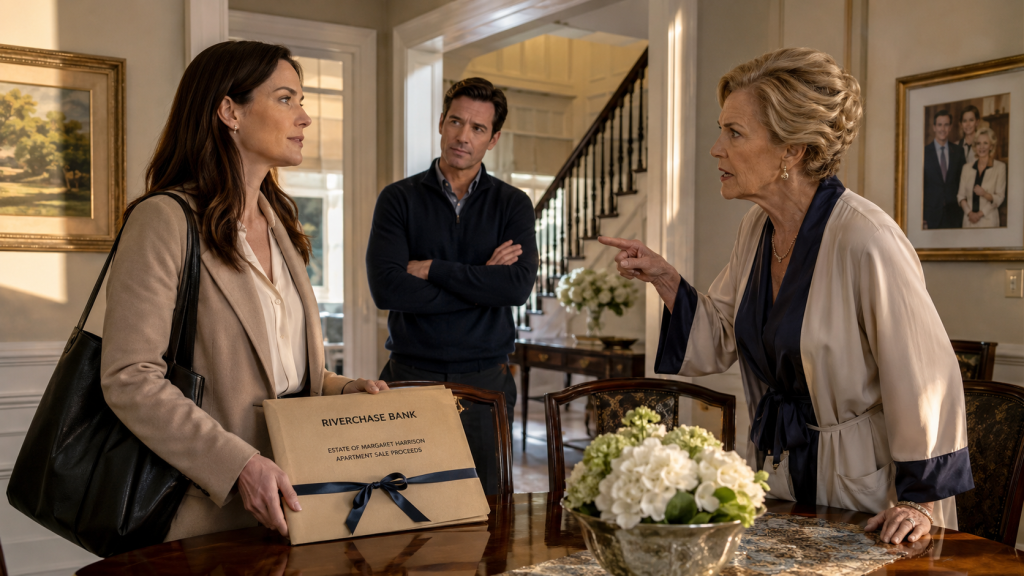
At six in the morning, my mother-in-law stormed into my house demanding the 8 million dollars I had received from selling my mother’s apartment. Then, my husband told me, with complete calm, that they had already decided to use my inheritance to pay off his brother’s debts. I didn’t argue.
I didn’t cry. I simply let them believe they had won…

At six in the morning, the house should have been silent. Instead, my bedroom door flew open with a hard thud, and Beatrice marched in like the room belonged to her.
She had never been big on knocking. Boundaries, apparently, were rules for other people.
“Where is it?” she demanded. “The money from your mother’s apartment. We need those 8 million dollars.”
I was standing near the dining room table with my purse still over my shoulder and the bank folder clutched in both hands. I had returned from New York City only a few hours earlier after signing the final paperwork for my mother’s Upper West Side condo.
To Beatrice, 8 million dollars sounded like a solution.
To me, it was the price attached to a lifetime I could never get back—my mother working overnight shifts, missing birthdays because bills came first, and raising me alone after my father disappeared.
“I’m sorry… what did you say?”
Before Beatrice could repeat herself, Marcus appeared at the foot of the stairs.
The second I saw his face, I knew.
He wasn’t surprised she was there. He wasn’t confused by what she was asking. He already knew.
“Camila,” he said carefully. “Maybe you should sit down.”
Beatrice flicked her hand toward him. “No. She needs to hear it straight.”
“Hear what?”
Marcus rubbed his forehead. “Mom and I were talking, and we believe that money should be used to help Sebastian.”
I stared at him. “Help Sebastian?”
“With his debts.”
Of course.
His younger brother had spent years digging the same financial hole deeper—failed businesses, reckless investments, sports betting, borrowed money, promises that he was finally going to change. Every family dinner seemed to end with another explanation for why Sebastian just needed one more chance.
Apparently, this time his second chance was supposed to come from my mother’s estate.
Beatrice stepped closer. “He’s family. Your mother would have wanted that money to stay in the family.”
A dry laugh escaped me. “My mother barely knew Sebastian.”
Marcus’s expression tightened. “This is not the time to be selfish.”
Selfish.
My mother had been dead for six months. I had spent weekend after weekend packing her apartment alone, sorting through clothes that still smelled like her, handling filings, appointments, attorney fees, and every miserable practical detail that comes after someone you love is gone.
Marcus hadn’t helped.
Sebastian hadn’t helped.
Yet somehow they had held a meeting about the money.
“So you’re telling me,” I said, keeping my voice level, “that you already decided what happens to my inheritance?”
Marcus hesitated.
Just once.
“I already promised Sebastian we’d help him.”
I looked at him. “We?”
Beatrice answered for him. “You’re married. What’s yours is your husband’s.”
I looked from her to Marcus, and something inside me became unexpectedly clear. They thought grief had made me easier to push. They thought if they presented the decision as finished, I would eventually surrender just to stop the fight.
So I placed the bank folder on the dining room table.
Then I looked directly at Marcus.
“You know what?” I said softly. “You’re right.”
His shoulders loosened.
Beatrice’s mouth curled into a small, satisfied smile.
They had no idea I had spent the last six months preparing for this exact kind of moment. And neither of them knew what was sitting inside the folder between us.
“Actually,” I said, “I have a surprise for both of you.”
Marcus reached across the table, and I slid the folder straight into his hands.
PART 2: THE FOLDER THEY THOUGHT CONTAINED EIGHT MILLION DOLLARS
Marcus took the folder with both hands.
For one brief second, he smiled.
Not widely.
Marcus was too careful for that.
But I saw the relief settle into his shoulders.
Beatrice saw it too.
She pulled out the dining chair across from him and sat down as if we were about to finalize something that had already been agreed upon.
“There,” she said.
Her voice softened.
“See? This doesn’t have to become ugly.”
I looked at her.
Six in the morning.
My mother had been dead six months.
I had barely slept.
And Beatrice had entered my home demanding the proceeds from a property she had never stepped inside.
Yet somehow, in her version of events, ugliness would begin only if I resisted.
Marcus opened the folder.
His smile disappeared.
There was no bank check inside.
No wire authorization.
No statement showing eight million dollars sitting in an account he could reach.
The first page was a letter from my attorney.
Marcus read the heading twice.
Then looked at me.
“What is this?”
“Keep reading.”
His jaw tightened.
Beatrice leaned across the table.
“What does it say?”
Marcus did not answer.
He turned the page.
Then another.
The silence changed.
I had spent months imagining this moment.
Not because I enjoyed it.
Because grief had given me too many sleepless nights, and during some of them I had finally done what I should have done years earlier.
I had looked closely at my marriage.
At our accounts.
At signatures.
At passwords.
At the way Marcus always called financial secrecy “privacy” when it benefited him and “dishonesty” when I wanted some of my own.
He reached the paragraph my attorney had marked.
His face tightened.
“What trust?”
Beatrice blinked.
“What?”
Marcus looked at me.
“You put the money in a trust?”
“Yes.”
“When?”
“Before the sale closed.”
His voice sharpened.
“Why?”
I almost smiled.
Because that question contained everything.
Why would I protect money that came directly from my mother?
Why would I stop my husband from deciding how it should be spent?
Why would I prepare for exactly the conversation happening now?
“Because it was my mother’s estate.”
“We’re married.”
“I know.”
“Then why move it somewhere I can’t access?”
I leaned back.
“Because you just told me you promised eight million dollars to your brother without asking me.”
Silence.
Beatrice frowned.
“That isn’t what happened.”
I looked at her.
“What happened?”
“We discussed what would be best for everyone.”
“Who is everyone?”
“Family.”
I waited.
She did not hear the contradiction.
So I helped her.
“My mother was family.”
Beatrice’s mouth tightened.
“Of course.”
“No.”
My voice remained calm.
“If she were family to you, you wouldn’t be sitting here six months after her funeral calculating what her home can pay for.”
Marcus closed the folder.
“Camila.”
I looked at him.
“This isn’t productive.”
I almost laughed.
“Neither is sports betting.”
Beatrice stiffened.
Marcus stared at me.
“Don’t.”
There.
One word.
Too fast.
Too frightened.
I noticed.
“Don’t what?”
“Start attacking Sebastian.”
“I haven’t attacked him.”
“You just brought up gambling.”
“Because he has gambling debt.”
Beatrice slapped one palm against the table.
“He has business debt.”
I looked at her.
“No.”
Her eyes narrowed.
“What do you know?”
More than they thought.
That was the second surprise.
I had not started investigating Sebastian because I wanted revenge.
I started because three months before Mom died, Marcus asked me to co-sign a “temporary bridge loan” for Sebastian’s logistics company.
Five hundred thousand dollars.
Marcus called it low risk.
I said no.
He sulked for a week.
Then claimed they had “found another solution.”
I had believed him.
After Mom died, I stopped believing things simply because they made my evenings quieter.
I looked at Marcus.
“How much does Sebastian owe?”
His eyes moved toward Beatrice.
Interesting.
Not me.
Her.
She answered.
“About three million.”
I nodded slowly.
“That’s the number you gave each other?”
Marcus stood.
“Enough.”
“No.”
I pointed toward the folder.
“We haven’t even reached the interesting pages.”
He froze.
Beatrice looked at him.
“What pages?”
I almost pitied her.
Almost.
Because I suddenly realized Marcus had not told his mother everything either.
That made three layers of lies at one table.
Sebastian lying about debt.
Marcus lying about how much he knew.
Beatrice believing she was the family commander while her sons fed her whatever version kept her useful.
“Page twelve.”
Marcus did not move.
I repeated:
“Open it.”
His fingers tightened.
Beatrice grabbed the folder from him.
“Give me that.”
She flipped pages impatiently.
Then stopped.
Her eyes narrowed.
“What is this?”
“A credit report.”
“Whose?”
“Sebastian’s.”
Marcus stared at me.
“How did you get that?”
“Legally.”
That was all I gave him.
The report I had access to was connected to records Sebastian himself had supplied during prior financing discussions involving a business entity in which Marcus had tried to involve our household assets.
My lawyer had obtained what could properly be reviewed and advised me carefully about what was relevant.
I had not hacked anything.
I had not broken into accounts.
I had simply stopped accepting family estimates as financial facts.
Beatrice read.
Her face changed.
Three million was not the number.
Not even close.
Sebastian had personal guarantees attached to multiple failed ventures.
Private loans.
Credit lines.
Tax obligations.
A judgment tied to a restaurant investment he claimed he had exited years ago.
And documented gambling-related transfers that made the phrase “bad investments” look charitable.
Beatrice whispered:
“Five point six?”
Marcus said nothing.
She looked at him.
“Marcus.”
He rubbed his jaw.
“It’s complicated.”
Her face hardened.
“You told me three.”
“Some of the obligations are disputed.”
“Five point six million?”
“There are assets too.”
“What assets?”
He did not answer.
I did.
“Almost none with clean equity.”
Marcus glared.
“Stop talking like you understand his finances.”
I stared at him.
“Page thirteen.”
Beatrice turned it.
Her mouth opened slightly.
A property list.
Vehicles.
Business interests.
Liens.
Several things Sebastian described at family dinners as owned were either leased, financed heavily, or pledged.
Beatrice stared.
“He said the Miami condo was paid off.”
“No.”
“He said the restaurant stake was worth at least a million.”
“No.”
“He said—”
“I know what he said.”
Her voice disappeared.
Something almost sad moved through me.
Because for years Beatrice had defended Sebastian by treating his promises as assets.
He was always about to sell something.
About to close something.
About to turn things around.
His future success had paid imaginary bills for a decade.
Marcus reached for the folder.
Beatrice pulled it away.
“No.”
He stared at his mother.
She kept reading.
Then she reached page fifteen.
Stopped.
And slowly looked at Marcus.
My husband went pale.
“What is this?”
He did not answer.
Beatrice’s voice became louder.
“What is this?”
I folded my arms.
That page had nothing to do with Sebastian’s credit.
It was a copy of a loan application.
A large one.
Applicant:
Marcus Hale.
Co-applicant:
Camila Hale.
My name.
Except I had never applied.
Beatrice looked from the page to me.
Then to him.
“Camila signed this?”
“No.”
I answered before Marcus could.
Beatrice stared.
“What?”
“That isn’t my signature.”
Marcus immediately said:
“It never funded.”
There.
Not:
I didn’t do it.
Not:
That application is fake.
It never funded.
I looked at him.
“Thank you.”
His face tightened.
“For what?”
“For answering the question I hadn’t asked yet.”
Beatrice seemed confused.
I was not.
I pointed toward the page.
“You submitted it.”
Marcus said:
“It was exploratory.”
“With my name.”
“We’re married.”
“With my income.”
“You’re my wife.”
“With our house listed as supporting collateral.”
“It wasn’t finalized.”
I leaned forward.
“And with a signature I did not write.”
His face hardened.
“Camila, watch yourself.”
The old warning.
It used to work.
Not because Marcus shouted often.
He did not.
He preferred calm.
Calm made his decisions sound more reasonable than your objections.
“Page sixteen.”
He stared at me.
Beatrice turned it.
Another application.
Different lender.
Different amount.
Same pattern.
Then page seventeen.
A draft authorization tied to a home-equity line.
Not completed.
But prepared.
My name again.
Marcus whispered:
“You’ve been going through my things.”
I almost laughed.
“Our finances.”
“My office.”
“Our home.”
“You had no right.”
“That’s an interesting sentence.”
He stood.
The chair scraped backward.
“Do you understand how invasive this is?”
I looked at him.
“My name appeared on debt paperwork I never approved.”
I let the silence sit between us.
“You don’t get to be the privacy victim in that sentence.”
Beatrice put the folder down.
For the first time since she entered my house, she looked uncertain.
“Marcus…”
He turned toward her.
“Mom, don’t.”
“What were you doing?”
“Trying to solve a problem.”
“Whose?”
He hesitated.
Again.
Sebastian’s.
Always Sebastian’s.
I whispered:
“How much have you already given him?”
Marcus did not answer.
Beatrice looked at him.
“What does she mean, already?”
Interesting.
She did not know that either.
I watched Marcus calculate.
I had seen him do it in business meetings.
How much truth has the room already discovered?
How little can I concede?
“Some.”
Beatrice stood.
“How much?”
“Mom.”
“How much?”
His jaw tightened.
“About nine hundred.”
“Nine hundred what?”
I almost closed my eyes.
She truly had no idea.
“Nine hundred thousand.”
Beatrice sat down again.
Hard.
“You gave Sebastian nine hundred thousand dollars?”
“Loaned.”
“No.”
I said it quietly.
Marcus turned.
“What?”
“It wasn’t all loaned.”
His face changed.
“Page nineteen.”
Beatrice did not even look at him now.
She turned the pages herself.
Bank transfers.
Not from my inheritance.
That had never been accessible to Marcus.
From our marital accounts.
Some from his separate earnings.
Some from a joint investment account.
Some routed through a small holding company he controlled.
I had known about the company.
I had not known it had become Sebastian’s private rescue fund.
Beatrice whispered:
“Why didn’t you tell me?”
Marcus looked stunned.
“You were the one telling me to help him.”
“Not like this.”
“What difference does it make?”
“The difference is I thought he needed three million.”
I stared at her.
That sentence told me exactly how distorted this family had become.
She was not upset Marcus had hidden nine hundred thousand dollars from his wife.
She was upset because the bailout calculation had been wrong.
I said:
“You both keep discussing my marriage like Sebastian is a line item.”
Beatrice snapped:
“This is not about your marriage.”
I smiled without humor.
“It became about my marriage when my husband used joint assets without telling me.”
Marcus said:
“You benefited from those accounts too.”
“And that gives you permission to move nearly a million dollars?”
“I made most of that money.”
There it was.
The sentence beneath his calm partnership language.
His money.
Our obligations.
My inheritance.
Family money.
Everything belonged to whichever category benefited him in the moment.
I looked at him.
“How much of my salary went into that same investment account?”
He said nothing.
“Marcus.”
“Enough.”
“No.”
“How much?”
His jaw clenched.
Beatrice said:
“Why does it matter? You both earn well.”
I turned toward her.
“It matters because ownership changes depending on who wants something.”
I pointed at Marcus.
“When Sebastian needs help, our savings become his to decide.”
Then at the folder.
“When my mother dies, my inheritance becomes family property.”
Then:
“But the moment I question a transfer, suddenly the money is Marcus’s because he earned more.”
Neither spoke.
I nodded.
“Thank you.”
“For what?”
Marcus asked.
“For finally making the rules visible.”
I reached for my purse.
Marcus’s expression changed.
“Where are you going?”
“Nowhere.”
I removed another envelope.
Placed it on the table.
He stared.
“What is that?”
“My second surprise.”
Beatrice looked exhausted now.
Good.
We were barely halfway through breakfast.
Marcus opened the envelope.
His face went blank.
A formal notice from our bank.
Our joint accounts had been placed under heightened verification after I reported unauthorized or questionable attempted transactions connected to my name.
Large movements now required direct verification.
Certain accounts had already been separated where legally appropriate.
My mother’s inheritance had never entered a joint account at all.
It had moved from estate closing through counsel into structures established specifically to preserve it while I made decisions.
Marcus looked up.
“You froze our money?”
“No.”
“I protected access.”
“You had no right to do this without discussing it.”
I stared at him.
He heard himself.
I saw it.
Beatrice did too.
A tiny pause.
Then I asked:
“Like you discussed giving eight million dollars to Sebastian?”
He threw the papers onto the table.
“That is different.”
“Why?”
“Because he is drowning.”
“And you decided I was the life raft.”
“He’s my brother.”
“She was my mother.”
Marcus went quiet.
My voice changed despite me.
Six months of grief entered it.
“You met her twenty times.”
He looked away.
“She cooked for you.”
“She gave us the down payment on our first apartment when your bonus was delayed.”
“You called her when you needed a recommendation for the hospital board because she knew someone there.”
“She gave you her old watch when we got married because you admired it.”
My throat tightened.
“And she died.”
Silence.
“Then before I finished settling her estate, you started calculating what her home could pay for.”
Marcus said:
“I’m sorry about your mom.”
It sounded so small.
I laughed.
Tears finally came.
Not many.
I wiped them immediately.
“I know.”
“Camila…”
“No.”
I shook my head.
“You don’t get to use my tears as proof this conversation became emotional.”
He froze.
That was something I had learned during the last six months too.
Marcus liked facts until my facts became inconvenient.
Then suddenly the problem was my tone.
I sat back down.
“Who told Sebastian he was getting the money?”
Marcus looked away.
“You did.”
No response.
“You promised him.”
“Yes.”
“When?”
“Last week.”
My stomach tightened.
Before the sale closed.
Before I returned from New York.
Before Beatrice stormed in.
They had already distributed my inheritance in conversation.
“What exactly did you tell him?”
“That we would handle his debts.”
“All of them?”
“I said we’d make him whole.”
I stared.
Make him whole.
What a beautiful phrase for pouring someone else’s money into a hole he kept digging himself.
Beatrice whispered:
“He’ll be expecting it.”
I turned slowly.
She looked worried.
Not about me.
About Sebastian’s disappointment.
Something inside me hardened again.
“That sounds like a problem for the person who made the promise.”
Marcus slammed his palm against the table.
“Stop acting like this affects only us.”
I stared.
“Who else?”
His face changed.
Too late.
I noticed.
“Marcus.”
No answer.
“What did Sebastian do because you promised him the money?”
Beatrice looked toward him.
“What?”
Marcus rubbed both hands over his face.
“It’s nothing.”
I felt cold.
“Nothing has never looked like that on your face.”
“Camila.”
“What did he do?”
Marcus whispered:
“He delayed a sale.”
“What sale?”
“His house.”
Beatrice stood.
“He was selling the house?”
Marcus turned on her.
“Mom, stop.”
She ignored him.
“Sebastian told me refinancing was enough.”
“It wasn’t.”
My stomach tightened.
“What else?”
Marcus walked toward the window.
“His creditors agreed to hold.”
“Because?”
He did not answer.
“Because you told them money was coming?”
Silence.
My chest tightened.
“How much did you promise?”
Marcus finally faced me.
“Eight million.”
The room stopped.
Not up to eight.
Not help.
All of it.
He had promised my exact inheritance to someone else’s creditors.
I whispered:
“You told third parties my inheritance would cover Sebastian’s debt?”
Marcus said:
“Not in your name.”
My heart sank.
“What name?”
He did not answer.
Beatrice said:
“Marcus.”
He closed his eyes.
Then:
“I said family funds were being released.”
I laughed.
A small, broken sound.
Family funds.
The phrase made theft sound ceremonial.
“Is it in writing?”
No answer.
“Marcus.”
“Some emails.”
Of course.
“Show me.”
“No.”
I stared.
“Show me.”
“This has gone far enough.”
I smiled.
“No.”
I stood.
“It went far enough when you sent my financial information to someone without permission.”
His face went pale.
Beatrice stared at him.
“What financial information?”
I had guessed.
But his face confirmed it.
“Marcus?”
He said:
“It was just proof of funds.”
My stomach dropped.
I felt the room shift beneath me.
“Whose proof?”
He looked at me.
That was answer enough.
“You used information about my inheritance?”
“It didn’t include account access.”
“That wasn’t my question.”
“It was a closing statement.”
My heart pounded.
The condo closing statement.
Eight million gross sale figure.
My name.
The property.
He had seen a copy?
I had not given him one.
“How did you get it?”
Marcus hesitated.
I thought of my suitcase.
My email.
Our printer.
Then remembered.
Three weeks earlier, my estate attorney had mailed a preliminary closing packet to our home because I had been traveling.
Marcus texted:
Mail from New York came. I put it in your office.
My stomach turned.
“You opened my attorney’s mail.”
“No.”
“Then how did you see the closing statement?”
Silence.
Beatrice whispered:
“Oh my God.”
Marcus snapped:
“It was sitting in the envelope.”
“So you did open it.”
“It was our house.”
I stared at him.
Our house.
His explanation for everything.
A home as permission.
Marriage as access.
Family as entitlement.
I reached into my purse once more.
This time Marcus actually laughed.
“What else could possibly be in there?”
“Enough.”
I placed my phone on the table.
Opened an email.
Turned the screen toward him.
The subject:
Unauthorized Third-Party Representation / Sebastian Hale Debt Restructuring
Marcus stared.
“What is that?”
“My attorney contacted Sebastian’s restructuring lawyer yesterday.”
Beatrice’s mouth opened.
Marcus went still.
“You did what?”
“I wanted to know whether anyone had represented that my inheritance was committed.”
“You had no right to interfere with Sebastian’s legal negotiations.”
I stared at him.
“You used my assets to support them.”
He stopped.
I continued.
“The answer was yes.”
Beatrice sat down slowly.
My attorney had not discussed confidential details he had no right to know.
He did not need to.
He sent a simple notice:
No funds from Camila Hale’s inheritance had been pledged, authorized, guaranteed, or committed toward Sebastian Hale’s obligations.
Any contrary representation was unauthorized.
That was enough.
Marcus’s face became gray.
“You contacted his creditors?”
“My lawyer contacted his lawyer.”
“Do you understand what you’ve done?”
I almost smiled.
“I corrected your lie.”
“His entire restructuring could collapse.”
“Then it was built on money he didn’t have.”
“He could lose everything.”
“He already spent everything.”
Beatrice whispered:
“Camila, please.”
That word surprised me.
Please.
The woman who entered my house demanding eight million dollars had finally reached a request.
I looked at her.
“What?”
“Sebastian has children.”
“Yes.”
“They could lose their home.”
My anger softened for exactly three people.
My nieces and nephew.
They had done nothing.
“What arrangements have you made for them?”
Beatrice blinked.
“What?”
“You’re his mother.”
I looked at Marcus.
“You’re his brother.”
“Have you offered housing?”
“School costs?”
“Food?”
“A temporary apartment?”
Neither answered.
I nodded.
“You don’t want to save the children.”
My voice stayed quiet.
“You want to save Sebastian from consequences while telling yourselves it’s for the children.”
Beatrice’s face collapsed.
“That is not fair.”
“Then help the children directly.”
Silence.
“I would.”
They looked at me.
That surprised them.
“If my nieces and nephew need tuition paid directly to their schools, I’ll consider it.”
“If they need groceries, I’ll send groceries.”
“If they need housing while their parents reorganize, we can discuss something safe.”
I looked at Marcus.
“But Sebastian will not receive eight million dollars from my mother.”
Beatrice stared.
“You’d let him go bankrupt?”
“I would let the legal process deal with debts he created.”
Marcus whispered:
“You’re cold.”
That word used to hurt.
I smiled.
“No.”
“I’m finally separating compassion from access.”
He looked away.
My phone rang.
My attorney.
Perfect timing.
I answered.
“Camila.”
His voice was calm.
“Are you somewhere private?”
I looked at Marcus.
Beatrice.
My dining room.
“Private enough.”
“There’s been a development.”
My chest tightened.
“What?”
“Sebastian’s counsel responded to our notice.”
Marcus went pale.
I put the call on speaker before he could object.
My attorney continued.
“Apparently, there is a document we were not previously aware of.”
I stared at Marcus.
“What document?”
“A family loan guarantee.”
The room went completely silent.
“Signed by whom?”
A pause.
“Purportedly by you and Marcus.”
My stomach turned cold.
Marcus whispered:
“No.”
I looked at him.
He knew.
Maybe not the document itself.
But something.
My attorney continued.
“It appears to guarantee up to six million dollars of Sebastian’s obligations using anticipated proceeds from your mother’s property sale.”
I stopped breathing.
Beatrice gripped the edge of the table.
“What?”
I asked:
“Do you have a copy?”
“Yes.”
“Send it.”
My phone chimed seconds later.
I opened the attachment.
Two signatures.
Marcus.
Camila.
Mine was false.
Again.
I enlarged it.
Same wrong angle.
Same too-careful C.
The person copying me knew what my name looked like but not how my hand moved.
I whispered:
“That isn’t mine.”
“I assumed not.”
My attorney said.
“Do not contact the lender directly. We’ll handle preservation and notice.”
Marcus started pacing.
“This is wrong.”
I stared at him.
“What part?”
“I never authorized six.”
My blood went cold.
My attorney went silent on the phone.
Beatrice slowly turned toward her son.
“Never authorized six?”
Marcus stopped moving.
He realized.
Too late.
I whispered:
“How much did you authorize?”
He said nothing.
“Marcus.”
His face looked sick.
“How much?”
“Two.”
The word barely came out.
Two million dollars.
The room tilted.
“You signed a guarantee for two million?”
“Draft.”
“With my name?”
“I told them you would agree.”
My breathing became painfully slow.
“You told them.”
“Yes.”
“Before asking me.”
“You were dealing with your mother.”
I laughed.
Actually laughed.
My mother was dying.
Then dead.
And Marcus had interpreted grief as an inconvenient delay in obtaining my signature.
“You were going to ask when?”
“After the sale.”
“This morning?”
His silence answered.
Beatrice whispered:
“Marcus, what did you do?”
He turned.
“Everything was falling apart.”
“For Sebastian.”
“Yes!”
His voice finally rose.
“He was going to lose the house.”
“The businesses.”
“Everything.”
“So you gambled my money on a man with gambling debt.”
“That isn’t what happened.”
“It is almost exactly what happened.”
He pressed both hands against his head.
“I thought if we cleared the debt, he could reset.”
Reset.
Another beautiful family word.
As though consequences were a frozen computer.
As though eight million dollars could restore factory settings to a man who had spent fifteen years refusing to change.
My attorney spoke through the phone.
“Camila, I recommend we end this conversation for now.”
Marcus looked at the phone.
“Who is that?”
I almost smiled.
“My divorce attorney.”
Silence.
Absolute.
Beatrice’s face went white.
Marcus stared at me.
“What?”
I closed my eyes.
There it was.
The real surprise inside the folder.
Not the trust.
Not Sebastian’s debts.
Not even the unauthorized applications.
I had spent six months preparing because my mother, even while dying, had asked me one question I could not forget.
It happened in her apartment.
Two weeks before hospice.
I was folding sweaters.
She watched me from the sofa.
Then said:
Does Marcus make your life bigger or smaller?
I had laughed.
Told her she was being dramatic.
She did not smile.
Just make sure you know before I’m gone.
After she died, I started looking.
Not because she ordered me to leave.
She never did.
Because she had noticed I kept using the word “we” while Marcus used it only when he wanted access to something mine.
I had met with counsel.
Separated documentation.
Reviewed accounts.
Protected the inheritance.
Prepared options.
I had not filed.
Not yet.
I wanted to know whether the marriage could still be repaired.
Then at six in the morning, Marcus answered for me.
He promised my inheritance to his brother.
Used my name on financial documents.
Accessed my private estate paperwork.
And brought his mother into our home to help pressure me.
I looked at him.
“Yes.”
His voice cracked.
“You hired a divorce attorney?”
“Yes.”
“When?”
“Four months ago.”
Beatrice stood.
“You planned this?”
I turned.
“No.”
“I prepared for it.”
“There’s a difference.”
Marcus looked wounded.
For the first time that morning, genuinely wounded.
“You never told me things were this bad.”
I stared at him.
Neither of us spoke.
Then:
“Three years ago, you took forty thousand dollars from our savings for Sebastian without asking.”
He looked down.
“You apologized.”
“Yes.”
“You promised it would never happen again.”
Silence.
“Two years ago, you co-signed his equipment loan.”
“You told me after.”
“He paid that.”
“Eventually.”
“Last year, you canceled our anniversary trip because Sebastian had a crisis.”
“That was different.”
“Every time is different.”
My voice cracked.
“That is how patterns survive.”
Marcus sat down.
I continued.
“I told you I felt like Sebastian was inside our marriage.”
He covered his face.
“I remember.”
“I told you your mother treated our money like a family emergency fund.”
“I remember.”
“I told you I needed you to stop discussing our finances with them.”
“I remember.”
My eyes filled.
“You knew things were bad.”
He lowered his hands.
“You just didn’t think they were bad enough for me to leave.”
Silence.
That was different.
And true.
My attorney spoke softly through the phone.
“Camila?”
“Yes.”
“Do you want me to stay on?”
I looked at Marcus.
Then Beatrice.
“No.”
“I’ll call you back.”
“Document everything.”
“I will.”
The call ended.
Beatrice grabbed her handbag.
“This has gone too far.”
I almost laughed.
At six, she wanted eight million dollars.
At seven-thirty, divorce was too far.
“Mom.”
Marcus looked at her.
She turned.
“Fix this.”
I stared at her.
Even now.
Marcus’s marriage collapsing.
Potential fraudulent documents.
Her younger son drowning in debt.
And her instruction remained:
Fix this.
As though Marcus were a mechanic standing beside a broken machine.
He whispered:
“How?”
Beatrice looked at me.
“Tell her the guarantee was a misunderstanding.”
My stomach turned.
Marcus stared at his mother.
Then something changed in his face.
A small thing.
But real.
“Mom.”
“What?”
“Stop.”
She blinked.
“What?”
“I said stop.”
Beatrice stared at him.
He stood.
“For once.”
His voice cracked.
“Just stop.”
Her face tightened.
“I am trying to help you.”
“No.”
He looked around the room.
“At me.”
“At the folder.”
“At the papers.”
“I think you’ve helped enough.”
She went pale.
“Marcus.”
“You came into my house at six in the morning to demand my wife’s inheritance.”
“Our family needed—”
“She’s my family.”
Silence.
It was the first correct sentence he had said all morning.
Too late?
Maybe.
But correct.
Beatrice looked almost betrayed.
“I am your mother.”
“Yes.”
“And Camila is my wife.”
He closed his eyes.
“Or she was.”
The words hung there.
I felt no triumph.
Only grief.
Because I had loved this man.
Maybe part of me still did.
Love does not disappear simply because evidence arrives.
Sometimes that is the hardest part.
Beatrice left.
The door closed behind her.
Marcus and I stood in the dining room.
Just us.
The way the conversation should have begun.
He looked at the bank folder.
“What was actually in the trust paperwork?”
I sat down.
“Protection.”
“From me?”
“From pressure.”
His eyes filled.
“That means me.”
“This morning?”
“Yes.”
He nodded.
Then whispered:
“Did your mother tell you to do this?”
“No.”
“What did she say?”
I hesitated.
Then told him.
Does Marcus make your life bigger or smaller?
His face collapsed.
He sat across from me.
For several minutes, neither of us spoke.
Then:
“What’s the answer?”
I looked at him.
Six years of marriage moved through me.
Good things too.
Rainy Sundays.
Road trips.
His hand on my back at Mom’s funeral.
The way he could make me laugh when I was furious.
The soup he made when I had pneumonia.
No relationship is only its worst morning.
That is why leaving can hurt even when it is necessary.
I whispered:
“Smaller.”
Marcus cried.
Quietly.
So did I.
Then he said:
“I can fix this.”
I shook my head.
“Maybe you can fix yourself.”
He looked up.
“What does that mean?”
“It means stop making me the project.”
I wiped my face.
“Get your own lawyer.”
“Tell the truth about the guarantees.”
“Stop rescuing Sebastian.”
“Learn why your mother can walk into our house and tell your wife what belongs to her.”
“And do that whether I stay married to you or not.”
He stared.
“You’re leaving.”
“I’m asking you to leave today.”
His face broke again.
“This is my house too.”
“Yes.”
I had already discussed that with counsel.
“I’m not pretending otherwise.”
“Then how can you ask me to leave?”
“Because if you refuse, we’ll handle temporary arrangements through attorneys.”
He stared at me.
I continued.
“But I am asking.”
“Not ordering.”
“Not using your mother.”
“Not bringing six relatives.”
“Just asking.”
That landed.
He nodded slowly.
Then:
“I’ll go.”
I did not expect it.
“Where?”
“Hotel.”
“Okay.”
He stood.
Then stopped.
“Do you hate me?”
I looked at him.
“No.”
That seemed to hurt more.
“I wish I did.”
He cried.
“I’m sorry.”
I nodded.
“I know you are.”
Then:
“But being sorry after I protect myself is not the same as protecting me before I have to.”
Marcus looked down.
He packed one suitcase.
Nothing dramatic.
No broken photographs.
No screaming.
Before he left, he placed the house key on the dining table.
I stared.
“You don’t have to do that.”
He said:
“I think I do.”
Then:
“Your mom was right.”
I looked up.
“About what?”
“You got smaller.”
His voice cracked.
“I just kept calling it compromise.”
He left.
I sat alone at the table until almost noon.
The folder remained open.
Papers everywhere.
My mother’s eight million dollars protected.
My marriage possibly over.
My brother-in-law still deeply in debt.
And somehow I did not feel victorious.
I felt exhausted.
That is the part people leave out when someone finally establishes a boundary.
Relief can grieve.
Freedom can hurt.
Doing the right thing can leave you staring at a chair where somebody you loved used to sit.
At twelve-thirty, Sebastian called.
I did not answer.
He texted.
I heard you pulled the money. You’re destroying my family.
I stared at it.
Then another.
My kids could lose their house because of you.
There it was.
The children again.
I replied once.
Send your attorney’s contact information to mine. Do not contact me directly about money again. If the children have immediate housing, food, or school needs, their mother can contact me separately.
He answered:
You think you’re better than us because you inherited money.
I did not respond.
The eight million had not made me better.
It had simply made their entitlement impossible to ignore.
Two hours later, Sebastian’s wife called.
Her name was Rachel.
We had never been close.
She was crying.
“I’m sorry.”
My stomach tightened.
“For what?”
“I didn’t know.”
“What didn’t you know?”
“Any of it.”
Her voice broke.
“Sebastian told me the debt was one point four million.”
I closed my eyes.
Of course.
“He said Marcus was investing in a new company with him.”
I sat straighter.
“What company?”
She named it.
I knew nothing about it.
“Rachel.”
“Yes?”
“Did Sebastian say I was investing too?”
Silence.
My blood turned cold.
Then she whispered:
“He said the seed money was coming from a family real-estate sale.”
I stopped breathing.
Even Sebastian had already built a future around my mother’s apartment.
“How much?”
“He said eight million.”
I closed my eyes.
There it was again.
Not debt relief anymore.
Seed money.
A new company.
Another chance.
Another hole.
Marcus had promised the same money twice.
Pay creditors.
Fund Sebastian again.
Maybe Marcus did not know that part.
Maybe he did.
I did not guess.
I asked:
“Did Sebastian show you anything?”
“A deck.”
“What deck?”
She hesitated.
“Camila…”
“What?”
“Your name is on it.”
My entire body went cold.
“As what?”
She began crying harder.
“Founding investor.”
I stood.
“Send it to me.”
Thirty seconds later, a file arrived.
I opened it.
There.
My name.
CAMILA HALE — FOUNDING CAPITAL PARTNER
Below it:
Committed Capital: $8,000,000
My mother’s money.
Not even deposited.
Already converted into a line on Sebastian’s next fantasy.
I stared at the screen.
Then at the folder Marcus had opened that morning.
And finally I understood why my attorney had warned me months earlier not to assume pressure would stop at one request.
The eight million dollars had never simply been intended to clear Sebastian’s debts.
They had planned to use my inheritance to make him solvent on paper—
then send him straight back into business.
My mother had worked night shifts for years.
Saved.
Invested.
Bought one apartment when the neighborhood was still rough and held it for decades while the city changed around her.
She built value slowly.
Painfully.
Responsibly.
And these people wanted to convert forty years of her discipline into one more afternoon of Sebastian feeling rescued.
I forwarded the pitch deck to my attorney.
Then Marcus called.
This time I answered.
His voice sounded wrong.
“Camila.”
“What?”
“I just found out.”
“About the pitch deck?”
Silence.
“You knew?”
“Rachel sent it.”
Marcus swore quietly.
Then:
“I didn’t know he was starting another company.”
I believed the surprise in his voice.
That did not absolve him.
“He told you he needed the eight million for creditors?”
“Yes.”
“He told me—”
Marcus stopped.
“What?”
“He told me he was done.”
I closed my eyes.
Of course.
Done gambling.
Done speculating.
Done risking.
The most expensive word in the Hale family.
Done.
Always spoken before the next request.
Marcus whispered:
“I think Mom knew.”
My eyes opened.
“What?”
“She mentioned Sebastian having something lined up after the restructuring.”
“When?”
“Last week.”
My blood cooled.
“Did you ask?”
“No.”
There it was.
Again.
The question Marcus never asked because the answer might interfere with rescue.
“Camila.”
“Yes?”
“There’s something else.”
I almost laughed.
“Of course there is.”
He went quiet.
Then:
“Mom invested too.”
I froze.
“How much?”
“Her retirement account.”
My chest tightened.
“How much?”
“Almost everything.”
I closed my eyes.
Beatrice had come to my house demanding my inheritance not only because Sebastian was drowning.
She had already jumped into the water with him.
“How much is left?”
“I don’t know.”
“Marcus.”
“I really don’t.”
His voice cracked.
“She told me Sebastian guaranteed her returns.”
I sat down.
There it was.
The real trap.
Beatrice was not simply protecting her favorite son.
She needed my eight million dollars because she had already risked her own security on him.
And if Sebastian failed—
she failed too.
Marcus whispered:
“Mom didn’t come this morning because Sebastian needed help.”
My stomach tightened.
“No.”
“She came because she needed your money to save both of them.”
Silence.
Then:
“I’m sorry.”
I stared out the window.
My mother used to say something whenever money exposed a person.
Never listen only to what someone asks for. Find out what they already promised before they came to your door.
I had thought she meant banks.
Business.
Contracts.
Maybe she meant families too.
Marcus continued.
“I’m going to get the records.”
“Legally.”
“Yes.”
“Through your attorney.”
“I know.”
“No touching accounts.”
“I know.”
“No deleting messages.”
“I know.”
“And Marcus?”
“Yes?”
“If you find out your mother is in trouble…”
I swallowed.
“…do not promise her my money.”
He was silent.
Then:
“I won’t.”
For the first time that morning, I believed him.
Not because trust had returned.
Because consequences finally had his full attention.
I ended the call.
Then sat alone in the quiet house.
Six hours earlier, Beatrice had marched into my bedroom believing eight million dollars sat waiting to become family property.
Marcus had stood beside her.
Calm.
Certain.
They thought the decision had already been made.
They thought all that remained was teaching me to accept it.
But inside the folder Marcus opened that morning was no surrender.
There was a trust.
A lawyer’s letter.
Evidence of unauthorized financial applications.
Records of transfers.
And preparations I had made while everyone assumed grief had made me careless.
My mother spent her life teaching me that money is not merely what sits in an account.
Money is choices.
Time.
Labor.
Safety.
The right to say no when someone else has already spent your yes.
I looked at her photograph beside the window.
She was forty in it.
Younger than I was now.
Standing outside the apartment building she had just bought into.
Cheap coat.
Tired eyes.
Proud smile.
She had worked too hard for that property for me to hand the result to people who treated accountability like cruelty.
I touched the frame.
Then whispered:
“I’m not giving it to them.”
The words were unnecessary.
Still, I needed to say them.
My phone buzzed.
A message from Beatrice.
I expected anger.
Instead:
Camila, please call me. I need to explain something before Marcus tells you the wrong version.
I stared.
Then another message arrived.
A photograph.
A document.
An investment agreement.
Beatrice’s name appeared at the bottom.
So did Sebastian’s.
Amount invested:
$2,750,000.
Almost three million dollars.
Her retirement.
Her house refinance.
Her savings.
Gone into one of Sebastian’s ventures.
Then I saw the date.
My stomach dropped.
Eighteen months earlier.
Long before my mother died.
Long before the apartment sold.
Which meant this crisis had not begun with my inheritance.
They had been waiting for my inheritance.
I enlarged the final page.
There was a handwritten clause.
A guarantee.
If Sebastian’s venture failed, Beatrice’s capital would be repaid from “anticipated family liquidity.”
My breath stopped.
Anticipated family liquidity.
Below it, in Sebastian’s handwriting:
Camila / NYC property expected 2026. Marcus confirms.
I stared at those five words.
Marcus confirms.
Eighteen months ago.
My mother had still been alive.
Her apartment had still been hers.
And somehow, my husband had already allowed his brother to treat my future inheritance as collateral for a promise I did not know existed.
I picked up the phone.
Not to call Beatrice.
Not Sebastian.
Not even Marcus.
I called my attorney.
When he answered, I said:
“I found the real beginning.”
Then I looked toward the empty chair where my husband had sat that morning.
And understood something that hurt far more than eight million dollars.
Marcus had not started betraying me after my mother died.
He had started spending her death before it happened.
PART 3: THE MONEY THEY SPENT BEFORE MY MOTHER DIED
My attorney was silent for several seconds after I told him.
Then he asked:
“Do you still have the original image Beatrice sent?”
“Yes.”
“Do not crop it.”
“I won’t.”
“Do not annotate it.”
“Okay.”
“And do not accuse Marcus of signing anything until we establish exactly what ‘Marcus confirms’ means.”
I closed my eyes.
Even then, some part of me wanted certainty faster than facts could provide it.
“I understand.”
“Good.”
Then his voice softened.
“Camila?”
“Yes?”
“Whatever this document ultimately proves legally, I understand why it feels like betrayal already.”
My throat tightened.
Because that was the part no court needed to explain.
Eighteen months earlier, my mother was alive.
Still making coffee in the tiny kitchen overlooking West End Avenue.
Still complaining about the upstairs neighbor’s shoes.
Still texting me photographs of flowers she wanted to plant on her windowsill.
And somewhere, Sebastian had written my name beside her apartment as though her future death were a line of credit.
Camila / NYC property expected 2026. Marcus confirms.
I stared at those words until they stopped looking like language.
Marcus confirms.
Not:
Camila agrees.
Not:
Estate settled.
Not:
Funds available.
My husband’s name.
Beside my mother’s future death.
I called Marcus.
He answered immediately.
“Camila.”
“Did you tell Sebastian he could count on my mother’s apartment?”
Silence.
Then:
“I need to explain.”
My body went cold.
“That is not a no.”
“No.”
His voice cracked.
“It isn’t.”
I sat down.
“Tell me.”
Another silence.
Longer.
Then:
“About a year and a half ago, Mom called me.”
“Beatrice?”
“Yes.”
“She said Sebastian’s new venture was short on capital.”
I laughed once.
Of course it was.
Marcus continued.
“She had already invested.”
“Two point seven five million.”
He stopped.
“You know?”
“She sent me the agreement.”
Marcus swore under his breath.
“Did you know how much she put in?”
“No.”
I believed that part.
“She told me it was around a million.”
“So what did you say?”
“She asked whether there was any chance we could help if Sebastian got into trouble.”
“We?”
He inhaled.
“I said we had assets.”
“What assets?”
“Our house.”
“Investments.”
“My bonuses.”
“And?”
Silence.
“Marcus.”
“And I said…”
His voice faded.
I gripped the phone.
“What?”
“I said your mother’s apartment would probably come to you eventually.”
I stopped breathing.
He rushed forward.
“I didn’t say she was dying.”
“I didn’t say when.”
“I didn’t promise eight million.”
“You discussed my inheritance while my mother was alive.”
“I was talking about future assets.”
“My mother was not a future asset.”
“I know.”
“No.”
My voice shook.
“You know now because I found the paper.”
“Camila—”
“Did Sebastian hear you?”
“Yes.”
“Did Beatrice?”
“Yes.”
I pressed my fingers against my forehead.
The betrayal was almost worse for being casual.
He had not sat at a dark table plotting my mother’s death.
He had done something more ordinary.
More believable.
He had spoken about her home as if my eventual ownership were inevitable and therefore available for family planning.
A person became a projection.
Grief became liquidity.
Marcus whispered:
“I never authorized that clause.”
“Did you tell Sebastian not to write it?”
“I didn’t know he had.”
“Did you ever tell him clearly that my inheritance was not his fallback?”
Silence.
There it was.
Again.
The question Marcus had not asked.
The boundary Marcus had not drawn.
The ambiguity that always benefited Sebastian.
“What exactly did you tell him?”
Marcus sighed.
“I said if the worst happened, I would talk to you.”
“The worst for whom?”
No answer.
“Your brother?”
“Yes.”
“My mother was alive, Marcus.”
“I know.”
“She was grocery shopping.”
“I know.”
“She called me that week because her dishwasher was leaking.”
His breathing broke.
“I know.”
“And you were discussing what her apartment might be worth after she died.”
“I’m sorry.”
I started crying.
Quietly.
Not because eight million dollars had been threatened.
Because my mother had been reduced to timing.
Some future year.
Some future sale.
Some future bailout.
“When she got sick…”
My voice cracked.
“…did you think about it?”
Marcus did not answer.
That was answer enough.
“Did you?”
“Yes.”
The word barely existed.
I closed my eyes.
“What did you think?”
“I thought Sebastian might finally have a way out.”
I hung up.
Not dramatically.
I simply could not hear another sentence.
For three days, I spoke to Marcus only through attorneys.
That surprised him.
I think until then, some part of him still believed our marriage existed separately from the financial documents.
As though signatures were one problem.
Sebastian another.
Beatrice another.
Marriage something untouched at the center.
But trust does not organize betrayal into separate folders.
It absorbs everything.
The loan applications.
The hidden transfers.
My estate mail.
The two-million-dollar guarantee he admitted discussing.
The promise to Sebastian.
The inheritance conversations while Mom was alive.
Each fact changed the meaning of the others.
My attorney began the divorce filing.
Not because eight million dollars made leaving easy.
Because the folder had finally made staying impossible.
The inheritance remained protected in the structure I had established.
Not Marcus’s.
Not Sebastian’s.
Not Beatrice’s.
Mine to manage under legal advice.
The marriage assets were different.
Those had to be traced.
Accounted for.
Separated properly.
No magical disappearance.
No revenge transfer.
Paperwork.
Statements.
Dates.
Signatures.
Real life.
And real life was brutal enough.
The financial review found that Marcus had sent Sebastian more than I knew.
The nine hundred thousand dollars we had already identified was only what could be traced quickly through obvious channels.
Additional amounts had moved through business entities Marcus controlled.
Some were legitimate investments at the time they were made.
Some were loans.
Some had no documentation at all beyond texts saying:
I’ll make you whole.
Or:
Don’t tell Camila yet. She’s dealing with her mom.
That one made me physically sick.
Dealing with her mom.
My mother was dying.
Marcus was protecting me from information?
No.
He was protecting himself from my no.
There is a difference.
Sebastian’s pitch deck became important too.
Not because typing my name onto a slide made me an investor.
It didn’t.
But he had shown it to potential partners.
Used my supposed eight-million-dollar commitment to make his company look funded.
Once my attorney sent notice that I had never committed a cent, several conversations stopped immediately.
The new venture collapsed before launch.
Sebastian blamed me.
Naturally.
His first voicemail said:
“You humiliated me in front of serious people.”
I almost laughed.
He had listed me as a founding investor without my knowledge.
Yet somehow the humiliation began when I corrected him.
His second voicemail was uglier.
“You’re sitting on eight million dollars while my kids are about to lose their home.”
That one hurt.
Because the children were real.
The risk to them was real.
So I did what I had told Beatrice I would do.
I called Rachel.
Not Sebastian.
Rachel.
“What do the kids need?”
She cried.
“Camila, you don’t have to—”
“I know.”
I interrupted gently.
“What do they need?”
Their oldest daughter’s school tuition had two months remaining.
I paid the school directly.
Their son needed asthma medication.
I covered the pharmacy cost until Rachel’s insurance situation stabilized.
When Sebastian’s house entered the foreclosure process, I did not pay off his mortgage.
I helped Rachel arrange three months of rent on a modest apartment after she decided to separate from him.
Directly.
Documented.
Limited.
No cash to Sebastian.
No blank checks.
When Beatrice learned, she called me cruel.
“You can pay for an apartment but not save their house?”
“Yes.”
“How does that make sense?”
“Because one protects the children.”
I said it quietly.
“The other protects Sebastian’s financial decisions.”
She started crying.
“You have changed.”
I looked at the wall.
“No.”
“I stopped confusing rescue with love.”
Beatrice lost most of what she invested.
Not everything.
Some assets were recovered when Sebastian’s venture was unwound.
But the loss was devastating.
She had borrowed against her house.
Pulled heavily from retirement accounts.
Ignored the advice of a financial adviser who had apparently warned her not to concentrate so much money in one speculative family venture.
She had fired him.
Of course.
“He didn’t understand Sebastian.”
That was what she told Marcus.
Eventually, she sold her house.
The big one with the marble foyer she always made us remove our shoes to protect.
She moved into a smaller condominium.
For months, she told everyone I had caused it.
Then Rachel found the email.
Sebastian had sent Beatrice projections before she invested.
They were wildly optimistic.
Buried near the bottom was a sentence:
If Camila’s expected inheritance becomes available, downside exposure should be substantially reduced.
Beatrice had read it.
She knew.
She had invested partly because she believed my mother’s eventual estate would protect her if Sebastian failed.
When Marcus showed me the email, I sat quietly.
Then whispered:
“So she knew too.”
He nodded.
The pain surprised me.
I had assumed Beatrice discovered the inheritance only after Mom died.
No.
She had been waiting too.
Maybe not consciously wishing for death.
I refuse to accuse people of something that monstrous without evidence.
But she had placed my future grief into her financial calculations.
That was enough.
Marcus began therapy.
Not because I asked him.
That mattered.
He also attended sessions for family financial enabling.
He stopped giving Sebastian money.
That mattered too.
When Sebastian called saying he would lose everything, Marcus finally said:
“Then you need a lawyer and a restructuring plan.”
Not:
How much?
Not:
Give me a week.
Not:
Camila has money.
Sebastian called him a traitor.
Marcus cried afterward.
I know because he told me months later.
“What did you say?”
I asked.
“That I loved him.”
Marcus looked down.
“And that loving him wasn’t the same as financing him anymore.”
I nodded.
“That sounds hard.”
“It was.”
I did not say I was proud.
That was not my role anymore.
His growth belonged to him.
So did his consequences.
During the divorce, Marcus did something I did not expect.
He admitted the unauthorized financial applications.
Not perfectly.
Not immediately.
But under legal advice, he stopped pretending they were “exploratory” in some harmless sense.
He acknowledged he had allowed my name to be used where my consent had not been obtained.
The six-million-dollar guarantee turned out not to have been created directly by Marcus.
Sebastian had expanded the two-million-dollar draft Marcus discussed and used a copied version of my signature.
That distinction mattered legally.
It did not rescue Marcus morally.
Because the first unauthorized two million opened the door Sebastian walked through.
Marcus cooperated with the investigation of the altered document.
Sebastian faced legal consequences connected to false representations and financial documents.
The exact outcome took time.
Negotiations.
Civil claims.
A criminal investigation into some conduct.
Repayment orders where appropriate.
I did not sit in a courtroom smiling while his life collapsed.
There was nothing satisfying about watching my nieces cry because their father could not attend something.
Consequences do not erase love.
They sit beside it.
That was perhaps the hardest lesson Marcus’s family had avoided for years.
You can love someone and let the consequence reach them.
You can be sad and still refuse to rescue.
You can forgive parts of someone and still decline access to your money.
Or your home.
Or your marriage.
My divorce from Marcus took fourteen months.
The inheritance remained mine.
The marital assets were divided through the ordinary legal process after accounting for disputed transfers.
Some of Marcus’s payments to Sebastian became part of those negotiations.
Nothing felt like eight million dollars of victory.
Mostly it felt like forms.
Meetings.
Boxes.
Changing beneficiaries.
Closing joint cards.
Moving my clothes from one closet to another.
The quiet death of routines.
The hardest morning came when Marcus picked up the espresso machine.
It was technically his.
He had bought it before our wedding.
I watched him wrap the cord.
Then started crying.
He looked confused.
“It’s just coffee.”
“I know.”
That was why.
For six years, I had heard that machine before I heard Marcus’s voice most mornings.
Relationships live inside stupid objects.
A mug.
A charger.
The dent on one side of a mattress.
Leaving someone does not automatically make those things meaningless.
Marcus set the machine down.
Then asked:
“Do you want to keep it?”
I laughed through tears.
“No.”
“You sure?”
“Yes.”
He nodded.
Then:
“I’m sorry.”
I looked at him.
“For the coffee machine?”
He almost smiled.
“For making you smaller.”
The sentence brought my mother back so quickly I had to look away.
“Thank you.”
He waited.
I gave him nothing more.
Some apologies deserve acknowledgment.
Not restoration.
On the day the divorce became final, I went to New York.
Alone.
Not to celebrate.
To visit Mom.
She was buried in Queens beside my grandmother.
I brought no flowers because Mom hated cut flowers.
“They’re already dead,” she used to say.
Instead, I brought a coffee.
Her favorite.
Hazelnut.
Too sweet.
I sat beside the grave.
For a long time, I said nothing.
Then:
“You were right.”
The wind moved through the trees.
Obviously, she did not answer.
“Marcus made my life smaller.”
My throat tightened.
“But he wasn’t the only one.”
I had let myself shrink too.
To avoid conflict.
To avoid Beatrice’s lectures.
To avoid another Sebastian crisis.
To preserve a marriage I kept calling peaceful because we rarely shouted.
Peaceful.
What a dangerous word when only one person is expected to surrender.
I placed my hand against the stone.
“I kept the money.”
That made me laugh.
Mom would have said:
Good. Now don’t become stupid just because you have it.
I could hear her perfectly.
I cried until a groundskeeper politely asked if I was all right.
I said yes.
For once, yes was true.
I did not spend the eight million quickly.
That surprised everyone.
Especially Beatrice.
She once told a cousin:
“If Camila cared more about family than numbers, she would do something meaningful with it.”
The cousin told me.
I laughed.
Meaningful.
I had already learned that people asking for your money frequently define meaning as the thing that benefits them.
I paid taxes and fees associated with the estate.
Kept a diversified portfolio under professional advice.
Set aside enough for my own long-term security.
Then I created something small in my mother’s name.
Not a giant foundation.
Not a monument.
A scholarship fund for women returning to school after raising children or surviving financial hardship.
Mom had gone to community college at thirty-eight.
Night classes.
Two courses at a time.
She once fell asleep over an accounting textbook with a highlighter still in her hand.
The first recipient was a forty-two-year-old nursing assistant named Denise.
Single mother.
Two children.
Wanted to become an RN.
At the award meeting, she cried.
Then apologized.
I laughed.
“My mother would’ve hated the crying.”
Denise laughed too.
I wrote the first tuition check directly to the school.
Maybe I had become obsessed with direct payments.
I was comfortable with that.
Rachel rebuilt too.
She divorced Sebastian.
Found a job with a property-management company.
Moved the children into a townhouse with a tiny yard.
The first time I visited, my youngest niece showed me a bedroom with glow-in-the-dark stars.
“This house is smaller.”
She said it as if confessing something.
I crouched.
“Do you like it?”
“Yes.”
“Then it sounds appropriately sized.”
She grinned.
The children learned something their father took longer to learn.
Losing a big house was not the same as losing a life.
Sebastian eventually entered treatment for gambling.
Not because everyone begged him.
Because after credit dried up and family money stopped arriving, denial became expensive.
He relapsed once.
Maybe more than once.
I do not know every detail.
I stopped tracking him.
That was another kind of freedom.
Years later, he wrote me a letter.
Not asking for money.
That was why I read it.
He wrote:
I used your mother’s death like a financial event.
I stopped there.
Then continued.
At the time, I told myself I was thinking practically. I understand now how disgusting that was.
He apologized for my name on the pitch deck.
The guarantee.
The expectation.
Then:
You were right not to save me. I would have used the money to survive long enough to make another bad decision.
I cried.
Not because the apology healed everything.
Because for once, Sebastian described himself accurately.
I wrote back two sentences.
I hope you keep choosing differently.
Please keep my finances out of your recovery.
He never asked again.
Beatrice took longer.
Much longer.
For nearly three years, I saw her only at events involving the children.
Graduations.
A school concert.
One hospital visit when my niece needed surgery.
We were civil.
Nothing more.
Then she asked me to lunch.
I almost refused.
Instead, I went.
She had aged.
Financial loss had not done that alone.
Reality had.
She looked at me for a long time.
Then said:
“I blamed you because blaming Sebastian meant admitting I had been wrong about him.”
I said nothing.
She continued.
“I thought if you gave him the money, then my investment wouldn’t have been foolish.”
There it was.
Finally.
Not family.
Not grandchildren.
Not morality.
Shame.
“You needed my inheritance to prove you hadn’t made a mistake.”
“Yes.”
Her eyes filled.
“And when you refused, I hated you for forcing me to see it.”
I nodded.
“I know.”
She looked surprised.
“How?”
“Because you came into my house at six in the morning demanding eight million dollars.”
She laughed despite herself.
Then cried.
“I was horrible.”
“Yes.”
No cushioning.
She deserved the dignity of an honest answer.
“I said your mother would want her money to stay in the family.”
“Yes.”
“I barely knew her.”
“Yes.”
Beatrice covered her face.
When she lowered her hands, she asked:
“Can you forgive me?”
I thought for a long time.
“I forgive some of it.”
Her expression fell.
I continued.
“But forgiveness is not a time machine.”
She nodded slowly.
“No.”
“We are not going back to the relationship we had.”
“I understand.”
“You will never discuss my money again.”
“I understand.”
“You will never ask me to finance Sebastian.”
“I won’t.”
“And if you ever call me selfish because I say no…”
She gave a tired smile.
“You leave.”
“Yes.”
“That seems fair.”
It was the first boundary with Beatrice that did not become an argument.
We never became close.
We became respectful.
Sometimes that is enough.
Marcus remarried four years after our divorce.
I learned through Olivia—
wrong story.
There was no Olivia.
See what families do to memory?
They make people so tangled that sometimes even years later, you have to remind yourself which names belong to which life.
I learned through Rachel.
Marcus married a woman named Elena.
I met her once at my niece’s graduation.
She was kind.
I did not warn her about him.
Not because I wanted her unprotected.
Because Marcus’s story was his responsibility to tell.
Later, he approached me near the parking lot.
“I told her.”
“What?”
“Everything.”
I looked at him.
“The money?”
“Yes.”
“Sebastian?”
“Yes.”
“My signature?”
His face tightened.
“Yes.”
“Your mother?”
“Yes.”
I nodded.
“Good.”
He looked older.
Healthier somehow.
Less polished.
More real.
“I wanted you to know I didn’t start over by pretending you were crazy.”
That sentence mattered.
Because people often repair their reputation by rewriting the person they hurt.
Marcus had once done that with me privately.
Apparently he had learned not to do it publicly.
“Thank you.”
He smiled.
Then:
“How are you?”
I thought.
“Big.”
He laughed.
“What?”
“My life.”
I smiled.
“It’s bigger.”
His eyes filled.
He nodded.
“I’m glad.”
So was I.
I never remarried.
Not because Marcus destroyed love for me.
I dated.
Loved again.
Was loved.
Maybe marriage will happen someday.
Maybe not.
I no longer use marital status as evidence of whether my life has worked.
My mother taught me that accidentally too.
She raised me alone.
Worked nights.
Bought one apartment.
Held it for decades.
Built a life no one in Marcus’s family respected until the sale price had enough zeroes.
They thought eight million dollars was the inheritance.
It wasn’t.
The apartment was money.
What Mom actually left me was judgment.
Not perfect judgment.
I still made mistakes.
But the ability to look at a promise and ask:
Who benefits?
Who agreed?
Who is being pressured?
What happens if I say no?
And most importantly:
Why does someone need my answer before I have time to think?
Years after everything ended, I found the original bank folder while cleaning my office.
The one I slid across the dining table at six in the morning.
The paper had softened along the corners.
Inside were copies of the trust documents.
The attorney’s letter.
Account protections.
Financial records.
And on the back of one page, in my handwriting, were four words I had forgotten writing.
Do not decide grieving.
I stared at them.
That was what those six months had been.
Preparation without irreversible decisions.
I had protected the money.
Investigated the accounts.
Met with an attorney.
But I had not filed for divorce immediately.
I waited.
Watched.
Asked questions.
Then Marcus and Beatrice arrived at six in the morning and made their expectations unmistakable.
Sometimes the greatest gift preparation gives you is not revenge.
It is time.
Time to see a crisis without being consumed by it.
Time to recognize pressure.
Time to let people reveal what they thought they were entitled to.
Marcus thought I was sliding eight million dollars across the table.
Beatrice thought I had surrendered.
Sebastian thought his creditors were about to be paid.
All three of them believed the argument was over before I had ever been included in it.
They were wrong.
The folder contained no money.
It contained something far more useful.
My ability to say no without needing their permission.
Today, the photograph of my mother outside her Upper West Side building sits in my office.
Cheap coat.
Tired eyes.
That proud little smile.
Sometimes people see it and ask:
“Is that the apartment you sold?”
I always answer:
“No.”
Then I point at Mom.
“That’s the woman who bought it.”
Because the building was never the story.
She was.
The night shifts.
The tuition.
The saving.
The years.
The decision not to sell during every market panic.
The life underneath the number.
Eight million dollars sounded enormous to Beatrice because she heard only the amount.
I heard my mother.
And that is why I kept it.
Not every dollar.
Money moves.
It gets invested.
Spent.
Donated.
Used.
But I kept what mattered.
The right to decide what her life’s work would become.
Not Sebastian.
Not Marcus.
Not Beatrice.
Me.
At six in the morning, my mother-in-law walked into my house believing my inheritance belonged to the family because I had married into it.
My husband stood beside her and believed promises made without me could become obligations for me.
I let them hold that belief for several minutes.
Long enough to open the folder.
Long enough to understand there was no check inside.
Long enough for the truth to begin arriving one page at a time.
And in the end, the surprise was never that I had hidden eight million dollars from them.
I had hidden nothing.
They simply never imagined I would protect something they had already decided was theirs.
THE END STORIES! THANK YOU FOR READING GOOD LUCK !❤️
Related Posts