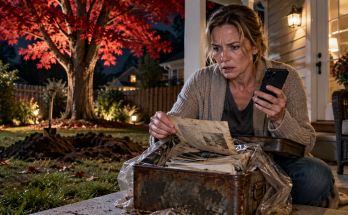
My patient came in with a 103.8-degree fever, purple fingers, and a month-old cast concealing something horrifying beneath it, yet her husband looked directly at me and calmly said, “It’s probably just the flu.” The instant I told him I was going to cut the cast open, his composure cracked into panic, and I realized I was seconds away from discovering something he was desperate to keep hidden.

The smell hit me before the stretcher even reached the room.
It was strangely sweet, metallic, and decaying, slicing through the sterile hospital air so strongly that even the nurses behind the station turned their faces away. I’m Dr. Sarah Jenkins, and after eight years working in emergency medicine, I’ve learned that the most dangerous cases don’t always arrive surrounded by shouting and chaos. Sometimes they come in almost silently, brought by someone who keeps insisting there is nothing seriously wrong.
“Thirty-two-year-old woman,” Marcus, one of our nurses, said as he hurried toward me. “Temperature 103.8, heart rate nearly 140, blood pressure falling. She’s barely responsive.”
Then his gaze shifted toward Trauma Room 2.
“Her husband keeps telling everyone it’s the flu,” he said quietly. “But Sarah, take a look at her arm.”
The moment I walked inside, every instinct in me went on alert.
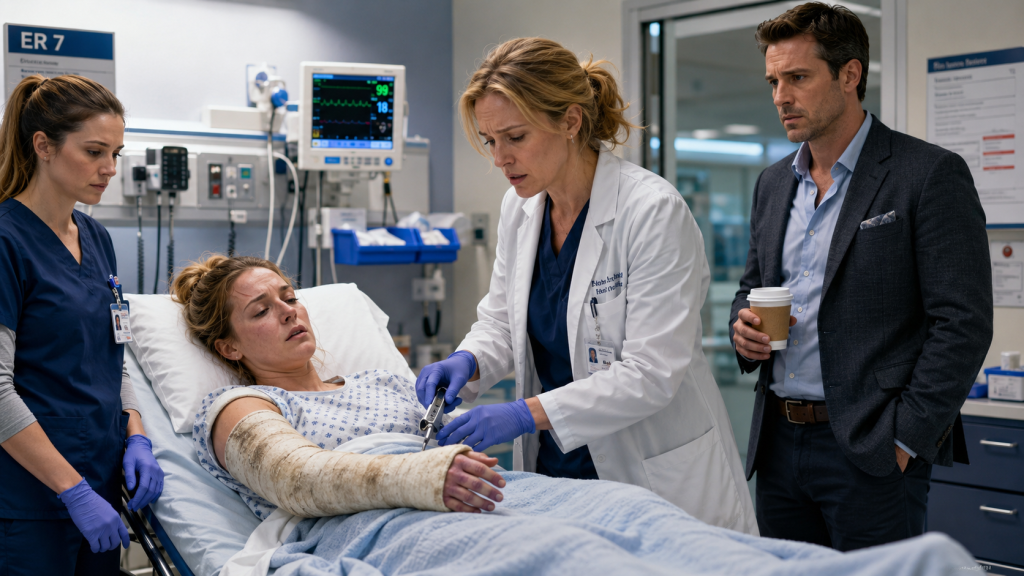
Emily Harris was lying on the bed, looking frighteningly weak. Her lips were dry and cracked, her cheeks appeared hollow, and her skin had that alarming pale shade I had seen before in patients whose bodies were slowly losing a fight they were no longer strong enough to win.
Her right arm was locked inside a fiberglass cast running from her fingers to above her elbow. The cast was dirty, heavily stained, and pressing tightly against skin that had swollen far beyond anything normal.
Her fingers were purple.
The fingertips were already beginning to turn blue.
I gently pressed one of them, waiting for the color to come back.
It didn’t.
“How long has she been wearing this cast?” I asked.
A man standing near the corner slowly raised his eyes from the Starbucks cup in his hand.
Daniel Harris, her husband, looked completely wrong for the scene in front of him. Designer jacket. Perfectly styled hair. Shined shoes. He looked like someone sitting through an ordinary checkup, not a husband watching his wife slide toward a potentially fatal medical emergency.
“About a month,” he replied casually. “Emily is pretty clumsy. She fell down the stairs.”
He took another drink.
“She seemed a little warm this morning. Probably some seasonal bug.”
I looked at him, then turned back toward Emily’s rapidly deteriorating condition.
“Mr. Harris, your wife is critically sick,” I told him. “Her body is showing signs of a severe infection. I need to remove this cast right now. She could lose her hand, and if the infection has already spread, she could die.”
I expected him to look frightened.
Instead, his expression turned hard.
“No,” Daniel said sharply. “Her orthopedic doctor said the cast stays on for two more weeks. Give her antibiotics, and then we’re going home.”
There was no concern left in his voice.
Only control.
And at that moment, I understood that this was not a normal medical crisis.
Because whatever was hidden beneath that cast, Daniel Harris was terrified that I was about to discover it.
PART 2: WHAT WE FOUND UNDER THE CAST
Daniel moved before I even reached for the cast saw.
“No.”
His voice cracked through the trauma room.
Not loud.
Not yet.
But the calm, polished husband standing beside the wall disappeared in a single second.
He stepped toward the bed.
“You are not cutting that off.”
Marcus looked at me.
I looked at Daniel.
“Mr. Harris, your wife’s fingers are blue.”
“I heard you.”
“Then you understand why the cast is coming off.”
“The orthopedist said—”
“Who?”
He stopped.
I waited.
“What is the orthopedist’s name?”
Daniel’s eyes shifted.
That was the first mistake he made.
Not the panic.
Not the refusal.
The pause.
“Dr. Keller.”
“First name?”
“I don’t remember.”
“You don’t remember the name of the physician treating your wife’s broken arm?”
He stared at me.
Then glanced toward Emily.
“She has the paperwork at home.”
Marcus was already beside the computer.
I said:
“Which hospital treated the fracture?”
Daniel’s jaw tightened.
“Saint Matthew’s.”
Marcus began typing.
I kept my eyes on Daniel.
“When?”
“Four weeks ago.”
“Exact date?”
“I don’t know.”
Emily made a weak sound.
Barely more than breath.
My attention snapped back to her.
Her heart rate had climbed.
Her blood pressure was dropping further.
The monitor began alarming.
That ended the discussion.
“Marcus, sepsis protocol.”
“Already moving.”
“Two large-bore IVs. Cultures. Labs. Broad-spectrum antibiotics.”
I looked toward another nurse.
“Get ortho and surgery down here.”
Then I turned to Daniel.
“The cast comes off now.”
He stepped in front of me.
“No.”
The entire room changed.
Marcus stopped moving for half a second.
Then positioned himself between Daniel and the bed.
I kept my voice level.
“Step aside.”
“You don’t understand.”
“That is correct.”
I said.
“I do not understand why a husband is trying to prevent emergency treatment while his wife may be dying.”
Daniel’s nostrils flared.
“She gets confused.”
“Then we treat the patient in front of us.”
“You’ll damage her arm.”
I looked at Emily’s purple fingers.
“It may already be severely damaged.”
His face changed.
Fear.
Real fear.
But somehow I knew it was not fear of losing his wife.
He was afraid of what the cast would say once it was no longer covering her.
Then Marcus spoke from the computer.
“Sarah.”
Something in his voice made me turn.
“No visit.”
“What?”
“I checked the regional exchange.”
Daniel went still.
Marcus continued.
“No orthopedic visit at Saint Matthew’s.”
“No emergency visit there either.”
He searched again.
“Nothing matching a fracture four weeks ago.”
Daniel snapped:
“Your system isn’t complete.”
“That is possible.”
I said.
“But right now your wife is unstable, and the medical history you’re giving us cannot be verified.”
His face hardened.
“I’m her husband.”
I stepped closer.
“And she is still the patient.”
Security arrived before I called.
One of the nurses at the desk must have heard the argument.
Two officers stood just outside the room.
I pointed toward the hallway.
“Mr. Harris, you need to wait outside while we stabilize Emily.”
His eyes widened.
“You can’t remove me.”
“Yes, we can.”
“She needs me.”
For the first time, Emily reacted clearly.
Her eyelids fluttered.
Then her lips moved.
“No.”
The word was almost inaudible.
Daniel heard it.
So did I.
His face emptied.
I bent beside her.
“Emily?”
Her eyes opened a fraction.
“Do you want Daniel to stay in the room?”
It took effort.
Terrible effort.
But she shook her head.
Once.
That was enough.
I looked at security.
“Please escort him out.”
Daniel’s composure finally shattered.
“No.”
He lunged toward the bed.
Not far.
Security stopped him.
Emily flinched so violently that the monitor screamed.
Daniel shouted:
“Emily, tell them!”
She turned her face away.
“Tell them I didn’t do anything!”
The sentence exposed more than he realized.
I had not accused him of anything.
Not yet.
Security pulled him toward the door.
He fought them just enough to reveal panic but not enough to lose control completely.
As he disappeared into the hallway, he shouted one final sentence.
“Don’t let them take photographs!”
I went cold.
Marcus looked at me.
Neither of us spoke.
Because I had not mentioned photographs either.
We began cutting.
A cast saw does not slice skin the way people imagine.
It vibrates.
Used properly, it cuts rigid casting material while protecting the tissue beneath.
But there was nothing ordinary about this cast.
The fiberglass was unusually thick.
Several layers had been reinforced.
The padding beneath it was wet.
Not with water.
With drainage.
The smell intensified as the first section opened.
One of the nurses turned away.
Marcus whispered:
“Oh God.”
I kept working.
Not because I did not smell it.
Because Emily needed us more than my stomach needed comfort.
We split the cast lengthwise.
Then carefully opened the edges.
The padding stuck.
I stopped.
“Saline.”
A nurse handed it over.
We soaked the material slowly.
Emily moaned.
Her eyes remained closed.
“Pain medication.”
“Already giving.”
We peeled back the first layer.
And the room became silent.
The skin underneath was swollen almost beyond recognition.
Sections of her forearm were deep red and purple.
Other areas had turned gray.
A large wound stretched along the inner side of her arm beneath the cast.
Not a clean surgical incision.
Not a normal pressure sore.
An open, infected injury with tissue breaking down around the edges.
Thick drainage had soaked into the padding.
The smell came from there.
But that was not the part that made Marcus whisper:
“What the hell?”
Around Emily’s wrist were two narrow bands of damaged skin.
Parallel.
Nearly circumferential.
Old enough to be healing.
Too regular to look accidental.
I had seen injuries like that before.
Not often.
But enough.
Pressure.
Binding.
Restraint.
There were similar marks higher on the arm.
Different ages.
Some yellowing.
Some purple.
Some almost faded.
I stared.
Then looked at Emily’s face.
She had not fallen once.
Whatever happened to her had happened more than once.
“Document everything.”
I said quietly.
Photographs were taken according to hospital protocol.
Measured.
Labeled.
Clinical.
Not spectacle.
Evidence only because a human body had become the place where somebody else’s story had been written.
Then we reached the elbow.
Marcus froze.
“Sarah.”
I followed his gaze.
Embedded in the infected tissue near the wound was something dark.
A fragment.
Not bone.
Not metal.
I irrigated gently.
The object shifted.
One of the surgeons entered just as I removed it with forceps.
A small piece of black plastic.
Flat.
Ragged.
The surgeon frowned.
“What is that?”
I placed it in a sterile container.
“I don’t know.”
Emily’s eyes opened.
She saw it.
And every remaining bit of color left her face.
“No.”
I leaned closer.
“Emily?”
“No…”
Her heart rate surged.
“What is it?”
She started trembling.
“No basement.”
My blood went cold.
“What?”
Tears slid sideways into her hair.
“Please.”
“Emily, you’re safe here.”
“No basement.”
I looked toward Marcus.
Then the surgeon.
The words did not sound like delirium anymore.
They sounded like memory.
I touched Emily’s shoulder.
“Daniel is not in the room.”
Her breathing came fast.
“We won’t let him back in unless you want him here.”
Her eyes opened fully for the first time.
Fear.
Pure.
Focused.
“Door.”
“What door?”
She looked at the black plastic fragment.
Then whispered:
“He broke it.”
I waited.
“What broke?”
“The cuff.”
Marcus went still.
My stomach turned.
I looked at the paired marks around her wrist.
Not ropes.
Not necessarily.
Something plastic.
Something rigid enough to break.
I kept my voice calm.
“Was something around your wrist?”
Emily began crying.
“Yes.”
The surgeon looked away for a second, anger moving across his face.
I asked:
“Did Daniel put it there?”
Her eyes closed.
She did not answer.
That was okay.
She had already given us enough to understand this was not a fall.
Her blood pressure dropped again.
The monitor alarmed.
Medical priorities returned instantly.
The questions stopped.
She needed surgery.
Now.
Imaging showed the fracture next.
It was not what Daniel had described.
There was a healing break in the ulna.
But there were other injuries too.
An older fracture in the radius.
Another injury near the wrist.
Different stages of healing.
The radiologist called me personally.
“Sarah.”
“Yes?”
“There are also healing rib fractures.”
I closed my eyes.
“How many?”
“At least three.”
“Same age?”
“No.”
My stomach turned.
Different episodes.
Different days.
Different injuries.
A pattern.
Then:
“There’s something else.”
I stared at the phone.
“What?”
“Old healed fracture of the left clavicle.”
I looked through the glass toward Emily’s bed.
Thirty-two years old.
A month-old cast.
A body carrying a timeline nobody had written in her chart.
“Document all of it.”
“Already am.”
The cast itself raised more questions.
When we examined the removed material, Marcus noticed the edges.
“This wasn’t done normally.”
I looked.
The fiberglass had been cut and reapplied.
At least once.
Possibly more.
Someone had opened the cast.
Then sealed it again.
The padding beneath one section was different from the rest.
Cleaner.
Newer.
The surgeon looked at me.
“If she was properly casted four weeks ago, somebody modified this.”
“Could she have done it herself?”
“Anything is possible.”
He looked toward the severe infection.
“But someone had access.”
And someone had chosen to close a cast over a wound that desperately needed treatment.
That thought sat heavily inside me.
Because abuse does not always look like the moment someone causes an injury.
Sometimes it looks like watching an infection worsen and doing nothing.
Sometimes control is denying care.
Sometimes the dangerous act is simply keeping the door closed.
Emily was taken urgently to surgery.
The surgical team needed to remove infected and dead tissue.
They could not promise her hand would be saved.
They could not promise anything beyond:
“We are going to do everything we can.”
I hated that sentence.
Doctors use it because sometimes truth has no kinder packaging.
Before they wheeled her away, Emily grabbed my sleeve.
“Dr. Jenkins.”
“Yes?”
Her voice was weak.
“My sister.”
“Who?”
“Claire.”
“Claire what?”
“Claire Morgan.”
“Phone?”
Her eyes closed.
Then opened again.
“He took it.”
“Daniel?”
She nodded.
“Your phone?”
Another nod.
“No numbers.”
That was understandable.
People do not memorize numbers anymore.
“We can find her.”
Emily’s fingers tightened around my sleeve.
“Don’t call home.”
“Okay.”
“He’ll answer.”
“I understand.”
Then:
“Tell Claire…”
Her eyes filled.
“What?”
“I tried.”
I swallowed.
“Tell her yourself when you wake up.”
Emily cried.
“What if I don’t?”
The question nearly broke me.
I bent closer.
“Then I will make sure she knows you asked for her.”
She released my sleeve.
The operating-room doors closed.
And I stood there staring at them, furious in the particular helpless way doctors become furious when medicine can repair tissue but cannot reach backward and prevent what happened to it.
Hospital social work became involved immediately.
So did law enforcement.
A domestic-violence advocate came.
Everything changed once Emily was no longer alone with Daniel.
Her medical records were reviewed.
The first surprise came quickly.
She did have an orthopedic visit.
Just not where Daniel said.
An urgent-care clinic almost forty miles outside the city had treated her twenty-nine days earlier.
The note described:
Right forearm fracture following reported fall from porch.
Not stairs.
Porch.
Daniel had already changed the story.
Then we saw who provided most of the history.
Husband.
Emily had reportedly been “too distressed” to answer questions.
The urgent-care physician recommended emergency orthopedic evaluation because the fracture looked complicated.
There was no record she ever went.
Instead, a cast appeared.
Nobody could initially verify who applied it.
That frightened me.
A properly trained orthopedic clinician would not normally seal that kind of untreated wound beneath layers of fiberglass.
So where had it come from?
The answer arrived two hours later.
Not from Daniel.
From Emily’s sister.
Claire Morgan ran into the emergency department shortly after six that evening.
She looked enough like Emily that I knew who she was before anyone introduced us.
Same brown eyes.
Same nose.
But Claire’s face held something Emily’s did not.
Open anger.
“Where is she?”
I stepped forward.
“Claire?”
“Yes.”
“I’m Dr. Jenkins.”
Her breathing stopped.
“Is she alive?”
“Yes.”
Her knees nearly gave out.
I caught her elbow.
“She’s in surgery.”
“What happened?”
I hesitated.
Not because I wanted to hide it.
Because there is no gentle way to tell someone you suspect a person they love has been hurt repeatedly.
“She came in with a severe infection beneath a cast.”
Claire frowned.
“Cast?”
I stopped.
“You didn’t know she had a broken arm?”
Her face went blank.
“No.”
My blood chilled.
“When did you last see Emily?”
“Five weeks ago.”
Before the cast.
“Have you spoken since?”
Claire’s eyes filled.
“Not really.”
“What does not really mean?”
“Texts.”
“Occasional.”
“She kept saying she was tired.”
“That Daniel wanted them to have some space.”
Claire looked toward the surgical doors.
“I called last week.”
“Daniel answered.”
“What did he say?”
“That she was sleeping.”
“And before that?”
“That she was in the shower.”
“And before that?”
Claire swallowed.
“That she had lost her voice.”
I closed my eyes.
Three excuses.
Three opportunities to isolate her.
Claire whispered:
“What did he do?”
I answered carefully.
“We are still establishing exactly what happened.”
“Does she have other injuries?”
My hesitation told her enough.
Claire started crying.
“I knew it.”
I looked at her.
“What did you know?”
“That something was wrong.”
“When?”
“Months.”
Her hands shook.
“Emily stopped coming to lunch.”
“Stopped answering our group chat.”
“Daniel said she was overwhelmed with work.”
“Then she quit her job.”
“What job?”
“She was an accountant.”
“Did she want to quit?”
Claire laughed bitterly.
“She loved that job.”
My stomach tightened.
“What did Daniel say?”
“That she wanted to focus on their marriage.”
Of course.
Isolation disguised as devotion.
Claire continued.
“Then her bank account closed.”
I went still.
“How do you know?”
“We used to send each other money for birthdays.”
“My transfer bounced.”
“She told me they had combined everything.”
“Was that normal for her?”
“No.”
Claire shook her head.
“Emily was the person who taught me to keep emergency money nobody else could touch.”
That sentence hit me.
A woman who taught her sister to protect herself had somehow ended up without access to her own phone.
“What about the injury?”
I asked.
“Had you seen anything before?”
Claire’s face changed.
“A bruise.”
“When?”
“Two months ago.”
“Where?”
“Neck.”
My stomach dropped.
“What did she say?”
“She walked into a cabinet door.”
Claire cried harder.
“I pretended to believe her.”
That guilt came instantly.
I recognized it.
I had seen it in families before.
The unbearable backward question.
Why didn’t I know?
Why didn’t I act?
Why did I accept the explanation?
I said:
“Claire.”
She looked at me.
“Your sister asked for you before surgery.”
Her face crumpled.
“What did she say?”
“She said to tell you she tried.”
Claire covered her mouth.
Then made a sound so soft I almost wished she had screamed instead.
Daniel had not left the hospital.
He was in the waiting area.
With an attorney.
That happened quickly.
Too quickly, perhaps.
But people are allowed attorneys.
Even people we distrust.
Especially then.
He had stopped asking to see Emily.
Now he wanted information.
Her condition.
Surgical plan.
Whether she had spoken.
That last question was the one that interested Detective Lauren Hayes.
She arrived shortly after Claire.
Detective Hayes had the calm demeanor of someone who understood that frightened people often tell truth slowly.
She did not charge down the hallway demanding confession.
She asked me for medical facts.
Asked Claire for history.
Then requested Daniel be interviewed separately.
Before she left, Claire grabbed her arm.
“You need to search the house.”
Hayes looked at her.
“Why?”
Claire hesitated.
Then:
“Because of the basement.”
My skin went cold.
Emily’s words returned.
No basement.
Detective Hayes noticed my expression.
“What?”
I told her.
Emily had repeated the same word.
Hayes looked back at Claire.
“What is in the basement?”
“I don’t know.”
“You’ve never been down there?”
“Not since they renovated.”
“When?”
“Maybe six months ago.”
“What changed?”
Claire wiped her face.
“Daniel installed a lock.”
I felt something cold move through my chest.
“A lock on the basement?”
“Yes.”
“He said he was keeping expensive equipment down there.”
“What equipment?”
“I don’t know.”
Claire swallowed.
“But Emily hated the basement after that.”
“How do you know?”
“She told me once.”
“What exactly did she say?”
Claire closed her eyes.
“She said…”
Then stopped.
“Take your time.”
Hayes said.
Claire whispered:
“She said if Daniel ever told me she had gone away, I should check downstairs first.”
No one moved.
I felt every hair on my arms rise.
“When did she say that?”
I asked.
“About three months ago.”
“Did you ask what she meant?”
“Yes.”
“What did she say?”
“She laughed.”
Claire cried.
“She said she was joking.”
But none of us thought it sounded funny anymore.
Emily survived surgery.
That was the good news.
The infection was severe.
That was the bad.
The surgical team removed a significant amount of infected tissue.
They relieved pressure.
Improved circulation.
Her fingers began to look slightly less blue.
The hand was still at risk.
She might need additional operations.
She might lose function.
But she was alive.
That night, she woke in intensive care.
Claire was beside her.
I stood near the foot of the bed while the ICU physician assessed her.
When Emily saw her sister, she began crying before she spoke.
Claire leaned over her.
“I’m here.”
Emily whispered:
“I’m sorry.”
“No.”
Claire grabbed her hand.
“No.”
“You do not apologize to me.”
“I stopped calling.”
“I know.”
“He…”
Emily’s voice broke.
Claire waited.
“He read everything.”
“Your messages?”
Emily nodded.
“He made me block you.”
Claire cried silently.
“He said you were trying to break us up.”
“That you hated him.”
“I do hate him.”
Claire said.
I almost smiled despite everything.
Emily did too.
Just barely.
Then I asked:
“Emily, do you feel able to answer a few questions?”
She looked at me.
“Yes.”
“If you want us to stop, we stop.”
She nodded.
I pulled a chair closer.
“Who put the cast on your arm?”
Her face changed instantly.
Daniel.
I knew before she said it.
“Daniel.”
Claire stopped breathing.
“He’s not a doctor.”
Emily shook her head.
“He watched videos.”
My stomach turned.
“Did he cause the fracture?”
She closed her eyes.
Tears leaked out.
“Yes.”
No details yet.
We did not need them.
Not tonight.
“Did you fall?”
“No.”
Claire began trembling.
Emily whispered:
“He twisted my arm.”
The room went silent.
“He said I was trying to leave.”
Claire made a broken sound.
Emily continued.
“It snapped.”
Her voice became distant.
“He panicked.”
“He took me to urgent care.”
“He told them I fell.”
“They wanted me to go to the hospital.”
“But when we left…”
She swallowed.
“He drove home.”
My hands tightened.
“What happened next?”
“He said hospitals ask too many questions.”
Claire turned away.
Emily looked at me.
“So he bought things.”
“What things?”
“Cast stuff.”
I kept my expression steady.
“And put the cast on himself?”
“Yes.”
My stomach twisted.
“Was there an open wound?”
Emily nodded.
“He said it would close.”
The surgeon’s findings flashed through my mind.
Infected tissue.
Drainage.
A month of decay sealed beneath fiberglass.
Claire whispered:
“Why didn’t you call?”
Emily cried.
“He took my phone.”
“I tried the neighbor once.”
“What happened?”
“He saw me.”
She looked toward her injured wrist.
The restraint marks.
No one asked more.
The room already knew.
Then I asked the question I was almost afraid to hear.
“What happened in the basement?”
Emily stopped breathing.
Claire leaned closer.
“You’re safe.”
Emily’s eyes moved toward the door.
Then:
“That’s where he kept me when I tried to leave.”
My skin went cold.
“How long?”
“I don’t know.”
“Hours?”
“Sometimes.”
“Days?”
She started crying harder.
“Once.”
Claire stood abruptly.
Turned toward the window.
Her shoulders shook.
Emily whispered:
“There’s a chair.”
That was enough.
I did not ask what kind.
Not then.
Detective Hayes would handle the details in a trauma-informed interview when Emily was medically stable.
I was her doctor.
My job was not to excavate every horror because curiosity demanded an ending.
My job was to keep her alive long enough to choose what happened next.
I said:
“You do not have to tell us more tonight.”
Relief crossed her face.
Then she grabbed my hand.
“But you need to tell them one thing.”
“What?”
Her eyes widened.
“The wall.”
I frowned.
“What wall?”
“In the basement.”
Claire turned back.
Emily’s voice shook.
“He fixed it after.”
“After what?”
Emily stared at us.
Then whispered:
“After Melissa.”
Silence.
Claire’s expression changed.
“Who is Melissa?”
Emily looked terrified.
“His first wife.”
My heartbeat stopped.
I looked at Claire.
She shook her head.
“I thought Daniel had never been married.”
So had Emily.
She whispered:
“He told me after I found the picture.”
“What picture?”
“In a box.”
“Who is Melissa?”
“I don’t know.”
Emily’s voice cracked.
“He said she left him.”
“When?”
“Six years ago.”
Then:
“But I found her necklace.”
My stomach tightened.
“Where?”
Her eyes filled.
“In the basement.”
Nobody spoke.
Then Emily said something that changed the entire case.
“It was behind the new wall.”
Claire whispered:
“How could you know that?”
Emily’s hand tightened around mine.
“Because I saw him put it there.”
The room went silent.
Not:
I found it near the wall.
Not:
It fell behind something.
I saw him put it there.
“What exactly did you see?”
I asked carefully.
Emily closed her eyes.
“A box.”
“What was inside?”
“Her things.”
“Just things?”
Emily started trembling.
“I don’t know.”
Then:
“But after I found them…”
Her breathing sped up.
“…he said I was going to end up exactly where she did.”
Claire began crying.
The ICU monitor started alarming as Emily’s heart rate rose.
I stopped immediately.
“That’s enough.”
I looked at Claire.
“No more questions.”
Then toward the nurse.
“Let’s settle her.”
Emily grabbed my wrist.
“Please.”
“We heard you.”
I said.
“We believe you.”
Her face collapsed.
I do not know which sentence broke her more.
Maybe both.
Because sometimes the first miracle in an abuse case is not escape.
It is being believed.
Detective Hayes obtained a warrant for the Harris home that night.
I did not go.
Of course I did not.
I stayed in the hospital.
Emily underwent another procedure the next morning.
Her hand looked better.
Not safe.
Better.
I told myself to take victories where they existed.
At 11:20 a.m., Detective Hayes called me.
Her voice sounded different.
Controlled.
But strained.
“Dr. Jenkins.”
“Yes?”
“Is Emily awake?”
“Intermittently.”
“I need to confirm something when she’s stable.”
“What?”
Silence.
Then:
“We searched the basement.”
My stomach tightened.
“And?”
“There was a locked room.”
I closed my eyes.
“A chair?”
“Yes.”
She did not elaborate.
She did not need to.
“What about the wall?”
Another pause.
“We found the recently renovated section.”
My mouth went dry.
“And Melissa?”
“We found documents identifying a Melissa Grant Harris.”
Daniel’s first wife.
“She has been missing for six years.”
My heart stopped.
“Missing?”
“Yes.”
“She was reported missing by her sister.”
“Was Daniel investigated?”
“Briefly.”
“What happened?”
“He told police she had left voluntarily after an argument.”
“Her car was found at a bus terminal two days later.”
“Any sign of her after that?”
“None.”
I sat down.
The world around me kept moving.
Nurses.
Monitors.
Phones.
Somebody laughing at the desk.
Normal life surviving beside horror.
“What did you find behind the wall?”
I asked.
Detective Hayes did not answer immediately.
Then:
“Enough that we have requested a forensic team.”
That was not an answer.
It was worse.
I closed my eyes.
“Is Daniel still here?”
“No.”
My eyes opened.
“What?”
“He left the hospital several hours ago.”
My heart jumped.
“I thought detectives were speaking with him.”
“They did.”
“But at that point we did not have grounds to detain him.”
“Where is he now?”
“We’re trying to locate him.”
My blood turned cold.
Emily was in the ICU.
Claire was with her.
Security had been alerted.
But Daniel knew this hospital.
He knew entrances.
Parking garages.
He knew his wife was alive.
And now, if Detective Hayes was right, he also knew police had entered the basement.
I stood.
“I’m notifying hospital security again.”
“Do that.”
Then Hayes added:
“Sarah.”
Her use of my first name made me stop.
“What?”
“We found something else in the basement.”
I waited.
“A box of medical supplies.”
My stomach turned.
“What kind?”
“Casting material.”
“Bandages.”
“Sedatives?”
“I can’t characterize everything yet.”
Then:
“And patient wristbands.”
I stopped breathing.
“What?”
“Hospital-style identification bands.”
“How many?”
Another pause.
“Four.”
My skin went cold.
“Were they Emily’s?”
“One was.”
“And the others?”
“We’re identifying them.”
My mind went immediately to Melissa.
Then somewhere darker.
Detective Hayes continued.
“There were names on two.”
“What names?”
“I can’t give you all of that yet.”
Then:
“But one name is Melissa Grant.”
Silence.
“And the other?”
She hesitated.
“Rachel Monroe.”
I did not know the name.
“Who is that?”
“We don’t know yet.”
Then my hospital pager went off.
ICU.
Urgent.
My entire body tensed.
“I have to go.”
I ended the call and ran.
Not walked.
Ran.
Claire met me in the ICU hallway.
Her face was white.
“What happened?”
I asked.
She held up a phone.
Emily’s phone.
The police had recovered it from Daniel’s car and returned it for evidence-assisted access earlier that morning.
Claire’s hands were shaking.
“A message came through.”
“From who?”
She turned the screen toward me.
Unknown number.
One line.
EMILY, HE KNOWS YOU TALKED. DON’T LET SARAH GO TO HER CAR ALONE.
My blood went cold.
I stared at the message.
Claire whispered:
“Who is Sarah?”
I could barely answer.
“Me.”
Then another message appeared.
Same number.
DANIEL HAS DONE THIS BEFORE. MELISSA WASN’T THE FIRST.
The hallway seemed to tilt.
Claire stared at me.
I stared back.
And suddenly the hidden room, the sealed cast, the missing first wife, and the four hospital wristbands no longer looked like separate pieces of one terrible marriage.
They looked like a pattern.
A pattern that had begun years before Emily.
And whoever was texting us knew enough to understand two things the police did not yet know.
Where Daniel might go next.
And why he had been so desperate to keep that cast closed.
PART 3: THE WOMAN WHO KNEW WHAT DANIEL HAD DONE BEFORE
For several seconds, I could not move.
The message on Emily’s phone glowed in Claire’s shaking hand.
DANIEL HAS DONE THIS BEFORE. MELISSA WASN’T THE FIRST.
The ICU hallway suddenly felt too bright.
Too open.
Too ordinary for a sentence like that.
Claire looked at me.
“Who is sending this?”
“I don’t know.”
My voice sounded strange even to me.
Then another message appeared.
DON’T REPLY HERE. POLICE FIRST.
That changed something.
Whoever was texting did not seem interested in drama.
They wanted distance.
Documentation.
Safety.
I immediately called Detective Hayes.
She answered on the second ring.
“Sarah?”
“We received messages.”
“What kind?”
I read them word for word.
She went silent.
Then:
“Do not respond.”
“I won’t.”
“Screenshot everything.”
“Already doing it.”
“And Sarah?”
“Yes?”
“Do not go anywhere alone.”
My stomach tightened.
“Is Daniel still missing?”
“Yes.”
That one word was enough.
I looked through the glass into Emily’s room.
She was asleep.
Her arm elevated.
IV lines running.
Machines doing quiet work around a woman whose own husband had apparently turned medical equipment into a weapon of control.
I whispered:
“I’m staying here.”
“Good.”
Detective Hayes continued.
“We’re sending officers.”
Then:
“And we may have an identity for Rachel Monroe.”
My heart jumped.
“The wristband?”
“Yes.”
“Who is she?”
A pause.
“Former girlfriend.”
Of Daniel.
I closed my eyes.
Of course.
“What happened to her?”
“We’re still confirming.”
Then Detective Hayes added:
“But she’s alive.”
Relief came so quickly I almost cried.
“Alive?”
“Yes.”
“Where?”
“We’re trying to reach her.”
Then I understood.
“The messages.”
“You think Rachel sent them?”
“Possibly.”
I looked at Claire.
She was listening to my side of the call.
Her face changed when I mouthed the name.
Rachel.
A living woman.
Maybe the first person who could tell Emily that what happened to her had happened before.
Maybe the person who had escaped.
Police arrived twenty minutes later.
Hospital security increased coverage around Emily’s floor.
I was told to move my car to a secure staff area later with security escort.
I hated how much of Daniel’s fear now belonged to us.
That is one of the ugliest things about abuse.
It spreads.
First the victim adjusts her life.
Then the sister.
Then the doctors.
Then nurses.
Then security guards.
Suddenly everyone is rearranging doors, routines, parking spaces, sleep.
All because one person believes control is worth everyone else’s fear.
I stood outside Emily’s room thinking about that when Claire touched my arm.
“She’s waking up.”
I went inside.
Emily opened her eyes slowly.
The first thing she asked was:
“Daniel?”
“Not here.”
Her shoulders relaxed.
Only slightly.
“Police?”
“Looking for him.”
Her eyes filled.
Then she saw Claire’s face.
“What?”
Claire looked at me.
I nodded.
Carefully.
Claire sat beside her sister.
“We got messages.”
Emily became still.
“From who?”
“We don’t know yet.”
“What did they say?”
Claire hesitated.
Then told her.
Not everything.
Just enough.
That someone believed Daniel had done similar things before.
That Rachel Monroe might be connected.
The name changed Emily completely.
Her face drained.
“You know her?”
I asked.
Emily’s lips trembled.
“Yes.”
Claire leaned closer.
“How?”
Emily looked toward the door.
Then whispered:
“He said she was crazy.”
My stomach tightened.
Of course he did.
“He said she stalked him.”
“When?”
Claire asked.
“Before we married.”
“What else?”
“He said she was obsessed.”
“That she made accusations when he left her.”
Emily closed her eyes.
“I believed him.”
I sat beside her.
“You believed the version he gave you.”
She started crying.
“That sounds nicer.”
“It’s also true.”
Her breathing shook.
“He showed me messages.”
“What kind?”
“Threatening.”
My stomach tightened.
“From Rachel?”
“I thought.”
There it was.
I did not ask if she still believed they were real.
Her face told me she didn’t.
Then Emily whispered:
“There was another woman too.”
Claire stopped breathing.
“What?”
“Daniel called her a patient.”
I frowned.
“Daniel isn’t a doctor.”
“No.”
Emily looked at me.
“He worked in medical equipment sales before we met.”
That explained some things.
The casting materials.
The hospital bands.
Not everything.
But access.
Knowledge.
Familiarity.
“What was the woman’s name?”
Emily closed her eyes.
“I only saw it once.”
“Take your time.”
She thought.
Then:
“Rebecca.”
My pulse quickened.
“Last name?”
“I don’t know.”
Claire looked at me.
Four wristbands.
Emily.
Melissa.
Rachel.
And possibly Rebecca.
A pattern was becoming a list.
I hated lists like that.
Detective Hayes came to Emily’s room later that afternoon.
Not to overwhelm her.
Just enough to ask whether she recognized Rachel’s name.
Emily told her the same thing she told us.
Then Hayes asked:
“Do you remember any last name for Rebecca?”
Emily shook her head.
“Did Daniel ever mention where she lived?”
“No.”
“Work?”
Emily’s face changed.
“Pharmacy.”
Everyone went quiet.
“Hospital pharmacy?”
“I don’t know.”
Then:
“He said she stole from work.”
Hayes wrote it down.
Emily looked at me.
“Do you see it?”
I knew what she meant.
Every woman had a story attached to her.
Melissa left him.
Rachel was crazy.
Rebecca stole.
Emily was clumsy.
Daniel did not simply hurt people.
He authored explanations before anyone could ask.
That was the pattern.
I whispered:
“Yes.”
Emily started crying.
“He was always ready.”
Claire took her hand.
“What?”
“With reasons.”
Her voice cracked.
“He always had a reason before I even asked.”
That sentence stayed with me.
Because lies become most effective when they arrive before doubt.
Rachel Monroe was located that evening.
Alive.
Forty-one years old.
Living two states away.
She had remarried.
Had a son.
A job.
A life Daniel apparently did not control anymore.
She agreed to speak with police remotely first.
Then, after being told Emily was alive and hospitalized, she asked one question.
“Did he put her arm in a cast?”
Detective Hayes later told me that question chilled the entire room.
Because Rachel had never been told about the cast.
She already knew enough.
Daniel was found the next morning.
Not in some dramatic forest cabin.
Not at an airport.
Not halfway across the country.
At his mother’s vacant rental property forty minutes away.
He had food.
Cash.
Clothes.
A second phone.
He had not vanished into thin air.
He had run to somewhere familiar.
Somewhere he believed he could wait until panic became strategy again.
Police arrested him without a public scene.
Good.
Emily did not need his capture turned into entertainment.
When Claire told her, she cried.
Not happiness.
Relief.
Then guilt.
“I feel bad.”
Claire stared.
“For him?”
Emily nodded.
“He’s going to jail because of me.”
“No.”
Claire said immediately.
“He’s facing consequences because of what he did.”
Emily looked unconvinced.
I understood.
Victims often carry responsibility long after the person hurting them stops deserving access to it.
So I said:
“Emily.”
She looked at me.
“You came to the hospital almost unconscious.”
“You did not create this investigation.”
“Your injuries did not accuse him falsely.”
“You survived long enough for other people to see.”
Her eyes filled.
“That is not betrayal.”
She cried.
For several minutes.
Then nodded.
Not because guilt disappeared.
Because someone had offered it another name.
Survival.
The forensic search of the basement took days.
The newly constructed wall was opened under proper supervision.
What was found behind it did not become gossip in our hospital.
I made sure of that.
But enough became public through later court proceedings.
There were personal belongings linked to Melissa.
Jewelry.
A purse.
Old identification.
Some documents.
No remains.
That mattered.
For several terrifying hours, everyone believed the worst.
Then records changed the story.
Melissa was eventually found alive too.
Not nearby.
Not using her old name.
Alive.
She had left six years earlier and deliberately disappeared.
Why?
Because she believed Daniel would find her if she remained connected to anyone who knew her.
Her car at the bus terminal had not been staged by Daniel.
She had staged it herself.
She left behind everything she believed could be used to track her.
Including belongings Daniel later collected and kept.
The wall was not a grave.
It was a vault.
A trophy room of sorts.
Not in some theatrical serial-killer sense.
Something quieter.
Items belonging to women who had rejected him.
Things he kept.
Messages.
Copies of documents.
Photos.
Hospital bracelets.
Control preserved after the person escaped.
That frightened me in a completely different way.
Melissa had survived.
And Daniel had spent six years telling people she abandoned him for no reason.
When Melissa finally spoke to police, she confirmed the pattern.
Not every injury.
Not every detail.
But enough.
Daniel controlled money.
Phones.
Movement.
He monitored messages.
He used shame.
Then fear.
Then physical violence.
She left after he fractured two of her ribs during an argument.
She went to an emergency department alone.
Told doctors she fell in the shower.
Then sat in the parking lot afterward and realized she had just lied to protect the person who hurt her.
That was the moment she decided to run.
She did not confront him.
She did not announce it.
She disappeared.
Sometimes survival is quiet.
Rachel’s story was different.
Daniel never married her.
They dated for eleven months.
When she tried to leave, he locked her in his garage overnight.
She escaped the next morning when a neighbor came outside.
She reported it.
Then withdrew cooperation later.
Why?
Because Daniel produced messages making her look unstable.
Friends told her she was overreacting.
His family called constantly.
She became exhausted.
Then she left the state.
She had spent years believing the case disappeared because she had failed.
When police contacted her about Emily, Rachel said:
“I thought I was the only one.”
That sentence broke my heart more than almost anything.
Abuse survives on isolation.
Not only physical isolation.
Narrative isolation.
Everyone believing their story is singular.
Embarrassing.
Impossible to explain.
Then one day, another person says:
Me too.
And suddenly the lie loses some of its walls.
Rebecca took longer to identify.
Her name was Rebecca Sloan.
She had worked as a pharmacy technician at a private outpatient center where Daniel once sold equipment.
They had a short relationship.
When Rebecca accused Daniel of entering her apartment without permission, he told coworkers she had been stealing medication.
She lost her job during an internal investigation.
The theft allegations were never substantiated.
But by then, her reputation was damaged.
She moved.
Changed careers.
Never spoke to Daniel again.
The fourth wristband carried her name.
She did not know why.
That remained one of the stranger unanswered questions.
Maybe Daniel kept it because it represented a moment of control.
Maybe because he planned something and never acted.
Not every mystery received a perfect explanation.
That was okay.
Truth does not become less true because one corner remains dark.
Emily needed five surgeries.
Five.
The first saved her life.
The next two focused on controlling infection and preserving as much tissue as possible.
The fourth repaired what could be repaired.
The fifth came months later.
She kept her hand.
Not full function.
But enough.
She could move her fingers.
Hold a mug.
Button a shirt with effort.
Write slowly.
The first time she signed her own name after surgery, she cried so hard the occupational therapist cried too.
I was not there.
Claire sent me a photograph later.
Emily’s signature looked shaky.
Uneven.
Beautiful.
The case against Daniel unfolded slowly.
As it should.
Medical records.
Witness statements.
Old reports.
Digital evidence.
Testimony.
No single dramatic piece proved everything.
Patterns did.
Emily’s untreated fracture.
The home-applied cast.
The infection.
The restraint marks.
The locked basement.
The phone control.
Prior reports.
Rachel.
Melissa.
Rebecca.
Daniel’s own messages.
Some charges were stronger than others.
Some older allegations could not be pursued fully because time and evidence matter.
But Emily’s case was current.
Documented.
Serious.
Daniel eventually faced convictions related to assault, unlawful restraint, tampering with evidence, and other conduct supported by the case.
He received a substantial prison sentence.
Not because a doctor “knew” the truth the instant she smelled the cast.
Because a patient survived.
Evidence was preserved.
Other women spoke.
And eventually the story Daniel had written for everyone else stopped being the only version in the room.
People later asked me:
“Did you know immediately?”
No.
I knew Emily was sick.
I knew the cast was dangerous.
I knew Daniel’s behavior was wrong.
That is different from knowing the entire story.
Doctors should not become detectives simply because instinct tells us something is off.
We document.
Treat.
Ask.
Listen.
Protect.
Then other professionals do their work.
That distinction matters.
I could have been wrong about Daniel.
The cast still needed to come off.
Emily still needed antibiotics.
Her blue fingers still mattered.
Medical urgency did not require a villain.
It required action.
The villain revealed himself afterward.
Emily spent nearly three months between hospital care, rehabilitation, and a protected living arrangement.
She did not return to the house.
Claire helped retrieve essential belongings with law-enforcement support.
Most of Emily’s possessions did not matter to her anymore.
She wanted four things.
Her grandmother’s necklace.
A box of old photographs.
Her college diploma.
And a blue ceramic mug Claire had made in high school.
That last one survived.
She laughed when Claire brought it.
“It’s ugly.”
“I know.”
“I missed it.”
“I know.”
Sometimes rebuilding starts with the smallest object that still belongs entirely to you.
Her recovery was not inspirational every day.
I want that understood.
Some days she hated everyone.
Some days she refused therapy.
Some days she blamed herself.
Some days she wanted Daniel to call.
That frightened Claire.
It frightened Emily more.
She asked me once:
“What kind of person misses someone who did this?”
I answered:
“A person who had a life with him.”
She stared.
“You don’t think I’m stupid?”
“No.”
“You loved parts of him.”
She cried.
“I did.”
“That does not mean you consented to the parts that harmed you.”
She looked at her injured arm.
Then whispered:
“I don’t know who I was married to.”
I said:
“You may never get one clean answer.”
That hurt her.
But it was honest.
Daniel was not violent every minute.
That was partly why leaving had been so hard.
He cooked.
Bought birthday gifts.
Remembered how she liked her coffee.
Then controlled.
Humiliated.
Isolated.
Hurt.
Human beings become dangerous when we insist goodness in one moment cancels cruelty in another.
It doesn’t.
Claire carried guilt too.
For not pushing harder.
For believing texts.
For accepting excuses.
One evening, she came to the hospital after Emily had fallen asleep.
She sat in the corridor.
“I should have broken into that house.”
I shook my head.
“You didn’t know.”
“I knew something.”
“You suspected something.”
“I should have done more.”
I looked at her.
“What would more have looked like?”
She opened her mouth.
Nothing came.
Exactly.
People imagine afterward that there was one perfect action they failed to take.
Usually there wasn’t.
So I said:
“Next time someone you love becomes isolated, ask more questions.”
“Stay available.”
“Believe fear when you see it.”
“But do not turn hindsight into a weapon against yourself.”
Claire cried.
Then laughed weakly.
“You doctors are annoying.”
“Yes.”
“Is that taught in residency?”
“Advanced course.”
She smiled.
That was the first time I saw her smile in weeks.
A year after Emily arrived in my emergency department, she returned.
Not as a patient.
She walked.
No stretcher.
No cast.
No fever.
Her arm was scarred.
She wore a soft compression sleeve.
Claire came with her.
I was finishing a shift when a nurse said:
“Sarah, somebody wants to see you.”
I stepped into the waiting area.
Emily stood.
Her hair was longer.
Her face fuller.
Still healing.
Still unmistakably herself.
She held out a small paper bag.
“What is this?”
“Coffee.”
I laughed.
“You nearly died and came back to bring me caffeine?”
“You looked exhausted last time too.”
Fair.
We sat.
She told me she had started working again.
Part-time.
Accounting.
Not at her old firm.
Somewhere smaller.
She had her own apartment.
A ridiculous number of plants.
A rescue cat named Marcus.
I stared.
“You named the cat after my nurse?”
“No.”
she said.
“I named him Marcus because he bites people who ignore boundaries.”
I laughed so loudly everyone looked.
Then her expression softened.
“I wanted to say thank you.”
“You don’t owe me that.”
“I know.”
She smiled.
“That’s why I can say it.”
That sentence stayed with me.
Not obligation.
Choice.
The difference had become the center of her new life.
She continued.
“When Daniel said no to the cast removal…”
Her eyes filled.
“…I thought you would listen to him.”
My chest tightened.
“Why?”
“Because everyone did.”
Silence.
“The urgent care.”
“Friends.”
“His family.”
“He talked.”
“People believed.”
“And I got quieter.”
She looked at her hand.
“When you said I was the patient…”
Her voice cracked.
“…I remembered I was a person.”
I had to look away.
Doctors are trained not to make patient stories about ourselves.
But some words enter you anyway.
I whispered:
“You always were.”
“I know that now.”
Good.
That was enough.
Two years later, Emily spoke publicly for the first time.
Not on television.
Not in some viral interview.
At a training session for hospital staff and domestic-violence advocates.
She talked about isolation.
Medical coercion.
Why patients may lie.
Why they may return to abusive partners.
Why asking the same safety question more than once can matter.
I sat in the back.
She did not know I was there until afterward.
When she saw me, she rolled her eyes.
“You’re stalking me.”
“Terrible boundaries.”
“Exactly.”
We hugged.
Carefully.
Her right arm still bothered her in cold weather.
Some damage never disappeared.
Healing did not mean restoration to the exact person she had been before.
It meant building a life that could include what happened without becoming only what happened.
Melissa eventually met Emily.
That happened three years later.
Rachel came too.
Rebecca chose not to.
Her choice was respected.
The three women did not become some perfect sisterhood.
They were strangers connected by one terrible man.
That is not the same as friendship.
But they met once.
Talked.
Compared stories.
Filled gaps.
Then decided what contact, if any, they wanted afterward.
Emily told me later:
“The most important thing Rachel said was that I didn’t have to turn surviving him into my whole identity.”
I understood.
For a while, everyone wanted Emily to be brave.
Strong.
Inspirational.
She hated it.
“I want to be boring.”
she told me.
So she became boring.
Beautifully boring.
Work.
Groceries.
Cat hair.
Bad television.
Late rent once because she forgot what day it was.
A neighbor who played drums at midnight.
Life.
Ordinary life became the thing Daniel had nearly taken from her.
She reclaimed it without ceremony.
I still think about the smell sometimes.
That is the part memory keeps.
Not Daniel’s face.
Not the courtroom.
Not even the basement.
The smell when the stretcher entered Trauma Room 2.
Sweet.
Metallic.
Decaying.
The body telling the truth before anyone else did.
Emily’s cast had been built to hide what was happening.
But the infection could not be negotiated with.
It did not care about Daniel’s explanations.
It did not care that he dressed well.
Spoke calmly.
Held a coffee cup.
Called it flu.
Biology had no interest in maintaining his story.
Her fever spoke.
Her purple fingers spoke.
Her falling blood pressure spoke.
Her body had been forced into silence for a month.
Then it became impossible to ignore.
Years later, a medical student asked me about the case.
Not Daniel by name.
Just the principle.
“What do you do when the family member seems more controlling than concerned?”
I thought before answering.
Then said:
“You keep returning to the patient.”
Not:
Confront the villain.
Not:
Trust your intuition blindly.
The patient.
Who can speak?
Who cannot?
Who is answering for whom?
What does the body show?
What is urgent?
What choice belongs to the patient?
Because that was the lesson I kept.
Daniel wanted the room centered around him.
His explanation.
His permission.
His version.
Emily was disappearing beneath all of it.
The moment we stopped asking him what was allowed and started asking what she needed, his control began to break.
Not completely.
Not instantly.
But enough.
Enough to cut one cast open.
Enough to find one wound.
Enough for one frightened woman to whisper:
No basement.
And from there, the truth finally had somewhere to go.
Emily sent me a Christmas card last year.
No dramatic message.
Just a photograph.
Her.
Claire.
The cat.
A ridiculous sweater.
On the back, she wrote:
Still boring. Still alive. Still mine.
I keep it in my desk.
Not because I saved her.
Too many people were involved for that lie.
Nurses.
Surgeons.
Police.
Advocates.
Claire.
Rachel.
Melissa.
And Emily herself.
Especially Emily.
I keep it because medicine does not always get the ending we want.
Sometimes despite everything, the patient dies.
Sometimes the hand cannot be saved.
Sometimes the person goes back.
Sometimes evidence fails.
Sometimes justice never arrives.
So when a good ending does come, I allow myself to remember it.
A woman entered my emergency department with a month-old cast hiding infection, injuries, fear, and a marriage built around control.
Her husband said it was probably the flu.
He was wrong.
It was not the flu.
It was sepsis.
It was abuse.
It was isolation.
It was a pattern several women had survived separately until one body finally made silence impossible.
And when we cut that cast open, we did not only expose a wound.
We exposed the story Daniel had spent years trying to keep sealed.
Emily survived long enough to write a different one.
In her own hand.
Slowly.
Shakily.
But entirely hers.
THE END STORIES! THANK YOU FOR READING GOOD LUCK !❤️
Related Posts