PART 3 — WHAT WAS BURIED BENEATH THE RED MAPLE
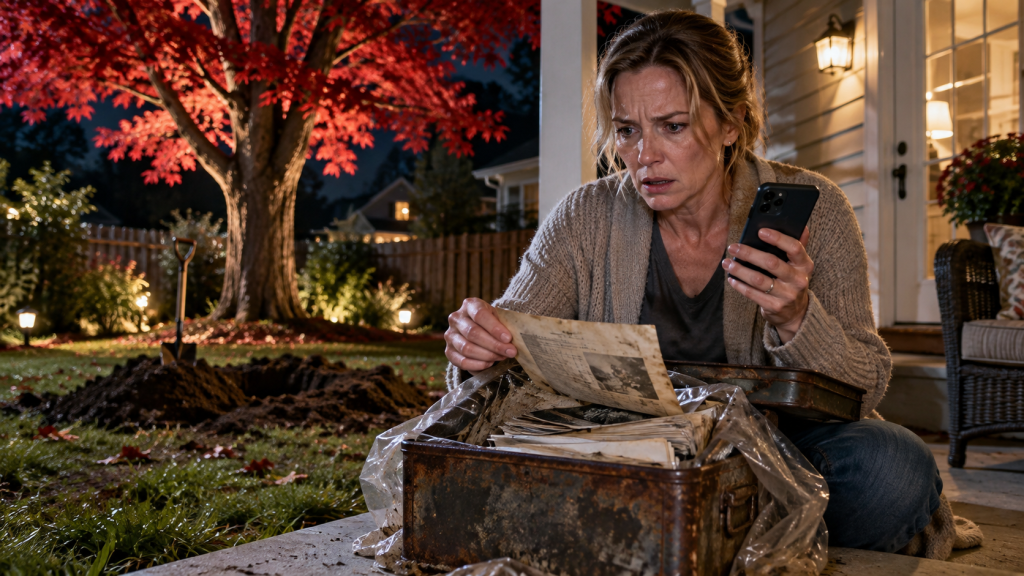
Joe looked at the open metal box beside my feet.
Then at the red maple.
Then at me.
His face had the strange, emptied look of a man watching twenty-seven years of silence collapse in a single night.
“Your mother didn’t bury evidence against me,” he said.
His voice broke.
“She buried evidence that I helped her survive.”
For several seconds, nobody moved.
Detective Claire Bennett stood between us with one hand resting near the radio clipped to her shoulder.
Another officer had stepped toward Joe.
Not aggressively.
Carefully.
The kind of movement police make when they do not yet know whether the person standing in front of them is a witness, a suspect, or both.
I stared at my husband.
Twenty-seven years.
Twenty-seven Christmases.
Twenty-seven birthdays.
Twenty-seven anniversaries.
Twenty-seven years of watching him and my mother exchange polite smiles sharp enough to cut glass.
And now he stood beneath the tree she had guarded like a grave and told me they had shared something large enough to poison nearly three decades.
“What did you help her survive?”
Joe closed his eyes.
When he opened them again, he looked older.
Not the gradual kind of older you notice in photographs.
Older all at once.
As if the secret had finally reached the surface and brought every buried year with it.
“Daniel.”
My mouth went dry.
“Daniel Harper?”
Joe nodded.
Detective Bennett stepped closer.
“Mr. Lawson—”
“Joe.”
Her expression did not change.
“Joe, before you say anything further, I need you to understand that depending on what you tell us, you may be placing yourself at legal risk.”
He gave a tired laugh.
“That would’ve scared me twenty-seven years ago.”
Then he looked at me.
“It doesn’t anymore.”
I almost said something.
I don’t know what.
Maybe:
You should be scared.
Maybe:
How could you?
Maybe simply:
Please don’t.
Because some part of me already understood that once Joe started talking, my life would divide into two parts.
Before.
After.
He looked at Detective Bennett.
“Daniel Harper died here.”
The backyard disappeared.
Not literally.
But suddenly there was no porch.
No grass.
No maple.
Only that sentence.
Daniel Harper died here.
My ears rang.
I stared at Joe.
“You’re saying there’s a body under that tree?”
His face twisted.
“No.”
The detective’s eyes narrowed.
“Where?”
Joe looked toward the far side of the yard.
“There used to be a shed.”
I followed his gaze.
The old gardening shed had been removed twelve years earlier after termites destroyed the floor.
Mom replaced it with a stone patio.
I remembered helping choose the tiles.
Blue-gray slate.
My stomach turned.
Joe pointed.
“Under there.”
The officer near him immediately raised his radio.
Detective Bennett’s voice hardened.
“Do not move.”
Joe gave a tiny nod.
I could barely breathe.
“Joe.”
He looked at me.
“You knew there was a dead man under my mother’s yard?”
Tears filled his eyes.
“Yes.”
Something inside me broke.
Not loudly.
Not dramatically.
It simply cracked.
A clean fracture through everything I thought I understood.
I stepped backward.
Joe moved instinctively toward me.
Detective Bennett lifted a hand.
“Stay where you are.”
He stopped.
That somehow made it worse.
My husband.
The man who had slept beside me for twenty-seven years.
The man who had held my hand during two miscarriages.
The man who taught our daughter to ride a bike.
The man who cried when our first grandchild was born.
Standing in my mother’s backyard while police told him not to move because he knew where a missing man had been buried.
I looked at the tree.
Its leaves moved softly in the night wind.
All these years, Mom had sat beneath it in summer.
She had drunk coffee there.
Read books.
Hung bird feeders from its branches.
My children had played beneath it.
We took family photographs beside it every October because the leaves turned such a brilliant red that people stopped on the sidewalk to look.
And less than twenty feet away, under stone I had personally helped select, a man had been buried for nearly three decades.
I bent forward.
My stomach clenched.
Detective Bennett caught my elbow.
“Ma’am?”
“I’m okay.”
I wasn’t.
I pulled away gently.
“I need to know.”
She looked at Joe.
Then at me.
“This is now potentially a homicide scene.”
The word hit harder than dead.
Homicide.
Joe flinched.
“It wasn’t murder.”
Bennett’s gaze snapped toward him.
“Then I strongly suggest you stop talking until you have counsel.”
“I’ve had twenty-seven years to think about what I’d say.”
“That doesn’t make this the right place.”
“No.”
Joe looked at the maple.
“But she deserves to know why her mother hated me.”
I stared at him.
“Hated you?”
He gave a sad smile.
“You always thought we disliked each other.”
“You did.”
“No.”
He shook his head.
“It was worse than that.”
That frightened me more than everything else.
Because hatred is simple.
Guilt is not.
Joe lowered his eyes.
“Your mother hated that I knew who she really was that night.”
I whispered:
“What did she do?”
Joe looked at me.
“She fought back.”
—
The police separated us.
That was the beginning.
Not of the truth.
Of losing control over how the truth would come.
Within forty minutes, my mother’s backyard was filled with people.
Crime-scene tape.
Floodlights.
Photographers.
Officers.
A detective from major crimes.
Then another.
My childhood home stopped being my mother’s house and became an address.
A scene.
Evidence.
I sat inside at the kitchen table.
The same table where Mom had made pancakes on Sunday mornings.
Where she helped my daughter with multiplication.
Where she once screamed at Joe because he put a hot pan directly onto the wood and left a white mark that never completely disappeared.
I stared at that mark now.
Twenty-two years later.
Such a stupid memory.
Such a normal wound.
Outside, strangers were preparing to dig up a dead man.
Detective Bennett sat across from me.
She had taken off her coat.
Placed a recorder on the table.
“Before we speak further, I want to make sure you understand that your husband is being interviewed separately.”
“Is he under arrest?”
“Not at this time.”
“Is he a suspect?”
She paused.
“He’s a person with direct knowledge of an unreported death and the concealment of human remains.”
The sentence made my throat tighten.
“Is that yes?”
“It means we don’t know enough yet.”
I looked toward the backyard.
“And my mother?”
“Your mother is deceased.”
“I know that.”
My voice sharpened.
“I mean was she a suspect?”
Bennett studied me.
“In what?”
I almost laughed.
Everything.
A missing person.
A body.
Documents hidden beneath a tree.
Joe saying she fought back.
“I don’t know.”
That was the worst part.
I did not know what question to ask because I had no idea which version of my mother had existed before the one I knew.
Bennett opened a folder.
“Tell me about Daniel Harper.”
“I barely remember him.”
“You said earlier he worked with your mother.”
“I think so.”
“When?”
“Late eighties. Early nineties.”
“How old were you?”
“Twenty-two when he disappeared.”
That made the detective look up.
Old enough to remember.
And yet I didn’t.
Not properly.
That bothered me.
I searched.
Daniel.
A face.
A voice.
Something.
Then memory moved.
A barbecue.
Mom’s old office.
A man with expensive sunglasses.
He called me “Margaret’s little girl” even though I was in college.
I disliked him instantly.
“He was charming.”
The words came slowly.
“Too charming.”
Bennett waited.
“He always touched people when he spoke. Shoulder. Elbow. Back. Like he already owned the conversation.”
The detective wrote something.
“Did he ever make you uncomfortable?”
“Yes.”
That answer came faster.
A memory sharpened.
Daniel standing too close in Mom’s kitchen.
His hand on my lower back.
Me stepping away.
Mom seeing.
Her face hardening.
Then later telling me:
“Do not ever be alone with him.”
I sat upright.
“Oh my God.”
Bennett’s pen stopped.
“What?”
“My mother warned me.”
“When?”
“I don’t know. Before he disappeared.”
“What did she say exactly?”
I closed my eyes.
Mom at the sink.
Angry.
Not at me.
Scared.
I had thought she was being controlling.
“She said not to be alone with him.”
“Did she say why?”
“No.”
“Did you ask?”
“Of course.”
I laughed bitterly.
“I was twenty-two. I asked why about everything.”
“What did she say?”
“That he didn’t understand boundaries.”
Bennett wrote again.
I swallowed.
“After he disappeared, Mom told me he’d left the company.”
“Did she say where?”
“Arizona, maybe.”
I rubbed my temples.
“She said he had problems and needed a fresh start.”
“Did you believe her?”
“Yes.”
That answer hurt.
Of course I believed her.
She was my mother.
That used to mean something simple.
“Did you know he was reported missing?”
“No.”
Never.
Not once.
For twenty-seven years, no missing-person story.
No family asking questions.
No news article I remembered.
“How could someone disappear and nobody tell me?”
Bennett looked toward the backyard.
“Sometimes people disappear from the lives of acquaintances long before they disappear from records.”
I hated that answer because it sounded true.
“What was his relationship with your mother?”
“Business partner.”
“Only business?”
“I thought so.”
Bennett slid the photograph from the metal box toward me.
Mom.
Joe.
Daniel.
Taken outside Mom’s office.
All three younger.
Joe looked twenty-nine.
Maybe thirty.
He stood at the edge of the frame.
Not smiling.
Daniel’s arm was around Mom’s shoulders.
Mom’s expression was unreadable.
“How did your husband know them?”
“He told me we met at Claire Davidson’s birthday.”
Bennett looked up.
“And when was that?”
“September.”
She tapped the date written behind the photograph.
June 14.
Three months earlier.
My heart sank again.
“So he lied from the beginning.”
Bennett did not respond.
She didn’t need to.
—
Joe came home at 4:36 in the morning.
I know because I was still sitting at the kitchen table when his key turned in the front door.
Police had released him pending further investigation.
I had returned to our house after Detective Bennett finally made me leave Mom’s.
I drove home alone.
I had refused my cousin’s offer.
Refused my daughter.
Refused everyone.
I wanted silence.
Then Joe entered it.
He looked exhausted.
His clothes smelled like soil and cold air.
For several seconds, neither of us spoke.
Then he set his keys down.
The ordinary sound nearly destroyed me.
Twenty-seven years of hearing those keys land in the same ceramic bowl.
How many nights had he come home carrying this secret?
“You lied to me before we were even married.”
He closed his eyes.
“Yes.”
“Did you meet me because of her?”
“No.”
“Think carefully.”
His eyes opened.
“No.”
“Then why were you in that photograph?”
He sat across from me.
I wanted to tell him not to.
Instead, I let him.
“My brother worked for your mother.”
I stared.
“What brother?”
“Tom.”
I knew Tom.
Joe’s older brother.
He died sixteen years ago.
Pancreatic cancer.
Quiet man.
Worked construction.
“What does Tom have to do with this?”
“He did contract work on your mother’s first warehouse.”
I listened.
“That’s how I met her.”
“Not through Claire.”
“No.”
My chest hurt.
“You told me—”
“I know.”
“Why?”
“Because Margaret asked me to.”
My hands clenched.
Even dead, my mother was in the room directing the lie.
Joe continued.
“I was doing electrical work for Tom’s crew.”
He swallowed.
“Daniel was around constantly.”
“What was he to Mom?”
Joe’s jaw tightened.
“Partner at first.”
“Business?”
“And romantic.”
My stomach dropped.
“No.”
“Yes.”
“My mother never—”
“I know.”
Mom had been divorced from my father for years by then.
She rarely dated.
Or so I believed.
“Were they together?”
“For almost three years.”
I sat back.
“How did I not know?”
“She kept it from you.”
“Why?”
“Because Daniel was married when it started.”
That hurt.
Not because my mother was a saint.
Because I had made her one after death.
We do that.
The dead lose their contradictions because grief edits aggressively.
Mom had become fierce.
Independent.
Difficult.
Generous.
Honest.
Now suddenly:
Affair.
Secrets.
A buried man.
I felt betrayed by a person who could no longer explain herself.
Joe looked down.
“She ended it when she found out he wasn’t leaving his wife.”
I laughed once.
“This gets better.”
“It doesn’t.”
His voice was quiet.
I believed him.
“Daniel didn’t take it well.”
“What does that mean?”
“He had money tied up in the company.”
“So?”
“So he thought that gave him ownership over more than the business.”
A cold feeling spread through me.
“Did he hurt her?”
Joe looked at me.
“Yes.”
The word barely existed.
I stopped breathing.
“How?”
He did not answer quickly enough.
“Joe.”
“He hit her.”
My eyes filled.
“How many times?”
“I don’t know.”
“You expect me to believe that?”
“I don’t.”
He rubbed his face.
“I think more than she admitted.”
Mom.
My mother.
The woman who once chased a salesman off the porch because he raised his voice.
The woman who taught me to never let a man control my checking account.
The woman who said weakness was expensive.
And someone had hit her.
More than once.
“She never told me.”
“No.”
“Why did she tell you?”
“She didn’t.”
I stared.
“I saw.”
Joe’s voice changed.
“Daniel came to the warehouse late one night. I was finishing wiring in the back office.”
His gaze drifted.
“I heard them arguing.”
He paused.
“Then something broke.”
My skin prickled.
“I went toward the office.”
He swallowed.
“Daniel had her against the wall.”
My hands went cold.
“He had one hand around her throat.”
I looked away.
I could not fit the image into my mother.
Joe continued carefully.
“I pulled him off.”
“Is that when he died?”
“No.”
I looked back.
“Then what happened?”
“I hit him.”
Joe’s mouth tightened.
“Hard.”
“Did you know him?”
“Enough.”
“What did he do?”
“He laughed.”
That surprised me.
Joe’s face twisted.
“He actually laughed.”
“Why?”
“He said Margaret liked drama.”
My stomach turned.
“He said she would calm down.”
Joe stared at the table.
“I wanted to kill him that night.”
“Did you?”
“No.”
“Eventually?”
Silence.
My heart pounded.
“Joe.”
“No.”
His eyes met mine.
“I did not kill Daniel Harper.”
I believed him.
I hated that I still knew when he was telling the truth.
“Then Mom did.”
He closed his eyes.
When he opened them, the answer was there.
“Yes.”
—
The night Daniel died was June 17, twenty-seven years earlier.
Three days after the photograph.
Two months before Joe claimed to meet me.
Joe told me everything sitting beneath the light above our kitchen table.
No recorder.
No police.
No lawyers.
Just husband and wife.
Maybe for the last time.
After Joe pulled Daniel away from Mom at the warehouse, she ended both the affair and their business arrangement.
Or tried to.
Daniel refused.
He had already been siphoning money.
Not huge amounts.
Enough to hide.
Company credit cards.
Fake vendor invoices.
Payments to businesses controlled by friends.
Mom discovered it while trying to remove him.
Daniel told her if she went to police, he would expose their affair publicly and claim she had participated in the financial fraud.
There were documents.
Her signature.
Some real.
Some forged.
Mom had been building her company for twelve years.
She had loans.
Employees.
A reputation.
And a daughter.
Me.
Daniel knew exactly which fear to use.
“She should have gone to the police.”
I said it bitterly.
Joe nodded.
“Yes.”
“Why didn’t you make her?”
“I tried.”
“And?”
“She fired Tom’s company from the project.”
I stared.
“What?”
“She didn’t want us near her.”
Of course.
Mom.
If someone saw her bleeding, she would remove the witness before admitting the wound.
“How did you stay involved?”
Joe’s eyes filled.
“Because I was worried.”
About her.
My mother.
I heard something in the way he said it.
Not romantic.
Something older.
Respect maybe.
“You barely knew her.”
“I knew enough.”
He looked away.
“She reminded me of my mother.”
I had never met Joe’s mother.
She died when he was nineteen.
I knew only fragments.
Alcoholic father.
Violence.
Joe leaving home young.
He continued.
“I knew what it looked like when someone was trying to convince the world everything was fine.”
I closed my eyes.
That made sense in a way I did not want.
“For weeks, I checked on her.”
“Without her knowing?”
“Sometimes.”
“That’s creepy.”
“Yes.”
He almost smiled.
“I was young.”
Then:
“Daniel started following her.”
The smile disappeared.
“He would show up outside the office. Her house. Restaurants.”
My stomach turned.
“Did he come here?”
“This house?”
“Yes.”
Joe nodded.
“Twice.”
I felt sick.
The home where I slept as a college student.
“He came while I was living here?”
“Yes.”
“Did she tell me?”
“No.”
“Did you?”
“No.”
I stood.
Anger needed movement.
“You both decided what I was allowed to know.”
Joe said nothing.
“Every single time.”
Nothing.
“You built my life around a secret and called it protection.”
“I know.”
“Stop saying that.”
He flinched.
I walked to the sink.
Then back.
“What happened on June seventeenth?”
Joe’s face changed.
He had reached the part he had spent twenty-seven years avoiding.
“Margaret called me.”
“What time?”
“After midnight.”
“Why you?”
“Because Tom was out of town and she didn’t trust anyone else who knew about Daniel.”
“She trusted you?”
Joe laughed without humor.
“No.”
That surprised me.
“She trusted that I already hated him.”
He looked at me.
“There’s a difference.”
Mom called because Daniel was outside.
Drunk.
Angry.
He had come to her house.
Joe told her to lock the doors and call police.
She refused.
Then the line went dead.
Joe drove over.
By the time he arrived, the back door had been broken.
Daniel was inside.
I stopped him there.
“Was I home?”
“No.”
My chest loosened slightly.
“You were staying with Claire.”
I remembered.
A college friend.
Summer.
We had gone to a concert and I slept over.
Mom knew.
Daniel knew?
I did not ask.
Not yet.
Joe continued.
He entered through the broken door.
He heard shouting near the back porch.
Mom had a cut above her eye.
Daniel was trying to force her toward the stairs.
“What do you mean force?”
Joe swallowed.
“He said he wanted the documents.”
The financial records.
Proof.
Mom had made copies.
She had hidden them.
The ones I found beneath the tree.
“She had the box already?”
“Yes.”
“Where?”
“In the shed.”
I looked toward nothing.
The old shed.
The future grave.
Joe continued.
Daniel knew about it.
He wanted the papers.
He grabbed Mom.
She fought.
Joe hit him.
Daniel fell.
Got back up.
Grabbed a fireplace poker from beside the back door.
I stared.
There had been one there my entire childhood.
Black iron.
Mom used it for the wood stove in winter.
Where was it now?
I could not remember.
“He swung at me.”
Joe touched the side of his head unconsciously.
“I moved.”
“Then?”
“He came again.”
“And Mom?”
Joe’s eyes filled.
“She had your father’s old revolver.”
I stopped breathing.
Dad had given Mom a gun after the divorce.
I remembered.
She kept it locked.
Later she told me she sold it.
Another lie.
“She shot him?”
“One time.”
“Where?”
“Chest.”
The kitchen went silent.
“He died immediately?”
“No.”
Joe’s voice cracked.
“He was alive for maybe two minutes.”
I covered my mouth.
Mom.
My mother stood in her own backyard while a man she once loved died from a bullet she fired.
“What did he say?”
Joe looked surprised.
Maybe he had not expected that question.
“I don’t remember everything.”
“Anything.”
He stared past me.
“He called her a bitch.”
I almost laughed.
Of course.
“Then?”
“He said she’d ruined everything.”
My tears came.
The dying man blaming the woman he attacked.
Some things are consistent until the end.
“What did Mom do?”
“She stood there.”
Joe swallowed.
“She wouldn’t put the gun down.”
“What did you do?”
“I called 911.”
I froze.
“You called?”
“Yes.”
“But the police never came.”
“I hung up.”
“Why?”
Joe looked ashamed.
“Margaret stopped me.”
“How?”
“She put the gun under her chin.”
I stopped moving.
The room disappeared.
“What?”
“She said if police came, she’d kill herself.”
My knees weakened.
I sat.
“No.”
“Yes.”
“No.”
Joe leaned forward.
“She was in shock.”
“She would never—”
“You didn’t see her.”
His voice broke.
“I did.”
I looked at my hands.
My mother.
Proud.
Controlled.
Terrifying.
A gun under her own chin.
“She said no one would believe her.”
Joe whispered.
“She said Daniel had made sure of it.”
The documents.
The affair.
Financial fraud.
He had built a story around her before he died.
She believed that if police came, they would see a wealthy businesswoman who killed her former lover after money disputes.
Maybe they would.
Maybe they wouldn’t.
The law is not a memory machine.
Truth and proof are not always twins.
But then?
Twenty-seven years ago?
A woman admitting an affair.
A dead man.
Forged documents.
Her fingerprints everywhere.
Joe with a history of bar fights in his twenties.
Fear did the rest.
“So you buried him.”
I said it flatly.
Joe closed his eyes.
“Yes.”
“How?”
“We moved him into the shed.”
“Just like that?”
“No.”
His voice sharpened.
“Nothing about it was just like anything.”
Good.
I wanted it to hurt him.
That frightened me.
“Did you dig the grave?”
“Yes.”
“Mom helped?”
“No.”
“Of course not.”
My bitterness surprised him.
“She was sitting inside.”
“While you buried a man for her.”
“Yes.”
“Then what?”
“I cleaned the porch.”
My stomach twisted.
“Burned the bloody clothes.”
He looked sick.
“Wiped the gun.”
“Why?”
“To protect her.”
“No.”
I stood again.
“To protect the lie.”
He looked at me.
“At the time, they felt like the same thing.”
That sentence stayed with me.
At the time, they felt like the same thing.
How many disasters begin there?
—
They buried Daniel beneath the shed floor.
Not beneath the maple.
The maple came later.
That detail somehow hurt most.
Because it meant the tree had been chosen.
A week after the burial, Mom bought a young red maple.
Joe asked why.
“She said she wanted something alive near him.”
I stared.
“What?”
“She couldn’t stand looking at bare ground.”
I felt cold.
“So she planted a memorial?”
“No.”
Joe shook his head.
“She hated him.”
“People can hate the dead.”
“I know.”
“Then why?”
Joe took a long time.
“I think she needed to see something growing where her life had stopped.”
That was Mom.
Even in horror, control the landscape.
Plant a tree.
Make beauty stand guard over ugliness.
Years later, when the shed rotted, she had Joe help remove it.
I stopped him.
“You went back?”
“Yes.”
“You dug near the body again?”
“We knew where it was.”
“And you covered him with a patio.”
He nodded.
I laughed.
A horrible sound.
“You helped me pick the stone.”
Joe’s face collapsed.
“I know.”
I remembered holding slate samples.
Asking Joe which shade he liked.
He chose the darker one.
Underneath, a dead man.
I stood so quickly the chair fell.
“You let me stand over him.”
“I’m sorry.”
“You let our children play there.”
“We never let them dig—”
“Mom screamed at Emma when she dug near the tree.”
“Because the box—”
“The box.”
I laughed again.
“Right. Not the corpse. The paperwork.”
Joe lowered his head.
I hated him in that moment.
Not because he had killed Daniel.
He hadn’t.
Because he had normalized the impossible.
He married me.
Built a family.
Visited Mom.
Argued about politics.
Fixed her gutters.
Carved Thanksgiving turkey.
And beneath all of it sat a night that neither of them had confessed.
“How did you marry me?”
He looked up.
The question wounded him.
Good.
“How?”
“I loved you.”
“That isn’t enough.”
“I know.”
“Did you know who I was when we met?”
“Yes.”
“Then you didn’t accidentally meet me at Claire’s party.”
“No.”
My stomach dropped.
“Why were you there?”
Joe’s face changed.
“Margaret asked me to stay away from you.”
That confused me.
“What?”
“After Daniel died.”
He rubbed his hands.
“She said the best way to protect you was to keep everything separate.”
“Then why were you at Claire’s?”
“Because Claire’s brother knew Tom.”
Small town.
Loose circles.
“I didn’t know you’d be there.”
I searched his face.
“You swear?”
“Yes.”
“On what?”
He almost said something.
Then stopped.
Good.
There was nothing left to swear on.
“I saw you across the room,” he said.
“And?”
“And I panicked.”
I remembered.
Joe had spilled beer on himself.
I thought he was nervous because he liked me.
Maybe he had seen the daughter of a woman whose lover he helped bury.
“Why didn’t you leave?”
“I tried.”
I stared.
“Claire introduced us.”
Memory returned.
Yes.
Joe awkward.
Me laughing.
Him barely looking at me.
I had thought shy.
God.
How many memories had been wearing masks?
“Did Mom know we were dating?”
“Not for the first month.”
“What happened when she found out?”
Joe laughed bitterly.
“She showed up at my apartment.”
That fit.
“What did she say?”
“She told me to end it.”
My heart clenched.
“She didn’t hate you because you were poor.”
“No.”
“She hated you because you knew.”
“Yes.”
“She tried to make you leave me.”
“Yes.”
“And you didn’t.”
“No.”
“Why?”
Joe looked at me.
“Because by then I loved you.”
My eyes filled.
I hated that the answer still mattered.
“Did she threaten you?”
“Yes.”
“With what?”
“Police.”
I froze.
“She said if I hurt you, if I told you, if I ever used the secret against her, she would confess everything and make sure I went down with her.”
That sounded exactly like Mom.
Even trapped, build leverage.
“So that was your marriage blessing?”
Joe almost smiled.
“No.”
“Why did she let us marry?”
“She didn’t.”
My wedding.
Mom wore green.
Smiled for photographs.
Danced once.
Left early with a headache.
I had always blamed tension with Joe.
Now I understood.
She had stood twenty feet away from the man who helped hide a body for her and watched him promise to love her daughter.
No wonder she looked ill.
“She begged me the night before the wedding to tell you I’d changed my mind.”
I stared.
“You never told me.”
“No.”
“What did you say?”
“That I wouldn’t destroy you because she was afraid of being exposed.”
My chest hurt.
“And then?”
“She slapped me.”
I blinked.
Mom had never mentioned it.
“She told me I was selfish.”
Joe laughed softly.
“She was right.”
“Were you?”
“I don’t know.”
He looked exhausted.
“I loved you. I thought I could keep the secret buried and still give you a good life.”
His voice cracked.
“I thought those things could exist separately.”
“They couldn’t.”
“No.”
Twenty-seven years of tension suddenly made perfect sense.
Mom looked at Joe and saw a witness.
Joe looked at Mom and saw the worst thing he had ever done.
And I stood between them calling their silence personality differences.
—
The police found Daniel’s remains two days later.
Not all at once.
Excavation took time.
Care.
Forensic teams removed sections of the patio.
Photographed soil.
Mapped everything.
I watched none of it.
Detective Bennett called me at 6:14 that evening.
“We recovered human remains.”
I sat at my dining table.
Joe was staying with his brother’s widow by then.
I had asked him to leave.
Not because police required it.
Because I could not sleep beside him.
“Is it Daniel?”
“We need formal identification.”
“But you think it is.”
“Yes.”
“Cause of death?”
“Too early.”
“There was a bullet.”
“Yes.”
I closed my eyes.
“Detective?”
“Yes?”
“What happens to Joe?”
A pause.
“That depends on evidence, his cooperation, prosecutorial decisions, statutes, and the exact offenses established.”
That was a long way of saying:
I don’t know.
“And Mom?”
“Your mother can’t be prosecuted.”
I almost laughed.
Death had given her the one protection she could not manipulate while alive.
“Does everyone find out?”
“What do you mean?”
“Family. Media. People.”
“Missing-person cases can attract attention, especially when remains are recovered.”
I looked around.
Mom’s funeral flowers still sat on my kitchen counter.
She had been dead six days.
Already her life was turning into a story strangers might consume.
I hated that.
Then I realized Daniel’s family had spent twenty-seven years with no grave.
No truth.
My discomfort was not the only grief in this story.
“Did he have family?”
“Yes.”
The answer was quiet.
“Who?”
“A sister. Two sons.”
My stomach dropped.
“Sons?”
“They were young when he disappeared.”
I covered my mouth.
All these years.
While Joe raised our children.
While Mom watched her granddaughter graduate.
Daniel’s sons did not know where their father was.
It did not matter that he had been violent.
It mattered.
And also it didn’t.
Human beings contain too many truths.
“What did they think happened?”
“Apparently they believed he fled after financial problems.”
Because Mom and Joe created that story.
I could not breathe.
“Will someone tell them?”
“Yes.”
I hung up.
Then I sat alone and cried for people I had never met.
—
Daniel’s sister called me three weeks later.
Her name was Rebecca Harper.
I almost did not answer.
Then I saw the surname.
Harper.
My chest tightened.
“Hello?”
“Is this Margaret’s daughter?”
No greeting.
No softness.
“Yes.”
“This is Rebecca.”
I knew.
“I’m sorry.”
She laughed.
It was ugly.
“You’re sorry?”
I closed my eyes.
“Yes.”
“For what?”
Everything.
Nothing.
Things I didn’t do.
Things my family did.
“I don’t know what else to say.”
“My brother was under your mother’s patio.”
“Yes.”
“Twenty-seven years.”
“Yes.”
“And your husband knew.”
“Yes.”
Silence.
Then:
“Did you?”
“No.”
She breathed.
“I don’t know if I believe you.”
That hurt.
But I understood.
“You don’t have to.”
She started crying.
Not gently.
“My mother died waiting.”
I pressed my fist against my mouth.
“Rebecca…”
“She waited for him to come home until she had dementia.”
I closed my eyes.
God.
“She thought he’d gone to Mexico.”
I could not speak.
“Do you know why?”
“Because that’s what my mother told people.”
“Yes.”
Rebecca’s voice hardened.
“Your mother wrote my mother a letter saying Daniel had stolen money and disappeared.”
I felt sick.
“I didn’t know.”
“She knew exactly what she was doing.”
“Yes.”
There was no defense.
Mom had been afraid.
Abused.
Blackmailed.
Maybe acted in self-defense.
Then after danger passed, she lied to another mother for decades.
Both truths.
“I’m sorry.”
Rebecca cried.
“He was not a good man.”
That surprised me.
“What?”
“My brother.”
She sniffed.
“He was not good.”
I waited.
“He lied. Cheated. Borrowed money. Scared people.”
Her voice cracked.
“He hit his wife.”
My stomach turned.
“She left him before he disappeared.”
So Mom had not been alone.
“He was my brother anyway.”
“Yes.”
“I deserved to know.”
“Yes.”
“My nephews deserved to know.”
“Yes.”
“And my mother…”
She could not finish.
Neither could I.
After a long silence, Rebecca asked:
“How did he die?”
I told her what Joe had told me.
Not every detail.
Enough.
She listened.
Then:
“So your mother shot him.”
“In self-defense, according to Joe.”
“And then they buried him.”
“Yes.”
Rebecca laughed through tears.
“Do you realize how insane that sounds?”
“Yes.”
“And you believe your husband?”
I looked toward the empty chair where Joe usually sat.
“I believe he’s finally telling the truth.”
“That’s not the same thing.”
No.
It wasn’t.
Before hanging up, Rebecca said:
“I want his watch.”
I remembered the bag from the metal box.
Old wristwatch.
“Of course.”
“And the photograph.”
“Yes.”
“The one with all three.”
I hesitated.
Then:
“Yes.”
She deserved even the ugly artifacts.
Maybe especially those.
—
The investigation lasted nine months.
That surprised everyone except the police.
Real investigations are slower than secrets.
Tests.
Forensics.
Interviews.
Old records.
Bank statements.
Property files.
Archived 911 data.
That last piece mattered.
There was a record.
June 17.
12:43 a.m.
A call from Mom’s landline.
Eleven seconds.
Disconnected.
Joe had told the truth about that.
The remains showed a gunshot wound consistent with the revolver police eventually recovered.
Yes.
Recovered.
Mom had kept it.
Not sold it.
It was hidden inside a false-bottom drawer in her office desk.
Cleaned.
Oiled.
Wrapped in cloth.
Another relic preserved like guilt needed maintenance.
The ballistic comparison was difficult after so long but consistent.
The medical examiner found evidence of an old fracture in Daniel’s hand.
Nothing relevant.
Dental records confirmed identity.
The financial records buried beneath the maple were examined too.
They supported much of Joe’s story.
Daniel had embezzled money.
Some documents bearing Mom’s signature were forged.
Others were real but tied to transactions she had not understood fully.
There were letters.
That was the hardest part.
Mom had kept letters from Daniel.
Threats disguised as romance.
You owe me.
Don’t forget what I can prove.
You think your daughter would look at you the same if she knew?
That one made me vomit.
He had used me.
Not directly.
As leverage.
Mom spent years protecting me from a truth I might have survived.
Instead, she built another truth I nearly could not.
There were also photographs of bruises.
Dated.
Kept.
Hidden.
Evidence she should have taken to police.
Maybe she intended to.
Maybe fear won.
One document changed the case most.
A handwritten statement by Mom, dated eight months after Daniel disappeared.
Not addressed to anyone.
Maybe to herself.
Maybe to the future.
Daniel came to my house threatening me. He struck me. He threatened my daughter. Joseph Lawson arrived after I called him. Daniel attacked him with the fireplace iron. I retrieved the revolver. I told Daniel to stop. He came toward me. I fired once. I believed he would kill one or both of us.
My hands shook reading the copy.
Then came the line that destroyed any clean sympathy.
Afterward I panicked. Joseph wanted to call police. I threatened to kill myself if he did. I forced him, through fear and guilt, to help me conceal Daniel’s death.
I stopped.
Forced.
Joe had never said that word.
Mom did.
Then:
I know this was wrong. I know his family deserves the truth. I have told myself for months that I will confess. Each morning I decide tomorrow.
Twenty-seven years of tomorrows.
She never did.
The last line:
If I die before telling the truth, then cowardice will be the final thing I leave behind.
I cried for hours.
Not because Mom was a coward.
Because she believed she was.
People are rarely only the best or worst thing they have done.
But shame simplifies us from the inside.
Mom built a business.
Raised me.
Paid college tuition for two grandchildren.
Volunteered.
Donated.
Loved fiercely.
And still, in one corner of her mind, she remained a woman kneeling in a backyard beside a dead man, choosing fear.
Maybe every life contains one room we never allow anyone to enter.
Hers contained a grave.
—
Joe was charged.
Not with murder.
The prosecutor concluded available evidence supported that Daniel’s shooting was consistent with self-defense by Mom.
But Joe had participated in concealment.
Evidence tampering.
Improper handling and concealment of human remains.
Obstruction-related offenses.
Some charges were complicated by the age of the case and legal limits.
Others were not.
I am not a lawyer.
I stopped pretending I understood every detail.
I understood enough.
Joe had broken the law.
He had also been twenty-nine.
Scared.
Manipulated.
In love with no one involved.
Trying to protect a woman he barely knew because he had seen what violence looked like.
Then he spent twenty-seven years choosing silence again.
And again.
And again.
That was the part I struggled with.
One night.
I could understand one night.
Panic.
Shock.
Fear.
But then a morning.
A week.
A month.
A year.
A decade.
Marriage.
Children.
Mom’s cancer scare.
Tom’s funeral.
Every moment offered a door.
Neither walked through it.
That was choice too.
Joe eventually pleaded guilty to reduced charges.
He received probation, community service, and conditions I will not list because the legal outcome is not the heart of this story.
Some people thought it was too lenient.
Rebecca did.
For a while, I did too.
Others thought a sixty-year-old man should not be punished heavily for a crime committed in panic nearly three decades earlier.
I stopped debating.
Justice belonged partly to law.
Healing belonged elsewhere.
—
My marriage did not survive unchanged.
I wish I could give you something cleaner.
Either:
I left Joe immediately because lies destroy love.
Or:
I forgave him because he had saved my mother.
Both would be easier.
Reality was uglier.
I asked him to move out.
He did.
No argument.
For six months, he lived in a small furnished apartment across town.
We attended counseling separately before we ever sat in the same room.
I hated him.
Then missed him.
Then hated myself for missing him.
Then missed the man I thought he had been.
Then realized that man had existed too.
This is the cruelty of discovering a lifelong secret.
It does not replace the person you loved with a stranger.
It forces both versions into the same body.
Joe was the man who lied.
Joe was the man who sat beside me through chemotherapy when I had a breast-cancer scare at forty-nine.
Joe was the man who concealed a body.
Joe was the man who slept on a hospital chair for three nights when our daughter nearly died after childbirth.
Joe was the man who lied about meeting me.
Joe was the man who packed my lunch for twenty-five years because I always forgot.
All true.
Love hates complexity.
Truth requires it.
Our first joint counseling session lasted twenty minutes.
I walked out.
The therapist had asked:
“What do you need from Joe to continue?”
I looked at him.
Then said:
“A time machine.”
The therapist nodded.
“Since we don’t have one?”
I laughed.
Then cried.
“I don’t know.”
Joe whispered:
“I’ll do whatever.”
That made me furious.
“Anything?”
“Yes.”
“Then go back twenty-seven years and tell me before I marry you.”
He cried.
I left.
Our second session lasted forty-five minutes.
The third, an hour.
Slowly, questions changed.
Not:
Why did you lie?
I knew.
Fear.
Mom.
Then habit.
Then love tangled with fear.
The harder question became:
Why didn’t you trust me with the truth later?
Joe struggled.
Finally, one evening, he said:
“Because every year I waited made telling you worse.”
I stared.
“That’s it?”
“No.”
He swallowed.
“I was afraid you would look at your mother differently.”
“She deserved that.”
“I know.”
“And you?”
“I was afraid you’d look at me differently too.”
“I do.”
His eyes filled.
“I know.”
We sat in silence.
Then he said something I did not expect.
“I also liked being the good husband.”
I frowned.
“What?”
He looked ashamed.
“You thought I was honest.”
I said nothing.
“You trusted me.”
His voice shook.
“And every year, I got more afraid of losing the version of me you believed in.”
That was the first answer that felt complete.
Not noble.
Human.
He had protected Mom.
Then protected me.
Then protected himself.
Eventually, all three motives became indistinguishable.
Secrets do that.
They begin as walls around something fragile.
Then become the room you live in.
—
I visited Rebecca.
That mattered.
I drove four hours to her house.
Alone.
She almost canceled twice.
Then didn’t.
Rebecca was seventy-one.
Daniel’s older sister.
She had his eyes.
That disturbed me.
We sat in her living room.
No hugs.
No coffee at first.
Just two women connected by dead people’s choices.
She had photographs.
Daniel at twelve.
Seventeen.
Holding his first son.
Standing beside his mother.
I stared.
It is difficult to maintain a villain when you see him as a boy.
That does not excuse the man.
But it reminds you that nobody begins as the worst thing they become.
Rebecca showed me a picture of Daniel with his wife.
“He hit her.”
She said it plainly.
“She left.”
I nodded.
“He scared me too.”
That surprised me.
“Why didn’t you say something when he disappeared?”
“To who?”
She laughed bitterly.
“He disappeared before people took women’s fear seriously.”
The sentence hurt.
“I thought he ran.”
She looked at me.
“Part of me was relieved.”
There it was again.
Complicated grief.
“I loved him.”
She cried.
“And sometimes I was glad he was gone.”
I took her hand.
She let me.
“Then Mom died waiting.”
My eyes filled.
“I’m sorry.”
“I know.”
This time, she accepted it.
We spoke for three hours.
At the end, Rebecca gave me something.
A letter.
Daniel had written to her one month before he died.
In it, he complained about Mom.
Called her ungrateful.
Vindictive.
Threatened to ruin her.
The letter supported what we already knew.
Rebecca had kept it because it was the last thing from him.
“Why give this to me?”
“I have copies.”
She looked tired.
“You need to know your mother wasn’t imagining him.”
I cried.
Because despite everything, I had begun secretly questioning Mom.
Was she exaggerating?
Was Joe protecting her story?
Did Daniel really attack?
That is what secrets do to truth.
They contaminate even evidence of suffering.
Rebecca squeezed my hand.
“Your mother should have called police.”
“Yes.”
“She should have told us.”
“Yes.”
“But my brother should never have gone to her house.”
“Yes.”
Both.
Again.
Always both.
Before I left, Rebecca asked:
“Do you still love your husband?”
I looked down.
“Yes.”
She nodded.
“Then figure out whether you can love him knowing who he is.”
Not who I thought.
Who he is.
That became the question.
—
A year after Mom’s funeral, the red maple was still standing.
I considered cutting it down.
For months, I could not look at photographs of it.
Its beauty offended me.
Leaves red as blood.
Roots winding around the metal box.
I wanted it gone.
Then the arborist came.
He walked around the trunk.
Touched the bark.
Looked up.
“This tree is probably forty years from the end of its natural life.”
I stared.
“That long?”
“Maybe more.”
I hated that.
Mom dead.
Daniel dead.
Tom dead.
The tree alive.
The arborist asked:
“Why are you thinking of removing it?”
I could not exactly say:
It guarded evidence in a death concealment for twenty-seven years.
So I said:
“Bad memories.”
He nodded.
People who work around trees may hear strange things.
“You can remove it.”
He looked up.
“But you don’t have to decide what the tree means just because something happened near it.”
I stared at him.
He shrugged.
“Tree didn’t do anything.”
That was so simple I almost laughed.
Tree didn’t do anything.
I kept it.
Not as a monument.
Not to Daniel.
Not to Mom.
Certainly not to the secret.
I kept it because removing every object touched by pain would leave us living in empty rooms.
The patio came out.
The area where Daniel had been buried remained bare for months.
Eventually, after consultation with Rebecca, we planted grass.
Nothing dramatic.
No plaque.
His remains were returned to his family.
They buried him beside his mother.
Rebecca invited me.
I went.
Joe did not.
She did not want him there.
He respected that.
At Daniel’s funeral, his son spoke.
He was fifty-two.
Older than Daniel had been when he died.
He said:
“My father was difficult. Sometimes frightening. But he was my father, and not knowing was worse than knowing.”
I cried.
Not for Daniel exactly.
For every child trapped inside an adult’s unfinished choices.
—
Mom’s reputation changed after the truth became public.
There were articles.
I hated them.
LOCAL BUSINESSWOMAN LINKED TO 27-YEAR-OLD DISAPPEARANCE.
REMAINS FOUND ON PROPERTY OF DECEASED ENTREPRENEUR.
People who had never met her explained her motives.
Some called her killer.
Some victim.
Some criminal.
Some survivor.
Every label was too small.
I stopped reading comments after one day.
Strangers like certainty.
They do not have to live with the person afterward.
I did.
Even dead, I had to live with Mom.
Her recipes.
Her jewelry.
Her voice in old recordings.
Her lies.
Her fear.
Her courage.
Her cowardice.
All of it.
I found one last thing while cleaning her office.
A note in the back of her recipe book.
Not hidden dramatically.
Between meatloaf and apple cake.
My name.
Just my name.
I unfolded it.
If you ever learn the truth, I am sorry.
My hands began shaking.
I kept telling myself silence protected you.
Tears blurred the page.
The truth is that eventually silence protected me from seeing disappointment in your face.
I sat down.
Mom had understood.
Exactly.
Joseph wanted to tell you more than once. I stopped him. Later, I think he became as afraid as I was. Do not let me make you hate him simply because hating the dead is harder.
I laughed through tears.
Of course she still wanted to direct traffic from the grave.
He saved my life that night before I saved my own.
I pressed the letter to my chest.
He also made a terrible choice with me afterward. Both are true.
Both.
Again.
You may never forgive us. You do not owe us that.
My vision blurred.
But please do not mistake our silence for lack of love.
I whispered:
“Then what was it?”
The page answered.
It was fear allowed to grow old.
I cried.
That sentence became the only explanation I eventually accepted.
Fear allowed to grow old.
Not protection.
Not loyalty.
Not love.
Fear.
Fed.
Maintained.
Inherited.
A small frightened decision on one terrible night that grew roots through three decades.
Like the maple.
—
I brought the letter to Joe.
We had been separated fourteen months.
He was sitting on the porch of his apartment.
I handed it to him.
He read.
By the end, he was crying.
“She wrote this when?”
“I don’t know.”
He read the line again.
Do not let me make you hate him simply because hating the dead is harder.
Joe laughed bitterly.
“That sounds like her.”
“Yes.”
He folded the letter.
Then handed it back.
“I’m sorry.”
I almost said:
I know.
But I was tired of apologies carrying the entire weight of repair.
So I asked:
“Why did you whisper it at her coffin?”
His face changed.
The original moment.
The thing that started all of this.
“I don’t know.”
“Try.”
He looked toward the parking lot.
“I thought it was over.”
“What?”
“The secret.”
He swallowed.
“She was the only other person who knew everything.”
“And Daniel.”
“Yes.”
“But he was dead.”
“Yes.”
“So when Mom died…”
“I thought I was free.”
That hurt.
I nodded.
“And you had to tell her?”
Joe’s eyes filled.
“I was angry.”
“At her?”
“Yes.”
He laughed once.
“Twenty-seven years and I was still angry.”
“For what?”
“Everything.”
He looked at me.
“For making me carry it.”
“You chose to.”
“I know.”
“For threatening you?”
“Yes.”
“For hating you?”
“Yes.”
“For letting me marry you?”
His face broke.
“Yes.”
That answer surprised me.
“You wanted her to stop us?”
“Part of me did.”
I stared.
“Why?”
“Because then I wouldn’t have had to choose.”
There it was.
Young Joe.
Already in love.
Already trapped by a secret.
Still hoping someone else would decide.
“I stood by her coffin and I thought…”
He wiped his eyes.
“I won.”
I recoiled.
He raised one hand.
“Not like that.”
“Then explain.”
“I thought the secret died with her.”
He looked ashamed.
“I thought I had survived it.”
Then:
“I told her I kept it because I wanted her to know she hadn’t ruined us.”
I stared.
“And the maple?”
“I thought everything would stay buried.”
His voice cracked.
“I had no idea you were outside.”
I almost laughed.
One careless sentence.
Twenty-seven years destroyed.
Secrets are arrogant that way.
They survive decades and believe one whisper cannot kill them.
—
I asked Joe to come home two months later.
Not forever.
At first.
“Try,” I said.
He stared.
“What does that mean?”
“It means bring two suitcases, not furniture.”
He laughed.
Then cried.
The first night, we slept in separate rooms.
The second too.
For weeks.
There was no dramatic reunion.
No movie kiss.
Trust does not return because love invites it.
It walks.
Slowly.
Suspiciously.
Joe began telling me things I never thought to ask.
Not secrets.
Just truths.
His childhood.
His father.
His mother.
How afraid he had been of becoming violent like his dad.
Why he avoided conflict.
Why Mom’s hostility controlled him so easily.
I told him things too.
How betrayed I felt.
How stupid.
He hated that word.
“Don’t call yourself stupid.”
“I believed you.”
“That wasn’t stupid.”
“You lied.”
“That was mine.”
Slowly, I stopped making his lie proof of my failure.
That mattered.
There were setbacks.
Once, I found Joe deleting an email.
I panicked.
“What are you hiding?”
He stared.
Then showed me.
Spam.
A coupon from a hardware store.
I cried.
He did not get defensive.
“I understand.”
That made me angrier.
“Stop understanding.”
“I’m trying.”
“So am I.”
We learned.
Not perfectly.
Then one night, nearly two years after Mom died, I woke from a dream.
Backyard.
Shovel.
Metal.
Joe beside me.
I was shaking.
He sat on the edge of the bed.
Did not touch me.
“Do you want me here?”
I nodded.
He lay beside me.
No words.
I put my head on his chest.
His heart beat.
Steady.
Alive.
For the first time since the secret surfaced, I understood that staying with Joe would not mean pretending the lie did not matter.
It would mean deciding the truth mattered more now.
That was different.
—
We renewed nothing.
No vows.
I did not want another ceremony.
I did not need promises prettier than the ones we had already broken.
Instead, on our thirtieth anniversary, we went to Mom’s backyard.
The house was mine temporarily while the estate settled, though I later sold it.
We sat beneath the red maple.
Joe brought coffee.
I brought Mom’s letter.
Neither of us spoke for a while.
Then Joe said:
“I hated this tree.”
I looked up.
“Really?”
“Every time I saw it.”
“Why?”
“It made the secret look beautiful.”
That sentence caught me.
The tree had done exactly that.
Covered horror with shade.
Turned red every autumn.
Made guests say:
What a gorgeous maple.
Beauty over burial.
I touched the bark.
“I love it.”
Joe smiled sadly.
“I know.”
“Maybe that’s why Mom kept it.”
“Maybe.”
I looked at him.
“Did she ever apologize?”
“For what?”
“To you.”
Joe thought.
“Once.”
“When?”
“After Emma was born.”
Our daughter.
I stared.
“What did she say?”
Joe smiled faintly.
“She came into the hospital room when you were asleep.”
I listened.
“She looked at Emma and said, ‘You love my daughter?’”
I laughed.
“Of course.”
“I said yes.”
“And?”
“She said, ‘Then I’m sorry I made loving her expensive.’”
My eyes filled.
That was Mom.
An apology disguised as a transaction.
“What did you say?”
“Nothing.”
“Joe.”
“I didn’t know how.”
I leaned back against the tree.
Thirty years.
So many unsaid things.
“That was the problem with both of you.”
“I know.”
“Words existed.”
“I know.”
“Police existed.”
“I know.”
“Therapy existed eventually.”
He laughed.
“I know.”
I smiled.
Then became serious.
“I forgive you.”
Joe stopped breathing.
I had not planned it.
The words simply arrived.
His eyes filled.
“You don’t have to.”
“I know.”
“Are you sure?”
“No.”
That made us both laugh.
Then I touched his hand.
“Maybe forgiveness is not certainty.”
He looked at me.
“Maybe it’s just deciding I don’t want to make you repay a debt you can’t repay.”
He cried.
I did too.
“But trust is separate.”
“I know.”
“And you don’t get to ask me to forget.”
“I won’t.”
“And if there is one more secret—”
“There isn’t.”
I raised an eyebrow.
He almost smiled.
“Nothing that involves bodies.”
I hit his arm.
Too soon.
Then laughed.
Sometimes healing is inappropriate.
That is how you know it is real.
—
We sold Mom’s house the following spring.
I expected that to hurt.
It did.
But less than I thought.
A young family bought it.
Two little boys.
A dog.
The mother loved the maple.
Of course.
At closing, she said:
“We’re keeping the tree.”
My chest tightened.
“Good.”
She had no idea.
The law required disclosure of some things.
Our realtor handled all that.
The buyers knew remains had been recovered from the former patio area.
They still bought it.
That surprised me.
The woman said:
“Bad things happen in old houses.”
I stared.
Then she smiled.
“So do good things.”
I thought of birthdays.
Mom dancing with my daughter in the kitchen.
Joe fixing the porch.
Christmas mornings.
Me learning to ride a bike.
Daniel’s death did not erase everything.
Nothing is powerful enough to erase everything.
That was comforting.
Before handing over the keys, I walked through alone.
Empty rooms.
Echoes.
In Mom’s bedroom, I found one red maple leaf on the windowsill.
Probably blown in.
I picked it up.
Held it.
Then left it there.
Not everything needs to be taken with you.
—
Rebecca and I became something like friends.
Not close.
But connected.
Once a year, on the anniversary of Daniel’s identification, we spoke.
The first conversations were heavy.
Then less so.
Eventually, she told me about her grandchildren.
I told her about mine.
One year she said:
“Funny, isn’t it?”
“What?”
“Our families only know each other because of the worst thing.”
I thought.
“Yes.”
“Maybe we should change that.”
So we did.
Not dramatically.
Lunch.
Birthday cards.
Once, she came to our house.
Joe offered to leave.
Rebecca looked at him.
Long.
Then:
“No.”
He stayed.
Dinner was awkward.
Painfully.
Then Joe dropped a dinner roll.
Our dog grabbed it.
Rebecca laughed.
Just once.
But the room changed.
Afterward, she asked Joe:
“Did he suffer?”
Daniel.
The question we had all avoided.
Joe answered honestly.
“Not long.”
Rebecca nodded.
“Was he scared?”
Joe’s eyes filled.
“Yes.”
She looked down.
“I hate him for making me care.”
Joe whispered:
“I understand.”
She looked at him sharply.
“No, you don’t.”
Joe nodded.
“You’re right.”
That was enough.
Sometimes humility repairs one inch at a time.
—
Detective Bennett retired five years later.
She sent me a note.
I had forgotten I once gave her my address.
Inside:
You did the right thing by calling.
I stared at that sentence.
For years, I questioned it.
Calling police had exposed Mom.
Joe.
Daniel.
Rebecca.
Everyone.
Part of me wondered whether I should have closed the box.
Put it back.
Let the dead keep their arrangement.
But secrets do not belong only to the people who create them.
They spill forward.
Daniel’s sons deserved truth.
Rebecca deserved it.
I deserved it.
Even Joe, eventually, deserved to stop carrying it.
I framed Bennett’s note.
Not publicly.
In my desk drawer.
Sometimes doing the right thing makes more pain before it makes less.
That does not make it wrong.
—
Joe died at seventy-four.
Not violently.
Not mysteriously.
Cancer.
There is mercy in an ordinary death after a life containing such an extraordinary secret.
We had forty-seven years together.
Twenty-seven before the maple.
Twenty after.
People sometimes ask whether the second half was different.
Completely.
Better in some ways.
Harder in others.
There were no untouched assumptions left.
We asked.
Explained.
Confessed small things before they became large.
Joe once backed into our daughter’s mailbox and told me before she got home.
I laughed for ten minutes because twenty years earlier he helped bury a man but now could not hide a dented mailbox for twenty minutes.
He did not find that funny.
Later he did.
Illness came slowly.
By the final year, I became his caregiver.
That frightened me.
Not because of the work.
Because care can erase boundaries.
I had watched what secrecy did to us.
I would not let illness create another version.
So we talked.
Constantly.
When I was tired, I said it.
When I needed help, I asked our children.
When he felt guilty, he said so.
When I resented him, sometimes I admitted it.
He laughed once.
“Romantic.”
“Honest.”
“Overrated.”
“Too late.”
The night before he died, he was awake around two.
I sat beside him.
He looked toward the window.
There was no maple outside our house.
We had planted a small dogwood years earlier.
White flowers.
Joe whispered:
“Do you still think about Daniel?”
The question surprised me.
“Sometimes.”
“Your mom?”
“Always.”
He nodded.
“Do you think she forgave me?”
I looked at him.
“For what?”
“Surviving longer.”
My heart broke.
There it was.
The guilt under everything.
Joe had spent decades believing life itself was something stolen.
I took his hand.
“She was the one who asked you to live with it.”
He cried.
“I know.”
“And she was wrong to ask.”
“Yes.”
“You were wrong to agree.”
“Yes.”
“But then you lived.”
He looked at me.
“You loved me.”
His face crumpled.
“Very much.”
“You loved our children.”
“Yes.”
“You told the truth eventually.”
“Too late.”
“Late is still truth.”
I leaned closer.
“Joe, you do not have to die in that backyard.”
His eyes closed.
Tears slipped down.
“You left it years ago.”
He squeezed my hand.
Then whispered:
“I’m sorry.”
I smiled through tears.
“You’ve worn that word out.”
He laughed weakly.
“What should I say?”
I thought.
“Thank you.”
“For what?”
“For staying after the truth.”
He looked at me.
“That was you.”
“No.”
I kissed his forehead.
“Both.”
He died the next afternoon.
My hand in his.
No secret.
No coffin whisper.
Nothing buried.
Before the funeral, I placed one thing in his jacket pocket.
A red maple leaf.
Not from Mom’s tree.
That tree belonged to another family now.
I found one in a park.
Close enough.
I wrote on it with black ink:
Nothing stays buried forever. Love included.
Then I tucked it beside his heart.
—
At Joe’s funeral, I stood near his coffin after everyone left.
For one strange second, I became him.
Twenty years earlier.
Mom’s coffin.
A secret.
A whisper.
I placed my hand on the wood.
“I know everything.”
My voice echoed softly.
“And I loved you anyway.”
I smiled.
“Annoying, isn’t it?”
Then I cried.
But I did not whisper anything I would be afraid for someone else to hear.
That mattered.
I had learned.
—
I am eighty-one now.
The red maple is still alive.
I know because the family who bought Mom’s house sends me a photograph every autumn.
They do not know why I want one.
Maybe they suspect.
The tree is enormous now.
Its canopy covers half the yard.
Each October, leaves turn crimson.
People see beauty.
I see layers.
Daniel.
Mom.
Joe.
Fear.
Violence.
Silence.
Survival.
Wrong choices.
Second chances.
The tree is not innocent or guilty.
It is simply alive.
Maybe that is why I kept loving it.
People wanted the story to have a clear villain.
Sometimes they asked me who I blamed most.
Daniel?
Mom?
Joe?
I stopped answering.
Daniel chose violence.
Mom chose concealment.
Joe chose complicity.
Then Joe chose silence for decades.
All true.
But if I reduce any of them to one choice, I repeat the same mistake secrecy made.
I erase complexity because it is easier to carry.
I refuse.
Daniel was a father and an abuser.
Mom was a victim and a liar.
Joe was a protector and an accomplice.
I was deceived and still loved them.
Human beings are unbearable that way.
We insist on containing contradictions.
—
My daughter once asked:
“If Grandma had confessed the next morning, would everything have been different?”
Of course.
Joe might never have married me.
Mom might have faced trial.
Daniel’s family would have known.
Maybe I would have hated Mom then.
Maybe understood sooner.
Maybe the case would have cleared her.
Maybe not.
There is no answer.
We cannot build moral certainty out of alternate timelines.
We can only examine the choice made.
Mom’s greatest mistake was not necessarily the shot.
She believed she was about to be attacked.
It was what came after.
Fear.
Concealment.
Delay.
Then another day.
Then another.
That is what I taught my children.
Not:
Always tell the truth immediately, no matter what.
Life can be dangerous.
Truth can require safety.
Legal help.
Support.
But this:
Do not build a home inside a lie.
Get help.
Tell someone trustworthy.
Document.
Call a lawyer.
Call police when safe.
Do not let shame make decisions indefinitely.
Fear deserves compassion.
It does not deserve permanent authority.
—
Years after everything, I found myself standing under another red maple with my granddaughter.
She was ten.
We were at a park.
Leaves everywhere.
She picked one up.
“This is your favorite tree, right?”
I smiled.
“Sort of.”
“Mom says you’re weird about maples.”
Of course she did.
My granddaughter held the leaf toward sunlight.
“Why?”
I thought about how much to say.
Not yet.
Someday.
Family truth should be age-appropriate, not erased.
“They remind me that roots can grow around difficult things.”
She frowned.
“That sounds like Grandma poetry.”
I laughed.
“I’m getting old.”
“You are old.”
Children.
I sat on a bench.
She climbed beside me.
“Does it hurt the tree?”
“What?”
“If roots grow around something.”
I looked at her.
What a question.
“Sometimes.”
“Does it die?”
“Not always.”
She nodded.
Then ran toward the swings.
I stayed beneath the maple.
Roots grow around difficult things.
Sometimes they split concrete.
Sometimes they bend.
Sometimes what was buried changes the shape of everything above it.
But still, leaves come.
That became the image I kept.
Not the grave.
The growth.
—
I kept Mom’s metal box.
The police returned it years later after the case closed.
Empty.
Rust cleaned as much as possible.
For a long time, it sat in my garage.
I considered throwing it away.
Then I turned it into something.
Not symbolic at first.
Practical.
I filled it with family documents.
Copies.
Birth certificates.
Letters.
Medical directives.
Wills.
And on top, a note.
Nothing in this box is a secret.
My daughter laughed when she read it.
“Subtle.”
“I’m eighty-one. I’ve earned obvious.”
Then I added another line.
If something frightens you, tell someone before fear grows roots.
That one she did not laugh at.
“Mom.”
“Yes?”
“Do you wish you never found it?”
The original box.
The night.
The shovel.
Police.
Joe.
Everything.
I thought a long time.
“No.”
“Really?”
“Yes.”
“Even knowing what it did?”
I looked at her.
“The truth didn’t do that.”
She waited.
“The secret did.”
That distinction took me years.
Truth can hurt.
But truth does not create the original wound.
It reveals where healing has to begin.
Sometimes we blame the revelation because it is the moment pain becomes visible.
But the damage existed already.
Under the patio.
Under the marriage.
Under the tree.
I simply heard a sentence.
Then dug.
—
I still remember the exact sound of the shovel hitting the metal box.
Clang.
For years, I heard it in dreams.
Now, when I remember, I think of a bell.
Not an alarm.
A bell.
Something calling buried things back into the world.
I had gone into Mom’s yard looking for an object.
I found a history.
I thought I was uncovering Joe’s crime.
I uncovered Mom’s fear.
Then Daniel’s violence.
Then Joe’s guilt.
Then my own need to make people simple so I could decide whether to love them.
The box held paperwork.
The deeper thing buried beneath that yard was the belief that silence protects families.
It doesn’t.
Silence sometimes protects moments.
Sometimes reputations.
Sometimes frightened people until they can reach safety.
But prolonged silence becomes its own injury.
Children feel tension they cannot name.
Marriages bend around missing information.
People inherit behaviors without knowing their source.
Secrets are rarely buried alone.
They take pieces of everyone with them.
—
If Mom were sitting across from me now, I know exactly what I would say.
I used to think I would scream.
Why didn’t you tell me?
Why did you lie?
Why did you put Joe in that position?
Why did you write to Daniel’s mother?
Why did you let me marry a man carrying a grave between us?
All still valid.
But now, at eighty-one, I think I would first take her hands.
They were small.
People forgot that.
Mom had such a large personality everyone imagined large hands.
They were tiny.
I would hold them.
Then say:
“You survived.”
She would probably bristle.
She hated being described as a survivor.
Sounded too passive.
Then I would say:
“But you should have let someone help you survive honestly.”
That is the tragedy.
Not that she was weak.
That she believed strength meant handling the unbearable alone.
She taught me that without meaning to.
I spent years unlearning it.
Then I would tell her about Rebecca.
Daniel’s sons.
Joe’s final years.
The tree.
My grandchildren.
And finally:
“I forgive you.”
Not because she deserves a clean record.
No one does.
Forgiveness is not editing.
It is refusing to let the wound remain the only relationship you have with the dead.
I have other memories.
Her cinnamon rolls.
Her awful singing.
Her lipstick.
The way she drove too fast.
Her hand on my forehead when I was sick.
Her terror.
Her lie.
All mine.
I keep them together.
—
If Joe were here, I would tell him again:
“You should have told me.”
He would say:
“I know.”
I would say:
“Sooner.”
“I know.”
“Much sooner.”
“I know.”
Then I would probably tell him the porch light needs fixing.
Because love eventually returns to ordinary things.
That is how I know ours healed.
The secret never became small.
Our life became larger around it.
There were grandchildren.
Illness.
Travel.
Arguments.
Anniversaries.
Burned dinners.
Dog hair.
Taxes.
Funerals.
Laughter.
The whole ordinary parade.
The worst thing Joe ever did remained part of him.
It did not remain all of him.
That took me years to accept.
Maybe because if people are more than their worst act, we have to make harder decisions.
Hatred becomes less efficient.
Love becomes more demanding.
Forgiveness stops being simple.
I think that is adulthood.
Not certainty.
Capacity.
The ability to hold two truths without dropping either.
—
Daniel’s grave has a marker now.
Rebecca chose the inscription.
Not:
Beloved brother.
Not:
Devoted father.
She said those felt dishonest.
Instead:
DANIEL HARPER
1949–1996
KNOWN AT LAST
When she told me, I cried.
Known at last.
Not forgiven.
Not condemned.
Known.
Maybe that is what all the dead want.
Not perfection.
Accuracy.
Mom’s grave is simple.
Her name.
Dates.
MOTHER. BUILDER. LOVED.
I chose those words before I knew.
For a while, I wanted to change the stone.
Then I realized none became false.
Mother.
Builder.
Loved.
Still true.
Joe’s grave says:
JOSEPH LAWSON
HUSBAND. FATHER. GRANDFATHER.
Underneath, at my request:
HE LEARNED TO TELL THE TRUTH.
My daughter thought it was too pointed.
Joe would have laughed.
I kept it.
—
Last autumn, I visited all three.
Daniel first.
Then Mom.
Then Joe.
It was not planned symbolically.
The cemetery routes simply made sense.
At Daniel’s grave, I placed nothing.
Just stood.
“I’m sorry you became who you became.”
That was all.
At Mom’s, I brought red maple leaves.
“Show-off,” I told her.
At Joe’s, I brought coffee.
Poured a little into the grass.
Then immediately regretted wasting good coffee.
He would have agreed.
I sat beside him.
“You know, this whole thing started because you couldn’t keep your mouth shut for five minutes.”
Wind moved through the cemetery.
I smiled.
“Twenty-seven years silent, and then you whisper beside a coffin while I’m ten feet away.”
I laughed.
“Idiot.”
Tears came.
“Thank God.”
That surprised me.
But yes.
Thank God.
Not for Daniel’s death.
Not for the cover-up.
For the whisper.
Because eventually, truth needs an accident if courage waits too long.
Joe thought my mother’s death had buried the secret forever.
Instead, his grief loosened it.
One sentence.
A tree.
A shovel.
And an entire family finally stopped living above something unspoken.
—
People ask whether I wish Joe had never whispered.
No.
I wish he had spoken sooner.
There is a difference.
I wish Mom had called police and kept the call connected.
I wish she had trusted that surviving violence would not make me ashamed of her.
I wish Joe had told me before our first date.
Before marriage.
Before children.
Before twenty-seven years taught him that silence was safer than honesty.
But wishing cannot edit history.
Only interpretation.
So this is how I understand it now.
My mother was attacked.
She defended herself.
Then fear convinced her to do something terrible.
Joe helped.
Then love and fear convinced him to hide it.
Years passed.
Shame hardened.
Everyone paid something.
Daniel’s family paid most.
Then truth surfaced.
Not neatly.
Not heroically.
But it surfaced.
And after truth, we had choices again.
That is what secrets steal.
Not only knowledge.
Choice.
I could not decide whether to forgive Joe until I knew what he had done.
Rebecca could not decide how to mourn Daniel until she knew where he was.
My mother denied everyone choices because she feared what we would choose.
That was her deepest mistake.
She loved us.
And still, she took our agency.
Love does not make that harmless.
—
The red maple photograph arrived yesterday.
The new owners’ youngest son took it.
The tree is enormous.
Red leaves against a blue October sky.
The patio is different now.
They built a small garden where the old one stood.
Lavender.
Rosemary.
Tomatoes.
Nothing marks the place where Daniel lay.
At first, I thought that was wrong.
Then I changed my mind.
Graves should mark the dead.
Backyards should belong to the living.
I printed the photograph.
Placed it beside Mom’s old recipe book.
Then made her apple cake.
Too much cinnamon.
Exactly like she did.
My daughter came over.
We ate at the kitchen table.
She looked at the maple photo.
“Still weird seeing it.”
“Yes.”
“Do you miss Grandma?”
“Every day.”
“Even after everything?”
I smiled.
“Especially after everything.”
She frowned.
“Why especially?”
Because now I missed the real woman.
Not the cleaned-up version grief created.
I missed someone complicated.
Frightened.
Brave.
Wrong.
Loving.
That is a deeper kind of missing.
“I know her better now.”
My daughter nodded.
Then:
“Do you miss Dad?”
“Every day.”
“Even after everything?”
I laughed.
“Your generation thinks love is very efficient.”
She laughed too.
Then I looked at Joe’s photograph.
Older.
Gray.
Smiling.
“Yes.”
I whispered.
“Even after everything.”
—
So if you want to know what I found beneath the red maple, the easy answer is a metal box.
Documents.
A watch.
Keys.
A photograph.
Evidence.
And deeper beneath the old patio, human remains.
But that is not the whole answer.
I found my mother.
Not the mother I remembered.
The woman she hid.
I found my husband.
Not the husband I imagined.
The man he had been before he knew me.
I found Daniel.
Not only a missing man or an abuser.
A human being whose family deserved a grave.
I found the cost of fear.
I found what silence does when people mistake it for protection.
And eventually, after years, I found something else.
Compassion.
Not excuse.
Never confuse those.
Compassion says:
I understand how you became capable of this.
Accountability says:
You were still responsible for what you did.
We need both.
Without accountability, compassion becomes permission.
Without compassion, accountability becomes vengeance.
It took me most of my life to learn how to hold both.
—
The night I dug beneath the maple, I thought I was searching for a secret.
I was really digging toward the truth about everyone I loved.
Truth is rarely clean when it finally comes up.
It is muddy.
Rusted.
Wrapped in old plastic.
It stains your hands.
Sometimes you wish you had left it underground.
Then time passes.
You wash.
You grieve.
You ask harder questions.
And one day, you realize the dirt under your fingernails was never the worst thing.
The worst thing was living above a grave and being told the ground was solid.
I know better now.
Solid ground is not ground without buried things.
Every family has buried things.
Shame.
Affairs.
Addiction.
Debt.
Violence.
Regret.
Words nobody said.
People they stopped speaking to.
The goal is not to have nothing underground.
That may be impossible.
The goal is to know where you are standing.
To stop calling unstable ground safe merely because nobody wants to dig.
—
I am old enough now to know that every family story eventually becomes a question of what gets passed down.
Mom passed me strength.
And secrecy.
Joe passed our children loyalty.
And fear of conflict.
I passed my daughter some of both before I knew better.
Then truth gave us a chance to choose what continued.
My grandchildren know that our family has a difficult history.
Not every detail yet.
Enough.
They know Grandma Margaret survived abuse.
They know she also made choices that hurt others.
They know Grandpa Joe helped her and then lied.
They know love does not erase responsibility.
They know calling police that night was not betrayal.
It was the beginning of honesty.
That is what we pass down now.
Not the secret.
The lesson.
If something terrible happens:
Tell.
If you are afraid:
Find someone safe.
If the first person doesn’t believe you:
Find another.
If you make a terrible mistake:
Do not let shame turn one mistake into thirty years of damage.
If someone you love tells the truth about something painful:
Do not punish them for breaking the silence.
And if you discover that the people you loved were more complicated than you knew:
Let yourself grieve the version you lost.
Then decide whether you can love the real one.
—
This morning, I placed the newest photograph of the maple into an album.
Underneath it, I wrote:
The tree was never the secret.
Then below:
The silence was.
I closed the album.
Outside my window, another autumn had begun.
Leaves turning.
Light changing.
Life doing what it has always done.
Moving.
I thought of Mom.
Joe.
Daniel.
Rebecca.
All the people changed by one night in June before some of my grandchildren’s parents were even born.
Then I thought about the sound of Joe’s voice beside Mom’s coffin.
I kept our secret, Margaret. No one ever knew.
He was wrong.
Eventually, everyone who mattered knew.
And it’ll stay buried beneath that red maple forever.
Wrong again.
Nothing human stays buried forever.
Not really.
Bones surface.
Documents survive.
Children ask questions.
Old men whisper.
Widows dig.
And truth, patient as roots, finds the smallest crack and pushes upward.
It may take twenty-seven years.
It may ruin the story everyone preferred.
It may force us to see the people we loved without the flattering light.
But when it finally reaches the surface, we have something silence can never give us.
A choice.
I chose to call the police.
I chose to listen.
I chose to be angry.
I chose to leave Joe for a while.
I chose to return.
I chose to forgive without pretending.
I chose to let Daniel’s family grieve.
I chose to keep the maple standing.
And in the end, I chose to stop letting the worst night in my mother’s life become the only truth about her.
That was mine to choose once I finally knew.
And perhaps that is the greatest reason secrets should not survive us.
The people we love deserve the truth not because truth is painless.
But because without it, they cannot choose what to do with our memory.
Mom never gave me that choice while she lived.
Joe almost took it to his grave.
Then one sentence slipped out.
And I dug.
I am glad I did.
Because beneath that red maple, I did not only uncover a dead man.
I uncovered the living.
All of us.
Frightened.
Flawed.
Responsible.
Capable of harm.
Capable of forgiveness.
Still reaching for light through whatever had grown around us.
Just like roots beneath a tree.
THE END STORIES! THANK YOU FOR READING GOOD LUCK !❤️
Related Posts