After my husband passed away, I kept my five-hundred-million-dollar inheritance a secret for one simple reason: I wanted to know who would still treat me with respect when they believed I had nothing left.
Grief has a strange way of clearing a room. People who once filled your life with laughter suddenly become strangers standing at the edge of your sorrow, measuring what remains and quietly calculating what they might take. My husband, Terence, had been gone for only twenty-four hours when I learned just how quickly love could disappear from the faces of people who had once called me family. The morning after his funeral was gray and bitterly cold. Rainwater clung to the windows of our home, sliding down the glass in thin, trembling lines, as though even the sky had not yet finished crying for him. I had barely slept. Every room still carried some piece of Terence—the faint scent of his cologne in the hallway, the book he had left open beside the bed, the reading glasses resting on the kitchen counter exactly where he had placed them the night before his heart gave out. I kept expecting to hear his footsteps. I kept waiting for the front door to open and for him to walk inside, smiling at me as though death had simply been a terrible misunderstanding. Instead, there was only silence. Then I heard the sound of wheels scraping against the stone path outside. At first, I thought it might be one of the neighbors. But when I looked through the window, I saw my mother-in-law, Eleanor, dragging a large suitcase across the lawn. Behind her stood my sister-in-law, Vanessa, holding her phone in front of her face. She was recording. I stared at them for a moment, unable to understand what I was seeing. Then Eleanor marched toward the front door and knocked so loudly that the sound echoed through the empty house. I opened it slowly. She did not offer condolences. She did not ask whether I had slept. She did not even look at the black dress I was still wearing from the funeral. Her eyes swept over me with the cold impatience of someone inspecting a problem that needed to be removed. “Now that Terence is gone,” she said, “you get nothing.” For a second, I thought I had heard her incorrectly. “Excuse me?” I asked. Vanessa laughed behind her phone. “Mom has been saying that since yesterday.” Eleanor pointed toward the driveway. “This house belonged to my son. The cars belonged to my son. Everything you have existed because of my son.” I felt my fingers tighten around the edge of the door. “Terence and I were married for fourteen years.” “And now you’re a widow,” she snapped. “Don’t confuse the two.” The words struck harder than I expected. Not because they were true, but because they came from a woman I had cared for like my own mother. I had sat beside Eleanor during hospital visits. I had cooked for her when she was sick. I had driven through storms to bring her medicine when no one else was available. And now, less than one day after burying the man I loved, she stood on my doorstep looking at me as though I were a thief who had overstayed her welcome. “You need to leave,” Eleanor continued. “We’ll handle the estate.” I almost smiled at that. Almost. The estate. If only she knew. If only either of them understood what Terence had quietly arranged before his death. Six months earlier, he had placed a sealed envelope in my hands and told me not to open it unless something happened to him. I had laughed at the time and told him he was being dramatic. He had kissed my forehead and said, “Promise me you’ll read it when the time comes.” I had promised. Three days after his funeral, when I finally found the strength to open that envelope, I discovered the truth. Terence had inherited a fortune from his grandfather’s private investment empire, and over the years, through trusts, companies, and investments I had never known existed, the family fortune had grown to more than five hundred million dollars. But there was one detail that mattered more than the number itself. It was mine. Completely mine. Terence had left everything to me. Eleanor did not know. Vanessa did not know. No one knew except Howard, Terence’s longtime attorney and the executor of the estate. Yet I said nothing. Not because I was afraid of them, and not because I needed their approval. I remained silent because grief had already taught me something important: people reveal themselves most clearly when they believe you have nothing they need. Eleanor stepped past me and into the house. “I’ve already spoken with Howard,” she said. That caught my attention. “You have?” “He’ll sort out the legal details.” Her confidence was almost amusing. Vanessa followed her inside, still filming. “This is honestly unbelievable,” she whispered dramatically into her phone. “She’s trying to stay in a house she can’t afford.” I looked at her. “Put your phone away.” “Why?” she said. “Afraid people will see the truth?” I could have told them everything. I could have walked to the desk, opened the drawer, and placed the legal documents in front of them. I could have watched Eleanor’s face collapse when she realized that the woman she was trying to throw out owned not only the house, but more wealth than she could possibly imagine. But I didn’t. Instead, I walked toward the living room, where the movers had placed several boxes beside the wall. During the argument, one of them had been knocked over. My wedding album lay open on the floor, its pages dark with mud from the lawn. I knelt down and picked it up carefully. There was a photograph of Terence and me on our wedding day. I was laughing. He was looking at me as though I were the only person in the world. My throat tightened. I brushed the mud from the corner of the photograph and held the album against my chest. Eleanor crossed her arms. “Well?” she demanded. “Are you going to fight us?” I looked at her, then at Vanessa’s raised phone. My heart was broken, but beneath the grief, something calm had begun to rise. “You’re right,” I said softly. Vanessa stopped laughing. Eleanor narrowed her eyes. “What?” I lowered my gaze to the wedding album. “I have nothing.” And for the first time that morning, I meant something completely different from what they believed. I walked past them carrying only the muddy album in my hands while Eleanor smiled in victory and Vanessa continued filming what she thought was my humiliation. Neither of them noticed the expression on my face. Neither of them understood that I was not leaving defeated. I was leaving with the truth, with Terence’s final gift, and with six months to discover exactly how far greed could take people when they believed no one would ever hold them accountable. And six months later, when I walked into their glittering charity gala in a black silk gown, with Howard waiting beside the stage and the entire ballroom watching, I would finally look Eleanor straight in the eye and say one calm sentence that would make every smile in the room disappear.
PART 2 — SIX MONTHS OF SILENCE
For the first few days after I left that house, I did not feel victorious.
I did not feel powerful.
I did not feel rich.
I felt empty.
There is something people rarely tell you about losing the person you love.
The world does not stop when your heart does.
The sun still rises.
Cars still move through crowded streets.
People still complain about ordinary problems.
Restaurants remain full.
Music continues playing somewhere.
And somehow, impossibly, life keeps moving forward while you are standing perfectly still inside the ruins of the life you once knew.
I stayed in a small apartment across town.
It was quiet.
Too quiet.
There were no photographs of Terence on the walls.
No familiar footsteps in the hallway.
No coffee waiting for me in the morning.
No voice calling my name from another room.
Just me.
And the silence.
The apartment belonged to one of Terence’s old friends, who had allowed me to stay there temporarily without asking questions.
That was exactly what I needed.
No sympathy.
No curious eyes.
No relatives pretending to care.
No one asking about money.
No one asking about the estate.
No one asking what I was going to do next.
Every morning, I woke up and reached toward the other side of the bed before remembering that Terence was gone.
That moment hurt every single time.
Sometimes grief arrives loudly.
Sometimes it screams.
But other times, it simply whispers.
It hides inside ordinary moments.
Inside an empty chair.
Inside a forgotten shirt.
Inside a song playing in a grocery store.
Inside the instinct to send a message to someone whose phone will never answer again.
Those were the moments that broke me.
Not the funeral.
Not the lawyers.
Not Eleanor standing at my door.
The smallest moments hurt the most.
One evening, I found one of Terence’s old sweaters inside my suitcase.
I had not packed it intentionally.
Perhaps I had grabbed it without thinking when I left.
I held it in my hands for a long time.
Then I pressed it against my face.
And I cried.
Not quietly.
Not gracefully.
I cried until my chest hurt.
I cried until there were no tears left.
I cried because I had spent so much time being strong in front of everyone else that I had forgotten I was allowed to fall apart when no one was watching.
And when I finally stopped crying, I remembered something Terence once told me.
We had been sitting outside on a summer evening.
The garden was full of warm light.
He had been holding a glass of wine in one hand while I complained about something I can no longer remember.
He smiled at me and said,
“Promise me something.”
I looked at him.
“What?”
“If life ever tries to make you smaller, don’t let it.”
I laughed.
“That sounds dramatic.”
“I’m serious.”
“Why would life make me smaller?”
Terence looked at me for a moment.
A long moment.
Then he said,
“Because some people only feel important when they can make someone else feel small.”
I did not understand those words then.
But six months later, I understood every syllable.
Howard came to see me two weeks after the funeral.
He arrived without ceremony.
No expensive car waiting outside.
No assistants.
No security.
Just Howard.
A man in his late sixties with silver hair, tired eyes, and the careful expression of someone who had spent most of his life carrying other people’s secrets.
He placed a thick leather folder on the table between us.
For several seconds, neither of us spoke.
Finally, he looked at me.
“Are you ready?”
I stared at the folder.
“No.”
Howard nodded slowly.
“Neither was Terence.”
That sentence made me look up.
“What do you mean?”
Howard leaned back in his chair.
“Your husband knew his family better than anyone.”
I felt something cold move through my chest.
“Eleanor?”
“And Vanessa.”
I said nothing.
Howard opened the folder.
Inside were documents.
Trust agreements.
Investment records.
Property deeds.
Private company shares.
Accounts I had never heard of.
Numbers so large that, at first, they did not seem real.
Howard watched my face carefully.
“Terence inherited the foundation of this fortune years ago,” he explained. “But he expanded it quietly.”
“Quietly?”
“He never wanted attention.”
I almost smiled.
That sounded exactly like Terence.
“He wanted a normal life with you.”
The room became very still.
Howard continued.
“Everything was structured legally. Every trust. Every company. Every investment.”
He placed one final document in front of me.
“This is the most important one.”
I looked down.
My name was written across the page.
My hands began to tremble.
“Terence left everything to you.”
Everything.
It was such a small word.
But it changed the entire room.
Everything.
The house.
The companies.
The investments.
The properties.
The private accounts.
The fortune.
More than five hundred million dollars.
Mine.
I should have felt shocked.
Maybe I should have felt excited.
But all I could think about was him.
Terence.
The man who had eaten cereal for dinner when he was too tired to cook.
The man who wore old sweaters even though he could afford closets full of expensive clothes.
The man who had never once made me feel that money was important.
I looked at Howard.
“Why didn’t he tell me?”
Howard’s expression softened.
“Because he wanted to know that you loved him without the weight of knowing what he had.”
My eyes filled with tears.
“And now?”
Howard looked toward the window.
“Now he wanted you to have the freedom he never believed money could give him.”
I sat there for a long time.
Then I asked the question that had been waiting inside me.
“Did Eleanor know?”
Howard’s face changed.
Not dramatically.
But enough.
“No.”
“What did she believe?”
“That most of Terence’s wealth was connected to the family.”
I laughed softly.
There was no humor in it.
“And Vanessa?”
“She believes what Eleanor tells her.”
That answer explained everything.
Howard closed the folder.
“There is something else.”
I looked at him.
“Eleanor has been making inquiries.”
“About what?”
“The estate.”
My expression hardened.
Howard hesitated.
“She has contacted several attorneys.”
I remembered the confidence in Eleanor’s voice.
We’ll handle the estate.
I felt something strange then.
Not anger.
Not exactly.
It was clarity.
Pure, cold clarity.
“She thinks I have nothing.”
Howard nodded.
“Yes.”
I looked down at my hands.
For the first time since Terence died, I understood something.
I did not need to correct her.
Not yet.
Sometimes the truth is more powerful when you allow people to build their lies around it.
So I said nothing.
Weeks passed.
Then months.
And Eleanor grew more confident.
Howard kept me informed.
Apparently, she had told people that I had left voluntarily.
She told distant relatives that Terence had not left me much.
She implied that I had been irresponsible with money.
She suggested that I had become emotionally unstable after his death.
That one almost made me laugh.
People often call a woman unstable when she stops allowing them to control her.
Vanessa was worse.
Her videos began appearing everywhere.
Not directly naming me.
At least, not at first.
But everyone who knew our family understood who she was talking about.
She posted videos about “women who marry for money.”
She talked about “widows who try to take advantage of grieving families.”
She spoke with the confidence of someone who had never imagined that consequences might one day arrive at her own front door.
I watched only one of the videos.
One was enough.
Vanessa sat in front of the camera with perfect makeup and carefully arranged lighting.
She looked directly into the lens.
Then she said,
“Some people forget who gave them everything.”
I stared at the screen.
Then I turned it off.
Because she was right about one thing.
People do forget.
They forget kindness.
They forget loyalty.
They forget who stood beside them when they had nothing to offer in return.
And eventually, they forget that every story has another side.
My side was simply waiting.
During those six months, I began rebuilding myself.
Not because I wanted revenge.
That is important.
People misunderstand revenge.
They think it is always about destroying someone else.
But sometimes revenge is simply refusing to be destroyed.
So I learned.
I learned about the companies Terence had left behind.
I met with executives.
I studied investment reports.
I asked questions.
Hundreds of questions.
At first, people looked surprised.
Perhaps they expected me to be another grieving widow who would simply sign documents and disappear.
They quickly learned otherwise.
Terence had left me responsibility.
And I intended to carry it.
Some nights, I worked until two in the morning.
Other nights, I sat alone with a glass of water and stared at old photographs of my husband.
I still missed him.
Money did not change that.
Five hundred million dollars could buy houses.
Cars.
Private flights.
Entire buildings.
But it could not buy one more conversation with Terence.
It could not bring his hand back into mine.
It could not make him laugh across the dinner table.
That was when I truly understood the difference between being wealthy and being fortunate.
I had inherited wealth.
But I had lost the person who made me feel rich.
Six months after Terence’s death, Eleanor announced her charity gala.
Of course she did.
Eleanor loved charity events.
She loved cameras.
She loved speeches.
She loved standing beneath chandeliers while strangers applauded her generosity.
The event would be held at one of the most expensive hotels in the city.
A black-tie evening.
Politicians.
Business leaders.
Influencers.
Old family friends.
Everyone would be there.
Vanessa posted about it constantly.
“Biggest night of the year!”
“Celebrating generosity!”
“Giving back!”
The irony was almost beautiful.
Then the invitation arrived.
I stared at it for a long time.
Howard had sent it to me.
Not because Eleanor had invited me personally.
She had not.
But because the charitable foundation hosting the event had business connections with several companies Terence had owned.
And now those companies belonged to me.
I looked at the invitation.
Then I called Howard.
“Will Eleanor be there?”
Howard paused.
“Yes.”
“Vanessa?”
“Yes.”
I looked toward the window.
Outside, the evening sky was beginning to darken.
“Good.”
Howard became quiet.
Then he asked,
“What are you planning?”
I smiled.
“Nothing.”
Howard knew me well enough by then to understand that I was lying.
The night of the gala arrived cold and clear.
I stood in front of the mirror for a long time.
Not because I wanted to impress anyone.
Not because I wanted Eleanor to see what she had lost.
I dressed for myself.
That mattered.
The black silk gown fell softly against the floor.
Simple.
Elegant.
Quiet.
Terence had always told me that true confidence never needed to shout.
So I wore no excessive jewelry.
No dramatic display of wealth.
Just one thing around my neck.
The necklace Terence had given me on our tenth anniversary.
I touched it gently.
“I wish you were here,” I whispered.
For a moment, I imagined him standing behind me.
Smiling.
Straightening his tie.
Telling me I looked beautiful.
Then the moment passed.
And I walked out the door.
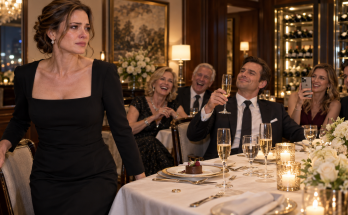
The ballroom was glowing when I arrived.
Crystal chandeliers.
White flowers.
Champagne.
Music.
Laughter.
The kind of room where everyone looked happy because they knew someone important was watching.
I stepped inside.
No one noticed me at first.
That was exactly how I wanted it.
I moved quietly through the crowd.
A few people recognized me.
Their expressions changed.
Some looked uncomfortable.
Others looked curious.
One woman whispered something to her husband.
He immediately turned around.
I almost smiled.
Rumors travel quickly.
But truth travels farther.
Then I saw Eleanor.
She stood near the stage wearing a silver gown.
Vanessa was beside her, taking photographs.
For one brief moment, I simply watched them.
Six months.
Six months of silence.
Six months of rumors.
Six months of being underestimated.
Eleanor turned.
Our eyes met.
The smile disappeared from her face.
Vanessa followed her gaze.
Her mouth slowly opened.
Neither of them expected me to be there.
Eleanor recovered first.
Of course she did.
She walked toward me with a smile that never reached her eyes.
“Well,” she said.
I smiled politely.
“Eleanor.”
Her gaze moved over my dress.
Then she looked at my hands.
No wedding ring.
I had taken it off that morning.
Not because I loved Terence any less.
But because I had finally accepted that loving someone and losing someone were two different things.
“You look well,” Eleanor said.
“Thank you.”
“I heard you’ve been keeping busy.”
“I have.”
She leaned closer.
“I hope you’re managing.”
There it was.
That tone.
The voice of someone pretending to care while secretly hoping the answer is no.
I looked at her.
“I’m doing very well.”
Vanessa approached us.
She was smiling.
But there was uncertainty in her eyes.
“Interesting dress,” she said.
“Thank you.”
“I didn’t realize you were invited.”
I smiled again.
“Neither did I.”
She frowned.
Before she could respond, someone called Eleanor’s name.
She turned toward the stage.
“Ladies and gentlemen,” the announcer said, “we will begin shortly.”
Guests began moving toward their tables.
Eleanor gave me one final look.
Then she walked away.
Vanessa followed.
I remained standing where I was.
A few moments later, Howard appeared beside me.
He looked exactly as calm as he had six months earlier.
“Are you ready?”
I looked toward the stage.
Eleanor was taking her seat at the front table.
Vanessa sat beside her.
“Yes.”
Howard studied me.
“You understand that after tonight, everything changes.”
I looked down at the necklace around my neck.
“Everything already changed.”
The gala began.
There were speeches.
Applause.
Videos showing smiling children.
Photographs of hospitals.
Long discussions about generosity.
Eleanor sat proudly beneath the lights.
At one point, she was invited onto the stage.
The audience applauded.
She smiled.
She spoke about compassion.
She spoke about community.
She spoke about helping those who had nowhere else to go.
I listened carefully.
And I wondered whether she remembered the woman she had thrown out of her home only twenty-four hours after burying her husband.
I wondered whether she remembered the muddy wedding album.
The suitcase.
Vanessa’s phone.
The words.
You get nothing.
The speech ended.
The applause grew louder.
Eleanor looked pleased with herself.
Then Howard stood.
The room slowly became quiet.
He walked toward the stage.
Eleanor looked confused.
The announcer handed him the microphone.
“Before we conclude tonight,” Howard said, “there is one important announcement.”
The ballroom became still.
Eleanor turned toward Vanessa.
Vanessa shrugged.
Howard continued.
“As many of you know, the charitable foundation has recently received a significant commitment from a private benefactor.”
People began whispering.
Eleanor smiled.
She clearly believed the announcement had something to do with her.
Howard looked toward me.
“Tonight, that benefactor has agreed to be publicly recognized.”
Every face in the ballroom turned.
I took a breath.
Then I began walking.
My heels moved slowly across the polished floor.
One step.
Then another.
The room watched.
Eleanor’s smile faded.
Vanessa stopped breathing for a second.
I reached the stage.
Howard extended his hand.
I accepted it.
Then I stood beside him.
Under the lights.
In front of everyone.
For the first time in six months, I looked directly at Eleanor.
Howard began speaking.
“The new majority owner of the Terence Holdings Group…”
The room became silent.
Eleanor’s face changed.
“…and the sole beneficiary of Terence’s estate…”
Vanessa’s hand slowly moved toward her mouth.
“…is his wife.”
I stepped forward.
Howard handed me the microphone.
For several seconds, I said nothing.
I wanted Eleanor to remember this silence.
Because silence had been my answer for six months.
Then I looked at her.
Straight into her eyes.
And I finally said the sentence I had carried inside me since the morning she stood at my door.
“You were right, Eleanor.”
Her expression froze.
I continued.
“I did have nothing.”
The room was completely silent.
I held the microphone gently.
Then I smiled.
“Nothing… except the house you tried to take.”
Eleanor’s face turned pale.
I continued.
“Nothing except the companies you believed belonged to your family.”
Vanessa stared at me.
“Nothing except every investment, every property, and every decision you spent six months trying to control.”
No one moved.
No one spoke.
Then I looked directly at Eleanor.
“And tonight, I have one more thing.”
My voice became quieter.
But somehow stronger.
“The truth.”
For the first time in my life, Eleanor had nothing to say.
No insult.
No command.
No confidence.
Nothing.
And as I stood beneath those lights, surrounded by hundreds of people who had spent six months believing the wrong story, I finally understood something Terence had wanted me to learn.
Money can change the way people look at you.
Power can change the way people speak to you.
But character?
Character is revealed when they believe you have neither.
I had spent six months pretending to have nothing.
And in those six months, Eleanor and Vanessa had given me something far more valuable than revenge.
They had shown me exactly who they were.
And now…
Everyone else could see it too.
PART 3 — WHAT REMAINED AFTER EVERYTHING
For several seconds after I spoke, no one in the ballroom moved.
It was as though the entire room had forgotten how to breathe.
The chandeliers still glittered above us.
The music had stopped.
Hundreds of eyes remained fixed on Eleanor.
And for the first time since Terence died, she looked exactly the way she had tried to make me feel.
Small.
Lost.
Powerless.
But there was no victory in watching her face collapse.
That was the strangest part.
For six months, I had imagined this moment.
I had imagined Eleanor discovering the truth.
I had imagined Vanessa lowering her phone.
I had imagined the whispers.
The silence.
The realization.
Yet when it finally happened, I did not feel the satisfaction I thought I would.
I felt tired.
Deeply tired.
Because revenge has a strange way of disappointing you.
You spend so much time believing that someone else’s suffering will heal your own.
But it doesn’t.
Nothing could bring Terence back.
Nothing could erase the morning I opened the front door and found his mother standing there with a suitcase.
Nothing could take away the sound of Vanessa laughing while she recorded what she believed was my humiliation.
Nothing could return the years I had spent loving people who had only loved me when it was convenient.
And suddenly, standing beneath those brilliant lights, I understood something.
I had not come to destroy Eleanor.
I had come to stop allowing her to destroy me.
There was a difference.
A very important difference.
Howard took the microphone from my hand.
But Eleanor suddenly stood.
“Wait.”
Her voice cracked through the silence.
Everyone turned toward her.
She looked pale.
Her silver gown shimmered beneath the lights, but there was nothing graceful about the way she stood.
One hand was gripping the edge of the table.
The other trembled at her side.
“This is impossible,” she said.
Howard looked at her calmly.
“No, Eleanor.”
Her eyes moved toward me.
“You lied.”
I almost laughed.
Not because it was funny.
Because sometimes the truth becomes so absurd that laughter is the only thing standing between you and tears.
“I never lied to you,” I said.
Her face tightened.
“You let me believe—”
“I let you believe exactly what you wanted to believe.”
The words landed heavily between us.
Vanessa stood beside her mother.
For once, she had nothing to record.
Her phone was still in her hand.
But the camera was facing the floor.
I looked at her.
“Why?” she whispered.
The question was so quiet that I almost did not hear it.
“Why would you do this?”
I stared at her.
For six months, she had spoken about me online.
For six months, she had allowed strangers to believe I was selfish.
For six months, she had built an entire story about a woman she never truly understood.
And now she wanted to know why.
I took a slow breath.
“Because I needed to know who you were.”
Vanessa’s eyes filled with tears.
I continued.
“When Terence died, I lost my husband.”
My voice began to shake.
I had not expected that.
I had promised myself I would remain calm.
But grief does not always obey the plans we make for it.
“When I lost him, I thought I still had family.”
The ballroom became even quieter.
“I thought I had you.”
I looked at Eleanor.
Then Vanessa.
“But less than twenty-four hours after I buried my husband, you came to my door.”
Eleanor lowered her eyes.
I felt the memory return.
The cold rain.
The muddy lawn.
The suitcase.
The phone.
The wedding album on the floor.
My chest tightened.
“You didn’t ask me if I was okay.”
Eleanor’s lips trembled.
“You didn’t ask me whether I had eaten.”
My voice broke.
“You didn’t even ask me how I was surviving the worst day of my life.”
There were tears in my eyes now.
I did not wipe them away.
I had spent too much of my life believing tears made a woman weak.
They didn’t.
Sometimes tears are simply proof that your heart survived something your soul never deserved.
“You came to take.”
Eleanor slowly sat down.
Her face had changed.
For the first time, I saw something I had never seen in her before.
Shame.
Real shame.
Vanessa looked toward her mother.
Then back at me.
“I didn’t know,” she whispered.
I stared at her for a moment.
“You knew enough.”
Her face collapsed.
That sentence hurt her.
I could see it.
But some truths are painful because they have waited too long to be spoken.
“You knew I loved your brother.”
Vanessa began crying.
“You knew I spent fourteen years building a life with him.”
I looked around the ballroom.
“And you knew I had just buried him.”
No one interrupted me.
No one dared.
“But you still lifted your phone.”
Vanessa closed her eyes.
“You still recorded me.”
Her shoulders began shaking.
“And while I was trying to understand how I was supposed to live without the man I loved, you turned my pain into entertainment.”
“I’m sorry,” she whispered.
I looked at her.
For a moment, I almost believed her.
Then I remembered something important.
An apology is not the same as accountability.
Sometimes people apologize because they finally understand the damage.
And sometimes they apologize because they have finally been caught.
The difference matters.
Howard stepped forward.
“There is another matter that must be addressed.”
Eleanor looked at him sharply.
My heart became still.
I knew what was coming.
For months, Howard had investigated everything.
The phone calls.
The lawyers.
The estate inquiries.
The documents Eleanor had attempted to obtain.
And there was more.
Much more.
Howard opened a folder.
“Over the last six months,” he said, “several unauthorized attempts were made to access information relating to Terence’s estate.”
The room filled with whispers.
Eleanor turned pale.
Howard continued.
“There were also attempts to influence employees connected to the estate.”
Vanessa stared at her mother.
“Mom?”
Eleanor did not answer.
Howard placed several documents on the table beside him.
“Financial information was requested.”
Eleanor stood again.
“I had every right!”
Her voice was louder now.
Desperate.
Angry.
“Terence was my son!”
No one answered.
She looked at me.
“He was my son!”
Her voice broke.
And for the first time that night, I saw her grief.
Not her greed.
Not her cruelty.
Her grief.
Eleanor had lost Terence too.
I had forgotten that for a moment.
He had been my husband.
But he had also been her child.
And no matter what she had done to me, there was a part of her that had buried someone she loved.
That realization hurt.
Because life would have been easier if she had simply been a monster.
But people are rarely that simple.
The same heart that can love someone deeply can also become selfish.
The same person who cries over one loss can cause another person pain.
We are complicated.
Sometimes terribly so.
Eleanor looked at me.
Her face was wet with tears.
“I didn’t know what would happen.”
I said nothing.
She continued.
“When Terence died, everything felt like it disappeared.”
My throat tightened.
“He was my son.”
“I know,” I whispered.
Her eyes widened slightly.
Perhaps she had expected anger.
Perhaps she deserved it.
But anger was no longer the only thing I felt.
“I know he was your son.”
The room remained silent.
Eleanor slowly covered her face.
“I thought…”
She stopped.
“What?”
I asked quietly.
She lowered her hands.
“I thought you would take everything.”
I stared at her.
The words were almost unbelievable.
“Eleanor.”
My voice was gentle.
“I would have given anything to have Terence back.”
She began crying again.
And suddenly, I did too.
Because that was the tragedy of everything.
There we were.
Two women who had loved the same man.
Standing on opposite sides of grief.
And somehow, instead of holding each other together, we had allowed money to tear us apart.
I looked at her for a long moment.
Then I said something I had never expected to say.
“I never wanted to take him away from you.”
Eleanor looked at me.
“You were his mother.”
The words barely left my mouth before she began sobbing.
And for one second, I remembered the woman she used to be.
The woman who had danced with Terence at our wedding.
The woman who had cried when he bought me my first anniversary gift.
The woman who had once hugged me and said,
“You make my son happy.”
Where had she gone?
Perhaps grief had taken her too.
Perhaps fear had changed her.
Or perhaps that part of her had always been there, waiting for the right circumstances to reveal itself.
I did not know.
Maybe I never would.
But forgiveness does not always require understanding.
Sometimes it simply means deciding that someone else’s darkness will not become part of your future.
Howard cleared his throat.
The legal matters continued.
Eleanor had not successfully taken anything from the estate.
Howard had protected everything exactly as Terence had instructed.
But her attempts had consequences.
She would face the appropriate legal review.
The details would be handled privately.
I did not need to stand there and watch.
I had already seen enough.
Then Howard turned to me.
“There is one final matter.”
I nodded.
The room waited.
Howard announced the donation.
Not to Eleanor’s charity foundation.
Not to the organization whose board had spent years applauding her generosity.
But to a new foundation.
A foundation created in Terence’s name.
The Terence Foundation for Grief and Family Support.
The first donation would provide counseling, emergency housing, and legal assistance for people who had lost spouses and suddenly found themselves vulnerable.
Widows.
Widowers.
Families who had lost the person holding their lives together.
People who needed help without being asked what they had to offer in return.
When Howard finished speaking, the room was silent again.
But this silence felt different.
It was not shock.
It was reflection.
I stepped toward the microphone.
“Terence believed that people mattered more than money.”
My fingers touched the necklace around my neck.
“He would have hated seeing his name used for revenge.”
I smiled softly.
“So I decided it would be used for something better.”
Someone began clapping.
Then another person.
Then another.
Slowly, the ballroom filled with applause.
But I did not look at the crowd.
I looked at Eleanor.
She was crying quietly.
Vanessa was holding her hand.
And for the first time that evening, neither of them looked like my enemies.
They looked like two people who had finally been forced to see themselves clearly.
Sometimes that is punishment enough.
I left the stage before the applause ended.
I did not wait for congratulations.
I did not wait for reporters.
I did not wait for anyone to tell me I had won.
Because I finally understood that I had never been competing.
Not with Eleanor.
Not with Vanessa.
Not with anyone.
The only person I needed to become was the woman Terence had always believed I could be.
Outside, the night air was cold.
The city lights reflected against the wet pavement.
I stood beneath the hotel entrance and closed my eyes.
For a moment, I imagined Terence standing beside me.
I imagined him slipping his hand into mine.
“You did okay,” he would probably say.
I smiled through my tears.
“No,” I whispered.
“I finally did better than okay.”
Behind me, the ballroom doors opened.
I turned.
Eleanor was standing there.
Alone.
Vanessa remained inside.
Eleanor approached slowly.
She looked smaller than I remembered.
Not physically.
Emotionally.
As though the woman who had once walked into my home believing she could take everything had finally realized how little control she truly possessed.
She stopped in front of me.
“I am sorry.”
I said nothing.
“I know that isn’t enough.”
“No,” I said softly.
“It isn’t.”
She nodded.
Tears rolled down her face.
“But I needed to say it anyway.”
I looked at her.
For six months, I had waited to hear those words.
I thought they would heal me.
They didn’t.
But they did something else.
They closed a door I had been standing in front of for too long.
“I forgive you,” I said.
Eleanor covered her mouth.
I continued.
“But forgiveness does not mean things go back to the way they were.”
She nodded immediately.
“I understand.”
“I loved you once.”
Her eyes closed.
“I know.”
“And part of me will probably always remember the woman you used to be.”
She began crying again.
“But I will never again forget the woman you became when you believed I had nothing.”
Eleanor lowered her head.
“I understand.”
For the first time, I believed she did.
She left after that.
Slowly.
Quietly.
And I watched her disappear into the night.
I never knew exactly what happened between Eleanor and Vanessa after the gala.
I heard that Vanessa deleted many of her videos.
I heard that she stopped posting for a while.
Months later, she sent me a letter.
Not an email.
Not a text message.
A letter.
Written by hand.
She did not ask me for forgiveness.
That surprised me.
She simply apologized.
She wrote that she had watched the video she recorded outside my house many times after the gala.
She said she could no longer recognize herself in the person holding the phone.
She wrote,
“I thought I was recording someone else’s humiliation.
I didn’t realize I was recording my own.”
I kept that letter.
Not because I wanted to remember what happened.
But because sometimes people really can change.
Not everyone does.
But some do.
And I wanted to believe that pain had not made all of us worse.
A year passed.
Then another.
The foundation grew.
We opened counseling centers.
We helped families find temporary homes.
We created emergency funds.
I met people whose stories were different from mine.
A young mother who had lost her husband unexpectedly.
An elderly man whose wife had handled every financial decision for forty years.
A woman whose husband died and whose relatives immediately tried to take her home.
Every story reminded me of that rainy morning.
And every time someone walked through the doors looking frightened and alone, I remembered why the foundation existed.
Not because I wanted to honor money.
Because I wanted to honor love.
One afternoon, almost two years after Terence died, I returned to our old house.
The house I had left carrying only my muddy wedding album.
I had not lived there since his death.
For a long time, I could not.
Every room carried too much memory.
But that afternoon, I walked inside.
The house was quiet.
Sunlight moved across the wooden floors.
Dust floated through the air.
I stood in the living room.
The exact place where I had picked up the wedding album.
For several minutes, I said nothing.
Then I smiled.
Not because I was no longer sad.
Grief does not disappear like that.
You do not wake up one morning and suddenly stop missing someone.
Instead, grief changes shape.
At first, it is a storm.
Then it becomes rain.
And eventually, if you are lucky, it becomes a quiet river flowing somewhere inside you.
It is always there.
But it no longer drowns you.
I walked upstairs.
I opened the bedroom door.
For the first time in years, I did not cry.
Instead, I remembered Terence laughing.
I remembered him singing terribly in the kitchen.
I remembered him falling asleep during movies.
I remembered the way he always reached for my hand when we crossed the street.
And suddenly, I realized something beautiful.
I had spent so long remembering the day he died that I had forgotten how wonderfully he had lived.
That day, I opened the windows.
Fresh air entered the room.
I stood there and watched the curtains move in the breeze.
Then I whispered,
“I’m okay now.”
The words felt strange.
But they were true.
Not completely healed.
Perhaps I never would be.
But okay.
And sometimes okay is a miracle.
Years later, people would still ask me about that night at the charity gala.
They wanted to know what it felt like.
They wanted to know whether Eleanor ever received what she deserved.
They wanted to know whether I enjoyed revealing the truth.
I always gave them the same answer.
“The truth was never the most important part.”
They would look confused.
So I would explain.
“The most important thing I learned was what happened before anyone knew I had money.”
That was when I discovered who stayed.
Who left.
Who pretended.
Who took.
Who loved.
And who only loved the version of me they believed they could control.
Terence’s inheritance changed my life.
But not because it made me wealthy.
It changed my life because it gave me choices.
And the greatest choice I ever made was deciding that I would not become cruel simply because others had been cruel to me.
I would not allow Eleanor’s greed to turn me bitter.
I would not allow Vanessa’s humiliation to make me seek humiliation in return.
I would not allow grief to make me hard.
Instead, I chose something more difficult.
I chose to remain soft.
I chose kindness with boundaries.
Forgiveness with distance.
Love with wisdom.
And strength without cruelty.
One morning, many years later, I stood beside a window in my new home.
The sun was rising.
The world outside was quiet.
On the table beside me was my wedding album.
The same one I had carried out of that house.
The same one stained with mud.
I had never replaced it.
I could have.
I could have restored every damaged photograph.
But I didn’t.
I left the small stain on the corner of one picture.
Because it reminded me.
Life is not always beautiful because it remains untouched.
Sometimes the beauty is in what survives.
I opened the album.
There we were.
Terence and me.
Young.
Laughing.
Completely unaware of how much life was waiting for us.
I touched the photograph gently.
Then I smiled.
“Thank you,” I whispered.
Not for the money.
Not for the inheritance.
Not for the house.
I thanked him for loving me.
For trusting me.
For believing I could survive.
For leaving me something far greater than five hundred million dollars.
He had left me proof.
Proof that I was stronger than I knew.
Proof that I could stand alone without becoming lonely.
Proof that losing everything does not always mean your life is over.
Sometimes it means your life is finally waiting for you to begin again.
I closed the album.
Outside, the morning light grew brighter.
And somewhere inside me, the pain remained.
But so did love.
And perhaps that was the greatest truth of all.
We do not move on from the people we love.
We move forward carrying them with us.
In our memories.
In our choices.
In the kindness we give strangers.
In the strength we discover when we believe we have none left.
Terence was gone.
But love had not died with him.
It had simply changed.
And so had I.
I was no longer the woman standing in the doorway, grieving, frightened, and holding a muddy wedding album against her chest.
I was no longer waiting for Eleanor’s approval.
I was no longer afraid of having nothing.
Because I had learned something that money could never teach me.
The people who truly belong in your life will not measure your worth by what you own.
They will not disappear when your world becomes dark.
They will not stand at the edge of your sorrow and calculate what they can take.
They will sit beside you.
Even when you have nothing to give them.
Especially then.
And as the sunlight filled the room, I finally understood why Terence had trusted me with everything.
Not because I was his widow.
Not because I was wealthy.
Not because I had won.
But because after everything I had lost…
I still knew how to love.
And in the end, that was the only inheritance that truly mattered.
THE END STORIES! THANK YOU FOR READING GOOD LUCK !❤️
Related Posts