“Chloe, if you are reading this, forgive me for not telling you sooner. Your father didn’t just take money from me. He also tried to take something that has been rightfully yours since you were born.”

At the bottom she had written, “Don’t go to the family. Don’t believe Susan. Go straight to the bank. Ask for the account marked with the red stamp.”
I searched every page until I found it: a nearly faded red circle on the last page beside a handwritten routing code.
I didn’t sleep.
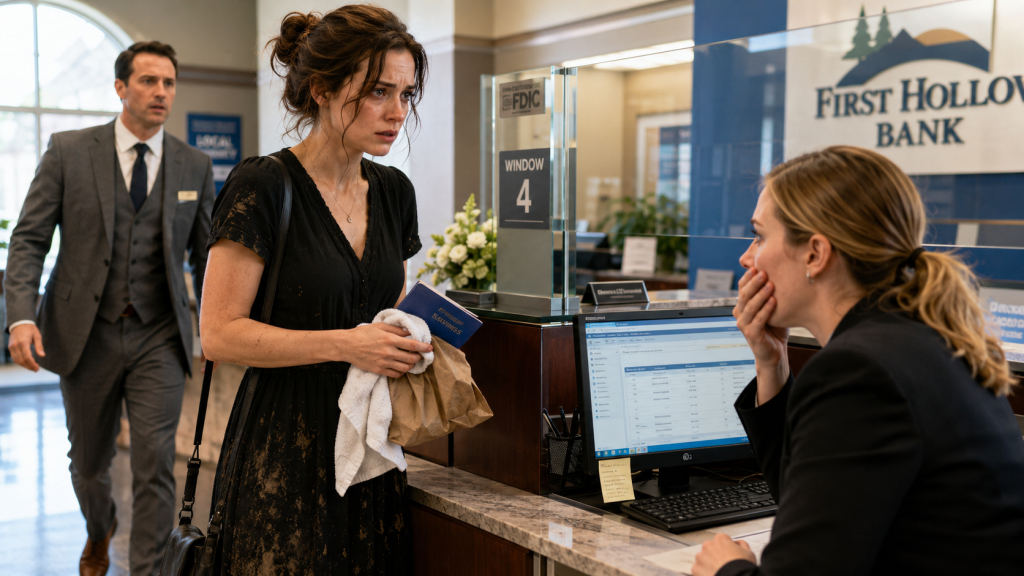
At eight the next morning, still wearing the grave-stained black dress, I walked into the main branch on Main Street with the passbook hidden inside a paper grocery bag and wrapped in a hand towel. Around me, people argued about debit cards, cashed checks, and tried to quiet restless kids. Everything looked normal.
My life wasn’t.
A young teller gave me a practiced smile. “Good morning. How can I help you?”
I unwrapped the book. “It was my grandmother’s. She passed away yesterday. She asked me to come here.”
The teller entered the number.
She frowned.
She entered it again.
She looked at the screen. She looked at the passbook. She looked at me.
Then every bit of color left her face.
“Are you a direct relative of the account holder?”
“I’m her granddaughter.”
“Your name?”
“Chloe Henderson.”
She asked for identification. I slid my driver’s license across the counter. Her fingers began to shake as she compared it with whatever was on her monitor.
Then she picked up the phone.
“Manager… I need you at window four. And call security.”
Before I could get another answer, she made the police call promised by whatever she had just found on that screen.
A man in a sharp gray suit hurried over with his name tag sitting crooked against his jacket. He flipped the Window Closed sign, reached past the teller, and took the muddy blue passbook from her hands.
PART 2 — THE ACCOUNT MY FATHER THOUGHT WAS BURIED
The manager did not look at me when he took the passbook.
He looked at the number.
Then at the teller’s screen.
Then back at the passbook again.
His face changed in a way that made my stomach tighten.
Not surprise.
Recognition.
The kind that comes when something you hoped never to see suddenly appears in front of you.
“My name is Daniel Reeves,” he said carefully. “I’m the branch manager.”
I nodded.
My throat felt too dry to speak.
He turned to the teller.
“Lock this station.”
She did it immediately.
Then he looked at me.
“Ms. Henderson, would you come with me, please?”
I glanced toward the front doors.
Two security guards had moved into position.
One near the entrance.
One near the line of customers.
Every person in the bank suddenly seemed too loud.
Pens clicking.
Shoes scraping tile.
A toddler whining beside a row of chairs.
The normal sounds of a Tuesday morning.
And yet I had the unmistakable feeling that I had just stepped into something that had been waiting for me long before Grandma died.
“Am I in trouble?” I asked.
Daniel’s eyes softened slightly.
“No.”
That should have comforted me.
It didn’t.
“Then why did she call the police?”
He hesitated.
“Because the account connected to this passbook was flagged years ago.”
My pulse quickened.
“Flagged for what?”
“I’d rather discuss that privately.”
He gestured toward a glass-walled office at the back of the branch.
I followed him.
My damp dress clung to the backs of my knees.
Mud from the cemetery had dried in dark streaks along the hem.
I had not even changed after the funeral.
Somehow that mattered to me now.
I wanted Grandma’s dirt with me.
Proof that yesterday had been real.
Proof that she had existed.
Proof that my father had thrown this little blue book into her grave because he believed the truth inside it would stay there.
Daniel closed the office door.
He placed the passbook carefully on the desk between us.
Not like trash.
Not like a worthless notebook.
Like evidence.
“Before we go any further,” he said, “I need to confirm your identity again.”
I handed him my license.
He studied it.
Then his eyes lifted.
“Date of birth?”
I told him.
“Mother’s name?”
“Emily Henderson.”
He typed something.
His expression tightened.
“Your mother’s maiden name?”
“Carter.”
Another pause.
“Was she married to Richard Henderson at the time of your birth?”
“Yes.”
My fingers curled around the strap of my purse.
“Why are you asking me this?”
Daniel leaned back.
“Because this account is not only linked to Margaret Henderson.”
My heart stopped.
“What do you mean?”
He rotated his computer monitor slightly.
Not enough for me to read everything.
Just enough for me to see a name.
Mine.
CHLOE EMILY HENDERSON
I stared.
“That’s me.”
“Yes.”
“Why is my name there?”
Daniel’s voice lowered.
“This was established as a custodial account when you were an infant.”
The room seemed to shift.
“A what?”
“An account opened for your benefit.”
I looked at the screen again.
“No.”
“Yes.”
“I never had an account here.”
“You did.”
“I would know.”
“You were a minor when it was created.”
A cold feeling moved down my arms.
“How much is in it?”
Daniel did not answer.
My stomach twisted.
“Mr. Reeves.”
He looked at me.
“How much?”
Before he could respond, there was a knock on the door.
One of the security guards opened it.
“Police are here.”
I turned.
Two officers entered the bank.
One was a woman in her forties with silver beginning to show at her temples.
The other was a younger man carrying a small notebook.
Daniel stood.
The woman introduced herself as Detective Laura Bennett.
Not patrol.
Detective.
That word frightened me more than the uniforms.
“Ms. Henderson?”
“Yes.”
“I understand you brought in a passbook belonging to your grandmother.”
I nodded.
“It was inside her casket yesterday.”
The younger officer glanced at me.
Detective Bennett did not.
“How did it come into your possession?”
I swallowed.
“I dug it out.”
Daniel’s eyebrows lifted.
Bennett merely said, “Why?”
“Because my grandmother told me not to let my father find it.”
That changed everything.
I saw it immediately.
The detective’s expression sharpened.
“What is your father’s name?”
“Richard Henderson.”
She looked at Daniel.
He gave one small nod.
My blood went cold.
“You know him.”
Neither answered.
“You know my father.”
Detective Bennett pulled out the chair across from me.
“I want you to tell me exactly what happened before your grandmother died.”
So I did.
I told her about Grandma Maggie squeezing my hand.
About her fear.
About Dad throwing the passbook onto the casket.
About the note hidden inside.
About the initials R.H.
About the warning.
If Richard says it’s worth nothing, it’s because he already tried to cash it.
Bennett wrote everything down.
When I finished, the room was silent.
Then she asked, “Did your grandmother ever mention a trust?”
“No.”
“An inheritance?”
“No.”
“Life insurance?”
“No.”
“Any settlement?”
“No.”
Bennett looked at Daniel.
He leaned forward.
“Ms. Henderson, I need to explain something, but parts of it may be difficult to hear.”
I almost laughed.
Difficult.
My grandmother was dead.
My father had humiliated her at her own burial.
And now a detective was sitting across from me because of a muddy savings book.
“I’m listening.”
Daniel typed several commands.
Then he said, “Your grandmother opened the original account twenty-six years ago.”
I frowned.
“I’m twenty-seven.”
“Correct.”
My breath caught.
“So she opened it when I was one?”
“Yes.”
“Why?”
“There was an incoming deposit from an insurance settlement.”
“What insurance settlement?”
Daniel looked at Bennett.
The detective answered.
“Your mother’s.”
I froze.
“My mother didn’t have an insurance settlement.”
“Are you sure?”
“Yes.”
My voice broke.
“She died when I was six.”
Nobody spoke.
I stared at both of them.
“My mother died in a car accident.”
Detective Bennett nodded.
“We know.”
That sentence frightened me.
“How do you know?”
She glanced at the notes.
“Because that accident was part of an investigation.”
I stared at her.
“No.”
My mother’s death had always been explained in one sentence.
Wet road.
Late night.
Car crossed the center line.
She died before the ambulance arrived.
Dad survived with a fractured wrist.
That was all.
That had always been all.
“What investigation?”
Bennett leaned forward.
“At the time, your mother had a life insurance policy through her employer.”
My heartbeat became painfully loud.
“How much?”
“Five hundred thousand dollars.”
I almost stopped breathing.
Five hundred thousand.
Twenty-one years ago.
My father had always told me Mom left nothing.
No savings.
No policy.
Nothing.
He said hospital costs and debt swallowed everything.
I heard his voice from my childhood.
Your mother didn’t plan ahead.
We lost everything after she died.
I had believed him.
“What happened to the money?”
Daniel answered.
“Some of it was transferred into an account established for you.”
“How much?”
“Three hundred thousand.”
My mouth went dry.
“Where did the rest go?”
Bennett’s eyes did not leave mine.
“That’s one of the questions we’re trying to answer.”
I stood.
The chair scraped backward.
“No.”
“Ms. Henderson—”
“No.”
I pressed both hands against the desk.
“My father told me there was nothing.”
Bennett spoke gently.
“I understand.”
“He took my college scholarship money.”
Nobody moved.
“He told me we were broke.”
My voice grew louder.
“He made me work two jobs at nineteen.”
I could feel tears coming.
“He made Grandma pay my textbooks because he said he couldn’t.”
I covered my mouth.
“And you’re telling me there was three hundred thousand dollars?”
Daniel corrected softly.
“There was more than that.”
I lowered my hands.
“What?”
He looked at the screen.
“The account accrued interest.”
My breathing stopped.
“And your grandmother made additional deposits.”
“How much is there?”
He hesitated.
I almost shouted.
“How much?”
Daniel turned the monitor fully toward me.
The balance sat near the bottom.
For a moment, the numbers did not make sense.
Then they did.
$1,842,611.37
I stared.
Then I laughed.
One short, broken sound.
“That’s not real.”
“It is.”
“No.”
“It is.”
I looked again.
One million.
Eight hundred forty-two thousand.
My knees went weak.
I sat down.
Grandma had lived in a small two-bedroom house with cracked linoleum and a furnace that rattled every winter.
She clipped coupons.
Reused foil.
Sewed buttons back onto old coats.
And all that time, nearly two million dollars had been sitting somewhere with my name attached to it.
“Why didn’t she tell me?”
Daniel looked uncomfortable.
Detective Bennett answered.
“Because someone had been trying to gain control of the account.”
My eyes lifted.
“Richard.”
She did not answer immediately.
She didn’t need to.
I knew.
“How long?”
Daniel opened another file.
“The first disputed withdrawal attempt was fourteen years ago.”
I did the math.
I had been thirteen.
“The second?”
“Twelve years ago.”
“Then?”
“Several more attempts.”
My stomach twisted.
“The initials.”
“Yes.”
“R.H.”
Daniel nodded.
My hands began shaking.
“What did he try to do?”
“He presented documents claiming he had authority over the funds.”
“What documents?”
“A guardianship form at first.”
“But Grandma was my guardian?”
“No.”
“My father was.”
Bennett spoke.
“But this account was structured so Richard did not have direct control.”
“Why?”
That question came out almost as a whisper.
Nobody answered for a moment.
Then Daniel said:
“Because Margaret specifically instructed the bank that Richard Henderson was not to be given access.”
My heart cracked open.
Grandma knew.
All those years.
She knew.
Maybe not everything.
But enough.
I pictured her at the kitchen table.
Cardigan sleeves pushed up.
The passbook beside the porcelain angel.
Her thin fingers smoothing the pages.
“This little paper is for when I’m gone.”
I had thought she meant a few thousand dollars.
Something modest.
Something sentimental.
She had been protecting a future.
Mine.
“Why was the account flagged?”
Daniel glanced toward Bennett.
“Because the attempts became more serious.”
The detective took over.
“About six years ago, someone submitted a death certificate for you.”
I stared.
“What?”
My voice was barely audible.
“A document was submitted claiming Chloe Henderson had died.”
I could not understand the sentence.
“Why?”
“To dissolve the custodial restrictions and redirect the assets.”
My stomach turned violently.
I stood and walked toward the trash can.
I thought I might be sick.
He had tried to declare me dead.
My own father.
Not metaphorically.
Not emotionally.
On paper.
I pressed one hand against the wall.
Detective Bennett spoke from behind me.
“The bank rejected the document.”
“Why?”
“The certificate number didn’t match state records.”
I turned around.
“Did you investigate?”
“Yes.”
“What happened?”
“The document led to a dead end.”
Of course it did.
My father was very good at dead ends.
He had built my childhood out of them.
Missing money.
Blamed on bills.
Bruises.
Blamed on temper.
Grandma’s fear.
Blamed on age.
Everything ended just short of an explanation.
I sat again.
“What happened after that?”
Daniel slid a paper across the desk.
“The bank placed the account under enhanced restriction.”
I stared at the red marking.
A red circle.
The same one Grandma had told me to find.
“That stamp.”
“Yes.”
“What does it mean?”
“It means no release without in-person identity verification by the beneficiary and additional review.”
“So Grandma knew I had to come here.”
“Yes.”
“She knew Dad couldn’t get the money.”
“She knew he had failed.”
The thought hit me.
That was why Dad threw the passbook into the casket.
Not because it was worthless.
Because to him, without me, it was.
He couldn’t cash it.
Couldn’t transfer it.
Couldn’t use it.
The only person who could unlock the account was the daughter he had spent years convincing she was financially helpless.
I felt something cold and sharp settle inside me.
Not rage.
Clarity.
“Why are the police here now?”
Detective Bennett placed her pen down.
“Because the account wasn’t the only thing flagged.”
I stared at her.
“What else?”
She looked at Daniel.
He opened another screen.
Several large withdrawals appeared.
Recent.
Very recent.
Thirty thousand.
Fifty thousand.
Ninety-five thousand.
I leaned closer.
“These happened last month.”
“Yes.”
“How?”
“Someone gained temporary access using credentials linked to Margaret Henderson.”
My stomach dropped.
“Grandma?”
“No.”
“But she was alive.”
“Yes.”
“Then why didn’t she stop it?”
Bennett’s face changed.
“We believe she tried.”
A cold wave moved through me.
“What does that mean?”
Daniel answered.
“The bank received two calls from Margaret last month.”
I held my breath.
“In both calls, she said she had not authorized the transfers.”
“Then you stopped them?”
“Some.”
“Some?”
“One withdrawal cleared before the fraud hold was placed.”
“How much?”
“One hundred and twenty thousand dollars.”
I closed my eyes.
“Where did it go?”
Bennett answered.
“To an account controlled by a business.”
“What business?”
She slid a photograph across the desk.
I looked down.
HENDERSON PROPERTY SERVICES LLC
Registered owner:
Richard Henderson.
My father.
I stared until my vision blurred.
“He stole from her.”
“Yes.”
“While she was dying.”
“We don’t yet know when he obtained the credentials.”
I thought back.
Three months earlier, Grandma fell and broke her hip.
Dad suddenly started visiting every day.
He brought groceries.
Changed light bulbs.
Drove her to appointments.
The whole family praised him.
“Richard’s finally stepping up.”
Susan posted pictures online.
Dad kissing Grandma’s cheek.
Dad sitting beside her hospital bed.
Dad cooking soup.
I had been grateful.
God help me.
I had been grateful.
“He got into her house.”
Bennett looked at me.
“When?”
“After her hip surgery.”
My hands shook.
“He was there constantly.”
I looked at the passbook.
“He knew where she kept it.”
“Possibly.”
“No.”
I shook my head.
“He did.”
The butter-cookie tin.
Under the bed.
Grandma had told me.
But Dad could have found it.
He could have searched while she slept.
He could have photographed pages.
Collected account numbers.
Stolen statements.
And Grandma, weak and recovering, might have discovered it too late.
I remembered her last words.
“Chloe… don’t let Richard find it.”
Maybe she hadn’t meant the book.
Maybe she meant the account.
The truth.
Me.
A knock sounded at the door.
One of the security guards appeared.
“Detective?”
Bennett stood.
“What is it?”
The guard glanced at me.
“There’s a man at the front asking for Ms. Henderson.”
Every muscle in my body tightened.
“Who?”
He did not need to answer.
I heard the voice from the lobby.
“Chloe!”
My father.
Loud.
Angry.
“Chloe Henderson!”
I froze.
Detective Bennett stepped toward the door.
“How did he know you were here?”
“I don’t know.”
Then I remembered.
The cemetery.
Family.
Someone must have seen me digging.
One of my cousins.
Tyler.
Maybe Susan.
Maybe Dad had realized the passbook was gone.
He had come looking.
“Chloe!”
His voice got closer.
“You don’t know what you’re doing!”
My hands went numb.
I had heard that tone my entire childhood.
The warning before a slammed door.
The growl before he grabbed my wrist.
The voice that taught me being afraid was the same thing as being obedient.
Bennett looked at me.
“Do you want to speak with him?”
Every old instinct screamed no.
Hide.
Stay quiet.
Let him cool down.
Do not make it worse.
Grandma’s voice rose above them.
Don’t let Richard find it.
I looked at the blue passbook.
Then at Detective Bennett.
“Yes.”
She studied me.
“You’re sure?”
“No.”
I stood.
“But I want to.”
Dad was standing near the teller counters when I stepped into the lobby.
Susan was beside him.
Of course she was.
He still wore the black coat from the funeral.
His face was red.
The moment he saw me, he started forward.
A security guard blocked him.
“Chloe.”
His voice changed instantly.
Softer.
Concerned.
The version strangers believed.
“What are you doing here?”
I stopped ten feet away.
“Banking.”
His eyes moved toward Daniel.
Then Detective Bennett.
For the first time, fear flashed across his face.
Gone quickly.
But I saw it.
“What did you bring them?”
I said nothing.
“Chloe.”
Susan stepped forward.
“Honey, your father is worried about you.”
I almost laughed.
Nobody had called me honey since I was nine.
“What did you do with Grandma’s passbook?” Dad asked.
I looked at him.
“You said it was worthless.”
His mouth tightened.
“It is.”
“Then why are you here?”
Silence.
The customers around us had gone quiet.
Even the tellers seemed to be listening.
Dad glanced around.
“This is family business.”
Detective Bennett stepped closer.
“No, Mr. Henderson.”
Dad looked at her.
“It may be criminal business.”
The color drained from Susan’s face.
Dad laughed.
Forced.
Sharp.
“What is this?”
Bennett showed her badge.
“Detective Laura Bennett.”
“I don’t care who you are.”
“That’s fine.”
She did not raise her voice.
“I need you to answer some questions regarding financial transactions connected to Margaret Henderson.”
Dad’s eyes snapped toward me.
“You stupid girl.”
There it was.
The real him.
Susan whispered, “Richard.”
But he was already moving.
“You had no right to bring that book here.”
I felt my fear rise.
Then something stronger rose with it.
“She gave it to me.”
“She was senile.”
“No.”
“She didn’t know what she was saying.”
“No.”
“She was confused.”
“No.”
Each word came easier.
Dad stared at me.
“You always were too stupid to understand money.”
I smiled.
Just a little.
“That must be inconvenient for you today.”
His face changed.
He knew.
Maybe not how much.
Maybe not what the bank had shown me.
But enough.
“You think that money is yours?”
The lobby went silent.
I stared at him.
He had just admitted there was money.
Daniel looked at Bennett.
Bennett noticed too.
Dad realized his mistake.
Too late.
“I mean whatever fantasy she put in your head—”
“Grandma put three hundred thousand dollars into an account for me when I was a baby.”
Susan turned toward him.
“What?”
Dad ignored her.
“She stole that money.”
I blinked.
“From whom?”
“Me.”
The word echoed.
“You?”
“Yes.”
“Mom’s insurance?”
His face hardened.
Susan looked between us.
“What insurance?”
Dad stared at me.
“You don’t know anything.”
“I know Mom had a policy.”
His eyes flickered.
“I know Grandma protected most of it.”
He said nothing.
“I know you tried to access the account.”
Nothing.
“I know somebody filed a fake death certificate in my name.”
Susan took one step away from him.
“What?”
Dad turned.
“Shut up.”
Her face went pale.
I continued.
“And I know one hundred and twenty thousand dollars went from Grandma’s money into Henderson Property Services last month.”
That was the moment he broke.
Not dramatically.
His shoulders dropped.
His mouth opened.
And the anger disappeared from his face.
What replaced it was worse.
Calculation.
His eyes moved toward the bank doors.
Detective Bennett saw it too.
“Mr. Henderson.”
Dad ran.
He made it three steps.
The first security guard caught his arm.
Dad swung.
Chaos erupted.
Susan screamed.
Someone dropped a phone.
A woman near the entrance pulled her child backward.
Dad shouted.
“Get off me!”
The younger officer rushed in.
Within seconds, they had Dad against the wall.
Hands behind him.
Metal cuffs closing around his wrists.
I stood frozen.
I had spent my whole life believing my father was enormous.
Unstoppable.
A force of nature.
Watching him struggle beneath fluorescent bank lights, I saw something I had never seen before.
He was just a man.
A violent one.
A dishonest one.
A frightened one.
But still just a man.
He looked at me as Bennett read him his rights.
“This is your fault.”
The words cut through the room.
For one second, I was twelve again.
Then I looked at the blue passbook on Daniel’s desk.
Grandma’s handwriting.
If Richard says it’s worth nothing, it’s because he already tried to cash it.
I met Dad’s eyes.
“No.”
My voice did not shake.
“This is what you did.”
He cursed me as they led him outside.
I watched through the glass doors as he was placed into the back of the police car.
Susan remained inside.
Completely silent.
Then she looked at me.
“What account?”
I almost felt sorry for her.
Almost.
“You really didn’t know?”
Her eyes filled.
“Richard handles everything.”
The sentence landed heavily.
Richard handles everything.
My mother probably said that once.
Grandma probably heard it.
And spent the next twenty years trying to make sure I never had to.
Susan sank into a chair.
“What happens now?”
I looked at her.
“That depends on what you knew.”
She stared.
I walked away.
The police took the passbook as temporary evidence that afternoon.
I hated watching it disappear into a plastic sleeve.
But Daniel promised the account itself was safe.
“Nothing moves without you now.”
I looked at him.
“Nothing?”
“Nothing.”
The words nearly made me cry.
For most of my life, things had moved without me.
Money.
Decisions.
Truth.
My father always controlled the door.
Now, for the first time, the key was in my hands.
Before I left, Daniel handed me a printed statement.
At the bottom was the balance.
$1,842,611.37.
I folded it once.
Then again.
I put it inside my purse beside Grandma’s embroidered napkin.
Outside, the rain had stopped.
The pavement shone under a pale afternoon sky.
I stood on the bank steps and realized I had no idea what to do next.
Buy a house?
Pay debt?
Quit my job?
None of it felt important.
All I wanted was Grandma.
I wanted to sit in her kitchen.
I wanted to hear the kettle whistle.
I wanted her to call me sweetie.
I wanted to ask her why she had carried this alone for so long.
Instead, I drove to the cemetery.
The grave was still fresh.
Dark earth piled high.
Flowers leaned crookedly beneath the damp wind.
I knelt beside Grandma’s name.
For a moment, I said nothing.
Then I pulled the bank statement from my purse.
“You did it.”
My voice cracked.
“You kept it safe.”
Tears came.
Hot.
Uncontrolled.
“I’m sorry I didn’t know.”
The wind moved gently through the trees.
“I’m sorry you had to be scared of him.”
I pressed my palm against the cold earth.
“And I’m sorry he made you think you had to protect me alone.”
I cried there longer than I expected.
Not for the money.
For the years.
For my mother.
For Grandma.
For every time Dad had made us feel small enough that he could take what he wanted.
When I finally stood, I left the statement there for a moment.
Then picked it back up.
Grandma would have hated me leaving an official bank document in the rain.
I could practically hear her.
“Chloe, use your head.”
I laughed through tears.
It was the first real laugh I had managed since she died.
Then my phone rang.
Detective Bennett.
I answered.
“Ms. Henderson?”
“Yes.”
“We found something at your father’s office.”
My stomach tightened.
“What?”
“Documents relating to the account.”
I closed my eyes.
“How many?”
“A lot.”
I waited.
Then she said:
“And something else.”
Of course.
“What?”
“A copy of your mother’s original life insurance file.”
My heart began pounding.
“What does it say?”
“I think you should see it in person.”
“Why?”
There was a pause.
“Because there’s a handwritten note attached.”
“Whose handwriting?”
“We believe Margaret’s.”
I stared at Grandma’s grave.
“What does it say?”
Bennett hesitated.
Then read it.
“Richard thinks Emily’s death solved his money problem.”
The cemetery disappeared around me.
My body went cold.
I gripped the phone.
“What?”
Bennett continued.
“The next line says, ‘I never believed that crash was an accident.’”
I could not breathe.
The trees blurred.
The headstone blurred.
Everything blurred.
All my life, my mother’s death had been one sentence.
Wet road.
Late night.
Accident.
But Grandma had doubted it.
Enough to write it down.
Enough to hide the note with the insurance papers.
And my father had kept the copy.
Why?
I didn’t know.
Not yet.
I looked down at Grandma’s grave.
At the wet earth.
At the flowers.
At the place where Dad had thrown the passbook and called it worthless.
And I finally understood.
The blue book had never only been about money.
Grandma had used it to leave me a trail.
A trail she knew Richard would laugh at.
A trail he thought he had buried with her.
But I had dug it back up.
And now the account had exposed something far darker than theft.
Because somewhere inside my father’s files was the truth about the night my mother died.
And this time, Richard Henderson was not going to bury it.
PART 3 — WHAT GRANDMA LEFT BURIED FOR ME
For the rest of that afternoon, I could not stop hearing Detective Bennett’s voice.
“I never believed that crash was an accident.”
The sentence followed me everywhere.
Into the car.
Into my apartment.
Into the shower.
Into bed.
I stared at the ceiling until dawn, trying to remember things I had spent twenty-one years refusing to examine too closely.
My mother’s funeral.
Dad standing beside the casket with one arm in a sling.
Grandma Maggie sitting in the front row, staring at him instead of the coffin.
The casseroles people brought.
The whispered conversations that stopped whenever I walked into the room.
I had been six years old.
At six, adults can place almost any version of the world in your hands and tell you it is true.
You accept it because you have no other shape for reality.
Mom died in an accident.
Dad survived.
We were unlucky.
That was the story.
Simple.
Clean.
Closed.
But now the door had opened again.
And behind it was my grandmother’s handwriting.
Detective Bennett called shortly after eight the next morning.
“Can you come to the station?”
“Yes.”
“Bring any photographs you have of your mother and father from around the time of the crash.”
My heart tightened.
“I don’t have many.”
“Bring what you can.”
I opened the old plastic storage box I kept beneath my bed.
Grandma had given it to me when I moved into my first apartment.
Inside were school certificates, birthday cards, old photographs, and a few envelopes I had not opened in years.
I found Mom quickly.
Emily Henderson.
Laughing in a summer dress.
Holding me beside a lake.
Sitting on Grandma’s kitchen counter with flour on her cheek.
My mother had been twenty-eight when she died.
Younger than I was now.
That realization hit me harder than I expected.
For most of my life, she had felt ancient in memory because mothers always feel older when you are a child.
Now I could see her properly.
Young.
Tired sometimes.
Beautiful.
Human.
I found one photograph of Dad from that period.
He stood beside Mom at a church picnic.
His arm around her shoulders.
His smile looked warm.
Almost gentle.
I hated that.
I wanted the picture to show me something obvious.
A warning.
A cruel eye.
A clenched fist.
Anything.
Instead, they looked happy.
That frightened me more.
Because evil, if that was what I was about to uncover, apparently knew how to smile for photographs.
Detective Bennett met me in a small interview room.
The same younger officer from the bank sat nearby.
On the table was a thick evidence folder.
My father’s name was printed across the front.
RICHARD HENDERSON.
Seeing it there felt different than seeing it on a birthday card or tax form.
Names change depending on where they are written.
On a police folder, my father’s looked less like family and more like a warning.
Bennett slid one document toward me.
It was the copy of my mother’s life insurance file.
Grandma’s note was attached with an old rusted paper clip.
The handwriting shook slightly.
Richard thinks Emily’s death solved his money problem.
Below it:
I never believed that crash was an accident.
Then one more line I had not heard over the phone.
If something happens to me, ask who changed the beneficiary three weeks before Emily died.
My stomach dropped.
“What beneficiary?”
Bennett opened another page.
“Your mother’s life insurance policy.”
I stared.
“Wasn’t I the beneficiary?”
“Originally.”
My breath stopped.
“At least in part.”
She pointed.
“When the policy was opened, it named you as the primary beneficiary through a custodial arrangement.”
I looked at her.
“And then?”
“Three weeks before your mother died, the beneficiary was changed.”
“To Dad?”
“Yes.”
My skin went cold.
“How much?”
“Five hundred thousand dollars.”
I tried to understand.
“Then how did Grandma get three hundred thousand for me?”
Bennett folded her hands.
“That’s where it becomes complicated.”
Nothing in my life had ever been simple where Dad was concerned.
“Tell me.”
“After your mother died, Richard attempted to claim the full amount.”
I nodded slowly.
“But?”
“But your grandmother challenged the claim.”
My eyes widened.
“She could do that?”
“She provided documentation showing that your mother had repeatedly stated she intended the policy for your future.”
A pause.
“There was also concern about the timing of the beneficiary change.”
I stared at Grandma’s handwriting.
“What happened?”
“The insurer delayed payout.”
“How long?”
“Nearly eleven months.”
“And then?”
“Your grandmother negotiated a settlement that protected three hundred thousand dollars for you.”
I sat back.
Grandma had done all of that.
While grieving her daughter.
While raising me emotionally, if not legally.
While fighting my father.
And I had never known.
“What did Dad get?”
“Approximately two hundred thousand, minus fees and debts.”
I closed my eyes.
Two hundred thousand.
He had told me there was nothing.
He had made me believe we were poor because Mom died.
He had taken my scholarship money.
Borrowed from Grandma.
Charged me rent at eighteen.
And all that time, he had already received money from my mother’s death.
“What money problem was Grandma talking about?”
Bennett opened another folder.
“Your father had debt.”
“How much?”
“More than anyone knew.”
She slid several statements across the table.
Credit cards.
Private loans.
Business losses.
Gambling withdrawals.
My stomach twisted.
“Gambling?”
“Yes.”
I thought of Dad mocking people who bought lottery tickets.
Calling them idiots.
The hypocrisy was almost laughable.
“How much did he owe?”
“At the time of your mother’s death, investigators now estimate at least one hundred and sixty thousand.”
I looked at the number.
A huge amount then.
Enough to frighten a desperate man.
Bennett continued.
“Two weeks after your mother died, several of those debts were partially repaid.”
“With insurance money?”
“We believe so.”
I swallowed.
“And the crash?”
Bennett’s face changed.
This was the part she had been preparing me for.
“The original investigation found no evidence of another vehicle.”
“I know.”
“The weather was bad.”
“I know.”
“The official conclusion was that your mother lost control.”
My fingers tightened.
“But?”
“The vehicle file was archived.”
She slid a photocopy across the table.
“When we reopened it, we found an old mechanical inspection report.”
I leaned forward.
“What did it say?”
“There was damage to the brake line.”
My mouth went dry.
“From the crash?”
“That was the original assumption.”
“Original?”
“The report notes that the damage pattern could have existed before impact.”
The room became silent.
I could hear the fluorescent light buzzing above us.
“You’re saying the brakes may have been damaged before she crashed.”
“Yes.”
I looked at my mother’s photograph.
Her smiling beside the lake.
“No.”
My voice shook.
“No, because Dad was in the car.”
Bennett nodded.
“He was.”
“He could have died too.”
“Yes.”
“Then why would he—”
I stopped.
Because I suddenly remembered something.
Dad had always told me he had been sleeping in the passenger seat when the crash happened.
But Grandma once said something different.
I had been ten.
We were baking cookies.
She was tired.
She said:
“Your mother never liked driving at night. Richard always drove when they went far.”
At the time, I thought nothing of it.
Now my skin prickled.
“Who was driving?”
Bennett watched me closely.
“Your mother, according to Richard.”
“Did anyone verify that?”
“The report assumed so based on his statement and where she was found.”
I felt sick.
“Where was Dad found?”
“Outside the vehicle.”
“How?”
“He claimed he was thrown clear.”
I shook my head.
Something felt wrong.
Too convenient.
Too clean.
“Seat belts?”
“Your mother was belted.”
“And Dad?”
“Apparently not.”
I stood and paced.
The walls felt too close.
“What are you saying?”
Bennett spoke carefully.
“We’re saying there are inconsistencies.”
“That’s not the same as murder.”
“No.”
The word came firmly.
“And we are not going to pretend evidence says more than it does.”
I appreciated that.
Even though part of me wanted certainty.
Wanted someone to point at Dad and say:
He killed her.
But truth does not always arrive in a dramatic confession.
Sometimes it comes in fragments.
A changed beneficiary.
A damaged brake line.
A debt payment.
A grandmother’s suspicion.
Enough to reopen questions.
Not enough yet to close them.
I sat again.
“What else did you find in his office?”
Bennett opened the thickest folder.
“This.”
Inside were copies of letters.
Grandma’s letters.
Dozens of them.
Some addressed to attorneys.
Some to the insurance company.
Some never sent.
I recognized her careful handwriting immediately.
One letter stopped me.
To whom it may concern,
My daughter Emily told me Richard had begun asking her to increase the insurance policy. She said he had debts he refused to explain. She was frightened by how angry he became when she refused.
I could not breathe.
Bennett let me read.
Another letter.
Emily told me she planned to leave Richard after Chloe finished the school year. She asked whether she and Chloe could stay with me. I told her yes.
Tears filled my eyes so quickly I could no longer see the page.
Mom was going to leave him.
She had been planning to take me.
Grandma knew.
Dad knew she was pulling away.
And then she died.
I covered my face.
For years, I had wondered whether my mother would have protected me from the way Dad treated me later.
Now I had my answer.
She had already been trying.
She just had not made it out.
The case moved slowly.
Painfully slowly.
The bank fraud was easier.
There were records.
Transfers.
Signatures.
Account access.
Surveillance footage.
My father’s business account receiving Grandma’s stolen money.
The old crash was different.
Twenty-one years had passed.
People died.
Records disappeared.
Evidence degraded.
The car itself had been destroyed long ago.
But Detective Bennett kept looking.
And so did I.
Not because I thought I could solve a murder.
Because I finally wanted to know who my mother had been before Dad reduced her to one tragic sentence.
I went through Grandma’s house with permission from the estate.
Every drawer.
Every cabinet.
Every rusted tin.
I found photographs.
Receipts.
Letters.
And one evening, behind a stack of old quilting magazines, I found a cassette tape.
On the label:
EMILY — JUNE
My hands started shaking.
I did not own a cassette player.
I drove across town to a secondhand shop and bought an old portable recorder for twelve dollars.
Then I sat on Grandma’s living room floor and pressed play.
Static.
A click.
Then my mother’s voice.
I knew it immediately.
Even after twenty-one years.
“Mom?”
I dropped the recorder.
My whole body shook.
I picked it up again.
Her voice continued.
She had apparently recorded the message for Grandma.
Maybe using a small tape recorder Grandma kept for church sermons.
“Mom, I don’t want to say this on the phone because Richard checks the bill.”
My skin went cold.
“I’m going to wait until Chloe finishes school.”
She laughed softly.
My mother laughed.
That tiny sound nearly destroyed me.
“She has a little presentation next week and she’s so excited. I don’t want to pull her away before that.”
I covered my mouth.
I remembered that presentation.
Kindergarten.
I had worn a paper sun costume.
Mom had helped me paint it yellow.
The tape continued.
“I know you think I should leave now.”
A pause.
“But he hasn’t touched Chloe.”
My blood froze.
“He only gets angry with me.”
I closed my eyes.
“I can handle it for a few more weeks.”
No.
Mom.
No.
“You were right about the money. I found another statement.”
Paper rustled on the tape.
“He owes someone more than he told me.”
Then her voice lowered.
“And he asked about the policy again.”
My breath stopped.
“I told him Chloe gets everything if something happens to me.”
She gave a nervous laugh.
“He said I was being dramatic.”
I could hear my father in that phrase.
Same weapon.
Different woman.
Mom continued.
“I changed the beneficiary last week, but he keeps asking questions.”
I frowned.
Changed it?
But the records said the beneficiary changed to Dad.
Then Mom said:
“I put it back in Chloe’s name.”
My heart stopped.
Bennett had said the official policy showed Dad as beneficiary three weeks before the crash.
But Mom was saying she changed it back.
I rewound the tape.
Played it again.
Same words.
I put it back in Chloe’s name.
Someone had changed it after her.
Without her knowledge.
I called Bennett immediately.
The tape changed the investigation.
Not magically.
Not overnight.
But it gave them a new direction.
The insurer had archived microfilm records.
Buried inside was a beneficiary-change form submitted twelve days after the date on my mother’s recording.
It named Richard.
The signature looked like Mom’s.
But a retired document examiner compared it with known samples.
He concluded it was likely traced.
Not definitive.
Likely.
Still enough to matter.
Then investigators found the witness signature.
A man named Paul Avery.
Dad’s former business partner.
He was still alive.
Seventy-two.
Living in Florida.
When police interviewed him, he initially claimed he remembered nothing.
Then they showed him the document.
His memory improved.
He admitted Dad had asked him to witness a signature.
He never saw Mom sign.
Dad told him she had already done it.
Paul signed anyway.
His statement opened another door.
Because Paul also remembered Dad complaining about Mom threatening to leave.
And asking strange questions about whether life insurance still paid if death involved a car accident.
I wish I could say that was the moment police arrested Dad for murder.
They did not.
Reality was not that neat.
But prosecutors reopened the death investigation.
Formally.
And the fraud case became enormous.
The fake death certificate in my name.
Attempts to access the custodial account.
The recent theft from Grandma.
False documents.
Identity fraud.
Forgery.
The list grew.
For the first time in his life, Dad could not scream loud enough to make the room change.
Susan left him within three weeks.
She called me once.
I almost did not answer.
Then I did.
Her voice sounded small.
“I didn’t know.”
I leaned against my kitchen counter.
“How much?”
“About the account? Nothing.”
“And Grandma?”
“I knew Richard borrowed money.”
“Borrowed?”
Silence.
She began crying.
“I didn’t know he was taking it.”
I believed some of that.
Not all.
“Did you know he tried to declare me dead?”
“No.”
“Did you know about Mom’s insurance?”
“No.”
I looked out the window.
The city moved below.
People carrying groceries.
A bus stopping.
Ordinary life.
Susan said, “He told me your mother left him with debt.”
“Of course he did.”
“He told me Margaret hated him because she blamed him for the accident.”
“She did blame him.”
Susan became quiet.
“You think he killed her?”
I closed my eyes.
“I don’t know.”
That truth hurt.
Maybe I never would.
“But I know he lied about almost everything surrounding her death.”
Susan cried harder.
Then she asked:
“What happens to Tyler?”
My half-brother.
The one who joked about burgers at Grandma’s funeral.
He was twenty-two.
Young enough to still believe Dad’s version of the world.
Old enough to make his own choices.
“That’s between Tyler and his father.”
“He’s devastated.”
“So am I.”
Susan went silent.
I felt cruel.
Then I remembered Grandma’s casket.
Susan laughing behind designer sunglasses while Dad threw the passbook onto Grandma’s chest.
Compassion does not require forgetting.
“I hope Tyler gets help.”
I meant it.
“But I cannot carry Richard’s family through the consequences of Richard’s choices.”
Susan did not argue.
We never spoke again.
The criminal case over Grandma’s money reached court first.
Dad pleaded not guilty.
Of course.
He blamed paperwork errors.
Claimed Grandma had authorized the transfer.
Called me vindictive.
Called Detective Bennett biased.
Called the bank incompetent.
Then prosecutors played audio from a bank call.
Grandma’s voice.
Weak.
Breathy.
But clear.
“I did not give my son permission to take that money.”
The courtroom went completely silent.
I sat behind the prosecution table with my hands clasped together.
Dad did not look at me.
Grandma continued through the speaker.
“That account belongs to Chloe.”
A bank employee asked:
“Do you believe Richard Henderson has your login information?”
Grandma paused.
Then:
“I believe my son takes what isn’t his when he thinks nobody will stop him.”
I cried quietly.
Even dead, Grandma was still fighting.
Dad’s attorney shifted in his chair.
The jurors listened.
And for once, my father could not interrupt her.
Could not call her senile.
Could not tell her she was dramatic.
Could not slam a door.
Her recorded voice belonged entirely to the room.
He was convicted on multiple fraud-related counts.
The sentence came months later.
I attended.
Not because I wanted revenge.
Because I needed to see one thing reach an ending.
Before sentencing, victims were allowed to speak.
I had written three pages.
I used none of them.
I stood.
Dad finally looked at me.
His face had changed.
He looked smaller.
Older.
But the eyes were the same.
Impatient.
Defensive.
Expecting the room to eventually bend.
I faced the judge.
“My father stole money from my grandmother while she was dying.”
My voice shook once.
Then steadied.
“He tried for years to steal money meant for me.”
I took a breath.
“But the money is not the worst part.”
Dad shifted.
“The worst part was what he taught us to believe.”
I looked at him.
“He taught me that fear was respect.”
His jaw tightened.
“That silence was peace.”
His eyes dropped.
“That being confused meant I was stupid.”
I swallowed.
“And that if he hurt someone, the easiest solution was to make that person doubt what happened.”
The courtroom was still.
“My grandmother spent years protecting me from him.”
My eyes filled.
“She should have spent those years enjoying her life.”
I looked at the judge.
“I cannot give her that time back.”
Then I turned toward Dad.
“But I can stop protecting the man who stole it.”
For the first time, my father looked frightened of me.
Not because I could hurt him.
Because I was no longer afraid of his version of me.
I sat down.
The investigation into my mother’s death remained open.
That was the hardest ending to accept.
There was not enough preserved physical evidence for prosecutors to charge Dad with murder.
The passage of time had taken too much.
But the official case file was amended.
Her death was no longer treated as a simple closed accident.
The beneficiary fraud became part of the record.
Grandma’s letters became part of the record.
Mom’s cassette became part of the record.
And Dad lived knowing the question would follow his name forever.
At first, that felt insufficient.
I wanted certainty.
Wanted a courtroom.
Wanted a verdict.
Then Detective Bennett told me something I never forgot.
“Truth and conviction are not always the same thing.”
I looked at her.
“Sometimes you recover enough truth to stop a lie from owning the story.”
That became enough.
Not perfect.
Enough.
The money in my account was eventually released.
After legal fees, restored funds, and Grandma’s estate adjustments, I received slightly more than two million dollars.
I did not quit my job the next day.
I did not buy a mansion.
I did not purchase a sports car and drive past Dad’s house.
Life is less satisfying when revenge becomes your financial adviser.
I paid off my student loans.
The same loans I had taken because Dad told me there was no money.
I bought a modest townhouse.
I created an emergency fund.
I invested most of the rest.
Then I did one thing that made me cry harder than any purchase ever could.
I established the Margaret and Emily Scholarship Fund.
It helps young women leaving unsafe homes pay for community college, trade programs, housing deposits, and textbooks.
The first recipient was nineteen.
Her father had taken the money she saved from working at a grocery store.
When I heard that, my chest tightened.
I gave her the scholarship letter.
She cried.
Then asked:
“Why are you helping me?”
I thought of Grandma.
The cardigan.
The passbook.
The butter-cookie tin.
“Because someone helped me long before I understood what she was doing.”
A year after Grandma’s funeral, I returned to Oakfield Cemetery.
This time, the ground was dry.
Summer grass covered the grave.
I brought flowers.
Not wilted ones.
Daisies.
Grandma loved daisies because she said they looked cheerful without trying too hard.
I sat beside the headstone.
“Hi.”
Talking to the dead feels ridiculous until you miss someone enough.
Then it feels necessary.
“I got the account.”
Wind moved through the grass.
“Dad was wrong.”
My throat tightened.
“It wasn’t worthless.”
I smiled.
“But I think you knew I would figure that out.”
I placed my hand against her name.
“You should’ve told me more.”
Tears came.
“I wish you had.”
I was angry with her sometimes.
That surprised me.
Grief is not always gentle.
Part of me hated that Grandma kept so much secret.
Hated that she protected me by keeping me ignorant.
Then I remembered the world she lived in.
The years she spent dealing with Richard.
The fear she carried.
She had done what she could with what she had.
I took a folded photocopy from my bag.
Not the original passbook.
That was stored safely now.
The copy showed the first page.
Margaret Henderson.
And her note.
If Richard says it’s worth nothing, it’s because he already tried to cash it.
I laughed softly.
“You really knew him.”
Then I pulled out another photograph.
Mom.
Young.
Smiling.
I placed it beside the daisies.
“They reopened her case.”
My voice cracked.
“I don’t know if we’ll ever get every answer.”
I looked at the sky.
“But people know now.”
That mattered.
Mom was no longer just the woman who lost control on a wet road.
She was Emily.
A mother planning to leave.
A woman trying to protect her daughter.
A woman whose signature had been stolen.
A woman who deserved better.
And Grandma was no longer just the old lady Dad insulted at a funeral.
She was Margaret Henderson.
The woman who challenged an insurance company.
Protected three hundred thousand dollars.
Documented fraud.
Saved letters.
Made calls.
Built a trail.
And trusted me to follow it.
Tyler contacted me six months later.
His message was short.
I’m sorry I laughed at the funeral.
I stared at it for a long time.
Then he sent another.
Dad lied to me too.
I believed that.
Richard lied differently depending on what each person needed to hear.
That was one of his talents.
I agreed to meet Tyler for coffee.
He looked nervous.
Older than twenty-two.
“Mom left.”
“I heard.”
He nodded.
“Dad says you ruined him.”
I almost smiled.
“And what do you think?”
Tyler looked down.
“I think Dad ruined Dad.”
The sentence loosened something inside me.
Not because I needed him to choose me.
Because he had chosen reality.
We did not become instantly close.
That only happens in stories that do not understand family damage.
But we started.
A coffee.
Then another.
A birthday text.
A holiday dinner.
Small bridges.
No speeches.
No pretending.
Maybe that was healthier.
Two years later, the bank branch on Main Street renovated.
Daniel Reeves invited me to the reopening because I had donated to their community financial-literacy program.
I almost declined.
Then I went.
Window four was still there.
Different teller.
Different sign.
I stood near the counter and remembered walking in wearing my mud-stained funeral dress.
Terrified.
Carrying a paper grocery bag.
Daniel came over.
“You look different.”
I laughed.
“Less dirt.”
“That helps.”
We both looked toward window four.
“Do you remember that morning?” I asked.
“I will never forget it.”
“Why did the teller look so scared?”
Daniel smiled faintly.
“Because when she entered your name, the system displayed a deceased-beneficiary fraud alert.”
I shook my head.
“I thought I had done something wrong.”
“You looked like you were about to run.”
“I almost did.”
He grew serious.
“I’m glad you didn’t.”
So was I.
That sentence stayed with me on the drive home.
I’m glad you didn’t.
My entire childhood had trained me to run from conflict.
Run from questions.
Run from Dad’s anger.
Run from anything that might make the family uncomfortable.
But the morning after Grandma’s funeral, I had walked into the bank instead.
Not fearless.
That distinction mattered.
Courage is rarely the absence of fear.
Sometimes courage is walking toward the counter while fear is screaming behind you.
I still have Grandma’s passbook.
The original.
The mud stains never fully came out.
One corner remains wrinkled from the rain.
The pages smell faintly old.
Every few months, I take it from the safe.
Not to check the numbers.
Those live digitally now.
I open the first page.
Read Grandma’s name.
Then her sentence.
I used to think the passbook was my inheritance.
It wasn’t.
The money helped.
Of course it did.
Money can buy safety.
Time.
Education.
Distance.
Choices.
Anyone who says money does not matter has probably never had someone control them with the lack of it.
But Grandma left me something bigger.
Evidence.
A way back to myself.
She showed me that my father’s voice was not the same thing as truth.
That a person can call something worthless simply because they cannot control it.
That a buried thing can still be recovered.
And that sometimes the people who seem weak are quietly building the strongest protections in the room.
Dad threw the passbook into Grandma’s grave because he thought the story ended there.
An old woman dead.
A daughter frightened.
A little blue book covered in dirt.
He assumed nobody would dig.
He had spent my entire life teaching me not to.
But he forgot who raised me whenever he wasn’t looking.
Grandma Maggie.
The woman who saved five dollars at a time.
The woman who challenged insurance lawyers.
The woman who wrote everything down.
The woman who looked at a violent son and quietly built a future he could not touch.
On the last anniversary of her death, I stood beside her grave with daisies in my hand.
The wind was warm.
No rain.
No mud.
No family standing behind me laughing.
Just me.
I touched the headstone.
Then whispered:
“You were right, Grandma.”
My eyes filled.
“He said it was worthless because he couldn’t take it.”
I smiled.
“And now he never will.”
I stood there a little longer.
Then walked back toward my car.
The passbook was safe at home.
My mother’s photograph sat on my desk.
The scholarship fund had just accepted its twelfth student.
Tyler was coming over for dinner.
And my father no longer controlled a single door I needed to walk through.
Behind me, Grandma rested beneath the earth.
But the things she gave me were no longer buried.
Not the money.
Not the truth.
Not my mother’s story.
Not me.
Dad threw one little blue book into a grave and called it worthless.
He thought he was burying an account.
What he actually buried was the last lie protecting him.
And I was the daughter who dug it back up.
THE END STORIES! THANK YOU FOR READING GOOD LUCK !❤️
Related Posts