My 8-year-old’s friend Kaylee slept over and refused to take off her pink sneakers, even when I told her we kept blankets in the den and the carpet was clean. At 10:16, I saw she had tied the laces in double knots over socks stiff with dried blood. When I asked gently,

she pressed both feet under the couch and said, “She checks if I told.” By sunrise, I was at the school office with the shoes in a grocery bag.
Kaylee Whitman was not my child.
I need to say that because I used it as an excuse for 2 hours that night.
She was my daughter Mia’s best friend from Mrs. Pruitt’s third grade class. Skinny little thing. Big brown eyes. Always first in line to help carry cupcakes. She had slept over once before, and she ate 5 pancakes like nobody fed her at home.
That Friday, her father, Greg, dropped her off at 5:40 and didn’t get out of the truck. His new wife, Tasha, was in the passenger seat with sunglasses on top of her head, tapping her nails on a gas station cup.
“Be good,” Tasha called through the open window.
Kaylee nodded too fast.
Inside, Mia wanted to paint nails and make popcorn. Kaylee kept her backpack against her chest like a life jacket.
At 8:30, I told the girls to get pajamas on. Mia came out in an old dance recital shirt. Kaylee came out in her jeans, sweatshirt, and those pink sneakers.
“Honey, you can take your shoes off,” I said.
She looked at my hallway.
Not at me. At the hallway.
“I’m okay,” she said.
I tried to make it normal. I told her my mother would haunt me if I let kids sleep in sneakers on clean sheets. She gave a tiny smile, but she didn’t move.
At 10:16, Mia had fallen asleep with a flashlight on her stomach. I went in to turn it off and saw Kaylee sitting upright on the floor beside the bed.
Her laces were knotted so tight the loops were pulled flat.
One sock had a rusty stripe at the heel.
I sat down on the floor, slow, because you don’t move fast around a child who already looks cornered.
“Kaylee,” I said, “are your feet hurt?”
She tucked them under the edge of the quilt.
“I just get clumsy.”
I had heard that sentence from grown women. Not from a child holding a stuffed llama like it might testify for her.
I got a warm washcloth from the bathroom. The hallway smelled like microwave popcorn and lavender detergent. Normal smells. Safe smells. That made it worse somehow.
When I came back, she had both hands wrapped around her ankles.
“If you show me,” I said, “I can help.”
That was when she said it.
“She checks if I told.”
I did not ask who. I did not need to.
I had seen Tasha at pickup, always with one hand on Kaylee’s shoulder, smiling at other mothers like she was posing for a church directory. She had brought gluten-free cookies to the spring party and made a big show of asking which kids had allergies.
The twist of the knife was in Kaylee’s backpack.
A note, folded into a square, written in Tasha’s neat teacher handwriting though Tasha was not a teacher.
Kaylee is dramatic about shoes. Please don’t encourage attention-seeking.
Attention-seeking.
I sat on my kitchen floor at 11:03 with that note in my hand and my phone in the other. I wanted to call Greg. I wanted to believe he didn’t know. Looking back, that was me trying to make the world less ugly than it was.
Instead I took photos. Not of her face. Of the socks, the laces, the note, the time on my stove clock.
At 6:52 the next morning, I drove both girls to Briar Creek Elementary. Mia thought we were early because I had a dentist appointment. Kaylee didn’t speak once. She held the grocery bag with her shoes in it on her lap.
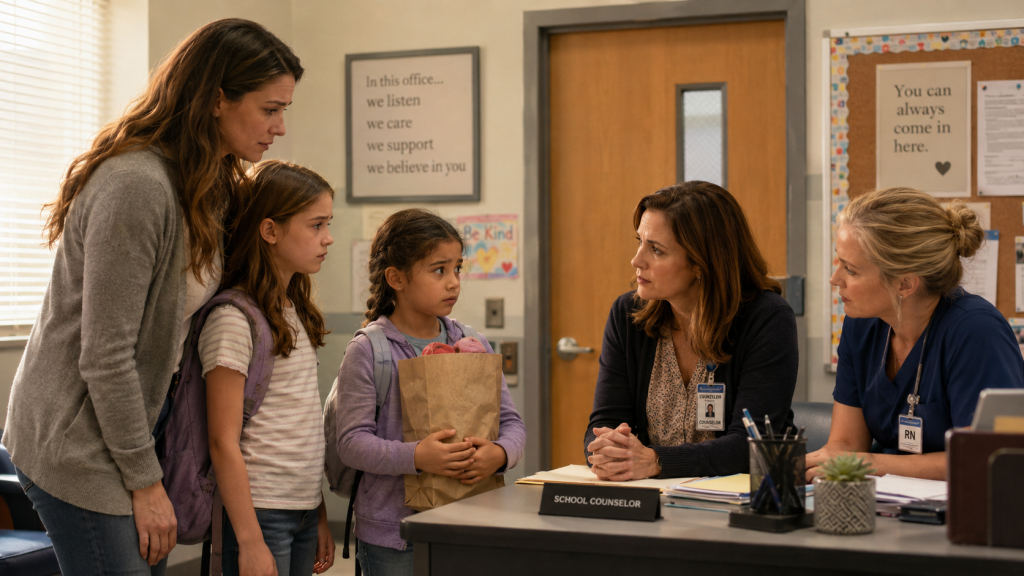
The counselor, Mrs. Angela Fox, took one look at the bag and shut her office door.
At 7:24, the school nurse called someone from the little room behind the front desk, and I heard her say, “I need you here now, not after lunch.
PART 2 — WHAT WAS INSIDE THE SHOES
At 7:31 that Saturday morning, the school office did not feel like a school anymore.
The fluorescent lights were too bright.
The hallway was too quiet.
No backpacks thumping against lockers.
No children calling to each other.
No sneakers squeaking across the waxed floor.
Just adults moving carefully.
Too carefully.
Mrs. Angela Fox, the counselor, had locked her office door.
The school nurse, Denise Harper, stood beside Kaylee with the kind of calm expression nurses wear when they are frightened but do not want a child to notice.
Mia sat in the corner with a coloring book someone had given her.
She had already figured out this was not about my dentist appointment.
Children always know when adults are lying for what we believe are good reasons.
She kept looking at me.
Then at Kaylee.
Then at the grocery bag.
The pink shoes were inside it.
No longer on Kaylee’s feet.
That fact should have felt like progress.
Instead, it terrified me.
Because once the shoes came off, there was no pretending anymore.
Kaylee sat on the examination table with a gray school blanket wrapped around her shoulders.
Her legs were pulled close to her chest.
White hospital-style socks covered her feet now.
The nurse had given them to her.
The old socks had gone into another bag.
Evidence.
I hated that word.
Children should not have evidence.
They should have stickers.
Library books.
Crumbs in their pockets.
Missing teeth.
Not evidence.
Mrs. Fox crouched in front of Kaylee.
“Someone is coming to talk to you.”
Kaylee stared at the floor.
“Am I in trouble?”
“No.”
“Is Mia?”
“No.”
Her eyes lifted toward me.
“Is Mrs. Lane?”
My throat tightened.
Mrs. Lane.
Me.
The adult who had spent two hours telling herself she should not interfere because Kaylee was not my child.
“No, sweetheart,” I said. “Nobody here is in trouble.”
Kaylee’s fingers tightened around the blanket.
“She’ll be mad.”
The nurse’s voice softened.
“Who will be mad?”
Kaylee immediately looked away.
Angela did not push.
She only said:
“You don’t have to answer everything all at once.”
That was the first thing anyone said that morning that seemed to let Kaylee breathe.
A little.
Then we heard the front doors unlock.
Heavy footsteps crossed the lobby.
A woman’s voice.
A man’s.
Mrs. Fox stood.
The nurse gave me a look.
Not panic.
Warning.
Stay quiet.
Let them do their jobs.
The office door opened.
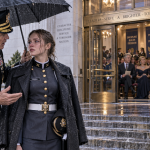
A woman in a navy coat walked in carrying a leather folder.
Behind her was a police officer.
Not uniformed school security.
An actual city police officer.
My stomach dropped.
The woman introduced herself.
“Kaylee, my name is Mara Benton. I work with children and families.”
Kaylee did not move.
Mara crouched.
“I’m not here because you did anything wrong.”
Nothing.
“I’m here because sometimes grown-ups are supposed to help when kids are hurting.”
Kaylee’s lower lip trembled.
That was all.
No confession.
No dramatic breakdown.
Just that tiny tremble.
And somehow it felt like watching a wall crack.
They separated us.
Not harshly.
Professionally.
Mia went with another staff member to the library.
Kaylee stayed with Mara and the nurse.
The officer asked me to sit in Mrs. Fox’s office.
His name was Officer Daniel Reed.
Maybe thirty-five.
Gentle voice.
Tired eyes.
He asked me to tell him everything from the beginning.
So I did.
The sleepover.
The shoes.
The blood.
The double knots.
The note.
She checks if I told.
I explained that Kaylee had slept over once before.
That she ate five pancakes.
That I thought it was funny then.
Cute.
A growing kid.
Now I could not stop thinking about it.
“Does Kaylee often seem hungry?” Officer Reed asked.
I frowned.
“I don’t know.”
“Think.”
So I did.
Birthday parties.
School events.
Movie night.
Every time Kaylee came over, she ate quickly.
Not greedily.
Quietly.
Like somebody afraid food could be taken away if she did not finish before anyone noticed.
“She always asks if she can take leftovers home.”
Officer Reed wrote that down.
My chest hurt.
“Is that important?”
He did not answer directly.
“Anything else?”
I thought of pickup lines.
Tasha’s hand on Kaylee’s shoulder.
Too firm sometimes.
Greg never getting out of the truck.
Kaylee apologizing when she spilled water at Mia’s birthday party.
Not a normal apology.
She had gone pale.
Hands shaking.
Saying:
“I’ll clean it. I’ll clean it. I’ll clean it.”
At the time, I thought she was embarrassed.
I told her accidents happen.
She looked at me like I had spoken another language.
I told him that too.
He wrote everything.
Then:
“Has Kaylee ever said she’s afraid to go home?”
“No.”
“Ever asked to stay longer?”
I hesitated.
Last sleepover.
Sunday morning.
Her father was supposed to pick her up at ten.
At nine-fifty, Kaylee suddenly asked whether she could help Mia clean her room.
At ten-ten, she asked if they could watch one more movie.
At ten-fifteen, when Greg’s truck arrived, she went into the bathroom for almost five minutes.
I remembered calling through the door:
“Your dad’s here.”
She answered:
“I know.”
Very quietly.
My stomach turned.
“Yes.”
Officer Reed looked up.
“Yes what?”
“She stalled.”
He wrote it down.
I stared at my hands.
“How did I not see it?”
He stopped writing.
“Because kids who are scared often learn how to make fear look ordinary.”
That sentence would stay with me for years.
At 8:06, Greg Whitman arrived at the school.
I heard him before I saw him.
“What do you mean she’s with child services?”
His voice carried through the front office.
“What happened?”
Then louder:
“Where is my daughter?”
I stood.
Officer Reed moved toward the door.
“Stay here.”
But the wall between Mrs. Fox’s office and the lobby was thin.
I heard everything.
Greg was furious.
Not frightened.
Not at first.
That bothered me.
A father told his eight-year-old daughter was being examined because someone believed she was hurt should sound scared.
Greg sounded inconvenienced.
“What did she say?”
A pause.
Then:
“Kids make things up.”
My whole body went cold.
He did not ask:
Is she okay?
He asked:
What did she say?
Officer Reed’s voice was calmer.
“Mr. Whitman, we need you to wait.”
“I’m her father.”
“Yes.”
“Then bring her out.”
“We can’t do that yet.”
Greg lowered his voice.
I could not hear the next part.
Then suddenly:
“Tasha would never hurt her.”
There it was.
Nobody had said Tasha.
Not where I could hear.
Maybe they had told him.
Maybe.
But something about how quickly he defended her made my stomach twist.
I stepped closer to the cracked door.
Officer Reed said:
“Who mentioned Tasha?”
Silence.
A long one.
Then Greg answered:
“I know what this is about.”
Every hair on my arms stood up.
At 8:14, Tasha arrived.
She came in fast.
Hair perfect.
Makeup perfect.
Cream sweater.
The same woman who brought allergy-friendly cookies to spring parties and wrote helpful notes in neat handwriting.
She looked around the office.
“Where’s Kaylee?”
Greg turned toward her.
“They won’t let me see her.”
Tasha’s face changed.
Not fear.
Anger.
Then she saw me through the office doorway.
Everything stopped.
Her eyes narrowed.
“You.”
Officer Reed stepped between us.
“Ma’am.”
She pointed at me.
“What did you do?”
I stared.
“What did I do?”
“You had no right to take her anywhere.”
“She spent the night at my house.”
“You should’ve called us.”
“She was bleeding.”
Tasha’s jaw tightened.
“She picks at her heels.”
I felt sick.
It came too quickly.
Too prepared.
“She told me she was clumsy.”
“She is.”
“She said someone checks if she told.”
Tasha’s face went still.
Greg looked at her.
Just for a second.
There.
Fear.
Not surprise.
Recognition.
Tasha recovered almost immediately.
“She’s been having behavioral issues.”
Mrs. Fox emerged from the hallway.
“What kind of behavioral issues?”
Tasha smiled tightly.
“Attention-seeking.”
The same word from the note.
I looked at her.
“So you expected the shoes to come up.”
Her eyes snapped toward me.
“What?”
“You wrote a note saying she was dramatic about shoes.”
“That’s because she is.”
“Why shoes?”
Silence.
I stepped closer.
Officer Reed lifted one hand.
“Mrs. Lane.”
I stopped.
Tasha looked toward the grocery bag on the office counter.
The pink sneakers were visible through the opening.
And for one second, I saw real panic.
Her face lost color.
She looked at Greg.
Then back at the bag.
“What did you do with those?”
The lobby went quiet.
Not:
Why are her shoes bloody?
Not:
What happened to her feet?
What did you do with those?
Officer Reed noticed too.
His voice changed.
“Why are the shoes important?”
Tasha stared at him.
“They aren’t.”
“Then why did you ask?”
“I don’t want strangers handling my stepdaughter’s belongings.”
Officer Reed said nothing.
Greg suddenly rubbed both hands over his face.
“Tasha.”
She turned.
“Don’t.”
One word.
Quiet.
Sharp.
Greg closed his mouth.
That frightened me more than if they had started screaming.
At 8:40, Mara Benton came out of the nurse’s room.
She did not look at Greg or Tasha first.
She looked at Officer Reed.
A small nod.
Something had changed.
The officer straightened.
Greg stepped forward.
“Can I see her?”
Mara answered carefully.
“Not yet.”
His face reddened.
“You’re keeping my child from me.”
Mara’s voice stayed calm.
“Kaylee is being transported for a medical evaluation.”
Tasha went pale.
“Transported where?”
“I can’t discuss details with everyone present.”
“I’m her stepmother.”
“I understand.”
“You think I did something.”
Mara did not answer.
That was answer enough.
Tasha laughed.
A sharp, offended sound.
“This is unbelievable.”
Greg looked sick now.
Actually sick.
I noticed sweat near his hairline.
He turned toward Tasha.
“What did she say?”
Tasha stared at him.
Then at Mara.
“What exactly did Kaylee tell you?”
Mara did not respond.
Tasha’s control cracked.
“She lies.”
The room went very still.
“She lies about what?” Mara asked.
Tasha froze.
I watched her realize it.
Again.
She knew too much about accusations nobody had described.
She crossed her arms.
“Everything.”
“Examples?”
“Schoolwork. Chores. Food.”
Food.
Officer Reed looked at her.
“What about food?”
Tasha’s mouth opened.
Then closed.
Greg turned away.
I felt cold.
Mara asked:
“Does Kaylee have food restrictions?”
Tasha snapped:
“She steals.”
I flinched.
“What?”
“She sneaks food.”
Greg whispered:
“Tasha.”
She spun toward him.
“She does.”
Mara’s voice stayed almost unnervingly gentle.
“Why would an eight-year-old need to sneak food?”
Tasha looked at her like the question itself was ridiculous.
“Because she has no self-control.”
My stomach dropped.
Five pancakes.
Leftovers.
Eating quickly.
I wanted to throw up.
Mara’s eyes hardened slightly.
“How do you respond when she takes food without permission?”
Tasha’s face changed.
That was when she stopped answering.
“I want a lawyer.”
Officer Reed nodded.
“That’s your right.”
Greg stared at her.
And for the first time that morning, he looked afraid of his wife.
Kaylee left the school through a side entrance.
I barely saw her.
Gray blanket.
Mara beside her.
A medical transport worker.
She turned once.
Not toward Greg.
Not toward Tasha.
Toward me.
I raised my hand.
She raised hers too.
Then they were gone.
Greg saw.
His face collapsed.
I almost felt sorry for him.
Almost.
Then he said:
“She’s confused.”
I looked at him.
“No.”
His eyes met mine.
“She’s eight.”
“Exactly.”
“You don’t understand our house.”
I laughed quietly.
“You’re right.”
I looked at the bloody shoes.
“I don’t.”
Tasha stood twenty feet away speaking urgently into her phone.
Probably a lawyer.
Maybe someone else.
Greg lowered his voice.
“You should’ve called me.”
My anger finally came.
“No.”
He flinched.
“You should have called me first.”
“So you could do what?”
“Handle it.”
“There’s that word.”
“What?”
“Handle.”
I stepped closer.
“Your daughter was sitting on my floor with dried blood inside her socks.”
His face tightened.
“You think I don’t know?”
The words escaped him.
We both froze.
I stared.
“What?”
Greg’s face drained white.
He looked toward Officer Reed.
The officer had heard.
Of course he had.
Greg closed his eyes.
I whispered:
“You knew.”
“No.”
“You just said—”
“I meant I know now.”
“No.”
My voice shook.
“You knew something.”
He rubbed his forehead.
“It wasn’t like this before.”
Every part of me went cold.
“Before what?”
Greg said nothing.
Officer Reed stepped closer.
“Mr. Whitman.”
Greg looked at the floor.
“When did it start?”
No answer.
“Mr. Whitman.”
Greg whispered:
“After her mother died.”
The room changed.
I knew Kaylee’s mother had died.
Everybody at school did.
Cancer.
Three years earlier.
Kaylee had been five.
Greg married Tasha eleven months later.
I had never judged him for it.
People grieve differently.
Children need stability.
That was what we all told ourselves.
Officer Reed asked:
“What started after her mother died?”
Greg’s face crumpled.
“Tasha said Kaylee needed discipline.”
My hands went numb.
“Discipline?”
“She was difficult.”
I stared at him.
“She was five.”
Greg snapped:
“You weren’t there.”
Then immediately looked ashamed.
I stepped back.
No.
I had not been there.
But I knew one thing.
Children do not have to be easy to deserve safety.
Mara had already left, but Mrs. Fox remained nearby.
Her face had gone very pale.
Greg continued:
“She screamed at night.”
His voice shook.
“She wet the bed.”
“She missed her mother,” Mrs. Fox said.
Greg looked at her.
“I know.”
“Did you?”
His eyes filled.
“I thought I did.”
Then he whispered:
“Tasha said comforting her was rewarding bad behavior.”
The words made my stomach twist.
“What did you do?”
Greg covered his face.
Nothing.
I stepped closer.
“What did you do?”
He lowered his hands.
“I let Tasha handle bedtime.”
My throat tightened.
“And the food?”
His eyes closed.
“She said Kaylee was eating for attention.”
I thought of five pancakes again.
“How long did you know she was being denied food?”
“No.”
Greg shook his head.
“I didn’t know she wasn’t eating enough.”
“But you knew food was punishment.”
Silence.
My voice cracked.
“You knew.”
He looked at me.
“I thought Tasha was making rules.”
“And her feet?”
He went completely still.
The answer was there.
I hated it.
“Greg.”
He whispered:
“I saw bandages once.”
I could barely speak.
“When?”
“Last month.”
“What did Tasha say?”
“That Kaylee had torn blisters open.”
“And you believed her?”
He looked toward the floor.
“I wanted to.”
There it was.
The ugliest sentence in the room.
Not:
I believed her.
I wanted to.
He had seen enough to question.
And chose the answer that made his life easier.
By 10:00, police had asked Greg and Tasha to remain available.
Tasha left with her lawyer.
Greg stayed.
He sat alone in the front office with his elbows on his knees and stared at the floor.
I found Mia in the library.
She ran to me.
“Is Kaylee okay?”
I crouched.
“She’s with doctors.”
“Is she sick?”
“Her feet are hurt.”
“Because of Tasha?”
My breath caught.
I looked at my daughter.
“Why would you ask that?”
Mia’s face changed.
Children know when they have accidentally said too much.
“Mia.”
She looked toward the bookshelves.
“Kaylee doesn’t like when Tasha picks her up.”
I felt cold.
“Did she tell you why?”
“No.”
“Did she ever say Tasha hurt her?”
Mia’s eyes filled.
“She said she had to be good.”
I swallowed.
“What does that mean?”
“She said if she was bad, she had to stand.”
My stomach dropped.
“Stand where?”
Mia whispered:
“On the rocks.”
Everything inside me stopped.
“What rocks?”
“She didn’t say.”
“Mia, look at me.”
She did.
“Did Kaylee tell you she had to stand on rocks without shoes?”
My daughter started crying.
“She said I wasn’t supposed to tell.”
My heart broke.
I pulled her into my arms.
“You’re not in trouble.”
“She said Tasha checks.”
The same words.
“She said if grown-ups find out, Greg will send her away.”
I closed my eyes.
Of course.
Threaten the child with abandonment.
Use the dead mother.
Use the father.
Make silence feel safer than rescue.
I held Mia.
“You did nothing wrong.”
“I should’ve told you.”
“You’re eight.”
“But I knew.”
“No.”
I pulled back.
“Listen to me.”
I held her face gently.
“You knew something scared your friend.”
Tears ran down her cheeks.
“You did not know how to fix it.”
She nodded.
“That is what adults are for.”
The words came out bitterly.
Because some adults had failed Kaylee badly.
I was not going to make Mia carry that failure too.
I told Officer Reed immediately.
His expression changed when I said rocks.
“Did Mia say where?”
“No.”
“Anything else?”
“She said standing.”
“How long?”
“I don’t know.”
He nodded.
Then asked if Mia could speak to a child interviewer later.
I agreed.
The grocery bag with the shoes left with police shortly afterward.
I watched it go.
Two pink sneakers.
Sparkly sides.
White rubber soles.
Little silver stars near the heel.
Shoes designed for an ordinary eight-year-old.
Somehow transformed into something everyone handled with gloves.
At 11:46, my phone rang.
Unknown number.
I almost ignored it.
Then answered.
“Mrs. Lane?”
“Yes.”
It was Mara Benton.
My heart started pounding.
“Is Kaylee okay?”
“She’s stable.”
I closed my eyes.
Stable.
A word nobody wants attached to an eight-year-old.
“Can I see her?”
“Not right now.”
“Did she say what happened?”
A pause.
“I can’t share everything.”
“I understand.”
“But I’m calling because she asked for you.”
My throat tightened.
“She did?”
“Yes.”
“What did she say?”
Mara hesitated.
“She asked if the pink shoes were gone.”
I looked toward the empty counter where the grocery bag had been.
“Yes.”
“I told her they were with police.”
Another pause.
“Then she started crying.”
“Why?”
Mara’s voice softened.
“She said, ‘Good. Now she can’t make me put them back on.’”
I pressed one hand over my mouth.
The room blurred.
“What happened to her feet?”
“I can’t discuss medical findings.”
“Please.”
“I’m sorry.”
I closed my eyes.
Then Mara added:
“Mrs. Lane, calling the school was the right decision.”
Guilt rose hot in my chest.
“I waited two hours.”
“You acted.”
“I almost called Greg.”
“But you didn’t.”
“I almost convinced myself I was overreacting.”
“Most people do that because the alternative is frightening.”
I sat down.
“What happens now?”
“Investigation.”
“Is she going home?”
Another pause.
“No.”
The answer broke something inside me.
Not because I wanted her returned there.
Because the fact that professionals already knew home was not safe meant whatever Kaylee had told them was serious.
“Where will she go?”
“Temporary placement while we assess relatives.”
“Does she have family?”
“An aunt, possibly.”
I thought of a woman I had seen once at a school concert.
Red hair.
Sat alone in the back row.
Kaylee kept looking at her.
Greg never introduced them.
“Her mom’s sister?”
Mara was silent.
That was enough.
Then she said:
“There’s one more reason I called.”
My stomach tightened.
“What?”
“Did Kaylee leave anything at your house?”
“Her backpack.”
Silence.
My heart started pounding.
“She brought it to school.”
“Yes.”
“Do you still have it?”
I looked around.
No.
The backpack had gone with Kaylee.
“I think she took it.”
Mara exhaled slowly.
“Okay.”
“Why?”
“Because Kaylee told the interviewer there was something inside.”
My skin prickled.
“What?”
“She called it her safety paper.”
I frowned.
“A note?”
“We’re not sure.”
“What did she say?”
Mara hesitated.
Then:
“She said her real mom told her never to throw it away.”
My chest tightened.
Kaylee’s mother had been dead three years.
“What paper?”
“She wouldn’t explain.”
I thought of the backpack.
Always held against her chest.
Like a life jacket.
Not because of clothes.
Not because of toys.
Something inside.
Something her mother gave her.
“Mara.”
“Yes?”
“Does Greg know about it?”
There was a pause.
“That’s what we’re trying to determine.”
At 12:20, police called again.
Not Mara.
Officer Reed.
“Mrs. Lane, we need you to come back to the school.”
My pulse jumped.
“Why?”
“Is Mia with you?”
“Yes.”
“Bring her if you need to, but don’t discuss the case with her on the drive.”
My stomach dropped.
“What happened?”
“We found something.”
“What?”
“Come in.”
I hated that phrase.
Come in.
Adults use it when the truth is too ugly for telephones.
When I arrived, Greg was gone.
So was everyone except Mrs. Fox, Officer Reed, and a detective I had not met.
She introduced herself as Detective Nora Singh.
On Mrs. Fox’s desk sat a clear plastic evidence sleeve.
Inside was a folded sheet of paper.
Pink around the edges.
Child’s handwriting in the middle.
My breath caught.
“What is that?”
Detective Singh gestured toward the chair.
“Sit down.”
I did.
She opened a folder.
“Kaylee’s backpack was searched with appropriate authorization after she told the child interviewer about the paper.”
I nodded.
“This was sewn into the lining.”
My skin went cold.
“Sewn?”
“Yes.”
I thought about how Kaylee held that backpack.
Always close.
Tasha’s note had been folded inside openly.
But this was hidden.
“Who wrote it?”
Detective Singh slid a photocopy toward me.
The handwriting was adult.
Not Tasha’s.
Rounder.
Softer.
At the top:
For Kaylee, when she is old enough to ask questions.
My throat tightened.
Her mother.
I knew before they said it.
“Was this from her mom?”
Detective Singh nodded.
“Apparently.”
I looked down.
The first lines were simple.
My sweet girl, if you are reading this, I’m sorry I’m not there to answer you myself.
My vision blurred.
I kept reading.
You may someday hear things about me that are not true. You may be told I was careless, sick, confused, or that I left things unfinished because I didn’t love you enough. None of that is true.
I stopped.
A cold feeling moved through me.
Careless.
Sick.
Confused.
Words used to discredit dead women.
Detective Singh watched me.
“Keep going.”
I did.
If Greg ever tells you Tasha was my friend, do not believe him.
My heart stopped.
I looked up.
“What?”
No one spoke.
I looked back down.
Tasha was not my friend. She worked at Dr. Feldman’s office during my treatment. I reported her after I found her going through my file.
My stomach twisted.
Kaylee’s mother had died of cancer.
Tasha worked at the medical office.
I kept reading.
Greg told me I was imagining things. He said illness had made me paranoid.
My hands started shaking.
More.
If anything happens to me before you are grown, call my sister Rebecca. Her number is written below. Do not let anyone convince you she abandoned us. Greg stopped returning her calls.
I stared.
The aunt.
The woman at the school concert.
Rebecca.
Greg had cut her out.
Not the other way around.
Then the last paragraph.
The one that made Detective Singh call me back.
There is a box in the storage unit on Mill Road. Unit 214. The key is inside the lining of Kaylee’s pink winter coat. Everything I couldn’t prove is there. If Tasha is in our house after I am gone, do not let her find it.
The room went silent.
My pulse roared in my ears.
I looked at Detective Singh.
“What’s in the box?”
“We don’t know.”
“You haven’t gone?”
“We’re obtaining access now.”
I stared at the page.
Kaylee’s mother had died three years earlier.
She had known Tasha before Greg married her.
She had been afraid enough to leave instructions for her daughter.
Not only about Tasha.
About Greg.
My voice came out low.
“Did Kaylee know what this said?”
“We don’t think she read all of it.”
“She’s eight.”
“She told the interviewer her mother said the paper was ‘for when things got scary.’”
My heart broke.
The paper was not a letter Kaylee happened to keep.
It was an emergency plan.
One written by a dying mother.
Detective Singh leaned forward.
“Mrs. Lane, there’s something else.”
Of course there was.
“What?”
“She said Tasha has been searching her room.”
My skin prickled.
“For the paper?”
“Possibly.”
“And the shoes?”
The detective’s expression changed.
“Kaylee says the punishments became worse two weeks ago.”
“Why?”
“She believes Tasha realized something was missing.”
I stared.
“The key?”
Detective Singh nodded slowly.
“Maybe.”
My heart pounded.
“Where’s the coat?”
Silence.
Then Mrs. Fox said:
“At home.”
Kaylee’s home.
With Greg.
With Tasha.
I stood.
“You have to get there.”
Detective Singh stood too.
“Officers are already going.”
“When?”
“Now.”
I looked at the clock.
12:37.
My stomach twisted.
“If Tasha knows—”
“We know.”
The detective gathered the folder.
“Mrs. Lane, go home with Mia.”
I laughed once.
“You think I can go home?”
“Yes.”
Her voice softened.
“Because right now, that’s the safest place for your daughter.”
That stopped me.
Mia.
My child.
My responsibility.
I nodded.
Before leaving, I looked once more at the photocopy.
A dying mother’s handwriting.
A phone number.
A storage unit.
A coat.
A key.
Three years of silence sewn into a backpack.
And suddenly the pink shoes were no longer the beginning of what happened to Kaylee.
They were the point where the secret finally became visible.
At 1:18, Mia and I were home.
She sat at the kitchen table eating cereal.
I made coffee and forgot to drink it.
At 1:42, my phone rang.
Officer Reed.
I answered immediately.
“Did you find the coat?”
Silence.
“Officer Reed?”
His voice was different.
Tighter.
“We found the coat.”
I gripped the counter.
“And the key?”
“No.”
My stomach dropped.
“It was gone?”
“The lining had been cut open.”
I closed my eyes.
“Tasha.”
“We don’t know yet.”
“What about the storage unit?”
Another pause.
Then:
“We got there.”
“And?”
“The lock had been replaced.”
My pulse quickened.
“When?”
“Yesterday.”
Friday.
The day Kaylee came to my house.
My knees weakened.
“By who?”
“We’re checking surveillance.”
I pressed one hand against the wall.
Then Officer Reed said:
“Mrs. Lane.”
“Yes?”
“There’s more.”
I almost laughed from the dread of it.
“What?”
“The facility manager remembered the person who changed the lock.”
My mouth went dry.
“Tasha?”
“No.”
I froze.
“Greg?”
“No.”
“Then who?”
Officer Reed exhaled.
“A woman.”
“Who?”
“We don’t know her name yet.”
My heart pounded.
“Description?”
He told me.
Mid-forties.
Red hair.
Thin.
Dark coat.
I knew before he finished.
Rebecca.
Kaylee’s maternal aunt.
The woman Greg said had disappeared.
The woman Kaylee’s dying mother told her to call.
I whispered:
“Her aunt.”
“That’s what we think.”
“Did she take the box?”
“We don’t know.”
“Is she missing?”
Pause.
“Yes.”
A chill went through me.
“When did anyone last see her?”
“Yesterday evening.”
The same night Kaylee came over.
I stared across the kitchen at Mia.
She was drawing circles in spilled cereal milk with her spoon.
Officer Reed continued:
“The storage facility camera shows Rebecca arriving at 4:53 p.m.”
Less than an hour before Greg dropped Kaylee at my house.
“She changed the lock.”
“Yes.”
“Did she go inside?”
“Yes.”
“How long?”
“Thirty-seven minutes.”
“And then?”
“She left carrying a banker’s box.”
My heartbeat accelerated.
“Where did she go?”
“We’re trying to determine that.”
I swallowed.
“Did anyone follow her?”
Silence.
That silence frightened me more than anything else.
“Officer Reed?”
Finally:
“A dark SUV left the facility two minutes after her.”
I stopped breathing.
“What kind?”
“We’re working on the plate.”
I already knew the question I was afraid to ask.
“What does Greg drive?”
Officer Reed was quiet.
Then:
“A dark SUV.”
My hand went numb around the phone.
Through the window, afternoon sunlight fell across my clean carpet.
The same carpet Kaylee had refused to step on without those pink shoes.
I thought of her words.
She checks if I told.
I had assumed she meant Tasha checked her feet.
Checked whether she spoke.
Checked for evidence.
Now I wondered whether Tasha had been checking for something else.
A key.
A note.
A dying woman’s secret.
And if Greg’s vehicle had followed Rebecca after she removed the box from storage, then the question was no longer whether Kaylee’s father knew what was happening inside his home.
The question was how long he had been helping hide it.
PART 3 — THE BOX HER MOTHER LEFT BEHIND
For the next forty minutes, I stared at my phone as if I could force it to ring.
Mia sat at the kitchen table coloring.
Blue crayon.
Yellow sun.
A crooked house with smoke coming from the chimney.
Every few minutes she looked up at me.
“Is Kaylee coming back?”
I did not know how to answer.
Not to our house.
Not that day.
Maybe not to school for a while.
Maybe not to the life she had known at all.
“I hope so,” I said.
Mia frowned.
“That’s not yes.”
“No.”
I sat beside her.
“It isn’t.”
She looked down at her drawing.
Then, very quietly:
“Did I make it worse?”
My heart broke.
“No.”
“I told you about the rocks.”
“Yes.”
“And then police came.”
“Yes.”
Her eyes filled.
“Kaylee said telling makes things worse.”
I reached across the table.
“No.”
Mia looked at me.
“Sometimes telling makes bad things visible.”
She swallowed.
“That can feel worse for a little while.”
I squeezed her hand.
“But visible things can finally be stopped.”
She thought about that.
Eight years old.
Trying to understand what grown adults had made complicated.
Then she nodded.
I wished adults were always as brave as children when given the truth plainly.
At 2:07, Detective Singh called.
“We found Rebecca.”
I stood so quickly my chair scraped backward.
“Is she alive?”
“Yes.”
My knees nearly gave out.
“Where?”
“At a roadside motel outside Harrington.”
“Was she hurt?”
“Shaken. Not seriously injured.”
I closed my eyes.
“Did Greg follow her?”
A pause.
“Yes.”
My stomach turned.
“What happened?”
“Rebecca noticed the SUV and drove to a gas station. Greg confronted her there.”
I gripped the counter.
“About the box?”
“Yes.”
“Did he take it?”
“No.”
I opened my eyes.
“Where is it?”
“Rebecca mailed it.”
“What?”
Detective Singh almost sounded impressed.
“She stopped at a shipping center before changing the storage lock.”
“To send the box where?”
“Her attorney.”
I exhaled.
Smart.
Careful.
Prepared.
Kaylee’s mother had trusted the right sister.
“What was Greg trying to do?”
“Convince Rebecca to give him the contents.”
“Convince?”
“He claims he was trying to prevent a misunderstanding.”
I laughed.
“Of course.”
“Rebecca says he threatened to report her for kidnapping if she contacted Kaylee.”
Cold moved through me.
“She wasn’t even with Kaylee.”
“I know.”
“He just wanted her scared.”
“Yes.”
I looked toward Mia.
She had gone back to coloring, but slower.
Listening.
I lowered my voice.
“What was in the box?”
“We’re reviewing it now.”
“Can you tell me anything?”
Another pause.
“Enough to confirm Kaylee’s mother was documenting concerns before she died.”
My chest tightened.
“What kind?”
“Medical records.”
I thought of the note.
Tasha at Dr. Feldman’s office.
Going through Kaylee’s mother’s file.
“What else?”
“Printed emails. Copies of billing records. Photographs.”
“Of abuse?”
“No.”
The detective’s voice changed.
“Of unauthorized medication changes.”
I went still.
“What?”
“She believed someone was interfering with her treatment.”
I sat down.
“Cancer treatment?”
“Yes.”
My stomach turned.
“Are you saying Tasha did something to her medication?”
“We do not know that.”
The detective was precise.
“And I don’t want to overstate anything.”
I appreciated that.
Even while every part of me wanted a villain I could understand.
“What do you know?”
“Kaylee’s mother, Jenna Whitman, documented that several appointment details and prescription instructions changed after she discussed concerns about her marriage.”
“Her marriage?”
“Yes.”
“To Greg.”
My skin prickled.
“What concerns?”
“Financial control. Isolation. She was considering leaving.”
I stared at the wall.
Not again.
Not another woman being told she imagined things.
Not another child learning fear by watching a mother be disbelieved.
Detective Singh continued.
“Jenna believed Tasha accessed her chart without authorization and passed information to Greg.”
My stomach dropped.
“They knew each other before Jenna died.”
“Yes.”
“How well?”
“Very well.”
That answer was heavy.
“How well?”
The detective sighed.
“Tasha and Greg had been communicating privately for at least eight months before Jenna’s death.”
I closed my eyes.
“An affair?”
“We haven’t confirmed the exact nature of the relationship during that period.”
“But Jenna suspected.”
“Yes.”
“And she reported Tasha.”
“Yes.”
I looked down at the wood grain of my kitchen table.
Kaylee’s mother had been sick.
Afraid.
Trying to leave.
Trying to protect her daughter.
And the woman who later became Kaylee’s stepmother had been inside the medical office handling information connected to her care.
“What happened after Jenna reported her?”
“Tasha was dismissed.”
My breath caught.
“From the doctor’s office?”
“Yes.”
“And Greg married her eleven months after Jenna died.”
“Yes.”
The timeline suddenly felt obscene.
Not proof of something criminal.
But ugly enough to explain the fear in Jenna’s letter.
“Did Greg know Jenna reported her?”
“We believe so.”
I swallowed.
“What else was in the box?”
“A journal.”
I felt something tighten in my chest.
“Jenna’s?”
“Yes.”
“And?”
“Mrs. Lane.”
Detective Singh’s voice softened.
“I think the rest should come through the proper channels.”
I understood.
This was not gossip.
It was a dead woman’s life.
A child’s case.
Evidence.
I nodded even though she could not see me.
Then I asked the only question that mattered.
“Is Kaylee safe?”
“Yes.”
“For tonight?”
“Yes.”
“For longer than tonight?”
A pause.
“We’re working on that.”
Rebecca Whitman came to the school the following Monday.
I saw her from across the parking lot.
Red hair.
Dark coat.
Thin shoulders.
The woman from the spring concert.
I remembered Kaylee looking back at her every few minutes.
I had thought she was distracted.
Now I understood.
Rebecca had stood at the back of that auditorium knowing her niece had been kept away from her.
Knowing her sister was dead.
Knowing something was wrong.
And apparently being told that pushing too hard might mean never seeing Kaylee at all.
She saw me.
Then walked over.
“You’re Mrs. Lane.”
“Yes.”
Her eyes filled immediately.
“Thank you.”
I shook my head.
“No.”
She frowned.
“Please don’t thank me.”
“I’m going to.”
“I waited.”
“You acted.”
“Not fast enough.”
Rebecca looked toward the school doors.
“Do you know how many people notice something and decide it’s none of their business?”
I said nothing.
She swallowed.
“My sister used to say the most dangerous thing about bad homes is how polite they can look from the sidewalk.”
My throat tightened.
“That sounds like something she learned the hard way.”
Rebecca nodded.
“Yes.”
We stood there in the cold.
Then I asked:
“Did you know about the shoes?”
Her face changed.
“No.”
“Did you know Tasha was hurting her?”
Rebecca’s eyes filled.
“I knew Kaylee had changed.”
“How?”
“She stopped hugging me.”
My chest tightened.
“She used to run into my arms. Then last year, the one time Greg let me see her, she stood beside him with her hands behind her back.”
Rebecca wiped her cheek.
“I asked if everything was okay.”
“What did Greg say?”
“That therapy had made her withdrawn.”
“Was she in therapy?”
“Not that I could verify.”
Of course.
Another explanation.
Another adult sentence placed over a child’s fear.
Rebecca looked at me.
“She whispered something when Greg went to the bathroom.”
“What?”
“‘Don’t call. She listens.’”
My skin went cold.
“Tasha?”
“I assumed.”
Rebecca closed her eyes.
“I tried child services once.”
“What happened?”
“They visited.”
“And?”
“Greg and Tasha said I was an unstable grieving aunt trying to interfere with their family.”
My jaw tightened.
“Did they believe them?”
“Not completely.”
She looked exhausted.
“But Kaylee denied everything.”
Of course she did.
She checks if I told.
Rebecca continued.
“After that visit, Greg blocked my number.”
“And threatened you.”
“Yes.”
“With kidnapping claims.”
“Yes.”
I looked toward the school.
“Why did you go to the storage unit Friday?”
Rebecca’s face changed.
“Because I got a letter.”
“From who?”
“Jenna.”
I stared.
“Your sister?”
She nodded.
“Delayed delivery.”
I frowned.
“What does that mean?”
“She left instructions with an attorney years ago.”
My heart started pounding.
“If Kaylee’s circumstances changed?”
“Yes.”
“How?”
“The attorney had a list.”
“Of what?”
“Specific triggers.”
Rebecca counted quietly.
“If Greg remarried Tasha.”
My stomach tightened.
“If Kaylee stopped having regular contact with me.”
Another.
“If Greg attempted to move out of county.”
Another.
“If Tasha ever worked in healthcare again.”
I stared.
“Why that?”
Rebecca shook her head.
“I don’t know.”
Then the last one.
“If Kaylee showed unexplained injuries.”
My breath stopped.
“The lawyer knew about her feet?”
“No.”
“But I had emailed him three weeks earlier because Kaylee came to school in July wearing a jacket in ninety-degree heat.”
I remembered that.
Mia mentioned it.
I had forgotten.
Rebecca continued.
“The attorney decided the pattern was enough and released Jenna’s instructions.”
“Which sent you to the storage unit.”
“Yes.”
“And the box?”
Rebecca’s jaw tightened.
“I mailed it because Jenna’s letter said never drive directly home with it.”
A chill ran through me.
“She expected someone might follow you.”
“Yes.”
“And Greg did.”
Rebecca looked away.
“That was when I stopped wondering whether Jenna had been paranoid.”
The investigation moved quickly after that.
Not because every question suddenly had an answer.
But because evidence started connecting.
Tasha had been dismissed from Dr. Feldman’s office three years before Jenna died for unauthorized access to medical files.
The official reason had been privacy violations.
The clinic had settled quietly.
Jenna had made the complaint.
Greg had known.
Records also showed that Greg and Tasha exchanged hundreds of messages during the final year of Jenna’s life.
Most were gone.
Some backups were not.
No one proved they had caused Jenna’s cancer to worsen.
That was never the case.
But investigators found something else.
After Jenna began talking to an attorney about separation, Greg secretly moved money from their joint account.
Tasha accessed appointment schedules that Greg later used to track where Jenna would be.
And after Jenna died, Greg filed paperwork claiming Rebecca had abandoned contact with the family.
She hadn’t.
He had blocked it.
Then there was Kaylee.
The immediate case did not depend on three-year-old suspicions.
It depended on what had happened to an eight-year-old now.
And that evidence was much clearer.
Kaylee eventually described the rocks.
They were decorative landscaping stones behind the garage.
Tasha made her stand barefoot on them when she “lied,” “stole food,” wet the bed, or asked too many questions about her mother.
Sometimes ten minutes.
Sometimes longer.
If Kaylee moved, the time restarted.
The blood came from reopened cracks and blisters.
The pink sneakers were punishment too.
Tasha made her wear them afterward even when her feet hurt.
Then checked the socks to see whether Kaylee had removed bandages or “made herself bleed for attention.”
That explained the sentence.
She checks if I told.
Not exactly.
But close enough for a terrified child.
Tasha checked the socks.
Checked the shoes.
Checked Kaylee’s room.
Checked her backpack.
Checked everything.
Silence had become part of the rules.
Food had too.
Kaylee was allowed regular meals, but snacks were controlled.
Then meals became conditional.
If she “misbehaved,” portions got smaller.
If she complained, Tasha said she was greedy.
Greg saw some of it.
Not all.
But enough.
Enough to know Kaylee was afraid of mealtimes.
Enough to see bandages.
Enough to hear crying.
Enough to understand Tasha’s discipline was not normal.
He admitted that eventually.
That mattered.
Not because confession erased anything.
Because the sentence he used became part of the case.
“I knew she was harsh. I did not want to know how harsh.”
I thought about that sentence for weeks.
I did not want to know.
People think cruelty survives because nobody notices.
Sometimes it survives because somebody notices exactly enough to look away.
Tasha was arrested first.
Greg was charged later in connection with child endangerment and failures that prosecutors said went beyond simple ignorance.
The details belonged to courts.
Not playground gossip.
Not parent group chats.
I refused to discuss them with people who asked too eagerly.
There is something ugly about adults turning a child’s worst months into entertainment.
Mia knew only what she needed.
Kaylee was safe.
Grown-ups were handling the rest.
Rebecca became her temporary caregiver.
Then, after hearings, evaluations, and more paperwork than I knew existed, Kaylee was placed with her permanently.
The first time I saw her after she left Greg’s house was six weeks later.
She came to our front door holding Rebecca’s hand.
No pink sneakers.
She wore blue socks with yellow stars.
Soft gray slippers.
She looked smaller than I remembered.
Then Mia screamed:
“Kaylee!”
And ran straight at her.
Kaylee flinched.
Just slightly.
Mia stopped herself before hugging.
That broke my heart.
Then Mia held out both hands.
“Can I?”
Kaylee stared.
Then nodded.
They hugged.
Carefully.
Children can learn consent faster than adults when somebody finally teaches it without shame.
Kaylee did not sleep over that night.
She stayed for dinner.
Then asked if she could come back next weekend.
I said yes.
She ate two pieces of lasagna.
Then looked at the serving dish.
“Can I have more?”
“Of course.”
She glanced at Rebecca.
Rebecca smiled.
“You don’t have to ask me.”
Kaylee frowned.
“But it’s not mine.”
Rebecca’s eyes filled.
“You are allowed to be hungry.”
Kaylee stared at her.
Then took a third piece.
I had to turn away because I was crying.
Not because three pieces of lasagna were remarkable.
Because food was becoming food again.
Not reward.
Not punishment.
Not evidence.
Dinner.
That was all.
Sometimes ordinary things are sacred after somebody has used them as weapons.
The first real sleepover happened three months later.
Mia planned everything.
Movie.
Popcorn.
Blanket fort.
Nail polish.
Kaylee arrived wearing white sneakers.
At the doorway, she stopped.
I noticed.
So did Rebecca.
Nobody said anything.
Kaylee looked at me.
“Can I keep them on?”
My chest tightened.
“Of course.”
She looked surprised.
“Even on the carpet?”
“Yes.”
“What about upstairs?”
“If you want.”
She stared at the floor.
Then slowly bent down.
Untied one shoe.
Then the other.
Placed them neatly beside the door.
She looked up.
“I want them off.”
I smiled.
“Okay.”
That was it.
No applause.
No tears.
Not in front of her.
But later, in the kitchen, Rebecca covered her mouth and cried.
I did too.
Because healing does not always announce itself dramatically.
Sometimes it is an eight-year-old taking off her shoes because she knows nobody is going to inspect the socks afterward.
The box Jenna left became important in ways none of us expected.
Not because it contained a single explosive secret.
Real evidence is rarely that theatrical.
It contained patterns.
Jenna’s journal.
Copies of messages.
Medical access logs.
Financial records.
Letters to Rebecca.
Notes about Greg’s behavior.
Documentation of Tasha’s involvement before Jenna died.
Enough to correct lies.
Enough to give investigators context.
Enough to show Jenna had been frightened for reasons other people dismissed.
One line from her journal became the thing I remembered most.
Rebecca showed it to me months later.
Jenna had written:
If I am wrong, I can live with being called paranoid. If I am right, I need someone to believe Kaylee before she learns silence is safer.
I read it three times.
Then cried.
Jenna did not live long enough to know whether anybody would.
But somebody did.
Eventually.
Kaylee’s school counselor.
The nurse.
Mara.
Rebecca.
Me.
Mia.
A whole chain of people.
None of us saved her alone.
That mattered.
Stories like to create one hero.
Real safety is usually built by many people doing one correct thing each.
A teacher noticing.
A friend listening.
A nurse documenting.
A counselor calling.
An aunt preserving a box.
A mother refusing to dismiss bloody socks.
One correct thing.
Then another.
Then another.
Until the child has somewhere to stand that does not hurt.
Greg asked to send Kaylee letters.
At first, professionals decided against direct contact.
Later, some communication was allowed through proper channels.
I never read most of it.
It was not my place.
Rebecca once told me the first letter said:
I should have protected you.
Kaylee did not answer for months.
Then she wrote one sentence.
Rebecca showed me only because Kaylee asked her to.
You were supposed to believe me before strangers did.
I had to sit down after reading that.
Eight years old.
One sentence.
Entire childhoods fit inside fewer words than adults use for excuses.
Greg eventually accepted responsibility in court.
Not perfectly.
Not immediately.
But publicly enough that Kaylee heard one thing she needed.
He stopped saying Tasha had tricked him.
Stopped saying he had been busy.
Stopped saying Kaylee had hidden it too well.
He finally said:
“I saw enough to ask more questions, and I chose not to.”
That was the closest thing to truth he could still give her.
Whether she forgives him someday will be hers to decide.
Not mine.
Not Rebecca’s.
Not a judge’s.
Hers.
Tasha’s case ended differently.
She denied most of it.
Called Kaylee dramatic.
Manipulative.
Attention-seeking.
The same word from the note in the backpack.
But words sound different once photographs, medical evaluations, school records, witness statements, and a child’s consistent account are sitting beside them.
Eventually, the word attention-seeking stopped sounding like an explanation.
It sounded like what it had always been.
A label designed to make adults stop looking.
That stopped working.
A year passed.
Then another.
Kaylee grew.
That sounds simple.
But I mean more than height.
Her shoulders loosened.
She stopped apologizing when she dropped things.
She ate slowly sometimes.
Left food on her plate sometimes.
Asked for seconds other times.
Normal.
She started wearing sandals.
That one took nearly a year.
The first pair was yellow.
Mia chose them.
Kaylee hated them.
Too sparkly.
They exchanged them for plain brown ones.
I loved that.
Healing does not mean turning every painful object into a symbol.
Sometimes a child just hates ugly shoes.
Good.
Let her.
By fifth grade, Kaylee joined chorus.
At her spring concert, Rebecca sat in the front row.
I sat beside her.
Mia waved from the risers.
Kaylee saw us.
For a second, she looked toward the back of the auditorium.
The place where Rebecca had once sat alone because Greg would not let her near.
Then Kaylee smiled.
A big one.
Not cautious.
Not checking anybody’s face first.
Just happy.
Rebecca grabbed my hand.
“She looks like Jenna.”
I looked at her.
“Really?”
“When she smiles like that.”
Her eyes filled.
“She used to smile with her whole face.”
Kaylee did too.
After the concert, she ran toward us.
Actually ran.
No hesitation.
No looking behind her.
Rebecca hugged her.
Then Kaylee hugged me.
She had gotten taller.
Her chin almost reached my shoulder.
“Mrs. Lane?”
“Yes?”
“Do you remember my pink shoes?”
My chest tightened.
“Yes.”
“I don’t.”
I stared.
“What?”
She shrugged.
“Not really.”
Rebecca looked at me.
Kaylee continued:
“I mean, I remember that I had them.”
She frowned.
“But I don’t remember how they felt anymore.”
My eyes filled.
That was the moment I understood something I had been waiting to understand since the school office.
I had thought healing meant Kaylee would someday be able to talk about what happened without crying.
Maybe.
But forgetting the feeling of the shoes?
That felt bigger.
The body giving up one piece of fear.
Making room.
I smiled.
“Good.”
She looked confused.
“Good?”
“Yes.”
“Why?”
“Because there are better things to remember.”
She thought about it.
Then said:
“Like pancakes?”
I laughed.
“Especially pancakes.”
Every year after that, the girls still had sleepovers.
Less often as they got older.
More phones.
More homework.
Less stuffed animals.
By thirteen, they mostly stayed up too late whispering about classmates and pretending I couldn’t hear them.
One Saturday morning, I made pancakes.
Kaylee ate four.
Then pushed the plate away.
“Full.”
I almost smiled.
Five pancakes had once made me wonder whether somebody fed her at home.
Now four pancakes meant nothing.
Breakfast.
Just breakfast.
That was a miracle too.
I kept one thing from that first night.
Not the photographs.
Police had those.
Not the bloody socks.
Evidence.
Not the pink shoes.
Those were eventually disposed of through the case.
I kept Tasha’s note.
A photocopy.
Kaylee is dramatic about shoes. Please don’t encourage attention-seeking.
For years, it stayed folded in my desk.
Then one afternoon, when Kaylee was twelve, I found it while looking for stamps.
I stared at the handwriting.
So neat.
So calm.
So confident that a polite sentence could outrun a child’s pain.
Then I tore it in half.
Then again.
Then again.
I did not need it anymore.
The case was over.
The truth had survived.
And I did not want that woman’s handwriting occupying space in my home longer than necessary.
Some evidence belongs in records.
Not hearts.
Mia asked me once if I was proud of what I did.
I told her no.
That surprised her.
“Why not?”
“Because I almost waited too long.”
“But you helped.”
“Yes.”
“So you should be proud.”
I thought about it.
Then smiled.
“Maybe I’m proud I stopped arguing with myself.”
She frowned.
“That sounds boring.”
“It is.”
She laughed.
But that was the truth.
The hardest part of that night was not understanding that blood was wrong.
I knew that immediately.
The hardest part was the two hours afterward.
The excuses.
Maybe she picks at her feet.
Maybe I am overreacting.
Maybe Greg doesn’t know.
Maybe Tasha is strict.
Maybe this is none of my business.
Every excuse sounded reasonable for about thirty seconds.
That is how people fail children.
Not always through cruelty.
Sometimes through reasonable-sounding hesitation.
I understand that now.
Kaylee is sixteen today.
She still comes over.
Not every weekend.
She has friends beyond Mia now.
A job at the public library.
A driver’s permit.
Opinions about everything.
She wants to study nursing.
Rebecca says Jenna would have loved that.
Kaylee rolls her eyes whenever adults say what her mother “would have wanted.”
“I can want things myself,” she says.
Good.
Exactly.
Last month, she came into my kitchen barefoot.
No thought behind it.
No hesitation.
Dropped her shoes by the door and asked if we had anything to eat.
I pointed toward the refrigerator.
She opened it.
Stood there too long, as teenagers do.
Then called:
“Can I finish the pasta?”
“Yes.”
“Even though Mia said it was hers?”
From upstairs:
“NO!”
Kaylee laughed and ate it anyway.
I stood at the sink smiling.
Because eight years earlier, she held both feet under a couch and whispered:
She checks if I told.
Now she could steal my daughter’s pasta and survive the consequences.
That is childhood.
The safe version.
Arguments over leftovers.
Shoes abandoned in hallways.
Doors closed too loudly.
Nothing hidden in backpack linings.
Nothing written in blood.
Sometimes I think about Jenna.
A woman I never met.
Dying.
Writing instructions for a future she would not see.
Sewing fear into preparation.
Trusting her sister.
Trusting that someday somebody might notice.
I wish I could tell her:
We did.
Late.
But we did.
I wish I could tell her that Kaylee sings.
That she hates sparkly sandals.
That she leaves wet towels on Rebecca’s bathroom floor.
That she eats when she is hungry and stops when she is full.
That she has grown into a girl who asks hard questions out loud.
That nobody checks her socks.
Nobody times her standing.
Nobody punishes her for grief.
Nobody tells her silence is safer.
Most of all, I wish I could tell Jenna that her daughter learned something fear had nearly taken from her.
Adults can be told.
Some will believe you.
Some will act.
And the people who love you do not make you prove your pain by bleeding long enough for them to care.
The night Kaylee stayed over, I thought the pink sneakers were the problem.
They were not.
They were a signal.
One little visible piece of a house built around secrecy.
The dried blood got my attention.
But the sentence saved her.
She checks if I told.
That was the moment the world split.
Before it, I was a mother hosting a sleepover.
After it, I was an adult who knew a child was asking, in the only language she could manage, whether telling me was safe.
I wish I could say I answered immediately.
I didn’t.
I sat with fear for two hours.
Then I chose.
At 6:52 in the morning, I put the shoes in a grocery bag.
At 7:24, a school nurse made a phone call.
And from there, one adult after another refused to put the secret back where it had been.
That is how Kaylee got out.
Not because I was brave enough.
Because eventually, enough people were.
And now, whenever someone tells me a child is “dramatic,” “attention-seeking,” “clumsy,” or “always making things up,” I hear the same warning underneath.
Look closer.
Ask gently.
Believe what your eyes are telling you.
Do not wait for a child to find perfect words for terrible things.
Sometimes the truth arrives wearing pink sneakers.
Sometimes it is tied in double knots.
Sometimes it is too frightened to take them off.
And sometimes all a child needs is one adult willing to say:
You can leave them here.
You don’t have to put them back on.
THE END STORIES! THANK YOU FOR READING GOOD LUCK !❤️
Related Posts