My Bride Was Minutes Away From Walking Down The Aisle When I Found My Daughter Sitting Beside A Washing Machine With Her Flower Basket On The Floor. She Said My Fiancée Told Her To Stay Hidden Until The Ceremony Ended. When I Asked Why, The Answer Made Me Say, “There Will Be No Ceremony.”

Three minutes before I was supposed to marry the woman I loved, I found my nine-year-old daughter sitting behind a locked laundry-room door with her flower basket beside her.
My name is Colonel Andrew Mercer. I was thirty-six years old, served in the United States Army, and had spent nearly eighteen years learning how to remain composed when plans collapsed around me.
Nothing in my military career prepared me for what my daughter said that afternoon.
My first wife, Caroline, died five years earlier after a sudden illness changed our lives within several devastating months. Since then, my daughter Emily and I had become a small family organized around school calendars, Army schedules, hurried breakfasts, and the constant possibility that duty might interrupt anything we planned.
Emily was observant enough to notice when a late-night call involved something serious. She recognized exhaustion after field exercises and understood that certain questions should wait until I removed my uniform and became her father again.
She rarely complained about the instability surrounding my career.
When Vanessa Hart entered my life two years earlier, she appeared to understand everything our family required. She accepted interrupted dinners, changed plans, weekend obligations, and the emotional reality that Caroline’s memory would always remain inside our home.
More importantly, Vanessa seemed affectionate toward Emily.
She helped with science projects, attended a school concert when I was delayed, and remembered that Emily disliked frosting but loved strawberry filling. During difficult moments, she repeatedly assured me that she never expected to replace Caroline.
“I only want Emily to understand that loving me does not mean loving her mother any less,” Vanessa once said.
That sentence helped convince me to propose.
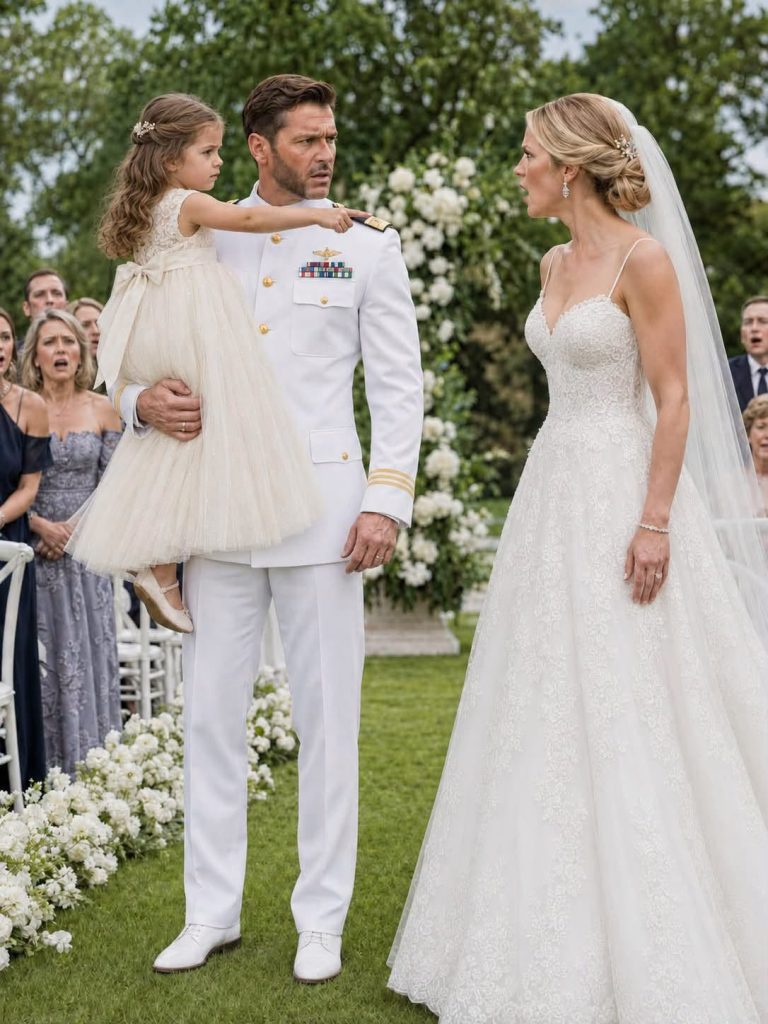
We planned a small wedding at Willow Ridge Lodge outside Colorado Springs, where a garden terrace overlooked pine-covered hills near Fort Carson. White chairs lined the lawn, strings of soft lights crossed between wooden beams, and wildflowers decorated an arbor overlooking the mountains.
Emily spent several weeks choosing her pale-blue junior bridesmaid dress. She practiced walking slowly with the flower basket because she worried excitement would make her scatter everything before reaching the aisle.
On the wedding morning, Vanessa complimented her dress and kissed the top of her head.
At least, that was what I saw.
Shortly before the ceremony, my sister Laura entered the preparation room and asked whether Emily had joined the wedding party outside. I assumed she was helping the photographer, but her assigned chair remained empty.
I checked the garden, kitchen, guest rooms, and upstairs hallway. Nobody remembered seeing her leave.
Then I heard a faint movement behind the laundry-room door near the lodge’s service corridor.
The handle would not turn.
“Emily, are you inside that room?”
PART 2 — THE EMPTY PLACE BESIDE ME
“Emily, are you inside that room?”
For one second, there was nothing.
Then I heard it.
A small breath.
Not crying.
Not yet.
The kind of breath a child takes when she has been trying very hard not to make noise.
“Daddy?”
Every muscle in my body tightened.
“I’m here.”
I put my hand on the handle again.
Locked.
“Can you open the door?”
“No.”
Her voice was thin.
“She locked it.”
I stopped.
Behind me, Laura went completely still.
“What did she say?” my sister whispered.
I did not answer.
I kept my voice level.
The voice I used when soldiers were frightened and looking at me for an indication of how afraid they were allowed to be.
“Emily, sweetheart, step away from the door.”
“I’m already by the washer.”
“Good. Stay there.”
I looked at Laura.
“Find lodge staff. Now.”
She was already moving.
I tried the handle once more.
No give.
The corridor smelled faintly of detergent and cedar cleaner.
From somewhere beyond the service hall, I could hear the wedding music beginning outside.
A string quartet.
The first piece Vanessa had chosen.
Gentle.
Elegant.
Completely wrong.
“Daddy?”
“I’m still here.”
“Are you mad?”
The question cut through me.
“At you?”
“Yes.”
“No.”
There was a pause.
Then Emily whispered:
“She said you would be.”
Something cold moved through my chest.
“Who said that?”
Another pause.
I already knew.
But I needed to hear it from her.
“Vanessa.”
The string quartet kept playing.
Outside, one hundred and twelve guests were waiting for me to walk toward the arbor.
Inside, my daughter was locked in a laundry room asking whether I was angry at her.
I crouched beside the door.
“What did Vanessa tell you?”
Emily said nothing.
“Sweetheart, you can tell me.”
“She said…”
Her voice broke.
I closed my eyes.
“She said what?”
“She said I was making today harder for you.”
My jaw tightened.
“How?”
“She said you were trying to start a new family.”
I stopped breathing.
“And that I…”
Emily sniffed.
“That I keep making you remember the old one.”
Laura returned with a maintenance employee carrying a ring of keys.
He saw my face and did not ask questions.
He tried one key.
Wrong.
Another.
Wrong.
Behind me, footsteps began gathering.
My best man, Daniel.
Vanessa’s brother.
Two lodge employees.
Someone asked whether everything was all right.
I turned.
“Clear the hallway.”
My tone left no room for discussion.
Everyone moved.
The maintenance worker found the correct key.
The lock clicked.
I opened the door.
Emily was sitting on the floor between an industrial washing machine and a metal shelving rack.
Her flower basket lay beside her.
Half the petals had spilled onto the tile.
Her pale-blue dress was wrinkled at the waist where she had been hugging her knees.
Her hair, which Laura had spent nearly an hour curling that morning, had fallen loose on one side.
Her cheeks were wet.
What I remember most were her shoes.
White flats.
Perfectly still.
She had been sitting there waiting because an adult told her to.
Waiting for my wedding to happen without her.
I stepped inside.
Emily looked up at me.
“I’m sorry.”
That nearly destroyed me.
I crossed the room and knelt.
“No.”
I took her face gently in both hands.
“Do not apologize.”
“I was supposed to stay.”
“No.”
“She said—”
“Emily.”
I made her look at me.
“You did nothing wrong.”
Her mouth trembled.
Then she threw both arms around my neck.
I held her.
Harder than I had held anyone in years.
For a moment, I forgot the tuxedo.
The guests.
The music.
The woman waiting in a white dress one corridor away.
There was only my daughter shaking against me.
My child.
The person whose safety had been entrusted to me long before any marriage vow.
Laura stood in the doorway crying silently.
I looked over Emily’s shoulder at her.
“What happened?”
Laura shook her head.
“I don’t know.”
I turned back to Emily.
“Tell me exactly what Vanessa said.”
Emily pulled away.
Fear crossed her face.
“Daddy…”
“I’m not angry with you.”
“She said it was supposed to be a secret.”
“Secrets that make you scared are not secrets you have to keep.”
Her eyes filled again.
She looked toward Laura.
Then at me.
“Vanessa came into the room after Aunt Laura left.”
“What time?”
“I don’t know.”
“That’s okay.”
“She said she needed help.”
“With what?”
“Her bracelet.”
Emily swallowed.
“So I went with her.”
“Here?”
She nodded.
“She brought me down this hallway.”
“Did she bring you into the laundry room?”
“Yes.”
My hands went cold.
“Then what?”
“She closed the door.”
“Did she lock it?”
Emily looked at the floor.
“Yes.”
Laura covered her mouth.
I felt something shift inside me.
Not anger yet.
Anger is hot.
This was colder.
Cleaner.
The moment a fact becomes irreversible.
“Why?”
Emily started crying again.
“She said I wasn’t going to walk in the wedding.”
The room disappeared around me.
“What?”
“She said the plan changed.”
“Who changed it?”
“She did.”
I felt my heartbeat in my throat.
“What reason did she give you?”
Emily’s answer came in pieces.
“She said today was about you and her.”
I waited.
“And…”
She rubbed her palms against the skirt of her dress.
“And she said people would look at me and think about Mommy.”
Nobody moved.
I stared at my daughter.
She continued because children often keep telling the truth once they finally realize someone is listening.
“She said that would make the wedding sad.”
My vision narrowed.
“She said your guests shouldn’t be thinking about a dead woman when she walked down the aisle.”
Laura whispered:
“Oh my God.”
Emily looked frightened by her own words.
I forced my voice to remain soft.
“Anything else?”
She nodded.
“She said after today things were going to be different.”
“How?”
“She said you needed to stop living like it was only you and me.”
My chest tightened.
“She said I have to learn that she comes first now because she’ll be your wife.”
I looked at Laura.
Her face had turned white.
Emily continued.
“And maybe I would go somewhere.”
I went completely still.
“Go where?”
“She said boarding school.”
The word barely made sense at first.
Then it landed.
Boarding school.
I had never discussed boarding school.
Never researched one.
Never mentioned the possibility.
Emily had attended Briarwood Academy since first grade.
I had no intention of changing that.
“Did Vanessa tell you I wanted you to go to boarding school?”
Emily nodded.
Something broke.
Not loudly.
Not dramatically.
Just a final interior thread snapping.
I stood.
Laura immediately said:
“Andrew.”
I looked at her.
“I need you to stay with Emily.”
She knew what my face meant.
“What are you going to do?”
I adjusted the front of my jacket.
Then looked at my daughter.
Her flower basket remained on the floor.
Petals scattered around it.
I picked it up.
Placed it gently in her hands.
“You were supposed to walk before me today.”
Emily nodded.
“You practiced for three weeks.”
Another nod.
“You were excited.”
Her eyes filled.
“Yes.”
I kissed her forehead.
Then I stood.
“There will be no ceremony.”
Laura inhaled sharply.
Emily stared at me.
“Because of me?”
“No.”
I crouched once more.
“Because of her.”
At 2:57 p.m., I walked out of the laundry room.
The ceremony was scheduled for three.
I had exactly three minutes before Vanessa was supposed to begin walking down the aisle.
Daniel, my best man, stood near the end of the service corridor.
He had served with me for eleven years.
He knew my expressions better than most people.
One look at my face and he stopped smiling.
“What happened?”
“Stop the music.”
He frowned.
“What?”
“Stop the ceremony.”
“Andrew—”
“Now.”
He moved.
No questions.
That is one of the things I have always valued about soldiers.
There is a time for clarification.
And there is a time to recognize the order came from somewhere serious.
The quartet stopped mid-piece.
Outside, murmurs spread among the guests.
I walked toward the bridal preparation suite.
Vanessa’s mother, Elaine, stepped into the hallway first.
She looked annoyed.
“Andrew, what is happening? They stopped the music.”
“Where is Vanessa?”
Elaine blinked.
“She’s getting ready.”
“I need to speak to her.”
“You can’t see the bride before the ceremony.”
I stared at her.
The old superstition would have been funny under different circumstances.
“Move.”
Her expression hardened.
“Excuse me?”
“Please step aside.”
Something in my voice reached her.
She moved.
I knocked once.
Then opened the door.
Vanessa stood in front of the mirror.
For one absurd second, she looked exactly like the woman I thought I had come there to marry.
White dress.
Hair pinned loosely at the back.
Small pearl earrings Caroline’s mother had once complimented when Vanessa wore them to dinner.
She turned.
Her smile appeared instantly.
“There you are.”
Then she saw my face.
The smile vanished.
Her maid of honor, Jenna, was adjusting the train.
Two other bridesmaids stood near the window.
Vanessa looked behind me.
“Where’s Emily?”
That question told me more than I expected.
I watched her carefully.
“Where do you think she is?”
Vanessa’s eyes flickered.
Just once.
“I assumed she was lining up.”
“No.”
Her hand tightened around the bouquet.
“What happened?”
“You tell me.”
She looked at the bridesmaids.
Then at me.
“Andrew, what is this?”
I closed the door behind me.
“Did you lock my daughter in the laundry room?”
Every face in the room changed.
Jenna stopped moving.
One bridesmaid whispered:
“What?”
Vanessa stared at me.
Then laughed.
It was small.
Nervous.
“That’s ridiculous.”
I said nothing.
Her smile weakened.
“I didn’t lock her anywhere.”
“Emily says you did.”
Vanessa exhaled sharply.
“She misunderstood.”
The words hit me almost as hard as the act itself.
Not denial.
Revision.
“What did she misunderstand?”
Vanessa glanced toward Jenna.
No help came.
Finally:
“She was getting emotional.”
“She was sitting behind a locked door.”
“I told her to wait somewhere quiet.”
“You locked the door.”
“I closed it.”
“The maintenance key opened it.”
Silence.
Vanessa’s face tightened.
“Maybe it locked automatically.”
“It doesn’t.”
She looked away.
I had already asked the maintenance employee.
Service rooms required manual locking from the outside.
She did not know that.
I did.
Now.
“Andrew.”
Her voice softened.
The voice she used when she wanted to pull me away from facts and toward feelings.
“Please.”
I waited.
“We can talk about this after.”
“After what?”
“The ceremony.”
I stared at her.
“You think there is still going to be a ceremony?”
Every bit of color left her face.
“Don’t do this.”
I almost admired the sentence.
Do this.
As if cancellation were the betrayal.
Not the child locked beside a washing machine.
“You told Emily she was making me remember Caroline.”
Vanessa closed her eyes.
“Oh God.”
“You told her people would think about my dead wife if they saw her.”
“That is not what I meant.”
“What did you mean?”
She looked at me.
Tears appeared.
Fast.
Too fast.
“I have spent two years feeling like I am competing with a ghost.”
The bridesmaids went silent.
I stared.
“Caroline is dead.”
“I know.”
“You told me you understood that she would always matter.”
“I tried.”
“Did you?”
Vanessa’s tears spilled.
“Do you have any idea what it’s like to walk into a house where another woman is everywhere?”
I said nothing.
“Her photographs.”
I felt something inside me harden.
“Emily’s mother is allowed to have photographs in Emily’s home.”
“That’s not what I’m saying.”
“It sounds exactly like what you’re saying.”
Vanessa put down the bouquet.
“I wanted one day.”
“One day for what?”
“For it to be about us.”
“It was.”
“No, Andrew.”
She wiped her cheek.
“Everything comes back to Emily.”
My jaw tightened.
“She’s nine.”
“I know how old she is.”
“Apparently not.”
Her face changed.
“That’s unfair.”
“Unfair?”
My voice rose for the first time.
“She was locked in a laundry room three minutes before my wedding.”
Jenna stepped backward.
Vanessa whispered:
“Keep your voice down.”
And there it was.
Appearance.
Even now.
My daughter had been hidden.
But the raised voice was embarrassing.
I laughed once.
Cold.
“There’s not going to be anything to keep quiet in five minutes.”
Vanessa stared.
“You cannot cancel this wedding over a misunderstanding.”
“I can cancel this wedding because I do not trust the woman standing in front of me with my child.”
Her mouth fell open.
“I love Emily.”
“No.”
I shook my head.
“You loved being seen loving Emily.”
She flinched.
“That’s cruel.”
“Is it wrong?”
Silence.
I continued.
“You helped with school projects.”
“Yes.”
“You attended concerts.”
“Yes.”
“You knew exactly what I needed to see.”
Her expression hardened.
“So now everything I did was fake?”
“I’m asking myself that.”
She stepped closer.
“You are throwing away two years because your daughter got upset.”
My entire body went still.
The room seemed to recognize it.
Jenna looked at Vanessa in disbelief.
One bridesmaid quietly set down her champagne glass.
I asked:
“What did you just say?”
Vanessa immediately knew.
“That’s not—”
“Say it again.”
“I didn’t mean—”
“My daughter got upset?”
“She is sensitive.”
“No.”
I stepped closer.
“She was locked in a room.”
Vanessa started crying harder.
“I panicked.”
Finally.
Truth.
A little piece.
“Why?”
She covered her face.
“I wanted the photographs to be right.”
I stared.
“What?”
She lowered her hands.
“The photographer said we only had a limited window before the light changed.”
I could not believe what I was hearing.
“What does that have to do with Emily?”
“I wanted some pictures of just us.”
“You could have asked for that.”
“I know.”
“Then why hide her?”
Vanessa looked away.
“Because she kept insisting on carrying Caroline’s locket.”
My heartbeat stopped.
“What locket?”
Vanessa said nothing.
I knew the one.
Small silver oval.
Caroline’s photograph inside.
Emily had asked me the week before whether she could wear it beneath her dress.
I had said yes.
Of course.
It was not visible unless she opened it.
“You made this about a necklace?”
“She was going to show people.”
“She was carrying her mother with her.”
“Exactly.”
Vanessa snapped the word.
Then froze.
The room went silent.
I stared at her.
Exactly.
There it was.
Not the cake.
Not the photographs.
Not timing.
Caroline.
She could tolerate my dead wife as long as Caroline remained abstract.
A sad chapter.
A photograph in another room.
A story mentioned carefully.
But Emily was living proof that Caroline existed.
And Vanessa wanted the wedding to mark a replacement.
Not an addition.
A replacement.
I turned toward the door.
Vanessa grabbed my arm.
“Andrew, wait.”
I looked down at her hand.
She let go.
“This is fixable.”
“No.”
“Please.”
“No.”
“What are you going to tell everyone?”
“The truth.”
Her face changed.
Fear.
Not heartbreak.
Fear.
“Andrew.”
I reached for the handle.
“Please don’t humiliate me.”
I looked back.
“My daughter was sitting on a laundry-room floor because you were worried a dead woman might appear in your wedding photographs.”
My voice lowered.
“You humiliated yourself.”
Then I walked out.
At 3:06, I stood in front of our guests.
The mountains were still there.
The wildflowers still moved in the wind.
The white chairs were full.
People looked confused.
Daniel stood beside me.
Laura had brought Emily to a private room away from the crowd.
I was grateful.
My daughter did not need to watch adults react to the wreckage.
I faced the guests.
There are moments when military training helps.
Not because it removes emotion.
Because it teaches you to speak while emotion is trying to close your throat.
“Thank you for coming.”
The murmurs stopped.
“There will not be a wedding today.”
Gasps.
Someone near the back whispered loudly.
Vanessa’s mother stood.
“What?”
I continued.
“A serious issue involving my daughter came to my attention immediately before the ceremony.”
Elaine walked toward the aisle.
“This is private.”
I looked at her.
“Yes.”
“It is.”
Then back at the guests.
“I won’t share Emily’s private experience with a crowd.”
Elaine seemed relieved.
Too soon.
“But I will say this.”
I took a breath.
“My responsibility as a father does not become secondary because I planned to become a husband today.”
Silence.
“I am not asking anyone to choose sides.”
I looked toward the lodge.
“I am simply telling you the ceremony is canceled.”
Then I stepped away.
No speech.
No spectacle.
No revenge.
The truth did not need decorations.
The same flowers that were supposed to witness a wedding watched guests begin to leave.
I found Emily sitting with Laura in an upstairs suite.
Someone had given her hot chocolate.
She had changed out of her dress.
My Army sweatshirt hung nearly to her knees.
I sat beside her.
“Is Vanessa mad?”
“Probably.”
Emily looked down.
“Are you sad?”
That question hurt more.
“Yes.”
Her eyes filled.
“Because you’re not getting married?”
“Yes.”
I did not lie.
Children deserve to know that doing the right thing can hurt.
I put my arm around her.
“But being sad doesn’t mean I made the wrong choice.”
She leaned against me.
“What happens now?”
“We go home.”
“You and me?”
I looked at her.
“You and me.”
She started crying.
I held her.
Then she whispered something against my shirt.
“I didn’t want you to be alone.”
My chest tightened.
“Emily.”
“I thought if you didn’t marry her, you’d be lonely.”
I pulled back.
“Look at me.”
She did.
“You are not responsible for whether I am lonely.”
“But—”
“No.”
I wiped her cheek.
“My relationships are adult decisions.”
She nodded.
“You never have to accept being hurt because you think it will make my life easier.”
Her mouth trembled.
“Okay.”
I kissed her forehead.
Then she reached under the sweatshirt collar.
Pulled out Caroline’s silver locket.
I closed my eyes.
There it was.
Small enough to fit in a child’s palm.
Powerful enough, apparently, to expose an adult.
Emily opened it.
Caroline smiled from the tiny photograph.
“I told Vanessa I could hide it under the dress.”
My throat tightened.
“What did she say?”
Emily hesitated.
“What?”
“She said Mommy had already had her turn.”
I stopped breathing.
“What?”
“She said it was her turn now.”
Something about that sentence hurt more than everything else.
Not because it was louder.
Because it revealed the logic beneath all of it.
Love as a competition.
Motherhood as a position somebody inherited when the previous woman died.
I took the locket gently.
Then closed it.
“Your mother’s turn did not end because she died.”
Emily looked at me.
“And loving someone new would never erase her.”
She nodded.
I put the locket back into her hand.
“Keep it.”
We did not go home immediately.
There were practical problems.
A wedding canceled three minutes before the ceremony creates an astonishing amount of paperwork.
Vendors.
Hotels.
Guests.
Deposits.
Property.
Vanessa had belongings at my house.
I did not want Emily walking into an argument.
Daniel offered to take us to his place.
We accepted.
That evening, while Emily watched a movie with Daniel’s wife and children, I sat on the back porch with Laura.
She handed me a beer.
I did not open it.
“You all right?”
“No.”
“Good.”
I looked at her.
She shrugged.
“I’d worry if you said yes.”
For a while, we said nothing.
Then Laura asked:
“Did you know?”
“No.”
“Nothing?”
I thought.
That question is cruel after betrayal because hindsight is an aggressive editor.
Suddenly every scene offers itself as evidence.
Vanessa asking whether Caroline’s photographs could move from the living room to the hallway.
Reasonable, I thought.
Vanessa suggesting Emily might benefit from summer camp because I needed “adult time.”
Reasonable.
Vanessa saying nine was old enough for more independence.
Reasonable.
Vanessa once joking that Emily and I operated like an “exclusive little club.”
I had laughed.
Now I didn’t.
“I missed things.”
Laura shook her head.
“You trusted her.”
“That’s not always different.”
My sister studied me.
Then:
“Emily told me something else.”
I looked over.
“What?”
“She didn’t want to tell you.”
My stomach tightened.
“Tell me.”
Laura hesitated.
“She said Vanessa had been talking about boarding school for months.”
The porch seemed to tilt.
“What?”
“She showed Emily a website.”
I stared.
“When?”
“Three weeks ago.”
My hands went cold.
“What school?”
“Some academy in Virginia.”
I stood.
“No.”
Laura looked up.
“Andrew?”
“I never heard of it.”
“That’s what I figured.”
My mind raced.
Vanessa had not invented boarding school today.
She had been preparing Emily for it.
Without me.
“Did she tell Emily I agreed?”
Laura nodded.
Anger returned.
Colder than before.
“Anything else?”
Laura looked away.
That was enough.
“What?”
“She told Emily that once you were married, Vanessa would be legally allowed to make more decisions.”
My jaw tightened.
“She said you were too busy with the Army to do everything.”
I stared into the dark yard.
A plan.
Not a tantrum.
Not wedding-day jealousy.
A plan.
I took out my phone.
Opened my messages.
Scrolled backward.
Vanessa had sent me articles months earlier.
Military family stress.
Children adjusting to remarriage.
Residential schools for children of deployed parents.
I had barely read them.
She framed them as curiosity.
General information.
Now my skin crawled.
I looked at Laura.
“Stay with Emily.”
“Where are you going?”
“Nowhere.”
I sat again.
Then opened the shared cloud account Vanessa and I used for wedding documents.
Search.
Boarding.
Nothing.
Search.
School.
Too much.
Then:
St. Catherine’s Residential Academy.
A PDF.
Application packet.
I opened it.
My hands went numb.
Student:
Emily Caroline Mercer.
Age:
Nine.
Parent/Guardian:
Andrew Mercer.
Secondary Guardian:
Vanessa Hart.
I stared.
“What?” Laura asked.
I handed her the phone.
Her face changed.
“Did you fill this out?”
“No.”
“Did you know about it?”
“No.”
The application was incomplete.
But enough had been entered.
Emily’s birth date.
School history.
My duty assignment.
Medical information.
Emergency contacts.
And in a section labeled Reason for Residential Placement, someone had written:
Father’s military responsibilities create inconsistent home structure. Prospective stepmother believes child would benefit from stable residential environment following remarriage.
I read it twice.
Then a third time.
Prospective stepmother believes.
Not father.
Vanessa.
Laura whispered:
“She was really going to try to send her away.”
I said nothing.
Because another file sat directly beneath it.
A scanned document.
FAMILY TRUST SUMMARY — CAROLINE MERCER ESTATE
My heartbeat changed.
Caroline’s trust.
The money she left for Emily.
I had never given Vanessa access to those documents.
Never.
I opened the file.
It was a copy of an annual statement.
Emily’s trust was substantial.
Caroline’s parents had contributed too.
The funds were restricted for education, health, and Emily’s benefit.
My mouth went dry.
Laura asked:
“Why does Vanessa have that?”
“I don’t know.”
Then I saw a handwritten note scanned beside the statement.
Not mine.
Vanessa’s.
I recognized the slanted handwriting from hundreds of wedding lists.
Residential tuition potentially payable from trust? Confirm after marriage.
I stopped breathing.
Laura whispered:
“Andrew.”
I kept scrolling.
Another note.
If Andrew deploys, POA may simplify control. Ask attorney after wedding.
Everything inside me went silent.
Power of attorney.
Trust.
Boarding school.
Emily.
This had gone far beyond a cruel sentence in a laundry room.
I called Daniel.
He answered immediately.
“What?”
“I need you to do something.”
“Name it.”
“Go back to the lodge.”
Pause.
“Why?”
“Vanessa had a laptop in the bridal suite.”
“I saw it.”
“Make sure nobody touches it.”
Daniel’s voice changed.
“Andrew, what did you find?”
I stared at Caroline’s trust statement on my screen.
“I’m not sure yet.”
Then I corrected myself.
“No.”
I had spent enough of the day minimizing what I could see.
“I found documents Vanessa had no legitimate reason to possess.”
Daniel was silent.
Then:
“I’m leaving now.”
Twenty-eight minutes later, he called.
“Andrew.”
His voice was wrong.
“What?”
“The laptop’s gone.”
I stood.
“Who took it?”
“Vanessa left fifteen minutes ago.”
My jaw tightened.
“Alone?”
“No.”
“Who?”
“Her mother.”
Of course.
“Anything left in the room?”
Daniel hesitated.
“Yes.”
“What?”
“A folder.”
“What kind?”
“Printed documents.”
My stomach tightened.
“Take pictures. Don’t remove anything unless lodge management approves.”
“Already talking to them.”
Then he went quiet.
“Andrew.”
“What?”
“Your name is on some of these.”
“Doing what?”
“I’m looking at a draft.”
“What draft?”
Paper moved on his end.
Then he read.
“Petition for delegation of parental authority during active military duty.”
I stopped breathing.
“That’s not unusual by itself.”
“No.”
He swallowed.
“But this one names Vanessa.”
I closed my eyes.
“When was it prepared?”
“Two months ago.”
Before the wedding.
Before she would have any legal relationship to Emily.
“Is there a signature?”
“No.”
“Attorney name?”
“Yes.”
“Who?”
He read it.
I knew the firm.
Not personally.
Family law.
Colorado Springs.
Daniel continued.
“There’s a note clipped to the front.”
“What does it say?”
Silence.
“Daniel.”
His voice lowered.
“‘Best completed before Andrew receives next movement orders.’”
My blood went cold.
Only a few people knew I was under consideration for a temporary overseas assignment later that year.
Vanessa knew.
My command knew.
Immediate family knew.
But nothing had been decided.
She had been preparing for the possibility that I would be gone.
Preparing paperwork.
Preparing Emily.
Preparing the removal of my daughter from my home.
And apparently preparing access to money Caroline had left behind.
Laura stared at me.
She could not hear Daniel, but she knew.
“What else?”
Daniel exhaled.
“There are emails printed underneath.”
“Between who?”
“Vanessa and her mother.”
I looked toward the room where Emily was laughing faintly at the movie.
My child had no idea the adults outside were discovering how close her life had come to changing without her consent.
“Read one.”
Daniel hesitated.
Then:
“Elaine wrote: ‘Once the wedding is done, Andrew will be easier to manage. He won’t want another failed family.’”
My stomach turned.
Daniel continued.
“Vanessa replied: ‘I know. Emily is the bigger obstacle. He makes every decision around her.’”
Laura covered her mouth when I repeated it.
“Keep going.”
Another rustle.
“Elaine: ‘Boarding school solves that and gives you two space to build your marriage.’”
Then Vanessa:
“‘He’ll never agree while he thinks she needs him. I need him to see the arrangement as necessary, not optional.’”
I closed my eyes.
There it was.
The part that hurt most.
Not:
I hope he agrees.
Not:
Maybe this could help.
I need him to see.
Manage.
Shape.
Control.
My entire relationship was suddenly full of verbs I hated.
“What’s the last email?”
Daniel went silent.
Long enough that I opened my eyes.
“Daniel.”
“This one is from yesterday.”
My hand tightened around the phone.
“Read it.”
“Vanessa to Elaine.”
A pause.
Then:
“‘Tomorrow has to reset everything. Once I’m his wife, Caroline stops being the center of that house. If Emily ruins the ceremony with the locket or starts crying, I’ll keep her inside until it’s over. Andrew will be angry, but he’ll calm down after we’re married.’”
I sat down.
Laura whispered:
“Oh my God.”
I could hear Daniel breathing.
Then he said:
“She planned it.”
“Yes.”
Not an impulsive decision.
Not a nervous bride.
Not a misunderstanding.
A plan.
She expected me to be angry.
She simply believed the legal and emotional fact of marriage would trap me into accepting it afterward.
That was the arrogance beneath everything.
She thought the ceremony was a finish line.
If she could get across it, consequences would become negotiations.
I looked toward the room where Emily sat.
Then said:
“Photograph every page.”
“I will.”
“Get lodge staff to preserve camera footage.”
“Already requested.”
“And Daniel?”
“Yes?”
“Thank you.”
He was quiet.
Then:
“Take care of your kid.”
“I will.”
I ended the call.
Laura sat beside me.
“What are you going to do?”
I stared at the dark phone screen.
“The wedding is over.”
“I know.”
“I mean all of it.”
My throat tightened.
“She will not be alone with Emily again.”
Laura nodded.
“And the documents?”
“I’m calling an attorney tonight.”
“Do you think Vanessa could actually get control of the trust?”
“No.”
I said it immediately.
Then:
“But the fact that she was asking is enough.”
Laura leaned back.
“Do you think she loved you?”
The question hurt.
I thought of two years.
Vacations.
Dinners.
Her hand in mine.
The night I proposed.
Her crying yes.
I thought of her sitting beside me on the anniversary of Caroline’s death and saying nothing while I stared at an old photograph.
I thought of every real-looking moment.
“I think she loved the life she believed marriage to me would give her.”
Laura said nothing.
I looked at her.
“I don’t know anymore whether that’s the same as loving me.”
At 8:43 that night, Vanessa called.
I watched the phone ring.
Once.
Twice.
Three times.
I answered.
“Andrew.”
She was crying.
“I need to explain.”
“No.”
“Please.”
“Did you prepare a boarding-school application for Emily?”
Silence.
Her crying stopped.
“Where did you get that?”
Wrong answer.
“Did you?”
“Andrew—”
“Did you?”
“Yes.”
I closed my eyes.
“Did you access Caroline’s trust documents?”
Another pause.
“I saw a statement in your office.”
“That statement was inside a locked file cabinet.”
Silence.
“How did you get it?”
“I was looking for tax documents.”
“No.”
“Andrew, I was trying to plan for us.”
“There is no us.”
She began crying again.
“Don’t say that.”
“I mean it.”
“You’re upset.”
I laughed.
There it was again.
Upset.
As if emotion invalidated evidence.
“I have never been more certain of anything in my life.”
“Emily misunderstood what happened.”
“I found the email from yesterday.”
Silence.
Complete.
Dead.
“What email?”
“The one where you told your mother you would keep Emily inside until the ceremony ended if she caused a problem.”
Vanessa stopped breathing.
I continued.
“You knew exactly what you were doing.”
She whispered:
“I was overwhelmed.”
“You had written it the day before.”
“I was scared.”
“Of a nine-year-old wearing her mother’s locket?”
“You don’t understand.”
“Then help me.”
My voice sharpened.
“Explain why my daughter needed to disappear for you to feel secure.”
No answer.
“Explain why you were preparing a school application I never authorized.”
Nothing.
“Explain why you were asking how Caroline’s trust could pay for it.”
Her voice finally came.
“I wanted a marriage.”
“So did I.”
“A real one.”
I went still.
“What does that mean?”
“It means I didn’t want to spend the next thirty years living around your dead wife.”
My chest tightened.
“Caroline is not in competition with you.”
“She is in that house.”
“She is Emily’s mother.”
“And I would have been your wife.”
Would have been.
At least some part of her understood now.
I answered quietly:
“You were never asked to erase one role to occupy the other.”
She started sobbing.
“I gave you two years.”
“No.”
I looked toward Emily.
“You were given two years.”
Silence.
“And today I learned what you planned to do with them.”
Vanessa whispered:
“Are you really choosing a child over your marriage?”
The question was so revealing that I felt calm.
Completely calm.
“Yes.”
A pause.
Then:
“Every time.”
She began saying my name.
I ended the call.
Later that night, Emily fell asleep on Daniel’s couch.
The locket was still around her neck.
I covered her with a blanket.
Then sat on the floor beside her.
For almost an hour, I watched her breathe.
I thought about how close I had come.
Three minutes.
If Laura had not asked where Emily was.
If I had assumed she was with the photographer.
If the music had started.
If I had walked outside.
If Vanessa had reached the aisle.
If we had said vows before Emily was found.
None of it would have made what Vanessa did acceptable.
But it would have made everything harder.
Legal.
Financial.
Emotional.
Complicated.
Vanessa had counted on complication.
She believed once we were married, I would protect the marriage from the truth.
I looked at my daughter sleeping beneath someone else’s blanket.
Then at Caroline’s locket resting against her chest.
And I understood something painfully simple.
A wedding is a promise about the future.
But before I could make that promise to Vanessa, I had already made another one years earlier.
At a hospital.
Caroline weak beside me.
Emily five years old and asleep in a chair near the window.
Caroline had taken my hand.
“Whatever happens to me…”
I told her not to talk like that.
She squeezed harder.
“Andrew.”
I listened.
“She needs to know she was never left behind.”
That was what Caroline had said.
Not protect her from everything.
Impossible.
Not never love again.
She wanted that for me.
Just:
Never let Emily believe she had been left behind.
Five years later, in a wedding lodge surrounded by flowers, the woman I intended to marry had locked my daughter away so she could begin a new family without the old one visible.
Vanessa thought she was removing a complication from the ceremony.
What she actually did was answer the only question that mattered before I said my vows.
Would this woman protect my daughter when I was not looking?
No.
And there are some answers a father only needs to hear once.
I touched the edge of the blanket.
Emily stirred.
Her eyes opened slightly.
“Daddy?”
“I’m here.”
“Wedding canceled?”
“Yes.”
She thought for a moment.
Then:
“Are we still a family?”
My throat closed.
I leaned down and kissed her forehead.
“We always were.”
She smiled sleepily.
Then closed her eyes.
I sat there until long after midnight.
Thinking the worst secret of the day had already been uncovered.
I was wrong.
Because at 12:47 a.m., my attorney called after reviewing the photographs Daniel had sent.
And the first thing she said was:
“Andrew, the boarding-school application isn’t the document you should be most worried about.”
I stood.
“What is?”
A pause.
Then:
“There’s a draft petition concerning Emily’s trust.”
My blood went cold.
“What kind of petition?”
My attorney exhaled slowly.
“One asking the court to determine whether your future deployments make you an unsuitable sole trustee.”
I stopped breathing.
“Who prepared it?”
Another pause.
“Vanessa’s attorney.”
I looked at my sleeping daughter.
“And who was supposed to replace me?”
My attorney’s answer made the room go completely silent.
“Vanessa.”
The wedding had not only been about becoming my wife.
She had been preparing to become something else.
The person standing between me, my daughter, and everything Caroline had left behind.
PART 3 — THE PROMISE I HAD ALREADY MADE
For several seconds, I could not speak.
The phone remained pressed against my ear.
My attorney, Rebecca Sloan, waited quietly on the other end.
Across the room, Emily slept beneath Daniel’s blanket with Caroline’s silver locket resting against her chest.
The little oval caught the light from the hallway.
A tiny silver flash.
A reminder.
A warning.
A promise.
“What exactly are you telling me?” I finally asked.
Rebecca exhaled.
“I’m telling you there is a draft petition in the documents recovered from the bridal suite.”
“Draft.”
“Yes.”
“Not filed.”
“Not that we can see.”
I closed my eyes.
That mattered.
Not enough.
But it mattered.
“What does it say?”
Her voice became more careful.
“It argues that your possible deployments and military responsibilities could create instability in the administration of Emily’s trust.”
My jaw tightened.
“I have administered that trust for five years without a single issue.”
“I know.”
“My accountant reviews it.”
“Yes.”
“Caroline’s estate attorney reviews annual statements.”
“I know.”
“So what basis could anyone possibly have?”
“That appears to be the problem.”
I stood and walked toward the window.
Daniel’s backyard was dark.
A porch light illuminated wet grass and the outline of a wooden swing set.
Ordinary things.
Things that suddenly seemed more valuable than money.
Rebecca continued.
“The petition itself is weak as written.”
“Then why prepare it?”
“I think that is the question we need to answer.”
I looked back at Emily.
“And Vanessa was named as proposed successor trustee.”
“Yes.”
“Before we were married.”
“Yes.”
“Without my knowledge.”
“Yes.”
I rubbed one hand over my face.
“What would she gain?”
“Direct access? Not automatically.”
“Control?”
“Potentially, if a court ever approved a change.”
“Money?”
“Not personally, at least not legally.”
I almost laughed.
Legally.
That word had become important.
“So why?”
Rebecca paused.
“Andrew, there are handwritten notes attached to the draft.”
My stomach tightened.
“What notes?”
“One references St. Catherine’s tuition.”
Of course.
Another piece sliding into place.
“And?”
“One says, ‘Trust can fund educational placement if deemed in child’s interest.’”
I stared at the dark window.
Boarding school.
Emily gone.
Trust paying the bill.
Vanessa controlling the narrative.
I felt sick.
“Anything else?”
Rebecca hesitated.
“Yes.”
“What?”
“Another note says, ‘Once Andrew is deployed, establish pattern of delegated control.’”
The room seemed to get colder.
I said nothing.
Rebecca continued.
“There’s no evidence this strategy would have succeeded.”
“I understand.”
“I need you to hear that.”
“I do.”
“No one was about to casually remove you as trustee.”
“I know.”
“But someone was thinking about how to try.”
My throat tightened.
That was the part.
Not whether Vanessa would have won.
The fact that she had prepared.
Studied.
Planned.
I had been choosing flowers while she was drafting a future in which my daughter lived somewhere else and I had less authority over the estate Caroline left behind.
“Rebecca.”
“Yes?”
“Is there any chance she had legitimate reasons?”
A long silence.
Not because Rebecca thought there were.
Because she understood why I needed to ask.
“Possibly she convinced herself she did.”
That answer hurt.
Maybe more than no.
Because that was how people crossed lines.
Not always by telling themselves they were cruel.
Sometimes by renaming control as care.
“She told herself I was too busy,” I said.
“Maybe.”
“That Emily needed stability.”
“Maybe.”
“That she was helping.”
“Maybe.”
I looked at my daughter.
“And she locked a nine-year-old in a laundry room.”
Rebecca’s voice softened.
“Yes.”
I closed my eyes.
“That part doesn’t need legal interpretation.”
“No.”
No.
It didn’t.
By sunrise, I had made three decisions.
The first was that Emily would not return to my house until Vanessa’s belongings had been removed.
The second was that Vanessa would not have any unsupervised contact with my daughter.
The third was that I would not turn the aftermath into a war Emily had to witness.
Anger wanted spectacle.
Fatherhood required discipline.
I knew the difference.
At seven-thirty, Emily woke.
She sat up slowly, hair tangled, Caroline’s locket still around her neck.
For a second, she looked confused.
Then everything came back.
Her face changed.
“Morning.”
I sat beside her.
“Morning.”
“Where’s Vanessa?”
“I don’t know.”
“Is she coming here?”
“No.”
Emily looked down at the blanket.
“Ever?”
The question was careful.
I understood.
Children can miss people who hurt them.
Adults find that confusing because adults want emotions to behave like court verdicts.
Guilty.
Innocent.
Loved.
Hated.
Children are rarely that tidy.
“Not without me knowing about it.”
She nodded.
Then whispered:
“Will I ever see her again?”
“I don’t know yet.”
Emily picked at a loose thread.
“I still love her a little.”
My chest hurt.
“That’s okay.”
She looked up quickly.
“You’re not mad?”
“No.”
“She was mean.”
“Yes.”
“But she wasn’t mean all the time.”
“I know.”
“She helped me with my solar system.”
“I remember.”
“She made those strawberry cupcakes.”
“Yes.”
Emily’s eyes filled.
“I don’t understand.”
Neither did I.
Not completely.
I put my arm around her.
“Someone can do kind things and still make a choice that hurts you badly.”
She leaned against me.
“Does that mean all the kind things were fake?”
“No.”
I thought before continuing.
“Not necessarily.”
She was quiet.
“Then why did she lock me in there?”
My throat tightened.
“Because she wanted something to happen her way.”
“That’s dumb.”
I almost smiled.
“Yes.”
“She could’ve just asked me not to show the locket.”
“She could have.”
“I still would’ve worn it.”
“I know.”
That earned the first tiny smile of the morning.
Then Emily asked:
“Are you sad?”
“Yes.”
“Really sad?”
“Yes.”
She looked guilty.
I caught it immediately.
“Emily.”
“I know.”
“No.”
I turned toward her.
“Say it.”
She frowned.
“What?”
“The thing I told you yesterday.”
She thought.
Then softly:
“My job isn’t to make you not lonely.”
“Right.”
“And your grown-up relationships are grown-up decisions.”
“Right.”
“And I don’t have to let somebody hurt me to make your life easier.”
My throat closed.
“Exactly.”
She nodded.
Then:
“I still think you should date someone eventually.”
I laughed.
The sound surprised both of us.
“Thank you for the strategic guidance.”
“You’re welcome.”
“Can I have breakfast first?”
“Probably.”
That was Emily.
Nine years old.
Locked in a laundry room one afternoon.
Managing my romantic future the next morning.
Children are astonishing that way.
Not resilient because pain does not hurt them.
Resilient because life keeps asking them to be children anyway.
Daniel returned from the lodge around ten.
He brought two boxes.
One held the printed documents.
The other held personal items that belonged to me and Emily.
He had also brought the flower basket.
I stared at it.
A few dried petals remained inside.
Emily saw it from across the room.
Her face changed.
“You want me to put it away?” I asked.
She walked over.
Picked it up.
Turned it once in her hands.
Then said:
“I don’t want it.”
“Okay.”
“Can we throw it away?”
“Of course.”
She frowned.
“Actually…”
I waited.
“Can we keep the ribbon?”
The pale-blue ribbon wrapped around the handle.
Laura had tied it herself.
“Absolutely.”
Emily pulled it loose.
She kept the ribbon.
We threw away the basket.
That seemed small.
It wasn’t.
Children should be allowed to decide which pieces of bad days follow them home.
Daniel spread the documents across his dining table.
Rebecca joined us by video call.
Laura sat beside me.
Emily was upstairs with Daniel’s wife.
I did not want her hearing adult speculation about her money, her school, or her future.
The papers were worse in daylight.
Not more dramatic.
More deliberate.
Lists.
Notes.
Printouts.
Emails.
Vanessa had researched St. Catherine’s for months.
Tuition.
Application cycles.
Boarding schedules.
Transportation.
She had exchanged messages with admissions staff using language that implied I was already considering enrollment.
I wasn’t.
She had asked whether military deployments created hardship exceptions for mid-year placement.
They did.
She had asked whether tuition could be paid by a child’s educational trust.
Potentially, with proper authority.
She had built a bridge before I knew there was a river.
Then Rebecca found something that made Laura swear under her breath.
A draft email.
Not sent.
Addressed to me.
Andrew, I know you’re upset that I took the initiative, but I did it because you’re too emotionally involved to see what Emily needs.
I stared.
The message continued.
She is overly dependent on you and still emotionally centered on Caroline. A structured residential environment could help her separate grief from identity.
My hands became cold.
Separate grief from identity.
Emily was nine.
Her mother died when she was four.
Of course Caroline lived inside her identity.
A dead parent is not a bad habit a child needs to outgrow.
Laura said quietly:
“She planned the argument too.”
Yes.
That was what frightened me.
Vanessa had not only planned the decision.
She had prepared the words she would use when I resisted.
You’re emotional.
You’re too involved.
You can’t see clearly.
I had heard versions of that logic in command environments.
Remove the person’s authority by questioning their judgment.
Then call control professionalism.
Rebecca said:
“There’s something else.”
I looked up.
She held one scanned page closer to the camera.
“What?”
“A billing record from the family-law firm.”
Vanessa had consulted them three times.
The first consultation took place almost six months before our wedding.
I remembered that month.
We were in love.
At least I was.
We had gone hiking near Estes Park.
Vanessa had laughed in the passenger seat because I forgot sunscreen.
She had fallen asleep with her head against the window on the drive home.
Two days later, apparently, she sat with a family-law attorney asking what legal authority a stepparent might eventually obtain over my daughter during military absences.
I felt physically ill.
“Does the attorney say why?”
Rebecca shook her head.
“Attorney-client material is another issue. We’re only seeing copies Vanessa retained.”
“Anything in her notes?”
“Yes.”
I braced myself.
Rebecca read:
Marriage first. Authority second. Trust only if necessary.
Laura whispered:
“Jesus.”
I stared at the words.
Marriage first.
Authority second.
Trust only if necessary.
Three short phrases.
My entire relationship suddenly reduced to sequence.
I thought about the vows I had almost spoken.
For richer, for poorer.
In sickness and health.
And all the while, Vanessa had another progression.
Marriage.
Authority.
Trust.
I stood and walked away from the table.
Daniel followed.
“Andrew.”
“I’m fine.”
“No, you’re not.”
I turned.
He had known me too long.
I laughed bitterly.
“I was three minutes away.”
“I know.”
“Three.”
He said nothing.
“I almost married someone who had been planning how to remove my daughter from my home.”
“You didn’t.”
“I almost did.”
“But you didn’t.”
I looked at him.
“I missed it.”
Daniel’s face hardened.
“Stop.”
“I’m supposed to read people.”
“You’re supposed to lead soldiers.”
“I’m supposed to notice patterns.”
“She loved you.”
I looked away.
“Or she understood me.”
“That’s not the same thing.”
“No.”
I swallowed.
“No, it isn’t.”
Daniel put one hand on my shoulder.
“You found Emily.”
“By accident.”
“You went looking.”
“Laura asked where she was.”
“And you looked.”
He squeezed my shoulder.
“You want to punish yourself for not knowing sooner because that feels more controllable than accepting somebody fooled you.”
I stared at him.
“You practicing therapy now?”
“No.”
“Good.”
“I’d be terrible.”
“You are.”
He almost smiled.
Then said:
“Protect Emily from what happens next.”
That brought me back.
He was right.
I could investigate myself later.
My daughter needed a father now.
Vanessa came to the house two days later to collect her belongings.
I was there.
So was Rebecca.
So was another neutral third party Rebecca recommended.
Emily stayed with Laura.
Vanessa arrived wearing jeans and a cream sweater.
No makeup.
No wedding dress.
No bouquet.
She looked exhausted.
For half a second, seeing her on my front porch triggered instinct.
Open the door.
Bring her inside.
Ask whether she had eaten.
Two years of habits do not disappear because truth arrives.
Then I remembered the laundry room.
I opened the door.
“Your things are packed.”
Vanessa looked past me.
“Where’s Emily?”
“Not here.”
Her face tightened.
“I want to apologize.”
“Not today.”
“She deserves—”
“No.”
My voice stayed calm.
“She deserves not to have to manage your guilt.”
Vanessa flinched.
“I’m not asking her to.”
“You’re asking to feel better.”
“That’s not fair.”
“Maybe.”
I stepped aside.
“You have forty-five minutes.”
She entered.
For several minutes, nobody spoke.
She walked from room to room identifying items.
Books.
Clothes.
Framed photographs.
Kitchen things.
A blue ceramic bowl she bought in Santa Fe.
Ordinary pieces of a relationship being separated into ownership.
Mine.
Yours.
Take it.
Leave it.
At one point, Vanessa stopped in front of a framed photograph of Caroline and Emily.
Caroline sat on a hospital garden bench with four-year-old Emily asleep against her chest.
The picture had always been in the hallway.
Vanessa stared.
Then whispered:
“I hated this photograph.”
I did not answer.
She turned.
“Do you know that?”
“No.”
“I did.”
“Why?”
“Because every time I saw it, I felt temporary.”
I looked at the picture.
“You weren’t.”
“I felt like I was.”
“That isn’t the same thing.”
She laughed sadly.
“No.”
I waited.
She touched the edge of the frame but did not lift it.
“I kept thinking if we got married, maybe that feeling would stop.”
“And Emily?”
Vanessa closed her eyes.
“I thought if she stopped centering everything around Caroline…”
“She doesn’t.”
“Yes, she does.”
“She remembers her mother.”
“She compares.”
“To what?”
“To me.”
I shook my head.
“Children don’t need to erase one mother to love another person.”
“I know that now.”
“No.”
My voice remained quiet.
“You knew it before. You just hated how it made you feel.”
She started crying.
Maybe that was cruel.
Maybe it was simply true.
Vanessa whispered:
“I did love her.”
I believed that.
And that made the whole thing worse.
“I think you did.”
She looked surprised.
“Then how can you—”
“Because loving a child does not give you the right to control the child.”
Her face crumpled.
“I panicked.”
“You prepared boarding-school applications months ago.”
She looked down.
“I thought structure might help.”
“You researched how to alter trust control.”
“I never filed anything.”
“You considered it.”
“I was worried about your deployments.”
“Then you should have spoken to me.”
“You always chose Emily.”
There it was.
Again.
Not as accusation this time.
As confession.
I stared at her.
“She is my daughter.”
“I know.”
“No.”
I stepped closer.
“I don’t think you ever accepted what that meant.”
Vanessa wiped her face.
“You wanted me to come second.”
“No.”
“That’s exactly what happened.”
“No.”
I shook my head.
“I wanted you to occupy a different place.”
She stared.
“My daughter is not your competition.”
Silence.
“My dead wife was not your competition.”
Her mouth trembled.
“You kept trying to win a race nobody else was running.”
Vanessa covered her face.
For a long moment, she cried.
I let her.
Not because I enjoyed it.
Because I was done rescuing her from consequences she had created.
Eventually she lowered her hands.
“Is there any chance?”
“No.”
The answer came without hesitation.
Her face collapsed.
“Ever?”
“No.”
“Because of the trust documents?”
“No.”
“Because of the school?”
“No.”
She stared.
“Then why?”
“Because when you had power over Emily for ten minutes, you used it to frighten and hide her.”
Vanessa stopped breathing.
“That’s the answer.”
I looked toward the stairs.
“I can forgive bad judgment.”
My voice tightened.
“I cannot build a home around somebody my daughter has learned to fear.”
Vanessa looked down.
She nodded once.
Tiny.
Broken.
Then she gathered her coat.
At the door, she stopped.
“Tell Emily…”
I waited.
Vanessa closed her eyes.
Then changed her mind.
“No.”
She looked at me.
“You’re right.”
Her voice broke.
“Don’t tell her anything for me.”
That was the first decision she made after the wedding that gave Emily something instead of taking something.
I nodded.
Vanessa left.
The door closed.
I stood there for a long time.
Then locked it.
Not dramatically.
Just once.
The attorney who prepared the draft petition later confirmed something important.
Vanessa had asked questions.
She had commissioned preliminary documents.
But she had never filed them.
The lawyer had repeatedly told her that any attempt to alter trustee authority would require proper legal grounds and court review.
In other words, the plot in Vanessa’s head was much easier than the real law.
That brought some relief.
Not because intent stopped mattering.
Because Emily’s future had never been as legally vulnerable as Vanessa appeared to believe.
Rebecca helped me update everything anyway.
Trust administration.
Emergency guardianship arrangements.
Deployment contingencies.
School permissions.
Medical authorizations.
Every document became explicit.
Laura was added as the designated temporary caregiver during certain absences.
Caroline’s brother became a secondary backup.
No future spouse would gain authority simply by marrying me.
I should have done that earlier.
Not because remarriage was inherently dangerous.
Because clarity is kindness when children are involved.
Emily deserved to know who could make decisions for her if I was gone.
So did I.
A month after the canceled wedding, Emily asked about boarding school.
We were making spaghetti.
She stood beside me tearing basil leaves badly.
“Was Vanessa really going to send me away?”
I turned off the stove.
“Come sit.”
Her face tightened.
“That means yes.”
“Sit anyway.”
We sat at the kitchen table.
I told her the truth.
Not every legal detail.
Enough.
“Vanessa researched a school.”
Emily stared.
“She filled out some information.”
“Did you know?”
“No.”
“Would you have said yes?”
“No.”
Immediate.
Certain.
She looked down.
“What if you deploy?”
“You stay with Aunt Laura under the plan we made.”
“What if she dies?”
“Emily.”
“What? People die.”
Fair.
“Then Uncle Matthew.”
“And if he dies?”
“Then I will personally return from overseas just to stop this interrogation.”
She smiled.
Then became serious.
“So I’m not going away?”
“No.”
“Ever?”
I thought.
“If someday you choose college somewhere far away, that’s different.”
She rolled her eyes.
“You know what I mean.”
“Yes.”
I took her hand.
“You will never be sent away because someone thinks you’re inconvenient.”
Her eyes filled.
“Promise?”
I swallowed.
“Promise.”
She squeezed my fingers.
Then:
“Can I have more cheese?”
Nine-year-olds know exactly how long an emotional conversation should last.
Apparently twelve seconds.
I gave her more cheese.
The wedding guests slowly became people again.
For weeks, I hated answering calls.
Everyone wanted to know what happened.
I told close family enough.
Others got:
“It was canceled for private family reasons.”
Some respected that.
Some speculated.
Let them.
Protecting Emily mattered more than winning the story socially.
Elaine called twice.
Vanessa’s mother.
The second time, I answered.
She sounded angry.
“You’ve destroyed my daughter.”
I almost hung up.
Then I said:
“No.”
“She’s lost everything.”
“She lost a wedding.”
“Her future.”
“She still has one.”
“Not with you.”
“No.”
Elaine started crying.
“She made one mistake.”
I thought of the emails.
Boarding school.
Trust.
The laundry-room key turning from the outside.
“No.”
I said it gently.
“She made a series of choices.”
Elaine went quiet.
Then:
“She was afraid Emily would never accept her.”
“That was never Emily’s job to solve.”
Silence.
I ended the call.
We never spoke again.
I took leave from work for several days.
Then returned.
The first morning I put on my uniform again, Emily stood in the doorway of my bedroom.
“You look normal.”
I smiled.
“Thank you?”
“I mean after everything.”
I understood.
The uniform.
The routine.
Boots.
Coffee.
Car keys.
Life had resumed.
Not healed.
Resumed.
That distinction matters.
“People can be sad and still go to work.”
She frowned.
“That sounds horrible.”
“Sometimes.”
“Are you still sad?”
“Yes.”
“Do you miss Vanessa?”
I tied my boot.
“Sometimes.”
Emily studied me.
“You can miss somebody and not want them back?”
“Yes.”
Her expression changed.
That answer mattered to her too.
“Okay.”
Then she left.
I realized later that she had needed permission for the same thing.
She missed Vanessa.
The good parts.
Science projects.
Concerts.
Strawberry filling.
And she was afraid missing them meant what happened in the laundry room mattered less.
It didn’t.
Love is not evidence of safety.
Missing someone is not a vote to return.
Those were lessons both of us had to learn.
Six months later, Emily performed in a school play.
She had three lines.
She practiced them as though preparing for Broadway.
I sat in the third row beside Laura.
When Emily came onstage, she looked for me immediately.
Then for Laura.
Then smiled.
Afterward, she ran toward us.
No hesitation.
No scanning for someone who might tell her she was taking too much attention.
I hugged her.
She smelled like stage makeup and dust.
“You forgot one line,” I whispered.
She gasped.
“I did not.”
“You absolutely did.”
“I improvised.”
“Strategic adaptation?”
“Exactly.”
Colonel’s daughter.
No question.
On the drive home, she fell asleep against the window.
I thought about Willow Ridge Lodge.
The pale-blue dress.
The flower basket.
The locked door.
Six months was not enough time to make those memories disappear.
But it was enough for something else to grow around them.
Trust.
Routine.
The knowledge that when she called “Daddy?” from behind a door, I came.
That mattered more than I understood at first.
A year after the wedding-that-wasn’t, Emily asked to visit Caroline’s grave.
We went on a cool October morning.
She brought wildflowers.
Not wedding flowers.
She had chosen them from a grocery store bucket because Caroline liked messy bouquets.
We sat on the grass.
Emily touched the silver locket at her throat.
She still wore it on important days.
“I think Mommy saved me.”
I looked at her.
“What do you mean?”
“If I didn’t wear the locket, Vanessa might not have gotten mad.”
My chest tightened.
“That doesn’t mean Caroline caused anything.”
“No.”
Emily looked at the stone.
“I mean maybe the locket helped me see.”
I understood.
Vanessa’s reaction to Caroline had exposed something hidden.
I put my arm around her.
“Maybe.”
Emily leaned against me.
“Do you think Mommy knew?”
“Knew what?”
“That you almost married somebody wrong.”
I laughed softly.
“Your mother was smart. Not psychic.”
Emily smiled.
Then grew serious.
“Would she be mad at you?”
“For what?”
“For not knowing.”
The question hit harder than I expected.
I looked at Caroline’s name carved into stone.
“No.”
I said it slowly.
“I think she’d be glad I listened when it mattered.”
Emily nodded.
Then:
“I’m glad too.”
Two years passed.
Then three.
I dated again eventually.
Slowly.
Carefully.
Emily met no one until I believed the relationship had substance.
The first woman she met was named Rachel.
Not a replacement.
Not a new mother.
Rachel made that clear without ever needing to announce it.
The first time she visited our house, she noticed Caroline’s photograph in the hallway.
She stopped.
“That’s Emily’s mom?”
“Yes.”
“She looks kind.”
That was it.
No tightening jaw.
No comparison.
No discomfort.
Later, Rachel asked Emily about the locket.
Emily opened it.
Rachel looked at Caroline’s photograph and said:
“Your eyes are the same.”
I watched Emily’s face light up.
Something inside me loosened.
Not because Rachel passed a test.
Because she did not know there was one.
Healthy people often look miraculous after you have lived through control.
We did not rush.
Three years later, Rachel and I married.
Very small ceremony.
Family only.
Emily was thirteen.
She carried no flower basket.
Her choice.
She stood beside me instead.
Caroline’s locket around her neck.
Before the ceremony, Rachel noticed it.
“Good.”
Emily frowned.
“What?”
“I was worried you forgot it.”
That one sentence nearly broke me.
The ceremony went forward.
No locked doors.
No hidden children.
No replacement.
Just expansion.
Vanessa eventually sent one letter.
Four years after the canceled wedding.
Addressed to me.
Not Emily.
I read it once.
She wrote that therapy had forced her to confront how deeply threatened she had felt by Caroline’s memory.
She admitted she had mistaken being included in our family for being entitled to reshape it.
She admitted the boarding-school research.
The legal consultations.
The trust questions.
She did not call them misunderstandings.
That mattered.
She wrote:
The worst thing I did was not wanting Emily gone. The worst thing was deciding that because I wanted it, I had the right to make it happen without her father knowing.
I sat with that line.
Then continued.
I hope she grew up knowing that the locked door was proof of my failure, not hers.
That was the only sentence I considered showing Emily.
I didn’t.
Not then.
When she was older, I told her the letter existed.
She chose not to read it.
Her right.
I respected it.
I never answered Vanessa.
Not from cruelty.
There was simply nothing left that needed saying.
Sometimes closure is not a final conversation.
Sometimes it is the absence of another one.
Emily is nineteen now.
College sophomore.
Political science major.
Argues with me professionally.
Calls only when she remembers.
Claims this is normal.
I disagree.
Last month, she came home for a weekend.
She found the pale-blue ribbon from the flower basket in a small memory box.
I had forgotten it was there.
She held it up.
“Wow.”
I looked from the kitchen.
“What?”
“This.”
I recognized it immediately.
Her face became thoughtful.
“You kept it?”
“You kept it.”
“Oh.”
She sat at the table.
Ran the ribbon through her fingers.
For a moment, she looked nine again.
Then she smiled.
“Do you remember the laundry detergent smell?”
My chest tightened.
“Yes.”
“Me too.”
She was quiet.
“Sometimes I used to smell lavender detergent at friends’ houses and feel sick.”
I sat across from her.
“You never told me.”
“I was a kid.”
Fair.
“Does it still happen?”
“No.”
She smiled.
“I actually buy lavender detergent now.”
I laughed.
“Rebellion?”
“Exposure therapy through laundry.”
“Very scientific.”
“Thank you.”
She folded the ribbon.
Then said:
“You know what I remember most?”
“What?”
“You opening the door.”
My throat closed.
Not the lock.
Not Vanessa.
Not the words.
The door opening.
Emily looked at me.
“I remember hearing you outside.”
She smiled softly.
“And thinking, okay. Dad found me.”
I looked away because my eyes had filled.
Nineteen years old and still capable of dismantling me with one sentence.
She reached across the table.
“You did good.”
I laughed through tears.
“I was three minutes from doing very badly.”
“But you didn’t.”
Daniel’s words.
All those years later.
You didn’t.
Emily squeezed my hand.
“You came looking.”
That was apparently the part that survived.
I spent years thinking the canceled wedding was the day I almost made the biggest mistake of my life.
Now I think of it differently.
It was the day a lie ran out of time.
Vanessa believed marriage would make everything harder to undo.
She believed vows would create obligation.
That embarrassment would keep me quiet.
That my fear of failing at another family would make me tolerate what happened afterward.
She was wrong about one thing.
I had already failed once.
Not Caroline.
Not our marriage.
I failed when illness came because I believed love should have been enough to save her.
For years after she died, part of me carried that impossible guilt.
So when Vanessa offered the image of a complete family again, I wanted it.
More than I admitted.
A wife.
A daughter.
Dinner around one table.
Someone beside me when Emily eventually left for college.
I wanted the picture.
That was my weakness.
Vanessa understood it.
But she misunderstood the boundary around it.
I wanted a new marriage.
I did not want one at the cost of my daughter.
There was never a contest.
Not even close.
The most important vow of that wedding day was not the one I canceled.
It was the one I remembered.
Caroline’s hospital room.
Her hand in mine.
Emily asleep near the window.
She needs to know she was never left behind.
Five years later, my daughter sat behind a locked laundry-room door because someone decided she did not belong in the picture.
Three minutes before the ceremony, I found her.
Sometimes I wonder what would have happened if I had not.
I don’t stay in that thought long.
There is no value in building lives inside disasters that never happened.
What happened is enough.
I found the door.
I heard my daughter.
I opened it.
And when the woman I loved forced me to choose between protecting a wedding and protecting a child, there was never really a choice at all.
There was only the promise I had already made.
Emily would never be left behind.
Not for a deployment.
Not for a marriage.
Not for appearances.
Not for somebody else’s insecurity.
Not for anything.
The ceremony never happened.
The flowers wilted.
The deposits were lost.
The photographs were never taken.
And for a long time, I thought that meant nothing beautiful came from Willow Ridge Lodge that afternoon.
I was wrong.
One thing did.
A nine-year-old girl learned that when she told her father she had been hidden, he believed her.
Immediately.
Completely.
And a father learned that sometimes the most important vows are the ones you make long before anybody asks you to stand at an altar.
The wedding ended before it began.
But the promise survived.
THE END STORIES! THANK YOU FOR READING GOOD LUCK !❤️
Related Posts