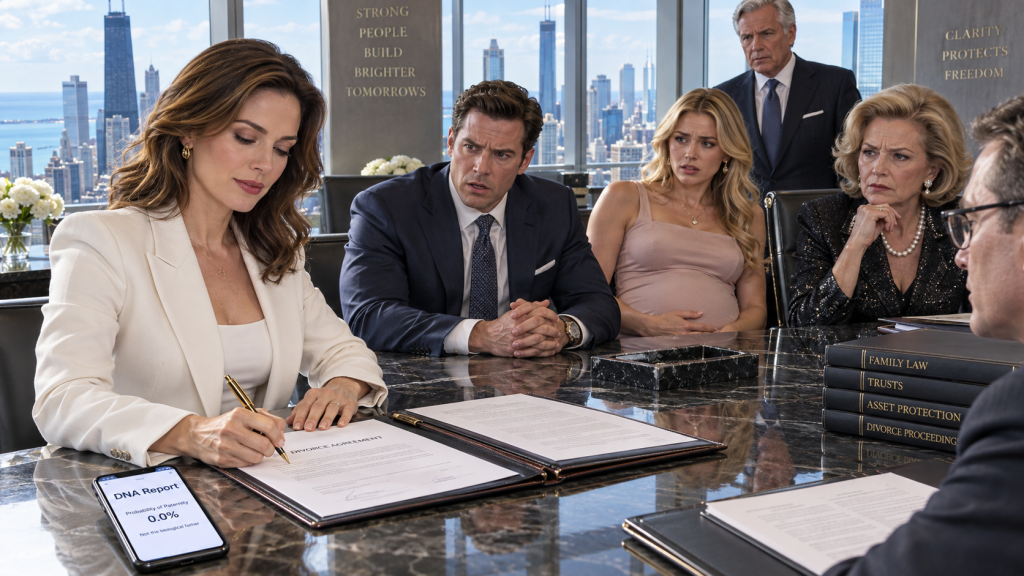
My husband’s family offered me $28 million to sign the divorce papers, disappear quietly, and never contact the twins his mistress was carrying. They thought I was broken after eight years of infertility and betrayal. So I signed every page without shaking. What they didn’t know was that three days earlier, a private DNA report had already proved one thing: those babies were not my husband’s.

PART 1: The Price of My Silence
“Name your price, Claire. Sign today, leave quietly, and disappear before those twins are born.”
That was how Eleanor Whitman ended my marriage. I sat forty-eight floors above downtown Chicago with Lake Michigan shining beyond the glass, while a divorce agreement lay open in front of me. Across the table sat my husband, Nathan. Beside him sat Sabrina Vale, his mistress, one hand on her barely visible stomach and the other wrapped around his fingers.
Twins.
The Whitman heirs.
The miracle I had supposedly failed to give him.
“This doesn’t have to be ugly,” Nathan said.
I stared at him. “It became ugly when you brought her here.”
Sabrina lowered her eyes as if I had embarrassed her. Eleanor pushed a leather folder toward me.
“Twenty-eight million dollars. The Charleston house. The Boston condo. Lifetime annuity.”
Then came the true payment.
Silence.
No public statements. No claim against Whitman Holdings. No contact with Nathan, Sabrina, or any future Whitman children.
One clause stopped me cold.
Complete separation from any present or future Whitman family matter.
Their attorney called it standard.
I almost laughed.
“There is nothing standard about erasing a wife of eight years before lunch.”
Nathan’s father, Conrad, leaned forward. “You had years, Claire. My son needs heirs.”
Heirs.
For years, I had endured injections, procedures, miscarriages, silent hospital rooms, and doctors apologizing while Nathan held my hand and swore children did not define us.
Then he stopped holding my hand.
Then came Sabrina.
“How far along are you?” I asked.
“Almost twelve weeks,” she said.
My eyes went to Nathan.
Ten weeks earlier, he had taken me to Lake Geneva. Rain against the windows. His arms around me. His voice breaking as he whispered, “I don’t want to lose you.”
Now his mistress was almost twelve weeks pregnant.
I picked up the gold pen.
Signed.
Page after page.
No one noticed my hands were steady.
No one asked why I was not fighting.
And no one knew that three days earlier, a private DNA report had proved one devastating fact.
The twins were not Nathan’s.
Then my phone lit up beside my hand.
A wedding planner’s message appeared.
Beneath it was the DNA report.
Nathan saw the laboratory name, leaned forward, and went pale.
“What the hell is that?”
I looked slowly at Sabrina.
For the first time all afternoon, she was not smiling.
PART 2 — THE HEIRS WHO NEVER WERE
For the first time all afternoon, Sabrina was not smiling.
Nathan stared at the laboratory name glowing across my phone.
Harrington Genetic Diagnostics.
His hand slipped from Sabrina’s.
Not dramatically.
Just enough for me to notice.
“What the hell is that?” he asked again.
I looked at him.
Then at Eleanor.
Then Conrad.
All three Whitmans suddenly seemed interested in something other than the divorce papers.
I turned my phone facedown.
“Nothing you need to worry about.”
Nathan’s jaw tightened.
“Claire.”
I picked up the gold pen.
“There are two more pages, aren’t there?”
The attorney sitting beside Eleanor cleared his throat.
“Three, actually.”
“Wonderful.”
I signed the next one.
Nathan reached across the table.
“Stop.”
I looked at his hand.
Then at him.
“You wanted my signature.”
“I asked you what that report was.”
“And I decided not to answer.”
Sabrina shifted beside him.
Her confidence was disappearing one careful inch at a time.
“Why would you have a genetic test?” Nathan asked.
I smiled faintly.
“Lots of reasons.”
“Concerning whom?”
I turned another page.
“Your attorney really should have warned you that divorce agreements become considerably harder to finish when the husband keeps interrupting.”
Nathan slapped his palm against the table.
“Claire.”
Eleanor looked sharply at him.
“Control yourself.”
That almost made me laugh.
Control.
That was the Whitman family religion.
Control the company.
Control the press.
Control the money.
Control the wife who had become inconvenient.
Even control the story of how their marriage ended.
Claire failed to give Nathan children.
Nathan found happiness elsewhere.
The Whitman family generously compensated Claire.
Everyone moved forward.
Clean.
Respectable.
Sympathetic.
Except the truth had already begun rotting beneath the polished surface.
I signed the final page.
The attorney gathered the papers.
“Mrs. Whitman—”
“Claire Mercer.”
He paused.
“My maiden name.”
Eleanor frowned.
“The decree has not been finalized.”
“I’m practicing.”
For a second, something almost like admiration passed across Conrad’s face.
Then it vanished.
The attorney said, “Once the court processes the settlement, the agreed assets will transfer according to schedule.”
“Good.”
I stood.
Nathan stood too.
“We’re not finished.”
I looked at him.
“I just signed twenty-eight million dollars’ worth of evidence suggesting otherwise.”
His face tightened.
“What laboratory report did you receive?”
Sabrina suddenly spoke.
“Nathan, let her go.”
Everyone turned toward her.
Her voice sounded calm.
Too calm.
She placed one protective hand over her stomach.
“This is clearly upsetting for her.”
I stared at her.
There it was again.
That performance.
The gentle mistress.
The compassionate victor.
Poor infertile Claire had finally cracked beneath the sight of the pregnant woman who replaced her.
I picked up my handbag.
“You’re right, Sabrina.”
She blinked.
“I am?”
“Yes.”
I gave her stomach a thoughtful glance.
“This is extremely upsetting.”
The color left her face.
Nathan stepped between us.
“What does that mean?”
I moved around him.
“It means congratulations.”
“Claire.”
“Twins.”
I smiled.
“How extraordinary.”
Sabrina’s fingers curled over the fabric of her dress.
I walked toward the door.
Behind me, Nathan said:
“If you know something, say it.”
I stopped.
Eight years.
Eight years of reacting when Nathan called.
Explaining when Nathan demanded.
Reassuring when Nathan doubted.
Apologizing when my body disappointed him even though he swore I never needed to apologize.
I turned.
“For years, you made me wait for doctors to tell me whether my life was about to change.”
My voice remained quiet.
“I think you can survive waiting a little too.”
Then I left.
The elevator doors closed on Nathan’s face.
Only when I was alone did my hands begin to shake.
I pressed the button for the lobby.
Forty-eight.
Forty-seven.
Forty-six.
I watched the numbers descend.
At thirty-nine, my lungs finally remembered how to breathe.
At thirty-two, my eyes filled.
At twenty-six, I leaned my head against the mirrored wall.
And at seventeen, I cried.
Silently.
Furiously.
Not because I regretted signing.
I didn’t.
I cried because knowing the truth did not erase the humiliation of sitting across from the man I loved while another woman carried what everyone believed were his children.
It did not erase eight years of negative pregnancy tests.
It did not erase the miscarriages.
It did not erase the nursery Nathan and I painted pale green after our second round of IVF.
We had bought the crib too early.
Everyone warned us.
I did not care.
I wanted one small act of confidence in a process built entirely around fear.
Nathan assembled it himself.
He complained about the instructions.
I sat on the floor laughing.
Three weeks later, there was no heartbeat.
I could still remember coming home from the hospital.
Standing in the doorway of that nursery.
Looking at the crib.
Nathan walked behind me and wrapped his arms around my waist.
“We’ll try again,” he whispered.
I had believed those words meant:
We will survive this together.
I eventually learned he meant exactly what he said.
He would try again.
Just not necessarily with me.
The elevator opened into the marble lobby.
I wiped my face before stepping out.
A man near the revolving doors stood when he saw me.
Julian Cross.
My attorney.
Technically, Elena Whitman believed Howard Grayson represented me.
And he did.
For the divorce.
Julian represented me for everything the Whitmans did not know existed.
He was forty-five, quietly dressed, and possessed the unnerving calm of someone who had spent twenty years watching wealthy families discover that money could not purchase a different version of the truth.
He held out my coat.
“How bad?”
“I signed.”
“That wasn’t my question.”
I looked at him.
“Worse than I expected.”
He helped me into the coat.
“They threatened you?”
“No.”
“Insulted you?”
“Conrad called the babies heirs.”
Julian’s expression changed slightly.
“I see.”
“They made Sabrina sit beside Nathan.”
“That sounds deliberate.”
“It was.”
We walked outside.
Chicago winter hit my face like cold water.
Cars hissed over wet pavement.
People rushed past beneath scarves and wool coats, living ordinary lives that had nothing to do with mine.
I almost envied them.
Julian opened the passenger door of a dark sedan.
Once inside, I reached into my handbag.
The DNA report was still there.
Twelve pages.
Private.
Preliminary but conclusive enough for what mattered.
Julian watched me touch the envelope.
“You almost showed him.”
It wasn’t a question.
“No.”
“You wanted to.”
“Yes.”
“That’s different.”
I leaned back.
“I wanted to put it on the table.”
“And?”
“And watch all four of them realize they had just paid me twenty-eight million dollars to disappear from children who aren’t even Whitmans.”
Julian almost smiled.
“Tempting.”
“Very.”
“But premature.”
“I know.”
That was why I hired Julian.
He did not tell me what I wanted to hear.
He told me when anger was about to make me stupid.
The car moved into traffic.
I looked down at the report.
“Are we absolutely certain?”
“We’ve reviewed it with two independent specialists.”
“The twins are not Nathan’s.”
“No.”
Even after three days, the sentence still felt enormous.
“How?”
Julian glanced at me.
“You know the likely answer.”
“Sabrina slept with someone else.”
“Yes.”
“While sleeping with my husband.”
“Yes.”
I laughed once.
“That would almost be funny.”
“Almost.”
“Do we know who?”
“Not yet.”
I turned toward him.
“But you have an idea.”
He hesitated.
That was enough.
“Julian.”
“We found something this morning.”
My heartbeat changed.
“What?”
He opened the leather case beside him and removed a folder.
“Remember the dates you gave us?”
“Sabrina’s conference schedule?”
“Yes.”
I nodded.
Sabrina had entered Nathan’s life through Whitman Holdings.
She was originally hired for a brand-reputation project after one of the company’s manufacturing divisions faced a public-relations crisis.
She was clever.
Beautiful.
Charming without appearing to try.
Nathan talked about her too often long before I understood why.
Once I did, I started reconstructing everything.
Flights.
Hotel stays.
Corporate dinners.
Credit-card charges.
Not because I wanted to torture myself.
Because Nathan’s affair had intersected with company spending, and Julian suspected that would matter later.
He slid a photograph toward me.
Sabrina.
Leaving a hotel in New York.
The date in the corner was thirteen weeks earlier.
A man walked beside her.
Baseball cap.
Dark coat.
Face partly turned away.
I frowned.
“Who is that?”
Julian handed me another photograph.
This one clearer.
My stomach tightened.
“No.”
“I thought you might recognize him.”
I did.
Graham Whitman.
Nathan’s cousin.
Conrad’s older brother’s son.
Senior vice president of acquisitions at Whitman Holdings.
Forty-two.
Married.
Three children.
And very much a Whitman.
I looked at Julian.
“You think Graham could be the father?”
“We think it’s possible.”
“Based on one hotel photograph?”
“No.”
He handed me another page.
Reservation records.
Two rooms.
Same hotel.
Booked through corporate accounts.
Graham Whitman.
Sabrina Vale.
I read the dates.
Three separate trips.
New York.
San Francisco.
Toronto.
My mouth went dry.
“Do Nathan and Eleanor know?”
“We have no reason to believe they do.”
I stared through the window.
Suddenly, the divorce meeting seemed even more grotesque.
Conrad had called the babies his grandchildren.
Eleanor had already begun talking privately about “continuity.”
The family’s lawyers had drafted clauses ensuring I never contacted the future heirs.
And somewhere inside the Whitman family tree, there was a possibility that the twins still technically carried Whitman blood.
Just not Nathan’s.
“Oh, this is bad.”
Julian looked at me.
“It could become worse.”
I turned slowly.
“What does that mean?”
“The settlement.”
“What about it?”
“Clause fourteen.”
I remembered.
Complete separation from any present or future Whitman family matter.
My stomach tightened.
“What did you notice?”
“It’s broader than it needed to be.”
“I know.”
“You asked why they cared so much about preventing contact with the children.”
“Yes.”
Julian folded his hands.
“I think we may have been assuming the clause was emotional.”
“What else would it be?”
“Corporate.”
I stared.
He continued.
“Whitman Holdings is still family-controlled.”
“I know.”
“Voting rights move differently depending on direct descendants.”
“Yes.”
Nathan and I had discussed it years ago.
Whitman Holdings was not merely a corporation.
It was a dynasty with quarterly reports.
Conrad controlled the largest voting block.
Nathan was expected to succeed him.
Children mattered.
Not sentimentally.
Structurally.
Julian continued.
“If Nathan has biological children, certain trust distributions activate.”
My chest tightened.
“How much?”
“We are still determining that.”
“How much, Julian?”
He looked directly at me.
“Potentially hundreds of millions over time.”
I became very still.
“So the twins aren’t just heirs.”
“No.”
“They trigger money.”
“Yes.”
That explained Eleanor’s urgency.
The rushed divorce.
The absurdly generous offer.
Twenty-eight million sounded enormous.
Because it was.
But not beside hundreds of millions in control, shares, and trust distributions.
“They aren’t paying me to leave Nathan.”
Julian shook his head.
“I don’t think so.”
“They’re paying me to stop being his wife before the babies are born.”
“That appears much closer to the truth.”
I looked down at my wedding ring.
I still wore it.
Habit.
Eight years of muscle memory.
I pulled it off.
The pale indentation underneath felt strangely intimate.
“Do they know the children aren’t his?”
“That’s now the most important question.”
I slipped the ring into my bag.
“What does your instinct say?”
“My instinct does not enter court filings.”
“Julian.”
He sighed.
“My instinct says someone knows more than Nathan.”
“Eleanor?”
“Possibly.”
I thought of her face when Nathan noticed the laboratory name.
She had not looked confused.
She had looked irritated.
That distinction suddenly mattered.
“Find out.”
“We are.”
My phone started ringing.
Nathan.
I watched his name.
Declined.
Again.
Declined.
Then Sabrina.
I almost laughed.
Declined.
Then Eleanor.
That one I answered.
“Claire.”
Her voice was perfectly composed.
“Yes?”
“You left abruptly.”
“I thought disappearing quietly was the objective.”
A pause.
“There’s no need for sarcasm.”
“Then there was no need to seat my husband’s pregnant mistress beside him while I signed my divorce.”
“You accepted the terms.”
“I did.”
She exhaled.
“What was the genetic report?”
There it was.
Not how are you.
Not are you reconsidering.
The report.
“Personal.”
“Concerning you?”
“Yes.”
That was technically true.
“What kind of test?”
“You are unusually interested in my medical privacy for a woman who just paid me to leave the family.”
“Claire.”
I smiled.
“You all keep saying my name as though repetition creates authority.”
Silence.
Then her voice cooled.
“If there is information materially relevant to the settlement, you are legally required to disclose it.”
Julian looked toward me.
I put the call on speaker.
“Are you giving me legal advice now?”
“I’m reminding you that concealment has consequences.”
“Interesting.”
“What?”
“I was thinking the same thing.”
The line became very quiet.
Eleanor said:
“What exactly are you implying?”
“Nothing.”
“Claire.”
“Ask your attorney.”
I ended the call.
Julian rubbed his temple.
“That was reckless.”
“A little.”
“You enjoyed it.”
“A lot.”
He almost smiled.
Then his phone buzzed.
He looked at the screen.
His expression changed.
“What?”
He did not answer.
“Julian.”
“One moment.”
He read the message again.
Then made a call.
“Confirm the source.”
Pause.
“You’re certain?”
Another pause.
“When?”
He looked at me.
“Send everything.”
He hung up.
My stomach tightened.
“What happened?”
“We found the clinic.”
“What clinic?”
“The prenatal genetics clinic Sabrina used before switching to her current obstetrician.”
My heart started pounding.
“How did you find that?”
“Insurance records obtained through authorized discovery tied to the corporate benefits issue.”
“And?”
He hesitated.
“She had testing done earlier than we thought.”
My fingers became cold.
“What testing?”
“A prenatal paternity screen.”
I stared at him.
“When?”
“Nine days ago.”
My breath stopped.
The room forty-eight floors above Chicago returned in perfect detail.
Sabrina smiling.
Her hand around Nathan’s.
Eleanor sliding twenty-eight million dollars across the table.
Conrad saying:
My son needs heirs.
Nine days ago.
Sabrina had already tested.
“Did Nathan know?”
“We don’t know.”
“Results?”
“Unavailable.”
I leaned closer.
“But if she ordered her own paternity test…”
“She had doubts.”
“Or she knew.”
“Yes.”
I closed my eyes.
The cruelty of it settled deeper.
She had sat beside me knowing there was a possibility those children were not Nathan’s.
She watched my marriage end.
Watched them blame infertility.
Watched Conrad reduce me to a defective route to succession.
And she said nothing.
My phone buzzed.
A message from Sabrina.
Can we meet? Alone. Please don’t tell Nathan.
I stared at it.
Julian read over my shoulder.
“No.”
“I didn’t say anything.”
“You have the look.”
“What look?”
“The one people get immediately before doing something their attorney wishes they wouldn’t.”
I almost smiled.
“She wants to meet.”
“Then she can contact counsel.”
“She won’t talk to counsel.”
“Excellent.”
“Julian.”
“No.”
“What if she knows?”
“She definitely knows something.”
“Exactly.”
“And frightened people are unpredictable.”
I looked again.
Another message.
You don’t understand what Eleanor is doing.
My heartbeat stopped.
I handed Julian the phone.
His expression hardened.
Then another message arrived.
Nathan cannot know I contacted you.
Julian looked at me.
“That changes things.”
“I thought you might say that.”
“Public location.”
“Obviously.”
“I’m present.”
“She said alone.”
“She does not dictate terms.”
I started typing.
Tomorrow. 10 a.m. The Palmer Hotel café.
Sabrina replied almost immediately.
Tonight. Please.
Then:
Before Eleanor finds out.
I stared at the screen.
Julian’s phone buzzed again.
Another investigator.
He answered.
“Cross.”
I watched his face.
“What date?”
Silence.
“Who signed?”
His eyes lifted to mine.
My stomach dropped.
“Send it.”
He hung up.
“What now?”
He did not answer immediately.
“Julian.”
He opened his email.
A document loaded.
Then he turned the phone toward me.
I read the heading.
Whitman Family Reproductive Trust — Contingent Beneficiary Certification.
My mouth went dry.
The date was four days earlier.
Before my settlement meeting.
Before I signed.
Before anyone had supposedly confirmed the twins’ parentage.
At the bottom were signatures.
Conrad Whitman.
Eleanor Whitman.
Nathan Whitman.
And Sabrina Vale.
I stared.
“What is this?”
“A declaration asserting that Sabrina is carrying Nathan’s biological children.”
“But they couldn’t know that.”
“Correct.”
“Unless Nathan tested.”
“There’s no documented test from him.”
I looked closer.
Something else was attached.
A physician certification.
I read the name.
Dr. Warren Bell.
I knew that name.
My fertility specialist.
The man who had treated Nathan and me for almost five years.
My skin went cold.
“Why is my doctor on this?”
Julian’s face had gone still.
“I don’t know.”
I grabbed the document.
Dr. Bell had certified that:
Based on available reproductive and medical records, there is no known reason to dispute biological paternity attributed to Nathan Whitman.
I laughed bitterly.
“That means nothing.”
“It means exactly enough to look official.”
My hands shook.
“Bell treated Nathan.”
“Yes.”
“He has Nathan’s fertility records.”
“Yes.”
“Then he knows.”
Julian went quiet.
I looked at him.
“He knows what?”
My voice sounded strange.
Julian hesitated.
That hesitation frightened me more than anything.
“Claire.”
“What?”
“We requested portions of Nathan’s fertility records this morning under the authorization you executed during the divorce preparation.”
I stopped.
“And?”
“There’s a discrepancy.”
The world became very quiet.
“What discrepancy?”
Julian looked at the driver.
“Pull over.”
The car moved toward the curb.
Traffic rushed past.
Julian turned fully toward me.
“When you and Nathan started IVF, what were you told about his fertility?”
I frowned.
“That everything was normal.”
“Completely normal?”
“Yes.”
“Every test?”
“As far as I knew.”
Julian exhaled slowly.
“We have a laboratory report from six years ago.”
My stomach turned.
“What report?”
“Semen analysis.”
I stared at him.
“And?”
He did not soften it.
“It indicated severe male-factor infertility.”
I stopped breathing.
“No.”
“Claire—”
“No.”
Nathan was normal.
I was the problem.
That had been the story.
My diminished ovarian reserve.
My irregular response to stimulation.
My embryos failing.
My body.
My failure.
Nathan held me while I blamed myself.
Doctors adjusted my medication.
Higher doses.
More injections.
More procedures.
I stared at Julian.
“That can’t be right.”
“We’re verifying it.”
“Dr. Bell said Nathan was normal.”
“The report says otherwise.”
“No.”
My voice cracked.
“Why would he lie?”
Julian did not answer.
I already knew the possibilities.
Money.
Pressure.
Whitman influence.
Something worse.
I looked down at my hands.
Eight years.
How many needles?
How many hormones?
How many mornings had I stared at bruises across my abdomen and told myself my body was broken?
“How severe?”
Julian’s voice became gentle.
“Severe enough that natural conception would have been considered highly unlikely.”
The sentence struck me physically.
I bent forward.
My lungs would not fill.
Nathan had made Sabrina pregnant naturally.
Twins.
Supposedly.
That should have raised questions immediately.
But everyone had been so eager to believe the miracle belonged to him.
Especially the Whitmans.
Especially after me.
“I need a minute.”
Julian said nothing.
I pressed my palms against my eyes.
Fragments of my marriage came back like broken glass.
Nathan once saying:
Maybe your body just needs a rest.
My body.
Nathan telling his mother:
Claire’s treatments are difficult.
Claire’s treatments.
Eleanor asking whether infertility “ran in my mother’s family.”
I had cried in a bathroom afterward.
Nathan found me.
He told me to ignore her.
He knew.
Had he known?
“Did Nathan see this report?”
“We don’t know.”
“His name is on it.”
“That does not prove he received it.”
“What about Dr. Bell?”
“He certainly would have had access.”
My phone buzzed again.
Sabrina.
Claire, please. It’s about Dr. Bell.
Every hair on my arms rose.
I showed Julian.
He stared.
Then said:
“We meet tonight.”
At 7:00 p.m., I entered a private dining room at a small hotel restaurant near the river.
Julian sat at a table outside the room.
Close enough to intervene.
Far enough that Sabrina would believe we were alone.
She arrived fifteen minutes late.
No cream coat.
No perfect makeup.
Her hair was tied back.
She looked younger without the armor.
And terrified.
She closed the door behind her.
“Did you tell Nathan?”
“No.”
“Eleanor?”
“No.”
She exhaled.
Then saw my face.
“You know.”
“Know what?”
She went pale.
“About Nathan.”
I sat.
“Say it.”
Sabrina remained standing.
“Claire…”
“Sit down.”
She did.
For several seconds, neither of us spoke.
I studied the woman who had slept with my husband.
I wanted to hate her cleanly.
That would have been easier.
But fear had transformed her face.
“What did Dr. Bell tell you?”
She looked toward the door.
Then whispered:
“Nathan probably can’t have children.”
Hearing it from her made everything inside me turn cold.
“When did you learn that?”
“Four months ago.”
I stared.
“Before you became pregnant.”
“Yes.”
My hands clenched beneath the table.
“And you continued sleeping with my husband.”
Tears filled her eyes.
“Yes.”
“Why?”
She laughed shakily.
“Because by then I was already in too deep.”
“That is not an answer.”
“I loved him.”
I almost laughed.
“You loved my husband.”
“Yes.”
“And someone else.”
Her face changed.
There.
Graham.
I leaned forward.
“Who is the twins’ father?”
She froze.
“I don’t know.”
“Try again.”
“I really don’t.”
“Graham Whitman?”
Her face drained completely.
That was enough.
“Oh my God.”
She covered her mouth.
“You know about Graham.”
“I know you shared three hotels.”
She shut her eyes.
“It wasn’t supposed to happen.”
Neither was my divorce, I thought.
Neither were eight years of humiliation.
But I kept my voice calm.
“Is Graham the father?”
“He could be.”
“Who else?”
Her eyes opened.
“Nathan.”
“No.”
She shook her head.
“The doctors said unlikely. They never said impossible.”
“Who else, Sabrina?”
Silence.
Then she whispered:
“No one.”
I stared at her.
“So you slept with Nathan and his married cousin in the same conception window.”
Her tears spilled.
“Yes.”
I almost admired the catastrophic efficiency.
“Does Graham know?”
“Yes.”
“Nathan?”
“No.”
“Eleanor?”
Sabrina hesitated.
My stomach turned.
“Sabrina.”
“She knows there is uncertainty.”
The room seemed to tilt.
“She knows?”
“Yes.”
“How?”
“She found the appointment.”
“What appointment?”
“The private paternity test.”
My hands became icy.
“The one nine days ago.”
Her head snapped up.
“How do you know about that?”
“Keep talking.”
Sabrina wiped her face.
“I scheduled it because I couldn’t keep pretending.”
“What happened?”
“Eleanor had someone monitoring expenses.”
Of course she did.
“She confronted me.”
“When?”
“The same day.”
“And?”
“She told me to cancel the test.”
“But you didn’t.”
“No.”
“Why?”
“I needed to know.”
That was almost human.
Almost.
“Do you have the result?”
Her silence lasted too long.
“Sabrina.”
Her mouth trembled.
“Yes.”
My heartbeat hammered.
“You already have it.”
“Yes.”
“Since when?”
“Yesterday.”
Yesterday.
Before she sat beside Nathan while I signed.
I stared at her.
“Who is the father?”
Sabrina started crying.
Not pretty tears.
Not controlled.
Her shoulders shook.
“I don’t know.”
I almost stood.
“You just said you have the result.”
“I do.”
“Then what does it say?”
She reached into her handbag with trembling fingers.
A white envelope.
Laboratory logo.
She placed it on the table but kept her hand over it.
“Promise me something.”
“No.”
Her eyes widened.
“You don’t get to ask promises from me.”
“Claire—”
“You sat beside my husband while his family paid me to disappear.”
“I’m sorry.”
“You let them talk about my infertility.”
“I know.”
“You let Conrad call your babies Nathan’s heirs.”
“I know.”
“And you already had the answer.”
Her face collapsed.
“Yes.”
I leaned back.
“Give me the report.”
She slid it across the table.
I opened it.
My hands did not shake.
I found the conclusion.
Then stopped.
Nathan Whitman:
Excluded as biological father.
I already knew that.
Then I read the second line.
Graham Whitman:
Excluded as biological father.
I looked up.
Sabrina was crying silently.
I read it again.
Neither Nathan.
Nor Graham.
My pulse roared in my ears.
“You lied.”
She shook her head desperately.
“No.”
“You said there was nobody else.”
“There wasn’t.”
“Then explain this.”
She covered her face.
“I can’t.”
“Yes, you can.”
She lowered her hands.
What I saw in her eyes was not embarrassment.
It was horror.
“I never slept with anyone else.”
“Then the report is wrong.”
“It isn’t.”
“How do you know?”
“Because there is another test.”
My stomach dropped.
“What test?”
She whispered:
“The twins aren’t genetically mine either.”
For several seconds, I did not understand the sentence.
Then I did.
And every breath left my body.
“What?”
Sabrina pressed both hands over her stomach.
“I thought I was pregnant with my embryos.”
My mind raced.
“IVF?”
She nodded.
“No one told me you used IVF.”
“Nathan wanted it private.”
“Why?”
“Because of his fertility problem.”
The truth unfolded rapidly now.
Nathan knew.
Of course he knew.
He had known enough to seek IVF with his mistress.
While allowing everyone to believe he had effortlessly conceived with the woman who replaced his infertile wife.
My stomach turned.
“Whose embryos?”
Sabrina started shaking.
“That’s why I contacted you.”
I stood.
“Whose embryos?”
“I don’t know.”
I stared at her.
“No.”
“Claire, please.”
“You have been lying since the day you entered my marriage.”
“I know.”
“So when you tell me you don’t know whose children you are carrying, I need something better.”
She reached into her bag.
Another document.
This one from a fertility clinic.
I recognized the logo before she placed it down.
My knees almost gave out.
Bell Reproductive Medicine.
Dr. Warren Bell.
My clinic.
My doctor.
The place where Nathan and I had created embryos.
The place where I had cried in recovery rooms.
The place where we were eventually told nothing viable remained.
I could barely speak.
“Why were you treated there?”
Sabrina’s face crumpled.
“Nathan arranged it.”
I stared at the page.
Embryo transfer.
Nearly twelve weeks earlier.
Patient:
Sabrina Vale.
Two embryos transferred.
Donor embryos.
My fingertips went numb.
“What donor?”
“The paperwork didn’t list names.”
I looked at her.
“But now you think something is wrong.”
She nodded.
“After Eleanor learned about the paternity test, she went insane.”
“What did she say?”
“She said the babies were Whitmans no matter what the DNA report showed.”
I froze.
“What exactly did she say?”
Sabrina swallowed.
“She said, ‘Those children belonged to this family before they ever belonged to you.’”
A chill ran through me.
I looked down at the transfer document.
Two embryos.
My clinic.
My doctor.
Nathan’s secret infertility.
The unusual settlement clause.
Complete separation from any present or future Whitman family matter.
My heart began pounding so hard it hurt.
“How many embryos did Nathan and I have?”
Sabrina looked confused.
“What?”
“During our last IVF cycle.”
“I don’t know.”
“Four.”
I remembered every one.
Two transferred.
Both failed.
Two frozen.
At least, that was what we believed.
Six months later, Dr. Bell told us the remaining embryos had arrested during thaw preparation and were not viable.
There had been paperwork.
Nathan handled most of it.
I had been too devastated to read anything carefully.
I slowly sat back down.
“No.”
Sabrina stared at me.
“What?”
I looked at her stomach.
For the first time, not with jealousy.
Not hatred.
Fear.
“Why twins?”
“What?”
“Why did Bell transfer two?”
She shook her head.
“I don’t know.”
I barely heard her.
Two.
Two embryos.
Almost twelve weeks.
The timing.
God.
The timing.
I grabbed my phone.
Called Julian.
He entered before the second ring finished.
One look at me and he stopped.
“What happened?”
I handed him Sabrina’s transfer record.
Then the DNA report.
His eyes moved rapidly across the pages.
He looked at Sabrina.
“These are genuine?”
“Yes.”
He turned toward me.
“Claire?”
My voice sounded far away.
“Find out what happened to my frozen embryos.”
His expression changed instantly.
“What?”
“The last two.”
I could barely breathe.
“Six years ago.”
He understood.
His face went pale.
Sabrina stared between us.
“What are you saying?”
I looked at her.
At the woman carrying twins.
At the stomach I had spent weeks believing represented everything my body could not give Nathan.
Suddenly, I remembered something Dr. Bell once told me.
One of our final embryos had been graded exceptionally high.
The other slightly lower.
He had joked:
“Could even be a pair if both ever get a chance.”
I gripped the table.
No.
It was impossible.
It had to be impossible.
Julian stepped outside and began making calls.
Sabrina whispered:
“Claire…”
I looked at her.
“What embryos?”
I could not answer.
Because if I said it aloud, it would become too real.
Minutes passed.
Maybe ten.
Maybe thirty.
Time lost its shape.
Then Julian returned.
He closed the door.
Locked it.
And placed his phone on the table.
His face told me before his voice did.
“Claire.”
I stood.
“What?”
“We found a storage discrepancy.”
My knees weakened.
“No.”
“The records Bell’s clinic submitted during your treatment do not match the internal embryology log preserved by the storage provider.”
Sabrina stopped breathing.
I stared at Julian.
“Tell me.”
“Your two embryos were not documented as destroyed.”
My heart seemed to stop.
“Then where are they?”
He looked toward Sabrina.
Then back at me.
“One was transferred under a coded donor designation eleven weeks and five days ago.”
The room tilted.
“One?”
My voice cracked.
“And the second?”
Julian swallowed.
“Transferred the same day.”
Sabrina made a broken sound.
I grabbed the edge of the table.
No.
No.
No.
My eyes dropped to her stomach.
Twins.
Two embryos.
My embryos.
I whispered:
“Genetic match?”
“We don’t have that yet.”
“But…”
He nodded slowly.
“The identifiers align.”
My entire body began shaking.
Sabrina stood.
“What are you saying?”
No one answered.
She looked down at herself.
Then at me.
Her face turned completely white.
“No.”
Tears filled my eyes.
The cruelty of the afternoon returned in one unbearable wave.
Never contact the twins.
Not Nathan’s twins.
Not Sabrina’s biological children.
Potentially mine.
My children.
Embryos I had been told were dead.
Embryos created from my eggs.
And depending on the original fertilization records, Nathan’s sperm—or something else Dr. Bell had concealed.
I thought of Eleanor’s strange clause.
Those children belonged to this family before they ever belonged to you.
She knew.
Maybe not everything.
But enough.
My phone began ringing.
Nathan.
I stared at the screen.
Then Sabrina’s phone rang.
Eleanor.
We looked at each other across the table.
Two women who had spent months believing we were enemies.
One wife.
One mistress.
Both manipulated.
Both lied to.
And between us, two unborn babies whose very existence might have been built on a crime.
Sabrina whispered:
“What do we do?”
My hands slowly stopped shaking.
I thought about the twenty-eight-million-dollar agreement.
The silence clause.
The erased embryos.
Nathan’s fertility report.
Dr. Bell.
Eleanor.
And those two signatures waiting inside a laboratory archive that might prove someone had stolen the children I had mourned.
I picked up Nathan’s call.
“Claire?”
His voice was frantic.
“Where are you?”
I looked directly at Sabrina.
“I’m with your mistress.”
Silence.
Then:
“What?”
“She told me everything.”
Nathan stopped breathing.
I continued.
“About your infertility.”
Nothing.
“About Bell.”
Nothing.
“About the embryo transfer.”
A faint sound escaped him.
That sound told me more than denial ever could.
“You knew.”
“Claire—”
“You knew.”
“It isn’t what you think.”
I closed my eyes.
Every guilty person eventually says that.
“What happened to my embryos?”
Silence.
“Answer me.”
“Claire, please.”
“What happened to my children?”
His voice cracked.
And then he made the mistake that ended whatever was left of our marriage.
“They were never supposed to find out.”
The room went completely still.
I opened my eyes.
Sabrina stared at me.
Julian had already begun recording.
I spoke quietly.
“Who is ‘they,’ Nathan?”
He realized too late.
“Claire—”
“Who was never supposed to find out?”
Nothing.
“Nathan.”
His breathing came ragged through the phone.
Then a second voice sounded faintly in the background.
Eleanor.
“Hang up.”
My blood turned cold.
She was with him.
Nathan whispered:
“Mother, stop.”
Eleanor said louder:
“End the call now.”
I smiled without warmth.
There it was.
The Whitman family.
Still trying to control the room.
Even from miles away.
I leaned toward the phone.
“Hello, Eleanor.”
Silence.
Then she took the phone from Nathan.
Her voice came cold.
“You signed an agreement.”
I looked at Sabrina’s stomach.
“Yes.”
“You accepted twenty-eight million dollars in exchange for separation.”
“Yes.”
“Then honor it.”
I felt something inside me settle.
Not rage.
Purpose.
“You should have read your own contract more carefully.”
A pause.
“What does that mean?”
“It means I agreed not to contact Nathan’s future children.”
Silence.
I continued softly.
“You might have a problem proving these are Nathan’s.”
Eleanor said nothing.
“And if they’re mine…”
My voice broke once.
I steadied it.
“…then twenty-eight million dollars isn’t enough money in the world to make me disappear.”
I ended the call.
For several seconds, nobody moved.
Then Julian looked at me.
“We need an emergency court order.”
I nodded.
“For the medical records.”
“Yes.”
“The clinic.”
“Yes.”
“And Sabrina?”
We both looked at her.
She instinctively covered her stomach.
Fear crossed her face.
Not fear of me.
Fear that someone might take away the babies she had already begun loving.
That was when I understood the shape of the nightmare.
If those children were genetically mine, Sabrina was still carrying them.
Her body had kept them alive.
Her heartbeat was the sound they knew.
There would be no clean victory here.
No simple villain and hero.
Only adults whose lies had placed two innocent babies inside an impossible story.
I sat beside Sabrina.
She looked at me cautiously.
“I’m not going to hurt you.”
She began crying.
“I didn’t know.”
“I know.”
“I swear, Claire.”
“I know.”
“I thought they were donor embryos.”
“I believe you.”
She covered her face.
“What happens if they’re yours?”
I looked at her stomach.
“I don’t know.”
That was the truth.
And somehow honesty felt more merciful than promises.
Julian gathered the documents.
“We move tonight.”
I nodded.
He reached the door.
Then his phone rang.
He looked at the screen.
Answered.
“Cross.”
His expression changed immediately.
“What?”
He listened.
Then looked directly at me.
My stomach dropped.
“When did this happen?”
Pause.
“Keep him there. Do not let anyone touch the files.”
He ended the call.
“What now?”
Julian’s face had lost all color.
“Dr. Bell’s office.”
“What about it?”
“Someone attempted to remove archived patient records twenty minutes ago.”
My heart began pounding.
“Who?”
“A Whitman Holdings security contractor.”
Sabrina whispered:
“Eleanor.”
Julian continued.
“They were stopped.”
Relief barely had time to arrive.
“But one sealed storage manifest had already been removed earlier today.”
I stared.
“What manifest?”
He swallowed.
“The original cryogenic-transfer record from your final IVF cycle.”
For a second, I could not breathe.
The one document that might prove where my embryos went.
Gone.
“Who took it?”
“We don’t know yet.”
Then my phone buzzed.
Unknown number.
A photograph appeared.
A paper file lying on a dark wooden desk.
Across the top:
MERCER-WHITMAN EMBRYO STORAGE — CONFIDENTIAL
Beneath the photograph were seven words.
If you want the original, come alone.
I stared at the message.
Another arrived.
And do not trust Nathan or Eleanor.
Then a third.
Dr. Bell lied to all of you.
I looked at Julian.
Sabrina leaned closer.
And then the fourth message appeared.
This time, there was no threat.
Only a name.
A name I recognized immediately.
A man who had attended my wedding.
A man who had worked beside Conrad Whitman for more than twenty years.
A man who had disappeared from the company six months after my final failed IVF cycle.
And beneath his name was one final sentence:
I know whose sperm was used to create your twins.
PART 3 — THE CHILDREN THEY TRIED TO STEAL FROM ME
The final message stayed on my screen.
I know whose sperm was used to create your twins.
For a moment, I could not feel my hands.
Sabrina was still sitting across from me, one palm pressed protectively against her stomach.
Julian stood near the door.
None of us spoke.
The name beneath the message belonged to a man called Thomas Hale.
For twenty-two years, Thomas had worked beside Conrad Whitman.
He had been legal counsel to Whitman Holdings before quietly leaving the company six years earlier.
I remembered him from my wedding.
Tall.
Gray suit.
Always watching.
He had hugged Nathan after the ceremony and told me:
“Take care of each other. Families like this forget that love is supposed to come before legacy.”
At the time, I thought he was being sentimental.
Now the sentence felt like a warning that had taken nearly a decade to reach me.
Julian stepped closer.
“You are not going alone.”
“I know.”
Sabrina looked at me.
“Who is he?”
I handed her the phone.
She read the name.
Her face tightened.
“I’ve heard Nathan mention him.”
“How?”
“He called him disloyal.”
Julian gave a humorless smile.
“That may be encouraging.”
My phone buzzed again.
A location.
An old private club near the lake.
Then:
Midnight. Ask for the Ashbury Room.
Julian shook his head.
“No.”
I looked at him.
“You have a better way to get the original manifest?”
“We involve investigators.”
“And if Hale disappears?”
“He already disappeared once.”
“Exactly.”
Julian studied me.
Then sighed.
“I hate this.”
“I know.”
“We go with security.”
“I know.”
“Sabrina stays somewhere safe.”
Sabrina looked up immediately.
“No.”
Julian frowned.
“You’re nearly twelve weeks pregnant with twins in the middle of a possible medical fraud conspiracy.”
“I know exactly what I am.”
Her voice shook.
“And I’m not sitting in another room while other people make decisions about the babies I’m carrying.”
I looked at her.
Something had changed between us.
I did not like her.
Not yet.
Maybe never.
She had slept with my husband.
Sat beside him while I signed away my marriage.
Let his family humiliate me.
Those things did not disappear because she had also been deceived.
But betrayal did not always create neat categories.
Victim.
Villain.
Innocent.
Guilty.
Sometimes one person could be wrong and wounded at the same time.
I understood that now.
“You’re coming,” I said.
Julian stared at me.
“Claire.”
“She has a right to know.”
Sabrina’s eyes filled.
She looked away quickly.
At 11:47 p.m., the three of us arrived.
The Ashbury Club was nearly empty.
Dark wood.
Old paintings.
Heavy curtains.
The kind of place where wealthy men probably spent decades convincing themselves that silence and dignity were the same thing.
A waiter led us to a private room upstairs.
Thomas Hale was already there.
He looked older than I remembered.
Much older.
His hair had gone almost entirely white.
A tremor moved through one hand.
On the table in front of him sat a sealed envelope.
I recognized the clinic markings immediately.
My stomach tightened.
Thomas looked at me.
“Claire.”
I remained standing.
“You know what happened to my embryos.”
He lowered his eyes.
“Yes.”
“Then start talking.”
He looked toward Sabrina.
“Is that her?”
Sabrina’s jaw tightened.
“My name is Sabrina.”
He nodded.
“I’m sorry.”
She stared at him.
“You’re going to have to be more specific.”
For the first time, I almost liked her.
Thomas gestured toward the chairs.
We sat.
Julian remained slightly behind me.
Thomas placed both hands on the table.
“Six years ago, Conrad Whitman came to me with a problem.”
I felt cold immediately.
“What problem?”
“Nathan’s infertility.”
I did not react.
I had already cried enough over that lie.
Thomas continued.
“Conrad believed biological heirs were essential.”
Sabrina whispered:
“For the trust.”
“Yes.”
He looked at me.
“Certain Whitman family trusts transfer voting control through direct genetic descendants.”
I nodded.
Julian had already explained.
Thomas took a breath.
“At the time, Nathan had been married to you for nearly two years.”
“Three.”
He nodded.
“Three.”
“Keep going.”
“You were undergoing fertility treatment.”
“Yes.”
“Conrad learned that Nathan’s chances of fathering a child naturally were extremely poor.”
My throat tightened.
“Did Nathan know?”
Thomas hesitated.
“Yes.”
The answer hurt anyway.
I looked down.
Nathan knew.
All those injections.
All those nights I blamed myself.
He knew.
Thomas continued.
“He was devastated.”
“Apparently not devastated enough to tell me.”
“No.”
“What did Conrad do?”
Thomas’s expression darkened.
“He did what he always did.”
“Which was?”
“Tried to solve the problem without asking whether he had the right.”
A chill moved through me.
“Dr. Bell.”
“Yes.”
I stared.
“He was paid?”
“More than paid.”
Thomas looked ashamed.
“Whitman Holdings quietly invested in one of his medical ventures.”
Julian leaned forward.
“In exchange for reproductive manipulation?”
Thomas nodded.
Sabrina covered her mouth.
I could barely breathe.
“What exactly did they do?”
Thomas looked at me.
“Your final IVF cycle produced four viable embryos.”
“No.”
My voice cracked.
“We were told only two were viable.”
“I know.”
“Two were transferred.”
“Yes.”
“And two were supposedly destroyed.”
“No.”
The room went silent.
“They were stored.”
My vision blurred.
“For what?”
Thomas looked toward the floor.
“Future use.”
My hands clenched.
“By whom?”
“Conrad.”
The word hit like a slap.
I stood.
“You are telling me my father-in-law secretly kept my embryos?”
“Yes.”
“For heirs?”
“Yes.”
I laughed.
I could not help it.
The sound came out broken.
“Without my permission.”
“Yes.”
“Without my knowledge.”
“Yes.”
“Nathan knew?”
Thomas shut his eyes.
“Not at first.”
I stared.
“At first.”
“He found out later.”
“How much later?”
“About eighteen months.”
I thought back.
Eighteen months after our final failed cycle.
The year Nathan became strangely attentive.
The year he bought me a new house.
The year he told me we should stop trying because watching me suffer was unbearable.
I had loved him for saying that.
God.
I had loved him more.
“He knew the embryos existed.”
“Yes.”
“And said nothing.”
“Yes.”
I sat down again.
Something inside me went numb.
Sabrina whispered:
“Why would they wait six years?”
Thomas looked at her.
“Because Claire was still Nathan’s wife.”
My skin prickled.
“What does that have to do with it?”
“Conrad needed children who could be socially accepted as Nathan’s.”
I understood before he finished.
Not just biological value.
Appearance.
Timing.
Narrative.
A married couple struggling with infertility could eventually have children through assisted reproduction.
But Nathan and I never did.
“So when Sabrina became involved…”
Thomas nodded.
“They saw another opportunity.”
Sabrina went pale.
“They chose me.”
Thomas looked miserable.
“Essentially.”
Her eyes filled.
“I thought Nathan loved me.”
I looked at her.
That sentence should have felt satisfying.
It didn’t.
Thomas continued.
“Sabrina’s age, health, and lack of public fertility history made her useful.”
Useful.
That word cut both of us.
I knew exactly what it was to be turned into a function.
Wife.
Failed womb.
Problem.
Obstacle.
Now Sabrina had been turned into another one.
Carrier.
Mistress.
Replacement.
Useful.
“What about the sperm?” I asked.
Thomas stopped moving.
There.
The deepest secret.
I leaned forward.
“You said you know whose sperm created the embryos.”
He looked at me.
“It wasn’t Nathan’s.”
My entire body went cold.
“I know.”
“No.”
He shook his head.
“I mean the embryos you created six years ago.”
I stared.
“That’s impossible.”
“You believed Nathan’s sperm was used.”
“Yes.”
“It wasn’t.”
The room disappeared.
I could not hear Sabrina anymore.
Could not hear Julian.
Could not hear the heater.
“Whose?”
Thomas reached for the envelope.
His hands shook harder now.
“Conrad was obsessed with preserving the bloodline.”
My stomach turned before he finished.
“No.”
Julian stepped forward.
“Mr. Hale.”
Thomas looked sick.
“He arranged for donor sperm.”
I could barely speak.
“From who?”
Thomas slid a document across the table.
One line.
Donor identifier.
C.W.-01.
My mouth went dry.
“No.”
Sabrina whispered:
“Oh my God.”
Julian read the page.
Then looked at Thomas.
“Conrad?”
Thomas shook his head.
“Not Conrad.”
I stopped breathing.
“Then who?”
“Graham.”
Everything inside me froze.
Nathan’s cousin.
The man in the hotel photographs.
The man Sabrina had also slept with.
I stared at Thomas.
“You’re saying my embryos were created with Graham Whitman’s sperm.”
“Yes.”
“Why?”
“Because he was fertile.”
The explanation was obscene in its simplicity.
“Nathan agreed?”
Thomas hesitated.
“Later.”
I closed my eyes.
“Did I?”
“No.”
“Did Sabrina?”
“No.”
“Did Graham?”
Thomas’s silence told me.
Not fully.
“Explain.”
“Conrad told Graham he was participating in an anonymous family fertility contingency program.”
Julian frowned.
“That sounds intentionally vague.”
“It was.”
“So Graham may not have known his sperm was used with Claire’s eggs.”
“Correct.”
I covered my face.
My embryos.
My eggs.
Graham’s sperm.
Nathan’s name.
Sabrina’s body.
Conrad’s plan.
Eleanor’s protection.
Dr. Bell’s clinic.
The entire thing felt less like a family and more like a machine.
A machine that took human beings apart and used whichever pieces were useful.
I lowered my hands.
“How did the embryos get transferred to Sabrina?”
Thomas took a breath.
“When Nathan’s relationship with her became serious, Conrad saw a way to activate the trusts.”
“Did Eleanor know?”
“Yes.”
“Everything?”
“Almost.”
“What does that mean?”
“She knew the embryos came from Claire.”
Sabrina flinched.
“She knew?”
Thomas nodded.
“She did not initially know Graham was the genetic father.”
I looked at Sabrina.
“That explains the paternity panic.”
She nodded slowly.
“When my test excluded Nathan…”
“Eleanor realized something was wrong.”
Thomas looked at me.
“Then she pushed the divorce immediately.”
There it was.
Twenty-eight million.
The Charleston house.
Boston condo.
Lifetime annuity.
All that money.
Not generosity.
Not guilt.
Containment.
They wanted me gone before anyone could challenge what they had done.
“They thought money could erase me.”
Thomas looked ashamed.
“Yes.”
I leaned back.
“What changed?”
He looked at the envelope.
“I left Whitman Holdings because of this.”
“Six years ago.”
“Yes.”
“Why didn’t you tell me?”
His face crumpled.
“I was afraid.”
I stared at him.
“That answer is getting old.”
“I know.”
“You were a lawyer.”
“Yes.”
“You understood exactly what they were doing.”
“Yes.”
“And you said nothing.”
“I tried to stop the transfer.”
“You failed.”
“Yes.”
His eyes filled.
“I told myself leaving was enough.”
“It wasn’t.”
“No.”
“Then why now?”
He looked at Sabrina’s stomach.
“Because the children are real now.”
My jaw tightened.
“They were real six years ago.”
He lowered his head.
“You’re right.”
Silence.
Then he pushed the envelope toward me.
“The original manifest.”
I opened it.
Every identifier matched.
My name was not visible on the public-facing sheets.
Only a coded number.
But underneath, an internal embryology index linked that code to my patient file.
Claire Mercer Whitman.
Oocyte source.
And another code linked the sperm source to Graham Whitman.
I stared at it.
My children.
Maybe that was too simple.
They were genetically mine.
But Sabrina was carrying them.
Sabrina had already heard their heartbeats.
Already vomited every morning.
Already begun sleeping on her left side because she read it might help blood flow.
No legal language could make that emotionally clean.
I closed the file.
“What do we do now?”
Julian answered.
“We preserve every document.”
Thomas nodded.
“I have backups.”
“Good.”
“We obtain Sabrina’s consent for independent genetic confirmation.”
Sabrina said:
“Yes.”
“We seek an emergency preservation order for clinic records.”
“Yes.”
“And then?”
Julian looked at me.
“That depends on what you want.”
I stared at Sabrina’s stomach.
Two babies.
Two heartbeats.
Two lives already surrounded by adults who had lied before they could even breathe air.
“I want nobody making another decision for them in secret.”
Sabrina started crying.
“So do I.”
I looked at her.
Then said something I never expected to say.
“We do this together.”
She stared.
“What?”
“Not as friends.”
I swallowed.
“Not yet.”
Her mouth trembled.
“But you are carrying them.”
“Yes.”
“And if they’re genetically mine…”
Tears blurred my vision.
“…then they are tied to both of us now.”
Sabrina covered her mouth.
“I’m sorry.”
“I know.”
“No.”
She shook her head.
“I need you to hear it.”
Her voice broke.
“I’m sorry I slept with Nathan.”
I said nothing.
“I’m sorry I sat beside him while they humiliated you.”
Tears streamed down her face.
“I thought I had won something.”
She laughed bitterly.
“I thought he chose me because I was younger and fertile and easier.”
I looked down.
“I let them make me feel superior because you couldn’t have children.”
She touched her stomach.
“And now I’m carrying your children because they used me too.”
Silence stretched between us.
Then I said quietly:
“I don’t forgive you.”
Her face collapsed slightly.
“But I believe you’re sorry.”
She nodded.
“That’s enough for tonight.”
Three days later, independent testing confirmed it.
The twins were genetically mine.
And Graham Whitman was their biological father.
When Julian called, I sat on the floor of my hotel bathroom for almost an hour.
Not because I was devastated.
Because there was no emotion large enough to contain what I felt.
I had mourned those embryos.
I had held a tiny hospital wristband from the transfer cycle and cried over children I believed never existed.
I had stored ultrasound pictures from pregnancies that did not survive.
I had donated unopened medication because I could not bear to look at it.
And all the while, two embryos had been sitting in storage under another code.
Waiting for people I trusted to decide when they would become useful.
That grief turned into something sharper.
Not revenge.
Justice.
The emergency court order came first.
Dr. Bell’s clinic was barred from destroying or altering records.
Then came subpoenas.
Then investigators.
Then headlines.
Whitman Holdings tried to contain it.
They failed.
Some stories are too ugly for money to bury.
Nathan called me twenty-three times in two days.
I answered once.
“Claire.”
His voice sounded broken.
“Please let me explain.”
“Did you know my embryos were alive?”
Silence.
“Yes.”
“How long?”
“Five years.”
My heart broke in a new place.
“Five.”
“I was going to tell you.”
“When?”
“I don’t know.”
“Did you know they used Graham’s sperm?”
“At first, no.”
“And later?”
“Yes.”
I shut my eyes.
“Did you agree to put them in Sabrina?”
His voice cracked.
“My father said it was the only way.”
“The only way to do what?”
“Protect the family.”
There it was.
Always.
Family.
A word powerful people used when they wanted obedience to sound noble.
“You mean protect the trust.”
“No.”
“Yes.”
I stood beside the hotel window.
“Did you love me?”
He started crying.
“Yes.”
The answer hurt because I believed him.
At least partly.
Maybe he had loved me.
Maybe he also loved his inheritance.
His father’s approval.
His future as Whitman Holdings chairman.
Maybe he loved me right up until loving me became inconvenient.
That was not the kind of love I wanted anymore.
“Then why did you let me believe I was the reason we couldn’t have children?”
Silence.
“Why did you watch me inject myself?”
“Claire…”
“Why did you watch me apologize?”
His breathing became ragged.
“I was ashamed.”
I laughed softly.
“No.”
“What?”
“You were comfortable.”
He went quiet.
“Shame would have made you tell me.”
I swallowed.
“Comfort made you keep lying.”
“Claire, please.”
“I’m done.”
“What about the babies?”
My entire body tightened.
“What about them?”
“They’re Whitmans.”
That sentence ended any tenderness I had left.
“No.”
My voice became cold.
“They are children.”
“Claire—”
“Not voting shares.”
Silence.
“Not heirs.”
“Not succession plans.”
I pressed my hand against the window.
“And not yours.”
He inhaled sharply.
That one hurt him.
Good.
Some truths should.
“I’m their legal father under the clinic documents.”
“Fraudulent documents.”
“Our lawyers will fight that.”
“Our lawyers already are.”
His voice sharpened.
“You signed the divorce settlement.”
“Yes.”
“You agreed to no contact with Whitman children.”
I almost smiled.
“They aren’t yours.”
Silence.
“And Nathan?”
“Yes?”
“Thank your mother for insisting on that clause.”
“Why?”
“Because it proves how badly all of you wanted me separated from children you already suspected might be mine.”
He stopped breathing.
I ended the call.
Eleanor was more difficult.
She did not cry.
People like Eleanor considered tears an admission of weakness.
She requested a meeting.
I agreed.
One final time.
We met in the same conference room.
Forty-eight floors above Chicago.
Same lake.
Same glass.
Same long table.
Only everything had changed.
This time Sabrina sat beside me.
Nathan sat across from us.
Conrad looked twenty years older.
Eleanor remained straight-backed and composed.
Lawyers filled both ends of the room.
Julian placed the DNA results on the table.
“Claire Mercer is the genetic mother.”
Nobody spoke.
“Graham Whitman is the genetic father.”
Conrad closed his eyes.
Nathan stared at the floor.
Eleanor looked at me.
“This can be handled privately.”
I laughed.
No one else did.
“You still think this is about privacy?”
“It is about the children.”
“No.”
I leaned forward.
“You lost the right to use them as your excuse.”
Her face hardened.
“We ensured their survival.”
“You stole embryos.”
“They would have been destroyed.”
“They were mine.”
“You and Nathan had no realistic path to parenthood.”
I stared at her.
The cruelty came so easily.
Practiced.
Clean.
“You decided that for me?”
“We acted in the family’s best interest.”
Sabrina spoke.
“You put embryos inside me without telling me who they belonged to.”
Eleanor looked at her with open contempt.
“You were compensated.”
Sabrina went still.
So did I.
There.
The entire philosophy in two words.
You were compensated.
As though money transformed violation into agreement.
I reached into my bag.
The divorce agreement.
Twenty-eight million.
I placed it on the table.
“You know what the difference is between you and me, Eleanor?”
She said nothing.
“You think money changes what something is.”
I pushed the agreement toward her.
“If you pay enough, you call theft a transaction.”
“If you pay enough, you call silence consent.”
“If you pay enough, you call a woman disposable.”
I looked around the table.
“But money never changed what you did.”
Conrad finally spoke.
“What do you want?”
I turned toward him.
For the first time, his voice held no command.
Only exhaustion.
“I want every clinic record released.”
He nodded faintly.
“Every trust document relating to the twins.”
Another nod.
“I want Nathan removed from any decision-making authority concerning them.”
Nathan looked up.
“Claire.”
“No.”
I looked at him.
“You had five years to choose honesty.”
His face broke.
“You chose yourself.”
Then I looked at Eleanor.
“And I want the Whitman family to stop referring to them as heirs.”
She stared at me.
“They are Whitmans by blood.”
“Maybe.”
I looked toward Sabrina.
“But they are babies first.”
In the months that followed, things became complicated in ways no dramatic confrontation could solve.
Dr. Bell lost his medical license while criminal investigations continued.
Conrad stepped down from Whitman Holdings.
Eleanor resigned from the family trust board.
Nathan’s position collapsed under shareholder pressure and the scandal surrounding the reproductive records.
The divorce settlement?
I kept it.
Every dollar.
Not because I wanted payment for what happened.
Because they had signed it before the truth became public.
Their attorneys tried to challenge it.
Julian destroyed that argument politely.
The Charleston house was sold.
The Boston condo too.
I placed a large portion of the money into a protected trust for the twins.
Not a Whitman trust.
A human one.
No succession clauses.
No voting rights.
No requirement that they preserve a family name.
Just education.
Healthcare.
Safety.
Freedom.
Graham was devastated when he learned the truth.
That surprised me.
He had cheated with Sabrina.
That was real.
His wife divorced him.
Also real.
But he had not knowingly agreed to father my embryos.
When the investigation confirmed that, I chose not to make him another villain simply because the story was already crowded with them.
He requested contact.
Not immediately.
Later.
We created boundaries.
Slowly.
Carefully.
Because DNA creates facts.
Not relationships.
Relationships require choices.
Sabrina remained pregnant.
At first, every appointment was awkward.
She wanted me there.
I did not know whether I had the right to want that.
At the first ultrasound after the truth came out, I sat beside her in a darkened room.
The technician moved the wand.
Two tiny bodies appeared on the screen.
One moving constantly.
One curled quietly.
The sound filled the room.
Heartbeat.
Heartbeat.
I stopped breathing.
Sabrina reached for my hand.
I let her.
Neither of us spoke.
I cried so hard the technician handed me tissues without looking away from the monitor.
Those babies were genetically mine.
But Sabrina was giving them every day of her body.
Blood.
Calcium.
Sleep.
Nausea.
Fear.
That mattered too.
We had to learn a language no one had prepared us for.
Mother.
Gestational mother.
Genetic mother.
Legal mother.
Those titles became weapons in other people’s mouths.
We refused.
Eventually, we used names.
Claire.
Sabrina.
And later:
Mama Claire.
Mama Bri.
Not what I would have imagined.
But life had already proved imagination was unreliable.
The twins were born at thirty-six weeks.
A boy.
A girl.
Ethan and Lily.
I was in the delivery room.
So was Sabrina’s sister.
Nathan was not.
Eleanor was not.
Conrad was not.
When Lily was placed against Sabrina’s chest, I thought my heart would split open.
Not from jealousy.
From awe.
Sabrina looked at me.
“Come here.”
I shook my head.
“This is your moment.”
“No.”
Her voice broke.
“Ours.”
I stepped closer.
She carefully lifted Lily toward me.
The nurse helped.
The baby weighed almost nothing.
Yet holding her felt heavier than anything I had ever carried.
I looked down at the face of a child created from a part of me I had once believed lost forever.
“Hi.”
My voice collapsed.
Lily opened her mouth.
Made a tiny sound.
I cried.
Then Ethan came.
Louder.
Angrier.
Apparently offended by existence.
Sabrina laughed through tears.
“He gets that from you.”
I laughed too.
For one moment, nothing else mattered.
Not Nathan.
Not Eleanor.
Not the trust.
Not twenty-eight million dollars.
Not the scandal.
Two babies were alive.
That was all.
Sabrina and I eventually reached a legal parenting agreement that nobody outside our situation fully understood.
We shared.
Not perfectly.
Nothing about us was perfect.
There were fights.
Boundaries.
Therapy.
Hard conversations.
Moments when I resented her.
Moments when she resented me.
But we made one promise.
The twins would never grow up inside a lie.
When they were old enough, we would tell them the truth in ways they could understand.
No secrets designed to protect adult reputations.
No mythology about Whitman heirs.
Just truth.
Years later, Lily asked me:
“Were you and Mama Bri friends when we were born?”
I laughed so hard I almost dropped the laundry basket.
“No.”
She frowned.
“Enemies?”
“Not exactly.”
Ethan looked suspicious.
“You fought?”
“Yes.”
“Who won?”
Sabrina called from the kitchen:
“Nobody.”
I looked at her.
She smiled.
“Then you two showed up.”
That was the right answer.
Nathan eventually wrote letters.
I kept them.
Not for me.
For the twins.
He was not their biological father.
But he had once participated in decisions that shaped their existence.
One day, when they were old enough, they could decide whether he mattered to their story.
That choice belonged to them.
Not me.
Not the Whitmans.
Not any trust.
As for Eleanor, she never apologized in a way that mattered.
She said she was sorry “for the pain caused.”
Not for causing it.
There is a difference.
I stopped waiting.
Forgiveness became unnecessary.
Distance was enough.
On the twins’ eighth birthday, we rented a little house near Lake Michigan.
Nothing grand.
Nothing named after anyone.
Ethan ran through the yard chasing a soccer ball.
Lily sat beneath a tree reading a book far too advanced for her age.
Sabrina carried a birthday cake outside.
I watched them.
Eight years.
That number moved through me strangely.
Eight years of marriage.
Eight years of infertility.
Eight years of believing my body had failed.
And now two eight-year-old children were laughing beneath string lights while chocolate frosting melted in the summer heat.
Sabrina stood beside me.
“Do you ever think about that meeting?”
“What meeting?”
“The twenty-eight million.”
I smiled.
“Sometimes.”
“You scared me.”
“You deserved it.”
“I know.”
We watched the twins.
Then she said:
“I used to think you were the obstacle.”
I looked at her.
“To what?”
“My life.”
She laughed softly.
“Nathan.”
“The family.”
“The future.”
“And now?”
She looked at Ethan and Lily.
“Now I think we were both obstacles.”
I raised an eyebrow.
“To what?”
“Their plan.”
That was true.
They needed women to compete.
Wife against mistress.
Infertile against fertile.
Discarded against chosen.
As long as we hated each other, neither of us would look upward at the people moving the pieces.
That lesson stayed with me.
Sometimes the person standing across from you is not the enemy.
Sometimes both of you are trapped inside somebody else’s design.
That evening, after cake and presents, Ethan fell asleep on the couch.
Lily stayed awake beside me.
She touched my wrist.
“Mom?”
“Yes?”
“Did you always know you wanted children?”
The question stopped me.
I looked toward Sabrina.
She was carrying plates into the kitchen.
Then I looked at Lily.
“Yes.”
“Always?”
I thought about the truth.
“No.”
She frowned.
“I think I knew I wanted love.”
“What’s the difference?”
I smiled.
“Sometimes there isn’t one.”
She considered that.
Then asked:
“Were you sad before us?”
Children ask the most dangerous questions with the softest voices.
“Yes.”
“Why?”
I touched her hair.
“Because I thought something I wanted very badly was never going to happen.”
“And then it did?”
I swallowed.
“Not the way I expected.”
She smiled.
“That’s okay.”
I laughed.
“Yes.”
“It is.”
She curled against me.
Within minutes, she was asleep.
I sat there listening to her breathe.
Years earlier, I signed papers agreeing never to contact the twins my husband’s mistress was carrying.
The Whitmans believed money had purchased my absence.
They believed infertility had made me desperate enough to accept humiliation.
They believed motherhood belonged to whoever could control the story.
They were wrong.
Motherhood, I learned, was not biology alone.
Not pregnancy alone.
Not paperwork.
Not money.
It was showing up.
Again.
And again.
And again.
It was truth when lies would be easier.
Protection without possession.
Love without turning another human being into property.
I carried Lily upstairs.
Tucked the blanket around her.
Then stood between the twins’ beds.
Ethan snored softly.
Lily slept with one hand beneath her cheek.
I thought about the two embryos I once mourned.
The ones I had believed were gone.
I used to imagine what they might have become.
I never imagined this.
Maybe that was the final lesson.
Life does not always return what was stolen in the same condition.
Sometimes what comes back carries scars.
Complications.
Other people’s fingerprints.
A story you never would have chosen.
But love is not ruined merely because the road to it was.
Downstairs, Sabrina was washing cake from the plates.
I joined her.
She handed me a towel.
“You okay?”
I looked toward the ceiling.
“Yes.”
And I was.
Not because everything had been repaired.
Some things never were.
My marriage.
My trust in Nathan.
My faith in the Whitman family.
The years I spent believing I was broken.
No amount of money could return those.
But I stopped measuring my life by what should have happened.
That had kept me miserable for too long.
Instead, I learned to ask:
What is here now?
Two children.
A strange co-parenting family no society magazine could summarize neatly.
Work I loved.
A home built without Whitman money controlling its walls.
And peace.
Real peace.
The kind that arrives only after you stop begging people to admit what they did and begin living without needing their permission to heal.
On the tenth anniversary of my divorce, Julian sent me a photograph.
The old Whitman conference room had been renovated.
The giant table was gone.
The family had lost controlling interest in the company after years of legal disputes, resignations, and trust restructuring.
He wrote:
Thought you’d appreciate the symbolism.
I laughed.
Then sent back:
I already got the better ending.
A minute later, Ethan ran into the kitchen yelling:
“Mom! Lily took my charger!”
Lily shouted from upstairs:
“It was mine first!”
Sabrina yelled:
“Both of you stop!”
I closed my phone.
There it was.
My better ending.
Loud.
Messy.
Unplanned.
Alive.
I walked toward the stairs.
For years, I thought the cruelest sentence anyone could say to me was:
You failed to give your husband children.
Then I thought the cruelest sentence was:
Sign here and disappear.
Eventually, I understood none of those words had power once I stopped accepting their definition of me.
I was not barren.
I was not discarded.
I was not erased.
I was Claire.
And those children were never proof that I had failed.
They were proof that even people with money, power, doctors, contracts, and secrets could not permanently own the truth.
The truth came back.
So did my children.
Not in the way I prayed for.
Not in the way anyone would call simple.
But they came.
And every night, when I kissed two foreheads goodnight and heard Sabrina arguing from the hallway that bedtime meant actually staying in bed, I remembered the day Eleanor Whitman pushed twenty-eight million dollars toward me.
She thought she was buying my silence.
Instead, she funded my freedom.
And the babies she ordered me never to contact?
Years later, they were the ones calling after me from the kitchen.
“Mom?”
I turned.
Two faces.
Two lives.
Two miracles born from something terrible.
“Yes?”
Ethan grinned.
“We love you.”
Lily rolled her eyes.
“He wants ice cream.”
“I can have two motives,” Ethan protested.
I laughed.
And that laugh filled the whole house.
Not a Whitman house.
Not Nathan’s.
Not Eleanor’s.
Mine.
Ours.
A place where no one had to earn belonging.
A place where nobody’s body was a business strategy.
A place where children were allowed to be children instead of heirs.
And every time I looked at them, I remembered the moment I signed my divorce papers without trembling.
Everyone in that room thought I had surrendered.
They had no idea.
I was not signing away my life.
I was signing my way out of theirs.
And waiting for the truth to bring me home.
THE END STORIES! THANK YOU FOR READING GOOD LUCK !❤️
Related Posts